



Abstract

Underground journals smuggled from house to house during the Communist era in ‘the Soviet Union became one of the few ways of reading independent news. In authoritarian Belarus, they are still a force today. Journalist
Samizdat is one of the Russian words brought to the world through the events of the turbulent 20th century. “Self-publishing”, as samizdat can literally be translated as, has a long history and is still a reality in one post-Soviet country, Belarus. The USSR might be history now, but remnants of its attitudes can still be found throughout the post-Soviet region, shaping its mentality, governance, and its political and economic development. Samizdat has survived as well. In Belarus, a part of the former Soviet empire, underground publications are still very much a part of the media landscape.
Ales (not his real name) was an Belarussian activist who belonged to an opposition youth movement. He worked as a “postman”. He did not deliver letters or parcels, he was part of a clandestine distribution network for an unregistered newspaper.
It was a weekly newspaper, produced by an editorial board of professional journalists and editors, who wrote about corruption among authorities; political prisoners; and the real reasons for the political and economic crises Belarus has gone through under the rule of Alexander Lukashenko, a man who has occupied the post of president of the country since 1994, and does not want to leave it.
Every Friday Ales got a call from a man. He only knew his name, and recognised the mobile number. Ales confirmed he was at home, and in an hour or so his doorbell rang. There was the man with a bag of freshly printed newspapers. There were more than a thousand copies, eight pages of A4. The man greeted Ales, gave him the newspapers and left. They barely knew each other, and never met outside that “conspiracy”.
Ales’s job was to fold the newspapers, put them into envelopes and then mail them to subscribers. These were people, who had informed the editorial board either through a network of local activists or by contacting a secure mobile phone number registered in Lithuania, that they wanted to receive the paper regularly.
Ales finished stuffing the envelopes, and then went out onto the streets of Minsk to post them. He did not use the same mailbox every time. He only had 200-250 envelopes with him at any one time, and not just for logistical reasons: every publication with a circulation of more than 300 copies has to be officially registered in Belarus and it is a crime to “act on behalf of an unregistered organisation”. Ales travelled to another district of the Belarusian capital, put the batch of envelopes with the newspaper in a mailbox in front of a post office and went home to get another batch to post somewhere else.
There are about 30 to 40 unregistered newspapers and bulletins that are still published all over Belarus. They cover local news state-run newspapers don’t cover. Some of them are dedicated to issues of human rights, youth initiatives, or local history and national culture.
“These publications not only provide people with information, they are also a powerful tool for keeping activists together. They help local civil society activists to attract new members to their initiatives through publishing a local bulletin,” said Rodger Potocki, senior director, Europe, at the National Endowment for Democracy.
Modern technologies affect the way today’s samizdat is produced. Most underground newspapers are printed on Risograph machines and some of them are designed quite professionally, but it is also possible now to distribute them in different ways.
Aliaksandr Starykevich, the editor of Salidarnasc newspaper, says: “We produce a weekly publication in a PDF format, and put it on a special section of our website. It is quite popular with local branches of independent trade unions: they just download the publication and print it out for their members. Its paper version was suspended because of pressure from the authorities, and it now only exists as an online publication (www.gazetaby.com) and a PDF bulletin.”
Starykevich, who is also vice-chairman of the Belarusian Association of Journalists, says it is the media situation that allows samizdat publications to exist and be in demand among the population in Belarus.
He said: “We have a record number of Soviet rarities which still exist in our country. For example, there is a modern version of Pravda newspaper, still called The Soviet Byelorussia (Sovetskaya Belorussiya) and published by the presidential administration. The existence of semi-clandestine publications shows traditional media cannot satisfy the audience’s need for information. We have 118 administrative districts in Belarus, but only a dozen of them have independent newspapers.”
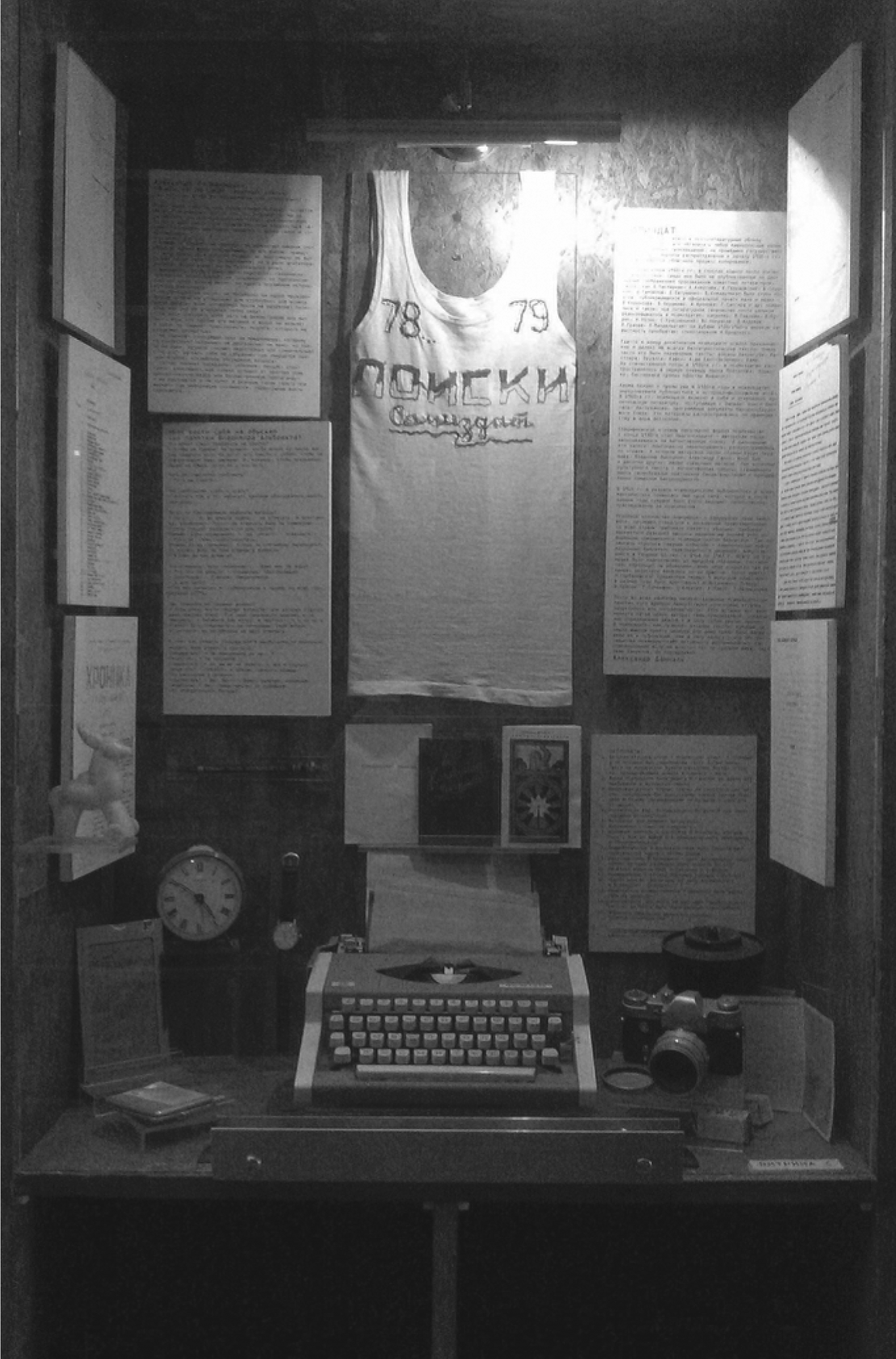
ABOVE: Copies of samizdat newspaper Chronicles of Current Events displayed in the museum of Sakharov Centre in Moscow
Credit: Valeriya Sauchankava
Forty-five years ago, in August 1968, the Soviet army occupied Czechoslovakia to suppress the anti-Communist uprising that had taken place in the country. On 25 August 1968, seven Soviet dissidents went out to Red Square in Moscow to protest against the occupation and express their support for rebellious Prague. They were arrested and later tried. Those who read the Soviet press had no opportunity to learn about their actions. Vague, propaganda-style reports about the sentence depicted members of the group as drunkards, spongers and profligates, who hated their Soviet motherland. Their picket was presented as an act of hooliganism and debauchery, and the reason for it went unmentioned.
ABOVE: Belarusians struggle to find out all the news they want to know
Credit: photo.bymedia.net

Yet, many Soviet citizens were able to learn about the story. They did not hear about it from state TV, or by reading about it in Pravda, of course. Their source of information was samizdat, small-circulation newspapers and bulletins, published in semi-clandestine conditions and passed from reader to reader.
Chronicles of Current Events stands out from a list of samizdat publications because it was first ever human rights bulletin published in the Soviet Union. It was launched in 1968, the same year the Soviet tanks rolled through the streets of Prague.
Leonard Ternovsky, a Soviet doctor, writer and human rights activist, wrote, in his book about the Chronicles: “I must admit at the very beginning I would not have singled out the Chronicles of Current Events from a set of samizdat publications that were passed from hand to hand at that time. But soon I realised those pieces of paper would lead to serious trouble. The Soviet authorities would severely punish anyone found reading them, and the people who distributed them among their friends, but they would leave those who actually wrote and produced them alone. It did not take long for me to become an ardent admirer of this publication. Every time I read it I passed it to my friends, and could not wait for the next issue.”
First, the bulletin was published quite regularly, about once every two months. It had a set of regular editorial sections, with a short overview of the latest events, arrests of dissidents, searches of their homes, news about political prisoners in Soviet jails and labour camps as well as facts about the persecution of religious and ethnic minorities in the USSR. It also contained a review of other samizdat publications, poems or stories by blacklisted authors, plus historical documents that proved the brutality of the Soviet regime. The style of articles was quite fact-based, tight, and sometimes even a bit cold, but this was because of the way the Chronicles were actually produced.
Liudmila Alexeeva, one of the founders and current chairman of the Moscow Helsinki Group, was one of the people who actually typed the bulletin and helped distribute it in a viral way.
“I usually received the first draft copy from the editor and produced the first copies, and then they were re-typed by other people, who had typewriters, seven or eight copies each. I have always cherished freedom of expression, starting from the time of the Soviet Union, when, first of all, I wanted to hear or read what others had to say about the issues that were important to me. Because of severe censorship, it wasn’t easy. That’s why I became a strong supporter of samizdat. I learned to type to help distribute the Chronicles of Current Events. This publication by the defenders of human rights in Moscow became an embodiment of free speech to me.”
Despite a real danger of persecution, the editorial team of the Chronicles asked their readers for feedback and information.
The fifth issue of the publication stated: “Everyone who is interested in Soviet society knows what is going on in their country and can provide the Chronicles with information. Tell it to the person you got the bulletin from, he will tell it to the one he got it from. Do not try to go down the whole chain yourself – or we will consider you an informer,”
In 1972 the bulletin was temporally suspended as the KGB started to put pressure on the dissidents. It was later restored, and published until November 1983, when Yury Shikhanovich, one of the editors of the Chronicles, was arrested. Liudmila Alexeeva had to leave the country. Several authors of the bulletin, like Shikhanovich or Sergey Kovaliov, served terms in prison, labour camps or internal exile. They were released when Perestroika brought the wind of change to central and eastern Europe.
The Soviet authorities would severely punish anyone found reading them, and the people who distributed them
Today, the internet is undoubtedly becoming a more and more important source of information for Belarusians, a way for them to get a variety of news. But with coverage still only around 50 per cent and even less in the provinces, it’s vital to find other ways of getting information to large groups of people. That’s why modern versions of the Chronicles of Current Events, which hark back to the traditional Soviet-era samizdat, are still very much in demand.