



Abstract

The day will not be easily forgotten in Chile. September 11 1973 saw the violent overthrow of democratically elected Chilean President Salvador Allende and the installation of one of the longest of Latin America’s 20th century military dictatorships.
In Chile during the 1960s, a consensus in favour of radical modernisation policies had emerged across much of the political spectrum. Policies including the redistribution of land to peasants or the nationalisation of wealth-generating resources such as copper represented an existential threat to the closely knit families who had historically controlled most of that wealth, along with the political power deriving from it. A key name in the pantheon of Chilean oligarchs is the Edwards family, owners since 1849 of their country’s largest circulation daily newspaper, El Mercurio, and a number of local and national subsidiaries.
One feature that makes the Chilean case stand out among the military regimes that held much of Latin America in their grip during the last third of the 20th century is the role of the media – and in particular El Mercurio and its subsidiaries – in consciously promoting a perceived state of war, both before and after the coup which brought General Augusto Pinochet to power. The planting of exaggerated or invented reports on foreign infiltration, unsubstantiated warnings about scarcity of basic goods (which became a self-fulfilling prophecy as a result of panic buying) or false revelations of sinister leftist plots was, by most historical accounts, a major factor in both justifying and provoking a military coup in a country previously famed for its strong democratic traditions. A logical consequence of the mission to bring down a president whose political opinions differed too much from their own was the paper’s subsequent role as mouthpiece for the Pinochet regime, along with the consistent covering up of crimes committed by the dictatorship until the transition to democracy in 1990.
A film, made by students of the School of Journalism at the University of Chile in 2008 (El Diario de Agustín by Ignacio Agüero, 2008, referring to Agustín Edwards, founder and owner of El Mercurio), tells the story of how a paper that claimed to campaign for freedom and to prevent what it saw as the seeds of totalitarianism ended up destroying democracy and actively collaborating in crimes against human rights. It features interviews with journalists, commentators, the paper’s directors and victims of human rights abuses.
Near the beginning of the film, prize-winning sociologist Manuel Antonio Garretón argues that El Mercurio transformed itself from a traditional conservative daily newspaper dedicated to forming public opinion into an element dedicated to political destabilisation. Already in 1967, years before the election of Allende, mass mobilisation by students and peasants was being supported by the Christian Democrat administration of Eduardo Frei, giving way to sweeping reforms that opened the gates to universal education and mass land ownership. According to Garretón, El Mercurio understood what was at stake, causing it to take up an extreme position that made it “not only into anti-Allende newspaper, but also an anti-democratic newspaper, basically a promoter of military takeover.” Stories began to run, falsely and deliberately implicating international communism in domestic student protest movements. Declassified documents released by the CIA in 1999 and analysed by Peter Kornbluh in The Pinochet File: A Declassified Dossier on Atrocity and Accountability, clearly demonstrate that the organisation had poured money into El Mercurio throughout the 1960s to prevent a left-wing victory, paying journalists to write opinion columns and articles for placement.
A paper that claimed to campaign for freedom and to prevent what it saw as the seeds of totalitarianism ended up destroying democracy and actively collaborating in crimes against human rights
In September 1970, the same month that Salvador Allende achieved the narrow electoral victory that would enable him to become the world’s first democratically elected Marxist president, Agustín Edwards met leading members of the CIA and the White House to discuss how best to get rid of Allende. According to Kornbluh, “throughout Allende’s aborted tenure, the paper continued an unyielding campaign, running countless virulent, inflammatory articles and editorials exhorting opposition against — and at times even calling for the overthrow of — the Popular Unity government.”
Although the campaign had failed to prevent Allende winning power, it succeeded in rallying a supposedly impartial military to take over power to “restore order”. However, the most blatant use of lies and propaganda occurred in the aftermath of military intervention. The coup, symbolised by the startling attack on the presidential palace, La Moneda, whose burning façade after the air strike is, for some, among the last century’s most iconic images, rapidly became synonymous with reports of mass arrests and disappearances. In order to justify this audacious act in the eyes of the world, as well as to ensure compliance amongst its own population, an entirely fabricated leftist plot, known as Plan Z, was announced by El Mercurio and one of its subsidiaries, Las Ultimas Noticias, less than a week after the coup. The alleged plan involved a military operation by Allende supporters to murder members of the armed forces and their families, import illegal arms and reduce Chile to chaos. A series of headlines followed, in order to emphasise the magnitude of the alleged operation: “600 families to be assassinated in Concepcion”; “Marxists planned the destruction of Limache” (a town near Valpaiso); “Another guerrilla training school discovered.” The existence of Plan Z has now been shown conclusively to be a fabrication. My own investigations of the coup in the southern provinces of Chile have shown that “guerrilla training schools” were little more than peasant co-operatives, which, at most, possessed a few rudimentary shotguns as a means of self-defence against hostile ex-landowners.
During the long dictatorship that followed, all opposition newspapers were banned, giving the Mercurio group an unrivalled market position, which it had not enjoyed before. But instead of using this privilege to soften the impact of military rule over an often terrified population, by reporting on crimes such as torture, murder or kidnap carried out by Pinochet sympathisers, El Mercurio chose to cover up those crimes by actively collaborating in a disinformation campaign. El Diario de Agustín depicts several examples of this.
Perhaps the most dramatic is the “Case of the 119”, a reference to an extraordinary cover-up operation to hide the practice of forced disappearance of political activists carried out by the regime’s semi-clandestine police unit, the National Intelligence Directorate (DINA). On 12 June 1975, La Segunda, a paper in the Mercurio group, published a front-page headline claiming that 2,000 Marxists were training in Argentina to organise guerrilla activities against Chile, including those who were believed to be “missing”. Various papers subsequently ran stories about arrests of dangerous terrorists and of guerrilla movements in Argentina as a prelude to the grand finale: that 60 of them had died in fratricidal in-fighting, and, separately, that 59 had been “exterminated like rats” by the Argentine secret services. Research by human rights groups and subsequently by the Chilean justice system, demonstrated that the information had originated in Santiago, and that bogus editions of non-existent magazines had been set up in Brazil and Argentina to report the stories. The Argentine secret services even collaborated by supplying dead bodies, which it was happy to identify as belonging to Chilean subversives. The lengths to which the secret services went to cover up its crimes by creating a false narrative of war, along with fake sources – with the active participation of the Mercurio newspaper group – demonstrates how concerned they were to keep secret the policy of forced disappearance.
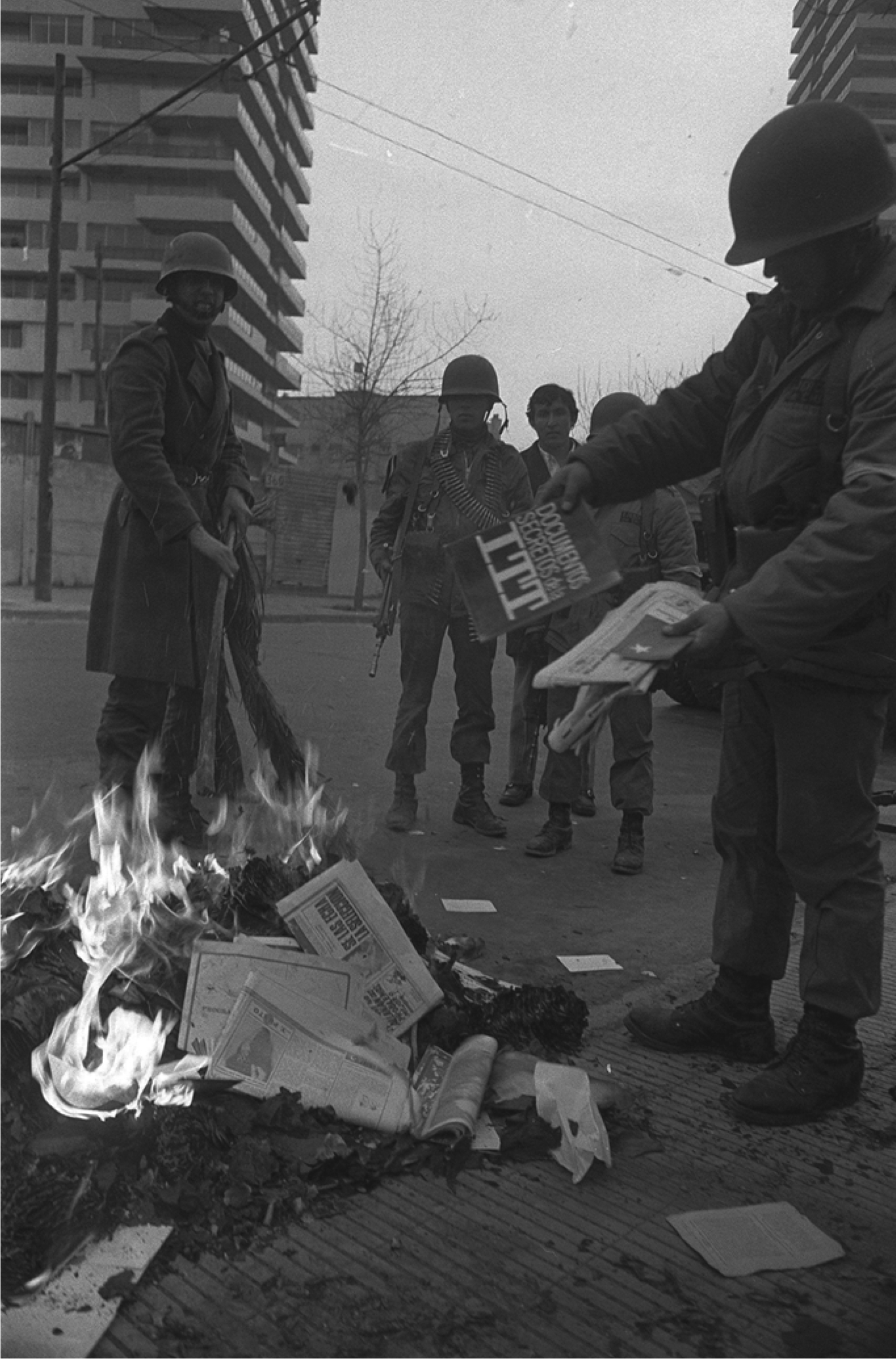
ABOVE: Soldiers in Valparaiso, 15 days after Augusto Pinochet’s coup, September 1973. Following the coup, the military junta burned material they deemed as being against the regime
Credit: Sipa Press/Rex Features
A dramatic story appearing a year later concerned the supposed case of a young woman who had been murdered on a beach in central Chile’s fifth region in a case of crime passionnel. According to El Mercurio, the body, discovered in September 1976, belonged to a 23-year-old woman who had been raped, beaten and dragged onto the beach at Los Molles, well known as a refuge for young lovers. The story hid a more sinister reality, however. The body in fact belonged to Marta Ugarte, a 42-year-old member of the Communist Party who, like hundreds of her fellow activists, had been taken from the infamous Villa Grimaldi torture centre and dumped at sea from army helicopters, in an operation known as the “death flights”. Human rights organisations estimate that some 400 prisoners of the DINA met this fate. Hers was the only body which ever returned to land. Testimonies by air force personnel responsible for the crime indicate that she became detached from the rail that was meant to ensure her body sank. Interviewed for El Diario de Agustín, Juan Guzman, the judge who presided over the case, affirmed that El Mercurio was a key instrument in the dictatorship’s crimes. The view was confirmed by the reporter assigned to cover the story, who claimed that press releases emanated directly from personnel within the secret services However when Arturo Fontaine, sub director of El Mercurio 1965-1978, was interviewed for the film and was asked if staff ever questioned their sources he said: “We were not handed information. We had our own sources. I am relatively proud of that. Do not think I am not.”
The author of this article approached El Mercuio for a comment, but the media group did not respond.
There is evidence that El Mercurio remained as complicit at the end of the dictatorship as it had been at the beginning. A visit to Chile by Pope John Paul II in 1987 nearly turned into a public relations disaster for the regime, when teargas hurled at demonstrators outside the stadium where he was speaking began to affect those inside, including the Pope himself. El Mercurio ran an article the following day, which claimed that trouble had been stirred up deliberately by members of the communist party. Photos of the two “instigators” appeared on the front page. The paper claimed to have identified them from a “thorough revision of photographs and videos shot during the disturbances.” As a result of these allegations, the two men were taken from their homes, arrested and tortured. Even government sources were unsure of the reliability of information emitted by the National Information Centre (CNI), a supposedly more respectable secret police unit that had replaced the infamous DINA in 1978. In spite of these official doubts, the paper went ahead with publication of the photos, resulting in the arrest and torture of two young men who had not even been present at the demonstration.
By contrast to the absolute freedom enjoyed by the regime’s press officers and their willing accomplices in El Mercurio, critical journalism was silenced through closure, censorship and murder. According to Puro Chile, a webpage that takes its name from a newspaper whose offices were destroyed by the military on the day of the coup, the dictatorship assassinated or “disappeared” a total of 23 journalists, nine journalism students, 20 photographers, and a number of others associated with the trade, totalling over 100. In 2006, a monument to these victims was erected in the headquarters of the Chilean Guild of Journalists in the capital, Santiago. Their voices had not only been proscribed, but silenced forever. Perhaps, in the case of Chile between 1967 and 1990, the truth was not so much a casualty of war as a victim of cold-blooded assassination by the country’s oligarchs.