




Abstract

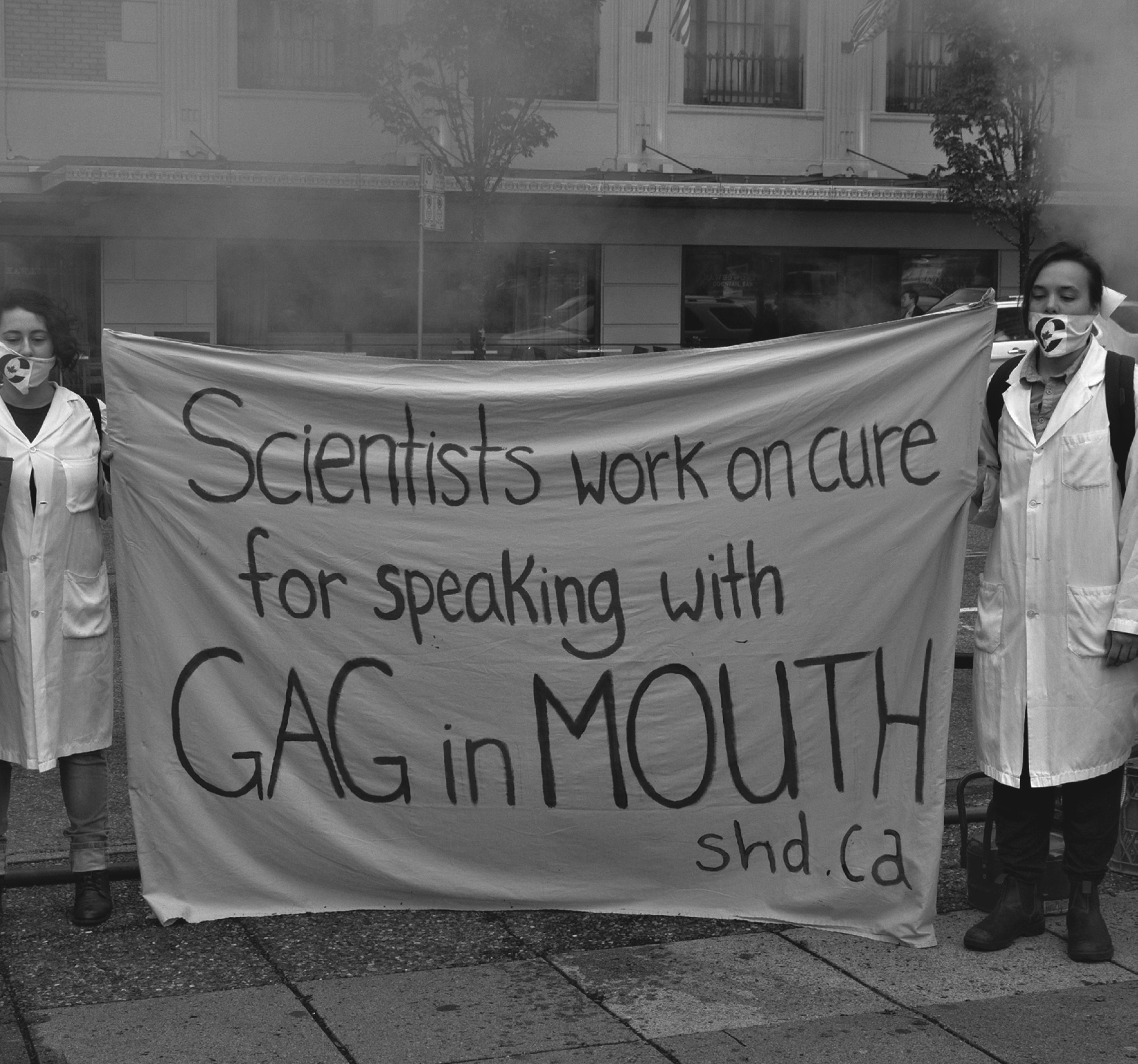
ABOVE: Protesters dressed as scientists take part in an Evidence for Democracy demonstration in Vancouver, during September 2013.
The group is protesting recent federal government cuts in scientific work and rules regarding releasing of information to the public.
Credit: Andy Clark/Reuters
Canadian scientists are being prevented by the state from discussing research findings in public, even about earthquakes in their backyard.
On Wednesday 24 June 2010, something very unusual happened in Ottawa, the Canadian capital. Office workers returning from their lunch breaks were surprised to feel the earth move beneath their feet and their office buildings tremble, causing pictures to fall from the walls and objects from desks.
People in the city immediately suspected an earthquake, though they are relatively rare in the region. As might be expected, reporters at newspapers in the city contacted Natural Resources Canada to find out what was going on. The journalists were surprised to discover that government seismologists told them they were unable to speak about it.
Meanwhile, the US Geological Survey was giving out plenty of information – a 5.5 magnitude quake had occurred at 1.41pm some 19km below ground on the Ontario-Quebec border.
One reporter hoping to find out more about the suspected earthquake was Tom Spears, a science reporter on the Ottawa Citizen newspaper. “The deputy minister’s office issued a statement saying there was no information and it was not until after 6pm that we heard more.”
A four-hour delay may not sound like much – but in a world increasingly driven by the internet and social media, it’s a lifetime.
Spears says the delay is indicative of what some are calling censorship of the work carried out by scientists funded by the Canadian government. “The fastest way to find out information is to find out if they are working with America or with a university, because academics are still free to talk,” says Spears.
He says that the earthquake incident is one of many cases where scientists funded by the Canadian government have been unable to share information on seemingly innocuous research.
A group of academics and students at the University of Ottawa organised a mock funeral to protest at what they saw as the death of scientific evidence in public policy making
“I can understand it if a scientist doing research that has enormous bearing on a sensitive area of public policy, if a bill is working its way through parliament for example, he is going to be sensitive about talking about it in public,” says Spears. “What has been going on is the gagging of scientists over tiny little things.”
In another case, Spears asked scientists working for Canada’s National Research Council about work they were doing on snowfall. Spears says he was told by the organisation’s communication chief that there would be no interview and that it would only provide a written statement.
So what are scientists allowed to say? The Canadian government has an official communications policy that was written in 2006 and updated in 2012. The policy states that government departments should “provide the public with timely, accurate, clear, objective and complete information about its policies, programs, services and initiatives” and “encourage public service managers and employees to communicate openly with the public about policies, programs, services and initiatives they are familiar with and for which they have responsibility”.
However, it also makes clear that government employees should “treat sensitive information with discretion” and that “communication specialists responsible for media relations” should “ensure that media requests, particularly for interviews or technical information on specialised subjects” are “directed to knowledgeable managers or staff designated to speak as official representatives of their institution”.
Communications professionals at Canada’s government scientific organisations say that the problems in communicating science are not about censorship but more about timely access to commentators.
Charles Drouin, chief media relations officer for Canada’s National Research Council, the country’s major scientific research and development organisation, says that the snowfall research Spears was seeking was not being censored.
“That was an unfortunate incident,” says Drouin. “The news went out on a smaller website and Tom Spears wanted to do a story within the next 24 hours and he approached us. We were ready to grant the interview and we wanted to make sure we gave access as quickly as possible. What didn’t come out is that the researcher wasn’t available on that day, he was in a conference and we asked if he could negotiate his deadline. But of course he wanted his story out the next day.
“Moving forward we will be clear when there is nobody available and we will try to negotiate. Our goal is to give access to scientists.”
Drouin says that the NRC is dealing with an increasing number of media requests. He says the organisation handled 50 media requests in 2010 but that this had increased to 363 in 2012 and that 95 per cent of those requests for an interview do go ahead.
“The other 5 per cent is because there are sometimes confidentiality issues or licensing requirements and in other cases it is the unavailability of the spokesperson,” he says.
He adds that it is sometimes the case that scientists themselves do not want to speak to reporters because they want to make sure the right message gets across.
According to Drouin the NRC uses government policy as a baseline, but works on a need-to-know basis. “Some of our researchers are well known to the media and they get approached directly but they usually let me know what is going on.”
If this were only a case of one science reporter having his attempts at getting interviews with one government department fail, then you might argue that it was merely a difference of opinion or a personal vendetta. Yet these incidents are part of a larger and more worrying campaign that is increasingly looking like censorship of federally funded scientists by the Canadian government.
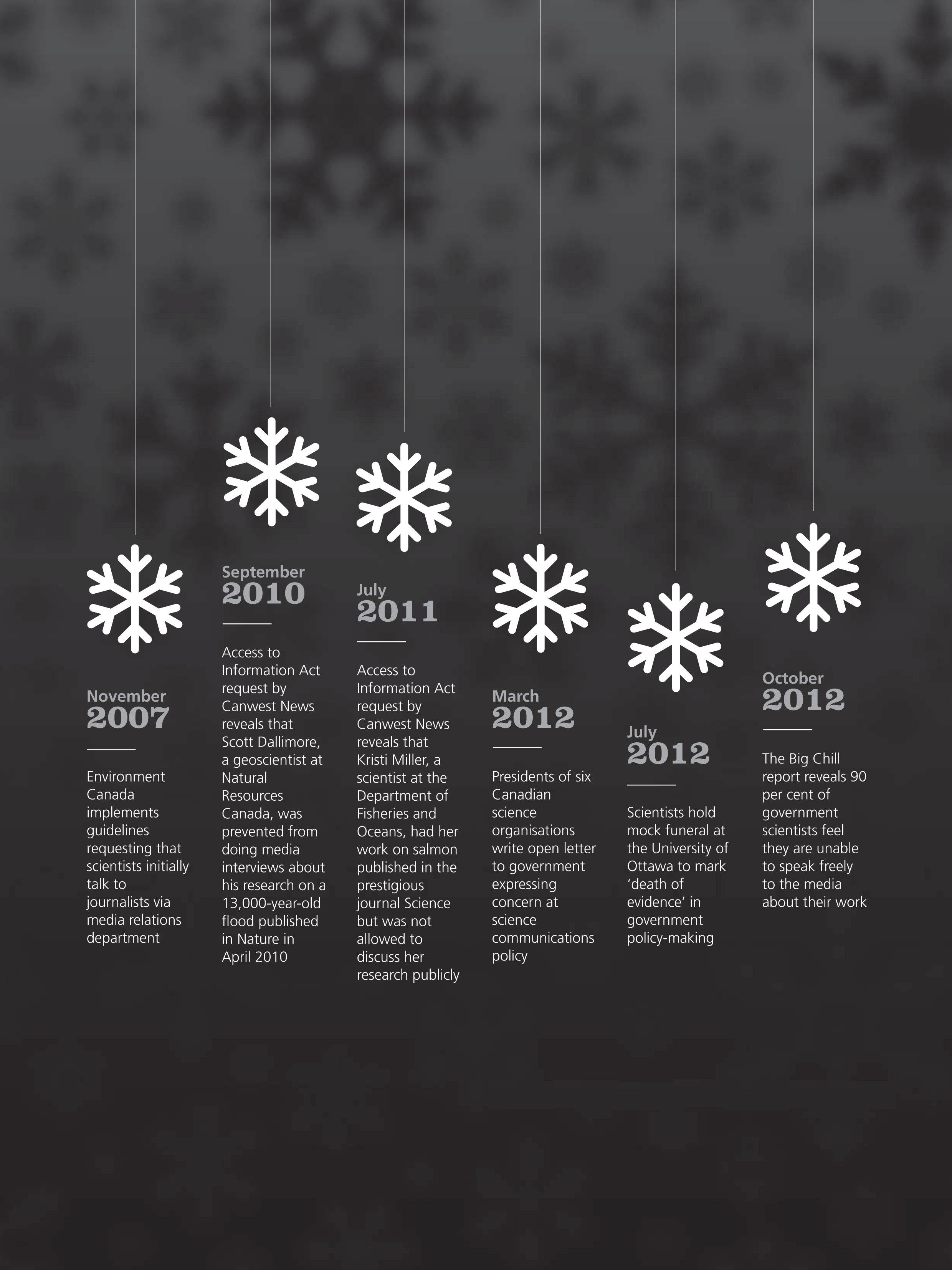
In early 2012, the presidents of six Canadian organisations representing government scientists and journalists sent an open letter on the issue to the Prime Minister Stephen Harper.
The letter said: “Despite promises that your majority government would follow principles of accountability and transparency, federal scientists in Canada are still not allowed to speak to reporters without the ‘consent’ of media relations officers. Delays in obtaining interviews are often unacceptable and journalists are routinely denied interviews. Increasingly, journalists have simply given up trying to access federal scientists, while scientists at work in federal departments are under undue pressure in an atmosphere dominated by political messaging…We urge your government to implement a policy of transparent and timely communication, one similar to that introduced in the US recently by the National Oceanic and Atmospheric Administration. This policy now encourages scientists to speak to the media without any intermediary. It even encourages scientists to express their own opinions, provided they indicate that they are speaking personally and not on behalf of the employer.”
A few months later, a group of academics and students at the University of Ottawa organised a mock funeral to protest at what they saw as the death of scientific evidence in public policy making. One of the organisers, PhD biology student Katie Gibbs, said the event went “far better than we ever contemplated” and attracted several thousand people.
Gibbs says: “There had been a lot of cuts to science and restrictions on government scientists speaking about their research. In May 2012, the government put out a bill which modified dozens of pieces of legislation and there were lots of cuts to science programmes – the Experimental Lakes Area, a place that is known for its freshwater research, had its funding cut, for example. We felt that enough was enough, and if we didn’t stand up for science, nobody was going to; we had to communicate to the public why this was such a problem.
“Prior to the event, there were stories of government scientists being muzzled and cuts to science funding and they were discussed as separate issues. The ‘funeral’ tied them together and put them in context for the general public.”
In early 2013, Gibbs, along with some of the other organisers of the rally, established the pressure group Evidence for Democracy “to ensure that the best available scientific knowledge and evidence is used to inform decisions that affect the health and prosperity of Canadians”. Gibbs says that the censorship of Canadian government science is part of a broad control of government communication. “The government has been very strong in controlling their message across the board. Some have described it as a broad muzzling that has caught science in its net. It is understandable in terms of politics but the desire to control has gone too far and to the point where it is harming our democracy.
Sources: www.scienceuncensored.ca, Evidence for Democracy
“It really comes down to the fact that if the government has a mandate they want to implement then it is far easier if they don’t have to worry about facts and evidence coming out.”
Canada’s censorship of scientists comes at a time when government-funded science is becoming more and more open. The internet has played an important role in this, allowing individuals to share information more easily and more widely than ever before.
Despite this, things do not appear to have improved in Canada.
In February 2013, the pressure group Democracy Watch asked Canada’s information commissioner, Suzanne Legault, to investigate, under the provisions of the country’s Access to Information Act, “the systematic efforts by the government of Canada to obstruct the right of the media – and through them, the Canadian public – to timely access to government scientists”.
In a letter to the commissioner, the Environmental Law Clinic of the University of Victoria, said: “There are few issues more fundamental to democracy than the ability of the public to access scientific information produced by government scientists – information that their tax dollars have paid for. We as a society cannot make informed choices about critical issues if we are not fully informed about the facts.”
At the time of writing, the commissioner had not yet ruled on the issue.
What is clear is that government scientists feel under threat when it comes to talking about their work.
In October 2013, the Professional Institute of the Public Service of Canada (PIPSC), the largest union in Canada representing scientists and professionals employed at the federal and some provincial and territorial levels of government, published a report, The Big Chill.
More than 4,000 scientists responded to a survey forming the core of the report and the findings underline concerns over censorship. It revealed that 90 per cent of respondents felt they were unable to speak freely to the media about their work.
More worryingly, for the Canadian public at least, only 14 per cent felt that if they knew of a departmental decision or action that, based on their scientific knowledge, could bring harm to the public interest, including to health, safety, or the environment, they felt able to share those concerns with the public or media without fear of censure or retaliation from their department or agency.
Two-thirds felt there had been a worsening of openness in recent times, with just under 75 per cent of those polled saying that sharing of government science findings with the Canadian public had become too restricted in the past five years.
Announcing the publication of the report, PIPSC president Gary Corbett said that Canadian federal scientists were facing “a climate of fear”.
He said that there is “a chill brought on by government policies that serve no one’s interests, least of all those of the Canadian public”. He added: “The safety of our food, air, water, of hundreds of consumer and industrial products, and our environment depends on the ability of federal scientists to provide complete, unbiased, timely and accurate information to Canadians. Current policies must change to ensure these objectives are met.”
The report concludes: “Canada’s scientists deal primarily in facts. They are not known for ill-considered opinions or rash judgments. Sound policy, public awareness and the integrity of evidence-based decision-making require that science be heard. So when a clear majority of federal scientists state that they are not permitted to speak freely, that the sharing of scientific findings has become too restricted, that public policy has been compromised by political interference, and that greater protection for whistleblowers is needed, Canadians and government alike should listen.”
And unlike the transitory tremors felt on that June afternoon in Ottawa in 2010, this one looks set to rumble on and on.
Footnotes
