



Abstract

Thousands of scientists across the US feel cutbacks are seriously restricting their research and contributions.
Scientists in the United States have experienced their fair share of censorship. Last year’s partial shutdown of government has left the federal scientific community facing an even more uncertain future.
The crisis began in March 2013, when the US government’s budget was sequestered, leading to immediate automatic cuts in public spending. Then in October, amid further political wrangles about the budget, the government closed down for two and a half weeks. Both events had serious implications for the rights to free speech of scientists working for or with the federal government.
With ongoing budget concerns and no prospects for revived public science funding on the horizon, the possibility of long-term detrimental consequences for federal science in the US looms large.
Actions taken during the George W Bush administration made it considerably more difficult for scientists to share publicly their research, and while there has been some improvement on that front, a whole new set of systemic challenges now undermines these scientists’ right to free speech. Nearly every federal science agency and programme saw their budget slashed by five per cent. Many programmes were no longer sustainable. There was a drastic decrease in the number and size of federal grants awarded to scientists both inside and outside government. Some laboratories were forced to close, and some researchers lost their jobs.
Scientists who survived the cuts were forced to work with newly imposed restrictions. Federal scientists were essentially barred from attending conferences; the unanticipated budget cuts led many federal agencies to make policy changes, resctricting how many scientists could attend a given conference. Or they implemented no-travel policies altogether. In fact even scientists scheduled to deliver keynote speeches at prestigious events, including ones that had been planned for months or even years, were forced to cancel their appearances at short notice.
The right to attend conferences is part of scientific free speech. Conferences are where ideas are fostered and collaborations born. Scientific free speech includes the right of scientists to express their professional and personal opinions on a topic, and this also includes the right to publish and contribute meaningfully to the scientific community. In other words, scientific free speech is the right to be a scientist.
Most scientists tolerated this restriction. After all, it was thought to be a temporary impediment. As it turned out, the effects of the sequestration were only the tip of the iceberg.
On 1 October 2013, the US government went into a partial shutdown because of Congress’ failure to approve a budget for the fiscal year 2014. During the 16-day shutdown - the third longest in US history - the government sent hundreds of thousands of federal workers and contractors on temporary leave and many programmes and services were suspended. Again, the scientific community’s right to free speech was undermined, this time with even more of an impact than had been felt under the sequester.
Eleven days into the shutdown, the Union of Concerned Scientists sent email enquiries to 20,000 Science Network members about the impact of the federal government shutdown on their ability to do their work. The network comprises scientists and other technical experts from across the US. They span a wide range of scientific fields, ages, employers and geographic locations. Some are employed by the federal government, and many more receive federal funding, use government facilities, or rely on federally produced data or other resources to carry out their work.
The shutdown was largely a huge, unplanned experiment in what happens when we give up on science for two weeks
Within hours, the union received a wide range of stories, testifying to the breadth of impacts being felt across the scientific community, from graduate students to principle investigators, from public health officials to field biologists. The following are some of the comments and sentiments expressed in the survey responses:
Firstly, at a fundamental level, the shutdown closed off basic communication within the scientific community. Many government scientists were not allowed to access email, much less their laboratories. One scientist noted that his “direct supervisor … confiscated all laptop computers on the day of the shutdown”.
Without access to work email accounts, federal scientists were also prevented from carrying out professional activities that went beyond their government job duties. Several scientists pointed out that their inability to access emails significantly slowed down the peer-review process and, therefore, journal publication.
These restrictions on communication were not limited to federal employees. During the shutdown, many scientists did not have access to government databases or government lands. One scientist explained: “Almost all of the NASA data sites that I use for my research have been shut down. This seriously impacts my analyses.” Another scientist working for a small non-profit company relies completely on government supercomputers because the organisation does not have the computer power to run their own computer models.
The shutdown had a detrimental impact on students and early career scientists in particular. One PhD student explained that the majority of her dissertation research is performed on a US Fish and Wildlife Service refuge and though she did not need the help of federal employees to conduct her work, she was locked out of the land during the shutdown. One early-career researcher had a “once-in-a-lifetime opportunity to travel to Antarctica” to do field work on long-term climate variations. After the trip was cancelled, she lamented the “millions of dollars that will have been squandered” and noted the “ripple effect” for future researchers.
This kind of disruption, even if brief, can have serious consequences for graduate students and early career scientists, who often rely on narrow time windows to conduct their research. Environmentally sensitive field studies, time-limited funding, and other factors mean graduate students and young scientists are often working on tight deadlines. Missed opportunities for research can have serious setbacks, as they may delay how quickly scientists can publish, obtain tenure in academic positions and build a solid footing on which to build their career in competitive scientific fields.
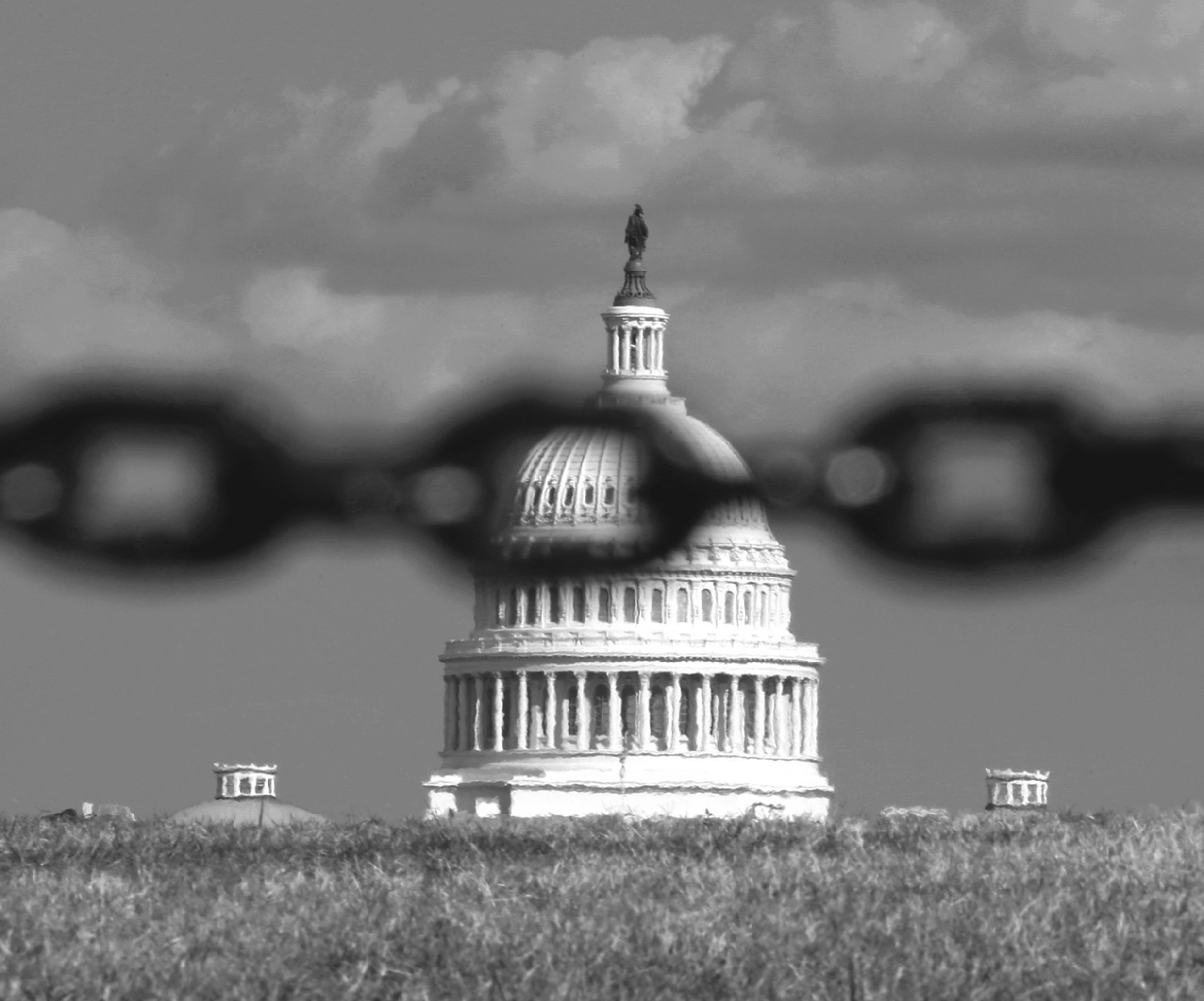
ABOVE: The US Capitol behind a chain link fence, 30 September 2013, on the eve of the two-week government closure
Credit: Kevin Lamarque/Reuters
One scientist shared the impact the shutdown had on a research group at the Environmental Protection Agency charged with addressing water quality issues on indigenous reservations. Again, travel restrictions were a chief concern. “An emergency site visit to a tribal water system in New Mexico with bacterial contamination in their well was cancelled,” the scientist said. The meeting would have included the state Environmental Protection Agency, tribal officials and the parent water system that was involved in the sale of contaminated water.
According to the chair of an internal science panel related to water resources and climate, participation by US federal scientists in meetings that had been planned for over a year was withdrawn for two October meetings. The meetings went ahead as planned, but “without involvement of US scientific leaders”. One scientist commented that this outcome has been “downright embarrassing for scientists in the US”. In another example, the National Climate Assessment, a consensus document produced every few years by the nation’s leading climate experts, was brought to a standstill as all coordination between government scientists and outside experts was halted.
Long-term impacts
Following the restrictions on scientists and the undermining of federal science under the George W Bush administration, the Union of Concerned Scientists, demoralised federal scientists and their supporters came together to advocate for changes in policy to ensure federal scientists enjoyed full free speech rights and were less vulnerable to political interference. Many improvements were implemented, including scientific integrity policies from 22 federal agencies. These included the right to express personal views, the right to publish, and enhanced whistleblower protections. The progress made, however, may in future be limited if inadequate resources prevent federal scientists from doing their work.
A second round of cuts in 2014 is a very real possibility
There are huge ramifications for scientists’ freedom to conduct their work. Many of the shutdown’s impacts on scientists may be permanent. This is especially true for scientists in time-limited programmes and funding sources, for example, research conducted by the National Institute of Health. Scientists from all disciplines need an open environment with reliable, dependable funding so that they can help deliver crucial public services.
“In the long term, the US lead in scientific research and technology will suffer,” said one senior scientist who uses government data for his work, basing his predictions on the morale of colleagues. This fear was echoed by early career scientists, some of whom considered seeking alternative work unconnected with government agencies. In some cases, these scientists considered looking for work outside of the country altogether.
A research entomologist with the US Department of Agriculture commented, “It seems time to consider other ways of paying my salary if the government puts so little value on science.” Another worried about the challenges of securing future funding from government sources, explaining that “moving to a country like the UK or other parts of Europe, which have much more stable funding structure[s] and overall support for scientists, may be a better career choice.” An astrophysicist who works closely with researchers at the National Aeronautics and Space Administration (NASA) keenly observed, “I am seeing a long term effect on my colleagues’ attitudes about their scientific research. Even senior researchers feel that their work is not valued. Funding has been cut severely even before the shutdown. Younger scientists have become disillusioned.”
As Andrew Rosenberg, director of the Center for Science and Democracy at the Union of Concerned Scientists, has put it, the shutdown was largely “a huge, unplanned experiment in what happens when we give up on science for two weeks.”
If the shutdown had been an isolated incident in an otherwise thriving scientific enterprise, its effects on scientists might have been minimal. Some research projects would have been disrupted, creating data gaps in long-term monitoring projects, but scientists would have recovered and research would have continued. The reality, however, is different. Adding the government shutdown to an already deflated group of scientists was a hard blow. Scientific research, already under strain from sequester cuts, now faces bigger challenges and scientists face more restrictions.
The greatest fear is of potential deeper cuts in the near future. The US Congress continues to debate solutions to the federal deficit and a second round of cuts caused by sequestration in 2014 is a very real possibility. The impacts of the 2013 sequester and the subsequent government shutdown were significant, but in some ways federal agencies were able to be resourceful – scraping up funds from less essential reserves and re-allocating current funding to minimise impacts. This year any reserves federal agencies have will be exhausted and they will have less flexibility in their spending. For some federal science programmes, a second round of cuts could be the straw that breaks the camel’s back.
Government agencies employ, and government grants fund, some of the top scientific minds in the US. But the progress of science depends on consistent, reliable institutions to support and stay with projects over long periods of time. To succeed in their work, scientists need the opportunity to exercise their right to scientific free speech. A scientific enterprise that is subject to the volatility of Congressional votes and political sentiment cannot provide this. It’s essential for the government to provide the tools and the culture necessary for its scientists and science to thrive.