




Abstract
In Turkey,the Islamic media continues to face significant pressure.Journalist
One day in 1997, a young journalist just starting out in her career, Nihal Bengisu Karaca, went to a concert given by the Red Army choir in Istanbul’s Cemil Topuzlu concert hall.
Towards the end of the performance, the choir performed the Tenth Year March, a nationalist song written and composed in 1933 to celebrate the tenth anniversary of the foundation of Turkish republic.
At the time the march was frequently used to send a clear political message to certain sectors of Turkish society, namely the Kurds and the religious, that the country’s actual hosts were nationalist and secular Turks. Others were merely guests in the country.
After the choir finished singing the audience rose to their feet and began applauding, at which point a woman approached Karaca and her friend, who both wore headscarves.
She told them that they had no right to applaud and that they didn’t “deserve” the march. “In a normal society you expect the bourgeois class to be democratic and supportive of freedoms and plurality,” Karaca says. “That night I realised this was not the case. Turkey’s bourgeois class considers itself to be the country’s aristocrats whose job it is to protect the oligarchic system at all costs.” She describes people’s reactions to headscarved women at the time as “hysterical”. The same year, when Karaca politely asked a man to stop talking during a film, he refused, dismissing her as a regressive individual, who had no right to enjoy the film, or even be in the cinema.
Karaca spent a lot of the 1990s in film theatres and concert halls for good reason. Her love of the arts was more than just a personal interest. It was professional, because she was a journalist writing about the arts. Karaca, now a columnist at the mainstream HaberTürk newspaper, started her career in the country’s Islamic media. In the 1980s the Islamic media was under intense pressure from the state, the Turkish General Staff and a group of mainstream media organisations who saw them as a threat to the stability of the republic.
In Turkey, the media is divided into three main groups, the liberal-secular media with no religious affiliation or prejudices (Taraf, Radikal), the nationalist media with an anti-Islamist agenda (Hürriyet, Aydınlık, Vatan, Sözcü), and the Islamic media. The Islamic media includes two sub-branches: liberal-centre (Zaman, Star, Sabah) and conservative-rightwing Islamist (Yeni Şafak, Yeni Akit). Star and Yeni Şafak both sell more than 100,000 copies each. Yeni Akit sells more than 50,000 copies and Yeni Şafak more than 100,000.
Karaca’s first job was at the weekly news magazine Aksiyon where she was the only woman employee. She worked there as a reporter, editor and film critic. At the same time she was carrying on her studies at the university but her academic interests were almost stifled when the authorities forced her to remove her headscarf to be allowed to enter the exam hall. “I was crying while trying to answer the questions,” she says. “If someone made me remove my veil on the street, it would no doubt be considered a crime or an act of abuse. But when the state did the same it became perfectly legal.”
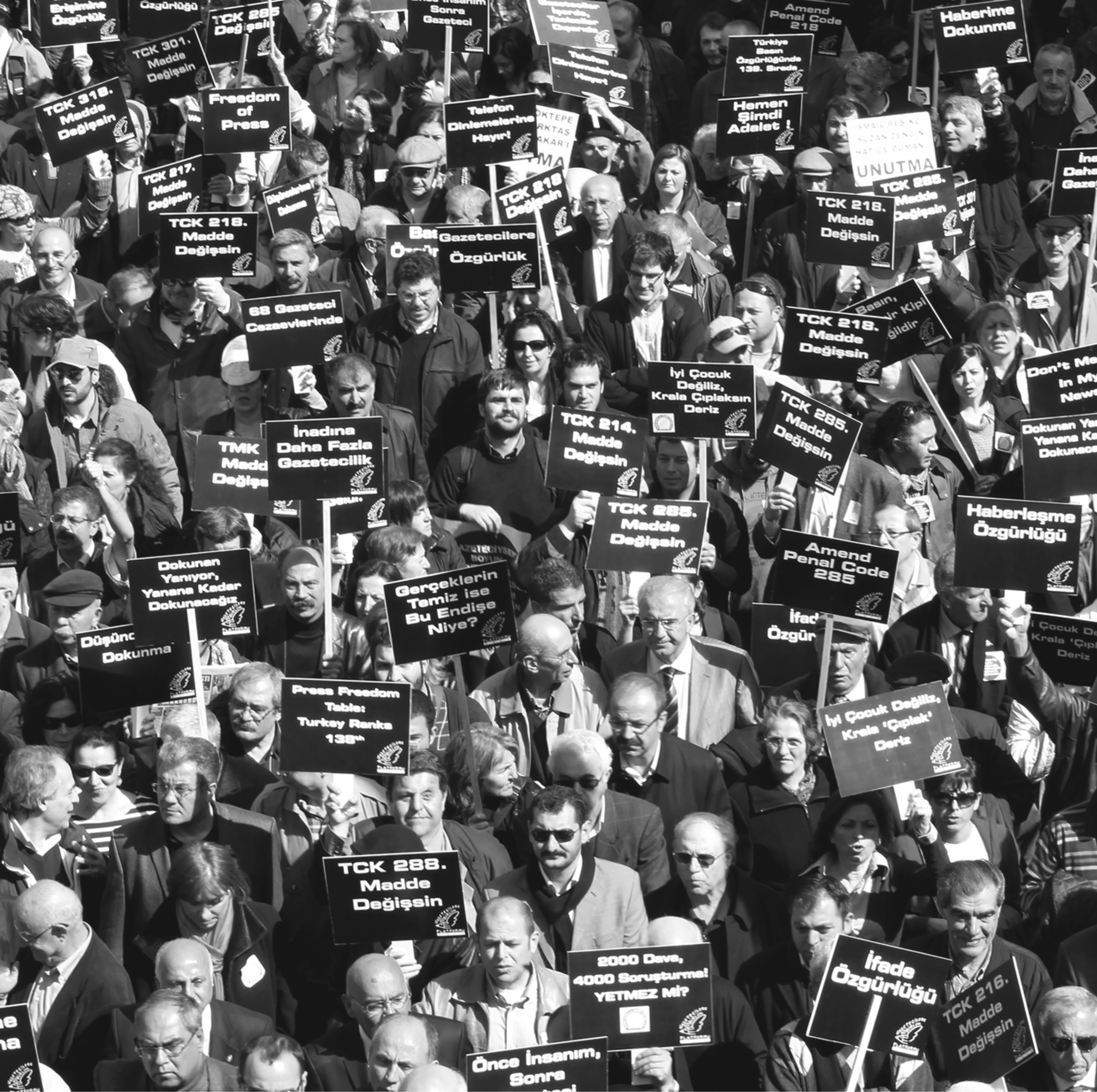
Above: Journalists and activists participate in a rally calling for press freedom in Ankara
Credit: Umit Bektas/Reuters
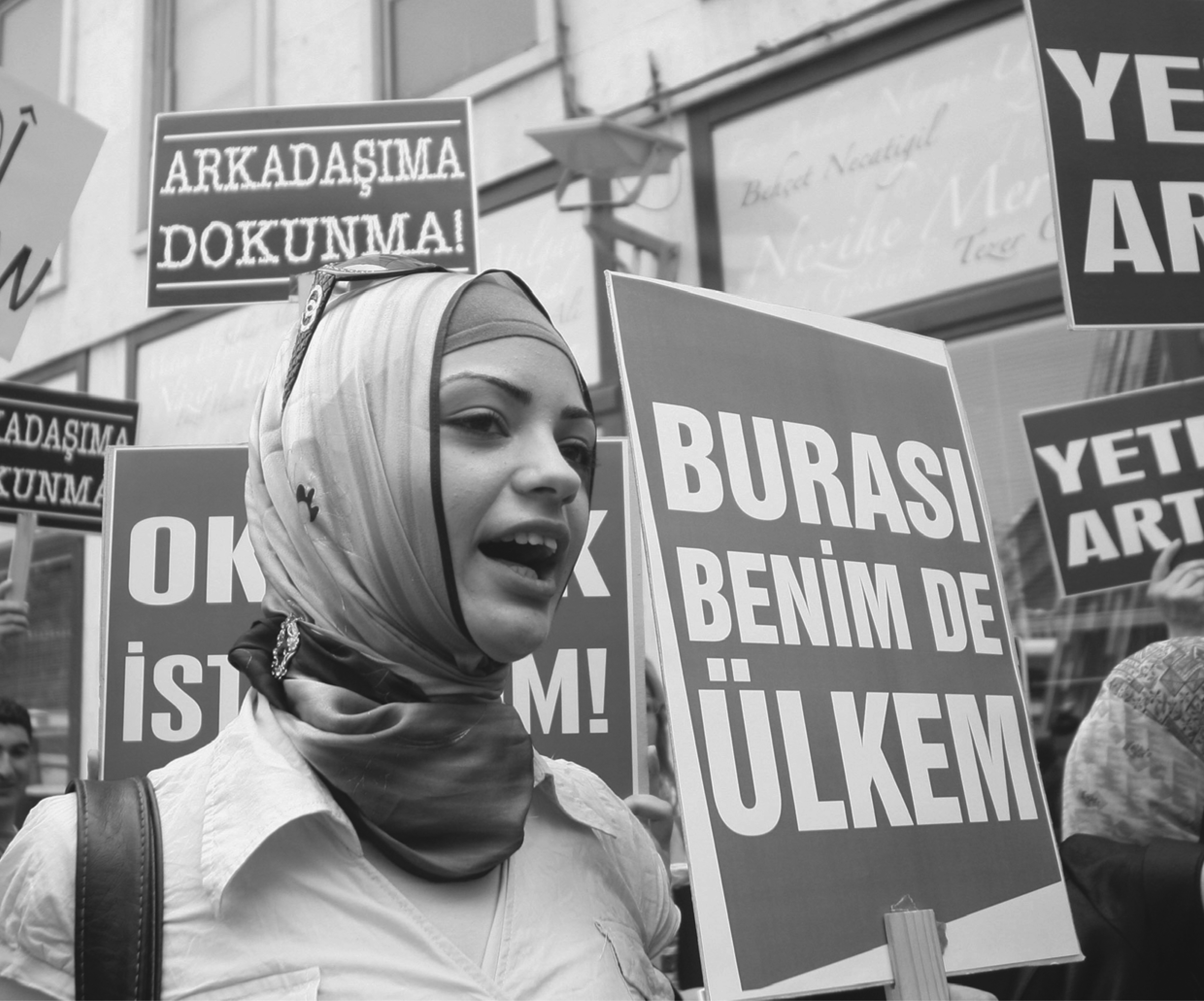
Above: A demonstrator holds a banner during a protest against the constitutional court’s verdict about headscarves at universities in Istanbul in 2008.
Credit: Stringer/Reuters
Things changed dramatically for Karaca and her colleagues in 1997 when the top brass of the Turkish military forced the country’s elected prime minister and the leader of the Welfare Party, Necmettin Erbakan, to approve a number of legislative acts it had drafted in the headquarters of the Turkish General Staff in Ankara. That day, 28 February 1997, the day the generals forced the prime minister to sign the declaration, turned into a big embarrassment for Erbakan, who saw himself as the representative of the country’s Islamist and conservative citizens. The memorandum included legislation that banned headscarves in universities and introduced extensive control over newspapers which didn’t bow to the official discourse of the military.
“At the time 90 per cent of the media had the same political view with which they indoctrinated their readers,” Karaca says. “And the media was extremely powerful: a media proprietor could harm or remove a government with a strong headline and pick members of the new government behind closed doors. They were always on good terms with the military high command and used this friendship to their advantage. If a government didn’t comply with their views they threatened them with the ‘coup card’.”
The military memorandum of 1997, widely known in Turkey as the ‘post-modern coup’, is a case in point. Leading secular voices in the media had supported the coup, a handful of liberal columnists objected to it and most Islamists condemned it. The military rewarded the secularist media by giving their journalists lengthy interviews about the military’s political agenda which effectively replaced the discourse of elected politicians. They also gave extensive access to army facilities to journalists supportive of the military’s intervention in the government of the country.
More than three hundred generals successfully sued one Anadolu’da Vakit columnist for libel
Alarmed by the developments and in fear for their safety, some Islamic publications backed down and changed the tone of their coverage. “After the postmodern coup our magazine decided to run a cover story about how Turkish Islamists did not want an Islamic state,” Karaca remembers. “Some conservative and religious groups were forced to prove that they were not Islamists like members of the Welfare Party.” Anadolu’da Vakit, the country’s hardline Islamist paper did the opposite and ran angry denunciations of the military elite and their activities.
More than three hundred generals successfully sued one Anadolu’da Vakit columnist for libel and the proprietor of the paper was ordered to pay the unprecedented sum of two trillion Turkish liras in damages. The newspapers ceased its operations only to return a few years later under the new title, Yeni Akit.
“In the media we were greatly outnumbered by supporters of the coup,” Karaca says. “That only a handful of people stood by us heartened the generals who announced that the 1997 coup would continue for a ‘thousand years’.”
Not only did the coup fail to last for a “thousand years” but it also became the subject of a massive trial in Turkey a mere sixteen years after the generals published their memorandum. The chief of staff and a group of generals accused of being behind the postmodern coup became defendants of the “February 28 trials’” There are currently 103 defendants being prosecuted, 36 of them are in custody. When the trial began in September this year, there were calls from Islamist columnists to ‘extend’ the range of the investigation and to go after media proprietors and opinion leaders supportive of the coup.
But however objectionable their views, prosecuting media bosses and journalists is extremely problematic for Turkey’s AKP government. Over the course of the last year the government had been accused of stifling press freedoms and prosecuting dissident voices by the world’s leading freedom of expression groups, including the Index on Censorship and the New York based Committee to Protect Journalists (CPJ).
According to Ferhat Ünlü, who also worked for an Islamist newspaper in 1997, the February 28 trial may have dangerous consequences. “It is not right to hang a Sword of Damocles over certain social, economic and political groups,” he says. “Arresting journalists would only intensify Turkey’s already intensified society.” Ünlü agrees that the mainstream media did a regrettable job during the coup era but says the editors should pay “a professional price” for what they did rather than a legal one. He believes that the country’s conservative media is repeating some of the mistakes the mainstream media made in the 1990s.
“Many people were subjected to character assassinations during the recent trials,” he says, referring to the Sledgehammer and Ergenekon court cases where a number of military personnel and journalists were convicted of plotting a failed coup to overthrow the government. Ünlü, who now works as a columnist and editor for Sabah newspaper, says some journalists in today’s new mainstream media will have a hard time in the future coping with the moral weight of recent events.
Ünlü started journalism in 1995 on the Islamist Yeni Şafak where he worked until 2004. He was then hired by Newsweek’s Turkish edition. He specialises in state intelligence and security issues. An avid reader of John le Carré and Dostoyevsky, he is an author with four novels to his name. Ünlü remembers how he faced difficulties when he started as a reporter. “The doors of mainstream media were closed to journalism students like me who came to Istanbul from Anatolian cities,” he says. “And this had to do with class.” The people who pulled the strings in the country’s mainstream media were the so-called White Turks who lived in Istanbul’s elite neighbourhoods. People coming outside their social circles were not welcomed to the world of the media.
“I had a secular lifestyle and yet I worked for the Islamic media,” Ünlü says. “At the time the secular elite acted as if they owned the state apparatus. They excluded Islamists and the pious from their publications.” In the aftermath of the post-modern coup Ünlü was prosecuted by the infamous State Security Courts where he was accused of publishing documents that featured sensitive information which compromised national security. “At the time the mainstream media was hard at work on producing articles that associated conservatives with terrorism,” he says. “Hürriyet, Sabah, Milliyet, Yeni Yüzyıl and Radikal newspapers led the effort. Mainstream media argued that illegal things were going on among Turkey’s Islamists.”
At the time Yeni Şafak’s columnists included Islamist intellectuals like Nabi Avcı who is now the country’s minister of education, as well as liberal figures like Ali Bayramoğlu, Mehmet Barlas and Cengiz Çandar who found themselves under pressure when they reacted to the military intervention. An aide of an influential general was accused of calling the editor of Sabah newspaper and conveying a threatening message to the paper’s liberal columnist Mehmet Altan, who is a professor at Istanbul University: “I’ll make him sit on a bayonet and then I will take him on a tour from one of our borders all the way to the other.” The same aide was accused of forcing editors in the mainstream media into firing their dissenting voices. And the country’s tense atmosphere reached a new level in 2001 when the Istanbul police raided the offices of Yeni Şafak.
He believes that the country’s conservative media is repeating some of the mistakes the mainstream media made in the 1990s
According to Ünlü the real victims of the post-modern coup were headscarved women. “I witnessed how they were pressured from all directions,” he says. This is a point shared by Esra Arsan, associate professor of media studies at Bilgi University, who witnessed how headscarved students were expelled from universities. “As members of a liberal university we always defended the rights of our headscarved students,” she says. “Bilgi University published Medyakronik, a website that ran critical articles about the mainstream media. As journalism scholars at Bilgi we were critical of the pressures Islamist media had faced at the time. Then one day Hürriyet newspaper published a front page story with a picture that depicted a lecturer from our university alongside headscarved students who were listening to him in a classroom.” At the time Bilgi university allowed headscarved students but shortly after Hürriyet published this picture, which was dutifully enlarged to make the students more visible, the university administration abruptly closed the Medyakronik website before being forced to tighten control over its headscarved students.
Arsan, who is a Reuters Foundation Journalism Fellow at Oxford University, is very critical of the current state of Turkey’s media. She says the Islamic media and its secularist opponents share a distaste for the rights of socialists and Kurds and warns that the content of some hardline Islamist papers amounts to hate speech. She also criticises the current government for not giving representatives of the socialist press accreditation for official press briefings. She says the practice reminds her of 1990s when Islamists shared the same fate. She says it is sad to see Islamists being silent about this.
When I asked her about whether Islamic journalists are doing a good job in defending freedom of expression today, Arsan says only a small number of pious journalists share the principle of ‘do unto others as you would have them do unto you’. She warns against an atmosphere of revenge and draws parallels with the injustices caused by militarist journalists during 1990s. Although she disagrees with their views, Arsan is skeptical of a legal campaign against old media barons, a view shared by many of her colleagues in the Turkish press.
I ask her about whether the media is more colourful today. “Yes,” she says, “in terms of printing techniques it is more colourful”. But she finds the content of papers extremely polarizing with most of their columnists focusing on the same narrow issues. She insists on focusing on the problems of the present and says the public should demand more from the mainstream media. “Readers should lead the effort in demanding a more liberal press. They should be the ones demanding the release of imprisoned journalists. Otherwise things will stay the same in Turkey’s media,” she says.
The Islamic papers are covering the current pressure on the media barons with obvious pleasure. Hardly a day goes by without them publishing an op-ed or a feature that invites the state prosecutors to go after old media barons. And the problem lies exactly there: their triumphant tone echoes that of the old mainstream papers. It seems that Islamist publications are now calling the shots in Turkey’s media. The February 28 investigation will show whether the Islamic media will treat its ideological opponents in the same unfair and aggressive way it had accused them of behaving towards itself.
Footnotes
