




Abstract

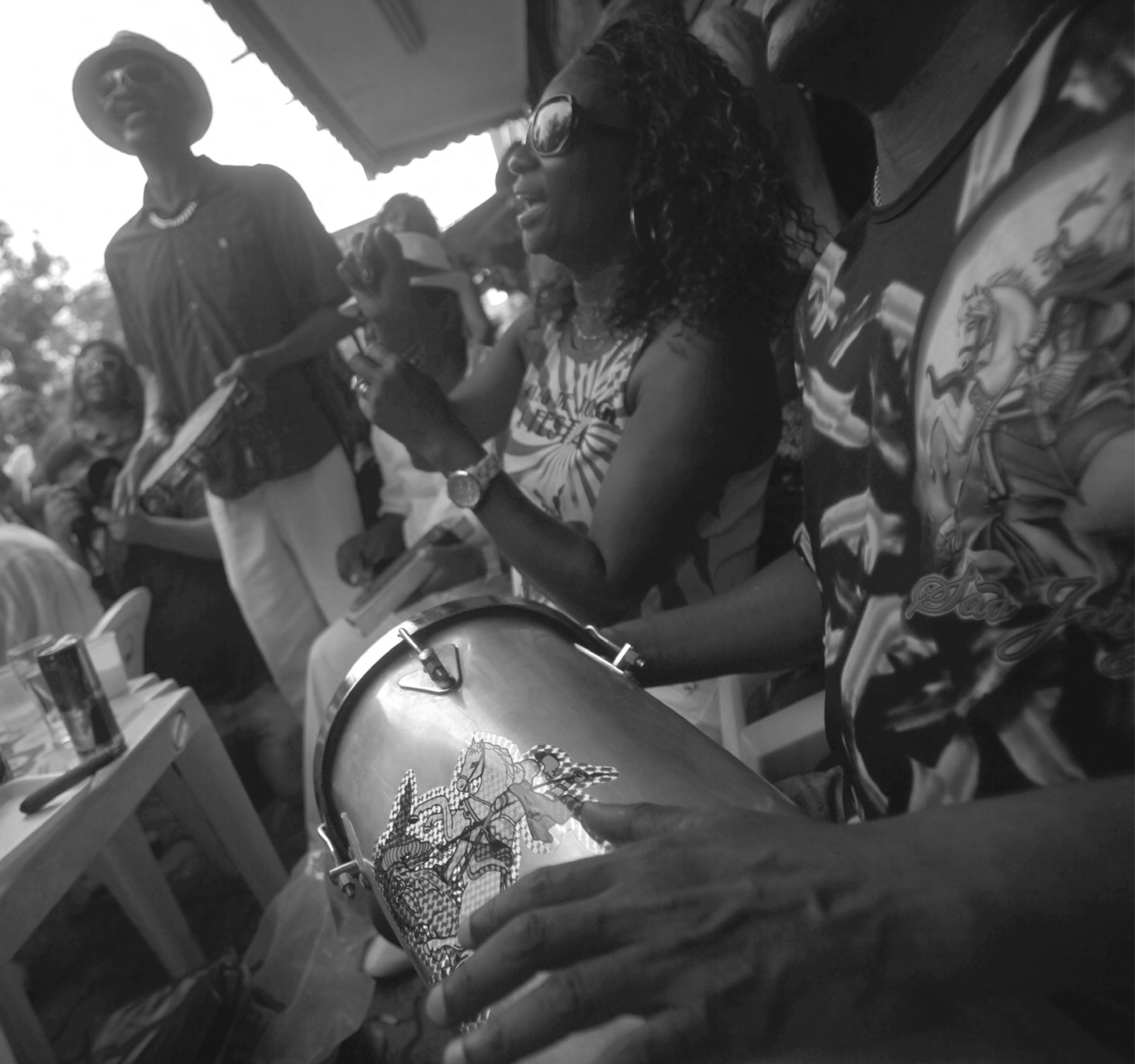
Above: Devotees of Sao Jorge, known as Ogum in the Afro-Brazilian Umbanda religion, sing during the celebrations of Sao Jorge’s day, Rio de Janeiro
Credit: Ricardo Moraes/Reuters
Historically Brazil has been seen as a land of festivals and great tolerance, where races live together harmoniously. The country has a image around the world as a place comfortable embracing different ways of life and different faiths. Recently, however, it has been become clear that this image does not reflect the present reality. Perhaps it never did.
Attacks on the temples of religions such as Candomblé, Umbanda, and others of similarly African origin by radical members of neo-Pentecostal churches has turned the subject of religious tolerance into a topic of regular debate.
There has never been a dominant church in Brazil; Candomblé and Umbanda are among the various religions of African origin that remain popular. They are practised by people in terreiros, or sacred spaces, named as such because they used to be outdoors, though most terreiros now are in buildings. Even though few people are prepared to admit that they belong to Candomblé or Umbanda congregations, it is perfectly normal for members of other faiths, especially Catholics, to visit the terreiros. People attend to invoke intercessions they may not be able to access through the mainstream churches, for example if they need help in their love lives, or have illnesses they need cured. They also go to terreiros for divinations and predictions for the future.
Brazil is nevertheless the largest Catholic nation in the world, and the Catholic church also boasts the largest black population outside of Africa. So religions of African heritage have had to adapt to the demands and conditions of a Brazilian reality.
Attacks on religions of African origin reached intolerable levels
In the case of Candomblé, its history is bound up with that of Africans trafficked as slaves to the Americas and the religion has been practised since the beginning of Portuguese colonisation. Its rituals are founded upon respecting the faith and dancing and singing. Offerings and animal sacrifices are made to the ancestors, and to the Orixas, the gods represented by the forces of nature.
Officially, the Portuguese never tolerated non-Catholic practices in its colonies. For example, in 1832 a decree was issued obliging slaves to convert to Catholicism. Any individual accused of fetishistic customs was punished and could even face the death penalty. So Africans adopted the saints of the Catholic church and began to worship them under African names. St George became Ogum; St Lazarus became Omulu and Santa Barbara, Yansa.
Umbanda is of more recent origin, and dates from the start of the 20th century. As well as Portuguese influence, there are also indigenous ones.
Historian and professor Washington Dener dos Santos Cunha from the State University of Rio de Janeiro is a specialist in African history. He says that during the 1930s and 40s the Umbanda community, which had come to include both caboclos (descendents of Indians and whites) and pretos-velhos (the descendants of former slaves), tried to develop a discourse with the government about Brazilian identity. “This happened principally over the period of the Estado Novo or New State, which existed between 1937 and 1945 and was the name given to the dictatorship government headed by President Getulio Vargas,” he says. “It was at a time when Getulio Vargas was seeking to consolidate his policy of a Brazilian racial democracy and create a land in which there were no racial conflicts and where everyone lived in harmony.”
To Marcio Alexandre M Gualberto, the author of The Map of Religious Intolerance 2011: the Violation of the Right to Free Worship in Brazil, such persecutions of the principal religions of African origin on the part of neo-Pentecostalists has arisen because of competition for new congregations. “As is commonly said of Brazil, everyone frequents the terreiro and everyone there beats a drum. Notwithstanding this, there is a more specific public being fought over. It is noteworthy that neo-Pentecostal churches are establishing themselves in places where there are few Catholic or Protestant ones, but where, invariably, there is a terreiro dedicated to Axe, god of energy and the life force. That is where they install themselves and pick a fight to win over the established congregation.”
Expulsions and segregation
The growth of so-called neo-Pentecostal sects has mainly occurred in the most impoverished corners of the country. The most radical members of the new faithful in the neo-Pentecostal sects have made violent common cause with organised criminals, who already have a high degree of control over the poorest areas, given the absence of a state presence. And that has led to members of Afro-Brazilian faith communities being expelled from the favelas of Rio.
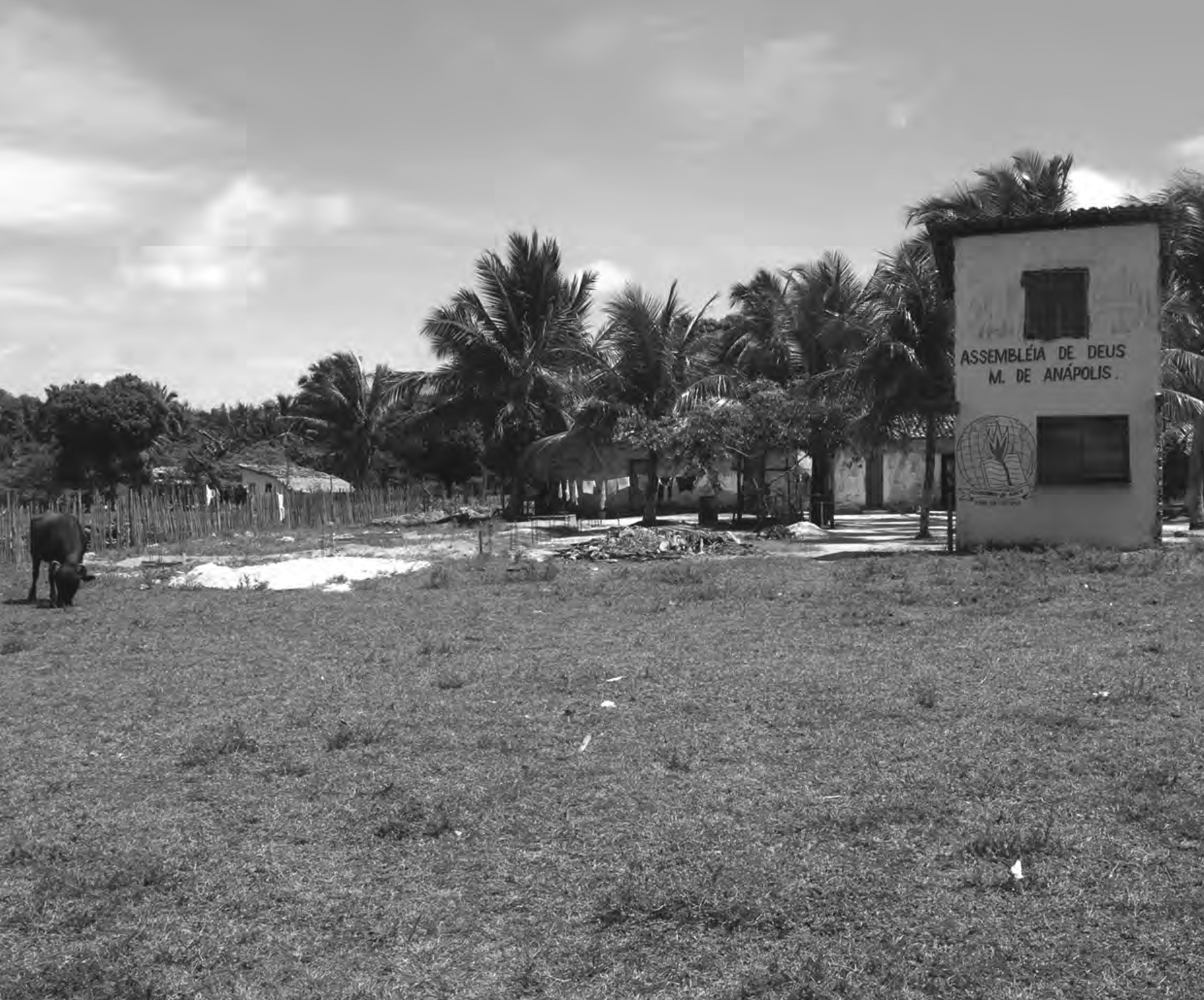
Above: A tiny evangelical Pentecostal church on Ilha do Marajo fluvial island in the Amazon, Para state, northern Brazil
Credit: Balthasar Thomass/Alamy
The Rio newspaper Extra, one of the most popular in Brazil, in its 7 September 2013 issue, coincidentally the date on which Brazilian independence from Portugal is celebrated, carried a report on the subject. According to the article, there are now more than 40 documented cases of members of the Candomblé and Umbanda faiths who, in addition to having been prevented from practising their religions, have been thrown out of their own homes.
“There was no way to survive such a threat. In those places it is simply impossible to be part of Candomblé. There are no more terreiros and where the religion is still practised, it has to be followed in secrecy,” a filha de santo, as Umbanda devotees are called, explained. She did not wish to disclose her name for fear of reprisals.
She was obliged to leave the Morro do Amor, one of the slums in the so-called Complexo do Lins, in Rio’s Zona Norte, to live in the Zona Oueste, which is much further out of the city. Coincidentally or not, the Lins favela was allocated one of the Police Pacification Units (PPUs) about a month after publication of the report.
The PPUs are the present government’s main device for dealing with public safety. The objective is to install small units of police in lawless areas governed by criminals who use guns to impose their own law.
Even today the state itself participates in racial segregation. The present constitution, dating back to 1988, which guarantees liberty of religious expression, determines that the places where rites and their liturgies are celebrated should be protected by law. Some may be surprised then by the official manner in which the constitution is implemented.
In Maranhao, one of the poorest states in Brazil, the State Public Ministry established an accord with the leader of the local Umbanda community, the pai de santo, Mauricio dos Santos Mota. The accord restricted the celebration of the cult only to Fridays, between 6pm and 9pm, and without the use of traditional musical instruments. The Spirit of Umbanda Centre of Our Lady of the Candelaria which, as its name suggests, has a Roman Catholic patron saint, also formally agreed to leave the place it had long occupied to move to another, far more remote and worse place.
If the contract was not complied with, Father Mauricio, as he is widely known, would be subject to legal consequences and a police investigation would be set in train. This happened despite a federal law dating back to 1997 that has severe penalties for religious discrimination. A rapid internet search gives us numerous other examples of attacks on the terreiros, in all parts of the country. There are no official statistics with which to document the number of violations of the right to freedom of belief, but the Secretariat of the Policies for the Promotion of Racial Equality from the Presidency of the Republic (Seppir) reports a sharp rise in the number of complaints brought to its attention.
Luiza Bairros, the Minister for Seppir, appears to confirm this. At an event organised to celebrate the National Day to Combat Religious Intolerance on 21 January 2013, she argued that the attacks on religions of African origin had reached intolerable levels. “The worst part is not just that of the considerable number of cases, but the gravity of the cases. They include physical aggression, and threats of destruction of homes and whole communities. It does not only constitute a religious dispute, but also the struggle for civilised values.”
Again, this trajectory of religions of African origin in the context of Brazilian history is not reflected in the statistics. In the 2010 census, the practitioners of Umbanda and Candomblé combined did not add up to even 0.5 per cent of the population. Professor Dener dos Santos Cunha explains that there are multiple reasons for this. Among them is the extremely conciliatory nature of such faiths: it is quite normal for the faithful to frequent other churches as well. When they responded to the census, they would usually describe themselves as either Catholic or Spiritualist in order to avoid preconceptions, or through mere inertia.
The rise of neo-Pentecostal religions
Neo-Pentecostal religions started to undergo a sudden growth in the 1990s, but the tendency dates back still further. For the purposes of comparison, over the past 50 years the Brazilian population grew by 63.2 per cent, while the number of evangelicals expanded by 93.3 per cent.
In 2010, 22.2 per cent of the national population of almost 200 million inhabitants described themselves as evangelicals. In 2000, it had been 15.4 per cent; in 1991, 9 per cent; and in 1980, 6.6 per cent.
The proportion of Catholics has also diminished. They constituted 99.7 per cent of the population in 1872, and being Catholic then was synonymous with being Brazilian. Now, according to the most recent figures available, they number no more than 64.4 per cent of the population.
This increase in the number of neo-Pentecostals is not the fruit of greater religious devotion, but of the appearance of new social values in Brazil, the theologian Orivaldo Pimentel Lopes Junior, professor at the Federal University of Rio Grande do Norte and author of the book Novas Perspectivas sobre o Protestantismo Brasileiro (New Perspectives on Brazilian Protestantism) says. He writes, “Economic rationalisation, the legal ordinances of the secular and democratic state, universal education, changes in the agrarian structure, among other elements typical of the modern state, only occur in tandem with the cultural changes conducive to the end of a religious monopoly on the part of Roman Catholicism.” He makes clear that economic rationalisation may also carry a high price because it promotes an excess of individualism. “Its political effects are still for the most part felt by the electorate and corporations,” he writes.
Hand-in-hand with their growth in strength outside Brazil’s Congress goes the participation of the block formed by representatives of these neo-Pentecostal churches inside Brazil’s legislative power.
There was an increase of 50 per cent in the number of evangelical Congressmen and women in the period between the last two elections. These politicians indicate through their voting patterns a conservative, if not a reactionary, tendency. The Evangelical Parliamentary Front (FPE), for example, is a non-aligned group established in 2003 to defend the vested interests of followers of these religions. They have 79 parliamentary deputies and senators out of a total 513 federal deputies and 81 senators overall.
The sociologist Ricardo Mariano, professor at the Pontifical Catholic University (PUC) of Rio Grande do Sul and author of Neopentecostais: sociologia do novo penecostalismo no Brazil (Neo-Pentecontalists: the Sociology of new Pentecostalism in Brazil) says, “In defence of morality and of good order, the FPE joins forces with deputies linked to groups of conservative Catholics in order to fight, for example, against the Project of the Law number 122/2006, which criminalises homophobia, considering it an attack on religious liberty and freedom of expression. The Front also radically opposes the decriminalisation of the private use of certain drugs, the legalisation of euthanasia and of brothels and the termination of pregnancy before the twelfth week, following the medical opinion of a doctor or psychologist.”
The growth of neo-Pentecostal sects has mainly occurred in the most impoverished corners of the country
It is difficult to make any sweeping generalisation on institutions that differ so completely from one another, but this individualistic character could be marked as among the most radical characteristic of these churches. “He who is not with you is against you,” concludes the historian and professor at Rio’s Fluminense Federal University, Marcos Alvito, demonstrating how the neo-Pentecostal vision of the world is marked by the concept of a spiritual war, in which the principal opponents in the religious field are deemed demonic. He says, “They are obsessed with combating Afro-Brazilian cults of Umbanda and Candomblé, described in such derogatory terms as macumbaria, fetishism and black magic. This fierce attack is all the harsher within the sub-group of certain churches of a neo-Pentecostal tendency, among which the most famous is the Universal Church of the Kingdom of God.” Alvito adds that the Universal Church (also known by the acronym IURD) has itself also adopted certain magical practices drawn from Afro-Brazilian religions, adapting them to give an inverted and “positive” significance.
IURD provides an interesting instance of the power of the neo-Pentecostal churches. They own churches spread through 96 countries of the world. In Brazil they own the Record Television Network, which has the second largest broadcast audience in the country, in addition to owning newspapers, radio stations, websites and other media outlets. There are even strong signs of a close connection to the Republican Party of Brazil, a political group to which ex-Vice President Jose Alencar, who died in 2011, belonged.
“The polarised vision of the Pentecostal church is not exactly compassionate towards Afro-Brazilian religions, such an important element in our overall Brazilian cultural heritage. In the face of this world vision, the creation of peaceful forms of co-existence between different religions, in accordance with Brazilian law, will daily become a bigger and more important challenge for each of us,” Alvito concludes.
Translated by Amanda Hopkinson