




Abstract

Using a soap opera and storytelling workshops, Theatre for a Change breaks down barriers between communities in Malawi and Ghana.
In Malawi, women aged between 15 and 24 are five times more likely to contract HIV than men in the same age group. Frequently, police are involved in the intimidation and harassment of vulnerable women. Sex workers are attacked. In Ghana, despite considerable economic growth and a marked decline in the number of people contracting HIV, many people do not feel do not feel their lives have improved, with extreme poverty affecting 30 per cent of the population, high unemployment among young people and uneven levels of education across the country.
So how can these groups make their voices heard and transform their lives?
For Patrick Young, director of Theatre for a Change (TFAC), an NGO that works with some of the most disadvantaged groups in these countries, it’s about telling stories – and choosing which audience will hear them. Using legislative or participatory theatre, inspired by Brazilian Augusto Boal’s Theatre of the Oppressed, the project uses performance techniques to bring about changes in society. Tapping into the important role that oral traditions play in many African countries, it aims to equip socially and economically marginalised communities with communication skills and knowledge to transform their lives. Legislative theatre encourages participants to recount negative experiences by re-enacting them, addressing their grievances directly to people who have been at least partly responsible for these encounters, such as police or politicians, and it invites those responsible to take part too. It’s a powerful tool, says Young, because one of its key principles is the belief that people are “experts in their own lives”, that no one else is qualified to tell their story. Among participants are groups that have a big impact on sections of society but who are also vulnerable in some way – for example, the police in Malawi, who have the second highest risk of contracting HIV, or teachers, the third highest risk group. How these groups interact with the stories or “performances” by other more marginalised groups can be crucial in changing how these people interact with one another, and can have a knock-on effect in wider society. In one example, local police began to change their institutional behaviour towards women in sex work, treating them with respect and not making assumptions. Minimising the risk of contracting HIV is one of the founding objectives of TFAC. It’s a complex issue in Malawi because some of the most powerful sections of society – including the police and teachers – are also the most vulnerable.
below: Interactive theatre performance with schoolchildren, Malawi
Credit: Theatre for a Change, tfacafrica.com
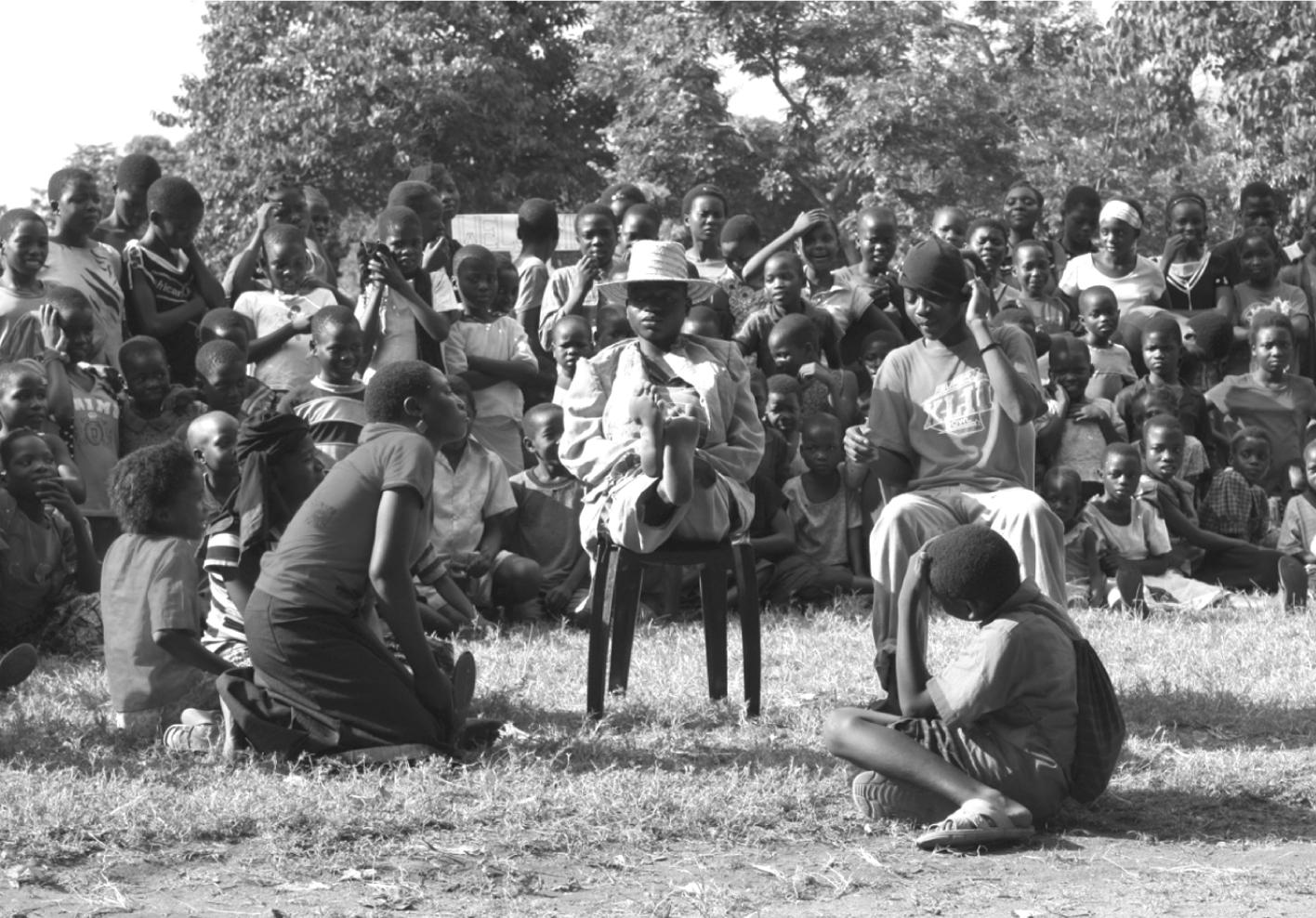
Using a technique known as “touch tagging”, in which participants physically tag one another in order to highlight a particular conflict and express how it might be resolved, TFAC helps people examine hostilities – for example, between sex workers and the police force in the case of Malawi. By inviting participants to play active roles, an important aspect of legislative theatre, policemen can briefly “become” sex workers and vice versa.
People address their grievances directly to police or politicians
In Malawi, TFAC also runs a hugely successful interactive radio soap opera – with an audience of around 500,000 people – which takes as its theme some of the most pressing issues facing these communities today. The programme encourages listeners to call in and participate directly with the conflict being performed.
In one project, sex workers acted out their experiences to the police and local decision-makers and later went on to present their story to the much wider civil society sector, including the UN. A group in Malawi took their story to the Malawian Parliament in 2010. Initially, politicians were hesitant to acknowledge what they were being told – details about violence and harassment suffered by sex workers – but the participatory, theatrical component to the project makes it not only a neutral way of diffusing resistance but also a hugely entertaining, even fun, one, Young says. The performance didn’t result in a legislative change, but it did challenge MPs to confront their prejudices about women and sex work. So, Young says, “we see very simple human dynamics being taken into a legislative and policy-making forum.” Malawi’s media responded, too, by asking whether sex work could be legalised or decriminalised, and opening up a debate that had not been part of public discourse before.
While the performed stories are never written down, they are always created by those who have lived the experience, and initiated by facilitators working in the local languages in Malawi and Ghana, Chichewa and Ga, as well as in English. TFAC employs a three-part strategy (or theory of change) in which an individual changes how they see themselves and how he or she views their ability to assert particular rights. Young says that what’s key is building communication skills, leading to an ability to negotiate and be assertive. When a group advocates for their rights “using their words, using their voices,” Young says, change at a societal level is realised. Facilitators witness groups becoming more cohesive and working together. Increasingly, these changes have a wider reach; TFAC currently runs workshops across the whole of Malawi with the police and the army. They’ve also seen change in the education system and attitudes around it. It’s about people being able to directly advocate their rights – to refuse unwanted sex, to report on exploitation, to practise freedom of expression in an incredibly powerful way. Young warns of the dangers of taking these very unique stories out of the hands of the people telling the story. “We’re interested in equipping people with skills to advocate for themselves,” says Young. “For a lot of people who are marginalised, the written word is not necessarily the most comfortable one.”
ABOVE: Participants at a workshop in Ghana
Credit: Theatre for a Change, tfacafrica.com
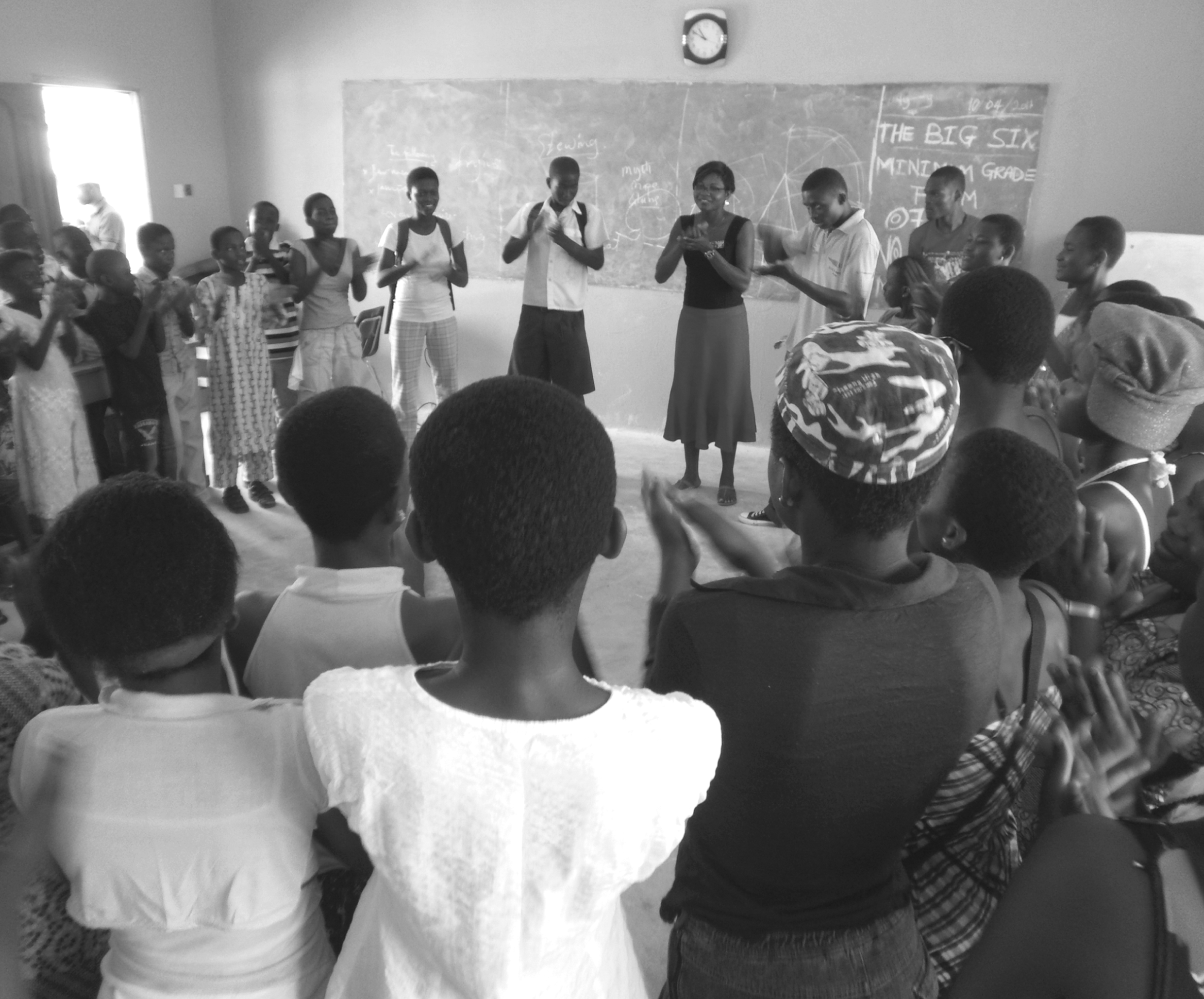
In both Ghana and Malawi, there are perceived and very real limitations to the right to freedom of expression, Young says. But the participatory approach to performance provides a culturally acceptable platform for people without power to talk to those in power without feeling threatened. Because the oral tradition is socially acceptable and familiar, it doesn’t pose a threat to the status quo. “The right to freedom of expression is being claimed, but not in an explicit way,” he says. Many lines of power or societal norms can be subverted by powerful cultural traditions, which involve changing roles or rebalancing levels of power within a liminal space for a period of time. “All cultures have those moments of transformation, like Mardi Gras, where the weak are strong and the strong are made weak,” Young says. In Malawi, Gule Wamkulu, a tradition where young men dress up or disguise themselves using paint, feathers and masks, serves as a space of transformation; men feel they have licence to cause trouble and step out of their normal lives. When it’s over, they take off their masks and go back to work and resume their normal lives. “Our methodology taps into that recognisable arena and that recognisable space where change is allowed and expression is permitted,” he adds. But he also points out that TFAC does not want those who have been disempowered to dominate the discussion, to be in a position of power, drowning out other voices. “What we’re looking for is balance,” he says. “We try not to come to a situation of injustice with an agenda.” Collaboration is key.
Ghana is widely seen as one of the most progressive countries in the African subcontinent, in terms of economic growth, promoting democratic values and supporting human rights. So how does this relative success feed in to TFAC’s work in the country – and what are the limitations? “Ghana has a longer history of independence than Malawi, so it has a much stronger sense of freedom and freedom of expression,” says Young. “Ghanaians are very confident about their right to express themselves. But there’s a long way to go because that’s truer for some people than others. If you’re poor and female, then the opportunity to express yourself is significantly reduced in both Ghana and Malawi. … There’s still a lot to do in terms of gender and power – and freedom of expression.”