




Abstract

In Ingushetia, bungled counter-terrorism operations end in the tragic deaths of innocent civilians. Chechen journalist and editor
For Russians, the North Caucasus is a territory where the rule of law does not apply. This stereotype view is partly true, but not everyone knows why.
People in Chechnya, Ingushetia and Dagestan say they defy laws not because they do not want to abide by them, but because officials who are supposed to uphold the law violate it in outrageous ways. Lawlessness in the Russian military and special services is not new: it dates back to the first Chechen War (1994–96). Authorities responsible for investigating these crimes have repeatedly turned a blind eye to them; in the North Caucasus, it’s an everyday reality.
So-called “anti-terrorism special operations” have resulted in the murder and kidnapping of innocent people. Military and law enforcement officers often describe their victims as “gunmen” or accomplices to “terrorists” – they know people who are tortured or killed will not be able to prove them wrong.
Yunus-bek Yevkurov, the president of Ingushetia, uses the same approach. He frequently smears victims of kidnapping – some of whom are still missing and have probably been killed – without any evidence. It’s surprising, then, that Yevkurov, a former paratrooper commander and intelligence general, has a reputation as an open politician, a statesman who can meet human rights defenders and have a friendly chat with them over a cup of tea. Some people praise him for suggesting he is not completely in charge. He regularly points out that law enforcement officials and the army are accountable to Moscow, but not to him.
To this day, Adam’s relatives do not know anything about his fate
Yet Yevkurov himself admits this is not entirely true. “When I say law enforcements are not accountable to me, it does not mean they act on the territory of our republic without endorsement from the authorities. We control all the special operations,” he told Gazeta.ru on 24 April 2013.
When asked about an incident in a village earlier that month, he said: “I knew about the special operation in Dolakovo; I knew who the special enforcement officers would be searching for there. More than that, the beginning and the end of the operation were reported to me directly, because I am in charge here,” he added.
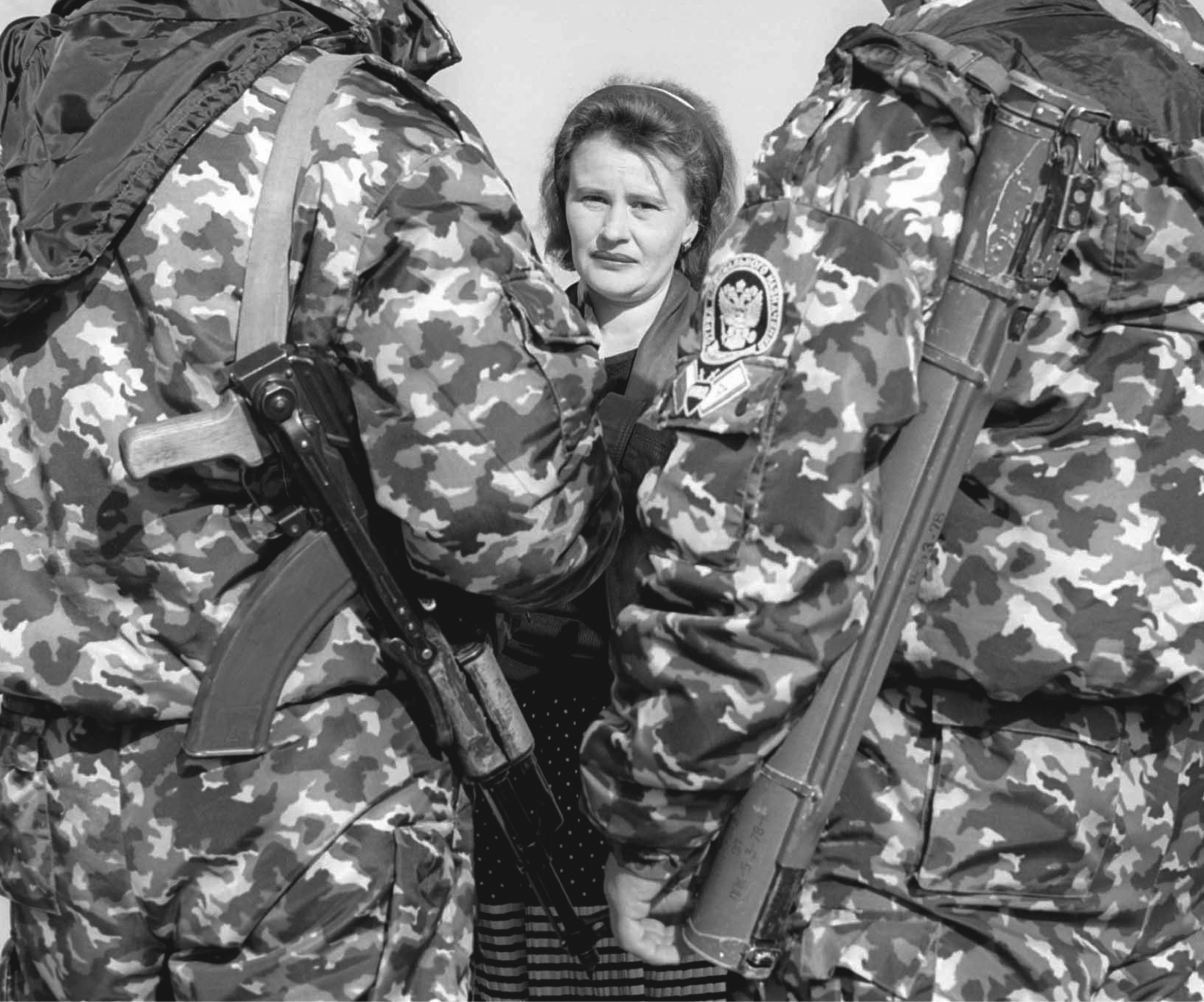
ABOVE: Military checkpoint on the border between Ingushetia and Chechnya, 2000
Credit: photo.bymedia.net
So what happened in Dolakovo?
“Damn, this is the wrong house!”
At the break of dawn on 8 April 2013, a military operation took place in Kombileevsaya Street in the village of Dolakovo, complete with armed vehicles. It was as if a siege was under way and the army had been instructed to intervene. A local inhabitant, Khavazh Ozdoev, 31, always left his house at number 35 very early; he worked in a boiler room at a local school and had to ensure classrooms were warm before children arrived. That morning he left his house as usual, but as he turned to close the gate behind him, a burst of submachine gunfire took him down. Khavazh was killed on the spot.
Adam Ozdoev, Khavazh’s younger brother, ran out of the house when he heard the noise. He says that when he saw a group of armed military personnel and his brother lying dead, he ran off. As he did, he saw his cousin Artur Pliev arriving. Artur lived nearby and had been preparing for his morning prayer when he heard the gun go off. He rushed to his relatives’ house.
Adam shouted to Artur to run away, but they were brought down by a new round of gunshots. Artur Pliev was shot dead; Adam Ozdoev was wounded.
Zareta Ozdoeva, Khavazh and Adam’s sister saw what happened and rushed to the gates of their house, despite the fact that the soldiers shouted at her and warned her not to approach.
“Who are you and what are you doing?” she cried.
“Is this Mestoev?” asked one of the soldiers.
“No, this is my brother Khavazh Ozdoev,” Zareta replied.
The soldier told her that Khavazh had opened fire first. She asked him to look at her brother’s body.
“He did not have a weapon, and he was lying with his face down and his arms stretched up. He had clearly been shot in the back, there were bullet holes in his back and his leg, and there was another one on his head. All in all, I heard more than 20 shots in our yard,” said Zareta Ozdoeva when I spoke to her.
According to Zareta, she wanted to turn her brother’s body over to show the soldiers that he had been unarmed, but they wouldn’t let her approach him. Shortly after, they took the body away. Later, a video appeared on the internet, showing Khavazh Ozdoev’s body in a different pose – and there was a gun with a silencer behind him.
After the murders, the military used explosives to destroy the house. Zareta persuaded them to search it first, however, to see that there was nothing dangerous there, that there had been no reason to attack her brother. She says the soldiers were afraid to enter the house, and agreed only when Zareta said she would lead them in as a human shield.
“One of them was in touch with somebody with a portable radio and reported that everything was fine. I showed them all the rooms in the house, and when we approached the garage, one of them pulled a terrible face and shouted at his radio ‘Damn, this is the wrong house! We needed the second house from the left corner of the quarter, and this one is the second from the right!’”
They forced Zareta and her mother to leave the house, and then proceeded to rob it. Minutes before they were afraid to enter – but once they saw there was no danger, they began looting, despite it being “the wrong house”.
Adam Ozdoev, the wounded brother, was taken to the central clinical hospital of Nazran, the largest city in Ingushetia. Witnesses later told his family he was accompanied by two law enforcement officers; they allowed doctors to dress his wounds and took him to an undisclosed place directly afterwards. To this day, Adam’s relatives do not know anything about his fate.
Human lives become statistics used to demonstrate how effective the government has been in “the war on terror”
The Ozdoevs’ mother, Ayshat, is disabled; she cannot walk without assistance. She came to Ingushetia as a refugee 20 years ago, following conflict between the Ossetians and the Ingush in North Ossetia. She brought up her daughter and two sons alone – and lost her sons and her nephew in just one morning. All three worked at a local school. Adam Ozdoev taught information science. Artur Pliev was a chief accountant.
“My children grew up in front of my eyes. All our neighbours knew them and knew they were doing nothing criminal or illegal; all the village saw them every day going to work, and coming back from their school,” said Ayshat as she tried to hold back tears that rolled from her eyes, filled with pain.
She does not know where to seek justice. She is desperate, and she does not trust or believe the federal or regional authorities. Despite her loss and deep sorrow, when I spoke to her she still had some faith in Yunus-bek Yevkurov, even though he failed to apologise for the murders of these innocent people. It is not normal practice for the military to give reasons or excuse mistakes that occur during special operations, even if these mistakes cost lives.
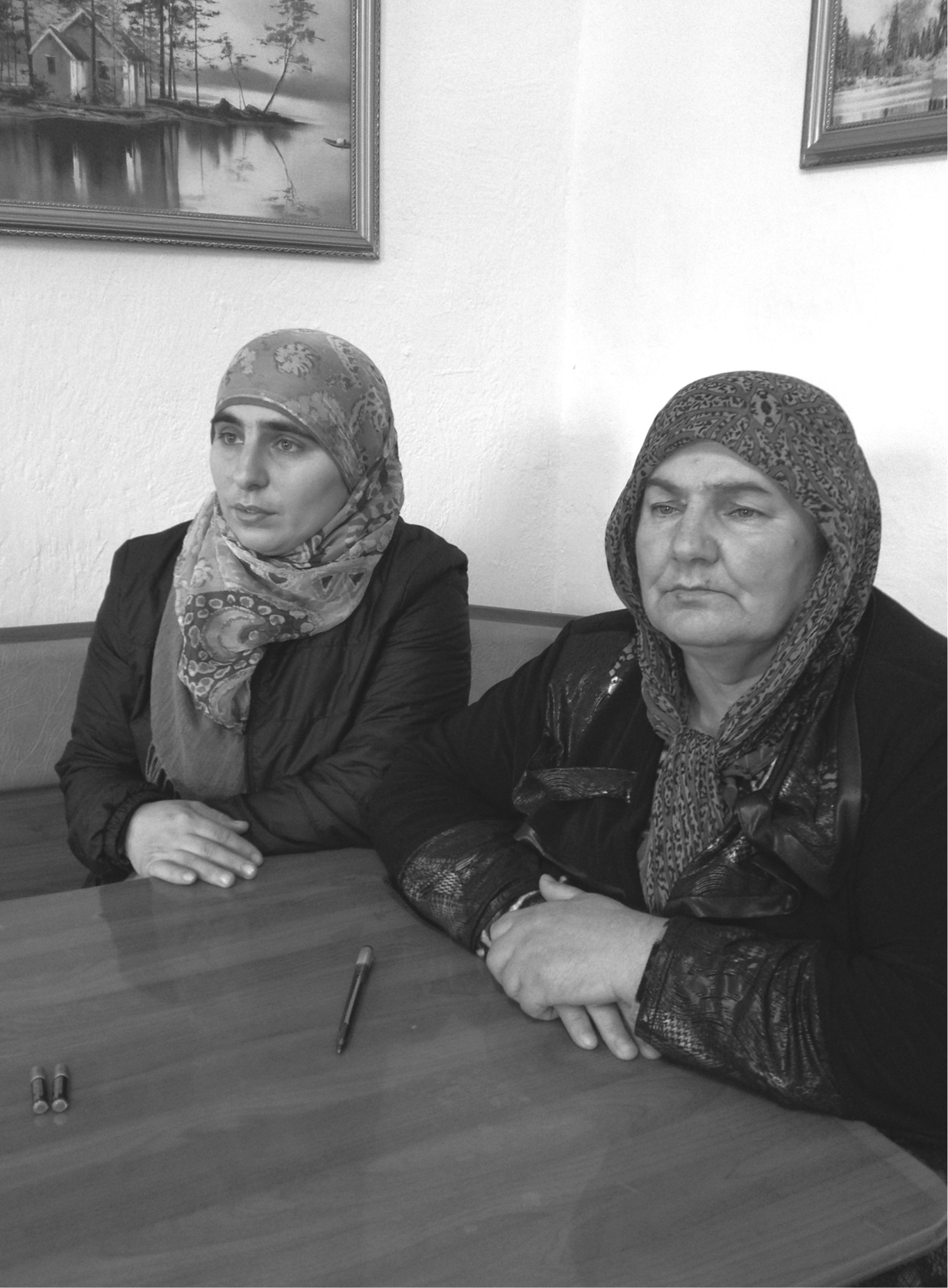
ABOVE: Zareta and Ayshat Ozdoev
Credit: Abdulla Duduev
On 18 April, Yevkurov agreed to meet Ayshat Ozdoeva. He asked her to bring her son Adam, who authorities claim she is hiding. Yevkurov promised to rehabilitate him if he surrendered. An officer of the Federal Security Service (FSB) Pavel Chernov, who was in charge of the “special operation” in Dolakovo, was also present at the meeting. As he started to tell the military’s account of events – that they had to kill Khavazh Ozdoev because he had opened fire first – Ayshat broke down.
“Why are you telling these lies? Aren’t you ashamed?” she cried.
This was the end of the meeting. The elderly woman was escorted out of the president’s office.
Zareta Ozdoeva says her mother returned from the meeting exhausted and run down; she had been in poor health before, and her condition worsened.
This story’s ending is quite common. The words of enforcement officers are accepted as the truth, even after they loot a house and kill an unarmed man, even when that unarmed man is later pictured with a gun next to his body that had not been there before. A couple of weeks later, a new photograph was posted on the internet: this time the photograph shows Khavazh Ozdoev’s body next to a machine gun.
But Yevkurov is too busy to question these suspicious miracles. In his interview to Gazeta.ru he described the Ozdoevs as “people with weapons” and “accomplices of clandestine gangs”. He told journalists that Adam Ozdoev ran away from the hospital and is being hidden by his relatives. In the same interview, he complained: “nobody believes us when we say these people were planning an act of terror.”
A vicious circle
For people in the region, it is a vicious circle. They suffer enormously because of the blatant lawlessness of law enforcement and military authorities.
When a person is kidnapped or killed, the victim’s relatives appeal to the police. Often their complaints are not even registered properly. They go to human rights defenders and independent journalists, who help them complete the formalities of their legal appeals, make the cases public and spread the word. But relatives do not have much of an incentive to tell their stories: in the majority of cases it does not lead to the triumph of justice.
It is for the relatives of victims to search for those who were kidnapped. Officers who are involved in murders, tortures and kidnappings are not brought to account. Instead, they are promoted. Human lives become nothing but statistics the military and the regional authorities use to demonstrate how effective they’ve been in “the war on terror”. As a result, state funding for anti-terrorism troops and special services is increased.
Victims remain alone with their grief and pain. Some wait quietly in hope that justice will be restored one day; others go down the road of long and exhausting trials and using all the legal mechanisms to hand, sometimes taking their cases to the European Court of Human Rights. But there are those who decide to seek a form of justice with weapons in their hands. The military authorities seem to welcome this response the most, not least because it boosts their careers and builds their wealth.
This vicious circle is so hard to break.