



Abstract

Though the free speech environment has shifted dramatically since Index on Censorship began publishing 40 years ago, the challenges are still strikingly familiar. Outgoing Index chairman
Snowden. Cyberspace. Security. Wikileaks. Leveson. Libel. Privacy. Pornography. Facebook. Twitter. The buzzwords tumble forth amidst a firestorm of confused debate about rights and wrongs. At the heart of the matter is a precious human right, a defining characteristic of a civilised society – the right to free expression.
A crusading alliance of cruelly ill-used victims, bruised celebrities and lapsed libertarians was ready to give politicians the ultimate and permanent authority to license the press – and thereby on what should and should not be published in a free society
More than 40 years ago, when Index opened a window against the stifling, foetid world of censorship in the Cold War, its focus was on Eastern Europe, where the voices of the intelligentsia were muffled and their typewriters were obliged to hack out the party line. Then it seemed so clear, so very black and white. I witnessed the Eastern Bloc as a reporter, and I saw the repression and the fear. I had secret rendezvous with brave individuals who could never express a free thought in public without courting arrest, and I pitied their humiliation. When the wall came down in 1989, I walked from West to East through Checkpoint Charlie. A forlorn East German border guard stamped my passport and a while later, authorised by no one, I clambered out again by the Brandenburg Gate, feeling that giddy elation of the moment that promised to be a New World Order in which freedom would rule and all would be well.
At University College London, I had been weaned on John Stuart Mill and Jeremy Bentham. So compellingly did they set the terms of a moral and political debate about rights, responsibilities and freedoms that to this day I set my compass by their convictions. And my experiences as a globetrotting reporter, especially in Africa and Latin America, gave me ample and horrifying evidence to confirm my prejudices in favour of those two great thinkers. I met tyrants and dictators and their victims – those few who were brave enough to talk to me with their faces hidden from the camera to protect themselves and their families from imprisonment, torture, or death. It seemed – it was a no-brainer – the denial of free expression for hundreds of millions of people across the planet was, unequivocally, a crime against humanity.
ABOVE: The Berlin Wall, 1989
Credit: Guy Le Querrec/Magnum
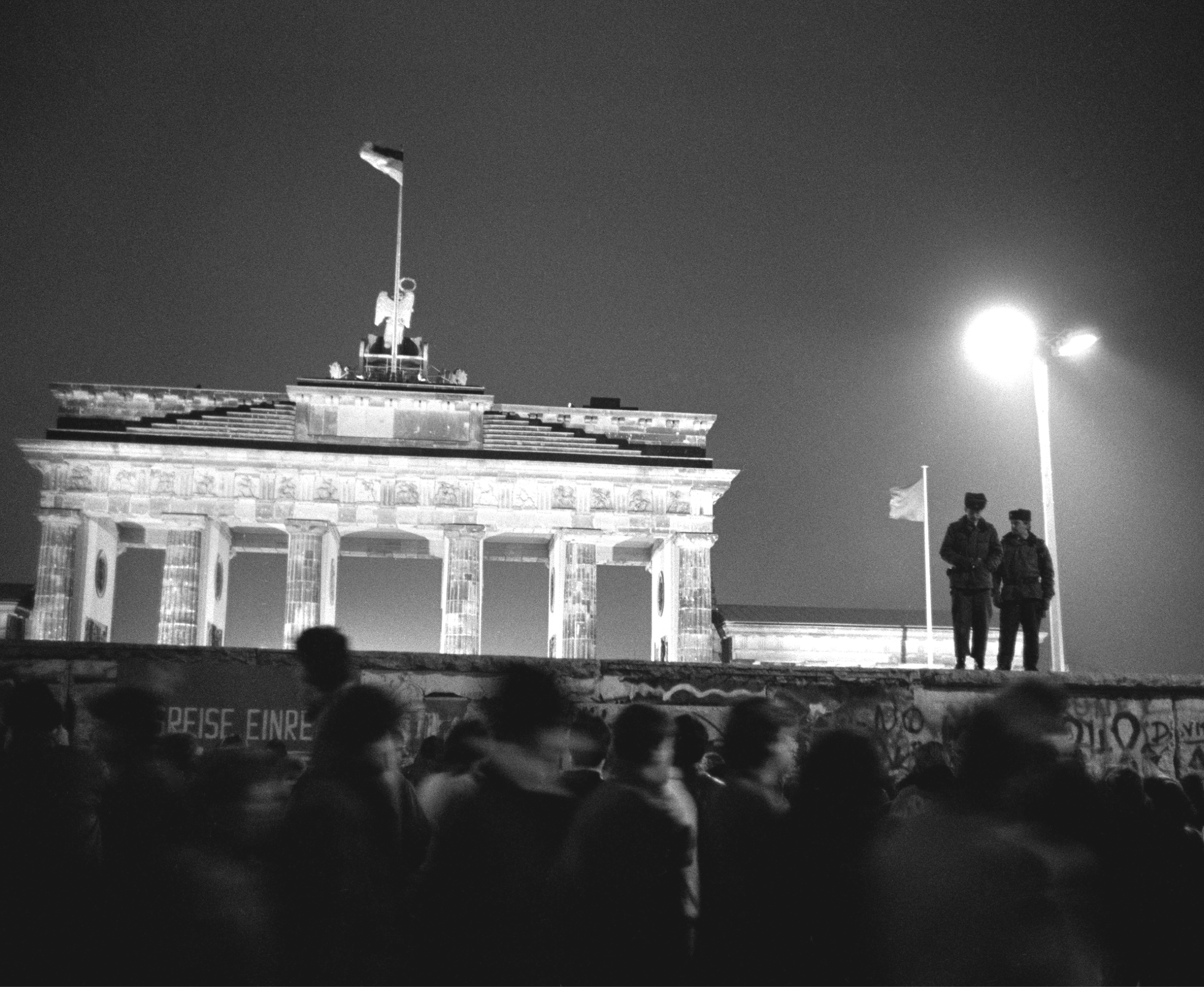
Today it is both the same and very different. The principles have not changed but the context is altered. In this century there are a great many shades of grey along the spectrum between black and white. It used to be said – and some still say it – that the only justification for restricting our freedom to say what we want by every means of communication is to prevent the immediate prospect of physical harm caused when someone shouts “fire” in a crowded theatre. But this is to beg all the important and interesting questions. Go back to the ten words at the top of this article and ask yourself: do I have a simple answer in the name of “freedom of expression” to the conundrums implicit in all of them? If you do, then I would warn you against being simplistic.
Very few countries in the world now openly suppress freedom of expression. Leaving aside Russia (which is a depressingly complex case) and relics from the Soviet era like Belarus and most of the “stans”, the continent of Europe is free of dictatorial regimes. Great swathes of Africa, Asia, and South America have been liberated from tyranny. Most of us now belong to a world where the mobile phone and cyberspace prevail where – with notable exceptions – the rulers have little choice but to heed the voices of the people, most of whom now have the right to vote in more-or-less free elections. To varying degrees this means that the threats to freedom of expression are universally shared and very similar. But they are also more equivocal: shades of grey again.
Inside every one of those ten words at the top of this piece lies a plausible and at least superficially persuasive argument in favour of arresting or suspending freedom of expression. In Britain, for example, we’ve seen the phone-hacking scandal. Journalists committed serious crimes, offences that disgust all decent people. But there is already a panoply of laws to balance the competing rights of the individual and society: laws against discrimination, laws that protect official secrecy, laws against libel and defamation (mercifully reformed, thanks to the work of Index and others), laws against contempt of court, laws against bribery and corruption, and – via the European Court of Human Rights – laws to protect privacy as well.
No wonder the rest of the “free world” was aghast to discover that a crusading alliance of cruelly ill-used victims, bruised celebrities and lapsed libertarians was ready to give a parliament of duly elected but “here today, gone tomorrow” politicians the ultimate and permanent authority to license the press – and thereby what should and should not be published in a free society. And no wonder authoritarian governments elsewhere looked on with complacent approval, perhaps asking themselves secretly: “If the mother of parliaments can accrue such control, why shouldn’t we? Their licence is ours as well!” So much for freedom of expression.
I am frequently offended by what others say and write – by their scurrilous gossip, careless cruelty, and unbridled bigotry – but I am even more offended by those who think I do not have the right to be offended. For me that nostrum is a useful lodestar. More importantly, these concerns are not just local British issues. They affect all people and all nations in a world where rapidly growing numbers of tweeters and bloggers – the new moguls of the social media – are writing the rules as they go along. How and why should their absolute freedom to write what they want be constrained by law?
One of the many things I have learned during five years as chairman of Index is that simple questions about freedom of expression invariably have complex answers. Take those ten words with which I started this article, and add others if you will. Then ask yourself a simple question in relation to each of them: is there any limit to freedom of expression that might be justified in this context? In our New World Order – which has acquired a form and a technology that most of us could scarcely imagine when the Berlin Wall fell – this is one of the great challenges facing all those who believe that the right to express oneself freely is indeed inalienable. It is also why Index on Censorship, by testing and challenging those who would muffle this right, matters so very much.