




Abstract

Party politics and a distaste for objectivity have skewed the media landscape. It’s time for journalists to place truth back on the agenda, argues
One of the defining characteristics of Italian journalism is the lack of a belief in objectivity. Indeed, as Ferdinando Giugliano and I argued in Eserciti di Carta (Paper Armies), published in April 2013, it’s not just that there’s a lack of belief, but for many, a positive and proactive disbelief in objective journalism.
Many Italian journalists argue that objective and neutral journalism is impossible
Two of the grandest figures in Italian newspaper journalism of the post-war period believed that objectivity was not relevant to the journalism they practised, or to the newspapers they created and edited. Both thought, instead, that journalism should be militant; that it should take a strong ideological position, be clear about it and promote it. Objectivity was not just unobtainable: it was irrelevant – worse, it was dishonest.
Indro Montanelli, for decades the most distinguished journalist of the right, resigned from Italy’s paper of record, Corriere della Sera, in 1974 because he found its editorial line too accommodating to the Communists: he founded Il Giornale as an explicitly and principled anti-Communist, liberal-conservative paper.
Later, when Silvio Berlusconi became his proprietor, he left the editor’s chair rather than accommodate himself to what he saw as the increasing intolerability of the owner’s demands – and spent much of the rest of his life passionately opposing the new leader of the Italian political right.
Eugenio Scalfari, on the left, prepared his equally audacious launch of La Repubblica in the same vein, dismissing any efforts to be fair, balanced, neutral or objective, scorning ‘an illusory political neutrality’ in favour of a journalism which was clearly – clearly is the important word – engaged, which had ‘explicitly chosen a side’. He was, he wrote, moving journalism from ‘the passive to the active voice’.
Democracy and the media
The debate over objectivity in journalism is at least a century old, erupting time and again, especially since the last world war, when efforts to found public service broadcasters with a neutral approach to their subjects – including, crucially, the state and the government of the day – were started in earnest. At root, as Scalfari in particular makes clear, is the question of whether or not there can (or should) be an objective and neutral journalism, and he, along with many Italian journalists, argues that it is impossible.
The Italian media cannot but be deeply affected by the relatively strong power of the political parties – and their influence over the way in which politics, and much else, is reported is greater than in most other democratic countries. But Giugliano and I concluded that the polemical gusto and diversity of the political and media scene, as refracted through the powerful lenses of the politics of the past two decades, do not properly serve the democratic commitments of the media (nor, for that matter, politics itself).
That is because the structure of post-war Italian journalism has been subordinated to political opinion and party power, and has thus not evolved as a journalism which aims to produce not only a diversity of views (which it must do, and which Italian journalism does do) but also an at least skeletal version of the truth.
Truth must exist for journalism to work as a profession, and to make the democratic claims for itself that it does. If it does not, then everything is opinion: and in Italian journalism, too much is opinion, too little is a careful piecing together of evidence leading to a solidly-based revelation.
That is not because Italian journalists cannot do such journalism; indeed, some do. But the premium, and often the demand from editors and proprietors, is for a journalism that fits itself to a pre-existing ideological mould. The journalism that privileges careful inquiry and a neutral approach – open to facts taking the inquiry in any direction – has not been seen as possible by its most distinguished practitioners, or desirable by either private owners or the state. Thus the bias against objectivity in Italy is both philosophical and practical: it cannot be attained, and few want it.
The public broadcaster Radiotelevisione Italiana, or RAI, has for some decades operated a system known as lottizzazione (derived from the word lotto, which, in one of its meanings, signifies the division of land into plots): it has assigned the three main channels to different political groups. RAI 1 is assigned to the government, and to the dominant party within it; RAI 2 to the largest party supporting the dominant party in government; and RAI 3 to the left, which had meant the powerful Communist Party and now means the less powerful Democratic Party.
Post-war journalism has been subordinated to political opinion and party power
Developed at a time when the Christian Democrats were dominant, the Socialist Party was in support and the Communist Party was in permanent opposition, lottizzazione worked, in its own terms. It has since ceased to work, since politics is more fluid – and has, for example, meant that in the event of a left government, the dominant party in the left coalition in theory has the main influence over all three terrestrial channels.
However, even in the period of party stability, the outcome was a malign one for journalism: it meant that journalists in the most powerful and popular news medium in Italy had to fit themselves, not in the first place to the discovery of the facts, but to the exigencies of political masters.
The foundation of the Mediaset channels was permitted by a political intervention on the part of the then prime minister, socialist Bettino Craxi, rammed through at the cost of defections from his government to serve the interests of his close friend, Silvio Berlusconi – who had created a then-prohibited nationwide network in defiance of the law.
ABOVE: Silvio Berlusconi prepares to participate in a talk show on RAI 1, which primarily broadcasts content relevant to the government’s dominant party, Rome, February 2008
Credit: Andrew Medichini/AP/PA
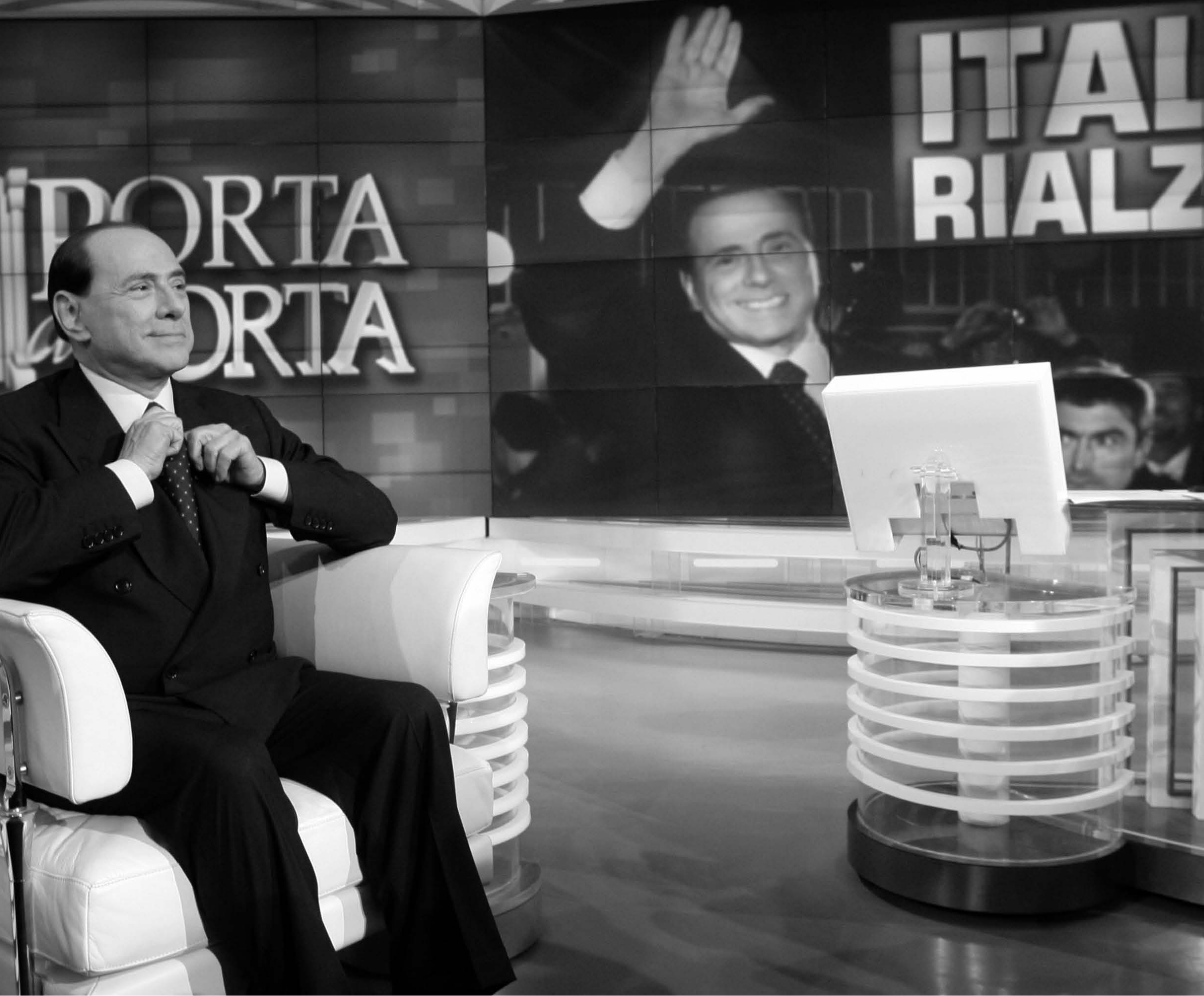
Berlusconi, who had been relatively hands-off in the first years of his network, took the decision to enter politics and create his own, centre-right party: his media were then mobilised in his support. That they should soon serve Berlusconi’s political as well as commercial interests was seen as outrageous by many; but the grounds for outrage had been weakened by lottizzazione.
Thus, since the early 1990s, television channels – both state-owned and private – were almost entirely captured by political forces. The press was already, in part, convinced that its role was to be overtly politically engaged; where it was less so – as in major newspapers like Corriere della Sera and the economic daily Il Sole/24 Ore of Milan and La Stampa of Turin – coverage was moderated by the need of the owners to remain on good terms with a government that controlled so much of the economy.
It’s understandable that this should be the view of many Italian journalists. Democracy was re-established after the war on the basis of parties which were both powerful (even when relatively small) and diverse. The two largest parties for nearly four decades after the Second World War – the Christian Democrats and the Communists – had millions of members and supporters, and vied with each other to provide them with activities, jobs and support.
Though there came to be an accord between them in the 1970s – the ‘historic compromise’, which saw the Communists support the Christian Democrats on some measures – they owed allegiance to radically different political philosophies, one grounded in Catholic social teaching, the other in Marxism mediated through the Soviet Union.
Turning to the facts
But however understandable, it’s been bad for Italian democracy – if less obviously so than the colossal conflict of interest which Silvio Berlusconi in power epitomises. It has not squashed all analysis and investigative reporting – the first is alive and well in Il Sole/24 Ore and the second is to be found in most major papers at times (though very rarely on TV). But it means that the latter is generally believed to be the product not of journalistic inquiry based on some version of ‘the public’s right to know’, but on a desire to smear the opposition to whatever political line the publication embraces.
Journalism is assumed a priori to be committed politically, not factually. And because that sometimes is the case, and because the behaviour of many politicians and journalists has led to a cynical approach on the part of both the producers of journalism and its consumers, it doesn’t have the impact it should.
The example of Italy shows that, in order to be effective, journalism has to cleave to a view that the truth is possible. Indeed, journalism loses much of its meaning if it does not have this at its base.
To construct a narrative that gives the outline of significant events – even long-form journalism must dramatically curtail its version of the facts, so all journalism of fact can only be an outline – is necessary for citizens’ understanding of the world.
To those who argue that objectivity and neutrality are impossible, the response is: the end is unattainable, the attempt is essential. Journalism that seeks the facts to make an outline of significant events in good faith is the bedrock of the journalist’s trade, at least as valuable as plurality of opinion (in fact the latter depends on the former).
Objective journalism is free journalism. Where journalism is not free, the search for facts is limited, in varying degrees of severity. Where journalists have only some measure of freedom – as in China – they seek to extend it as much as they can, no longer (except in extremis) in danger of imprisonment, but often of unemployment: China is where the most important struggle for journalistic freedom, and thus freedom, is taking place.
Free journalism is not so for its own sake. It is free so that society can be too. And for that, facts are indeed sacred.