




Abstract

Since Aung San Suu Kyi’s release from house arrest in 2010, the world has watched as reform began to take hold. But, asks Index’s head of advocacy
According to the US government and several member countries in the European Union, Burma is a country in transition, opening up to the world and in the process of liberalisation. The EU has dropped all non-military sanctions on the government of Burma because of its ‘remarkable process of reform’, while the US has moved quickly to allow its companies to invest in the country.
It’s certainly a different country to the one Index visited in 2010. Index staff travelled under cover, could not use email, and, when meeting with opposition activists and journalists, were accompanied from place to place. In April 2013, with Burmese partners, Index organised the country’s first public symposium on artistic freedom of expression, with high-profile former political prisoners taking part, among them comedian Zarganar, activist Min Ko Naing, poet Zeyar Lynn and filmmaker Min Htin Ko Ko Gyi.
As a forthcoming report by Index highlights, although this transition is underway, serious barriers to freedom of expression remain. It’s clear that some of the progressive measures and democratic change endorsed by the opposition party the National League for Democracy (NLD) have yet to take hold, not entirely surprising as it is not in power. To date, few steps have been taken to reform the country’s draconian laws and increasing bureaucracy poses particular obstacles to free speech. Serious questions remain over the government’s long-term commitment to reform, particularly while the military continues to retain such significant power.
The NLD, of course, has been outspoken in its commitment to human rights and democracy since its inception in 1988, and its leader Aung San Suu Kyi was held under house arrest for close to 20 years as a result. Eighteen months after her release, she wrote in Index on Censorship:
Words can move hearts, words can change perceptions, words can set nations and peoples in powerful motion. Words are an essential part of the expression of our humanness. To curb and shackle freedom of speech and expression is to cripple the basic right to realise our full potential as human beings. Without substantive law reform, the chill on freedom of expression will remain
Much loved over decades, as leader of the NLD, Aung San Suu Kyi still commands enormous respect. But, more than two years on from her release and huge success in the 2012 by-elections, some civil society activists and sections of the media have also begun to question how the NLD will protect free speech, and whether the party will be able to facilitate the change the country so desperately needs.
While representatives of Aung San Suu Kyi’s NLD were present at Human Rights Day events on 13 March, some activists spoke publicly about the need for a third political party in addition to the government’s Union Solidarity and Development Party (USDP) and the NLD. Support for the NLD remains strong across Burma decades after their election victory in 1989, but for some, disillusionment has set in, especially after the party’s first public congress, where older faces dominate the now expanded Central Executive Committee.
I visited Café 88 in Mandalay on 13 March, on what the 88 Student Generation democracy movement calls Myanmar Human Rights Day – also often referred to as ‘Phone Maw Day’, named after one of the students gunned down during the Rangoon Technology University uprising in 1988. Café 88 would have been unimaginable just 18 months ago. Former dissidents and political opponents of the regime meet openly and discuss politics over cups of sugary tea and coffee. Many have spent time in jail. At the upstairs cafe, ‘Grace’, or Swe Zin Htaik, a famous actress and human rights activist, gave a lecture on women’s rights and the link between access to information and illiteracy.
The theme for this year’s Human Rights Day was ‘change and harmony’, in reference to the reformist approach adopted by both the NLD and the 88 student movement. This was not always the students’ approach. I met a former member of the Democrat Student Army, a guerrilla group that took up arms against the government. In contrast to the tactics of a previous generation, one younger activist told me his generation was committed to a peaceful and pluralist transition with ‘no more Che Guevaras’.
There was also a celebration for Human Rights Day at a monastery in Mandalay. A former student engineer who had been at the Rangoon Institute of Technology during the 1988 massacre addressed those gathered to mark the occasion. He said police informers were probably in attendance at the event, adding that this sort of pressure no longer bothered him because he was so used to surveillance. Police regularly watch his house.
The day highlighted some of the tensions of the transition process: while former political prisoners are able to speak openly about politics and reform, they remain monitored by the security services. There is more space for politics, including criticism of the opposition.
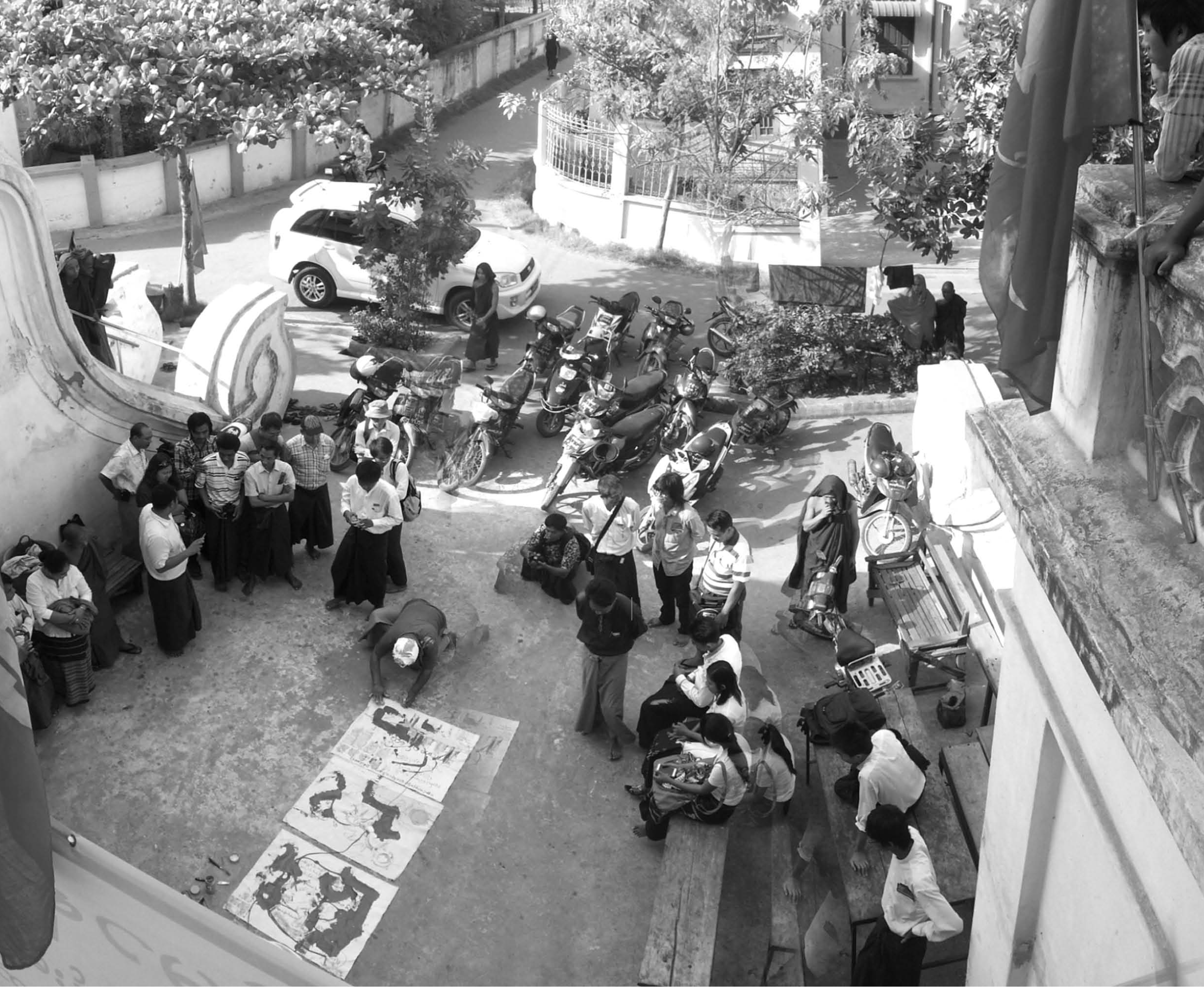
Outside the monastery, a performance artist painted an elaborate picture using his entire body as a small crowd looked on. The same artist had been arrested for a similar, more public performance in downtown Mandalay in 2012. In a restaurant that evening, I spoke to him about the transition. He told me something he had told another youth activist earlier that day: ‘When we talk about the law, we call it “rubber theory”. The authorities use the law as they see fit – every day the restrictions stretch and reshape.’
Artists are pushing at the boundaries – and with force. Zarganar, one of Burma’s favourite comedians, tested the limits of free expression during a six-hour marathon comedy show broadcast live on Sky Net (a pay-per-view TV channel set up in 2010). His skits took no prisoners and included parodies of Aung San Suu Kyi, President Thein Sein, comedy about corruption and a satirical chant translated as ‘we are free to do anything now – sell our shit, piss on the streets’. Throughout the show, comedians offered their take on the theme ‘what is freedom?’ In one sketch, protesters with blank placards walked around aimlessly. When asked what their cause was, they replied that they didn’t know.
Filmmakers have also challenged the boundaries: the Art of Freedom Film Festival in January 2012 showed films for the first time that had previously been censored in Burma. One short film that has been shown on several occasions, Ban that Scene, satirises the film censorship board, with characters portraying the censors as corrupt and guilty of double standards. The characters are said to closely resemble real people on the board. Later in 2013, following the relaxation of the censorship board’s guidelines, Min Thin Ko Ko Gyi’s Human Rights and Human Dignity Film Festival aims to look at human rights violations by the government. Artists do this at no small risk to their liberty, for although the transition has led to a relaxation in the application of the law, it has not led to significant reform of Burma’s authoritarian legal framework.
ABOVE: On human rights day, celebrated on 13 March – the anniversary of the 1988 Rangoon massacre – an artist performs outside a Mandalay monastery
Many of Burma’s draconian laws date back to the colonial period under British rule. Following on from that, the military has imposed new laws since 1962. A worrying sign is that although the worst laws remain untouched by the transition – including the law of criminal defamation (1861), the State Protection Act (1975), the Unlawful Association Act (1908) and the Publishers Registration Act (1962) – new laws passed or proposed in the last two years have failed to meet international standards to protect free speech, including the Peaceful Assembly and Peaceful Procession Law (passed in 2011) and the draft Printing and Publishing Enterprise Law (prepared by the Ministry of Information). Without substantive law reform, the chill on freedom of expression will remain. Activists still face up to 15 years in prison for ownership of an email address that is used in connection with ‘political activities’.
This framework continues to cause unnecessary uncertainty to civil society in Burma. A Burmese lawyer told me that one charity that helps poor families bury the dead is still being refused registration due to one of the founders’ links to the opposition; a musician said it had taken him over 10 weeks to apply for a permit to stage a live music performance, while journalists worry that the abolition of pre-censorship opens them up to criminal defamation charges from government ministries.
The EU has given up its leverage over Burma and relaxed sanctions, but some have questioned whether it has done so too soon. There can be no doubt that Burma is freer now than at any time in the last 50 years, with the exception of the short months during the 1988 revolution. Artists and journalists are keen to test this freedom. This incredible transition shows some promising signs: the release of political prisoners, greater freedom for both the opposition and for those exercising their right to free expression. But it’s clear that the government – and the powerful military junta behind the scenes – must take steps to bring about lasting legal and political reform. Until it does, it is unclear how sustainable this transition will be, and whether it will lead to a flourishing democracy.