




Abstract

Act I: Let us begin at the beginning
In September 2011, I get an email from a certain Tal Kramer. He is an Israeli. He is inviting me to participate in the Jerusalem International Writers Festival from 13–17 May 2012. Fear and trembling: an invitation from Israel, the mortal enemy of Arabs and Muslims! Surely everyone must already know that I am holding in my hands an invitation from the ENEMY! To make matters worse, Kramer proposes to make me the guest of honour.
I believe that in order to judge a country one should see it with one’s own eyes. Propaganda is not enough
A quick spin on Google and I discover that the Jerusalem International Writers Festival has welcomed the greatest international writers … and not a single writer from the Arab world. What to do? Go and trigger World War III? Decline the invitation and stay at home writing immortal prose?
My analysis of all pertinent information and every possible and imaginable repercussion can wait; first of all, I need to check my diary. May 2012 … phew, the date is free, the festival falls between two other engagements: a symposium in Luxembourg (8–11 May) and a tour of the Czech Republic (18–22 May). This is wonderful, Yahweh works in mysterious ways. For a long time now I’ve dreamed of visiting Israel. I believe that in order to judge a country one should see it with one’s own eyes. Propaganda is not enough.
And so, I accept. A single email and fate shifts its course.
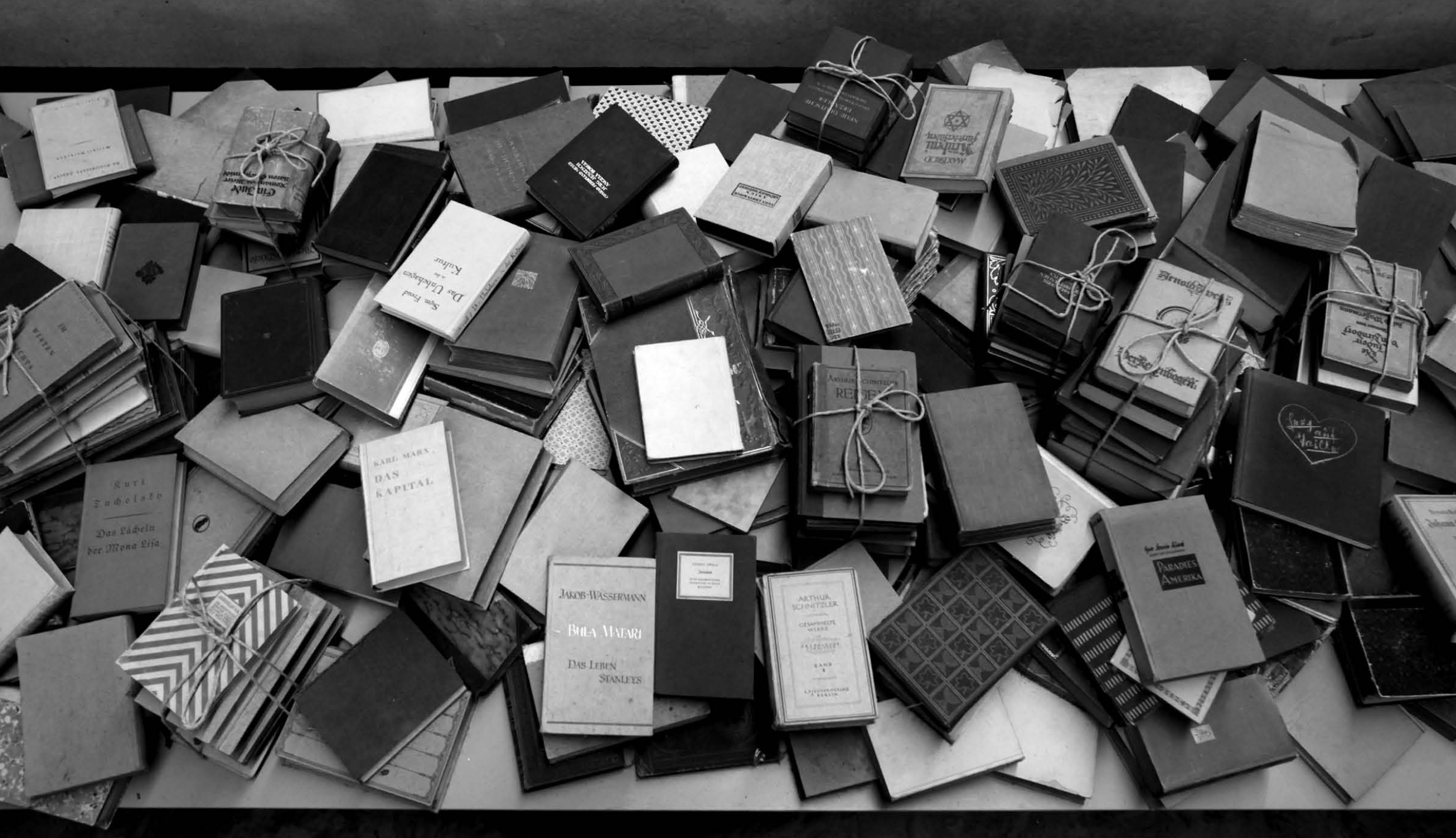
The power of the book: Sansal looked forward to visiting Yad Vashem History Museum while in Israel, where this book installation is displayed
In March 2012, the festival programme is published. My name appears along with those of Amos Oz, David Grossman, Abraham Yehoshua. Hamas, the masters of Gaza, see red and issue a fatwa, accusing me of committing high treason against Islam, the Arabic nation and its martyrs, and calling upon every Arab on the planet to oppose me. They demand that I withdraw.
Again, what to do: obey or defy them? I am paralysed with fear, the streets of Algiers are teeming with Islamists working for Hamas, Hizbollah, Ahmadinejad, al Qaeda, Groupe salafiste pour la prédication et le combat (also known as the Group for Call and Combat), al Qaeda in the Islamic Maghreb. Moreover, the Algerian government loathes me. I am surrounded. Mahmoud Abbas’s government remains silent. Are they planning to condemn me? To support me? How could I know? I suspect they simply have bigger fish to fry. Never mind, once the first step is taken there is no going back, and if war breaks out, you try your best not to lose it.
On 12 May 2012 I find myself in Paris on a plane bound for Israel. I am travelling Air France. El Al is too conspicuous. I spent the night before at the Israeli consulate in Paris on the Rue Rabelais. They were expecting me. They issued me with a visa on a separate piece of paper. There would be no trace of it on my Algerian passport.
A peaceful journey. The fear will come later, when I get back. On the plane I write, I read. I gain time. This day had just passed into history for me.
At midnight, I set foot upon Tel Aviv soil. My heart is hammering. A VIP car is waiting for me. We speed towards Jerusalem and one hour later I step into the Mishkenot Sha’ananim, a prestigious guesthouse that welcomes artists, writers and musicians invited to Jerusalem. It is here that the festival is taking place. Four days of discussions, of interviews and encounters. And of sightseeing. I was thinking about the Old City, about Yad Vashem, about the Wall, the famous West Bank barrier (a monument to stupidity since missiles travel through the air, not on foot). I hardly need talk about my excursion. It was fantastic, unique and very productive.
The following day, 14 May, I receive an email that shocks me to the core: it is from the Arab Ambassadors Council in Paris (all 22 of them). Gosh! In it they inform me that I am the fortunate winner of the Arabic Novel Prize, worth €15,000 (US$20,000), and suggest the prize-giving ceremony take place on 6 June at the Institut du Monde Arabe in the presence of the great and the good of Paris. Is it possible? What does it mean? Are the Arab Ambassadors supporting me against Hamas? Do they support my journey of friendship to Israel? Is something brewing in the whole Arab world? Some extraordinary initiative? Peace, perhaps? Is it something I had sparked off?
Via Google, I discover that the prize jury is composed of famous figures, both Arab and French, and Hélène Carrère d’Encausse of the Academie Française is honorary president. Wow!
On my return from Israel I publish a long article on the Huffington Post on 25 May. Who knows why, I decide to give it the provocative title ‘I went to Israel … and returned delighted and enriched’. What was I thinking? What I had seen in Israel? The €15,000 prize? Hammering my point home to Hamas?
The article ends with a little idea that flourishes in extraordinary ways. In this extraordinary affair, everything is extraordinary. The piece generates a lot of response. Some say it is a wonderful article. Others think it is astounding in its naivety and stupidity. As for the Islamists, they are more pragmatic: they increase their threats.
Either the government knows nothing about my journey of friendship with the ENEMY or they deferred retribution until later
At the end of May, I conclude my tour of the Czech Republic and go home to Algeria. I feel a tremor of fear. I send a text message to my wife, reminding her to phone some friends in Paris. If I am arrested at the airport, they can mobilise international support. Bizarrely, everything goes well. Either the government knows nothing about my journey of friendship with the ENEMY, or they don’t care, or they have deferred retribution until later.
Three days later, exhausted by a smear campaign waged against me by a particular section of the press, I receive another email from the Arab Ambassadors Council: ‘Monsieur, as a result of the situation in the Arab world, the prize-giving ceremony scheduled for 6 June has been rescheduled until a later date’. The tone is curt, it elicits no response, no comment. It is utterly unlike their first email, which was punctiliously polite and respectful.
The following day, Olivier Poivre d’Arvor, director of radio France Culture and a member of the Arabic Novel Prize, phones me to check a rumour going about in Paris that the Arab Ambassadors have withdrawn the prize. I forward him the Council’s email. He responds by telling me he will resign from the jury. This he does in an open letter to Libération entitled ‘Why I am resigning from the jury of the Arabic Novel Prize’. It is a brave and powerful piece. His fellow-jurors follow suit and resign en masse. One particular case attracts the attention of the press, that of Elias Sanbar, a distinguished Palestinian intellectual. He is a member of the jury … and a member of the Arab Ambassadors Council, as well as the Palestinian Ambassador to UNESCO. Ouch! Being on the side of those giving the award and those criticising it cannot be easy. The French press rail against the Council. A prize is a prize and their word is their word.
In late June, the jury (minus Elias Sanbar) meets at the offices of Gallimard, my publisher, in Paris, where they symbolically award me the Arabic Fiction Prize. Handshakes, accolades, speeches, cocktails. A receptive audience. The press is present and wholeheartedly supports me. The Arab Ambassadors must have been crying with rage and humiliation.
Act II: The affair is not over, far from it
A week later, a mysterious Swiss man asks one of his friends, the poet Shmuel Thierry Meyer, to get in touch with me and let me know he would personally like to give me the €15,000 the Council denied me. Shmuel passes on this message and, for his own part, sets up a writers’ group in support of me.
When I refuse his offer, the generous donor insists and proposes giving the money to a charitable association. I accept. Charities need money. I choose Un coeur pour la paix, an association of French and Israeli doctors who treat Palestinian children suffering from heart disease. The children are transferred to the West Bank, where they are treated at Hadassah hospital, which works in partnership with the association. They also offer equipment and training to the children’s parents so they can provide the necessary care for their child when they go home from the hospital.
The business is efficiently conducted by Shmuel, who acts as intermediary between the mysterious sponsor, the association, the writers’ group and me. The presentation of the €15,000 cheque takes place on 4 October at the French National Assembly in front of a large audience. Everyone is there except the generous sponsor.
Act III: An unexpected sequel
My article for the Huffington Post ends with a little flight of rhetoric: I muse how wonderful it would be if the writers of the world came together to fight for peace. The idea had occurred to me in Jerusalem during my encounter with David Grossman, a tremendous writer, a tireless militant for peace and a warm-hearted man. With men like this, I thought to myself, peace might be won in a day.
The idea of this gathering flashes around the world. I mention it to David Grossman. Three months later, on 6 October, he and I find ourselves in Strasbourg where, with the support of the mayor, the general secretariat of the Council of Europe and a number of international organisations (Etonnants Voyageurs, a forum of travelling French writers, the World Alliance, PEN, German publisher Börsenvieren, Radio France Culture, Gallimard and others), we launch the ‘Strasbourg Appeal for Peace’, demanding that writers around the world join us to create a vast gathering of advocates for peace. The Nouvel Observateur call it ‘the writers’ UN’. On 12 October, at the Frankfurt Book Fair, Alfred Grosser and I launch the appeal at a press conference.
Today, we number 170 writers spanning five continents and 50 nationalities. Among us are winners of the Nobel Prize, the Friedenpreis, the Prix Goncourt, and so on. We hope to number 1,000 by spring 2013 and to launch the ‘Appeal of the Thousand’. This we will do at Saint-Malo. Working for peace is a big deal. It requires great numbers and great determination. Who knows what we will be able to achieve.