



Abstract

This December, roughly 200 countries will gather in Dubai to thrash out a treaty on global internet governance at the landmark World Conference on International Telecommunications. But given its tainted commitment to freedom of expression, is the United Arab Emirates the right country to host such an event? UAE is not the first country, of course, to host discussions about the vital role communications and information-sharing play in modern society while clamping down on the rights of its own citizens: take the World Summit on The Information Society in Tunis in 2005, and, more recently, the Internet Governance Forum in Baku, Azerbaijan in November 2012. In the UAE, 2012 alone saw a flurry of arrests, with 61 Emiratis currently behind bars for exercising their right to free speech, in many cases online.
In this interview, journalism professor Matt Duffy speaks to Ahmed Mansoor, a blogger, engineer and co-founder of the now-banned online forum UAE Hewar, about censorship in the UAE. Mansoor was one of five bloggers found guilty in November 2011 of ‘publicly insulting’ top government figures on UAE Hewar. Although the Emirati president Khalifa Bin Zayed al Nahyan has since pardoned all five, the group still faces difficulties. In July 2012, Mansoor was twice attacked by unknown assailants at the Ajman University of Science and Technology, where he studies law.
The authorities shut down UAE Hewar in 2009. Clearly they did not appreciate the types of conversation taking place on the site. What kinds of discussions take place in the traditional media?
We have to understand first of all who controls the media in the UAE. Even those which promote themselves as independent are tied to the government’s complex net of interests. So it is very unlikely we see truly independent media – and that applies across the spectrum: radio, the printed press, TV, satellite channels and so on. We do not see much coverage that is critical of the politics of the UAE. We do not see coverage about sensitive social matters. We do not see coverage about crimes claimed to be committed by the state security. There are so many taboos that you cannot talk about. Anything related to the ruling family. Talking about bidun, those who are stateless in the UAE, is also taboo. The press in the UAE does not talk about human rights-related subjects. They never cover arbitrary arrests, media censorship or torture beyond what is in the official news agency.
There were a slew of arrests over the summer. Those people were mainly jailed for things that they said on social networking platforms such as Twitter. Have those arrests been covered in the media?
The arrests were not covered in the media, apart from by the official news agencies. Only pro-government writers and voices were allowed to be heard and they were critical of detainees. The state media never allows voices from the other side.
This lack of coverage is part of the ‘red lines’ set up by the government. Journalists understand that if they cross these lines there may be repercussions – perhaps the loss of a good-paying job or an ex-pat’s residence visa. Obviously, this system means much journalism goes unreported. As a journalism professor I would tell a student to interview the family of the people who have been detained. I would do stories on the legal process, asking about the charges. Do you feel like any of these stories appear in the English or Arabic press? The English press in the UAE is a little freer than the Arabic press. What is the effect of that on Emiratis, particularly those that only read the Arabic press?
I still think the Arabic press is more effective. There are a good number of citizens who read English newspapers but it is a small percentage. Now what effect do the English newspapers have? I think it is probably limited to the elite. I do not see that there is a great impact on society. I think the problems with the Arab press have resulted in people finding different outlets for information. This is why people have moved to getting their information from online media, social media, international TV stations and the international press.
You started the website UAE Hewar, which means ‘discussion’ in English. It was shut down after six months. Give me an example of the types of conversations that were on the site.
One was the necessity of having a democratic election for the Federal National Council (FNC) and allowing people to freely criticise the current situation. Why do we need this kind of parliament in place? Why is the political situation in the UAE not moving? Who is behind this stagnancy? Why would political reform be better than the current situation? Some people went as far as talking about the constitution and the monarchy. Some talked about changing the structure of the country from a federal state to maybe a kingdom. People also talked about human rights, about the economic crisis in Dubai, and about political relations between the UAE and adjacent countries. These are the kinds of discussions that you would not see in the media.
Clearly the government and security forces did not appreciate your discussion because you found yourself arrested. You faced various charges including insulting the ruler, which is a criminal offence, and discussing governmental reform.
Yes, that’s right. I was arrested on 8 April 2011 and jailed for almost eight months. They said I humiliated the president, the vice chancellor and also the crown prince of Abu Dhabi. They said I had instigated people to disobey the law because I personally wrote a press release asking people to boycott what I referred to as a quasi-election of the FNC. And by the way, that was the only thing that was attributed to me directly; the other charges were because they called me the owner of the site. Now, though I am very proud of UAE Hewar, I would not call myself the owner because there are other individuals who participated and they should be credited for this effort.
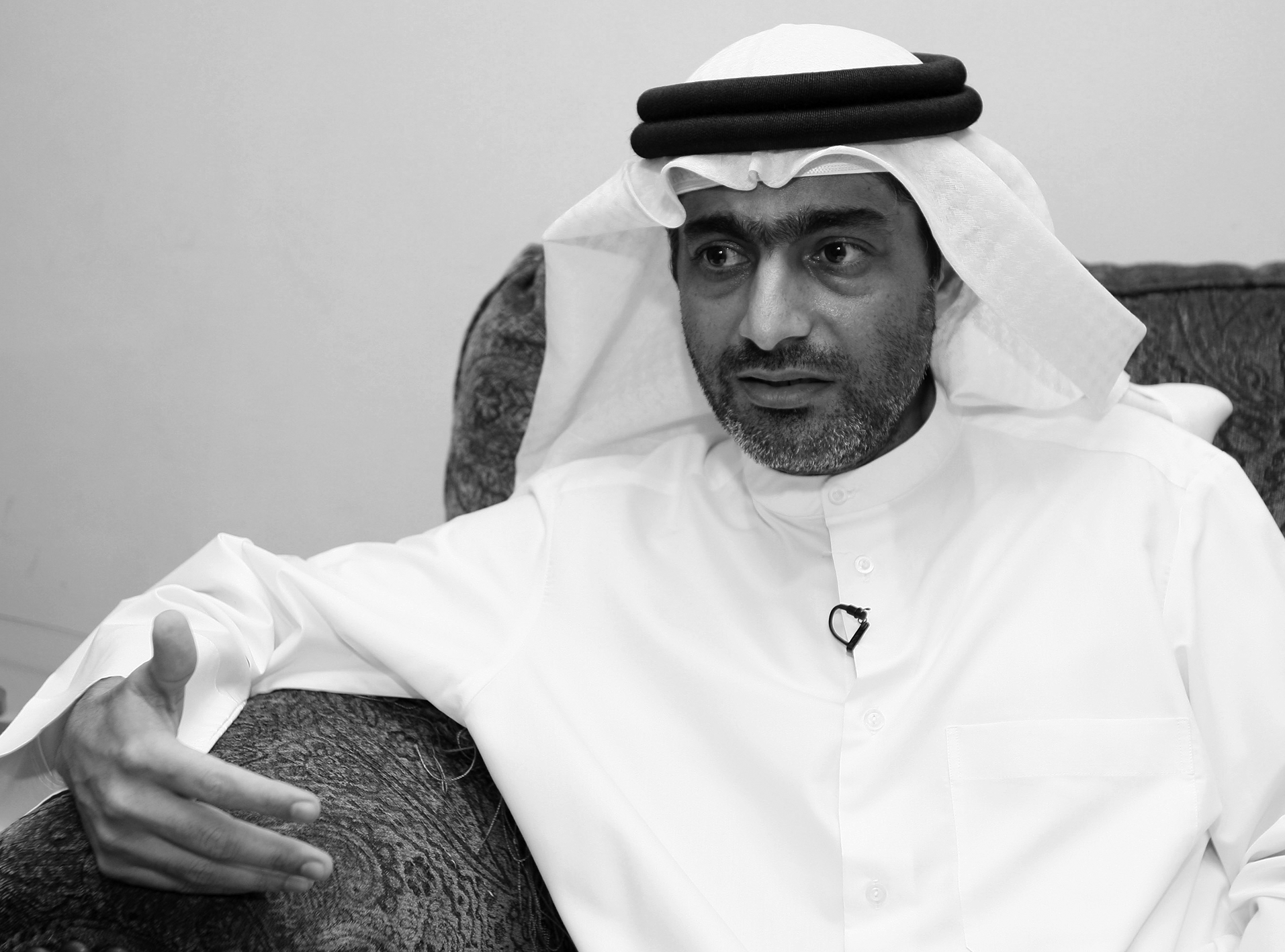
Ahmed Mansoor in Dubai, 30 November 2011
Credit: Nikhil Monteiro/Reuters
Do you feel that you were mistreated when you were in prison for eight months?
Definitely. I was denied medical service. After trying to get treatment for scabies for almost three months, I managed to see the general practitioner and was put in isolation. We were arbitrarily moved between different blocks so we would not have any psychological stability. We would be moved to a new block with new people and to a new room for one week, two weeks, 10 days. They just kept revolving us inside the jail. They did not allow us to go to the library. They did not allow us to do sports like all the other prisoners.
The UAE5 were not initially formally charged and the government did not make a statement about their arrests. The international press covered the arrests, but the UAE press waited for an announcement from the official news agency before reporting. In the Arabic press you really saw nothing official. The difference between the English and Arabic press was interesting.
They all work within different boundaries and there are limits even for the English press. The Arabic newspapers coordinate closely with WAM (the Emirates News Agency) and WAM coordinates very closely with the state security, which says what can and cannot be published.
UAE Hewar was shut down, but at the same time Twitter became big. And some of the conversations that had started on UAE Hewar started to happen on Twitter.
Yes, definitely, the same subjects are now discussed on Twitter in a similar way. On UAE Hewar, we did not allow any libellous comments to be posted about individuals. You could say anything you wanted about ideas, thoughts and policies but were not allowed to target people as individuals.
Do you think those rules are being followed on Twitter in some of these discussions?
Not at all. We had some control over deleting certain comments or suspending certain individuals who were really misbehaving. On Twitter you see lots of people who are politically motivated and who attack certain individuals – not their ideas but the people themselves. There is no doubt that there are a few accounts that belong directly to the state security and their allies. They are trying to create an atmosphere to make people reconsider their beliefs, for example the election of the FNC. If you go and talk about an elected FNC now, lots of people will reject your comments because of the pro-government accounts.
You said there is a dominant pro-government line that a lot of people take. My experience is that there is a hidden coercion. For instance, all jobs in the UAE require clearance from the security agency and people can find they cannot get security clearance. Have you ever heard stories like that?
Absolutely. There is an atmosphere of fear so people are afraid that they might lose their jobs, not get their deserved promotion, be sent to early retirement or their kids might not have a job or a scholarship. They may be harassed or their family members may be harassed. People are afraid that they may face the consequences if they speak out. They have decided it is going to be much easier to adopt the official view.
These are indirect coercion methods. What about the arrests over the summer?
The government says that these guys were arrested because they belong to the Islamist group al Islah. Of course a lot of them have been very active online and they had been arrested before. They were detained during the major crackdown in March and April 2012. And it intensified in July.
These are serious charges, so a court should hear their evidence. But they are just being detained without due process and there is certainly no vetting of what is happening to these 61 people. There is no public accountability at all. The press is not covering the story except in the shortest of WAM press releases. This whole thing is sort of happening outside of the public sphere.
We are 100 per cent sure that these accusations are totally fabricated, led by the state security apparatus. But let us assume that there is one per cent of reality in what they have said. This still does not justify their behaviour. It does not justify depriving people of their basic rights as stated in the constitution, the law and the regulations of the UAE and also the international covenants that the UAE is part of. We are talking about very basic rights. You cannot just go and detain people without arrest warrants. Or search people’s houses very early in the morning or late at night, taking them to unknown destinations, keeping them incommunicado for a very long time and not allowing them to see their families or their lawyer.
My understanding is that for at least one of the people we are talking about, there has been no official confirmation of his arrest. He is just missing.
Yes, some of the families were informed by the state security prosecutor that there were no arrest warrants for the family members they had enquired about. And the official statement only indicated that officials were investigating a plot.
How do you envision things could get better in the UAE with regards to free expression?
I think the first thing is to liberate society from the control of the state security. This is the biggest obstacle that we have. Even if you come up with a more modernised law to govern media activities, you would not see a change unless the state security stopped intervening.
If the state security is prosecuting you for your speech on Twitter then that’s obviously going to have an impact on the level of free expression.
Yes. I noticed that in the beginning a lot of people were using their real names. Since the arrests, quite a lot of pseudonyms are being used again because people do not want to be arrested, they do not want to be taken to unknown places, they do not want to be jailed for no good reason, for just speaking freely.
Do you feel social media will help change things for the better?
The revolution in UAE is happening online right now, there is a call for change – and a diversification of thoughts and a conflict of ideas are also taking place online. The good, the bad and the ugly in UAE society are all being represented. Despite all the harassment and the aggressiveness from the state security, people are still talking and becoming more concerned about public affairs. The number of people involved in the discussion indicates that this online activism is not going away very soon.