




Abstract
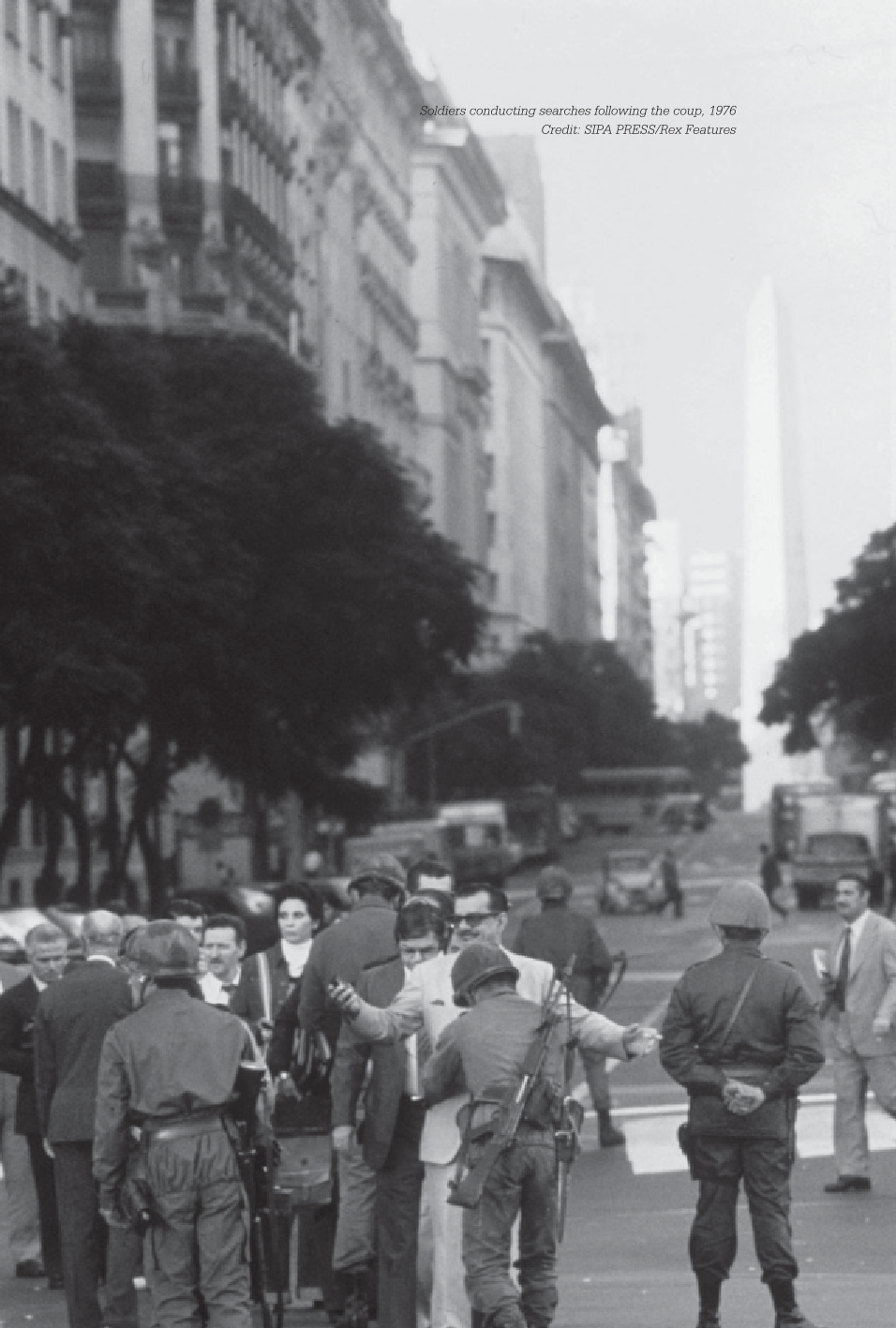
Soldiers conducting searches following the coup, 1976
Credit: SIPA PRESS/Rex Features
‘The phrase Final Solution was never used. The words Final Disposal were used frequently: those are two very military words that mean taking out of service something that is useless. When, for example, you speak of old clothing that is no longer used or worn out, it is marked Final Disposal. That has no further useful life.’ Another of his remarks was: ‘Let us assume that there were seven or eight thousand people who had to die to win the war against subversion: we could not execute them. Neither could we bring them to court.’
Twice before starting work on this book I had interviewed Jorge Rafael Videla. It became obvious that his remarks on the war against the guerrilla groups in the 70s were unknown, his views precise, sweeping and harsh. I shelved other plans to concentrate on Final Disposal.
There are questions that have pursued me for years, just as they must have so many other Argentines: when, how, where and why did the military take the decision to kill and disappear so many people? Why weren’t they taken before a judge or executed? How did the military come to think that such an absence would be forgotten? Why were they taken to detention in secret places? How was torture to be justified? What was the influence of the so-called French Doctrine [a reference to the anti-guerrilla tactics imposed by the French army during the war of independence in Algeria, including extreme torture]? Do they have regrets? Was it a unanimous decision by the leadership of the armed forces? What was Videla’s role? Is there a list of the victims? Where are their remains? How did the military refer among themselves to the circumstances? Could the lower rank officers disobey their orders? Did any disobey? Who, how, when and where was the Final Disposal decided for each of the detained? Was there a systematic plan to steal the children from the detained and hand them over to families that changed their identity? If that happened, why were there so many children appropriated by families linked to the military regime?
Final Disposal includes the testimony of other military chiefs, former officers, political appointees, guerrillas, politicians, trade unionists and businessmen who helped construct a picture as detailed as possible of those years of terror.
A visit to Montevideo helped to launch my project. Bookstores in the Uruguayan capital stocked copies with the self-criticism of former guerrillas, self-critical military officers, and reflections by the Tupamaros guerrillas on the dictatorship. There was one book based on interviews with general Gregorio Alvarez, Uruguay’s Videla. I had previously tried and failed to interview the leader of the Montoneros guerrillas, Mario Eduardo Firmenich (sentenced to 30 years in prison, in a 1984 trial in which Andrew Graham-Yooll was prosecution witness at the request of President Raúl Alfonsín; pardoned in 1990 by President Carlos Menem), but I was able to speak to his second-in-command, Roberto Perdía. That interview, with Perdía and others of his kind, was what convinced Videla. ‘To me, you are a protagonist of history,’ I told Videla as we started our first interview on Wednesday, 26 October 2011. Videla smiled, unbelieving. The book is not a biography, but centred strongly on the concept of Videla as an historic character, the dictator during five out of the seven years and eight months that the military regime lasted.
Videla was the army strongman and head of a dictatorship different to all that came before; one that was much more violent, which sought to ‘discipline an anarchic society’ and launch ‘a new economic model’ which would liberate Argentina from the ‘plagues’ that prevented the country from reaching its manifest destiny. The plagues were seen to be Perónism, whose ‘demagogic populism’ was unbeatable in elections; trade unionism, which was an ‘exaggerated and irrational’ element of power; the land-owning bourgeoisie that had substituted hard, creative and competitive work with accommodation with whoever happened to be in government, through corruption and official credit that was never paid. All were seen as affected by the ‘divisive and foreign oriented’ line of the left in politics, trade unions and, above all, culture. This foundational objective was made clear in the baptism of the military regime, the National Reorganisation Process.
In this way, Videla represented the high point of the political and social autonomy of the army, and by extension the armed forces, which had grown since 1930. The counterpoint to this was the systematic decline of the parties and of all institutions of liberal, republican democracy. Thus, the army and the Catholic Church, the sword and the cross, united to defend the Fatherland and ‘western and Christian’ values. Videla was the main actor in the 24 March 1976 coup, which had the support of a vast majority of Argentines for multiple reasons, among them the bombings, the kidnappings, the hold-ups and hijackings, and the murders by the guerrillas. And it was also welcomed by groups that banked on a ‘popular war’ against the ‘system’s military machine’, as Mario Eduardo Firmenich had stated in 1977 when opening a training course for cadres in the Montonero party.
Videla described each ‘disappearance’ as the ‘disguising of a death’ and explained why the forces resorted to that definition. ‘The effort required to win the war was tremendous.’
The late author Ernesto Sabato in his original 1984 introduction (rewritten by President Néstor Kirchner in 2005) to the Nunca Más (Never Again) report by the National Commission on Disappeared Persons, Conadep, wrote: ‘Thousands and thousands of human beings, generally young and even adolescent, became part of that terrifying and ghostly category: the “Desaparecidos”. The word – a sorry Argentine privilege – is now used in Spanish in the press of all the world.’
A majority of the deaths, disappearances and thefts of children took place during the early stages of Videla’s presidency, when he was also army chief. That fact alone would justify a book of interviews with Videla. After the return of democracy in December 1983, the former dictator was sentenced to life in prison and cashiered, banned from using rank and uniform. That was on 9 December 1985, at the end of the historic trial of the members of the first three military juntas. Five years later president Carlos Menem pardoned Videla, along with other officers and ministers, and the Montonero ‘commander’ Mario Firmenich. Videla lost his freedom again in 1998, accused of the theft of babies [of the ‘disappeared’]. He spent 38 days in prison and the courts conceded house arrest at his three-room home in the suburb of Belgrano (even the politicians and officers who detest him admit he made no money while in power). House arrest is granted to detainees over the age of 70, largely because the prison system is not designed to tend to people of that age. But it does depend on the judge. Ten years later, when Videla turned 83, a federal judge sent him to a military prison in the Campo de Mayo barracks, west of Buenos Aires.
President Menem’s 1990 pardons were cancelled in part by congress and the supreme court during the presidency of the late Nestor Kirchner, on grounds that crimes against humanity could not be pardoned. Videla was tried again and sentenced on 22 December 2010, this time for the murder of 30 political prisoners held in Córdoba, between April and October 1976. His lawyers appealed.
Videla considers himself a political prisoner: ‘I have been tried for all actions during the war against subversion in the trials of 1985. In some I was found guilty, I was absolved of other charges. The new trials have no meaning because nobody can be tried twice for the same actions. Also, my accusers are using legislation concerning lesa humanidad (crimes against humanity) that was passed after the events I am accused of.’
He was not a ‘classic’ dictator given his personality and because military power was divided. There was a junta, formed by the commanders of the army, navy and air force, which in theory stood above the office of president. The public administration was carved up between the three forces, each controlling part of the bureaucracy, although hampered by a complex system of veto and cross-checks involving the other forces.
‘I was not a typical dictator, Pinochet style, for organic reasons, given that supreme power was divided in three. And I have not been an authoritarian. Certainly, I was a dictator in the Roman sense, as a temporary remedy, to save the institutions of the republic. I would have preferred not to have been so. I would rather have not had to save those institutions. But I was a military officer who did his duty, who took over government as an act of service.’ Videla considered that nobody conditioned his rule. ‘Truth is, during five years I did as I wished. Nobody hampered my government; not the junta or anybody else.’ He admitted his decisive responsibility in the methods used under the Final Disposal.
I was a dictator in the Roman sense, as a temporary remedy
From one point of view it is practical to consider Videla, Massera, Firmenich, Perdía and others as the protagonists of history; convenient, because it frees us – the public, journalists, politicians – of the prejudices and passions that such figures spark, and releases an interviewer from asking nice, polite questions, insisting on clarification if necessary, and from looking at personality details or the way the interviewee lives.
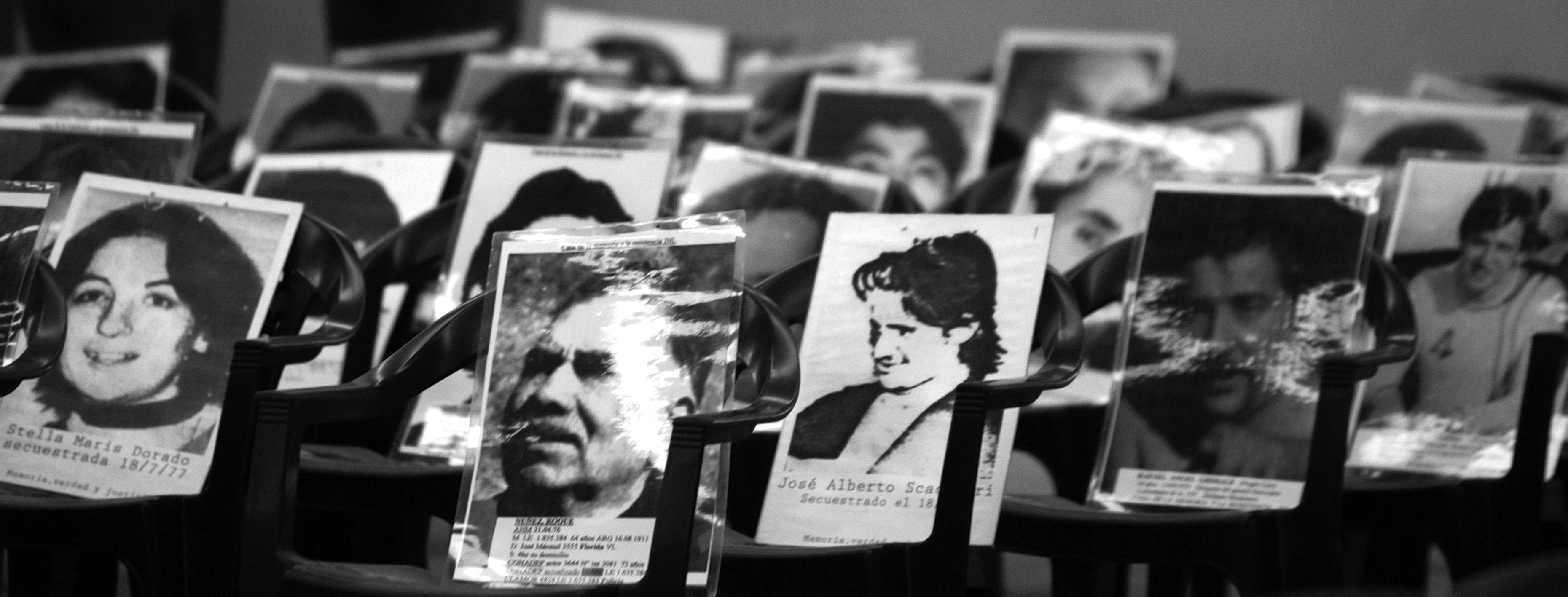
Photographs of people who disappeared during Argentina’s 1976–83 military dictatorship
Credit: Marcos Brindicci/Reuters
However, some of those sources appear more than eager to be interviewed. On the warm night of Friday, 11 March 2011, I went to the home of General Albano Harguindeguy, Videla’s once powerful and terrifying interior (home) minister, on a street ironically named Eva Perón in a suburb of Buenos Aires. The ‘Basque’ as his second wife, Elena, calls him, is under house arrest and awaited me in his wheelchair.
Harguindeguy answered all my questions, his memory intact, his glance clear and cunning, his voice at once friendly and ironic, even if a little dulled by age. The government of Cristina Kirchner and followers were marking the 38th anniversary of the election victory of Juan Perón’s delegated presidential candidate, a dentist and former national deputy named Héctor J Cámpora (who was removed 49 days after taking office by the man who had made him presidential candidate, Juan Perón). At 11pm, when the interview was over, Harguindeguy remarked: ‘They thought they were omnipotent. We believed we were omnipotent.’ I thanked him. ‘You can’t leave already,’ he complained. ‘Hardly anybody visits me these days.’
I thought that we journalists were doing something wrong, writing more than necessary about the 70s. And yet we do not consult the actors of those years enough: the military are in prison or at home. Defeated, sentenced, bored, abandoned by their successors in command, many of them are available and ready to answer questions about the past.
That was the case with Videla, who started to end ‘the silence I had forced on myself’ from about mid-2010. He first spoke out at his trial in Córdoba. Next he granted an interview to the Spanish weekly Cambio 16, published in two parts, on 12 February and 4 March 2012. Ten days after this coverage, which won wide notice in Argentina because of his criticism of the Kirchner government, I found him in great spirits. Videla, like many of his imprisoned peers, had gambled on the defeat of Cristina Kirchner in the October 2011 presidential elections. He had really expected a former president, Eduardo Duhalde, to win, and then he would have been freed by a special amnesty. After the 54 per cent re-election victory secured by President Cristina Kirchner for another four years, Videla concluded that at his age there was no point in refusing to be interviewed. That may have been the reason he first granted an interview to Cambio 16 magazine. The debate as to whether or not journalists should interview characters such as Videla remains open.
For human rights organisations in Argentina and followers of the Kirchners, the demons were Videla, the military and police during the dictatorship. Therefore, the guerrillas, the activists, were angels: young people filled with enthusiasm, fervour and pure ideals sacrificed their lives for a better Argentina, where there would be real freedom and equality. As if such noble aims can gloss over some of the methods used which were in clear violation of human rights. The undercurrent in the official view now is that there is a moral superiority on the left and amongst revolutionaries. This counters the view of the 80s, when people spoke of two forms of terrorism: on the left, the guerrillas, on the right, the state. ‘The two demons’ was the definition then. In fact, the basic ideas of the left are currently shared by the right. They differ only in some of the language: the left speaks of the working classes and socialism. The right refers to patriotism and nationalism.
But the violence of the dictatorship cannot be equated with that of the guerrilla groups: it is not just the number of casualties. The Final Disposal was particularly vehement because it was implemented as a policy of the state, in theory the guarantor of law and life in society.
As a result of the theory of ‘angels and demons’, human rights organisations and the government insist that the number of desaparecidos is 30,000, even though official figures range from 7,500 to 8,875 ‘disappeared’ and confirmed deaths, named and identified, and even though those figures include some killed as far back as 1969. Videla speaks of ‘seven or eight thousand’ people ‘who had to be killed’ although, in a strange coincidence with one progressive group, he remarked, ‘we could argue the figures’, but the key element ‘is not in the numbers but the fact’.
It is not a minor issue. The Argentine state should be concerned with establishing an exact number, not just because 30 years after the return of democracy it is time to know the truth in all areas. One way of closing old wounds would be to find out what happened with each of the disappeared or, at least, the whereabouts of their remains. That would be basic in mitigating the pain of their loved ones who have no place to leave a flower. President Cristina Kirchner was right to say that ‘there must be no greater horror for the human condition than that uncertainty’. Disappearance implies a double death.
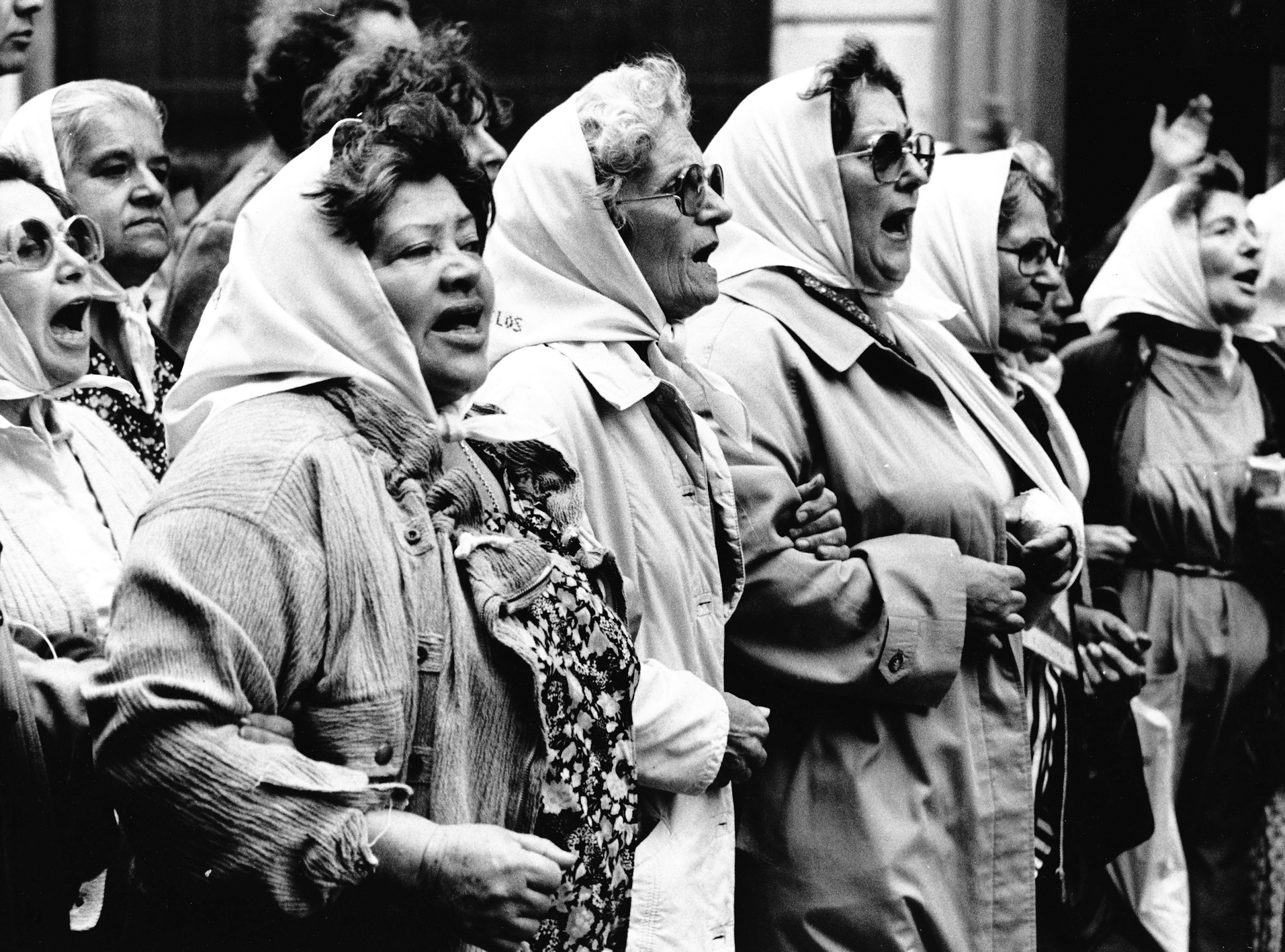
Mothers of Plaza de Mayo, the relatives of the disappeared, demand justice, Buenos Aires,1985
Credit: Julio Etchart/Alamy
But it is difficult to know the whereabouts of the disappeared, all of them, without a list of names and figures as precise as possible. Arguing at this stage that victims of the dictatorship were 30,000 makes the problem of finding their remains unsolvable. It is a banner for the politics of human rights, but no more.
Videla occupies cell number 5 in the military prison. It is a small room. There is a single bed with a wine-red cover stretched very tidily. There is a crucifix on the wall above the pillow, a small wardrobe, a fan, a heater and a dressing table on which stands a photo of his wife when she was 15. Mrs Alicia Raquel Hartridge de Videla can hardly walk, but visits him each week. There are blue curtains on the single window. The toilet and shower are shared with the prisoner next door. There is a chapel nearby where Videla prays every day at 7pm. On Sundays he takes communion. He is convinced God always guided him and never let go of his hand, not even in prison.
As we parted I had to say: ‘You will not be satisfied with this book, because that is inevitable. Given the subjects we have discussed, the only way you could like a book is if you or some friend writes it.’