




Abstract

As UK campaigners make the last push for libel reform,
At 7pm on 18 May 2009, about 300 people packed into the basement of the Penderel’s Oak pub in Holborn for a public meeting. Professor Brian Cox, the physicist, broadcaster and former pop star, was among the speakers, and so was Dave Gorman, the comedian, but the main draw was a less well-known name – an excitable science writer with John Lennon glasses and a spiky haircut.
The assembly of assorted sceptics, bloggers and scientists had come to listen to Simon Singh, the author of Big Bang and Fermat’s Last Theorem. He wasn’t there because he had a new book to promote. He was there because he was fighting a libel case that could easily bankrupt him.
Just over a year before the meeting, Singh had marked Chiropractic Awareness Week by raising a little awareness of the alternative therapy in the pages of the Guardian. ‘You might think that modern chiropractors restrict themselves to treating back problems,’ he wrote, ‘but in fact they still possess some quite wacky ideas. The British Chiropractic Association (BCA) claims that their members can help treat children with colic, sleeping and feeding problems, frequent ear infections, asthma and prolonged crying, even though there is not a jot of evidence. This organisation is the respectable face of the chiropractic profession and yet it happily promotes bogus treatments.’
The respectable face of the chiropractic profession did not seek to rebut the charge with evidence. Instead, the chiropractors sued for libel – with every prospect of victory.
England’s defamation laws are notoriously friendly to claimants, who need not show that an alleged libel is false. The burden of proof lies on the defendant, who must demonstrate his assertion to be true, or a matter of fair comment. The legal costs involved are so steep, often running to hundreds of thousands of pounds, that even defendants who are sure of their facts can be cowed into submission for fear of bankruptcy.
With the financial resources to sue, the BCA saw an opportunity to force one of Britain’s most vocal and effective critics of alternative medicine to eat his words. And when the geeks gathered at Penderel’s Oak, that seemed a very real possibility. A few days beforehand, Mr Justice Eady had ruled that by using the word ‘bogus’, Singh had implied deliberate dishonesty on behalf of the British Chiropractic Association – a charge he never intended, and which would be exceptionally difficult to defend. He was on the point of giving in.
The chiropractors, however, had reckoned without the geeks. And their intervention in support of Singh was not only to turn the course of his case but to catalyse a campaign for libel law reform that, three years on, is starting to bear fruit.
The BCA’s oversight was perfectly understandable. People with a passion for science, and the critical thinking on which it is founded, have never been particularly conspicuous in public life, let alone formed a constituency to be crossed at your peril. Yet something has been stirring among the geeks. Drawn together by the social networking power of the internet, they’ve stopped apologising for their interests, and are beginning to become a force in politics and society.
Through vibrant blogs and online forums such as Twitter and Facebook, and through the success of increasingly high-profile figures such as Singh, Cox and Ben Goldacre, geeks and sceptics are starting to fight for the value of science and evidence-based thinking.
The geeks are on the march. The BCA foolishly threw itself in the way.
Even before the chiropractors decided to mess with Simon Singh, many geeks had become dogged pursuers of homeopaths, anti-vaccine activists, dodgy nutritionists and other purveyors of quackery and pseudoscience. Some geeks are scientists. Some are doctors. Many are neither. All, though, care deeply about the scientific method: the most reliable tool humanity has yet developed for distinguishing truth from falsehood. ‘We’re rationalists,’ as Singh puts it. ‘We aren’t necessarily scientists, but we have an affinity for science.’
Biochemist Stuart Jones speaking in Parliament at lobby for libel reform, 27 June 2012
Credit: Della Thomas
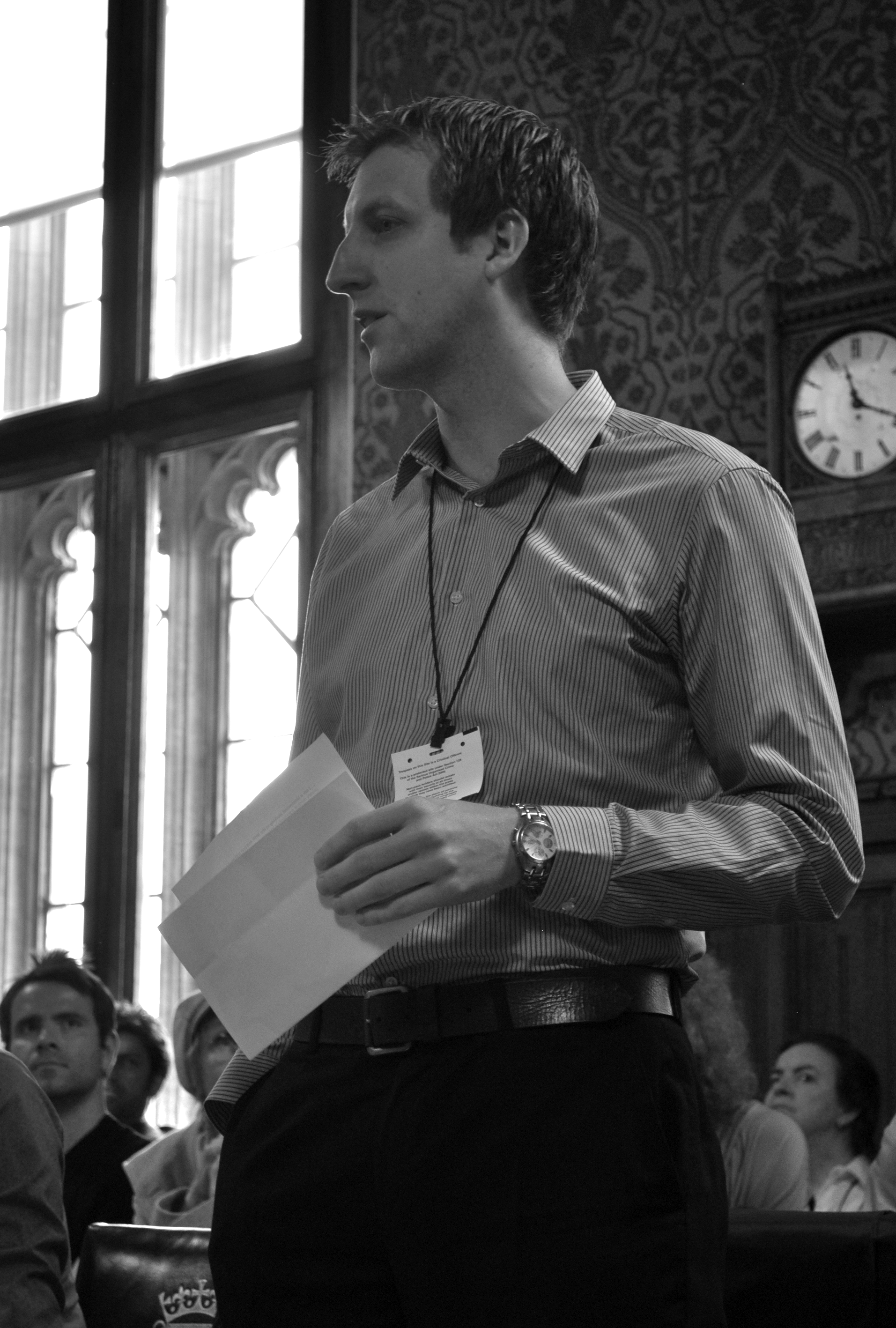
Geeks take a forensic approach to the evidence behind medical claims, and are strongly committed to unfettered debate. The chiropractors’ writ could scarcely have been better calculated to rile them. Legal bullying was shutting down rational argument. No self-respecting geek was going to stand for it.
As news of the law suit reached the blogosphere, geeks bearing noms de plume such as Gimpy and Zeno, the Quackometer and Adventures in Nonsense rallied to Singh’s support. Almost 10,000 people joined a Facebook group started by David Allen Green, a lawyer who blogs as Jack of Kent. Others weighed in on Twitter. Many offered money to finance the defence, which Singh declined. As a bestselling author, he had the means to fight. The question was whether he had the stomach for a legal battle that might effectively become a full-time job for years on end.
That stomach was never more sorely tested than in the days after Eady’s ‘bogus ruling’. Yet as he weighed up whether or not to settle and apologise, the groundswell of support he received both in person at Penderel’s Oak and from many more well-wishers online steeled his nerve.
‘The reaction was extraordinary,’ Singh says. ‘There was a point in May when I was close to caving in. That support was really important. It made me think: “Simon, you’re not crazy. You’re not the only one who thinks this matters.”’
Green agrees that the geeks were crucial. ‘No one would have thought badly of Simon if he had just brought the case to a halt,’ he wrote later on his blog. ‘The ever-growing online support helped keep him soldiering on.’
It wasn’t just moral support that was on offer from these welcome allies. A devastating counter-attack was soon under way. When the BCA released what it called a ‘plethora of evidence’ supporting chiropractic as an effective treatment for childhood ailments such as colic and asthma, a battalion of bloggers demolished every claim within 24 hours. If the claimant were to rely on this in court, the defence would have refutations to hand.
Then there was what Green dubbed the ‘quacklash’. Unlike most other alternative therapists, such as homeopaths or reflexologists, chiropractors are regulated in the UK. They must adhere to a set of professional guidelines that include obtaining informed consent from their patients, and they are subject to trading and advertising standards, which do not allow claims that are not supported by evidence.
Bloggers such as Andy Lewis (the Quackometer), Simon Perry (Adventures in Nonsense) and Alan Henness (Zeno’s Blog) began to trawl chiropractors’ websites for misleading and unsupported medical assertions. They then reported those who appeared to be in breach of regulatory standards. ‘I don’t think there could be a better use of £75 worth of stamps,’ wrote Perry.
There was no shortage of suitable targets. In June 2009, shortly after Mr Justice Eady’s preliminary ruling, the General Chiropractic Council received complaints about more than 500 individual practitioners in the space of one day. Chiropractors went into full-blown damage-limitation mode. Lewis got hold of an email from the McTimoney Chiropractic Association urging its members to take down their websites and ‘to remove any patient information leaflets of your own that state you treat whiplash, colic or other childhood problems in your clinic’. These, of course, were the very claims Singh had questioned to prompt the BCA’s writ.
By resorting to law, the back-crackers inflicted terrible self-harm. In trying to silence a critic, the BCA invited unprecedented scrutiny of the evidence base for its techniques. Newspapers that hadn’t covered the original lawsuit gleefully reported the quacklash and the threat to free speech. There was suddenly a news hook for articles examining the questionable claims made for chiropractic, and the Kafkaesque anachronisms of English libel law.
Even were the BCA to win at trial, damage to the reputation it sued to protect would reach a different scale to anything inflicted by Singh’s original column. But the victory was to be Singh’s. In April 2010, the court of appeal overturned Mr Justice Eady’s ruling in a withering judgment, and the chiropractors dropped their case. Singh’s supporters celebrated on their blogs and on Twitter by posting: ‘The BCA happily promotes bogus treatments.’ One in four British chiropractors was under investigation by regulators at the time.
Geek activism had helped Singh to win a seminal case, which established an important legal precedent that should protect other scientists and writers. ‘Scientific controversies must be settled by the methods of science rather than by the methods of litigation,’ the judgment noted. But the campaign achieved something else besides, focusing public attention on the chilling effect of English libel law on public discourse.
The libel action turned Singh – well known for a science writer but hardly a household name – into a cause célèbre. He became a symbol of free speech and principled scepticism, championed by celebrities such as Ricky Gervais, Dara Ó Briain and Stephen Fry. But the movement didn’t stop there.
Science writer Simon Singh (second left) with supporters outside the High Court, London in 2010, after he won his libel battle against the British Chiropractic Association (BCA)
Credit: Fiona Hanson/PA
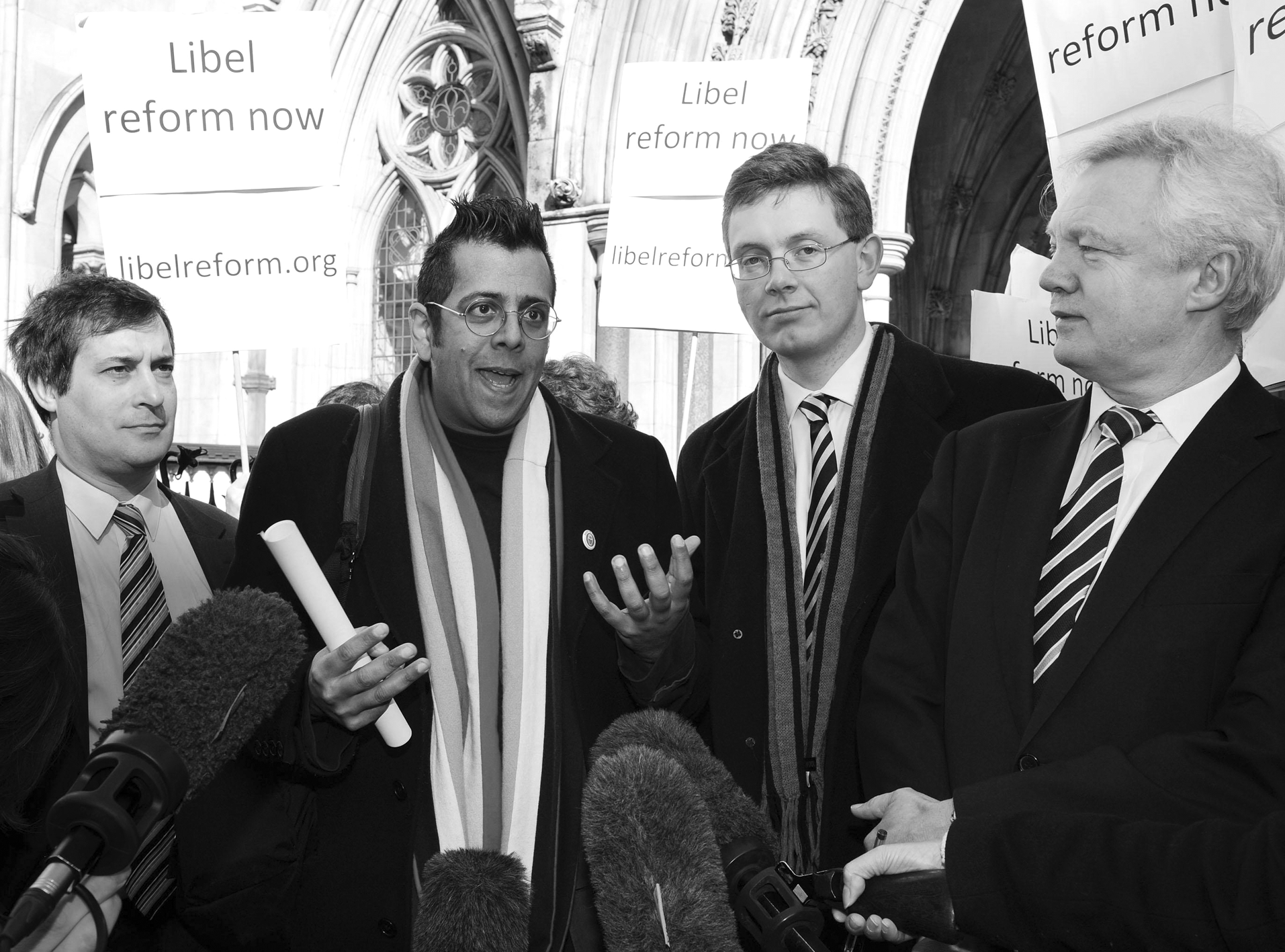
Galvanised by the Penderel’s Oak meeting, Tracey Brown and Sile Lane, of the charity Sense About Science, began a ‘Keep Libel Laws Out of Science’ petition, soon to carry 20,000 names. They then joined forces with Index on Censorship and English PEN, to begin a wider campaign for libel reform that rapidly began to gather pace.
The narrow aversion of a serious injustice, which still left a vindicated Singh £60,000 out of pocket because of legal costs he could not recover, offered convincing evidence that libel law had become a serious threat to free expression. It was even a threat to public health: if medical techniques and technologies could not be criticised without risking a defamation suit, they could not receive the scrutiny that is necessary to protect patients.
This was a message that campaigners could take to MPs with every chance of convincing them, not least because the Singh case was no isolated incident. Peter Wilmshurst, a British cardiologist, found himself defending a libel action after he criticised a heart device made by an American company. His remarks were made at a conference in the United States, and reported by a North American website, but the writ was filed in London. He faced bankruptcy and the loss of his home.
Cases such as Singh’s and Wilmshurst’s offered clear evidence that libel reform was not simply an obsession of tabloid journalists still smarting over the award of million-pound damages to celebrities like Elton John. Defamation was being used to stifle the kind of criticism without which science cannot properly take place.
This was a message that was sufficient to convince Labour, the Liberal Democrats and the Conservatives to support reform in their 2010 election manifestos. And on 9 May 2012, a Defamation Bill was included in the Queen’s Speech.
This bill is imperfect, but it does offer an opportunity to begin to reform a libel system about which journalists, human rights activists and some lawyers had been complaining for years, with little effect.
Through the Singh case, geeks provided a catalyst for change. They made it plain that the cause of libel reform was not simply a sectional interest of a media that wanted to peddle poorly sourced gossip without fear of sanction. When legitimate scientific criticism of medical interventions stood at risk of being silenced, libel became a matter of public interest and public health.
Through their outspoken activism in support of Singh, and Wilmshurst, the geeks succeeded in forcing libel reform onto the political agenda where others had failed. Their message was one that resonated with MPs, many of whom were prepared to stick up for the unfettered discourse of science when they would have been reluctant to defend the perceived interests of the Sun and the News of the World.
Geeks turned libel reform into a cause that reasonable politicians could no longer ignore. And as the Defamation Bill begins its final journey to the statute book, they are again at the forefront of efforts to improve it with remorseless lobbying to ensure that no one speaking out in the public interest can be silenced or bullied.