




Abstract

Head of Dagestan’s journalists’ union
On 15 December 2011, editor and journalist Hadjimurad Kamalov was murdered in Makhachkala, the seaboard capital of Dagestan. The journalism community in Russia, and the Caucasus region as a whole, suffered a loss that could easily be equated to that of Anna Politkovskaya in 2006. He was less well known to the outside world but Dagestan, a country as large and populous as neighbouring and independent Georgia, plays a key role in the area, not least with regard to its immediate neighbour Chechnya.
Since 2005, Dagestani journalists have increasingly become targets of largely successful attempts at assassination. In March 2008, the head of broadcasting for the country, Hadji Abashilov, was shot dead. This was followed by the assassination of Telman Alishayev, author and presenter for a moderate Islamic TV channel, in September. In 2009, Malik Akhmedilov of Khakikat newspaper was shot dead and, in 2010, Telman Alishayev’s successor, Sultan Magomedov, was assassinated.
In August 1999, the Chechen warlord Shamil Basayev and his Saudi comrade-in-arms Khattab bin Ali led a small invasion force from eastern Chechnya across the mountains into neighbouring Dagestan. This fateful event, followed by apartment bombings in subsequent months in the cities of Buinaksk (Dagestan), Volgodonsk (Southern Federal District) and, worst of all, in Moscow itself, led to the second Chechen ‘war on terrorism’, which began in November 1999.
In 2005, the counter-terrorist operation was declared finished in Chechnya. The small country in the North Caucasus, with a million inhabitants at the most, had paid dearly for its attempt in 1994–1996 to secure, and again in 1999–2005, to maintain a greater independence from Russia. The campaigns waged by Moscow in Chechnya could not help but affect its neighbours on the north side of the Caucasus mountain range. Ingushetia to the west was flooded by waves of displaced people and then afflicted by regular disappearances and kidnappings.
Dagestan, the largest of the seven republics, with a population of three million belonging to more than 30 different ethnic groups, has faced growing violence and instability. Basayev, Khattab and their forces were driven out but an increasingly radical youth and other local radicals began taking to the hills and the forest. If they subscribed to any clear ideology, they often proclaimed that they wanted an Islamic republic or, even, a Caliphate of all the countries in the North Caucasus, from the Black Sea to the Caspian. They engaged in persistent running battles with the local police and security forces, who themselves lost hundreds of men. Unlike Chechnya, military and police units from all over the Russian Federation have not yet been drafted in to ‘help’ the local authorities cope with the terrorist threat. This constant possibility remains a nightmare scenario for Dagestanis.
Hadjimurad’s uncle, journalist and editor Ali Kamalov, who helped pioneer ways in which newspapers in Dagestan could survive, speaks here about free speech and the danger journalists face.
Journalists continue to be killed for their work; more than ten have been murdered there since 2005. Can you tell us more about what it’s like to be a journalist in Dagestan today and about the cultural, social and political climate?
In Dagestan today, it is not only journalists that are attacked or killed. Lawyers and judges are targeted as well.
There are divisions within society. Over the past 20 years a relatively small group of people have grown rich, leaving many others impoverished and increasingly resentful. There is an ongoing struggle between different clans to divide up positions of power and authority. When journalists write about these tensions and conflicts they find themselves caught in between.
A further division is a religious one. The country is 99 per cent Muslim. State authorities in Dagestan, particularly the law enforcement agencies, have done their best to increase animosity. If people do not think like our rulers (and in Dagestan, religious leaders are close to the government) the police persecute them.
Journalists in Dagestan today act as human rights defenders. They are opposed above all to disregard for the law. They act as the people’s lawyers. My nephew set up Chernovik in 2003 as a publication that would perform that role.
Chernovik was a phenomenal success. Within 18 months, it had become the most popular newspaper in Dagestan. It began campaigning, not against a particular individual or on a single issue, but against shortcomings in the judicial system and the republic’s law enforcement agencies. This was my nephew’s achievement – the Russian political analyst Maxim Shevchenko described him as the ‘Martin Luther King of the Caucasus’.
Russian journalist Julia Latynina stated that Hadjimurad’s death will severely restrict access to reliable information about the North Caucasus. What will be his legacy, and how is the newspaper coping without him?
Hadjimurad was universally trusted. Prosecutors and judges feared him. Officials respected and feared him. All were reluctant to debate with him on television. The most intimidating of our ministers and prosecutors would ask me to intercede and help them restore good relations with him.
The current president of the republic became friendly with him and suggested that Hadjimurad might become a minister in Dagestan or run a major region within the country. My nephew replied: ‘I am not joining the administration. If I do so I will have to abandon the newspaper and I am not prepared to do that.’
Hadjimurad demonstrated that one person can alter the way people think. Those who had not wanted to raise certain subjects in the press started to speak out when they saw what he was saying. Since his death people have again begun to fall silent. Hadjimurad would sign articles written by others to shield them from reprisals.
During the 1990s he was a college lecturer. I invited him and his two brothers to join me at our newspaper, Khakikat (Truth), so they would know what it means to be a journalist. He then moved to the Novoe delo newspaper. It’s a tabloid daily with universal appeal and, at that time, Dagestan’s favourite newspaper. Hadjimurad was deputy chief editor and ran it, although he always remained in the background.
Hadjimurad Kamalov at a demonstration against law enforcement officials, 29 August 2008
Credit: Sergey Rasulov/RIA Novosti
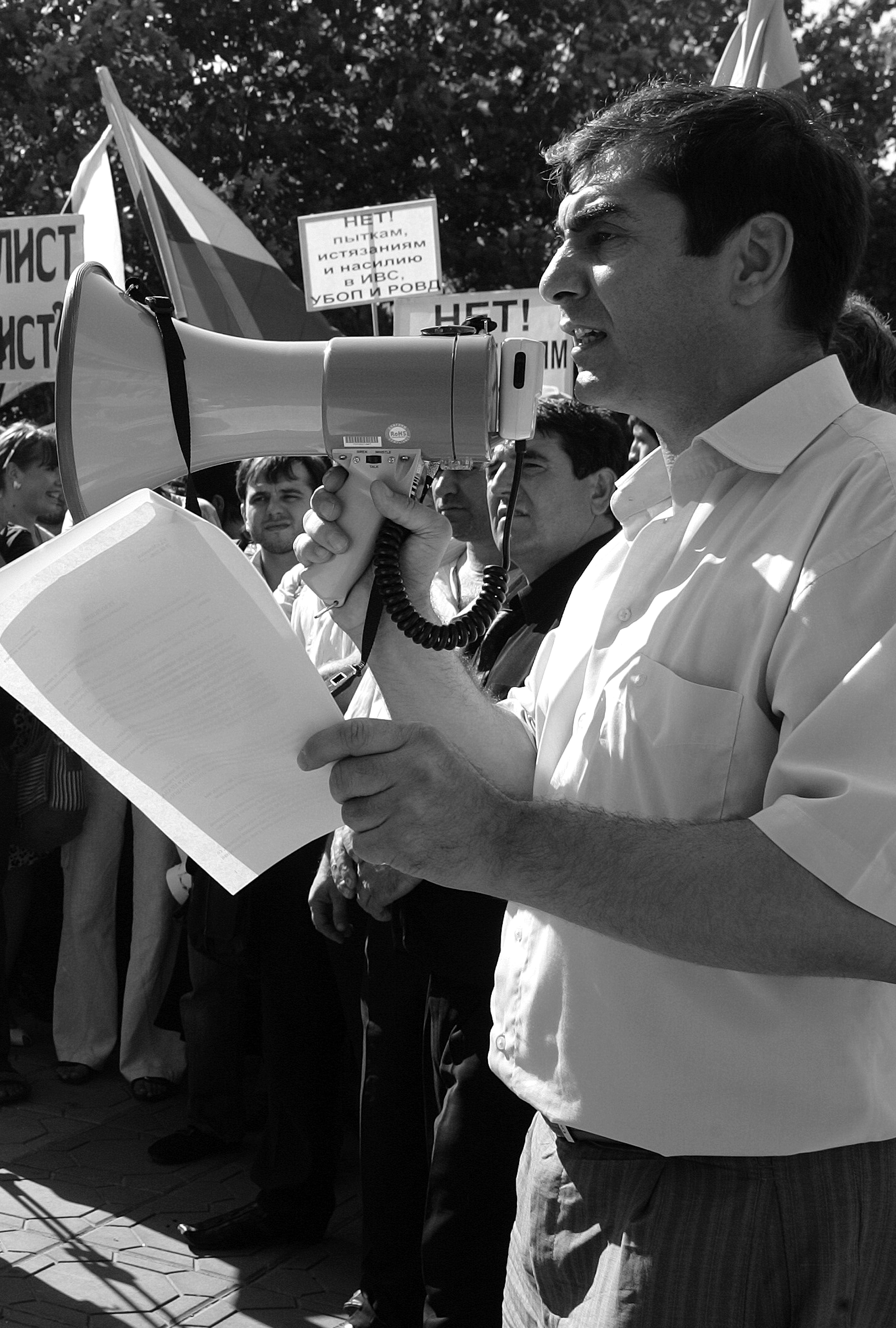
Next he set up the Free Word Institute, which was both a law firm and an institute for social analysis. Finally he started Chernovik, which means ‘Rough Draft’. Its title comes from US publisher Philip Graham’s dictum, ‘a newspaper is the first draft of history’. At first the new daily ran on enthusiasm, but in time Hadjimurad’s law firm and consultancy provided the income to support it. The newspaper, now headed by Hadjimurad’s younger brother Magdi-Magomed, continues. But we must consider the future. There are probably people in Dagestan who want to see the paper close. Others would like to cash in on its wide appeal. For political reasons or to make money, that’s why people want to own papers. Currently Chernovik is the only newspaper in Dagestan that pays its way.
To be frank, the newspaper lacks its former thrust and self-confidence. The president of the republic offered some funding. That means we are selling out and that society in Dagestan is not yet capable of defending the things it values.
A few years back journalist and rights activist Fatima Tlisova reported that not only was she being followed around in Nalchik (Kabardino-Balkaria), but that also her children were subject to surveillance. Do similar things go on in Dagestan?
Of course, there are threats and harassment; this is particularly the case when someone begins to expose the misdeeds of our law enforcement agencies. That explains why journalists have been murdered.
Chernovik defended anyone who was genuinely the victim of surveillance and harassment, whether they were rich or poor. Hadjimurad often used to say he was accused of being a Wahhabi. ‘Yes, I’m a Wahhabi’, he would say. ‘I admit it. Yes, I’m a bandit, I admit it. Yes, I’m an extremist. Here, put on the cuffs, take me to jail and, if you can prove that I’m any of these things, punish me. You must not punish anyone, however, without an investigation and a trial.’ Hadjimurad used to interrupt his phone conversations and say, ‘Take good note of this, I’m saying this for your benefit’ – addressing those whom he knew to be tapping his phone. They searched Hadjimurad’s apartment, they searched my home. We were publicly denounced as extremists.
Are there signs his murder is being properly investigated?
Authorities assure me that the investigation is making progress. I’m not convinced. After Hadji Abashilov, the director of state television, was murdered in March 2008, they carried out an investigation, arrested two lads and put them trial. The case collapsed and no verdict was reached.
Chernovik could always defend itself in court. One entire issue, for example, exposed staff at the state prosecution service as liars and cheats. It was quite specific in its allegations and challenged the prosecution service to go to court and disprove what the newspaper said. After Hadjimurad raised the standard in this way, people began to feel more confident. The courts re-examined their own behaviour and a great many judges were dismissed. Ordinary people began feeling that the judicial system could reach fair verdicts.
Who do you think killed Hadjimurad? What’s the general feeling?
There are different stories. Some say that a high-profile case like the murder of Hadjimurad was needed in the run-up to this year’s Russian presidential elections. The security services wanted to unsettle people and set them against each other. The result, though, was an enormous demonstration at his funeral on a scale that Dagestan has not seen before.
Following the murder of a fellow journalist in 2008, Hadjimurad addressed a big rally and called for the Minister of Internal Affairs to resign. The response was a circular distributed within the Ministry, as we learned by chance, saying that I was shielding and supporting extremists. The brains behind this group of extremists was Hadjimurad, the note said, and it listed 27 individuals who supposedly had met at the Journalists’ Club in Makhachkala with the aim of overthrowing the government. Since then two on that list have been murdered: Malik Akhmedilov, my deputy at Khakikat, in 2009; and Hadjimurad.
Following Hadjmurad’s murder there were calls to hold protest rallies. We set up a public commission, which I myself headed, and I spoke out against such gatherings. It would have been easy to call 30,000 to 50,000 of our young people out on the streets. But this would make it all too easy to for provocateurs to create an incident that could quickly escalate, causing bloodshed. I was alarmed at the prospect.
Are there journalists in jail in Dagestan?
Not one journalist in Dagestan has been convicted and sent to prison. Instead opponents use threats, beatings and murders. I myself was attacked, on 16 May 1996, in the stairwell entrance to our apartment building, by three men. They hit me over the head and stabbed me three times in the heart. Fortunately I did not lose consciousness; otherwise, I would have quickly bled to death.
Journalists are killed with guns, mortars or explosives planted underneath their cars. Most of the killings take place in the centre of the capital, Makhachkala. In many cases the murders take place in broad daylight with traffic police and other policemen standing nearby – and yet the perpetrators are not caught. This raises the suspicion that the killers may be linked to the security services, Special Forces, the judicial system and law enforcement officials.
Hadjimurad and I often discussed the likelihood that he might be killed. Others told me: ‘You must protect and defend your nephew.’ He carried a gun for a while. There were times when he had bodyguards and travelled in an armour-plated vehicle. He tried to avoid going to places that were very busy. He always said: ‘If they’ve decided to kill me, they’ll succeed.’
There are all kinds of ways they could have organised his murder. Some ignorant young man may have accepted money to do the job, but the decision was taken at a high level. My nephew stirred the hostility of many powerful people in Dagestan.
Translated by John Crowfoot