




Abstract
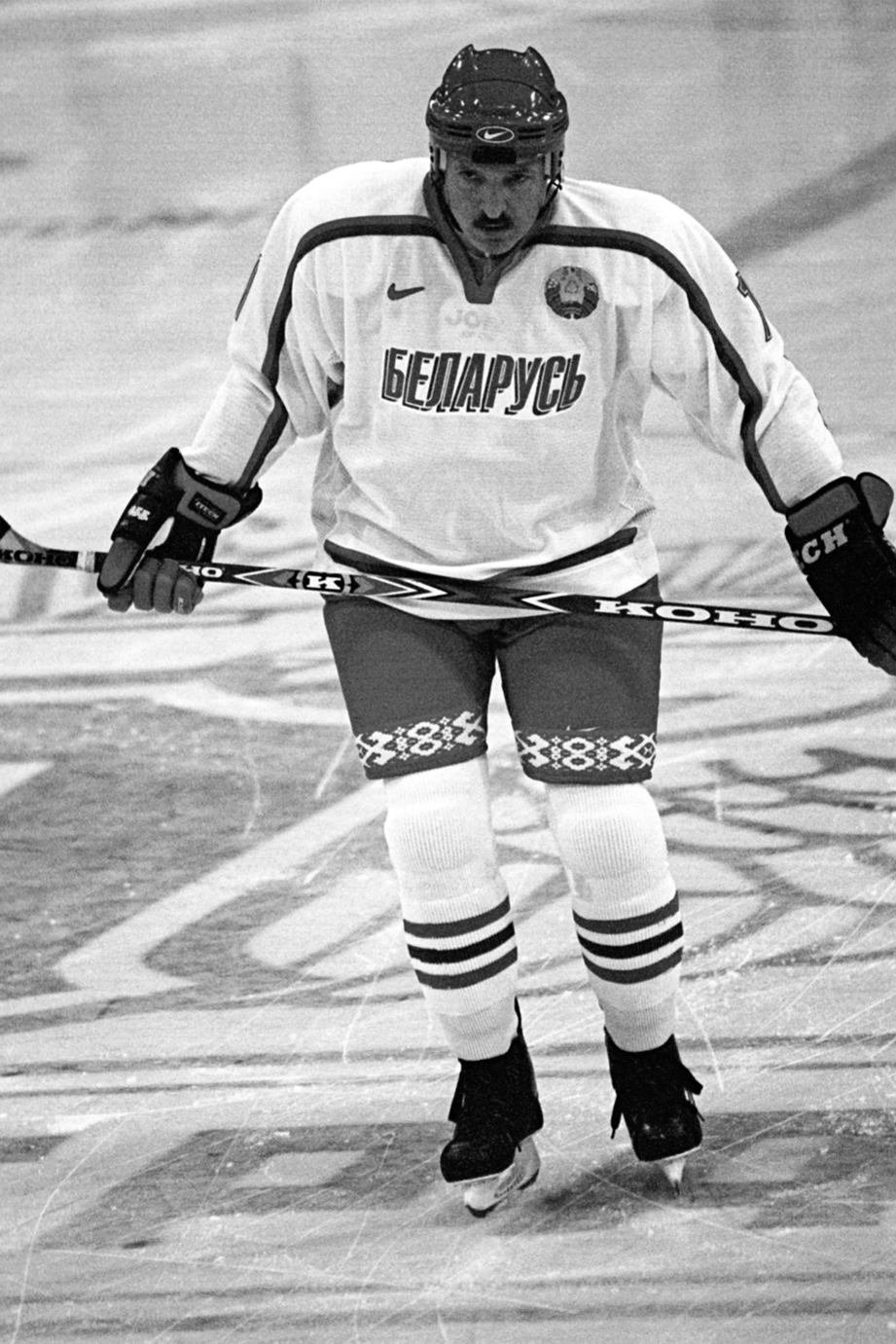
President Alexander Lukashenko during an ice-hockey match, Minsk, September 2003
Credit: Alexander Polyakov/RIA Novosti
Belarus’s dictator is an ice-hockey fanatic. Should the rest of the world boycott the 2014 games?
The window of my apartment in Minsk looks out onto a huge structure in the form of a grotesque-looking hockey puck. It is known as the Minsk Arena, a sports complex built specially for international ice-hockey tournaments, and it stands as a symbol of the sporting ambitions of the Belarusian authorities. In addition, the Minsk Arena acts as the regime’s visiting card, because the government and sports administrators are hoping that, in 2014, the world ice-hockey championships will take place right here, on this skating rink, in a stadium designed for 15,000 spectators.
Hockey is the favourite sporting activity of the Belarusian president Alexander Lukashenko. Every year he organises hockey tournaments in which he himself participates and wins. A Belarusian oligarch – on whose companies the EU recently imposed economic sanctions – has admitted in an interview that he goes to play hockey with Lukashenko much as he goes to work. If you play hockey with the president and join him in the gardens of his residence, mowing the grass with a scythe, you are in with the Belarusian elite. So ‘welcome to Belarus’, all you visiting competitors!
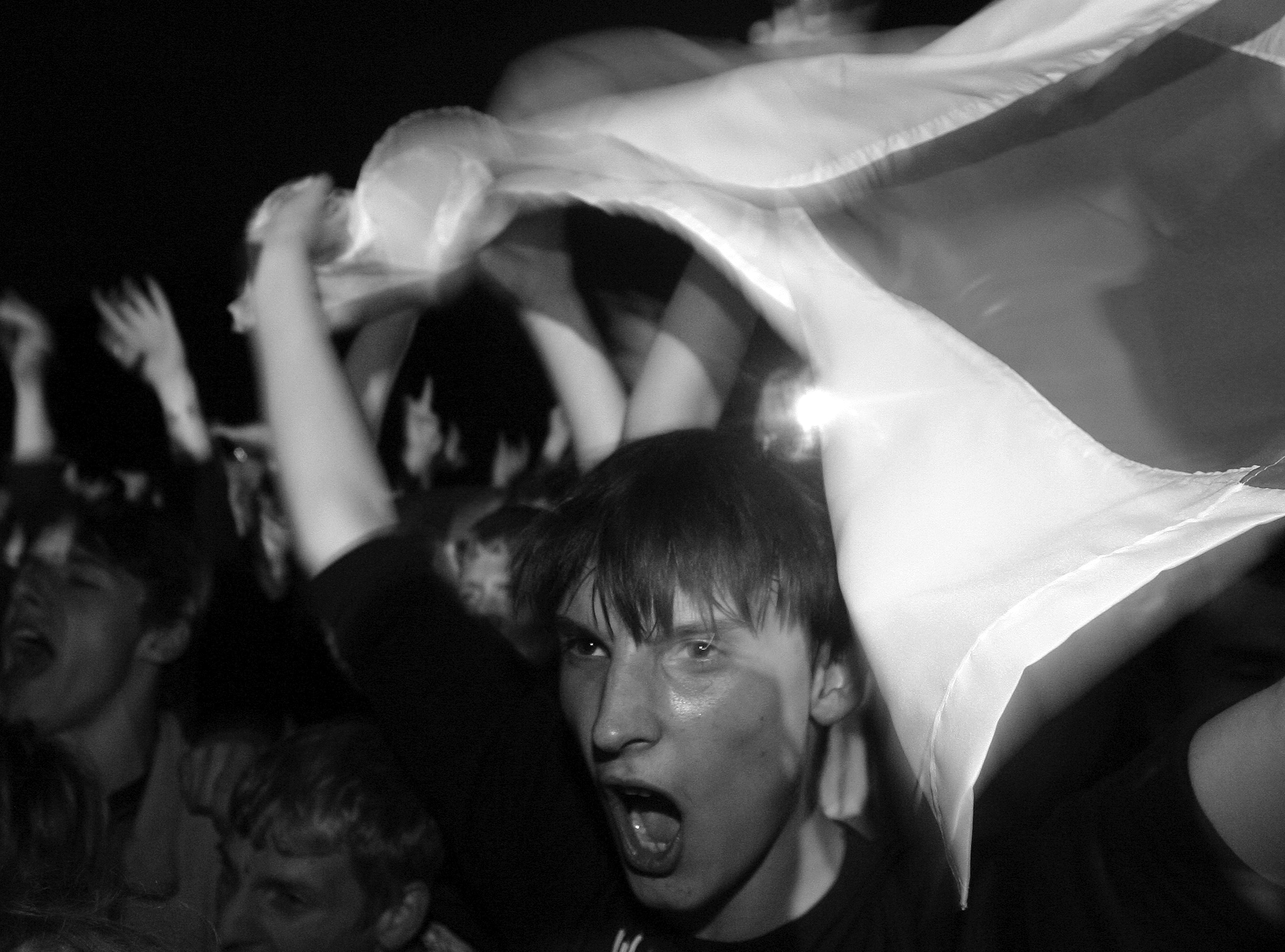
In Belarus there are many so-called Ice Palaces – vast edifices with ice-rinks designed specifically for hockey tournaments and built at Lukashenko’s personal instruction. On the whole they are empty. When matches do take place, schoolchildren and students are forcibly hustled in to play the part of spectators. Before a match everyone is carefully checked and frisked. Why? Well, how would it look if anyone displayed a political banner or the forbidden national white, red and white flag in public, which has become a symbol of national resistance? On one occasion my 10-year-old nephew was instructed to remove a white scarf with a red strip down the middle before going into the Minsk Arena. When his father expressed outrage and threatened to surrender their tickets, he was allowed through, but a security official sat with the boy throughout the match in case he thought to brandish the seditious scarf.
As I write, Siarhei Kavalenka is starving in a prison psychiatric ward, solely because he raised the national flag on New Year’s Eve in his home town.
Does Siarhei Kavalenka need the championships in Minsk – assuming he survives?
Do my nephew and his father need them?
Does the Belarusian oligarch?
But there can be no doubt at all that those who do need the championships in Minsk are none other than Lukashenko and his team.
What do international sporting organisations have in mind as they plan the championships in Minsk? Is it all about popularising ice-hockey? Organising a festival for hockey fans in Belarus? Earning a bit of money? Enriching the Lukashenko clan?
If it’s the last of these, then success is certain. All the Ice Palaces, along with most hotels and restaurants in Minsk, belong to the Presidential Administrative Directorate – for which read Lukashenko. So the money is sure to end up in the right pocket.
Any other possible agendas the sporting organisations may have in view remain hazy.
As regards popularising hockey and organising festivities for Belarusian fans, I must confess I’m not particularly interested in professional sport and all I know about ice-hockey is that you have to get the puck into the other team’s goal. In my view, funding allocated to any sporting championships, wherever they may be held, would be better spent feeding the hungry or treating sick children. Please don’t bother to read on if you disagree. But if championships like this do take place, the beneficiaries of the events should be the people of the country in which they are being held. At the present time Belarus is in no condition to hold festivals of any kind.
The people of Belarus are living in a state of persistent hardship and oppression imposed by the regime in power. As the Russian poet Mandelstam once wrote: ‘We live without feeling the country beneath our feet.’
We have felt this hardship particularly over the past 18 months. The blatant fraud associated with the presidential elections; the cruel, bloody suppression of peaceful protests; the false evidence given during the trials of the protesters; disastrous financial collapse; a mysterious explosion in the metro for which many people have blamed the authorities themselves; and the summary punishment of people who may or may not have been terrorists – irrespective of the fact that over 150,000 people signed a petition against the death penalty.
Immorality, demonstrative cruelty, an intentional flouting of law human and divine, chronic lying, national discrimination – all these characterise the actions of the authorities on a daily basis.
Threats, beatings, house searches and provocation dominate the lives of civil rights activists and the independent media in Belarus.
Sudden impoverishment, lack of civil rights, and deep despair that comes from knowing that it is impossible to change things are experienced daily by ordinary people.
I shan’t presume to say anything about the daily life of oligarchs – I know nothing about it.
I’ve tried putting the following question to a number of people: ‘How do you view plans to hold the ice-hockey championships in Minsk?’ Typical responses included remarks such as:
‘Unimpressed. In my mind hockey is associated with Lukashenko and he’s not a figure who makes me feel comfortable. So neither does the prospect of the championships.’
‘It would be fine, but not now.’
‘Not at all. I worry about surviving on my pension, and helping my children who live in poverty on a miserable salary. Hockey leaves me cold.’
I recall a recent conversation that took place when I was queuing in a bank, in the small town where I live. As they waited their turn, people chatted about how unprecedented devaluation had left them three times poorer overnight; about the rising prices of subsistence goods, what to do, and how to live.
‘According to the constitution, in this country power lies with the people. We need to change the government,’ I said.
A protester holds the banned opposition flag during celebrations to mark the 15th anniversary of Belarus’s independence, Minsk, 25 August 2006
Credit: Vasily Fedosenko/Reuters
Everyone burst out laughing.
‘When you get hit on the head with a truncheon, it hurts – a lot…’ said a middle-aged woman after a hearty giggle.
So there you have it: an average conversation. People do not feel that power lies in their hands, nor do they have the leverage to change their lives. And in terms of what the authorities offer, people see only the truncheons wielded by the special forces.
So let’s distract them with a bit of hockey! It’s just what everyone needs!
The decision rests with international sports organisations. If they decide to hold the world ice-hockey championships in Minsk, they will be offering the authorities the perfect gift, as well as a propaganda coup. For the Belarusian people, for civil society, it will be yet another insult. It will confirm the imperative that the authorities are diligently imposing on Belarusian society: ‘Morality is nothing: it is a hollow invention. The globe turns on money and coercion. The central values in the world are possession and power. That is the system we are building here in Belarus. The whole world lives like this. The world supports us, so don’t even think of trying to resist.’
I hope that those who take the decisions in world hockey support the basic values we share as human beings: do not kill, do not lie, do not commit adultery, respect your own people. The authorities in Belarus do not share these values and are doing their best to ensure that Belarusians also forget about morality and human dignity. If the thought of shaking hands with representatives of this regime does not seem rebarbative, then by all means hold the championships in Minsk. Only remember that the hands you shake sign documents that impose prison sentences on people who are trying to defend their constitutional rights. Belarus is ruled by ochlocracy – the power of the worst.
Belarus and the Belarusian people are treading a path that may be familiar to many other nations, a path that leads, as the classic Belarusian poet Yanka Kupala wrote, to a state that lets us ‘call ourselves human’ and ‘not be as cattle’. It is a path that will allow us to define our own lives, freedom and dignity. Let there be no doubt: Belarus shall achieve this. But help from the outside is also important. Holding the ice-hockey championships in Minsk will act as a powerful shot to the advantage of Lukashenko and his team of hockey-lovers, and send the puck over the goal-line of Belarusian society.
Any dictator knows the value of both pop music and sport. In a political dictatorship song and sport cease to be any kind of refreshment (which is what they should be) and become, essentially, instruments of propaganda. In Belarus every sport has its curators amongst government officials. Their ready declarations on how sport should be dissociated from politics are pure demagogy. Sport is a factor in politics. If it contributes to the support of an unethical order, then it becomes a factor in a particularly repellent kind of politics. And even if sport should indeed be dissociated from politics, should it be dissociated from ethics as well?
It should not, or disaster is bound to ensue.
I may appear to exaggerate, but that is reality as I see it. There is a limit to immorality beyond which nemesis awaits. The authorities have taken us to this limit. I can’t say what kind of disaster threatens: a loss of independence; an accident at the nuclear power plant currently under construction in Belarus; some awful terrorist attack at the world championships, similar to that in the Minsk metro a year ago?
If all this does not take us as far as terrorism, it will certainly lead to acts reflecting the despair of Belarusians who have not yet lost their ‘inner moral perception’ or forgotten how to look at the stars. The International Federation must be prepared.
In Belarus it is a criminal offence to call for sanctions against the ruling regime. This means that I could be arrested for writing this article. However, I shall not be calling for the championships to be moved elsewhere, not because I’m afraid of prison (which I am) but simply because I don’t feel competent to offer advice to specialists.
Instead, let me simply present a few facts.
Over the past 17 years, all elections in the country have been rigged. This is something Lukashenko himself has seen fit to recognise.
The country has always held political prisoners, who are used by the authorities as leverage to achieve their own ends. At present there are 13 political prisoners in the country. Two candidates for the presidency were arrested on the day elections took place in 2010 and released 16 months later in April.
Peaceful protests are crudely and violently suppressed.
Lukashenko admires Hitler and the system he enforced in Germany.
The country is effectively lawless, legal decisions are taken by the imposition of ‘telephone law’.
In his public addresses, Lukashenko likes to describe European politicians in the following way: ‘they haven’t got the balls …’; ‘goats’; ‘scumbags’; ‘a lousy bunch’.
According to sociologists the majority of the Belarusian population does not object to the idea of transferring the championships from Minsk to a different country.
If, under the circumstances, the International Ice Hockey Federation feels that it is either moral or logical to hold the championships here – then by all means let them do so.
Translated by Irena Maryniak