




Abstract

In 1991, Index was the first to publish the draft of a play that had not yet been staged and was eventually to be called Death and the Maiden. It was a claustrophobic work, dealing with the dilemmas of a transition to democracy in a country that might be Chile, but stood in for so many other wounded lands across the globe whose citizens were trying to figure out how to emerge from the past without forgetting its lessons or its pain and what to do with the unrecognised, often unnameable, traumas that they had suffered. I enclosed the story in a beach house and circumscribed the time to less than 24 hours in the life of three opposing protagonists and personalities, a supposedly limited microcosmos that ‘represented’ a vaster world outside where many similar people were facing the same fears and uncertainties. Of course, plays are never ‘about’ something. They should not attempt – at least mine do not attempt – to send a message or decide beforehand what the solution is to the terrors that haunt the men and women in that fictional universe. Even so, any work of art will inevitably reflect in some way, obliquely or more directly, the larger political and cultural framework within which it was given birth. More so, if it happens to be, like mine, a play where the state is itself an overwhelming force in the lives of the characters, where state policies of forgiveness and investigation and justice determine those lives: what is allowed remembrance, what is silenced, who gets away with torture and who suffers the consequences, who gets to decide the national narrative and who is left out of power.
Death and the Maiden, the Royal Court Theatre, London, 1991
Credit: Alistair Muir/Rex Features
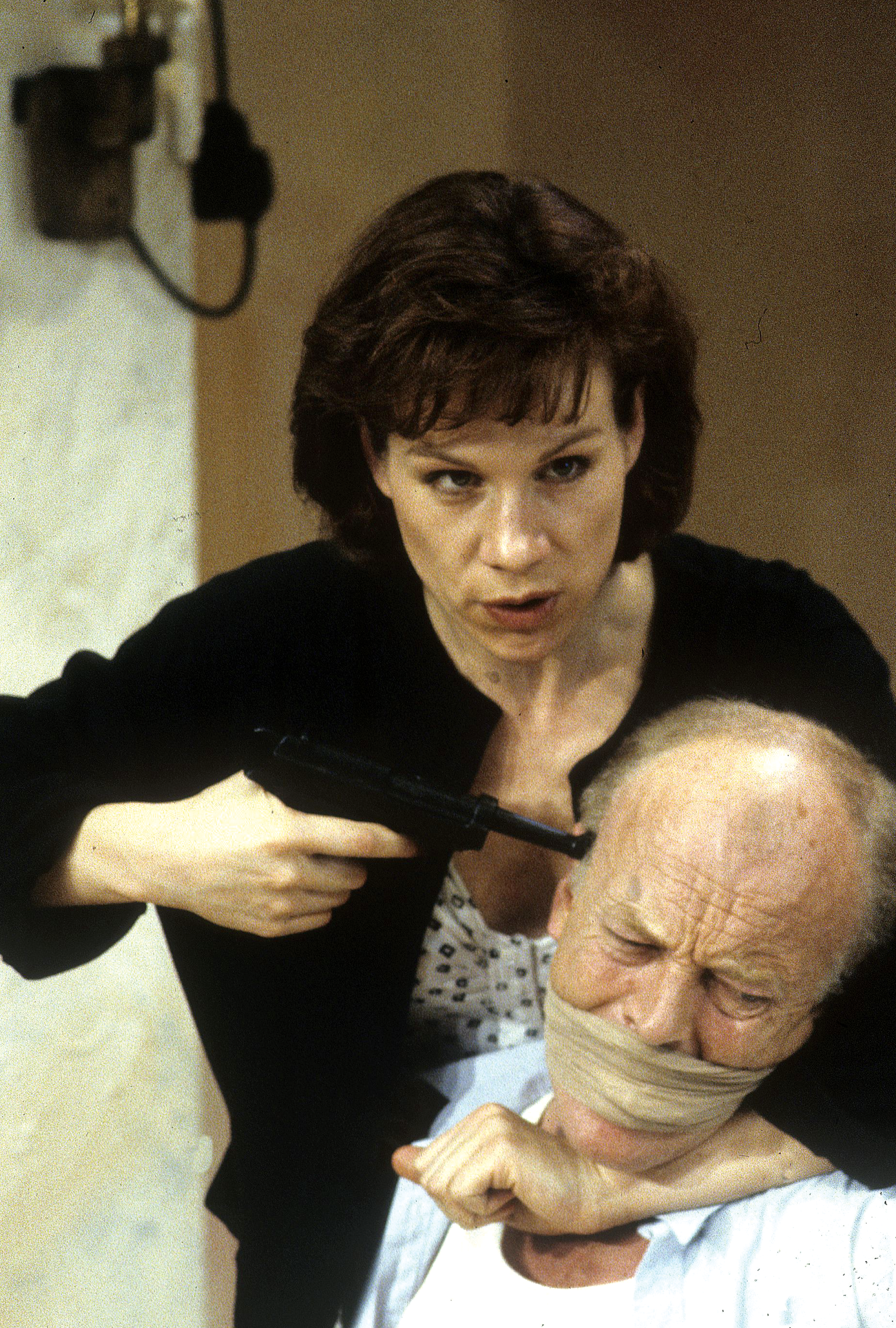
So the country just beyond the boundaries of that beach house is always lurking there, invisible but pressing down upon those two men and that woman. Which is why, in the final scene of Death and the Maiden, I broke all three characters out of the confines of those walls (really, the confines of their own minds), made them reconnect with each other in the public space of a concert hall, forced the real audience in the real theatre to see in the twisted fate of Paulina and Gerardo and Roberto their own collective destiny. The conflict up till then may have been circumscribed to these three and that beach house, but what happens to these people afterwards will be determined by history, by their further existence in a real country with real spectators, real victims, real accomplices.
Ever since that final scene, I have been wondering how to tell a story of a transition to democracy and its pitfalls, a story that could make the leap into history, get the epic treatment such a theme deserved, spanning decades. Like my play Widows (adapted with Tony Kushner from my novel), except that instead of focusing on a remote mountain village and peasant women whose men have been abducted, it would have at its centre the owners of power, the presidents and generals and opposition leaders – and their lovers, wives, husbands, consorts, subordinates. A play that dealt with many of the issues I had explored in previous work (disappearances, torture, truth commissions, resistance, complicity) but did so from the perspective of the rulers (I had dabbled with such a possibility in my play Reader, where the protagonist is a censor; but he was a functionary and not really in charge).
In a first version of that epic play, that I called In the Dark, commissioned by the Royal Shakespeare Company, I placed the action, almost automatically, in my home continent of Latin America – and indeed my play in Spanish, called Desde la Oscuridad, keeps that original location. But last year, as the Arab spring exploded and developed, I realised that to locate this story in an invented land in North Africa or the Middle East was to give it the urgency and immediacy and relevance it demanded. Of course, just as Death and the Maiden transpires in a simulacrum of Chile but was understood to be addressing a planet suffering through so many other parallel transitions to democracy, from Russia to South Africa, from East Germany to South Korea, so Out of the Dark also has shades of many other latitudes and longitudes, pain and secrets.
And because this is only an excerpt, only part of the first act, readers of Index won’t fully know what those secrets might be, what hidden pain is yet to be revealed.
I hope that those readers will be able, in the near future, to find out the destiny awaiting the characters as the play continues towards its inexorable and, one would pray, redemptive end. Over 20 years ago, those who read Index back then, in 1991, had a preview of the play that would become Death and the Maiden. May Out of the Dark also take that journey from print to stage, from my feverish mind to the larger mind of our times, from the pages of Index into the world.
The time is now but covers a span of 20 years. The place is Tigris, an invented country in the Middle East or Northern Africa.
Walid! Walid! Walid!
Lights rise on a crowd of men and women cheering WALID, a charismatic young Captain who appears in a spotlight, surrounded by soldiers. Behind him is another officer, in full uniform, KHALEEL. Walid salutes the crowd and they renew their chant in a frenzy.
… a new dawn for our country, a new dawn for every last citizen of this land too long divided against itself. Not mere words, not false promises. The Movement of Captains has reached an historic agreement with our adversaries. Ali Mukhtar, leader of the Resistance …
ALI MUKHTAR, a sombre man in his late 40s, appears behind. Walid and the crowd go wild again.
Ali Mukhtar and his men have deposed their arms and are ready to join our government. Not mere words, not false promises. My first decree as new president has been to free political prisoners, every last one.
The crowd cheers, and then a new chant begins.
Jadiya! Jadiya! Jadiya!
Yes, Jadiya. At this very moment, a door to a cell is being opened, opened wide, and Jadiya, after five years in prison, is walking into the light, that unforgettable woman at last free. All of us walking with her, God willing, into the light of this new dawn, this blinding light of liberation.
A blackout.
In the darkness, we hear the sound of shovelling, leaves being scuffled, grunts. Lights come up on RABBIA, a woman in her late 40s, dressed in dark clothes. She is on her knees next to a mound of earth. She is carefully sweeping a site with a whisk. She sees something, snaps her fingers – and the FIRST ASSISTANT, dressed in a white doctor’s gown, materialises out of the shadows, hands her a pair of pincers. Rabbia uses them to examine a bone. She deposits it in a cardboard box, then scrounges around in the mound of earth, finds what she is looking for: less than half a skull. She nods, hands it to the assistant, who puts it in the box. They cross the stage to a different space, where Leila waits in a chair. She is in her early 30s, dressed sombrely. Rabbia acknowledges her presence without stopping, continues on to an adjacent room only furnished with a table. As she puts on a white surgeon’s gown and begins to assemble the remains on the table, the light fades on Leila.
Who is the murdered man? That’s always the first question. Or is it a woman? Still the first question. Only later do we ask about the culprit. If indeed there is only one culprit. Can I have that –? Yes, thanks, that one. So. Where were we?
About the culprit?
You want to catch a killer. That’s why everybody comes to work at the morgue. But at some point you’ll realise no, we’re here to serve the victims, listen to what their remains are still saying, doing God’s work. Can you pass that? Even a splinter, that’s all you’ll need to detect, not much more, at times just a whisper of a hair, that’s all, the remnants of a toe. And I can tell what berries this one ate – pincers, please –, if his father beat him. I’m his last friend. A ghoul, that’s what I am. Does that make you nervous? That I’ll eat him up?
2008 – Zimbabwe
Local and foreign journalists, along with members of the opposition, are attacked and arrested during the presidential elections in March. The violence follows the announcement that President Robert Mugabe’s Zanu-PF party has lost its majority.
The SECOND ASSISTANT, female, also dressed in a white gown, enters breathlessly.
You’re late, Nibras.
The soldiers stopped me, Doctor Rabbia. They told me he’s coming here. Right now. The new president! Only an hour after he –
We have a crime to solve.
Doctor – the television –
Look at this forearm, can you see how it’s cracked? Not by the teeth of a fox or a rodent, see – so –
A man?
Maybe he, maybe she – we’ll find out, once we’re into the rib cage –, ah yes, see how the fracture splits upward, as if she, maybe he, was trying to fend off a blow. Did they club you, my love? Was it with a stick? And here, in the quiet of this other bone, here’s the answer. First a stick, then a knife.
Rabbia passes the bone to the first assistant, who drops it.
You want to work here? You’ll treat each bone as if it belonged to your own mother, formed cell by cell inside a female body. It all starts, always, everything, with a female body. Guard this shiver of a bone as if it were the holiest of temples …
First assistant leaves with the bone.
… Until the day when we can repair more than one broken body, when the country is ready –
That’s what they said on TV. That you’ve been chosen to head –
I don’t believe in television. I believe in this femur.
Walid enters, with Khaleel and a soldier. Second assistant leaves.
Ah, and here he comes. You must be …?
You don’t recognise me?
You’re the one who’s been sending me messages, little messages, enigmatic, cryptic, for the last two years. Asking me if I’d be willing to serve, to help.
I didn’t really expect a reply. But now –
You’re in a hurry, of course, Captain Walid. Now that you’re president, right? But … no time for mourning, Captain President? Do we lose a mother, a father, everyday, now, do we? And here you are, their funeral just yesterday and here you are, in a rush, full of plans, pulsating with life, as if they hadn’t died, as if your mother were still alive. Tell me why I should trust a man who recovers so quickly from the murder of his parents, from any murder, tell me that, Captain?
The Captain President has not come here to discuss his feelings, Doctor. The country is in dire –
And you must be … Captain. Khaleel, yes. Another one who sent me messages. Secret plans to redeem this land. Another one who has no time to mourn.
In times like these, each of us has to put aside our own sorrows, our –
I met him once, you know, the Admiral. He came here, your father, just like you now, Captain Walid. Asked me to stay out of politics. Stay out of politics, he said, your father said, leave religion and politics to us, and we’ll leave you alone, Rabbia, you can exhume all the bodies you want, you can console widows and comfort orphans, what do you say? And now, you have come to ask me to do the opposite. Here you are, the dead Admiral’s son, eager for me to leap into politics, head his Commission – for Peace, right?
For Peace and Reconciliation.
Peace. Reconciliation. Names, names. When it’s really about the bodies, eh, Captain? Bury them so they won’t stink?
2009 – Philippines
At least 20 journalists are among those killed in the Ampatuan Massacre on 23 November 2009. A powerful clan with links to the government is accused of the attacks, widely recognised as the country’s most devastating case of political violence.
I thought you’d be the first to want to put the dead to rest, Doctor.
Because nobody knows more about the dead than Rabbia, eh?
That, yes. But also: who has more integrity, more moral standing, is respected by all sides –
All sides in this conflict, yes, secularists against fundamentalists and traditionalists against socialists and mullahs against progressives, yes, all sides exalt me, the most renowned forensic doctor in the country, yes, distinguished even beyond our borders, and of ancient mountain heritage to top it all off – yes, yes, my fame – tales told by the press, publicity believed by the rabble. When what matters is that woman.
What woman?
Maybe you were in such a hurry you didn’t see her out there, she faded into the wallpaper. But she’s been coming to this morgue every morning for the last 12 years. And at the end of each day I go out and say to her – come and see what I say to her.
As lights rise on Leila, Rabbia goes to her. Walid, Khaleel and soldier follow but remain in the shadows.
Good morning, Leila.
You have news, Doctor Rabbia?
No, my dear. There is still no news. Not about your husband. But that may change. Perhaps you should ask – we have a new president.
Walid steps forward into the light.
Perhaps you heard him on the radio, heard his speech. A new dawn for this country of ours, a new dawn for Tigris, right, Captain? Did you listen to him, Leila?
As if my life depended on it.
He wants me to head a Commission. I’d have to establish the truth about the victims of the last 25 years of conflict. Anyone who lost a relative from one side or the other can come to this Commission and ask – what would you ask me, Leila, if I were to preside over it?
Credit: Ben Tallon
I’d ask you to find my Bashir, track down the men who killed him, put his killers on trial.
I don’t think that is what the Captain has in mind.
In effect, uh …
Leila.
We will find your husband’s body, Leila. But my colleagues in the Armed Forces will only reveal information, his possible whereabouts, if they are guaranteed no retribution, no trials, no names.
No justice.
As much justice as is possible, Leila. I will not lie to you. Neither the officers who have entrusted me with the presidency nor the guerrillas and religious leaders who have now joined our government of national unity are ready to have their past violence investigated. There is no democracy without a blanket amnesty for both sides.
Somebody took my Bashir from our house that night. It was the night of our wedding, Captain. All I want is to look that person in the eye. Not jail, not for me to break his bones or burn his skin. Not revenge, Captain. All I want is to look at the man who killed him straight in the eye, slowly, up and down his body.
I can’t offer you that. Only this: a chance for you and so many others to bury your dead, achieve some form of closure, make peace with God. The question is if Doctor Rabbia should join us in this effort. What do you think?
I hope she says yes. Anything that brings my waiting to an end.
There is your answer, Doctor. The people have spoken.
But not Jadiya. What does the Mother of the Nation say to this plan of yours?
Not a word yet, Doctor. Jadiya is being released from prison right now, as we speak. Who knows how she will react after five years in –
Who knows, who knows. That’s the point. She knows.
You’ve met her?
Not even her shadow. I stayed out of politics, remember? But that’s not what matters, is it, if I’ve talked to her, seen her shadow. Or her photo. What matters is if she trusts you. Because then you can count on people like me as well.
I’m about to meet her, in fact. In fact, she is probably waiting for me at this very moment, at the presidential palace.
Then this old witch should not keep you here. If Jadiya awaits your charms … What will you say to her?
I will tell her the truth: that we need to bury the past, that we have to stop poisoning ourselves endlessly with the past!
Save your fiery words for her. You will need them, Captain President.
We hear the resounding thunder of a crowd chanting
Who is our Mother? Jadiya! Jadiya! Jadiya!
Lights go down on Rabbia, Leila and Khaleel, as Walid crosses to an office in the presidential palace. Decorated with 19th-century furnishings. Portraits on the wall, a flag, a big desk with a stately chair behind it. Walid approaches the window, is about to look out, when Khaleel enters.
She’s here, Walid. Jadiya in person. And guess what? Still in her prison clothes. Said she wouldn’t mind wearing them forever, if that’s what it took to free the country from tyranny.
Good. As passionate as I’ve always imagined her.
2010 – International
WikiLeaks leaks 250,000 state department cables, embarrassing the United States and governments around the world. There are fears that the leaks may endanger a number of individuals.
Passionate! Ready for some action, I’d say, after five years of abstinence. Maybe you can persuade her to take those prison clothes off, eh, Captain President?
That’s not funny, Khaleel. I meant passionate for justice.
How long do you intend to be President, Walid? Five years, 20, 30, how many?
As long as it takes to do the job.
KHALEEL As long as you can get re-elected, you mean. Because we will be having elections now, Walid – and to win an election you’ll need to pretend you have a sense of humour. So smile a bit more.
I lost my mother and father a week ago –
They were like parents to me too, you know how –
They’re rotting in some hole, Khaleel, so don’t ask me to smile at your jokes. I’m keeping my smile for Ali Mukhtar who is responsible for their death –
We’re not sure about that.
– and who I’m going to have to work with for who knows how long –
He won’t last, he’ll resign, claim he represents the true Islam and denounce you as a secular devil, run against you in the next –
Even after he breaks with us, I’ll have to smile at him, at his fanatical followers, smile at his sister who’s out there with her prison clothes, but for God’s sake don’t ask me to smile at you. You’re the one person I don’t need to deceive about who I really am, how I really feel. Show her in.
Khaleel exits. After a pause, Jadiya enters. A woman in her early 40s, dressed in simple prison clothes. Alluring, seductive, restrained, majestic. They look at each other for a long while. Jadiya comes up to the desk, touches it. She crosses to the chair. She is about to sit in it, decides not to.
That’s exactly where he used to stand, you know.
Your husband?
Exactly where you are now, General Walid.
I’ll stay a Captain, thank you. Keeps me closer to the people. I think your husband would have approved.
She says nothing, keeps looking at him.
What was he like? What was President Mussa like?
President. I haven’t heard anybody in the military calling Mussa that in – 25 years, since my husband was deposed, in fact.
Well, I’m calling him President. I’d liked to have met him.
Well, you might have, if your father –
I was hoping we wouldn’t drag my –
– hadn’t walked into this room, betrayed my husband. And I thought he was our friend, persuaded Mussa to appoint him Admiral, trusted him. Where is Mussa, that coward? The Admiral’s first words to me. Because Mussa didn’t stay here, wait to be paraded in a cage, in chains. I’d rather they killed me. And that’s what they finally did, didn’t they, didn’t you? – killed him, dumped him in the ocean, scattered his remains in some field, some desert, you and your people, without even funeral rites.
I had nothing to do with –
So who was the coward? Who was the traitor? My man, victorious against the colonialists, elected by his people to be President? Or that other – man, your father, who crawled into this office and became the ruler of this land and used his guns to violently kidnap a woman six months pregnant with –
My father had many faults. And God knows I am going to correct as many of them as I possibly can. But nobody ever accused him of mistreating a woman –
Oh it was violent.
– and certainly not a woman who – I mean, my mother was pregnant at the time. I asked him once why he had allowed someone like you to be mistreated in –
Mistreated? Violently abducted, gagged, kept in a cellar for three months until my baby –
Jadiya, all your life you have been an advocate of dialogue, while your brother Ali Mukhtar preached jihad. Only talking to each other can set us free. Your words. Now. My father is dead and cannot defend himself. Please let me at least speak for him. Because my father always said that the men who dragged you to prison had disobeyed his orders. They hid it from him, told him you had left the country. Your loss was regrettable, he said, but –
Regrettable! I never even got to see my baby. They took my little girl away before I could even hold her in my arms, not even once. I awoke and she was gone. But you know what? She’s dead. My little girl is dead, Captain. And there’s nothing I can do to bring her back except to make sure no other mother, no other child ever has to go through something like that. That’s why I’m here today, because I thought maybe this man is not like his father – and then I came into this room and I thought, yes, he is different. But I was wrong. This has been a waste of time.
She turns and starts to walk towards the door. Walid interposes himself, grabs her by the shoulders gently. She tries to break loose and cannot.
Just like your father. He also grabbed me. And now you’ll tell me you’re going to save the country, tell me, just like he did, give me a chance, we both want the best for our country, we all want progress. He was so close I could smell the breakfast in his mouth. Like now.
She sniffs him.
You even use your father’s damn toothpaste.
Walid lets her go.
Do you know how long I’ve waited to meet you? No, hear me out. Because I’ve been listening to you, scrutinising your words. It’s what an intelligence officer does. Gets to know the enemy. Think like the enemy, get into his skin, under her skin, get inside her, see the world from her eyes – and I did. I became a specialist in you. Hearing from you, about you, from every man, every woman I interrogated –
So you also interrogated women, you –
Hear me out! Go to the huts, to the huts and fields and mines and factories, go there, to the origins, where the real people drag themselves through the endless mud of their days and nights. Touch their lives, you said, touch the lost children, the prisoners said that you said, be there when the baby dies from the lack of a vaccine, when the mother is beyond consolation, when there is one job for two thousand men and the husband gets drugged and lifts his fist to punish the wrong person, the woman close by. Ask yourself if we can afford to waste all those lives, if that can be what God desires. No, no, hear me out. Because I went, guided by that voice of yours I had only heard on the clandestine radio when I was a child – right here in this room, as I played with my toys, my Dad and I listening to you after prayers, oh yes, he listened to you, and then later, by myself, surreptitiously, as I grew up, whispering to me, tell me what would happen if we stopped plundering one another and started dreaming one another, tell me, tell me. And now I can tell you, face to face. I listened, I learned. Like a child in school, like a child at his mother’s knee. I am saying this to you, confessing this to you, this man who has just lost his own mother, what I could never have told my real mother.
Walid takes Jadiya’s hand. She withdraws hers.
The fate of our country is in your hands, Jadiya. The people out there, they need something to give them hope, someone to lead them out of the darkness. Our two families have been feuding for 25 years. My father against your husband, your brother against my father, now me against you. Split on every issue, disputing who is really doing the will of God, ready to kill the adversary if he doesn’t agree. But the riddle always stays the same. How to repair the past so it doesn’t devour us? How to modernise this country and end the curse of hundreds of years of underdevelopment? How to leave the childhood of this country behind and stop crawling and start walking on our own two legs? How to be true to our religion but not shackled by it? Only one way, Jadiya. Repair the future, create a future where we act responsibly, seek accords, where such crimes, such fights to the death between brothers, race against race, rich against poor, one sect against another, are no longer conceivable. That’s why you came here, why you’ll help me. Because we can’t always end up in the same place, impoverished and lost in this remote backland …
2011 – Middle East
Protests calling for democratic change spread across the region, beginning in Tunisia in December 2010. The Arab spring in Egypt, Libya, Syria and Bahrain leads to the resignation of more than one authoritarian leader.
… impoverished and lost in this remote backland surrounded by deserts, yes, as if history had passed us by, as if history hated us, we who were once a great nation.
(overlapping with her last words) – as if history had passed us by, as if history hated us, we who were once a great nation, your words, your very own words. And I say, echoing you: we have to stop killing each other. We have to join forces.
You have my brother, Ali Mukhtar.
He’s too ambitious, agreed to our terms much too quickly. Was ready to change clothes, let’s say. And will change his clothes again, someday, when it serves his purpose, helps him install an Islamic Republic. Whereas you …
I have my prison clothes on. And if I –
If the woman who has been most damaged, who lost her baby and her husband, if she refuses to demand anything from that Commission that starts its work tomorrow – just like me. I will not track down the men who murdered my parents. If you join me and don’t appear in front of that Commission, that sends a message, allows the citizens of this country to believe that it’s possible to turn the page, start anew … Is that too much to ask of you? What I’m asking of myself?
Jadiya goes to the chair behind the desk and sits there.
This was his chair. Mussa used to sit here. Hazard a guess, Captain. Tell me how often I saw my husband in the last 25 years? Once. I saw him once in the last 25 years. Once. When I was released that first time, after giving birth, I came to the attic where he was hiding, came to him without the baby. Asked Mussa to forgive me for … ‘I didn’t want it anyway,’ that’s what he said. ‘That daughter would only have been one more person they could hurt, that they would be hunting down to get to me.’ That’s what he said. ‘I couldn’t have loved her anyway,’ he said, ‘because if they came and paraded her in front of me, I had to be able to tell those military bastards: kill her, cripple her, pierce her feet, throw her over a cliff, go ahead. You won’t change my devotion to the people, to the cause.’ Always talking as if he were addressing a multitude. I never saw him again after our meeting in that attic 25 years ago. ‘I don’t want to be tied down by you, by anybody. And I don’t want you to know where I am, identify me, if they come for you.’ As if I could have recognised him anyway. Mussa. The master of a thousand disguises, the man with a thousand faces. Just now you confessed what you’ve told no one, not even your mother. Here’s my truth, Captain Walid: after a while, I didn’t want him to come back to me anymore. Oh I loved him, like you love a ghost, like you love a song nobody sings anymore. Messages would arrive from time to time. The last one – five years ago, just before I was arrested myself a second time, and then … nothing. They must have picked him up and … You know what, Captain? It won’t be that hard, what you’re asking of me. I wouldn’t have done it anyway, humiliate myself in public, crying about that stranger who was my husband, crying about him in front of some old crone on some Commission. He’s dead, Captain. He died a long time ago. But my daughter. She still hurts. That I never even got to see her face.
Credit: Ben Tallon
Someone has to have accorded her a burial. We could –
I don’t want to know.
She holds back her tears, manages not to break down. Walid watches for an instant, then embraces her.
I understand, I –
She breaks away.
Nobody understands. I could have saved her. If I had left with her father, but I was so arrogant, so sure of myself, you go, Mussa, I’ll be fine, I know how to defend myself, and then I spat those insults out to your father and – oh my poor baby. Maybe she would have died anyway, was fated to die, would have been born ill in the best hospital in the world – but I keep thinking that if her birth hadn’t been in that hellhole, she’d be alive today if I hadn’t – if her mother hadn’t been … me.
Walid touches her shoulder. She takes his hand away.
And now, I’m lost, Walid. Who will save me from my ghosts? Or do you have some sort of magical formula which would return me to the times when we lived in peace in this land?
If you decided to join me …
You’re not as smart as I thought you were, young man. Your mother – oh, I once loved her dearly – was much more cunning. If she were here, she’d tell you to wake up, realise that I’ve already said yes, that you can count on me. And I’d hoped you had inherited some of her brains. But I’ll be nearby to make sure you make no mistakes. So – you want me to announce that we’ve reached an agreement, let’s say 20 years for the Commission to investigate, is that a good compromise, will that satisfy you?
There’s only one thing that will satisfy me now, Jadiya.
She turns her back. Walid puts his hand on her neck.
I don’t think this is a good idea.
She does not reject him. Walid embraces her from behind.
My husband wouldn’t – he wouldn’t like this sort of –
He’s dead. You said so.
Yes.
He kisses her neck.
No. Not that.
You’ve been waiting for me to do this since you walked through that door.
You know that much about women?
I don’t know anything about women. But you – it’s as if I’ve known you all my life.
Things men say to women. My husband said exactly that all those years back, the first time he invited me into this room. Word for word.
And did it work?
Yes. But this is different. I was 17.
Yes. I’m the young one now. I’m the one who needs to learn.
He kisses her. She hesitates and then responds. Lights fade. We hear Jadiya’s voice as a spotlight rises on Rabbia, alone, by herself, listening to the radio. Jadiya is interrupted often by cheers.
why we support this Commission for Peace and Reconciliation, this moderate revolution. This is our pledge. We will honour the dead, bury the dead. But, God knows, we will not be chained to the dead.
Rabbia nods, switches off the radio, lights fade on her, rise on Safeer and Hannah, bathed in the light of a television screen, a cradle nearby. We see Jadiya, sumptuously dressed, delivering her speech. Behind her are Walid and Ali Mukhtar. A crowd surrounds them.
The time has come for the fisherman to go out and catch fish at dawn. Fish, not bodies. He’s tired of dragging up bodies with his nets. Just as our soldiers are tired of the endless ocean of killing.
A baby cries in the home. Hannah comforts the child, rocks it in her arms, continues watching the speech.
I am sure all the citizens realise what it means, that my brother and I should be part of this process of national unity, that we are ready, as our Captain President is, to turn the page, dream a land without retribution and recrimination, a land where tomorrow matters more than yesterday, where everybody can worship God in their own way without fear.
Cheers from the crowd. Ali Mukhtar steps forward
Look, look, Hannah, it’s Ali Mukhtar. It’s really him. God, when I think how we searched for him.
Well, it’s good you didn’t find him. Listen!
Fellow citizens: like my sister Jadiya, I believe in a land free of misery. But the Resistance has not forgotten why it was born. I am part of this government in order to guarantee that our righteous programme, the goals of our dead martyr, our great President Mussa, the plan of God, will be achieved. I do not sleep. Long live Tigris!
More cheers, as lights fade on Jadiya, Walid, Ali Mukhtar and the crowd. Safeer clicks off the television set.
So. Are you going before the Commission? Speak to them? You must know something, have seen something. Somebody threw my father down those stairs, maimed him for life, somebody must know –
Not this, Hannah, not again. We settled this! My hands are clean, what could these eyes of a lowly Sergeant have seen? I swore to you, on my knees, that I’d resign from the military if that’s what you needed, and I did, woman, gave it all up for you, we made love right here, made our Alma right here, on this couch, what more do you want?
I want you to say it again.
The baby starts crying.
I swear it by – by our little girl. I saw nothing, did nothing.
You swear it by our Alma?
She passes him the baby.
As God is my witness.