Abstract

As Burma marked 50 years of independence, veteran editor
The unreconciled will always resist where systematic lies and violence prevail. They know the taste of hypocrisy; the smell of fear; the touch of cruelty. And with unfailing instinct, too, they recognise their fellows: their heroism, determination and courage.
In Rangoon, I heard the arguments of the defenders of the military dictatorship. They spoke of ‘reasons of state’ and ‘irresponsible, destabilising elements’. And I saw people so paralysed by fear of the police that they would not speak to a foreigner. Not least, I saw functionaries of the Burmese security services who would not allow anyone to enter the home of Nobel Prize winner and leader of the National league for Democracy (NLD) Aung San Suu Kyi.
Looking at Burma, I thought of Poland. Thinking of the Polish experience, I saw Burma. I belong to the ‘unreconciled’. I remember well what dictatorship means. I am not in the least tempted to relativism about what I experienced then: the abject humiliation and the fear. Burma has its ‘hope’, its ‘Solidarnosc’ in the NLD. It went through its August 1980 (the two-week strike in the Gdansk shipyard that led to the birth of Solidarity) in 1988. It has been through its martial law; it has its WRON (Jaruzelski’s Military Council for the Salvation of the Nation) called the SLORC (State Law and Order Restoration Council, reborn in November 1997 as the State Law and Development Council.) It has its Lech Walesa in Daw Aung San Suu Kyi. It does not yet have its General Wojciech Jaruzelski mark 1989 (the year of the Polish Round Table at which all sectors of society met), although it does have its Jaruzelski mark 1981 (the declaration of martial law in Poland). Will a Burmese Jaruzelski willing to open a Round Table emerge?
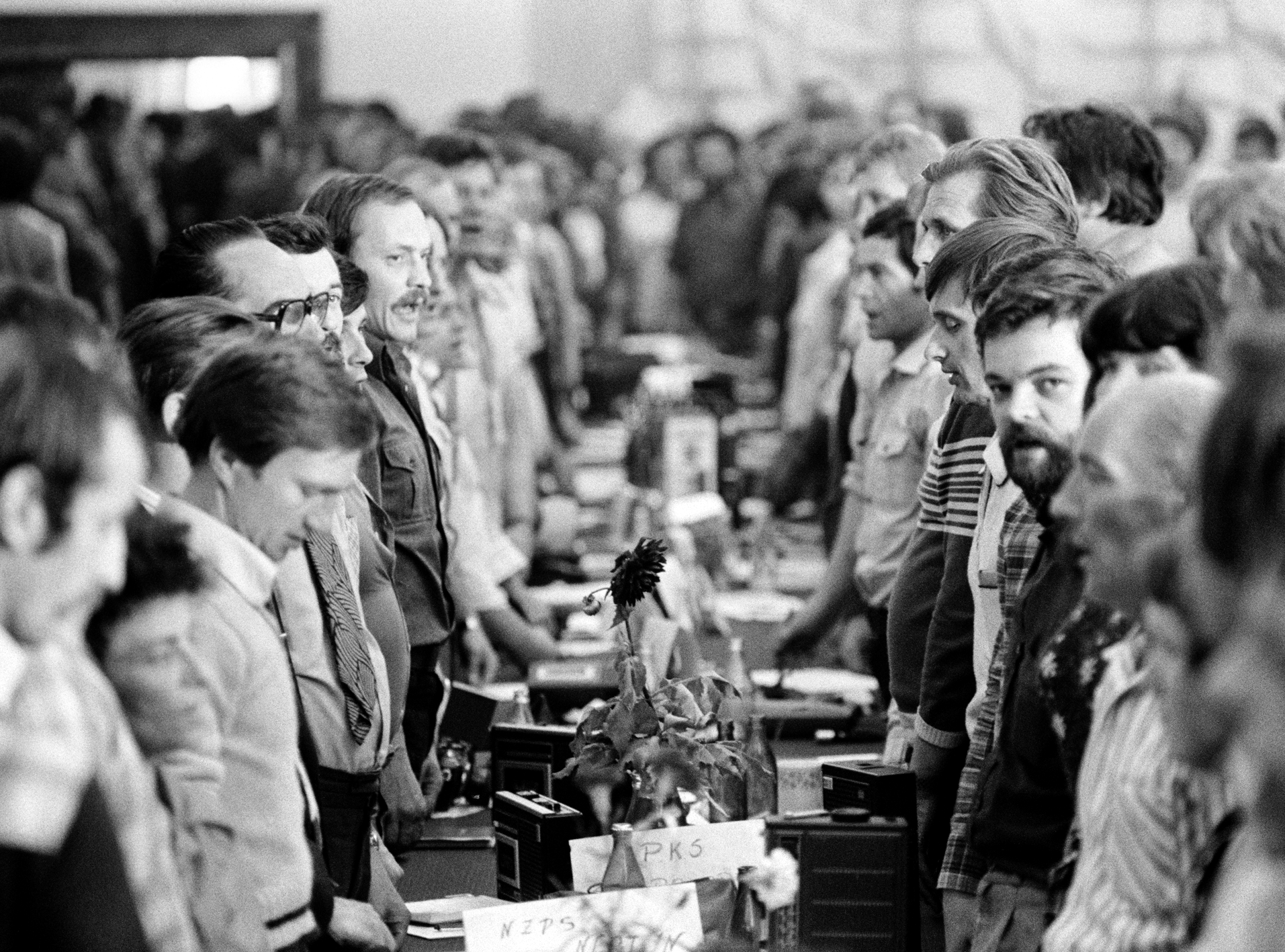
‘The reformer abandons the logic of revolution for the logic of negotiation.’ Shipyard strike, Gdansk, Poland, 1980
Credit: Peter Marlow/Magnum
The NLD won an overwhelming victory in the 1990 elections only to have victory snatched away by the military who remained in charge as they had done since 1962. NLD leaders were confined to prison. I visited NLD leaders at night and in secret. While Pawel, my colleague from Gazeta Wyborcza, kept muttering ‘Junta shit’, I remembered the police blockade of Lech Walesa’s flat in Gdansk, the ubiquitous presence of the secret police, house searches, detentions and arrests, the anxiety of neighbours and later their discreetly expressed admiration. Déjà-vu, I thought. In Rangoon I felt 20 years younger.
Dictatorship emerges from the weaknesses of democracy and from a lack of consensus on the rules of the democratic game. Those who muddy the waters in the name of social justice, historical truth or the battle against corruption generally do so for serious reasons. The Bolsheviks sought to end World War I and promised radical agricultural reform; the Nazis intended to control inflation and overcome anarchy, unemployment and the stifling humiliation of the Treaty of Versailles. Jaruzelski aimed to stem the progressive disintegration of the Communist state and secure Poland from the threat of ‘fraternal intervention’. The Burmese generals sought to guarantee the unity of a country torn by ethnic warfare and bring safety to city streets they claimed were ruled by gangs of thugs. For many people the distinction between order and chaos carries greater weight than the difference between democracy and dictatorship.
Dictatorship is security as well as fear. It is liberation from the need to make choices. Others decide: as for me, I am free of the threat of risk and the burden of responsibility; my obedience is the key to happiness and a career. But security also means danger. The institution which prompted the greatest fear in Communist Poland was the Ministry of Public Security. The security apparatus was a state within the state: its agents and informers became the bearers of an all-pervading fear. Laughter died, conversations slipped into silence. Safety became transfigured into danger: a security service colonel was more loathed than the leader of a band of criminals.
In a dictatorship, the security chief is as unassailable as the head of an underworld mafia in times of freedom. But who is more to be feared? Those aspiring to a role in public life are more likely to be fearful of the security colonel; those who want a quiet life will be more concerned about the mafia terrorising the city in a fragile, corrupt and helpless parliamentary democracy. As a rule, dictatorships guarantee safe streets and terror of the doorbell. In a democracy the streets may be unsafe after dark, but the most likely visitor in the early hours will be the milkman.
Democracy is uncertainty, risk and responsibility, but it seldom enforces its policies through violence. Dictatorship means violence daily; it is fear, humiliation and silence. But it is the charm of dictatorship that it liberates people from responsibility: the state answers for everything. You cease to be a citizen and become state property.
***
Every dictatorship is controlled by economics. If the economy collapses, the desperate come out onto the streets demanding bread. When the police begin to shoot they demand bread and freedom. If the economy develops well, there will be a limited period of peace, but people whose elementary needs – and particularly their children’s – are met will eventually seek civic freedoms. Such is the natural order of things.
Economic collapse leads to revolt born of despair, economic growth to rebellion born of aspiration. This rebellion also permeates the inner reaches of the dictatorship. Increasing numbers of people from the ruling apparatus find they no longer want to be sitting on a time-bomb. They are tempted to introduce a rationalised system of democratic reform. Reforms introduced from within the dictatorship are invariably intended to change everything so that nothing changes. The dialectic of change depends on that singular encounter between a reformer from within the dictatorship and a reformer from the opposition. In Burma I met both: people from the junta responsible for the crimes of martial law and long-term political prisoners from the opposition.
***
Dictatorship hates reform and loves ‘development and improvement’. But, despite everything, reform keeps knocking at the gate. Because, at some quite arbitrary moment, people rebel. Police squadrons disperse the crowd. There are victims: the wounded, the arrested and the dead.
The people have their martyrs. Police batons and arrests act as agents of integration and new leaders are its hallmark. And though later they may be arrested, smeared and abused, they remain a sign of hope in the collective memory. Solzhenitsyn and Sakharov, Walesa and Havel – and Aung San Sui Kyi. Social resistance is no longer a shapeless river of stones spewed up from riot-riven streets onto government buildings; there are leaders now to articulate political proposals with whom the authorities can negotiate. If – and this is the crux – the will is there on both sides.
The thing to do is to wait for the Great Explosion
And so the arguments begin, in the corridors of power and among the opposition as well as in the democratic world without. Inside the establishment ‘men of concrete’ talk of closing ranks in the face of an outside threat. Any change will be read as a sign of weakness, they argue. The opposition want only to destroy us. Its success will lead to chaos and collapse, and take us to prison or the hangman’s noose. It will be a gift for foreign enemies, whom the opposition in this country represent.
And government reformers are unconscious tools of the destruction the opposition seek to wreak. How can reformers now persuade their comrades in the dictatorial camp that the more inflexible they remain, the harder they are working to self-destruct? Blind faith in the principles of traditional doctrine has to lead to rebellion, bloodshed, chaos and the collapse of the state.
The result of the debate between ‘men of concrete’ and the reformers is also determined by signals from the democratic opposition and from abroad. The opposition – previously held together by the firmness of its resistance to the dictatorship – begins to break up. Should it focus on public protest or seek routes to negotiation? Should it demand punishment for the dictators or agree to compromise, reconciliation and reform?
At the critical moment, that is the dilemma. The ‘revolutionaries’ continue to repeat their arguments: the dictatorship has innocent blood on its hands, it is an absolute evil and its people are the carriers of that evil. The evil must be exposed and destroyed and its carriers appropriately punished. That is what justice demands; that is our duty to the victims of the dictatorship. Any attempt at compromise with evil is a gesture of support for it, the destruction of the purity of the ‘idea’, moral fraud and political folly. The thing to do is to wait for the Great Explosion when people take to the streets. That is the time to stand up and lead, and overturn the dictatorship. Only then will truth and liberty triumph, justice be victorious, virtue rewarded, treachery and transgression punished.
‘Reformers’ see things differently. We could be waiting for the Great Explosion for a long time, they say. It holds immense risk: social suicide, civil war, new wrongs and new victims. Life is short, the country is going to waste and the people have not yet recovered from earlier revolutions. That is why negotiations with yesterday’s enemy must be undertaken, to find ways to a peaceful dismantling of the dictatorship, and to compromise.
To the revolutionary, compromise is opportunism and lack of principle. To the reformer, it is essential. The reformer abandons the logic of revolution for the logic of negotiation. Earlier, he had sought out everything that divided him from the dictatorship; now he must search for whatever they have in common. He is exposed to allegations of betrayal. For it is in the nature of compromise that some principles are abandoned; that victory isn’t absolute; that yesterday’s enemy must be allowed full citizen’s rights and a place under the sun. If, in the dictatorial establishment, the ‘men of concrete’ prevail, there can be no hope of compromise; nor if the revolutionaries do so in society. But if reformers from both sides emerge victorious, the country has won its prize on the lottery.
The Poles won their lottery in Spring 1989. And what of Burma?
In foreign capitals, the transformations of a creaking dictatorship are carefully watched. Tactics are considered: political boycott and economic sanction, or flexibility and ‘politically realistic’ silence on human rights. Or perhaps the carrot and stick, pressuring the dictatorship to tolerate the expansion of civil society.
If pressure from abroad – economic, political and diplomatic – is in the interest of the reformers from the power camp and reformers from the democratic position, the chances for a peaceful transformation are very real. That was the formula in the Polish Velvet Revolution. No one gives up power faced with the spectre of a guillotine. People from the regime must have some guarantees of safety. Otherwise they will defend their power to the end, drowning the country in blood. Only after their total defeat will real justice triumph – amid burned-out cities, orphaned families, thousands of newly dug graves.
Negotiation brings disappointment, bitterness, a sense of injustice and unpaid debts. But it spares the victims: those who are disappointed are at least still living. Negotiations are possible when democratic resistance is strong enough for the dictatorship not to destroy it, and while the dictatorship itself is strong enough for the democratic opposition not to overthrow it overnight. The country has its chance in the weakness of both sides. ❒
Translated by Irena Maryniak
Letter from Václav Havel to Index on Censorship, August 1989 (facing page)