



Abstract
The development of structured outreach activities tailored to mechanical engineering is essential for cultivating interest and proficiency in this discipline across educational levels. This study outlines a comprehensive framework for engaging students from primary school through senior high school, using methods aligned with their cognitive and developmental stages. Primary-level activities introduce mechanical concepts like motion and force through hands-on, playful learning experiences, while middle school programs integrate guided inquiry and teamwork to explore basic engineering systems. High school initiatives emphasise the use of advanced tools such as Computer-Aided Design (CAD) and Finite Element Analysis (FEA), preparing students for real-world challenges and higher education. By addressing the complexities of mechanical engineering progressively, the framework nurtures creativity, critical thinking, and technical skills. This research highlights how strategic engagement fosters a sustained interest in mechanical engineering, equips students with essential competencies, and bridges academic and professional pathways through innovative activities and industry collaboration.
Introduction
Attracting students to engineering programs is a multifaceted challenge that universities face, especially given the diverse array of majors available and the increase in technology driven majors such as biomedical and robotics engineering. The decision-making process for choosing a university degree is influenced by a myriad of factors including pathway chosen. 1 Academic performance often correlates strongly with students’ enjoyment and proficiency in school subjects, which in turn influences their inclination towards related disciplines at the university level. 2 An independent study of Queensland school students revealed that extracurricular activities also play an important role in subject selection for years 11 and 12. 3 Moreover, the timeline for making these choices varies for each student. Gosper, Malfroy and McKenzie 4 predicts that due to current students’ reliance on technologies in their daily lives, there is an expectation that a more diverse set of technologies will play an integral role in their university experience. Factors such as perceived ease of degree, job opportunities, and wage expectations further drive degree selection, with some disparity between male and female students 5 across various disciplines. 6 Furthermore, students’ socioeconomic backgrounds and geographical proximity to university campuses play pivotal roles in shaping their educational aspirations. 7 Challenges persist for students in remote areas, who face the dilemma of relocating for study or forgoing further education due to limited local opportunities. 8
To aid in this process, universities offer outreach activities for school students. Alternatively referred to as ‘Engagement Activities’ and ‘School-University Partnerships,’ these initiatives range from large-scale programs such as the Science and Engineering Challenge in Australia, which reaches 15,000 school students per year, to more localised efforts. Such innovative methodologies highlight the versatility of outreach activities in catering to diverse audiences and enhancing science, engineering, technology and mathematics (STEM) engagement.9,10 Fitzallen and Brown 11 explored the experience of university engineering students delivering STEM outreach programs, citing benefits such as social and responsibility skillset building. Despite its importance, outreach activities face challenges such as funding constraints and reliance on volunteer efforts. 12
Interactions with university staff can help shape students’ understanding of the requirements and prospects in various engineering majors. These interactions aim to promote awareness of STEM and motivate learners. 13 Engaging students can take various forms, including compulsory on-campus experiences, voluntary open days, and off-campus activities. Academics often tailor these activities to showcase cutting-edge research in their field, yet they may inadvertently deter certain demographics with overly technical content. Crucially, these activities should provide students with opportunities to connect with professionals outside the school environment. 14 Typically, students are exposed to engineering activities in conjunction with their school curriculum. Project-based learning can increase participation in STEM fields. 15 Timing for outreach activities is crucial, with 60% of students in year 10 having a broad area of study, 80% deciding on a specific degree between years 11 and 12, and 73% having chosen universities to attend by year 12. 2 However, Gore, Holmes 16 contest the assumption that career aspirations for Australian students take shape around year 10, suggesting instead that significant interest is often expressed as early as year 7, rising and falling towards the end of high school.
Understanding the capabilities of each age group is also key in designing effective outreach activities. For instance, programs targeting younger students focus on hands-on (tactile), interactive experiences with low levels of theory to foster curiosity. As the demographic ages, activities gradually increase emphasis on practical applications and career pathways in STEM fields. 16 As students advance through age groupings and year levels, outreach activities adjust to their changing needs, considering factors such as comprehension levels, interests, and STEM career aspirations. Research from Tillinghast, Appel 17 finds that elementary-aged outreach programs often focus on enhancing fundamental skills, primarily fostering curiosity in STEM subjects. As students move into middle school, more complex concepts are introduced, incorporating team or project-based learning. In these grades, peer influence begins to play a larger role in career interests. High school marks the final transition into formally selecting a tertiary path, thus the engagements offered provide insights into various STEM career pathways, collaborating with industry professionals.
In designing an outreach activity, understanding students’ attitudes towards engineering is vital as well as preparation to be creative and professional.18,19 These attitudes vary widely across different year levels, with declines seen over the first year of high school. Links to this decline are found in students’ associations with the usefulness of engineering and their personal capabilities in the field.
20
Long-form problem-based programs have been observed to provide a more effective learning environment and better cohesion within teams and with teachers, compared to short-duration programs.
14
Therefore, there is a growing need for a framework for engineering outreach activities available to Australian students. To address these challenges, this project aims to articulate key practices identified in the research literature to develop a structured framework that guides the design of effective outreach programs for mechanical engineering across multiple grade levels. The outreach sequence presented in this study serves as an application of the framework, demonstrating how its principles can be used to inform and structure engagement activities tailored to different student cohorts.
Can a generic STEM based framework be developed for outreach activities across varying student age groups. To develop outreach activities based on the above framework for mechanical engineering.
This paper is structured as follows: Framework development outlines the development of a comprehensive framework for engaging students in mechanical engineering across various educational levels, addressing key strategies and methods identified in the literature. Development of conceptual designs presents the development of conceptual designs for outreach activities tailored to different student age groups, from primary school through to high school. These activities are designed to progressively build interest, understanding, and technical skills in mechanical engineering. Future implementation discusses the conclusions and implications of this framework, highlighting its potential impact on student engagement and the future of mechanical engineering outreach programs.
Framework development
To develop a comprehensive framework to engage and inspire the new generation of engineering students, the current areas of success in the literature need to be investigated for the different age groups of school students. 21 As this research is taking place at the University of Southern Queensland, the universities outreach model will be used to develop the age ranges but can be varied based on institutional programs. There are four different outreach models, that cater to primary school students, year 7 & 8, year 9 & 10, and year 11 & 12 students.
Primary school students
Introducing young students to the domain of mechanical engineering necessitates a thoughtfully developed strategy that conveys theoretical concepts in a manner that is both accessible and engaging. 12 At this foundational educational stage, it has been observed that students are more adept at absorbing new information when it is presented through active involvement and straightforward hands-on (tactile) activities rather than extensive theoretical discussions.22,23 Research on cognitive development in primary school-aged children indicates that experiential learning is significantly more effective than passive learning methods.15,24,25
Consequently, activities tailored for this age group typically introduce essential STEM concepts such as the laws of motion, friction, and speed. However, these concepts are woven into tasks that encourage creativity, exploration, and imaginative thinking.12,18,26 The intention behind these introductory activities is not to overwhelm students with intricate engineering principles but rather to introduce these ideas through engaging and playful projects.4,27 Instead of focusing on mathematical equations governing motion, activities involve designing and testing simple devices, enabling students to intuitively grasp the connection between theory and practical application through observation and experimentation.24,28
This educational approach is corroborated by established research in early STEM education, which underscores the idea that children are more inclined to cultivate a sustained interest in engineering when they are granted the opportunity to explore these subjects in an enjoyable, low-pressure environment. Established research underscores that primary students are more inclined to cultivate sustained interest in engineering when they are granted the opportunity to explore in a fun, low-pressure environment.29,30 The pedagogical framework for teaching primary students is grounded in constructivist learning principles, whereby knowledge is constructed through direct engagement and meaningful social interaction. 6 By fostering hands-on participation and collaboration, these activities create an atmosphere where students learn by doing and interacting with both their peers and the materials they are working with. Activities that enable them to visualize mechanical principles, such as constructing simple machines, are favoured over more abstract discussions.31,32
Furthermore, these initial activities contribute to the development of crucial skills such as teamwork and communication. Through collaborative tasks, students learn the significance of working collectively to tackle challenges, exchange ideas, and support each other's efforts These skills are not only vital in the field of engineering. 19 At this developmental stage it is important to acknowledge that engagement methods suitable for older students may not be as effective for younger learners. Inquiry based learning which encourages students to formulate and investigate their own questions, is typically less effective for primary students who may lack the necessary foundational knowledge to form meaningful inquiries.25,33 Younger students often benefit from a structured approach to learning, where guidance is provided to help them understand new concepts.13,34 While exploration is encouraged, it must be carefully balanced with clear instructions to prevent frustration or overwhelm.
The primary objective during this phase is to cultivate curiosity and a sense of wonder about the world, rather than achieving mastery of technical engineering concepts. By involving students in activities that foster creative problem-solving, experimentation, and tangible outcomes, they begin to perceive engineering as an exciting and dynamic field.35,36 This intrinsic motivation, driven by enjoyment and exploration, is more vital than precision or correctness at this stage. Educators should aim to inspire a lasting interest in STEM fields, laying a solid foundation for future learning and encouraging young learners to appreciate the process of discovery in mechanical engineering as they progress in their education.
High school – years 7 & 8
As students transition into middle school, their cognitive development allows for a deeper understanding of complex concepts. 31 This stage of growth opens the door to introducing fundamental engineering hypotheses and experimentation, fostering curiosity about the principles underlying observable processes. The focus increasingly shifts towards exploration and guided inquiry, equipping students with the ability to comprehend scientific questioning and testing more effectively. While hands-on activities continue to play a crucial role in the learning process, it becomes essential for middle school students to investigate the reasoning behind the mechanics of their projects. This shift encourages them to explore basic mechanical systems and establishes a foundation for more advanced topics they will encounter in subsequent years. Designed activities prioritise experimentation and creative problem-solving, where students can plan and evaluate various designs, prompting inquiries about how specific principles impact their creations. 32 This practice nurtures critical thinking and analytical skills vital for future endeavours in engineering.
Group challenges serve as particularly effective learning tools for middle school students, as they thrive on social interaction and collaboration. Collaborative problem-solving not only enhances technical understanding but also cultivates necessary skills such as communication, teamwork, and leadership each of which is critical in the field of engineering, where collaboration often determines success.7,13,14,37 Research indicates that group-based learning in STEM education positively influences students’ perceptions of these fields, making them more likely to pursue further studies in related areas. 38
Despite the increased complexity of activities and the potential for theoretical exploration, certain advanced engagement methods are not suitable for this developmental stage. For instance, fully independent inquiry-based learning, where students direct their own learning by formulating questions and pursuing individual experiments, should not dominate the curriculum at this level. 34 Although students are encouraged to explore and experiment, they still need the structure and guidance of instructors to effectively frame their questions and conduct meaningful investigations. Guided inquiry where instructors offer a framework for exploration while granting students the freedom to make decisions and experiment within that framework remains the preferred approach for fostering learning in this age group. 24
The integration of industry collaboration or mentorship is not prevalent among this demographic. While such approaches may significantly enhance the educational experience for high school or university students where real-world application and career readiness are paramount middle school students are generally not prepared to interact with seasoned professionals or navigate the complexities inherent to industry-driven projects. 39 Instead, the priority is on creating a supportive learning environment that allows students to experiment, make mistakes, and learn through trial and error, free from the pressures associated with professional expectations. During this formative period, students are encouraged to explore the connection between theoretical knowledge and its practical applications, gaining insights into how the mechanical systems they design align with broader engineering principles.
This foundational phase aims not only to nurture creativity and problem-solving skills but also to establish a basis for more advanced engineering concepts in the future. Engaging activities that promote tinkering with designs and prompt inquiries into the efficacy of various configurations serve to cultivate an engineering mindset. While the absence of advanced engagement methods is noted, the focus remains on building competencies that will prove invaluable for subsequent engineering pursuits. Collaborative group challenges and guided inquiry are instrumental in promoting essential skills such as communication and teamwork. The capacity to collaborate effectively, articulate ideas clearly to peers, and revise designs based on constructive feedback are critical facets of engineering practice. Middle school is an opportune time to begin developing these essential competencies, setting the stage for future success in engineering and related fields.
High school – years 9 & 10
Grades 9–10 are critical years for student development, as they begin choosing subjects that will shape their future career paths. During this time, students transition from exploring broad engineering concepts to focusing on specific areas of interest, which requires a shift in engagement activities.16,39 The model for these activities should aim to deepen students’ understanding of engineering principles while introducing advanced tools and techniques. 3 This approach is crucial, as students benefit from challenges that not only enhance their design skills but also promote critical thinking and analysis.
To align with these educational needs, activities for this age group should incorporate cutting edge technologies like CAD software, 3D printing, and simulation tools. These instruments allow students to visualise and refine their designs in unprecedented ways.31,32 Through CAD software, students can create digital models of mechanical systems, conduct design simulations, and iterate on their ideas before moving to physical construction. This iterative design process is essential in engineering, as it encourages continuous refinement based on feedback and testing.40,41
Contextual learning is especially significant at this stage, as students better grasp the application of theoretical knowledge to real-world challenges. Activities aimed at solving practical problems can bridge the gap between abstract theory and tangible outcomes.3,42,43 By analysing how different engineering principles influence their designs’ performance, students develop a more comprehensive understanding of mechanical systems and the implications of their choices. This deeper engagement with engineering content will assist students in making informed decisions about their subject selections as they approach their final years of schooling. 4 Project-based learning is particularly beneficial for students in Grades 9–10, as they engage in longer-term projects that require planning, design, prototyping, and testing. Navigating a complete design process not only hones technical skills but also provides experience in managing complex projects. 32 Without such support, students may find it challenging to manage complex projects or connect theoretical principles with practical outcomes effectively.44,45 Striking a balance between freedom and structure is vital during this time. While exploration is encouraged, it is essential to do so within a framework that fosters meaningful progress. The development of engineering skills in students in grades 9–10 requires a balance between practical experience and foundational knowledge. Collaborating with industry professionals can enhance learning, but varying maturity and technical skills among students limit its effectiveness. Although students have access to tools like CAD software and 3D printing,46,47 they are still learning how these technologies fit into professional engineering practices.
Engaging students in simulated real-world scenarios is an effective approach. These activities mimic industry challenges while providing needed instructional support, helping students navigate engineering processes without direct industry involvement. The curriculum introduces complex engineering principles with an emphasis on practical application rather than intensive theory, which is more suitable for advanced learners. By incorporating tools and critical thinking exercises, educators build a strong foundation for future specialised study. As students engage in these activities, they deepen their understanding of engineering concepts, leading to more meaningful applications of their learning. This crucial preparatory phase helps them refine their interests and make informed academic and career decisions as they approach the end of high school. 48
High school – years 11 & 12
In the final years of schooling, most students have solidified their career aspirations, with many having already chosen subjects that align with their future goals. For those participating in outreach activities related to mechanical engineering, it is likely that they have a well-established interest in the field. This creates a unique opportunity to engage students at a more advanced level, both in terms of content and the methods used to deliver that content.44,49 The activities designed for this age group must reflect a more progressed level of engagement with mechanical engineering principles, preparing students for the challenges they will face in tertiary education and professional practice. The focus shifts away from igniting curiosity and creativity, which was essential in earlier stages, and toward refining the technical knowledge and skills they need to succeed in higher education and professional environments. 50 These activities should mirror real-world engineering projects, requiring detailed planning, execution, and critical analysis. The intent is to simulate the type of work students will encounter in both their future studies and professional engineering roles. For instance, a project might involve designing and optimizing a mechanical component using CAD software, performing FEA to assess its performance under stress, and iterating on the design based on the results. 51 This introduces students to the iterative design process that is fundamental to engineering, where prototypes are tested and improved in cycles to achieve the best possible outcome. Advanced technologies and tools will play a significant role in these activities. Additionally, these tools provide students with a deeper understanding of the theoretical frameworks that underpin mechanical engineering. 31
One of the key elements at this stage is the opportunity for students to collaborate with industry professionals. This collaboration provides experience firsthand how theory is applied in professional contexts. Through this type of exposure, students can learn about current industry challenges, technologies, and methodologies helping them solidify their interest in mechanical engineering and providing them with professional networks that can support their transition. 50
Activities emphasise independent problem-solving and critical thinking, with students expected to take full ownership of their projects from initial design to final presentation. Through projects requiring detailed planning and iterative refinement, students build the confidence and expertise needed to tackle complex engineering challenges.
The outreach activities for students in their final years of schooling are specifically designed to help them transition from high school to higher education and professional engineering careers. The decrease in hands-on and creativity-driven tasks reflects the students’ evolved focus; they are less interested in exploration and more focused on preparing for the demands of tertiary. By exposing students to industry-standard technologies and requiring them to solve complex, real-world engineering problems, these activities ensure that students develop the confidence and competence necessary to succeed in their future studies and careers. 52
Outreach programs in Australia
Across Australia, in regions including Victoria, New South Wales, and Queensland, STEM outreach initiatives are increasingly adopting innovative approaches that prioritise student engagement, accessibility, and meaningful connections to potential careers. Rather than relying solely on traditional educational activities, many programs now blend interactive, entertainment-driven experiences to reach students who might otherwise overlook STEM fields, such as the Science and Engineering Challenge, the Endeavour Program, and La Trobe's LaserTag initiative.
At La Trobe University, outreach efforts have notably embraced gamification. The LaserTag program, developed for high school students, involves participants actively constructing their own devices and applying scientific and engineering concepts within immersive, game-based contexts. The success of this approach has encouraged expansion into escape-room style activities, further emphasising critical skills such as problem-solving, teamwork, and creative thinking.10,53 These interactive experiences resonate especially well with students who may have previously found STEM subjects unappealing or inaccessible.
In contrast, the University of Melbourne's Endeavour program centres on providing students direct exposure to authentic STEM projects through an annual expo. Here, final-year university students present their engineering and technology innovations publicly, demonstrating the tangible outcomes of STEM education. This event, complemented by targeted classroom sessions delivered across Victorian schools, effectively bridges the gap between secondary and tertiary education. Over its extended history, Endeavour has successfully demystified STEM pathways for younger students, building sustained partnerships between schools and the university. 54
At a national level, the University of Newcastle coordinates the Science and Engineering Challenge (SEC), which leverages competition-based events to engage a diverse cohort of students annually. The SEC targets both upper-primary and lower-secondary students, combining hands-on, practical challenges with competitive elements to motivate student involvement. This model not only fosters enthusiasm but also addresses key educational gaps, including teamwork, creativity, and applied problem-solving skills—areas frequently underrepresented in traditional classroom settings.3,55
These programs highlight the varied ways Australian universities engage students in STEM, underscoring the importance of innovative, student-centred approaches. Despite their strengths, however, outreach initiatives alone are insufficient to resolve broader systemic issues influencing student decision-making, such as socioeconomic barriers, geographic disparities, and deeply embedded attitudes toward STEM careers. Addressing these challenges requires comprehensive, coordinated strategies that complement outreach efforts, creating sustainable pathways into STEM education and employment.
Final framework
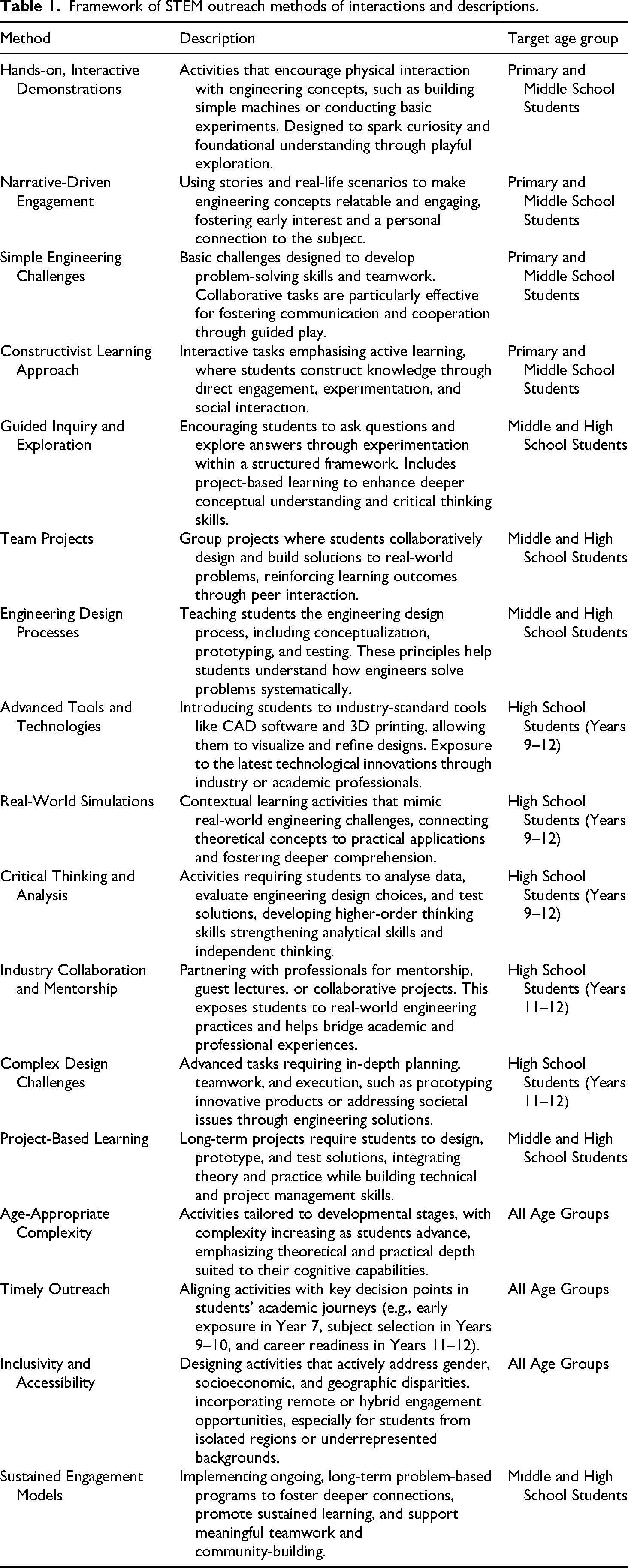
The STEM outreach framework presented in Table 1 was systematically developed through a comprehensive synthesis of literature reviewed and cited throughout this manuscript. Through synthesising the literature and current outreach and engagement activities for the four age ranges the following generic framework for utilisation in STEM outreach was developed.
Framework of STEM outreach methods of interactions and descriptions.
This framework can be visualised by Figure 1, seen below.
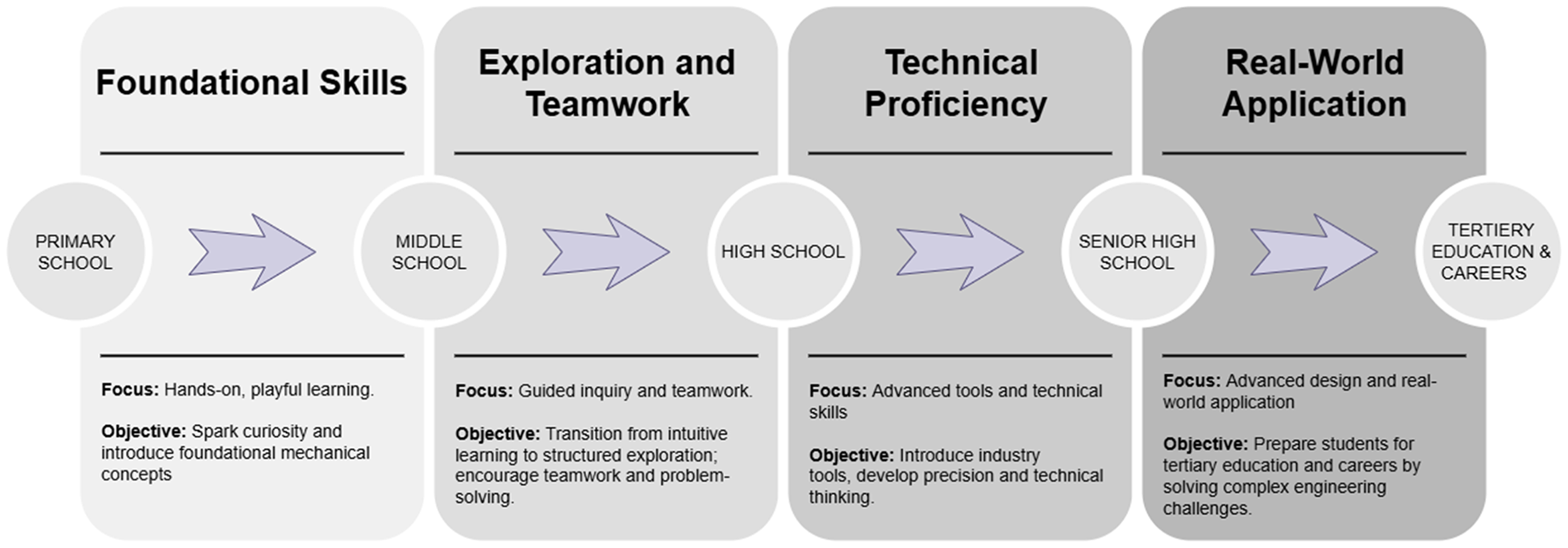
Flowchart of outreach framework.
Development of conceptual designs
This section introduces a newly designed series of outreach activities developed as part of this research project. These activities were carefully constructed to align with the framework outlined in the previous section, ensuring that each engagement method is tailored to the cognitive and developmental stages of the target age groups. While elements of the designs may have drawn inspiration from existing outreach models, this was solely to identify key components that resonated with participants, helping to refine the proposed framework. Each activity serves as both a standalone engagement tool and a demonstration of how a structured, multi-year outreach approach can progressively deepen students’ understanding of mechanical engineering principles.
The purpose of these activities is to illustrate how a structured, age-appropriate engagement model can be implemented to foster student interest in mechanical engineering. By progressively increasing in complexity, these activities provide a pathway from early exposure to engineering concepts in primary school through to advanced problem-solving and industry-aligned tasks in senior high school. Each of the four conceptual designs outlined in this section corresponds to a specific student age group, progressing from hands-on, exploratory learning in primary school to more complex, technology-driven tasks in senior high school. The structured nature of these activities allows educators and outreach coordinators to implement them effectively, with clear alignment to the broader goals of increasing student engagement and fostering long-term interest in mechanical engineering.
The outreach activities described in this section were conceptualised using data and experience drawn from multiple Australian institutions, but specific school selection for implementation will vary by region and is dependent on partnership availability and program reach. While this paper presents the framework and example activities, empirical implementation and demographic targeting are part of future research. However, these activities are designed to be adaptable to a wide range of contexts, including public and private institutions in both urban and regional settings.
Primary school students
In this activity for primary school students, the focus on building a strong foundational interest in mechanical engineering concepts using Hot Wheels cars. The activity is designed to be simple yet highly engaging, using accessible materials and play-based learning to introduce students to core engineering principles. By allowing students to physically interact with objects, observe real-time outcomes, and make basic predictions, this activity encourages hands-on learning and exploration. Furthermore, the use of familiar objects like toy cars ensures that students are comfortable with the materials and can focus on experimentation. This accessibility is vital, as it removes any intimidation associated with more complex or abstract engineering tools. The success of similar STEM outreach programs discussed in the literature, such as La Trobe University's LaserTag activity, 10 demonstrates the effectiveness of using familiar, enjoyable tasks to introduce engineering principles in a way that resonates with younger audiences. The activity's primary objective is to immerse students in a highly engaging, tactile experience where they can intuitively grasp the basic principles of motion, mass, and force. Focus is on fostering curiosity about the physical world, helping students begin to form connections between everyday experiences and the mechanics behind them. This experience sets the stage for more formal education in science and engineering, sparking early interest in STEM fields.
Framework application
Constructivist learning approach
Students at this age are highly tactile learners. By providing physical objects like Hot Wheels cars, we are adhering to the constructivist learning principles that emphasise learning through doing. Students in this demographic are in the preoperational stage of cognitive development, where they understand the world largely through sensory experiences and direct interactions with their environment. The act of launching a car and visually witnessing how different factors affect its movement helps solidify abstract concepts like force and motion.
Hands-on, interactive demonstrations
Literature suggests that play-based learning is essential for this age group as it reduces pressures to comprehend engineering principles and instead encourages exploration and experimentation. The playful nature of this activity makes it easy for students to engage without feeling as though they are in a formal learning environment. This is crucial as the goal at this stage is not mastery of complex engineering concepts, but rather sparking an enduring interest in learning about how the world works.
Narrative-driven engagement
By framing the experiment as a quest to figure out which car can travel the farthest, we are introducing a narrative element to the activity. As previously noted, narrative-based learning can aid in making abstract concepts more relatable and memorable for young learners. Students personalise the learning experience, giving them a sense of ownership and excitement over the discoveries they make.
Simple engineering challenges
Even in primary education, social learning plays a critical role in enhancing comprehension and engagement. While students will each launch their own cars, there will be opportunities to work in small groups to compare results and discuss outcomes. Social learning theory suggests that observing and interacting with peers can enhance understanding, especially in environments where students are encouraged to discuss their observations and form collective conclusions. This activity facilitates peer-to-peer learning, allowing students to articulate their understanding of motion and weight, which reinforces the concepts being explored.
High school – years 7 & 8
As students’ progress to grades 7–8, their cognitive and analytical abilities allow for a deeper engagement than the concepts introduced in primary school. This activity revisits the Hot Wheels ramp but introduces a more rigorous exploration of trajectory, weight, and the effects of angle and release height. The activity integrates theoretical mathematics, requiring students to predict outcomes using basic physics equations and then test their predictions through experimentation. This progression helps students bridge the gap between intuitive understanding and formal scientific reasoning. Students will explore how weight, angle, and release height affect the distance travelled by a toy car, and they will be introduced to basic calculations involving velocity and distance. The activity aims to teach students how to apply theoretical knowledge to real-world situations and to encourage critical thinking through hypothesis testing and analysis of results.
Framework application
Guided inquiry and exploration
At this stage, students are beginning to develop the ability to form and test hypotheses in a structured way. As discussed previously, guided inquiry is a critical engagement method for this age group because it encourages independent thought while still providing a framework to support learning. In this activity, students will hypothesise how changes in the car's weight or the ramp's angle will affect its speed and trajectory. They will then conduct experiments to test these predictions, learning to refine their hypothesis based on the results they observe.
Engineering design processes
One of the main ways this activity builds on the primary school version is by introducing simple mathematical models to help students predict outcomes. Basic physics equations, such as those for velocity and distance, allow students to make predictions before conducting their experiments. This aligns with the design framework, where we explore the importance of connecting hands-on activities with theoretical learning.
Constructivist learning approach
Like the primary school version, this activity includes a strong collaborative element. Students will work in small groups to perform their experiments, discussing their predictions and comparing results. However, the focus in this age group shifts towards more structured teamwork, where students take on defined roles such as data recorder and experimenter. This structured collaboration mirrors the collaborative nature of real-world engineering projects and helps students develop essential teamwork and communication skills.
Age-appropriate complexity
This activity also introduces a higher level of problem-solving and critical thinking, as students must not only conduct the experiment but also analyse their results and discuss their observations. This iterative process mirrors the engineering design process, where initial prototypes are tested, refined, and improved upon based on performance data. By encouraging students to think critically about the relationship between their theoretical calculations and the experimental results, we are fostering the development of higher order thinking skills that are crucial for success in STEM fields.
High school – years 9 & 10
Participants in grades 9–10 are introduced to CAD software, focusing on developing their skills in designing mechanical components. The aim of this activity is to expose students to the tools and features of CAD, allowing them to create 3D models of simple mechanical parts such as gears, brackets, or other basic components. This introduction to CAD lays the foundation for understanding the role of design in mechanical engineering, emphasising precision, spatial awareness, and the importance of visualisation in the engineering process. The primary objective of this activity is to familiarise students with CAD software by guiding them through the process of creating 3D models of mechanical components. By the end of the activity, students will have learned how to navigate the software's user interface, use basic tools like sketching, extrusion, and dimensioning, and understand the importance of accuracy and detail in mechanical design. The goal is to introduce students to the world of digital design in engineering, encouraging them to think critically about how physical objects are conceptualised and created.
Framework application
Advanced tools and technologies
One of the central engagement methods for this age group is exposure to industry-standard tools. By using CAD software, students gain practical experience with a powerful tool used in professional engineering settings. Although the activity is limited to modelling without simulations, this initial exposure is vital for helping students develop a comfort level with the software, preparing them for more advanced tasks in the future. This also introduces students to the role of CAD in mechanical engineering, where design precision is paramount before any physical prototyping occurs.
Engineering design processes
This activity immerses students in the early stages of the engineering design process. They begin by conceptualising mechanical components like gears or brackets, and then using CAD to translate their ideas into digital 3D models. Students will focus on creating accurate, detailed models, which requires them to understand the importance of geometrical constraints and tolerances in engineering. This emphasis on precision mirrors real-world engineering practices, where even small errors in design can lead to significant issues during manufacturing.
Guided inquiry and exploration
Although the activity is digitally focused, it maintains the interactive learning approach that is still critical at this developmental stage. Students are actively engaged in creating their own designs, manipulating objects in a 3D space, and using CAD tools to refine their models. This engagement with digital objects helps students build spatial awareness and problem-solving skills, as they learn how to manipulate dimensions, shapes, and features within the CAD environment.
High school – years 11 & 12
In this final engagement activity, students in grades 11–12 will build upon their foundational knowledge of CAD by engaging in more complex design tasks. They will not only design mechanical components, such as brackets or gears, but also perform FEA to test the structural integrity of their designs under various conditions. This activity bridges the gap between digital design and real-world mechanical performance, helping students understand how engineers validate and refine designs before manufacturing. The goal of this activity is twofold: first, to enhance students’ skills in designing mechanical components, and second, to introduce them to FEA, a critical tool in mechanical engineering for assessing stress, strain, and deformation in materials. Students will design a mechanical component and use FEA to analyse how their design performs under applied loads. The goal is to simulate real-world conditions and teach students how engineers use FEA to ensure that components can withstand the forces they will experience in use.
Framework application
Advanced tools and technologies
Students in their final years of high school are ready for advanced exposure to the tools and technologies used by professional engineers. In this activity, 3D modelling and FEA is a powerful feature that allows students to simulate how their components will respond to forces, stress, and deformation.
Engineering design processes
Students will go through a more rigorous version of the engineering design process in this activity. They will start by designing a component, ensuring that it meets the outlined specifications, and then subject it to FEA to validate their design. This process introduces students to the concept of design validation, where engineers use simulations to test how their components will perform under real-world conditions before they are improved and finally built.
Critical thinking and analysis
FEA requires students to think critically about the material properties, forces, and constraints involved in their design. By performing stress and strain analysis on their components, students learn how to interpret data from simulations and use that information to refine their designs. This encourages higher-order thinking, as students must evaluate whether their component will fail under certain conditions and make the necessary adjustments to improve its structural integrity. This aligns with the engagement methods discussed, where problem-solving and critical analysis are key to developing students’ engineering mindset.
Industry collaboration and mentorship & real-world simulations
One of the primary learning outcomes of this activity is helping students connect theoretical principles of mechanics, such as stress, strain, and load distribution, with their real-world applications. FEA allows students to visualise how their designs behave under different conditions, helping them understand abstract mechanical engineering concepts in a tangible way.
Future implementation
The proposed framework outlines a developmental progression in outreach activities, designed to align with students’ cognitive stages. At the primary school level, hands-on and play-based learning introduces basic principles such as motion, force, and simple machines in low-pressure environments that encourage curiosity. In middle school, activities shift towards guided inquiry and collaborative problem-solving, allowing students to deepen their understanding of mechanical systems. High school students may then gain exposure to industry-standard tools and practical applications, while senior-level programs prioritise independent problem-solving and direct industry collaboration, immersing students in authentic challenges that reflect the demands of tertiary education and engineering careers. A key priority for future implementation is to embed sustainability principles within this progression, linking activities to concepts like life-cycle design to better prepare students for modern engineering challenges. Generative artificial intelligence should also be integrated, as there are many ethical considerations of use for an engineer.56,57
While the conceptual model shows promise, further research is needed to explore its practical implementation and long-term impact. Future studies should pilot the framework across a range of educational settings, including urban, rural, and resource-limited contexts, to assess adaptability and effectiveness, particularly regarding the integration of sustainability content.
Priority areas for investigation include measuring student engagement, interest in STEM subjects, and skills development over time. Longitudinal studies could examine whether early outreach is associated with sustained interest in engineering, increased participation in STEM education, and progression into related careers. Comparative research across demographic groups would also help evaluate how effectively the framework supports inclusive participation, particularly among underrepresented students. Further research into program scalability, educator support, and the integration of culturally responsive and sustainability-focused content will also be essential for effective and widespread implementation.
Conclusions
This study demonstrates the potential value of aligning outreach activities to students’ developmental stages, by fostering both interest and readiness for careers in mechanical engineering. By intentionally matching activities with cognitive development, the proposed framework may help students progressively build foundational engineering skills, enhance critical thinking capabilities, and prepare effectively for more advanced concepts.
Importantly, by utilising minimal equipment, the activities are designed to be accessible even in remote or resource-limited settings, it directly addresses potential disparities arising from socioeconomic status and geographic location. Nevertheless, further work remains to enhance gender and cultural diversity within outreach programs. Applications of this framework should intentionally embed inclusive practices, tailored mentorship opportunities, and culturally responsive content to ensure equitable participation across all demographics.
Continued refinement of this outreach model particularly by ongoing feedback from students and educators, and scalable, adaptable approaches will be essential to address this important gap. By doing so, mechanical engineering outreach can sustainably inspire a diverse range of students, ensuring equitable access to meaningful pathways into higher education and professional engineering careers.
Footnotes
Funding
The authors received no financial support for the research, authorship, and/or publication of this article.
Declaration of conflicting interests
The authors declared no potential conflicts of interest with respect to the research, authorship, and/or publication of this article.
Use of AI
The authors wish to declare that various GenAI tools were used to craft and enhance the structure and flow of the work.

Data availability statement
Data sharing is not applicable to this article, as no datasets were generated or analysed during the current study