



Abstract
The great demands for computational fluid dynamics (CFD) practitioners in industry have motivated universities to integrate CFD courses into undergraduate curricula. This article introduces a learning-centred CFD course that aims to train critical users of commercial CFD codes. The main features of the course include a project-based approach to learning and assessment-guided learning activities, both scaffolded by technologies. The implementation of the course is informed by contemporary pedagogical theories that encourage students to have the ownership of their own learning and constructively build their knowledge in an inclusive and supportive learning environment. The students upon completing the course have developed a conceptual understanding of the CFD principles and the importance of performing CFD simulations in a critical way, making them ready for more advanced CFD learning and practices. Course evaluation based on feedback from various sources demonstrates that the learning-centred approach is the key to the success of the course.
Keywords
Introduction
Computational fluid dynamics (CFD), according to the definition of Anderson, 1 is ‘the art of replacing the governing partial differential equations of fluid flow with numbers, and advancing these numbers in space and/or time to obtain a final numerical description of the complete flow field of interest’. It uses discrete numerical techniques to solve the equations of fluid flow and produces a set of numbers that quantitatively describe the temporospatial distributions of fluid properties such as velocity, pressure, temperature, turbulence, etc. The data can be visualised via computer graphics, intuitively presenting a wealth of information and contributing to great insights into the flow physics. Since its emergence in the 1960s, CFD has gained rapid development partially due to the fast increase of available computing powers and advances in numerical techniques. Since the 1980s, increasingly powerful commercial CFD software packages have significantly boosted the applications of CFD in industry. Nowadays, CFD is extensively used as a design and diagnostic tool to tackle engineering problems and has become a part of computer aided engineering (CAE). The mathematical equations solved by CFD solvers are no longer limited to those of fluid flow, but also include those describing complex multi-physics, multiphase, chemical and biological processes. The simulated flows span from micro/nanoscale cellular physiological flows 2 to astrophysical systems such as the solar atmosphere. 3 It is fair enough to say where there is a fluid, there is CFD.
As show in Figure 1, the process of simulating a fluid flow using CFD starts from the understanding of fluid physics, followed by the development of governing equations to describe these fluid physics. At the same time, the geometric features of the fluid domain must be properly captured, usually using a computer aided design (CAD) model. Then the fluid domain is discretised into a large number of small volumes known as mesh cells. The partial differential governing equations are then re-written based on the geometric topology of the mesh, forming a system of algebraic matrix equations. The matrix equations are solved using various solvers, resulting in a set of data quantifying the distributions of flow variables in the domain. The data is manipulated to reconstruct and visualise the flow field virtually via computer graphics.
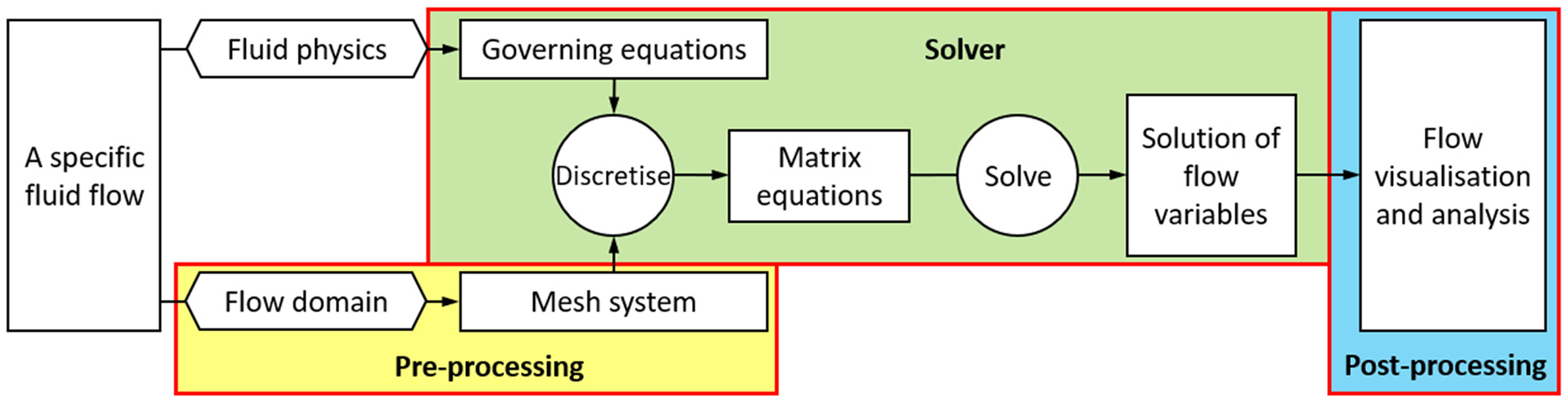
The CFD workflow. CFD: computational fluid dynamics.
Figure 1 reveals that CFD involves multidisciplinary knowledge and skills, including fluid dynamics, discrete numerical methods, computer language and discipline-specific knowledge on top of some other essentials such as mathematics and CAD. Because of the requirements on high-level knowledge and skills, CFD remained as a ‘specialist skill’ for a long time in the history. Moreover, completing such a process requires a large amount of labour and endurance if contemporary CFD software and computing powers are not available. Kawaguti 4 in the 1950s using a mechanical desk calculator worked 20 hours per week for 18 months to simulate a simple two-dimensional (2D) flow around a cylinder. As a comparison, students today upon finishing an undergraduate CFD course may only need 30 minutes to do the job on their personal computers.
This exciting advancement is partially brought about by commercial CFD packages, which have played a pivotal role in the development and applications of CFD as a technology. Owing to their user-friendly interfaces and growing capabilities, commercial CFD packages have quickly gained popularity since the release of the world's first general-purpose CFD code PHOENICS in 1981. Today, when we are planning a CFD simulation, high chances are that the simulation is to be completed using a commercial CFD code. Most commercial CFD codes come with guided or automated workflow management, which greatly reduces user interference and simplifies the procedures of CFD simulation. To complete a CFD simulation, the user no longer needs high-level knowledge about fluid dynamics and discrete numerical methods, he or she only needs to follow the step-by-step guide to finish the workflow and will be presented with beautifully rendered simulation results. The increasing powers of commercial CFD packages have significantly facilitated the analyses of fluid-related engineering problems, and made CFD accessible to more engineers. A shift has taken place in the demographics of CFD practitioners from a user community with terminal degrees at the doctoral level to one with an increasing proportion of terminal degrees at the bachelors level. 5
However, the prevalence of commercial CFD packages also causes some misconceptions. As shown in Figure 1, using a commercial CFD package to simulate a fluid flow usually involves three sequential steps: pre-processing, solver and post-processing. The CFD solver involves a range of complex algorithms, however, behaves increasingly like a black box in order to be user-friendly. Some CFD users can spend 80–90% of their time in pre-processing and post-processing, but only click a few buttons to solve the equations. As a result, CFD is often used as a calculator rather than a technology. This is especially the case when CFD is incorporated in the CAE workflow working with CAD and artificial intelligence tools. 6 Engineers without proper knowledge about how CFD works tend to assume that commercial CFD codes would always return correct results, and this is when CFD is associated with disappointment. In fact, a thorough understanding of the flow physics and proper knowledge about discrete numerical methods is of fundamental importance to the success of CFD simulations. However, these can only be achieved through systematic learning and long-time practice. Although CFD software companies often host training sessions, these are usually limited to software manipulation and barely touch fluid dynamics fundamentals and principles of numerical methods that underpin CFD. Versteeg and Malalasekera 7 in their famous CFD textbook An Introduction to Computational Fluid Dynamics: The Finite Volume Method predicted that ‘the next constraint to the further spread of CFD amongst the industrial community could be a scarcity of suitably trained personnel instead of availability and/or cost of hardware and software’.
Review of undergraduate CFD courses
The great demands for CFD practitioners in industry have motivated universities to integrated CFD courses into undergraduate curricula, which historically was exclusively for postgraduate students. The University of Manitoba introduced CFD into a undergraduate mechanical engineering curriculum as early as 1989. 5 Since then, CFD has quickly become a popular undergraduate course in engineering disciplines all over the world.
The American Institute of Aeronautics and Astronautics (AIAA) Fluid Dynamics technical committee 8 reported that CFD has been integrated into undergraduate curricula via different levels of involvement: CFD Light, CFD Moderate, CFD Heavy, CFD in Lab, and CFD in Design courses. In CFD Light and Moderate courses, flow visualisation via CFD simulations in lieu of laboratory experiments is used to help the students better understand fluid mechanics fundamentals 9 or explore complex flows. 10 In both cases CFD is mainly used for demonstration purposes thus no or very little CFD knowledge is taught. CFD in Lab and CFD in Design courses, sitting in the other end of the spectrum, are designed for higher-level students who use CFD for research purposes or to tackle real-world problems in their capstone projects, thus generally involve advanced CFD theories and skills, and require a significant dedication of time and efforts.
Most stand-alone undergraduate CFD courses fall into the category of CFD Heavy courses, which place emphases on fluid dynamics theories and discrete numerical methods while also aiming to teach the students hands-on experience of developing or using CFD codes to simulate fluid flows. The AIAA report 8 presents a long list of topics that can be covered by CFD Heavy courses. On the other hand, most undergraduate CFD courses are designed only for one semester, ranging from 8 to 16 weeks.11–14 Given the wide breadth and tight time frame, the topics to be addressed in the course must be carefully selected because pouring a large amount of information to the student over a short period of time can easily reach the students’ thresholds of learning.11,15
Specifically, the potential topics of CFD courses can be classified into the following categories:
Basics: mathematics (including calculus, matrix algebra and differential equations), fluid mechanics (including multidimensional fluid kinematics and fluid dynamics), discrete numerical methods, programming language, CAD skills and discipline-specific knowledge. CFD theories: conservation equations, turbulence and turbulence models. Numerical methods: mesh generation, finite difference method, finite volume method, boundary conditions, spatial and temporal initialisation, solver type, interpolation scheme, velocity-pressure coupling, relaxation, iteration and convergence. CFD skills: code development, flow simulation using commercial CFD packages, flow visualisation and data analysis, CFD scepticism and best practice. Advanced topics: high-fidelity turbulence modelling (e.g., large eddy simulation, direct numerical simulation, etc.), advanced mesh techniques (e.g., mesh adaption, sliding mesh, dynamic mesh, overset mesh, etc.), and discipline-specific applications (e.g., coupled heat transfer, thermal radiation, multiphase flows, phase change, chemical reactions, combustion, non-Newtonian fluids, acoustics, supersonic flows and many more).
Apparently, trying to cover most of the topics in a single course is unpractical and way too ambitious. Therefore, two key questions to ask are, (1) how much understanding of CFD basics should the students develop after they finish the course? And (2) how much prior knowledge do they need to enter the course in order achieve the goal? To answer these questions, Ormiston 5 compared a CFD course to a computer code with input, output, a process to perform and an environment in which it operates. The input is the background knowledge and skills of the students entering the course. The output is the knowledge and skills required by their future careers. The environment is defined by the levels of support and resources available, as well as the time frame allowed for the course. The process is the way the course is structured and delivered, which is dependent on the other factors.
Over the past 30 years, all the input, output and environment conditions for CFD education have changed significantly. One of the major changes is the increasingly diverse student backgrounds. In the 1990s, most students entered a CFD course with sound background knowledge of fluid mechanics, numerical methods and high-level computer languages. 12 As a contrast, Hu et al. 16 reported that many students entered their CFD course without a good background in mathematics and fluid dynamics. Accordingly, the main learning objectives of different CFD courses have spanned from ‘to develop a fundamental understanding of the physical and numerical behaviour of the Navier-Stokes equations’ 12 to ‘to introduce CFD as a design and analysis tool’ 16 in order to cater for the diverse student backgrounds. To introduce higher-level CFD knowledge into undergraduate courses, Navaz et al. 17 and Hailey et al. 18 split the teaching into two subsequential courses, where mathematical and physical fundamentals of CFD were taught in a junior-level course, followed by a senior-level course focusing on using commercial CFD codes to simulate complex flows.
Another major change is the tools and techniques used to scaffold CFD learning and teaching. In 1990s and early 2000s, commercial CFD packages were not commonly used in CFD courses, partially due to the high costs associated with licencing and the educators’ concern that the use of commercial CFD packages might distract the students’ focus from on the underlying theories, models and methods to on the issues associated with learning the packages. 11 Instead, in-house CFD codes and specially designed educational interfaces (e.g. the in-house code developed by Stern et al. 19 and FlowLab 20 developed by Fluent, Inc.) were the main tools for the students to gain hands-on experience. In recent years, instructors believe that the use of commercial CFD packages is one of the key factors contributing to the success of CFD education because they make it possible for the students to tackle real-world problems and thus improve their job-readiness upon graduation. 21 CFD software companies have in recent years released student versions of their packages for CFD learners to use for free, which has greatly boosted the use of commercial CFD packages in classrooms. However, the risks remain. A complete CFD workflow involves pre-processing, solver and post-processing, which usually need to be completed using separate codes. As a result, multiple software codes must be used in a CFD course in order that the students can fulfil a complete CFD workflow (see, e.g.12,13,22). When so many software codes are used in a single-semester course, the steep learning curve can easily become overwhelming without careful planning. 15
The discussions in the CFD educator community over the past decades have centred around how to find a balance between theoretical fundamentals and hands-on experience in response to the varying input, output and environment conditions. However, one thing has remained unchanged: undergraduate CFD courses are mostly classroom-centric where the instructors put great efforts on ‘teaching’ and ‘course delivery’ while the students’ active learning has not received its long-deserved attention. In fact, most CFD practitioners in industry have gained their CFD knowledge and skills outside of a classroom, 5 indicating active learners do not necessarily need a classroom teacher. A survey by Adair et al.23,24 showed that as much as 73% of the students in their CFD course preferred tutorials and laboratory-based learning activities or working in groups while only 11% preferred lectures. Probably CFD instructors should think out of the box and find more engaging approaches to learning and teaching.
The constructivism learning theory 25 states that learning is a social activity that involves sharing and application through the zone of proximal development. 26 The connectivism learning theory 27 adds to constructivism by elaborating how the internet and peer network have allowed sharing of information across the world. This is particularly important in the digital era when knowledge is no longer stored entirely within an individual or small group but throughout the world. Learning is no longer a classroom-centric activity and the instructor's role needs to transform from a knowledge deliverer to a learning facilitator. Accordingly, the focus of learning and teaching should shift from teaching to learning. Unfortunately, these contemporary pedagogical theories have rarely been applied to the design and implementation of undergraduate CFD courses. As a result, CFD education in universities is severely lagging behind what is demanded by industry. Many CFD educators including Miller 14 believe that ‘education remains a major roadblock for the correct and more widespread use of CFD in industry, academics, and government sectors’. A paradigm shift is greatly needed in university CFD education.
The design of CFD course at the SWJTU-OSU Co-Ed Program
The SWJTU-OSU Co-Ed Program is a joint degree programme between Southwest Jiaotong University and Oklahoma State University. The authors have been invited as guest lectures to help design and teach a CFD course in the discipline of Fire Protection and Safety since 2019. The programme has around 50 intermediate-to-senior-level undergraduate students entering the course each year. Compared to the mechanical engineering students at RMIT university, the students at the programme only have very basic fluid mechanics knowledge such as hydrostatics and the Bernoulli equation for one-dimensional inviscid flows. Most of them don’t have exposure to multidimensional fluid kinematics and fluid dynamics, which are of fundamental importance to the Navier-Stokes equations that underpin CFD. The students’ limited knowledge on matrix algebra adds to the challenges of the course. However, statistical data over the past years showed that around 50% of the graduates would pursue postgraduate-level education, mostly in the fields of mechanical, aerospace, automotive, building and environment engineering. CFD will be an important tool for their future education and research. Therefore, most students show great interest and enthusiasm in the course.
In order that the students can make the most of the one-semester learning journey, the CFD course is carefully designed in reference to Ormiston's input–output model 5 while taking into account the availability of institutional and external resources. The students’ prior knowledge (the input) is one of the most important factors affecting what learning activities can be included in the course. Although the CFD knowledge and skills required by a student's future career are very hard to predict, these can be expected from the institutional learning objectives, which include ‘an ability to apply knowledge, techniques, skills and modern tools of mathematics, science, engineering, and technology to solve broadly-defined engineering problems appropriate to the discipline’. 28 In addition, a survey by the AIAA 8 revealed 11 CFD-related skills desired by employers in various industries, including ‘understanding flow phenomena’, ‘post-processing’, ‘verification and validation’, ‘mesh generation’, etc, which also help determine the expected output of the course. Comprehensively considering the above conditions, this course aims to enable the students to apply entry-level CFD knowledge and skills to the analysis of simple engineering problems involving fluid flows.
In order to define the intended learning outcomes (ILOs) of the course, it is necessary to understand that CFD is underpinned by two pillars: fluid mechanics theories and discrete numerical methods to solve the governing equations, as shown in Figure 2 (modified from Figure 1). Proper knowledge about both pillars is critical to avoid falling into the trap of black box. Given the fundamental importance of fluid kinematics theories for the learning of CFD conservation equations and interpretation of CFD-produced data, the fluid kinematics theories are placed emphases because a thorough understanding of theories can facilitate the learning of CFD theories and greatly boost the ability to understand various flow phenomena. The learning of fluid kinematics theories is usually not included in a CFD course, however, the authors believe it is necessary to consolidate these basics before moving to more advanced topics because according to the constructivism theory, 26 learners build their knowledge based on personal meaning and guided by prior knowledge. Deep learning cannot happen without proper prior knowledge. In fact, as mentioned before, ‘understanding flow phenomena’ was rated as the most important CFD-related ability in the AIAA survey. 8 Unfortunately, the participating employers of the survey only gave an average of 2.6 out of 5.0 for the question ‘How well prepared are students?’ on this ability, highlighting the necessity to enhance theoretical learning in classrooms.
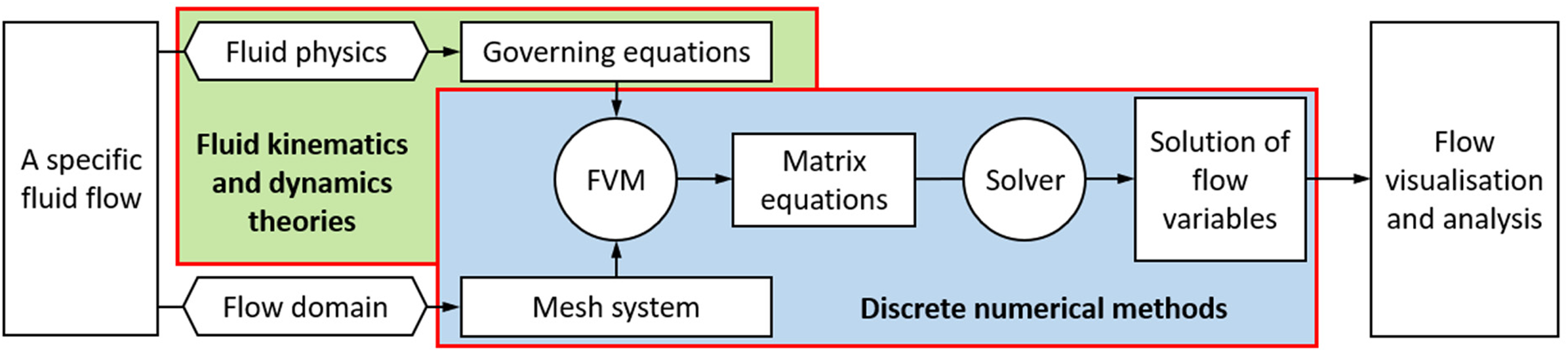
The two pillars of CFD (fluid dynamics theories and discrete numerical methods) are emphasised in the course. CFD: computational fluid dynamics.
Additionally, the discrete numerical methods serve to convert the continuous partial differential equations into discrete algebraic matrix equations and solve them in an iterative manner. A range of errors can be introduced during the process if the numerical procedures are not properly configured. Proper knowledge about discrete numerical methods is another important aspect promoting effective CFD simulations. Unfortunately, this probably is the weakest ability of the community of commercial CFD software users. It is not unusual to see CFD practitioners perform various simulations only using the default solver settings. In fact, a properly configured CFD solver not only improves the accuracy of the simulation, but also remarkably reduces numerical instability and accelerates convergence, thus contributing to a higher predictive accuracy at a lower computational cost. Although these numerical procedures are built in commercial CFD solvers and usually do not require users to do additional programming, proper knowledge about the principles of these numerical procedures is still essential in order to optimally configure the solver for different flow problems. The knowledge is particularly important for trouble-shooting the issues associated with solution such as numerical instability and divergence.
The ILOs of the CFD course are developed based on the above considerations and in reference to the revised Bloom's taxonomy
29
which classifies the ILOs into different level of mastery and recommends ‘standardised’ verbs to describe the ILOs. The ILOs state that upon the completion of the course, the students should be able to
ILO 1 – describe various terms, theories and models of multi-dimensional fluid flows. ILO 2 – explain the governing equations and basic numerical methods of CFD. ILO 3 – select proper theoretical models and numerical procedures to develop a complete and correct CFD model for the simulation of a simple 3D fluid flow. ILO 4 – properly present and interpret CFD-generated data, examine the sources of error and judge the effectiveness of the simulation. ILO 5 – investigate a simple engineering problem using CFD theories and methods.
We would like to emphasise that this course aims to train ‘smart CFD users’ rather than CFD specialists. It also aims to prepare the students for more advanced CFD learning and practice, foster critical thinking and lifelong CFD learning.
Implementation of the CFD course at the SWJTU-OSU Co-Ed Program
The implementation of the course is a comprehensive practice of contemporary pedagogical theories and principles in engineering education. In order to achieve the above ILOs, a student-centred approach 30 is used where the focus is placed on learning rather than teaching. In this setting, the instructor is not an expert imparting knowledge to unknowing students. Instead, the instructor is responsible for building and maintaining an inclusive and supportive learning environment in which he/she guides the students across a zone of proximal development by assisting them in incorporating new knowledge and skills into their intellectual framework, as detailed below.
A supportive learning environment
A supportive learning environment can encompass many things, but most importantly, it should engage the students in active learning, allow the students have the ownership of their own learning and know where to find help when needed. Efforts are made in the following aspects to build such supportive learning environment.
First, as shown in Adair et al.'s survey, 24 students have diverse preferred learning styles. Therefore, a key feature of the supportive learning environment is the inclusive and flexible learning activities and assessment tasks to cater for different learning styles and strengths. Fluid dynamics theories are of fundamental importance to this course. When lectures serve as a main approach to the learning of the theories, carefully designed group presentations and computer laboratory activities offer additional opportunities for the students to consolidate their understanding by learning from peers and applying the theories to CFD simulations. In addition, the final project covering a complete CFD workflow is a major summative assessment task of the course. When standard projects are given by the instructor, the students have the option to have a ‘personalised’ project on a self-selected topic. The students are encouraged to find an interested engineering problem and come to discuss with the instructor, so that the levels of required knowledge and skills, challenges, and risks can be assessed. Over the past years, several students have been able to continue the research on their personlised projects after the course and published their research as journal or conference papers,31,32 which greatly contributed to the success of their applications for higher-degree education.
Secondly, when classroom remains the main venue of organised learning activities, learning does not happen in the classroom only. In today's digital era, internet-based technologies have been proven highly efficient in evoking deep learning 33 and play a critical role in creating flexible learning opportunities. The main digital learning environment of the course is Moodle, the Learning Management System (LMS). Course materials including lecture notes, reading materials and laboratory tutorials are open to the students at least 2 weeks prior to the classroom activities, which offers opportunities for the students to pre-visit the materials and study in their own time and at their own pace. Course notifications are sent out via the LMS on a weekly base so that the students can be well prepared before entering the classroom. A discussion board containing various chat threads is set up in the LMS where the students can interact with the instructor, tutors and peer students through synchronous and asynchronous discussions. All the lectures and laboratory demonstrations are recorded and stored as videos in the LMS, so that the students can revisit them at any time. Course survey over the past years show that revisiting the lecture and laboratory videos is an important means that many students use to enhance their learning especially when an excessive amount of information is delivered in the classes. Other important course information such as syllabus and assignment rubrics are also available in the LMS. Moreover, the learning materials are not limited to those developed by the instructor and tutors. The internet has made a huge amount of information easily available at the fingertip, which is also leveraged to boost CFD learning. In order to avoid the students losing themselves in the long list of search engine-returned results, the instructor carefully review and select quality materials pertaining to the topics of the course before recommending them to the students. This is proven to be a highly effective method to help the students enhance their learning of software manipulation and understanding of perplexing concepts and mathematical equations. In particular, the free Ansys Fluids Engineering Courses use short videos (usually less than 10 minutes) to explain key fluid dynamics and CFD concepts in a concise way, offering a valuable supplement to the lectures.
The third major component of the supportive environment is the atmosphere of peer network and group work. Social learning via open discussion and group work is proven to be a highly efficient approach towards deep learning. 26 Therefore, besides the online discussion board in the LMS, organised discussions and group presentations on selected topics are also conducted in the classroom, where the students share their understanding of the CFD principles while learning from each other. In addition, peer-review of assignments is a mandatory part of the assessment tasks. The students are required to review their peer students’ assignments and project reports, and find out mistakes and give suggestions for improvement. Their review comments per se will be assessed by the instructor. This work requires the students to possess proper knowledge in order to give appropriate comments, and enable them to learn from their peers and gain first-hand impressions regarding high-quality work.
The supportive learning environment also includes other important components such as carefully designed learning activities and timely feedback, as will be discussed in the following sections.
Assessment-guided learning activities
Assessment is an important means to measure how well the actual outcomes of learning match the ILOs. It not only evaluates the effectiveness of learning and teaching, but is an integral part of the process of learning that has been proven to effectively promote learning. 34 In this CFD course, the assessment tasks are strategically designed to align with the ILOs (‘The design of CFD course at the SWJTU-OSU Co-Ed Program’ section) according to the constructive alignment principles of Biggs. 35 Assessment is a dynamic process throughout the course and is used to guide the conduction of learning activities.
The knowledge outlined in the ILOs can be classified into two categories: declarative knowledge and procedural knowledge. 36 The declarative knowledge is reflected in the first two ILOs which mainly include the fluid kinematics basics and CFD theories. Underpinned by the declarative knowledge, the procedural knowledge is embedded with the last three ILOs which involve the manipulation of CFD software to complete a CFD simulation, examining and presentation of CFD results, and CFD scepticism. A system of assessment and feedback, which includes both formative and summative assessment tasks, is developed to promote learning and quantify how well the ILOs are achieved, as shown in Figure 3.
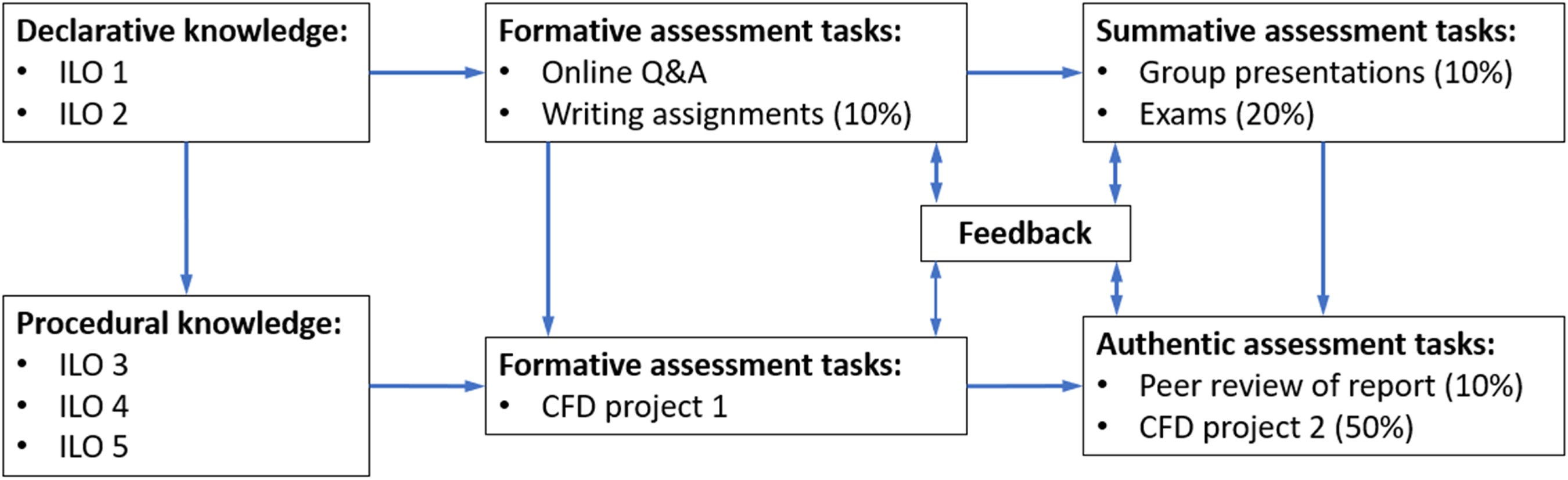
The system of assessment and feedback of the CFD course. CFD: computational fluid dynamics.
The learning activities are guided by and centre around the assessment tasks. Due to the different natures of declarative and procedural knowledge, various learning activities are designed. All the learning activities including assessment tasks are to be completed within 16 weeks (48 lessons). The students are advised to spend at least 8 hours per week on the learning activities in order to fully achieve the ILOs.
The weekly learning activities and associated assessment tasks are shown in Table 1 below. This course includes lectures, software demonstrations, computer laboratories, presentations and discussions. Although lectures are not regarded as an effective way to prompt deep learning, they are effective in helping the students quickly acquire knowledge of terms, basic facts and concepts, 37 thus still play an important role in the CFD course given the very tight time frame. In order to prompt deep learning, a project-based learning method is used, with two parallel CFD projects spanning the entire course period. Project 1 is an in-classroom project for formative purpose while project 2 is for summative purpose. All the learning activities and feedback are directly associated with project 1 and the students are required to apply the knowledge and skills learnt from project 1 to complete project 2. The free student version of Ansys Fluent is chosen as the CFD software of the course because it combines mesh generator, solver and pro-processor in a single graphic user interface, which can greatly shorten the learning curve and avoid students being distracted by issues associated with software manipulation. In addition, the student version restricts the maximum number of mesh cells that can be used in a simulation, which makes it suitable for most personal laptop computers and avoids the students building large models that cause additional issues.
The assessment-guided learning activities.
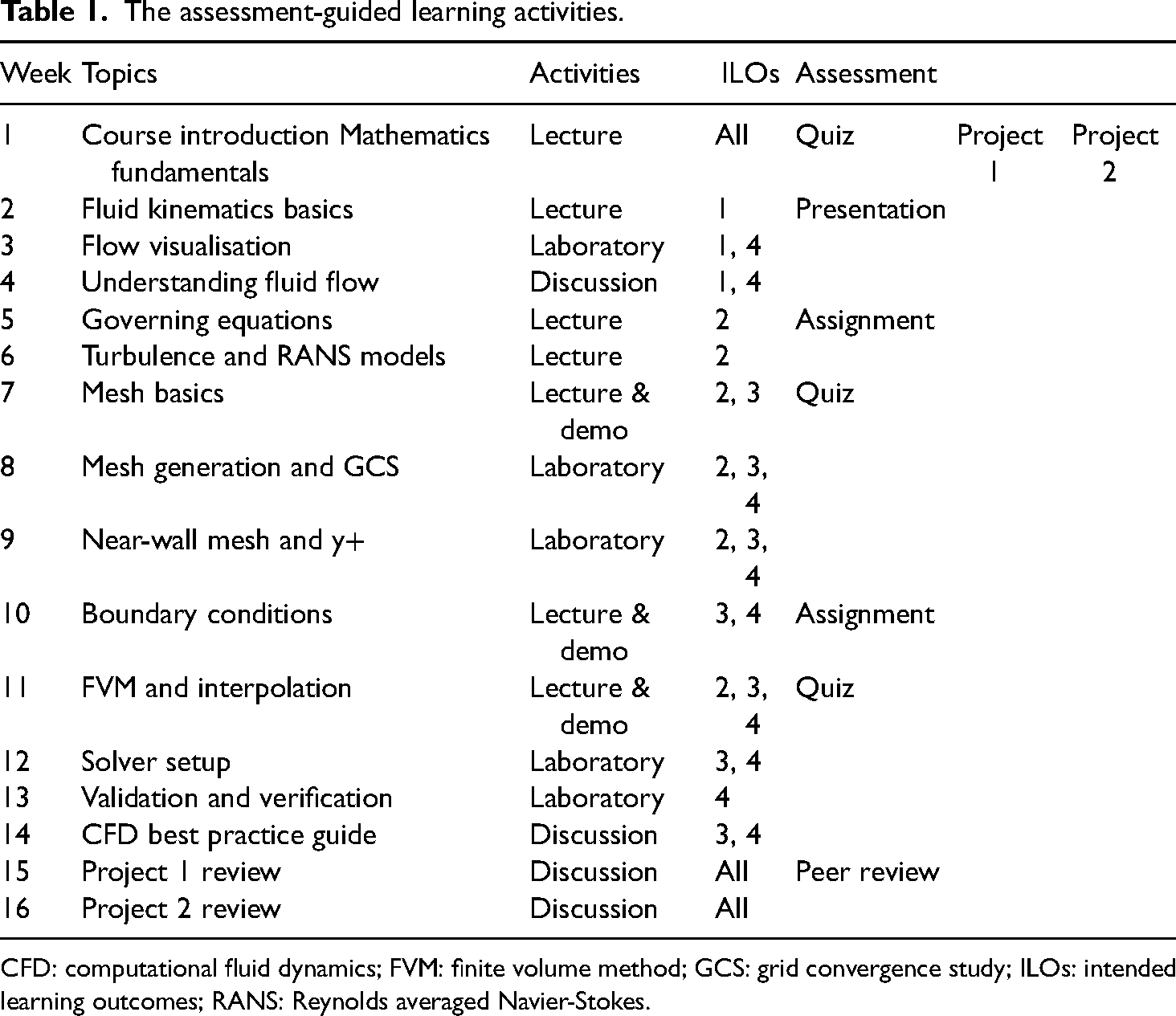
CFD: computational fluid dynamics; FVM: finite volume method; GCS: grid convergence study; ILOs: intended learning outcomes; RANS: Reynolds averaged Navier-Stokes.
The first week is about the course introduction. The syllabus, learning resources, ILOs, assessment tasks, rubrics and due dates are clearly explained in the first lesson, so that the students know exactly what is expected from them from the very beginning of the course, thus are able to internalise the goals to form their own learning goals and proactively monitor their own performance as the course goes on.38,39 This is proven to be extremely important for the conduction of subsequent learning activities. In addition, some mathematics fundamentals such as calculus and vector operators are quickly reviewed. Summative assessment via online Q&A and quizzes is conducted to ensure the students are ready for the learning of multidimensional fluid dynamics theories.
Fluid kinematics basics and flow visualisation (partially CFD post-processing) are learned between weeks 2 and 4. Lectures are first delivered to quickly introduce important concepts and theories to describe fluid flows, including the Eulerian and Lagrangian methods and theories to link these two methods (e.g., the substantial derivative and Reynolds transport theorem), as well as important flow field variables such as gradient, divergence, curl, strain rate, etc. The lecture is followed by a laboratory session in which students are given a completed CFD simulation, and are guided to visualise and analyse the flow field using the post-processing module of Ansys Fluent. Due to the fundamental importance of fluid kinematics knowledge and post-processing skills for subsequent learning, the learning of CFD post-processing skills is carried out throughout the course. The students are guided to analyse the flow field, quantify the flow field variables and present their results via group presentations, through which their mastery of fluid kinematics knowledge and post-processing skills are assessed to ensure they are ready for subsequent learning.
The thorough understanding of the fluid kinematics theories can greatly facilitate the learning of CFD conservation equation, Reynolds averaged Navier-Stokes (RANS) equations and turbulence models, which is carried out in weeks 5 and 6. The move from fluid kinematics to fluid dynamics is an easy step if the former is properly mastered. The main goal of this part is to help the students understand the physics governing the balance of mass, momentum and energy transport in fluid flows, as well as how fluid turbulence can physically affect overall flow features and the governing equation mathematically. Therefore, the lectures are focuses on interpretation of the physical meaning of the equations. Relatively, the mathematical derivation is not a priority. Written assignments and quizzes are the main approaches to the assessment of this part.
Mesh-related topics are covered from weeks 7 to 9. Mesh topology and quality is one of the most important factors affecting the quality of a CFD simulation. An optimal mesh can greatly improve the predictive accuracy, avoid numerical instability and reduce the number of iterations needed to reach convergence. Sometimes a single low-quality mesh cell can cause the entire calculation to fail. As a result, mesh generation is often the most time-consuming job in CFD practices. As this part is more about developing skills rather than learning theoretical knowledge, only a short lecture is delivered to help the students understand different mesh types and methods to evaluate mesh quality. Students are guided in computer laboratories to build a mesh on a geometry provided by the instructor, locally refine the boundary layer mesh according to the selected turbulence mode, and complete a grid convergence study. By generating the mesh, the students also start their project 1. Project 1 is designed for the students to learn CFD skills and is an important part of the project-based learning journey. The project will be progressively completed as the courses goes on.
Boundary conditions are discussed in week 10. A lecture is delivered to help the students quickly get an overall impression of boundary conditions, including different types of boundary conditions and the importance of properly specified boundary conditions. Different ways to specify complex boundary conditions are also introduced via demonstration. The learning outcomes of this part will be jointly assessed with the numerical procedures of project 1, in addition to the assignments to enhance the ability to properly use different types of boundary conditions.
The discrete numerical methods to solve the governing equations are introduced from weeks 11 to 14. The focus of this part is to help the students understand how the governing equation are discretised via the finite volume method and the importance of interpolation schemes during this process, as well as how the resultant algebraic matrix equations are solved for compressible and incompressible flows, respectively. This course does not involve computer coding to develop algorithm programmes, instead, it aims to familarise the students with the principles of the discrete numerical procedures used by mainstream commercial CFD codes, thus know how to optimally set up the solver for a given flow condition. In addition, the numerical errors that can be induced during the discritisation and solution processes are examined, which helps the students to expect the possible sources of errors and contributes to the development of CFD verification skills. All the learning outcomes associated with numerical methods will be reflected in the report of project 1 and will be peer reviewed in week 15. Project 1 itself is not for summative purposes, however, the peer review comments will be assessed by the instructor.
The students are required to use all the CFD theories and skills they have learnt over the course to complete project 2 where applicable. No direct feedback is given to project 2 before the project report is submitted, but the students are able to find answers indirectly from other assessment tasks and course materials. The students are required to explain their selection of theoretical models, grid convergence study, solver setup, convergence judgement and CFD verification criteria. This authentic assessment method has proven to be highly effective in building the students’ ability to apply CFD to real-world problems. It is important to reiterate that course aims to foster lifelong CFD learners, therefore, it is always important to provide feedback to the students’ work even after the project has finished. Therefore, a review session is designed in week 16, which provides opportunities not only for the students to reflect their learning over the course, but also for the instructor and tutors to collect feedback from the students on course design and implementation.
CFD scepticism
This course is to help the students establish an understanding that CFD is all above replacing the continuous distribution of flow variables using discrete numerical values at selected spatial positions and temporal instants. In other words, CFD in essence is an approximation by using finite numbers to represent the infinite physic fields, thus error is an inevitable part of CFD. A range of errors can be introduced to the final CFD solution, such as the CAD model error, mathematical model error, boundary condition error, discretisation error, numerical error, human error, post-processing error, etc. As future CFD practitioners, the students’ job to identify, quantify and minimise these errors, and sometimes to accept the errors for trade-off. To be smart CFD users, they must perform CFD simulations in a critical way because ultimately CFD is a craft rather than a tool.
Although several CFD educators14,23,40 have addressed the importance of critically performing CFD, a systematic learning and practice of CFD scepticism has rarely been implemented in CFD courses especially at the undergraduate level. Scepticism is enforced throughout the course via first-hand experiences. As the course goes on, the students are guided to conduct CFD simulations with different mesh types and densities, turbulence models, discretisation and interpolation schemes, boundary condition types and profiles, solver types, convergence criteria, etc. All these not only produce simulation results of different accuracies and resolutions, but also have different levels of convergence and computational resource demands. In particular, students are guided to quantify the discretisation error associated with mesh generation through calculating the grid converge index. 41 Through these carefully designed learning activities, the students can thoroughly understand how various factors can affect the final simulation results, so that gradually improve their model setup and develop better simulation strategies according to the purpose of simulation and constraints of resources. Their simulations from project 1 are inspected with a critical eye via a laboratory session in week 13, in which commonly used methods of verification and validation 42 are also introduced. A guided discussion on the best way to conduct CFD simulations are then held in week 14, after the students have established the impression that many factors can affect the process and outcome of a CFD simulation. The discussion provides a great opportunity for the students to enhance their knowledge and experience on how to effectively conduct CFD simulations, this will help them to improve their summative project 2.
Preliminary course evaluation
Evaluation is an intrinsic part of good teaching that involves regularly collecting information, interpreting the information, building on strengths and identifying areas where there is scope for improvement. 43 According to Berk, 44 a comprehensive measure of teaching effectiveness involves collecting evidence from a range of sources including the students, alumni, peer colleagues, administrators, employers, national standards, and the instructor's records and self-evaluation. In this CFD course, evaluation is a continuous process. However, due to the difficulties of acquiring information from stakeholders outside the university, course evaluation is conducted within the campus. Multiple methods recommended by Light et al., 45 including questionnaires, peer observation, group discussion, and informal feedback, are used to collect feedback and opinions regarding different aspects of the course from the students and peer colleagues, in addition to the instructor's self-evaluation.
The students are the most important participants of the course, thus their opinions are first-hand and the most valuable information to evaluate the course. An anonymous questionnaire is carried out to collect feedback from the students concerning their opinions about the course. In the questionnaire, the students are given 10 statements which are designed in reference to the guidelines of Light et al.
45
The statements of the 2022 Questionnaire are as follows:
The teaching team makes a real effort to understand my difficulties and is accessible when I need help. The learning resources are easily accessible. Contemporary technologies are used in this course to support my learning and create flexible learning opportunities for me. I have the sense of belonging to this course as my ideas and suggestions are accepted or I can confidently explore ideas with other people. The course has sufficient flexibility to suit my needs. The course is well organised and carried out in a logical and progressive way. The assessment criteria are clear, I usually know what is expected of me. The workload is appropriate, and enough time is allowed for the assignments. This course offers opportunities for me to tackle real-world problems, thus develops my problem-solving skills and confidence to deal with unfamiliar problems. Overall, this course is intellectually stimulating and valuable for my future.
The above statements cover various aspects of the course. Statements 1 to 5 are regarding the supportive and inclusive learning environment; statements 6 to 8 are about course design and implementation; statements 9 and 10 are concerning critical thinking and problem solving. The students are asked to respond, based on their personal course experience, to each of the above statements by choosing one rating from five options: strongly agree, agree, not sure, disagree, and strongly disagree. The average response rate to questionnaires over the past 3 years was 92% (138 out of 150 students responded to the questionnaires), demonstrating great engagement of the students in the course. The statistical responses to the above statements are shown in Figure 4(a). Overall, the students believe they had an excellent learning experience throughout the course. In particular, they are happy with the flexible and supportive learning environment in which a community of learners can freely share viewpoints and have the ownership of their own learning that is supported by the teaching team and scaffolded by a range of contemporary technologies. They also believe that the project-based learning approach is effective in helping them learn CFD principles and applying the CFD to real-world problems. However, the learning curve of CFD software is still felt as steep even only Ansys Fluent is used in the course. As a result, the students feel somewhat overwhelmed by the assessment tasks, suggesting that the time allowed for some of the tasks especially the group presentation and project 2 is not enough, suggesting the students’ thresholds of learning 11 have been reached. In fact, Brown and Rice 34 has discussed the potential risks of assessment-centred learning activities, which include the stresses induced by the assessment tasks. Further investigations and practices are needed to reduce the stresses. The students’ feedback provides very useful information to address this issue.
In addition, an informal questionnaire is conducted to survey what knowledge or skills taught in the course the students are most interested in or believe can best benefit their future careers. The students are asked to choose only one type of knowledge or skills from four given options (i.e. fluid dynamics theories, numerical methods, Software learning and CFD projects) based on their personal preference. The results of the survey are shown in Figure 4(b). As expected, nearly half (48%) of the students are most interested in doing CFD projects, which involves comprehensively applying CFD knowledge and skills to real-world problems. Additional 26% of the students believe that the skills of manipulating CFD packages are of practical importance. In comparison, only a small proportion of the students think it important to thoroughly understand the principles of fluid dynamics (17%) and discrete numerical methods (9%). This outcome once again highlights the importance of using encouraging and engaging approaches such as project-based learning to CFD education. Pure theoretical learning cannot effectively engage the students in learning because the governing equations and numerical discrete procedures are mathematically complex and often look daunting. Similar to Adair's observation,23,24 students in this CFD course clearly show greater interest in laboratories and discussions than lectures. However, the survey by AIAA 8 showed that employers are not satisfied with engineering graduates’ ability to interpret flow phenomena, which can only be built on thorough understanding of CFD theories and methods. In fact, the students will gradually gain deeper understanding of the importance of theoretical learning as they gain experience in their careers. The discrepancy between the students’ self-satisfaction and employers’ unsatisfaction highlights an ongoing issue that has not been properly solved in undergraduate CFD education: how to help the students understand the importance of theoretical fundamentals that underpin CFD? This issue deserves extensive investigation and discussion in the community of CFD educators.
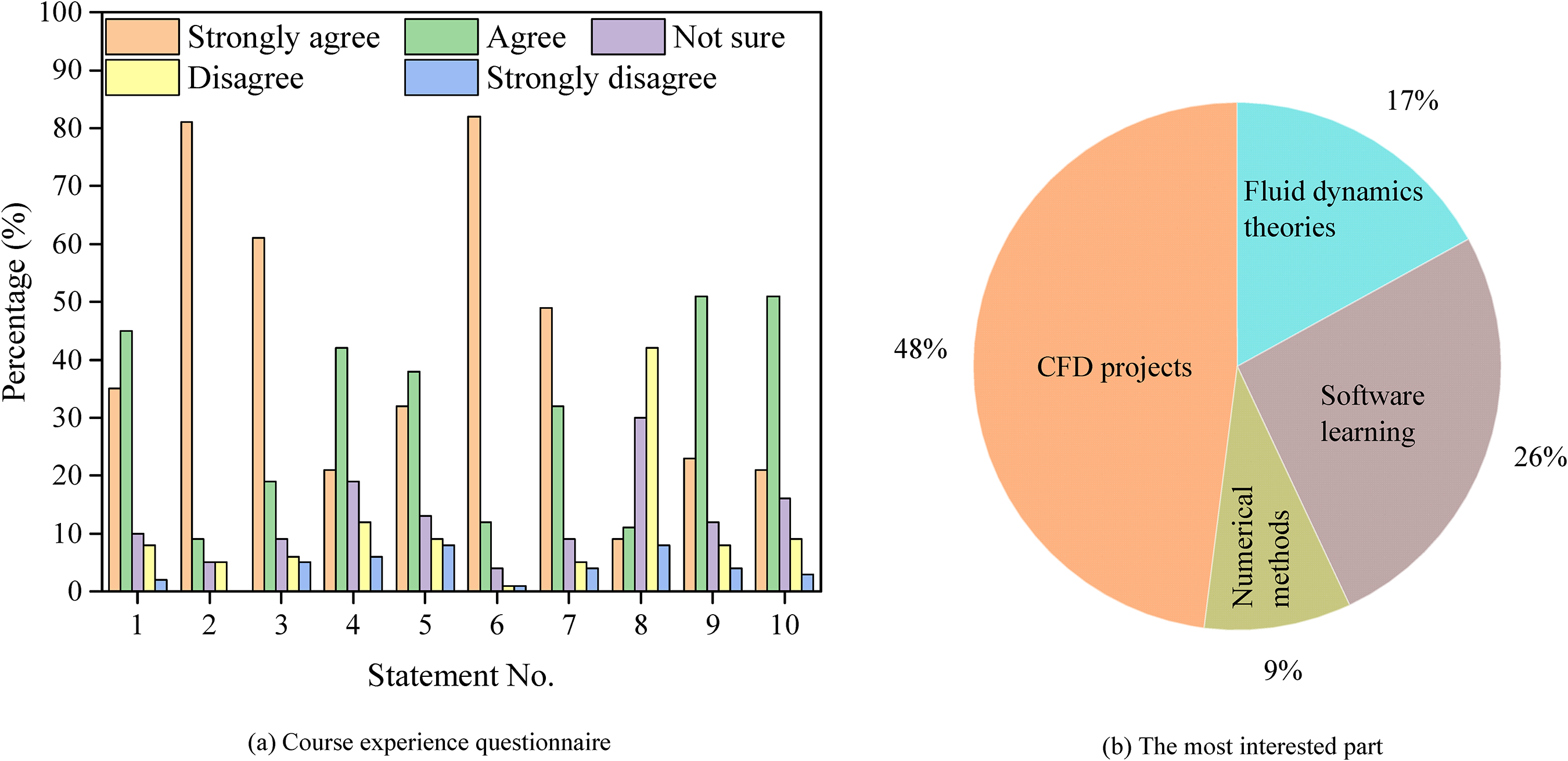
Summary of students’ responses to the questionnaire. (a) Course experience questionnaire. (b) The most interested part.
The second approach to course evaluation is the review by peer colleagues. Due to the busy schedules of colleagues, this is only conducted once a year and involves one colleague from different disciplines each year. Peer colleagues are first invited to visit the course LMS, so that they can have an overall image about the course, including the cohort size, course objectives, course content and resources, learning environment and activities, assessment tasks and rubrics, etc. Then the colleagues are invited to sit in the classroom (lectures, laboratories or student presentations) and discussions are carried out after the learning activity to collect the colleagues’ opinions and suggestions on the design and implementation of the course. Over the past years, the peer colleagues highly appraised the supportive and inclusive learning environment, student-centred approach and authentic assessment tasks and believe these are innovations that prompt active learning. However, different opinions are raised regarding the balance between theoretical learning and CFD projects. Some colleagues argue that more efforts should be placed on CFD fundamentals because ‘universities are not tradie schools’. They believe that a solid grasp of fundamental theories can greatly boost the students’ ability to learn and use CFD. Although similar debates have existed in the CFD education community for a long time and will remain a major topic of debating, as discussed in the second section, the colleagues’ opinions once again highlight the necessity to carefully select topics to be covered in the CFD course according to the learning objectives and discipline background. All these opinions offer valuable first-hand evidence to further improve the course design and implementation.
The third approach to course evaluation is the instructor's self-evaluation. One of the main purposes of self-evaluation is to assess if the most important learning objective has been achieved. That is, if the students are able to perform CFD simulations in a critical way upon completing the course. The evaluation is based on the students’ reports of CFD project 2. Over the past 3 years, over 85% students were able to choose correct governing equations, complete grid convergence study, properly generate near-wall mesh in order to obtain required y+ values for the selected turbulence models, optimally use domain initialisation, interpolation schemes and under-relaxation to accelerate convergence, judge if convergence has been achieved, and properly present and interpret the simulated results using relevant fluid kinematics and dynamics theories. All these are strong evidence that the course has been successful. In addition, the self-evaluation also includes the instructor's self-reflection on self-collected feedback and ‘incidental feedback’. 43 In particular, video recordings of lectures and software demonstrations are stored in the LMS, which not only make it convenient for the students to revisit the course contents at any time, but also provide opportunities for the teaching team to observe and reflect on their own teaching, thus making more awareness of our own activities and being useful to improve the teaching performance in a timely manner.
Summary
This article has introduced a CFD course at the SWJTU-OSU Co-Ed Program. The course is carefully designed based on a systematic literature survey that identifies the gap between the CFD skills desired by the industry and the actual status of CFD education in universities. The course aims to train critical users of commercial CFD codes and prepare the students for more advanced CFD learning and practice. The course features student-centred and project-based approaches to learning. Two parallel CFD projects, for formative and summative purposes, respectively, are designed and conducted throughout the course with critical thinking being enforced throughout. Carefully designed learning activities including lectures, computer laboratories, presentation and discussions are conducted to help the students progressively learn the knowledge and skills needed to fulfil the projects and to enhance the skills of CFD simulation. Assessments of different types are regularly conducted to make sure effective learning has happened. A supportive and inclusive learning environment is built in which discussion and sharing of knowledge is encouraged and facilitated. A range of internet-based technologies including LMS, videos, online discussion boards and openly available resources are leveraged to scaffold learning and enhance the students’ understanding of CFD principles and limitations. The summative assessment tasks show that over 85% students are able to properly explain CFD principles, select governing equations, complete mesh independence test, optimally configure the solver to achieve convergence at the lowest possible computational cost, and properly present and interpret simulation results, demonstrating the success of the course especially considering the students’ relatively lower level of prior knowledge when entering the course.
Course evaluation within the university is conducted by collecting opinions from the students and peer colleagues via questionnaires and informal feedback. The questionnaire results show that the students are happy with the project-based approach and agree that the approach effectively engages them in deep learning. In addition, the social learning and flexible assessment tasks are key factors contributing to the success of the course because students are motivated for active learning when they have the ownership of their own learning. Feedback from peer colleagues also show the project-based and student-centred approaches are main innovations of the courses. However, due to the tight time frame, some students feel overwhelmed by the assessment tasks and do not fully understand the importance of mastering fundamental CFD theories. These valuable feedback and opinions are important for the further improvement of the course. We suggest that splitting the single-semester course into two semesters respectively focusing on CFD fundamentals and practice (analogous to the CFD courses of Navaz et al. 17 and Hailey et al. 18 ) could be a potential solution to the problem because as mentioned before, CFD is a multidisciplinary subject that requires a range of prior knowledge. Intensively learning a large amount of new knowledge and skills has the risk of overwhelming the students and thus adversely affects the learning outcome.
Footnotes
Declaration of conflicting interests
The authors declared no potential conflicts of interest with respect to the research, authorship, and/or publication of this article.
Funding
The authors received no financial support for the research, authorship, and/or publication of this article.

Data Availability Statement
Data sharing not applicable to this article as no datasets were generated or analyzed during the current study.