



Abstract
The general physics of how objects float is only partly covered in most undergraduate fluid mechanics courses. Although Archimedes’ principle is a standard topic in fluid statics, the role of surface tension in floating is rarely discussed in detail. For example, very few undergraduate textbooks, if any, mention that the total buoyancy force on a floating object includes the weight of the fluid displaced by the meniscus. This leaves engineering students without an understanding of a wide range of phenomena that occur at a low Bond number (the ratio of buoyancy to interfacial tension forces), such as how heavier-than-water objects can float at a gas-liquid interface. This article makes a case for teaching a more unified version of Archimedes’ principle, which combines the effects of surface tension and hydrostatic pressure in calculating the total buoyancy on floating objects. Sample problems at the undergraduate level and two classroom demonstrations are described that reinforce the basic science concepts.
Introduction
Determining whether an object floats or sinks in a liquid is arguably one of the most fundamental calculations in fluid statics. If an object floats, then the gas-liquid interface (i.e. the “waterline”) also needs to be accurately located.
The buoyancy force analysis in introductory fluid mechanics textbooks is based on the traditional Archimedes’ principle, which only accounts for the hydrostatic pressure on an object. This analysis is accurate for fully submerged objects and floating objects at high Bond number, where the Bond number characterizes the relative importance of the buoyancy force to the surface tension force:

Floating at a low Bond number produces behaviours that many engineers should understand and be able to predict. For example, objects that are much denser than water can float at an air-water interface, as shown in Figure 1. Beyond these types of novelty examples, there is a wide range of emerging engineering applications that require an understanding of the role of surface tension in floating. Self-assembly of floating objects via capillary effects is a versatile technique used for the manufacture of MEMS. 1 Indeed, as many technologies miniaturize to the micro- and nano-scales, the effects of surface tension become more important relative to volume-based quantities like buoyancy. 2 At larger scales, there has been an interest in the optimization of biomimetic water-walking robots.3,4 Therefore, it is increasingly necessary for engineers of such technologies to be able to design with capillary effects in mind.
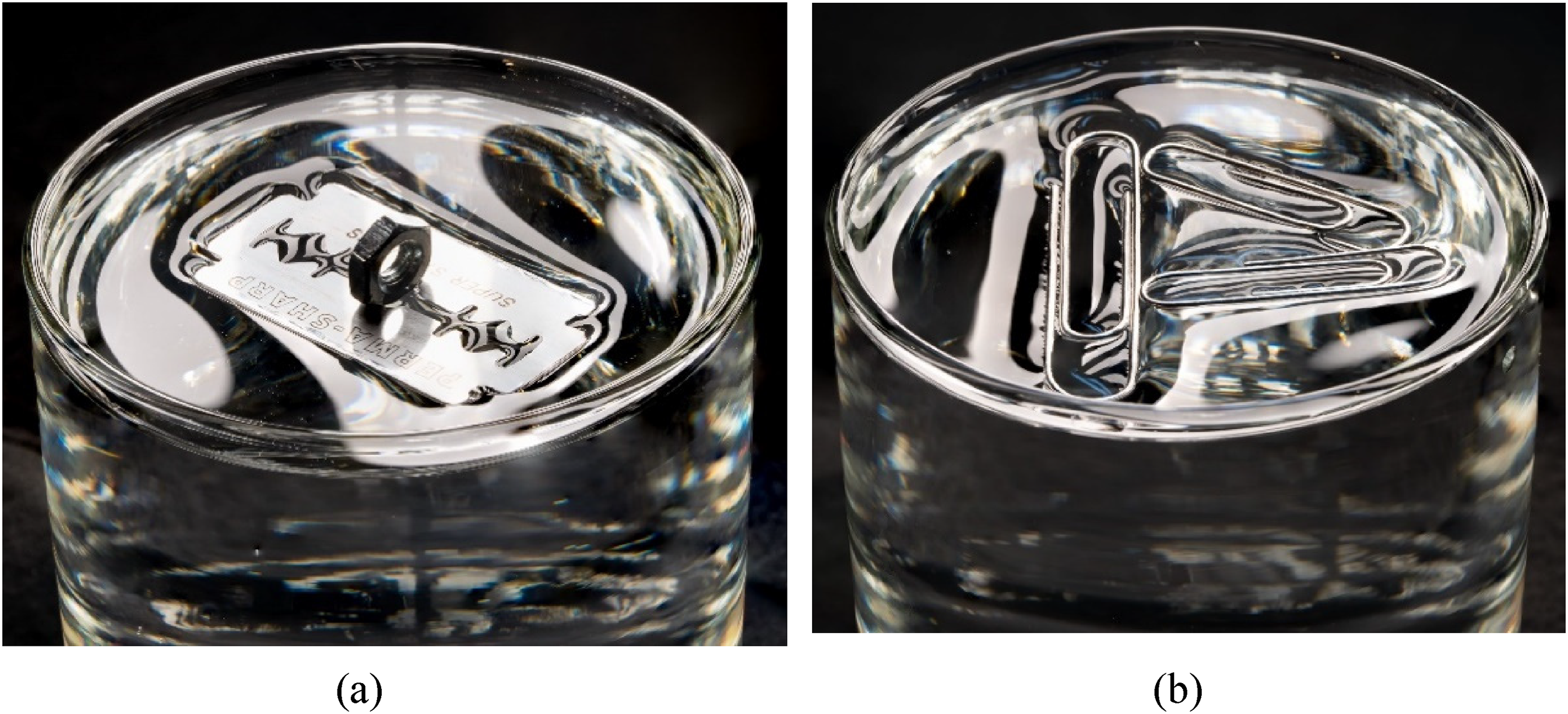
Objects that are much denser than water floating at an air-water interface: (a) steel nut on a stainless-steel razor blade and (b) steel wire paper clips floating on the free surface of water in a drinking glass.
This article makes the case for teaching a more general version of Archimedes’ principle in undergraduate fluid mechanics. The theory by Keller 5 combines the effects of hydrostatic pressure and surface tension on an object at a gas-liquid interface. The total restoring force is the sum of the weight of the liquid displaced by the object and the meniscus. We discuss how this generalized theory considers the effects of both surface tension and buoyancy, which are standard topics in introductory fluid statics. Thus, undergraduate students have the necessary background knowledge to understand a more complete theory of the mechanics of floating. A sample problem is presented to illustrate the level of analysis that can be performed at the undergraduate level. Two classroom demonstrations that reinforce the main concepts are also described. Some limitations and anticipated difficulties in teaching this topic at the undergraduate level are discussed.
Literature review
Table 1 summarizes the content related to surface tension in several undergraduate textbooks that are currently used to teach introductory fluid mechanics. Most of the textbooks in Table 1 cover the general physics behind surface tension and the definition of the contact angle in an introductory chapter on fluid properties. This discussion is extended to applications, including the calculation of the capillary pressure inside small droplets and bubbles. The analysis of capillary action in tubes is also a standard topic. It is described how liquids that wet a tube surface are drawn up, and nonwetting surface-liquid pairs are pushed down relative to the undisturbed free surface. Most of the books discuss how to correct pressure measurements in manometers and piezometers for capillary effects. Some of the books also have a short discussion of the importance of the Weber number and/or Bond number in the chapter on dimensional analysis.
Summary of the content related to surface tension in some widely used introductory undergraduate fluid mechanics textbooks.
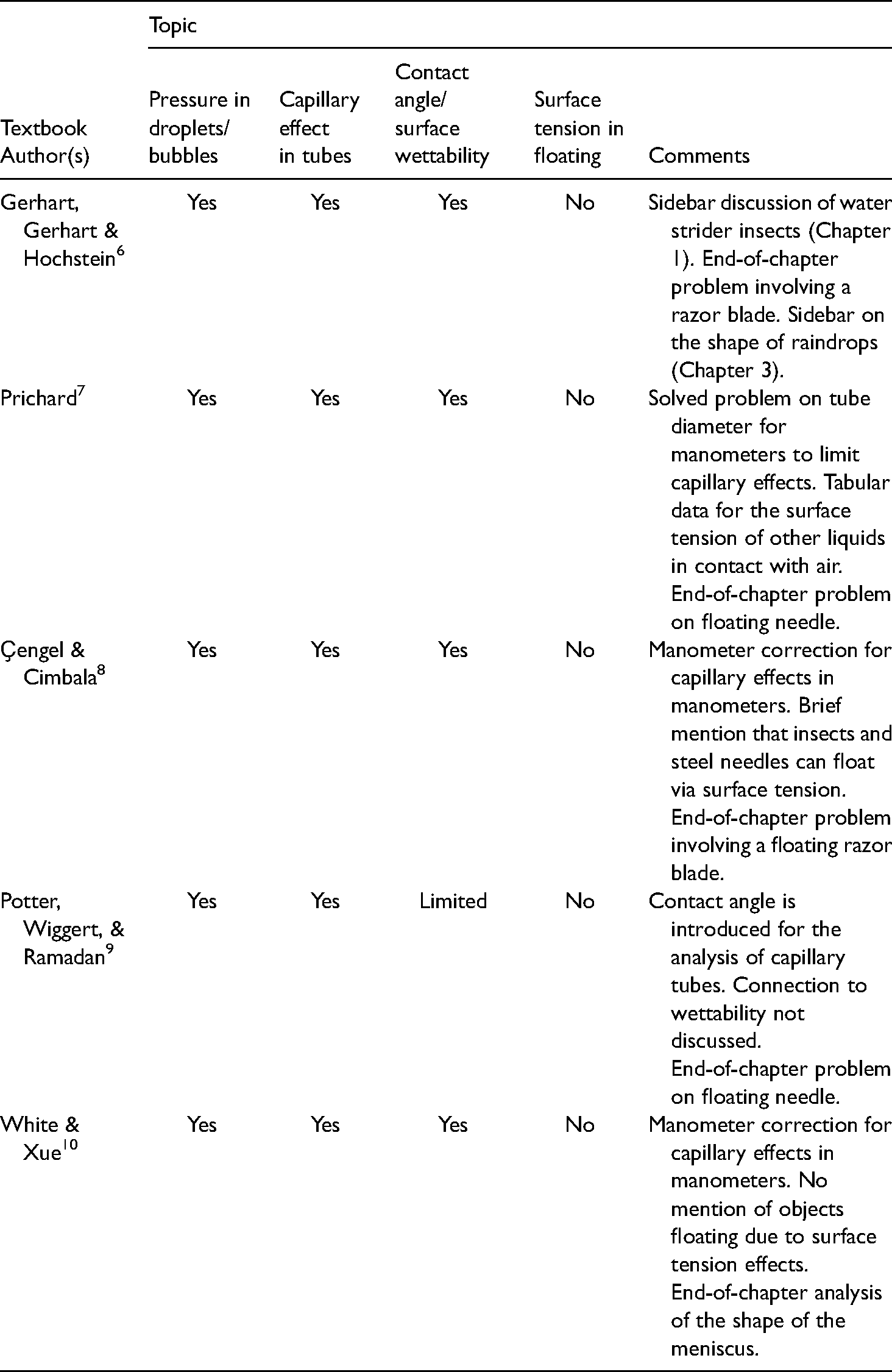
One mainstream textbook has an end-of-chapter problem on the analysis of a floating needle which illustrates the inadequate handling of this topic. The problem requires the student to derive an expression for the maximum diameter of a steel needle that will be able to float in a liquid. The student is told that the liquid wets the surface at a contact angle of 0° and to neglect buoyancy effects. Thus, the solution involves a vertical force balance, with the surface tension on both sides of the needle balancing the needle's weight. Unfortunately, this problem statement is flawed. As described earlier in Chapter 1 of this text, when a surface is wetted by the liquid, the meniscus is drawn upward and surface tension acts downward. It is not possible for a solid object that is denser than the liquid to float with a contact angle of 0°. Furthermore, for this problem to be solvable at an introductory level, the student needs to be given the angular location of the contact line, in addition to a nonwetting contact angle.
A review of introductory fluid mechanics textbooks reveals that the analyses presented of the role of surface tension in floating are limited. The discussion tends to be mostly descriptive. However, most of these textbooks do cover the prerequisite material (surface wettability and Archimedes’ principle) needed to understand a more complete analysis of floating. In this article, we demonstrate that a more detailed understanding of these phenomena is possible at the undergraduate level.
Surface tension-modified Archimedes’ principle and when surface tension effects become important
Archimedes’ principle is that the buoyancy force on an object immersed or floating in a liquid is equal to the weight of the liquid displaced. This naturally leads to the familiar conclusion that an object can float only if its mean density is less than that of the liquid. To account for objects denser than the liquid floating at a gas-liquid interface requires the integration of surface tension effects into the analysis.
The fundamental idea is that an object will float at an interface when the weight of the liquid displaced by the object plus the weight of the liquid displaced by the meniscus is greater than the object's weight. The weight of the extra displaced liquid is equal to the vertical component of the surface tension force on the object. Vella 11 notes that this fact was intuitively understood by Galileo in the 1600 s. However, the rigorous mathematical proof of this equivalency for the general case (requiring vector calculus and Gauss’ divergence theorem) is surprisingly recent, published by Keller 5 in 1998.
Figure 2 illustrates the equivalence demonstrated in Keller's 5 generalization of Archimedes’ principle. There are two forces that balance a floating object's weight: The upward force produced by the vertical component of the hydrostatic pressure distribution over the wetted surface of the object, and the vertical component of surface tension per unit length (σ), which acts along the liquid-vapor contact line, tangent to the gas-liquid interface. The pressure force is always upward and is equivalent to the weight of the liquid displaced by the wetted portion of the body including the area above the contact lines. This displaced volume is the shaded area in Figure 2. Keller 5 showed that the additional restoring force caused by the vertical component of the surface tension is equal to the weight of the liquid displaced by the meniscus. This displaced liquid is the cross-hatched area. Surface wettability determines the direction of the surface tension force, which can be upward or downward. For the case shown in Figure 2, the total restoring force is the weight of the entire volume of liquid displaced which is equal to the sum of the shaded and cross-hatched regions.
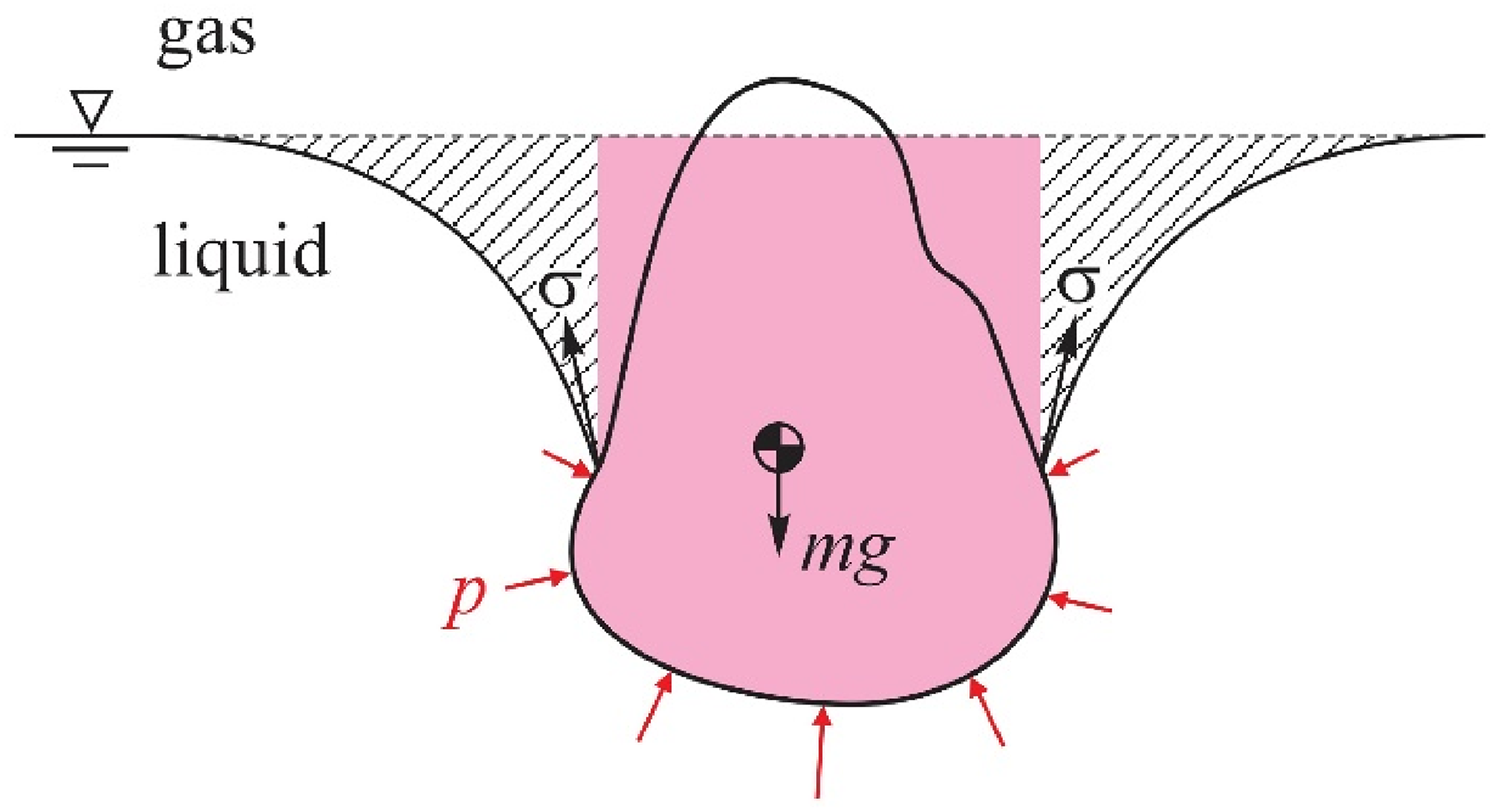
Illustration of the more generalized Archimedes’ principle (Keller 5 ) for a floating object, including the effect of surface tension.
Referring to Keller's equivalency, Vella 11 states “Whether to think of the additional force as coming from the weight of the liquid displaced by the meniscus or from the surface tension force acting on the body is…a matter of preference.” Yet, there are benefits to understanding both views. Vella explains that thinking in terms of the weight of the liquid displaced by the meniscus leads to a physical understanding of the maximum load that can be carried. For example, an object cannot be lowered arbitrarily deep into a liquid. At some limiting depth, the meniscus will destabilize, allowing liquid to flood the space above the object. Although there are no general results for the maximum depth of a meniscus, the shape of the interface must satisfy the Laplace–Young equation. 11
However, thinking of the additional force as coming from the surface tension force per unit length at the meniscus is useful in determining when the effect of surface tension becomes important. As conceptualized in Figure 2, one can think of the additional force as the sum of the vertical components of the force per length because of the surface tension σ, multiplied by the circumference of the object. Taking this view allows one to see that objects that have a small volume—resulting in a small downward gravitational force—and occupy a large circumference at the liquid-air interface, will experience a significant contribution of floating from surface tension effects. In contrast, a large volume object—for example, a long rod inserted into the liquid vertically—which occupies a small circumference on the liquid-air interface, will experience a floating force that is dominated by the weight of the liquid displaced by the object, as predicted by the more classical understanding of Archimedes’ principle. Other factors such as surface wettability also come into play, but practically, this means that the analysis of small objects requires consideration of surface tension effects. Surface tension's contribution becomes negligible with increasing object size.
Thus, whether surface tension is an important contributor in a floating problem is approximately determined by the comparison of an object's characteristic length scale, R, to the liquid's capillary length, ℓc = (σ/ρf g)1/2, where ρf is the density of the liquid and g is the gravitational constant. Surface tension plays an important role in low Bond number situations, where R << ℓc, and surface tension's effects diminish generally when an object's size is large, such that R >> ℓc.
Free body diagram analysis of the meniscus
The analysis of Keller 5 uses mathematical methods that are beyond the scope of an introductory undergraduate course. Nevertheless, the main result can be obtained from basic fluid statics analysis, without invoking vector calculus. Figure 3 shows a free body diagram of the liquid in a two-dimensional meniscus. The liquid on one side of a floating object is shown. For simplicity of presentation, it is assumed in this analysis that the weight of the gas is negligible.
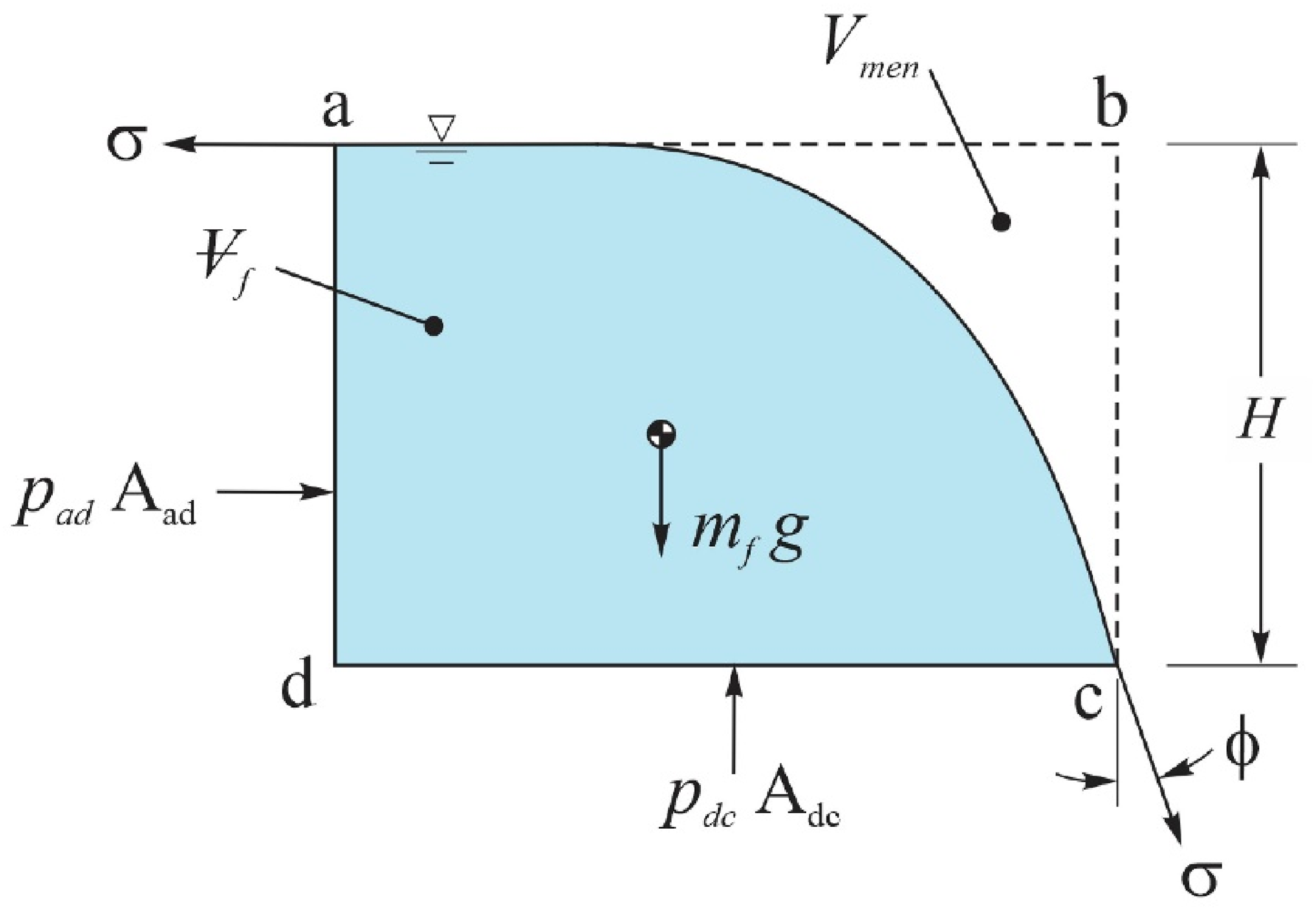
Free body diagram of the liquid in a two-dimensional meniscus.
On a per-unit depth basis, a balance of the vertical forces gives:

Students may be puzzled that the pressure along line dc is constant even though the depth of the liquid changes. However, students should be familiar with how the curvature of the free surface produces a pressure difference across the interface. All the textbooks listed in Table 1 discuss this effect for liquid droplets in a gas. Thus, at any location, the weight of the column of liquid, plus the added capillary pressure caused by the local curvature of the meniscus, combine to produce a constant pressure along line dc.
Substituting the pressure 
The balance of the horizontal forces in Figure 3 gives an expression for the depth (H) of the contact line.

A sample problem is presented next, to illustrate the level of analysis that can be introduced in an undergraduate course. These types of calculations can be used to reinforce the students’ understanding of the basic mechanics of floating.
Sample numerical example
A small disk of wood (ρs = 510 kg/m3) floats in a stable orientation in liquid water at 20°C (ρf = 998 kg/m3, σ = 0.0728 N/m) as shown in Figure 4. The disk has a diameter of D = 18 mm and thickness of L = 10 mm. Calculate the depth ( Using Archimedes’ principle and neglecting the surface tension force. Considering that the water wets the surface of the wood with a contact angle of Considering that the wood is given a superhydrophobic coating, such that the contact angle is
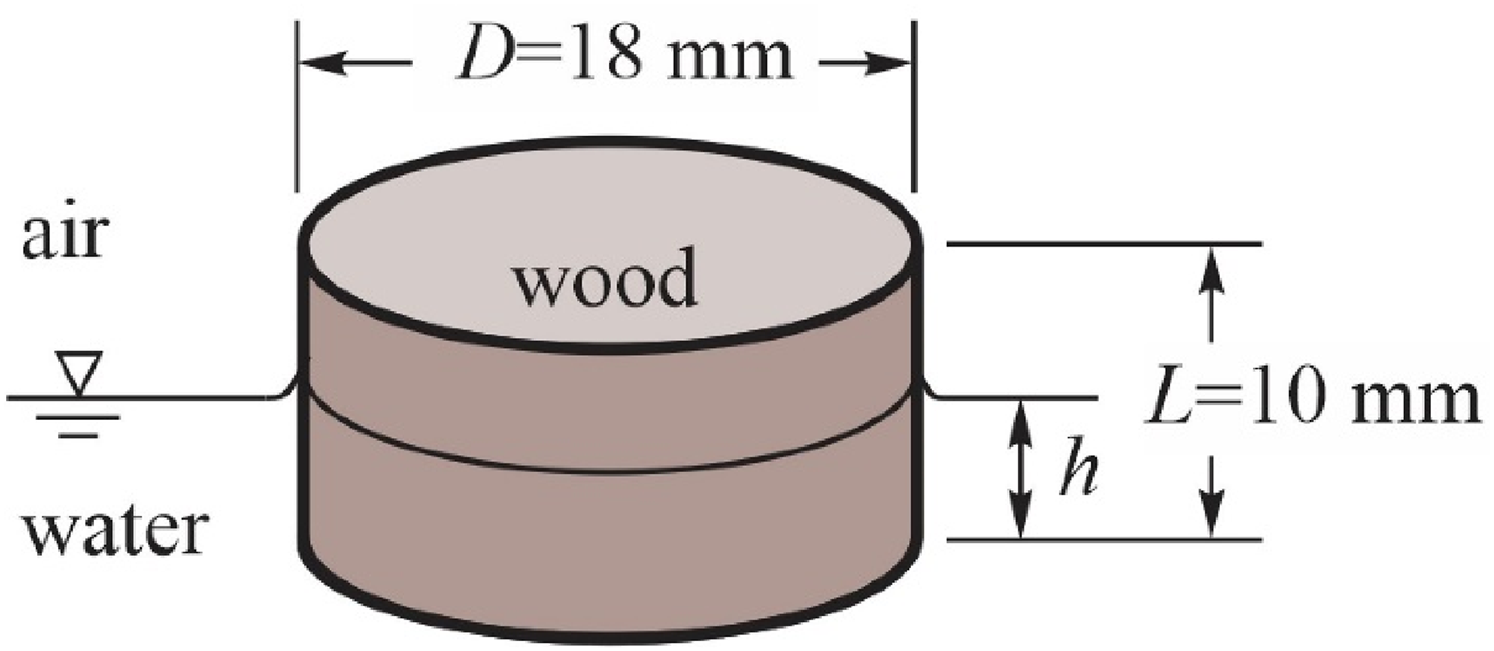
A wood disk floating at the air-water interface.
Solution
Figure 5 shows a free body diagram of the wetted wood disk.
Ignoring surface tension, a vertical force balance gives the traditional result. The hydrostatic pressure force balances the disk's weight: Including surface tension, the hydrostatic pressure force balances the object's weight and the surface tension force:



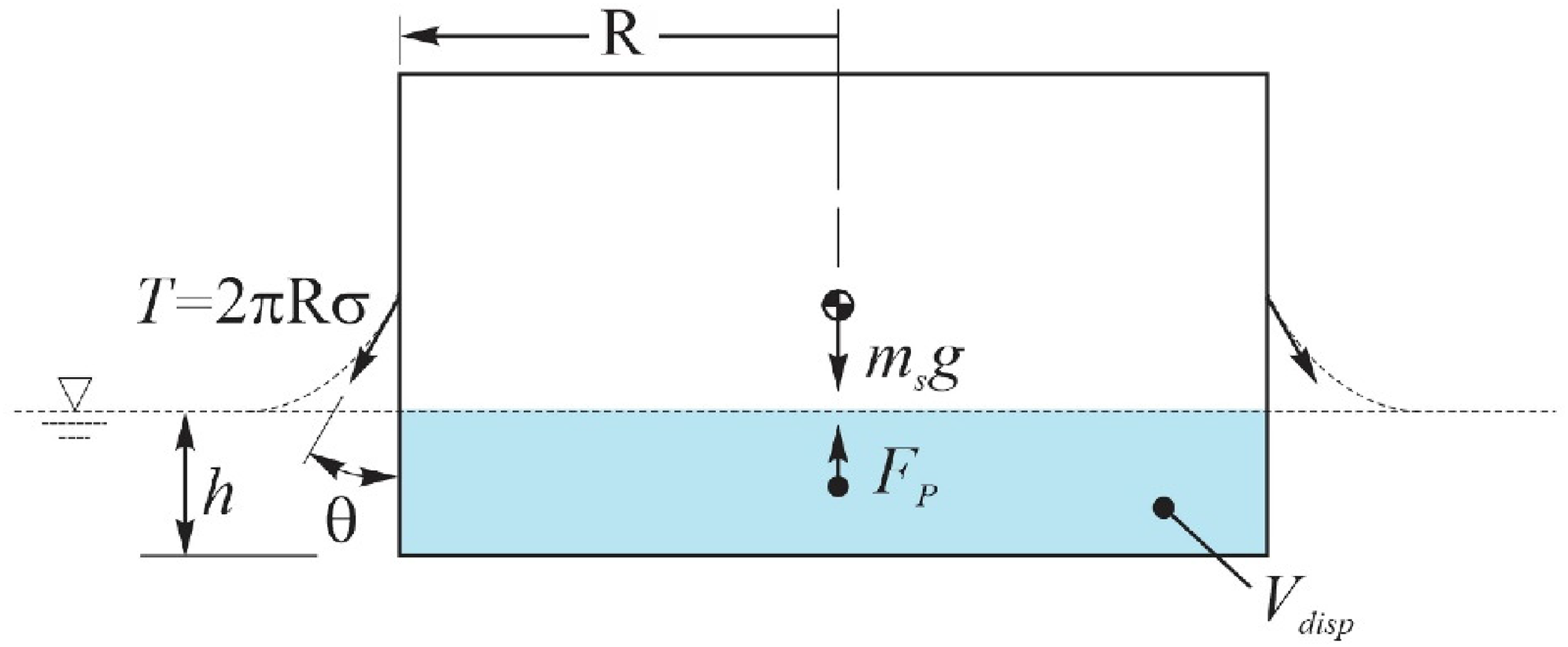
Free body diagram of the wetted wood disk.
When the water wets the wood, the surface tension force causes the disk to float lower in the water. Note that Equation (8) can be expressed in dimensionless form as:
The capillary length for liquid water near room temperature is ℓc = 2.7 mm. In this sample problem, the size of the disk is of the same order of magnitude as the capillary length, (c) Applying the vertical force balance for the nonwetting case
For the nonwetting case, the meniscus displaces water around the disk, which contributes an upward force.
As an aside, the volume of water displaced by the meniscus can be calculated from Keller's
5
equivalency, Equation (4). Referring to Figure 3, the angle that the surface tension makes relative to the vertical plane at the contact line is 
Figure 6 shows a sketch of the results. This example illustrates that surface tension and wettability are significant when the object's size is close to the capillary length of the liquid.
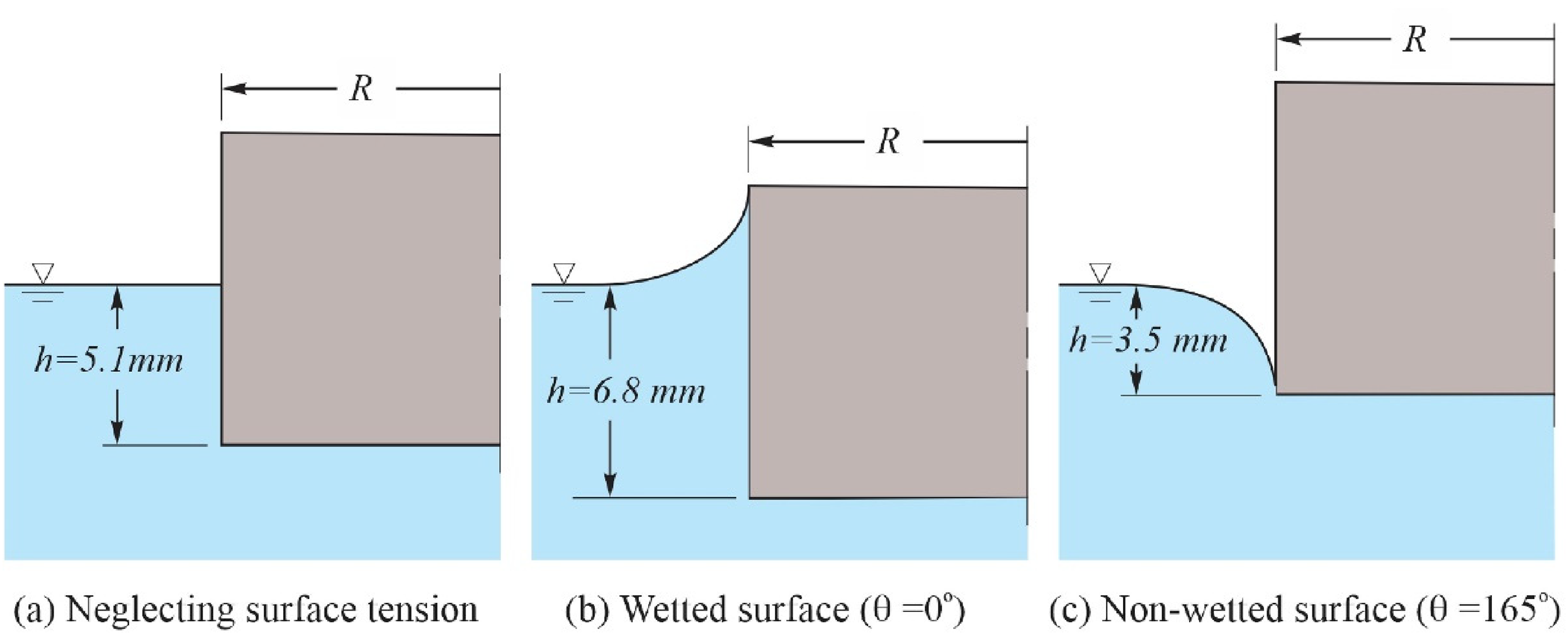
Sketch of the results of the numerical example of a floating wood disk.
Another floating problem suitable for undergraduates is shown in Figure 7. Force balance solutions are given for a sphere and cylinder, assuming a stable meniscus with a contact line location of 90°. To be easily solvable at the undergraduate level, the student should be given both the angular location of the contact line and the contact angle. The object's depth is assumed to be sufficiently small so that the meniscus is stable. To ensure that the problem statements are physically realistic, instructors can find detailed results for the limits on the depth of the meniscus for specific geometries in the literature.12,13
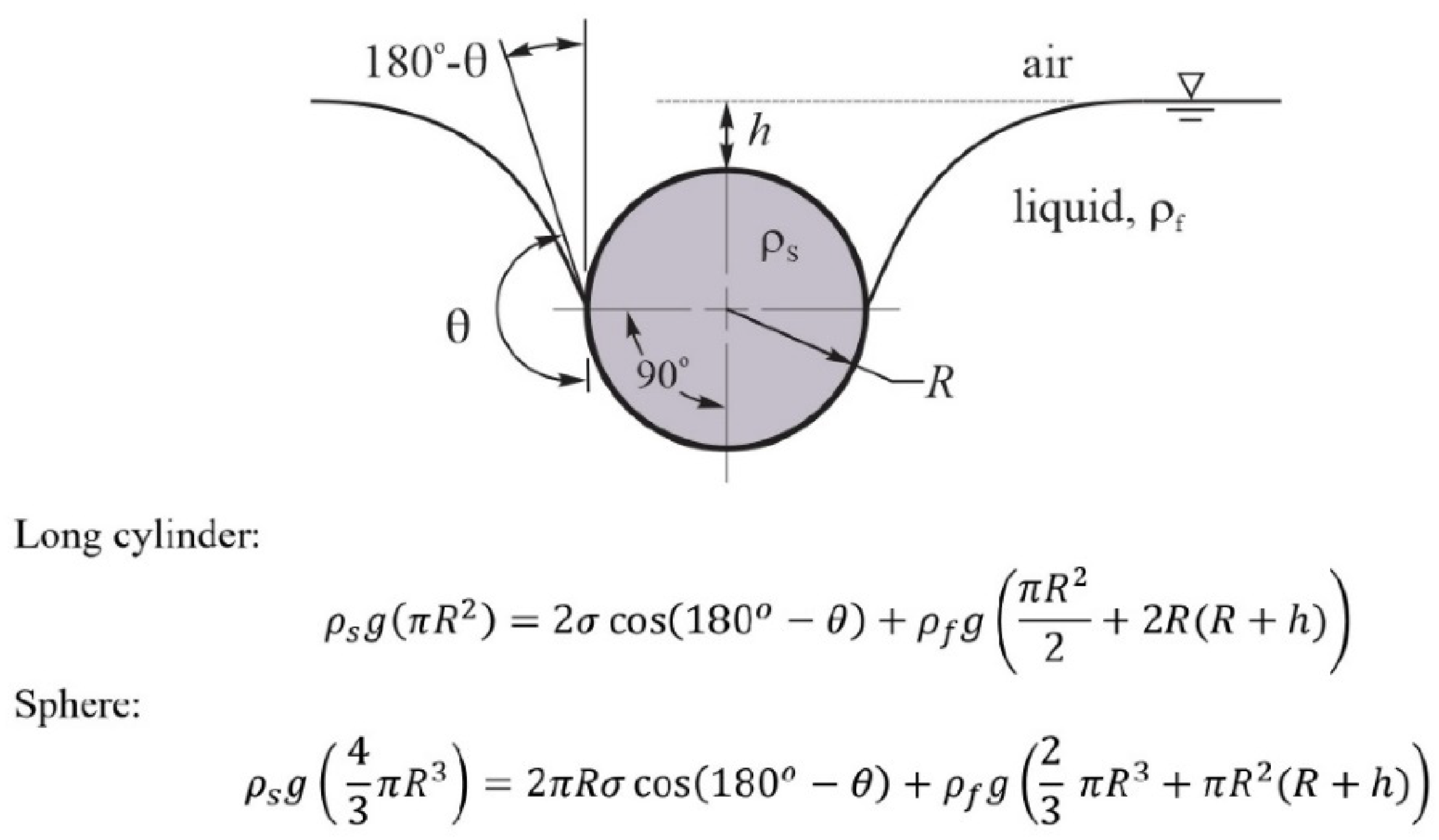
An alternate form of a floating problem involving surface tension, which can be used at the undergraduate level. Solutions are shown for a long cylinder and a sphere, assuming a stable meniscus with a contact line location of 90°.
In-class demonstrations using superhydrophobic coatings
Demonstration #1: floating wood disks
Figure 8 shows a photograph of two wood disks (D = 18 mm, h = 9 mm) floating in water. The disk on the left is untreated wood which is wetted by water. The otherwise identical disk on the right has been treated with a superhydrophobic coating. As predicted in the example problem, the nonwetted disk floats much higher in the water because of surface tension effects. Most of the side of the coated disk is exposed and dry. The meniscus of the nonwetted disk is observed to displace more water than the untreated disk and experiences a greater total upward force. The similarity to the results of the example problem shown in Figures 6 (b) and (c) is clear.
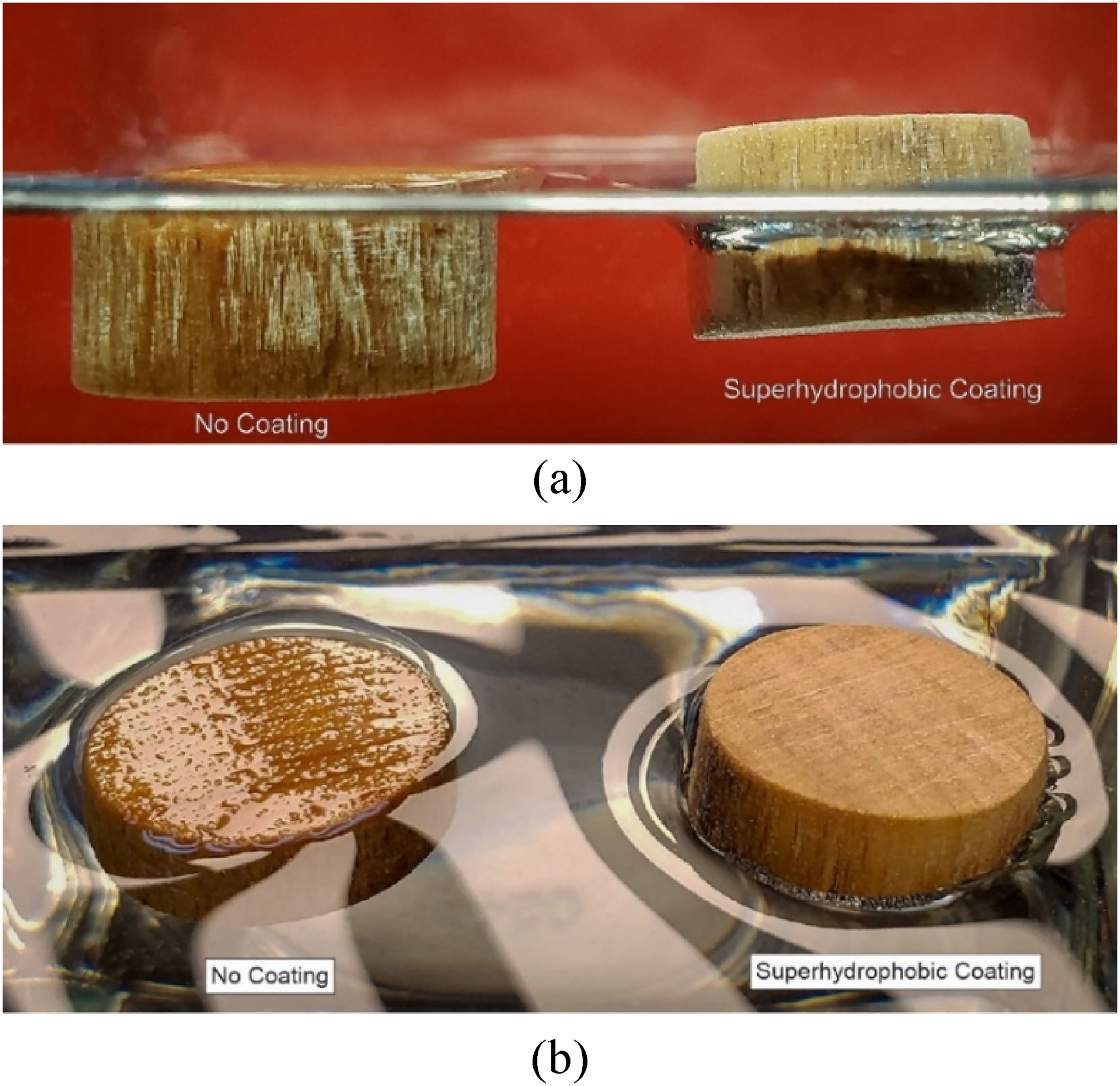
Two wood disks (D = 18 mm, h = 9 mm) floating in water. The right disk is coated with a superhydrophobic coating and the left is untreated: (a) elevation view, (b) oblique view.
The superhydrophobic coating used for this demonstration is a two-step commercial spray (Rustoleum NeverWetTM). The manufacturer specifies that this coating gives a contact angle of up to θ = 165° for a sessile droplet of water.
Demonstration #2: floating steel rings
The role of surface tension in floating can also be demonstrated in a classroom setting using two steel rings, as shown in Figure 9. Each steel ring has a mean diameter of 37 mm and is made from wire with a diameter of 1.5 mm. As would be intuitively expected, water wets the untreated steel ring
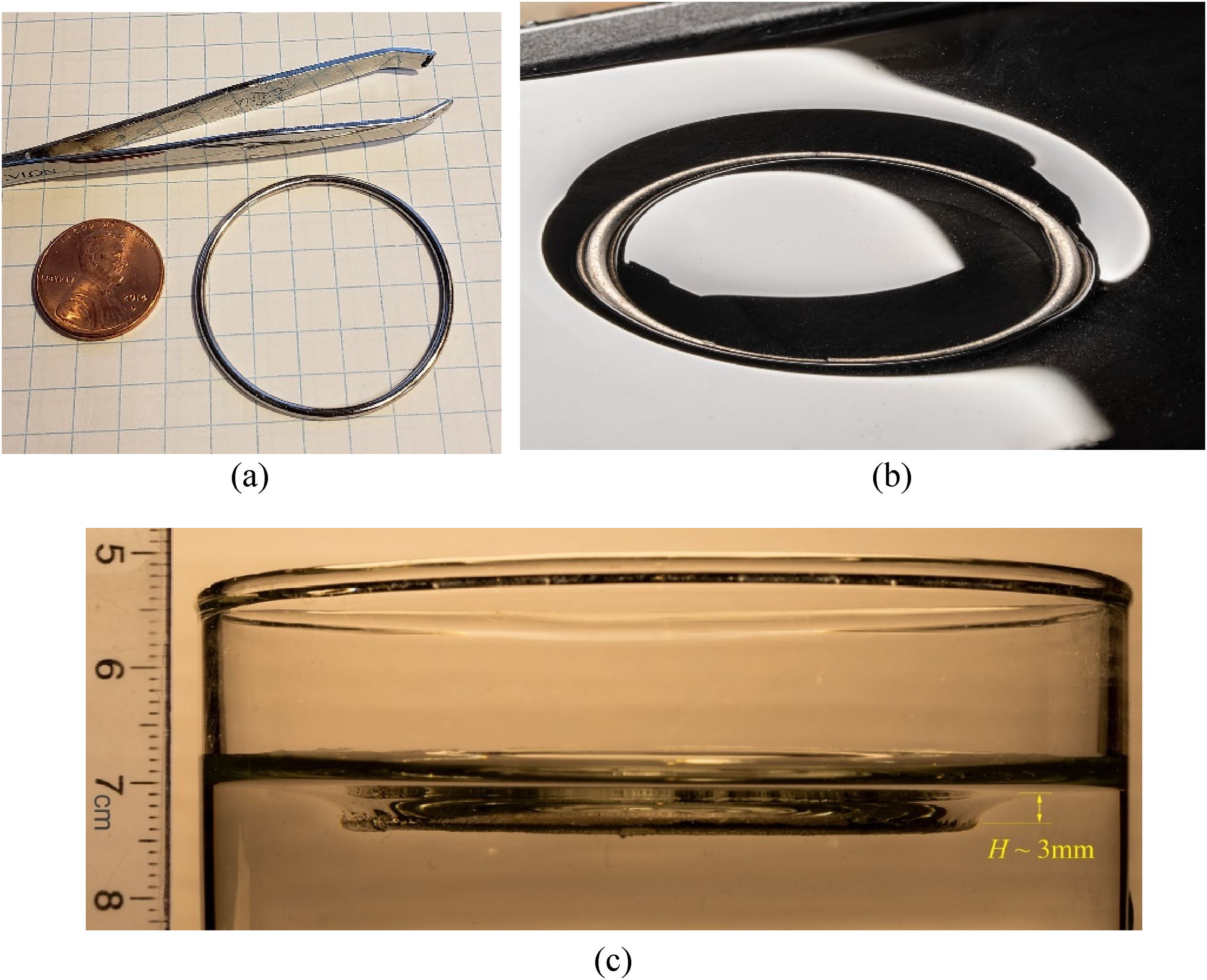
(a) An untreated steel ring that does not float on water and (b) an identical steel ring treated with a superhydrophobic coating that floats on water and (c) an elevation view of the floating ring (H∼3 mm).
However, an identical ring with a superhydrophobic coating floats easily, as shown in Figure 9(b). The top surface of the coated ring remains dry and the water contacts the ring's surface on the lower half of the ring. Again, the superhydrophobic coating used for this demonstration is Rustoleum NeverWetTM (θ ≅ 165°).
If the angular location of the contact line is assumed to be ∼90°, a surface contact angle of θ = 165° corresponds to ϕ ≅ 15°. These values can be used in Equation (6) to estimate the depth of the contact line:
This demonstration reinforces several concepts associated with the more generalized application of Archimedes’ principle. A free-body diagram of a section of the floating steel ring is shown in Figure 10, with the depth of the ring and meniscus drawn approximately to scale. The superhydrophobic ring floats because of a combination of the surface tension forces and the hydrostatic pressure on the wetted portion of the ring. The coating prevents the liquid from flooding the region above the ring.
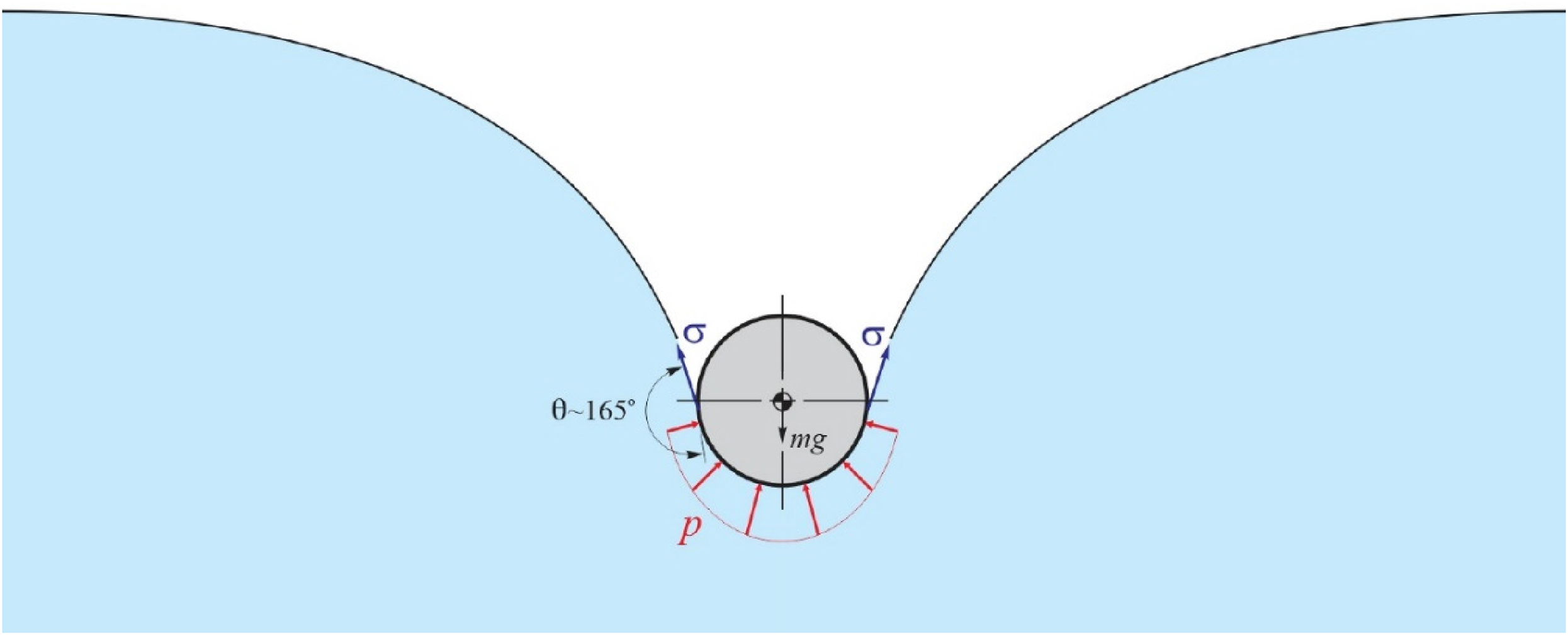
Free body diagram of a section of the superhydrophobic ring floating in water, drawn approximately to scale.
An alternate and mathematically equivalent explanation of how the ring floats is that the superhydrophobic coating increases the contact angle, causing the meniscus to displace a larger volume of water. The specific gravity of the steel wire is approximately 7.9. So, the total displaced volume of water will be 7.9 times the volume of the wire. The weight of this displaced volume of water balances the weight of the steel ring.
Several other interesting points about floating versus sinking can be made as part of this demonstration. A student who experiments with this setup will quickly discover that the ability to float depends upon how gently the ring is placed at the interface. If the ring goes too far down into the water, either by momentum or a direct force, the meniscus will collapse inward, flooding the top of the ring. Some studies have examined the effect of the initial velocity on the ability of an object to float. 14 The ability to float can also be shown to depend on the proximity of nearby objects which distort the free surface. Two floating rings will be drawn together because of the “Cherrios effect”. 15 The combined “raft” has a greater tendency to sink than the individual rings.
For technical completeness, it should be mentioned that superhydrophobic coatings typically have very fine hair-like surface structures which may trap a thin air layer adjacent to the surface. Pan and Wang 16 have suggested that this effect may contribute some additional buoyancy, which is not included in the present analysis.
Summary
A more complete understanding of the basic physics of how objects float is important for many engineers. The role of surface tension in floating is not normally taught in undergraduate engineering courses. Also, the concept that the total buoyancy force on a floating object includes the weight of the fluid displaced by the meniscus is not generally included when teaching Archimedes’ principle. This is, at least in part, because this topic is inadequately covered in the current mainstream introductory textbooks. The current work illustrates an approach that can be used to fill this instructional gap.
We have shown that a more unified version of Archimedes’ principle, which includes the effects of surface tension, can be easily integrated into the fluid statics content of introductory fluid mechanics courses. It combines the concepts of surface tension, wettability, hydrostatic pressure, and buoyancy, which are taught in introductory courses. Also, the basic physics and mathematics are well within the capabilities of undergraduate students. The topic could be taught either in parallel with the standard coverage of Archimedes’ principle or as a separate special topic in fluid statics.
Footnotes
Declaration of Conflicting Interests
The author(s) declared no potential conflicts of interest with respect to the research, authorship, and/or publication of this article.
Funding
The author(s) received no financial support for the research and authorship of this article. The Open Access publication charges were paid by the Canadian Research Knowledge Network.
