



Abstract
This article begins by arguing that the UK race riots of August 2024 had their own distinct – and especially worrisome – sociological dynamics when it came to the disorder that occurred in Northern Ireland. The upsurge in race hate and racism has to be viewed in the context of the continuing existence of loyalist paramilitary groups and most especially the enduring sectarian division which is shown to have not been adequately addressed in the years since the Belfast Agreement of 1998. Most importantly, it is advanced that what lies at the heart of such social problems that beset Northern Ireland is a particular form of systemic racism: ‘systemic sectarianism’. It is the web of systemic sectarianism which ensures that sectarian division endures and operates to reproduce inequality and social injustice. Against this, it is asserted that there is a need to advance a social transformation agenda that enables people to develop a political vision and agenda that transcends race hate, racism and sectarianism.
Keywords
Introduction
Over more than twenty-five years on from the Belfast Agreement of 1998, recent outbreaks of racial violence in Northern Ireland have dramatically revealed that the stability of the peace process is not even skin deep; that Northern Ireland is a society still troubled by mistrust, prejudice and hatred. Such overt racism largely confirms the view of American scholar James Waller, expressed in 2021, that Northern Ireland ‘is trending in a darker and more dangerous direction’. 1 Riots in Belfast formed part of the week-long wave of British far-right instigated violent protests that were triggered by the brutal murder of three young girls in the northern English seaside town of Southport, in late July 2024. In Belfast city, as elsewhere, 2 there were racist attacks on people from black and ethnic minority communities – including new migrants, refugees and asylum seekers – who were abused, intimidated and assaulted. Indeed, what happened from 3–5 August 2024 attracted widespread UK media attention and made for headline news. 3
On Saturday 3 August – a date on which riots occurred in a total of ten English cities and towns – there was a night of rioting in the South Belfast area following an anti-immigration protest rally that took place at City Hall. A large breakaway crowd of protestors intent on marching from the city centre to the Belfast Islamic Centre found their route blocked by the police and hence decided to proceed along ‘Belfast’s most multi-cultural street’, 4 Botanic Avenue, where shops owned by ethnic minority people and hotels rumoured to be housing asylum seekers were targeted and had their windows smashed. As night fell, the disorder spiralled into ongoing riotous behaviour involving masked youths, petrol bombs and riot police, in the nearby environs of Sandy Row and the Donegall Road – loyalist areas where the Union Jack has long flown proud.
This racial violence was more intensely repeated (in the same locale) on the night of Monday 5 August, 5 and over the days that followed, there were many race hate attacks across Northern Ireland directed against homes and businesses belonging to black and ethnic minority people. In fact, the Police Service of Northern Ireland had to call for the assistance of four public order units from Police Scotland to try and contain the threat posed and ended up making forty-five arrests, seven of which related to persons aged under eighteen. 6 The question that arises is: What lies behind all of this?
Paramilitarism lives
Within Northern Ireland, it has long been known that racially-motivated intimidation and violence has been instigated through the coordinated action of loyalist paramilitary organisations such as the Ulster Defence Association and Ulster Volunteer Force. As Daniel Holder, director of the Committee on the Administration of Justice, recognised: ‘What we’ve seen is an escalation but in reality a continuum of a long-term issue of racist intimidation and racist violence, largely driven by elements of loyalist paramilitarism.’ 7 In fact, some twenty years ago, sociologist Bill Rolston perceptively pointed to the links between loyalist paramilitarism, the British extreme far Right and racism, in relation to a Unionist working-class area of South Belfast (the Village), concluding that ‘intolerance within unionism is a legacy which has not been overcome’. 8 And today it is true to say that within those Protestant working-class areas, where many new migrants find the most affordable housing, the loyalist paramilitary groups have not – despite the peace process – gone away. 9
The significant point to make in this regard is that the nativist form of British nationalism that drove the racial violence that occurred across much of England is of a kind with the sectarian structure of Ulster loyalist ideology. Central to the Ulster loyalist tradition is the self-defence of the Protestant community and maintenance of the union with Great Britain, which takes the Union Jack to be ‘a centrally important symbol’. 10 And it is those ‘warriors’, the loyalist paramilitaries, historically tasked with the imperative to defend this community from all existential threats to ‘Protestant social and political dominance’, 11 that have long found common cause with the ethnocentric elements that define the ultra-nationalism of the British far Right. 12 All the more so given the increase in immigration to Northern Ireland, and that the political dynamics of Brexit necessitated the drawing of the Irish Sea border, 13 which have made the Protestant community’s defence of the Union just as important as ever. 14
Thus, whilst in Great Britain it can be said that ‘no one organisation owned or organised the riots’ and that they lacked cohesion, 15 this is not the case for Northern Ireland. For, here, at the heart of the racial violence stood those paramilitary groups long acknowledged to have had close ties not just with the National Front, the British National Party and Britain First, but the ‘terror squad’ known as Combat 18. 16 In Britain, these latter four neo-Nazi groups are certainly not the force they once were; but in Northern Ireland, the loyalist paramilitaries have actually seen their membership rise since the Belfast Agreement was signed. 17 Moreover, there is no doubt that loyalist ‘warriors’ have tapped into and connected with the nebulous British far-right online network which – through social media platforms, multiple influencers and secure messaging apps (such as Telegram) – now fuels racial intolerance and violence throughout the UK. 18 All told, today, there are forces at work within Ulster unionism that identify with British ‘far-right fears of cultural dissolution facilitated by immigration and state treachery’, 19 but which present far more of a threat to societal peace.
That this is so has to be understood in terms of the grip of a much larger socio-political phenomenon. For, contrary to all the otherwise soothing talk of Northern Ireland now being a ‘post-conflict’ society, there is a serious matter that has to be confronted head on. And that is to recognise that this is a society that, to its core, is structured around and driven by a historically specific macro-sociological form of racism, namely: systemic sectarianism. In other words, in this society, race hate and racial violence must primarily be interpreted as being nested within the social dynamics of sectarianism; as thereby tied to fundamental systemic contradictions and deep-lying colonial power relationships. In truth, and as is about to be presented, in Northern Ireland sectarianism has to be understood as representing a form of systemic racism that has most pernicious effects. Consequently, it follows that as long as systemic sectarianism is not constructively addressed, Northern Ireland will remain an untransformed society that is ever susceptible to the spectre of race hate crimes and racial violence.
Sectarian division
The Belfast Agreement of 1998 has brought ‘peace’ in the sense that there has been an end to armed conflict; but, aside from recent events, it is not all that difficult to show that government policies concerned with ‘community relations’, poverty and social inclusion have all fallen short in confronting sectarian division, and have therefore failed to advance equality with social justice. Despite the hopes of many intellectual commentators, 20 after all the great acclaim afforded to the Belfast Agreement, and after years of electoral success for the historically hard-line Democratic Unionist Party (DUP) and Sinn Féin (SF), the pattern of sectarian division in all spheres of life has endured – and in some cases even deepened. High levels of endogamy persist; social housing estates are either at least 90 per cent Protestant or Catholic; the proportion of pupils in segregated post-primary schools stands at over 90 per cent; 21 only around one employee in eight goes to work in territory dominated by the ‘other side’; and, as ever, people lack friends across the sectarian divide. 22 Moreover, the number of peace walls and barriers actually rose in the wake of the Belfast Agreement; 23 and for all the talk of a ‘new’ regenerated Belfast, it remains a city pock-marked with vacant land, empty spaces and derelict buildings.
Tellingly, the position of the DUP and SF whilst in office, since 2007, has not seriously got to grips with any of this; their agreed policy positions as first expressed in the Programme for Cohesion, Sharing and Integration and then in what remains the leading policy document Together: Building a United Community, 24 have been framed within the consociational political logic that accepts the existence of the sectarian divide, and believes that it is best addressed through seeking to maintain the ‘Unionist’ and ‘Nationalist’ communities in a state of equilibrium whilst upholding a spirit of mutual accommodation, co-existence and tolerance. Amongst much else, this has meant that ideas around mixed housing or integrated education have been held back in favour of promoting a limited number of shared neighbourhood projects, shared spaces plans and shared post-primary education sites. 25
All in all, it is not an exaggeration to say that there has been no concern at the heart of the Northern Ireland Executive and Assembly to advance social transformation; to further equality and social justice by confronting sectarian division. 26 It is, then, surely time to properly understand why this is so – especially as the central problem can be simply stated. Basically, the position that the constitutionally-protected ethnonational group categories of ‘Unionist’ and ‘Nationalist’ require equal recognition and treatment whilst being kept in a state of stable equilibrium is not enough. And it is not enough because it is an approach that unthinkingly abstracts out the all too real-life salience of systemic sectarianism. What has been left unseen and unsaid is an understanding of sectarianism as a system.
Sectarianism is a system
Sectarianism is not just a question of ‘religious bigotry, the promotion of one’s religion or religious background at the expense of the alternative’; 27 it is a system. In truth, sectarianism is best interpreted as constituting an intersecting self-perpetuating matrix of social closure around land, housing, education and employment, based on the categorical markers of Protestant and Catholic that result in inequality and social injustice. 28 This is a system centred on an interlinked and mutually reinforcing pattern of exclusion, one that results in cumulative advantage for Protestant people and disadvantage for Catholic people. 29 It is, to be clear, a dehumanising system. And the key point to be made is that Protestant people and Catholic people still confront unequal life chances as a result of how the positional structure of society has been and continues to be overdetermined by the systemic pattern of categorical exclusion. 30 Indeed, this is a system that has led Northern Ireland to be labelled ‘one of the most unequal societies in the developed world’; 31 a society in which 48 per cent of all those in relative poverty are Catholic people – which is 1.8 times that for Protestant people; 32 and a society in which Catholic people find themselves almost twice as likely to be arrested and charged by the police than Protestant people. 33
Historically speaking, sectarianism is a system rooted in the seventeenth-century colonial Plantation of Ulster. 34 From the 1610s onwards, Protestants and Catholics were systematically set against each other through the machinations of colonialism that ‘built privilege into the social order and conferred it on Protestants at the expense of Catholics . . . [as] Protestants were colonizers, while Catholics were colonized’. 35 As the twentieth century unfolded, this system – with the collusion of the British state – extended its reach to become all-pervading as a result of five decades of intransigent Unionist rule. It was the inherent logic of this system that then came to be reproduced by more than two decades of British direct rule, 36 and then subsequently rearticulated through the Belfast Agreement. 37 Of particular significance was the inability of the Unionist party-political leaders of the ‘Orange State’ to deliver equality with social justice that led to what are colloquially known as the ‘Troubles’, 38 with its downward spiral into reaction, counter-reaction and armed struggle, in which a large-scale counter-insurgency campaign was conducted under the command of the British Army.
The civil rights movement of the late 1960s took issue with the discriminatory public administrative practices that Catholic people faced with respect to voting rights, council housing and local authority employment; 39 but there was a more encompassing matrix of social closure at work. For what the Unionist politicians at Stormont managed to bring into being – with the support of the long reach of the Orange Order – was ‘a Protestant Parliament for a Protestant people’; 40 a society with an over-arching system of closure in relation to the allocation of land, housing, education and jobs. All of which meant that Catholic people were reduced to ‘second-class citizens’, 41 to living lives that mattered less. And much of that, despite the best of intentions of some individuals, is what remains in a rearticulated form today; in ways that remain largely unseen.
Reform and the new political calculus
It has been argued by a number of scholars that the main demands of the civil rights movement were largely met during the period of direct rule; that many substantive issues were addressed by reforms focused on promoting equality of opportunity. 42 But such a reading not only assumes that the problems were restricted to those identified by the civil rights movement; 43 it assumes that the kind of reforms proffered as redress under British direct rule were what equality with social justice demands. Essentially, the reform agenda pursued by the British state centred on an equality agenda in which Protestants and Catholics would be treated in accordance with non-sectarian liberal-legalist reasoning. 44 Yet for all that, the British state could not so easily place itself above the sectarian divide – simply because to try to abstract sectarianism out of the equation in principle does not in and of itself dispose of it in practice; and especially so when what was labelled as ‘sectarian’ was so poorly understood in the first place. Thus, as Liam O’Dowd understood, direct rule actually led to sectarian division ‘being reformed – not in the sense of undermining or rendering it irrelevant, but in the sense of its “re-creation” within the new state apparatuses, even within those which appear to constitute a British reform of Unionist abuses’. 45
Since the Belfast Agreement, and with the inception of consociational power-sharing, the public policy agenda has been marked by a turn to a new sectarian political calculus. 46 It is one driven by the new political pragmatism of the Democratic Unionist Party and Sinn Féin to deliver whatever is ‘good’ for defending and bolstering their standing within what they see as their respective ethnonational communities. 47 This approach, which began under the congenial leadership of Ian Paisley and Martin McGuinness, has meant a sharing of the spoils of office whilst giving priority to ‘growing a dynamic and innovative economy’; 48 wherein it has been reckoned that the life chances of Protestant people and Catholic people should be kept in a state of relative equilibrium so as to enable everyone to have equal opportunity to benefit from neoliberal economic development and growth. That said, the Belfast Agreement itself did provide for the ‘mainstreaming’ of equality of opportunity in public policy-making, and it also recognised the need to work harder towards ‘eliminating the differential in unemployment rates between the two communities by targeting objective need’. 49 And yet, it is true to say that this equality agenda has not amounted to all that much. 50
Consequently, it is no exaggeration to say that the Northern Ireland of today is best characterised as ‘a policy-light zone’ when it comes to tackling ‘hard issues’. 51 And, by default as it were, systemic sectarianism has symbiotically rearticulated itself to the dictates of neoliberal capitalism. This has happened precisely because categorical inequality is already built into the basic structure of Northern Irish society – such that the land, housing, education and job market mechanisms do not, when left to their own devices, dislodge the inherent logic of the system. 52 The overall result has not only been continuing disadvantage for Catholic people, but a widening gap between the rich and poor within the Catholic community. 53 The worst of it all, however, is that sectarian division remains hostage to a politics without vision; a politics that has little idea as to what equality with social justice demands for such a ‘troubled’ land.
The web of systemic sectarianism
In reality, it should not be all that hard to see that the web of exclusionary categorical mechanisms that were firmly spun under Unionist rule have been able to seamlessly modify themselves to ensure that Catholic people are still more likely to own low-value land, inhabit inferior housing, receive poorer schooling, and, if employed, work in low-paid jobs. And it should not be that difficult to see how the accumulated gains of Protestant people – that include returns from control of the ship-building and linen industries – work to embed inequality. It is incontrovertible that Catholic people still continue to matter less: whether it be that Catholic families wait longer to occupy public housing of unequal quality, 54 or that Catholic people are more prone to finding themselves unemployed. 55 Without doubt, Catholic households experience lower living standards; this has been shown by survey findings which indicate that some three-fifths of Catholic families do not have enough money to ‘avoid being behind on one or more household bill’. 56
The full picture is much more damning than can be portrayed here, as it is much larger than can currently be drawn from publicly available data sources. 57 Statistically speaking, what is really required to help fully unravel the continuing cumulative impact of systemic sectarianism are indicators relating to wealth, i.e. the net worth of the typical Protestant household as compared to the typical Catholic household. It has, however, been deemed politically imprudent to present and publish any such data (the Wealth and Assets Survey, for instance, omits Northern Ireland). The same is true when it comes to the question of geographically mapping past and present patterns of land ownership, or mapping the number of Protestant families and Catholic families who lost their home as a direct result of the ‘Troubles’, so as to better assess who has come to benefit and lose most.
Moreover, the full sociological significance of all the benefits accrued through systemic sectarianism has to be probed. As, for example, in relation to how many Protestant families have been able to provide a head start for the education of their children; allowing them to attend the best built and best resourced grammar schools, and to then graduate from universities in Great Britain that out-rank those in Northern Ireland, or to take up high paying jobs in the private sector – where Protestant people still comprise the majority of the workforce. 58 Altogether, there is much need to map the web of systemic sectarianism through developing a data-mining model capable of revealing its full discriminatory effects.
That sectarian division is so deeply embedded has to be understood in terms of how sectarianism as a system has almost seamlessly rearticulated itself through its distinctive dynamics – through social forces that, to this day, remain unseen and unthought through. And what is most distinctive in all of this, is that the dynamics of systemic sectarianism have the power to lock in place a totalistic form of categorical discrimination; to such effect that it is not even seen, let alone engaged with by those academics and policy-makers who accept mainstream positivist social-scientific approaches to the analysis of inequality. And what is perhaps most troubling of all, is that systemic sectarianism has a cutting-edge; it has the power to generate vortexes of hyper-concentrated inequality – places where human beings are pushed towards nothingness; places where people’s hopes of living in a safe home, receiving a quality education and securing a steady job are but dreams. It is little wonder that these are the very places that have been at the heart of the ‘Troubles’.
The cutting-edge of systemic sectarianism
There is, then, a profound but largely invisible truth about the Northern Ireland ‘problem’: systemic sectarianism is a root cause of inequality and the political conflict. Above all, it is systemic sectarianism that has created and continued to sustain division between Protestant people and Catholic people, especially so in the highly segregated, poor and working-class neighbourhoods of Belfast and Derry – precisely the areas in which political intimidation, rioting and violence have always been most prevalent and have faced large-scale population displacement in which tens of thousands lost their homes and means of livelihood. 59 Significantly, most of the deaths during the ‘Troubles’ era occurred in fewer than ten of the eighty-one postal code districts for Northern Ireland; 60 and particularly therein around interface areas where the territorial boundaries between Protestant and Catholic communities are marked out by high walls, concrete barriers or metal gates. 61 Indisputably, more Catholic people than Protestant people have been killed, maimed or injured in close proximity to interface places. 62
The extent to which Catholic families have lost the most from the ‘Troubles’ has never been officially calculated, but what has been lost must have direct bearing on what can be indirectly deduced from Northern Ireland Multiple Deprivation Measure data. Namely, that whilst six of the twenty-nine poorest wards in Northern Ireland are predominantly (over 75 per cent) Protestant, a disquietingly high number are predominantly Catholic: nineteen. The resultant 1:3 ratio speaks to the cutting-edge of systemic sectarianism. More than that, amongst the twenty-nine most affluent wards there is not one predominantly Catholic ward to be found. 63 And what needs to be most strongly emphasised here is that public policy-making and implementation concerning the urban areas of concentrated poverty – from New Targeting Social Need to Renewing Communities – has led to very little by way of redress. 64 But then again, how could it if the overriding policy framework has homed in on ‘objectively’ managing and regulating the taken-for-granted fact of segregation? How could it, if no serious thought is directed to the systemic roots of sectarian division? 65 And all this is so, despite the fact that more and more poor and working-class Protestant people have in these neoliberal capitalist times come face-to-face with the cutting-edge of systemic sectarianism.
The traditional class interests of Protestant workers were ‘rooted in a colonial class structure’ which ensured their dominance through the hoarding of well-paying blue-collar jobs. 66 But this class structure has now fractured as a result of neoliberal market dynamics that have seen the number of traditional manufacturing jobs shrink as the restructuring of production has proceeded apace with the imperative for many companies to employ short-term contract and casual workers. Thus, it has been put that: ‘the educational non-progressor in Northern Ireland is [now] most likely to be a Protestant working class male’. 67 Whilst this remains a contested claim in need of more detailed and sophisticated empirical research, 68 there is no doubt that the dynamics of systemic sectarianism assume a sharp cutting-edge within those loyalist working-class areas of Belfast that have been most impacted by the decline of Unionist political patronage and the loss of privileged labour market opportunities – precisely those areas in which the real force of the sociological links between racist attitudes and behaviour, paramilitarism and racial violence are currently at their strongest; areas more than supportive of calls to ‘stop the boats’ (migrant crossings of the English Channel, see Figure 1).
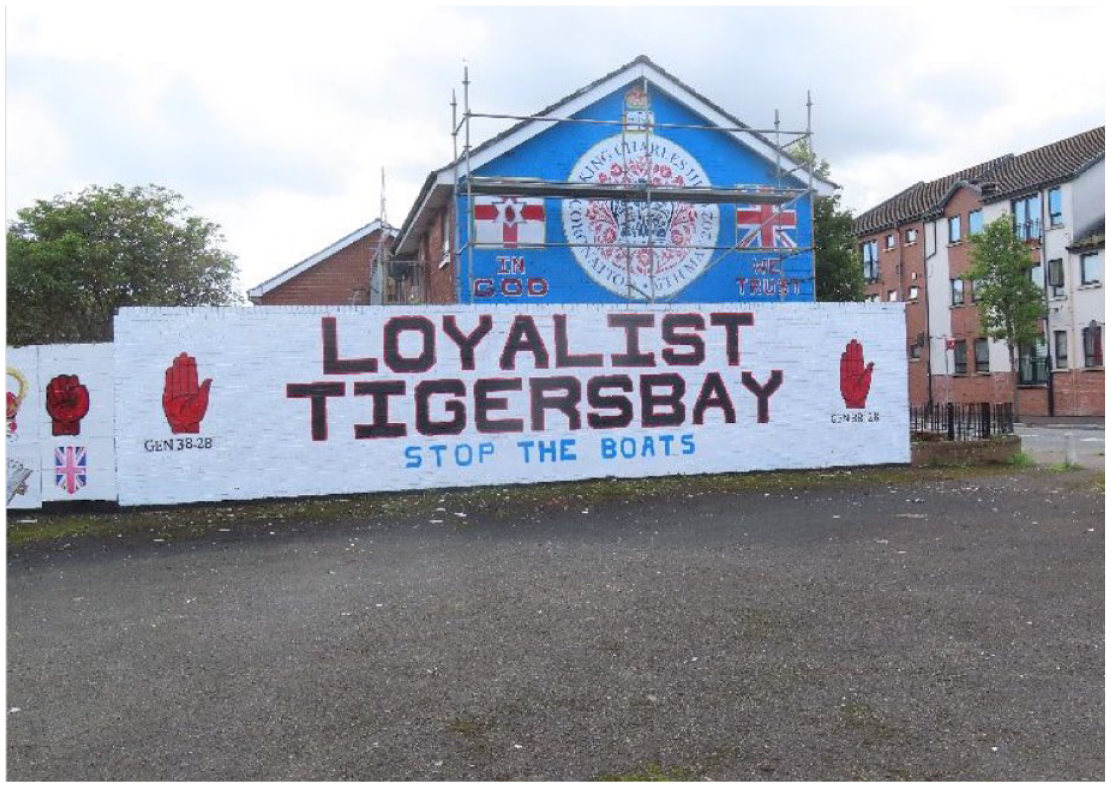
Loyalist mural on Limestone Road, Belfast. © Bill Rolston.
In sum, all public policies guided by the rationale of treating both Protestant and Catholic communities in terms of formal legal equality, ‘objectivity’ and ‘non-sectarianism’, have not, for all their self-professed good intentions, been effective in reducing group differentials and have done more to reinscribe sectarian division than challenge it. Extant public policies do not begin to comprehend systemic sectarianism and have no sense of how a commitment to liberal-legalist principles in a systemically sectarian society ineluctably results in unequal outcomes. 69 To put this another way: a commitment to liberal-legalist principles, in a society where sectarianism as a system has become embedded over so many years of categorical exclusion, does not in and of itself advance equality with social justice. It is time to acknowledge this and accept that much more is required.
Social transformation
Confronting the reality of systemic sectarianism requires forward thinking around substantive reform initiatives that move beyond the kind of ethnonational group-centred reasoning that underpins consociational power-sharing. It requires a commitment to create a society that, in the words of Erich Fromm, better enables the freedom of Man ‘to realize that which one potentially is’; 70 it demands a will to bring into being a society that does not subordinate Reason to the metaphysical forces of ethnonationalism, to God, Nation and History. The social transformation of Northern Ireland must, then, be concerned with bringing systemic sectarianism to an end in as much as it no longer determines who one is and who one can be – whether in a united Ireland or not. And yet, the 2024–2027 draft Programme for Government for the new Northern Ireland Executive which is audaciously entitled Our Plan: What Matters Most, only goes to show that sectarianism is what matters least; for, over its eighty-eight pages the term ‘sectarianism’ does not appear once. 71
To be clear, a social transformation agenda is not just about promoting integration here and there, or encouraging non-sectarian projects within civil society. 72 Rather, it must be concerned with opening up the space to formulate and promote an ever deepening integrated programme of structural reform around innovative organisational forms that install ‘different categories or change the relation between categories and rewards’; 73 especially in relation to land use, public housing, post-primary school places and job placement; especially with regard to incentivising ‘Others’ (those who do not accept ‘Unionist’ and ‘Nationalist’ appellations); and, most especially in terms of blunting the cutting-edge of systemic sectarianism, the continuing hold of paramilitarism and the spectre of race hate crimes and racial violence.
Moreover, any realistic programme for systemic transformation must be sufficiently robust to counter the long-held – though waning – Republican ideological argument that Northern Ireland is inherently irreformable, 74 a move that would require enabling people to ‘plot either to foil [institutional] sites’ inequality-producing effects or to turn them toward the promotion of equality’, 75 which would empower people to embrace a normative stance that self-consciously challenges systemic sectarianism in the furtherance of justice – most seriously with regard to properly advancing a transformative constitutionalism that goes beyond the constraining conservativism of the current governmental form of consociational democracy, 76 as well as against the broader controlling power of the British state.
Propitiously, there is now a non-Unionist majority amongst the electorate and their representatives, 77 and there is a growing schism between voters who identify in terms of the designated ethnonationalist groups and those who do not. 78 Thus, there is an unprecedented opportunity to begin to think through a ‘neo-consociational’ or ‘post-consociational’ political vision for Northern Ireland. When all is said and done, the advance of societal peace, of securing equality with social justice for everyone regardless of sect or race, must rest on rising to the challenge of developing a political vision that encourages people to think and move beyond the exclusivist categorical distinctions of ‘Unionist’ and ‘Nationalist’ – to think and to be Otherwise.
Footnotes
Rupert Taylor is a visiting research scholar at the Centre for the Study of Ethnic Conflict at Queen’s University Belfast, Northern Ireland; r.taylor@qub.ac.uk. He is author of Systemic Racism in South Africa: Humanity Lost (Singapore: Palgrave Macmillan, 2024).