




Abstract
From the Shankill Defence Association’s Orange-Loyalist Songbook to the UDA’s appropriation of ‘Simply the Best’, music has long been used to celebrate loyalist paramilitaries in Northern Ireland. During the Troubles, loyalist songs served a variety of functions, from community fundraising and entertainment to the transmission of loyalist cultural memory and the articulation of political perspectives ignored by the mainstream media. Yet, in addition to celebrating local practices and political traditions, loyalist songs now feed into a broader ‘culture war’ in Northern Ireland where, in the absence of intercommunal violence, the commemoration of paramilitary groups is used to continue the conflict by other means. This article traces the origins of contemporary loyalism’s culture war against Irish republicans, unravelling the role loyalist songs played during the Troubles and their ongoing legacy.
Introduction
On 7 July 2017, unionist politicians and community leaders unveiled an unlikely mural in east Belfast (see Figure 1). 1 It featured four singers who entertained the local loyalist population during the darkest days of the Troubles (1969–1998), 2 and replaced an older and more militaristic display calling for the release of loyalist paramilitary prisoners. 3 Such ‘reimaging’ is part of an ongoing process of ‘de-politicisation’, wherein paramilitary groups are incentivised to rebrand themselves and their message, to reflect Northern Ireland’s transition from armed conflict towards peace and reconciliation. 4 Yet while removing paramilitary iconography in favour of those famous for performing paramilitary songs may be viewed as a positive step by some − such as the Northern Ireland Housing Executive (NIHE), 5 which funded the project − others were not as accommodating.
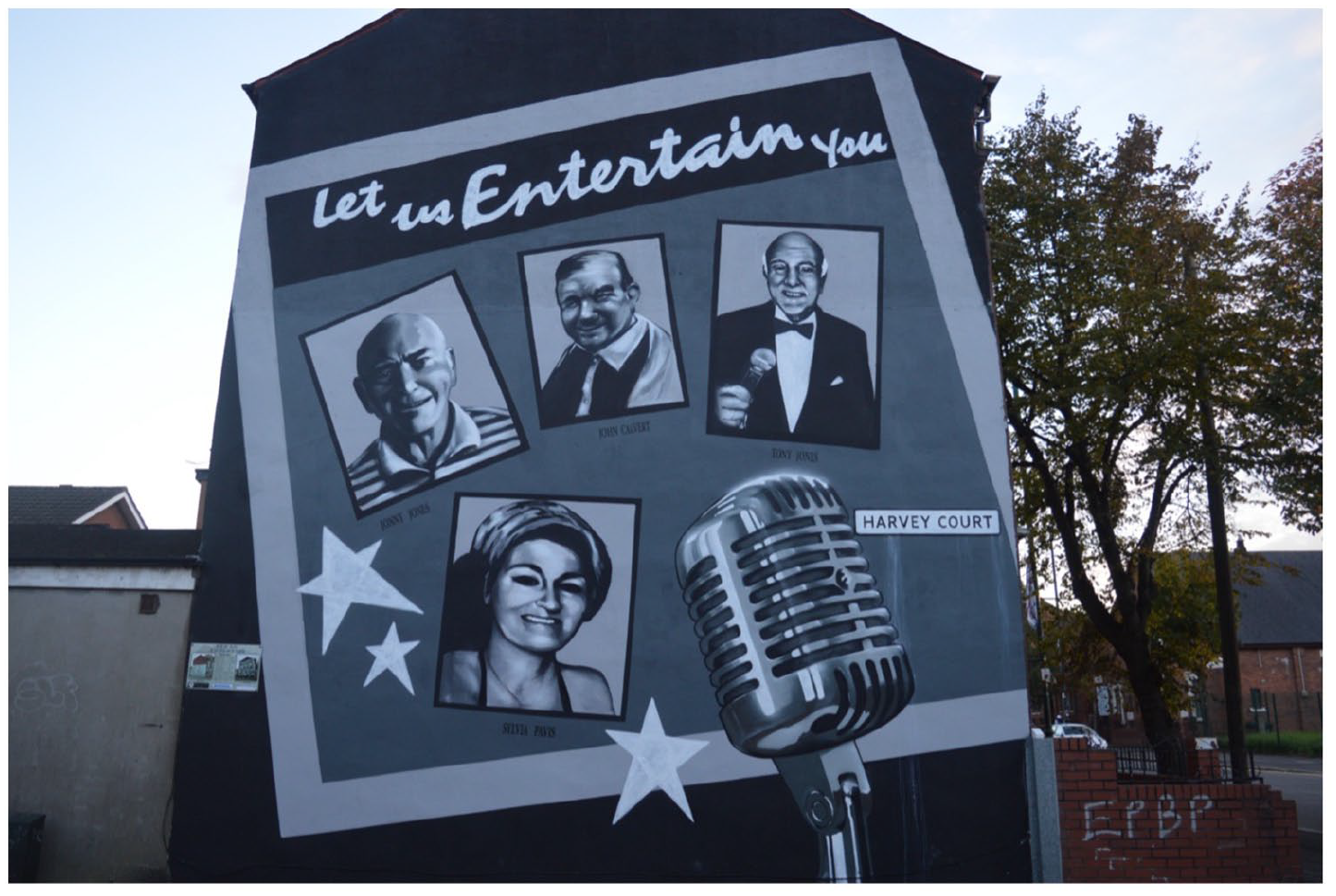
‘Let us entertain you’ mural in east Belfast. 24 September 2018. Photograph by author.
That same summer, those depicted in the mural had their album Loyalist Prisoners’ Aid removed from Spotify and Apple Music because its content breached the organisations’ terms and conditions, which state that content must not encourage ‘unlawful conduct, or otherwise be obscene, objectionable, or in poor taste’. 6 Originally released in 1976, the album was co-produced by the Ulster Defence Association (UDA), the largest of Northern Ireland’s loyalist paramilitary organisations, which was responsible for over 400 murders during the Troubles. 7 Thus, while loyalists in east Belfast celebrated and commemorated local performers, the same artists were being no-platformed on the world stage. Such disparities highlight the controversial politics of cultural production in Northern Ireland, particularly in relation to songs produced during − and focusing on − the Troubles, exemplifying the inherent challenges of celebrating loyalist culture in a ‘post-conflict’ era.
Following Neil Whitehead’s pioneering work on the poetics of violence, this article does not fixate on the formal properties of signs, symbols and rituals, focusing instead on ‘how those signs are used performatively through time’. 8 In so doing, it builds upon recent attempts to ‘distinguish loyalism as an everyday culture and ideology’, 9 by exploring how loyalist paramilitaries have used music and political song to shore up support for their ideology within their local communities.
This article forms part of a larger project on the politics of loyalist songs in Northern Ireland, which involved attending loyalist concerts and events in Belfast, Larne, Derry/Londonderry, Lurgan and Newtownabbey. Although I sporadically attended loyalist performances from 2013–2015, my primary fieldwork took place between 2017 and 2020. The article draws on primary data from local loyalist newspapers and songbooks, court documents obtained from the Public Records Office of Northern Ireland (PRONI), as well as song texts themselves. It includes interviews with leading loyalist musicians (including two of those depicted in Figure 1), as well as more general discussions with loyalist ex-combatants, loyalist booking agents and loyalist concert-goers. Some of those interviewed have been performing within the loyalist music circuit since the 1970s and have a wealth of information on how the scene has grown and changed. All interviewees have been anonymised. 10
Performing paramilitarism
Writing in a global comparative context, Uğur Üngör argues that paramilitarism is ‘a historical and contemporary phenomenon that has existed across cultures, nations, regime types, and political systems, but always in the shadow of the state’.
11
As a general typology, Joshua Lund posits that ‘“paramilitarism” has to do with the franchising out of the state’s monopoly of violence’ to other groups involved in irregular warfare.
12
Yet in conflicts across the world, paramilitary groups often remain operational long after the flames of war have receded.
13
In and out of conflict, paramilitaries require some level of ‘buy-in’ from the communities in which they operate. Lund’s work on the poetics of paramilitarism in Latin America stresses the importance of analysing paramilitarism’s aesthetics to understand the narrative structures ‘that underwrite its theories and practices’ and ‘convince us of its legitimacy’.
14
Lund posits that: a literary and cultural studies approach to paramilitarism does not abandon the still-on-going identity-oriented work that has defined the field in recent decades. Rather, it mobilizes it, reorients it, and brings forth its critical potential . . . in the same ways that it has so productively participated in the critique of racial course, nationalism, and the production of gender inequality: by interrogating the nature of paramilitarism, its naturalization and reification in everyday life.
15
Such an approach is urgent and necessary owing to the crucial role popular culture plays in legitimising paramilitaries and their narratives, as well as recruiting new members to their ranks. 16
In this context, the Northern Ireland Executive’s Report on the Disbandment of Paramilitary Groups highlighted the appeal of the cultural aspects of paramilitarism and the need to understand the significance of cultural production for reducing residual paramilitary activity, 17 particularly among the young, echoing earlier ethnographic studies of loyalist youth culture. 18 Here, paramilitaries are frequently name-checked on the drums of the many ‘blood and thunder’ bands that regularly process through Ulster, on the flags that accompany them, and the murals they pass along the way (see Figures 2 and 3).
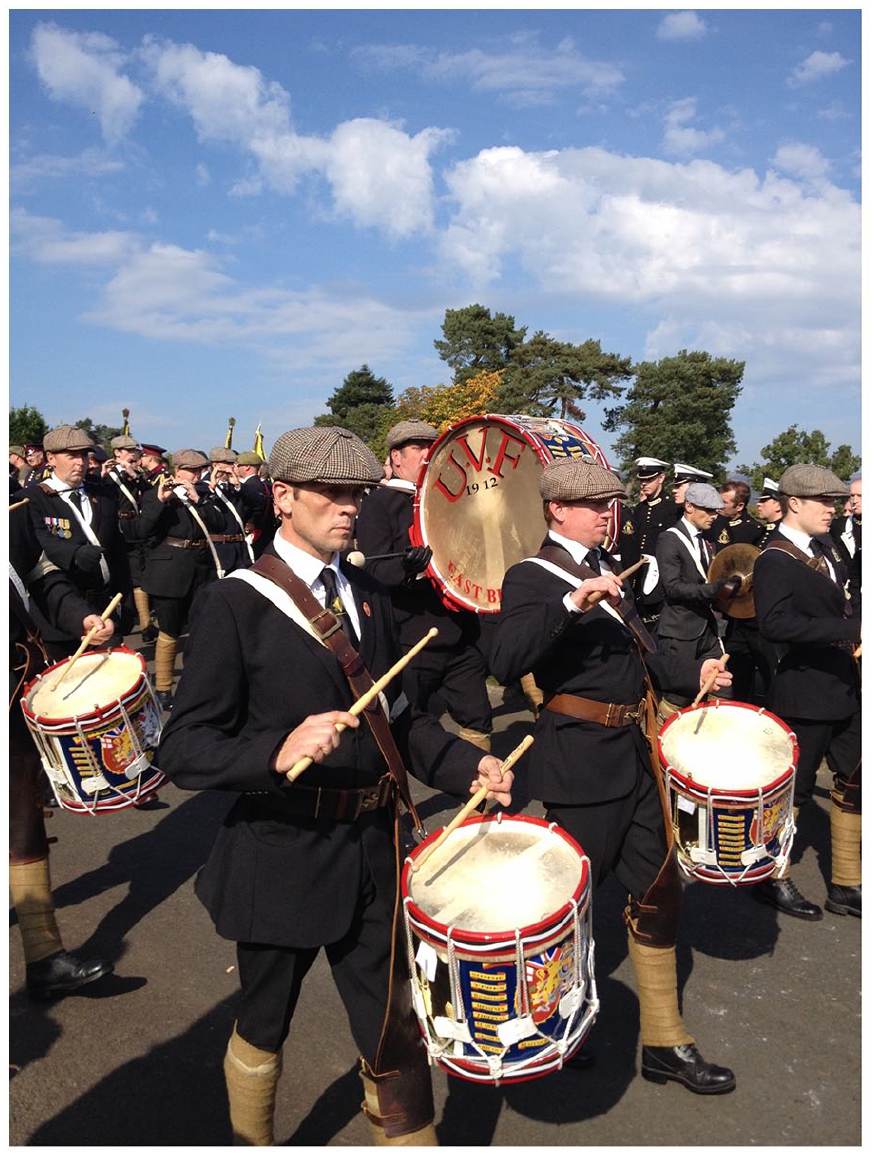
Men in period costume take part in the ‘Ulster Day’ commemoration, marking the anniversary of the signing of the 1912 Ulster Covenant. 28 September 2013. Photograph by author.
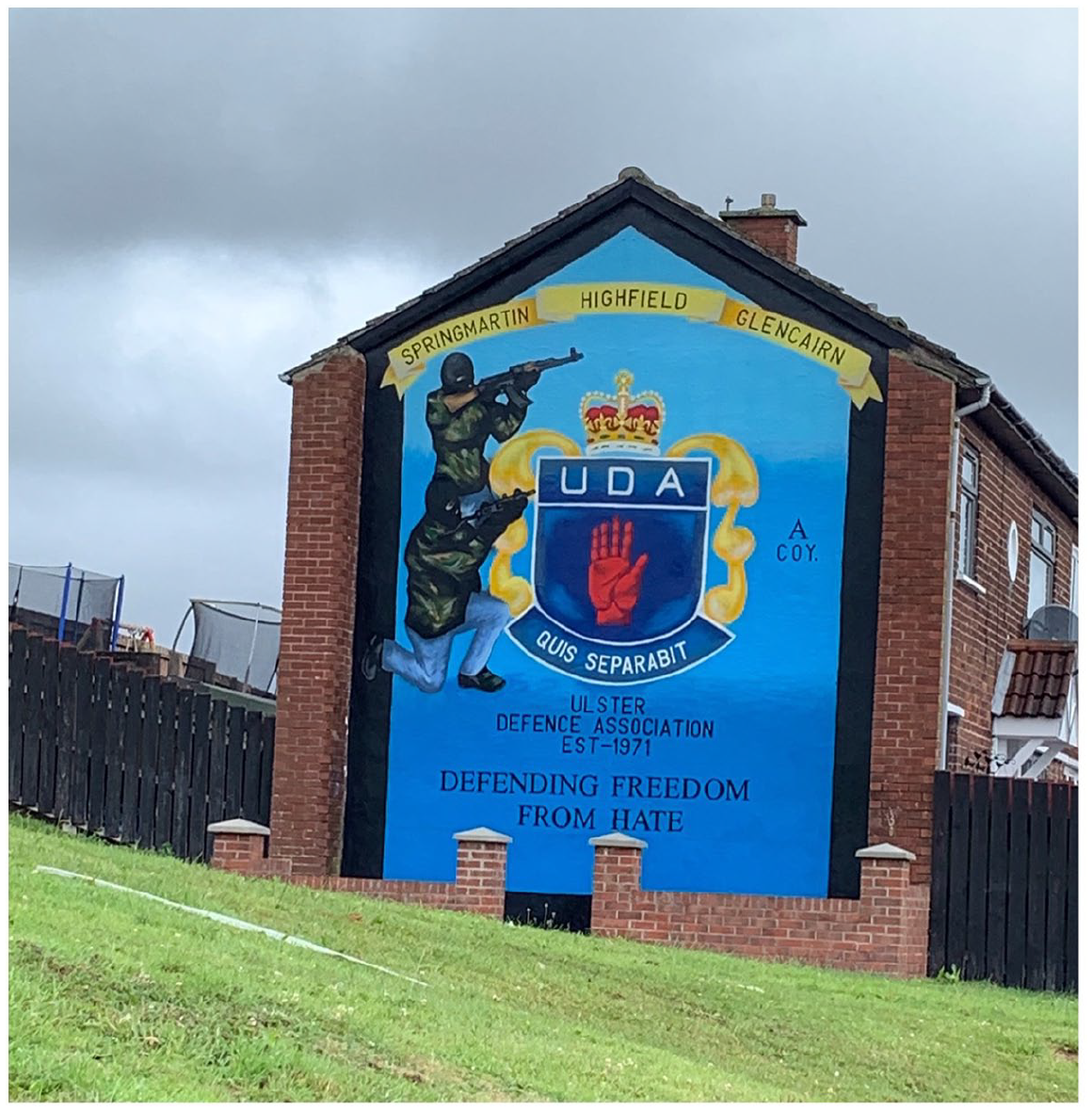
UDA Mural in Belfast’s Highfield Estate. 11 July 2021. Photograph by author.
There is a long tradition of loyalist combatants playing in Northern Ireland’s loyalist marching band scene, which has been well documented. 19 Although less prominent, there were also loyalist combatants who played in loyalist folk and rock groups. For example, the former UDA leader Johnny Adair played bass in the rightwing skinhead band Offensive Weapon with fellow UDA member Sam ‘Skelly’ McCrory. The band performed around twenty concerts from 1981–1984 and frequently covered songs such as ‘Smash the IRA’ and ‘Shove the Dove’, by the English neo-Nazi group Screwdriver, as well as their own material. 20 The chorus to their song ‘Made in Ulster’ featured the lines: ‘The IRA and communists/ Are walking hand in hand/ They’re killing people in Ulster/ They’re killing off our land’. 21 Lastly, there were also members of loyalist paramilitary groups who wrote and published loyalist folk songs, which this article will discuss in detail.
Although this article focuses on loyalist songs as ‘cultural violence’, which Johan Galtung defines as ‘those aspects of culture that can be used to justify or legitimize direct or structural violence’ making them ‘look, even feel, right’, 22 it is important to highlight and acknowledge that music also accompanied acts of extreme violence and murder. For example, in 1974, Ann Ogilby was killed by members of the South Belfast UDA women’s unit for her involvement in an extramarital affair with South Belfast UDA commander William Young. Ogilby was hooded, tied to a chair and beaten to death while her attackers danced to disco music. 23 Twenty years later, Margaret Wright − a Protestant woman mistakenly identified as Catholic − attended a late-night rave in a loyalist band hall, where she was taken from the dance floor, beaten, then shot by members of the UVF and Red Hand Commando, while a DJ guarded the door. 24 In their book on the West Belfast UDA, David Lister and Hugh Jordan recount an event where, having murdered a 19-year-old Catholic civilian, UDA Volunteers drove off singing along to rave music on their car radio. 25 In another example, following the murder of two Catholic civilians on the nationalist Springfield Road, UDA Volunteer Stevie McKeag approached a woman who had just witnessed the killings and provocatively sang ‘Follow the Yellow Brick Road’ from the Wizard of Oz before leaving the scene. 26 Such examples highlight the instrumentalisation of music in the Northern Ireland conflict, while also illustrating the continuities between cultural and physical violence.
Loyalism and loyalist songs
In Northern Ireland, both unionists and loyalists positively identify with the United Kingdom and support Northern Ireland’s continued position as a constituent nation.
27
However, although the boundaries between the two can be somewhat porous, loyalism can be considered a subgroup within unionism and, in general, one key distinction between the two has been in their approach to ‘defending the union’.
28
Another key marker of loyalism is class. James McAuley describes loyalism as ‘an expression of unionism seen through the prism of Protestant working class life’.
29
One former loyalist paramilitary described loyalism’s frustrations with middle-class unionists as follows: There is still that whole thing within the loyalist community of doffing your cap to the big house. If I had the same education and the same knowledge as Stephen Hawkins, they would still look up to some unionist guy who couldn’t string a sentence together. They would still look to him rather than look to me . . . The whole thing [is] about the misconceptions of loyalism . . . people brand loyalism [as] ‘scumbags’ and this and that. They don’t realize, or they don’t see, or they don’t even look into or query [where] you’re actually at.
Yet any definition of loyalism must also come with an acknowledgement that it is in a state of decline both numerically, in terms of loyalists’ physical population, and in terms of its political power. 30 Loyalism is fixated on the past and is marked by an ‘ontological insecurity’ fuelled by ‘economic decline, social deprivation, educational underachievement and everyday, albeit, often low-level sectarianized conflict’, 31 which is exacerbated by ongoing shifts in Northern Ireland’s demographics.
For an embattled minority on the island of Ireland, loyalist songs have long acted as a cultural buttress, Katrin Pietzonka arguing that their ‘communicative effect produces a sense of security’ and that through the performance of such songs, ‘loyalists can identify with the various identities that are symbolized in the lyrics and with the shared experiences of the loyalist community’. 32 This is further supported by Bill Rolston who finds that there is ‘a close match between the popular expressions of ideology in loyalist songs and in the representation of loyalist ideology by political experts’. 33
Although there is a long history of loyalist and patriotic songs being written, performed and consumed across Britain and Ireland, 34 few survive in public memory. With the notable exceptions of ‘God Save the Queen’ − the UK national anthem − and ‘Rule Britannia’, traditionally performed at the last night of the BBC Proms, such songs are rarely heard in most parts of the UK. 35 However, in Northern Ireland, loyalist songs exist within a specific political context and are written, performed and consumed by a small but dedicated subculture.
David Wilson describes this subculture as ‘the musical world of an embattled minority with a highly local sense of consciousness − the Protestant working-class housing estates of places like Belfast, Londonderry, and Portadown, with their long historical memories, short pockets, deep resentments, and wide insecurities’. 36 He describes loyalist songs as ‘preaching to the converted’ and as ‘part of a conscious and continuing attempt to contribute to a distinctly loyalist culture’ whose purpose is to ‘boost the morale and reinforce the solidarity of communities who believed that the whole world was against them’. 37 However, it is important to acknowledge that this process also works in reverse and that ‘the legacy of the Troubles still sustains cultural violence which facilitates recruitment to loyalist (and republican) paramilitary groups, sectarian and political protests and obstructs political accommodation and conflict transformation’. 38 As such, loyalist songs might not only be preaching to the converted, but doing affective work towards actual conversion, or at least the sustainment of militancy.
Loyalist songs and local media
In the late 1960s, against a backdrop of growing unrest across Northern Ireland, a cottage industry of loyalist publications emerged to inform, entertain and − ultimately − provoke their local community into action. Chief among such periodicals was Loyalist News. First published in January 1969, Loyalist News was a Belfast-based newspaper that printed local news and opinion pieces. The paper’s many cartoons often portrayed Catholics as dirty, stupid, lazy, alcoholic and, in the case of women, highly promiscuous. 39
Each issue of Loyalist News featured loyalist songs and poems, which were then compiled and printed separately as Orange-Loyalist Songs, published annually from 1970 to 1972 (see Figure 4). The songbook was sold at a variety of outlets, including stalls on Belfast’s main commercial thoroughfare, Royal Avenue. Yet despite the hundreds of loyalist songs and poems printed across both the newspaper and the songbooks, the same material often shows up in multiple issues, forming a crude canon. Such songs formed ‘part of a conscious and continuing attempt to contribute to a distinctly loyalist culture’ and one that ‘attempted to boost the morale and reinforce the solidarity of communities who believed that the whole world was against them’. 40
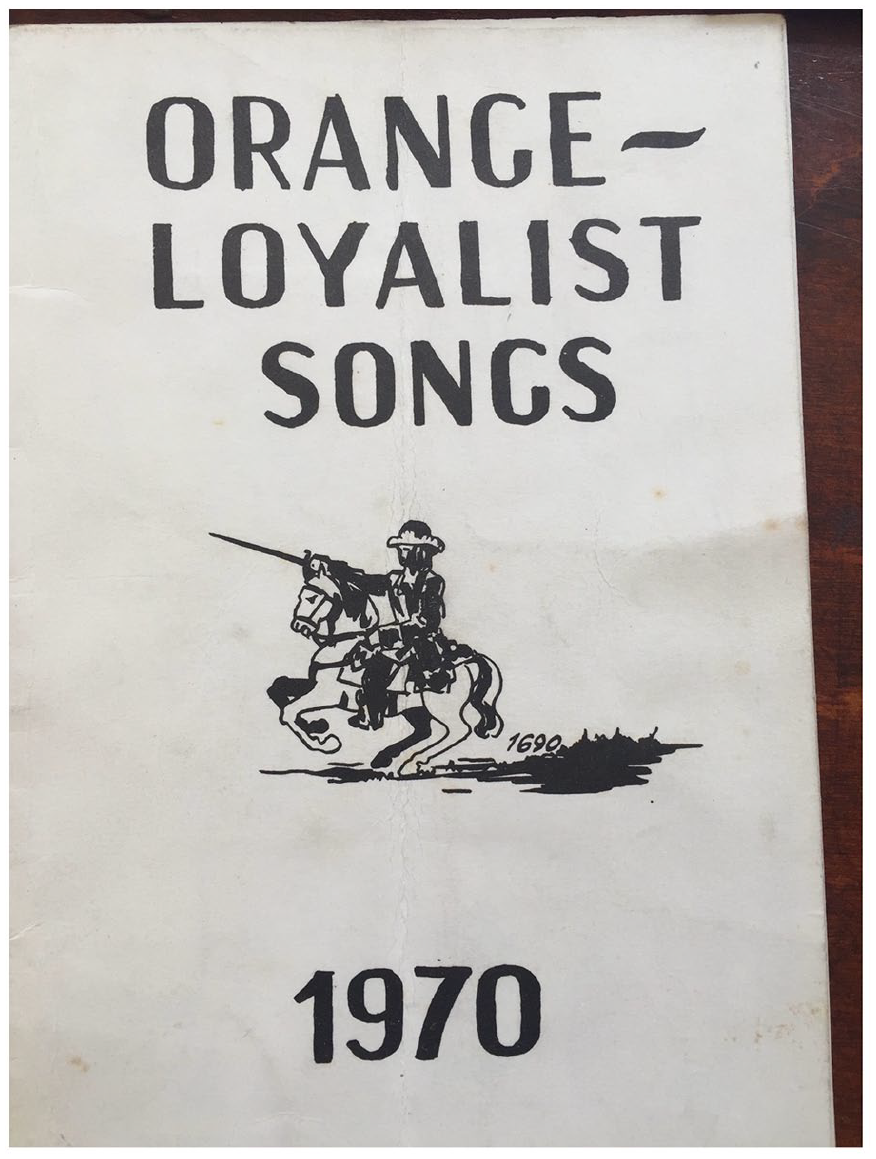
Front cover of the first Orange-Loyalist Songs songbook, which depicts King William of Orange at the 1690 Battle of the Boyne, creating both a textual and visual connection between Orangeism and loyalism. Photograph by author.
In addition to their subject matter, Loyalist News and Orange-Loyalist Songs are noteworthy in that their editor, John McKeague (1930–1982),
41
was a loyalist firebrand whom Steve Bruce describes as ‘a committed Free Presbyterian and supporter of Ian Paisley . . . who could only be a part of a movement if he led it’.
42
At various points, McKeague was involved in all Northern Ireland’s main loyalist paramilitary groups and was a founding member of both the Shankill Defence Association − a predecessor of the UDA − and the Red Hand Commando.
43
That McKeague devoted such energy to writing and compiling loyalist songs underlines their important role in the conflict and echoes similar connections between other leading loyalists who combined song-writing with (para)military action.
44
Indeed, McKeague makes the purpose of such songs explicit in the preface to the 1972 edition of Orange-Loyalist Songs: The songs contained in this book are an expression of the Ulster Protestants’ will to resist not only our traditional Irish enemies but also the attempts of an English Government at Westminster to coerce our people and nation into an alien state – the Irish Republic. These songs and stories are evidence that the Ulster Loyalist has found a new identity and a new allegiance; more and more we are realizing that our first Loyalty must be to each other and to the land of Ulster, our own land and our own people. The book records a new folk-lore in Ulster, a new spirit heralding the re-birth of the Ulster Protestant Nation.
45
McKeague’s words echo the distrust many loyalists held (and continue to hold) in relation to England and their concern at being ‘sold out’ and forced into a United Ireland. 46 The ‘new identity’ he refers to involved a departure from traditional, often rural, Orange folk culture in favour of a harder and more aggressive paramilitary culture that focused on urban street fighting between working-class Protestants and Catholics and drew its legitimacy from loyalist paramilitaries’ contribution to the first world war. This rhetorical framing device was used time and again to underline the important role loyalist songs played during the Troubles, offering its community a sense of solace and security during such stressful and uncertain times. 47
Although often satirical, many of the songs printed in Orange-Loyalist Songs were violent, explicitly sectarian, and provided a chilling insight into how some loyalists viewed Catholics, Irish nationalists and republicans. For example, ‘I Was Born Under a Union Jack’, sung to the tune of the American country song ‘I Was Born Under a Wandering Star’, features lines such as ‘Kill all the Popeheads’ and ‘If guns were made for shooting, then skulls were made to crack/ You’ve never seen a better Taig [Catholic] than with a bullet in his back’ (Orange-Loyalist Songs, 1971). 48 Indeed, the authorities deemed the publication so extreme that McKeague and his co-editors were arrested and charged under Section 1 (a) of the Prevention of Incitement to Hatred Act. 49 Although he was subsequently released, McKeague’s treatment is illustrative of how such songs were perceived by Northern Ireland’s authorities, of historical concerns around the role political songs played in stoking sectarian tensions in Ireland, 50 and connects with ongoing concerns over the dangerous role music can play in inciting genocide in global contexts. 51 Such songs are examples of cultural violence that, ultimately, helped set the stage for the use of direct violence which could then be blamed on the victim, following the continuum of violence in war and peace. 52
Concerts and fundraising
Throughout the Troubles, loyalist groups organised concerts to promote their ideology and raise funds for their fledgling paramilitary organisations. The first of such events, on Friday 25 September 1970, was an ‘Orange Concert’ organised by the ‘Ulster Defence Association’ and held in Belfast’s Ulster Hall − a publicly owned venue in the centre of the city.
53
Two months later, on 23 November, a second Orange Concert was held in the same venue, which included bands, vocalists and groups. This was the subject of a rave review in the 28 November 1970 edition of Loyalist News: A great night was enjoyed by all who attended the Orange Concert in the Ulster Hall on Monday night. A packed house, with all ages and all shades of Protestant opinion, their voices raising in unison to the old and the new Loyalist and Orange Songs. One old tune was in great demand ‘THE SASH’ and second came the new song written by Mr John Calvert, ‘Come All Ye Young Protestants’ and in third place ‘ULSTER’. How we all wish that we could hear more of these tunes and songs on our local radio and T.V. for these Orange Concerts prove that we have good Protestant talent but all we see on our local T.V. and radio is a lot of rebels. It is hoped to run another concert in late January 1971, look out for more details in the ‘LOYALIST NEWS’.
The review’s reference to ‘all shades of Protestant opinion’ attempts to mask that loyalism was − and remains − a subculture within Protestantism and Unionism, and one lacking both cultural credibility and political legitimacy within mainstream politics and media. Indeed, despite the concert being held in the Ulster Hall, one of Belfast’s premier venues, the event received no news coverage in any of the city’s major newspapers. 54
Similarly, the review’s reference to ‘the old and the new Loyalist and Orange songs’ can be viewed as a way to promote McKeague’s Orange-Loyalist Songs and use the legitimacy of Orange folksongs to support his newer blend of ultra-loyalist and pro-paramilitary songs. Indeed, McKeague’s aforementioned ‘I was Born Under a Union Jack’ is a microcosm of such blending in that it features the lines ‘we’ll guard old Derry’s Walls’, itself a synecdoche for the prominent and well-known Orange song ‘Derry’s Walls’ (sung to the tune of ‘God Bless the Prince of Wales’), thus explicitly connecting the old and the new. Such techniques were common and, as Radford describes, Orange and loyalist paramilitary songs are ‘connected by a certain degree of overlapping and shared material’, which is manifested in shared melodies, and in ‘recurring themes in the texts that include comradeship, moral strength and anti-Catholic rhetoric, [and] in the overarching political ideology of the performers and audiences and in the performance style and context’. 55
In McKeague’s review above, he notes that the second most popular song (after Orangeism’s unofficial anthem ‘The Sash My Father Wore’) was John Calvert’s freshly written ‘Come All Ye Young Protestants’. John Calvert (1929–2018) was a Belfast-based songwriter and entertainer who became a central figure in the loyalist music scene and is one of those pictured in the mural shown in Figure 1. In an interview with his son, ‘Phil’, Phil described his father’s musical trajectory: He used to go around the hospitals performing to kids . . . He had a wee band in Mitchell’s and the place was packed every Saturday night . . . There was a bar in the Woodstock Road, the Primrose, he was upstairs there and he sung – he sung everywhere to tell you the truth! And then, when the loyalist thing hit, he was more into loyalism, if you know what I mean. And rather than going out and singing in the [local] pub or something, it was always up the Shankill, over in Liverpool, Scotland . . . He was never a cabaret singer, he was just . . . if somebody phoned, ‘can you come up and do a wee loyalist [set]’, ‘yes, no problem, I’ll be up’.
Phil explained that ‘Come All Ye Young Protestants’ was the first song his father ever wrote and dates the song to around 1969 or 1970. The song’s melody belongs to an Irish folksong entitled ‘The Merry Month of May’, which Bob Dylan used in his 1964 track ‘With God on Our Side’.
However, despite their politics being antithetical, it seems clear that ‘Come All Ye Young Protestants’ was in fact based on the republican songwriter Dominic Behan’s ‘The Patriot Game’ (1964). Behan’s song begins, ‘Come all ye young rebels and list while I sing/ For love of one’s land is a terrible thing’, while Calvert’s song starts with ‘Come all ye young Protestants and list while I sing/ For the love of old Ulster is a wonderful thing’. Indeed, John McKeague’s Orange-Loyalist Songs (1970), includes the lyrics to ‘Come All Ye Young Protestants’ and explicitly instructs these are sung to the tune of ‘The Patriot Game’.
When I asked long-standing loyalist singer ‘Davie’ about this practice, he replied: Most of the [loyalist] songs, as you’re listening to them, they’re all old folk songs, traditional old folk songs with nice music from years ago. You get some of them Irish folk songs, fiddley dee stuff. It’s very good. Most of the tunes come from that. It saves you learning the tune because you’ve heard it before as an old folk song, then you get the words and you’ve just to learn the words that match in with it . . . You just change the words; you just change the names of the people that’s involved.
This practice of contrafactum is well established in folk music and, as Davie maintains, there are many examples of loyalist songs borrowing both the tune and much of the lyrical content of their republican counterparts. 56 Yet, in some quarters, there remains strong resistance to admitting this apparent fact. As part of my wider research into the use of political songs in Northern Ireland, I have encountered many loyalists who refuse to accept the influence of Irish ballads on loyalist songs. For example, when I asked Phil whether ‘Come All Ye Young Protestants’ copying ‘The Patriot Game’ meant that his father listened to rebel songs, he laughed, replying: ‘my da’ wouldn’t listen to republican songs. Not a chance’. 57 Yet, whether they enjoy them or not, it is common for musicians operating within ethnonationalist conflicts to write sarcastic responses to the songs of the opposing side, turning their enemies’ tunes against them, as Pettan describes so vividly in his work on former Yugoslavia. 58
‘Sweet Music to Our Ears’
As Northern Ireland’s Troubles intensified, its prison population increased exponentially, with as many as 15,000 loyalists incarcerated for politically motivated crimes. 59 Inside Northern Ireland’s largest prison of Long Kesh, Rocky Burns described how he and his fellow loyalist prisoners would ‘sing the Loyalist War songs of Ulster in place of [Christmas] carols to prove to all that hear them that the spirits and hearts of Ulster men can never be broken by the turning of keys and locking of steel doors’. 60 And in his biography of the UVF leader Gusty Spence, Roy Garland notes that ‘“The Ballad of Gusty Spence”, often referred to as “The Sprung Volunteer” was sung by loyalist prisoners in Long Kesh in 1975 and captured on tape by Winston Rea’. 61
Outside the prison, members of the community found innovative ways to support those incarcerated. Indeed, in a May 1972 issue of the Orange Cross, ‘The Loyalist Prisoner Council’ thanked a woman who had been protesting outside Belfast’s Crumlin Road Gaol, further illustrating the supportive role ‘loyal sounds’ played in motivating prisoners and boosting morale. We hear your ‘War Cries’ daily and it is sweet music to our ears. God Bless You what would we do without you. Why not bring along your sons or husband’s [sic] football rattle and we could hear you even more! Maybe you could even dig up a couple of accordion players as it would be great to hear the Sash again. Could the Ladies’ Accordion Bands not help us here? We leave the details to you Ladies. We know you will not fail us: Keep it going at all costs from us. ‘THERE WILL BE NO SURRENDER’ ‘Loyalist Prisoner Council’
Such statements resonate with those of other loyalist prisoners, who pointed to music’s role in ‘boosting morale’ but stressed this was only one of several uses. As former UDA prisoner ‘Andy’ stated: For me, the whole music thing was multifaceted. As I said, it was about morale within the prison. Morale within the ranks. At times you took a bit of a knock back, but then you had a big gig and played a lot of songs to get people back up again. And it brought in money and all of the rest of it. It spread your message and all as well. It was a multifaceted thing.
In this sense, loyalist songs served a similar function to the ‘rebel songs’ used by Irish republicans, imbuing the carceral soundscape with a participatory consciousness that helped sustain prisoners’ political convictions and mental wellbeing. 62
In his work on how loyalist paramilitaries were financed during the Troubles, Andrew Silke reveals that between 35 per cent and 45 per cent of UDA and UVF Volunteers were imprisoned at any one time and that supporting these individuals (and their families) was ‘one of the major drains on loyalist resources’.
63
Local communities responded by forming fundraising groups, such as John Calvert’s Woodstock Loyalist Prisoners Aid, which was the forerunner to the UVF’s Loyalist Prisoners’ Welfare Association (LPWA) and the UDA’s Loyalist Prisoners’ Aid (LPA). Both organisations established a variety of events to support prisoners’ families, which included a sponsored darts tournament, children’s parties, and cigarette coupons.
64
Yet perhaps the largest legitimate fundraising activity was music.
65
As one long-standing loyalist singer explained: A lot of people had no cars or no way of getting down [to the prisons], so we ran minibuses and you had to pay for them. So, the money that they gathered at these shows that we were doing was to help with the minibus and sending food parcels down. A lot of them were on the breadline, it was a working-class area. A lot of people had no money. When their husbands were in jail, they had no money coming in. So, that was basically what these shows were for.
During an interview with ‘Ruth’, another loyalist entertainer from east Belfast who has been performing for over fifty years, she confirmed the connection between loyalist fundraising and music, explaining that performers were on occasion accused of both fundraising and money laundering for loyalist organisations, particularly when returning from shows in Scotland: Oh, we got a very hard time. [The police] kept us until the last ones, until the plane was ready to go and wouldn’t let us on it. Oh aye . . . they kept me in for hours . . . they did awful things to try and stop us.
However, with the proliferation of affordable recording technology, loyalist organisations were able to reach beyond those who physically attended their concerts to promote their ideology, and support prisoners’ families.
Putting it on record
In 1974, the Loyalist Prisoners’ Welfare Association (LPWA) released Ulster Volunteer Force: In God Our Trust (see Figure 5). The album features several songs popularised by the preceding Orange Concerts, including ‘A Wee Spot in Europe’, performed by Tony Jones, and ‘Three Scottish Soldiers’, sung by Sylvia Pavis. The album begins with John Calvert’s slow baritone voice narrating the following statement, which is also reproduced on the cover sleeve: What you are about to hear is not just a handful of songs put together to make up a record, this is a message, and a dedication. A dedication to those who have fought and died for the loyal cause of Ulster, those who are still fighting and to those loyal Protestants incarcerated in Long Kesh, Crumlin Road and other concentration camps. The message is a simple one. It was given to us many years ago by thirteen gallant men, who closed the gates of Derry against King James’ rebel hordes. The message is
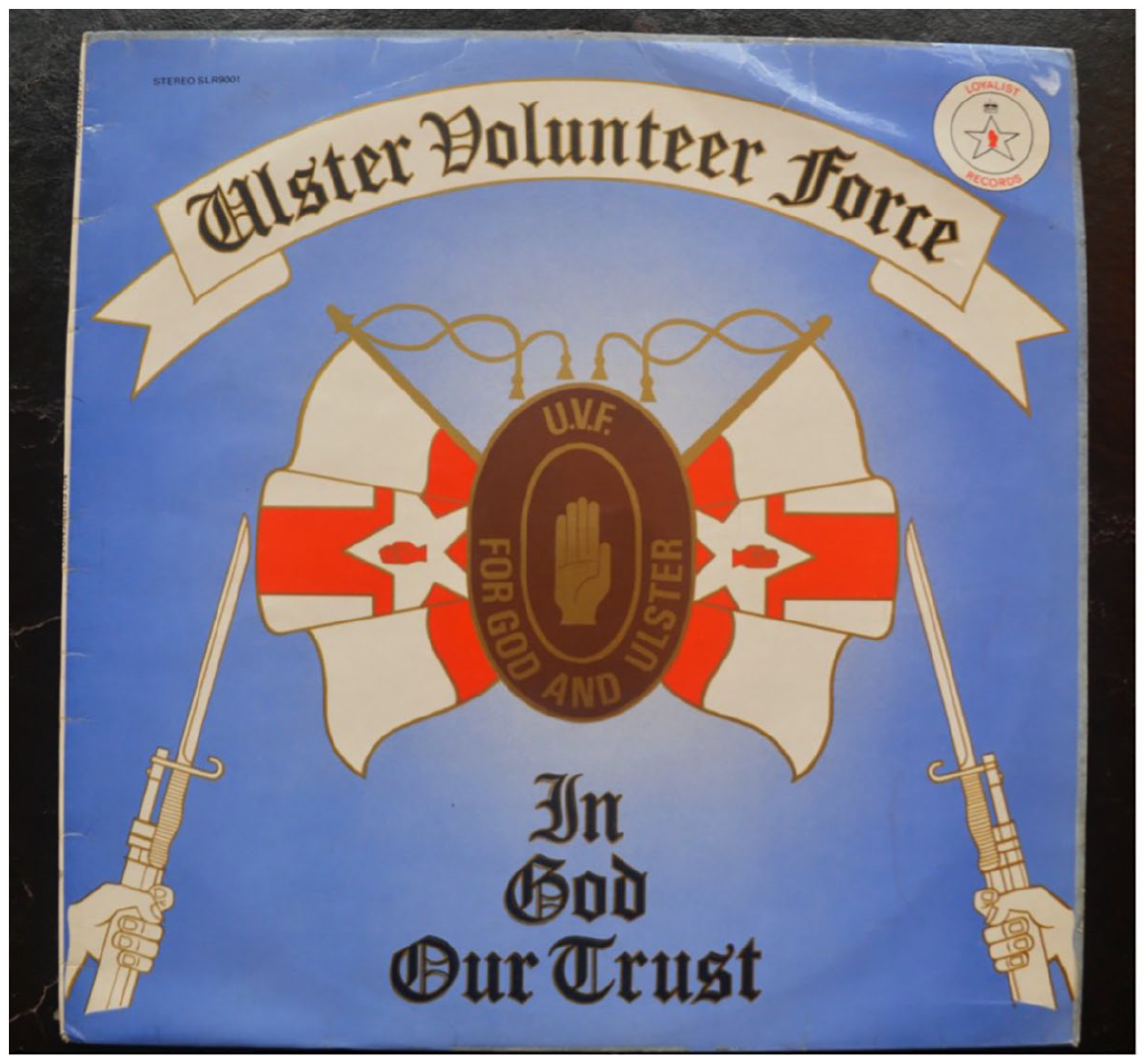
Front cover of the 1974 album In God Our Trust. Photograph by the author.
Like the statement printed in McKeague’s 1972 Orange-Loyalist Songbook, Calvert’s message underlines the important role loyalist songs were perceived to play in the wider struggle against the IRA and is immediately followed by ‘Orange Medley No.1’, which includes ‘The Sash My Father Wore’, ‘Derry’s Walls’, ‘A Loyal Protestant’, and the ‘Orange Lily-O’. In so doing, In God Our Trust follows the pattern established in the aforementioned Ulster Hall ‘Orange Concert’, including older Orange songs alongside newer loyalist songs, thus creating a connection between the two, which serves to shore up the cultural, historical and political legitimacy of loyalism.
The album was launched as part of a ‘Grand Concert’ held at the Ulster Hall, on 3 June 1974. Recalling his performance at the sold-out concert, ‘Alan’ described the event as ‘packed’, adding ‘they came from everywhere. It was a good night’. He explained how he and the other singers on the recording were selected so as to incorporate various areas of Belfast: They give you the words, ‘Here’s a couple of songs, here are the ones we want you to sing’. As I said, there were a couple from east Belfast, there were a couple from the Shankill, there were a couple from south Belfast, north Belfast, which meant all the communities were all involved in it . . . In those early ones [concerts] that they done in the Ulster Hall . . . that was just a band put together just to do the gigs . . . it was just a three- or four-piece band, just them. No name. They just done their own wee bits here, there and everywhere. You just brought them in, ‘You play guitar, you do the keyboard, you do the drums’.
A report in the Orange Cross stated that 20,000 copies of the LP had been pressed for ‘worldwide distribution’ and that ‘well known loyalist groups gave their services free of charge in the making of the album but, at their own request, none had been credited on the label’. 66 The album was priced at £1.50, and proceeds were donated to the UVF’s Loyalist Prisoners and Detainees Welfare Fund (LPWF).
Seeing the success of the UVF/LPWF albums, the UDA’s Billy McCarroll asked John Calvert to recruit singers and record an album for Loyalist Prisoners’ Aid (LPA). Calvert’s son described McCarroll as ‘one of the top UDA men at the time’ and the two co-produced Loyalist Prisoners Aid, which was launched at the Ulster Hall, on 12 April 1976 (see Figure 6). 67
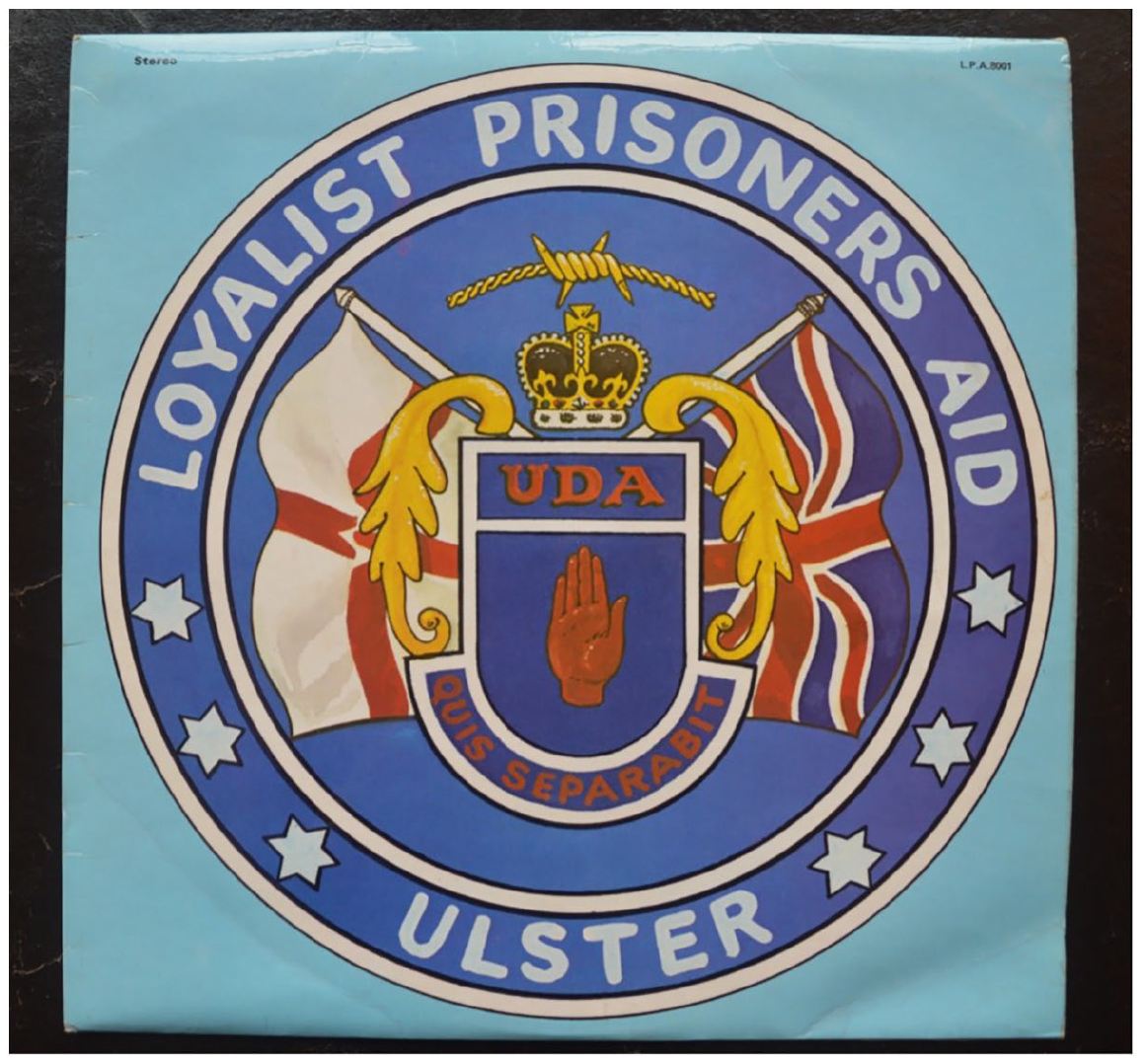
Front cover of the Loyalist Prisoners’ Aid album (1976). Photograph by author.
John Calvert recruited singers from a range of loyalist areas, including east Belfast (Sylvia Pavis), the Shankill (Billy Byers), Sandy Row (Bobby Cruthers), and the Shore Road (Norman Kerr), as well as Londonderry (Ken Kerr), thus bolstering the album’s community appeal. As with the examples discussed earlier, Loyalist Prisoners Aid was frontloaded with a statement outlining its motivation: We dedicate this record to each Protestant, irrespective of his, or her, affiliations, who is willing to fight for Ulster; to those who have already done so, and who are now paying the price of loyalty behind the wire. It is especially dedicated to those who have already forfeited their lives so that we live to fight on against the evil forces that beset us. The motto of our forefathers NO SURRENDER, must live on.
The album features a version of ‘Losing of the Green’, performed by Sylvia Pavis, as well as more belligerent tracks, such as Ken Kerr and Sammy Doyle’s ‘We’ll Fight in the Bogside’, which features the lines: The men of the UDA prepare to fight They’ll fight for their country, their loved ones and freedom We’ll kill every rebel we get in our sights.
Calvert himself appears on three tracks, namely ‘A Loyal Protestant’, ‘Enemies of Ulster’ and ‘Rise of the UDA’. The songs refer to the IRA as ‘rebel scum’, ‘monsters’ and ‘not even men’. Adopting an apocalyptic tone and sung to the tune of Christian hymn ‘The Old Rugged Cross’, ‘Enemies of Ulster’ promises that the IRA will be ‘cut down like the mad dogs they are, by the men of the UDA’, a repeat of the violent, genocidal language adopted in both ‘We’ll Fight in the Bogside’ and McKeague’s Orange-Loyalist Songs. The song rages against the killing of British soldiers by IRA Volunteers before concluding, ‘We’ll send them back where they belong to crawl back to their den/ Then loyalists shall all rejoice that Ulster’s free again’.
Yet despite these records’ violent language and imagery, ‘Ann’ stressed, ‘in the early days, there was very little aggro over any of the music’. This was facilitated by the closed nature of the loyalist scene, wherein the shops that sold these records were located within loyalist areas where those likely to be offended by them did not go. This also held true for anyone reading loyalist newspapers or attending loyalist concerts in the Ulster Hall. However, with the advent of online streaming, those loyalist records uploaded to YouTube, Spotify and Apple Music became ubiquitous and accessible to anyone. It was only a matter of time before they were heard by those objecting to their message.
‘Propaganda glorifying past genocide’
Forty years later, in June 2017, Spotify issued an ‘immediate takedown’ of Loyalist Prisoners Aid and a representative of Apple Music confirmed the album had been removed for breaching its terms of use, which state content must not encourage ‘unlawful conduct, or otherwise be obscene, objectionable, or in poor taste’. John Dallat of Northern Ireland’s Social Democratic and Labour Party (SDLP) described the album as ‘disgusting’ and ‘propaganda glorifying past genocide’, adding: This unfortunately serves as a stark reminder that there are people linked to the UDA out there who have yet to accept that killing Catholics was a crime as was similar activities of all other so-called paramilitaries . . . How else could such a marketing tool exist to promote naked sectarian music?
68
The following month, a mural depicting loyalist political prisoners was replaced by one commemorating those loyalist singers who performed on the Loyalist Prisoners Aid album in east Belfast. The event was attended by unionist politicians, community leaders, and officiated by a loyalist ex-prisoner who is widely believed to be one of the senior leaders of the UDA, making a clear connection between cultural and physical manifestations of paramilitarism.
Considering the outrage associated with the Loyalist Prisoners Aid album, one might question why loyalist community leaders opted to promote the individuals who sang on it. In an interview with one of the singers depicted in the mural, they explained the sequence of events, stating: Someone from [community organisation] said: ‘we’re trying to do away with all the paramilitary murals. So, we want to paint a mural of yourself and [name removed] . . . We’ll put four of you up for the work you’ve done over the years’. So, I said ‘I don’t mind, it’s nice recognition’.
It is perhaps unsurprising that local entertainers would be selected as a tribute for their efforts both in entertaining the local community, as well as raising money for prisoners’ dependants − not least because their connection to the LPA bridged the old and the new. Indeed, loyalist paramilitary groups often acknowledged the role played by musicians throughout the Troubles, from statements printed in local newspapers, 69 to commemorative plaques (see Figure 7). While some expressed a level of distaste for the violence and sectarianism present within some loyalist songs, most of those interviewed considered such songs to be ‘a product of their environment’ and a reflection of the violent times in which they were living.
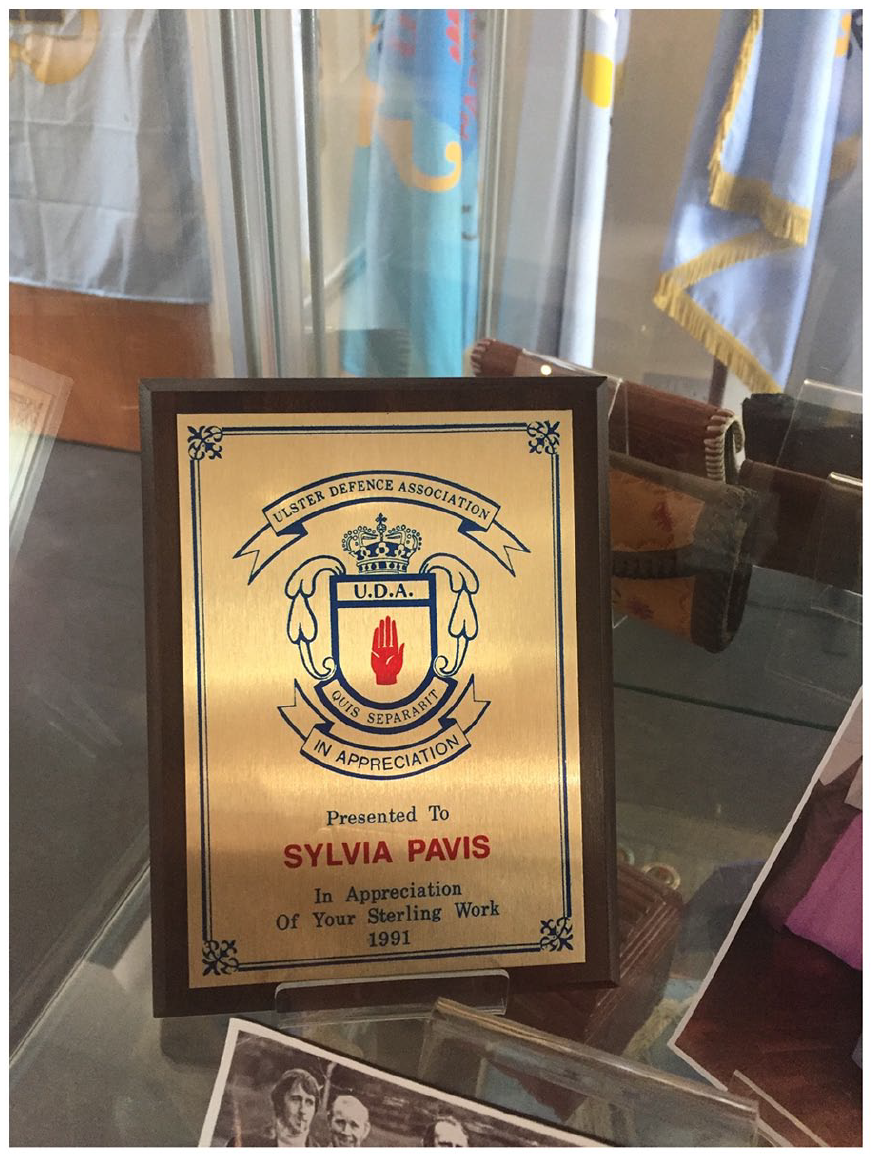
UDA commemorative plaque given to the loyalist singer Sylvia Pavis currently on display in the Loyalist Conflict Museum: Andy Tyrie Interpretive Centre in east Belfast. Photograph by author.
Yet, in keeping with wider work on cultural intimacy, 70 for many loyalists the outrage such songs elicit by those within mainstream society is directly connected to their appeal. Here, the unveiling of a mural to those producing music so reviled by mainstream society was an act of performative resistance that etches the fleeting sound of music onto a permanent physical space. As a subculture largely invisible to those within mainstream society, the mural forces the wider community to witness those involved in the production of loyalist songs while inviting the viewer to seek out and discover such music, thus making them audible.
Although the UDA and the UVF are proscribed organisations, both continue to recruit new members. Recent intelligence reports estimate the UDA has 5,000 members, while the UVF has 7,500 people within its ranks. 71 Both organisations are heavily involved in drug-dealing, forced evictions and racketeering, which many in the community are opposed to. 72 As such, both the mural and the exercise around it enable the UDA to present itself in a positive light.
More broadly, within the framework of Northern Ireland’s ongoing culture war, the veneration of local loyalist entertainers offers one potential ‘front’ on which to fight: both in terms of battling the republican narrative that ‘loyalists don’t have culture of their own’, 73 and also in terms of using the entertainers as cover for promoting a harder paramilitary edge, through their ultimate connection to it. 74 This harder edge can be witnessed on a sign bolted onto a wall a few streets from the ‘Let Us Entertain You’ mural, which features a far darker and more threatening depiction of what the culture war has come to mean for some loyalists in Northern Ireland (see Figure 8).
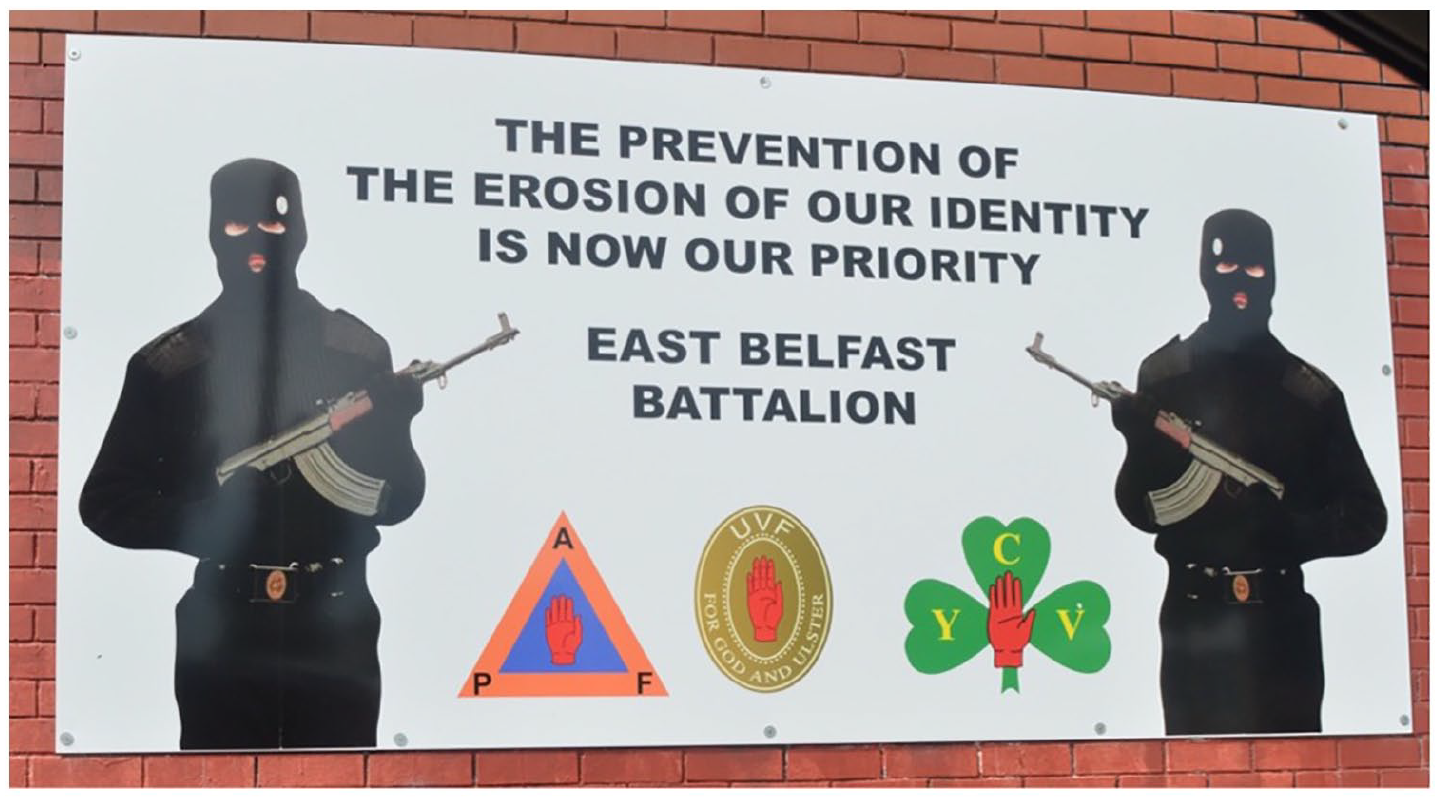
UVF sign on Newtownards Road, east Belfast. Photograph by author.
Conclusion
Implicit in loyalist attempts to reimage paramilitarism through political songs is the notion that music is a universal good and that ‘culture’ is separate from conflict. Yet as countless studies have shown, in peacetime and in war, music has been used to obfuscate, legitimise and propagate violence, as well as being used as a direct weapon of sonic torture. 75 The difficulty in reimaging loyalism through a pivot towards loyalist music is that, unlike Irish rebel songs, many of which articulate themselves through the language of anti-colonialism and social justice, loyalist songs often express what Stephen Howe describes as ‘a swaggeringly in-your-face glorification of violence . . . asserted with a kind of desperate bravado’. 76 In so doing, these songs are the direct descendants of the Orange songs preceding them, which Georges Zimmermann describes as ‘expressing the sentiments of a stern-faced minority defending its privileges’. 77 In this, loyalism shares with other settler-colonialist ideologies in their twilight years.
Rhodesian patriotic songs express a similar sense of ownership, victimhood and paranoia. For example, in ‘The Great White Tribe’, Rhodesian soldier-songwriter John Edmond sings that ‘the dreams of a nation were split by the sword, And the world rose against them with sanctions and war, But they weathered the storm like twigs in the sea, And were beached on the shores of the lands that are free’. Similar sentiments can be found in songs such as ‘Rhodesians Never Die’ and ‘What A Time It Was’, both written by Clem Tholet, who was married to the stepdaughter of Prime Minister Ian Smith. Speaking in relation to Rhodesia’s Unilateral Declaration of Independence, the latter states, ‘The U.N. made us outcasts, The British said we couldn’t last’ and ‘You see when people love their homeland, they regard it as their own land, And they fight, whether they’re right or they are wrong.’ The song’s plaintive chorus laments, ‘What a time it was, with all the world against us. What a time it was when all we did seemed wrong.’
Like loyalist songs in Northern Ireland, settler-colonialist songs in Rhodesia commonly invoked the struggle of previous generations to pacify the land and its inhabitants, creating a strong sense of indebtedness well exemplified by Jack Watson’s ‘Rhodesia, We’ll Ever Cherish Thee’. The song features lines such as ‘The early fathers of our land, have left their trust in us. On guard for all they won we stand, as those who follow must!’ Other songs, such as ‘Black Boots’ and ‘Troopie Boy You Won’, valorise paramilitary groups and justify the use of state violence. Each of these songs is available on YouTube and the relatively high number of views is indicative of recent attempts to rehabilitate the apartheid south African regime among white nationalists, 78 and loyalists in Northern Ireland, as evinced by the lyrics tweeted by the (now deleted) loyalist twitter account (see Figure 9).
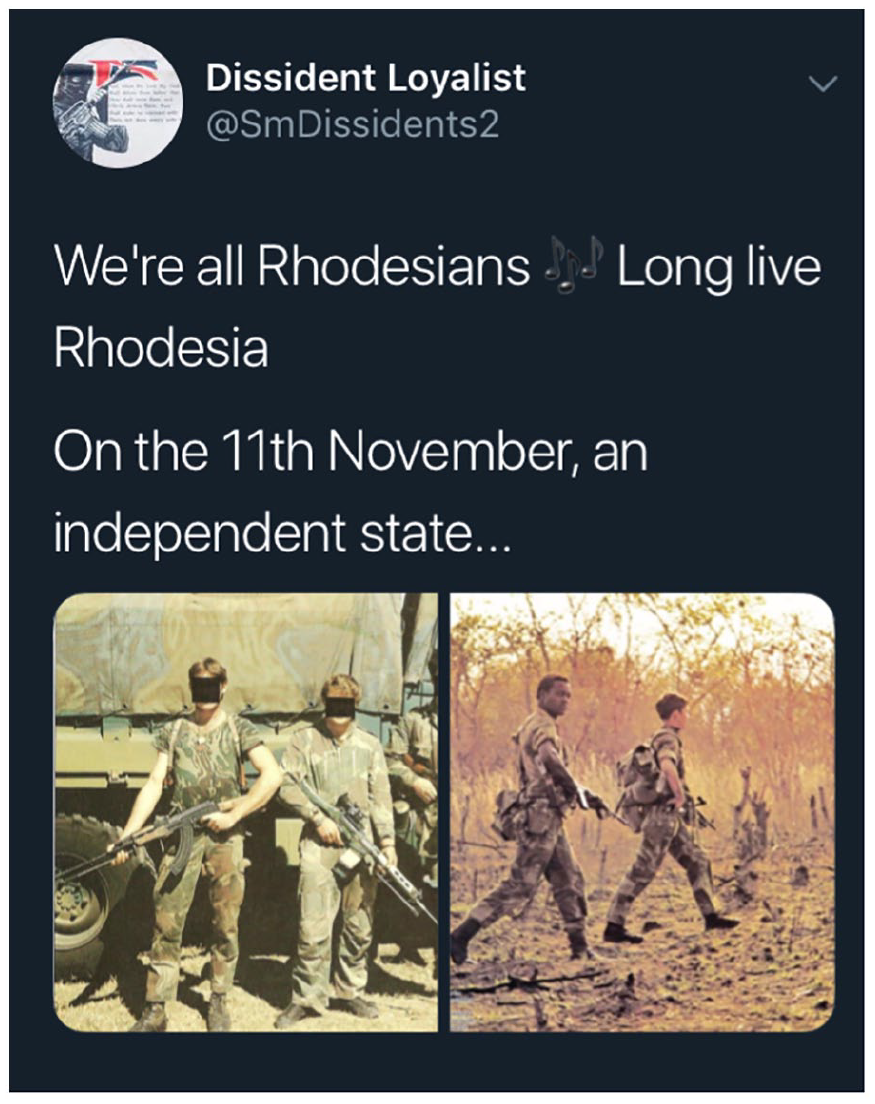
Tweet from loyalist account on 2 May 2019.
In keeping with the use of violent lyrics more generally, loyalist songs can create ‘a familiar narrative landscape for fans, and an implied threat for non-fans, sharpening the boundary between fans and non-fans and enhancing group identity and solidarity’. 79 Indeed, many of the overtly racist and sectarian songs from this period conform to the genre of ‘hateful music’, which Kent describes as ‘strengthen[ing] ties between the collaborators, but at someone else’s expense’, which is ‘more important than the message communicated to the targets of the racism’. 80
That said, this should not mean that all loyalist songs are cast aside wholesale. Although this article has focused on some of loyalism’s more violent and problematic songs, it is important to note that some are relatively uncontroversial, tackling more general themes of patriotism, community spirit and love for one’s friends. 81 Indeed, a blanket ban on all loyalist albums − as carried out by Spotify and Apple Music − is arguably unfair, not least when listeners are free to listen to songs celebrating republican paramilitary organisations, such as the IRA, which further fuels loyalists’ fear that they are engaged in a peace process through which they can only lose. 82 That such censorious decisions are taken by private companies poses further problems in terms of preserving and curating Northern Ireland’s broader cultural history – not least when such decisions are often motivated by a desire to be seen to be doing the right thing, rather than any principled stance.
Rather than erase such songs from the public record, one possible alternative might be to offer them up as a public resource. Following the successful curation of murals and political street art in Northern Ireland, through websites such as Extramural Activity, 83 an online archive of political songs could serve as a living resource, reaching audiences inside and outside of the island. Community sound archives have been pioneered as tools of conflict transformation in other international contexts, such as Samuel Araújo’s pioneering work in Brazil. 84 In a Northern Ireland context, such an archive could serve as a window back into a violent time, offering an unvarnished account of working-class vernacular culture and how political songs of diverging persuasions commented on and connected with the social and political landscape during the Troubles and beyond. 85
Footnotes
Acknowledgements
Earlier versions of this article were presented at the annual meetings of the International Association for the Study of Popular Music, the Society for Ethnomusicology, and a Wenner Gren workshop on irony and new political movements − all of which took place online in 2021. The author wishes to thank Jonathan Evershed, Ioannis Tsioulakis and the article’s anonymous readers for their engaged comments and suggestions. This article forms part of a larger project on the politics of loyalist songs in Northern Ireland and the author wishes to offer a special thanks to all those involved.
Stephen R. Millar is Assistant Professor of Anthropology at the University of Amsterdam. He is author of Sounding Dissent: rebel songs, resistance, and Irish republicanism (University of Michigan Press, 2020) and co-editor of Football and Popular Culture (Routledge, 2021).