




Abstract
The case of Angelo Soliman − a black man raised in the royal courts of eighteenth-century Vienna who appeared during his lifetime to have attained significant social status and acceptance into bourgeois society, only to have his body stuffed and exhibited after death in a natural history museum − is discussed in the context of Enlightenment race theories at the core of a then-new ‘scientific racism’. This article explores his representation in its wider discursive and historical context, and critically reflects on predominant narratives and typologies associated with him. The piece then reflects on contemporary attempts to retell his story – via museum exhibitions, literature and film – some of which started to critically reflect on age-old European stereotypes of blackness used in earlier representations of Soliman. The piece promotes a discussion of Soliman’s life from a more critical, historically reflexive, de-colonialising and anti-racist position that questions white normativity and the scientific racism of the European Enlightenment and colonialism, the foundations of modern racism.
Keywords
Soliman’s life and the Enlightenment – a brief sketch
Angelo Soliman is today often remembered as a well-respected member of eighteenth-century Viennese society. Verifiable historical data on his childhood and adolescence is lacking, but it is likely that he was abducted as a child from Africa to Europe and sold as a slave to an Italian Marchesa, who gifted him to Count Lobkowitz, the imperial Governor of Sicily. Later, Soliman worked as a so-called ‘court moor’ 1 for Prince Wenzel von Liechtenstein, serving his master’s display of power by dressing in exoticised outfits. His gradual emancipation becomes visible, for example, in his decision to secretly marry widow and member of Vienna’s aristocratic circles Magdalena Christiano in 1768 without obtaining the approval of Prince von Liechtenstein (required for Soliman as a servant). Soliman lost his position when the prince heard of this unauthorised wedding, but was later reinstated by the prince’s successor and worked at the royal court until he retired. As a married man, he began to run his own household in Vienna with his wife Magdalena, and they had a daughter who would later marry an eminent aristocrat. Soliman established himself further as a member of Vienna’s higher circles when he joined the masonic lodge ‘Zur wahren Eintracht’ 2 (true unity) in 1782. There he became the master of ceremonies for a time and contributed to the lodge’s ‘singular existence as a lodge of research and a meeting place of many intellectuals and artists’, which included Mozart.
Soliman was highly educated, spoke several languages, became a Christian, and seemed to have reached the status of a well-respected member of eighteenth-century Viennese society. He worked as an educator at the Court, took on other duties, and developed a personal bond with the Austrian emperor Franz Joseph, with whom he is said to have played chess. However, dramatic events following his death in 1796 show us beyond doubt that in the eyes of his alleged ‘friends’ in Viennese society, he was never fully accepted. Despite trying hard and succeeding on many counts, he never truly became ‘one of them’. When Soliman died of a heart attack on 21 November 1796, well into his retirement, he did not receive a Christian burial. His daughter Josephine went to the police many times shortly after his death to demand them to hand over the ‘remains of her deceased father’. She had, with the support of the Catholic Church, insisted on the right of everyone to a proper burial. 3 Yet, Angelo Soliman was denied this right. His body was snatched away right after his death and desecrated. His corpse was anatomically examined, skinned, taxidermised and prepared for use in a museum exhibition. Abbé Simon Eberlé, the director of the Royal Natural History Collection, had ordered a death mask to be created before Soliman’s skin was removed and prepared for exhibition with a stuffing compound. The so created figure was then dressed up as a ‘savage’ in a loin cloth, with an ostrich feather crown and glass beads, and presented to the public in the midst of taxidermised exotic animals. 4 This violent act had been planned carefully and the Museum director had, even prior to Soliman’s death, successfully petitioned the Lower Austrian government for the ‘cession of the corpse’. 5
As surprising, unusual and disturbing as Soliman’s story is, nearly all elements of his biography can be situated within pre-existing trends and phenomena. But what makes the case unique is the particular confluence of these historical trends and phenomena: the slave trade in the Mediterranean; Enlightenment thought and the origins of modern racism; colonialism; eighteenth-century aristocracy; servanthood in Royal courts; and the limits of social mobility.
The context
Slavery
As far as we know, Soliman arrived in Europe as a child through slave-trading networks in the Mediterranean. Though his exact birthplace remains unknown, recent research suggests that he was from Kanem-Bornu (today, Nigeria). 6 Between the fifteenth and eighteenth centuries, the Spanish and Ottoman empires dominated the slave trade in the region. Soliman himself arrived in Europe by way of a Spanish slave-trade route that ended in the Sicilian city of Messina − a major market in the slave-trading network − where he was ultimately purchased by an Italian Marchesa. 7 Her precise identity is unknown (major earthquakes in the region in 1783 and 1908, as well as second world war bombing in Messina probably account for the lack of historical data 8 ) but Soliman was likely to have been purchased by (and received his surname from) the Sollima family, a prominent noble family in Messina that emigrated from Germany in the thirteenth century. 9 His name was likely to have been changed later in Vienna to allude to Suleiman the Great, the Ottoman ruler who besieged Vienna in 1529 and was thus something of a household name. 10 The fact that Soliman was purchased by a private slave owner is significant: according to historian Salvatore Bono, the distinction between publicly owned (by the state) and privately owned slaves is that the former, in contrast to the latter, were often forced to perform manual labour, and were rarely freed. 11 Bono also notes that it was common practice for nobles at this time to purchase individual slaves as part of proselytisation efforts, in both Christian (Spanish) and Muslim (Ottoman) contexts. 12 Both his given first name ‘Angelo’ (angel) and surname ‘Soliman’(aka ‘Sollima’, Catholic nobility) support the theory that Soliman could have been part of such a religiously motivated effort. He was allegedly presented as a gift from the Marchesa to the Austrian Prince von Lobkowitz, who was the imperial governor of Sicily from 1732 to 1734 when the Habsburg Empire controlled Sicily before its conquest by the Spanish. 13 Soliman then spent his teenage years travelling in Lobkowitz’s service, often accompanying him in battle in Hungary and Bohemia, apparently even saving Lobkowitz’s life on one occasion. When not on the battlefield or travelling, it is thought that Soliman spent time at Lobkowitz’s castle Melnik, in what is today the northern Czech Republic. 14 Soliman did not arrive in Vienna until 1753/54, when he began to serve Prince Wenzel von Liechtenstein after Lobkowitz’s death. 15 So, his path from Nigeria to Europe, and ultimately to Vienna, was not only influenced by an established slave-trade network but also shaped by social connections in the aristocracy.
The black presence in Vienna
The fact that no direct links existed in the slave trade between Sicily and Vienna did not mean, however, that Soliman was the only man of African descent in Vienna when he arrived there. This is not to say that there was a burgeoning black population in the area. Wolfgang Kos’ characterisation of eighteenth-century Vienna as a ‘multicultural metropolis’ 16 in the introduction to the 2011 Soliman exhibition catalogue seems to imply the existence of a black minority community in the city. While it is right that people from different origins and backgrounds lived in the city, there is no historical record either of Soliman regularly interacting with other people of African descent while living in Vienna or of a black community in Vienna at this time. Philip Blom notes that there were only about forty people of African descent documented in historical records as having lived in or near Vienna in the eighteenth century and, of those, many died young. 17 Walter Sauer and Andrea Wiesböck estimate the total number of black people living in Vienna in the seventeenth and eighteenth centuries combined to have been between one and two hundred, and characterise them as a small, ‘continuous’ population 18 in the city. It is hence possible to speak of a black presence in Vienna in the eighteenth century. In addition to those residing in Vienna, there were also people of African origin who came to the city frequently, whether as royal servants or, more typically, as soldiers and as part of diplomatic entourages sent from the Ottoman capital city of Constantinople to Vienna, the capital of the Habsburg Empire. 19
The ‘court moor’
Soliman was, as far as we know, the most prominent and famous black person in eighteenth-century Austria, and, with his close links in aristocratic circles, an anomaly. In a broader European context, however, Soliman was not an isolated figure but part of wider-reaching social and cultural phenomena. As a ‘court moor’, he belonged to a long tradition of black servants to European royalty. One of the earliest royals owning black servants was the Holy Roman Emperor Friedrich II (1194−1250). Such servants were a rare sight at the time, and, as Veronica Buckley points out, likely used as symbols of the Emperor’s influence on and power over non-Christian lands. 20
From the seventeenth century onwards, African servants were no longer uncommon figures in European royal courts, and it also became increasingly common to see black musicians and dancers at royal events. 21 Soliman’s prominent status in Vienna and induction into elite intellectual and social circles as a freemason was also not unique at the time. There was, for example, the Ethiopian-born man named Abram Petrovich Hannibal (1696−1781), a former slave and servant of Peter the Great in Russia (and interestingly, the great-grandfather of Russian literary giant Alexander Pushkin). After being freed, Hannibal rose to prominence within the military as an engineer and in various positions of command, and also gained modest social status within court society. 22 In Germany, Anton Wilhelm Amo (1703−1759), whose family origins lay in Ghana, succeeded in establishing himself as a scholar. He had been sold as a slave to the German aristocrat Anton-Ulrich von Wolfenbuttel-Braunschweig before being freed and successfully pursuing an academic career. He was awarded a PhD in philosophy in 1734, and shortly thereafter lectured at the famed University of Jena. 23 In France, Joseph de Boulogne, Chevalier de Saint-Georges (1745−1799), the son of a white French plantation owner and a slave in the West Indies, became a distinguished virtuoso violinist and composer. He had come to live in France at the age of 8 in 1753 as the plantation owner’s son (not as a slave), and was, on the basis of his work as a highly gifted musician and composer, referred to as the ‘black Mozart’. 24 All three men had, like Soliman, to contend with serious acts of racism and related discrimination during their lives: to note only the most visible, egregious examples, Hannibal 25 and Wilhelm Amo 26 both had offers of marriage refused explicitly because of the colour of their skin, and Saint-Georges was removed from the role of director of the royal opera of Ludwig XVI shortly after being appointed due to rising racist protests. 27 But none of these three other prominent black men in eighteenth-century Europe suffered the horrific fate of having their bodies taxidermised, alienated and racistly exhibited after their deaths.
The post-mortem racist taxidermisation and exhibition of Soliman’s body was, however, not unique either: it, too, can be situated within a wider trend. Philip Blom has argued that the exhibition of stuffed bodies of racialised ‘others’ in museums was not uncommon in the eighteenth century, given scientific fascination with the anatomical classification of bodies, on the one hand, and colonial obsessions with collecting objects from ‘exotic’ colonised lands, on the other. What makes the case of Soliman particularly remarkable and horrifying is the stark contrast between his elevated social status during his life and the way his body was handled and degraded after death. 28
Race theories and the Enlightenment
The brutality of this racist act was ideologically fuelled and legitimated by the Enlightenment’s ambivalent concept of humanity and pseudo-scientific hierarchical race theories developed by the scientists of the time. The violation of Soliman’s body post-mortem suggests that he never lost ‘exotic status’ despite his socially well-integrated, bourgeois life in the aristocratic circles of Vienna, and successful role as a ‘court moor’. As Wigger and Klein have argued, Soliman’s scientific contemporaries hence saw no shame in ‘abandon[ing] every last ounce of respect towards him’ and transforming ‘his dead body from its bourgeois state back to its natural one’ 29 because his ascribed exoticism seemed to have been transformed into a ‘natural’ essential racial quality.
It is important in this context to reflect on the inner ambivalences of the European Enlightenment and understand that racism was embedded in Enlightenment thought. Even though widely known as a progressive period, associated with rational thinking, a growing importance of science and scientific enquiry in European society, and the spread of secular, liberal and universalist values, the Enlightenment was also a project of categorisation, in which a (pseudo-scientific) race discourse and modern racism, as such, developed. 30 Many of the period’s most distinguished thinkers (among them German philosopher Immanuel Kant, Swedish biologist Carl Linné and Scottish moral philosopher David Hume) systematised earlier ideas of human differences and developed hierarchical race theories – in an effort to reconstruct the ancient construct of a ‘Scala Naturae’ – a Great Natural Chain of beings. ‘Race’ became a common term in the middle of the eighteenth century – the heyday of the European Enlightenment 31 and was used in theories that positioned the white race at the top of a perceived racial hierarchy and placed other ‘inferior’ races below. While the scientists who participated in this race discourse could agree neither on the exact number of races nor on how exactly to distinguish and classify them, they insisted that the white race was the superior and dominant race, and the only one capable of fully realising ‘progress’ and civilisation. 32
Anthropological examinations of perceived ‘anatomic particularities of Blacks’ by European scientists and anthropological studies of their bodies became increasingly popular in the course of the century and served, along with descriptions of ‘natives’ and ‘wild Africans’ by European colonisers, as the dubious basis for racial classification. By the end of the eighteenth century, the ‘collecting of African skulls and body parts’ had become a ‘fashion’ and was ‘pursued passionately not any longer only by scholars’. 33
These race theories and accompanying anthropological and anatomic studies of blacks impacted on the way Angelo Soliman and other black people were perceived and treated. Audrey Smedley has shown how racial ‘classifications by reputable and widely renowned scientists . . . made humankind part of the natural order of things’. They served to justify European colonial domination by legitimising ‘as “natural” and as God-given the inferior qualities ascribed to non-Europeans and helped to justify their lower positions in World societies’. Smedley demonstrates in this context how race theories emerging in the Enlightenment provided ‘scientific sanction and scholarly credibility for prevailing popular images and stereotypes of non-Europeans’. 34
Such notions of European white supremacy and black inferiority predate Soliman’s life but they were systematised in the eighteenth century. In his critical discussion of racism in the Enlightenment, Wulf D. Hund explains how already ‘[i]n the seventeenth century, science combines the views on human groups of different skin colours with notions of cultural and intellectual superiority’. This early concept of racial difference was then further ‘systematised’ and ‘synchronised’ ‘with historic-philosophical ideas about the progress of humanity’ in the eighteenth century, which formed the basis for early race theories developed by Immanuel Kant and other Enlightenment thinkers. From the beginning, racism had a strong cultural dimension. Enlightenment ideas of progress and race theory did not only develop together, but they were also, as Hund and others have demonstrated, ‘systematically interwoven: “Progress” has a skin colour. It is seen as an expression of the cultural abilities of the white race.’ 35 ‘[C]oloured races’ were constructed in contrast to this culturally chauvinist and normative image of whiteness, and Kant and many of his contemporaries were convinced that, based on ‘coloured races’ alleged primitive nature and idleness, they were to remain ‘on the lower levels of societal development’. While some Enlightenment thinkers suggested that ‘coloured races’ could ‘develop further under the guidance and with the help of Europeans’, others thought that they could possibly vanish. Kant was sure that all progress had to come from Europe and concluded that ultimately ‘[a]ll races will become exterminated . . . except for the whites’. 36
Charles W. Mills has explored the core role of white normativity in the history of the European philosophical tradition, noting how ‘whiteness is originally coextensive with full humanity’ so that in consequence ‘the nonwhite Other is grasped through a historical array of concepts whose common denominator is their subject’s location on a lower ontological and moral rung’. 37 His powerful critique of a ‘Racial Contract’ of white normativity, white privilege and ‘white ignorance’ highlights convincingly that ‘all those theories of European superiority to the rest of the world are still with us today’ in a modified and more subtle form. 38
Representations of Soliman
Soliman’s life and the circumstances of his death illustrate the problematic inner ambivalences of an Enlightenment conception of humanity and human progress that promoted perfectibility of the human species and educability of individuals alongside the construction of a white dominant race and inferior races. In the following sections we discuss different overlapping representations of Soliman which illustrate the two different Enlightenment tendencies. We use a number of pictures and other objects linked to his life to reconstruct different representations of him during his life and after his death − as ‘noble moor’, ‘princely moor’, ‘physiognomic moor’ and ‘taxidermised moor’.
The ‘noble moor’
The most well-known image of Angelo Soliman presents him as a noble and dignified man (see Figure 1) in an exotic outfit, with a turban on his head and a cane adorned with a lion in his hand. The caption depicts him as a ‘true companion of princes’ 39 and describes him as a highly intelligent man with beautiful features. Soliman stands in front of two small pyramids, a space depicted as stereotypically ‘African’. This portrait predates Napoleon’s campaign in Egypt and the related scientific expedition − as well as the publication of ‘Description of Egypt’ (Description de l’Égypte, a collection of publications 1809–1829), which provided a complex archive of knowledge that later served as the groundwork for European Egyptology. Napoleon’s flagship was called Orient for precise reasons, taking a journey through time, ‘through which the ancient image of the old Egypt would become inextricably linked with the history of modern Europe, and through which reflection on its current situation would at the same time ultimately become orientalized’. 40 The annexation of Egypt’s cultural past was an integral part of this journey. In the early Enlightenment, in 1817, Georges Cuvier decided to depict this operation from a racial-theoretical perspective. He was convinced that ‘the culture of ancient Egypt could only have been created by the white race’. 41
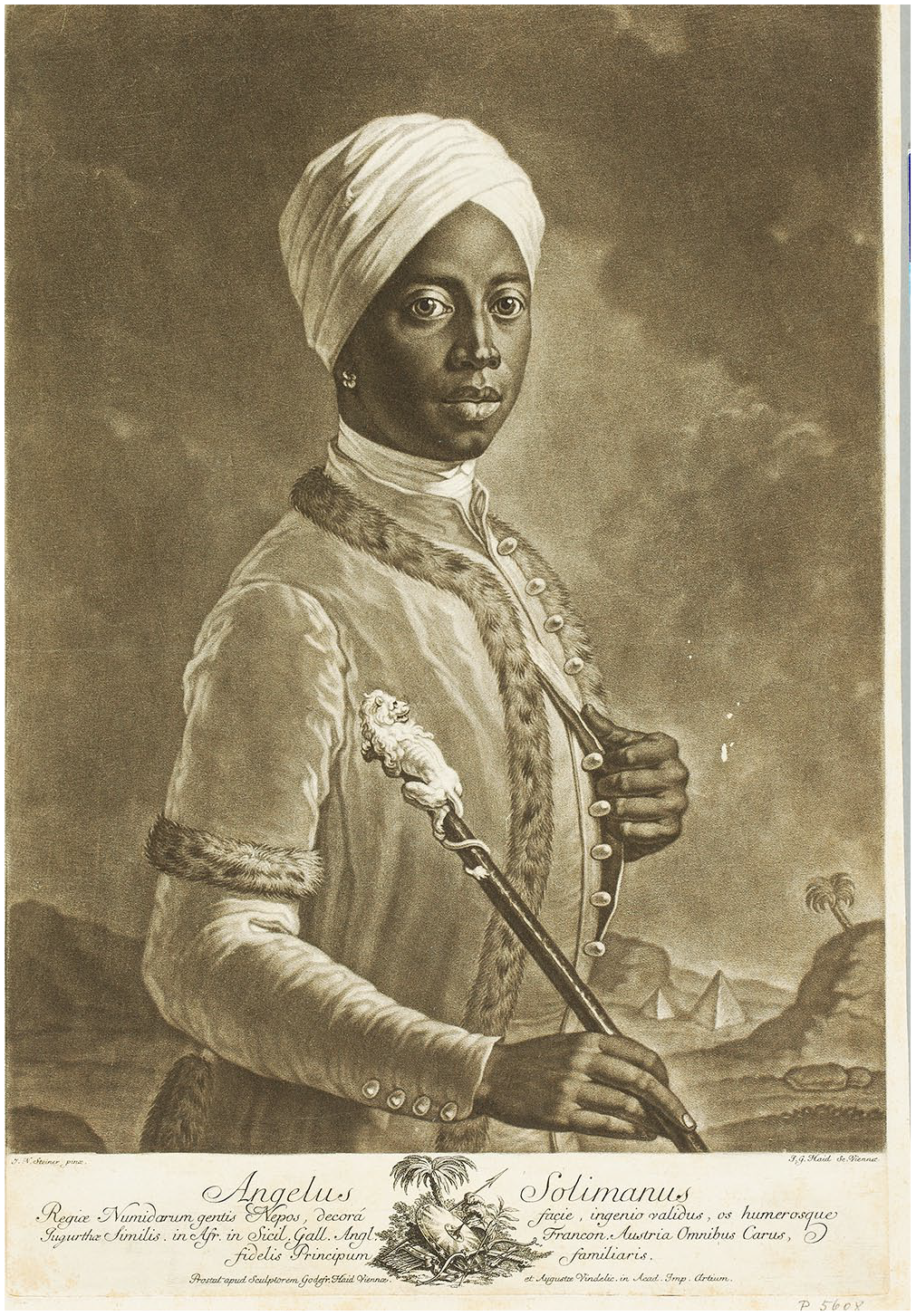
Soliman’s representation as ‘noble moor’.
Soliman’s representation in this painting is complex. On the one hand he seems to stand in front of the pyramids of his own accord. However, their small size seems to indicate a loss of once imposing meaning. Moreover, the two pyramids are, iconographically and textually, associated with European jurisdiction. The caption ‘Angelus Solimanus, Regiae Numidarum gentis Nepos, decora facie, ingenio validus, os humerosque Jughurtae similis. in Afr. in Sicil. Gall. Angl. Francon. Austria omnibus Carus, fidelis Principum familiaris’ – ‘Angelo Soliman, royal descendant of the Numidians, a man with beautiful facial features and significant intelligence, similar in figure and face to Jugurtha; held dear by all in Africa Sicily, France, Franconia, Austria, a true companion of princes’ 42 links Soliman’s appearance to ‘Jugurtha’, a Numidian ruler who caused the Romans considerable problems until he was captured and executed. Given that the caption describes Soliman as a loyal supporter of his European prince, the comparison of Soliman with an African ruler proves somewhat paradoxical.
Soliman was described in this image as descending from ‘royal lineage’. This claim was class-specifically charged and made clear that the ‘noble moor’ was no longer an autonomous figure whose reputation could have been achieved through exemplary behaviour and chivalry. The fact that Soliman as a descendant from royal lineage had become a servant to a prince signified that his ‘noble’ heritage had already been invalidated by his perceived ‘moor-ness’. The exotic dimension of this noble lineage obviously still sufficed to distinguish the prince. 43 His ascribed exotic status is also linked to his headwear, a turban that orientalises the Nigerian royal descendant, distorting political realities. The turban associates him with oriental culture in a time when the Ottoman Empire remained a powerful force globally. 44 In this context, the name ‘Soliman’ given to him in the role of subordinate ‘moor’ who had become a Christian is of particular interest. Soliman was one of the spellings of the name of ‘Süleyman the Magnificent’, who was responsible for the first siege of Vienna. The idealised portrait could hence visually associate Soliman with an aura of high culture of past times (signified by the pyramids), linking this aura with the suggestion that this greatness had diminished (leading all the way up to Soliman’s Christianisation). The image hereby associated the Orient with an alleged lack of development (as a sign of the ruin of erstwhile greatness) and presented this whole image as a decorative accessory to the prince’s display of power.
The ‘noble moor’ highlights the limitations of Soliman’s social integration and agency, revealing a perception of Soliman as essentially different, the exotic ‘other within’, despite his best efforts to emancipate himself and integrate into eighteenth-century European society. Soliman demonstrated his agency above all when he married a bourgeois white woman with aristocratic connections in Vienna without gaining the required permission of his employer. They had a daughter, who later married into the highest Viennese circles. 45 While his marriage was at least tolerated in eighteenth-century Vienna, relationships between white and non-white partners were vehemently opposed in European colonial discourse. In England’s North American colonies, for example, regulations about sexual relations between races became increasingly intertwined with the issue of slavery and were severely punished. 46
These politically driven colonial efforts to hinder and punish mixed-race relationships were paired with attempts to reject race ‘mixture’ on a pseudo-scientific basis. Thomas Jefferson was convinced ‘that the blacks . . . [were] inferior to the whites’ and therefore, that slaves were not allowed to be freed until it was assured that they could be ‘removed beyond the reach of mixture’. 47 Enlightenment thinkers gave credit to such claims by developing theories about allegedly natural inequalities between the races and openly expressed contempt against ‘half-castes’ and race mixing.
We don’t know whether Soliman’s relationship became subject to similar attacks. Soliman’s rise in Viennese society did not go unnoticed but the praise he received from some of his contemporaries revealed an underlying conviction that a black man could only prove his human status and ability to progress by assimilating to white European culture. When Henri Grégoire, an outspoken opponent of slavery, praised Soliman with reference to a biographical sketch he had received from the author of his first biography Karoline Pichler, he granted him ‘one of the highest places among the Negroes who have distinguished themselves by a high degree of culture, and even more by the morality and the excellence of their character’. 48
However, Soliman received this praise only because he had, in the eyes of Grégoire and his white contemporaries, set himself apart from what they considered the essentially primitive character of ‘the negro’. Grégoire had, in opposition to slavery, polemicised against ‘those who have a material interest in colonial agriculture and wish to use the supposed absence of moral faculties in the Negro as another reason for treating him, with impunity, like a beast of burden’. This view did not consider blacks capable of an autonomous development but insisted that their perfectibility had to be proven through assimilation to white norms and culture.
It can be argued that Soliman’s biography was marked by an increasing assimilation to the culture and norms of whiteness. He was robbed of all elements of ethnicity, origin and black identity and instead placed in the servile role of ‘court moor’, from which he eventually emancipated himself. His recognition in the upper echelons of Viennese society was not least based on the way in which he seemed to have lost every vestige of self-determination. Interestingly, Soliman himself entertained the suspicion that his ‘master’ might have ‘purchased’ him, ‘in order to find out whether Culture educates a negro in the same way as it educates a white European’. 49 His suspicion echoes the Enlightenment’s white-cultural chauvinist conviction that it alone could set the standard of measuring human development and progress and could conduct racist experiments on other human beings in the name of human progress, without even entertaining the possibility of their autonomous development.
Pre- and post-slave trade
Before the rise of the transatlantic slave trade, European representations of Africans were inconsistent, including the ‘noble moor’ as well as the ‘black devil’, ‘symbolic blacks’, ‘genealogical blacks’, ‘enemy blacks’, ‘holy blacks’ and ‘chivalrous blacks’. 50 The character of the ‘noble moor’ stood, as Wigger and Klein have suggested, ‘in a tradition that produced Balthasar, one of the three wise men, the black knight from Wolfram von Eschenbach’s Parzival and Saint Maurice. His skin colour was incidental, an attribute that could be explained by the strong rays of the sun in southern latitudes and, as a result, it was the character of the individual that was decisive.’ 51
It was in the seventeenth and eighteenth centuries that these diverse images were replaced by increasingly narrow perceptions of African people that constructed them as primitive and naturally inferior to Europeans. These representations were closely linked to ideological attempts to justify slavery such as a new contradictive interpretation of Noah’s Curse (The Curse of Ham), which called Africans descendants of Noah’s son Ham and cursed with eternal servitude. Moreover, thinkers of the early Enlightenment started to reconstruct the ancient concept of a Great Chain of Beings – ‘Scala Naturae’– and shaped the idea of a European biological identity, expressed in the concept of race from the seventeenth century onwards in an increasing number of hierarchical race theories developed by scientific elites. These generalised the stereotype of the ‘savage’, developed originally in the context of the conquest of the Americas, and applied it to Africans and other ‘native’ populations. 52 The race discourse of the Enlightenment was not without critics in its own ranks and did not simply overwrite older complexities and ambivalences within the representation of African people in Europe. Johann Friedrich Blumenbach, a prominent Enlightenment thinker on race emphasised ‘the good disposition and faculties of . . . our black brethren’ and criticised ‘the animalistic brutality of our white executioners’ on slave plantations. He was keen to draw public attention to ‘examples of the perfectibility of the mental faculties and the talents of the negro’ 53 and mentioned in this context the ‘dignified and very highly educated’ Angelo Soliman.
The ‘princely moor’
A painting by Canaletto presents Angelo Soliman as ‘princely moor’ (see Figure 2). While his earlier portrait as ‘noble moor’ ascribed Soliman at least formally some sense of independence and individuality, he is here presented as an exotic, juvenile and decorative servant to Prince Wenzel – a relation of direct submission to and dependence on his white ‘superior’.
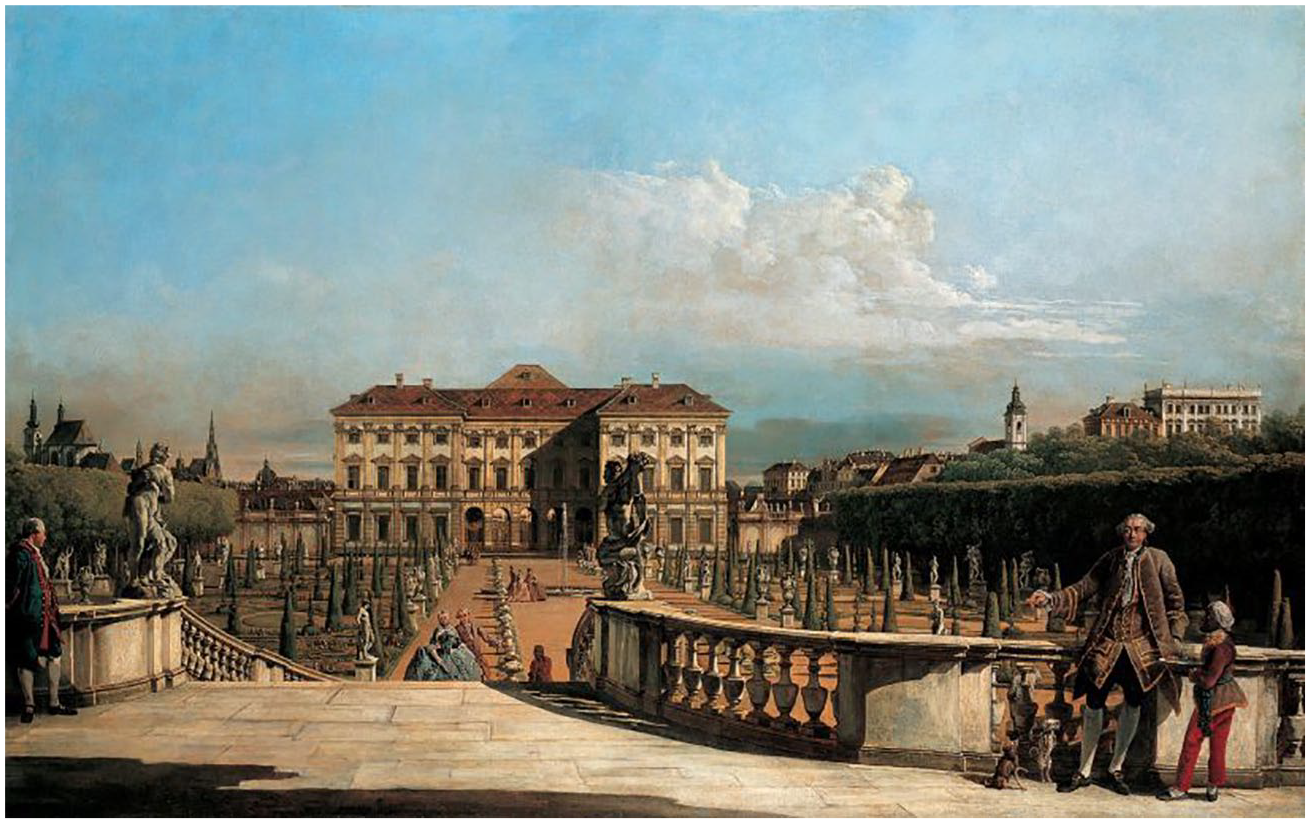
Soliman’s representation as ‘princely moor’.
It captures a power relation between Soliman and his ‘noble superior’ that was racially defined and reduced him to a decorative ornament to his master, a servant marked by attractive exoticism and infantility. The Soliman depicted here in a childlike manner was, at this point, around 38 years old. The painting is dominated by the figure of the prince, and the presence of a small dog to the prince’s left further highlights Soliman’s subservient position. Wenzel’s biographer’s description of the scene falsely depicts Soliman as a ‘negro boy’ who ‘hands’ his prince ‘a glass and baked goods on a tray. Brick-red pants, a dark jacket, and a white turban clothe the obliging waiter.’ 54
The small size of Soliman’s body in this painting was no depiction of actual physical size but a representation infantilising Soliman to emphasise dependence. He is hence not presented as a child who is yet to grow up and can still grow, but instead as somebody who will always remain dependent on his allegedly naturally superior white master, no matter how old he gets. Soliman’s representation in Canaletto’s painting echoes colonialist discourses and depictions of African people in hierarchical Enlightenment race theories that classified Africans as infantile and insisted that they would always remain ‘pupils’ in need of ‘white direction’ and domination. 55 Soliman’s representation as a ‘court moor’ turned into a child is already comparable to the western colonial stereotype of the eternal ‘boy’ of colonial and imperial servitude.
The employment of abducted African slaves in European courts was widespread from the thirteenth century. European aristocratic rulers were keen to possess ‘court moors’ and incorporate them in aristocratic displays of splendour to symbolise their own social superior status, dominance and far-reaching political influence. The role of the ‘court moor’ changed, as argued before, with the rise of the bourgeoisie insofar as ‘“court moors” fulfilled a new function, making visible the social contrast that the aristocracy, increasingly put under pressure, sought to highlight through the fashion of powdering and using white makeup. This symbolic act of distinction from the lower classes went hand in hand with the development of European colonialism and ultimately led to the social contrast between lighter and darker skin becoming racially-charged.’ 56
‘Court moors’ had been placed into the role of dependent servants whose inferior status became directly associated with and ascribed onto their skin as a racial stigma. Their dark complexion was increasingly turned into a signifier of perceived racial inferiority and subjection, associated with subservience and so enhancing the display of their white masters’ power. The inferiorisation of ‘moors’ and African people in general became a core element of European colonial imagination and was embedded in Enlightenment race theories and a political theory of liberalism that argued that human beings had been created equal while simultaneously constructing the idea that humans could be classified and, using skin colour as an indicator, be differentiated into ‘human’ and ‘sub-human’. 57
Canaletto’s painting is a fitting example of a genre of images that exhibit ‘moors’ in the role of infantilised servants and it was not the only painting representing Soliman in this role. 58 The function of these images was, as Jan Nederveen Pieterse has argued, similar to that of a ‘status symbol’, signalling ‘a privileged indulgence’. 59
‘Brother moor’
A prominent freemason lodge ‘brother’ of Angelo Soliman, Georg Forster, called him ‘brother moor’. This seemingly positive term illustrates the deep ambivalence about Soliman’s role and his exotic ‘princely moor’ status. While the term brother signifies the familiar and seems to present Soliman as belonging, integrated and ‘part of the family’, its combination with the term ‘moor’ makes it clear that ‘brother moor’ was a double entendre, a dubious ‘compliment’. It did not characterise Soliman as an equal among his lodge ‘brothers’, but emphasised his difference, his exotic status among them, and alluded to infantile and inferior qualities attributed to ‘moor’ figures in racialised European discourse. Forster was a friend of Samuel Thomas Soemmerring and supported his polygenist perspective on ‘race’. He thought black people benefited from education and prompted ‘whites’ to ‘cultivate the holy flame of reason’ in them. 60
There are, however, some indications that Soliman grew increasingly sceptical of and resistant to white dominance and challenged it, despite the position of inferiority he had been assigned in the process of his ‘moor’-ification. Interestingly, Soliman continued to wear his ‘moor’-ish-oriental clothing after his dismissal from princely service, suggesting that his role as ‘princely moor’ had become internalised and ‘habitually ingrained’ in his life, something he could not shed.
From ‘physiognomic moor’ to ‘taxidermised moor’
With the development and popularisation of pseudo-scientific Enlightenment race theories, the image of the ‘princely moor’ and associated narratives largely dissolved. Soliman became viewed within the parameters of developing systems of racial classification and was now classified on a chauvinistic, white-normative basis. A freemason argued that Soliman could in historical context be described as ‘a black skinned brother’, so, ‘a negro’.
Descriptions of Soliman became increasingly racially charged associating him with the racist stereotype of the ‘negro’, a term already widely used in the nineteenth century. This is evident for example in the account of Ferenc Kazinczy, a lodge brother, who saw Soliman once without a ‘turban’ when visiting him in his home. He described him in racial terms when referring to his ‘ebony moor-face’ and hair ‘as nappy and gray as the fur of a gray sheep’. His daughter was classified within the same racial context as being ‘of a yellowish color’, while her nose and lips did not ‘evidence her moorish ancestry’. She obviously seemed to be composed of parts ‘taken from the father’ and ‘from the mother’. 61 Kazinczy’s description is driven by a comparative and judging taxonomic gaze and attempts to discern their alleged ‘racial features’. This perspective became increasingly common in a time in which someone’s skin, hair, lips and nose were examined in terms of the often already so-called races and their perceived characteristics. 62
Contemporary thinkers of the Enlightenment tirelessly evaluated and classified human beings to establish the exact borders between the races. They also engaged in studies in the increasingly popular new pseudo-scientific disciplines of physiognomy and phrenology. Both were based on the premise that the physical appearance of humans would allow researchers to draw conclusions about their ‘inner beings’, and that particular characteristics were represented by the form of the brain and imprints it left on the skull. Relatedly, people believed increasingly that body, intellect and soul were closely connected, which made it possible to read perceived weaknesses of individuals and groups off their bodily features.
Modern physiognomy as a pseudo-scientific theory emerged in eighteenth-century Europe (i.e. during Soliman’s lifetime). Early physiognomic theories were associated with the Swiss writer Johann Caspar Lavater (1741−1801). Phrenology as a sub-form of physiognomy was developed around 1800 and is in its early form associated with the German physician Franz Joseph Gall (1758−1828). With the development of these new disciplines, in the course of the Enlightenment it became increasingly popular to study people’s faces, profiles and skulls. Phrenological lectures and physiognomic séances were well-attended, and many contemporaries entertained themselves with the creation of paper cut-outs that showed people’s silhouettes. It also became quite common to take a death mask of people who had just died, to immortalise the visible features of personality.
Two images of Soliman reflect these new trends in Europe, a cut-out of his silhouette and a death mask taken after his death (see Figure 3; a and b). These were not innocent memorabilia, but cultural relics of a time in which Enlightenment thinkers developed the discriminatory ‘optic of racism’, 63 engaging in increasingly taxonomic attempts to racially classify people. The silhouette reduces the complexity of facial features to form types. It represents Soliman as ‘physiognomic moor’, stripped of the royal surrounding associated with the ‘noble moor’. His oriental costume, essential for his representation as ‘princely moor’, also lost significance in this silhouette, in which the artist covered only parts of Soliman’s head with a garment that could be interpreted as a small turban or beret.
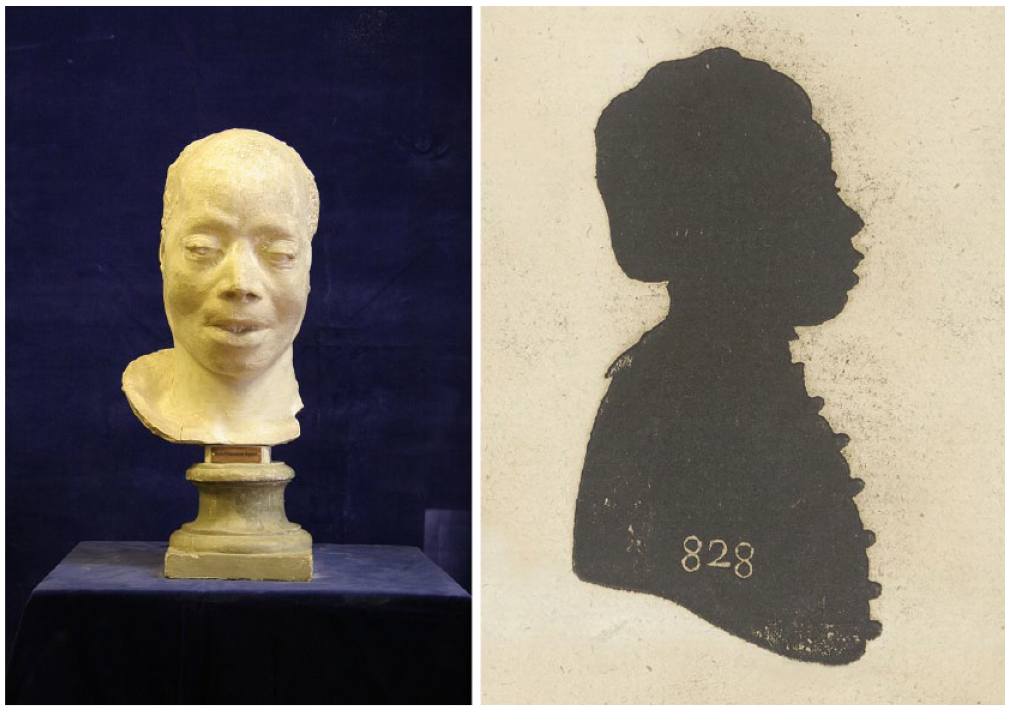
Death Mask (a; left) and Cut-out (b; right): towards a racial type.
The Enlightenment search for the ‘Missing Link’ in the ‘Scala Naturae’ led many to believe that black people could be placed at the bottom of hierarchical race theories. Racialised interpretations of facial features in silhouettes went hand in hand with other racial valuations such as measuring facial angles to distinguish the physiognomic features of different human races. People of colour were often simianised to argue in racist fashion that close similarities existed between the ‘negro’ and the ‘ape’. Johann Caspar Lavater, for example, who treated silhouettes as an alleged ‘proof’ of the ‘objective truth’ of ‘physiognomy’, simianised and degraded ‘the “moors”’ arguing that they had a ‘turgid open mouth . . . in common with the apes in their country’. 64
Death masks became culturally significant in the ‘northern civic and secular culture of the eighteenth and nineteenth centuries’. They are ‘both manufactured’ and ‘somehow organic’ in nature, given their ‘proximity to the skull in form and through production’. 65 Death masks are ‘casts of the human body’ and Marcia Pointon explains how ‘especially’ those ‘of the face of a deceased person aroused viewers in the past’. 66 From the early eighteenth century on, death masks were often produced as ‘an aid to memorial sculpture’ and spread in different European countries with ‘the cult of great men’. Famous examples of the production of non-royal death masks include Oliver Cromwell in the seventeenth century, Isaac Newton in 1727, John-Jacques Rousseau (1778), Friedrich II of Prussia (1786), Friedrich von Schiller in 1805 and Franz Joseph Haydn in 1809. 67
Soliman’s death mask was taken shortly after his death in 1796. The artist Franz Thaller had been ordered by the Emperor’s museum director Eberlé to prepare Soliman’s death mask and had taken a cast of his face only hours after Soliman’s death to start the preparation of a Soliman exhibit. 68 This death mask became an object of highly arbitrary taxonomic valuations. It was not taken to highlight and remember the significance of Angelo Soliman as an established member of Viennese society. Instead it classified him in racially discriminatory terms as a ‘negro’ and ‘African’. European Enlightenment race thinkers were sure that the shape and features of someone’s skull could serve as the basis of racial classification, and the collecting of heads became popular. Soliman’s death mask was received by the anatomist Joseph Gall, who included it in his collection of ‘national heads’. Soliman was hereby racially classified and placed with other ‘African heads’, which Gall compared to Europeans. In line with other racialised scientific phrenological and physiognomic studies, he argued that ‘in general, the negro is inferior to the European in terms of intellectual capabilities’ because ‘the negroes had smaller heads and a less considerable brain mass’ compared to Europeans. 69
The ‘taxidermised moor’
After Angelo Soliman died, his skin and body were preserved. He was then displayed inside a cabinet in an exhibition room of the Austrian Royal Natural History Collection, standing upright with right foot drawn back and left hand outstretched, a belt of feathers around his waist and crown of feathers on his head, each composed of alternatingly juxtaposed red, white, and blue ostrich feathers. Arms and legs were adorned with a string of white pearls and a wide, delicately braided necklace made of cream-colored coin-porcelain snails hung down to his chest.
The curators put him into a ‘glass cabinet, painted with green oil paint, the door of which, forming the front wall of the cabinet, was cloaked in a curtain of green taffeta’ presented in a ‘tropical wooded area with shrubbery, streams, and pipes’, containing ‘a capybara, a tapir, some muskrats, and many American marsh and songbirds grouped in various ways’. 70
A contemporary researcher has speculated that Soliman himself had probably approved of the taxidermy and display of his body. Monika Firla assumes without foundation that everything points ‘to Soliman himself having handed his body on for further “use” after his death’. 71 This dubious idea is grounded in her ‘sneaking suspicion that Soliman took his own African skin to market as his own decision’ because the ‘circle of natural scientists’ with which he associated talked him into it ‘in a spirit of friendship’. Firla’s suspicion has been criticised by other researchers, and rightly rejected as fictitious ‘adventurous speculation’. 72
It seems phantasmagoric to suggest that Angelo Soliman agreed to being stuffed and exhibited as an exotic object of public curiosity among wild exotic animals in a fantastical tropical landscape. Soliman had his skin removed from his body to which he had not agreed, and, as is well documented, against the will of his relatives. His body became the product of curators’ racist fantasies, an object of racist desecration and alienation. Wider critique of this disgraceful exhibition led to his stuffed and preserved body being moved into storage for many years. 73
Soliman’s body was transformed into a ‘taxidermised moor’ by curators. His display was an attempt to turn the socially accepted and established man they knew into a primitive racial type. Despite these efforts to degrade him, Soliman’s memory would live on. ‘He was, after all, neither an anonymous corpse robbed from a grave, nor a man to whom a trace of the monstrous or primitive was already attached while he was alive.’ 74 Following protests by his family and the Catholic church, the cabinet was fitted with a curtain, which was only sporadically opened to allow visitors on request to view the Soliman figure.
Turning Soliman, who had lived a successful life as an emancipated citizen of Vienna, into the figure of a primitive savage was not accidental. Instead, it followed the logic and ambition of the Enlightenment’s scientific racism. Soliman was never able to lose the exotic status ascribed to him by the term ‘moor’. His title ‘brother moor’ implied on the one hand that he was seen and respected as someone familiar; it at the same time depicted him as ‘the other’, emphasising his difference and exotic character. The Museum director’s keenness to get hold of his corpse, and the willingness of those involved to brutally desecrate it, should not be mistaken for the misled actions of individual perpetrators. They rather echo chauvinist racist ambitions directed towards Soliman’s body, which flourished with the rise of Enlightenment race theory and its white-normative and racist logic. Given that, as Charles Mills has argued, ‘[t]he white delusion of racial superiority insulates itself against refutation’ 75 this racist logic has, long after Angelo Soliman’s death, continued to shape European perceptions and the racist subordination of those constructed as ‘racial others’.
Contemporary representations of Soliman
Angelo Soliman’s story continues to occupy the consciousness of modern Austrian and European culture. There has been a recent resurgence of interest in his story, evidenced by new projects as diverse as academic scholarship (of which this article is an example), a museum exhibition, literature and film.
Recent scholarship on Soliman
At present Heather Morrison’s 2011 article ‘Dressing Angelo Soliman’,
76
published in the journal Eighteenth-Century Studies (JHU Press), remains the only contemporary scholarly article exclusively on Soliman written in English. While Morrison’s research is unique and compelling in its central focus on Soliman’s clothing, it, to some extent, perpetuates problematic stereotypes of Soliman and offers a far too optimistic reading of Soliman’s fate. Morrison writes: even when evoking fear, death, and the exorcism of evil as a Freemason, or empire as a servant of Prince von Liechtenstein, Soliman was complicit in the choice of costume. Through his dress, Soliman molded how the public comprehended his identity as an African . . . His dress portrayed a free-thinking, self-aware man partaking fully in Vienna’s culture − until his death, when the state requisitioned his body and dressed and displayed him to convey the exact opposite.
77
To call Soliman ‘complicit’, even while he was a servant, in the choice of his ‘moor’ costume and to argue he ‘molded’ how he was perceived as an African is speculative. It ascribes to him a form of agency that he simply did not have and at the same time overlooks the subjugating forces of racism that Soliman had to contend with throughout his life. Some of Morrison’s language, with phrases such as ‘free-thinking and self-aware man’, displays a belief in the fantasy of Soliman as an Enlightenment success story. To interpret the theft and taxidermising of Soliman’s skin as existing in opposition to everything he experienced during his life, and not as a result of it, is misleading and falls short of recognising the ways in which Soliman’s life and perceptions of him were influenced by the race discourse of the Enlightenment and its proponents’ racist ambitions.
A compelling new scholarly work relating to Soliman is Claudia Unterweger’s Talking Back: Strategien Schwarzer österreichischer Geschichtsschreibung [Strategies of Writing Black Austrian History]. 78 The project emerged out of the Recherchegruppe zu Schwarzer österreichischer Geschichte und Gegenwart [Research Group on Black Austrian History and Present], an activist collective formed in conjunction with the 2006 exhibition ‘Verborgene Geschichte/n – remapping Mozart,’ part of ‘Wiener Mozart Jahr 2006’. The research collective, formed of Austrian academics and artists of African heritage, then continued their work after the exhibit. Unterweger describes the collective’s mission as activism, and its rationale as follows: ‘the group conducted research on historically transmitted, gender-specific Austrian traditions of representation and their effects on the realities of the lives of Black people from the eighteenth century to the present and proposed its own counter-images to those representations’. 79 These counter-images are a form of the ‘talking back’ that Unterweger and her group promote − an idea taken from African-American sociologist and author bell hooks, understood as both confrontation to authority and declaration of subjectivity by the one who ‘talks back’.
Two central counter-images that ‘talk back’ to stereotypical and racist representations are Angelo Soliman and his daughter Josefine. In the fourth chapter of Talking Back, Unterweger calls Josefine Soliman ‘The Fighter’, 80 emphasising her fight to obtain her father’s remains. Here, contrary to the way the story is traditionally told, Josefine does not fail by not actually managing to have her father’s remains returned to her. Instead, she displays a strong act of resistance against (white) authority to even ask for them, instead of keeping silent, as eighteenth-century Viennese social norms expected her to. Unterweger reclaims Josefine Soliman from the annals of history and refashions her as an empowering figure for black women in contemporary society. Angelo Soliman himself also features prominently in the text, transformed from historical fetish-object as ‘court moor’ 81 to ‘Angelo X’, ‘Champion of Civil Rights’, 82 the latter represented through an image created by Robert Sturm that featured in the ‘Verborgene Geschichte/n – remapping Mozart’ exhibition (see Figure 4). Created by superimposing other graphics on top of the iconic eighteenth-century image of Soliman as ‘royal moor’, the powerful new image depicts Soliman with an Afro, a fist raised in solidarity with the black power movement, and the words ‘Angelo X’ (in reference to Malcolm X) and ‘black is beautiful’ written on his hooded sweatshirt, amidst a backdrop of black protesters around the Austrian parliament.
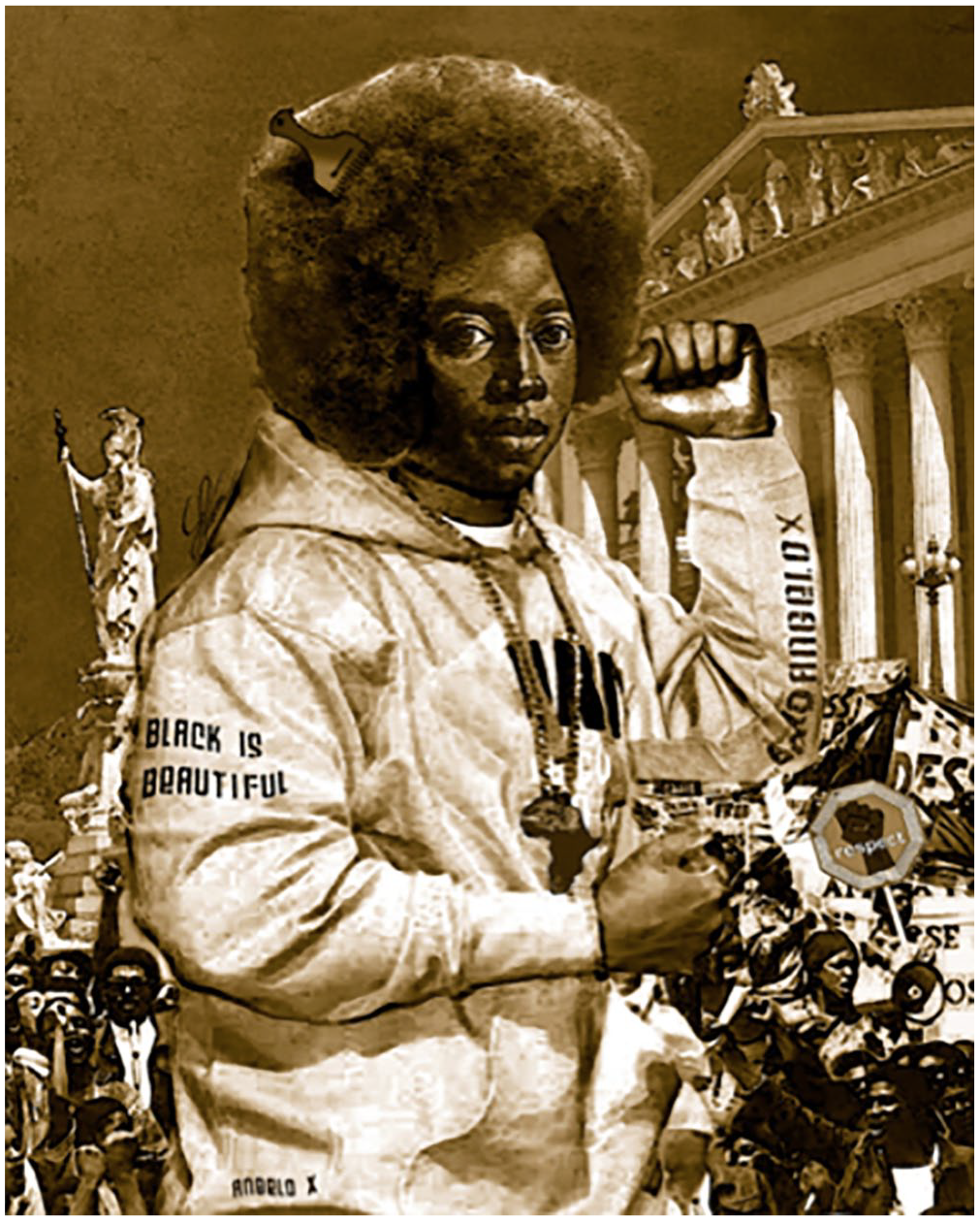
Angelo X. Canvas print 70×90cm. Idea and concept: Research Group on Black Austrian History and Contemporary Society. Graphics: Robert Sturm. Vienna 2006.
Unterweger’s research differs from other scholarship on Soliman due to its directly present-oriented, socio-political nature, and the way it extends the Soliman discourse into the realm of African-American history and activism. Her book has unfortunately received less attention in both the press and scholarly community than it deserves in the light of its content.
2011 Museum exhibition
One of the most high-profile public representations of Soliman in the last decade was the special exhibition ‘Angelo Soliman: An African in Vienna’ that ran from 29 September 2011 to 29 January 2012 at the Wien Museum. 83 Guest-curated by author-historian Philip Blom, with assistance from researchers Werner Michael Schwarz, Walter Sauer and Veronica Buckley, the exhibition produced a thorough, multifaceted portrait of Soliman in both historical and contemporary contexts. It was divided into eight roughly chronologically proceeding rooms, starting with ‘An unknown world: how Europeans imagined Africa’ and ending with ‘Vienna: 2011’. 84
The exhibition was a critical and popular success. Die Presse’s Norbert Mayer called it ‘thought-out, unsentimental’. 85 Bernhard Baumgartner (Wiener Zeitung) wrote that ‘Wien-Museum Director Wolfgang Kos was right when he called the exhibit “one of the most important in recent years” . . . an absolutely successful intersection of culture, migration, and human rights’ that gave ‘Soliman, so to say, a belated context worthy of his story’. 86 Der Standard noted that the Wien Museum had about 125,000 visitors in 2011, a 15 per cent increase from the previous year, 87 no doubt due in part to the Soliman exhibition. Though press coverage was mostly confined to Austria, the event also received some international attention. Paul Jandl (Die Welt, Berlin) called the exhibition ‘an illuminating journey through [Vienna’s] mythology and through constructs of the foreign’. 88 It even became the subject of a short article in London-based weekly magazine The Economist. 89
The Wien Museum’s choice to publish an exhibition catalogue prefaced by twelve new essays reveals a commitment to a historically nuanced portrayal of Soliman. Notable new contributions even include a piece by prominent public intellectual Kwame Anthony Appiah entitled ‘Honoring the Dead’. 90 The essay focuses on denial of deserved honour as the crux of what we find reprehensible about Soliman’s taxidermisation, examining the history of the concept of honour and the moral systems in place that led Kaiser and museum officials to conclude that it would be acceptable to taxidermise and display Soliman. Per Appiah, not only Soliman’s race but also potentially his class, as a servant, made the rules of honouring a dead body seem not applicable to him. 91 Appiah’s contribution further highlights the complexity of Soliman’s story and the actions of those involved in it.
Despite all of their positive contributions, the exhibition and catalogue are not entirely without issue in their representation of Soliman. Regardless of how well-researched the exhibition was, it once again placed Soliman in a Viennese museum as an object of public curiosity. It is certainly possible to read this choice as a redemptive gesture, an attempt to make up for Soliman’s horrific, degrading nineteenth-century exhibition in the Royal Natural History Collection, but atonement for Soliman’s fate seems impossible.
Additionally, certain choices and remarks by curator Blom highlight a potential disconnect between the exhibition’s white research team and the black Austrian experience. The last section of the exhibition, ‘Vienna: 2011’, is a ‘video installation’ that includes clips of Austrians of African descent living in Vienna reflecting on Soliman’s story in light of their own experiences. 92 Though inclusion of such clips is certainly better than omission, the extent to which these interviews (and the exhibition as a whole) are representative of Black Austrian perspectives on Soliman is hard to judge, given that the clips were curated by an all-white, mostly male research team. Furthermore, in an essay, Blom seemingly dismisses the only black-designed representation of Soliman in contemporary Austria, the 2006 ‘Remapping Mozart’ exhibition (the genesis of Unterweger’s ‘Research Group on Black Austrian History’). He writes ‘even Soliman’s afterli[ves are] characterized by the way seemingly everything can be projected onto him’, and then illustrates that point with a list of ‘projectors’: Pichler, Grégoire, Bauer, Musil, Fels (author of the 1992 play Soliman), Firla and ‘Remapping Mozart’. 93 ‘Remapping Mozart’ just turns Soliman, per Blom, into a ‘focus of postcolonial critique’. Listing postcolonial critique alongside Firla’s and Grégoire’s representations of Soliman makes all appear to be equally untrue, unhelpful ‘projections’. Reflecting on Soliman’s life from a postcolonial perspective, though, can allow new critical insights and help us to reflect more appropriately on his life, role and treatment in Viennese society and the myths surrounding him. Postcolonialism is hereby not a mode of projection, but a catalyst for a much-needed more critical reading and historically reflexive analysis of Soliman’s story.
To be fair, Walter Sauer does discuss ‘Remapping Mozart’ positively, and at length, at the end of his second essay in the exhibition catalogue, 94 but that does not effectively counter Blom’s dismissive comments.
Novel
Gergely Péterfy’s ‘moving, disturbing, and gripping . . . magnum opus of modern Hungarian literature’ 95 Kitömött barbár [The Stuffed Barbarian] 96 tells the (largely fictionalised) interwoven stories of Angelo Soliman and Soliman’s masonic brother, Hungarian author Ferenc Kazinczy. As a novel on realities of eighteenth- and nineteenth-century Enlightenment thought, The Stuffed Barbarian is fittingly told from within the internal musings of narrator Sophia Kazinczy, Ferenc’s widow. The novel begins shortly after Ferenc’s death (1831) with Sophia standing in front of Soliman’s taxidermised corpse in storage in the attic of the Royal Natural History Collection in Vienna. What follows is Sophia’s recollection of Soliman’s story, as told to her by Ferenc on his deathbed. Ferenc could never bring himself to write it during his lifetime, and only barely manages to tell Sophia before dying.
Soliman appears in the novel in all the tropes (noble, princely, physiognomic and taxidermised ‘moor’) discussed in this article, but one of the most important aspects of The Stuffed Barbarian is the way Péterfy gives Soliman an identity and inner life beyond the mere repetition of problematic stereotypes. Of course, such an identity and inner life are fictional, but as Péterfy explained in a recent interview about The Stuffed Barbarian, ‘the psychological accuracy that is missing from the available historical data can only be produced within literary fiction’. 97 Péterfy’s fictional Soliman is a fully realised character − a thinking and feeling human being with an individual voice − an especially important attribute, given that nearly all other retellings of Soliman’s story have continued to silence him.
The Stuffed Barbarian is not, however, without flaw in its representation of Soliman. One of its most compelling attributes is also one of the novel’s most problematic: the interwoven stories of Soliman and Kazinczy. In the novel, both characters are called or treated as ‘Barbarians’. In likening Soliman’s perceived otherness as a black man in eighteenth-century Vienna to the otherness of Kazinczy − a Hungarian within the Austro-Hungarian Empire, and a political revolutionary under a monarchy − Péterfy oversimplifies the specific form of racism that Soliman faced as a black man in Vienna. Critics have perpetuated this equating of Soliman and Ferenc’s experiences, concluding that ‘Ferenc and Angelo are like two sides of the same coin: one white, the other black, but both foreign, excluded, and ridiculed despite their scholarliness and love of freedom’. 98
Furthermore, in imagining a fictional deep friendship between the two men, Péterfy also chooses to ignore, or was simply unaware of, the actual published writings of Kazinczy (already discussed) in which Kazinczy taxonomically analyses Soliman and his daughter’s external appearance immediately after meeting them, leaving the impression that the real Kazinczy thought of Soliman less as a friend and more as an object of scientific, taxonomic fascination.
Film
Markus Schleinzer’s 2018 film Angelo 99 is a sparse, chilling film that says just as much by what it presents as by what it omits. Angelo is especially important to consider when looking at contemporary representations of Soliman because it has reached perhaps the widest audience − geographically, if not also in terms of viewer-count − of all Soliman-related projects in the twenty-first century. The film garnered numerous awards and accolades internationally, from the Österreichischer Filmpreis 2019 for ‘best costume design’, ‘best mask’ and ‘best production’, to being selected for the Toronto, San Sebastian, BFI London, Zurich and Haifa film festivals. Reviewing Angelo for the Toronto Film Festival, critic Wendy Ide described it as a ‘supremely assured . . . [and] profoundly uncomfortable’ film that ‘uses silence as a tool and a weapon’. 100 Viennese daily newspaper Der Standard called the film a ‘masterful’ work that shows that ‘the patterns of interpretation [that affected Soliman] are also at work in our current view of the foreign’. 101 Schleinzer divides the film into three parts, plus a brief prologue, producing a fragmentary, often coldly clinical and disturbing representation of Soliman. It is clear that his intention was not to educate, but to elicit an emotional response in his audience, to shock the audience into feeling the horror of Soliman’s story.
Angelo is without doubt a powerful, unsettling film. This does not mean, however, that the way it tells Soliman’s story is unproblematic. One of its most intriguing features is the way every character except Soliman remains unnamed and unidentified. Even then, he is only ever ‘Angelo’. Schleinzer presents name-giving itself as an act of violence, a forceful and unauthorised imposition of culture and identity. There is, however, a major drawback to this choice. Perhaps a European audience already aware of Soliman would be able to recognise the outlines of historical fact in Angelo. For the viewer who is unfamiliar with his story, however, the film is a blur of stereotypes and images of exploitation, leaving little more than a deep sense of unease. The film has already received substantial attention outside of Europe, so the question of reception by an audience unfamiliar with Soliman is pertinent.
Further, in an effort to highlight the ways in which Angelo was silenced by forces of racism around him, Schleinzer goes to an extreme and nearly completely silences Angelo’s character in the film. While this certainly makes a point and elicits a disturbing reaction in the viewer, it does not change the fact that Schleinzer has created and disseminated another mythologised version of Soliman, devoid of individual voice and identity. All that remains of Soliman’s character (and of a man who spoke five languages in his lifetime) in Angelo, then, are stereotypical modes of representation. In a review of Angelo for Die Presse, critic Andrey Arnold recognises the downside of Schleinzer’s choice to portray a mostly silent Angelo devoid of personhood: [The film’s] abstraction itself functions as a formal display cabinet, behind which Soliman appears as a mere object lesson. One could have − on account of his in reality far more eventful life − also given him more moments of rebellion against the reins of the didactic narrative.
102
Arnold’s comment shows how Schleinzer’s representation of Soliman puts his character in a position of subservience once again: instead of serving the court, Soliman here serves both the medium of the film (‘abstraction’) and its message (‘didactic narrative’).
Lastly, Schleinzer’s contentious choice to show white actors in blackface in three scenes in the movie cannot go uncritiqued. 103 All scenes are clearly intended to disturb, and they do. The choice to show white actors in blackface in a twenty-first century film, however, even if intended as historical reference, is more than disturbing: it is inconsiderate, and possibly triggering for a black audience. To use blackface in contemporary film points either to ignorance and assumption of a white audience at best, or a deliberate provocation of black viewers at worst.
Conclusion
In her interview with Wienerin, responding to the question of how much research exists on the topic of black Austrian history, other than her own Talking Back, Unterweger answers: There are certainly a few papers on the topic written by black researchers. But they hardly receive the attention they deserve. On the other hand, there are a handful of white professors who research black history, but not critically enough, I find. They often − quite paternalistically − emphasize a supposed tolerance of Austrian society towards African people.
104
This article on Soliman aims to respond to Unterweger’s statement by providing a critical and historically grounded analysis of Angelo Soliman’s life and roles in eighteenth-century Viennese society to offer a necessary critical perspective and to question remaining uncritical dimensions in the public discourse on Soliman. It is the hope of the authors that bringing Angelo Soliman’s story in all of its complexities, realities and contexts − past and present − to the English-speaking scholarly community will allow the discussion to reach a broader audience and contribute to a fuller understanding of the historical origins of European racist representations of people of colour that continue to haunt contemporary societies globally.
Footnotes
Iris Wigger is a Sociology lecturer in the School of Social Sciences at Loughborough University, UK and a Visiting Assistant Professor in Sociology at University College Dublin, Ireland.
Spencer Hadley is a research assistant in the Department of German at Princeton University, where he completed his undergraduate studies. He will begin postgraduate study towards a PhD in German Studies at Cornell University in the fall of 2020.