




Abstract
The British war on woke is an intensive ideological campaign against social justice movements that is mobilising far-right tropes and conspiracy theories within mainstream British political discourse. It sees itself in a battle of good versus evil, reason against the dark forces of pre-modernity, ‘Cultural Marxists’ and a ‘globalist elite’ intent on ruining ‘western civilisation’ and replacing ‘white’ British culture with woke multiculturalism. The authors examine this campaign’s discourses on various digital media including magazines, blogs, news sites and Twitter, and used search engines and a media database to capture a network graph of a community waging its war on woke. Using the graph metric of ‘betweenness centrality’, they isolate and visualise a small densely inter-connected homophily of political actors who share media platforms and cooperate with think-tanks, campaign groups, and ‘educational charities’. Using van Dijk’s concept of the ideological square, they explore the conceptual logics driving this campaign to its extreme positions, often justified on the basis of representing the interests of the British white working class.
Keywords
Introduction
Recently, a group of academics and cultural commentators have framed wokeness as a pseudo-religion. As Phelan notes, Hayek, in 1973, foreshadowed this by calling social justice a ‘quasi-religious superstition’ that ‘has no meaningful place in a social order organised around a market economy’. 1 This framing was resurrected by American academic John McWhorter and developed into a full ‘taxonomy’ of ‘woke religion’ by Michael Shellenberger and Peter Boghossian. 2 In 2021, this framing was voiced on UK television by Professor Eric Kaufmann who told his host, Andrew Doyle, on GB News that wokeism involved the ‘sacralization of historically marginalised out [sic] race, sexual and gendered identity groups’. 3 One of Kaufmann’s collaborators, Professor Matthew Goodwin, developed this definition further on Twitter (see Figure 1).
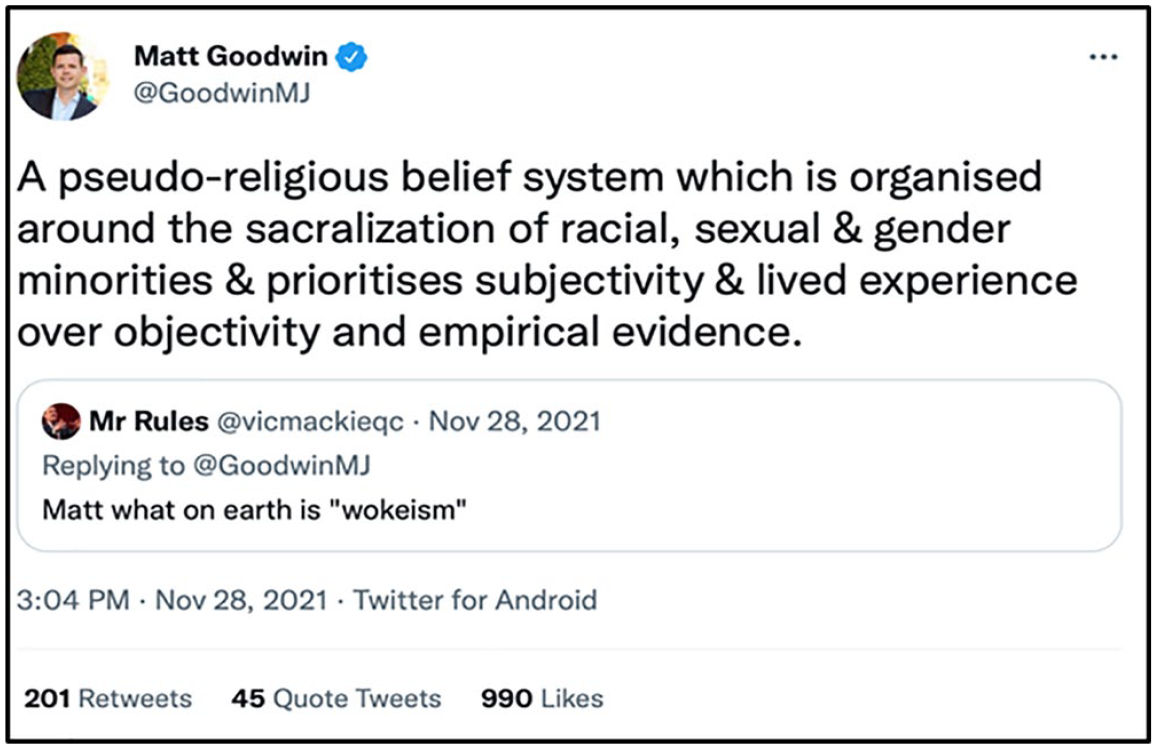
Goodwin’s definition of wokeness.
Subsequently, a community has coalesced around this pseudo-religious definition of wokeism, and within this community the woke are described as a threat to ‘western civilisation’. From their various media and political platforms, these anti-woke campaigners retain the right to adjudicate what is woke and what they allow to be considered normal, thereby policing the speech and behaviours of social justice campaigners. 4 To achieve this, anti-woke actors have to be seen to be moral and rational. However, woke and wokeism are not empirically established concepts. Rather they are discursive constructs with sufficient interpretive flexibility 5 to allow anti-woke campaigners to apply them to any group or practice they wish to discredit.
Anti-woke campaigners use platforms that also espouse the benefits of global warming and fossil fuel production, which the Intergovernmental Panel on Climate Change says is not just a threat to what anti-woke campaigners claim to be protecting (‘western civilisation’) but the whole of humanity and our ecosystem. 6 This article explains how, via a denial of structural racism, this community has ended up telling itself that academics identifying artefacts looted from colonies on display in stately homes are ‘extremists’, while a sustained year-on-year series of record-breaking temperatures in the UK and across the globe is just normal weather. 7 We begin this explanation by describing how this pseudo-religious frame has become the latest attempt to intellectualise a moral panic about perceived leftwing cultural hegemony.
The term ‘woke’ can be traced back to pre-war African Americans responding to their racist persecution. For example, in 1938, it was used by the folk singer-songwriter Huddie Ledbetter (aka Lead Belly), to warn potential victims of racist violence that they ‘best stay woke, keep their eyes open’. 8 During the civil rights movement woke came to mean being fully politically conscious of one’s racial oppression. It was reactivated, particularly via social media, during the Black Lives Matter (BLM) campaign, especially in the wake of George Floyd’s murder. 9
Activists and journalists soon became concerned that its memeification through social media discourse trivialised the concept of woke, making it popular but poorly understood. 10 Scholarship also began to emerge that critiqued the cynical commercialisation of woke messaging, particularly in corporate marketing to young progressive audiences. Sobande calls this ‘woke-washing’ where, in the absence of any actionable appreciation of the structural and intersecting ‘nature of oppressive forces linked to racism, sexism and transphobia’, companies offer their publics relatively meaningless anodyne and comforting stereotypes of performative empowerment. 11 Kanai and Gill argue such ‘woke capitalism’ is ‘making racial, gendered and sexualised oppression a matter of individual responsibility and attitudinal orientation’. 12 Therefore, these critics of woke from the Left are concerned the concept enables corporate actors to sell ‘the superficial trappings of progressive idealism without doing the real work to understand and change systems of oppression’. 13 Meanwhile, antipathy towards the BLM movement began to emerge discursively across a range of conservative media. 14
In the latter half of the last decade, the British rightwing press began using woke pejoratively to target progressive politics and public figures. From 2017, as her relationship developed with Harry Windsor, the online publication Spiked (which we detail later in the article) started to consistently apply the term pejoratively to Meghan Markle. 15 This frame, established early by Spiked, became particularly useful as the British rightwing media intensified its targeting of Markle. 16 The Daily Mail initially began discussing wokeness broadly by co-opting it into its scathing treatment of other celebrities, media creatives and so-called ‘politically correct’ comedians. 17 It subsequently drew on woke as an instrument of parody. 18 This form of woke was framed as something performative, inauthentic, self-righteous, self-indulgent and practised by privileged individuals.
People who write for publications such as the Daily Mail and Spiked therefore took an opportunity to disassociate wokeness from authentic anger against racism, and associate it in the public imagination with celebrity self-indulgence. Such publications also picked up on corporate hypocrisy or ‘woke-washing’. This dissociation from authenticity and association with ‘the elite’− celebrities and corporations − enabled woke to be co-opted into a moral panic about perceived leftwing cultural hegemony. 19
The development of the woke moral panic
The campaign we map in this article involves a prominent and public-facing community which has escalated the status of wokeness to a dangerous, punitive and subversive, Stalinist, 20 Maoist, 21 ‘totalitarian’ 22 ideology or pseudo-religion that is ‘infecting’ 23 British schools and universities, and ‘polluting’ 24 British culture. But woke is only the latest in a series of concepts to service a moral panic about perceived cultural hegemony that has been reverberating through British politics for over forty years.
Political correctness
In the 1980s and 1990s, before wokeness, the British rightwing press, informed by their American counterparts of the ‘rising hegemony of the politically correct’, routinely ran stories about ‘political correctness gone mad’. 25 In 1986, one such rightwing moral panic concerning Susanne Bösche’s 1983 picture book, Jenny Lives with Eric and Martin, 26 portraying a girl living with two gay men, made its way from the press into parliament. 27 The eventual outcome of these debates was Section 28, of the Local Government Act 1988, also known as Clause 28, which banned the promotion of homosexual behaviour in schools, effectively enshrining homophobia in education into British law. 28 During this period, echoing much that is said today about the woke, promoters of diversity were constructed as totalitarians who were forcing people to accept sexual diversity, commit to equality and use non-racist and respectful language. 29
As immigration into the UK increased, this campaign against perceived leftwing hegemony intensified when public figures such a Nigel Farage of the UK Independence Party (UKIP) labelled immigration ‘uncontrolled’ 30 and reiterated older arguments 31 against multiculturalism. 32 UKIP’s vociferous condemnation of the Labour Prime Minister Gordon Brown in 2010 calling a member of the public who complained about immigrants a ‘bigoted woman’ offered an insight into the future direction of campaigning tactics against immigration. Following Brown’s election defeat, leading figures on the British Right, including Farage, the Eurosceptic wing of the Conservative Party, plus a small number of Labour MPs, began calling for more public debate about immigration. 33 These actors framed anti-immigration sentiment, such as this member of the public had voiced, as a ‘legitimate concern’ with no prejudicial connotations. 34 In 2016, Farage left UKIP to form the Brexit Party.
Brexit and the ‘left behind’
Farage’s Brexit Party campaigned against the EU from within, framing it as an anti-democratic liberal/left technocracy that was forcing immigration and multiculturalism on to the British working class without its consent. 35 Anyone who supported the Remain vote was consequently constructed by the Brexit Party (and its affiliates including former Revolutionary Communists who are now writers for Spiked) as an opponent of a British working class that had been marginalised by multiculturalism and silenced by a form of political correctness that stigmatised legitimate concerns. 36
After the referendum on EU membership, leading Brexit figures 37 denied the vote had anything at all to do with immigration 38 or claimed immigration was merely a proxy for sovereignty. 39 Alternative explanations constructed Leave voters as ‘the left behind’ – working-class people forgotten by the London-based liberal/left elite. 40
As Mondon and Winter explain, ‘arguments about the white working class “left-behind” became common to explain the resurgence of populist-right and far-right parties as it was argued they were able to attract former leftwing voters alienated by the convergence of the mainstream left and right and their focus on the middle class’. 41 The subsequent campaign for a second vote was constructed by Brexit supporters, including writers for Spiked, as an attempt to disenfranchise working-class voters by denying their democratic voice. 42
In 2019, Kaufmann wrote for Spiked problematising what he called ‘Left Modernism’ – the ‘ideology’ of perceived leftwing cultural hegemony. 43 Notably, he didn’t mention wokeness or Critical Race Theory (CRT). This suggests the Brexit supporting/Spiked community represented by figures such as Kaufmann and Baroness Claire Fox (details below) had yet to make the connection between three strands we have identified so far: the backlash against corporate wokeness emerging from America, the Daily Mail’s version of wokeness as a self-indulgence of the pampered rich, and its own construction of a Remain-voting anti-working-class elite.
Meanwhile, the American Right was fomenting a moral panic about wokeness that it claimed, through leftwing academic CRT, was indoctrinating children, creating prejudice against white people and producing racial division rather than preventing it. The latest stage in this campaign is represented in, for example, Florida Governor DeSantis’s Stop the Woke Act. 44
Cultural Marxism
For decades before this moral panic about wokeness, the American far Right was developing its theory of Cultural Marxism to intellectually explain its perception of leftwing cultural hegemony including what it saw as the imposition of political correctness, multiculturalism, minority rights and diversity on to white people. This theory posits that a group of Jewish intellectuals who fled Nazi Germany to set-up the ‘Frankfurt School’ developed a strategy to achieve cultural hegemony, including infiltrating the organs of American culture such as Hollywood, to capture the minds of the public and convert them to leftwing ideas. 45
In the twenty-first century, the notion of ‘Cultural Marxism’ has developed into a conspiracy theory that has been cited by racist far-right mass murderers. 46 In his manifesto, mass murderer Anders Breivik referred on 111 occasions to an online blog written by Fjordman, a pseudonym of Peder Jensen, that claimed Cultural Marxists were white supremacists’ ‘mortal enemies’. 47 Despite its far-right origins, Cultural Marxism was once the default alternative to political correctness that the British mainstream Right used to describe perceived leftwing cultural hegemony.
Cultural Marxism offered the putative mainstream Right an ostensibly intellectual and historical explanation of perceived leftwing cultural hegemony that political correctness failed to capture. For example, in 2007, the Daily Mail’s editor writing in The Guardian said ‘political correctness’ should ‘properly be called Cultural Marxism, since it is at root a leftwing doctrine which seeks to destroy our society’. 48 Cultural Marxism was still in mainstream circulation in 2019 when former Attorney General and current Home Secretary Suella Braverman said that ‘as Conservatives we are engaged in a battle against Cultural Marxism, where banning things is becoming de rigueur; where freedom of speech is becoming a taboo; where our universities, quintessential institutions of liberalism, are being shrouded in censorship and a culture of no-platforming’. 49 Again, Braverman, like Kaufmann, does not mention woke.
The Institute of Economic Affairs (IEA), which has tax exemptions as an educational charity, also attempts to account for leftwing ‘cultural hegemony’ by invoking the Frankfurt School. 50 Marc Sidwell, a Senior Fellow at the New Culture Forum (based at 55 Tufton Street) writing for the IEA, argued that modern wokeism had its origins in the Frankfurt School which sought to ‘tear down Western economic and social norms through a “long march” to capture key cultural institutions’. 51
Braverman received enough public criticism to show that there is at least some social cost to using this theory because of its associations with the far Right and its antisemitic and conspiratorial connotations. 52 However, this didn’t prevent the parliamentary Common Sense Group subsequently writing to The Telegraph to claim the correct term for wokeness is ‘Cultural Marxist dogma’. 53
While Tim Black, writing for Spiked, concedes Cultural Marxism is a far-right trope, he argues that this is not ‘a sign that far-right thinking somehow underpins and drives those defending free speech and challenging censorship’. 54 Instead, Black argues, this is an indication that the Left has ‘turned away from economic critique and towards cultural criticism’ (we explore this explanation that denies moral culpability for using such far-right tropes as Cultural Marxism later in the article).
Critical Race Theory
Therefore, to corporate woke-washing, celebrity wokeness and ‘elite Remainers’ we can add a moral panic about CRT coming from the US and the clear need for a seemingly intellectual explanation of leftwing cultural hegemony to replace Cultural Marxism that fulfils the same purpose.
In 2020, Baroness Claire Fox, and GB News presenters Andrew Doyle and Inaya Folarin Iman wrote to The Spectator. 55 Their letter, which was counter-signed by many leading figures now engaged in the war on woke, including people who have subsequently been appointed to prominent positions in public office such as the Head of the Social Mobility Commission, claimed that CRT was an ideological agenda that threatened to undermine British race relations. Therefore, by 2021, we can see all these strands converging into a new campaign narrative. Besides the event where Kaufmann spoke, we have the Daily Mail and many other rightwing outlets such as The Express and The Spectator regularly commissioning academics and writers from Spiked to say CRT was entering British schools to brainwash children and turn black children against white. 56 The next section identifies and maps out the community making these claims, while subsequent sections use the concepts of the ‘ideological square’ 57 and ‘reactionary democracy’ 58 to explain the war on woke – and its escalation to the point that this community tells its audience that wokeness is a greater threat to ‘western civilisation’ 59 than man-made climate change. 60
Mapping the British anti-woke community
To fully document the war on woke, we needed an entry point to start building this ‘community’ through its various connections and affiliations to reveal who is involved and measure the depth of their commitment. We began with two professors of political science, Kaufmann and Goodwin, who, in the UK, have publicly described wokeism as a pseudo-religion. 61 Then, to identify who else shared their diagnosis for leftwing cultural hegemony, we looked at the events and networks these two academics operate in to problematise wokeness.
For ethical reasons, we focused on British public figures including members of the House of Lords and House of Commons, journalists, commentators, and academics who contribute to the public sphere in the UK by appearing on television, on radio, or in the national press, and use a range of public forums such as Twitter, online magazines and public events to take issue with wokeism within this pseudo-religious frame. We excluded, for example, employees of anti-woke campaign groups who are on Twitter but otherwise have no public profile or media presence.
All the data we use here is available on the open web; the anti-woke movement is a public campaign seeking to influence public opinion so we are not compromising anyone’s privacy. Aggregated lists of the media outlets that this community uses are already collated on the website muckrack.com . We were also able to draw on websites such as Spiked which provides a list of its authors, and individual profile websites that provide a portfolio of media outputs. Every relationship in our data is supported by a publicly available uniform resource locator (URL).
We mapped this community by asking the following questions. Who else uses the pseudo-religious frame to suggest wokeism is irrational, intolerant and dogmatic? Who has access to broadcast, print and digital media to discuss ‘the woke’ in this way? Which media outlets do they use to campaign against wokeness? What lobbying and campaign groups do they belong to? Which political parties fund them, which do they belong to, or work for? What think-tanks do they use for their campaign platforms? Who is financing these institutions? Can the properties of this community be quantified? And how do we frame the logics and tropes this community is promoting within its discourses?
We found Professor Goodwin has appeared on the BBC’s Any Questions, Moral Maze, Newsnight, and Politics Live; Channel 4 News, GB News and Planet Normal. He has also written for the Daily Mail, Evening Standard, Financial Times, The Guardian, New Statesman, The Spectator, The Telegraph, The Times, Times Higher Education, Unherd and Spiked. While as a political pundit he addresses many issues, his concerns about wokeism are a recurrent theme in his output. For example, he takes issue with wokeness for Unherd, the Daily Mail, on Spectator TV, on GB News and regularly on Twitter. 62 Professor Goodwin is also a speaker at the Battle of Ideas festival, Director of the Centre for UK Prosperity at the Legatum Institute, and on the advisory council of the Free Speech Union. 63 He has advised the Conservative Party on strategy and supported anti-woke campaigner Kemi Badenoch for prime minister, calling her ‘one of the most interesting Conservatives in British politics for a very long time’. 64 He also supports the Conservatives’ plan to automatically deport unauthorised asylum seekers to Rwanda (see Figure 2).
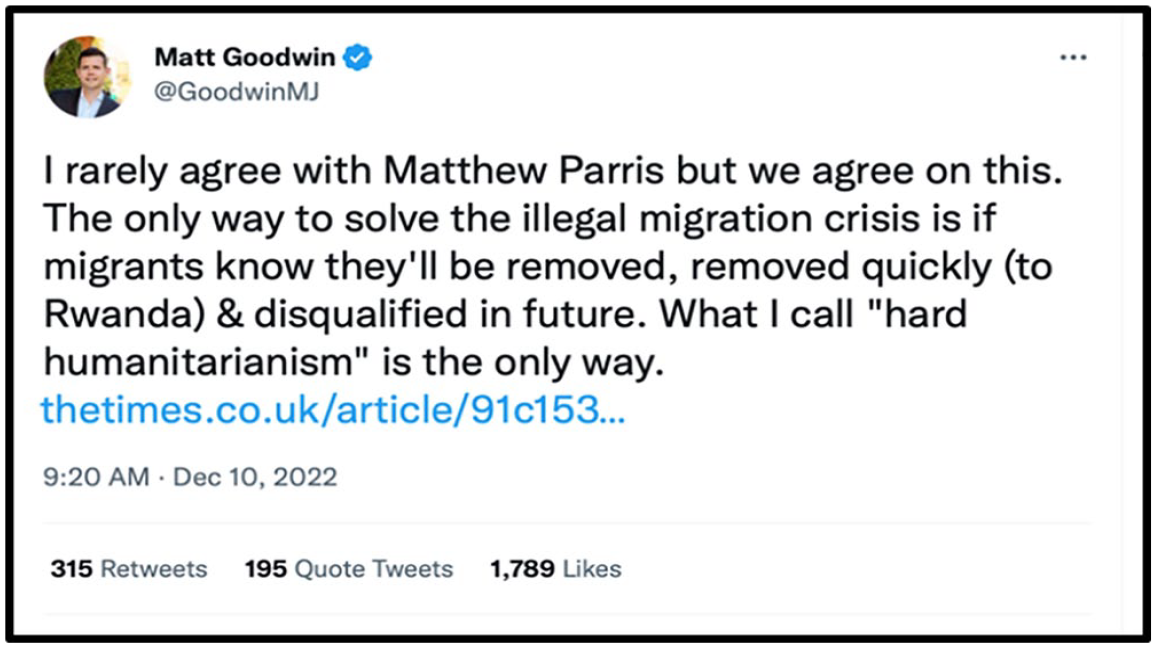
Goodwin’s approval of the Rwanda policy.
Professor Kaufmann has appeared on RT (formerly Russia Today), GB News, and BBC Newsnight. He writes for the National Review and Unherd, contributes to Spiked’s content, speaks at the Battle of Ideas and is also on the advisory council for the Free Speech Union. 65 He is an affiliate of the anti-woke campaign group Counterweight, a senior fellow at the Policy Exchange think-tank and an adjunct fellow at The Manhattan Institute. 66 Goodwin and Kaufmann also appeared together to give evidence to the Commons committee on the Higher Education Freedom of Speech Bill. 67
We expanded this network of associations, using a form of purposive sampling of those with a commitment to this pseudo-religious frame as the eligibility criteria and key word searches drawn from Goodwin’s definition of woke such as ‘woke’ + ‘pseudo-religion’ or ‘woke + religion + ideology’. 68 Using this technique, we identified other instances where Goodwin and Kaufmann use this definition as well as other public figures who share a platform with Goodwin and Kaufmann and operationalise the pseudo-religion frame in their outputs. For example, Kaufmann uses this definition at a Battle of Ideas event, which was hosted by Andrew Doyle and broadcast on GB News and YouTube. 69 As we show in the section on discourses, this framing has resonated within the anti-woke community.
Via subsequent searches, a dense network of related actors quickly emerged. For example, Calvin Robinson shares this pseudo-religious frame. 70 He also writes for Spiked, The Telegraph, Daily Mail, The Spectator and Breitbart. 71 He appears as a presenter on GB News, has been a guest on BBC’s Newsnight and is a former fellow of the Policy Exchange. 72 He speaks at the Battle of Ideas, stood for the Conservative Party, the Brexit Party, worked for Vote Leave and works for the Reclaim Party. Robinson is also a founding signatory of the campaign group Don’t Divide Us. 73
The University of Kent’s Professor Frank Furedi is a former Revolutionary Communist who also writes about wokeness as a dangerous dogma for Spiked and the Daily Mail, has appeared regularly on GB News 74 and used to criticise the woke on RT. Claire Fox, who sits in the House of Lords as Baroness Fox of Buckley, is another former Revolutionary Communist and campaigns against wokeness within the same frame; she has written for Spiked, the Daily Mail, has been featured in Breitbart, regularly appears on GB News, collaborates with the Reclaim Party, and stood for Nigel Farage’s Brexit Party. 75 Along with other anti-woke campaigners such as Charles Moore, she is an honorary academic at the University of Buckingham. 76 Moore is also affiliated to the Policy Exchange think-tank, writes for The Telegraph and Spectator and, along with Fox is a member of the House of Lords. While Moore did not stand for the Brexit Party, he was a prominent pro-Brexit campaigner. Fox is director of the Academy of Ideas that hosts the Battle of Ideas, where Goodwin, Kaufmann, Doyle, Robinson, Furedi have all appeared as speakers. 77
We translated all these relationships into a graph and described the relationships of the connections between people and institutions. For example, ‘Writes for’ as in Douglas Murray writes for The Spectator, ‘Is chair of’ as in Nigel Biggar is chair of the Free Speech Union, and ‘Is a director at’ as in Joanna Williams is a director at Civitas.
It is often difficult to categorise these entities because they confuse the distinction between educational charity, political campaign group and think- tank. Charity status offers institutions tax incentives and the impression that they are answering a noble calling independent of any partisan or ideological agenda. For example, the IEA is a free-market think-tank and UK registered charity describing itself as an ‘educational research institute’.
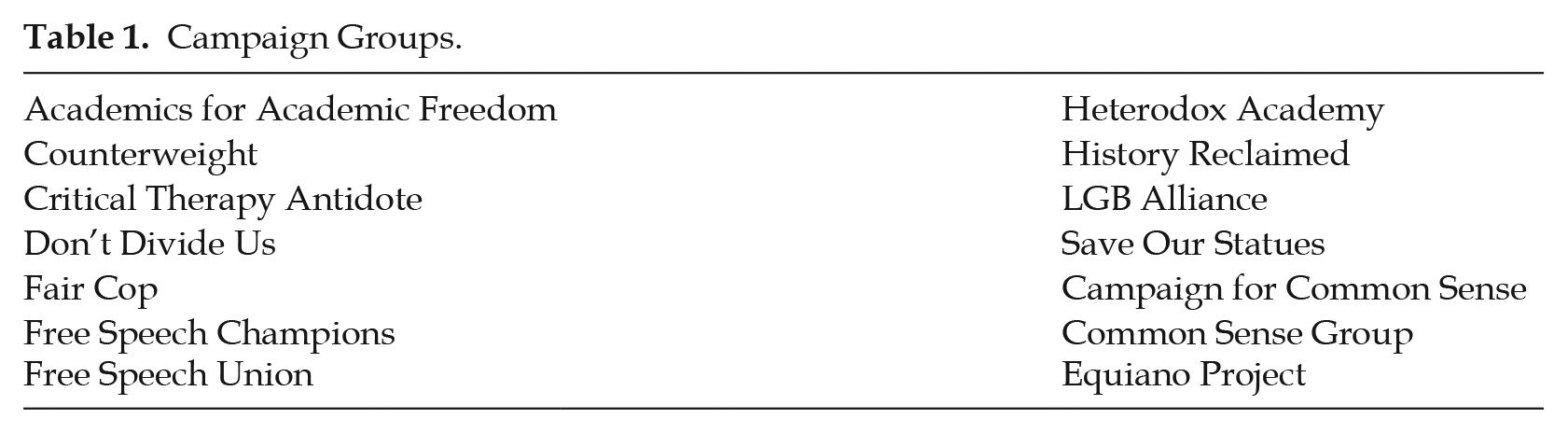
In total we found fourteen campaign groups that are affiliated to each other and/or share personnel (see Table 1).
Campaign Groups.
In total, we found five think-tanks that have an anti-woke stance and/or have associations with anti-woke campaigners: the Policy Exchange, the New Culture Forum, the Legatum Institute, Civitas and Cieo. The Policy Exchange and Civitas are charities.
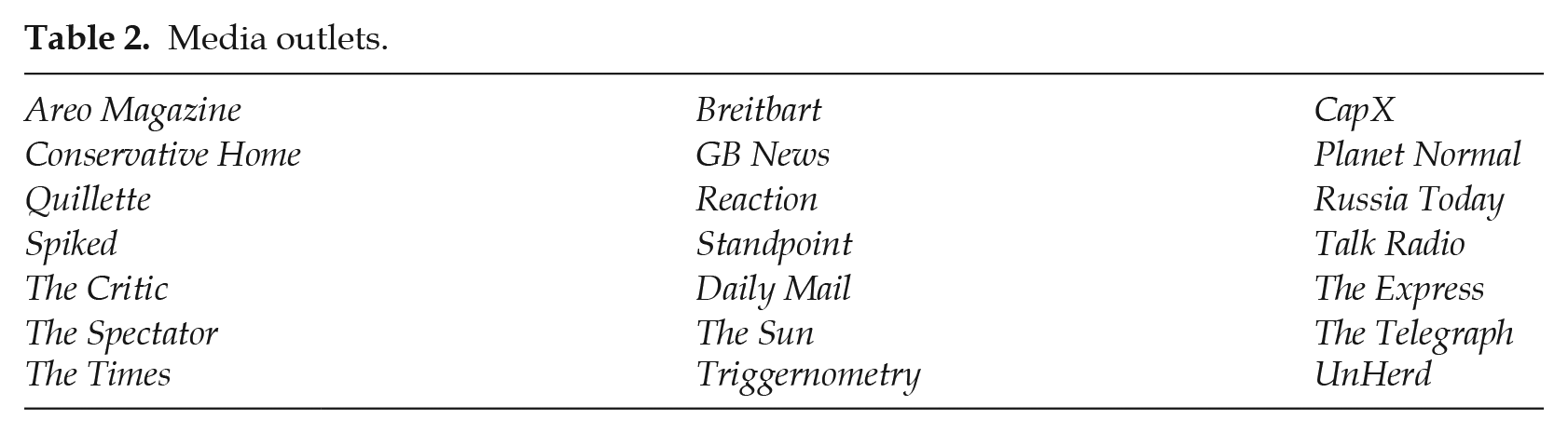
Apart from having extensive access to public service broadcasters such as the BBC and Channel 4, anti-woke campaigners use twenty media outlets that carry their message (see Table 2).
Media outlets.
Additionally, we found five tax-exempt educational charities including the IEA, the Spiked-affiliated Debating Matters, the Academy of Ideas, the Battle of Ideas and Reasoned that are anti-woke.
There are strong affiliations between American funders, institutions and anti-woke campaigners based in the US 78 but these are beyond the scope of this article. We focus on British institutions and British-based actors. In total we found 167 people, including fifty-nine Conservative Members of Parliament and seven Life Peers from the House of Lords in the Common Sense Group.
Analysing the graph
In graph theory, betweenness centrality measures how many times an entity in the graph lies on the shortest path between two other entities, or in the lexicon of social network analysis, ‘nodes’. Generally, nodes with high betweenness have more control over the flow of information and act as key bridges within the network. They can also be potential single points of failure. By this metric, the Battle of Ideas, a tax-exempt educational charity, is the most important institution in the war on woke. It hosts an annual event, convened by Alastair Donald and Ella Whelan, where members of this community meet to exchange and validate their ideas.
The betweenness centrality metric applied to media outlets alone reveals Spiked as the number one and GB News as the number two media outlets carrying the anti-woke message. This shows many of thirty-one Spiked’s content providers have found a new home on GB News (see Figure 3).
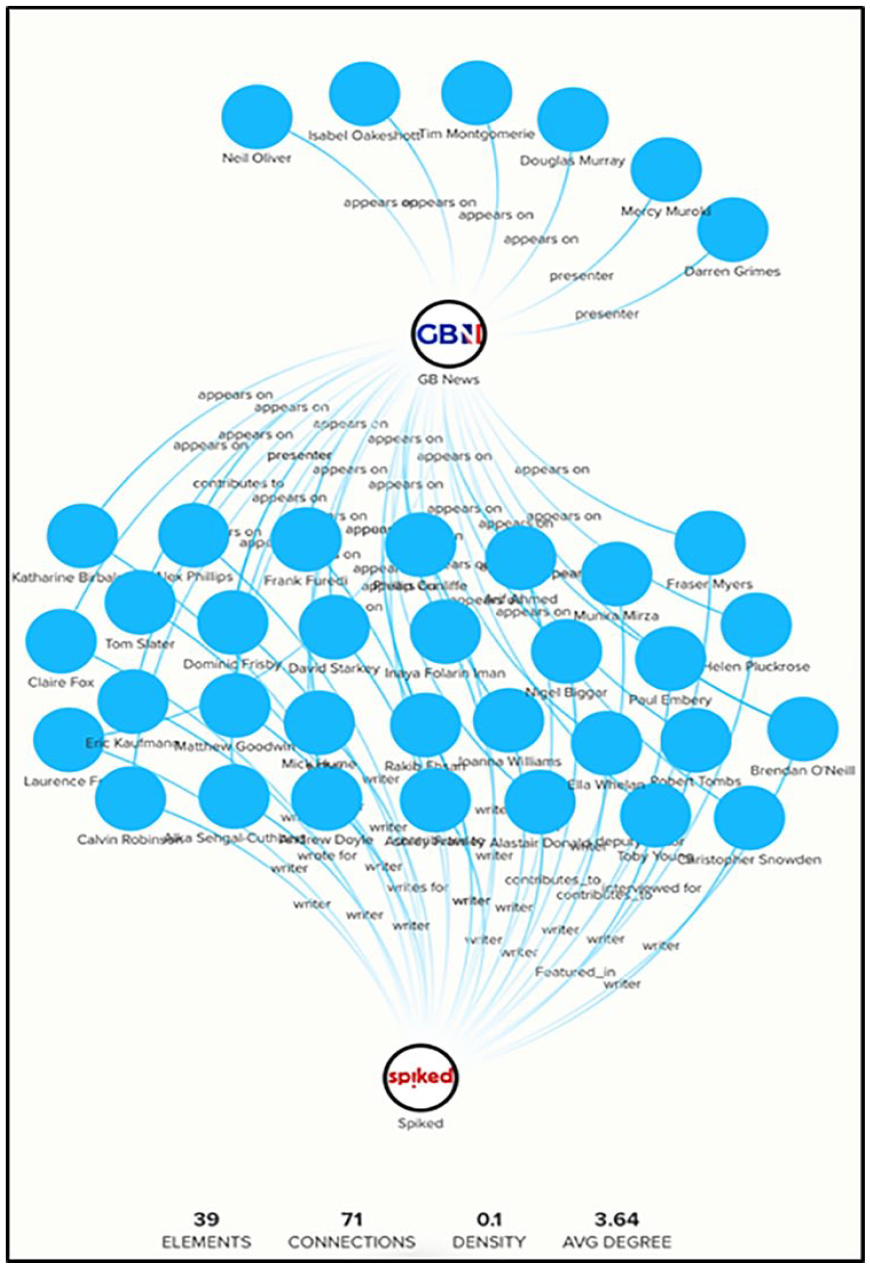
Spiked/GB News cross-over.
We used betweenness centrality to rank campaign groups. The first three were the Free Speech Union, Don’t Divide Us and History Reclaimed. We cross-referenced these with the Spiked, Battle of Ideas and GB News communities. A core group of thirty-one individuals (blue circular nodes here) emerges who are involved in two or more of these entities (see Figure 4).
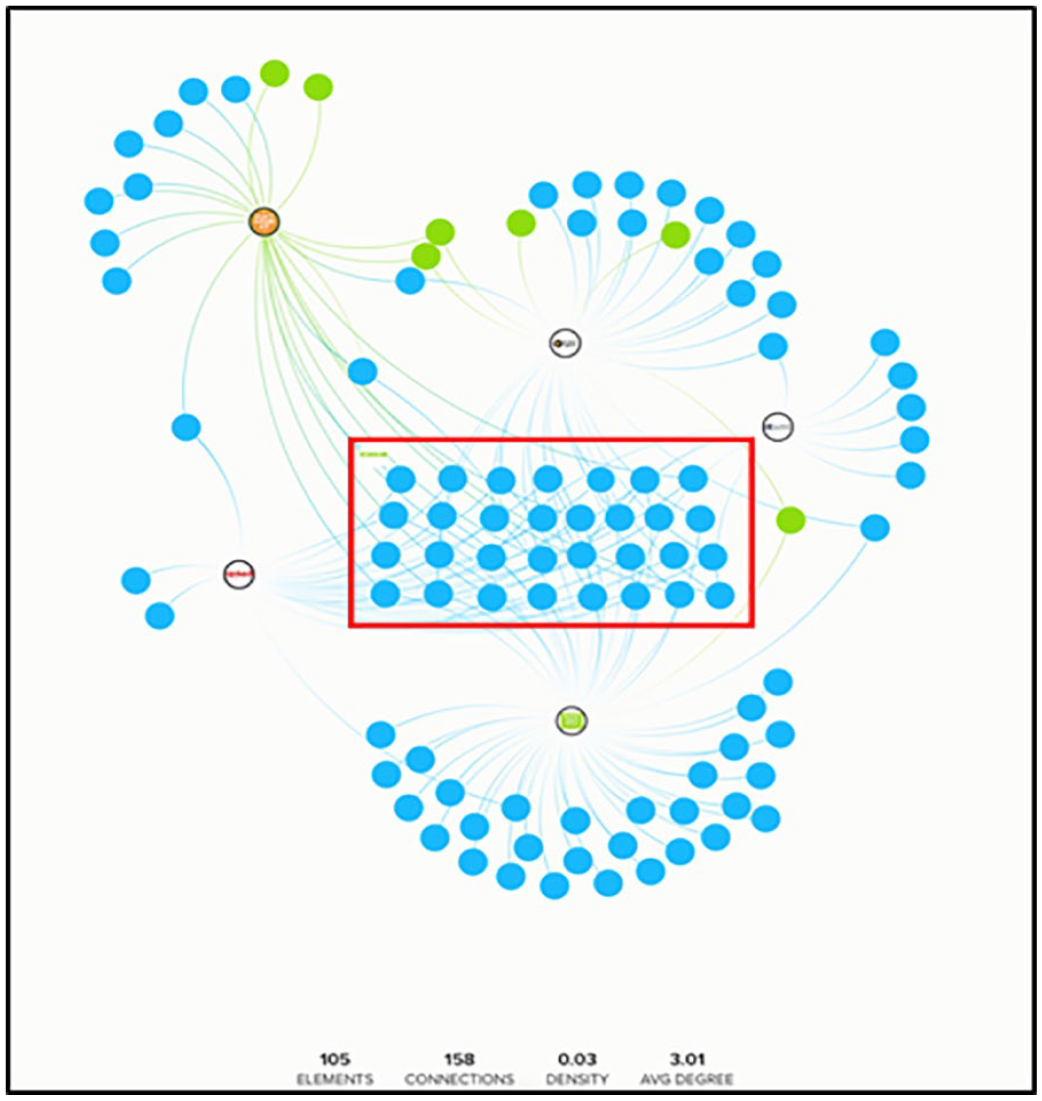
Thirty-one core anti-woke campaigners according to the betweenness centrality metric.
The thirty-one are the blue circular nodes in the centre while the five entities, the Free Speech Union, Don’t Divide Us, History Reclaimed, Spiked and the Battle of Ideas are surrounding them (plus the Academy of Ideas below Spiked).
The Free Speech Union involves many of the prominent anti-woke media figures. It was founded by Toby Young, and its directors include History Reclaimed’s Nigel Biggar, The Spectator columnist Douglas Murray and former GB News presenter Inaya Folarin Iman. Academics Goodwin, Kaufmann, Stokes, Williams and Ahmed are represented on the Union’s board, as are GB News host Andrew Doyle, Claire Lehmann founder of the media outlet Quillette, Telegraph columnist Alison Pearson, historian David Starkey, Baroness Fox, and various comedians including Dominic Frisby, perhaps best known for the song ‘17 Million F*ck-Offs’. 79
We can therefore observe a dense community centred on a Battle of Ideas/Spiked/GB News nexus of anti-woke campaigners. There are eighty-eight nodes in the graph that are separated from Spiked by two degrees or less. A degree of separation is a measure of social distance between people. You are one degree away from everyone you know, two degrees away from everyone they know, and so on. See Figure 5 with this graph of two degrees of separation from Spiked.
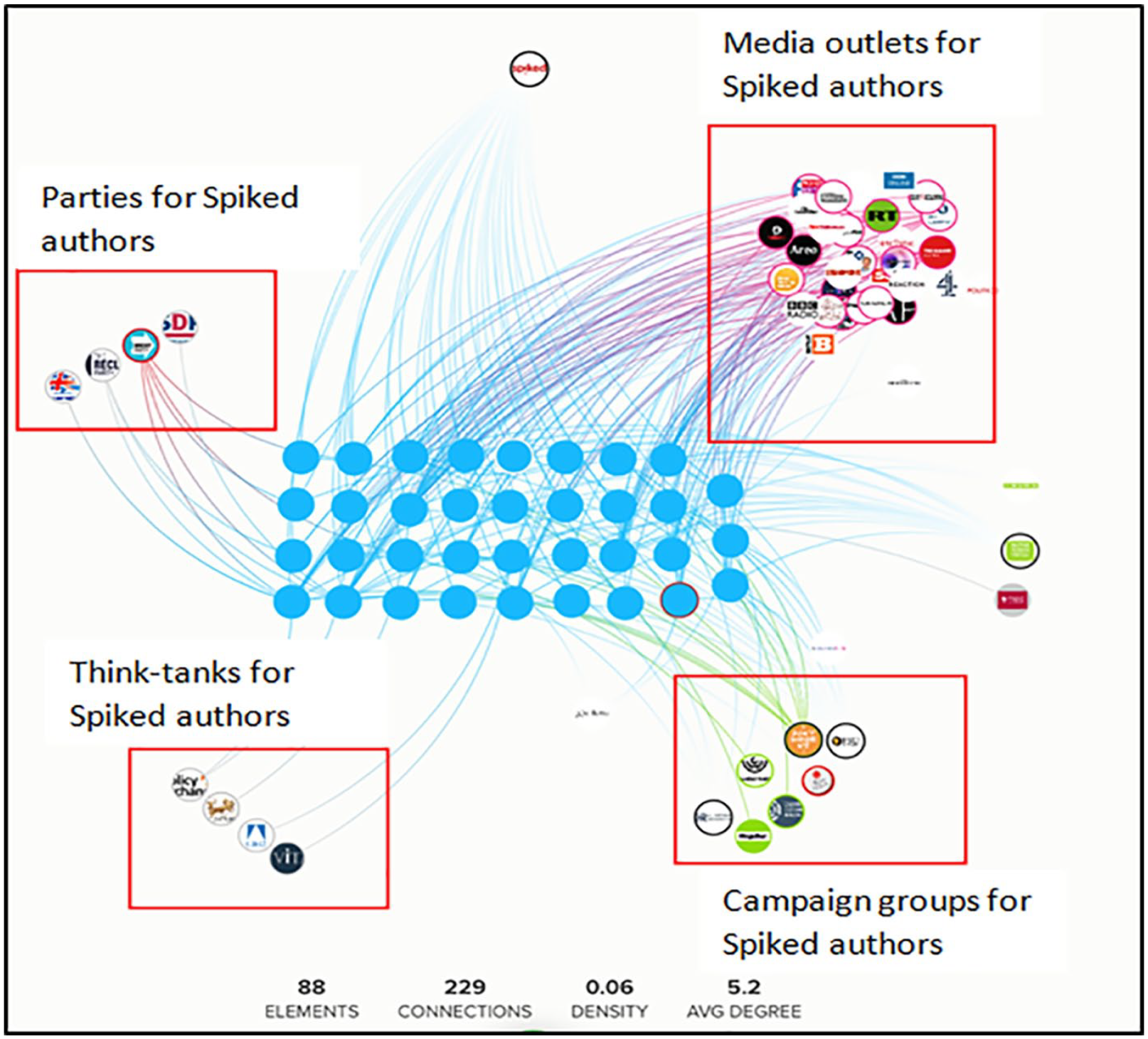
Two degrees of separation from Spiked.
Spiked was begun by former members of the Revolutionary Communist Party after their first media outlet LM (previously Living Marxism) was litigated into bankruptcy for libelling two television journalists while they were covering the atrocities of the Bosnian war. 80 We can see from Figure 5 it now has an important role in the war on woke.
Spiked writers now have significant reach. The Daily Mail had 23.5 million online readers in June 2022. 81 Nine of Spiked authors have written for the Daily Mail. Spiked’s Mick Hume alone has written thirteen articles for the Mail in the last year (see ‘Mick Hume’ site: dailymail.co.uk). Indeed, Spiked writers have successfully transitioned to many rightwing newspapers. Twelve Spiked authors write for The Telegraph, eight for The Times, four for The Sun and one for the Daily Express.
Despite calling it ‘systemically’ woke, seventeen of Spiked’s contributors have appeared regularly on the BBC in recent years, 82 including fifty-seven recent appearances on the BBC’s flagship political discussion programme, Question Time. Spiked is also frequently represented on BBC Politics Live, Newsnight, Any Questions, and the Moral Maze. Thirty Spiked contributors have recently appeared on GB News either as presenters or pundits, often to discuss the woke or related issues such as CRT or ‘cancel culture’.
Spiked authors are represented within Don’t Divide Us, the Free Speech Union, History Reclaimed, Counterweight, the Campaign for Common Sense, Together, and Academics for Academic Freedom. Members of Civitas, Cieo, Legatum, the Policy Exchange, and the Global Warming Policy Foundation (also based at 55 Tufton Street) are Spiked contributors. Spiked’s authors have associations with the Brexit Party (which has recently developed into the Reform Party), the Reclaim Party, the Social Democratic Party, and the Conservative Party. Almost every anti-woke campaign involves someone from Spiked. For a more detailed analysis of the Spiked community’s journey from Revolutionary Communism to today’s involvement in the Conservative Party and the House of Lords, see Smith, No Platform and Jones on ‘Culture war “Marxism”’. 83
Anti-Left establishment coalition
The key to understanding Spiked, its associations to political parties, the rightwing media, think-tanks such as the Policy Exchange and Civitas (which is based in the same building as the New Culture Forum – 55 Tufton Street, again) is the set of overlapping interests and ideas that this community shares. Its members will not agree on everything. For example, many in this community would not subscribe to the IEA’s and the Legatum Institute’s faith in free markets to improve public services through privatisation. However, other beliefs, such as the moral purity of Brexit (the assertion that it had nothing to do with bigotry towards immigrants or ethnic minorities) are more representative of this community’s shared understanding. Neither will anyone in this community concede that Brexit has been at least partly responsible for Britain’s lack of economic growth. The government-funded Independent Office of Budget Responsibility calculates a 4 per cent loss in GDP and drop of around 15 per cent in exports and imports as a result of Brexit’s new trading conditions. 84
This community is putatively libertarian. Unless the state is used to legally enforce the platforming of contentious speakers at universities through the Higher Education (Freedom of Speech) Bill, or to restrict the protests of activists they disapprove of, such as anti-fossil fuel campaigners, or to prevent trans men and women from self-identifying their gender without state approval, this community is anti-state intervention. And it is anti-Labour, which it sees as the party of the woke elite and technocratic state interference. As Slater, Spiked’s editor, argues, despite the Conservative Party’s recent record on austerity, its failure to improve outcomes for children on free school meals, and expansion of child poverty, the Labour Party is ‘the most anti-working-class outfit in British politics today’. 85 All of this community’s leading figures including Goodwin, Fox, Robinson, Kaufmann and Murray, endorsed Kemi Badenoch in her campaign to be the next prime minister. Badenoch is seen as a true Brexiteer who was awake to its benefits and a ‘freedom fighter’ against gender-neutral toilets. 86
However, this community is mainly mobilised by its shared contempt for its own construction of the establishment liberal Left. This means some members of this community take up a series of positions that always contradict what they see as technocratic, establishment, or leftwing, even if this means opposing scientific reality, as it does on climate breakdown. Therefore, because they are seen to represent the leftwing establishment: universities; the teaching profession; scientists who advocated for lockdowns to contain the COVID-19 outbreak before we had a vaccine; scientists who say the climate is reaching crisis point; social scientists who identify cases of structural racism; political scientists and sociologists who alert us to a resurgent far Right; and historians who are decolonising history have all become this community’s targets.
This leads the anti-woke to claim universities, the teaching profession and the BBC all have a problematic leftwing bias and actively discriminate against conservatives. 87 University management is said to ‘kowtow’ to woke orthodoxy and capitulate to ‘woke mobs’ by sacking academics for their conservative or common-sense opinions. 88 Doyle claims universities are also dropping standards because they are woke and that they have become ‘patronising and racist’. 89 Universities are also said to be ‘infected’ by CRT, 90 oppressing individuals, 91 suppressing free speech and open debate. 92 Murray agrees: wokeism has ‘infected our universities and schools’. 93
Impact on government policy
Owing to this network’s lack of transparency it is difficult to establish the direct impact of its positions on the UK government. However, sometimes examples of its influence surface. The anti-woke community is quick to deny the historical legacy of racism or any form of institutionalised racism as a causal factor in any systematic discrimination.
We can see the lineage of this argument in Munira Mirza’s ascendancy in British politics. Mirza’s PhD was supervised by Furedi and draws on his theories to argue that leftwing identity politics has produced ‘a crisis of individual meaning and identity’ within which ‘citizens are made to feel they need therapeutic affirmation to reach their “authentic” self by realising their own distinct cultural lifestyle and choices’. 94 Mirza wrote for Spiked, became a Policy Exchange fellow and went on to work for Boris Johnson when he was London mayor. 95 Mirza was Johnson’s Head of Policy at No. 10 Downing Street. We are told, in 2018, Mirza blamed the Windrush scandal on malfunctioning bureaucracy, and not on structural racism. 96 While in office, Mirza helped coordinate the Commission on Race and Ethnic Disparities. 97
There is evidence Mirza may have influenced Prime Minister Johnson’s thoughts on race. In a blog describing her encounter with a painting at the National Portrait Gallery she reflected on a portrait of a Ayuba Suleiman Diallo to argue that ‘slavery was a well-developed practice in Africa long before the imperialists arrived, though it became much more profitable afterwards’. 98 Two years later, the Prime Minister reiterated Mirza’s observation and argument in his announcement of the Commission on Race and Ethnic Disparities by referring to ‘the case of Ayuba Suleiman Diallo, whose portrait hangs in Room 15 of the National Portrait Gallery’. 99
Anti-woke campaigners claim the woke self-servingly imagine racism, particularly structural racism, so they can represent people of colour as victims and themselves as their saviours. This, as Williams and Robinson among many others argue, reduces all people of colour to their racial category in a way that makes the woke the true racists. 100 The anti-woke routinely quote Martin Luther King’s famous ‘dream of a future in which people will not be judged by the colour of their skin but by the content of their character’ as evidence of their commitment to anti-racism, as Doyle does in the Daily Mail. 101
The Commission on Race and Ethnic Disparities subsequently found no structural racism in the UK. Goodwin claimed that this ‘dismantles the woke mob’s central claim that we are living in a fundamentally racist society’. 102 For Goodwin, Kemi Badenoch’s ascendancy within the Conservative Party is confirmatory evidence that structural racism is a woke myth. 103 The report’s conclusions were extensively critiqued by experts, such as the British Medical Association, whose evidence was submitted to the Commission but ignored in the report. 104 Goodwin has recently been appointed by the government as a Social Mobility Commissioner. 105 His analysis of structural racism suggests it will not be part of his agenda as commissioner. We can see then that this network’s position on structural racism has been operationalised within UK government.
Absence of transparency
There is no public data available to establish who funds anti-woke think-tanks. The network is marked by its lack of transparency. In its absence, it is left to activist journalists to search tax returns filed with US authorities to find out who is donating to UK think-tanks that have charitable status. 106 One of their key roles in the war on woke is to provide a vehicle for publishing conservative academics’ views. They can therefore publish their research on CRT in schools and free speech in universities through the think-tanks, reproduce it on various uncritical platforms, and influence their partisan audience easily.
Whether it is to affect public opinion, policy or politicians, this community is an influence campaign. Despite its anti-elite claims, it is unlikely that at least some of these media outlets and lobby platforms that the war on woke uses to prosecute its campaign would exist without the financial backing of Britain’s traditional or ‘non-woke’ elite. The Telegraph and The Spectator are owned by Press Holdings, which is British billionaire Frederick Barclay’s company. British aristocrat Jonathan Harmsworth, 4th Viscount Rothermere, a great-grandson of one of the original co-founders, is the current chairman and controlling shareholder of the company that owns the Daily Mail. The newer outlets, such as GB News, Unherd and The Critic are supported by two of Britain’s Brexit supporting millionaires. Oxford-educated hedge-fund manager Sir Paul Marshall who donated £60m to GB News also founded and publishes Unherd. 107 Marshall has written for Unherd arguing that ‘the creed of Progress . . . is defying any biblical understanding of human nature’. 108
Dubai-based investment group Legatum also supports GB News. 109 Legatum funds the Legatum Institute that employs Goodwin. 110 People Polling, of which Goodwin is director and part owner, is used by GB News. 111 GB News employs Goodwin to comment on the polling company’s results (see Figure 6).
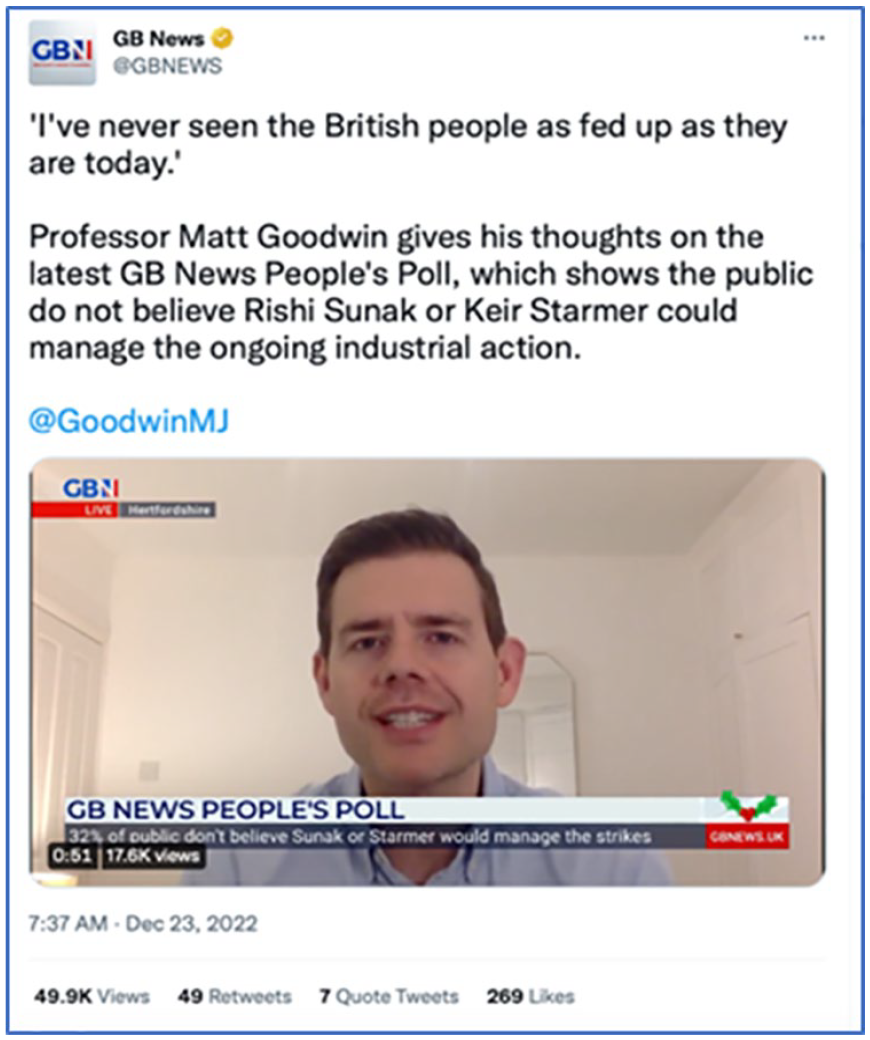
GB News clip of Goodwin commenting on polling data.
The Critic, an additional platform for twelve of Spiked’s authors such as Furedi and Whelan, is funded by another Brexiteer multi-millionaire, Cambridge-educated asset-manager Jeremy Hosking, who also founded the anti-woke Reclaim Party and financed the Reclaim Party’s Laurence Fox in his attempt to be London mayor. 112 Marshall and Hosking donated to the Vote Leave campaign and donate to the Conservative Party. 113 Meanwhile, Spiked solicits donations from the public but otherwise, like the anti-woke think-tanks, keeps its finances and donors hidden from public scrutiny. British climate activist George Monbiot’s investigation into Spiked forced the publication to concede that the Koch Foundation is among its contributors (funding Spiked’s free speech tour of America). 114 The Legatum Institute also has received $154,000 from the Koch Foundation in 2018 and 2019. 115
It is entirely logical that donors to think-tanks, Spiked and GB News share a political outlook. However, the marketplace of ideas, where conflicting policy positions are presented for public deliberation has an expensive admittance fee. It costs money to be always available for comment and to be able travel to studios, stage campaign events, place articles in the national media and lobby politicians. None of these activities would be possible without subsidies from anonymous donors who share the agenda of the commentator or lobbyist. Wealthy donors who, for example, want an end to green subsidies underwrite those who would lobby on their behalf. The Policy Exchange think-tank published a report in 2019 – two years after taking money from ExxonMobil – claiming that Extinction Rebellion were ‘extremists’ and calling for the government to introduce new laws to crack down on the climate protest group. 116
The Koch Foundation, based in the US, financially supports projects that attack the policy of net-zero and platforms that deny climate change is an urgent concern. 117 It may, of course, be a coincidence the British anti-woke community also support this agenda. As of July 2022, Spiked has 637 negative mentions of net-zero on its website (‘net zero’ site: spiked-online.com). Similarly, The Critic includes ninety-eight mentions (‘net zero’ site: thecritic.co.uk) of net-zero, almost all framing it as problem or calling for its abolition. The anti-woke community’s favoured leadership candidate to replace Boris Johnson as prime minister (evidenced by substantial social media support), Kemi Badenoch, also was explicit in sharing her opposition to net-zero. 118 GB News’ CEO, Angelos Frangopoulos, said in a BBC interview: there ‘are multiple sides of the climate debate’. 119 Alan McCormick, Legatum’s co-founder and chairman of GB News’s parent company All Perspectives Ltd, also has a history of sharing articles that dismiss the threat of climate change. 120
This community is subsidised by private donors and offshored capital, has permanent seats in the House of Lords, has a significant media presence reaching an audience of millions, operates within influential think-tanks, and has open access to the party of government. Yet it claims to be external to the elite. None of these political campaigns against climate action, lockdowns, or the woke on behalf of the working class would have any moral legitimacy if they were seen to be impenetrable to democratic scrutiny and working on behalf of anonymous donors and high-profile hedge-fund managers. How does this community resolve this contradiction?
The ideological onslaught
Building the in-group and negating the out-group
The paradox is neutralised for this community by building what van Dijk calls an ‘ideological square’ whereby its members represent themselves positively and their out-group negatively. 121 Ideological discourse seeks to reproduce the power and legitimacy of in-groups and to disempower and delegitimise their out-groups. The subsequent escalation in discourse that this process demands leads to proportional expansion of the ideological square in opposite directions.
The anti-woke in-group tells its audience morality tales within which its members present themselves, through a series of tropes, as servants of ‘higher’ powers or abstract noble causes, such as ‘our way of life’, the Enlightenment, reason, western civilisation, democracy, or the sovereign people. As Cammaerts argues, this is the ‘abnormalisation of social justice’ where the ‘woke’ are positioned as a threat to the sovereign will of ‘the people’, ‘the common good’, and a Britain that does not belong to them. 122 In his leadership campaign, Prime Minister Sunak appealed to this sentiment. He sought approval from his audience by suggesting women were a possession that needed to be defended from the woke out-group: ‘I will be incredibly robust in standing up against that lefty woke culture that is trying to cancel our history, our values and indeed our women.’ 123
The Enlightenment
Spiked has intensified the meaning of this struggle by claiming to be in a ‘war against the Enlightenment’ waged by the woke. 124 In 2015, Spiked attacked feminism for its ‘turn against Enlightenment’ 125 but has now redeployed this trope to argue it is on the side of feminists who are defending it. A similar escalation suggests ‘western civilisation’ is under threat. Tombs has declared wokeism is producing ‘the collapse of intellectual freedom in the West’ and Murray also writes of the woke’s ‘War on the West’. 126 Likewise, when Civitas contributes to public discussions about global warming it reaches for the ‘threat to the West’ trope: ‘The problem of man-made climate change has deliberately been blown out of all proportion and is used as a mechanism to undermine the West.’ 127
To advertise their status as common-sense sages keeping the Enlightenment’s flame alive, members of this community have to emphasise their rationality and objectivity by revealing the woke elite’s agenda. This signals to their audience that, as rational actors taking an unorthodox or anti-establishment approach to seeking truth, by using alternative means to the elite, they are therefore above the wokes’ ideology, culture war and identity politics. Scientific claims supported by an accumulation of robust evidence are dismissed as irrational simply by labelling the science a religious belief. The Head of Policy for campaign group Net Zero Watch (which is also based at 55 Tufton Street) claims ‘The “climate crisis” is a religious belief, nothing to do with science.’ 128
Within the ideological square, this rejection of the scientific consensus built on peer-reviewed evidence also results in defending scientific racism and those who work with scientific racists. We are not suggesting figures such as Kaufmann and Goodwin support race science itself; however they do claim academia is too willing to cancel people who maintain there is a link between race and intelligence. For example, Kaufmann and Goodwin and other anti-woke campaigners claim Bo Winegard and Noah Carl were cancelled for challenging orthodoxy. Kaufmann defended Carl arguing he was a victim of the ‘kind of orthodoxy that once prevented Galileo from propounding his heliocentric view of the universe or Darwin from speaking of our evolution from apes’. 129
Interpreting academic freedom
Bo Winegard, with fellow authors Ben Winegard and Jonathan Anomaly, implies that certain races can be distinguished by their IQ because ‘genes play some role in cognitive differences between human populations’, that ‘race is a perfectly reasonable construct that picks out real patterns of human variation’, and refer in their response to critics of these statements to a ‘well-documented black-white IQ gap’. 130 Among others, they cite Jensen, Herrnstein and Lynn in this regard. Winegard et al. make the argument that there is a black-white IQ gap because Darwin’s theory of evolution by natural selection suggests there should be one. 131 This argument has been dismissed by peer-reviewed and evidence-based science. Saini’s work, documenting a resurgence in race science, clearly demonstrates the majority of published literature on the alleged link between race and intelligence supports the scientific consensus that race is a social construct and is not based on biologically discrete populations that can be differentiated by intelligence. 132
A survey instituted by Goodwin under the auspices of the University of Kent and first published by the Legatum Institute in a report asking ‘Is Academic Freedom under Threat?’ claimed that academics were being fired for their views. 133 To sustain this assertion, one of the survey’s questions suggests ‘Professor [sic] Bo Winegard’ lost his job because students complained about one of his tweets (see Figure 7).
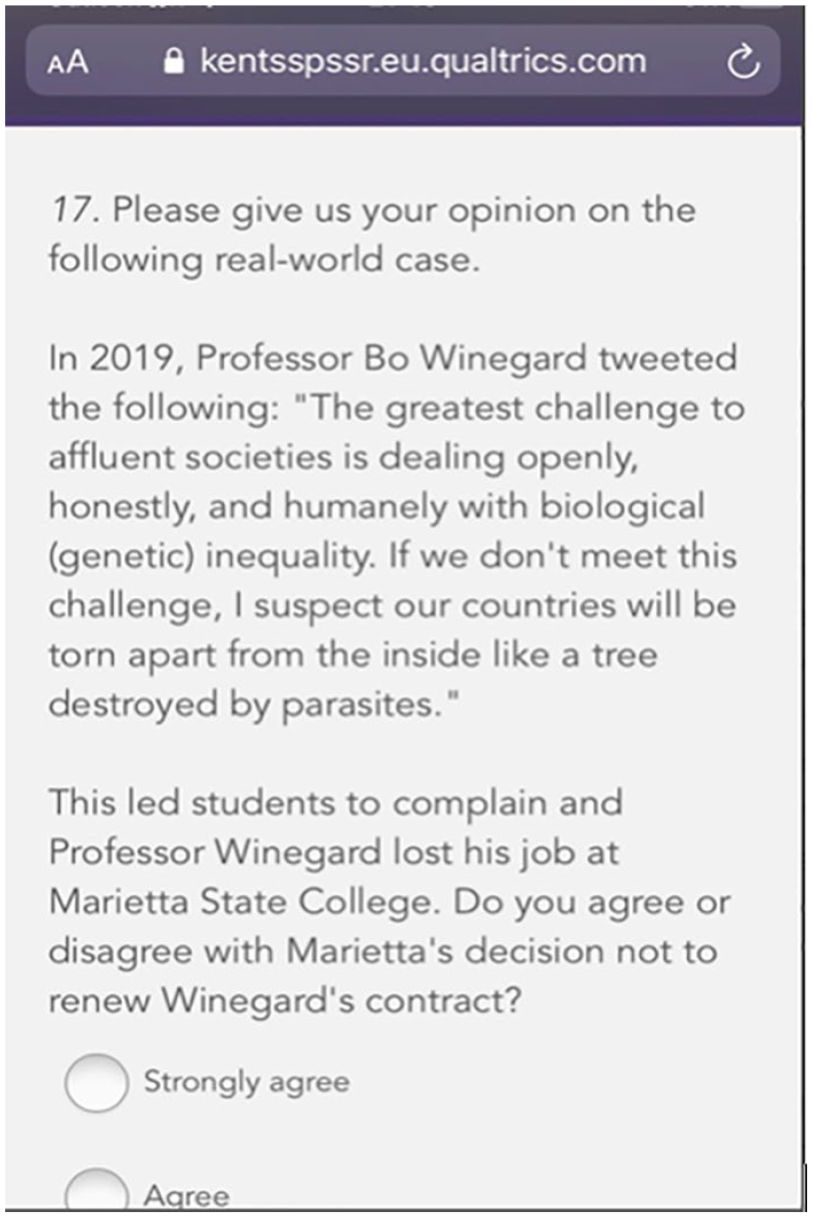
Question 17 in Goodwin’s survey.
Dr Winegard has been defended by other members of the anti-woke community. 134 Within the anti-woke ideological square, he is presented as an innocent victim of a woke mob who had him cancelled for fairly benign unsanctioned speech acts. 135
But such ‘cancelled science’ can then leach even into the manifestos of racist mass murderers. To support his arguments Winegard has previously cited the work of G. Meisenberg and Michael Woodley, also of Rinderman, Woodley and Stratford. 136 Woodley was in his turn cited by the gunman who in June 2022 killed ten Black people in a racist attack in Buffalo, US. 137
Woodley has also co-authored a paper with Noah Carl who was sacked by the University of Cambridge for his alleged collaborations with extremists. 138 He, like Winegard, believes races can be differentiated by intelligence. Among others, he cites prominent race scientists Richard Lynn and Charles Murray to argue that, ‘There is a large amount of evidence that groups differ in average cognitive ability. This is true for comparisons across nations, as well as comparisons across races within a country.’ 139 Carl has also written in the journal Mankind Quarterly (with a history of publishing scientific racism) in which he investigated the link between exposure to sunlight that produces darker skin and IQ. 140 Carl currently contributes, along with Toby Young, to the Daily Sceptic, the successor to the Lockdown Sceptics blog. 141 As well as sharing similar views on the need to explore ‘population’ differences 142 (which is often used as a synonym for race), Carl and Young both supported the Great Barrington Declaration, 143 held up as an alternative to widely adopted mass quarantines or ‘lockdowns’ during the pandemic. It proposed ‘focused protection’ of vulnerable people, 144 but had no clear definition of vulnerable. For the rest of the population, it advocated natural herd immunity in lieu of vaccines. However, every single one of the millions of reinfections worldwide refutes this conception of natural herd immunity protection from COVID-19. It would have been ethically intolerable for the government to stand by while the virus infected the majority of the population before we had a vaccine that prevented serious illness and the need for emergency care. Such ideas as focused protection and natural herd immunity are, therefore, sustained by counterfactuals that can never be tested. Because herd immunity through infection is not mainstream, it helps some members of the anti-woke community maintain their outsider, anti-group-think and victim status.
As Mondon and Winter argue: In recent years, we have witnessed an incredibly successful rise in of [sic] reactionary academics and intellectuals who have represented themselves as victims and outsiders in elite institutions, misrepresented academic research and used their institutional positions, media platforms and liberal tropes to re-introduce and give legitimacy to what were thought of as illiberal, outdated, debunked ideas including eugenics and scientific racism.
145
Following this logic also involves backing any newly rejected ideas, circulating counterfactuals and unfalsifiable theories that reinforce the identity, values and commitment of the anti-woke in-group. This in-group then becomes further alienated from the mainstream and retreats to spaces where its members can find validation, while claiming to be victims of elite woke persecution rather than scientifically wrong.
Climate change as pseudo-religion
Spiked has always debated the scientific consensus on global warming. In 2013, Rob Lyons, Science and Technology Director for Baroness Fox’s Academy of Ideas, told Spiked’s readers that the climate crisis was ‘a myth’ because, there ‘is 50 per cent more ice in the Arctic than last year’. 146 Years later, Spiked tacitly admitted climate change was a problem but it ‘was not the apocalypse’ thereby amending its original stance from outright denial to downplaying the outcomes. 147 Spiked made further adjustments to its stance on climate change when it recently published an article celebrating the benefits of global warming, while advocating the use of more fossil fuels such as shale gas and coal. 148 When Spiked addresses net-zero, its authors reiterate the ‘Stalinist’ trope that is also used to describe the woke and draws climate change into the anti-woke ideological square. 149
To reinforce their rationality, within the ideological square, anti-woke campaigners have to construct climate activism, anti-racism and other forms of so-called wokeness relatively as an elite form of religious fanaticism, an extremist ideology or a disease. The pseudo-religious frame therefore helps consolidate the anti-woke’s self-image as the antithesis of the irrational woke. To make the woke appear even more relatively irrational, the pseudo-religious explanation demands an escalation to full medieval or early modern religious zealotry, so that enforcing wokeness is analogous to the ‘burning witches at the stake, lynch mobs, and self-flagellation’, 150 the ‘Inquisition’, 151 and ‘Puritanism’. 152 Members of this community publicly endorse this framing on social media. For example, Baroness Fox retweeted a post from Goodwin outlining the main methods of the ‘woke elite’, including ‘imposing orthodoxy’, ‘proselytising, expelling heretics, and blasphemy’. 153
For some though even this fails to capture the destructive power and punitive violence of wokeness. Wokeism is therefore raised to Stalinism, Maoism and more generic totalitarianism. 154 Williams, writing for Spiked, claims that something akin to Mao’s Cultural Revolution is happening in education. 155 This is clearly a hyperbolic statement. There are no reported deaths caused by gender-neutral children’s characters in story books and, based on an average of figures given in six investigations, the death toll of Mao’s Cultural Revolution was nearly 2.95 million people. 156
The fight for civilisation
This escalation in anti-woke discourse was also evident when academics commissioned by the National Trust to investigate the relationship between colonialism and the Trust’s properties were constructed as fanatics. The Common Sense Group of MPs accused these academics of ‘radical projects which disparage our nation and despise the history of its people’ 157 that are allowing the woke to ‘rewrite our history in their image’. 158 Baron Moore of Etchingham claimed the National Trust had been ‘rolled over by extremists’. 159 Such reactionary statements sully the academics working rigorously to decolonise the discipline by casting them within the ideological square as agenda-driven, irrational and inferior historians. Winning the argument here involves appeals to victimhood, patriotism, pride in country and values. This led Tombs to declare at a Battle of Ideas event that such ‘woke history’ is ‘polluting our cultural springs’. 160 This use of the language of abjectification represents another escalation in anti-woke discourse: it employs disease metaphors and the language of disgust, such as ‘infecting’ 161 and ‘polluting’ 162 to dehumanise the woke, transforming them into a contaminated other 163 that needs to be cleansed to restore to purity.
Furedi also mobilised disgust when he spoke to the Conservative Political Action Conference (CPAC) in Hungary in May 2022. He told the audience that ‘we’ are in a fight to save ‘western and human civilisation’ and that now the ‘natural distinctions between a man and a woman are called into question’, the ‘next battle in the culture war will be about the distinction between humans and animals’. 164 To justify this claim he added, ‘there is a discussion going on in many universities in the West about whether or not animals can consent to a human having sex with them’. 165 These are academics and commentators who are replete with the knowledge of the dark places where such tactics lead.
Given this discourse, it is unsurprising that some personalities in the anti-woke community see themselves as engaged in a full-on battle of good against evil. For example, the anti-woke Reclaim Party’s leader, Laurence Fox, said wokeism is ‘a burgeoning religion with no repentance and no forgiveness’, adding he ‘never understood before how Nazi Germany could happen. Now I do’ 166 (see Figure 8).
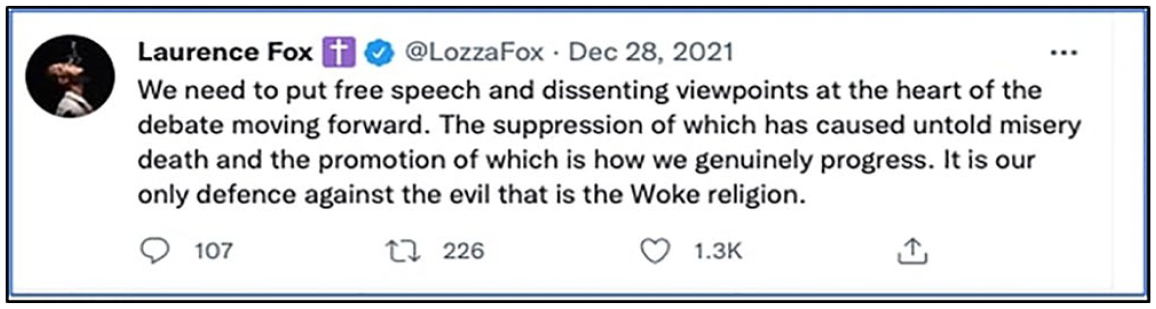
Laurence Fox on ‘the evil that is the Woke religion’.
This construction depends on the woke being this community’s inverse: not guided by a noble calling to defend civilisation but self-interested, divisive, irrational, malign, undemocratic, clandestine, powerful, sly and conspiratorial.
The anti-woke’s self-presentation of nobility is further morally purified and distanced from their wealthy donors by claims that theirs is a counter-offensive against powerful dark forces on behalf of a victimised and manipulated white working class whom woke elites ignore and ‘despise’. 167 For example, the woke constructed lockdowns during the pandemic as part of an elite project, involving power-hungry scientists, to strip the working classes of their hard-won freedoms. Members of the anti-woke community claimed there was no public consent for lockdowns. They argue it was manufactured by sly elite manipulation techniques such as fixing public polls, nudging, stigmatising non-compliance and fear-mongering. 168 Calvin Robinson, while being interviewed for David Icke’s conspiracy theory channel ICKONIC, said people are starting to ‘wake up’ to the truth that ‘lockdowns were probably more deadly than the virus itself’ and ‘vaccines were pushed on people’; he asks, was ‘big pharma pushing this to make money?’ 169 Being awake or woke in this instance means being receptive to conspiracy theories. Similarly, Laurence Fox invited MP Andrew Bridgen on to his show to discuss how Big Pharma had ‘captured’ the NHS to make money from ‘dangerous’ vaccines (see Figure 9).
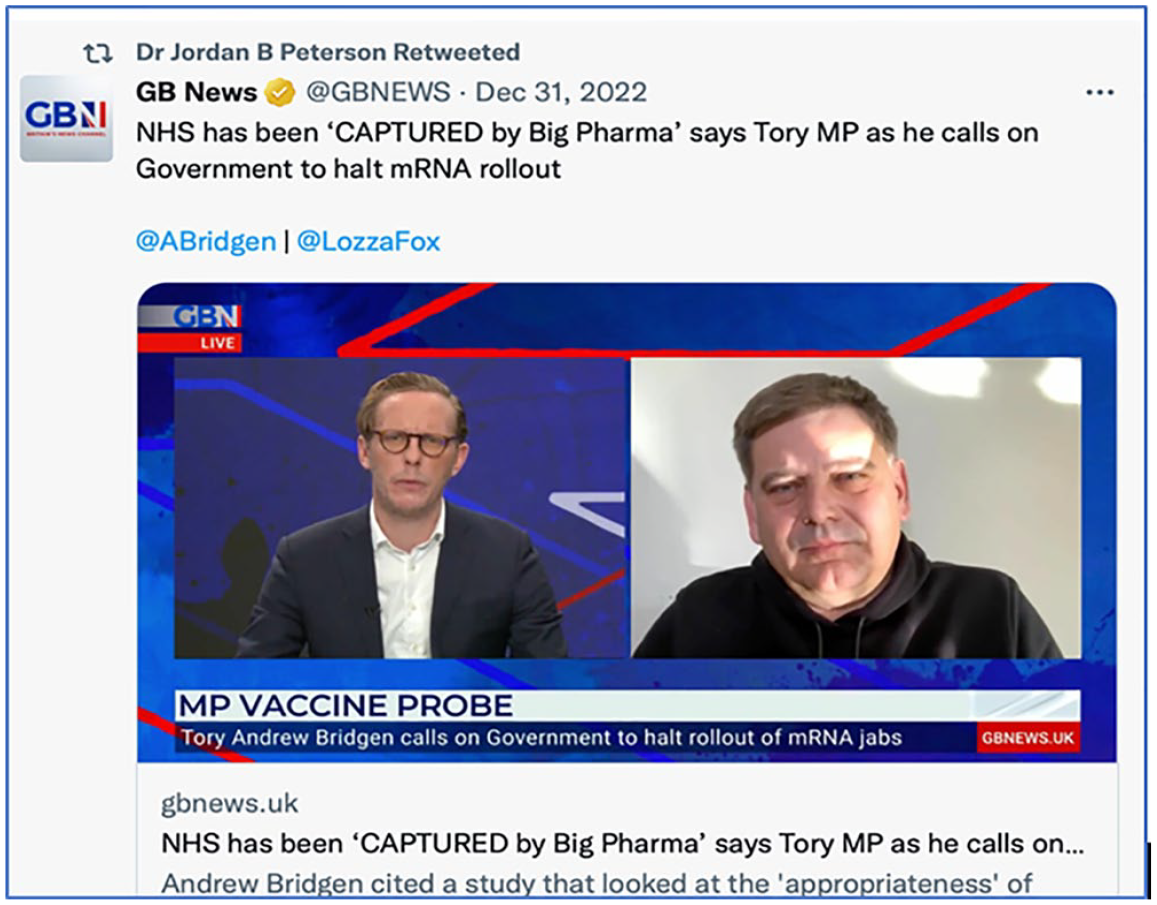
Bridgen tells Fox about ‘Big Pharma’.
Elite attack on the working class
The Spiked community in particular argues that fear is the main tool of elite control. Using the power of reason, it claims it can see through the elite’s agenda. One of the foundational texts of this interpretation of reality is Furedi’s book The Culture of Fear. 170 The Spiked community also argues that there was no morally legitimate case against Brexit, only self-interested liberal/left elites which oppose working-class enfranchisement and, through ‘Project Fear’, attempted to scare the British working class into voting to remain in the EU. 171 According to this logic, the use of fear by the elite failed to work for Brexit but succeeded for lockdowns. This community also argues that there is no climate emergency, only elites supported by ideologically or financially motivated scientists and special interest groups manufacturing fear about normal weather. 172 Spiked, along with campaign groups such as Don’t Divide, also argues, in denial of structural racism again, that there are only self-interested elites manufacturing racial division. 173
To justify its defence of the working class, this community has to identify that class as the victim of such elite projects. As Williams, writing for Spiked, argues, wokeism, like the Remain campaign, is ‘another form of attack on the working class’. 174 Goodwin tells his Daily Mail readers that there is an ‘informal alliance between white elites, corporations and minorities against the white working class’. 175 Many in this community have transferred their working-class persecution/elite fear-mongering framing to their long-term opposition to environmentalism and their newer campaign against net-zero. Now Spiked is claiming net-zero is also class war by other means. As Myers says, ‘net-zero policies are an attack on the working class’. 176
Within the ideological square, white working-class children are the end of the anti-woke victim scale. Within the anti-woke community, establishing white working-class children as victims of the woke begins by suggesting class disadvantage has something to do with whiteness but the woke are too agenda-driven to address it. Goodwin writes of the shameful taboo of white working-class boys’ underachievement, concluding the government should be supporting ‘left-behind whites’. 177 The then Head of the Social Mobility Commission said, in an interview with Spiked, that this ‘kind of othering’ and ‘low expectations’ mean ‘the white working classes are the new black people’. 178 The vulnerability of the victim is intensified with claims that the woke are not just neglecting and othering white working-class children but abusing their positions of power by specifically targeting working-class children with CRT, making them ashamed to be British, telling them to avoid any ‘open display of Britishness’. 179
According to this logic, CRT teaches them to be ‘hostile to Britishness and symbols of British identity’ 180 thereby ‘destroying the foundational values of British culture’. 181 Williams tells Spiked readers that ‘from nursery’ education is becoming ‘re-education or indoctrination. Its purpose is to socialise children away from the values of their home environment’. 182 Therefore, systemic and institutional explanations for disadvantage are, in this thinking, reserved for whites. As Patel and Connelly argue, all this ‘(re)positions whiteness as a victimised identity’ 183 and once again emphasises the nobility of the cause.
Repudiating the far Right
This community also claims the threat of the far Right is an artefact of elite fear-mongering. Its members present an ideology of abstract colour-blind liberalism, ‘where they view policies intended to reduce racial and ethnic disparities as violating meritocracy and unfairly disadvantaging Whites’. 184 This requires the public dismissal and minimisation of far-right politics when it inconveniently emerges, especially among allies. The anti-woke have to deny moral culpability for being associated with anyone who uses extremist tropes − especially to justify violence − by blaming the woke.
When and where the anti-woke concede that the far Right does exist, they claim it is a fringe movement with little influence that is implicitly of less concern than the real threat to the West of the pseudo-religious/Maoist/Stalinist woke activists and environmental campaigners. When they are accused of extremism, the anti-woke respond combatively, take offence and once again advance their moral credentials and delegitimise their opponents by arguing that calling any anti-woke tropes ‘far right’ is ‘hyperbole’ that ‘trivialises fascism and insults ordinary voters’. 185 Wodak calls such denial tactics ‘calculated ambivalence’ because different interpretations of their messages (including inoffensive explanations) allow them to blame out-groups for misunderstanding those messages. 186 As Lorenzo-Dus and Nouri explain, they then use these ‘insults’ (accusations of extremism) to ‘lend further weight to their victimised group claims’. 187
As the powerlessness of the victim is pushed in one direction, the scale and power of the elite’s ability to orchestrate events is forced the opposite way. To achieve a contrast, anti-woke actors need to construct the woke as powerful, unaccountable, cunning and beyond public scrutiny. This also helps members of the anti-woke community present themselves as defenders of the underdog, taboo-busting, iconoclastic and uniquely able to see through the tactics of the woke elite.
Conspiracies – from the domestic to the global
The anti-woke community therefore also relies on conspiracies to explain political events. In October 2022 then Prime Minister Truss appointed a new chancellor, Jeremy Hunt, to help reassure the financial markets that her government had a credible economic policy. The Conservative Party subsequently removed Liz Truss from her role as its leader. On both occasions, the anti-woke community again laid claim to a special insight into the dark, powerful forces at work that normal people were unable to identify. Even though Truss was subsequently replaced by her own MPs for another committed Brexiteer, Rishi Sunak, her removal was variously described in an escalating conspiracy theory that involved hidden actors opposed to Brexit (see Figures 10 and 11). The unelected member of the House of Lords Baroness Fox and Spiked’s Tom Slater cited a relatively soft conspiracy of unelected technocrats and a technocratic coup.
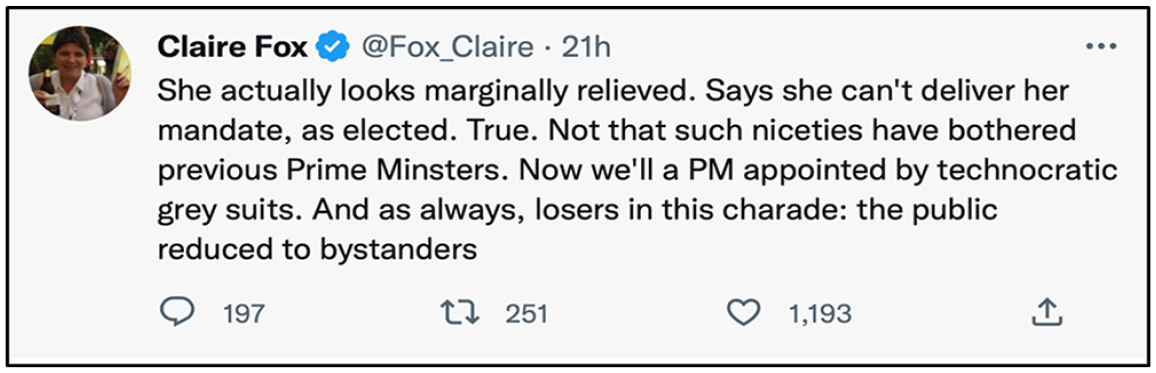
Claire Fox on Truss’s removal.
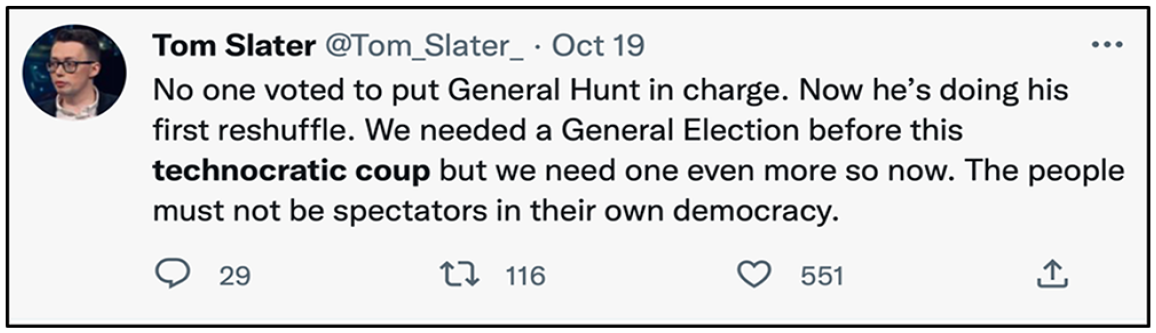
Tom Slater on Truss’s new Chancellor.
Columnist for The Telegraph Tim Stanley, GB News pundit Paul Embery, Spiked’s Brendan O’Neill, and GB News presenter Martin Daubney call these events a ‘Remainer coup’ (see Figures 12, 13, 14 and 15).
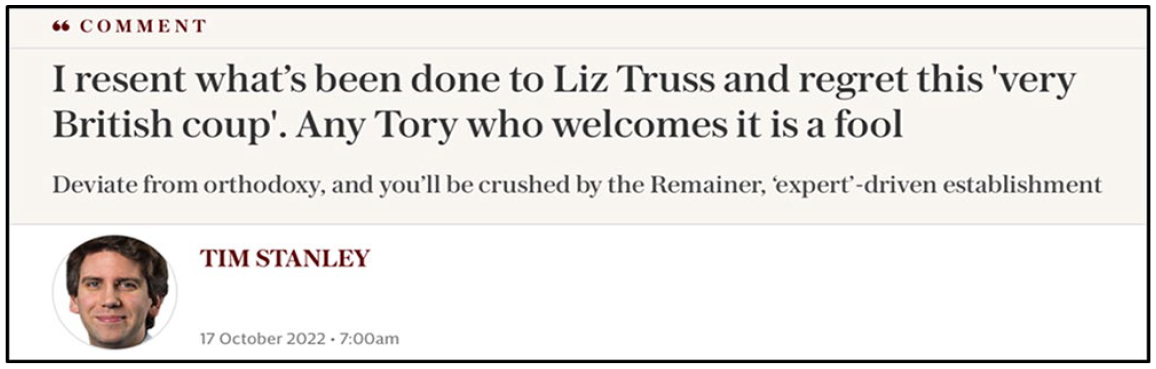
Tim Stanley on Hunt’s appointment.
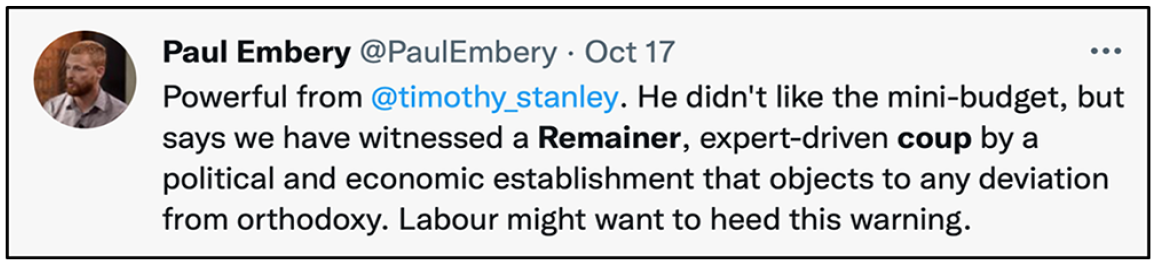
Paul Embery agreeing with Stanley.
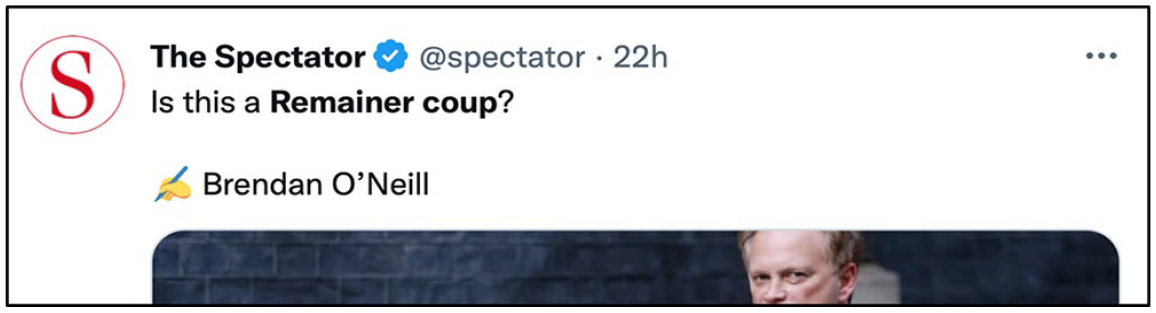
Spiked’s Brendan O’Neill also agreed.
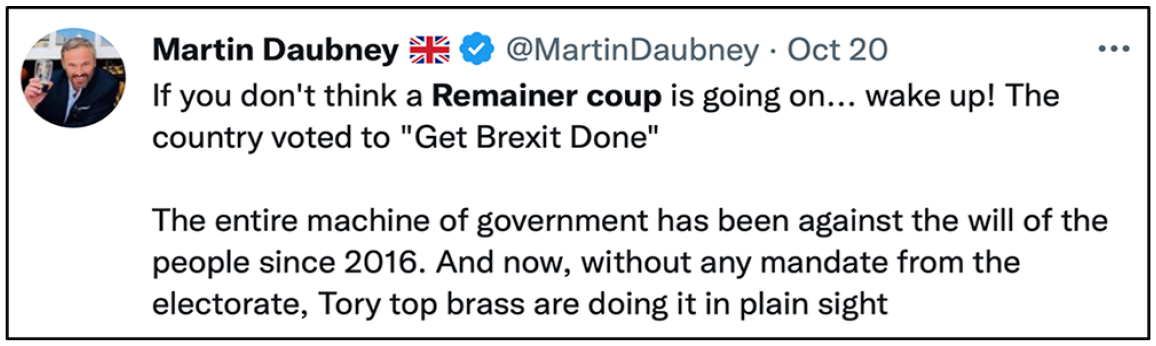
As did GB News’s Martin Daubney.
However, for others, the scale of this ‘Remainer coup’ was unsatisfactory. The Reform Party’s leader Richard Tice, GB News presenter and Daily Mail columnist Dan Wotton, former Brexit Party leader Nigel Farage and the Free Speech Union’s Toby Young went for a more extreme and larger conspiracy calling it a ‘globalist coup’ (see Figures 16, 17, 18 and 19).
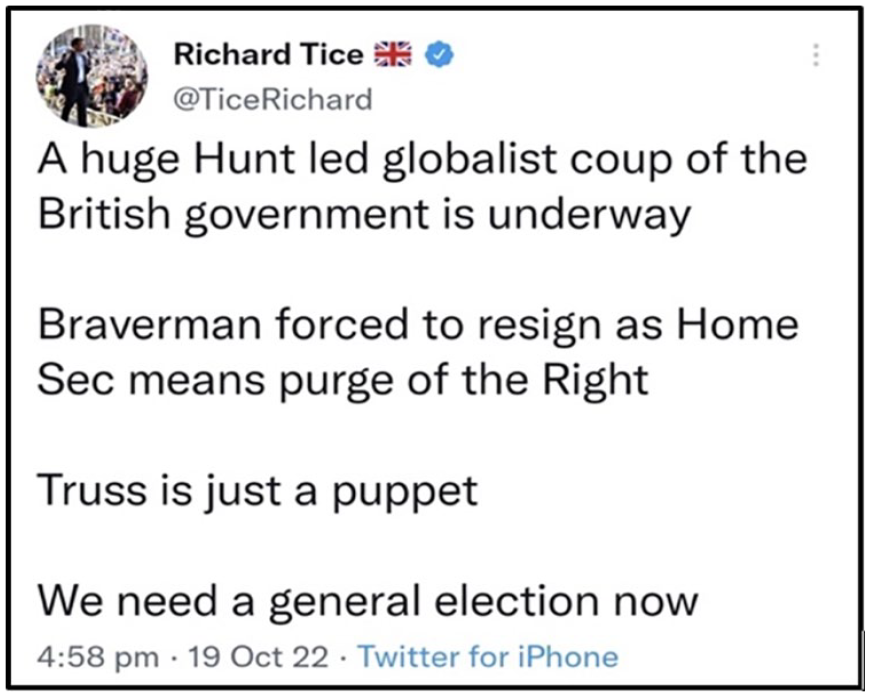
Richard Tice of the Reform Party and Talk TV on Hunt’s appointment.
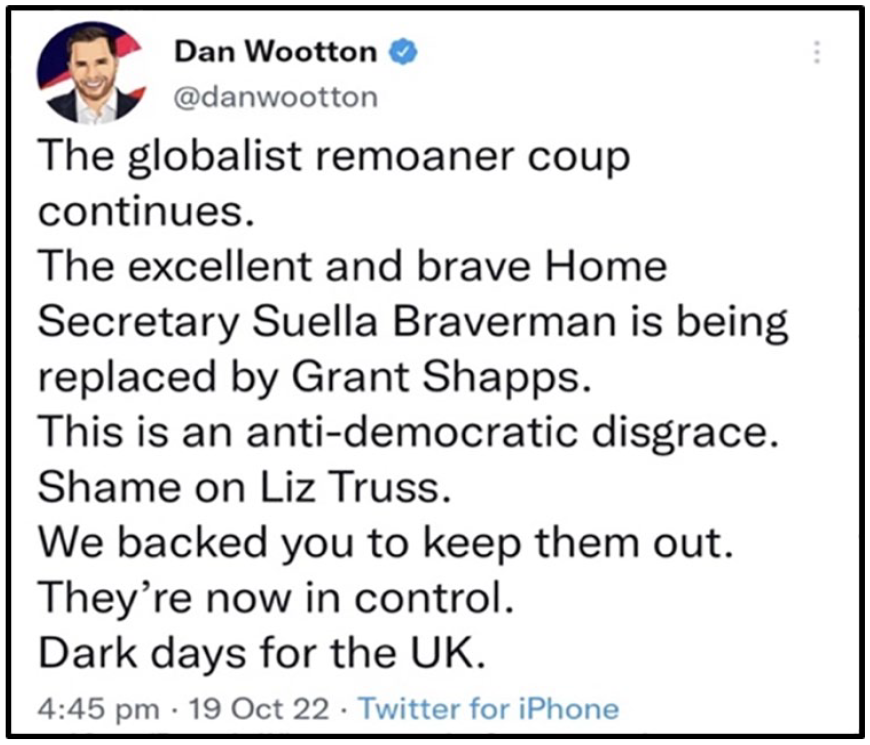
GB News presenter Dan Wotton on Suella Braverman’s replacement after she resigned for a security breach.
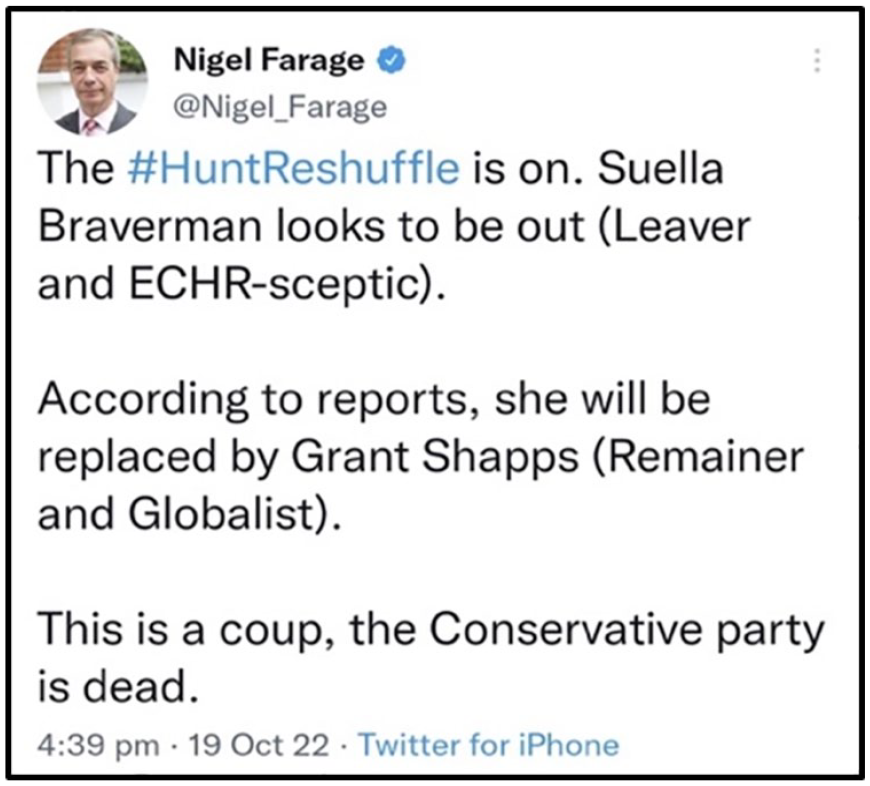
Former leader of the Brexit Party Nigel Farage agrees.
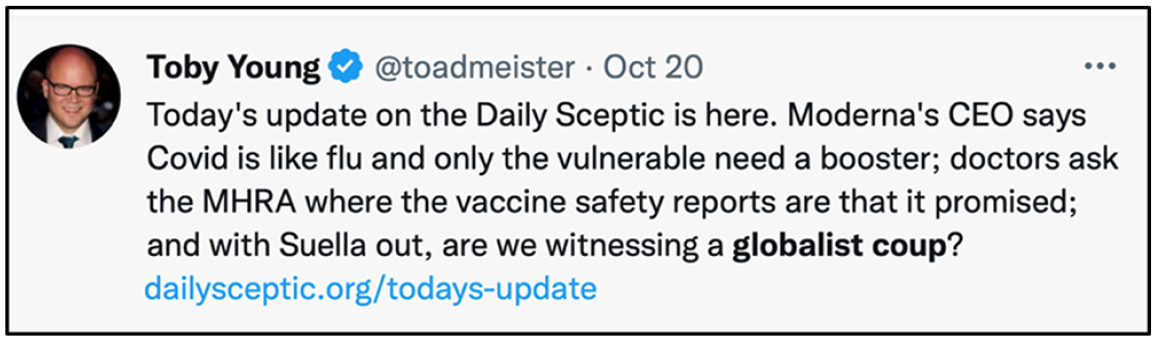
Toby Young, Free Speech Union, also suggesting Truss’s reshuffle is a globalist coup.
The Great Reset and echoes of the Great Replacement
Apart from the woke elite’s alleged take-over of British culture and institutions and various species of coup, members of the anti-woke community regularly circulate other conspiracies. Young is a prominent supporter of the ‘lab leak cover-up’ (see Figure 20).
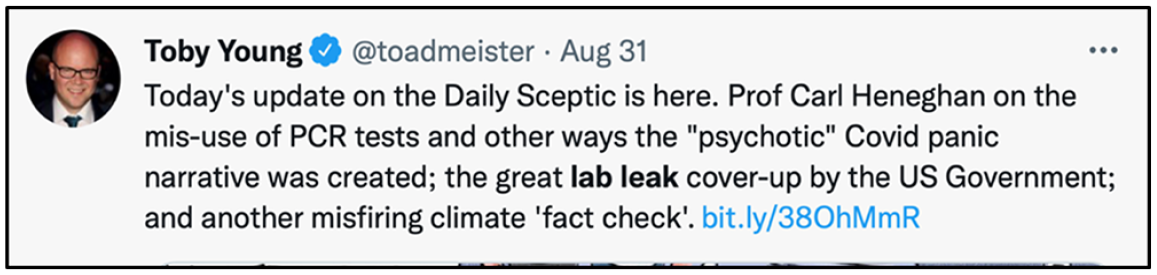
Toby Young on the ‘lab leak cover-up’.
Similarly, Calvin Robinson riles against a ‘Capitalist-Communist’ conspiracy against the working classes called ‘The Great Reset’ (see Figure 21) that he says was conceived at Davos. 188
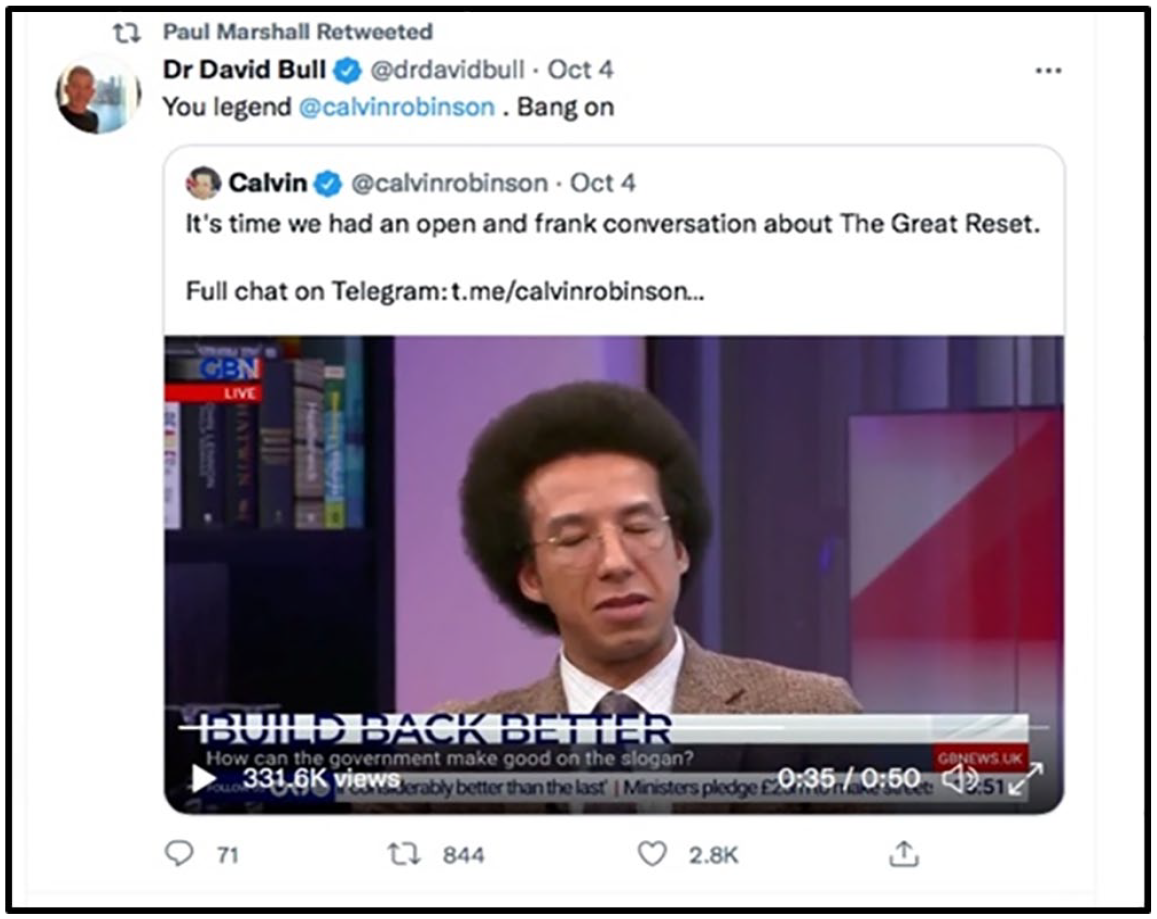
Robinson on the Great Reset, GB News, (retweeted here by GB News investor Sir Paul Marshall).
The Great Reset conspiracy theory is shared by far-right activists such as Peter Sweden (an alias for Peter Imanuelsen, see Figure 22), who also believe climate change is a part of the conspiracy. 189 Peter Sweden also has a history of Holocaust denial and in August 2022 was a guest on GB News invited to discuss ‘population decline in the West’. 190 The promoted video of this appearance was subsequently deleted when evidence of Imanuelsen’s history of Holocaust denial emerged (see Figure 23).
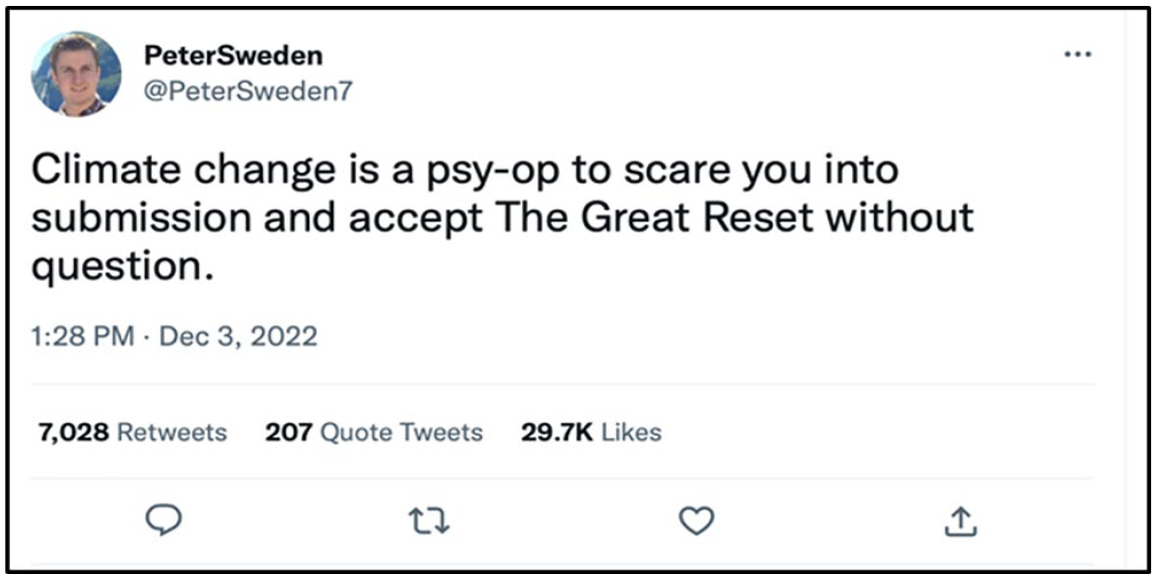
Peter Sweden on the Great Reset.
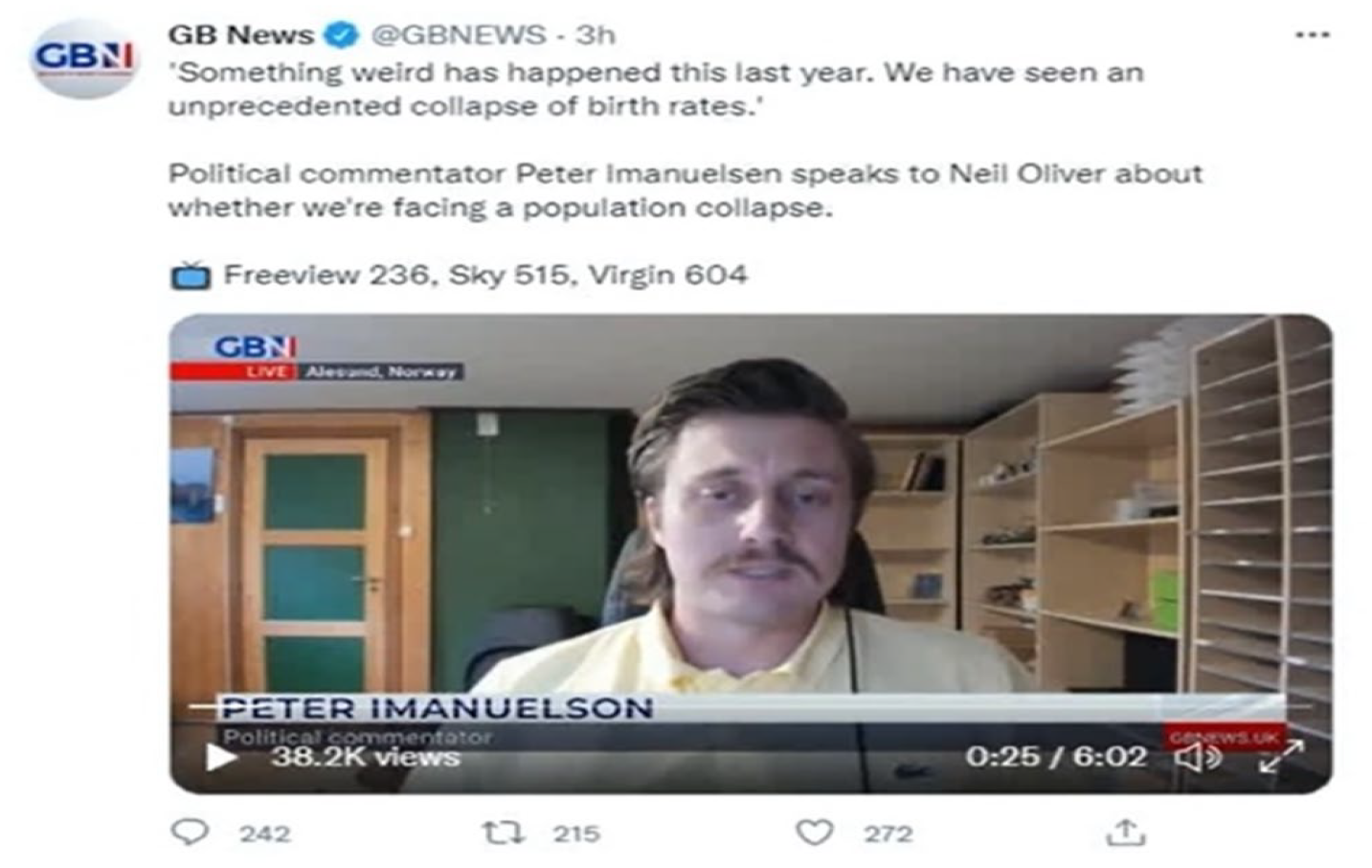
Imanuelsen on birth rates.
Robinson also argues (see Figure 24) that, as British birth rates are on the decline while immigration is increasing, ‘unless Brits start making families again, Britain will be a very different place culturally, ethnically, religiously’. He adds, ‘in a matter of years we are looking at the inevitable replacement of British culture’. 191
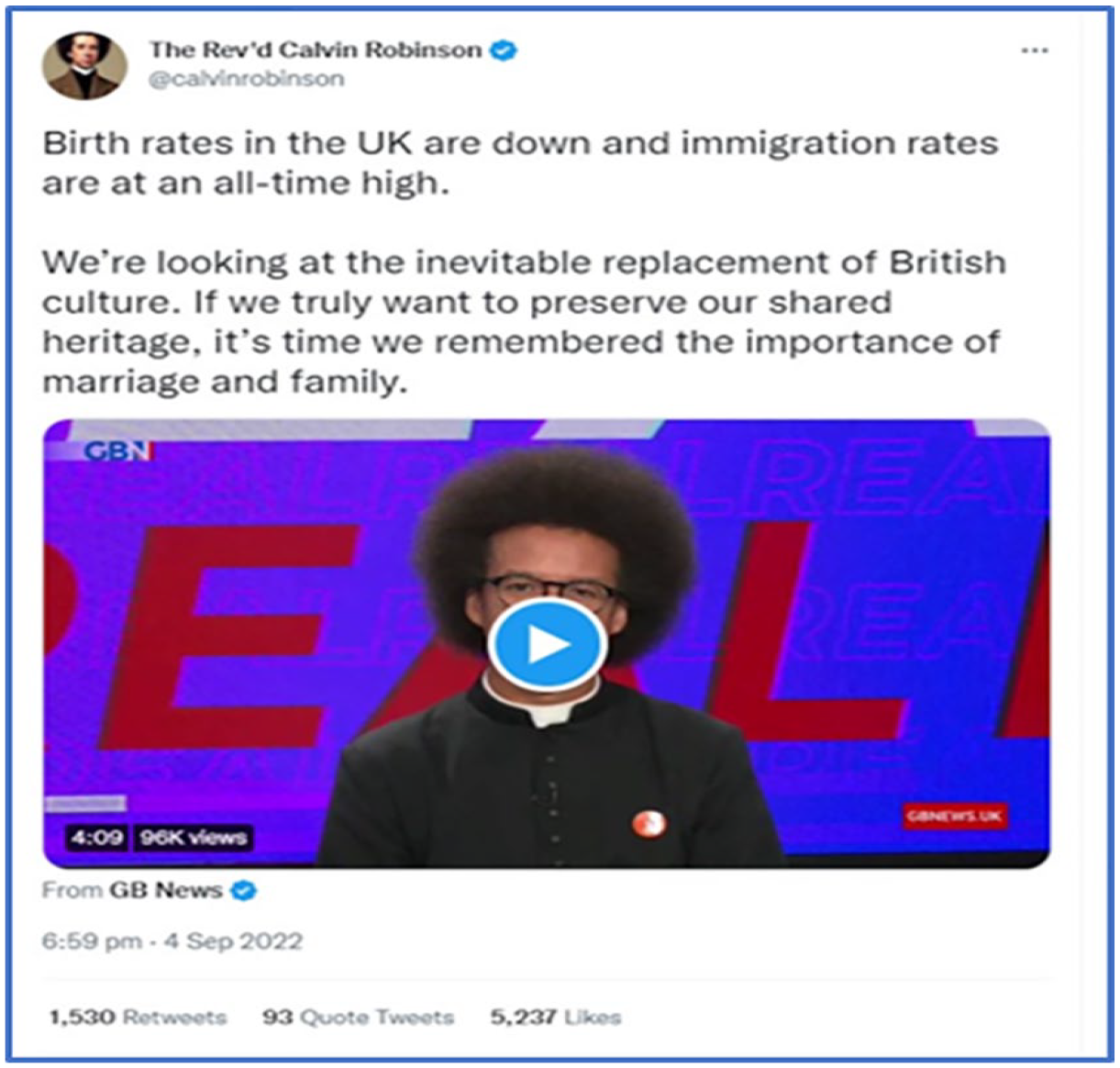
Calvin Robinson on the replacement of British culture.
While, Robinson doesn’t refer to whiteness in this instance, he went on to say ‘Enoch [Powell] was right’, because ‘diversity means fewer white people’ (see Figure 25).
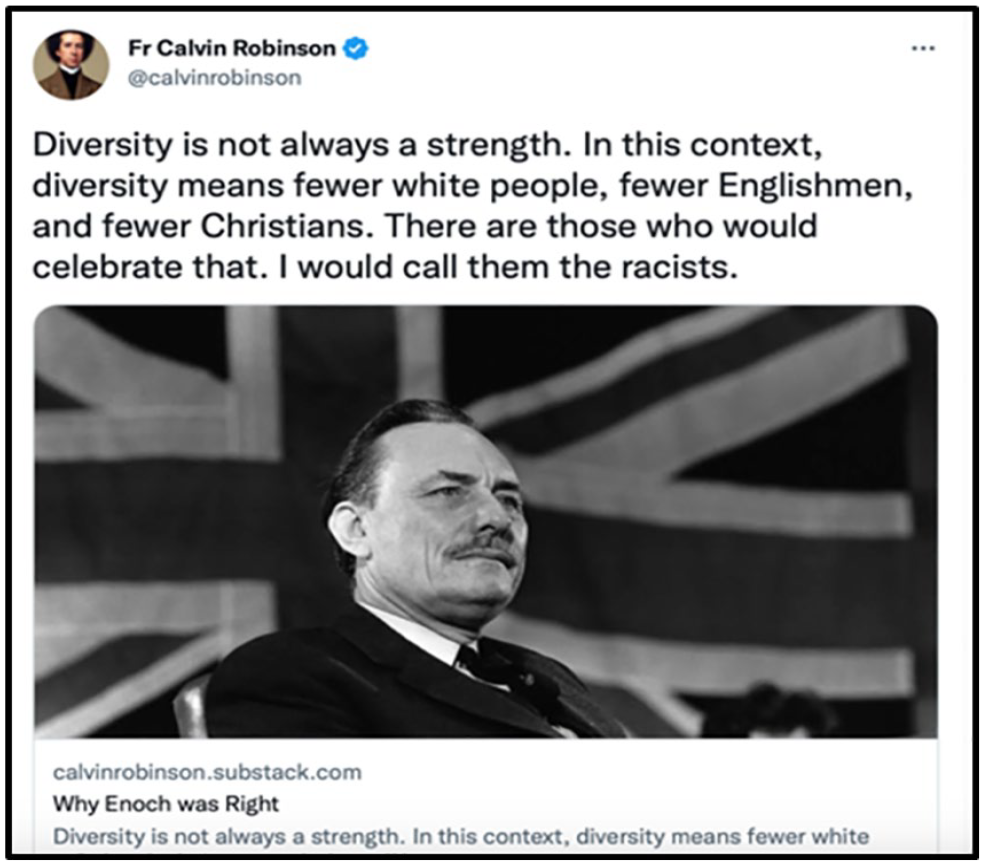
Robinson on ‘Why Enoch was right’.
Prominent anti-woke campaigner and author of The War on the West Douglas Murray similarly mobilises whiteness when he implies ‘we’ – his in-group − voted to keep British cities majority white (see Figure 26).
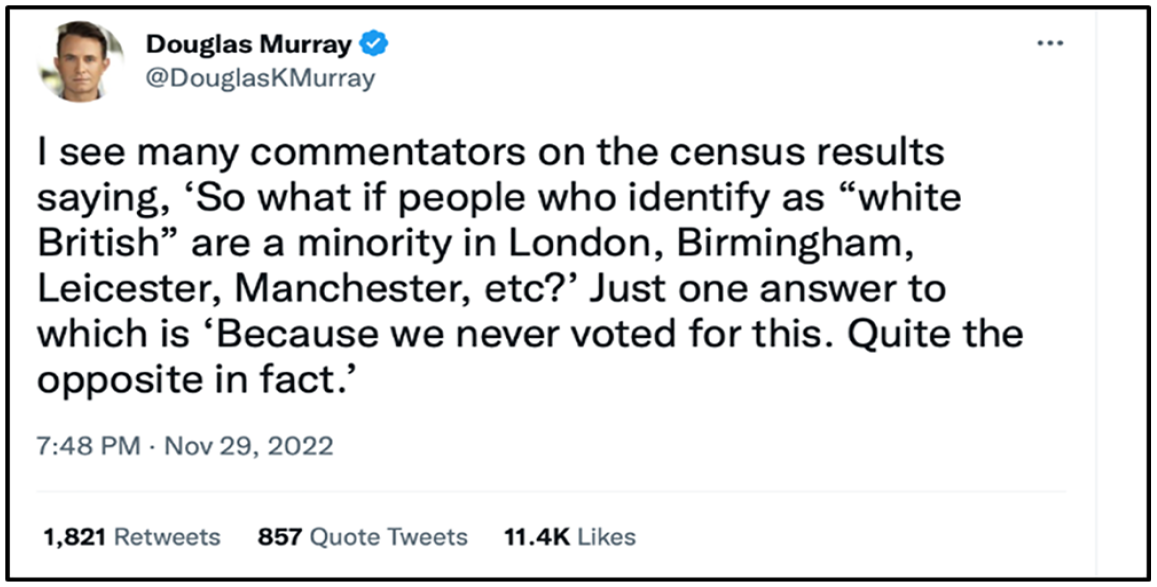
Murray on the ‘white British . . . minority’ in cities.
This exclusionary framing echoes the Great Replacement Theory, a far-right conspiracy theory warning that an indigenous European population is being replaced by non-European immigrants. The idea was popularised by French writer Renaud Camus in his 2012 book, Le Grand Remplacement (the Great Replacement). 192 However, the concept of other races, ethnicities and inferior immigrant cultures replacing the superior indigenous culture has a longer far-right heritage.
In the 1960s and 1970s, many American white supremacists, like Ku Klux Klan leader Thomas Robb, mobilised replacement ideas in their racist political advocacy. In the 1980s, Ku Klux Klan leader David Duke and white supremacist Don Black advanced replacement theory in the US, ‘the idea that immigrants will reshuffle demographics, eventually replacing white people’. 193 In more recent times the Great Replacement Theory circulated during the American white supremacist ‘Unite the Right’ rally in August 2017. 194 The man who murdered ten black people in Buffalo, New York, also repeated key elements of replacement theory in his 180-page online manifesto. 195 And the man who murdered at least fifty Muslim people at mosques in New Zealand in 2019 also wrote about an alleged ‘assault on European people’. 196
Since the refugee crisis in 2015, the ‘replacement’ conspiracy theory has fomented far-right politics across Europe. 197 As Ekman tells us, the Great Replacement is a conspiracy theory that consolidates ‘political statements of failed integration’ that are ‘frequently underpinned by quasi-scientific ideas deeming cultures of immigrants and Europeans as “insurmountable” to one another and notions of homogeneous national and/or European cultures’. 198
The discursive construction of in-group victimisation is the key to the ‘replacement’ conspiracy. By producing a common ‘us’ (indigenous British, white people) as victims of the actions and plans of traitorous politicians and/or secret agreements within power elites, immigrants are constructed as an out-group threat. 199 Conspiracy theories and white victimhood combine and compound two prominent far-right tropes. 200
We can infer from Black’s defence of the concept of Cultural Marxism for Spiked that the use of far-right tropes by anti-woke campaigners can be justified because ‘at some point usually located in the 1960s, the left turned away from economic critique and towards cultural criticism’. 201 The result, argues Black, at its most extreme, is a mode of politics concerned chiefly with culture wars, rather than class war. Yet the Spiked community argues that working-class support for Brexit was also a rejection of the economic frame that prioritised values over any financial concerns. 202
Anti-woke campaigners claim to be fighting powerful dark forces, not for their own ideological interests, but on behalf of a victimised, manipulated, neglected and patriotic white working class. But this construction requires members of the working class to be without agency: gullible and ignorant; vulnerable to these elite tactics such as nudging and fear-mongering and unable to see through attempts to manipulate them themselves – otherwise their advocates in Tufton Street and writers for Spiked would be entirely redundant.
The ideological square
This, then, is the current state of the anti-woke ideological square (see Figure 27).
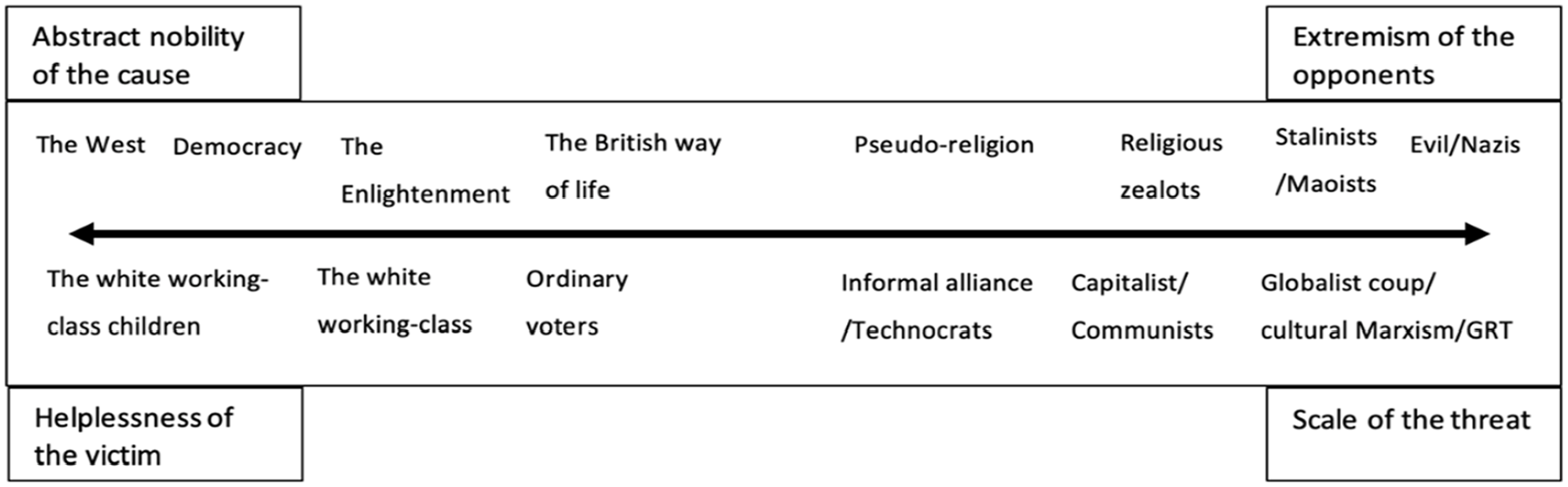
The ideological square.
The ideological square produces an apparent paradox within which the defenders of democracy, rationality and liberal values are using tropes associated with far-right anti-democratic movements. Phelan calls this ‘a paradoxical articulation of libertarian and fascistic discourses’. 203
However, despite their use of far-right tropes, calling the anti-woke community fascist or far Right presents problems. Rightwing extremism is usually defined as a specific ideology characterised by ‘anti-democratic opposition towards equality’. 204 No-one in this community identifies as far Right nor have any of them rejected democratic processes. Fascism ‘favours actions rather than detailed political programs, being characterised by glorification of violence and military virtues’, 205 which no anti-woke campaigner does, at least overtly. Mondon and Winter resolve this apparent contradiction – this community’s claim it supports democracy while using far-right tropes – within their concept of ‘reactionary democracy’. 206 They argue that the community we have mapped here has effectively gamed and exploited weaknesses in liberal democracy to mainstream far-right discourses for political capital and influence.
Many members of this community can be described as professional reactionaries, whose opinions create a space within which liberal and illiberal racism is indistinguishable, automatically deporting unauthorised asylum seekers to Rwanda becomes government policy and the rejection of race science is compared to the Catholic Church’s treatment of Galileo. 207 However, the scale and intensity of this community’s relentless campaign suggests it has little confidence in its audience’s commitment to the war on woke. The anti-woke community is particularly anxious about the future. The solution for leading members of the community is to intervene in education to influence future generations.
In 2022, Furedi told the CPAC conference in Hungary organised by Victor Orbán’s regime that ‘taking over the schools and winning the battle for the minds of young people is really quite important’. 208 He added, ‘we need to win back the schools’ because ‘you cannot win this battle of civilisation unless you influence the ideals of the young’. He concludes by saying ‘we need to take control of language’ and ‘think of ourselves as fighters in the battle for the future of civilisation’. 209
We can see the tactics of this ‘battle’ for young minds in action in, for example, Scotland and Hungary. In 2021, Furedi began attacking Scottish education on Russian state broadcaster RT claiming it was a form of ‘social engineering’. In 2022, Furedi was a keynote speaker at a Battle of Ideas event in Scotland that included Alka Sehgal Cuthbert (former Brexit Party candidate, current Civitas employee, director of Don’t Divide Us and contributor to Spiked, History Reclaimed, The Critic, GB News, the Battle of Ideas and Debating Matters), another former Brexit Party candidate and Spiked contributor and representatives of conservative Christian groups. This meeting’s agenda sought to discredit existing educational provision with claims that the woke are deviants who are intent on harming children. It said the ‘Scottish government’s new sex-education curriculum’ is exposing ‘very young children to overtly sexualised material’. Such tropes that mobilise disgust are again echoed among the far Right when it calls the woke ‘groomers’. 210
In Hungary, British anti-woke campaigners are able to use more direct interventions by contributing to an ideologically affiliated educational institution. Hungary’s president, Victor Orbán, is a rightwing extremist. For example, in a widely condemned speech, he said countries that tolerated racial ‘mixing’ were ‘no longer nations’. But, Orbán’s politics are unpopular among the young people he claims to be protecting from the woke. 211 To address this deficit, Orbán’s government funds the Mathias Corvinus Collegium (MCC). The MCC aims to ‘transform 10,000 students’ into ‘worthy representatives of the cultural, economic and social elite of Hungary’. Orbán’s brother, Dr Balázs Orbán, is Chairman of the Board of Trustees of the MCC. 212 Furedi is Executive Director of MCC Brussels. American anti-woke campaigner Peter Boghossian has been one of MCC’s visiting fellows. 213 Professor Nigel Biggar of History Reclaimed was a keynote speaker at the launch of MCC Brussels, and Jacob Reynolds, author for Spiked and partnerships manager at Baroness Fox’s Academy of Ideas, is Head of Policy at MCC Brussels. 214 In Hungary, campaigners such as Furedi and Biggar are able to prosecute ‘the battle for the minds of young people’ through the MCC with government support – while, in Scotland, to host the recent Battle of Ideas event, they needed the support of the Tron Church which, in 2012, left the Church of Scotland because, ‘among other things’, it embraced ‘homosexual relationships for its ministers’. 215
Conclusion
The central moral justification for the war on woke is that it represents the interests of the working class. However, in constructing its ideological square, this community refuses the possibility that as well as white manual labourers and retirees, the working class can include people from any ethnic background, including immigrants. By constructing ‘the working class as white’ the anti-woke community pits whites ‘against racialised minorities and immigrants, who are denied working class status’. 216
This community also refuses to address working-class people who voted to remain in the 2016 EU Referendum, who want to understand the colonial legacy of Britain’s stately homes, support footballers taking the knee or trans rights. Also, it has nothing to say to members of the working class who think asylum seekers are not illegal by default, nor to anyone from the working class who doesn’t believe plans to decarbonise energy are a threat to ‘western civilisation’. When members of the working class themselves are declared woke, like construction workers condemned by the Daily Mail, it is unclear if they have become woke by their own volition or as, people without agency, they have also been ‘infected’ by the ‘informal alliance’. 217
However, even if this group did consider the working class in all its ethnic, cultural and intellectual diversity, it would be irrelevant because, beyond far-right tropes, it offers no policy framework to deliver economically credible and environmentally sustainable solutions to any form of structural inequality including and especially class. Black is right to remind Spiked’s readers that economics matter because government economic policy, supported by anti-woke tax-exempt educational charities such as the IEA and anti-woke think-tanks, is making the working class poorer. A discussion paper by the Centre for Economic Performance at the London School of Economics shows Brexit has increased food prices by around 6 per cent overall but disproportionately affected Britain’s poorest communities. 218 Economics matter also because the anti-woke movement is subsidised by wealthy patrons. Since the working classes and poor are the most exposed to the social and economic costs of climate breakdown, opposition to climate action is what one of Goodwin’s fellow Social Mobility Commissioners, Rob Henderson, calls a ‘luxury belief’. 219 This means, in Goodwin’s words, beliefs ‘that cost elites less than they cost people who have to live with their consequences’. 220
If it were a grass-roots campaign for the working classes, the anti-woke community would be transparent in its finances, reject strategic investments from anonymous wealthy donors, argue the effects of climate breakdown will disproportionately affect the world’s poor and working classes, and it would lobby for wealth redistribution and a green revolution in high-skilled jobs. 221
In lieu of such a campaign, this community seeks to discredit, delegitimise and constrain its political enemies. It wants the public to reject the consensus on climate science, end net-zero policies and think of climate activists as brainwashed extremists. It asks its audience to choose between its righteous in-group and the woke’s malign out-group. It stereotypes the working classes, projects its grievances on to them and uses them as proxies to claim moral legitimacy for its own fossil fuel-friendly agenda.
The British war on woke also pathologises social justice campaigns by likening them to dangerous and violent extremism and positioning them outside the normal process of democracy and representation. Anti-woke campaigners want their adversary − ‘the woke’ − to be confronted. They claim that this is an enemy within that is working in alliance with ethnic and racial minorities, won’t listen to reason and cannot be appeased. They say this internal threat wants to bring down ‘western civilisation’, beginning at its centre by betraying Britain’s historic heroes, infecting Britain’s institutions, polluting British culture and making disadvantaged children ashamed of their whiteness, their culture and country. Despite the repeated and sustained use of these far-right tropes, anti-woke campaigners claim any associations with the far Right are censorious smears.
Footnotes
Huw C. Davies is an alumnus of the Web Science Institute and the Oxford Internet Institute, currently working as a lecturer in Data and Society at the Moray House School of Education, Edinburgh;
Sheena E. MacRae works on the interactions between policy, education, media and politics from a digital sociology perspective, currently with the Knowledge Power and Politics research cluster at the University of Cambridge and the Screen Department at the University of Hull;