




Abstract
This article presents a situational analysis of the expert advice offered by Independent SAGE, a group of scientists that formed in May 2020 in the UK to provide advice on the Covid response. Based on interviews with the group’s members and partners, we argue that through its interventions Indie SAGE demonstrated an important alternative approach to linking science and politics in a time of emergency. They showed that the only way to ensure that policy and decision-making on Covid-19 was grounded in knowledge was by making expert advice public. Indie SAGE’s decision to ‘go public’ was a response to the political situation in the UK, one in which scientific advice, in particular public health expertise, was being ignored, sidelined and contested as such. We identify four rationales for making expert advice public: openness, calling out, translation, and responsive engagement. We describe associated modes of intervention that Indie SAGE adopted in relation to different critical situations of Covid-19. Distinctive about their advice, we argue, is its prioritization of situational adequacy. Much of it was explicitly oriented towards addressing practical and existential challenges experienced by particular social groups, professions and everyday publics. We argue that this way of making science public in an ‘ontological’ register acquires critical importance in a political situation like the UK Covid response, which was marked not just by disagreements about science but growing contestation of science as such. In this respect, our study holds a wider lesson for the understanding of the role of evidence in public politics. To advocate for evidence-based governance, as Indie SAGE did, is not necessarily to endorse a post-political vision of government. When science is contested in a time of emergency, making evidence public becomes a key means for responding to the demands of situations. It is not only pragmatic but a critical accomplishment.
Following the science?
The slogan ‘follow the evidence’ served as a political rallying cry during the Covid pandemic (Ehlers & Esselborn, 2023). In the UK, Prime Minister Boris Johnson famously stated that the government ‘was guided by the science’ 1 to justify its decisions about Covid policy, including the delayed decision to impose lockdown on 23 March 2020, significantly later than in a number of other countries, and which was later shown to have caused a markedly high number of avoidable deaths (Devlin & Boseley, 2020). Other government ministers, too, regularly pointed out that their decisions on Covid policy were guided by the scientific recommendations of the four UK Chief Medical Officers and the Scientific Advisory Group for Emergencies (SAGE), a group of scientists created in February 2020 to advise the UK government on Covid-19 policy. However, from April 2020 onwards several UK scientists, including Richard Horton, Editor of the Lancet, went public with their criticism that the government was not following the science at all, declaring the UK pandemic response ‘the biggest science policy failure in a generation’ (Ahuja, 2020). It was under these trying circumstances, in May 2020, that a group of ‘rebel scientists’ (L. Clarke, 2021) formed a scientific advisory group called Independent Sage—Indie SAGE for short—with the aim of informing the British government and the public about the unfolding Covid pandemic. They adopted the slogan ‘following the science’ as their motto.
Why did Indie SAGE adopt this much abused phrase? It was clear at the time that this mantra of the Prime Minister and his colleagues did not hold water. In April 2020, Bacevic (2020) wrote that the British government claim to ‘follow the science’ was first and foremost a political manoeuvre, one that immediately prompts a follow-up question: ‘which science?’ McKee et al. (2022b, p. 1) criticized the government’s use of ‘the science’ as a legitimatory device, noting that because ‘evidence is socially constructed and can be highly contested … it is important to consider whose science counts, and why’. More recent revelations have confirmed that the UK government used this phrase at the time as a form of window dressing. The Covid inquiry, which started in Spring 2023, heard that there were no scientists in the room when the delayed 23 March decision was made to impose lockdown, only advisers, civil servants and experts who worked for tech companies. 2 Around the same time, the Chief Scientific Advisor noted in his daily diary ‘dump’ that the government was cherry-picking scientific advice ‘in order to publicly claim they were following the science’, while using scientists as ‘human shields’ to protect politics (Neate & McEwen, 2023). During this same period, Boris Johnson apparently sent this same Chief Scientific Advisor ‘a video of a guy blowing a special hairdryer up his nose “to kill Covid” asking for the Advisor’s view’ (Baker, 2023a). As the Covid inquiry lifted the lid on the shenanigans inside Number 10 Downing Street, the Prime Minister’s office, the government’s insistence that they were ‘following the science’ lost much of what was left of its credibility—already battered as per the above and also, more indirectly, by Johnson’s repeated insistence while the pandemic was still in full swing that he and his staff were following ‘the guidelines at all times’ even as he and they attended very socially undistanced parties.
In this context of widely perceived failures of the UK government’s pandemic response, the adoption of the slogan ‘following the science’ by the independent scientific advisory group Indie SAGE takes on a distinctive meaning. The group deployed the slogan as a critical rallying cry, a way to call out failure and assert the autonomy of knowledge. The first tweet from the official Independent SAGE [@IndependentSage] (2020a) account reads: ‘This is the official twitter feed for the Independent SAGE. We are following the science’. The adoption of this tagline, then, can be understood as a public commentary on the government’s lack of serious commitment to scientific advice as a basis for and constraint on decision-making. Ehlers and Esselborn (2023) mention another notable example of this, namely the US Marches for Science, which advocated the adoption by local authorities of Center for Disease Control and Prevention guidelines for curbing the COVID-19 pandemic (Wessel, 2020). Before that, in 2017, this same group had brought scientists into the streets to chant: ‘What do we want? Evidence-based policy! When do we want it? After peer review!’ Under the populist government of Donald Trump, a technical, procedural proposition that during previous decades had achieved near-hegemonic status, namely evidence-based policy and medicine, had shape-shifted to become a cause of public concern (Greenhalgh, 2020).
In this article, we show how the Covid emergency in the UK created a set of exceptional conditions under which a previously unexceptional proposition, that government decision-making should be informed by evidence, became the focus of widespread contestation. Certainly, this situation goes back much further—to at least June 2016 when Michael Gove, then Lord Chancellor and Vote Leave’s campaigner in the Brexit referendum, infamously declared that ‘the people of this country have had enough of experts’ (Sky News, 2016). However, during the pandemic, we argue, the contestation of science took on clear
Science and politics during the Covid-19 pandemic in the UK: Failures of government, going public, and the vital problem of intervention
When Sir David King, the former Chief Advisor to the British government, launched Independent SAGE (2020f) in May 2020, he defined its remit as to ‘provide independent scientific advice to the UK government and public on how to minimize deaths and support Britain’s recovery from the COVID-19 crisis’. This constituted a re-orientation of the practices of scientific advice to which many of the founding members of Indie SAGE had grown accustomed: A significant proportion of Independent SAGE members were also members of SAGE. 3 What led these scientists to set up a parallel group and to go ‘public’ with their advice? The 12 expert interviews that the first author of this article conducted with members and partners of Indie SAGE during 2022 4 provided several different answers to this question, which we will discuss below. But all of them refer to the exceptional political situation in which the UK government developed—and failed to develop—its Covid response. In the first year of the pandemic, the UK experienced one of the highest per capita mortality rates in the world, and this situation has been attributed to political factors including ‘hypertrophied executive dominance’, fragmentation due to the absence of coherent governance across the nations, poor communications and lack of parliamentary oversight (Grogan, 2022, p. 61). Jasanoff et al.’s (2021, p. 17) international comparative study of Covid responses present the UK as one of the countries marked by chaotic policy as well as ‘political division and inaction or incoherent action’. For scientists, this situation expressed itself in the first instance in the failure of the UK government to act on available scientific advice. In April 2020, Lancet editor Richard Horton went public with his critique of the UK government Covid response, stating that ‘warnings from doctors and scientists were ignored with fatal results’ (Horton, 2020). In October 2020, the Guardian concluded that ministers ‘frequently ignore scientific advice’ in the governance of the pandemic (Sample, 2020) and throughout 2020 and 2021, various UK scientists took to media to call out the government for blatantly ignoring scientific advice (Iacobucci, 2021; Inge, 2020; Michie et al., 2022).
This critical assessment of the government’s approach to scientific advice is supported by several social studies of science–government interaction during the Covid pandemic in the UK. These confirm that, especially during the pandemic’s early phase, the relations between SAGE and the UK government were marked by secrecy and a narrow range of expert advice, primarily epidemiological modelling (Ballo et al., 2024; Evans, 2022; Pearce, 2020). During the first months of the pandemic, the UK government refused to disclose the identity of expert advisers and the minutes of their meetings (Atkinson et al., 2020). Cairney and Wellstead (2021) argue that the government’s claims that its COVID-19 policy was ‘guided by the science’ should be taken to mean that they consulted ‘our scientists’, a small group of ‘core insider’ government science advisors. Evans (2022) notes that there was little public health expertise on SAGE and points out that a different composition of expertise would have changed the questions addressed by SAGE and broadened awareness of dimensions of the pandemic beyond contagion (see also Anderson, 2021). Ballo et al. (2021) note that despite the government claims to be guided by the science ‘there was no discernible linear push from science to policy. Scientific models and assessments were shaped and framed by a sense of what was economically and politically possible’ (p. 97).
The combination of these procedural and substantive problems with the provision of scientific advice severely limited the capacity of science to inform public policy, as it allowed a set of underexamined assumptions to gain a disproportionate influence on public policy (Jasanoff et al., 2021; Pearce, 2020). Among these assumptions was the notion of the ‘non-compliant public’, a framing of the public as unlikely to accept behavioral restrictions from experts and decision-makers and one that suggests widespread popular resistance to evidence-based guidance and low epistemic literacy (Ballo et al., 2021). Others have noted that a restrictive definition of evidence was imposed on scientific advice in SAGE at the time, which led to a shrinking of the pool of usable knowledge and contributed to the delay in the implementation of policies like lockdowns to contain the pandemic (Evans, 2022; Greenhalgh, 2020). In line with this assessment, Rhodes and Lancaster (2022) identify the primary importance attributed to the ‘empirical fit’ of after-the-event epidemiological data with epidemiological models as a significant limitation on the government’s capacity to make decisions on the basis of such models.
Alongside these critical assessments of the relations between science and government during the pandemic in the UK, however, scholars have also directed attention to how the Covid-19 emergency transformed the relations between science and the public (Cairney & Wellstead, 2021). At the onset of the pandemic, scientific evidence came to matter practically and often urgently, as the unprecedented emergency of Covid-19 affected the whole population—albeit in very different ways—raising a host of practical questions that demonstrated the relevance of scientific evidence to everyday life in a forceful way: Can I get it from touching door handles? Is it safe to go to the supermarket? (Green et al., 2022; see also Geiger et al., 2023). Other scholars argue that the emergency demonstrated the importance of participatory approaches to the development of expert advice, noting that in order to ensure the efficacy of scientific advice during the pandemic a move beyond a narrow focus on government policy as the addressee of evidence-making was necessary, as the limits on institutional capacities to intervene in the emergency became especially obvious (Lancaster et al., 2020), and policy implementation (masks, distancing, testing, vaccines) ‘requires cooperation and trust across all sectors of society’ (Scheinerman & McCoy, 2021, p. 1). As Lancaster et al. (2020, p. 8) put it: ‘Emergency conditions … highlight that policy decision makers ought not to be the only target for evidence translation when rapid community responses are required.’ In other words, experts responded to the Covid emergency by engaging with publics, echoing the classic pragmatist argument that when institutions fail to or prove unequipped to address unprecedented problems, it falls on publics to intervene (Marres, 2007; see also Greenhalgh & Engebretsen, 2022). Emergencies have the capacity to transform relations between science and politics: In revealing the limits of the state’s existing capacities for problem-solving, epistemic and political agency is redistributed towards actors in society, citizens, and publics. These studies then suggest that if we are to understand the relation between science and politics during the Covid emergency, we must attend not only to the interaction between scientific advisors and government, but equally to the relations that form between science and publics, and to operations of making scientific advice public.
One of Indie SAGE’s first acts was to open up a channel of public communications dedicated to the provision of ‘robust, unbiased advice’ (Devlin, 2020), hosting a media briefing on YouTube on 4 May 2020 (Independent SAGE, 2020h, 2020i), which assembled virologists, public health experts, and social researchers to answer questions from invited journalists. Members of Independent SAGE justified its creation specifically in terms of the importance of public communication of science during the pandemic: ‘Independent SAGE’s first purpose was to compensate for specific weaknesses in the official mechanisms for communicating science to the public during the pandemic, weaknesses also identified much later by a joint report from two Parliamentary committees.’ (McKee, Altmann, et al., 2022, p. 235).
How did Indie SAGE go about making scientific advice public? Before addressing this empirical question below, we would like to make explicit our conceptual understanding of scientific engagement with publics during the Covid emergency, which we approach as operating in an ‘ontological’ register. In contrast to perspectives that frame the interaction between science and politics first and foremost in discursive and institutional terms—that is, as operating on the plane of ideas, representation and organized relations—we focus on situations and the socio-material, practical and sometimes existential challenges they pose to individual, collectives, and institutions, which create a vital need for intervention. Following the lead of classic pragmatists such as John Dewey, we understand the Covid emergency as a distinct type of problematic situation, which entailed the creation of a distinctive set of ‘relevance relations’ between publics, science, the state and the world (de la Cadena & Blaser, 2018; Marres, 2012) defined by the necessity to intervene in known and unknown problems affecting a wider population. These are marked not only by the need for evidence as a basis for action, but equally by socio-material challenges to existence (for an approach similar to ours see, Hinchliffe et al., 2021). Drawing on Anderson (2021), we define the onset of Covid as a critical situation, one in which actors across all domains of society were confronted with unprecedented challenges, which not only revealed the limitations of existing knowledge, but equally constituted vital or existential predicaments, indicating threats to these actors’ very existence (see also Marres, 2023). As such, the Covid emergency, qua critical situation, can be characterized in terms of a distinctive knowledge-action-existence problem which is marked by a set of contradictory constraints and requirements they place on actors (Scarry, 2011). On the one hand, emergency confronts actors with the limitations of existing knowledge, robbing them of the epistemic grounds for actions (‘we had no idea what to do’). At the very same time, this situation confronts them (us), with the necessity to act on the situation (‘we need to do something’).
Crucially, what is distinctive about the critical situation of Covid-19 from this ontological perspective is that it is distributed: Not just the government, but different institutions, organizations, professions, communities, and everyday publics were all confronted with the limitations of existing knowledge, even as the situation raised existential challenges placing on them the obligation to intervene (people are dying, our staff, pupils, customers, residents, etc are at risk). This has consequences for how we understand the relation between science and politics in a time of emergency: In this critical situation, the role of scientific advice in governance not only raises issues of knowledge politics that confront the state concerning its ability to govern effectively. Emergency may equally occasion a transformation of the relations between knowledge, action and existence that affects all agencies and actors in society, transferring crucial relevance onto the public when it comes to the vital question of how to intervene. Insofar as the emergency situation in the UK was not only epidemiological but also clearly political and existential, it also challenged scientific advisers to move beyond their own routines for ensuring their research enabled effective intervention.
Why Independent SAGE? Four reasons to make scientific advice public during the Covid emergency in the UK
But first things first: How, then, did Independent SAGE’s scientists seek to make a difference by making scientific advice public during the Covid pandemic? During the interviews that the first author conducted with members and partners of Indie SAGE, we asked our interlocutors to identify ‘critical moments’ in relation to which the group sought to intervene by providing scientific advice. We took this notion from Hutter and Stark (2015) who, drawing on John Dewey’s concept of the problematic situation, define these as moments of heightened tension that are spatially and temporally located and marked by ‘the possibility of dispute’. For the purposes of this study, we further specified critical moments as situations in which it is not possible to go on ‘in the usual way’, taken-for-granted arrangements are thrown in jeopardy, and the outcome partly depends on what happens (see also Marres & Lezaun, 2011). In response to our request to identify such moments, a surprising number of such ‘moments’ identified by Indie SAGE members and partners referred to problems of a structural nature (e.g. societal inequalities) and to conflicts that go beyond what happens in a moment (e.g. government failure). In what follows we therefore refer to critical situations—instead of moments—to highlight their uncertain extension in time and space and possible involvement of latent and structural phenomena (A. E. Clarke, 2015, p. 96). Furthermore, roughly two-thirds of our interviewees singled out the creation of Indie SAGE itself as a response to the critical situation of the botched government Covid response in the UK. We will therefore begin by introducing the critical situations foregrounded by our interlocutors by narrating a set of ‘origin stories’ of Indie SAGE, alongside members’ accounts of critical situations of Covid-19 in the UK. From this analysis, four different visions emerge of why it was necessary to make science public at the beginning of the Covid emergency.
The first of these accounts focuses on the difference between Independent SAGE and SAGE. Some Indie SAGE members, including the group’s founder Sir David King, insisted that the principal problem with SAGE was that its advice was kept secret during the first months of pandemic. As King (2023) put it in an op-ed in the Times, ‘committee’s scientists have every right to criticize the government’: ‘When Indie SAGE was formed the membership of SAGE was not published and its advice was not going into the public domain. When the prime minister and ministers used the refrain “We are following science advice”, the public had no means of judging whether or not they were.’ Similarly, McKee et al. (2022a) write that ‘“The science” was, essentially, a secret.’ In the interviews, several interviewees criticized the government’s failure to disclose their minutes or even the composition of the official SAGE during the first months of the pandemic. 5 The problem, from this perspective, was not with the nature of SAGE’s advice. Indeed, several Indie SAGE members insisted that the content of Indie SAGE’s advice was essentially the same as that of SAGE. For several Indie SAGE members, then, and this notably included those who were also members of SAGE, the principal difference between SAGE and Indie SAGE was that the former offered their advice in secret to the government, while the latter was transparent and open about it. ‘We were actually quite aligned with SAGE and what SAGE was recommending. Almost advocating for SAGE and so we ended up doing a lot of those [public briefings] and they would get released as a press release every Friday’ (Indie SAGE member, mathematician).
In invoking this binary of secrecy and transparency, these scientists offer a minimal definition of ‘making science public’, one that consists of ensuring transparency and openness of scientific advice. Others, however, offered a more substantive rationale for the creation of Indie SAGE, namely that the scientific advice that they provided to the government as SAGE members was being ignored. As a member of Spi-B, SAGE’s behavioral science sub-group, put it: ‘If you might get a 10,000 pound fine if you’re not isolating when you’re positive, why on earth would you get tested? Why on earth would you give the names of friends and family to the tracers? No, you wouldn’t. … So that’s an example, not only was behavioural science not listened to, but counterproductive things were being done.’ During March 2020, UK government spokespersons referred on several occasions to the problem of ‘behavioral fatigue’, the idea that people would quickly grow tired of behavioral restrictions, as a reason to delay the move to a suppression strategy (Chappell, 2022). This idea has been discussed in the literature as an unrealistic, naïve construct, or policy contrivance (Harvey, 2020) and was heavily criticized by Indie SAGE members for being invoked as a ground for inaction while unsupported by evidence (See McKee et al., 2022a). As an Indie SAGE member observed: ‘There’s not such a thing in behavioural science, there’s no theory, there’s no measure of it, it doesn’t exist. It was made up, I think for political reasons’ (Indie SAGE member, psychologist). While the source of the notion remains disputed, it did not come from SAGE and its uptake by the government was taken by Indie SAGE members and others as indicative of the problem with its wider, politicized approach to scientific advice: Some of the scientific discussions were being distorted in some way, whether in fact there was a manipulation of the scientific advice, whether for instance, the specific questions that the scientists were asked to comment on were themselves highly political, you know, or guided by a political perspective. And so, it’s for all those reasons we were very keen that there was transparency. (Indie SAGE member, virologist)
A second rationale, then, for making scientific advice public was to demonstrate the government’s failure to follow the science. This ‘calling out’ mode of intervention can be recognized in the declarations of institutional failure in the media, already mentioned in the introduction. For instance, Indie SAGE offered a public critique of the government’s choice for a private-sector-led implementation of a test and trace system. In May 2020 Indie SAGE claimed in media and public statements that the government did not follow the advice of its own SAGE group in opening schools. Then in October 2020 it called out the failure of government’s so-called tier system, which was implemented instead of adopting lockdown or national ‘circuit breaker’ (e.g. Reicher, 2020). Official SAGE could not make such criticisms—at least not in public—as it is ultimately part of the Government and is generally convened by the Government Chief Scientific Adviser (GCSA). But there was also another fundamental concern at stake in the charge that the UK government had politized scientific advice during the early phase of the pandemic. The concern was that, instead of a government led by the science, government officials were trying to lead science (Stevens, 2020).
6
Comparing the SAGE that was created to address Covid with an earlier SAGE committee that was set up in 2014 to deal with Ebola, one member of both groups notes: This SAGE that was convened [for Covid] was a far more political structure, there were far more, not civil servants but government advisors, personal, people like Dominic Cummings and political advisors, who were also sitting there. So clearly, it was taking a different perspective, rather than what we’d seen before. And that was really what we were concerned with. (Indie SAGE member, virologist; see also Devlin, 2020)
In this context, making scientific advice public provided a way of ‘correcting the record’ (e.g. Independent SAGE, 2021c). As one member put it during the online group interview: ‘We went public with our advice so that at least there would be a record of the scientific advice that wasn’t being listened to.’ One could read this approach as aligned with the usual framing discussed in STS, of expert advice as a moral issue, of ‘defending objective science from interested politics’ (Hilgartner, 2000, p. 133). 7 However, several Indie SAGE members made it clear that their response to the situation went beyond the defense of scientific independence. They proposed that Independent SAGE implemented an altogether different mechanism for securing the independence of scientific advice than the one that SAGE adhered to, namely, a translation model, as opposed to the deterministic model favored by SAGE: ‘So [as SAGE members] we were discouraged from writing about implications for practice and policy in our scientific papers, we were not allowed, in the middle of an emergency, to talk about practice and policy implications of our scientific advice’ (Indie SAGE member, psychologist). This third rationale for the creation of Indie SAGE sets up an opposition not between secrecy and transparency, but between a rigid and flexible view of the relation between science and policy: a scientistic model that stipulates a strict separation between the production of evidence and policy-making, and a translational model, in which evidence and policy recommendations are co-produced (Greenhalgh & Engebretsen, 2022).
For some, the choice between these two models is separate from the issue of what kind of scientific advice was being provided: ‘The debate has never been about the science, most of the time what we’ve been saying has very much aligned with what SAGE and Spi-B and so on is saying. The issue is how far do you go in deriving policy implications from what you are doing.’ For other members, however, the different models for scientific advice are closely related to the type of disciplines from which scientific advice was sourced: A more fundamental critique we had was that the balance of expertise around the table was not as complete as it should be. One of the key lacking areas was public health. Public health is in effect the discipline of how science and understanding of disease, whether infectious disease or other disease, can be translated into what public policy is. That’s what public health is. That includes, of course, prevention, as well as how to manage disease and infections to stop transmission. … And that, we felt, was a lacking from SAGE. (Indie SAGE member, virologist)
For several members, furthermore, the translational approach to scientific advice meant that a different approach to public and social engagement was required than the one adopted by the UK government. ‘We made the point really early on to ensure that there was a diversity of thought and people within independent SAGE, it was a critical thing, so that we could better represent a whole range of experiences within the population’ (Indie SAGE member, virologist).
A distinctive feature of the translational approach, some pointed out, is the value it confers onto public engagement. A former Independent SAGE Chair emphasized that Independent SAGE was ‘committed to more public engagement’ than was SAGE, noting: We were very keen right from the beginning to have a public engagement. And that was not only just to, you know, provide information to the public, but actually, given that this was a pandemic and clearly was going to be a unique situation, our policy recommendations were informed by what the challenges were. I’m thinking about schools, for instance, being able to have teachers and teaching unions engaged with us was a hugely helpful because we can’t be experts in everything. We need to have that interaction. (Indie SAGE member, virologist)
From this involvement with the public, a fourth rationale emerges. Indie SAGE went on to implement a distinctive approach to engagement with multiple collectives like professional communities, social groups and everyday publics in the creation of scientific advice, one which deems such engagement necessary to the creation of expert advice in a time of emergency. Indie SAGE members identified a key problem with the government’s approach to the public communications of science during Covid, in that it was devoid of practical relevance: The scientific advisors, you know, Chris Witty, as the chief medical officer, and Patrick Vallance as the chief scientific advisor, they would speak to the public through those press conferences in a very one-dimensional way. Showing slides and almost like teaching students. It reminded me of medical school lectures. By contrast, Indie SAGE was focused on providing practical information to publics about when and how to test, and about ventilation. (Indie SAGE member, virologist)
In this way, Indie SAGE’s approach to public engagement was responsive, practical and interactive: The communication of Independent SAGE with the public was not just a one-way communication. It was also about bringing the public to our table. And, basically, asking them to share their concerns and their voices and tell us what’s going on in the ground from the way they worked with people on the ground, local people. (Indie SAGE member, social scientist)
Some emphasized that public engagement was key to building capacities in society for pandemic response: The less the public know why … it is that they’re being asked to do what they’re being asked to do, you know, then they’re not as likely to follow it. … Enabling them to get a good understanding of the nature of the virus, the nature of transmission, you know, the ways in which transmission can be stopped, …. This is incredibly important both of itself, we are a society made up of the public. It’s respectful and it’s the right thing to do. But also, in order to try to reduce the pandemic as quickly as possible. (Indie SAGE member, psychologist)
There are, then, at least four different rationales for the creation of Indie SAGE in the early phase of the Covid pandemic, and associated framings of what it means to ‘make science public’: First, there is a minimal narrative that emphasizes the importance of transparency. Second, there is one focused on calling out the government’s failures arising from its reluctance to follow expert advice. Third is a more comprehensive diagnosis, which rejects a strict separation between science and policy and foregrounds the necessity of close interaction between them to realize an effective emergency response. A fourth account foregrounds public engagement as a way to build capacity in society for intervention in the Covid emergency.
The differences in the assessments of what is distinctive about Indie SAGE’s advice have partly to do with the institutional positions of the scientists involved. Independent SAGE members who were also members of SAGE were on the whole more likely to adopt the more minimal narrative of opposing transparency to government secrecy, while insisting that ‘the arguments, the science was the same, it’s just, we were making these arguments more public’ (Indie SAGE member, psychologist). However, they also imply a different understanding of the relations between science and politics in the UK, one in which the very relevance of scientific advice to political decision-making cannot be assumed as given.
Some members expressed their shock about the extent to which the government was willing to sideline scientific advice. As one member remembers: The new messaging was leaked. And I, my first thought was honestly, oh my god, where did this even come from? Because I think I’ve just sat in the meeting that was about science communication and this is not it. I can’t remember the names of the people who did that campaign now, but it was leaked in the Telegraph that this came from Conservative Party social media, the campaign office in 2019. Certainly not scientific experts. And for me that was a turning point in multiple ways. (Indie SAGE member, social scientist)
Another member noted that during March 2020 the UK government was focused on negotiations with the private sector to implement a test and trace program, in effect sidelining existing public health arrangements.
Before we started in independent SAGE, I think this was in March, I was phoned by Deloitte to ask my advice. They’ve got my name from someone to ask what my advice is in how to set [it] up. They were saying they’ve got the contract with government to set up lots of laboratories around the UK, and they wanted advice. (Indie SAGE member, virologist)
Significant for the social study of scientific advice about accounts like these is that they highlight a very different set of practices than the institutional processes on which these studies often focus.
The STS literature tends to characterize scientific advice to governments in terms of the fuzziness of science/politics relations. Social studies of expert advice during Covid, too, drew on the familiar constructivist dictum that it is often not possible to draw a sharp distinction between science and politics (McKee et al., 2022a; Rhodes & Lancaster, 2022). They show that scientific evidence produced at the onset of the pandemic in the form of contagion rates, projections of patient loads, numbers of cases, hospitalizations, and deaths weren’t ready-made facts that provided a neutral basis for policymaking, but emerged from translation processes between science, government, and society (Ehlers & Esselborn, 2023, McKee et al, 2022a; Rhodes & Lancaster, 2022). However, it seems to us that a critical situation in which the government deliberately ignores scientific advice is not just marked by fuzziness. Instead, it has the effect of thematizing the difference between a politics informed by science and one that is not. At key decision moments in the early phase of the Covid emergency, the UK government chose to rely on the advice of informally assembled experts with positions in the tech industry and long-standing ties to the Conservative party, instead of the official scientific advice prepared by SAGE. In this context, in which informal connections trumped institutional mechanisms for the creation of advice with scientific legitimacy, the demarcation between dodgy and robust expert advice became newly important. This situation created the need to make explicit whether and how science is or is not followed by the government, and made apparent that listening to the science may constitute a democratic act.
One striking piece of evidence presented to the Covid inquiry in November 2023 was an email of Cabinet Secretary Sedwill, who objected to the idea that key decisions would be taken without the involvement of scientists. On March 11 2020, he wrote: ‘We are not running a dictatorship here and the PM is not taking nationally significant decisions with a bunch of No10 SpAds and no ministers, no operational experts and no scientists’ (Baker, 2023b). In this emergency situation, listening to the science was what separated democracy from authoritarian rule. To capture what is at stake in this situation, we can differentiate between ‘controversial science’ and ‘the contestation of science’. In the former case, there is disagreement among experts, the affirmation of which can serve to expand the range of expertise relevant to its resolution and the range of probable hypotheses and appropriate interventions. In the latter case, however, it is the very relevance of knowledge to decision-making that is being put at stake. The situation in which the UK government formulated its Covid response in the spring of 2020 was not just marked by disagreement over what constituted the ‘right advice’, or the proper instrumental ‘use’ of scientific advice as a regime of justification, to use Boltanski’s (2012) term. Rather, institutionally validated scientific advice was being sidelined and in several instances its relevance to government decision-making was contested as such. Our questions then are: How did Independent SAGE seek to intervene when the very role of science in politics was contested, including by actors who represented the state? How did Independent SAGE’s scientists seek to make a difference in this critical situation by making science public?
Response-abilities of expert advice: How did Independent SAGE intervene in the Covid-19 emergency?
The different rationales for the creation of Independent SAGE, which we summarized above as (1) openness, (2) calling out, (3) translation, and (4) public engagement, broadly correspond to different formats of publicity (Marres & Lezaun, 2011) adopted by Indie SAGE to communicate scientific advice to the government and the public. During 2020, the group was active in a variety of media channels, and adopted a set of specific media formats that remained in use until December 2023: (1) It hosted weekly briefings via a dedicated Indie SAGE YouTube channel every Friday at 1pm—interactive sessions which were often used to discuss recommendations, and sometimes, the underpinning data, and which at times reached audiences of around 25,000 viewers as at the moment of the delayed imposition of lockdown in January 2021. (2) It published reports and statements via its website, which by now are in the hundreds. (3) Members of the group appeared in news and broadcast media, and (4) through Twitter they discussed evidence and recommendations via the Independent SAGE account as well as via personal accounts. Each of these formats correspond broadly with the different modalities of making scientific advice public identified above: Media appearances are aligned with a commitment to openness, as are data presentations, as well as with calling out failures; the reports and recommendations present efforts at policy translation; while the interactive sessions on Friday afternoon frequently featured discussions with members of the public and stakeholders (teachers, young people) and thus implemented a translational approach as well as supporting public engagement.
When considering the volume of activity associated with these different formats of publicity, one may get the impression that Indie SAGE primarily intervened in the mode of openness or ‘transparency’. An analysis of the categories of the Indie SAGE website posts, for instance, shows that the vast majority of their posts were tagged as ‘media highlights’, with the peak corresponding to that same period of the post-Christmas rise in cases, and delayed imposition of lock-down (Figure 1; Institute for Government, 2022). A similar picture emerges from the links that we traced from the Independent SAGE’s website. Of all the hyperlinks collected from their web posts, the relations to social media (mainly Twitter and YouTube), news media organizations (like The Guardian, The Independent, Channel 4, the BBC, the Sun) and scientific publications (BMJ, Science, Nature, the Lancet) stand out, though they also includes some civil society organizations such as the Council for Disabled Children, and the National Autistic Society. One might be tempted to conclude that for all the nuance and diversity in the reasons that Indie SAGE members gave for why they decided to make their advice public, how they did this was simple: through media exposure. However, the fluctuations in the volume of materials that are associated with different publicity formats also indicate that the focus on attracting media attention was especially strong for particular types of critical situations like ‘new variants’ and ‘lockdowns’ (see Figure 2).
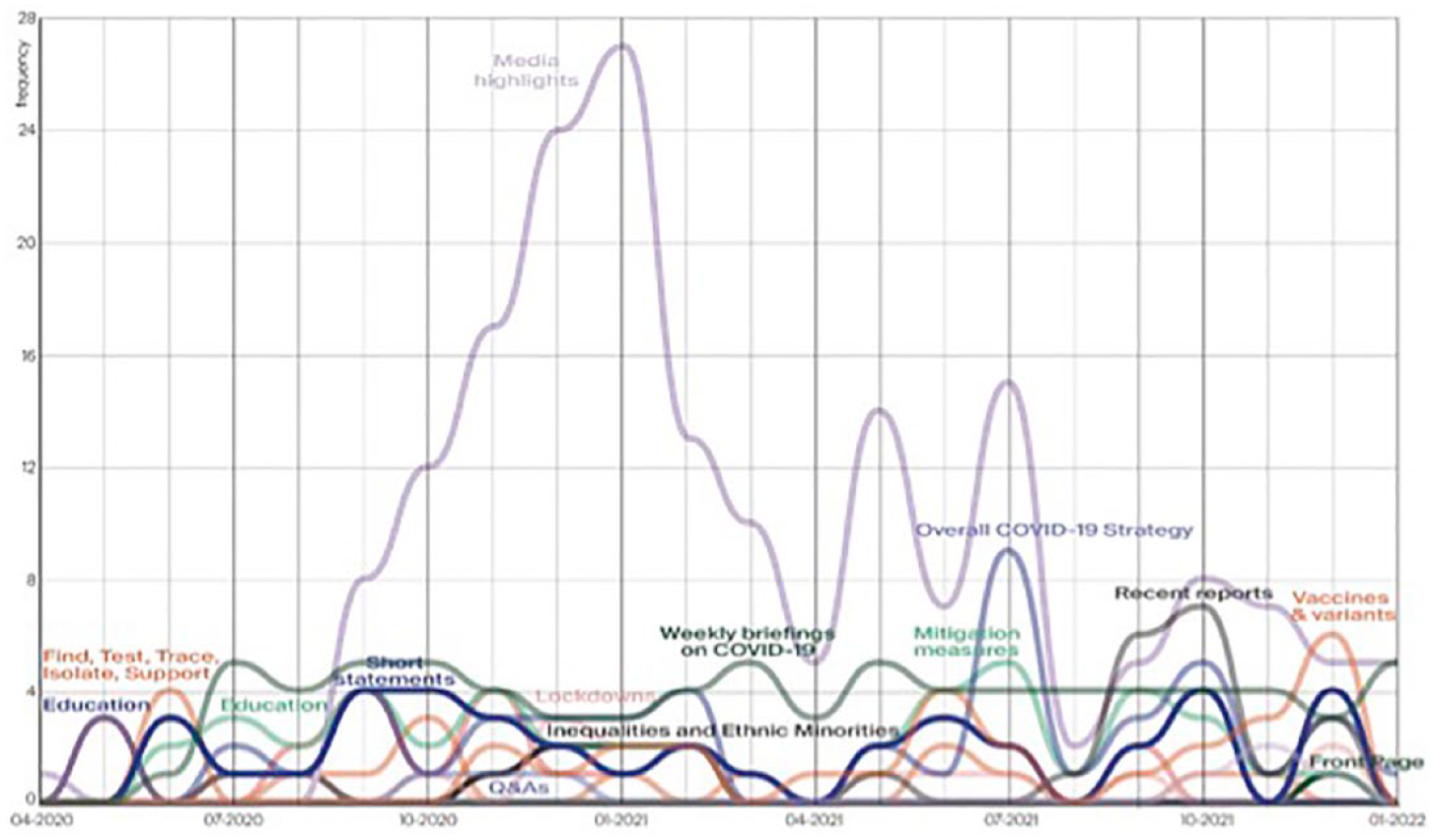
Posts on the IndieSage website over time, categorized by their tags.
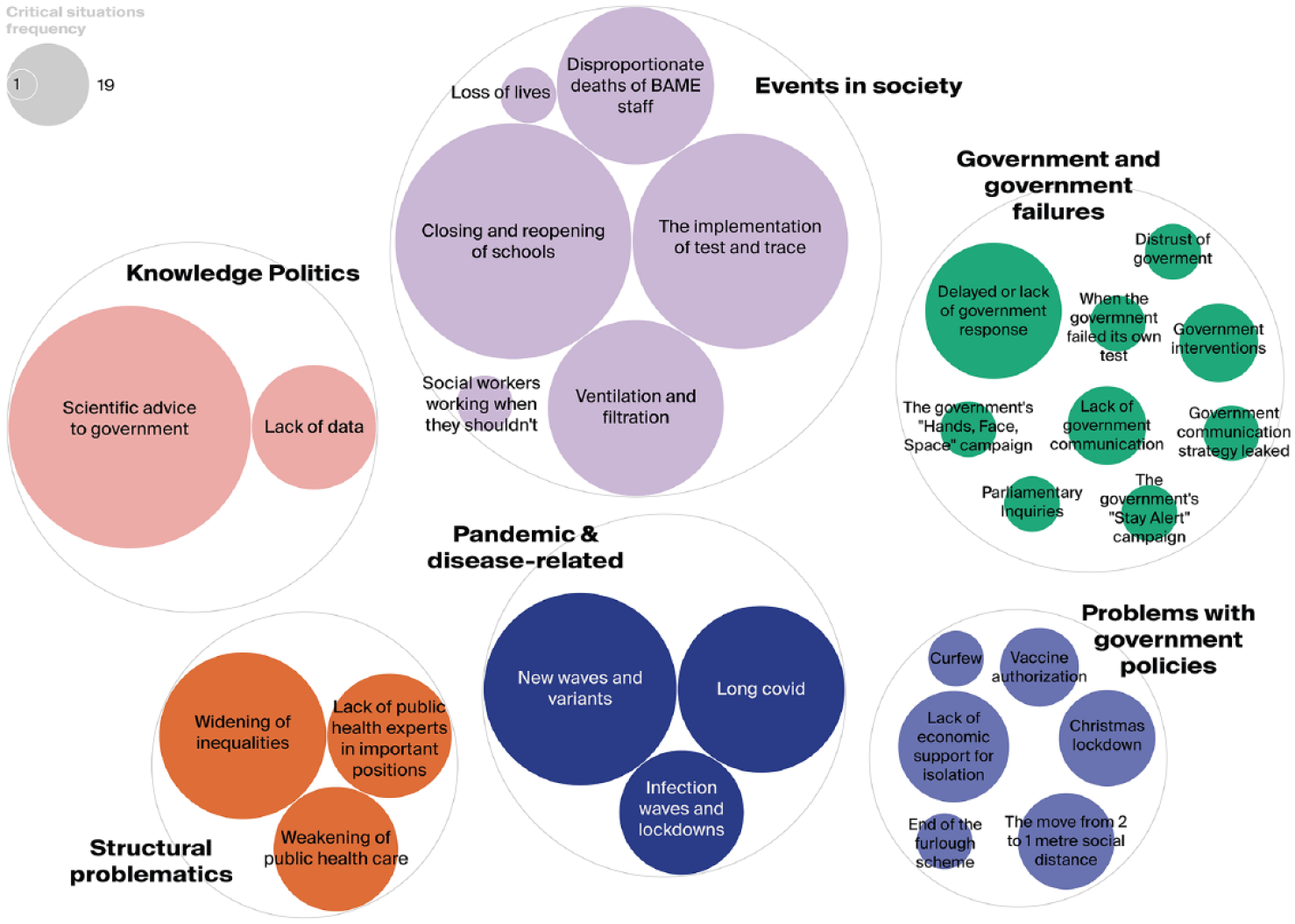
Critical situations of Covid-19 identified by members and partners of IndieSAGE.
If we consider Indie SAGE activities in different media and formats not on their own right, but in relation to the type of critical situations in which Indie SAGE sought to intervene, a more nuanced picture emerges of the modes of publicity adopted by Indie SAGE. Based on the interviews and collected media materials and documents, we conducted a situational analysis of Indie SAGE. Building on A. E. Clarke et al. (2015) and Marres (2020), we analyzed the interviews and documents for the types of critical situation that were identified as relevant by members and partners of Indie SAGE, and the modes of intervention adopted by Indie SAGE in relation to these situations. 8 Based on this analysis we found that, during the first two years of the pandemic, Indie SAGE intervened in several different modes, of which making media appearances is simply the most visible. For instance, critical situations such the relaxation of government restrictions in December 2020 sparked an increase in activity and was followed by a peak of web postings and tweets by Indie SAGE members during January 2021, after the government was forced to change the strategy and apply a third lockdown in the country. We found that the different modes of intervention adopted by Indie SAGE were marked by situational adequacy: They depended on the type of situation in relation to which Indie SAGE sought to intervene and what mode of intervention they adopted, whether openness, translation, engagement, or calling out government failure.
When it comes to the type of critical situations with which Indie SAGE engaged, what stands out first and foremost is their scope and breadth (see Figure 2). Many of these situations, as might be expected, are linked to the pandemic and related diseases: new variants, waves and long covid. But critical events in society were also prominent foci of Indie SAGE activity: the disproportionate deaths of people of racialized groups, the closing and re-opening of schools, and the implementation of test and trace program by private contractors rather than the National Health Service. Alongside these events, we also find many mentions of structural problematics in society, like the widening of social inequalities as a consequence of Covid and Covid policy or the dismantling of public health institutions during austerity in the UK. A fourth large category concerns government failures, which include both general problems like lack of communications and specific policies, such as ‘Help out to eat out’ that earned the Chancellor the name ‘Dr Death’ from his Chief Scientific Advisor, because of the encouragement it gave to people to take epidemiological risks (Harrison, 2023). A last category we termed knowledge politics, which encompasses the contestations of scientific advice.
How did Indie SAGE intervene in relation to these critical situations? We visualized the relative prominence of different type of interventions mentioned by the interviewees in relation to the above situations in Figure 3. In this figure, too, one can note the relative prominence of the type of interventions that we associated with ‘openness’ above: We might consider media appearances, the publication of reports, or social media activity are primarily ways of putting expert advice ‘out there’. An indicative example of how Indie SAGE practiced openness can be found in the Twitter posts that Indie SAGE members posted during and after their weekly briefings. A member prepared presentations of digested data and figures for these weekly briefings, which they would also present in Twitter threads, some of which ‘easily took 5 hours to prepare’ (Indie SAGE member, mathematician). Some threads have more than 25 tweets. In this way, the evidence collected by Indie SAGE was made visible and accessible on multiple social media platforms. However, alongside this minimalist approach to ‘making science public’, one focused on transparency and access, we can also observe interventions that fit with the translational and engaged ways of making science public, which notably include the co-production of expert advice with civic organizations and local governments: labor unions, patients, women, the Labour party, representatives of which were invited to join and suggest topics for the weekly briefings. Since its creation, Indie SAGE carried out public consultations to create reports on schools reopening during the COVID19 pandemic, based on questions from headteachers, local authority officials, students, parents, teachers, and others. They also worked closely with unions like National Education Union (Independent SAGE [@IndependentSage], 2020b) and the University and College Union (UCU) to develop guidelines and provide evidence relevant to decision-making (Independent SAGE [@IndependentSage], 2020c). Finally, the translational mode can also be recognized in the category of advocating specific policies and the tailoring of the communication of expert advice to specific groups, including mayors, disability groups and so on. Because of this translation work with other actors, Indie SAGE was able to adopt a sharper focus on matters of concern with societal relevance.
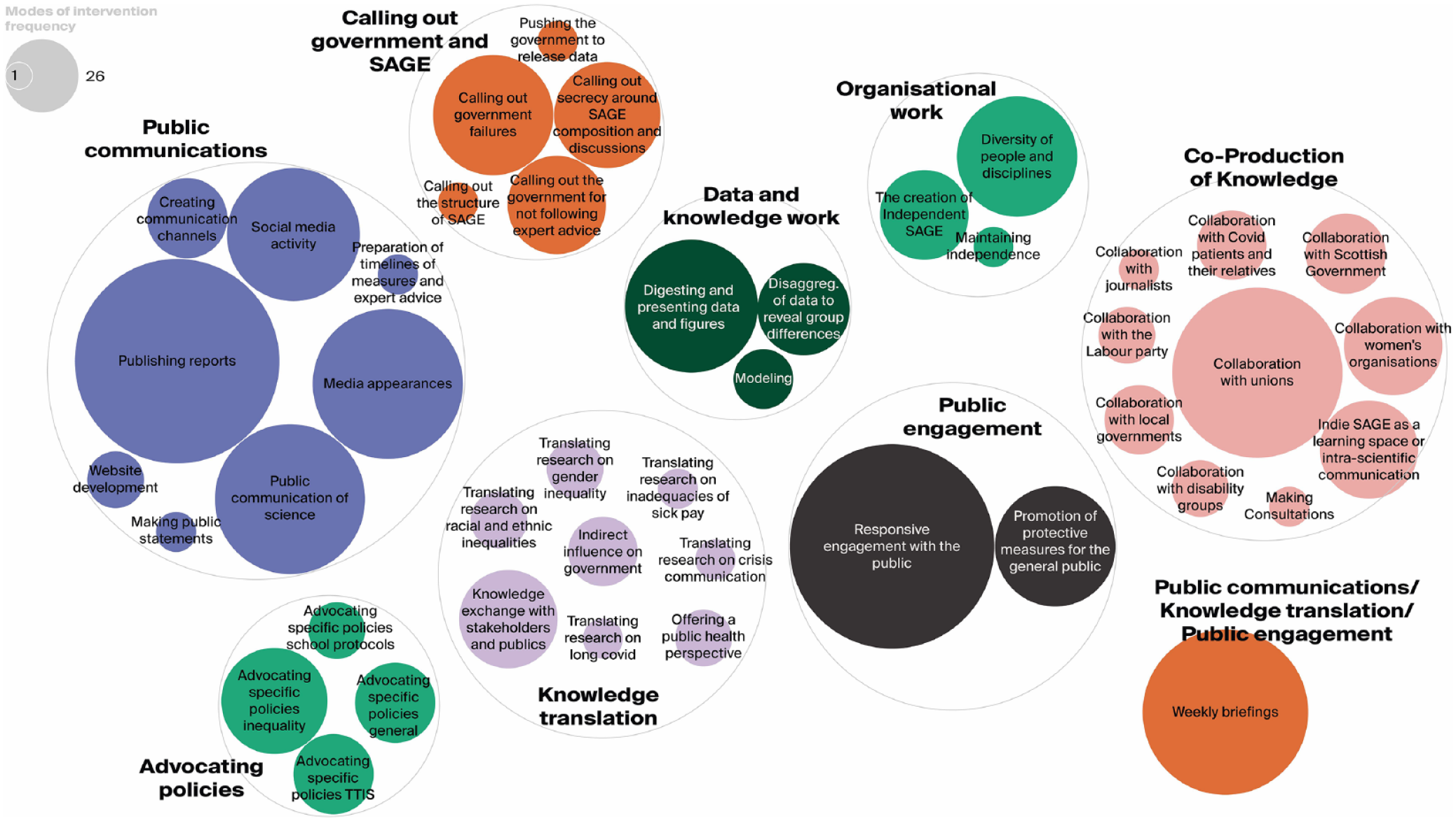
Modes of intervention identified by members and partners of IndieSAGE.
In a next and last step of our analysis, we examined the correlations between critical situations and modes of interventions, not in order to establish a precise hierarchy of connection, but rather to explore what relationships between categories emerge as most salient in our interview coding (Figure 4). 9 On a first reading, this figure provides a reminder of the heterogeneity of situations in relation to which Indie SAGE sought to intervene. But on closer inspection this figure also provides a sense of the degree of contextual adequacy of the modes of intervention adopted by Indie SAGE. That is, Indie SAGE advice evinced what Rhodes and Lancaster (2022), discussing emergency modelling have called a ‘situational fit’, a notion that we operationalize as a discernable match between critical situation and mode of intervention. In response to the critical situations regarding scientific advice to the government, Independent SAGE criticized SAGE’s secrecy and engaged with the public more strongly. In contrast, the closing and opening of schools was addressed primarily via translational interventions of ‘collaboration with unions’: In this situation, Indie SAGE was able to establish collaborative relations with professionals and representatives of the educational sector, and to provide information on contagion modelling and recommendations regarding when to open schools, testing guidelines, and other safety measures. But in relation to the implementation of test and trace by private contractors, the mode of intervention was primarily oppositional, with ‘calling out government failure’ the largest category of intervention, alongside publishing reports, which offered highly critical assessments demonstrating that the ‘failing privately test and trace system’ was initially, ‘not even remotely functional’ and structurally ‘not fit for purpose’ and presented a more integrated and holistic system (e.g. Independent SAGE, 2020b, 2020d, 2020e). In the ‘ventilation’ situation, finally, we can see that there was a strong emphasis on promoting plans for protective measures designed for specific public and social settings, such as schools (Independent SAGE, 2020a, 2020c), live events (Independent SAGE, 2021a), shops and pubs. 10
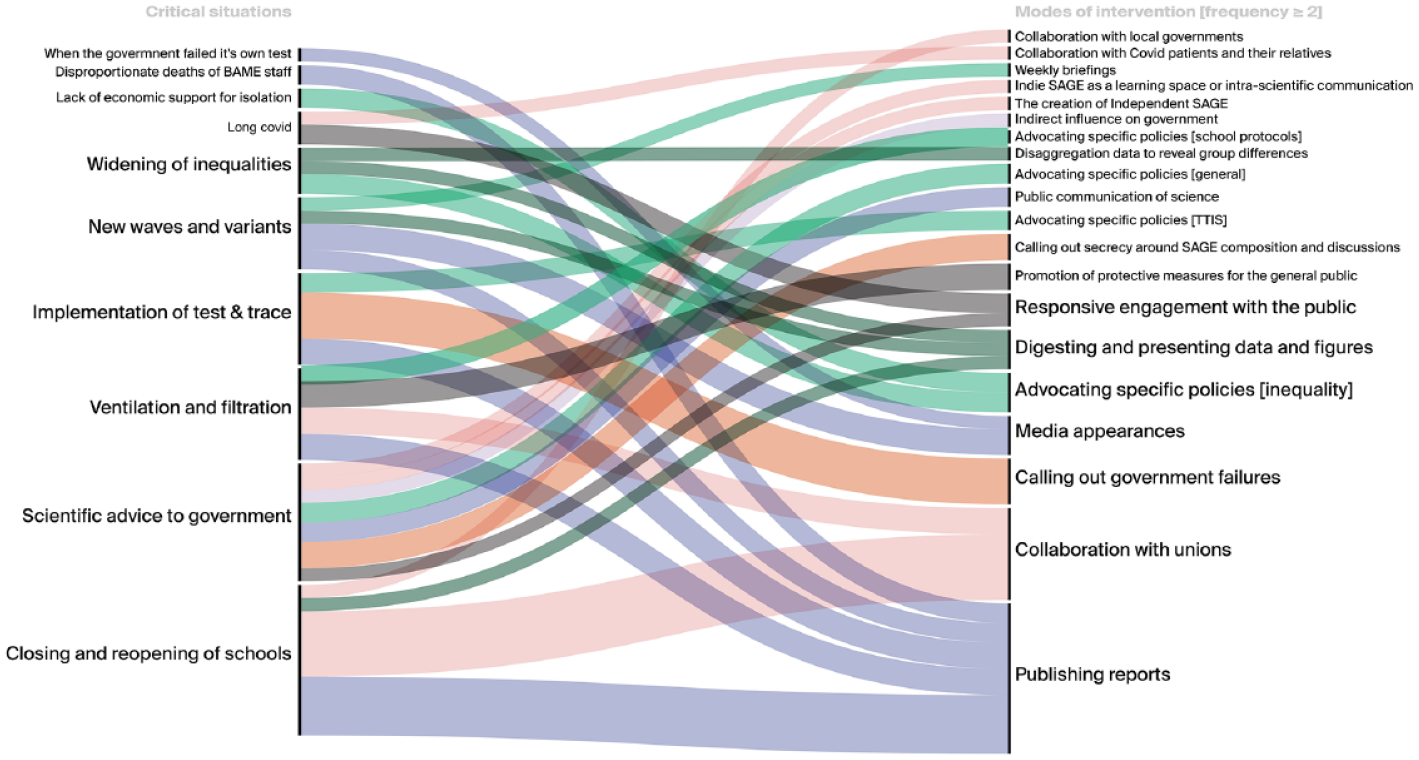
Co-occurrence between critical situations and modes of interventions as indentified by members and partners of IndieSAGE.
Our situational analysis makes it clear that Indie SAGE adopted several different strategies of making scientific advice public. It may also be inferred that Indie SAGE did not instantiate one single alternative structure for scientific advice for times of emergency, but operated in a flexible or, more precisely, a response-able mode, demonstrating a strategy of responsiveness that prioritized the provision of scientific advice not only to governments but also in, to and for publics adequate to the situation at hand, or, as the early 20th century sociologist of knowledge Karl Mannheim would say, is ‘situationally congruous’ (Mannheim, 1936, p. 175). Adopting Mannheim’s vocabulary, we could say that rather than seeking to ‘transcend situations’, Indie SAGE promoted and adopted strategies oriented towards achieving a certain correspondence with the ‘concretely existing’ critical situations of the pandemic.
Feminist science studies have foregrounded the capacity for situational attunement as key to the ability of scientists not just to ‘take responsibility’ but to cultivate ‘response-ability’ (Haraway, 2016; Martin et al., 2015; Puig de la Bellacasa, 2017). Haraway (2016, p. 7) foregrounds ‘the capacity to respond to worldly urgencies with each other’, and hence the capacity of scientific inquiry to open up different forms of response and responsiveness. Crucially, within such an approach, responsive-ness to situations does not indicate a ‘lack of strategy’, or a sign of passivity as one allows one’s action to be ‘led’ by the situation. Instead, it highlights that the ability to grasp challenges as they arise from what we call critical situations is key to enabling intervention, as scientists, by scientific means, precisely to the degree that critical situations are unprecedented and require improvised action and inquiry as in such situations it is impossible, precisely, to operate in the usual way. Even as the UK government could not make present to itself what it was doing and take account of the absences that it generated through its actions and lack thereof, Independent SAGE created a space where emergent data could be interpreted and made relevant to the questions of scientists, professionals, and everyday publics. And through its orientation of scientific advice towards sector-specific, contextual, and public concerns, built the decentralized capacities for pandemic response that it advocated in its reports.
The commitment to situational response-ability can clearly be recognized in the group’s public engagement strategy. As an Indie SAGE behavioral scientist put it: we had the debates about do we keep going or not, one of the things that was important for us is we are an important resource for a lot of people, and we give people practical advice on what to do. So, it’s certainly true that our sense of what we were doing was not just about changing policy, it was about helping and supporting individuals in terms of knowing, you know, how did they keep themselves safe, understanding the nature of the virus and, you know, understanding technical issues. (Indie SAGE member, psychologist).
They addressed questions such as ‘Should you get jabbed?’ and ‘Should you test your child?’
11
Indie SAGE was invested in tailoring this advice to the particular circumstances experienced by diverse social groups, as some members were: thinking about people’s backgrounds, thinking about the context of their lives, the type of housing they lived in, multi-generational homes, because they didn’t have money, the types of choices that they had to make, you know, whether they would admit that they had Covid, whether they would report the tests, whether they would self-isolate, whether they could self-isolate. Could elderly, Black and ethnic minority people in multi-generational homes have the room to self-isolate?
Indie SAGE, that is, practiced a form of scientific advice that was comfortable being led by questions arising from specific situations in society, and to orient scientific advice towards the challenges arising from socio-material conditions experienced by actors in society. An Indie SAGE member said: ‘It wasn’t that public didn’t know anything and therefore we needed to fill that gap. It was that the public had all these searching questions, you know, and they were intelligent questions, and they were important questions.’ 12
Becoming collective: The independence of Indie SAGE
Unsurprisingly, critics were quick to question Independent SAGE’s effective independence, either by ‘revealing’ King’s links to the Labour party or Independent SAGE’s relation with The Citizens group founded by journalist and activist Carole Cadwalladr, associations which Indie SAGE has publicly acknowledged on its website since July 2020 (Independent SAGE, 2020f). So, what was Indie SAGE’s politics? In line with Barry’s (2002) proposition that experts secure their influence by not having a politics, some Indie SAGE members insisted on the organization’s neutrality: We weren’t very political. We didn’t have a clear philosophy of influence. What we hoped to do was, as a set of independent scientists, lay out the science and the implication of the science as if, you know, that would be taken on board automatically. … And we would debate, you know, what sort of group are we? And we agreed we’re not a campaigning group. We are a group of scientists hoping to give independent scientific advice. (Indie SAGE member, psychologist).
The group was clearly marked by diversity of perspectives, bringing together medical, behavioral, mathematical, institutional and social perspectives, and this diversity of perspective paradoxically extends to the question of how important consensus was to ensure the group’s functioning. According to some members, Indie SAGE almost always spoke with a ‘unified voice’. An email sent by Indie SAGE member and public health physician Gabriel Scally notes that the group’s ‘ability to influence policy is, in my view, dependent upon our ability to provide a unified voice when we have finished our discussions’ (quoted in L. Clarke, 2021, p. 2). Independent SAGE reports do not mention the names of individual Indie SAGE members but are collectively authored. On one occasion, Indie SAGE discussed whether to publish minority reports, and decided against it: ‘Having minority reports, or highlighting major differences in our views will significantly reduce our impact’ (quoted in L. Clarke, 2021, p. 2). The situation resulted in the departure of an Indie SAGE member, indicating that not all diversity of perspective was welcomed and highlighting its reliance on a familiar strategy identified in STS literatures (Hilgartner, 2000), one that mobilizes agreement between experts—scientific consensus—to solidify the authority of expert advice. However, other members insisted that ‘it was absolutely fine to disagree and to disagree in public and to explore that disagreement in public and that was healthy’, 13 insisting that disagreement about disagreement was exceptional and that they sometimes desisted from publishing advice when there was a strong division on the issue at hand (e.g. vaccine passports).
In this regard, rather than focus on the extent to which Indie SAGE prioritized unity in its public views, we can equally observe that Indie SAGE undertook a collectivization of scientific advice at a time of emergency. This sense of Indie SAGE as a collective is also apparent in the characterization of the group by several members as a space for intra-scientific communication and learning. As one member noted, everybody’s just been incredibly supportive, and we’ve learned a huge amount from each other. I mean, I think a lot of the others have learned a huge amount of behavioral science, I’ve learned a lot about, you know, public health, pandemic management. (Indie SAGE member, virologist)
This mode of operation raises the follow-up question of whether Indie SAGE expert advice also contributed towards the collectivization of expert advice. While Indie SAGE’s strategy seems to have remained, in British fashion, largely ‘uncodified’, we found many indications that the group favoured collective modes of intervention: promoting public health, decentralizing public health governance, and opposing the privatization of health services. 14
Conclusion
In the face of the contestation of science during the Covid emergency in the UK, scientists felt compelled to try out new ways of mobilizing scientific advice to build capacity for pandemic response, with a central focus on ‘making science public’. In this article, we have analyzed the extent to which and manner in which Indie SAGE activities and interventions were oriented towards critical situations. Evaluating how Indie SAGE intervened in relation to different types of situations, we found that the group’s activities evince situational adequacy: the adoption of a variety of forms of publicity and advocacy for public health in relation to critical situations of Covid 19 at varying scales. They addressed issues from the political dysfunction of mechanisms of scientific advice to government to the vital everyday challenges of how to ventilate classrooms and crowded households, creating interventions that were congruous with these situations. In adopting diverse, contextually appropriate ways of intervening in different types of situations, we have argued, Indie SAGE demonstrated a solution-oriented approach: The group’s principal stated objective was to minimize deaths and support the recovery. Through their interventions, Indie SAGE demonstrated that this objective is eminently compatible with a commitment to making scientific advice public, in its double meaning of both actively involving differently positioned actors in society in the creation of scientific advice, and ensuring that scientific advice is orientated towards the specific, situational challenges faced by everyday publics. Importantly then, Indie SAGE not only advocated a decentralized approach as key to realizing an effective pandemic response, the group also put this advice into practice, as they engaged with a range of different constituencies, from city mayors to teachers, disability groups to pub patrons, to develop scientific advice relevant to the critical situations they faced.
The modality of Indie SAGE’s scientific advice can then be characterized as focused on enabling situational response-ability across institutions, professions, social groups and everyday publics, and this is one important way in which the group has made a difference in science-public-government relations in the UK from the start of the Covid emergency.
To conclude, we would like to address one objection to this approach to scientific advice. It may be tempting to interpret our notion of situational adequacy in narrow terms, as somehow not very … scientific, and not very political. It might seem that we suggest that Independent SAGE prioritized the particular over the general, the concrete over the abstract, the practical over the theoretical. From such a perspective, a science oriented towards building responsive capacities among coping—and not coping 15 —professions and publics might be interpreted as somehow aligned with a post-epistemological and post-political agenda: one in which the effect of deploying scientific advice to intervene in public debates and inform decision-making is to contribute to the reduction of the space for critical enquiry and political mobilization and struggle. A way of shrinking the ‘modes of existence’ (Latour, 2018) of science and politics to the mundane, to the minutae of coping, mere practicality, and muddling through. Such an interpretation, in our view, is mistaken. Important political, epistemic as well as ontological aspects of the orientation of scientific advice towards situational challenges faced by coping and not-coping actors in society remains out of view as long as we characterize Independent SAGE responsive mode as ‘merely practical’. It fails to take seriously the transformative potential of a focus on coping and not coping: a responsive mode of scientific advice enables critical engagement with ontological challenges, including structural conditions of existence in society, and the collectivization of emergency response.
Herrick et al. (2022, p. 6) point towards this when they characterize Covid as a ‘big exposer’: The pandemic ‘uncover[ed] structural vulnerabilities and systemic dysfunctionalities in institutions and governance’. Put differently, Covid-19 ‘renders perceptible an ongoing slow emergency that would otherwise remain hidden (or perhaps is trivialized or responded to as spectacle)’ (Grove et al., 2022, p. 15). As soon as we recognize this dimension of societal crisis in the critical situations of Covid-19 in the UK, it becomes clear that to interpret a focus on situational response-ability as ‘merely practical’ very much misses the point. Rather, through its orientation of scientific advice towards the critical situations of closed schools, disproportionate deaths between racial and ethnic groups, lack of ventilation, racialized stigma, no tests, overcrowding, the prospects of unemployment in a country with inadequate social benefits, and so on, Indie SAGE intervened in the onto-political parameters of pandemic response: they demonstrated there is scope for public intervention in relation to slow crises on which the ‘official’ forms of scientific advice on Covid-19 remained mostly silent during that first tragic year of the emergency (Anderson, 2021). We contend that the emergency situation of the Covid pandemic in the UK, in which anti-science movements were in the ascendancy and the government sidelined expert advice, compelled the making public of expert advice not only for transparency reasons, but to enable collectives to cope with ontological challenges posed by Covid-19.
While our analysis is particular to the UK, 16 we feel it holds a wider lesson for the understanding of the role of evidence in public politics. To advocate for science-based governance, as Indie SAGE did, is not necessarily to endorse a merely pragmatic vision of government, as is sometimes suggested. One could say that through its interventions Indie SAGE demonstrated the limits and the provinciality of critiques of evidence-based governance that are sometimes made on the left as ‘technocratic’ or ‘post-political’ (e.g. Müller, 2017). Such critiques had salience in the pre-Covid context in which evidence-based governance still had hegemonic status in many countries, but as the government demonstrably sidelined public health scientists, the framing of evidence-based governance as post-political demonstrably collapsed. By making evidence public during the Covid emergency in the UK, Independent SAGE demonstrated the critical importance of scientific knowledge to political decision-making. In any emergency, the predicaments of the situation take precedence, and knowledge becomes key to the ability to respond (Scarry, 2011). When, during the early phase of the pandemic, the UK government followed through on Gove’s ill-fated slogan that the ‘people have had enough of experts’ and scientific advice was ignored, sidelined and contested from inside government, making evidence public became a key means for enabling emergency responses across society. As Indie SAGE engaged in public communication of evidence against the odds, the group showed that deploying evidence to enable decision-makers to respond to emergency situations is not only pragmatic but a critical accomplishment.
Scientific efforts to enable actors in society to ‘follow the evidence’ during the Covid pandemic in the UK cannot be understood in our view as implicit or explicit endorsements of a technocratic mode of government, nor as an attempt to ‘epistemize’ politics (Bogner, 2021). Such an interpretation does not take seriously the critical situations that actors in science and society faced during Covid, it does not take into consideration their status as existential challenges (Marres, 2023). As Indie SAGE members put it: ‘science communication requires an active engagement of science experts with the implications of their science for policy, politics, and people’s lives’ (Pillay & King, 2021). This point also has implications for some of our engrained intellectual habits in STS, such as the reflex to criticize the slogan ‘follow the science’ for being deterministic and glossing over the uncertainties of evidence, which themselves proved to an extent inadequate in the face of critical situations of Covid-19. Could it be that the role of scientific advice in politics and society cannot be adequately understood as long as we frame this primarily as a question of what are the ‘right’ institutional relations between science and government? It could well be that we can only get to the politics of expertise by getting closer to lived situations, as they are experienced ‘out there’ in society. Rather than only evaluating Indie SAGE’s ‘success’ in terms of its impact on news coverage and viewers (L. Clarke, 2021) or its influence on government decision-making, we emphasize the importance of scientific advice as a mechanism for building responsive capacities in relevant sectors, professions and publics enabling them to cope and intervene in the manifold critical situations of Covid-19. Such a response-able mode of intervention proved uniquely relevant in the UK context, where the pandemic posed significant, life-threatening challenges across society even as institutional arrangements for scientific advice were actively undermined by the government. In this situation, Indie SAGE opened up a path where the communication of scientific advice becomes oriented towards the cultivation of response-ability among professions, institutions, communities, government and everyday publics alike.
Footnotes
Acknowledgements
We would like to thank Oihane Etayo Ballesteros for her contributions to several aspects of the research reported here, in particular the interviews and interview analysis. We are grateful to all members and partners of IndieSAGE who made time to talk with us and participate in group discussions organized as part of this study. Conversations with Kari Lancaster and Ann Kelly informed our understanding of the peculiarities of expert advice in the context of public health and pandemic governance. Without Nathalie Mitev, this study would not have happened. We want to thank Ginevra Terenghi for the design of the data visualizations that accompany this article.
Funding
The author(s) disclosed receipt of the following financial support for the research, authorship, and/or publication of this article: This study received funding from Research England Participatory Research Fund in 2022 and from The Leverhulme Trust (Leverhulme Research Fellowship RF-2021-603).
