




Abstract
If an apparently extinct bird calls in a forest, and there are people there to hear it—to record it, even—is it still extinct? The Ivory-billed Woodpecker was last ‘officially’ seen in the United States in 1944, but its extinction continues to be a subject of intense debate between conservation authorities, scientists, and grassroots activists. Tensions peaked around 2005, when scientists from the Cornell Laboratory of Ornithology announced their rediscovery of the species. However, their evidence received significant challenge from other ornithologists, and this apparent rediscovery has since been generally dismissed. In 2021, the United States Fish and Wildlife Service recommended the ivorybill be declared officially extinct. Still, many people continue to trawl the Southeastern forests in search of ivorybills. In this article, I investigate the methods, debates, and results of efforts to locate this species, with a focus on sound. In doing so, I explore the interconnected roles of sound and space in the making of extinction knowledge. Sonic search methods of listening, sounding, and translating are core ways that searchers attempt to attune to, communicate with, and establish evidence of ivorybills. Additionally, sonic search practices are critical spaces of negotiation and contestation between different searchers, between searchers and ivorybills, and between searchers and skeptics. Ultimately, this article argues that sonic geographies affect the production of extinction knowledge, and vice versa—extinction knowledge making practices produce distinct sonic geographies.
In the spring of 1935, a team from the Cornell Laboratory of Ornithology set out on a cross-America field trip to record the sounds of vanishing birds before it was too late (Brand et al., n.d.). Most of all, they wanted to observe, photograph, and record the iconic Ivory-billed Woodpecker (Campephilus principalis; Figure 1). The largest of all North American woodpeckers, ivorybills had been dipping in and out of presumed extinction for decades. Once found in the bottomland forests of the Southeastern United States— from eastern Texas to southwestern Kentucky to Southern Florida, with a subspecies in Cuba—this lone US representative of the Campephilus woodpecker genus was all but decimated due to industrial deforestation and widespread culling by bird skin collectors (T. Gallagher, 2005; Tanner, 1942). After days of staking out a nest cavity in the Singer Tract woods of Northern Louisiana, the recordists finally got their prize: the first—and still the only—undisputed sound recordings of the ‘Holy Grail Bird’. 1 In the same woods in 1944, artist Don Eckleberry had what many consider the last human encounter with an Ivory-billed Woodpecker in the United States.
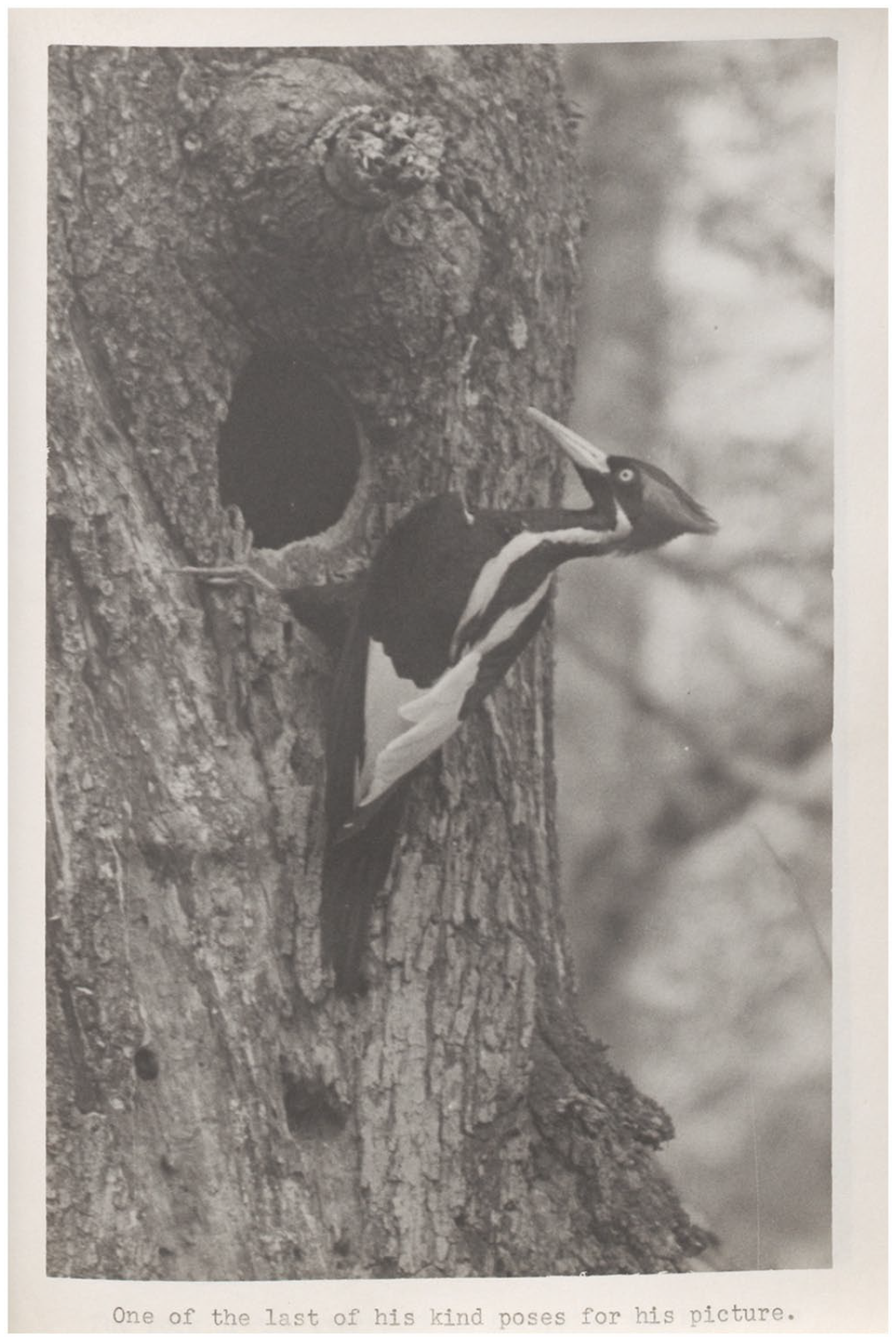
Male ivory-billed woodpecker at a nest cavity in the Singer Tract of Louisiana in 1935. Arthur A. Allen papers, #21-18-1255. Division of Rare and Manuscript Collections, Cornell University Library.
Decades later, Floridian ornithologists Jerome A. Jackson and Malcolm Hodges were searching for ivorybills in Mississippi, armed with a copy of the 1935 recordings and a playback machine. At 11am on March 29, 1987, they heard what they had been waiting for: an apparent ivorybill survivor calling back to broadcasts of its recorded ancestors (Jackson, 2006a, p. 183). Without an accompanying clear photo or video, though, this apparent ivorybill encounter is similar to scores of other post-1944 reports: tantalizing, but not enough to prove the species’ persistence for the broader conservation community (see United States Fish and Wildlife Service [USFWS], 2021).
In 2005, a team based predominantly at the Cornell Laboratory of Ornithology published a paper in Science that detailed a suite of apparent evidence that the ivorybill had survived into the 21st century: eyewitness testimonies, foraging signs, a blurry 4-second video, and sound recordings (Fitzpatrick et al., 2005). The sound recordings were said to closely match the 1935 captures of ivorybills and recordings of other Camemphilus woodpecker species that persist in South America. As with all other evidence presented, however, these recordings were dismissed by many other ornithologists, who claimed they could be attributed to more common species or events. One rebuttal even questioned whether they might be the sounds of someone blowing a clarinet mouthpiece in the forest (Jackson, 2006b, p. 2–3).
Undeterred by a recent recommendation by the United States Fish and Wildlife Service [USFWS] to officially declare the Ivory-billed Woodpecker extinct in the US and thus remove it from the Endangered Species Act (USFWS, 2021), passionate grassroots groups continue to look—and listen—for the species. For the Louisiana group Mission Ivorybill, one search method is a ‘Chain of Human Listening Posts’, where searchers wait in promising habitats before dawn and listen silently for the first ivorybill sounds of the morning, hoping these could lead them to an active nest (M. Courtman, personal communication). At the time of writing this article, however, no active nests have been found, nor has the USFWS made a final ruling regarding the species’ extinction. The ivorybill remains, excruciatingly, lost.
Ecological hide-and-seek
How do we know when a species is extinct? ‘Extinction’ is, most simply, the total, global expiration of a particular biological lineage. It is also, however, a powerful legal category that determines conservation funding and management (Greenwald et al., 2019), a compelling ecological narrative that affects humans’ relationship with places and processes (McCorristine & Adams, 2020), and an uneven event experienced by different ecological communities to different degrees at different timescales (Szabo et al., 2012). It is also far from black and white: Many species do not fall cleanly into categories of ‘extinct’ or ‘not extinct’, but into a more troublesome category of debate, surveying, and waiting, known as ‘gray extinction’ (Baumsteiger & Moyle, 2017). Faced with mounting threats, species adapt, relocate, hybridize, and hide, making determinations of their presence or absence difficult (Jørgensen, 2016). The consequences of categorization are enormous: If declared extinct prematurely, surviving populations may become extinct anyway once protections are removed. Not declaring extinction can also be problematic because conservation budgets are increasingly limited and, many argue, their resources better allocated to species that definitely persist. 2
Lost species like the Thylacine and the Eastern Cougar might be troublesome, but they also ignite imagination and passion well beyond mainstream conservation bodies (McCorristine & Adams, 2020). Searches to rediscover these creatures have thus been driven by conservation authorities as much as by academics, amateur naturalists, and grassroots activists. This is particularly apparent in the case of the Ivory-billed Woodpecker, where tens of millions of government dollars have been allocated to their recovery; numerous books, academic articles, and blogs have been produced about the search; and many individuals have devoted their lives and careers to searching for this creature (e.g. T. Gallagher, 2005; Jackson, 2006a; Mission Ivorybill, 2021).
Though there are politics of power and authority here, knowledge production about ivorybill presence is a diffuse and diverse affair, with all asking the same question to the Southern forests they search: Is the species there? Science and Technology Studies (STS) researchers and more-than-human geographers have done important work to critically reveal the field practices of ‘establishing presence’ in conservation work, including how fieldworkers attune to and translate the traces of elusive species (e.g. Hinchliffe, 2008; Lorimer, 2008; Mason & Hope, 2014). There is limited research, however, about searches for species that most have already written off: creatures about which little is known, that leave few traces, that seem to actively evade detection, and that might not be there at all. How is extinction knowledge made?
In this article, I address this question by tracing the role of sound and space in the search for the Ivory-billed Woodpecker. Sound is not the only sense that matters in this extinction debate. It is, however, a critical, and underexplored, component of this and other cases of conservation fieldwork. As Lynch (2011) notes, visual materials were overwhelmingly emphasized in publications and talks regarding Cornell’s purported ivorybill rediscovery, an emphasis that remains in current search accounts (e.g. Latta et al., 2023). Still, sonic methods and evidence play an important role in ivorybill searches, and these, along with the trend of deemphasizing them, demand critical interrogation (Lynch, 2011, p. 101). Indeed, the question of the role and status of sound in science more broadly remains a rich topic of inquiry in STS (e.g. Bijsterveld, 2019; Marshall, 2022). The highly contested and high-stakes search for the Ivory-billed Woodpecker offers an intriguing case study to further explore the practices and cultures of sonic knowledge production. How do searchers capture, analyze, and translate sonic traces of this species? How is extinction knowledge made—or not—through sound?
As a geographer, I come to these questions with an ear to space. In what follows, I draw on STS and human geography to advance the concept of ‘sonic geographies of knowledge production’. I argue that the roles of sound and space in knowledge production are deeply entangled, that sonic methods are produced by and productive of powerful physical and conceptual geographies. I propose that sonic geography is a helpful framework not only for better understanding the making of extinction knowledge in this case and beyond, but also for better placing the role of sound in field science more broadly. This article thus contributes to—and uniquely connects—STS scholarship about sound, space, field science, and extinction.
I begin by grounding this framework in current literature and outlining its conceptual contribution. Then, I offer an overview of ivorybill search efforts discussed in this article, before presenting three analytical subsections: listening, sounding, and translating.
Sonic geographies of knowledge production
Space
Sociologists, historians, and especially geographers of science have long emphasized the role of space in the production of knowledge. Livingstone (2003) describes three core facets of this: site, region, and circulation. ‘Site’ refers to how the spaces where the things of science are observed, collected, analyzed, and received—like the lab, field, and ‘border spaces’ like field stations (Kohler, 2002)—affect the production of scientific knowledge, and vice versa. For instance, Hennessy (2018) describes the making of the Galapagos Islands as a ‘natural laboratory’ in the 20th century, where the geographical imagination of ‘nature’ as a pure, separate entity was both critical to the authority of knowledge claims made there and also a neocolonial fallacy upheld by biopolitical management regimes. Along with studies of ‘region’, (e.g. Greer, 2013), such works emphasize the coproduction of scientific knowledge with and through places, as well as the place-making effects of scientific endeavor.
‘Circulation’ refers to the making and sharing of knowledge through movement. Latour (1986), for instance, maps the ways that scientific facts are made through the processes of ‘bringing back’ (p. 5) things from the field through their translation into immutable, mobile, and flat inscriptions (1986, 1987). These inscriptions—representing ‘absent things’ (1986, p. 8) like a map for an island’s topography, or a graph for changing global temperatures—can be endlessly circulated, compared, and combined. However, these are not neutral processes. With Mercator’s map, for instance, some things were left out, and some manipulated, to create a flat representation of the globe (Livingstone, 2003, pp. 154–155). Such transformations can have wide-ranging scientific, political, and cultural implications (e.g. Rose-Redwood et al., 2020). Even mechanical inscriptions like photographs and sound recordings do not capture uncorrupted representations: they too are products of situated individuals with particular skills and intentions (Bruyninckx, 2012; Livingstone, 2003, pp. 263–271).
Studying the production of scientific knowledge is thus inseparable from a consideration of geography. Where knowledge is found, analyzed, presented, and debated—and how it moves and mutates between these places—is not only integral to the ‘doing’ of science and the production of spaces, but also has a major impact on the authority, integrality, and consequences of knowledge claims.
Sound
Scholars in STS and aligned fields have also explored the ‘ambiguous and at times contested position of sound’ (Bijsterveld, 2019, p. 3) in knowledge production. Modern Western science is imbued with visual metaphor and forms of communication. Even overtly sonic subjects, like avian bioacoustics and architectural acoustics, analyze and present their data through primarily graphical means. Many STS researchers are critical of any essentialist explanations for this: what Sterne (2003, p. 15) dubs the ‘audiovisual litany’, where sound is described as affective and relational, in contrast to the visual, which is apparently more objective and authoritative. Instead, the framing of science as a primarily visual way of knowing is understood to be a result of distinct socio-cultural histories and practices (Bijsterveld, 2019; Daston & Galison, 1992; Hui et al., 2013; Sterne, 2003).
Nevertheless, ‘listening for knowledge’ does happen in various contexts (Bijsterveld, 2019, pp. 1–22). For instance, scientists mobilizing their results through sonification (Supper, 2016) and entomologists using electrophysiology to sonically measure aphid behavior (Marshall, 2022). As above, STS scholars emphasize that scientists employ sonic methods because of specific material, sociocultural, and technological circumstances (Volmar, 2013). For instance, Bruyninckx (2012) argues that the uptake of the parabolic reflector and mechanical notation in bird sound research in the 20th century resulted from trends towards mechanical objectivity in Western science at the time, as well as the sonic technological developments of the World Wars. Further, listening for knowledge is not a homogenous practice: Individual scientists’ skills and faculties affect the processes and results, as will the technologies they employ (e.g. Rice, 2010, pp. 55–58). Additionally, many stress that sonic knowledge production does not occur independently from other senses (e.g. Rice, 2010, p. 50; Vallee, 2018).
This sensorial emphasis is shared by scholars focusing on multispecies attunements in fieldwork. Despret (2013), for instance, argues that despite the canonical figure of the ‘detached’ (p. 52) scientist, fieldworkers’ bodies are integral to field practices. Though usually absent from scientific articles, this becomes apparent through interviews with scientists or in their memoirs. For instance, in Never Cry Wolf, Farley Mowat details his attempts to eat, sleep, and otherwise embody the actions of the wolves he studied in order to better ‘attune’ to them (Despret, 2013). Other forms of bodily attunement in fieldwork are more conventional. For instance, in Lorimer’s (2008) study of corncrake census work, one researcher ‘stood alert, hands cupped around his ears, rotating slowly like an aural CCTV camera’ (p. 391) when listening for the species. Careful attunement to corncrakes was built from passed-down knowledge from other researchers, embodied knowledge of the wider landscape, and bodily re-alignment (see also Alcayna-Stevens, 2016; O’Mahony et al., 2018). It is thus not only bodies and senses, but particular, skilled bodies embedded in particular, complex places that produce ecological knowledge. Especially for research regarding elusive, nocturnal, or unpredictable creatures, researchers also employ technologies to enhance sensory attunements in the field: ultrasound bat detectors, camera traps, and autonomous recording units (ARUs) (Mason & Hope, 2014; O’Mahony et al., 2018; Vallee, 2018). However, such technologies are not simply neutral prostheses for human senses: Sensing technologies constitute—and are enrolled in—networked, more-than-human ecologies with wide-ranging political implications (Gabrys, 2012).
Sonic geography
In this article, I bring these two foci of STS—sound and space—together to explore the sonic geographies of knowledge production. Sonic geography is already an established and diverse subdiscipline of human geography (Paiva, 2018), addressing the relations of sound, space, and, such things as voice (Kanngieser, 2012), borderlands (Margulies, 2023), and regional identity (Matless, 2005). There is not yet, however, much consideration of the sonic geographies of science: how sound and space affect the production of knowledge, and how the production of knowledge through sound affects space. Works that begin to address such relations—for instance, Mody’s (2005) study of sound in laboratory practice, and Bruyninckx’s (2018) history of bird sound recording practices—do not explicitly define their approaches as sonic geographic ones. However, sonic geography’s conceptual and analytical tools can enrich STS understandings of these processes. Sonic geographers argue that ‘[s]ounds both produce spaces and are produced by them’ (M. Gallagher et al., 2017, p. 621), together modulating how the world is experienced. For sonic geographers, sound and listening are unavoidably spatial, temporal, and more-than-human processes (M. Gallagher et al., 2017; Revill, 2016). It follows, then, that an understanding of the role of sound in science is incomplete without interrogating such spatial relations. Sonic geographers also advocate ‘reading’ spatio-sonic phenomena to foster rich understandings of social, cultural, and political landscapes more broadly (Kanngieser, 2012; Margulies, 2023; Matless, 2005). This approach, then, can sound out more than the sonic alone.
In this article, I argue that sonic methods of knowledge production are in fact inseparable from the spaces in which this knowledge is made: Sonic knowledge is made in place, and is understood and accepted (or not) in the context of specific physical and conceptual spaces. Not only this, but spaces of knowledge production are themselves affected by sensory methods and experiences. In other words, the geographies of knowledge production are not predetermined, but shaped and experienced through particular sensory configurations. The framework of sonic geography allows one to hold the balance between how methods affect space, how space affects methods, and how both affect knowledge production, while remaining responsive to the complex realities of particular cases. A sonic geography of knowledge production, then, responds to disciplinary warnings against essentialization of the senses (Sterne, 2003).
There are a number of key questions to be explored: How do physical geographies affect how and when listening for knowledge happens? How does the creation of sonic knowledge affect spatial relations and imaginations? How do different technologies and methods change the geographies of scientific listening and sound-making? How and with what effects does sonic knowledge move between the lab, the field, and beyond? And what are the unique difficulties and debates found at the intersections of sound, space, and science, particularly in terms of the authority of knowledge claims produced here? In exploring these questions through the experiences of Ivory-billed Woodpecker searchers, I focus on sonic methods and sonic spaces (Table 1).
Sonic methods: Producing knowledge through sound.
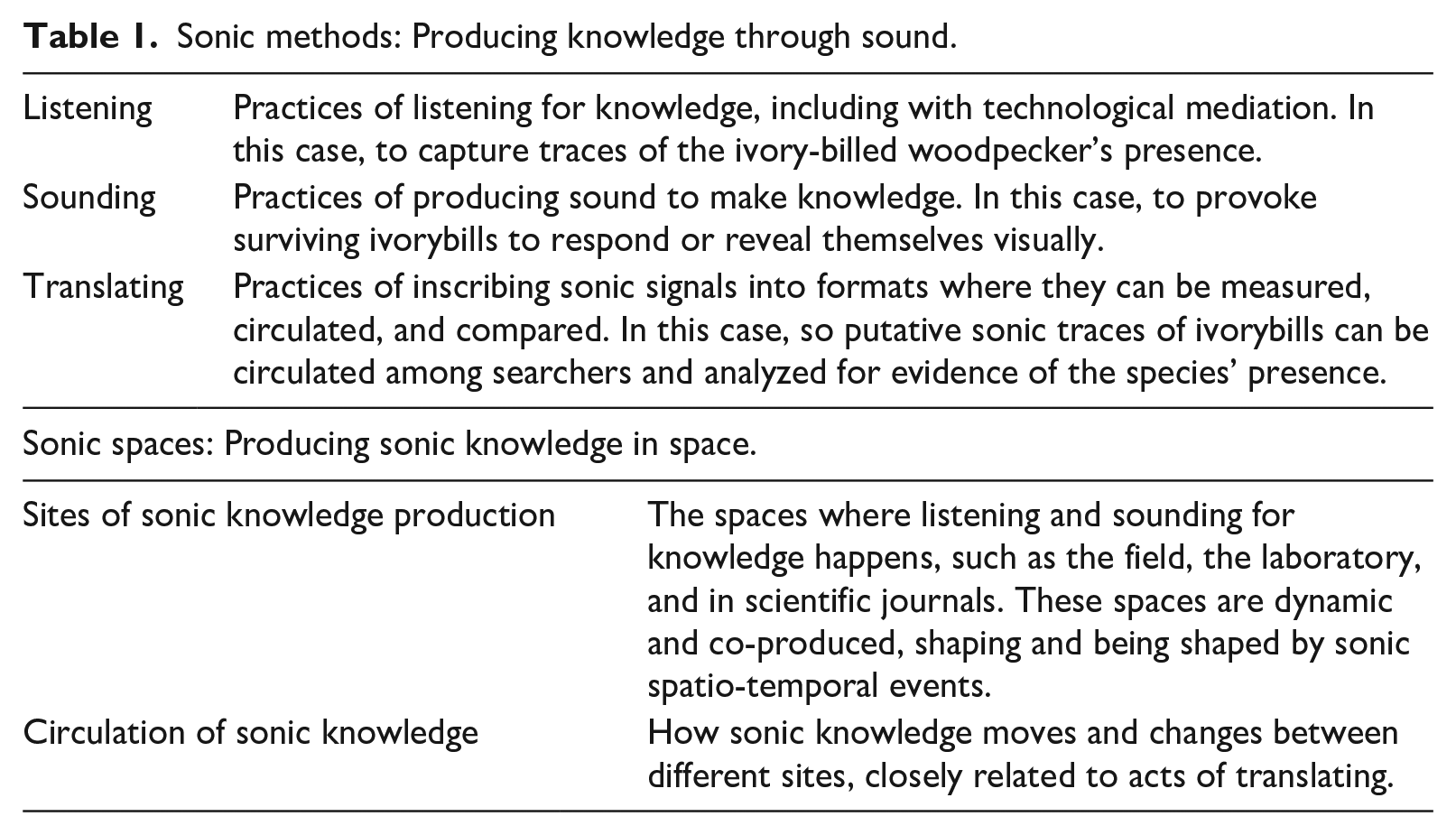
In their various configurations with one another, these elements constitute the lively sonic geographies of ivorybill searching, which—from the disciplining of searchers’ sounds in the field to the exchange of audio data in spectrograms—play a critical, variegated, and at times contested role in the production of extinction knowledge. These geographies are both physical—referring to material sites of knowledge production like the field and analysis labs—and conceptual—as in, the epistemological landscapes of knowledge translation, circulation, and debate. In what follows, I show that these sonic geographies reflect and generate spaces of negotiation and contestation: between searchers, between searchers and ivorybills, and between searchers and other scientists; about whether the ivorybill persists, about the very facts of the species, and about what kinds of methods ‘work’ and what kinds of evidence ‘count’ in high-stakes conservation biology. Ultimately, I argue not only that sonic geographies affect the production of extinction knowledge, but also the reverse: that extinction knowledge-making practices produce distinct sonic geographies.
The ‘Holy Grail bird’
The ivorybill was last ‘officially’ seen in the US in 1944, but a steady beat of controversial sightings have been reported ever since. Most famously, the Cornell Laboratory of Ornithology announced in 2005 their rediscovery of the Ivory-billed Woodpecker after searches in Arkansas spurred by an apparent sighting by outdoorsman Gene Sparling (Fitzpatrick et al., 2005). Despite an initial flurry of excitement that rippled well outside of the ornithological world—the federal government allocated millions of dollars to further searches and habitat protections as a result (Troy & Jones, 2022)—this rediscovery faced heavy challenge. As well as accusations concerning the sound recordings, the team’s headline video footage of a putative ivorybill was fleeting and blurry. Rebuttals suggested the bird captured could be the (much more common) Pileated Woodpecker, or, at least, that none of the evidence was strong enough to be definitive (Jackson, 2006b; Lynch, 2011; Sibley et al., 2006).
Even though many of those involved still stand by their rediscovery, years of follow-up searches failed to capture more definitive evidence. Another intensive search led by Geoffrey E. Hill of Auburn University and Dan Mennill of the University of Windsor in Florida’s Choctawhatchee River basin in 2006–8 faced similar problems. The team’s principal publication about their search detailed sound recordings, eyewitness and earwitness encounters, and foraging signs that they argued were ‘highly suggestive’ of ivorybill survival (Hill et al., 2006). Without a clear photo or video, though, many people were unconvinced (USFWS, 2021). And, again, follow-up searches failed to produce unequivocal proof (Hill, 2007; Swiston, 2008); they did eventually capture video footage of potential ivorybills, but it was inconclusive (Hill, 2007, pp. 231–235).
As well as these large-scale institutional searches, there are also grassroots conservation activists, independent scientists, and birders who have searched—and are still searching—for ivorybills. 3 Alongside Mission Ivorybill, organizations like National Biodiversity Parks and Project Principalis have devoted significant effort to ivorybill searching. The fact that these efforts are generally self-funded and small in scale does not diminish their impact. A recent article by Project Principalis suggesting evidence for ivorybill survival, for instance, was widely picked up by mainstream media (Latta et al., 2023). Individual actors are also significant—for instance, acoustic scientist Michael Collins has published extensively in scientific journals on his evidence of ivorybill presence in Louisiana, which includes sound recordings and videos (Collins, 2011, 2021). As with other searches, however, no evidence presented by these actors has been universally accepted. As the temporal distance since an undisputed sighting of the bird grows, many critics feel that continued searches for the species are not only hopeless, but frivolous (e.g. Troy & Jones, 2022). Searchers’ methods, experiences, and results—including sonic-spatial ones—are inescapably shaped by this highly contested conceptual landscape, where irrefutable evidence itself has become the ‘holy grail’.
This article explores the sonic geographies of 21st century searches for the ivory-billed woodpecker (2004-present) through analyzing search reports, peer-reviewed scientific articles, and memoirs, as well as qualitative interviews with 6 people involved in searches. Interviews were conducted in 2021 and 2022 with: lead bioacousticians from the Cornell search (Russ Charif) and the Auburn-Windsor search (Dan Mennill); an acoustic analyst in the Cornell search (Ann Warde); a long-time searcher and organizer with Mission Ivorybill (Matt Courtman); the lead scientist in Cornell’s searches (Martjan Lammertink); and one long-time searcher with Project Principalis (Mark A. Michaels). 4 Interviewees were selected to illuminate processes and perspectives less evident in published accounts, especially regarding sonic methods. For instance, since comprehensive sonic analysis of Cornell’s searches were never published, interviews with Charif, Lammertink, and Warde provided important detail unavailable elsewhere. Additionally, although personal accounts of searching can be found in the search memoirs of Tim Gallagher (2005) and Geoffrey E. Hill (2007), such sources are not available for all searches, or from all perspectives. Semi-structured, qualitative interviews with other individuals involved thus enriched available narrative fieldwork data and sonically expanded the sphere of ivorybill discourse. This article does not intend to reflect the experiences of all people involved in ivorybill searching. In focusing on a few key recent search efforts understood through a broad range of sources, what follows represents some of the most critical moments, methods, and debates in contemporary ivorybill searching as they relate to sonic geography.
Listening
Some of the most important tools available to ivorybill searchers are their listening bodies. This is true for many acts of birding: Though often associated with birdwatching, one usually hears more birds than they see. In everyday birding as much as in ornithological fieldwork, bird-seekers use sound to guide them towards visual encounters. In ivorybill searching, the huge areas of potential ivorybill habitat and the challenging physical geography of these areas heighten the importance of the ear as a navigation device. Ivorybill habitats are often described as murky and unforgiving—historical ornithologist John James Audubon, for instance, warned of the danger of these ‘gloomy and horrible swamps!’ to ‘the very life of the adventurer’ (Audubon, 1831, p. 342). This perspective was echoed in my interviews with contemporary searchers, who described stifling heat, dense vegetation, flooding, and dangerous wildlife at search sites. Not only do such conditions restrict safety and mobility, but also lines of sight: Bird calls are much less obstructed by dense forests than birds’ bodies are. As Volmar (2013) argues, sound emerges as a particularly useful tool of knowledge production in conditions of ‘in-visibilities’—such as hearts in human bodies and, in this case, elusive birds in thick forests.
Listening was thus a fundamental search method advocated by Cornell graduate student James Taylor Tanner, whose written observations from the 1930s are the only comprehensive study of this species (Tanner, 1942). Informed in part by Tanner, listening remains an important method in ivorybill searching. Generally, though, any promising sounds heard are treated as indications rather than proof of ivorybill presence. Tanner, for instance, would routinely track ivorybills to their cavities by following their calls (Tanner, 1942)—a method contemporary searchers now attempt to mimic. Putative ivorybill sounds thus act as beacons for their potential physical presence: The birds call, and searchers follow.
To listen for this species, searchers construct a shared sonic expectation of ivorybills from which their ‘sonic skills’ (Bijsterveld, 2019) can be cultivated. The trouble with ivorybills, though, is that scientific knowledge of this species is limited, fractured, and contested. Whereas those listening for a common species like the American Robin can access abundant recordings and vocalization descriptions to learn from, there is only one undisputed set of sound recordings of ivorybills, and few written descriptions of their sounds. Searchers’ sonic expectation of ivorybills is thus variously cobbled together from sources including the digitized 1935 sound recordings of ivorybills, written descriptions by historical naturalists, accounts and putative recordings from contemporary searchers, and sonic knowledge and recordings of other Campephilus woodpeckers (Table 2).
Ivorybill sounds.
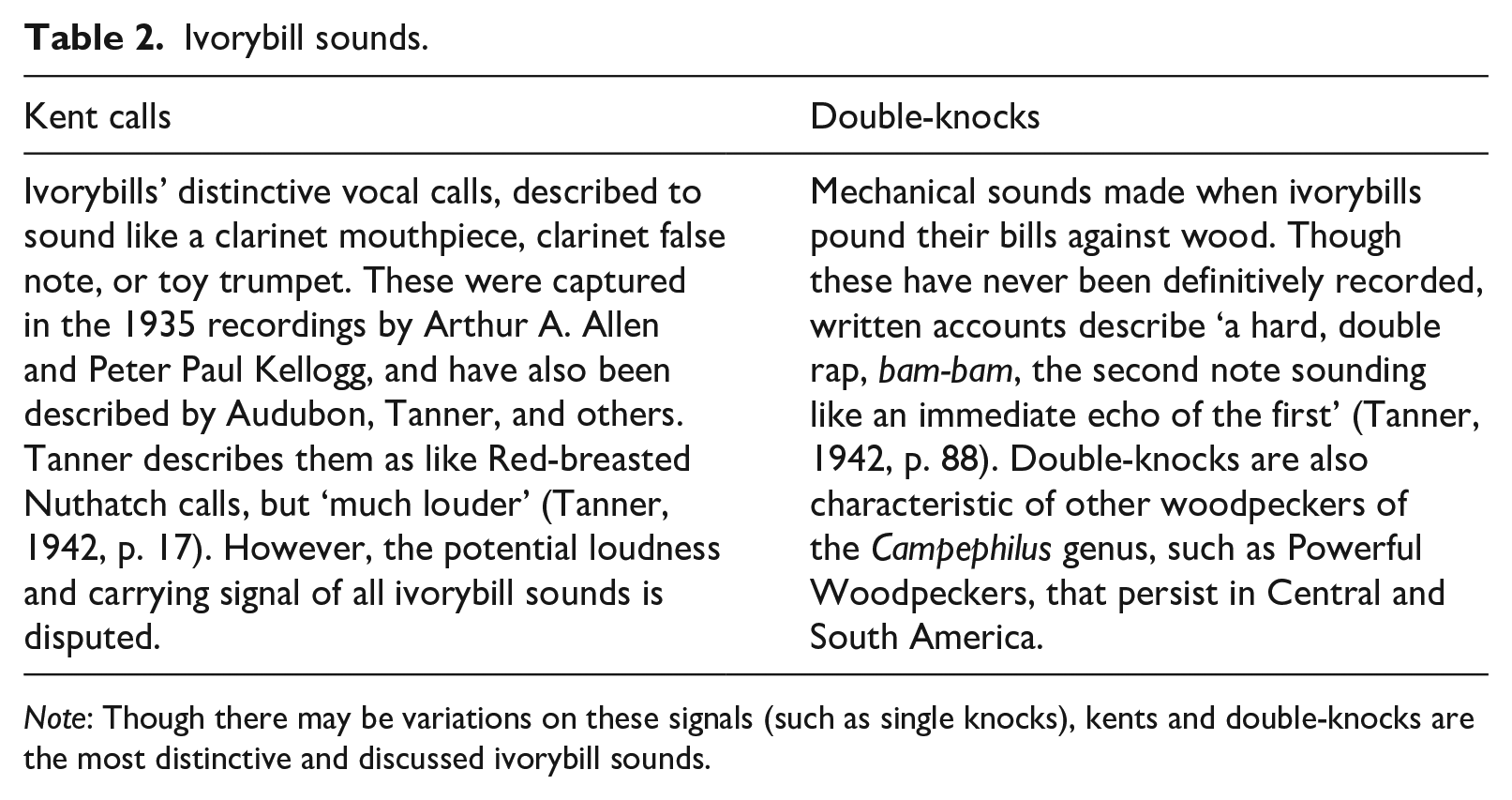
Note: Though there may be variations on these signals (such as single knocks), kents and double-knocks are the most distinctive and discussed ivorybill sounds.
Such fractured sources of sonic knowledge leave ample room for debate about ivorybill sounds, particularly as many of them contradict each other. For instance, Audubon referred to ivorybills as rather noisy (Audubon, 1831, p. 343), whereas the 1935 ivorybill recordists and observers from Cornell described the species as quiet and elusive (Allen & Kellogg, 1937). Audubon further described ivorybills as silent when flying, but a later naturalist, E.A. McIlhenny, claimed that they only made sound during flight (Jackson, 2006a, pp. 18–19). Additionally, the 1935 Louisiana recordings demonstrate the ivorybill’s distinctive nasal ‘kent’ calls coming in quick succession, whereas Hill describes the putative ivorybill calls his team recorded in 2006–8 in Florida as ‘separated by several or tens of seconds’ (Hill, 2007, p. 243). Indeed, though the 1935 recordings may be presumed the most stable source of sonic knowledge of this species, many question whether the behavior they capture is typical. The recording differs from some written historical descriptions (T. Gallagher, 2005, p. 70) and accompanying fieldnotes detail the recordists’ invasive recording methods, such as banging the tree containing the birds’ nest to elicit a response (Allen & Kellogg, 1937). Contemporary searchers’ cultivation of a shared sonic expectation of ivorybills is thus a space of ongoing negotiation and contestation, and individuals differently grab onto particular fragments to inform their sonic searches. For instance, consider this secondary account of a sighting in Arkansas: February 14, 2005: Casey Taylor, one of the full time searchers … heard a loud, distinct double rap .… She had listened to the double rap from the ARU [Autonomous Recording Unit] as well as recordings of a powerful woodpecker [(another Campephilus species)] and thought they sounded identical to what she had just heard. She pulled her canoe out and began making her way slowly and quietly southeast … trying to get closer to the source of the sound .… She saw the distinct shape of a large woodpecker, with a long straight bill and black-and-white plumage. Quickly raising her binoculars, Casey locked onto the bird for three or four seconds … She feels confident that the bird was an ivorybill (T. Gallagher, 2005, pp. 245–246).
Here, Casey had been ‘tuned’ to ivorybills through sonic traces—a previous putative double-knock recorded by the search team and recordings from another Campephilus woodpecker—and through situated listening was able to track similar sounds to a visual encounter with an apparent ivorybill. The sonic geography of ivorybill searching here thus spans spatial and temporal registers, where acoustic traces of the past, recordings of other species, the searchers’ attuned sonic skills, and putative ivorybill sounds at the search site come together to form an apparent ivorybill encounter.
The best sonic searchers, Courtman says, are local outdoorspeople with a solid ‘baseline’ of the sounds of Southern forests (personal communication). Since these people are already tuned-in to the sonic geographies of these areas, they are more sensitive to sounds that are out of the ordinary. For instance, Courtman once searched with two experienced hunters, one of whom had ‘hunted [in the North Louisiana woods] for over 50 years [and] has probably heard every sound in the forest’ (M. Courtman, personal communication). The group heard what they thought were double-knocks, sounds that can be and have been confused with gunshots. However, Courtman was more confident the sounds were ivorybills because the hunters had ‘never heard anything like [them] … they’re much more familiar with firearms—that was not a firearm’ (personal communication). This situated attunement might be a potential advantage that Mission Ivorybill, as a grassroots organization, has over previous institutional search teams that were largely made up of scientists and volunteers from out of state.
When listening, searchers usually try to be as quiet as possible, both so they are more likely to hear sonic clues, and so potential ivorybills will not be scared away. Collins argues that ivorybills are very wary which, combined with the assertion that they ‘lack conspicuous behaviors (such as loud and frequent calls)’ (Collins, 2021, p. 5), suggests that they are difficult to detect unless at close range, but this closeness is difficult to obtain. Collins deduces this from his own experiences in the field (where he has had several putative ivorybill encounters), and from the experiences of other searchers (e.g. Collins, 2021, p. 6). In this sonic imagination, ivorybills are so disturbed by human presence that, once they detect humans, ‘the bird may never return to that location’ (Collins, 2021, p. 5). Indeed, some postulate that ivorybills may have survived without detection due to ‘strong selection … to be very, very secretive’ (D. Mennill, personal communication). As such, in an online ‘Ivorybill Searcher Bootcamp’, Courtman presented just one rule for those acting as human listening posts: ‘NO talking!’ (Mission Ivorybill, 2021). Such efforts recognize the omnidirectional contact zone of these spaces, wherein the forest is an area of not only potentially sense-able ivorybill bodies, but also potentially sensing ones—and sensitive ones at that. This is a delicate geographical imagination with distinct consequences for search practices, as well as the active composition of the search area as a sonic space where ivorybills might be encountered.
Human bodies are not the only listening instruments that search for ivorybills. Autonomous Recording Units (ARUs) are sound recorders mounted in habitats to monitor wildlife. These were a new technology during the Auburn-Windsor searches, so the team constructed their own setup (D. Mennill, personal communication). This was complex given technological limitations at the time and the flood risk of the swamp: Their eventual creation involved digital recorders hooked up to dry-bag-covered motorcycle batteries and a microphone mounted high to avoid water damage. The battery lasted between 24 and 48 hours, and around 13 (at the peak) were scattered around the Choctawhatchee River banks. A searcher would periodically travel to these stations to replace their batteries and remove their memory cards, sending them to Mennill’s lab in Ontario, where undergraduate research assistants and/or automated analysis programs would review them (see Swiston, 2008). 5 Though these captures were sometimes presented as evidence for ivorybill presence (as I will explore below), the lab’s primary goal was to aid navigation: to quickly scan recordings so they could alert on-the-ground searchers to areas where ivorybills might be present.
ARUs were also a major part of Cornell’s search methods in the 2000s and in more recent independent searches. They are potentially critical to search efforts, as they can cover large areas, including areas with difficult terrain, and are thought to be less invasive than human listeners. In other words, they expand and, in theory, circumvent some of the knotty geographies of ivorybill searching, rearticulating forests as sites of ecological surveillance through networked, more-than-human listening (see Gabrys, 2012). Searchers have encountered several issues with ARUs, however, including their production of weak audio signals, which are difficult to analyze and follow to their source. In this regard, Collins, an underwater acoustician who compares searching for ivorybills in dense forests to locating submarines in the ocean, has advocated for ‘[a] horizontal array of microphones, [where] it would be possible to detect weaker sounds and determine the directions of sources’ (Collins, 2021, p. 30). However, Project Principalis, who recently deployed more than 90 small ARUs to attempt to localize an ivorybill nest cavity, faced other problems, like high financial costs and vandalism (M. A. Michaels, personal communication). And indeed, like all contemporary search methods, ARUs have not yet led to unequivocal proof of the species’ presence. As such, Courtman is cautious about using them, as he believes there could be a chance that the material presence of ARUs could distress ivorybills and compromise search efforts (M. Courtman, personal communication). Indeed, the sight, smell, and sound of camera traps—another remote sensing technology common in wildlife observation—have been shown to be detectable by mammals, potentially leading to their avoidance of sites where cameras are present (Caravaggi et al., 2020; McCorristine & Adams, 2020, p. 108).
Listening is a critical and contested method in ivorybill searching, and these practices are informed by and productive of multivarious sonic geographies. Through their situated practices of (and debates about) listening, searchers contribute to the production of extinction knowledge about ivorybills, as well as knowledge of the very facts of the species—what it would sound like, where it would be, how it would act. Additionally, listening methods affect the production of search sites as sonic spaces where extinction knowledge claims might (or might not) be made.
Sounding
Searchers, however, are not always silent. Audio playbacks of the 1935 Allen-Kellogg recordings are a common but controversial method for attempting to encourage responses from surviving ivorybills. For instance, in Cornell’s searches in the 2000s, playbacks would sometimes be deployed periodically as part of an area survey; in others, in response to a possible ivorybill encounter to encourage the bird to reveal themselves (Rohrbaugh et al., 2006, pp. 10–11). In their 2005-2006 season in Arkansas, the team deployed a ‘refined and streamlined protocol’ (p. 24) for playback, where searchers ‘broadcast a one-minute series of … kent-calls extracted from the 1935 Allen-Kellogg recordings, waited 15 minutes, then broadcast a one minute series of double knock drumming displays’ (p. 10). Since no undisputed recording of ivorybill double-knocks exist, the double-knock broadcast was a pileated woodpecker drum edited to sound like a Powerful Woodpecker (p. 11).
The 1935 recordings were also editorially ‘improved’ for their deployment: [T]he background noise between calls was completely eliminated and brought down to digital black. The internote distances remain the same between kent calls, but several pauses were added to avoid continuous calling during playback and to give field personnel a few seconds to listen for responses during the playback cycle. A brief fade was added prior to each kent but not over the actual call and a longer fade was added to the end of the call. The fades help limit reverberation but do not alter the call itself. (Rohrbaugh et al., 2006, p. 10)
Through these processes of editing and standardization, the 1935 audio recordings were crafted into instruments of field science. This follows the pattern of the historical shift towards mechanical bird sound recording practices described by Bruyninckx (2012, 2018), who explains how technologies like the parabolic reflector (Figure 2) allowed recordists to home in on birds’ sounds, detaching them from their contexts and pinning them down into ‘inscriptions’ that could be analyzed in the lab: part of a process he refers to as ‘sonic sterilization’ (Bruyninckx, 2012, p. 129). It is interesting, then, to observe the further practices of manipulation through which these same recordings are turned back into the ecological contexts they came from: transformed from ‘sterilized’ recordings intended for scientists’ ears and eyes into controlled field instruments intended for ivorybill auriculars, as well as fieldworkers’ ability to hear a response to them.
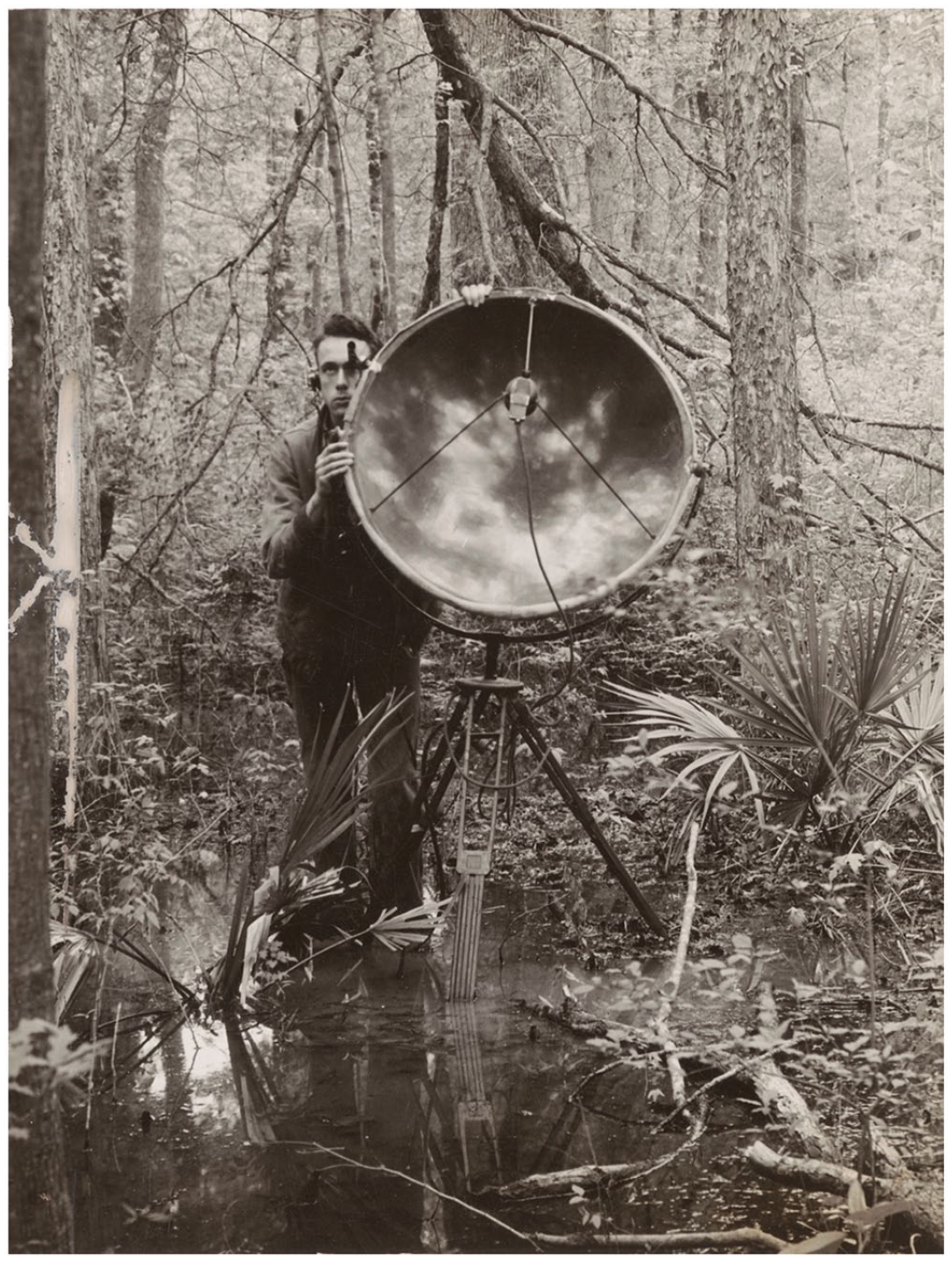
James T. Tanner aiming a parabolic reflector at ivory-billed woodpeckers in Louisiana in 1935.
After the 2005–06 field seasons, however, digital playback was de-emphasized as a search method in Cornell’s searches. It had a relatively small ‘carrying distance’ (Rohrbaugh et al., 2007, p. 36), so was not particularly helpful in sampling large, dense areas. Additionally, the weight and maintenance of the early-2000s digital playback equipment was burdensome for searchers, particularly given landscape conditions: ‘you fall in and out of the water, it’s muddy, it’s raining … [and] you’re crawling through really dense vegetation all the time’ (M. Lammertink, personal communication). A more geographically appropriate ivorybill communication tool was found in mechanical double-knock mimicry. This method can be traced back to Tanner, who wrote that ‘pound[ing] loudly on a wooden stub’ to imitate a double-knock would ‘sometimes make the bird answer by calling or rapping itself’ (Tanner, 1942, p. 42). Additionally, double-knock simulation has been successful in communicating with other Campephilus woodpeckers in South America. 6
While some searchers have banged planks of woods together or sticks against trees to mimic double-knocks, Lammertink—a lead scientist on the Cornell efforts—engineered a double-knocker tool for this purpose. This device comprises of two wooden sticks attached with a pivoting point that, when banged on a wooden box strapped to a tree, imitate the sound, rhythm, and resonance of an ivorybills’ ‘BAM-bam’. Since there is no undisputed recording of an ivorybill exhibiting this behavior, the double-knocker’s engineered interval between the two knocks was designed based on the relative body mass of the ivorybill compared to other Campephilus woodpecker species—the larger the species, the longer the interval (M. Lammertink, personal communication). These tools are described to have ‘a natural, “wooden” quality that carries far into the surrounding forest’ (Rohrbaugh et al., 2006, p. 24)—thus perhaps a more convincing and efficient mode through which to sonically trick surviving ivorybills than digital playback.
As well as improving the carrying distance and realism of sonic mimicry, these tools were created as standardization devices. Though freestyle banging on trees can sound convincing, the large and dispersed population of searchers involved in the Cornell searches made Lammertink concerned there would be ‘a huge difference between people in their consistency of … making a good double-knock signal’. The double-knockers were thus centrally produced and distributed among regional search teams, who were trained to follow a standard deployment protocol: ‘seven double-knocks spaced 10 seconds apart, followed by a four-minute pause, and then another seven double knocks at 10-second intervals’ (Rohrbaugh et al., 2007, p. 23). As with the manipulation of the 1935 recordings, the double-knockers and accompanying standard deployment disciplined double-knocks into field tools—things that are precise and repeatable. However, these sonic signals were impossible to standardize completely: For instance, conditions such as wind would likely have an impact on the distance double-knocks could travel, as well as whether a surviving ivorybill would respond (M. Lammertink, personal communication).
As with listening, the primary goal of double-knocking is to navigate towards visual encounter and documentation. Though the goal of a clear picture or video remains unfulfilled, there are many accounts of putative contact with ivorybills following double-knock mimicry. Often this takes the form of an apparent sonic response that can aid navigation, but at times double-knocking has led to potential visual encounters, for instance in this account from Michaels: Frank [Wiley] did a series of double-knocks. I saw a large bird come in and I kind of just got ‘woodpecker’ from it … Frank stood up to do another double-knock, the bird took off and I saw it fly—I got the underwing pattern but not very well. And … I thought it was an ivorybill … we put a trail-cam on the tree and a week later we got one of the images that I think really should be convincing [to other people]. (personal communication)
Here, sound acts as a bridging tool between searchers and ivorybills—cutting across species divides and dense forests in the way that cameras and lines of sight cannot. In so doing, these efforts conjure spaces of negotiation between the two species. Searchers send out signals, and putative ivorybills—along with the other more-than-human residents of the forest—can decide if and how to respond.
Sonic communication methods, however, are not embraced by everyone. Hill, for instance, wrote these instructions to future ivorybill seekers: [I]mitations of ivory-bill calls and knocks should absolutely never be used in the Choctawhatchee River basin. … There is no evidence that such sounds have any positive effect on your chances of seeing an ivorybill, but such sounds will corrupt our monitoring efforts and will mislead other birders into thinking they have detected an ivorybill. … I think we can all agree that when we hear a kent call or a double knock in the forests … we want to be confident that it is an ivorybill and not a human imitating an ivorybill. Let the ivorybills do the banging. You do the listening. (Hill, 2007, p. 241)
This passage encompasses several common criticisms of sound-making methods. Firstly, that they have not been proven to ‘work’. Contrary to the idea that ivorybills would be lured in or would respond to sonic mimicry, some believe that ivorybills are territorial birds that could be scared away from an area if they hear the apparent calls of other ivorybills. Some have even speculated that Cornell’s use of active sonic methods in the 2000s drove away what may have been an active ivorybill population from the search areas (M. A. Michaels, personal communication). Many of these concerns stem from insecurity about how little is known about ivorybill communication and behavior, and fear that what is true for other Campephilus species in South America might not be true for ivorybills—and, indeed, that what worked with the ivorybills Tanner encountered in the 1930s might not garner the same response in ivorybills today. 7 Courtman, for instance, has recently stopped using active sonic methods altogether, since he is ‘just not sure of what we’re communicating’ (M. Courtman, personal communication).
The other concern Hill highlights is that sound-making methods might ‘corrupt’ by misleading other searchers. Elsewhere, Hill describes an instance where one searcher heard a double-knock, but thought it was another searcher playing a trick on him. Even though this turned out not to be the case, Hill decided to set clear anti-mimicry rules so the team ‘would never have to wonder if something that we heard or recorded was a bird or a human making a sound like a bird’ (Hill, 2007, p. 107). This concern is not only relevant in the field: In the early days of ARU monitoring, Cornell sound analysts thought the ARU had captured a perfect kent call, but this eventually turned out to be fieldworkers broadcasting the 1935 recordings at the search site (A. Warde, personal communication). Though such problems were solved through diligent log-keeping (Fitzpatrick et al., 2006, p. 589), the team’s use of active acoustic methods cast doubt on any of their sonic evidence for some skeptics (e.g. Jackson, 2006b). On top of the possibility of confusing searchers, some have postulated if mimicking species like Blue Jays might begin to exhibit ivorybill-like vocalizations after being exposed to playback of the 1935 recordings, which could consequently confuse searchers further (R. Charif, personal communication).
Attempts like Hill’s to cast sonic discipline on search sites, as with the imposition of silence detailed above, are intriguing to consider in relation to Matless’s work on contested sonic geographies, where social debates about sound are argued to be moral and cultural expressions of place (Matless, 2005). Bans on sonic mimicry represent a ‘laboratization’ of the field site in an effort to maintain its authority as a space of knowledge production (Bruyninckx, 2012, p. 144). Indeed, Hill’s choice of the word ‘corrupt’ implies the existence of a pure field site that searchers’ sonic presence can compromise (see Hennessy, 2018). Field scientists often draw legitimacy from claims of noninterference—the efforts they go to in order to claim that their presence does not affect animals’ ‘typical’ behaviors (Alcayna-Stevens, 2016). The difference here is that searchers are not attempting to observe and document ivorybill behavior, but determine its presence. As such, active methods might be justified under conditions of encouraging this elusive species to exhibit atypical behavior in revealing themselves so their presence can be visually documented.
However, since there is still no irrefutable visual evidence of ivorybills in the 21st century, searchers’ cases for ivorybill survival usually gather variegated, ‘smaller’ traces like sound recordings, nest cavity measurements, eye-witness testimonies, and blurry video recordings (e.g. Fitzpatrick et al., 2005; Hill et al., 2006; Latta et al., 2023). Sonic traces thus sometimes become ‘evidence’ to be presented and scrutinized in academic journals. Under these conditions, sound-making methods are not only spaces of human-ivorybill negotiation, but sites of contestation between different searchers and scientists about what kinds of methods ‘work’ and evidence ‘counts’ in a physical and conceptual landscape where these two goals can interfere with one another.
Translating
Sound becomes evidence of ivorybill presence through the capture, translation, analysis, and circulation of field recordings. The ivorybill and its sounds are (perhaps literally) ‘absent things’ (Latour, 1986, p. 8) that must be made ‘present’ and thus become political subjects worthy of conservation intervention (Hinchliffe, 2008, p. 93). In both the Cornell and Auburn-Windsor searches in the 2000s, their efforts included centralized labs for analyzing ARU recordings for ivorybills. These acted as ‘centers of calculation’ (Latour, 1987) where field information was further translated into inscriptions to be analyzed and then disseminated back to the field and to broader audiences. In Cornell’s case, field audio was processed in a sound analysis lab in Ithaca, New York. Through the Extensible Bioacoustic Tool (XBAT), audio data was visualized into spectrograms, scanned for events of interest by an automatic Data Template Detector, and then human sound analysts would closely scrutinize the highlighted events (Rohrbaugh et al., 2006, pp. 13–14; A. Warde, personal communication). As in field listening methods, the Detector and analysts assessed recordings based on their likeness to known ivorybill recordings and recordings of other Campephilus woodpecker species (Rohrbaugh et al., 2006, p. 13). However, the lab analysis process was predominantly visual, and thus likeness was quantified based on the pattern the sonic signals generate on a spectrogram.
Spectrograms visualize the frequency content of a sound signal over time, where the strength of the signal at a particular frequency is represented by the brightness. Spectrograms are common in bioacoustics, partially due to the high pitches and fast cadence of birdsong, as well as the belief that they offer a more ‘objective’ form of analysis (Mundy, 2009). Additionally, ARUs, which are now widely used in ecological surveys of all kinds, collect huge amounts of data, making listening with human ears not only inefficient, but often impossible to do in entirety (Vallee, 2018, p. 58). In their 2006 and 2007 searches, for instance, the Auburn-Windsor team collected over 46,000 hours of ARU recordings (Swiston, 2008, p. 28). Even with the help of their 21 research assistants, listening to all of this would be unreasonable. Trained analysts scanning recordings visually, with the assistance of automated detectors trained on the same template sounds, streamlined and standardized the acoustic analysis protocol.
A significant advantage of spectrograms is that they appear to allow for ‘immutable’ circulation, and for one set of sounds to be quantifiably measured against another. For example, Collins’ analyses of his putative ivorybill recordings explains that they ‘are composed of simultaneously excited harmonics .… This simple structure is characteristic of all known and putative recordings of Ivory-billed Woodpecker vocalizations’ (Collins, 2011, p. 1672; see also Hill et al., 2006). The ‘excited harmonics’ Collins describes are what make up the distinctive ladder-like pattern of the visualized 1935 recordings (Figure 3). Beginning with the ‘fundamental frequency’—the lowest frequency that comprises a kent call—the simultaneous harmonics of each call appear as several horizontal lines placed at regular ascending intervals up the frequency axis. Though no two kent calls are identical, a structural similarity between a contemporary recording and the 1935 series could be persuasive for ivorybill presence.
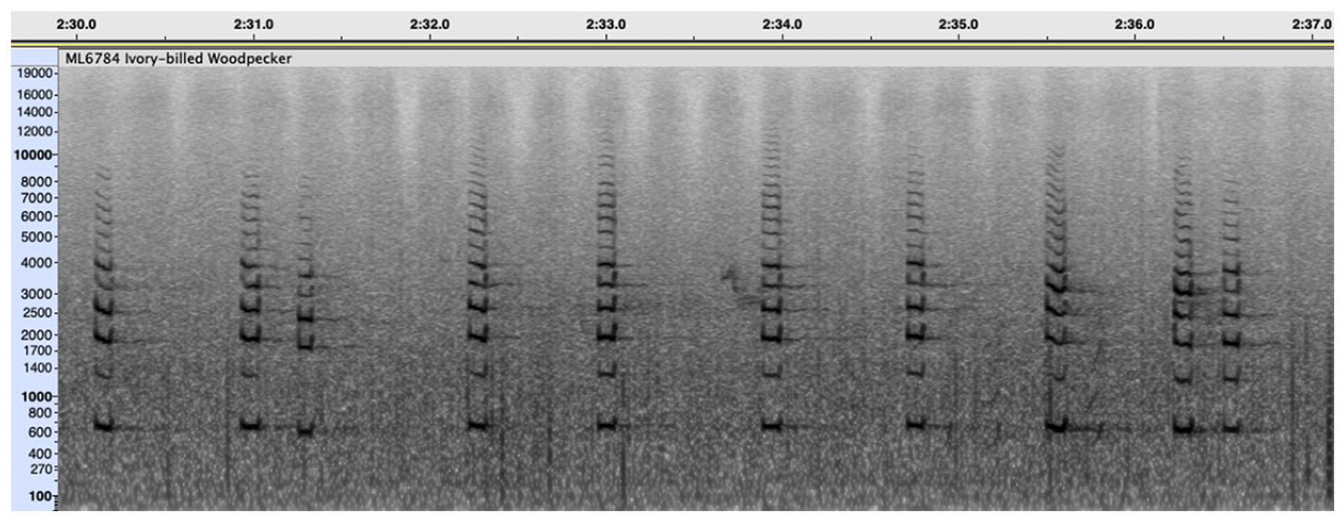
Acoustic structure of Ivory-billed Woodpecker Kent calls.
As well as aiding real-time navigation, particularly compelling acoustic events were presented in journal articles and talks about ivorybill persistence (Fitzpatrick et al., 2005; Hill et al., 2006). Such events, first identified in the automated and analyst detection stage, would then go through further processes of analysis and grading. For instance, the Cornell team detailed a 3-stage review process of sound events in their 2005–06 search effort: The first stage was initial manual screening of events flagged by the automated template detector, where events determined to warrant further review were passed to the second stage of screening by a larger team of acoustic analysts. The final stage was review by a ‘panel of three or more experts (outside of the acoustic analysis team)’ (Rohrbaugh et al., 2006, p. 14). Sounds that passed through all these stages were considered worthy for ‘future, more scientifically rigorous analysis’ (Rohrbaugh et al., 2006, p. 14) to determine whether the events might indeed be ivorybills. In the Auburn-Windsor team’s similar process, this has included quantifying the relative amplitude, frequency, and length of the sounds against known ivorybill recordings (Hill et al., 2006).
It is through these processes of translation and analysis that sound becomes an object of scientific knowledge: a quantitative and standardized slice of the world that can be measured, compared, and circulated. Searchers draw legitimacy from such measurements and processes in a landscape of skeptics that often accuse searchers of ‘seeing what they want to see and hearing what they want to hear’. For instance, Charif, the leader of Cornell’s acoustic search, showed me a ‘multidimensional scaling plot’ that was used in talks after the rediscovery announcement. This compared the strongest of the team’s ARU recordings taken on the White River in Arkansas in January 2005 to the 1935 ivorybill recordings and calls of similar-sounding species like Blue Jays. This process ‘basically superimposes the … spectrographic images of two sounds upon each other’ (R. Charif, personal communication; see Latour, 1986, p. 19). In this plot, the White River recordings came out closest in similarity to the 1935 recordings, ‘which basically was a fully objective verification of the subjective impression that “yeah, they sound kind of like ivorybills” … it’s not based on what anybody thought they sounded like, it was just based on actual machine extracted acoustic measurements’’ (R. Charif, personal communication, emphasis added).
Still, the attuned sonic skills of searchers and analysts have been critical to the search effort. For instance, in the Auburn-Windsor search, human analysis of ivorybill sounds was found to cause fewer false detections than the machine algorithm did (Swiston, 2008). Analysts were able to listen to the recordings in context—which, as I will explore below, is particularly critical in this case. Moreover, acoustic analysts are people with specific skills and perspectives. For instance, Warde was an analyst with Cornell who had significant bioacoustics analysis experience and training as a musician. The latter, she believes, was part of her strength as an analyst: Though the process was primarily visual, she was able to ‘hear the sound of what [she] was seeing’ in her mind—like notes on a sheet of music (A. Warde, personal communication, June 3, 2022). Like the local hunters who interpreted sounds through their situated knowledge of the forest, Warde encountered the spectrograms through her skilled sensory attunements. The fact that both university-based search teams’ analysis protocols culminated in expert panel reviews shows neither mechanical objectivity nor human interpretation alone were considered sufficient. In most cases, algorithmic detections, individuals’ situated, trained skills, and quantitative measurements worked together to translate sound recordings into potential evidence.
Despite these processes, Charif stressed that even the strongest recordings from White River weren’t ‘proof of anything’, but instead ‘very intriguing evidence’ (R. Charif, personal communication). One issue for the persuasiveness of these putative ivorybill recordings is that there is such limited information about ivorybill sounds. There is only one undisputed sound recording series to compare against: one that is rather short, controversial, and difficult to replicate. As Michaels told me, ‘the [1935] recordings from the Singer Tract are like a Hollywood movie … so everybody, the public expectation, and even the scientific expectation, is for something that’s impossible to obtain in the real world’ (M. A. Michaels, personal communication). The parabolic reflector used by the 1935 recordists (Figure 2) is ‘like an incredible zoom lens .… That recording was made at a nest tree so they were very close, [and] they had a super high gain microphone. … the recordings that you pick up from distant birds [with ARUs] are nothing like that’ (R. Charif, personal communication). This is largely an issue of signal-to-noise ratio (SNR): the relative strength of the desired signal (here, the ivorybill sounds) against background noise. ARUs, however, by design pick up sounds indiscriminately: they capture soundscapes with lots of information (other species, weather, human presence, etc.), which may or may not contain ivorybills far away or in passing. Any surviving ivorybills included in these sonic captures, then, would likely sound and look (on a spectrogram) quite different than the 1935 recordings (A. Warde, personal communication).
Despite efforts to sonically control the field through searchers’ discipline, standardized methodologies, and technologies, the soundscapes of search sites are cacophonous. ‘Sound-alikes’ are signals made by other creatures or processes that, especially when picked up by an ARU, sound or look (on a spectrogram) a lot like ivorybills. For kent calls, suggested sound-alikes include Blue Jays, Gray Squirrels, Fish Crows, White-breasted Nuthatches, or digital playback; for double-knocks: gun shots, branches snapping, raindrops, or searchers’ double-knock mimicry. Many involved in recent searches initially thought kent calls to be distinctive enough that sound-alikes wouldn’t be an issue: ‘if you were to say to anybody who knows North American birds … who has listened to the [1935] Allen-Kellogg recordings, like “suppose I tell you that you could confuse a Great Blue Heron for an Ivory-billed Woodpecker”, they would think you were absolutely out of your mind’ (R. Charif, personal communication). Part of the problem, Charif says, is that ‘when you have tens of thousands of hours of recordings, you also get recordings of very unusual anomalous sounds, which are not the typical sounds of that species’. Additionally, though ivorybill sounds are somewhat distinctive, the acoustic structure of kent calls and especially double-knocks are relatively simple, and thus vulnerable to spectrogram look-alikes (M. Lammertink, personal communication). When combined with the SNR issue, false detection of ivorybill sounds was a real concern, and sound-alikes continue to be a common retort against acoustic evidence.
These issues can be somewhat solved by listening to the detections in context. For instance, something that sounds unmistakably like an ivorybill might morph into another species after a few vocalizations or with additional context (R. Charif, personal communication). One paper, for example, suggested that some of Cornell’s ARU recordings of double-knocks were instead ‘wing beats’ produced by Gadwall ducks (Jones et al., 2007). The authors argued that Gadwall ducks had been recorded in other contexts to make such sounds, and that their vocalizations were audible in some of Cornell’s putative ivorybill recordings (Jones et al., 2007). For all these reasons, a close quantitative match between an ARU recording and the template sounds would not necessarily mean the recording was an ivorybill. Indeed, the process of translating sounds into recordings, and then into spectrograms, is not totally immutable—not only because background and contextual sounds around specific events might be lost, but also because field recording conditions and spectrogram processing choices affect the final appearance of the image. In other words, this is translation with corruption, in subtle but significant ways.
Sound is thus rarely emphasized in arguments for the ivorybills’ persistence. The recent preprint article by Project Principalis put it bluntly: ‘because of the nature of the known sounds of Ivory-billed Woodpeckers, auditory evidence of the presence of this species is unlikely to be generally persuasive … therefore, our audio data are not further described’ (Latta et al., 2022, p. 5). 8 The idea that sound as a form of evidence does little to ‘move the needle’ (M. Courtman, personal communication) in this debate came up frequently in my interviews and in ivorybill literature. Typically, sound recordings are not presented alone, but as part of a wider body of evidence (see e.g. Fitzpatrick et al., 2005; Hill et al., 2006; Latta et al., 2023). Even in context, though, sound recordings seem to hold little weight, and the recent proposal from the USFWS cited the lack of ‘objective evidence’ such as ‘clear photographs, feathers of demonstrated recent origin, specimens, etc.’ (USFWS, 2021, p. 54307) as a reason for their delisting recommendation. Whatever this ‘etc.’ refers to, it does not seem to be sound recordings.
This is not to say that sound can never offer consequential evidence in science, 9 but rather that, in this case, the physical and conceptual geographies of ivorybill searching limit sound’s persuasiveness. In addition to the issues outlined above, there are the limits to the contemporary acoustic evidence itself: Many of the ARU recordings not only have weak SNR but are also rare and generally brief. Both Mennill and Lammertink, who have studied other Campephilus species in Central and South America, pointed out that the ivorybill-like captures of the Cornell and Auburn-Windsor searches were atypical of these kinds of birds: ‘whatever is producing those sounds that we’ve got on the Choctawhatchee is not producing the double-knock and the kent sounds very often … if this is an Ivory-billed Woodpecker, why isn’t it double-knocking 100 times in a morning? Why are we getting 5 or 10 double-knocks in a day and not many, many more than that?’ (D. Mennill, personal communication). Although there are several contemporary recordings that these scientists still find intriguing, all the issues discussed in this section make it unlikely that the conservation community will be convinced of ivorybill survival from sound recordings alone, or even in context with other forms of evidence. This is especially true given widespread ornithological skepticism about ivorybills: In such a beyond-belief, high-stakes case, there is little room for ambiguity. The capture, translation, and analysis of field sound recordings are thus of most use when circulated back to the field to inform searchers’ navigation. That is to say, in their role of expanding and quantifying the listening geographies of search sites towards the goal of an irrefutable video or photograph of an ivory-billed woodpecker.
Conclusion
If an apparently extinct bird calls in a forest and someone is there to hear it—to record it, even—is it still extinct? This article joined STS and sonic geography to explore the intersections of sound, space, and knowledge production in the search for the ivory-billed woodpecker. I argued that the sonic geography of ivorybill searching is a lively physical and conceptual space of negotiation and contestation: where sound is made and heard, how it moves within and beyond the field, how searchers’ sonic expectations are cultivated—and debates about all these issues—are all critical to the making of extinction knowledge, as well as more-than-human imaginations and experiences of ivorybill search areas. Sonic geographies shape extinction knowledge production, and extinction knowledge production shapes sonic geographies.
It is not only sound and space, but their interrelations that are of core importance in the production of knowledge. For instance, ivorybill searchers not only listen and make sound, but do so in the context of particular sites (e.g. the knotty physical geographies of the swamp) and in relation to circulations of knowledge (e.g. historical sound recordings and other searchers’ experiences). At the same time, sonic methods such as silence, sound making, and ARUs are themselves productive of space, articulating particular geographical imaginations (e.g. of the ‘pure’ field site), as well as generating spaces of negotiation and contestation where extinction knowledge might be made. In addition, sonic knowledge will not always be deemphasized in science, but is in this case, despite efforts of translation, because of the complex conceptual and physical geographies of ivorybill knowledge production. Such contested sonic-spatial relations are of course heightened in this case, where both the stakes and burden of proof are incredibly high.
A sonic geography focus illuminates the entangled impact of situated individuals, physical spaces, geographical imaginations, and circulation in the production of knowledge. In addition, focusing on one spatial-sensorial mode can be a rich methodological approach for exploring complex and contested scientific cases. With this focus, this article was able to span diverse spatial and temporal contexts, including intimate field encounters, debates in academic journals, and the skills of particular actors. Through this, I displayed some of the core practices and debates of ivorybill searching, so that we might better understand this important case more broadly. As more species fall into the liminal zone of gray extinction, there will be many more lost creatures to search for. Gaining a richer understanding of such searches is an important step for better elucidating the place, practices, and consequences of science and conservation in the sixth mass extinction. 10
Footnotes
Acknowledgements
Laura Jean Cameron, Claudia Towne Hirtenfelder, Brendan Smith, and the Cornell Department of Science and Technology Studies’ Science Studies Reading Group provided helpful comments on earlier iterations of this article. Three anonymous reviewers also provided immensely valuable feedback that greatly improved this contribution. I would like to thank Vishal Nyayapathi for their archival research assistance, and the staff of the Division of Rare and Manuscript Collections, Cornell University Library for their help navigating the archives. My deepest thank you also to the research participants in this project who so generously offered their time and expertise.
Declaration of conflicting interests
The author declared no potential conflicts of interest with respect to the research, authorship, and/or publication of this article.
Funding
The author(s) disclosed receipt of the following financial support for the research, authorship, and/or publication of this article: This work was supported by a Social Sciences and Humanities Research Council Vanier Canada Graduate Scholarship and a Mitacs Globalink Research Award.
