




Abstract
This article unpacks the logic of the equivalence invoked by the Government of Canada between Indigenous consent and the inclusion of Indigenous peoples and knowledges in impact assessment. We situate the logic within the politics of recognition in Canada—a politics that aims to shore up national unity in the face of regular challenges to it. We use the Canadian results from a recent scoping review on conceptions of environmental justice in impact assessment to highlight the challenges of invoking recognition, and we provide a theoretical analysis of these challenges. To do this, we highlight the ways in which ‘we-making’ is ‘knowledge-making’ and ‘knowledge-making’ is ‘we-making’. In this sense, recognizing Indigenous knowledges is part of Canada’s answer to the challenge of constructing and stabilizing a political ‘we’: a community of political subjects with shared connection to a nation state via the institutional, social, and cultural apparatuses that generate the kind of publicly visible legal and technical knowledge upon which the state’s authority depends. We show how this project relies on actively obscuring the relationship between ‘we-making’ and ‘knowledge-making’ by treating ‘knowledge-making’ as neutral and un-situated, putting into practice a universalist logic. This logic shores up power because obscuring the situatedness of dominant knowledges also obscures the situatedness of the dominant political orders with which they are intertwined. We ultimately argue that Canada’s approach to recognizing Indigenous knowledges helps consolidate power by sidestepping ongoing jurisdictional struggles with Indigenous peoples.
Keywords
In the winter of 2020, rail lines, highways, and ports across Canada were shut down and large demonstrations were held across the country by people acting in solidarity with Wet’suwet’en hereditary chiefs and supporters. These chiefs and supporters had been arrested by officers of the Royal Canadian Mounted Police (RCMP) when they refused to vacate the camp and healing centre they had built on Wet’suwet’en territory directly on the construction route of the Coastal Gaslink Pipeline (APTN News, 2020; Bracken, 2021; Unist’ot’en Camp, 2020). At immediate issue were disagreements over who had jurisdiction to grant Coastal GasLink permission to undertake their pipeline project. Wet’suwet’en hereditary chiefs had been clear in their refusal of the project; however, it had received regulatory approval from the Province of British Columbia, and Coastal GasLink (CGL) had signed agreements with 20 of the 22 elected First Nations band councils along the pipeline route.
During an emergency Parliamentary debate about these events, Canadian politicians argued about how the principles of the 2007 United Nations Declaration on the Rights of Indigenous Peoples (UNDRIP) might apply to this and similar ongoing conflicts in Canada. Of particular concern was how to understand the notion of free, prior, and informed consent (FPIC) within UNDRIP. For some, the conflict over Coastal Gaslink was a prime example of the risks of endorsing the consent standard. This was a re-hashing of a long-standing debate (for a short timeline on this debate see Borrows et al., 2020, p. 4). Conservative Party politicians had resisted signing on to the UNDRIP over concerns that FPIC implied that Indigenous peoples 1 held veto powers over projects on their territories. Indeed, when a Conservative government was at the helm in 2007, Canada was one of four countries to vote against the adoption of UNDRIP (Imai, 2017, p. 377). More recently, under a Liberal Party government, Canada adopted the UNDRIP Implementation Act (Government of Canada, 2021). Despite the adoption of this act, the interpretation of FPIC remains a matter of debate and political struggle. There is a general consensus that FPIC represents a departure from the duty to consult and accommodate framework developed by the Supreme Court of Canada over the last several decades (Beaton, 2018; Hamilton, 2018; Imai, 2017; Leydet, 2019; Mitchell et al., 2019); however, opinions about the nature and extent of this departure vary considerably.
It was in the context of this ongoing struggle that Minister of Crown–Indigenous Relations, Carolyn Bennett, took the debate over resistance to the Coastal GasLink pipeline as another opportunity to counter the worries of Conservative Members of Parliament that supporting FPIC means supporting the right of Indigenous peoples to refuse projects on their territories. Bennett repeated her government’s position that ‘[c]onsent is not a veto’ (Canada, 2020). Instead, according to her, consent ‘means that Indigenous peoples and Indigenous knowledge will be mandatory at the very beginning of a proposal for any major project’. It is about ‘striving to achieve consensus as parties work together in good faith on decisions that impact Indigenous rights and interests’. Her statement drew an equivalence between the inclusion of Indigenous knowledges (IKs), on the one hand, and consent for resource development projects, on the other. This comment was not just made to get Bennett out of a political mess. Rather, it was a nod to her government’s painstaking and controversial effort to overhaul the impact assessment processes that govern decision-making about federally regulated resource extraction projects (see Impact Assessment Act, 2019). A key aim of this overhaul has been to achieve greater consensus from members of the public and Indigenous peoples. Reforming the ways in which IKs are included in assessments is an important part of this legislative change.
Here we unpack the logic operating in Bennett’s statement and draw out its political stakes. How is it that the inclusion of IKs comes to stand in for Indigenous consent? To consider this question, we begin by detailing the Canadian government’s efforts related to IKs in impact assessment (IA). We characterize these efforts as attempts at epistemic recognition and situate them within a broader Canadian political culture shaped by the politics of recognition more broadly. We then draw on the results of a recent scoping review of literature on conceptions of environmental justice in impact assessment (Blue et al., 2021) to highlight the ways in which this effort at epistemic recognition comes up short in practice. From there, we provide a theoretical analysis of the roots of these shortcomings, starting from the premise that the construction of knowledge and the construction of legal and governance institutions go hand in hand. We illustrate the ways in which ‘we-making’ is ‘knowledge-making’ and ‘knowledge-making’ is ‘we-making,’ not only within liberal democracies like Canada’s, but also in several Indigenous knowledge and political traditions. Finally, we contrast this account of ‘we-making’ and ‘knowledge-making’ with the approach to ‘we-making’ that is embedded in Canada’s efforts at epistemic recognition. Epistemic recognition is part of Canada’s answer to the challenge of constructing and stabilizing a political ‘we’: a community of political subjects with shared connection to a nation state via the institutional, social, and cultural apparatuses that generate the kind of publicly visible legal and technical knowledge upon which the state’s authority depends. We demonstrate how epistemic recognition relies on actively obscuring the inseparability of ‘knowledge-making’ and ‘we-making’ by treating ‘knowledge-making’ as neutral and un-situated. We ultimately argue that this obscuring further consolidates the power of the Canadian state and of the dominant 2 knowledge systems with which it is co-produced. We show how the logic implicit in the idea that consent is about the inclusion of Indigenous peoples and knowledges is a universalist logic that acts against fundamental insights from STS scholarship.
Impact assessment and Canadian politics of recognition
Recent efforts to formalize the inclusion of Indigenous knowledges in impact assessment are efforts to extend the Canadian politics of recognition to epistemic matters. The relevance of IKs in technical decision-making has been referenced in Canadian legislation since 1999 (McGregor, 2021, p. 6); however, in the day-to-day operations of the Federal government these knowledges ‘were “dealt with” on an ad-hoc basis at the discretion of managers, scientists, and others from the relevant agencies’ (p. 6). Formal processes for recognizing IKs were established more recently. In 2017, the Aboriginal Traditional Knowledge: Process and Protocols Guidelines document was created under the Species at Risk Act. In 2019, these priorities were also formally established with respect to impact assessment when the Liberal government successfully overhauled the existing legislative framework for reviewing resource extraction projects in the country.
In so doing, the Liberals delivered on a major election promise. Environmental assessment (EA) was a key election issue during the 2015 federal election campaign in Canada. Re-orienting the legislation from environmental assessment to the broader and more holistic impact assessment was one of many strategies aimed at restoring faith in the assessment process across the board (see Doelle, 2018; Doelle & Sinclair, 2019). The Liberals had support for an environmentally ambitious impact assessment tool from those angered by how the prior Conservative government had scaled back environmental overview of development as part of a general ‘gutting’ (NDP, 2012; see also May, 2012; The Narwhal, 2012) of environmental legislation in the country. At the same time, many Canadians were equally upset that development projects were stalling, mired in legal challenges and resistance from Indigenous peoples and environmental groups. The Minister of Environment and Climate Change even subjected the proposed bill to a series of cross-Canada public ‘roundtable’ conversations and accepted submissions from academics and non-governmental groups that were intended to weigh into the legislation as it was being written. Despite the ambition to account for a broad review of social, rather than just technical, considerations, the legislation was highly controversial. It faced multiple hurdles while moving through the legislative process. The controversy did not end once the new Act was adopted. While many certainly do see it as a significant improvement, it continues to attract criticism. Pierre Poilievre, the popular new leader of the Conservative Party, has promised to, if elected, ‘scrap “anti-energy” laws’ such as the new Impact Assessment Act (Quon, 2022). At the same time, others argue that the Act retains too many pathways for environmentally harmful projects to get approved (Johnson et al., 2021) and fails to recognize Indigenous jurisdiction (King & Pasternak, 2018).
Criticisms of the Impact Assessment Act related to Indigenous jurisdiction speak to the importance of this legislation for ongoing struggles over Indigenous rights. Through adjudicating disputes over projects subject to federal assessments, the Supreme Court of Canada has developed its jurisprudence related to the duty to consult and accommodate framework (Imai, 2017). Under this framework, the final decision on whether the government’s duty to respect Indigenous rights has been met is assumed to rest with the Supreme Court of Canada. The framework takes for granted the Crown’s exclusive jurisdiction and assumes that Indigenous peoples are in a subject-to-sovereign relationship with the Crown (Nichols, 2018). This understanding goes against a vision of shared jurisdiction and legal pluralism in Canada (Borrows, 2010) which several Indigenous law scholars see as being aligned with the UNDRIP (Borrows et al., 2019, 2020; Craft et al., 2018). This is a vision that rejects the ‘doctrinal unilateralism’ (Hamilton, 2018, p. 107) that characterizes the duty to consult and accommodate framework and affirms a strong interpretation of Indigenous jurisdiction—one that includes respecting Indigenous peoples’ right to withhold consent. It is precisely the rejection of unilateralism involved in many interpretations of the UNDRIP that Conservative analysis views as dangerous (Christie, 2018). 3 While the Liberals have affirmed their desire for a less unilateral approach, they have been criticized by Indigenous rights advocates for advancing a narrow vision of Indigenous jurisdiction that does not actually do away with unilateralism (Diabo, 2019; King & Pasternak, 2018).
Indeed, within the new impact assessment legislation, the official legal and policy justification given for including IKs does not mention jurisdiction. Rather, including IKs is justified on the basis that it will enhance prediction and deliver credible data in service of evidence-based decision-making. Impact assessments are expected to ‘look at both positive and negative environmental, economic, social, and health impacts of potential projects’ (Impact Assessment Agency of Canada, 2020) in order to ‘contribute to informed decision making on major projects in support of sustainable development in Canada’. IKs are expected to contribute to this process. The Impact Assessment Act specifies that IK ‘enhances the understanding of the potential environmental, social, health and economic impacts of projects’ and is meant to support ‘determining the effects that are likely to be caused by the carrying out’ (Impact Assessment Act, 2019, sec. 3.1) of a proposed project. 4 This understanding of the role of IKs in IA is echoed in the Draft Indigenous Knowledge Policy Framework for Project Reviews and Regulatory Decisions (Impact Assessment Agency of Canada, 2021, p. 6).
The implementation of this new formal role for IKs is supported by an Indigenous Advisory Committee made up of First Nations, Inuit and Métis people with a mandate to ‘provide the [Impact Assessment] Agency [of Canada] non-political advice reflecting the interests and concerns of the Indigenous peoples of Canada for the development of key policy and guidance’ and to ‘advise on approaches for collaboration and engagement with Indigenous peoples on policy and guidance products’ (Impact Assessment Agency of Canada, 2020a). Early on in the Committee’s mandate, IKs were identified as one of the ‘[p]riority areas for policy development and guidance’ (Impact Assessment Agency of Canada, 2019, p. 4). This mandate related to IKs is ‘distinct from that of the Technical Advisory Committee on Science and Knowledge’ (Impact Assessment Agency of Canada, 2020a). Instead, there is a Sub-Committee of the Indigenous Advisory Committee established to ‘inform the development of the Interdepartmental Indigenous Knowledge Policy Framework’ (Impact Assessment Agency of Canada, 2020b) that applies to the Impact Assessment Act, Canadian Energy Regulator Act, Canadian Navigable Waters Act, and to fish and fish habitat provisions in the Fisheries Act. The principles for developing this framework were made available in August 2020, and a draft framework was released in July, 2021 (Impact Assessment Agency of Canada, 2021).
This framework includes the principle that ‘both Indigenous knowledge and western scientific knowledge systems should be equally valued and used in tandem’ (p. 4) during IA processes. While the meaning of ‘equally valued’ is never spelled out, this is clearly a project aimed at remedying the systemic exclusion of IKs within IA. This move could be fruitfully analyzed through the lens of epistemic justice (Fricker, 2007) or by picking up certain threads of feminist and postcolonial STS (Harding, 1998, 2008, 2011; Seth, 2009). In this article, though, we are especially interested in how this effort to ‘equally value’ Indigenous and dominant knowledges can be understood as part of a politics of recognition, and in how this politics relates to the exercise of political power. The stated aim of ‘equally valuing’ Indigenous and dominant knowledges represents an attempt to address status-based inequities. This aligns with Fraser’s (2008) formulation of recognition, which considers overcoming these kinds of inequities as addressing the cultural dimensions of decision-making, helping to achieve participatory parity in political processes by ‘dismantling institutional obstacles that prevent some people from participating on par with others’ (p. 405, see Blue et al., 2021 for a longer discussion). Owing to the specifically epistemological nature of the aim of ‘equally valuing’ Indigenous and dominant knowledges in IA, we refer to this specific project as one of epistemic recognition.
This effort at epistemic recognition is reflective of a broader orientation towards recognition in Canada. If elsewhere political struggles for justice have often been struggles for inclusion into a common ‘we’, in Canada these struggles have just as often been struggles against incorporation or assimilation into such a ‘we’. These include struggles for sovereignty and against violent assimilation by Indigenous peoples (Manuel & Derrickson, 2021; Obomsawin, 1993; L. B. Simpson, 2017), struggles among francophone Quebeckers to assert their own distinct nationhood (Dagenais, 2020; Hébert & Lapierre, 2015), struggles among French-speaking and English-speaking minority groups in different provinces to resist assimilation into the social world of the dominant colonizing group (Blay, 1987; O’Donnell, 2021), and struggles among different cultural and ethnic groups in the country to retain rights to maintain their own cultural practices and legal traditions (Janzen, 1990; Korteweg & Selby, 2012; Moon, 2009). The paradigm of recognition has offered tools for the federal government to overcome these challenges since at least the late 1980s, after the Canadian constitution and its Charter of Rights and Freedoms were enacted, and as controversies about this process and its implications played out over the years that followed with respect to group and minority rights 5 as well as the law. 6
Epistemic recognition in Canadian impact assessment
The results of a scoping review we recently conducted further confirm the influence of the paradigm of recognition in Canada. In this review, we typologized definitions and operationalizations of ‘environmental justice’ in international English-language peer-reviewed journal articles about impact assessment published between 2000 and 2020, drawing on a tri-valent understanding of environmental justice as consisting of distribution, representation, and recognition (see Fraser’s framework refined by Schlosberg, 2009, 2013). The 249 articles we reviewed often addressed representational justice (85%), relatively frequently (41%) addressed distributional justice, and less frequently (30%) addressed recognitional justice. Viewed geographically, though, this broad picture became much more nuanced. Figure 1 illustrates how articles about the US strongly emphasized distributional justice, while articles dealing with cases in Canada, Mexico, Central & South America 7 were most concerned with issues of recognition—so much so that they appear as significant outliers in comparison to the other geographic regions represented in the literature.
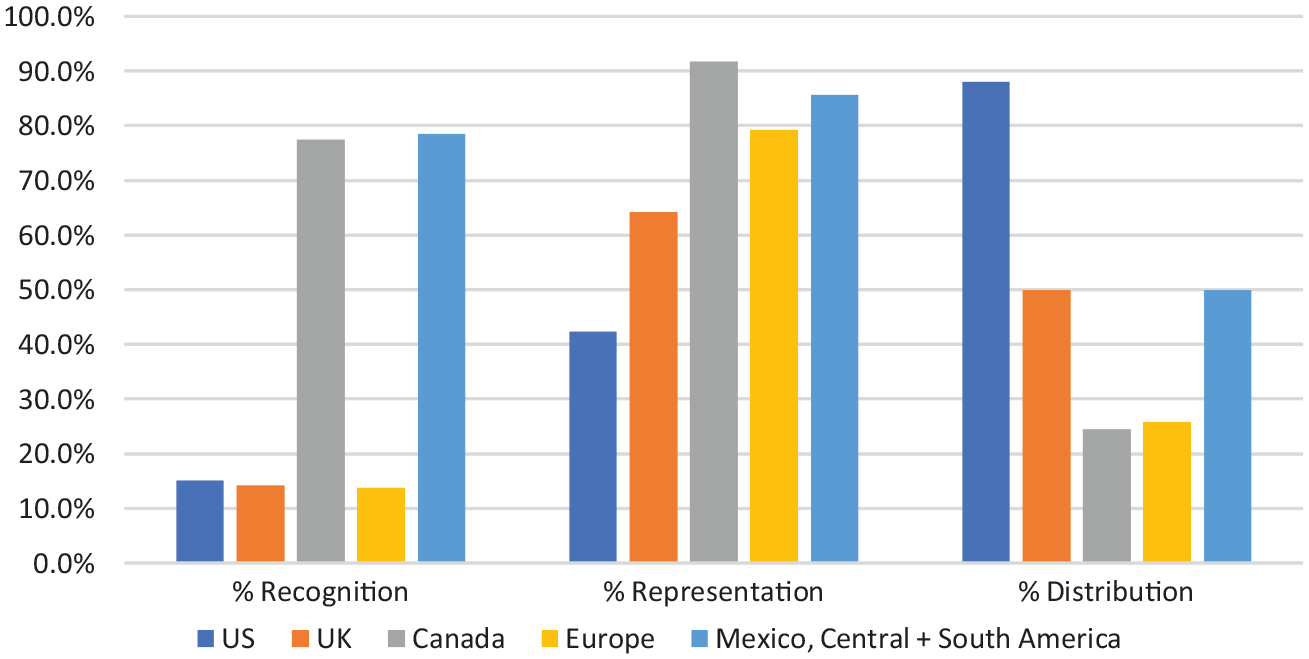
Comparison of prevalence of discussion of different dimensions of justice in case studies from four geographical regions (y axis [vertical]: % of studies mentioning each dimension of justice; X-axis [horizontal]: dimension of justice described. Colors indicate geographic area (US is dark blue, UK is orange, Canada is grey, Europe is yellow, Mexico, Central & South America in light blue).
In this review, we found 40 peer-reviewed articles about Canada that address recognition, overwhelmingly in terms of positively recognizing Indigenous knowledges’ contributions to formal impact assessment processes. 8 As with the stated aims of Canada’s new IA legislation, many of the most recent articles describe or propose approaches specifically aimed at dismantling any hierarchy between Indigenous and dominant knowledges. For instance, Mantyka-Pringle et al. (2017) draw on the concept of two-eyed seeing described by Elder Dr. Albert Marshall (Bartlett et al., 2012) to propose ‘blending’ knowledge about ecosystem health. Another team (Abu et al., 2020) similarly proposes a two-eyed seeing approach ‘to bridge Western science and Indigenous knowledge systems’ (p. 757). Despite these aspirations, the body of literature paints a picture of attempts at epistemic recognition in IA consistently coming up short. ‘Blending’ and ‘bridging’ are meant to address status-based inequities such as those documented by Usher (2000) over 20 years ago. Usher argues that claims generated from IKs must be ‘comprehensible and testable as a knowledge claim in public reviews’ (p. 183) in terms primarily determined by non-Indigenous people drawing on non-Indigenous understandings of what constitutes credible knowledge. Rather than demonstrating success at overcoming status-based inequities, however, more recent literature highlights the extent to which IKs remain unequally valued in Canadian IA. Arsenault et al. (2019) document an ongoing ‘tendency to use Western science to ‘validate’ traditional knowledge before it is accepted as a legitimate way of knowing’ (p. 120) and describe how ‘the assessment process to date has focused on ‘extracting data’ from Indigenous peoples and inserting ‘palatable’ information into externally driven and motivated environmental regimes’. Others note how even these processes of extracting data from IKs are limited by prejudice against the reliability of the information they yield. This is manifest through substantial asymmetries between the funding allocated to studies based on dominant knowledge as opposed to IKs (Galbraith et al., 2007, p. 34; O’Faircheallaigh, 2007, p. 334) and through a lack of engagement with the empirical observations of Indigenous knowledge holders by non-Indigenous participants in IA processes (Haalboom, 2016, p. 1010). This is a trend also noted in a systematic review of IKs in federal environmental assessments in Canada. Eckert et al. (2020) find that 70% of the papers they reviewed document ‘perceived hierarchies of knowledge—namely, the problematic perception that scientific knowledge is superior to IK, as a barrier to engaging IK in federal EAs’ (p. 74).
‘Blending’ and ‘bridging’ knowledges are also understood as increasing the accuracy of evidence. In this sense, the scholarly literature aligns with the reasoning found in the updated Canadian Impact Assessment legislation—it portrays recognizing and including IKs in impact assessment as increasing the accuracy of the evidence collected and considered. Abu et al. (2020), for instance, speak of the potential of IKs to ‘enhance environmental assessment and planning by providing a more accurate and coherent narrative of long-term social-ecological change’ (p.757). Roué and Nakashima (2002) emphasize IKs’ ‘predictive capacity’ (p. 337). Gondor (2016) posits that IKs are most useful when they provide ‘factual observations, and past and current uses of land’ that ‘complement modern science’ (p. 1153).
In these instances, IKs are indeed recognized as being as valuable as dominant knowledges; however, this treatment of IKs as data faces significant criticism. Arsenault et al. (2019) are critical of how applications of IKs ‘by dominant government agencies often reduce complex Indigenous knowledge to facts, observations, and singular practices’ (p. 122). Here, the problem is not so much that the empirical evidence delivered via IKs is not treated as authoritative, but instead that the IA process forces IKs to be, or become, something different from what they are outside the context of IAs. Eckert et al. (2020) identify this type of challenge as being the most frequently cited in their literature review, with 80% of the papers they reviewed documenting how the dominant worldviews held by those designing and executing IAs are inconsistent with the worldviews, knowledges, and understandings of the environment held by Indigenous knowledge-holders and many Indigenous peoples more broadly. They identify ‘fundamental knowledge incompatibilities’ (p. 74) that stem from the fact that ‘values that inform Indigenous and western knowledge systems are oftentimes at odds with each other’ (p.75). They illustrate this dynamic with a representative example about perceptions of fish presented by the Tsilhqot’in Nation during the Prosperity Mine proposal and following federal environmental assessment: The distance between Indigenous epistemologies of fish and the quantification of trout matters here greatly. For the Tsilhqot’in, fish represent much more than ‘a limbless coldblooded vertebrate animal with gills and fins living wholly in water’ as defined by the Oxford English Dictionary. It would seem this definition, however, fits within the biological renderings supposed in mining feasibility studies (Hoogeveen, 2016, p. 363, cited in Eckert et al., 2020, p. 75).
Eckert et al. find that throughout the IA literature ‘[t]his fundamental disconnect, shaped by divergent worldviews and cultures in which western and IK systems are embedded, comprises a fundamental hurdle in the exercise of invoking IK in federal EAs’ (p. 75).
One disconnect between Indigenous worldviews and the worldviews in which IA is embedded stems from the insistence within the IA legislative process of separating facts from questions of values and ethics. McCreary and Milligan (2014) document how those managing the IA for the (now cancelled) Northern Gateway pipeline project refused to consider issues of ethics and values in treatments of IKs, directing particular attention to the distinctions drawn in evidentiary hearings between ‘evidence’ and ‘arguments’: In procedural directions for the oral evidentiary hearings, the panel clearly indicated that these hearings were for oral traditional knowledge, not ‘recommendations to the Panel on whether or not to approve the Project or terms and conditions that should be applied if the Project were to proceed’, which it considers argument not evidence (p. 120).
They go on to argue that ‘recognition of traditional knowledge only as evidence dismisses the relevance of Indigenous jurisdictions and traditions as frameworks for decisions’. This can be contrasted with Gondor’s (2016) argument that Indigenous ‘strategies for management, ethics, values and spiritual relationships are not directly applicable to project impacts’ (p. 1153). In this sense, the literature documents fundamental differences between what qualifies as reliable and authoritative knowledge within impact assessment processes, on the one hand, and what constitutes reliable and authoritative knowledge from the perspective of those mobilizing IKs, on the other.
What emerges from looking at the IA literature centered on issues of justice is a tension—between IA frameworks that understand knowledge as statements of fact used to improve the accuracy of predicted project impacts, on the one hand, and an understanding of knowledge that is more closely entwined with governance, ethics, and values on the other. It is with this in mind that we should understand Nadasdy’s (2003b) observation that the ‘integration of science and traditional knowledge’ generally involves ‘translating First Nation people’s life experiences into forms compatible with state wildlife management’ (p. 367) and other forms of state-organized management practices, rather than involving substantive re-thinking of government process and practice to reflect the core commitments that undergird IKs. More recently, in a paper published after we completed our review, McGregor (2021) recounts her experience participating in a research initiative organized by the new Impact Assessment Agency aimed at finding ‘better ways to consider Indigenous knowledges in Impact Assessment’ (p. 7). McGregor says of this experience: ‘The question posed concerned (yet again) how to “integrate” IK into these non-Indigenous public review and regulatory processes’ despite the fact that Indigenous peoples repeatedly raise concerns about the absences of respect for the broader IK systems. Fundamentally different understandings of what it means to include IKs in IA continue to vex efforts at epistemic recognition. IA is designed to deal in evidence, facts, and data, which are implicitly assumed to be separate from political context; however, reducing IKs to evidence, facts, and data misses something fundamental about what IKs are. Reducing IKs to evidence, facts, and data also misses something fundamental about the relationship between these knowledges and Indigenous legal and governance systems. In this sense, the project of epistemic recognition in IA is stuck in a loop of incommensurability.
‘Knowledge-making’ = ‘we-making’ = ‘knowledge-making’
Analytical tools from STS offer one way of making sense of this persistent incommensurability between Indigenous and dominant knowledges by clarifying the dynamic between ‘knowledge-making’ and ‘we-making’ in societies and by illustrating how this dynamic is currently operating in Canada. To say that ‘knowledge-making’ is ‘we-making’ and that ‘we-making’ is ‘knowledge-making’ is to rearticulate insights already expressed in much of the STS literature, especially literature that starts with an understanding of co-constitution (Haraway, 1988; TallBear, 2013, p. 23) or co-production (Jasanoff, 2004). When we refer to ‘knowledge-making’, we mean the process of coming to a collective interpretive understanding of facts. This is a social process requiring that an interpretive framework be shared by enough people that a set of facts come to be collectively regarded as true and established. ‘Knowledge-making’ is ‘we-making’ in the sense that those who share an interpretive framework become a ‘we’ as they engage in the process of stabilizing the knowledge in question. As Latour (1987, p. 258) famously put it, the settlement of a scientific controversy through the determination of facts ‘is the cause of Society’s stability’, that is, it is the cause for the consolidation of a ‘we’. This is easily seen in studies of scientific communities. For instance, in her field studies of molecular biology and high energy physics laboratories, Cetina (1999, p. 3) describes the ‘different architectures of empirical approaches, specific constructions of the referent, particular ontologies of instruments, and different social machines’ in each field. She calls the different machineries of knowledge production in scientific fields ‘epistemic cultures’—cultures which involve different logics of evidence, different relationships between observation and theory, different ways of arriving at scientific knowledge—and describes how shared group identities are stabilized within these cultures through the process of making knowledge.
The relationship between knowledge-making and we-making also operates more generally in society. Whether considering different interpretations of the science of climate change, the safety of Covid vaccines, or a whole host of other questions, group identities are stabilized around shared understandings of facts informed by shared interpretive frameworks. We lament the social fissures that come from the apparent breakdown of these shared understandings precisely because they represent a breakdown of a commonly agreed upon reality, and the associated knowledge-making processes meant to hold us together as public citizens. STS scholars continue to actively debate these dynamics and the role of our field in generating them (c.f. Collins et al., 2017; Fuller, 2016; Jasanoff & Simmet, 2017; Latour, 2004b; Lynch, 2017; Sismondo, 2017). These are the kinds of dynamics we have in mind in this article when we refer to ‘we-making’, by which we mean the process through which individuals come to see themselves as belonging to a larger collective. This can take place on multiple and overlapping scales—from families and groups of people with a shared profession to transnational groups with shared experiences of oppression or shared histories of domination and everything in between. The type of ‘we’ that primarily interests us in this article is the one that comes to exist around a nation or polity, that is one that comes from a shared sense of belonging to an imagined community (Anderson, 2006) associated not only with territorial borders, but more importantly with institutions of governance and law that are generally treated as legitimate by enough of the right 9 members of a society that it is rendered stable. We-making of this kind is knowledge-making because when people form a sense of ‘we’ around shared institutions of governance and law, they also form a sense of ‘we’ around the accepted modes of knowledge-making required for these institutions to carry out their day-to-day functions.
The processes involved in stabilizing accepted modes of knowledge-making rely on the coalescing, through some combination of coercive power and implicit or explicit consent, of a political ‘we’ capable of granting legitimacy to them. Jasanoff (2005) observes that different societies have different ‘shared understandings about what credible [knowledge] claims should look like and how they ought to be articulated, represented, and defended’ (p. 249). According to her, different societies have different civic epistemologies, meaning different ‘institutionalized practices by which members of a given society test and deploy knowledge claims used as a basis for making collective choices … tacit knowledge-ways through which they assess the rationality and robustness of claims that seek to order their lives’ (p. 255). Here again, knowledge ways are stabilized when they are granted legitimacy by enough of the right members of a given society for them to be recognized as leading to just and legitimate decisions. The concept of civic epistemologies points towards the ways in which different societies—different configurations of ‘we’—influence knowledge-making and vice-versa. In this way, it draws attention to how authoritative knowledge and authoritative decision-making are co-produced. It is in this sense that we say that we-making is knowledge-making and knowledge-making is we-making.
Ezrahi (1990) has described the co-production of knowledge-making and we-making in the broad liberal democratic tradition as a product of the ‘Enlightenment’s synthesis of knowledge and politics’ (p. 255, emphasis added). Through this synthesis, value-free, depersonalized knowledge came to be understood as a foundation of legitimate power. Enlightenment knowledge and politics were synthesized in that political power had no authority without depersonalized knowledge to support it. This premise remains central to liberal democracy in all its variations because through it, ‘the power of public knowledge [can] both discipline and democratize the uses of political power and authority’ (p. 288; see also Shapin & Schaffer, 1985). This Enlightenment synthesis relies on a ‘belief in the universality and neutrality of factual reality, in the existence of a ‘neutral cosmos” (p. 282). It is only if this is the case that it is possible and desirable for facts and values to be held separate and for knowledge to be conceived of separately from governance. From this perspective, authoritative knowledge as well as authoritative decision-making rely on a clear separation between is and ought. Science provides the is, while political and legal institutions shape shared decisions about the ought. Of course, the specific civic epistemologies of different political communities differ (Jasanoff, 2005), and decades of STS scholarship illustrate the extent to which this ideal of separation will always remain unattainable in practice. Nevertheless, liberal democracies broadly hold this commitment to pursuing the separation of is and ought in common. Their legal and governance structures are designed to reflect understandings of knowledge that conform to this pursuit—that is, to reflect the view that knowledge should be depersonalised and universal.
These are the epistemic commitments on display when the IA literature we reviewed discusses the Canadian government’s insistence on maintaining the distinction between arguments and evidence in IA. Knowledge, understood as universal and depersonalized, is considered evidence. ‘Equally valuing’ Indigenous and dominant knowledges means treating IKs as depersonalized, universal, and removed from governance contexts since it is knowledge that is perceived as bearing these qualities which is the most valued inside liberal thought. Recognizing IKs as possessing these qualities amounts to affording these knowledges equal status to those dominant knowledges. From within a liberal democratic tradition—where publicly visible, depersonalize, universal knowledge is central to disciplining and democratizing the use of political power—recognizing non-dominant knowledges as capable of contributing to this process is meant to broaden the political ‘we’. It does so by bringing into the fold of the state those who will be more likely to accept decisions informed by the authority of these non-dominant knowledges. To the extent that the literature we reviewed in the scoping review documents prejudice against the reliability of the empirical data IKs yield, the project of recognizing IKs as contributing to this liberal democratic ideal remains incomplete. From inside the frame of epistemic recognition, though, the remedies to this problem are relatively straightforward: ensuring parity in funding, addressing instances of empirical observations by Indigenous knowledge holders not being taken seriously, among else.
As we have seen, though, several scholars have argued that thinking of IKs as only empirical data reflects a more fundamental misunderstanding. This is where it is useful to note how the dynamic between the construction of knowledge and the construction of shared political identity exists not only within the liberal democracies that have traditionally been interpreted via analytical concepts such as civic epistemology, but also in other IKs and political traditions relevant to this paper. Take, for instance, a proposal from McGregor et al. (2020) to ‘enrich the theoretical grounding and practice of environmental justice’ (p. 36) via a vision of Indigenous environmental justice as ‘grounded in Indigenous philosophies, ontologies, and epistemologies in order to reflect Indigenous conceptions of what constitutes justice’ (p. 43). This formulation draws on ‘anti-colonial critiques and insights’ of Indigenous environmental and climate change declarations from the international, national, and local levels. It involves a ‘set of logics that recognizes the agency of non-human beings as well as the Earth itself’ (p. 36) and understands humans and non-humans as having kinship responsibilities towards each other. McGregor et al. point to Whyte’s (2018, 2020) articulation of environmental justice as an example. Whyte proposes that ‘environmental injustice is an assault on kinship relationships’ (2020, p. 270)—an assault that plays a critical role in ‘strategically undermining Indigenous collective continuance’ (2018, p. 126). 10
McGregor et al. and Whyte also link just and legitimate decision-making based on kinship between animate, agential humans and non-humans with specific approaches to knowledge-making. From the perspective of the legal and political philosophies embedded in these approaches, and in contrast to those embedded in liberalism, knowledges must be visibly entangled with values, beliefs, and ethics to be authoritative (McGregor, 2000, 2005; Whyte, in Parthasarathy & Stilgoe, 2022). Knowledge ‘must be lived’ (McGregor, 2005, p. 104) and in being lived must reflect ongoing demonstrations of good relations with human and other-than human members of a given community. From this perspective, legitimate decision making as well as authoritative knowledge require attention to extended webs of kinship responsibilities. Shobita Parthasarathy, in conversation with Kyle Whyte, summarizes the difference between liberal democratic traditions and these traditions in this way: ‘In the context of Indigenous knowledge traditions, there is no … division between evidence and policy, [while] of course in the Western traditions … trust in evidence and trust in policy … both ensure and assert their authority by there being a distinction between the two’ (Parthasarathy, in Parthasarathy & Stilgoe, 2022, 34:00).
Watts’ (2013) influential description of Indigenous Place-Thought as well as the concept of grounded normativity described by Coulthard (2014) and L. B. Simpson (2011, 2017) offer other avenues for understanding this difference. Informed by Haudenosaunee and Anishnaabe cosmologies, Watts explains that Indigenous Place-Thought provides a ‘theoretical understanding of the world via physical embodiment’ (p. 21). This understanding is ‘based upon the premise that land is alive and thinking and that humans and non-humans derive agency through the extensions of these thoughts’. She outlines how dominant knowledge relies on the separation of ontology and epistemology, removing ‘the how and why out of the what’ (p. 24). In Indigenous Place-Thought, on the other hand, there is no such separation—authoritative knowledge should be entangled with, rather than purified from, the ought. This also has implications for we-making: Non-humans are part of the collective that creates and authorizes knowledge. Watts explains: [H]abitats and ecosystems are better understood as societies from an Indigenous point of view; meaning that they have ethical structures, inter-species treaties and agreements, and further their ability to interpret, understand and implement. Non-human beings are active members of society. Not only are they active, they also directly influence how humans organize themselves into that society.
L. B. Simpson (2011) similarly describes ‘diplomatic agreements between human and animal nations’ (p. 110) within her Nishnaabeg traditions. These agreements are part of Nishnaabewin, that is ‘all of the associated practices, knowledges, and ethics that make us Nishnaabeg and construct the Nishnaabeg world’ (p. 23). According to Simpson, Nishnaabewin is an example of grounded normativity, the ‘ethical framework provided by … place-based practices and associated forms of knowledge’ (Coulthard, 2014, p. 60). As with Indigenous Place-Thought, grounded normativity is based on the premise that Indigenous peoples’ societies and knowledges are deeply situated. Coulthard explains, ‘Place is a way of knowing, of experiencing and relating to the world and with others’ (p. 61). He also draws attention to how ‘sometimes these relational practices and forms of knowledge guide forms of resistance against other rationalizations of the world that threaten to erase of destroy our sense of place’.
From the Indigenous perspectives discussed here, different animals, and the places in which they live, cannot be reduced to data points by wildlife biologists as these animals are not merely subjects to be studied. Instead, they are active participants in the construction of society (‘we’) as well as in the creation of knowledge. They cannot be sequestered into the domain of an is separate from broader normative questions. 11 This points towards more general divergences between these visions; each reflects its own process of political we-making co-produced with knowledge-making. One relies on an understanding of the world as agential, emphasizes how knowledge and values are always connected to place and knit together through relationship, and is characterized by legal and political communities that reflect this. The other views the world as neutral and inanimate, sets out to create universal knowledge (that is, knowledge disconnected from place), draws firm boundaries between knowledge and values, and institutionalizes these boundaries through its political and legal institutions.
Therefore, when the literature in our scoping review highlights fundamental differences in values between Indigenous and dominant knowledges, when it refers to the different ontological status accorded to fish in Indigenous and dominant knowledge systems as a representative example of a commonly cited challenge, when it criticizes the reduction of IKs to mere data, we see it aligning with the perspectives on Indigenous ‘we-making’ and ‘knowledge-making’ practices outlined above. For those who share this general orientation, liberal commitment to ‘equally valuing’ Indigenous and dominant knowledges by treating IKs as depersonalized and universal misses the fundamental nature of IKs. In this sense, recognizing IKs in impact assessment relies on their being aligned with visions of authoritative knowledge compatible with liberal democratic institutions. To achieve this, these knowledges must be severed from any ontological and epistemological commitments as well as legal and political traditions that are incompatible with the de-personal and universal values that characterize liberal we-making and knowledge-making. This means that ‘equally valuing’ Indigenous knowledges from inside the liberal frame ends up lending further power to the frame itself, marginalizing those Indigenous approaches to knowledge and governance that do not fit within it. As TallBear (2017; see also TallBear, 2011, 2015) puts it: Nonindigenous society has put much effort into erecting a barrier between what it is thought humans can know through their materialistic, empirical investigations and what (some) humans believe to exist beyond the knowable material world. This knowing/belief divide, as Nadasdy (2003a) points out, is a form of discrediting language used, for example, by even sympathetic anthropologists when explaining indigenous subjects’ cosmologies (p. 192).
TallBear goes on to remark how this divide is ‘upheld by institutions to govern [Indigenous peoples] lives, the land, and the lives of nonhumans who have been savaged by Western analytical frameworks, animacy hierarchies, and the institutions they produce’ (p. 194).
Of course, while the literature we reviewed points us towards this analysis we cannot assume that it is shared by all members of all Indigenous communities. Indigenous traditions within Canada are diverse. Just as importantly, these are traditions that continue to change in response to new circumstances, including circumstances arising from colonialism. Communities continue to decide whether and how to seek out, subvert, or resist full participation in Canadian governance and legal processes, and they continue to adapt their traditions accordingly. These are not easy decisions. They have the potential to involve significant intra-community political struggle. If we take seriously the idea that stabilizing modes of knowledge-making relies on the coalescing of a political ‘we’, then we must understand intra-community debates over these questions as pertaining not only to questions of governance but also to questions of knowledge. We can refuse (A. Simpson, 2007, 2016) to get into the weeds of these debates while still recognizing this relationship between struggles over knowledge and struggles over governance.
The failed promise of epistemic recognition
The institutional practices and policies of Canadian IA appear to lack the conceptual ‘vocabulary’ to treat as knowledge anything coupled with ethics, values, and worldviews that reflect epistemological and ontological commitments different from those built into the existing structure of the liberal democratic state. The result of this absence is that the very body charged with the act of recognizing Indigenous knowledges is incapable of doing so if they retain any sense of entanglement with relational values and governance structures. Success at recognizing any such knowledges would require major changes to the institutions that sustain the boundary between fact and value, the boundary between knowledge and governance, which rests at the heart of liberal democracy. The results from our literature review as well as the current policy landscape illustrate that the fact/value distinction remains central to IA in Canada. In this sense, the promise of epistemic recognition in the new IA legislation is hamstrung by the requirements of Canadian institutions of governance.
The failure of epistemic recognition in IA is consistent with challenges with the paradigm of recognition along other axes. Coulthard (2014) questions the value of recognition as theorized by Fraser, drawing attention to the fact that Fraser herself ‘admits that her status model may not be as suited to situations where claims for recognition contest a current distribution of state sovereignty’ (p. 36), as continues to be the case in Canada. In such a context, according to Coulthard, recognition means that people can only be esteemed, seen, and respected from within the existing state apparatus, rendering invisible or unrecognizable anything about them that is unintelligible within it or that poses a threat to it. As Coulthard puts it, ‘colonial powers will only recognize the collective rights and identities of Indigenous peoples insofar as this recognition does not throw into question the background legal, political, and economic framework of the colonial relationship itself’ (p. 41). Based on what we have said in the preceding pages, we add to Coulthard’s argument the assertion that colonial powers will also only recognize the knowledges of Indigenous peoples insofar as this recognition does not throw into question the background frameworks for authoritative knowledge and associated legal and political institutions that help sustain the colonial relationship.
The colonial relationship is stabilized through the ongoing mobilization of visions of authoritative knowledge that position the epistemological and ontological commitments of dominant science as universal. This practice serves to actively obscure the inseparability of knowledge-making and we-making by treating credible knowledge-making as necessarily neutral and un-situated. To see what we mean, we veer briefly into the international arena. Martello and Jasanoff (2004) observe that in efforts to include Indigenous and local knowledges in international environmental management, 12 ‘international regimes have continued to invoke, and so to reinforce, the boundary between science and other forms of knowledge; only knowledge that cannot and does not aspire to the status of science is labeled local or indigenous’ (p. 13). In processes geared towards recognizing these knowledges in international regimes, new group rights, and new forms of representation based on group identities, become linked to those who do not ‘do science’ while ‘science itself … remains putatively universal and free from local coloration’ (p. 13). This approach hinges on the presumption of essential differences between IKs and universal ‘science’ and, by extension, between those who do science and those who do not. While there are certainly important differences between approaches to IKs in international arenas and in Canada, this active demarcation between science (universal, neutral) and IKs (local, contingent, culturally specific) is present in both. The substantial focus on recognizing IKs in the impact assessment literature about Canada—always assumed to be distinct from science—speaks to this fact. So does the institutional organization of efforts to include IKs in regulatory processes: Issues related to IKs belong to the Indigenous Advisory Committee while it is left to the Technical Advisory Committee on Science and Knowledge to consider matters of science.
The treatment of science as universal shores up power because obscuring the situatedness of dominant knowledges also obscures the situatedness of the dominant political orders with which they are intertwined. This serves to normalize the dominant political order. In contrast, treating dominant knowledges as situated opens pathways for de-normalizing not only the ethical commitments implicit in these knowledges, but also their associated political orders. TallBear and Kolopenuk, for instance, ‘reject the idea that science and Indigenous knowledges exist as a binary, foreground Indigenous ethics, and challenge non-Indigenous science to do better’ (TallBear, 2021). This is a perspective also reflected in TallBear’s (2014) ethnography of Indigenous bioscientists in the US, which is ‘not mainly concerned with assessing Native American social or cultural difference’ (p. 173) but instead with ‘how Indigenous participation in bioscience can help make Western bioscience more multi-cultural and democratic’. Liboiron (2021) similarly rejects the binary drawn between Indigenous knowledges and science by describing how Indigenous researchers may ‘use their own diverse knowledges to get scientific work done’ (p. 53). As with TallBear and Kolopenuk, Liboiron emphasizes the ethical dimensions of knowledge and draws on Indigenous perspectives on relationality to transform the methodological and ethical orientations of scientific practice. This work involves drawing close attention to how the same epistemological and ontological commitments that inform the liberal-democratic ‘we-making’ we have discussed in this paper are linked with the ethics and values that figure into purportedly neutral and universal scientific practice today.
This adds epistemic and ontological dimensions to existing critiques of the politics of recognition. Recall Coulthard’s comment that ‘colonial powers will only recognize the collective rights and identities of Indigenous peoples insofar as this recognition does not throw into question the background legal, political, and economic framework of the colonial relationship itself’ (p. 41). The kinds of critical examination of the basic commitments of dominant science offered by TallBear, Kolopenuk, and Liboiron require exactly that which Coulthard says the politics of recognition does not allow—they draw out the values implicit in dominant modes of knowledge-making and propose new approaches to knowledge-making informed by Indigenous worldviews. Given the inseparability of knowledge-making and we-making we have outlined here, these approaches must ultimately pose challenges to dominant modes of governance as well—challenges recognition, in its current formulation, is not equipped to meet.
Conclusion
To conclude, we can return to Carolyn Bennett’s comments that consent ‘means that Indigenous peoples and Indigenous knowledge will be mandatory at the very beginning of a proposal for any major project’ (Canada, 2020, p. 2100). Taken at face value, Bennett’s comments amount to a statement that consent means representation and the recognition of IKs in IA processes. This understanding of consent stands in stark contrast to the understanding of consent expressed by those refusing the project. Hereditary chiefs answered a BC Supreme Court injunction ordering them to vacate their land with an eviction notice of their own presented to Coastal GasLink. The chiefs’ notice stated that CGL had violated the Wet’suwet’en law of trespass—that CGL did not have their consent to be on their land (Unist’ot’en Camp, 2020). Consent in this sense did not equate to participation and the inclusion of Indigenous knowledges in federal decision-making processes. No amount of empirical data derived from IKs, stripped of its relational and ethical elements, and fed into a federal impact assessment process, would change the clear difference in understandings.
STS scholarship makes clear that knowledge is always embedded in historical, social, and technical contexts, and is always infused with normative, ontological, and epistemological commitments. In this article, we have highlighted how multiple political and legal structures in liberal democratic societies decontextualize knowledge as much as possible. Liberal democracy depends on this decontextualization to facilitate the ongoing separation between knowledge and politics, fact and value; from within liberal democratic logic, both knowledge and political power rely on such a separation for their authority. We have also drawn attention to how this approach to knowledge is a matter of choice and tradition. Societies determine and develop their political and legal institutions in conjunction with their understandings of authoritative knowledge. The two can never be separate.
Our literature review of impact assessment scholarship drew attention to the ways that epistemic recognition in impact assessments comes up short—only those elements of IKs that can be viewed as neutral data about impacts are admissible into federal IA processes. This is because impact assessment is part of a set of political and legal structures operating from a different set of epistemological and ontological commitments from those in which IKs are produced. Rather than pursuing pathways to shed light on these epistemological and ontological commitments impact assessment processes continue to treat science as universal. This has the effect of naturalizing the basic legal and political institutions of the Canadian state and ends up lending further power to them.
If diverse knowledges are to be ‘equally valued’ in impact assessment, as the federal government claims it wants, then diverse approaches to governance and politics, not to mention diverse ontological and epistemological commitments, must be welcome. In other words, the current structure of the settler colonial liberal democratic state, existing distributions of power, and the ontologies and epistemologies with which they are linked, must be up for negotiation and rearrangement. This is an argument that has been repeatedly made by scholars in Indigenous studies, who consistently emphasize the importance of Indigenous sovereignty and of thinking critically about the sovereignty claims of settler-colonial states (Bauder & Mueller, 2023; Deloria, 1996; Gaudry & Lorenz, 2018; Moreton-Robinson, 2015; Tuck & Yang, 2012; Yellowhead Institute, 2019). From this perspective, valuing Indigenous and dominant knowledges equally requires the very rearrangement and redistribution of power that existing efforts at recognition seem to be designed to avoid.
Understanding Bennett’s statement with any measure of generosity involves unpacking its implicit logic. This is a logic that situates consent in terms of consenting to participate in a process of de-personalized data gathering to determine the impacts of a project and to make decisions in the ‘public interest’ informed by these data. From this logic, the effort of recognizing IKs means better including Indigenous peoples into the ‘we’ of the state while retaining the basic frameworks that underpin its co-produced political, legal, and knowledge orders. This is the Enlightenment synthesis of knowledge and politics in action. The political, ontological, and epistemological commitments of this synthesis are treated as universal rather than as the products of a culturally specific process of co-production. This synthesis shifts the meaning of consent away from questions of jurisdiction and into the domain of ‘universal’ knowledge. This shift, reliant as it is on its universalist claims, does major work in buttressing the sovereignty claims of the Canadian state and bringing Indigenous peoples living within the borders Canada claims into the ‘we’ of that state. As Liboiron (2021) writes, however, the ‘[t]he universal is never universal, but rather an argument to imperialistically expand a particular worldview as the worldview’ (p. 52). Ultimately, these universalizing moves reflected in the Canadian impact assessment literature, and made evident in legislation and policy, distract from ongoing struggles over jurisdiction.
Footnotes
Acknowledgements
The authors thank the three anonymous reviewers, as well as Alex Paterson, Gwen Ottinger, Mascha Gugganig and members of the Science & Society Collective at the University of Ottawa, for helpful comments on earlier versions of this article. The authors also acknowledge the support of the Network for Expertise and Dialogue for Impact Assessment (NEDIA), a research collaboration which connects academics, practitioners, and communities engaged with impact assessment.
Funding
The author(s) disclosed receipt of the following financial support for the research, authorship, and/or publication of this article: This work was supported by the Social Sciences and Humanities Research Council of Canada Knowledge Synthesis Grant (number 872-2019-0011) and by a Joseph-Armand Bombardier Canada Doctoral Scholarship.
