



Abstract
Regarding technology, “modularity” typically refers to an apparatus’ interchangeability, reproducibility, or transposability, i.e., “plug and play” applications. However, critical scholars contend that modularity is laborious and aspirational, not to be taken for granted. Where promoters of modularity often focus on material dimensions of technology, this article intervenes in these debates by revealing the necessary practical and discursive work required. We problematize desalination's transnational modularity through an analysis of archival and ethnographic research of comparative connections between California and Israel. We argue desalination emerged from Israel's project to restructure environmental, political, and economic risks with(in) Palestine. Through naturalizing colonization and extraction, desalination's applicability to places such as California is made to appear self-evident. We demonstrate this process by interrogating three common arguments used to craft comparability between California and Israel: (1) desalination overcomes “natural” scarcity; (2) desalination produces geopolitical cooperation through “abundance”; and (3) desalination displays superior techno-managerial expertise. In so doing, we contribute to science and technology studies and critical environmental justice studies by illustrating how “adaptations” can emerge from settler-colonial projects. Founded on socionatural exploitation and domination, settler-colonial projects prove productive of modular capitalist endeavors and ongoing practices of constructing comparisons.
Keywords
As we spread democracy around the world, we have to find a way to spread water around America…It's completely doable…Availability of water is not the problem. To the east of us, flooding. To the west, a giant reservoir called the Pacific Ocean. Oh yes, the ocean. Did you know that Israel gets most of its water from the ocean—from desalinization. Why can’t we do desalinization if Israel does? Bill Maher on Real Time with Bill Maher, 10 September 2021, emphasis added.
1
Introduction
Water scarcity and drought are readily observable climate change impacts (AghaKouchak et al. 2020). However, implementing climate adaptation to address water sustainability has revealed the entangled social, spatial, political, and economic battles undergirded by social inequality, gender, racial, and ethnic domination, as well as finance capital's proliferation (Mascarenhas 2018). These dynamics have pushed scholars to develop analyses beyond the bounds of typical environmental (in)justice research concerned with distributional and procedural dimensions (Pellow 2018). Following this push, this article problematizes the promotion of transposable large-scale seawater desalination and the promotion of Israel as the model of desalination. The Israeli state and corporate actors boast of constructing a self-contained techno-managerial drought solution, prompting comparisons of applicability. However, desalination's modular character is both a product of and participant in Israel's ongoing settler-colonial expansion, extraction, and domination in/of Palestine. Rather than overcoming scarcity, Israeli desalination “makes and remakes…the uneven conditions of possibility for life” (Gaber 2021, 1079).
Seawater desalination is the industrial production of potable ocean water. Large-scale, reverse osmosis desalination plants can produce millions of gallons of high-quality, locally managed drinking water from a seemingly endless source. Touted as a reliable solution to deepening drought, global interest has grown, with plants in more than 150 countries, servicing about 300 million people (World Bank 2019). The world market for desalination is forecasted to grow to USD32 billion in the coming years (Adroit Market Research 2020). In the United States, the most aggressive push for large-scale implementation has been from California (e.g., Morgan 2020).
Despite technological viability, desalination infrastructure has been criticized for its inattention to social and ecological impact (O’Neill and Williams 2023). Scholars have begun to recognize the many implications of desalination, as more evidence has come to light about it being energy-intensive, carbon emitting, and hyper-saline-waste producing, as well as highly political (King and Murphy 2009). In the past decade, struggles in response to desalination and in favor of more equitable water solutions have been witnessed in Australia, India, South Africa, the United States (Texas, California), Mexico, and even Israel, 2 where the practice has long been touted as a model of excellence (c.f. Gasteyer et al. 2012). 3 How then, are we to understand the industry's forecasted growth coupled with the problematic realities, alternatives, and social critiques of desalination? We argue that a key, if underexplored component, is not just how technology is made modular, but also how comparisons are activated.
Israel's attempt to export desalination technology is instructive. Proponents in Southern California have insisted on the similarity of shared environmental challenges, making Israel's approach a ready-made model, like the talk show host Bill Maher insists in the opening quote to this article. Furthermore, observe a California newspaper's comparative tendency: This parched nation [Israel] has turned itself into the unlikeliest of water giants, due to large-scale investments…By the end of next year, Israel will have achieved a miraculous transformation from being a virtual desert into a thriving, green paradise. As California moves through another multi-year drought and struggles to deliver enough water to support its urban and agricultural needs, Israel's success story stands as a working model for affordable recycling, low-cost desalination plants, and private-public teamwork. (Bill Hazard, The Montecito Journal, 5 October 2021. Emphasis added)
In this formulation, Israel's biophysical conditions are meant to highlight desalination technologies’ applicability to California. The “miraculous transformation” is said to be driven by technological and managerial expertise, which was the focus for collaborative development in a 2014 MOU between Israel and California (The Government of the State of Israel and the Government of the State of California 2014). By fostering “innovation partnerships” 4 for technical, legislative, and financial development, Israel's “extraordinary” accomplishments are commonly accepted and referenced as relevant and viable for California's water challenges (Kramer 2016; Randolph 2021, 5). Yet such assessments disavow Israel's policies with(in) 5 Palestine, disconnecting Israel's “successful” desalination industry from the settler-colonial reality.
The comparison between California and Israel gives us pause: What makes the association possible? What accounts for its durability? We trouble the comparison by building on the concept of modularity, which describes capitalist enterprises’ reconfiguring local social and material relations to construct disembedded, mobile infrastructure projects (Appel 2012, 697). Our intervention in these debates is to highlight that modularity is about constructing comparability. Subsequently, we are not motivated by myth-busting per se, where the objective would be to reveal the limitations of Israel's “green paradise.” Rather, we track how comparability is a deliberate project that constructs and exploits a specific image of—and felicitous relation between—techno-optimistic climate adaptation and colonialism (Vitalis 2007; Williams and Swyngedouw 2018, 13).
Lastly, if we agree that ready-made desalination infrastructure is desirable and proven, the question remains, why Israeli desalination? Empirically, firms such as Acciona in Spain and Veolia in France, or countries such as Saudi Arabia, outperform Israel in technological, scientific, and economic metrics (Zetland 2017). Yet, Israeli firm IDE Technologies has received coverage in Fortune magazine (2016), as a company “taking on society's biggest problems—and making money doing so,” for acquiring billion-dollar contracts in the United States. Furthermore, The New York Times bestselling author Seth Siegel (2015) discusses desalination as a specifically Israeli solution (contrary to historical evidence, see Low 2020; O’Neill 2020) that can be applied the world over, but especially in the United States. As we show, the dynamics of Israel's settler-colonial project in Palestine demonstrates a proclivity toward such modular endeavors.
First, we turn to critical literatures on desalination and climate adaptation to problematize the techno-managerialism surrounding the desalination industry. Second, we discuss modularity, emphasizing how distancing and disentangling processes fundamentally restructure a project's social and environmental context. Third, by examining historical and contemporary contexts, we argue that three myths circulate, which depict Israeli desalination as (1) overcoming natural scarcity, (2) producing geopolitical cooperation through abundance, and (3) displaying techno-managerial expertise. In so doing, we identify how the modularity of Israeli desalination couples productively with the state's ongoing settler-colonial project, what we call settler modularity.
Problematizing “Adaptive” Desalination
Desalination is often discussed as a climate adaptation technology. Policy studies have sought to assess “adaptiveness” in various ways, such as potential to reduce climate risks (Shi et al. 2016; Tubi and Williams 2021). Desalination is touted as reducing risk by augmenting available water quantities in the context of scarcity (Barnes 2017). However, such assessments narrow potential risk reduction initiatives by favoring prescribed technical adjustments. Vulnerability is often prolonged while communities wait patiently for “necessary” technological innovations (Jones et al. 2019). This logic forecloses political transformations by negating critical consideration of underlying socio-economic formations that led to hydro-inequalities (Gunel 2016). This pitfall is present in an appraisal by environmental policy scholar Alon Tal (2018) of the Israeli desalination network's reliance on fossil fuels. Tal acknowledges desalination's carbon footprint, but argues that innovations in energy efficiency, e.g., reverse osmosis, are promising. His analysis does not reference settlement expansion and overextraction, which drive biophysical decay and maintain an inefficient, exclusionary colonial infrastructure (e.g., Elmusa 1996; Hughes et al. 2023; Salamanca 2016).
Thinking through climate adaptation's political dimensions, rather than “assessments” alone, changes one's analysis (Clapp 2014; Leguizamón 2016). For example, Israel's adoption of desalination was used as the state's techno-political justification to uproot and privatize a water regime characterized by institutional and biophysical crisis (Teschner, Garb and Paavola 2013, 100). Motivated by neoliberal pressures to privatize and marketize government services, Mekorot, the government-owned water utility provider, was disbanded, thereby breaking the political power of the sector's organized labor force (Feitelson and Rosenthal 2012, 278-81). In its place, the new national Water and Sewerage Authority (IWA) addressed management inefficiencies by overseeing a competitive water market. However, this only led to market consolidation through public-private partnerships that provided government concessions for all privately produced water, thereby displacing the cost to customers while “stabilizing” supply (Tevet 2018). Since the early 2010s, a consistent and efficient supply of profit has been guaranteed, keeping internal costs low and water abundant—for those willing to pay (Selby, Daoust and Hoffmann 2022). In essence, “poor water management” became the anti-political entry point to privatize the sector (Ferguson 1994), and desalination was the techno-political solution.
However, it is not just in Israel-Palestine that recent examples of these dynamics have emerged. The failed Huntington Beach plant in California was promoted as a fix to the state's water concerns, based in part on previous small-scale “successes” (Figure 1). The ability of US project development firms to align themselves with outside experts helped to represent a paradigm of “reliable” water production. This had strong political contours, as it was revealed that firms aimed to redefine and deploy discourses of scarcity and environmental justice as a way of legitimizing a continued bourgeois “class bias for a luxury commodity” (O’Neill 2023, 11). Effectively, desalination shifts water management's orientation away from the materiality of supply and demand to supplying enough water to uphold private contracts and securitize returns.
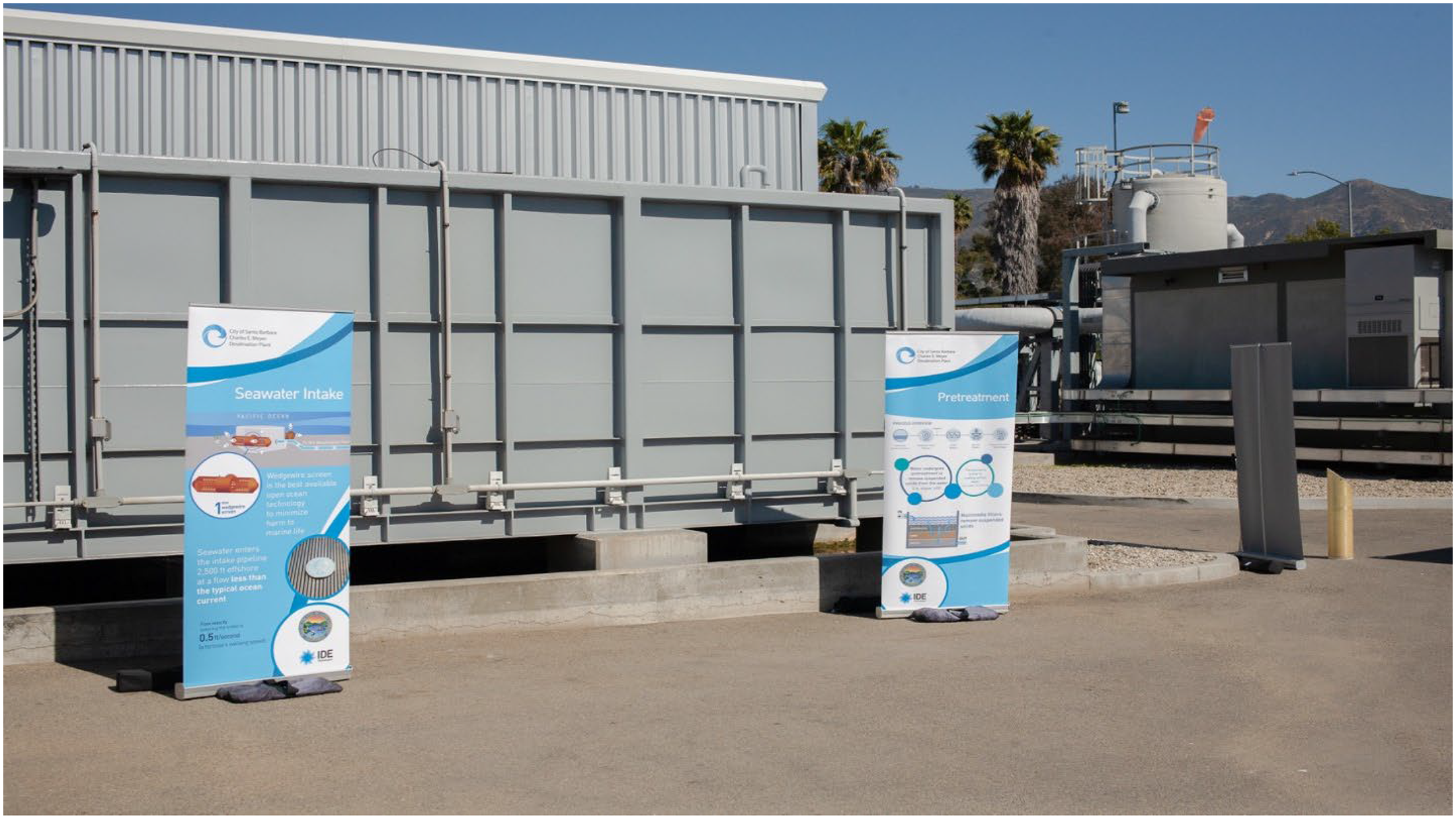
City of Santa Barbara Charles Meyer Desalination Plant, located in an industrial district along the Pacific Coast of California. This facility operates by a tiered water delivery structure and is an example of a modular facility (notice the shipping container-style encasement). It is operated by the Israeli firm IDE Technologies. The tiered rate structure means that water generated by the facility only goes to high-use areas inhabited by a majority of wealthy residents willing to pay the increased fees. March 2020. Image by the authors.
Interestingly, the most significant adaptation desalination technology has developed has actually been to address financial risk, rather than environmental or technical. Former IDE Technologies CEO Avshalom Felber agrees; commenting on praise received for IDE's pioneering approach to the Carlsbad, California plant, he stated: “The main attribute they needed for the CEO of a company like IDE Technologies was a financial background, rather than a water and engineering background” (Freyberg 2013). Indeed, the underlying financial models of Israel's privatized plants are the Build, Own, Transfer or Build, Own, Operate (BOT and BOO), which are referenced as factors contributing to Israel's prominence in the technology's global proliferation, allowing them to be presented to public partners as flexible, long-term options (Greer et al. 2021). In particular, this involves project finance, which is a tried-and-true approach to large-scale, large-sum infrastructure projects (e.g., Finnerty 2013). There is a paucity of academic literature about project finance, yet it remains important because of the distinctive profile of the transactions: “Their scale is enormous, their structure is sophisticated, their details are arcane and…their effects on the world around them are often highly visible and dramatic,” all of which call into question the “consensuality” of the arrangements (Bjerre 2002, 412). Project finance arrangements center on the management and distribution of risks: financial, engineering, operational, environmental, etc. A project's investment viability relies on guaranteeing absolute barriers between risks, including protections from “external,” political, or social risks. In reality, there are formal and informal components to risk management that influence the investment environment (Lee 2016, 40-2), and Israel is often able to blur lines between financial and social risk management to encourage private international investors. This type of social and financialized “risk management” is responding to concerns of capital accumulation, rather than climate crises (Loftus and March 2016; Pryke and Allen 2019, 1326). Specifically, Israel's approach to risk management prompted our analytical turn toward desalination as a modular enterprise.
The Modularity of Desalination
The concept of modularity is commonly understood as any interchangeable material structure. Often, modularity is touted as an engineering virtue. For example, McKinsey & Company uses the slogan “Go Modular” in reference to, among other things, climate technologies, emphasizing the utility of standardized, reusable architecture and organization (Appel 2019, 26; Hart, Phaf and Vermeltfoort 2013). 6 Repurposing this directive as an analytical lens of socio-political relations, Hannah Appel (2012, 693) argues that modularity has become an increasingly central political economy strategy as corporations “disentangle the production of profit from the place in which it happens to find itself…to structure liability and responsibility in such a way that it can seem to remove itself from local social, legal, political, and environmental entanglements.” With regard to desalination, IDE Technologies similarly boasts prefabricated, transposable infrastructure, signaling frictionless implementation (Figure 1). 7 However, the facticity of material standardization that modularity implies remains insufficient—it does not address managerial challenges such as cost, distribution, implementation, and waste. Rather, management regimes and practices aim to disentangle from local complexities, “engineering political relations” for operational smoothness (Mitchell 2011, 5). Disentanglement and smoothness are not features inherent to capitalism; they are work-intensive aspirations. Modular projects “disentangle” precisely by reconfiguring social, spatial, and legal contexts so as to shift or obscure liabilities (Clapp 2015, 309).
Reconfiguring local relations, modular projects aim to standardize practices and abstractions—belying their contextuality—which promoters use as measurements to showcase a project's aptitude for reproducibility and transposability. Constructing managerial standardizations is crucial to “derisking,” the practical and financial processes of redistributing local liability aimed at attracting international private financial investors (Gabor and Sylla 2023). A project's abstractions similarly prompt international interest, typically by aspiring to connect to desirable global imaginaries about sustainability, scarcity, or efficiency, which has been central to numerous supposedly “post-oil” green projects (Koch 2023). Making the link between the materiality of modular initiatives and the more abstract values and ideas of any project allows boosters to deploy spontaneous comparisons, examples of which might be environmental or social similarities to emphasize the prospect of ready-made solutions (Steinmetz 2024). Restructuring legal, political, financial, and social risks is how modular enterprises pursue qualities of distance and decontextualization. In this way, disavowing of local conditions and contestations requires continual, deliberate work. The intentionality of any such labor suggests the utility of the specific representations targeted and deployed, therefore deserving careful and critical analyses.
But if modular projects require work to restructure, (re)conceive, and redistribute risk, what makes Israel—ostensibly confronting various political and environmental threats—a suitable locale? Risk is both an obstacle and a resource; where proficiency is based on how, where, and to whom risk is distributed. “Real-world test sites” provide a valuable opportunity to distinguish a model's efficacy (Machold 2018, 92). Understanding risk-as-resource provides a link between micro imperatives of constructing modularity and the state-level, macro project of settler-colonial expansion and dispossession. As shown below, settlement processes are driven by imperatives of exclusion, segregation, elimination, and domination (Sabbagh-Khoury 2023; Shafir 1996). Throughout the early twentieth century, Zionist settlers sought international legitimation and support to develop a separate, technologically modern society, juxtaposed with “backward” Palestinian society (Karlinsky 2000; Tesdell 2017). Actual separation failed, yet continual pursuit of societal and economic separation from Palestinians proved beneficial, as logics of comparison/contrast and exclusion were crucial justifications for Israel's founding myths (George 1979). Today, those myths are widely repeated but require continual “mythmaking” (Vitalis 2007). In other words, the social and material reshaping intended to make myths empirical generates constant political and social instabilities, which modular enterprises eagerly exploit.
Theoretically, modularity provides a response to overly pathologized theories of settler colonialism (Wolfe 2006), which tend to isolate settler expansion from global processes and interests. Practically, constructing modular enterprises is mutually beneficial with settlement, as private capital's eagerness to manage risk has become analogous to state-sponsored colonization. Examples abound: colonial policies in the Palestinian territories naturalize separation; racially segregated settlements expand; tiered permit regimes for employment and movement proliferate; uneven management and distribution of resources and waste overlap. All this occurs synergistically as capitalist enterprises seek to distance profits from local contexts, tap new markets, “scale up” production, and show “success” in former locales. This study of settler modularity describes how settler-colonial expansion in Israel-Palestine was supported by capitalist endeavors, working in a felicitous partnership to set up disembedded, transposable, and licit desalination enterprises.
Research Context, Data, and Methodology
This article is the result of scholarly coordination in California and Israel-Palestine. For one author, fieldwork was conducted in Israel-Palestine over the course of three months in 2018, with return visits in 2022 and 2023. Across this fieldwork, 33 semi-structured interviews were conducted regarding water management and agriculture in the region, alongside multiple specific site visits (farms, businesses, etc.) with informants. Participant observation included work with local human rights clinics and research institutes. For the second author, ethnographic fieldwork was conducted from 2019 to 2022, primarily in Orange County, in the United States, where a high-volume seawater desalination proposal was in the throes of the state's permitting process. This research included data from more than 60 semi-structured interviews with residents, as well as public and private sector personnel. Both scholars developed databases of qualitative content from contemporary and historical regulatory hearing transcripts, media articles, scientific, policy, and financial reports.
The data collected for this research article is bolstered by archival research about the national Office of Saline Water and related agencies operating during the Cold War. It was through the archival work that the historical connections between Israel and California were initially revealed. The existence of historical connections highlighted contemporary comparatism (Steinmetz 2024), not a serendipitous event, but deliberate. This realization came as the authors found that in the case of each fieldwork, informants often used comparative assessments of water scarcity as a means for discussing how desalination may, or may not, be a solution for Israel-Palestine and California. However, our interest is not in assessing the validity of the informant's comparisons. Rather, we were struck that the comparison appeared unquestioned by our interlocutors. Why were California and Israel-Palestine mentioned together and not, for example, California and Saudi Arabia, or Spain (where desalination is more robust)?
Several scholars inspired our approach to analyzing this transnational comparative practice. In particular, global ethnography (Burawoy et al. 2000) stresses the co-constitution of local and global forces and imaginaries, whereby local outcomes result from ideological and material connections. Additionally, Steinmetz's (2004; 2014; 2024) theoretical and methodological work on empire was instrumental. Steinmetz specifically argues that comparison-making is an expression of expertise that is often used to connect powerful states with the construction of territories as colonies. Similarly, David Naguib Pellow has argued that any critical environmental justice analysis must concern itself with the scalar implications of injustice and technological applications through time. Often overlooked is how environmental issues and threats “‘jump’ scale, crossing vast expanses of geographic space and time, by refusing to be contained by artificial boundaries such as national borders or election cycles” (Pellow 2018, 16). Pellow points to Zionism and Israeli environmental management as an ongoing issue of environmental injustice that benefits both from processes of transnational legitimation and local Palestinian dispossession.
Finally, settler modularity is an attempt to consider how macro imperatives of settler colonialism and transnational capital may configure micro dynamics central to science and technology scholars’ concerns. Following Latour and others who argue macro and transnational processes must necessarily be understood in their connections to micro dynamics (Gille 2010; Latour 2005), we problematize how models are made to be comparable. How has Israel's desalination model been made comparable? Focusing on Israel's settler-colonial project highlights the overlapping processes of settlement and exclusion and constructing techno-managerial formations. To stop there, however, would miss the transnational force, durability, and mobility (Law 1984, 256-57) which specific models target and achieve. We extend Appel's (2012) concept of modularity by highlighting that transposability and transnational appeal are co-constitutive features. Therefore, analysis of/from California, in effect, identified the outputs of “myths” as actively constructing comparability.
Settler Modularity's Myths—Connecting Israel, California, and Desalination
The concept of settler modularity attempts to articulate the congruous relation between processes of a settler-colonial project and the pursuit of modular capitalist enterprises. Typified by the slogan “making the desert bloom,” settlement myths (George 1979; Messerschmid 2014; see Figure 2) have long garnered international support and legitimacy by naturalizing dispossession and decontextualizing Zionist colonization (Teisch 2011). Myths represent both aspirational aims and work-intensive projects to reshape the socio-environmental formations of Palestine (Anton 2008; Dajani 2020; Karlinsky 2005; Sufian 2007).

Politicians and engineers toast as they drink the first modern ocean water intended for terrestrial consumption. The Freeport, Texas water conversion facility, as it was called, was the first of a series of “demonstration facilities” set up by the United States federally administered Office of Saline Water. During his address to the gathered crowd, President John F. Kennedy noted this plant would show the world that it would be possible to work together to see the “deserts bloom” (Kennedy 1961, at 0:22). The caption associated with this image reads as follows: Israeli Prime Minister “Levy Eshkol tasting desalinated water at the sea water conversion plant in free port Texas.” 8 June 1964. Image credit: Wikimedia Commons.
Myth #1: Naturally Occurring Water Scarcity
The myth of scarcity refers to the commonly recited truism that Israel (Palestine)'s water scarcity is a naturally occurring phenomenon. For example, an article recently published in the Nature suite of journals uses this logic as its starting point for talking about the need for Israel's expanded desalination program: “Ensuring sufficient water supply has always been among Israel's foremost challenges. During the first several decades of its history, Israel managed chronic water scarcity through a combination of technological innovations, conservation efforts, and policy measures” (Kramer et al. 2022, 1). While seemingly a clear statement backed up by data on insufficient available resources, the stark water inequality between Israeli citizens and Palestinians demonstrates scarcity's political contours. Instead, scarcity must be understood as a geographical and historical, hydrosocial (Buchs et al. 2021, 107176) fact: the naturalized condition of political deprivation (Beltran and Kallis 2018).
Historically, the Israeli state has used water scarcity to garner both domestic and international legitimacy as a virtuous neighbor to Palestine and the Middle East region. Prior to 1948, settlement organizations wielded narratives of “water abundance” to signal Palestine's “absorptive capacity” and spur in-migration (Alatout 2009). Politically, however, for a newly formed state facing questions of water security and distribution to an unevenly developed territory, “abundance” narratives were untenable (Meiton 2015). Within elite spheres, contestations over state water policy concerned competing conceptions of the national project to transform the demographic character of Palestine (Alatout 2008a, 965). Following early-twentieth-century US consultants’ prescriptions for “scientific colonization,” technocrats in Israel mobilized assessments and surveys of water resources to instrumentalize scarcity as a political tool (Alatout 2008b, 50-1). For instance, ownership and centralization of water resources as state property under Mekorot's management were mandated in the Water Law of 1959. The law was directly influenced by US engineer and bureaucrat Elwood Mead's proposed legislation to address potential scarcity through racialized economic development (Alatout 2008a, 978; Rook 2000, 85). 8 After 1967, the law was extended to the remaining Palestinian territories as legal-scientific justification to seize, control, and de-develop existing Palestinian water resources (Lowi 1993; Zeitoun 2008). As Yossi Yaacoby, vice president of engineering for Mekorot, noted: “Water was a source of conflict” but now “Israel understands that water is a foundation for peace”; and “Israel understood from its inception that water is a scarce resource” (Mandel 2023). “Scarcity” proved effective for facilitating and legitimizing Israel's settler-colonial endeavors in Palestine.
The persistence of Palestinians’ continued water deprivation is therefore a product and political goal of Israel's settler-colonial practices in the occupied Palestinian territories (oPt). Israel's water regime, extending between the Jordan River and Mediterranean Sea, has sought to limit or prevent Palestinian development, and Israeli desalination has been instrumental in settlement expansion across the Jordan River Valley. Expansion throughout the West Bank is buttressed by maintaining high water supplies consistent with indicators inside Israel's 1948 borders. Israeli settlers consume 70 percent of West Bank water supplies, even though the Palestinian population was eight times larger (B’Tselem 2023, 9). Meanwhile, in the Jordan River Basin, 90 percent of the river's flow has dried up due to the Israeli National Water Carrier's massive diversion and an expanding water-intensive agribusiness industry (Zeitoun et al. 2012). Palestinian agriculture is squeezed as springs have dried up, and salinization of soils shrinks arable land (Trottier, Leblond and Garb 2020). In the Jordan Valley, desalination has shielded Israeli settlers from the consequences of overextraction. However, in the absence of infrastructure to pipe in water from elsewhere, Palestinian farmers are more reliant on local resource availability. They experience the immediate fallout of ecological degradation. In essence, Palestinian deprivation trickles down from Israel's “green paradise” of settler abundance, reifying international consensus of regional scarcity while simultaneously affirming Israel's technological excellence.
This is even recognized in the scientific field: hydrogeologist Clemens Messerschmid (2014, 62) argues that claims of scarcity are easily debunked, saying: “Israel's water officials use the ‘scarcity myth’ to avoid responsibility for Palestinian water deprivation and present Israel as the victim of a cruel Mother Nature.” To propagate that myth, institutions such as the Jewish National Fund host US and international professionals and politicians, providing tours of desalination plants, wastewater treatment systems, and drip irrigation in the Jordan Valley. 9 The only engagement with precarious Palestinian farmers is deliberately framed as a negative contrast to Israel's industrialized agricultural production (Farmer, al-Auja, West Bank. Interview, August 2023).
Additionally, United Nations agencies and international institutions naturalize Palestinian exclusion and deprivation by propagating Israel's accounting of water resources, abstractions, conservation, capacity, etc., while omitting, under-, and/or over-representing Palestinian (mis)use of transboundary resources (Messerschmid and Selby 2015). As a result, commentators overstate and misrepresent “miraculous” Israeli conservation, technology, and innovation enabled by desalination (see Aviram, Katz and Shmueli 2014). Even critics of desalination in California have struggled to articulate a position on Israel, as a one environmental activist conceded: Israel could be an exception. They went through a lot of stuff and really homed in on conservation. They went until they could not conserve any more, until they said let's opt for this [desalination] and still, they’re trying to use everything [water resources] wisely. (Environmental Justice Activist. Interview, Los Angeles, California, February 2020)
Beyond a discursive misrepresentation, the myth of scarcity dictates policy framings for Palestinian self-determination. Many interlocutors highlighted heightened pressure from international actors to renounce territorial claims in exchange for purchasing desalinated water (see also Al-Haq 2022, 55-9). Advocating a position of “enough water for all” in the eyes of donors “effectively relinquishes our [Palestinian] right to water…they believe there is either not enough, or that we are mismanaging it” (independent water analyst, Bethlehem, West Bank. Interview, September 2022). Others referred to developmental constraints of scale, technological sophistication, and network integration for internationally funded projects (hydrologist, Ramallah, West Bank. Fieldnotes, September 2022). The Palestinian Water Authority (PWA) coordinates these projects; however, jurisdictional fragmentation, settlement expansion, and military destruction of infrastructure prevent neither territory-wide governance nor network integration. Increasingly, funding is filtered toward small-scale, “nature-based” (i.e., minimal technology) projects facilitated through civil society organizations, 10 which are tasked with mitigating ecological collapse induced by Israeli colonial expansion. These projects are necessary but only meant as band-aids that subsidize Israeli-driven ecological exhaustion and continue the cyclical process of “institutional-instability-to-poor-management-to-funding-small-managable-projects, repeat” (environmental official, Ramallah, West Bank. Interview, September 2022).
Myth #2: Abundance Encourages Cooperation
The myth of cooperation refers to how an abundant supply of desalinated water has incentivized transboundary cooperation with contentious neighbors: Palestine and Jordan. An attractive abstraction, the cooperation myth promises a techno-political fix to social, economic, and political contestations. As a settler-colonial myth, cooperation is the aspirational project to legitimate Israel's total control of Palestine's water resources.
Especially since the Palestinian National Authority's (PA) establishment in 1994, resource control is secured through gestures toward internationally sanctioned practices such as transboundary agreements and institutions (Selby 2003). Desalination has become central to official transboundary agreements between Israel and its neighbors, evincing Israel's singular achievement in an arid region, and codifying liability for resource management. Within academic and popular literature, Israel's water management and technological prowess are framed as “peacebuilding measures” in the Middle East (Abukhater 2019; Al-Omari, Salman and Karablieh 2014; Aviram, Katz and Shmueli 2014; Tal and Rabbo 2010). Similarly, desalination's capacity to generate regional cooperation was regularly invoked by Californian promoters in regard to Israel-Jordan hydro-relations: It's successful. It works. Israel has two (holds up two fingers) desalination plants. And, not only are they producing enough water for themselves, they’re also starting to export into Jordan. That's how much success these types of projects bring. (44-year resident of Orange County speaking at California Coastal Commission. Fieldnotes, May 2022. Emphasis in original statements)
In Palestine, Israel's hydro-domination is significantly more direct, exercising violence and colonial bureaucratic management. Israel's 1967 Military Orders No. 92 and No. 158 claim authority over all water resources and infrastructures. 13 This facilitated the de-development of Palestinian infrastructure and prevented political economic sovereignty. Furthermore, existing infrastructure is under threat of tampering or destruction from both settlers and the military. For example, a 2021 survey identified 56 Palestinian wellsprings attacked by Israeli settlers and/or military, 30 of which were entirely cut off from Palestinian use, with the rest under constant threat (ARIJ 2022). Indeed, it is difficult to see how water management is successfully distributed anywhere except inside Israel.
Legitimizing Israel's model is a recurring need, and cooperation is a notion circulated to meet this need. Bi-national institutions such as the Joint Water Committee (JWC) provide a façade for colonial water management. Tasked with technical coordination and joint management, Palestinian participation in planning, permitting, and development is structurally foreclosed (Selby 2013). During the JWC's most active period, i.e., 1995-2009, Palestinian representatives submitted 602 proposals for various new wells, rehabilitation projects, system integration, etc. However, only 38 of those projects have been utilized, another 106 stalled, and the remainder denied or indefinitely delayed (B’Tselem 2023, 16). The JWC was established during the Oslo Peace Process, yet now Palestinian administrators are forced into deals that grant the Israeli military final control over infrastructure and legitimize settlement expansion (Selby 2013, 18). Israel's “cooperation” has confined the Palestinian Water Authority (PWA) to managing “mundane tasks” while supporting it as a distinct entity and then admonishing its “mismanagement” of the water resources of the oPt (Selby 2003, 128).
Within these conditions, multiple interlocutors identified two ways that Israeli desalination has not alleviated, but in fact exacerbated, coercive conditions for Palestinians. First, desalination has increased wastewater flows in the West Bank, both from Palestinian urban centers and illegal Israeli settlements. The PWA wants to treat and recycle this wastewater for use in industrial and cash crop settings, avoid environmental damage, and prevent fines that Israel levies on the PA for wastewater, which crosses the Green Line. Additionally, the majority of international donations for approved projects in the oPt are domestic wastewater treatment plants (Trottier, Rondier and Perrier 2019). 14 The PWA sees these projects as an opportunity to centralize water management and generate revenue from agribusinesses. However, this has come at the expense of rehabilitation, connection, or repair permits and funding for existing water networks (Al-Haq 2022). Lacking necessary network improvements, treated wastewater effectively becomes recharge for groundwater sources or aquifers, which are prohibited to Palestinians. Additionally, new wastewater treatment plants alter and transform the hydro-geography, upending previous irrigation and agricultural formations and undermining Palestinian land tenure (Trottier, Rondier and Perrier 2019). The shrinking viability of local water management has fomented contention between PWA administrators and Palestinian farmers (McKee 2019). As one interlocutor highlighted, the conditions driving the tensions are not hidden: “We are always dealing with the toxic water and sewerage, but farmers do not want crops growing from this water. I don’t blame them…If we invested in rain-irrigated crops, farmers could feed all of Palestine and keep their homes” (senior water analyst, Bethlehem, West Bank. Interview, August 2023). In effect, increasing wastewater quantities naturalizes restrictions on Palestinian economic development and self-determination.
Second, Palestinian hydro-dependency affords Israel a malleable demand supplement and cost reduction opportunity. In simplified terms, water allocations are determined by a combination of available resources, demand, and network capacity to extract and convey water efficiently with minimal loss. Superior capacity is how Israel typically explains extraction and consumption disparities between themselves and regional neighbors (Messerschmid and Selby 2015). However, Palestinian interlocutors informed us that verifying the factors and determinations used to calculate allocations is nearly impossible because Israel withholds these data (PWA hydrologist, Ramallah, West Bank. Fieldnotes, May 2018). And since Israel effectively determines Palestinian capacity development through the permitting regime that oversees installation of larger pipes, deeper wells, or connecting networks, Palestinian allocations remain capricious (ARIJ 2023). Unable to develop the proper connective infrastructure, the PWA relies on the Israeli national provider, Mekorot, to meet growing demand, purchasing water at “full real cost” (B’Tselem 2023). Since the PA was first established, quantities and costs have steadily increased. In 1995, the PWA purchased around 28 mcm for less than USD0.44/cm; in 2021, they purchased more than 96 mcm, costing between USD0.77 and 1/cm (Al-Haq 2022, 53; B’Tselem 2023, 14). By comparison, since 2011, Israel has experienced a steady decrease in water prices, with rates as low as USD0.01/cm (Who Profits 2023). In negotiations between Mekorot and PWA, desalination affords Israel leverage to increase prices, acting as a looming threat to undermine Palestinian claims to land and water resources (Al-Haq 2022, 56-7).
These dynamics have reshaped Palestinian water relations and management, with contradictory imperatives to develop water infrastructure while relying on Israel to meet demand. In pursuing these ends, the PWA and other Palestinian authorities assist in reproducing the myth that Israeli desalination promotes cooperation with neighboring states. Additionally, it formalizes the redistribution of liability and risk to the colonized population. Israel's cost-saving and profit-seeking endeavors do not constitute a hidden goldmine of untapped accumulative potential, as there are sufficient subsidies for costly large-scale industrial desalination (Al-Haq 2022, 54). And while transboundary cooperation has been necessary to make desalination viable, the technology's existence now acts as a depoliticizing bludgeon against Palestinian claims to water and land rights. Many reports stage Palestinians’ unwillingness to purchase desalinated water from Israel as evidence of being overly concerned with political and moral claims rather than with alleviating drought (independent civil engineer, Ramallah, West Bank. Interview, September 2022; see also Al-Haq 2022, 56-9). Yet, the core issue is Israel's ability to use desalination as political leverage, entrenching relations of domination, thus revealing the “success” of desalination's modularity.
Myth #3: Necessity-Driven Innovations in Technology and Expertise
This [desalination] innovation was critical to the sustainability of our society…I am the son of a Doctor of Biology, a wildlife biologist, and from my earlier childhood memories, I remember learning of Israel and Australia's miracle of keeping their societies thriving, sustainable, and democracy alive…It is safe. It is sustainable. And all we hope is that in the end, this is for this Board [to] approve the revised permit so we can continue to keep our communities thriving. (Orange County Water District Board Member speaking at the NPDES permit decision hearing of the Santa Ana Regional Water Quality Control Board relating to desalination plant proposal, California. Fieldnotes, 15 May 2020. Emphasis added)
The myth of expertise refers to the belief that conditions such as scarcity and drought have necessitated the development of scientific, technological, and managerial knowledge of water management. This quote demonstrates how the myth emphasizes technical and scientific, rather than social or political, solutions to crises. Settler modularity works to commodify a particular practice of expertise and innovation. Indeed, the Israel Innovation Authority (IIA) reflects commodification's reifying logic when they proclaim that “innovation is one of Israel's most valuable natural resources.” 15 Historically, settlers relied on denigrating Palestinian society and expertise to construe and promote innovation as “autonomous discoveries” in hopes of garnering international legitimacy and financial support (Jaber 2019; see Lowdermilk 1944; Tesdell 2017, 47). Similarly today, Israel's “miraculous” innovations rely on redistributing liability for and risks from environmental degradation and waste onto the Palestinians.
Israeli desalination has largely dematerialized water management and eroded water conservation initiatives, regardless of natural resource surplus or drought (Selby, Daoust and Hoffmann 2022, 293). Stemming the corporate and institutional tide that promotes increased desalination quantities as hydrosocial panacea has proven difficult (Kassirer 2022). Desalination provides more than 80 percent of urban and industrial water consumption with no signs of slowing down (Katz 2016). Increased desalination quantities have reduced Israel's domestic dependency on West Bank resources and incentivized illegal settlements’ overextraction of (shared) West Bank aquifers and resources. Inevitably, the rise in consumption has resulted in large amounts of untreated, raw sewerage dumped into Palestinian lands and water networks. The influx of settlement sewerage accounts for between a third to more than half of all wastewater within the West Bank (Salem, Yihdego and Muhammed 2021, 136). Tellingly, the hydro-disparity of settler overconsumption and dumping is seen as neither inefficient nor excessive. Instead, it is a testament to the regime's efficiency and prowess (Selby, Daoust and Hoffmann 2022). This is not new; overexploitation is typically fueled by waste production and distribution. A state or corporation's ability to transfer waste to “lesser” countries or populations provides cost-effective disposal and avoids political opposition and environmental regulation (e.g., Mascarenhas, Grattet and Mege 2021). Indeed, efficiency that treats nature as a tap “always implies a mis- or overuse of natural resources” (Gille 2022, 16-7).
Instead, conservation and treatment efforts are shouldered by Palestinians, who are systematically denied the necessary social and material infrastructure to coordinate conservation or adaptive measures (Mason, Zeitoun and Mimi 2012; Stamatopoulou-Robbins 2018). Frequently, efforts to address ecological decay result in developing initiatives and infrastructures that are under- or unused or redundant (Stamatopoulou-Robbins 2021). While ineffective, international institutions and donors continue to fund these depoliticized, half-measures in hopes of bolstering the PA's governance capacity. In reality, this reinforces the PA's existing dependency on Israel and compliant international actors (Trottier and Brooks 2021). Researchers from a local institute highlighted that inefficiencies such as redundancy and administrative fragmentation were commonly leveraged by Israeli administrators to “negotiate subsidies” for settlement expansion, such as authorizing infrastructure connection in exchange for a settlement's free use of Palestinian sewerage treatment plants (hydrologist, Al Bireh, West Bank. Site visit, September 2022). These interlocutors made clear that offloading crises or risks was the condition for, not the exception to, Israel's efficiency. Hence, the colonial distribution of waste, unusable (contaminant) and unused, helps to incentivize models of overproduction such as desalination.
To make a cost-effective desalination model, Israel continually presupposes and disavows the colonial capture of Palestinian markets and land. Mekorot's control over critical infrastructure, coupled with ever rising demand, allows Israel to set exploitative water prices to subsidize all production costs (World Bank 2018). Palestinians absorb Israel's excess, curbing the costs of overproduction and waste. A Palestinian developer described this “trash can logic:” once the trash is in the can, no one has to care about it (former international development coordinator, Jericho, West Bank. Site visit, September 2022). Effectively, colonial sites buttress supply-side infrastructure models by disentangling investment and production from back-end liabilities. While desalination technology developed in the 1970s and early 1980s, Israel's multiple financial crises led to mass privatization of national services in the early 2000s (Paz-Fuchs, Mandelkern and Galnoor 2018). Desalination became viable with the influx of capital afforded by the Oslo Peace Process (Hanieh 2013). Public-private partnerships, including small management and investment firms, developed specialized techniques to package, allocate, and limit investor risk exposure. Israel de-risked by separating front-end investment from back-end costs. Twenty-five-year BOO and BOT contracts increased “investability” (e.g., Gabor and Sylla 2023) for heavy development costs and protected private investors from long-term environmental liability. The state shouldered the costs of externalities and risks such as time, energy, and/or standards of (re)treatment, management of toxins and waste, or infrastructure development.
However, the ability to separate profits from risk that financial and managerial models provide ultimately still relies on the backstop of the Israeli state's colonial management of the oPt. One way or another, the financial or material costs of ecological destruction have been dumped onto Palestinians (Al-Haq 2022, 67-9; B’Tselem 2017). At every level, sovereignty is denied or fragmented, reinforcing dependency on international donors to make up the difference, which explains the proliferation of wastewater treatment plants (Trottier, Rondier and Perrier 2019). Packaging and offloading waste (contaminants, wasted commodities, unwanted costs) onto colonial sites and populations displaces corporate liability while sustaining and reproducing racialized (mis)representations of environmental degradation (Stamatopoulou-Robbins 2020). The racial juxtaposition is naturalized, as one interlocutor succinctly explained while examining his spoiled fig tree: “No one is responsible when we use shitty water to make shitty fruit” (farmer, Sa’Ir, West Bank. Fieldnotes, September 2023). The “inefficiency” of PWA management or municipal stewardship or proportional water sharing—necessary adaptations of deprivation—are racialized as both the cause and effect of wasteful or inefficient management.
Globally, myths of Israel's innovation and expertise are commonly cited to generate publicity and collaboration. Consider the US Department of State's (2024) Investment Climate Statement, which discusses various aspects of the Israeli economy, including the importance of state-owned Mekorot, noting that “Israel has an entrepreneurial spirit and a creative, highly educated, skilled, and diverse workforce. It is a leader in innovation in a variety of sectors” (Bureau of Economic and Business Affairs 2024). Likewise, Alon Tavor, CEO of IDE Technologies, said: We have the technologies to improve production, reuse, purification, and management to ensure that no one will suffer from a shortage of quality water for any purpose…Investments in this critical resource and infrastructure are immense, but we need to have exemplary leadership to support implementing those solutions. (US Department of State 2024) I am working for responsible desalination because this technology, which has been used widely in the arid country of Israel and has allowed that nation to build a strong economy, already has proven itself in California.
16
To me, as a proud environmentalist, it makes enormous sense.
Such statements highlight the generative features of propagating a specific, techno-managerial model. Israeli corporations face significant up-scaling limitations when competing in global markets. Rather than competing at scale, Israeli economic development prioritizes enterprises that strategically curate innovative or “industry-leading” models. Indeed, many Israeli firms now market their approach as the “Israeli model” of their industry, signaling technical and managerial prowess (Machold 2024, 71-2). This is especially true of new climate tech firms, with more than one fifth of Israeli start-ups exclusively targeting international markets, touting their innovative approaches to severe climate conditions (IIA 2023, 26). Here, an enterprise's success relies on elevating unique features or conditions, including (managing) risks, as if to convey extreme necessity has compelled innovation (Halper 2015; Hughes et al. 2023; Wind 2024). However, as quotes from promoters demonstrate, the specificities or content of an Israeli model is vague or contradictory. This is an effect of settler modularity and mythmaking endeavors; successful modularity is dependent on decontextualization, thus becoming comparable. For instance, Israel's touted uniqueness—biophysical, economic, etc.—is also the proof of its comparative applicability to California, highlighting a “natural bond between Silicon Valley and Silicon Wadi” (Vanek 2021, 8). In other words, Israeli desalination's uniqueness qua innovation relies on the ability to structurally disavow its unique character, namely, settler-colonial domination and expansion. Disentangling desalination technology from realities in Israel-Palestine validates an image of Israeli expertise legible to the global market.
Conclusion
This article provides an understanding of the colonial dynamics surrounding a particular technological formation offered as a global climate adaptation solution. The notion of water scarcity draws forth solutions based on concepts of efficiency, reliability, cooperation, and innovation. The case of desalination illustrates the interplay of colonialism and technology, revealing the practical and ideological work to translate micro techno-managerial dynamics into transnationally mobile solutions. As we showed, the appeal of specifically Israeli desalting is intriguing; it reveals how abstract ideas—the three myths discussed in this article—are deliberately constructed from particular social relations involved in Israel's settler-colonial project with(in) Palestine, which, quite often, go unquestioned. Rather than challenging political and economic formations that reproduce socio-environmental inequalities, solutions to climate crises maintain capitalist relations: accumulation, exploitation, and commodification. Alternatively, settler modularity articulates how climate adaptation solutions can arise from settler-colonial projects, by compressing and naturalizing colonial domination into interchangeable, comparable environments, e.g., between Israel and California. The idea of settler modularity we propose here adds to insights on the political economic implications of spatial (mal)distribution, water rights, and environmental crisis, including questions of race, expertise, and colonialism. Under such conditions, desalination is a solution in search of a problem; our critical framework aims to re-politicize these endeavors beyond what boosters for climate solutions might propose.
Drawing from fieldwork conducted in California and Israel-Palestine, we demonstrated how myths of settler modularity such as scarcity, cooperation, and necessity-driven innovation serve to decontextualize Israeli techno-scientific and managerial practices and policies that benefit from Palestinian exploitation. Focusing on Israel's colonial restructuring with(in) Palestine highlights how settler myths continually reproduce and buttress a self-contained and distinct Israeli model of desalination. Furthermore, these myths are diffuse, emerging from expected “sites” but also spanning various areas of cultural and societal import, from scientific and governmental reports, environmental activists, and everyday people to the media, enabling proliferating technologies and practices (Tuan 1991, 686).
Modular projects enhance their appearance as replicable and transposable by disentangling from local contestations. Indeed, any implication of Israel's entanglements with(in) Palestine has been reorganized and reframed as a testament to the impressive achievements of desalination. Building on Appel's argument that “risk avoidance” practices become central to constructing modularity: Israel's ability to deal in risk is central to its elevated status, partly explaining why conversations about desalination tend toward the Israeli model, rather than other major industry players, such as Saudi Arabia or Spain. What qualifies as risk—financial, social, physical, or environmental—seems to be deeply contingent, yet deliberately void and pliable (Appel 2019, 25-6). Israel's ability to “manage” the risky Palestinian territories or wider regional dynamics is productive, hence the felicitous relation between techno-social modular projects and settler-colonialism.
Finally, exploring US hydrological and agricultural support for Zionist settlement informs an understanding of contemporary comparisons between California and Israel. The longer history of comparison and connection between these settler-colonial projects requires further sociological investigation than what can be provided here; still, the California–Israel partnership has been surprisingly resilient and influential. Paradoxically, this history showcases the faulty logic of environmental comparisons that led to many failed agricultural and hydrological agendas (Tesdell 2017). And yet, the comparisons and collaborations continue, and it is settler modularity that helps perform this continuation. Therefore, an understanding of settler modularity demonstrates the problematic contours of any environmental project founded on socionatural exploitation and domination. Practically, critical political movements addressing environmental (in)justices must attend to the imbrication of social inequality and technology inherent in the techno-optimistic models currently offered as climate change adaptation.
Footnotes
Acknowledgments
The research and writing involved in this project was performed in equal collaboration among the authors. The authors would like to, first and foremost, thank those individuals who have helped in the fieldwork process and archival research leading to the ideas presented in this article. Without your time, attention, and insights into the dynamics of climate adaptation politics, seawater desalination, and everyday struggles, this piece would not have been possible. Many extended conversations with Zsuzsa Gille, Asef Bayat, and Matt Soener helped to establish the core principles of the analysis. Additionally, Andy Clarno, Natalie Koch, and Matt Huber were generous with their time and insights. An earlier version of this paper was presented at the 2022 annual American Sociological Association conference on the panel entitled: “Global and Transnational Perspectives on Climate,” and we are thankful to all the useful comments our colleagues provided there, especially grateful to Benjamin Bradlow and Gowri Vijayakumar for seeing early promise in this project. Finally, the writing would not have been possible without the sustained help, attention, and camaraderie provided by Mona Kneisser, Asha Sahwney, Musa Hamideh, Matthew Jerome Schneider, and Anne-Lise Boyer.
Declaration of Conflicting Interests
The authors declared no potential conflicts of interest with respect to the research, authorship, and/or publication of this article.
Funding
The authors disclosed receipt of the following financial support for the research, authorship, and/or publication of this article: This project was supported by the Nippon Foundation Ocean Nexus Center.
