




Abstract
This article problematizes vision in practices of identification. It draws on the metaphor of the ‘interface’ to emphasize that vision emerges ‘in between’ eyes, faces, bodies, objects and ideas of belonging and otherness. As such, vision can be a material and political technology that enacts certain people as racial others. To attend to the materiality and politics of vision and its messy relationship with race, I bring together three European stories in which faces are drawn, seen or identified, while race hides or surfaces in intriguing ways. Through these stories we learn that race is saturated with affect and is recalled in objects and bodies. In addition, this article offers a novel methodological approach. It employs the eyes of the reader not only to read but also to watch. Vision itself becomes a technology, this time not to produce or reinforce, but to disturb and perhaps even undo ideas of racial otherness. Through the use of experimental montage, I attend to the complexities and incongruities of seeing faces and race without settling on a single narrative. I actively engage the eyes of the viewer to argue that vision is always relational and partial and therefore, it can also be harnessed to undo racial otherness by fragmenting, multiplying and affecting.
Introduction
A boundary across which two independent systems meet, act on, or communicate with each other is an interface. An often-used term in computer technology, an interface is in between. This in between-ness, I suggest, opens up intriguing ways to think about seeing faces and race in practices of identification in Europe. Faces play a prominent role in both forensic and police practices of identifying people as well as in everyday practices of seeing and recognizing (M’charek, 2020). But what role do phenotypic variations play in these practices? And when exactly do these variations become racial differences? How does race come into being as a (visual) relation between the eyes and faces? Answering these questions, I seek to learn about how we look and how we order differences. I argue that phenotype is not a physical marker of human bodies but, rather, a collage of shades, shapes, imaginations and ideas about belonging and otherness brought about through situated and embodied technologies of vision (Haraway, 1988). Faces, although playing a prominent role in identification, are not the exclusive sites for racializing the phenotype either. Other body parts, physical markers, and even objects can contribute to producing racial subjects.
In my take on race and face, I draw on recent scholarship in Science and Technology Studies (STS), and specifically on the work of M’charek (2000, 2013, 2020), who, in her research about genetics and forensic technologies, argues that race is a material semiotic object that comes about as a relation between bodies, concepts, entities, materials and technologies. This approach, M’charek (2013) argues, allows us to attend to race and its materializations without naturalizing it (p. 424). It proves to be especially useful in thinking about vision as a material technology that enacts and orders the world into visual objects.
To develop my argument, I use a multimodal format in which I intertwine written text with experimental film clips. These clips engage the eyes of the viewer/reader and enact vision as a material and embodied technology, in order to intervene in our habitual way of seeing and ordering the world. Although vision has long been established as a political technology (Haraway, 1988) and amply analyzed as sites of surveillance (Dijstelbloem et al., 2017; Follis, 2017; Suchman et al., 2017) or, as carrying biases built into automated and digital technologies of seeing (Azar et al., 2021; Møhl, 2020; Stevens & Keyes, 2021; Uliasz, 2020), we seldom question our own vision. While vision is a relational practice between viewer and what is viewed, I actively engage the eyes of the viewer to demonstrate how vision, too is embodied and partial (Haraway, 1988).
In this article, I explore vision and its relation to the face, race and affect by bringing together three stories. I narrate these stories in three chapters. In Chapter I, we sit with a Dutch forensic artist who draws a facial composite, drawing on slippery and situated markers of geographical and physical sameness and difference. In Chapter II, we wander the streets of a Greek city together with a group of Iranian men, who try to pass through the streets unnoticed by the police, to pass as tourists instead of refugees. Finally, in Chapter III, we learn about race and affect through the virtuous playing of Gypsy musicians from Transylvania, whose hands and violins take the role of faces and become sites of identification and racialization.
Although these stories come from different corners of Europe and are embedded in different socio-political contexts, all three of them are concerned with how seeing enacts distance and proximity, sameness and otherness. That is, they are concerned with the politics of face, race and vision. Instead of striving for a singular narrative, I use film and the eyes of the reader to remain generous to the complexities and incongruities of these stories. Using intellectual montage, I deliberately play with fragmenting and multiplying where the different elements complement each other – or, more frequently, create frictions (Tsing, 2011). By bringing these various stories, images, and sounds into one another’s proximity, I actively explore the tensions between them as a means of (un)doing race. Rather than giving clear-cut answers, I raise further questions: How are faces recognized visually and how does race play out in this process? How does race become visible and how does this visibility materialize in front of the eyes of the viewer? And finally, how can we reclaim vision to undo race?
As a technique, experimental montage is ‘in between’ par excellence. Mostly associated with film editing, montage is the main technique of storytelling (Schneider & Pasqualino, 2014). As audiences immerse themselves in a developing story, they do not notice its cuts anymore. The gaps or jumps become invisible, hence creating a narrative. However, instead of hiding the spatial and temporal ellipses of each cut, montage can also be used to do the opposite, to draw attention to them (Marcus, 2013; Suhr & Willerslev, 2012). When different strips of footage are brought together in an unexpected way, the tension or friction between them amplifies the gap in between. In this gap or ‘fissure’, as Suhr and Willerslev (2012) call it, the invisible can emerge. Montage here is a methodological and deliberate act of assembling or piecing things together in order to disrupt, complicate or resist. In this article, I use this technique to direct attention to the complexities and incongruities of seeing faces and race by intervening in our habitual ways of seeing and ordering faces. I do so by mobilizing the vision of the reader in a deliberate intellectual play with the medium. I bring together images and sounds in a non-linear and sometimes unexpected way, to explore and disturb how we tend to give meaning to what we see. Cinematic montage directs our attention, and affectively intervenes in the realm of in between where vision enacts race as phenotypic difference.
Through the written and visual arguments, I make a case for the contingency and relationality of vision. Vision is not only relational in that it gives meaning to what is being seen in relation to bodies, situated markers, objects, entities, and ideas, but it happens between the one who sees and the object of vision. In the process of watching the experimental film clips the distinction between the two positions, the subject’s and the object’s, collapses. Looking at the screen, the eyes, bodies, and faces of both the viewed and the viewer come to play in creating knowledge. My aim is to demonstrate that ‘race’ and the phenotype are made in front of our eyes. Seeing and knowing is a material engagement where the object and subject do not preexist but come about through the act of seeing. And so does race, entangled in the very practices of vision. By placing vision center stage, this article opens up new platforms for attending to forensic face-making practices whilst paying attention to the (visual) materiality and the politics of race.
Chapter I. Vision and face
Can you describe him?
Hmmm, yes. He is not too tall but has dark curls. Curly hair, a bit of beard. He is rather slim. As if he was kind of lanky, his movement.
Good. Very good!
He wears glasses. Loose fitting clothes. Dark… brown, dark brown eyes.
And where do you think he’s from?
South Europe. Yes, I think South Europe. Italy, Spain, Portugal, that direction.
And his skin tone?
Somewhat lighter I think, lighter skin tone. [… His beard] was rather well covered. Really dark … Not a patchy beard. Full and very even. It seemed evenly trimmed from each side. As if the trimmer was set at exactly one centimeter.
We are sitting around the table at which a forensic artist draws the face of an unknown individual based on witness description. 1 The witness frowns as she concentrates to find the right words. Words that help the forensic artist to draw the face of the unknown individual. Not the whole body. Not even a bust. But the face is here the object of interest. A drawing of a face is about to emerge in black and white on a sheet of paper.
While navigating between the mental image in the head of the witness and the drawing that slowly takes its visual contours on the paper, words navigate the realm of in between. ‘Brown.’ ‘Lighter.’ ‘Patchy.’ These specific words either act as visual signifiers or allow for questioning, contesting and explaining. ‘More like this?’ ‘You mean here?’ And words are followed by gestures, hands touching the face, pointing at specific parts or signaling shapes that could hardly be described by exact words (Bleumink et al., 2021). The space of the in between is thus heavy with traffic between the mental image and the drawing in the making. Traffic of words with ambiguous meanings, gestures negotiating lines and shapes. For the drawing to be successful, the witness and artist must come to a mutual agreement that eventually materializes in a face. But after so much negotiation and adjustment in between, the relation of this drawing and the actual individual face is far from straightforward.
When the forensic artist bends over to sketch the contours of the face on the paper, she positions it exactly in the middle. This face will look straight ahead, mouth closed, eyes open. No frowning, no laughing. A somber, standardized face that is reduced to its elements: eyes, nose, mouth placed carefully at the right distance from each other. Facial shape, types of curls, length of the beard, glasses. This process is aided by a set of reference images – a collection of eyes, noses and hairs – carefully sorted, and organized in neat folders. There are two folders. Although there is, deliberately, no label on them, the first one containing facial elements that could be qualified as typically White, while the second one elements that could be qualified as non-White. The forensic artist does not seem interested in racial classification. She is not interested in categorizing the face either. She is interested in drawing the face. Therefore, she delegates the task of using one folder or the other to the witness. In this simple act of reaching out for one folder or the other, in this silent event in between, race surfaces for a moment only to disappear in the next one. The witness makes her decision and immerses herself into the folder of her choice to find the facial features that speak best to her memory.
The witness flips through the folder, feature by feature, and selects the ones that come closest to the mental image she has in mind. First the type of curls, then the eyebrows, eyes, nose and so on. Some of the images are picked out by the witness from the folder and are laid out on the table around the drawing. They are meant to aid the imagination and lead the pencil. And the forensic artist starts to draw. The somber face that is slowly reassembled by these isolated and categorized features is not only stripped of the individual markers that make a face truly unique. It is also stripped of the movement that makes it live and laugh. The hair stops curling. The beard stops growing at ‘exactly one centimeter’ and it stays so preserved for posterity on this drawing. This freezing in place creates a still life or a moment of stillness.
In this drawing, beyond its movement and ever-changing expressions, the face is also stripped of the body. The ‘not too tall, slim body’ with ‘lanky movements’ and ‘loose fitting clothes’. The body that is in some way related to Southern Europe. Or so the witness thinks. The belief that this individual is, or is coming from, Southern Europe enacts a distance between the here and there. The here is the Dutch context in which the facial composite is being drawn; and the there is signaled in this instance by the words ‘Southern Europe’, and further elaborated as ‘Italy, Spain, Portugal, that direction.’ This distance is not only about the geographic distance that stretches between South and North or East and West, or that folds centuries of migration histories within. Here, around the drawing table of the Dutch forensic artist, this distance also implies phenotypic distance (see Fujimura & Rajagopalan, 2011). Here provides visual clues, and materializes as a different facial shape, different curl, different shade. The individual features thus materialize only by imagining the features of a collective, a population group that does not belong to the here. A population group from a distant there.
The forensic artist gets closer to how this specific person looks by mobilizing a collective, first in how she offers the two folders to the witness to choose from, and then by interrogating the category ‘Southern European’. She cannot possibly know if the person whom she is drawing indeed is, or came, from there. But, according to the witness, he looks as if he is, and for the forensic artist that is what matters. The visual clues about an individual face are attained by placing him in a collective. Therefore, here, on the drawing table of this Dutch forensic artist, there is no individual without a population (M’charek, 2000). The face is articulated in a relation between the individual and the collective (M’charek & Wade, 2020). For the facial composite to fulfill its purpose, that is, to lead the investigators to an individual, it needs to help narrow down larger population groups into smaller ones. The human into male, White, European, Southern European, curly, etc. The facial composite drawing is the outcome of such a process of narrowing down. This is necessarily also a process of translation and solidification of certain facial traits.
The facial composite drawing aims at giving a face to an individual. Rather than the face of an individual, however, this face is standardized and stabilized, and its individual features materialize through its resemblance with collective features attributed to population groups. The face is composed of various facial elements disaggregated and re-assembled through a laborious process of describing, pointing, drawing. This process cherishes the idea that people are best known through the face. The face is assembled from features of certain shapes and at a certain distances from one another. Not their smile or the curving of their eyebrows when they laugh or frown, but features that are measured, fixed, and immortalized. It also cherishes the idea that this face stripped of its individuality can be known by the type assigned to a group of people, a historically and culturally crafted box into which someone is carefully placed.
However, faces resist such maneuvers. Unless people willingly or unwillingly stare straight into a camera to enroll their faces into an official database, be it a national registry or the mugshot database of the police, people seldom stare at each other exactly from the front with a neutral facial expression. The face is moving! The beard grows and needs to be shaved. The skin wrinkles. Light sources render the face a tricky surface of shadows and light. Movement unfolds in time. Whereas time is removed from the drawing, it is at the core of the medium of film. I will now reintroduce this fluidity and ever-changing nature of faces, the blink in the eye, the intimacy of a smile by means of cinematic montage.
To further my argument, I will for five minutes and twelve seconds switch to an audiovisual mode. To ‘read’ – that is watch – the following audiovisual paragraph formulated in a cinematic language, I kindly ask the reader to click on the link below and watch Chapter I (Figure 1). You also can access the film by scanning the QR code next to the snapshot from the film.
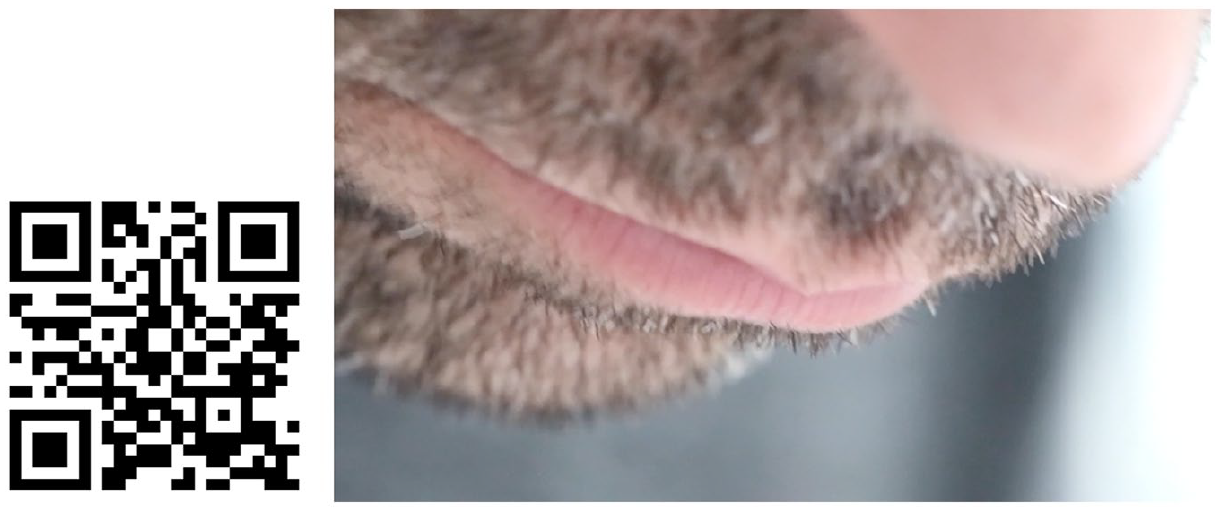
Chapter I: https://vimeo.com/333723479.
In the audiovisual mode of storytelling, vision is not only the subject of our interrogation, but becomes an inventive method (Lury & Wakeford, 2012) that affectively engages with the eyes and as such with the materiality and embodiment of vision. The film is not a representation of a process of face making. It is not there to teach us how such forensic method works. It is there to produce a response and to make us aware of how we make faces and what faces make us see. When watching the film, the viewer is not fully an outsider, listening and visually following the process of drawing the facial composite, but also caught up in the very exchange. The face does not represent but enacts an individual while simultaneously doing various modes of classification, valuing and affective relations.
The film is a curious anthropological object. While it mobilizes the vision of the reader, it simultaneously reminds the viewer that the realm of the visible and the ‘reality’ it enacts are not to be taken for granted. Experimental montage, instead of hiding cuts and gaps, draws attention to and amplifies them. In these gaps, it is precisely by the means of vision, the vision of the reader, that it becomes possible to attend to the complexities of seeing, faces and race. By layering the facial composite in the making with close-ups of real faces, their ever-changing movement and flickers, the film questions the static nature of faces. It disturbs the idea that faces can be unproblematically described, drawn and identified in forensic practices such as facial composite drawings. The film introduces the fluid and living face to comment on and intervene into scientific traditions of disaggregating the body to its parts in order to measure, count, and identify.
Experimental montage not only disturbs the assumed immediacy of knowing faces. By making us as it were blink, it denaturalizes seeing as well. It proves that seeing is an embodied and mediated practice (Haraway, 1988). To be more precise, technologies of vision bring about and enact the face. And in this process race slips, slides and hides (Bleumink et al., 2021). Othering often involves distancing, fixation, and categorization – the film reintroduces fluidity and movement, affectively disturbing the idea that the face can be known by performing such fixations and categorizations. Let us now move on to a different time and space of Europe; one in which different movements are at stake. At the borders of Europe, vision – the vision of police officers and passersby – becomes a crucial technology to distinguish between citizens and refugees on the streets.
Chapter II. Vision and race
In the early spring of 2016, together with my visual anthropologist friend Arjang Omrani, I embarked on a short project. We met up in Thessaloniki, a Greek city that at the time was visibly full of newcomers, often labelled as refugees, or asylum-seekers. These people, after arriving from there, from distant places, were now living in refugee camps or in squatted houses, waiting for the borders to re-open, papers to be issued or their asylum procedure to be processed. We got to know such a group of men and spent two days with them wandering the streets of Thessaloniki. Arjang would talk to them in Farsi. Me in English. We would walk through the city center, visit tourist destinations, rest on benches in parks and squares. Were we seen as refugees by the passersby? We asked our companions the same question: How do you feel when walking these streets on your own? Do you think you are being spotted? Stared at? Recognized as refugees or asylum seekers?
From the stories of these young men, we learn what it takes to ‘pass’. Most importantly, they clarify that there is more than one way to be the other in public spaces. The other who is different from the local passer-by, the city dwellers rushing after daily business or leisurely walking on a Sunday: the loiterer, the unemployed youth, the homeless, or the refugee. But tourists can also come from there, be the other. This other is of a more ‘proper’ kind though. One that instead of posing a threat to the economic and moral order, is harmless. Useful even. Welcomed to spend money while collecting memories. How then to tell apart these different types of others? How to distinguish them while looking around on a square? And what to look at more precisely? Is it the face? The skin tone or perhaps the beard? ‘You shouldn’t have any problem,’ one of the Iranian young men explains to his friend, ‘you look quite European-like.’ And the discussion continues to whether the beard makes a difference and how the best strategy is to pay careful attention to one’s looks: to have clean and tidy clothes, use cologne, carry small backpacks and take photos with one’s smart phone. They are playing tourists. That is, they want to be taken as another other, a harmless, welcomed one.
The term ‘passing’ has its deep roots in the U.S. American history of slavery and racial segregation. When legally defined ‘Negros’ assumed to claim a ‘White’ identity, they had to pass through boundaries or trespass the racial line. Passing involved a physical movement (Pile, 2011), crossing through spatially demarcated forms of identity in order to escape subordination, and oppression (Ginsberg, 1996, p. 3). Passing also involved a deliberate altering of one’s physical appearance and behavior, trying to conceal one’s racial otherness assumed to be ‘visibly evident’ in physical features such as facial structures, hair texture and skin color – or what Frantz Fanon has called the ‘racial epidermal schema’ (Fanon, 1952/2008, p. 112). Passing therefore implies an active, material tinkering with beards and hairdos, clothes and behaviors. Biology, we learn, is never separate from the realm of the social. Our skin tone are not matters of facts. They are only one part in how we present ourselves and in how we are perceived by the people around us, by the unknown passersby, or, what was at stake for our Iranian friends in Greece, by the patrolling police. While some people might feel safer when the police are around, others might feel a grip in their stomach and become suddenly aware of what they wear and how they look. Perhaps they will also pay more attention to how others look and make up strategies to blend in better. Our Iranian friends did this in Thessaloniki. Passing is thus about familiarity and proximity. But is also about flexibility and adaptability.
Passing takes laborious effort to manage one’s image. It takes pondering on how one looks, what to wear, and how to behave. However, vision, as the primary technology of orienting ourselves in the world, has an intricate relationship with knowing. Telling apart the different groups of people, the refugee other from the tourist other, is hardly an easy process. The other needs not only to present themselves in one, rather specific way. The one who looks also has to recognize, identify and categorize. And in turn the other anticipates these categorizations, mobilizing them or aiming to flee them. Vision again appears to be the main technology of knowing. ‘But what if vision is not subjective, but rather an effect of our relations with one another … – that is, what if vision exists, so to speak, “between us” rather than “within us”?’ Willerslev and Suhr (2013, p. 286; see also Willerslev, 2009). That is, what if knowing is neither about the object to be known nor about the one who looks, but rather about the relationship between the seer and the seen?
The following filmic paragraph breaks down the dichotomy of the seer and the seen to argue that vision is by no means a one directional process. It happens in between, where the roles of who is looking and who is being looked at are distributed across the bodies, eyes and faces involved. And it is distributed across the materiality of the images and the technologies of vision as well. Montage as yet another technology of vision can mess with the eyes. Please allow it to mess with yours.
Please watch Chapter II now (min. 5:18) (Figure 2).
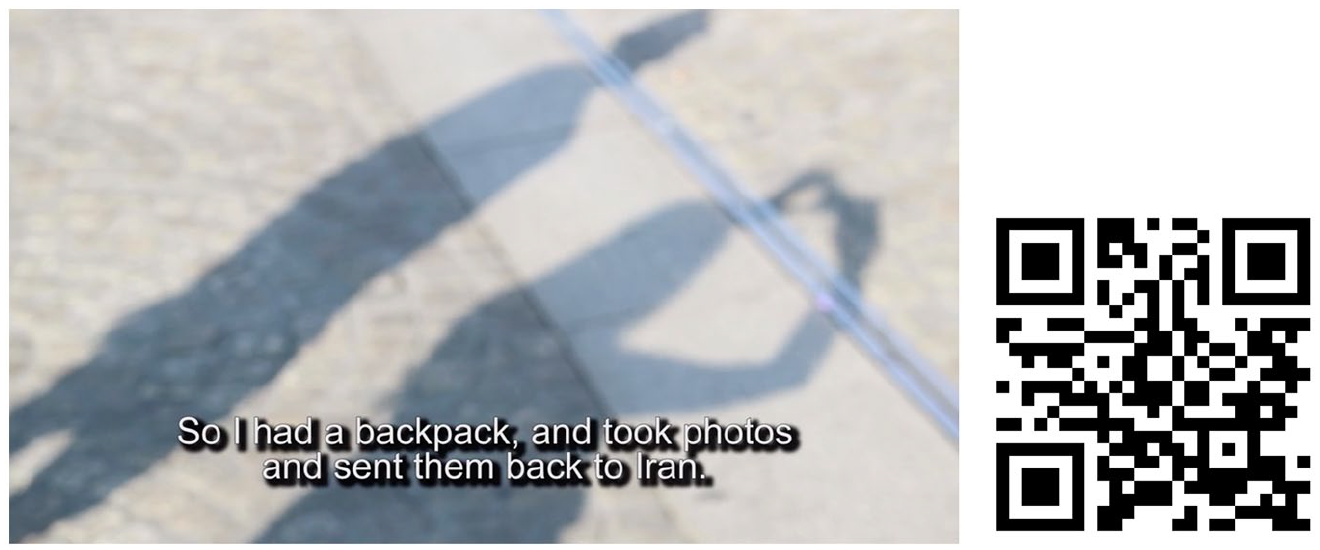
Chapter II: https://vimeo.com/333723479.
Were you wondering whose story you were listening to? What does the person talking look like? At the beginning, the face is withheld from the viewer, creating a void, a visual space for the viewer to imagine. When we do see a face, the image rubs against our dominant ways of seeing and apprehending faces. It doesn’t come as a whole, but by means of extreme close-ups, in fragments. Similarly to how the forensic artist assembles composites, the face is disaggregated. Eyes, mouth lines, chins. However, while the facial composite works from the many to the one, working its way down to one face out of many possibilities contained in the composite sketcher’s folders, here the process is reversed. While we listen to one voice at a time, one person speaking, the film presents us with a variety of eyes, mouth lines, chins, shades, and colors. In the film the faces multiply and through this proliferation, the meanings attached to words as ‘olive skinned’ and ‘European-like’ are destabilized.
While the narration in this filmic chapter is about the effort to pass, the collage of close-ups of eyes, noses and mouth constantly disturbs the words spelled out by the Iranian men. What darker or lighter means is both relational and mediated, not least by the camera itself. Seeing is inherently material. The properties of surfaces, namely that they absorb certain wavelength while reflecting back others, make us see different colors. Then, introduce a recording and a replaying device, a film camera and a computer screen for instance, into the process of seeing, and the material interfaces multiply. These interfaces bring with them their specific histories and politics. Starting with our eyes and perception that is trained in specific socio-cultural (Grasseni, 2007; Lynch & Woolgar, 1990) and professional (Goodwin, 1994) contexts, all the way to cameras that are white balanced (van Dienderen, 2015, 2017) and monitors that are calibrated in specific ways. What becomes visible and how it does so are therefore contingent upon the materials and technologies involved.
The active decomposition of faces into parts switches the attention from the object or subject of vision to the one who is looking. It turns the gaze on us, the viewer. And in this process it makes us aware of how, when looking at unknown faces, we tend to look for classificatory boxes often based on racial cues. The face here refers not just to the physical face, but also to the face as a technology of making sense of and governing bodies (M’charek & Schramm, 2020). By exploding the face and disturbing the everyday ways of looking at and categorizing faces, the film actively dismantles the face of the ‘phenotypic other’ (M’charek et al., 2014). Montage here not only unravels the work of audiovisual juxtapositions but, by amplifying its temporal and spatial ellipses, it again effectively disturbs the idea that people can be known by looking and being looked at. The film therefore contests the taken-for-granted nature of race as ‘common sense’ (Posel, 2001) and alerts us that vision can be complicit in everyday racism on the streets, in refugee camps and in police practices.
These young men on the streets of Thessaloniki would rather go unnoticed, would rather disappear in the crowd. Like most of us, they feel uncomfortable when being stared at by the passersby. But for them the stakes are high. They need to avoid being stopped and identified by the patrolling police. Because of this, racial otherness weighs heavily on their bodies, and not only on individual bodies, but also on the collective one of the prevailing racial other. While we tend to think about physical markers as already present, given phenomena that lend themselves to the eye, these young Iranian men teach us the opposite. Phenotypic differences are not shapes and shades that can be unproblematically read off the body. Rather, they come into being as visual markers that gain meaning and significance in between the eyes and other bodies, faces, backpacks and ways of traveling. Moreover, as the film does not present us with faces in their entirety, the fragments and the possibility of faces unleash a process of montage in the viewer. Also, in this way, the face is both material (the fragments presented to the eyes) and mediated (the montage for the viewer). They come into being through the play of light and darkness (Willerslev & Suhr, 2013), visibility and invisibility (Minh-Ha, 2016), and materialize through interfaces. These interfaces are not only heavy with traffic. They are also saturated with affect.
Chapter III. Race and affect
In this third, and final chapter, let me start with an object. A violin. An ordinary violin made in a small town in Transylvania (Romania) and now belonging to a folk musician living in a village not far from there. He got it as a present from his father, who also taught him to play it. He never attended music school. Everything he knows about music he learned from his family. His uncles and cousins also play string instruments. They organize themselves in a so-called traditional village band. Our musician sits on the stage. The body of the instrument rests firmly on his thigh, while his left hand gently holds its neck. They are waiting for the concert to begin. In the next moment, the lights go up, he lifts the violin and places it on his left shoulder. The concert begins.
The musician is on stage playing his violin. Lit by strong lights he is center stage. However, the focus of attention is not on his face, but is on his hands. On his left hand, to be precise. On his fingers dancing on the strings, while his right hand holding the bow moves up and down on the rhythm of the music. And on his violin. The violin’s resin-dusted surface catches stage lights that dance faster and faster. In this visual and sonic feast, the body of the musician and the body of the violin become one. Entangled, they become a symbol of a cultural heritage, namely folk music from Transylvania that is traditionally played by Gypsy musicians. The label ‘Gypsy’ is key in this heritage and the musicians themselves make witting use of it as to sell their crafts. They even brand themselves ‘a traditional Gypsy band’. However, the term ‘Gypsy’ weighs heavily, as it carries centuries-old divisions of roles. The Gypsy, othered and racialized (Plájás et al., 2019), kept at the margins, is still at hand to perform traditional crafts. Gypsy crafts become building blocks of the majority’s cultural patrimony (Piotrowska, 2013). The Gypsy musician here, on stage, embodies this patrimony. However, it does so by simultaneously bringing about the racialized other. The othering does not happen at the level of the face, though, or even at the level of the skin tone or bodily features. It happens at the level of playing the instruments with ostensible ‘innate’ virtuosity. The Gypsy is to be recognized by his hands playing the violin, becoming faces, as it were, sites of racialization and stigmatization.
Drawing on the work of Deleuze and Guattari (1987/2004), M’charek argues that ‘the face is not limited to the skull or the head; it spills over to include bodies and even environments’ (M’charek, 2020, p. 370). Faces come about through an ‘abstract machine of faciality (visagéité)’ (Deleuze & Guattari, 1987/2013, p. 197), a material-semiotic system entwined with notions of similarities and differences, normality and deviance (M’charek, 2022, p. 370). In everyday life our musician might not be a ‘Gypsy’, might not even identify himself as belonging to the Roma ethnic minority. He ‘passes’ as a respected craftsman who earns a decent living, and even entertains connections with the cultural elite that is busy with preserving folk tradition. On stage, however, the intense character of race binds him to a historically crafted role which cannot be escaped. The Gypsy musician is recognized by his virtuosity and talent, which are seen by the cheering audience as innate, almost biological traits. Race here sticks to his hands and violin, and while doing so it is saturated with affect.
As the Gypsy musician plays, his music, full of the virtuosity of his othered and exoticized craft, evokes strong emotions. It makes people joyous, prompting them to dance, sing, and shout. However, it also elicits unease and suspicion that stick to and travel together with certain bodies – unwanted, racialized bodies that evoke fear and distrust (Ahmed, 2004). How should we engage with race when it spills over into the everyday lives and bodies of those who are constantly othered? Or when it spills over into the pages of this article? How should we actively engage with its (visual) materiality without reproducing or reinforcing racial otherness? Taking this challenge seriously, I once again switch to an audiovisual format.
Please watch Chapter III (min. 8:36) (Figure 3).
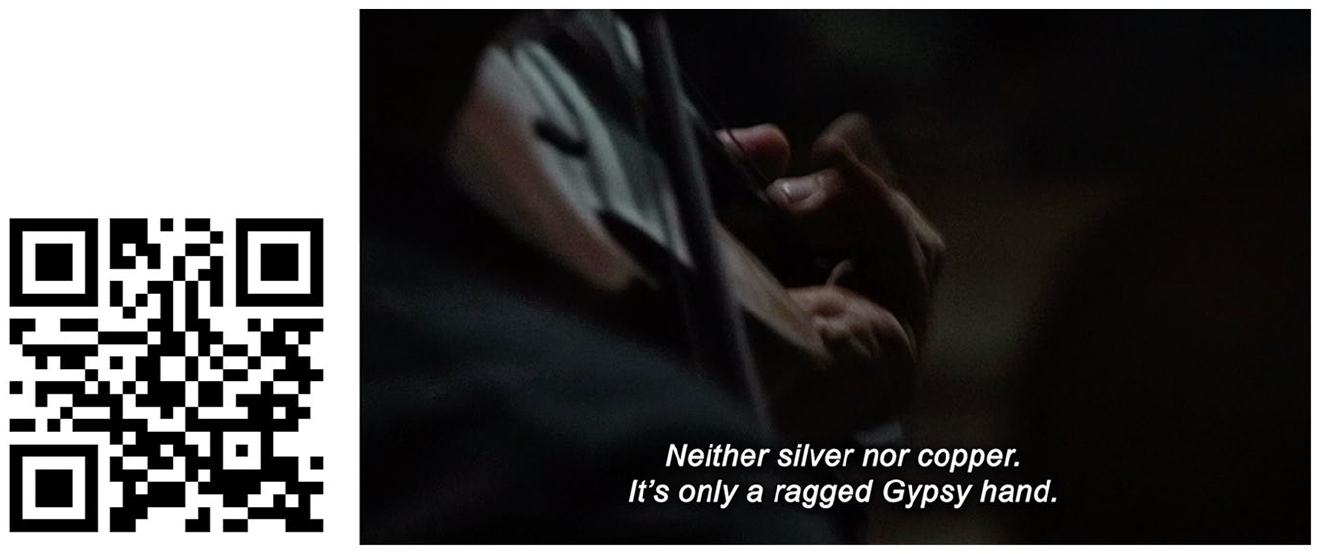
Chapter III: https://vimeo.com/333723479.
The close-ups of instruments and hands producing rhythms and sensations bring about what Deleuze calls ‘affection-images’: ‘The affection image is the close-up, and the close-up is the face’ (Deleuze, 1983/2002, p. 87). On the screen, the closeups of hands and violin facialize the image (Deleuze & Guattari, 1987/2013). They stand for and become the face, and thus enact race. Playing instruments while the crowd is dancing, the sweaty hands, the accelerating beat and the dust stirred by the dancers’ feet, create an intense moment. The music, their music, played here, for us – their otherness, too – infuses this moment. The music is experienced both directly and indirectly. Directly it is affective and sensuous; indirectly it brings forward histories of othering, marginalization, and exoticization.
Play, Gypsy violinist! Your hand is not out of silver. Neither of silver nor of copper, It’s only a ragged Gypsy-hand.’
What we hear, what is happening in this specific space and time, and in this specific film clip, is not just music; race is happening as well. Through the means of experimental montage, this moment of race can be interrupted. Inspired by Minh-Ha’s (1989) work, I slow down, reshuffle, and manipulate image and sound to unpack the easy, straightforward narrative about racialization. The music, and the bodily movements it elicits might give us the feeling that we are all one. However, by slowing down and disrupting the lively rhythms, the film exposes the exotic edge of our immersion in the joyous music, feeding on otherness and folding in itself a long history of racialization. While the music plays with our emotions and we are moved to dance, shout, and sing, I steer the attention of the viewer towards the hands and instruments, introducing the story of hard labor and surveillance. Then the music suddenly stops and we find ourselves in an different environment. There are resting hands, perhaps in an office where fingerprints are taken. The fingerprint here becomes yet another facialized image, akin to a mugshot stored in police databases to be later used for identification. These visual layers alert us to the fact that our emotions do not map onto the emotions of the musicians. They alert us to a hierarchal and racial asymmetry exposed through the closeups of hands and instruments.
The film once again stops being a neutral ‘window’ that allows us to devour the fingers dancing on the strings or that reports on the racializing effects of being in the role of a Gypsy musician. It again foregrounds the technology of montage and the materiality of images. It disrupts and frustrates spatial and temporal continuity to make an argument. The face is not by itself while enacting face-ness. It is fashioned by hairdos and makeup. It is surrounded by objects. And the face, following Deleuze (1983/2002), can be evoked in hands or violins. It is decentered, put out of focus, only to learn more about its politics. Racial otherness as it comes about on the stage where the Gypsy musician plays his instrument ‘engages and yields an affective response’ (M’charek, 2020, p. 369). It evokes and provokes emotions. And it provokes resistance as well, even if a silent, resilient one.
Race, trapped in history, is evoked through objects. It is, one could say, carried around in the violin case and inscribed into the hands playing the instrument. It sticks to bodies that are perceived as suspicious. Yet, our musician, following in his father’s footsteps, picks up his violin and sets out on his journey to play at local events and international festivals. He willingly stands in strong stage lights to perform traditional folk music while performing his ‘Gypsy-ness’, no matter whether or not he wants to. He makes a living. And he teaches his sons to play the violin as well. Race is trapped in objects and histories and constantly evoked, bringing about the melancholia of resistance (Dányi, 2020) – the deeply political act of sometimes going along, other times resisting hegemonic discourses of othering. Of embracing the complexity and messiness of the daily business of survival.
Attending to the affective character of race is also to attend to the politics and sociality of emotions. The fear, disgust and joy that do not reside in subjects or objects. Rather, they are produced as effects of circulations (Ahmed, 2004, p. 8). That is, they come about in between bodies, violins, faces, and fingers but also through music, smells, and vision (Plájás et al., 2019). The racial other is enacted in between all these elements and in between the one who looks and who is being looked at.
Conclusion: Experimental montage and the disruption of race
What one sees in an image is a manifestation of how one sees it. In research and exploration, as well as in political dissidence, the question is not merely to gain vision and visibility, nor is it to vainly oppose the ear to the eye, or the other senses to sight, for example. On the contrary, invisibility is built into each instance of visibility, and the very forms of invisibility generated within the visible are often what is at stake in a struggle. The two are inseparable, for each is the condition for the advent of the other. (Minh-Ha, 2016, p. 132)
In this multimodal essay, I engage with the relationality and materiality of vision in various face- and race-making practices. I do so by means of experimental montage in which I intertwine various written and audiovisual stories. Although film and text are meant to do different kinds of intellectual work, in combining them, I create a multimodal platform to attend to complexities and incongruities. I multiply stories about seeing (Galison & Daston, 2008) and identifying faces to disrupt the narrative of race.
In the three chapters of this article I use cinematic montage to affectively intervene in our habitual way of seeing and ordering faces. I show that faces, phenotypic features or skin tones do not exist a priori, but are fluid and elusive and brought about vision, a technology of ordering and othering. Vision is not a neutral way of accessing reality, but happens in between subjects and objects, beards and backpacks, ideas of sameness and otherness. While I use montage as a method to disturb the neutrality of vision, the film clips demonstrate that what is being seen is ultimately narrated and montaged in the head of the viewer as they make sense of the cinematic arguments. While Chapters I and II disconnect sound and image to simultaneously tell and interrupt common stories about face and race, Chapter III dislocates the face altogether. This moving away from faces – by looking at hands playing instruments or at instruments themselves – emphasizes that body parts can also become a political technology of facializing in/visible faces, while amplifying the affective dimension of race. The story of the Gypsy musicians also alerts us to other senses and sentiments about race when smells and sounds (for instance through the loudness of a voice) are mobilized to enact race. When race surfaces it is saturated with affect. It spills over into places, bodies and time, setting apart the here and there, the bodies that belong and those who do not. The film clips help attending to these complexities by summoning the very technology used in identification: vision.
The film not only interrupts and complicates scientific narratives about faces and race making practices, but it also crafts a theoretical intervention into the materiality and politics of vision. Montage allows for unravelling or disaggregating in order to understand how race is done. Montage can manipulate time. It can slow down perception and facilitate close and attentive look at forensic practices. It can also disrupt easy narratives on race by fragmenting, multiplying and affecting.
Footnotes
Acknowledgements
I would like to thank Amade M’charek and Huub van Baar for embracing my experimental endeavors and for encouraging me to develop the argument of this paper. And to Sergio Sismondo for his generous comments and careful editing. Many thanks to the RaceFaceID team for the thinking together and to Jeanette Pols and Endre Dányi for helping me take some crucial turns along the winding road. I thank Christian Suhr, Metje Postma, Mattijs van de Port and the Security Vision team for their invaluable advice on the filmic parts. Chapter I is based on an experimental project developed together with Ryanne Bleumink and Lisette Jong; and Chapter II has been co-labored with Arjang Omrani; I am also indebted to all the research participants and my colleagues and friends who generously offered (fragments of) their faces, hands and instruments to this project.
Funding
The research leading to this paper was supported by the ERC Consolidator Grant (FP7-617451-RaceFaceID-Race Matter: On the Absent Presence of Race in Forensic Identification), led by Amade M’charek.
