




Abstract
This story is about the twentieth-century ethnobotanist, Richard Evans Schultes (1915–2001), and his research on hallucinogenic plants. Ethnobotany can contribute directly to science and technology studies in that the discipline makes cultural ways of knowing its scientific subject. Ethnobotanists must learn about plants through people, and are not able to conceal their interactions with indigenous informants and other ethnobotanists. I focus on an ‘enigma’ that Schultes presented, concerning the peculiar ability of indigenous Amazonians to distinguish between local varieties of vine that he was unable to tell apart, notably those used to prepare the hallucinogenic beverage ayahuasca. The enigma describes a complicated and irresolvable question thrown up at the uneasy intersection between different ways of knowing about the world, and shows how modern scientific travellers might navigate – or fail to navigate – the uncertain passage between them. Together with Schultes’s accounts of his own non-ordinary states of consciousness elicited by ayahuasca, and his writings on the Victorian botanist Richard Spruce, I chart an epistemological gulf between Schultes’s modern scientific cosmology and that of his Amazonian informants. In describing his inability to learn about the ayahuasca varieties from Amazonians, Schultes’s enigma traces the very limits of the ethnobotanical discipline and reveals the fragility of the processes by which scientific naturalists might impose categories such as ‘nature’ and ‘culture’.
Keywords
Plants’ relationships with people have long been complicated. Their intricacies are reflected in the stories that people tell about the provenance of plant knowledge. The anthropologist Gerardo Reichel-Dolmatoff (1975: 134–135) relayed a story told by the Desana people of the Colombian Amazon. It described how they had acquired their knowledge of the hallucinogenic yagé (or ayahusaca) vine. The yagé woman looked at the Sun Father and became impregnated through her eye. Having given birth to her child, she entered a ceremonial house where men from different groups had gathered together, and demanded to know who was the father of the child. Bewildered, all the men claimed it as theirs and fought over the child, tearing it apart, each part of the child’s body becoming a different kind of yagé.
In 1957, in a discussion of the botanical identity of ayahuasca, the Harvard botanist Richard Evans Schultes (1957: 1–4) – one of the most prominent and celebrated figures in twentieth-century ethnobotany – provided his own provenance story in an attempt to ‘make some order from the rather chaotic state’ of the botanical and anthropological literature on ayahuasca. Like the Desana story, it featured bewildered men squabbling over a question of identity. But whereas the Desana men settled their disagreement by tearing the body of the child into its different parts, producing many different kinds of ayahuasca, the taxonomists in Schultes’s story tried to agree on how to subdivide the genus Banisteriopsis into its constituent species.
I structure this article around a paper that Schultes published in 1986, in which he described an ethnobotanical ‘enigma’. Schultes’s enigma concerned the ‘uncanny’ ability of indigenous Amazonians to distinguish between multiple varieties of plants that he was unable to tell apart, notably those used to make the hallucinogenic beverage ayahuasca (Schultes, 1986). The enigma plunges the reader into a gulf between different ways of knowing about the world. In this turbulent space, Schultes wrestles with an intractable puzzle: How was it that local Amazonians could see something that he could not? Were the varieties of ayahuasca vine that the Amazonians identified natural or cultural entities? In contrast with recent work in science and technology studies (STS) that has focused on how scientific practice emerged through hybridization and cultural exchange, I describe how a scientific naturalist might find themselves unable to reconcile their own ways of knowing with those of their local informants.
How do people learn about plants? Schultes celebrated ayahuasca’s ‘discovery’ by the Victorian botanist-explorer Richard Spruce one hundred years before, a discovery that he lauded as ‘undoubtedly’ one of Spruce’s ‘greatest contributions to science’. Although Spruce learned about ayahuasca from indigenous Amazonians, Schultes’s emphasis on its discovery masks the exchanges and interactions surrounding Spruce’s acquisition of this plant knowledge. 1 By contrast, in the Desana story, knowledge of ayahuasca explicitly arose from an interpersonal exchange. In the vein of the Desana story, much compelling recent work in STS has prioritized stories of knowledge exchange over discovery (e.g. Cruikshank, 2005; Raj, 2007; Schiebinger, 2004). 2 However, in dealing with the disordered translations and transactions that underpin the making of knowledges (Anderson and Adams, 2007: 184), less attention has been given to the interactions that take place upstream of more familiar scientific sites, particularly those between local, often indigenous, informants and their intermediaries. This is largely due to the scarcity of source material that can grant access to both sides of the story, a problem arising from the non-literacy of many local indigenous cultures, the systems of oppression and cultural erasure that silence subaltern voices (Schiebinger, 2004: 14; Spivak, 1988: 80–81), and processes of decontextualization inherent to scientific classification, through which life forms are extracted from their places in local histories and social or symbolic systems and rehabilitated within European-based logics of unity and order (Cruikshank, 2005: 256; Pratt, 1992: 31). The subordination of local knowledges often led naturalists to downplay their interactions with local informants, and to separate ‘objective’ natural knowledge from ‘subjective’ or ‘superstitious’ local knowledge (Raffles, 2002: 145). Although one-sided naturalists’ reports may be read against the grain in an attempt to amplify these quiet historical voices, it is difficult to correct for these biases retrospectively. 3
I suggest that Schultes’s enigma and the discipline of ethnobotany can illuminate complicated questions of knowledge exchange between cultures. Ethnobotany provides an idiosyncratic perspective on scientific enquiries in that it is exactly the relationships between people and plants that make up its subject matter. The discipline makes cultural ways of knowing its scientific subject (Schultes, 1967: 33). Consequently, ethnobotanists must learn about plants through people, and aren’t able to conceal their interactions with indigenous informants and other ethnobotanists. Both ‘natural’ and ‘cultural’ features of plants are reported and discussed. This unusual feature of the discipline renders the constant boundary work between ‘objective’ scientific knowledge (‘nature’) and ‘subjective’ local knowledge (‘culture’) a visible part of ethnobotanical practice. I aim to show how the discipline of ethnobotany can usefully foreground the tension between the conventional subject of scientific enquiry – an ostensibly singular and objectively knowable nature – and the many, culturally variable ways of knowing. Holding this focus, I emphasize the broader importance of ethnobotany for the social studies of modern science.
The enigma, about which Schultes is explicit, serves as a gateway to larger questions about which he is less explicit. One such question arises from Schultes’s accounts of his own botanical knowledge, most clearly articulated in his writings on his relationship to his predecessor, Richard Spruce (1817–1893). Here, Schultes ranged beyond lexicons and taxonomic practice and confronted the more general problem of how it is that any scientific traveller can claim to be a credible reporter. Another question emerges from Schultes’s implausibly neat accounts of his own ayahuasca-induced non-ordinary states of consciousness. In these writings, his inherently subjective experience of coloured visions became part of his ostensibly objective scientific methodology, and crystallized into straightforward taxonomic reports that bear no trace of chaos or ambiguity. Schultes’s work reveals an epistemological chasm separating the cosmology of indigenous Amazonians from his own modern scientific cosmology, and shows how a scientific practitioner might grapple with what it means to see under the influence of ritually administered Amazonian plants, and how this differs from what it means to see within the ‘objective’ ocularity of Western science. This ontological crack provides unusual vantage on the often fragile processes by which scientific naturalists might impose categories such as ‘nature’ and ‘culture’, and how they might navigate – or fail to navigate – the passage between radically different ways of knowing and observing.
‘An old practice, a new discipline’
The term ethnobotany was coined by the American plant taxonomist John Harshberger in 1895, but it was only in the first half of the twentieth century that it emerged as a distinct discipline. In a tribute to Schultes following his death, the botanist Ghilean Prance (2001) wrote that ‘no single person has done more research in the field personally nor encouraged more people to enter the field. Schultes can rightfully be called “The Father of Modern Ethnobotany”.’ Schultes’s role and status within the field was further celebrated in an unconventional biography, One River, written by one of his former students, Wade Davis (1997). 4
Ethnobotany was, and remains, variously defined (Schultes and von Reis, 1995: 11). Schultes’s 1967 rendition is the most generally applicable: ‘a study of the relationships between man and his ambient vegetation’ (Schultes, 1967: 33). According to Schultes, ethnobotany as a discipline had two goals. The first was of academic interest and concerned the study of the ‘psychological’ features of human relationships with plants. The second goal gave ethnobotany applied value and involved the ‘finding’ of plant species that might have agricultural, industrial or pharmacological value (e.g. Schultes, 1979: 259–260). Schultes’s definition reveals ethnobotany’s kinship with the field of ‘economic botany’, a discipline closely affiliated with imperial enterprise; Schultes published many of his studies in the journal Economic Botany, and it was there that Prance published his tribute to Schultes.
Disciplinary ethnobotany could take many forms. While ethnopharmacologists might analyse collected plant matter for biologically active compounds (Holmstedt and Bruhn, 1995: 338), palaeoethnobotanists might use archaeological and textual evidence to reconstruct the plant knowledge of past cultures (Emboden, 1995: 94). In the former case, as Hayden (2005) has observed, ethnobotanists’ studies might feed into bioprospecting enterprises – a form of extractive colonialism – by which ‘indigenous knowledge’ might be transformed into Western pharmaceutical capital and intellectual property. In other situations, ethnobotanists with an activist agenda might use their studies as ‘staging grounds’ to prove the truth of ‘indigenous knowledge’ within their own scientific and cultural frameworks, and argue for the remuneration of the sources of knowledge, whether countries or communities. Both approaches are loaded with epistemological charge. 5
‘An old practice, a new discipline’ was a maxim used by Davis (1997: 40) to describe ethnobotany. It is a recurring trope in the ethnobotanical literature (e.g. Harshberger, 1896: 149; Schultes, 1997: 158). Serving both to legitimate and situate the ‘new’ discipline and to broaden its scope, ethnobotanists’ preoccupation with the history of their practice brings out an interesting reflexivity. For instance, Schultes included the work of the ‘explorer-naturalist-physician-herbalist researchers’ of the sixteenth and seventeenth centuries within the ethnobotanical canon. Verifying the information in herbals of Francisco Hernandez (1514–1587) and Georg Eberhard Rumphius (1627–1702) was a part of the ethnobotanical project. At the same time, these works were themselves the products of ethnobotanical enquiry, containing as they did hundreds of plants’ ‘folk uses’. By the same token, the acquisition and accumulation of useful knowledge about plants by indigenous peoples was itself ethnobotanical in nature (Schultes and von Reis, 1995: 11). As far as ethnobotanists learned about plants from people, ethnobotanists studied ethnobotanists, and in doing so participated in the exchange of plant knowledge that formed the subject matter of their discipline.
Schultes’s ethnobotany combined extended periods of field work, mostly in the Colombian Amazon, where he spent twelve continuous years between 1941 and 1953. He initially travelled to Colombia on a grant from the National Academy of Sciences to study curare, which had recently acquired medical importance in the West. He was ordered to remain in Amazonia for the duration of the Second World War to research rubber trees (Prance, 2001). Following his return to the US, he took up the curatorship of the Oakes Ames Orchid Herbarium at Harvard (1953), Curator of Economic Botany (1967), and later a professorship of biology (1970). During his long periods of fieldwork, he witnessed widespread ecological destruction and became an outspoken advocate for rainforest conservation (Prance, 2001). He authored ten books and 496 scientific papers over the course of his career.
Much of Schultes’s work centred around plant identity. What mind-altering organism was described by the Aztec name teonanacatl (Davis, 1997: 95)? What species of plant were present in the hallucinogenic ayahuasca preparations of the Northwest Amazon (Schultes, 1957: 1)? Many of Schultes’s projects involved clearing up taxonomic confusions and cases of mistaken identity (e.g. Schultes, 1957; Schultes et al., 1974). The customs and habits surrounding plant uses and preparation were a major part of his study: It was a plant’s human context that put the ‘ethno’ in ethnobotany. Perhaps unsurprisingly, these investigations were rarely straightforward. The dependence of ethnobotanists on local informants and the difficulties associated with taxonomic identification meant that indigenous plant knowledge could not always be easily translated into formal scientific knowledge. That most field work had to take place through conversations with local people meant that ethnobotanists like Schultes interacted with local languages and classificatory systems (Schultes, 1983a: 343). 6
Schultes was fascinated by indigenous uses of psychoactive plants and inspired a similar interest in many of his students (Prance, 1992: 2). Davis (1997: 22) described Schultes’s teaching laboratory at Harvard, where ‘oak cabinets elegantly displayed every known narcotic or hallucinogenic plant together with exotic paraphernalia’, containing ‘enough psychoactive drugs to keep the DEA [US Drug Enforcement Administration] busy for a year’. Although Schultes reiterated the importance of investigating drug plants for the development of new therapeutic treatments (Schultes, 1967: 34, 1972a: 113) his years of research into the subject were driven by a personal preoccupation with the effects of these mind-altering plants, which he described as ‘frequently inexplicable’, ‘uncanny’, ‘mystical’ and ‘confounding’. Of all the hallucinogenic preparations that Schultes encountered, ayahuasca, the ‘magic drink of the Amazon’ and subject matter of his enigma, was possibly the ‘weirdest’ (Davis, 1997: 217; Schultes, 1963: 147, 1972b: 124). 7
Schultes’s research played a large part in the explosion of interest in psychedelic drugs in the 1950s and ’60s. It was Schultes who in 1953 advised William Burroughs (a contemporary of Schultes as an undergraduate at Harvard) on how to find ayahuasca (or yagé) in the Colombian Amazon. Burroughs’s subsequent experiences and correspondence with the poet Alan Ginsberg formed the basis of the widely read Yagé Letters, published in 1963. More significantly, in 1939, Schultes published a paper in which he reported that the mysterious sacrament described in pre-Columbian codices, teonanácatl – ‘flesh of the gods’ in Nahuatl – was a psychoactive mushroom (Schultes, 1939). His paper attracted little interest until 1952, when Gordon Wasson, an amateur mycologist and a Vice President of the bank JP Morgan received a letter about Schultes’s paper on the subject from the poet and scholar Robert Graves. Wasson was fascinated by Graves’s news of the mind-altering fungi. Schultes’s paper was long out of print, but Wasson managed to obtain a reprint. He travelled to Oaxaca in search of the mushrooms, and later became an affiliate of the Harvard Botanical Museum and a close correspondent of Schultes.
In 1957, Wasson published an account of his experiences of mushroom-induced states of consciousness in Life magazine. 8 Wasson’s article was a sensation and read by millions. LSD had been discovered some years earlier, but had not yet become widely known outside the US military, the CIA, and a community of psychologists and intellectuals, including Humphrey Osmond and Aldous Huxley (Dyck, 2008: 3). Wasson’s article was one of the first accounts of hallucinogenic mind-altering experiences to reach a popular audience. In 1960, Timothy Leary, a well-respected Harvard psychologist, went to Mexico to try the mushrooms for himself. Back at Harvard, inspired by his experience, Leary abandoned his research program and set up the Harvard Psilocybin Project with Richard Alpert (later Ram Dass). The project aimed to help people discover new forms of consciousness and to document their experiences. Ginsberg became one of its mouthpieces and Huxley sat on the board. In 1963, Leary tried LSD for the first time. Soon afterwards, he left Harvard and began in earnest to promote his vision that cultural revolution and spiritual enlightenment could be attained via the consumption of psychedelic drugs (Dyck, 2008: 6).
Harvard grew into a major centre for the study of hallucinogens. Despite his long-standing interest in – and considerable influence on – the subject, Schultes remained aloof to the countercultural discourse that had sprung up around their use. He was disdainful of Leary, 9 and famously played down his own experiences of non-ordinary states of consciousness. In response to Burroughs’s vivid descriptions of his experience with ayahuasca, Schultes replied: ‘I only get colours, no visions’ (Davis, 1997). Schultes was politically conservative and remained an establishment figure, Davis observes: ‘an odd choice to become a sixties icon’ (he insisted on voting for ‘Queen Elizabeth II’ in presidential elections). 10 But despite his political views, noted Prance, Schultes had a libertarian streak and ‘spoke out freely on individual freedom and personal choice on such issues as religion, sexual orientation, abortion and the use of drugs’ (Prance, 2001). 11 His students mirrored the ‘extremes of his personality’, Davis recalled, and ranged from ‘quietly conservative, earnest scholars’ to those with more ‘unusual’ interests attracted to his work on hallucinogens.
Schultes’s enigma
In 1986, in a paper published in the Journal of Ethnobiology, Schultes presented an enigma. In it, he puzzled over the ability of indigenous Amazonians to recognize different varieties of plants that he was unable to distinguish (Schultes, 1986). Schultes observed that it was ‘botanically impossible’ to discern morphological differences to set these varieties apart from one another. Nonetheless, it was usual for an Amazonian to be able to ‘tell at once and frequently on sight and at a significant distance, without feeling, tasting, smelling, crushing, tearing or other physical manipulation, to which category a plant belongs’. Despite his inability to recognize the varieties, Schultes could still perceive that the local categories were stable: remarkably, individuals from different tribes, living at ‘appreciable distances’ from each other could consistently identify them. Schultes reported that he rarely found the local Amazonians ‘hesitant, doubtful or in error’.
Schultes bemoaned the fact that so little research had been attempted ‘on this fascinating aspect of ethnobotany’. All the explanations offered so far were no more than conjecture. Some researchers suggested that the varieties were different parts of a single plant, or specimens of the same species viewed at different stages of its life, or different forms of the same species resulting from growth in different environmental conditions. In cases where the plant was consumed in some way (as food, medicine, psychoactive or poison), the varieties might be forms of an identical species that varied only in their chemical composition due to differences in their growth conditions. These ‘chemovars’ could be distinguished on the basis of the physiological effect that they had on the organisms ‘human or nonhuman’ that they came into contact with. But if this was the case, how could Amazonians identify which variety it was from a distance, by sight alone? If particular plant individuals were cultivated and already known to the local inhabitants, this would not be extraordinary. However, varieties of wild plants in untravelled parts of the forest could be distinguished, not just cultivated ones.
Schultes discussed the enigma with reference to two vines, the stimulant yoco (Paullinia yoco), and ayahuasca (species in the genus Banisteriopsis, Figures 1 and 2), a primary ingredient of the powerful hallucinogenic beverage. He reported on the ‘sundry field studies’ that described a number of native variants, alongside several criteria (identified by European researchers) that formed the basis of indigenous classification. Besides familiar morphological characteristics, such as leaf structure, these criteria included the method of preparation of the brew, and in the case of Banisteriopsis caapi, 12 the quality and strength of the visions induced. However, the point of the enigma was not that modern scientific and indigenous systems of classification differed, or that indigenous people took into account a wider range of variables in classifying plants. The enigma concerned the ability of Amazonians to identify the named variety of a plant from a distance. It was, according to Schultes (1986, 1987a: 527), an ocular phenomenon.
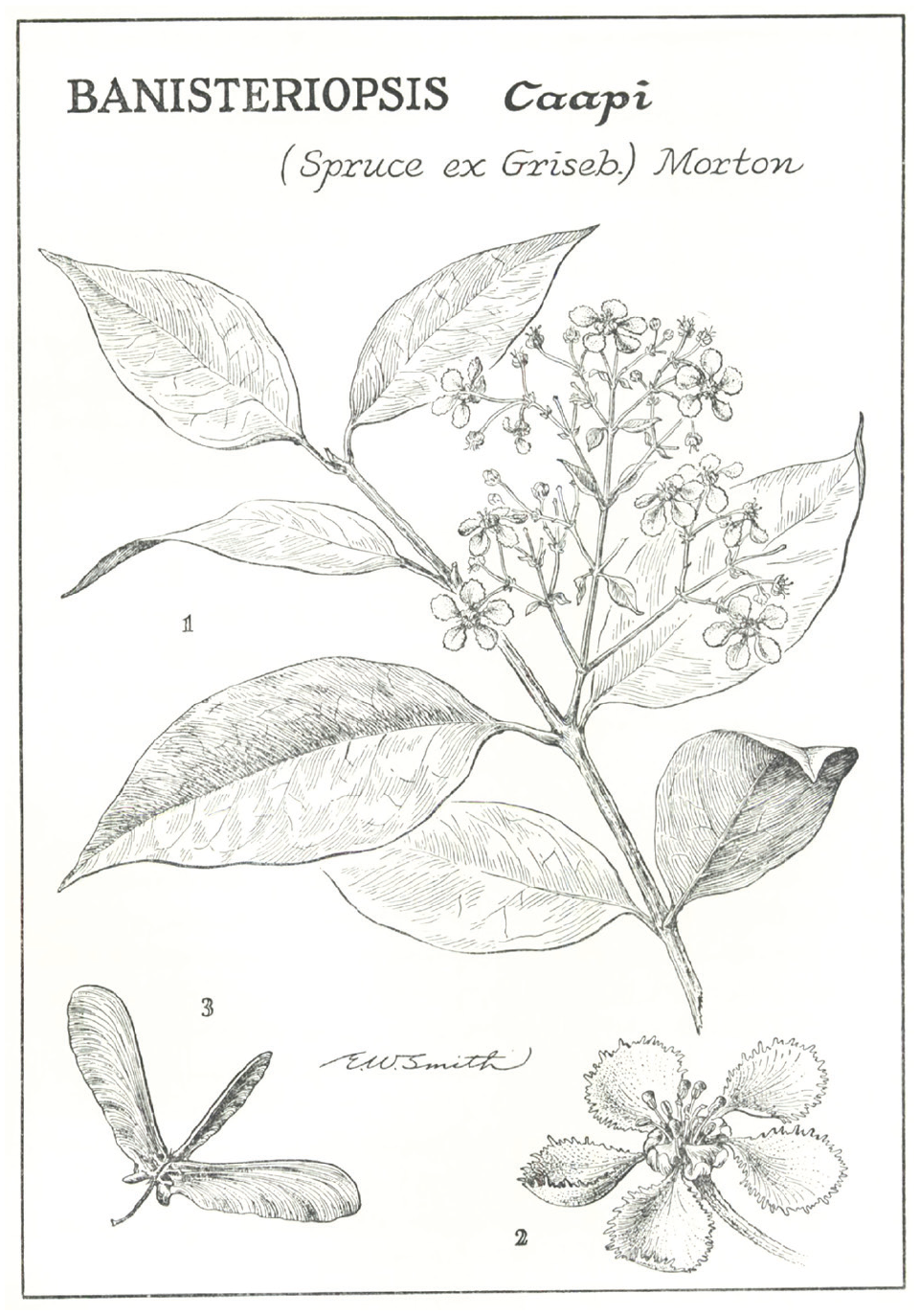
Banisteriopsis caapi according to Elmer Smith, 1957. Drawn from the type collection at the Botanical Museum, Harvard. From Schultes (1957: Plate II).
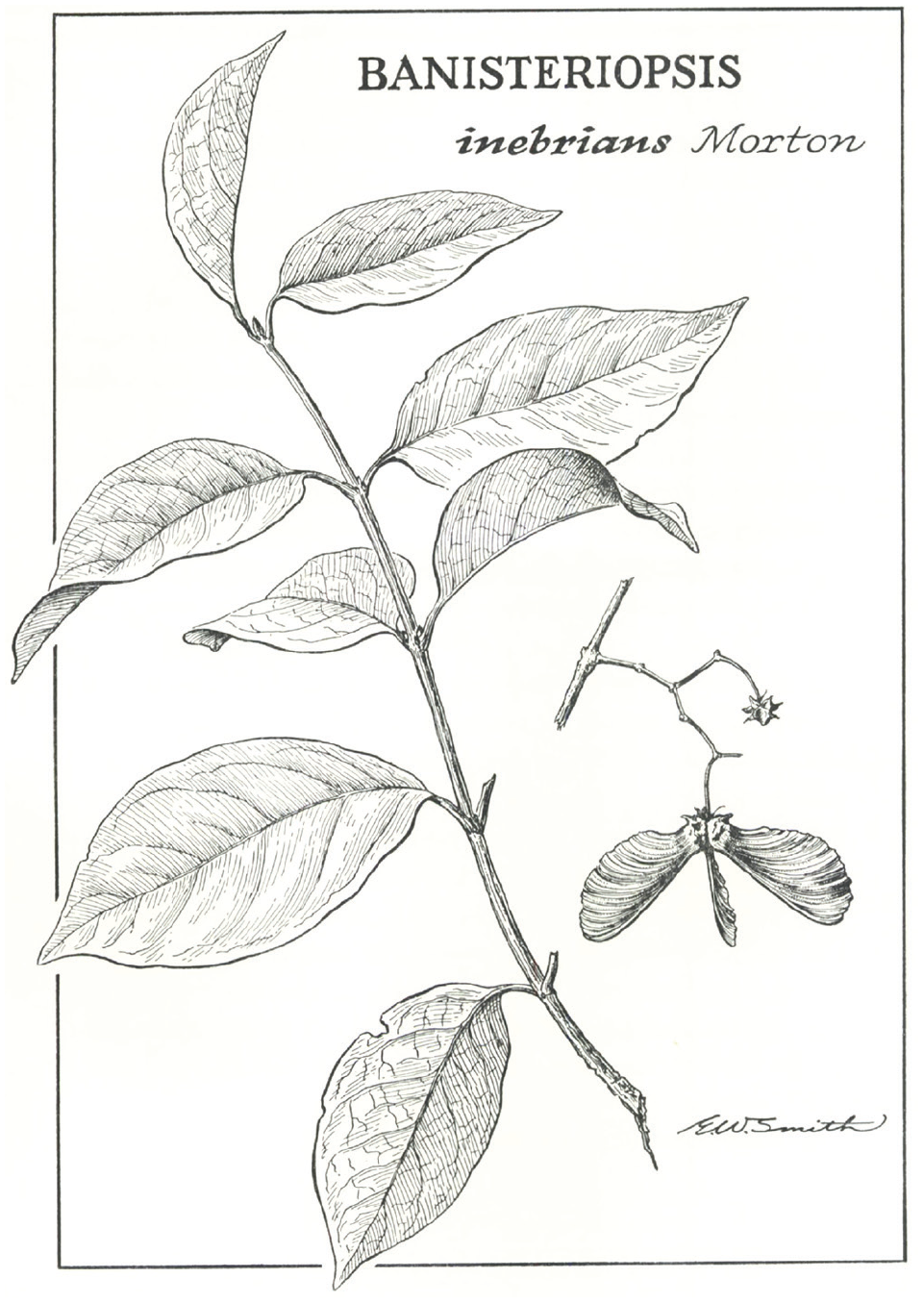
Banisteriopsis inebrians according to Elmer Smith, 1957. Drawn from the type specimen at the Botanical Museum, Harvard. From Schultes (1957: Plate III).
Schultes was sixty-six when the enigma was published. The synoptic style of the article gives it the feel of a retrospective, the sum of many personal and reported experiences over the years. According to Davis, Schultes found the intellectual problem posed by these plant preparations more astonishing than their psychological effects. Out of the tens of thousands of plant species that grew in the Amazon, the local people had learned to combine dissimilar species with ‘complimentary chemical properties’, apparently against all odds. As Davis observes, Schultes came to realize that ‘trial and error’, the well-handled catch-all explanation, was ‘a euphemism which disguises the fact that ethnobotanists have very little idea how Indians originally made their discoveries’ (Davis, 1997: 217).
Although Schultes mentioned the occurrence of multiple local varieties elsewhere in his writings (Schultes, 1957; 1972b; 1985: 62), he did not present their recognition as an intractable puzzle. He used the word enigma to describe unsolved riddles of different sorts (Schultes, 1967, 1987c), but nowhere else did he develop them to the same extent. In light of Schultes’s extensive field experience, his expertise on the subject of ayahuasca and yoco, and his considerable influence in the field of ethnobotany (Davis, 1997: 11; Prance, 2001: 347; Society for Economic Botany, 1979: 257), the enigma raises a number of additional puzzles alongside its central feature. Not least is the ocular spin that Schultes gave it. Described by Davis as possessing ‘the taxonomic eye’, Schultes’s capacity to ‘detect variation at a glance’ set him aside from other tropical botanists. Schultes’s gaze, according to Davis, would fall immediately ‘on what was novel or unusual’. He was accustomed to seeing what others could not (Davis, 1997: 394). 13
Schultes’s taxonomic perspective
Much ethnobotanical research concerns the determination of a plant’s taxonomic identity. Ethnobotanists must describe a plant in taxonomic terms if they are to know whether or not they are talking about the same thing. Stable identifications are a precondition for collaboration. Schultes wrote at length on the taxonomic disputes and misunderstandings that surrounded the identification of the plants used to prepare ayahuasca. Did the local names pinde, natema, caapi and yagé describe the same preparation or did they describe preparations made from different plant ingredients? Had these plants been correctly identified in the past, and if so, how could we know? Schultes discussed the findings of the Belgian botanist-explorer Florent Claes. In the existing literature, yagé had been described as a ‘small bush’. Upon finding that it was in fact an ‘enormous forest liana’, Claes suggested that those who had reported yagé to be a small bush had seen something different: ‘young, cultivated individuals, and not the vine in its “wild state”’. But since Claes was not able to collect botanical specimens, it was impossible for Schultes to know what Claes had seen (Schultes, 1957: 16–17). Although Claes had accomplished the first stage of determination by attributing a plant to a vernacular name, he had not been able to perform the second stage, namely the attribution of a Latin name to the plant. As a result, his efforts were of little taxonomic value (Schultes, 1978: 311). 14
The ‘beclouding of the exact identity’ of the ayahuasca plants was, for Schultes, a problem that could only be resolved through the collection of herbarium specimens and their accurate botanical determination (Schultes, 1957, 1978: 311, 324). 15 In one instance, the anthropologist Stephen Hugh-Jones sent Schultes specimens of eight varieties of yagé as distinguished by the Barasana people. The vernacular names contained epithets and were reported in translation. Varieties ranged from ‘red jaguar yagé’ which causes one to see ‘red under the influence’, to ‘yagé which came inside the [river] jurupary “fish swim bladder”’ which causes one to see ‘people under the influence’ (Schultes, 1972b: 142–143). Schultes referred all but one to the single species Banisteriopsis inebrians. The specimens served as a guarantee that the indigenous Amazonians and Schultes were looking at the same plant when they made their identifications. It was only under these conditions that Schultes could determine local varieties to be botanically indistinguishable.
There is a tendency in much of the literature on folk taxonomies to hold indigenous classifications up to the yardstick of modern scientific taxonomy, admire any correspondences and either criticize or ignore the points of disparity (Nazarea, 2006: 321). In many cases, taxonomies of taxonomies have been devised, which not only serve to bolster the status of modern scientific taxonomy by identifying it as the ‘type’ system to which all others are compared, but also presume that ‘folk’ taxonomies exist as self-contained systems that may be viewed independently of their cultural context (eg. Berlin et al., 1973; Hunn, 1976). These attitudes often serve more to conceal indigenous systems of classification than to illuminate them. Moreover, they frequently exaggerate the efficacy of modern scientific taxonomy. 16 Overconfidence in modern taxonomic methods was a problem for Schultes, despite his long taxonomic career and reputation as an outstanding morphologist. He noted that the ‘simple and basic truth’, regrettably sometimes overlooked by ‘zealous taxonomists’ was that plants were ‘not made to be catalogued and classified’. What constituted a species varied from genus to genus, and family to family. Armed with an historical perspective, Schultes observed, it was clear that scientific taxonomy had changed in its aims and structure over time (Schultes et al., 1974). Systems of classification themselves had to be analysed alongside their subject matter in order to clear the ‘foggy atmosphere’ surrounding plant identification (Schultes, 1987b).
20th-century ethnobotanists differed widely in their attitudes towards local plant knowledges. These differences may be broadly described in terms of emic and etic perspectives (Pike, 1967: 37). A distinction made by Kenneth Pike in 1954, the etic framework ‘studies behaviour as from outside of a particular system’ while emic approaches work ‘from the inside of the system’ (Pike, 1967: 37). In the case of the enigma, the attribution of a modern taxonomic identity to the ayahuasca plants represents an etic approach, and the recording of indigenous varieties with their local names and epithets an emic one. While the relative importance of each has been keenly debated within anthropology, these approaches are not mutually exclusive and often depend on each other. Particular combinations of etic and emic approaches may be more or less appropriate under different conditions, to serve different purposes (Jardine, 2004: 275).
It is Schultes’s combination of emic and etic approaches that gave rise to the enigma. The botanical identification of Hugh-Jones’s samples of Banisteriopsis indicated that local and scientific systems of classification differed. Yet this difference would not have been visible unless the local varieties had first been considered to be self-supporting categories. Although it was possible to explain away the existence of multiple local varieties using modern taxonomy (a strong etic approach), some anthropologists offered cultural interpretations that supported the existence of the varieties within an alternative system of classification, but rendered these varieties invisible to European botanists by basing them on a range of scientifically irrelevant criteria (a strong emic approach). Both strong etic and strong emic explanations stopped short of the enigma, which was visible to Schultes on account of his particular blend. Just as the Amazonians saw several plants where Schultes saw one, Schultes saw an enigma where many of his colleagues did not.
A natural or cultural enigma?
The enigma’s central tension concerns Amazonians’ abilities to consistently distinguish between varieties of ayahuasca, apparently by sight. By framing the enigma as an ocular phenomenon, Schultes made the enigma resistant to anthropological explanations that considered the ayahuasca varieties to be invisible cultural projections. However, the absence of detectable differences in the plants themselves rendered the enigma inexplicable purely in Schultes’s modern scientific terms. I suggest that the enigma is not only the peculiar outcome of an interaction between modern scientific and local Amazonian systems of classification, but that Schultes, in his exposition of the enigma, scrambled the traditional categories of plants’ ‘natural’ and ‘cultural’ properties. In doing so, he revealed some of the profound differences in his and his Amazonians’ ways of knowing.
It’s no surprise that people classify the world in different ways. In the mid-nineteenth-century, taxonomic disputes took place between Joseph Hooker, a botanist based in England, and the colonial naturalist William Colenso, based in New Zealand. Endersby (2001, 2009) contrasts the ‘lumping’ tendency of Hooker, who sought to derive broad laws that governed plant distribution across the world, with the ‘splitting’ tendency of Colenso, who worked from detailed, first-hand experience of the plants in their environment, and put a premium on local knowledge. Hooker, faced with the Kew Herbarium, containing preserved specimens of plants from all over the world, tended towards taxonomic asceticism. Colenso, whose local perspective arose from first-hand experience of New Zealand plants, their habitats, and indigenous uses, tended towards taxonomic efflorescence. 17 Neither could agree on how much variation was too much variation. Far from being a clear-cut and perfectly optimized system, taxonomic decisions were contested, and many remained unresolved (Endersby, 2001, 2009). 18
In their efforts to explain why different cultures order the world in different ways, some authors have shifted the emphasis from the observable features of classified organisms, to cultural features of the human classifiers. In his classic paper ‘Why is a cassowary not a bird?’, Bulmer (1967) discussed the apparent taxonomic anomaly that is the cassowary among the Karam people of New Guinea. 19 Within modern systems of classification the cassowary is considered to be a flightless bird, as it is among some other tribes in New Guinea. But for the Karam, the cassowary enjoyed special taxonomic status, set aside from birds in a category of its own. Bulmer argued that this classification was a product of a special cultural or cosmological status, and not dependent just on ‘objective features’ of its appearance and behaviour, which taken alone, Bulmer advanced, would suggest that it was in fact a bird. 20 In this vein, a number of anthropological studies of the indigenous classification of ayahuasca vines have discussed ways in which varieties might be distinguished from each other. The quality of visions seen while under the influence is often described as an important diagnostic trait. Different varieties may elicit different colours, contents and intensity of visions, stronger or milder effects, and may be used in conjunction with different ceremonies, with different magico-religious significance (Langdon, 1981: 110; Reichel-Dolmatoff, 1975: 158, 1996: 162; Schultes, 1972b, 1986).
At first glance, it would appear that Schultes’s enigma might be explained by examining differences between modern scientific and local Amazonian classificatory systems. The systems have arisen to serve different purposes, and may be based on different criteria, some of which may be invisible or irrelevant from different standpoints. Just as Bulmer could not understand why the cassowary was not considered to be a bird by the Karam until he examined the symbolic and mythological relationship that it held with humans, modern botanists may not understand why two specimens of what appear to be a single species of plant are known as different varieties until they understand that they are distinguished on the basis of a particular relationship that they maintain with Amazonians.
On closer inspection it becomes clear that this kind of explanation cannot solve the enigma. Plants might be distinguished by the colour of their sap, the quality of vision produced, their shamanic provenance, and their optimum mode of preparation, but how could they be consistently identified on first sight, and at a distance? Schultes (1986) noted that identification may be based on visible markers, such as the surroundings of the plants, their ages, and the soil in which they grow, all of which might alter their pharmacological effect on humans. But these differences were rarely sufficient to distinguish between varieties, which often grew side by side, and could be harvested at the same time.
The fact that the Amazonians could consistently make such identifications, rarely being ‘hesitant, doubtful or in error’ despite being ‘tested’ by Schultes (1986), would suggest that the differences were natural, objective features of the plants. But that Schultes could not perceive the differences, despite the visual basis of his scientific taxonomy and his extensive field experience, would suggest that the varieties were cultural projections. The problem was that the mystery of these varieties could not be resolved either by using cultural explanations (which suggested that the varieties were a property of the Amazonian observers rather than a property of the plants) or natural ones (which suggested that the varieties described perceivable differences in the plants themselves). Where, then, were these varieties located? Every rational explanation that Schultes offered just served to intensify the mystery.
Botanists, ethnobotanists, anthropologists and others have shared the assumption that people of different cultures are able to perceive the same differences between plants, whether or not these differences are immediately obvious. Differences in classification stem either from different kinds of evidence being used to distinguish categories, or the same kinds of evidence being used, with differences in the way that cultural significance is attached. Ways of knowing the world may differ, in other words, but the world itself remains the same. In the enigma, however, Schultes took it further. The problem was not that he and his hosts were seeing the same thing and representing it in different ways, otherwise he would at least be able to distinguish visible differences between the varieties of vine. Schultes and the Amazonians were seeing different things. Schultes used the enigma to ask how this was possible. How was it that standing in the same place, looking at the ‘same’ plant, the Amazonians could make out differences that he – with his taxonomic eye – could not? 21
Schultes and Spruce
The enigma presents the sort of conundrum that might arise at the place where different ways of knowing about the world rub up against one another. The enigma itself is an outcome of such an interaction, an insoluble puzzle in which Schultes presented the ayahuasca varieties neither as features of Amazonians’ culture, nor as features of the plants themselves, but as a product of an irreducible relationship between the two. Here, I explore Schultes’s own relationship to plants, articulated most clearly in his discussion of the Victorian botanist Richard Spruce. 22 Schultes puzzled over what Spruce had or hadn’t seen during his travels in Amazonia, and in doing so portrayed plant knowledge as embedded within a web of social relations. I suggest that Schultes’s relationship with Spruce can illuminate some of the entangled and intersubjective logics inherent to his ethnobotanical practice.
Richard Spruce travelled in the Amazon and the Andes for fifteen years just under a century before Schultes. A contemporary of Alfred Russel Wallace and Henry Walter Bates, Spruce collected thousands of plant specimens and compiled many reports of indigenous plant uses (Seaward, 2010: 450), including the first botanical specimens of that ‘curious plant’ caapi [ayahuasca], which he named (Spruce, 1873: 185). Spruce was a hero of Schultes. Counting him ‘amongst the greatest naturalists ever to have engaged in collecting’, Schultes made an extensive study of Spruce’s writings over many years (Seaward, 2010: 448), and published many celebratory narratives of his Amazon exploration (see Raffles, 2002: 117, 244). Davis, in his exploration of their relationship, described Schultes’s bordering obsession with Spruce as a ‘raw atavistic association’. Asked whether, unconsciously or subconsciously, he had modelled his life and career on Spruce, Schultes replied, ‘Neither. It was conscious’. Spruce’s notebooks and writings directed and informed Schultes’s travels and investigations in Amazonia, and he wrote fondly of his encounters with plants that had been discovered by or named after Spruce: ‘I saw some wonderful examples of Cunuria spruceana in the forest…’ (Davis, 1997: 373–374).
Schultes was fascinated by what Spruce did or did not see. Admitting that it had ‘always been difficult’ for him ‘to understand how several very important ethnobotanical discoveries eluded such a perspicacious scientist’, Schultes marvelled that Spruce had not noticed the use of a particular ‘red bark-resin’ to make an hallucinogenic snuff when travelling on the Rio Negro. Used in some tribes by the entire male population, this snuff and its source plant had been immediately apparent to Schultes. Yet it had gone totally unnoticed by Spruce despite his four years spent in the region, his ‘meticulous observation and insatiable curiosity’, and his interest in and ‘personal contact’ with several hallucinogenic plants (Schultes, 1976: 65–67). How was it that Schultes, in the same place as Spruce, had been able to see something that Spruce had not? How could Spruce’s ‘meticulous’ powers of observation have let him down?
Schultes went to some effort to explain these oversights. Perhaps Spruce was ‘too busy’ or ‘too ill’ to delve into the question of indigenous uses of plants. Alternatively, Schultes ventured, it might have been Spruces’s relationships with local people that caused him to see different things. Maybe it had been more difficult for Spruce to gain the trust of the Amazonians living in the region than it was for Schultes. Or could it be that Spruce had misunderstood the organization of Amazonian societies, and looked for plant knowledge in the wrong places, or asked about plants in the wrong way (Schultes, 1976: 68–69). 23 In his speculation, Schultes depicted plants as bound up in a network of social relations: Spruce’s interactions with plants depended on his interactions with the Amazonian people, which in turn depended on the way that they saw him (did they trust him?), and the way that he saw them and their plant relationships (was he looking in the right place?). Knowledge of plants, Schultes intimated, could not be easily separated from knowledge of people. What Spruce saw changed depending on his own bodily state (he was too tired, or ill), or a relational one (how others saw and trusted him, or he they). His gaze was implicated in a complex mesh of relationships and (mis)understandings.
Schultes destabilized Spruce’s privileged and ‘unnamed location’, so familiar in ethnographic and scientific writing, by implicating him, the observer, in the life of the observed (Appadurai, 1988: 16). Schultes implied that this was how knowledge about plants, and by extension, how knowledge about nature, worked. In doing so, Schultes revealed how his own experience was refracted through the ‘prisms of a complicated conversation’ with his predecessors (Appadurai, 1988: 19), placing himself within a mesh of interactions not only with local Amazonians, but with scientists and anthropologists who had influenced him through their reports of travel in the region. Crucially, in suggesting that Spruce’s relationships determined what he was able to see, Schultes raised the question of how anyone, himself included, could ever be a credible observer. If Spruce couldn’t see the red bark-resin snuff, as observant as he was, what might Schultes not be able to see? What was it that made a reliable or an unreliable reporter given that natural knowledge and cultural knowledge were inseparably entangled?
Species androgyny
In his enigma, Schultes asks why Amazonians could see more than him. In his writings on Spruce, Schultes puzzles over why Spruce could see less than him. Both frame a third, larger question. What does it mean for Schultes to see at all within the epistemological framework of his ocular modern science, and how does this differ from what it means for Amazonians to see within their own cosmological systems?
Schultes’s modern scientific cosmology is based on the concept of a unitary nature (making it mononatural), surrounded by an impermanent halo of different cultures (making it multicultural). Different cultures are different because they know and represent the same world in different ways. By contrast, as advanced by Viveiros de Castro, within Amazonian cosmologies nonhuman animal and plants are understood to be human persons, with human souls and subjectivities. Because all are human, the Amazonian cosmos is monocultural. Jaguars regard themselves as humans, as do peccaries. Peccaries differ from Homo sapiens not in lacking consciousness, language or culture, but in inhabiting a different body, and thus possessing a different perspective (a muddy watering hole appears to a peccary as a ‘great ceremonial house’). As such, all entities perceive and inhabit different natures depending on their point of view and the different relationships that they maintain. Amazonian cosmologies are thus multinatural and relational (Viveiros de Castro, 2004; 2009). 24
Within Amazonian culture, the role of the shaman is central. Shamans are ‘species androgynous’, and able to cross boundaries, and take on the perspectives of others. Indeed, it is by taking on the point of view of others, by occupying different subjectivities, that knowledge is acquired in the first place. For example, self-consciousness is achieved by occupying the perspective of another and seeing oneself from there (Viveiros de Castro, 2004). Ayahuasca is one of the means by which such shifts in perspective are made possible. Amazonian cosmologies are thus directly reinforced by ayahuasca’s ritual ingestion. Venerated as a medium and a source of knowledge, ayahuasca is believed to facilitate contact with the ancestors and other spiritual entities, permit trans-species transformation, allow distant places to be seen and the future to be foretold (Bristol, 1966: 131; Descola, 1993: 221, 226; Harner, 1973: 6; Langdon, 1981: 108; Rivier and Lindgren, 1972: 102). Visions received under the influence provide useful knowledge of the past, the future, social relations, conditions for hunting, and more. Ayahuasca is found in many Amazonian societies across the entire Amazon region and is thought to have been used for millennia (Shanon, 2002: 14). Its significance is difficult to overstate. 25
Langdon (1981) describes the cultural transmission of specific visions between shamans and their apprentices. Visions are accompanied by particular songs and have specific ritual applications. A shaman with many visions is considered more powerful than one with few, and novices might travel from shaman to shaman to acquire particular visions, some for use in hunting, some in healing, some to influence the weather, and so forth. Specific plant varieties and modes of preparation accompany these visions, and visiting shamans or apprentices might return home with a cutting of a particular variety of ayahuasca vine for use in a particular ceremony to elicit a particular vision. To classify a vine, according to Langdon, one needs to know about its trading history, the shaman that it came from, the visions that accompany it, and the particular method of preparation.
For Schultes’s Amazonian informants, then, a knowledge about the capabilities of different ayahuasca vines was of intrinsic cosmological importance. Their varieties were more than mere names. The botanical knowledge of the Amazonians was inseparable from their cosmology, and as such the classification of ayahuasca vines was implicated in an understanding of the very nature of reality. The ontological status afforded to these visions went far beyond a taxonomic concern with their ‘ambient vegetation’.
A stable gaze?
Schultes’s descriptions of his first-hand experiences of ayahuasca reveal that there is far more at stake in the enigma than resolving a discord between two different systems of classification. Schultes’s Western botanical knowledge brought with it a world view that had to contend not only with the differing lexicons and classifying practices of Amazonians, but also with the larger cosmology of which these practices were a part. To make things even more complicated for Schultes, he and his Amazonian informants had completely different understandings of the knowledge provided by visions.
Despite his obvious fascination with the ‘curious’ effects of psychoactive plants, Schultes’s many reports of his own non-ordinary states are portrayed as continuous with his taxonomic project. 26 Davis has written about Schultes’s experimentation with ayahuasca brewed with different admixtures, and his notes on the different colours and patterns of vision produced, whether ‘undulating’ blues and purples versus ‘electric’ reds and golds (Davis, 1997: 216). Among the Kofan Indians he ‘experimented in both localities with the intoxicant’ finding that decoctions of Banisteriopsis inebrians ‘had marked narcotic effects’ each time he drank them, regardless of whether any admixtures had been used (Schultes, 1957: 36). He discussed the uncertain identity of a sterile collection that he knew, ‘from personal experimentation, to possess narcotic properties’. Among the Makunas, Schultes noted, ‘I took yagé twice; once made with bark from Schultes & Cabrera 15587 and leaves from Schultes & Cabrera 15588, and once with bark of Schultes & Cabrera 15587 alone. Intoxication was induced in both cases, and I was unable to note that one preparation had different or stronger effects than the other’. It was through direct experience that Schultes was able to verify that cold-water preparations of Banisteriopsis caapi ‘had highly narcotic effects’, and his ‘good fortune, in 1948, to be able to witness the preparation of and to take a narcotic drink amongst the nomadic Makú Indians of the Ira-Igarapé’. Following his own experience of ‘intoxication’ he was able to identify this drink as having ‘proven narcotic properties’ (Schultes, 1957: 38–41).
In his writing on Spruce, Schultes (1968) bemoaned the fact that we could not know what Spruce would have seen under the influence given how little Spruce had been able to ‘experiment personally’ with ayahuasca, ‘most regrettably so because notes on the effects of the intoxicant from such an analytical mind would have been of extreme value to modern investigators’ (one wonders what else Spruce would have failed to notice, had he had the opportunity to explore these states of non-ordinary consciousness). Once again, Schultes enquired after what Spruce was not able to see. In doing so, Schultes both emphasized the importance of his own experiences of ayahuasca, and made it clear that reports of altered states could be of higher of lower scientific value depending on the quality of the investigator’s ‘analytical mind’. There was something special about the observational faculties of the trained naturalist, faculties that could be used to translate their own bodily and physiological experience into orderly reports in a process analogous to their taxonomic ordering of the natural world.
In his study of Alexander von Humboldt’s self-experimentation in the eighteenth century, Dettelbach (2005: 55) describes the way that Humboldt used certain literary techniques to lend credibility to his reports. Whether in placing his own deltoid muscle in circuit with frogs’ legs or galvanizing his gums, Humboldt reported his experiences dispassionately, clinically and without sensation. Through his tone and language, Dettelbach argues, Humboldt was able to incorporate his own physical experience into his science. The body of the experimental naturalist, presented in this way, could be used to display not just himself, but ‘a general power of organized nature’. Schultes applied an analogous technique, dispassionately writing ‘intoxication’ into his scientific investigations and reporting with clinical briskness on the use of his own experience, either to prove the narcotic properties of a hallucinogenic beverage, or to classify a vine as one variant or another. 27 But whereas Humboldt modified his body, trusting in the reliability of his senses and analytical power of his mind to observe the effects, Schultes’s consumption of ayahuasca led to the modification of both his vision and rational mind, precisely the faculties of observation and interpretation that were to be used to report on the experience. Far from applying a stable observational faculty to changing surroundings, his ‘stable gaze’ was both directly altered, and used to report on the alteration. The subject of investigation and the object of analysis were combined in an intractable mixture, like the plant ingredients of ayahuasca themselves. 28
Schultes’s accounts of his non-ordinary states of consciousness muddled the conventional roles assigned to scientific human researchers and the objects of their enquiry. Nonetheless, and rather improbably, Schultes was able to reassert a distanced, experimental tone in his published reports, in which his trained powers of scientific observation are presented as remaining intact. We can infer that this process of rationalization was not straightforward. Ayahuasca can have unpredictable effects, especially for foreign scientific travellers whose empirical methods, unlike those of the Amazonians, tend to be rooted firmly in rational and ordinary states of consciousness. In the first published record of ayahuasca consumption, by the Ecuadorian geographer Villavicencio in 1858, he described ‘an aerial voyage, wherein I thought I saw the most charming landscapes, great cities, lofty towers, beautiful parks, and other delightful things’ (Spruce, 1873: 186). In his 1873 discussion of ayahuasca, and its ‘extraordinary effects’, Spruce relayed the accounts of travellers in the region: ‘The sight is disturbed, and visions pass rapidly before the eyes.’ The anthropologist Reichel-Dolmatoff (1970: 33) described his own experience of ‘spectacular visions in colour of a multitude of intricate designs of marked bilateral symmetry’. More recently, in an extensive survey a psychologist (Shanon, 2002: 17), ‘found ayahuasca visions to be characterized as exhibiting a beauty that is beyond imagination. Invariably the visions impress their viewers as marvellous, and when powerful they introduce drinkers to what seem to be enchanted realities that fill them with wonder and awe.’ Experiences aren’t always so pleasant. William Burroughs vividly described his experience in a letter to Allen Ginsberg in 1953, having attached himself to one of Schultes’s expeditions (Davis, 1997: 154). Desperately paranoid, ‘on all fours convulsed with spasms of nausea’, he ‘fell down on the ground in helpless misery’ unable to break out of the ‘numb dizziness’. He sedated himself with difficulty and awoke the next day ‘all right except for a feeling of lassitude and a slight backlog of nausea’ (Burroughs and Ginsberg, 2006: 26). 29 Schultes’s accounts, by contrast, come across as flattened understatements, and give the impression of a rational mastery over what were probably unruly and overwhelming experiences.
Schultes’s neatly cauterized reports of ‘intoxication’ represent the outcome of a process of extraction and decontextualization, a process familiar from many accounts of naturalists’ attempts to classify and order the world (e.g. Cruikshank, 2005: 256; Foucault, 1966/2005: 146; Pratt, 1992: 31). But whereas conventional taxonomic processes involved the disentangling of specimens from cultures, histories or economies (Pratt, 1992: 31), Schultes’s reports involved disentangling plant specimens from his experience of his own altered states. Just as taxonomists did not feature in the products of their own classificatory activity (Pratt, 1992: 32), Schultes did not feature in the taxonomic products of his own altered states, which concerned the narcotic properties of the plants rather than the sum of their hallucinogenic effects on his mind and senses. The ‘stable’ scientific observations that arise from Schultes’s experiences are products of a translation of his non-ordinary states of consciousness, a process by which he was forced to fractionate the subject of investigation and object of analysis, observer and observed, person and plant, culture and nature. Against the intractability of the enigma, Schultes’s ability to impose such clear distinctions comes across as almost absurdly uncomplicated. Could it be that some of the confusion and bewilderment associated with Schultes’s non-ordinary states of consciousness found expression in the enigma? 30
True hallucinations
In light of recent work in STS, it has become hard to think of the reports of scientific travellers as clearly separable from the local knowledge and cultures that shaped their experiences (Nader, 2014: 10; Raffles, 2002: 135, 144). Schultes’s writings illustrate the process by which a scientist might impose such a separation. His accounts imply that not only plants themselves, but plant-induced visions and dreams could be classified by the analytic and taxonomic skill of the trained naturalist, no matter how heavily under their influence. However, in the enigma, Schultes makes an even bolder epistemological move by assuming that his modern scientific way of knowing converged at some point with Amazonian ways of knowing about plants. In doing so, he rejected his informants’ interpretation of the varieties of ayahuasca vines and the non-ordinary states of consciousness that they grant access to. ‘These were the ideas’, Schultes wrote in the early 1990s, ‘of a people who did not distinguish the supernatural from the pragmatic’ (Davis, 1997). Schultes’s modern scientific practice was thoroughly mononatural and multicultural, to use Viveiros de Castro’s terms. For Schultes, the non-ordinary states of consciousness elicited by ayahuasca were ‘intoxications’ and ‘inebriations’ – curious for sure, but ultimately illusory. As a consequence, his altered states had to be stripped of ‘subjective’ content as part of their translation into ‘objective’, rational, and universally applicable scientific knowledge.
This was a classification entirely opposed to that of his informants. For Amazonians, it was exactly the subjective content of their visions that gave rise to knowledge and insight about plants in the first place. The Amazonian cosmologies he encountered were directly engaged, informed, and tested through the ritual ingestion of the plants in question. The non-ordinary states elicited by ayahuasca provided access to realms of reality that were perfectly real (Beyer, 2009). 31 But because the Amazonians’ rich cosmological accounts did not fit within Schultes’s modern scientific world view, in his reading of the enigma he systematically undermined their epistemological importance and ontological validity by assuming that they could be explained in terms of his own metaphysical position. Within Schultes’s cosmology there was no way for ayahuasca visions to provide routes to genuine knowledge – unless they had been implausibly scrubbed clean of their subjective content by a trained analytical mind and reduced to bifurcating decision trees that mirrored the bifurcating taxonomic keys of naturalists guidebooks (narcotic, or non-narcotic? strong or weak?). There was no way that plants could speak to humans about themselves, no way for plants to teach people to sing, no matter how prevalent these accounts are among Amazonian holders of plant knowledge (Beyer, 2009). 32
Schultes’s attitude was a predictable consequence of his modern scientific training. But it wasn’t inevitable. Over the second half of the twentieth century, a number of Western researchers came to quite different conclusions about the ontological status of psychedelic visions. Unlike Schultes, many chose not to omit ambiguity and confusion from their accounts of their own psychedelic experiences. Indeed, ambiguity and confusion was framed by many researchers as a central feature, whether by psychoanalysts, who were interested in repressed memories, or psychotherapists, who were interested in patients’ levels of self-awareness (Dyck, 2008: 15). Nor was it unusual for Western researchers to describe psychedelic substances as providing access to realms of experience that were different, but not necessarily any less real than those experienced during the ‘ordinary’ states of consciousness normally associated with modern scientific knowledge making. ‘I did tell you of my experience of the dog world using lsd didn’t I?’ wrote the psychiatrist Humphrey Osmond to Aldous Huxley in 1956. ‘The dog world is very different from ours and wholly different from our construction of it.’ 33 Huxley’s idea of the ‘doors of perception’ arose from the idea that our normal sensory faculties filter out sensory information. In this view, psychedelics open up human capacity for perception and experience, and could permit, as Huxley wrote in a letter to Osmond, ‘the “other world” to rise into consciousness’ (Bisbee et al., 2018: xliii). In these accounts, and those of the patients, the nuanced textures of psychedelic experiences were foregrounded, rather than reduced to epiphenomenal ‘intoxications’. 34
The anthropologist and ethnobotanist Terence McKenna used the term ‘true hallucination’ to communicate this apparent paradox. Doyle (2011) points to McKenna’s naturalistic interpretation of ayahuasca as a ‘molecular prosthesis for visualization’, that ayahuasca could provide access to features of the world – such as invisible parts of the electromagnetic spectrum – unavailable to normal, ‘ordinary’, consciousness. McKenna went further, however. Psychedelic experiences could provide access to more than subtle aspects of a singular mononatural world. They could provide access to other minds and forms of consciousness. The psychedelic experience, McKenna asserted, was ‘made of mind, but not made of my mind’ (McKenna et al., 2005: 33).
Schultes’s participation in the more colourful outgrowths of his ethnobotanical research was strictly limited. Nonetheless, as a self-identified ethnobotanist, he had a disciplinary duty to learn about plants through people. In describing his failure to learn about the ayahuasca varieties from his Amazonian informants, Schultes’s enigma calls into question his ability to make reliable statements about the relationship between Amazonians and their ‘ambient vegetation’. It emerges from – and illustrates – a profound incomprehension between a scientist, his scientific ‘objects’, and his indigenous informants. In a warped reflection of Schultes’s concern with what Spruce was unable to see, the reader of the enigma is left asking after what else Schultes was not able to see.
The limits of a discipline
Amazonian ‘perspectival multinaturalism’, as it is advanced by Viveiros de Castro, represents such a radically different understanding of reality that Latour (2009) has described it as a theoretical ‘bomb’, with the potential to explode the mononatural and multicultural modern cosmology implicit in most anthropologists’ (and by extension, ethnobotanists’) interpretation of their subjects. ‘Bomb’ may not be an exaggeration. In proposing that what is ‘natural’ for us may be ‘cultural’ to Amazonians, perspectival multinaturalism suggests that people differ in their nature as well as their culture. The very basis of reality is at stake. If the metaphysical foundations of your world are brought into question by the metaphysics of your informants, what happens? How do modern Western scholars deal with this tension? Perspectival multinaturalism doesn’t solve the enigma, but it does represent the kind of revisioning that would better allow us to understand it. Could it be that Schultes’s puzzlement emerges from his struggle – and inability – to defuse an ontological ‘bomb’ such as this? 35
In looking at the processes by which scientific ‘ideas, texts, practices, norms, instruments, procedures and protocols’ have spread, researchers have worked to reframe the claims of science as topics of enquiry rather than premises accepted in advance (Raj, 2010: 514). Many of these approaches involve exploring the places where the neat pictures of scientific endeavour wear thin, revealing their often concealed underpinnings. 36 I suggest that Schultes’s enigma represents such a moment of ‘wearing thin’, and that it is a place where the difficulties and dilemmas of scientific rationalization are made visible, by contrast with the orderly stories of his own non-ordinary states of consciousness. The enigma, I suggest, provides an (albeit small) window into the confusing ‘intersubjective space’ of scientific knowledge making (Thomas, 1994: 7), a rare glimpse given the tendency of naturalists and scientific field workers to conceal their inhabiting of this ‘intimate’ place by asserting their mastery within it (Raffles, 2002: 145). 37
The enigma reveals that Schultes could not, in this instance, be a credible reporter. Unable to see the phenomena he attempted to describe, the Amazonian varieties evaded him, and through his presentation of the enigma are made to evade his readers also. The varieties did not describe properties of the plants themselves, as understood by Western botanists. If they had, then Schultes, with his taxonomic eye, should have been able to make out their distinguishing features. Nor were they sole property of the Amazonians’ culture. If they were, indigenous Amazonians would not be able to identify the varieties ocularly, at a distance, never before having encountered a given plant before. The enigma is precisely the irreducibility of the Amazonian varieties to either ‘nature’ or ‘culture’. Their whereabouts was the puzzle. Restlessly shifting between apparently contradictory locations, Schultes was unable to locate them. By shuttling between ‘natural’ and ‘cultural’ solutions to the problem, each one of them inadequate, Schultes fosters in the reader something of the uncertainty of his Amazonian investigations, not to mention the ambiguity, contradiction, and incomprehension associated with the non-ordinary states of consciousness elicited by ayahuasca. 38
Despite Schultes’s unwillingness to accept his informants accounts at face value, and his call for ‘more intensive’ research on the recognition of indigenous varieties (presumably to ‘solve’ the enigma in the terms of his own reductive scientific framework), readers are invited to entertain the enigma without seeking reconciliation. In presenting the varieties as neither the sole property of the Amazonian observers nor the plants being observed, Schultes pointed to a complicated and irreducible entanglement between investigating human subjects (the Amazonians) and their objects of analysis (the plants). 39 In doing so, he expressed some of the paradoxes that can be thrown up along the fault lines between different ways of knowing, paradoxes ultimately inherent to his research program. Furthermore, he revealed some of the quandaries and dilemmas that he faced in pursuing scientific reduction at all costs, and portrays the plights and perils faced by scientific travellers in imposing rational, analytical frameworks on their own experience. Above all, Schultes grappled with the unsettling clash between the cosmology of his Amazonian informants and that of his own modern science, a world view that prevented him from understanding the plants on the Amazonians’ own terms. The enigma is a statement of incommensurability, a record of the way that knowledges might not be exchanged. Indeed, the enigma calls into question the very notion of encounter, a term that presumes knowledge of the actors involved; it is precisely the lack of clear knowledge about the nature of the actors, both plant and human, that form the subject matter of the enigma. Where the concept of hybridization closes the gap between cultures, the enigma re-asserts discontinuity, and reveals informative points of difference between modern scientific and indigenous knowledge systems. Schultes’s enigma is a postcard from the limits of a discipline.
Footnotes
Acknowledgements
Many thanks to Nick Jardine, Simon Schaffer, and several anonymous reviewers for their comments on the manuscript.
