




Abstract
It is becoming apparent that changes in climatic and demographic distributions are increasing the frequency and social impact of many ‘natural hazards’, including wildfires (or ‘bushfires’ in Australia). Across many national contexts, the governmental agencies legally responsible for ‘managing’ such hazards been called upon to provide greater foresight into the potential consequences, occurrence and behaviour of these dynamic phenomena. These conditions, of growing occurrence and expectation, have given rise to new anticipatory regimes, tools, practitioners and expertise tasked with revealing near and distant fiery futures. Drawing on interviews with Fire Behaviour Analysts from across the fire-prone continent of Australia, this article examines how their expertise has emerged and become institutionalized, exploring how its embedding in bushfire management agencies reveals cultural boundaries and tensions. This article provides important insight into the human and nonhuman infrastructures enrolled in predicting and managing landscape fires, foregrounding the wider social and political implications of these infrastructures and how their ‘fuzzy boundaries’ are negotiated by practitioners. Such empirical studies of expertise in practice are also, we suggest, necessary to the continued refinement of existing critiques of expertise as an individual capacity, derived from science and serving established social orders.
Around the world, changes in climate and the distribution of human populations are leading to increasingly frequent and severe ‘natural hazard’ events, such as wildfires. 1 To cite some recent examples, the ‘Black Saturday’ fires in southeast Australia during February 2009 directly killed 173 people. Between June and October 2015, landscape fires in Indonesia caused an estimated US$14 billion in damages and up to 100,000 premature deaths from associated smoke pollution in the wider region (Glauber and Gunawan, 2016). In May 2016, fires around Alberta’s Fort McMurray burned over 3,000 buildings and led to the evacuation of over 88,000 people. After spending a record US$2 billion in 2016 fighting wildfires, US federal agencies exceeded this mark in 2017, due to large and uncontrollable conflagrations in drought-stricken California, where estimated total costs reached over US$5 billion. Between June and October 2017, intense heatwaves and wind in Portugal and Spain spread wildfires that killed 113 people and injured hundreds more, and the following July, 96 people were killed by wildfires during another heatwave in the Attica region of Greece. This brief and anthropocentric tour of the past decade is written as Australia, following its hottest year on record, is in the midst of a record-breaking bushfire season (see Figure 1).
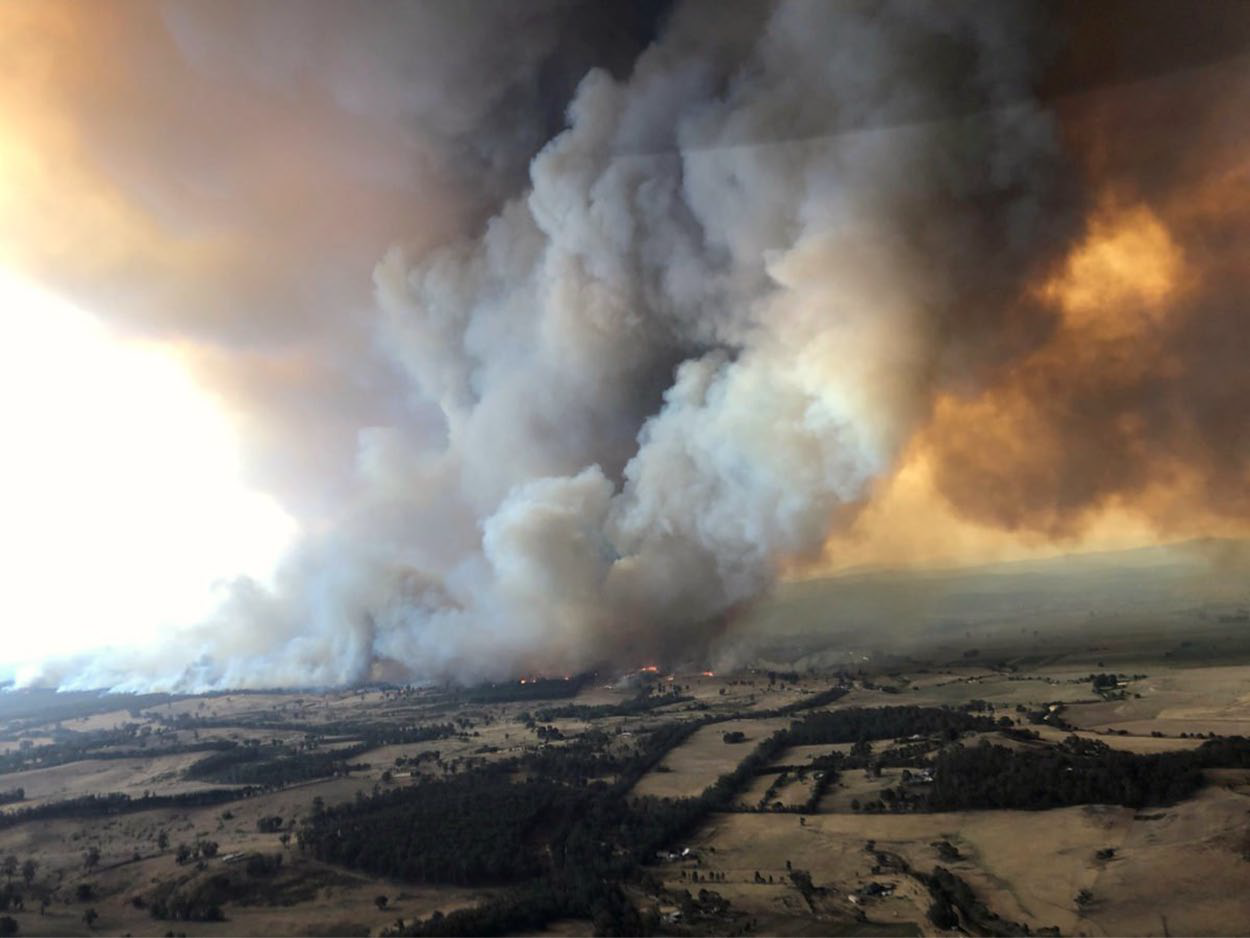
Smoke billows from a bushfire near Buchan, Victoria, Australia, on 30 December 2019 (image: Glen Morey via Reuters CC-BY 2.0).
As Dalby (2017: 22) argues, freely combusting landscapes draw attention to the broader issue of ‘constraining combustion’ on this rapidly changing planet. The rising social, economic and ecological impacts of wildfires (or ‘bushfires’ in Australia) are driven, in part, by the cumulative climatic effects of burning excessive amounts of fossil fuels. Also, like attempts to limit petrochemical combustion, attempts to control the burning of grasslands, forests and other flammable ecologies are confounded by many social and political factors. Foremost amongst these is the ongoing migration of humans into interfaces with flammable ‘wildlands’ – environments dominated by plant ecologies – simultaneously increasing the number of people and assets at risk and the sources of possible ignitions (Mell et al., 2010). Cultural dispositions towards climate and environment also have a profound influence (Hulme, 2016). In Australia, one of the most fire-prone regions in the world, the ability to endure environmental volatility is a source of nationalistic pride (Rickards et al., 2017). But while bushfires in general are consistently positioned as ‘part of the Australian experience’, to quote a former prime minister, specific fires are often treated as disastrous aberrations (Neale, 2018). This is partly due to the fact that citizens in some Global North countries, such as Australia, have ‘unrealistic attitudes’ about the capacity of government agencies to predict, prevent and suppress fires (Bowman et al., 2013: 70; Buizer and Kurz, 2016).
Internationally, the governance of bushfire is typically split between government institutions focused on mitigating its potential and those focused on responding to its occurrence. Mitigation is often the purview of public land management agencies, such as parks departments, and the regulators of private land use, such as land planning departments and municipal governments. Alternately, once ignited, bushfire becomes an object of emergency response managed through hierarchical and scalable incident control systems (ICS). First formalized in the late 1960s (see Lakoff, 2017), such systems coordinate the efforts of multiple government agencies and volunteer groups to reduce a fire’s impacts. In many fire-prone countries, state (or provincial) agencies wield authority over these systems and their infrastructures, such as firefighting vehicles and airtankers. While these agencies and their employees are commonly indemnified against the legal consequences of their actions during emergencies – provided they are not demonstrably negligent – major fires are routinely the subject of expensive and prolonged official enquiry processes and lawsuits (Eburn and Dovers, 2015). Following the Black Saturday fires, the Victorian state government was party to class action lawsuits which were settled for payments totalling AUD$800 million.
The naturalization of government agencies’ mitigation and response roles has placed increasing pressure on those agencies to continually enhance their capacities to predict the consequences, occurrence and behaviour of increasingly frequent, severe and impactful fires (see Neale, 2016; Petryna, 2018; Sherry et al., 2019). In Australia, the past decade has witnessed substantial growth in the resources devoted to prediction or, following Petryna (2018: 573), ‘horizoning work’ that brings near and distant fiery futures ‘into the present as an object of knowledge and intervention’. 2 State bushfire agencies have invested significantly in new software packages, capable of modelling certain key fire behaviours, as well as a new set of accredited practitioners to use them, known as Fire Behaviour Analysts (or FBANs, pronounced ‘eff-bans’) (Neale and May, 2018). As in Canada, the United States and elsewhere, these specialists are tasked with producing predictions of fire behaviour to inform others within an incident control system and, thereby, the deployment of firefighting resources and the dissemination of information to residents, news media, and others. FBANs and their models are also central to a growing list of diagnostic and prognostic practices, including the probabilistic mapping of potential fire impacts (or ‘risk’), smoke hazards, and mitigation benefits (Neale, 2016). As our climate changes our fires, the ‘anticipatory regime’ (Anderson, 2010) constructed around flammable landscapes is also changing, altering the styles and logics through which disastrous combustive events, the places that produce them, and their human and nonhuman communities are framed as predictable sites of technical intervention.
Previous studies of predictive practices within environmental management suggest that changes in the abilities of government agencies to make future probabilities and consequences legible can themselves have unpredictable effects (e.g. Demeritt et al., 2013; Rayner et al., 2005). New agents of expertise necessarily alter existing institutions, reshaping the values and practices through which knowledge is created, authorized and distributed in a given context (Knorr Cetina, 1999). In light of our more combustive future (and present), and techno-utopian representations of computer-assisted fire behaviour analysis as a ‘holy grail’ in managing this combustion (see Neale and May, 2018), it is important to gain empirical insight into the practices of FBANs and how simulators are now being applied to the high stakes of bushfire. To this end, Neale began to interview FBANs in April 2017, seeking to understand the cultural values and tensions underpinning their work and, thereby, the potentialities to alter or secure the dominant logics of fire management. The results raise important questions about how such forms of avowedly ‘objective’ analysis involve the navigation of ‘fuzzy’ technical and social boundaries. Rather than being functionaries of a technical apparatus of securitization, as such practitioners can sometimes appear in STS scholarship on risk (cf. Lakoff, 2010; Masco, 2014), FBANs are often required to improvise and make do in order to exist within their contingent institutional contexts.
Expertise and risk
Expertise and its social and political authority have been abiding concerns across the social sciences over several decades (Kuus, 2013; Lave, 2015; Whatmore, 2009), giving rise to well-established understandings of expertise as an individual capacity (e.g. Collins and Evans, 2002), linearly derived from science (e.g. Beck, 1992), and serving established social orders (e.g. Wynne, 2006). But, as Landström and Whatmore (2014) argue, explorations of the contingent and social character of expertise both confirm and contradict these critiques. For example, studies of forms of applied predictive expertise similar to bushfire analysis – such as meteorology (Daipha, 2015), hydrology (Lane et al., 2013; Morss et al., 2005), and climatology (Sundberg, 2009) – consistently show that these specialists must deviate from scientific principles in order to make their ‘expert’ forecasts. To be successful, and exercise some authority, they must learn to become ‘masters at mastering uncertainty’ (Daipha, 2015: 2–15), convincing their audiences of the acuity of their tools and the rigour of their analysis while, nonetheless, treating complex models and predictive outputs ‘seriously but not literally’ (Lahsen, 2005: 902; see also Timmermans and Berg, 2003). Environmental prediction is often described by practitioners as ‘akin to an art’ (Fine, 2009: 13), but accepting that discretion and intuition are important to their work requires us to consider how such non-scientific capacities are justified and acquired within technical contexts. In other words, how are different or disparate practices framed in the cultural ‘making up’ (Hacking, 1986) of a given predictive expertise?
Empirical studies of prediction also provide grounds for reflecting on the established understanding of expertise as always assisting dominant knowledge/power hierarchies (see Boyer, 2008). Notably, meteorologists and similar practitioners may share ‘a prospective orientation’ with stock market analysts, political pollsters, fortune tellers and many other prognostic experts (Fine, 2009: 14), but they do not share their social context. Within many environmental management agencies, predictive practitioners at different levels are structurally incentivized towards conservatism in their choice of methods and findings (e.g. Morss et al., 2005; Rayner et al., 2005). For example, the implementation of a new ‘early warning’ ensemble flood prediction system across Europe in the mid-2000s did not lead to earlier warnings, in part due to the conflicting expectations faced by forecasters (Demeritt et al., 2013). Where these forecasters embraced the new system it was in part, Demeritt et al. (2013: 152) suggest, because of the peer prestige and resources to which it gave them access. As demonstrated by studies of climatology (Lahsen, 2005; Sundberg, 2009), practitioners’ performances differ depending on whether they are – to use Goffman’s terms – ‘backstage’ with fellow insiders or ‘frontstage’ with outsiders. Understanding the effects of new forms of expertise requires examination of the operative hierarchies both backstage and frontstage.
Another way of approaching issues of knowledge/power is to consider who or what is being treated as authoritatively ‘expert’. The anticipatory governance of environmental risks involves both practitioners and ‘the things involved’ in practice being treated as convincing (Landström and Whatmore, 2014: 585). Indeed, satellites, atmospheric sensors, modelling software packages, algorithms, and the manifold other ‘epistemic things’ (Rheinberger, 1997) involved in environmental prediction have diverse social lives of their own. Each have significant potential to be treated as ‘black boxes’, to be worthy of some level of trust or scepticism; truth machines, heuristics for making-do, or something in between (Lahsen, 2005: 904). Algorithms, for example, are useful precisely because they shortcut human actors and analysis, conveniently ‘structuring possibilities’ for further action by swiftly translating a multitude of inputs into a refined set of outputs (Ananny, 2016: 98). MacKenzie’s (1993) ‘certainty trough’ has provided an influential framework for understanding the social life of such complex ‘epistemic things’, positing that it is those most intimately involved in a given system of technical knowledge production and those completely estranged from that system who are the most uncertain about its outputs. However, as Lahsen (2005) suggests, social intimacy with an epistemic thing is not always so straightforwardly a cause of trust or distrust.
Recent studies of environmental management regimes have illustrated that personal and institutional investment in the worthiness of a new calculative program or technique also needs to be understood in terms of its narrative affordances. To borrow a phrase from Verran (2010): What can nature calculated ‘as number’ do, and what can it do for you? One obvious benefit of any calculative program is that it can generate ‘an aura of objectivity’ around guesswork (Ballestero, 2014: 39), producing mobile quantifications that different actors may easily disseminate and narrate for their purposes (Brooks, 2017). But this ‘aura’ of calculative expertise is not simply at the service of hegemony and may be used to defuse political interference (e.g. Nobert, 2013). The ambivalence of calculative systems and expertise is well demonstrated by Mikes’ (2011) study of US financial risk managers between 2000 and 2010. As Mikes explains, this period saw the rapid expansion of new techniques for quantification, giving rise to a split between cultures of quantitative enthusiasm and scepticism. Some individuals and institutions bent towards qualitative assessments of the future, while others looked to extend calculative techniques to capture both future contingencies and residual uncertainties (cf. Sundberg, 2010).
Such enthusiasm is likely crucial to ‘risk colonization’, wherein risk management regimes follow ‘a spiralling tendency’ to the point that they themselves become managed as risks (Rothstein et al., 2006: 93). Based on other research (Neale, 2016), a calculative initiative might begin by tabulating consequences and probabilities in relation to a proliferating group of entities: houses, roads, critical infrastructure, endangered species, water catchments, and so on. With time, though, such an initiative may be ‘colonized’ by risk logics and become managed as an institutional risk, capable of damaging or improving an institution’s reputation. Amongst risk colonization’s dangers, Rothstein and others suggest, is that while risk management’s ostensible purpose is to reveal the limits of regulatory systems, expert risk analyses implicitly represent the future as knowable and governable. Such dynamics are not invisible to practitioners (e.g. Demeritt and Nobert, 2014; Mikes, 2011). Thus, while it is arguable that changes in risk prediction and other forms of expertise often entrench hierarchies, particularly between institutions and their publics, applying this diagnosis universally obscures the many cultural contests through which human and nonhuman actors variously secure and lose their authority.
Bushfire behaviour analysis in Australia provides a compelling context within which to further examine expertise. FBANs and their ‘products’ – the catch-all term for their different predictive outputs – are relatively novel within their workplaces, but have been the target of significant economic and social investment and have been positioned as providing a ‘fix’ for fire problems. FBANs, in particular, collectively face common challenges in establishing and exercising their influence. This includes both epistemic challenges, relating to the limitations of bushfire science and its translation into models and algorithms, but also social ones, relating to how others understand and act upon (or ignore) their predictions. As increasing responsibility is placed on certain government agencies to foresee and manage the growing potential and presence of fire, FBANs and their predictions are being rendered increasingly central to meeting, mediating and redistributing this responsibility. By analysing these practitioners’ reflections on predictive capacities within their sector, and their experience in making and distributing predictions, this article draws attention to the values, tensions and affordances of current bushfire management on our increasingly flammable planet. Returning to the categories examined by Landström and Whatmore (2014), the following sections consider the extent to which fire behaviour analysis is an individual capacity, derived from science, and serving dominant social orders. As we demonstrate, spending time with FBANs reveals the ‘fuzzy boundaries’ of their institutional worlds and objects of attention.
Fire behaviour analysis
Internationally, the use of predictive analysis during major bushfire events precedes the invention of computer simulators. As shown elsewhere (Neale and May, 2018: 26), the first known official position of ‘fire behaviour specialist’ began in the United States in the late 1950s, when the US Forest Service identified the need for specialists able to identify ‘especially hazardous conditions’. Intensive training courses began in the US in 1974 and followed in Canada in 1996, each producing hundreds of graduates. In Australia, the formal accreditation for operational FBANs is more recent. Following a series of impactful and complex fires in the nation’s populous southeast in the early 2000s, the availability and use of predictive analysis became the subject of ‘strong debate and critique’ inside and outside bushfire management agencies (Slijepcevic et al., 2008), prompting a Victorian fire agency to initiate the development of a national FBAN accreditation. First convened in 2007, this initiative was reinforced by official inquiries into subsequent impactful fires, which often suggested that incident controllers’ decision-making would be improved through greater use of the analyses provided by FBANs (Neale and May, 2018).
Meanwhile, parallel to these developments, researchers in various countries sought to develop desktop computer software packages that simulate key aspects of how bushfires spread (on the nuclear origins of these models, see Eden, 2004). In Australia, the first such simulator, based on a US model, began being used in 1980, however it was not until the 2007–2008 fire season that such programs had developed to the point that government agencies were willing to use them ‘operationally’ during incidents. Prior to this, predictive analysis of fires principally revolved around two practices. One, introduced in the early 1940s, was the tracking of atmospheric conditions conducive to large conflagrations. The detection of ‘fire weather’ was, and remains, the foundation of incident control centres and public warnings regularly broadcast through radio, roadside signs, mobile apps and other media. The second practice, introduced in the early 1960s, is the use of ‘fire spread models’, which are tables of empirical data or algorithms that reveal the ‘rates of spread’ that a fire will follow under different fuel and weather conditions (Pyne, 1991: 348-352). Before the 2000s, certain skilled individuals within bushfire incident control systems started occupying roles similar to the contemporary FBAN, sometimes combining fire weather forecasts and fire spread models for predictive purposes. However, it was only after the mid-2000s that the role became institutionalized.
Today, almost all Australian bushfire agencies have full-time FBAN units, varying between five and twelve fulltime staff, as well as employing other staff who perform FBAN roles during the ‘fire season’ from October to April in Australia’s southeast and southwest. During this season, both full-time and seasonal FBANs typically work within local, regional or state-wide incident control centres (ICCs), observing conditions, generating ‘operational’ predictions of potential and existing fires, and communicating these to their ‘users’; namely, incident controllers, public communications officers, and others within the ICC as well as, on occasion, senior bureaucrats. 3 Predictions are meant to tell these users what a fire might do, and thus help them make decisions about deploying firefighting resources at a given time and place (or not), issuing public warnings (or not), evacuating towns (or not), declaring a state of emergency (or not), and other matters. The predictions informing these decisions are derived from at least one, and sometimes both, of the following two sets of practices to imagine a bushfire’s spatial and temporal development in a given space. The first, ‘manual’ prediction (see Figure 2), is produced by hand using paper maps, rulers and protractors. The second, ‘simulated’ prediction (see Figure 3), is produced using a computer-based bushfire spread simulator. Each process uses the same three core elements: a set of weather variables describing wind and temperature; a topographical GIS layer or map describing fuels; and fire spread models, either expressed on spreadsheets or as algorithms (see Sullivan, 2009; also Cruz et al., 2016).
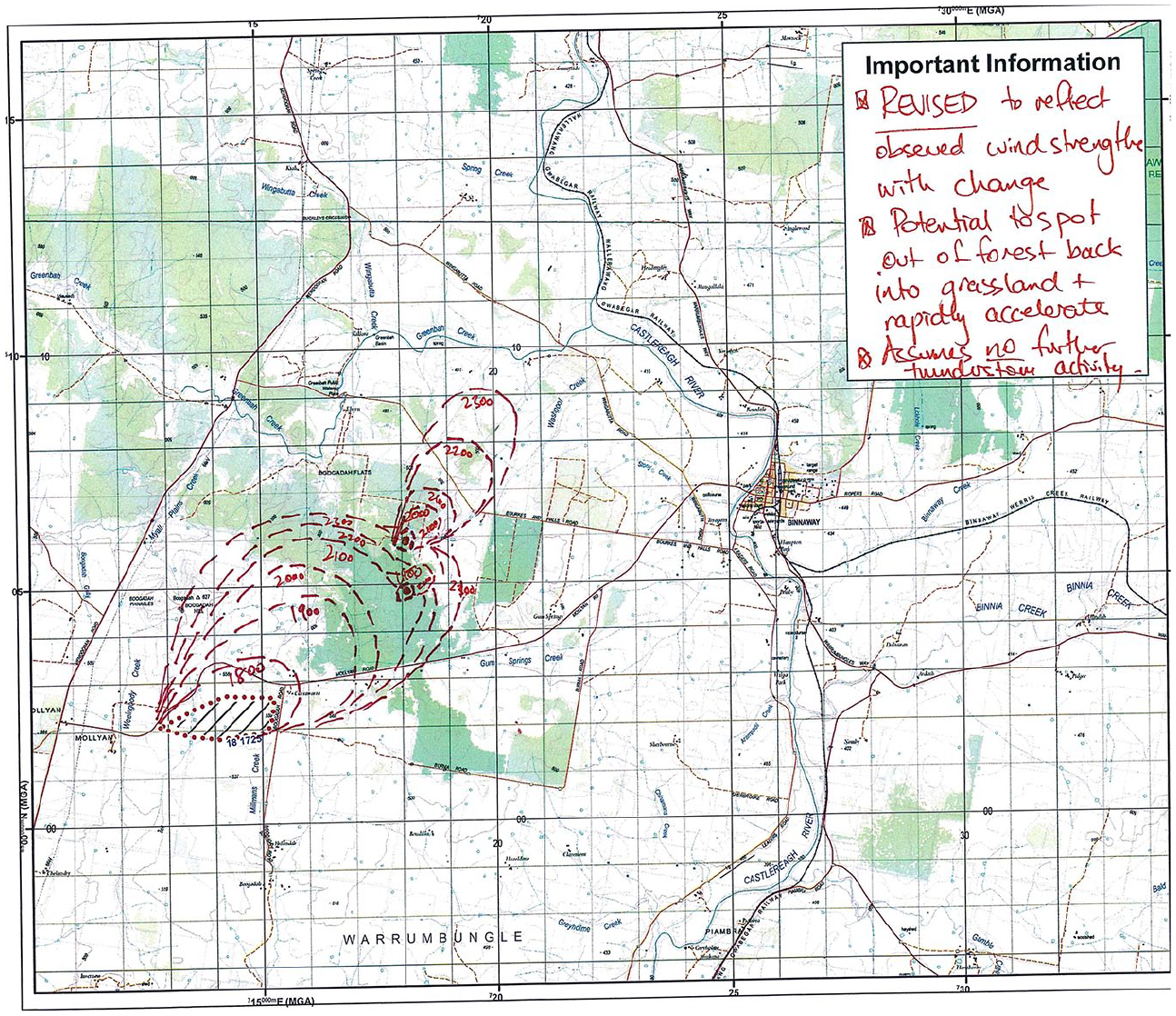
Manual prediction map (image: New South Wales Rural Fire Service).
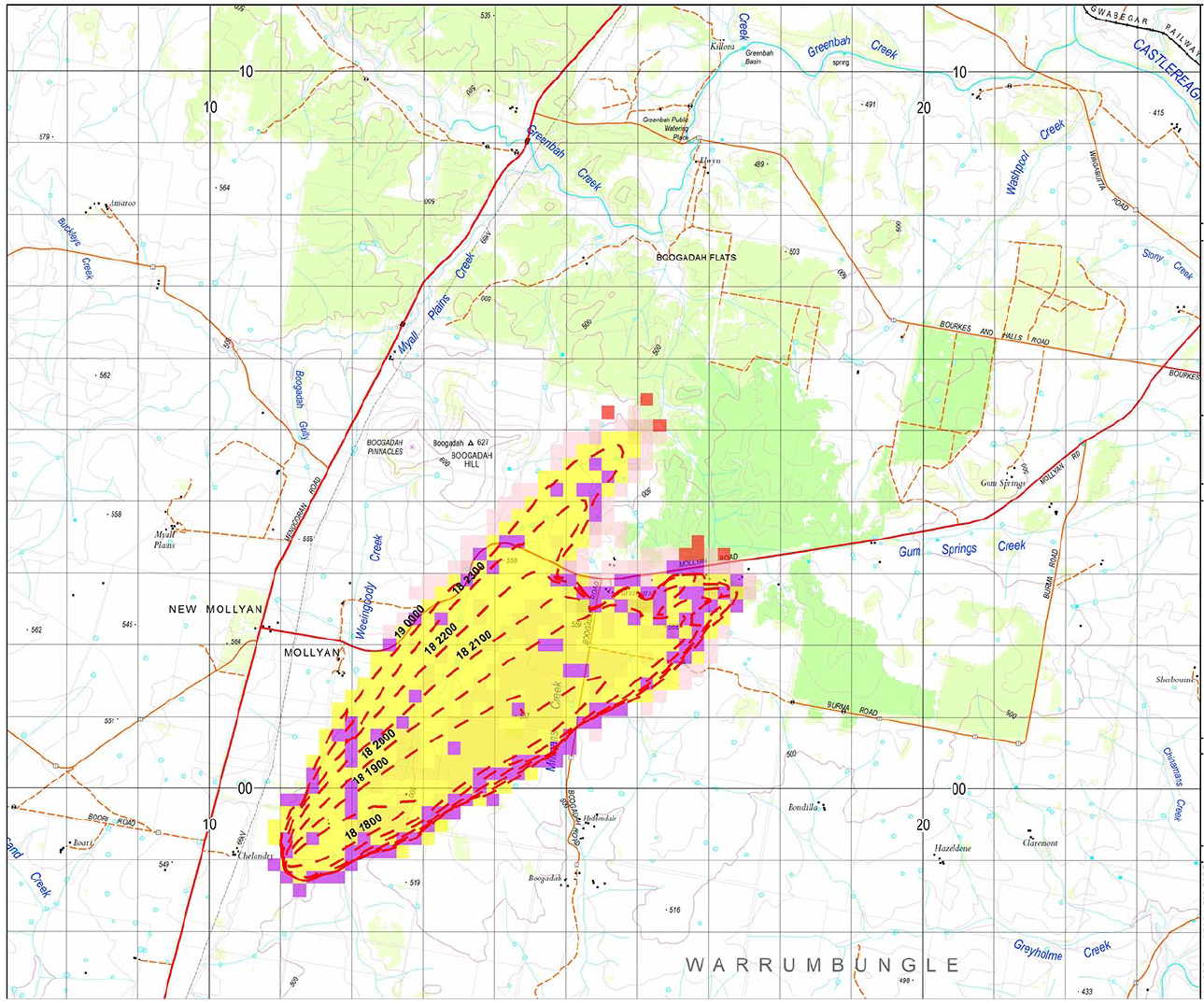
Simulated prediction map for same bushfire as Figure 2 (image: New South Wales Rural Fire Service).
But, while they have the same basic ingredients, simulated predictions are not simply a way of generating manual predictions quickly. Simulators differ in several important aesthetic and epistemic respects. Simulated predictions can, for example, appear animated, colourful and definite in comparison to manual predictions; they can incorporate and generate a greater volume, specificity and diversity of data than manual predictions, and perform as ‘black boxes’ more easily than manual predictions. This gives us some basic coordinates from which to understand the work of FBANs. To recall Ballestero’s phrase, the ‘aura’ of predictions is shaped by differences in how their appearance and production are perceived. This point is worth expanding on. There are currently over twenty fire spread models for Australian fuel types (e.g. spinifex, dry eucalypt forest, etc.) published in scientific journals, each of which is considered imperfect (Cruz et al., 2016). Most simulators use these models and allow FBANs to select where they are applied, however the official simulator currently used by fire agencies in five out of six jurisdictions, PHOENIX RapidFire (or ‘PHOENIX’), automatically selects its models and uses unpublished variations of the published models. As we explore in the following sections, such differences between predictive methods significantly alter how FBANs are able to ‘tune’ (Sundberg, 2009: 168) or shape predictive outputs, as well as how those outputs are received and understood by users.
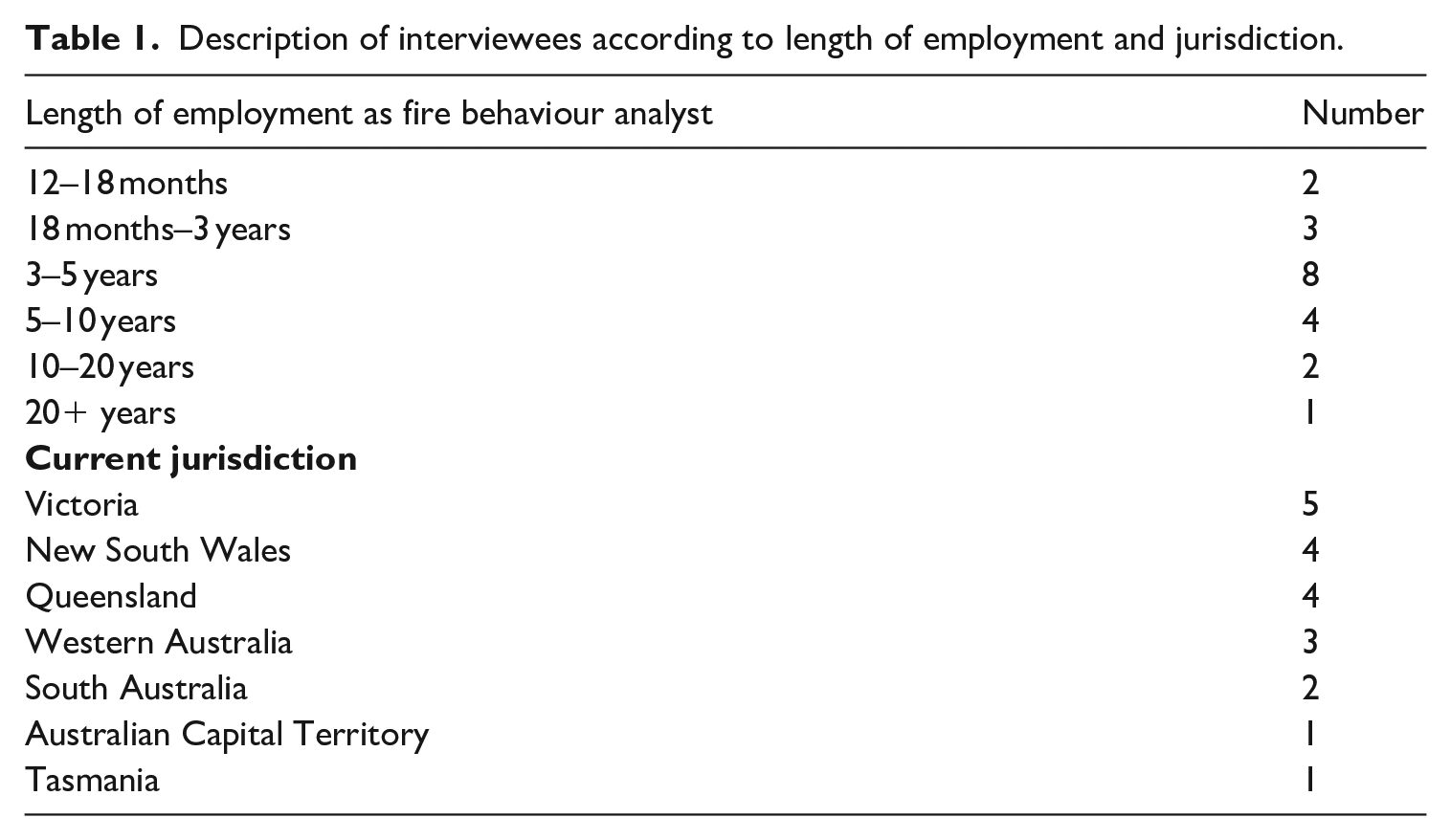
To enquire into these issues, Neale conducted semi-structured interviews with FBANs during April–May 2017. Participants were recruited through a ‘snowball’ method, beginning with existing contacts, leading to interviews with 20 FBANs, or approximately a fifth of all full-time and part-time FBANs in the country (AFAC, 2017). At least one practitioner was interviewed from every Australian state and territory that uses FBANs in incident response, all of whom – except one – had been trained in Australia (see Table 1). The cohort was diverse in terms of age and experience in the FBAN role. All of them were male, however; as in other countries, bushfire management in Australia is very male-dominated (Eriksen, 2014) and no female FBANs identified by practitioners were able to be recruited for this study. 4 Following the interviews, transcriptions of interview recordings were coded in NVivo 10 by both authors according to common themes. Following Cope (2005), this coding was structured by research questions (descriptive codes) – such as the qualities of a ‘good’ FBAN and the challenges they encounter in their roles – and emergent themes that arose during the study (thematic codes) – such as values of experience, improvisation and judgement. Our analysis presents a synthesis of this coded data, focused on the values and tensions that are emerging as FBANs attempt to establish their expertise socially.
Description of interviewees according to length of employment and jurisdiction.
The field and the office
Asked about their careers, the FBANs revealed three broad pathways into the work of fire behaviour analysis. First, there were those (n = 6) who had come to it through a career in firefighting. Having progressively pursued a vocation in community safety, often accompanied by some personal interest in the science of bushfire behaviour, they were either selected or volunteered for FBAN training and certification. This group had the least experience with operational analysis and were, by and large, engaged in seasonal FBAN roles. Second, there were those (n = 8) who had previously trained and been employed as scientific researchers within state agencies and universities while also, progressively, acquiring some operational experience in bushfire management. This group included all of the most experienced FBANs and several who were considered by their peers to be leaders in the field. Third, there were those (n = 6) who had previously trained and been employed in a variety of ‘scientific’ roles that required the use of GIS and modelling software. For this group, the pathway to their FBAN positions was less obvious, with some citing experiences in volunteer firefighting, or their upbringing in rural areas, as pathways to their current roles. As might be expected, the second and third groups contained the majority of full-time FBANs, a number of whom were engaged in experimental projects testing new predictive tools and approaches to operational prediction and risk forecasting.
These different pathways illustrate wider cultural and social divisions between ‘the field’ and ‘the office’. The field names those sites, also known as the fireground, where fire management practitioners use their bodies, fire hoses, retardant chemicals, McLeod tools, Pulaski axes and other implements to, in the language of the sector, ‘fight’ a bushfire and ‘save’ houses and residents. The field is a place of proximity with a major fire’s physical presence – its incredible heat and roaring wind, its atmosphere of ash and burning debris, its destructive impacts on peoples’ lives – and is associated with ideas of danger, duress and heroism (see Desmond, 2007). The office, alternately, names those sites where fire management practitioners use telecommunications networks, maps, software platforms and other tools to coordinate an agencies’ response to a fire or manage bushfire risks. The office is defined by its physical distance from fire – an ICC may be tens or hundreds of kilometres from the fireground it is overseeing – and is the site associated with ideas of bureaucratic management and institutional power. Conventionally, bushfire practitioners spend many years in ‘the field’ before being able to exert significant decision-making power within an ICC or ‘the office’ more generally. While most FBANs have not avoided this apprenticeship completely, their domain is the office, and many have spent less time in the field than the ‘users’ of their predictions within an ICC or on the fireground.
Repeatedly, when asked about the value of their role in bushfire management, FBANs emphasized the need for them to be perceived as ‘authoritative’ or ‘trustworthy’ by their various audiences. As one junior practitioner summarized, ‘the real struggle is not producing the prediction, it’s being able to communicate that [prediction] and have a level of influence’ on users.
5
But the cultural divide between field and office presents challenges for FBANs to overcome if they hope to influence others. As one senior practitioner commented: A lot of [incident managers] … are really great salt-of-the-earth people and the only thing that matters to them is that you’re a firefighter. They don’t give a shit that you’ve got a Master’s degree and you know [fire behaviour] really well … [if] you can turn around and go, ‘Oh yeah, I’m a rural volunteer … I’ve got six years in and been to a few big campaign fires’ then they go, ‘Oh, sweet. All right.’
Most FBANs agreed with the sentiment that a perceived lack of field experience could hurt their credibility, particularly with the ‘old school incident managers’ that predominate within ICCs and decision-making positions in the sector more generally. A biography of fireground stories helped establish that an individual FBAN was part of a shared community of experience.
Asked about the role of the field in their work, one of the longest-serving FBANs summarized the feelings of several junior practitioners when he stated that ‘you can do good predictions without fireground experience, but I don’t think you can be a good FBAN without fireground experience’. Three ideas were used to justify this assessment. First, time in the field gave FBANs some personal knowledge of the landscapes they were predicting and the social networks of their users. Such knowledge provided physical and social referents for building rapport with users and, thereby, gaining the trust necessary to being ‘a good FBAN’ rather than just being someone who produced predictions. ‘With some [field] experience,’ one concluded, ‘you can build credibility fairly quickly.’ Second, field experience was seen to give an embodied sense of the power and unpredictability of uncontrolled bushfire. Witnessing the behaviour of this inhuman phenomena, some suggested, helped give FBANs an important sense of modesty when making their predictions within a secure office environment far from the fireground. Third and most importantly, field experience was seen to give FBANs an understanding of what predictive information was useful to users and what information was just ‘interesting’ to the analyst. ‘If it’s not going to change [an] incident controller’s decisions,’ one senior FBAN surmised, ‘then we don’t need it.’
But the common emphasis on the field occludes the ways in which the office is also a site of experience vital to influencing others during an incident or planning meeting. That is, creating and disseminating predictions within also relies on FBANs acquiring less-respected skills necessary to negotiating the protocols and politics of their bureaucratic office surrounds. Important knowledge about, for example, senior peers and their temperaments, complex predictive methods, the optimal delivery of predictions, and the negative consequences of miscommunication were all acquired in the brightly-lit and air-conditioned environs of ICCs. At the same time, some FBANs reframe their experience away from the field to undermine perceptions of them as overly determined by their ‘very science-y research-y background’ and office location. This was illustrated in several characterizations of FBANs as people who ‘love technical detail, [and] love to really get in on the tools’. A ‘good’ FBAN is someone who enjoys ‘delving into the mechanics’ of bushfire behaviour. As Timmermans and Berg (2003: 152) discuss in their study of doctors, FBANs strategically position themselves as ‘researchers’ rather than ‘librarians’ in their use of fire science, able to critically evaluate their tools for users. Without this critical literacy and disposition, cultivated in office contexts, FBANs worry they might take simulations ‘at face value’ and, in the words of a senior FBAN, ‘won’t know whether that simulation is reliable, crap, or anything else’. In this way, they position themselves as the relatable and pragmatic translators of a more obscure ‘office’ culture: research science.
In accord with wider institutional cultures, FBANs generally emphasize the field as the site of valued experience and action and downplay the importance of their own office work. In some cases, they are othered by their peers as ‘mad scientists’ or ‘boffins’; technically-minded experts within practically-minded institutions. But examining the field-office divide reveals several ways in which FBANs work to blur this boundary. Undermining any sense that they are determined by their training or tools, they present themselves as worthy of trust not only because of shared experience of the flammable ‘field’ but also because of the ways in which they individualize their relationship with ‘science’.
Improvising and standardizing
In the 1984 Canadian guide to fire behaviour, the authors state that predicting fires ‘remains an art’ executable only by ‘a highly trained and experienced fire specialist who must observe a vast number of interacting parameters and evaluate them in [their] mind’ (Alexander et al., 1984: 63). Almost three decades later, the guide’s lead author stated that the ‘art’ is still vital because key bushfire behaviours can be quantified ‘only in a very general way’ through mathematical relations and functional algorithms (Alexander and Cruz, 2013: 376). In the time between these two publications, not only have simulators become routine in Canada, Australia, the United States and elsewhere, but scientific research into bushfire behaviour and risk mitigation has also increased dramatically across the globe. Nonetheless, despite this proliferation of predictive practices, tools and their scientific foundations, as Scott et al. (2013: 371-389) state, ‘very little research or even thought has been given to the “art” of fire behaviour prediction’. The ‘art’ of predicting fires lies, according to the 1984 guide, in the FBAN’s ‘experience, local knowledge, and judgement’ (Alexander et al., 1984: 63). Speaking to Australia’s FBANs, this differentiation between ‘science’ and ‘art’ was discursively ubiquitous but practically and conceptually vague. True to their quantitative training, one senior FBAN reckoned that predicting bushfires is ‘about 70% science and 30% art’.
In speaking about their ‘art’, many FBANs spoke to the epistemic uncertainties they manage in making a prediction. Throughout the fire season, FBANs make predictions in order to gauge different scenarios, the primary focus being the production of operational predictions following ignitions on the most hazardous summer days when winds are high, temperatures crest, are fuels are dry. During such events, they are called upon to make a wide range of ‘products’ which vary across jurisdictions. Usually, the first product is either an automatically-generated or ‘quick and dirty’ simulation by an FBAN, based on initial meteorological data and the fire’s estimated location and size. This gives ‘a vague sense’ of a fire’s potential spread and impact within the following 24 hours. In New South Wales, initial predictions are performed by two separate practitioners using manual and simulation methods respectively, before a third person synthesizes the results. In all cases, these products are then progressively updated over time, while FBANs also work on more refined predictions over different temporal and spatial scales. The latter typically involve the mapping of both the fire’s most likely spread and its maximum ‘potential impact zone’.
During the minutes and hours after a fire starts, many important prediction ‘inputs’ such as ignition location, fire size, fuel conditions, and the effects of current suppression strategies can all be highly uncertain (if not unknown). Fuel information may be obtained from outdated datasets, whereas other crucial information will be communicated ‘in a hurry by people looking out of the truck’. For some, as one junior FBAN stated, ‘the best way you can manage [uncertainties about fire location and size] is to get on the phone and find someone local’, however, according to others, such sources ‘can be a long way off’ and lead to ‘some of the worst predictions’. As another FBAN explained, ‘for something like PHOENIX, if you move the point of ignition by 50 metres in one direction, your fire might increase [in size] by an order of magnitude’. To mitigate unreliable inputs, FBANs improvise by triangulating different sources and weighing their past reliability. This might involve, for example: speaking to multiple ‘local’ and non-local firefighters on the fireground, relying on key informants with local experience (and experience of locals) within the ICC, consulting various agency datasets on fuels and past fires, examining recent satellite imagery and, according to several FBANs, searching Google Street View and social media in order to understand fuels and other local conditions. FBANs often use the popular idiom of ‘garbage in, garbage out’ – meaning poor inputs lead to poor outputs – and they have each improvised ways to process the ‘garbage’ through personal and impersonal networks, triangulating data and hearsay.
Other major uncertainties managed while making predictions are those associated with fire spread models and simulators. Model uncertainties relate to their character, sensitivities and limits. Simply put, FBANs understand given models as having a characteristic tendency to either ‘undercook’ (under-predict) or ‘overcook’ (over-predict) a fire’s spread (see Cruz et al., 2014). The cause of this characteristic performance is often attributed to a model’s sensitivity or lack thereof to a given input, particularly wind. Unlike the physics-based models used in the US, Australian fire models are extrapolations from small-scale empirical experiments (Cruz et al. 2016), meaning that the rate at which it says a landscape fire under extreme conditions will spread in any forest or grassland of a particular type is a linear function of how several small fires once spread under moderate or light conditions in similar fuels. FBANs know this to be false, in reality, as fires are dynamic and do not grow exponentially. Finally, when all of these model uncertainties are encoded within a simulator, they are complicated by how that simulator treats input variables spatially. But whether inputs such as fuel dryness and wind are plotted within 50, 5 or 1 square kilometre grids, they necessarily impose spatial uniformity. Thinking with Callon et al. (2009), we might see these uncertainties as emerging from necessary ‘translations’ between the worlds of scientific experiments, theorization and application; models and simulators treat heterogenous and dynamic combustible landscapes as though they were homogenous and linear because that is how they are theorized scientifically.
FBANs’ knowledge of these ‘translation’ issues is variable though all actively attempt to manage them in some way. One set of improvised strategies relates to communicating predictions, examined in the next section, while another relates to tuning them. This is significantly easier in manual prediction, where FBANs can, for example, mitigate the tendency of a given model to overestimate rate of spread by adjusting wind inputs, or adjust fuel dryness on small sections of forest that are known to be drier, wetter or denser than fuel maps suggest. Simulations are less clearly tuneable, as the exact models they use may not be published – as with PHOENIX – and their inputs are not so easily manipulable. Only those with the highest computational skills can, for example, alter certain inputs to ‘correct’ model and simulator uncertainties. While many FBANs asserted that ‘comfort with uncertainty’ is important to their work, their responses to the uncertainties encoded within models and simulators suggest a tension underlying their ‘art’. For many senior FBANs, it is important that they are ‘able to play with the inputs or turn the dials with the inputs so that [the simulators] gives you something that makes sense’, while some junior FBANs contend that ‘you shouldn’t have to be an [information technology] expert… to drive the thing’ (F11). This, we suggest, is not simply an issue of technical or scientific literacy, but of the extent to which FBANs and others within the bushfire sector believe improvisation and standardization are important to ‘good’ prediction.
The prevailing view amongst FBANs that ‘there’s no standardization at all’ in their work requires some elaboration. There is a standard accreditation which most, but not all, active FBANs have completed. There are standard models and simulators that all active FBANs use, and there are, in most cases, (limited) official guidelines about their use. However, the workflows, methods, processes and reviews of prediction are neither standardized within jurisdictions nor across them. During incidents, many report, eccentric requests for prediction emerge and disappear at seemingly random times. Greater standardization would, as several explained, enable them to be deployed across the country as needed. Additionally, they noted, standardization would help mitigate personal risks. Typically, the only formal assessment of predictions occurs through government inquiries following major fire events. These inquiries largely seek to find deviances from official policy, which are endemic to the practice of bushfire management (Desmond, 2007: 257-267) and allot blame in problematic ways (Eburn and Dovers, 2015). Within this context, the use of intuitive and creative fixes can pose a risk to FBAN’s careers and wellbeing. At the same time, these practitioners contend that standardization poses a risk to the quality of their work. This is because, first, the lack of standard timelines and processes means they can better respond to their users’ needs and, second, the lack of standard methods means they can better manage their innately uncertain data and heuristics as conditions require and intuitions suggest.
Disclosing and withholding
Like similar predictive practices (e.g. Demeritt et al., 2013; Fine, 2009), the practice of fire behaviour analysis is shaped by ideals about disclosure and withholding. This has several important dimensions at both the individual and institutional level, representing another boundary over which there are ongoing contests. ‘Backstage’, amongst themselves, FBANs emphasize the importance of openness in their methods and practices. A ‘good’ model or simulator is one validated by peer-review and ‘good’ FBANs should be able to manually replicate a simulator’s prediction. This changes substantially when these practitioners are communicating predictions to users, such as incident controllers or government ministers, due to the perceived dangers of disclosing too much. First, FBANs often have their user’s attention for brief periods of time; to quote a mid-career FBAN, incident controllers ‘don’t have a lot of time. … You’ll probably have, like, one or two minutes to actually explain what your fire prediction is to them.’ Users need to make effective decisions within the ICC and do not have the capacity to deliberate over uncertainties. Second, FBANs contend that their users often take strong positions on the utility of a given tool or practitioner. Many spoke of how users, based on limited experience and peer opinion, have already taken the position that a simulator or model is either intrinsically ‘good’ or ‘crap’. Consequently, third, FBANs are wary of distracting their users with excess information about their predictions, particularly if it potentially destabilizes the authority of prediction itself. According to one mid-career FBAN, users with too much insight into this error-prone process may respond, ‘“this is unreliable” and tend to just discard the whole lot’.
We can see these dynamics at work by attending to ‘products’ or outputs. Though they are diverse, they are all topographic maps accompanied by a box of text listing their assumptions. In this way, they disclose uncertainty without any assurance that it has been understood by their users. ‘Often [users] completely ignore’ such information, one mid-career FBAN stated, adding that ‘people laugh about it, “Oh yeah, I don’t want the fine print, just give me the map.”’ ‘When you’ve got a fast-tempo incident running,’ a more senior FBAN explained, ‘[users] are not going to sit there and read our disclaimer and go, “oh, so your models are limited?”’ As several others stated, maps often communicate the ‘wrong things’ at the most important time simply through their formal properties. ‘It’s almost human nature to see a map and trust it, and believe that it is the reality,’ one said, ‘notwithstanding all the assumptions and provisos and cautions that I will tie to that map.’ More specifically, many drew attention to the contrast between the lines or isochrones typically used to depict a fire’s future and their own thinking of actual fires as having ‘fuzzy sort of boundaries at best’, spatially and temporally. So, while some feel that simulators are excellent tools because they make ‘a nice pretty image’ that grabs users’ attention, others felt that this was a ‘massive weakness’. For the latter, simulations disclose fires with a specificity that is completely misleading. ‘The beauty with doing manual predictions,’ one mid-career FBAN explained, ‘is there’s an instant perception that… it’s got an element of uncertainty associated with it’ which simulations do not, even though they are using the same basic models and manual predictions are more finely tuneable.
During the most high-consequence bushfire events, when predictions are both most uncertain and most pertinent, opportunities to explain predictive work or raise alternate scenarios are curtailed or eliminated. Aesthetic choices are typically limited in these moments between presenting their deterministic prediction sketched in pen or etched in digital isochrones. To mitigate the possibility that they might communicate the ‘wrong things’, FBANs have two further disclosing and withholding options. The first, as several explained, is to actively or passively refuse release a prediction if inputs are too uncertain (e.g. Noetic Solutions, 2016). The second, recently tested in several jurisdictions, was to disclose significantly more information by producing probabilistic maps (see Jones and Esnouf, 2016). This requires the production of ensemble simulations – that is, hundreds or thousands of predictions with small input variations – that are then communicated according to a colour matrix. Whether users in fact see these outputs differently is unclear, though we can at least begin to assess what is at stake in tensions between disclosing and withholding information. Returning to MacKenzie’s (1993) certainty trough, most FBANs hold that those most intimate with models and simulators should be the most uncertain (even dubious) about their outputs. The negative potential of users having absolute scepticism or faith in predictions leads FBANs to disclose and withhold information, trying to make others see predictions as they do: at once compelling, credible, imperfect and limited.
From another reading, predictive maps are a vector for risk distribution and, potentially, risk colonization. Situated within the ICC, does an FBAN pass some of their personal risk for ‘good’ prediction onto a user when they pass on a map which explicitly reveals its limitations? Who bears the responsibility for these imperfect predictions: the individual who produces it, or the individual who acts upon it? Recent government inquiries have commonly held users responsible for paying too little or too much attention to predictions (Neale and May, 2018). Asked about what the rise of fire behaviour prediction revealed about the sector, some FBANs spoke of the ‘gradual professionalization’ of emergency management roles and governance structures, which were operating ‘a bit more strategically’ in accordance with ‘a broader societal shift around trust in models’. Other FBANs linked their emergence to policymakers becoming ‘more risk-aware’ or ‘more risk-averse’, responding to ‘a lot more expectation’ amongst interested publics to show ‘cost-effectiveness’ and, in the words of one junior practitioner, ‘to demonstrate … a sensible process to make the decisions that you made’. Following this logic, investments in prediction expertise might also be seen as a way for bushfire agencies to protect themselves from ‘post-incident review and judgment, analysis, litigation, all that kind of thing’, as one senior FBAN explained, producing ‘a defendable prediction so that we’ve covered our arse and we can say that was the best available [information]’. Explicitly aimed as managing social risks, predictions of bushfires have significant potential to mitigate reputational risks to oft-criticized government departments.
This is not to say that risk colonization is occurring in Australia’s bushfire sector. Rather, we suggest that fire behaviour analysis raises questions for both FBANs, their users and others about the social and political consequences of this expertise. Currently, predictions are very rarely relayed beyond bushfire agencies without being mediated from maps into words. Warnings of proximate fires, or of the need to evacuate, reach publics via radio and text messages. Bushfire risk mitigation strategies such as prescribed burning are justified in government reports through aggregated numbers of ‘residual risk’, absent the thousands of simulations and assumptions that went into their computation (Neale, 2016). However, bushfire simulations are beginning to travel to new audiences, becoming integrated into community preparedness workshops, and there are plans for simulators and their outputs to be disseminated through social media and smartphone apps. To illustrate the potential institutional stakes, let us outline three scenarios based on FBAN’s experiences. In the first, agencies are seen to have withheld one of their legion predictions before or during a fire, undermining residents’ and others’ preparations and reactions. In the second, agencies are seen to disclose highly uncertain predictions before or during a fire, misleading residents and others irresponsibly. In the third, agencies are seen to have withheld and disclosed correctly, and it is residents and others who bear responsibility for personal impacts.
Therefore, though there is no real ‘legal impediment’ to agencies releasing accurate hazard information (Eburn and Handmer, 2012: 12), there are clear disincentives and incentives to releasing predictions. Further, if we accept both that bushfire prediction is in a moment of early development, and that publics currently have unrealistic ideas about agencies’ abilities to foresee and forestall disastrous or impactful fires (Bowman et al., 2013; McLennan and Handmer, 2012), then it is conceivable that predictive capacities present a moral hazard to those agencies. By celebrating or promoting their newfound but imperfect expertise in foresight they may only further increase others’ expectations on them. It is also worth noting that this expertise has as-yet unrealized potential to help democratize bushfire management, provided that agencies open up their methods and tools for analysis and inquiry. If such agencies continue to obscure the technical and cultural context of their decisions, fire behaviour analysis will further reinforce the hierarchical division between agencies and publics that their recent participatory policy initiatives ostensibly seek to undercut (e.g. DELWP, 2015).
Conclusion
Several months after completing the interviews for this study, Neale received a call from a senior FBAN seeking some advice. They had been asked to facilitate educational workshops on fire behaviour analysis to two separate groups – the first being incident controllers, the second being community liaison officers. Whereas, for this FBAN, the former were a known quantity, the latter raised a new set of issues, as they would be using PHOENIX outputs to explain bushfire to residents at risk of major conflagrations. ‘Since you know a bit about the models and about “social” things, I thought I’d ask your advice about what to say’, the FBAN explained. Their concern was that either audience would leave the workshops seeing simulations as the truth and simulators as truth machines, then relay this understanding to others. The FBAN envisioned an epistemic contagion taking place, aided by the charismatic ‘aura’ of the simulator and its rendering of real and imagined fires in three dimensions and discrete colour-coded pixels. Fires would seem knowable and, therefore, governable sites of intervention. After half an hour of discussions about the pitfalls of prediction, the conversation ended with the FBAN resolving that they would emphasize to both audiences how their own analysis was trustworthy, but that models and simulators gave you ‘an answer but not the answer’.
This exchange highlights the consequences of current and emergent divisions of information and expertise within fire management infrastructures. Fire behaviour analysis has the potential to change decisions for a range of actors within and outside government, informing decisions about where firefighting resources are deployed, where emergency messages are sent, where evacuations are conducted, where preventative fires are lit, where community preparedness is supported, where financial relief is sent, where houses are built (or rebuilt), where risk mitigation funding is invested, and much more. Curiously, FBANs’ personal concerns about how their analyses and tools might travel socially parallel institutional concerns about revealing the reasoning – calculative, discretionary, or otherwise – behind such decisions. In disclosing both the limits and content of their calculative regimes, each potentially jeopardize their authority while opening up possibilities for reconfigurations. That is, although it is possible that fire behaviour analysis could further consolidate the established power of government agencies over bushfire management, or further risk colonization within those agencies, or facilitate the distribution of bushfire risks to unknowing publics, these are not the only possibilities. As one junior FBAN wondered, perhaps putting simulators in the hands of at-risk publics ‘would be pretty cool’, because it would provide an aperture for others into the inscrutable layers of ‘objective’ analysis that are used to dress subjective institutional decisions. Although some FBANs were dubious about simulators and predictions travelling more freely through the world – beyond their improvisations and control – most also acknowledged that this was likely inevitable.
To return to Landström and Whatmore’s critique (2014), FBANs’ expertise and authority are not simply derived from science, an individual possession, or aligned with established social orders. Rather, it has scientific elements, individualistic values, and ambivalent social effects and potential. Its sedimentation into the everyday workings of different bushfire agencies across Australia has been shaped by wider cultural tensions over the importance of embodied ‘field’ experience versus the technical and bureaucratic knowledge acquired in the office, individual improvisation versus common standardization, and, disclosing versus withholding uncertainties from non-expert others. As this research suggests, the emergence and subsequent attempts to variously expand and delimit the purpose and authority of such expertise creates opportunities for fuzziness: fuzzy lines on maps, fuzzy claims about the future, fuzzy roles and responsibilities, and fuzzy (re)workings of key internal contests over norms and resources. For now, the conduct of many FBANs arguably practically undermines the forms of technicism and scientism their role itself represents, ‘making up’ their expertise without simply being determined by the risk logics that structure their workplaces.
Creating and warranting knowledge occurs in any epistemic culture under particular conditions (Knorr Cetina, 1999), shaped, in this case, by nascent norms about what a ‘good’ FBAN, a ‘good’ simulator and a ‘good’ prediction might be. At this moment, somewhere between emergence and standardization, it is useful to ask: How will these contests develop? Several FBANs noted that institutional investments in predictive services are motivated by different values to their own, their apparent quantitative enthusiasm driven by institutional interests in maintaining a public image of epistemic certainty, procedural compliance and financial efficiency. Should outsized expectations of natural hazard management agencies continue, and anticipated technological advances in predictive automation come to pass (e.g. Pagano et al., 2016), which agents will be held responsible for inevitable failures in foresight, preparedness and intervention? Or, put differently, will FBANs and similar practitioners look back in the decades to come and see their labours as having foremost sedimented their own presence and authority, or that of the simulators?
The effective governance of bushfire risks and management of bushfire incidents are key to ‘constraining combustion’ (Dalby, 2017: 22) on this increasingly flammable planet. To meet these challenges, fire management agencies in many fire-prone countries are investing in foresight, implementing forms of calculative expertise that might render fire’s near and distant futures into legible sites of intervention. In Australia, while its current federal government is infamously reluctant to acknowledge or act on climate change, FBANs are certain that fire behaviour prediction will continue to expand rapidly in the next decade as anthropogenic climate change amplifies the intensity, severity and impact of fires. Though some have significant doubts about whether predictive systems are leading to better outcomes, our own suggestion is that bushfire management agencies, practitioners and their ‘epistemic things’ need to themselves become more legible to external audiences in order that our entanglements with fire and its futures may become more equitable. New models and practices are being deployed to (re)define the relative hazardousness of different combustible landscapes, giving rise to new categorizations of risks and new interventions in those risks. If ‘another politics of fire might be possible’ (Neale et al., 2019: 127), it is one finely attuned to landscape combustion’s multiple exchanges of meaning, materiality and potentiality. In fire management, as in other fields, further empirical studies of the affordances and conditions of expertise are necessary if we are to continue to push towards other relationships between state power, expertise and publics.
Footnotes
Acknowledgements
Our thanks to Greg Esnouf, Mike Wouters, Noreen Krusel, the Australasian Fire and Emergency Service Authorities Council’s (AFAC) Predictive Services Group, and our interlocutors for supporting this research. We also thank Sébastien Nobert, Brian Cook, Emma Kowal, Cultural Fire Lab members Will Smith and Alex Zahara and our peer reviewers for their comments on how to revise and improve earlier drafts of this article.
Funding
The author(s) disclosed receipt of the following financial support for the research, authorship, and/or publication of this article: This research was partially supported by the Australian Government through the Australian Research Council’s Discovery Early Career Researcher Award funding scheme (project DE190100233).
