



Abstract
This paper shows that expert authority can be the result of a process of co-construction by scientists and users, using the case of the Netherlands’ storm warnings system. I analyze the changing “culture of prediction” of the Netherlands’ storm warnings system between 1860 and about 1920, focusing on the changing relation between scientific experts and users with experience-based expertise. When started, the storm warnings relied on users taking an active role. The new storm warning system, introduced by Buys Ballot in 1860 following the introduction of telegraph networks, explicitly tried to mobilize sailors’ weather wisdom. Following complaints from the maritime community and controversies about criteria for accuracy or reliability around 1900, storm forecasting authority became the exclusive domain of scientists. Interestingly, the authority of experts was not challenged during this controversy. Rather, the debates focused on mutual expectations of expertise and on whether the storm warning system was primarily a scientific or a practical system. This paper is based on historical documentation from the archives of the Royal Netherlands Meteorological Institute, which includes the perspectives of users.
Introduction
In 1898, the Royal Netherlands Meteorological Institute (Koninklijk Nederlands Meteorologisch Instituut [KNMI]) established a new storm warning system along the Dutch coast. Within a year, it was heavily criticized by the sailors who were its main target audience. They called the warnings unreliable and accused the KNMI of being too “scientific,” neglecting the demands of daily practice at sea. The subsequent debate rapidly turned into detailed technical discussions about the calibration of anemometers (wind speed meters) and the criteria for reliable storm warnings.
At first sight, this looks like a classic clash between scientific experts and a nonscientific community over expert authority and risk management, which have been studied in Science and Technology Studies (STS) for decades. A closer inspection of the controversy and its history reveals quite a different picture, however. The authority of KNMI’s scientific experts was never challenged. On the contrary, if anything, the experts insisted that the problem was caused by too much trust in their predictions. The same can be said about the reverse: the experts also had high, perhaps too high, expectations of sailors’ expertise. The controversy forced both experts and users to change their expectations of each other’s expertise.
In this paper, I analyze the changing mutual expectations of Dutch scientific meteorologists and the maritime community, from the creation of the first storm warning system by C. H. D. Buys Ballot in 1861, until the stabilization of a renewed system in the early twentieth century, and how these changes were reflected in the material and institutional setup of the storm warning system. The episode provides a fascinating example of how scientific experts’ epistemic authority was co-constructed by scientists and users, from an initial stage in which nonscientific experts were expected to be actively involved in translating weather data into forecasts to a final situation in which experts had obtained exclusive authority. The process in between could be seen as the opposite of a “problem of extension” (Collins and Evans 2002): it was a process of contraction during which the responsibility for storm warnings was assigned to a smaller rather than bigger group of actors. Users played an active role in this process.
Meteorology is an eminently suitable field to investigate the social dynamics of expert authority. Every day meteorologists issue hypotheses (forecasts) that are tested in front of local and national populations. It is also a very complex science, with many interacting causal factors, which operate at wildly different scales of time and place, and with a high level of uncertainty about many of them. Golinski described eighteenth-century meteorology as “science encountering the limits of its capabilities” (Golinski 2007, 206). This is still true. Several STS studies highlight the sophisticated strategies that contemporary meteorologists have developed to deal with the unavoidable uncertainty in their daily practice of research and prediction (Fine 2007; Daipha 2015).
At the same time, many nonscientists also claim “weather wisdom” of their own. Folk knowledge is enshrined in sayings and popular rules, while all kinds of weather prophets and almanacs claim to be able to predict the weather weeks or even years ahead. There is also a class of professionals who have extensive experience-based expertise (Collins and Evans 2002), most notably sailors and farmers. Their expertise is not certified by diplomas, and their professions are not regulated, but their expertise is specialized and technical, if not “scientific.” It is obtained by extensive training and experience. As we will see, such professionals were the main target audience of the storm warnings (and also of early general weather forecasts). In this paper, I describe them as professional users.
Historical studies of early weather forecasting often focus on how scientific meteorology replaced nonscientific weather wisdom. These studies often feature the British admiral and meteorologist Robert FitzRoy as the tragic hero (e.g., Gribbin and Gribbin 2004; Halford 2005; Moore 2015). Anderson (2005), Locher (2008, 2009), and Pietruska (2017) have analyzed the relation between popular and expert knowledge in a more nuanced way, describing how meteorologists tried to connect to public weather wisdom in order to gain public trust, while still claiming exclusive authority for scientific forecasts, and denouncing anyone else who claimed to be able to predict the weather.
Most of the historical studies implicitly analyze expert authority as a zero-sum game: they assume scientists gained authority at the expense of weather prophets and popular lore. This fits in a wider trend in the STS and historical literature that analyzes expert authority in terms of a competition for influence in policy decisions (Wynne 1996; Epstein 1995, consider also Turner’s [1978] classic paper on the rise of scientific experts in the nineteenth century, and Shapin [2001] on how popular proverbs are often used to underline the unreliability of popular knowledge and conversely the value of scientific expertise). Collins and Evans (2007) have questioned the strict division between scientific and other expertise, but their analysis still focuses on controversies, in which different groups in society question each other’s expertise and try to influence policy. The case of Dutch weather forecasts and storm warnings offers an alternative perspective. It did involve interaction, and sometimes clashes, between different knowledge cultures, but the groups concerned did not fundamentally question each other’s authority or expertise. The issue here was the creation of a new culture of prediction, in which the most contested part was not the authority of the experts but users’ expected level of expertise.
I begin by describing my method and conceptual framework. In the first section, I discuss the introduction in the 1860s of the storm warning service and the aeroclinoscope by Buys Ballot in the context of the development of meteorology and early attempts at scientific weather forecasting. I explain how Buys Ballot’s system was shaped by fundamental ideas about the nature of the weather and the act of forecasting. It promoted a specific relation between centralized scientific expertise and localized experience. I conclude this section with a brief international comparison with Britain, France, and Germany. In the second section, I discuss the reorganization of the storm warning system around 1900, which triggered a clash between scientific and practical criteria for assessing the accuracy or reliability of “scientific” predictions. I end by analyzing the role of expertise and authority in the changing culture of prediction in the early nineteenth century in the Netherlands.
Method
The history of modern storm warnings in the Netherlands involved one central institution (the KNMI) and a clearly delineated user community: the maritime community. Since the topic was not politically charged, the discussion remained fairly localized. It is well-documented, with the main source material collected in the KNMI archives in Utrecht. This article is based on extensive study of hundreds of documents relating to the storm warning system in those archives, including correspondence from harbor officials and shipping companies. 1 Two cases in which the KNMI systematically solicited opinions from the maritime community proved especially useful: in 1899 (presented in Schippers 1899) and in 1933 (KNMI inv. 243). These archival data were used to reconstruct the development of the storm warning system over half a century and to find relevant publications and newspaper articles. At the same time, I present a comprehensive historiographical analysis of scholarly research on the history of meteorology and weather forecasting.
After establishing the chronological framework and the historiographical context, I have reevaluated the archival sources, extracting both explicit and implicit formulations of (expected) expertise, using the framework of cultures of prediction as introduced by Fine (2007) and further developed by Heymann, Gramelsberger, and Mahony (2017). This allowed me to reconstruct the evolving practices and discourses of accuracy and reliability and to disentangle the views of different actors.
Conceptual Framework
Cultures of prediction can be defined as sets of shared expectations, values, and practices concerning the creation and use of scientific predictions in a specific community. Fine (2007) has described the culture of prediction among US meteorologists. Heymann, Gramelsberger, and Mahony (2017) gave the concept a historical dimension, analyzing how numerical modeling had changed the culture of prediction within the discipline of climate science. I build on their work by applying it to a wider community, involving scientists as well as nonscientific professionals. This enables an analysis of how a new culture of prediction was cocreated by a diverse set of historical actors.
Heymann, Gramelsberger, and Mahony identified five characteristics of cultures of prediction. I will use four of them in this paper and add another characteristic. The first is the social role of prediction. In the case of storm warnings, this would seem obvious: their function is to help prevent disasters. Looking a bit closer, however, reveals that the social positioning of the storm warning system could be contested. Different stakeholders had different views on the social nature of the system, especially whether it belonged primarily to the scientific or practical domain. Which domain had preference directly influenced the social relation between the scientific experts and professional users (cf. Wynne 1996).
The second characteristic, the character and significance of computational practices, will not be discussed in this paper, because here I focus on the public side of storm warnings and weather forecasts rather than their scientific background. This aspect is discussed extensively by, among others, Harper (2008), Anduaga (2020), and of course Heymann, Gramelsberger, and Mahony (2017).
The “domestication of uncertainty” is the third characteristic of cultures of prediction. This is a central theme in much historical and STS literature on meteorology and weather forecasting. For example, there is much interesting research on current-day interpretations of uncertainty and probability in weather forecasts (e.g., Gigerenzer et al. 2005; Joslyn and LeClerc 2012). In the case discussed in this paper, the central issue was not dealing with uncertainty per se, but how to evaluate it. As Heymann, Gramelsberger, and Mahony (2017, 27) argue, “evaluation [of uncertainty] is a social process based on shared practices, norms, and values and on agreement and compromise.” In the controversy about storm warnings, there was no agreement on practices, norms, and values. While the scientists promoted quantitative (statistical) evaluation of accuracy to “tame” uncertainty (Hacking 1990; Coen 2007; Pietruska 2017), users stressed the importance of practice: the system should be assessed according to the degree to which sailors actually used the warnings in practice based on their personal trust in the system. I use the term reliability to describe this qualitative standard of assessment.
A major theme in this paper is the fourth characteristic: the degree of institutionalization and professionalization of predictive expertise. The creation of national weather bureaus was a key development in the history of nineteenth-century meteorology (Burton 1986; Fleming 1990; Van Lunteren 1998; Anderson 2005; Locher 2009). These bureaus were among the first dedicated state-sponsored research institutions. In the history of weather forecasting, their exclusive claim to predictive expertise is an important theme. Dry (2009) has already argued that the centralization was less absolute than often suggested: in Britain, Robert FitzRoy tried to educate fishermen to be independent interpreters of (though not contributors to) his forecasting system. My study goes further, showing that Buys Ballot expected an active contribution from professional users. In Collins and Evans’s (2007, 120-22) terms, Buys Ballot positioned the locus of legitimate interpretation well outside the scientific center, without aiming to turn users into scientists.
I use the term professional expertise for the expertise of captains and naval officers that Buys Ballot wanted to mobilize. They were not trained as scientific meteorologists, but did have significant “experience-based” expertise (Collins and Evans 2002), which was acknowledged by the scientific experts of the KNMI. By describing them as professional, I emphasize that the expertise is obtained through extensive training and experience related to their professional life, even if the status of the profession is not regulated (cf. Lidskog and Löfmarck 2015, on professional jurisdictions). Collins and Evans’s (2007) notion of contributory expertise is applicable but in a modified sense: in this case, users were not expected to contribute to (scientific) research or policy debates but to translating scientific information into usable knowledge in specific practical situations.
The fifth characteristic of cultures of prediction is the cultural impact of predictive practices and claims, which are most directly visible in the integration of storm warnings in daily maritime practice: how (or whether) storm warnings are used to answer the question “to sail or not to sail”? As we will see, discussions about storm warnings also reflect changing cultural ideas about the role of science and its relation to practice on a more general level.
One important aspect of cultures of prediction is not discussed by Heymann, Gramelsberger, and Mahony: its materiality. The social, institutional, and epistemic characteristics of a culture of prediction are embodied in predictive infrastructures, consisting of things like measuring instruments, telegraph connections, signal poles, as well as explanatory posters and brochures (cf. Edwards 2010; Wille 2017). For example, Buys Ballot’s vision of an ideal culture of prediction was embodied in the aeroclinoscope, an idiosyncratic contraption that plays a central role in this story (cf. Chang [2004] and Golinski [2007] on the role of instruments in meteorology, and Shapin and Schaffer [1985] on how scientific audiences are shaped by instruments). Its replacement by new storm signals in 1898 marked the emergence of a new culture of prediction.
Part 1: Buys Ballot and the Aeroclinoscope
Historians and contemporary scientists agree that meteorology was only getting started as a scientific discipline in the mid-nineteenth century (cf. Burton 1986; Fleming 1990; Anderson 2005; Harper 2008; Gramelsberger 2017; Anduaga 2020). Humboldtian scientists, looking for patterns in every aspect of nature, had a hard time finding any regularity on scales smaller than seasons in the unstable European and North American climate zones. Understanding the weather was not just a scientific interest but also held great military and commercial value. Both (colonial) governments and merchants wanted to shorten shipping times, so they avidly pursued knowledge about prevailing winds, for example, while insurance companies were interested in the probability of disasters such as flooding or hail in specific regions (Kneale and Randalls 2014).
The mid-nineteenth-century introduction of telegraph networks was a turning point. Using the rapidly growing telegraph networks in Europe and the United States, meteorologists could collect simultaneous weather observations from a large geographic area. This synoptic view made it easier to follow the development of weather systems such as storms, which generally travel from west to east in the northern hemisphere. Plotting that data on maps also led to identifying large-scale weather patterns, such as low (depressions) or high (anti-cyclones) pressure areas (Locher 2009). The effort of coordinating observation networks and processing vast amounts of data, combined with the hope of finding general rules that would enable the prediction of forthcoming weather, led to increasing institutionalization of meteorology in the 1850s (Burton 1986; Fleming 1990; Van Lunteren 1998; Anderson 2005; Locher 2009). Together, telegraph networks and new meteorological institutions provided the foundations for a new culture of prediction. Still, general rules were difficult to find, and the link between large-scale patterns and local weather remained hard to establish.
The French astronomer François Arago (1845, 376) famously wrote that no serious scholar would ever risk his reputation by attempting to predict the weather. A young physicist from the Netherlands begged to differ. In 1844, Christophorus Buys Ballot (fig. 1) had already remarked that meteorology would “soon legitimately claim the title of ‘science’” (Van Everdingen 1953, 37). From the start, he also emphasized the practical benefits of scientific meteorology, including storm warnings and weather forecasts (Buys Ballot 1847, 1852). Together with naval officer M. H. Jansen, Buys Ballot started lobbying for a national meteorological institute (Van Lunteren 1998). This would be the first Dutch national research institute (there was no national observatory, for example). In 1854, the government established the KNMI in Utrecht. Buys Ballot became its first director.
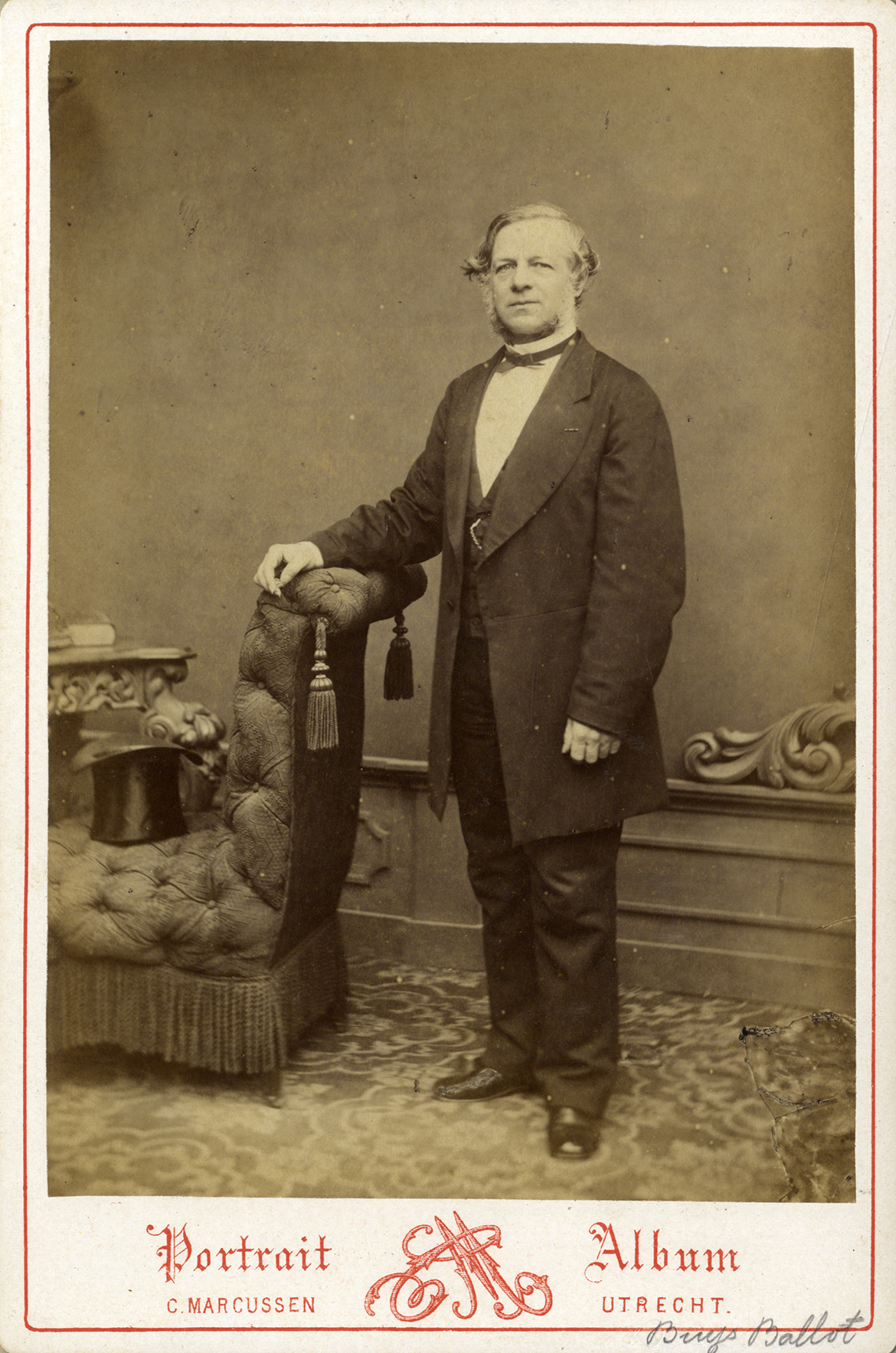
C. H. D. Buys Ballot. Source: Photo by C. Marcussen, around 1870. Utrechts Archief cat. 104267.
In the meantime, Buys Ballot started a research program analyzing differences in barometer readings at different places (Buys Ballot 1847, 1860, 1868).
2
In 1857, he announced his first major success. He found that the pressure gradient over the Netherlands was strongly correlated with wind: the bigger the difference in barometer deviation, the stronger the wind, while the direction of the difference indicated the direction of the wind. Crucially, he claimed that the difference often preceded the wind by up to one day, thus enabling forecasts (Buys Ballot 1857). Combined with the knowledge that wind from the North Sea to the west was generally stronger than from the east, this enabled him to formulate his “main rule” in the form of a warning: Danger of storm, and Westerly wind, if the barometer is 4 mm or more higher in Maastricht or Vlissingen than in Groningen or Helder at the same time. (Buys Ballot 1860, 72)
The Storm Warning System
The Dutch storm warning signaling system became operational on July 1, 1860. There is some disagreement in the literature about whether the earliest signals can be described as warnings, however. The signals consisted of daily telegraphic messages relaying the 8 am barometer readings from measuring stations in the four corners of the Netherlands: Vlissingen (southwest), Den Helder (northwest), Groningen (northeast), and Maastricht (southeast). These readings were posted at public places such as harbors and telegraph offices. Ewoud van Everdingen, Buys Ballot’s biographer and distant successor, insists that the messages were not warnings because they did not state the readings’ implications (Van Everdingen 1953, 89). 3 It was up to sailors and other users to draw their conclusions, using Buys Ballot’s wind rule.
In 1864, the KNMI began to send special telegrams to harbors when it judged that a storm was likely. These telegrams are sometimes considered the start of “real” storm warnings. They were received by lighthouse guards, harbor pilots (loodsen), or other people at hand, who hoisted drums and cones up tall poles along the coast, following the system FitzRoy had introduced in Britain in 1861. At this point, the storm warning system was also actively promoted to users, with official explanations and articles in newspapers (e.g., Krecke 1864).
Yet the “real” warnings did not last long. In 1867, Buys Ballot had the storm signal poles remodeled into aeroclinoscopes, an instrument (as he called it) of his own invention (Buys Ballot 1868; cf. Dekker 2010 and KNMI archive 1319). Aeroclinoscopes were a kind of semaphore pole that signaled the pressure gradient over the Netherlands (fig. 2). Most importantly, they did this continuously, not only when storms were expected. Like the posted messages from 1860, aeroclinoscopes only provided barometer readings, leaving it up to users to draw their own conclusions, using their professional expertise. Buys Ballot (1868) published a book to explain how this should be done, using his famous wind rule.
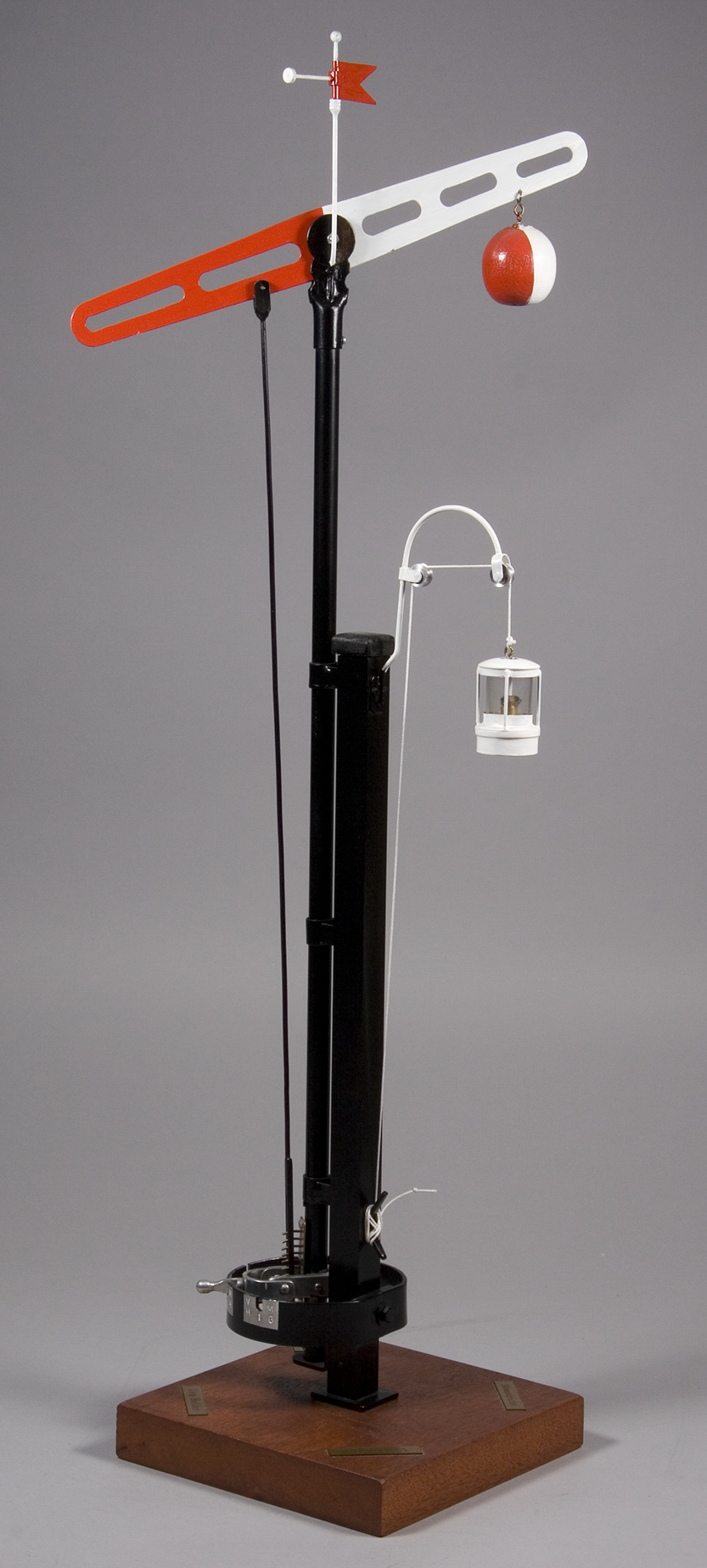
Model of an aeroclinoscope. The red and white arm could be tilted to indicate the size of the difference in pressure; the entire instrument could rotate to indicate the direction of the gradient. Source: Model by Henk Veerdig, Wind Museum Vlieland (www.expometeovlieland.nl). Used with permission.
Buys Ballot’s reluctance to issue actual storm warnings may have been influenced by the British controversy about Robert FitzRoy’s forecasts, which had been heavily criticized by the Royal Society (Burton 1986; 1989; Anderson 2005; Halford 2005; Walker 2012; Moore 2015; Achbari and Van Lunteren 2016, 33). 4 But Buys Ballot also had other reasons to shun direct warnings. In his booklet about the aeroclinoscope, he writes that although he had originally adopted the English system for the sake of uniformity, he did not feel comfortable with it. When the English warnings were terminated in 1866, he felt free to introduce his aeroclinoscopes. He had several objections to the English system, including FitzRoy’s “outdated” use of simple barometer readings instead of differences (to his chagrin, FitzRoy never referred to Buys Ballot’s wind rule; Achbari and Van Lunteren 2016, 21-24).
Another objection related directly to the issue of expert authority. Buys Ballot worried that sailors would take the signals as official announcements of storms. He conceded that FitzRoy had made clear the limitations of his warnings, but Buys Ballot believed this was not enough. He feared sailors would over-rely on the signals and stop being vigilant (Buys Ballot 1868; cf. Krecke 1864).
Buys Ballot’s caveats were not related to the imperfections of scientific knowledge. He never doubted his wind rule, for example (Buys Ballot 1868, 24). He saw the problem as more fundamental. The weather is a local and fast-changing phenomenon, which cannot be predicted centrally. Atmospheric changes can develop too fast for the once-a-day messages of the aeroclinoscope. Besides, just as it was important to know the barometer reading in different places rather than just one, it was important to know their development over time rather than at just one moment. Similarly, the barometer readings showed only large-scale structures in the atmosphere, while local prediction required attention to local circumstances too (Buys Ballot 1868, 4). So in his view, domesticating uncertainty was an issue of scale, both in time and space. Coen (2018) has beautifully analyzed the central role of scaling in climate science in the land empire of Austria-Hungary; here, we see that scale was also relevant at a practical level for weather forecasts on the North Sea coast.
According to Buys Ballot, centrally issued storm signals were not unreliable or uncertain, but incomplete. It was up to users to complete the picture of the atmosphere: Each user should consult the instrument in combination with his barometer and the impression of the sky and the sea, which gives him more complete and accurate information than just from it alone. (Buys Ballot 1868, 27)
This also explains why Buys Ballot described the aeroclinoscope as an instrument rather than a signal; he once even called it a differential barometer (Buys Ballot 1868, 27). It may be moved by human action rather than the force of nature, but the point was that it had to be used as an instrument, together with other instruments like barometers and thermometers. Besides, the aeroclinoscope could be regarded as an extension of a nation-wide infrastructure of barometers, whose measurements were collected in Utrecht and displayed along the coast. It enabled users to witness barometer readings for themselves, seemingly cutting out any interfering interpretation in an act of extended witnessing (cf. Shapin 1984 on virtual witnessing). In order to educate sailors, more meteorology was included in their training from the 1860s onwards (Davids 1980, 2012).
Buys Ballot’s ideas about the nature of the weather are also reflected in daily weather reports in Dutch newspapers. Newspapers in France had started publishing daily weather reports from 1857; Britain and the Netherlands followed in 1860, tabulating the latest weather observations for specified locations. From 1861, FitzRoy famously added brief forecasts for the next day to these reports. They have attracted a lot of attention as the first scientific weather forecasts. Buys Ballot refrained from issuing forecasts, but we now see it is not such a fundamental difference. His weather report was intended as a tool to create forecasts, even if he did not make them himself. Three weeks after the start of the publication of daily weather reports, a national newspaper published this explanation: it has been found that it is possible to deduct forthcoming changes in the weather with considerable accuracy from weather observations, done at different places…this is why we have recently started daily publication of the weather observations released by the meteorological observatory at Utrecht. To draw any conclusions from these observations, one needs to know the practical results that science has obtained. We refer our readers to the newly published book from our able meteorologist Mr. Dr. Buijs [sic] Ballot. (Algemeen Handelsblad, August 4, 1860)
Both in the aeroclinoscope and in the general weather reports, we see that Buys Ballot was actively trying to shape the emerging culture of prediction. He wanted to limit institutional authority over weather predictions. Instead, he thought that the fundamental nature of the weather required a social infrastructure in which forecasts and storm warnings are co-constructed by scientific and professional experts. The necessary expertise would not be fully professionalized. The aeroclinoscope materially embodied these ideas. The envisioned culture of prediction required the creation of a new community of users who combined experience-based expertise with scientific literacy, enabling them to translate scientific statements into local, practical decisions. That his expectations may have been overly optimistic is illustrated by the fact that his book starts with instructions on how to build your own barometer.
International Comparison
The 1860s saw several attempts internationally at weather forecasting, especially storm warnings. Scientific meteorologists generally accepted the possibility of forecasting but struggled to find the right balance between authority and modesty and to connect to the weather wisdom of practitioners like sailors or farmers. The different approaches taken in Europe show that the first forecasting initiatives all assumed that experience-based expertise and personal judgment were required to formulate reliable forecasts.
In Britain, FitzRoy (1863) emphasized the importance of personal judgment and practical experience. He described how understanding a “complicated and extensive…subject as that of our atmosphere and its movements” required a combination of “mathematical exactness with the results of experience obtained by practical ocular observation and much reflection.” But in his case, it was the meteorologist himself who had obtained “an insight into its dynamical laws…to which each passing month has added elucidation and value” (FitzRoy 1863, 170). He emphasized the need for scientists to learn from practice rather than the need for users to learn the science. This reflected his own background as a naval officer who was very aware of the practical nature of meteorology.
FitzRoy also mentioned that users had to make their own judgments, simply because they are always imperfect. Users could “derive useful cautionary notices from these published expectations of weather: although (from the nature of such subjects) they can be but scanty and imperfect under present circumstances” (FitzRoy 1863, 189). For example, FitzRoy promoted the use of barometers by fishermen along the British coast, aiming to create an audience of “autonomous” users, who could interpret the barometer readings using their own local expertise, thereby mitigating or correcting the inherent uncertainty of centralized forecasts (Dry 2009). Like Buys Ballot, FitzRoy (1859) also published a booklet on how to interpret instrument readings, but his book was much more basic and practical than Buys Ballot’s, providing clear rules of thumb formulated in maritime jargon, with minimal scientific explanation.
FitzRoy was criticized by the Galton committee for relying too much on personal (we might say tacit) expertise and subjective judgment in his forecasts, instead of empirically confirmed laws of nature. The committee recommended suspending daily forecasts, and demanded a more solid scientific foundation for storm warnings, which should be made more accurate and more specific (Galton 1866). This aligns with the culture of certainty Pietruska (2017) described in the late nineteenth-century United States: science should be accurate or remain silent, free of uncertainty and personal judgment (cf. Daston and Galison 2007). The Galton (1866, 35, 41) report acknowledged that FitzRoy’s storm warnings were “far too important, too popular, and too full of promise of practical utility to be allowed to die,” but at the same time, they could not be “allowed to continue in [their] present unscientific, and therefore unsatisfactory, condition.” Buys Ballot was frustrated that the committee failed to acknowledge that a better scientific basis was already available, as demonstrated by the superior Dutch storm forecasts. He redoubled his efforts to promote his wind rule in Britain. Eventually, Buys Ballot’s law was used as a legitimation to resume storm warnings in England at the end of 1867 (Achbari and Van Lunteren 2016).
The French approach was similar to the Dutch. When Hippolyte Marié-Davy started to issue daily weather reports and forecasts from the Paris Observatory in 1863, he explicitly connected scientific meteorology to the experience-based expertise of sailors and farmers, which he differentiated from unreliable folk knowledge or weather prophets. He aimed to provide an overview of weather patterns in order to guide local interpretations of weather indicators (Locher 2009, 91, 100). The famous Paris Bulletin provided daily weather reports and maps, which were used by meteorologists all over Europe. Even Galton (1866, 24) approved of this service.
In Germany, there were several attempts to develop storm warnings in the 1860s, with mixed success. From 1865, a Zentralstelle für Stumwarnungen led by the eminent Prussian meteorologist H. W. Dove served the Prussian harbors, but only nine warnings were issued until 1873 (Seewarte 1878, 123; Wille 2017). Along the North Sea coast, the Norddeutsche Seewarte, established in 1868, created a British-style storm warning system. An effective storm warning system only started functioning in 1876, after the various German meteorological institutes were centralized. It was operated by the Deutsche Seewarte. Some of the signal posts included a message board on which the latest weather reports were posted. Similarly, German harbors obtained daily weather reports by telegraph starting in 1865, but daily forecasts only began in 1876. The forecasts (Wetterprognosen) were gradually expanded, but the directors of the Seewarte were aware of the limits (Mangelhaftigkeit) of their expertise and wanted to carefully control their message in public (Seewarte 1878; cf. Wege 2002).
At an international meeting of meteorologists in Leipzig in 1872, fifty-two participants were asked to provide their views on a range of issues. A small committee, including Buys Ballot, reported on storm warnings and forecasts in a subsequent meeting in Vienna the next year (Neumayer 1873). The great majority of participants were in favor of issuing storm warnings. Most wanted to provide actual warnings as well as report the latest observations. Some “significant voices” (presumably including Buys Ballot's) favored providing data without warnings, but nobody wanted to issue warnings without reporting the underlying observations (Neumayer 1873, 71). Clearly, the forecasters were not prepared to claim absolute authority. All agreed that it was important to “tactfully” avoid too many details, which risked discrediting the forecasts if they were wrong. Only strong winds (above Beaufort 7) could be predicted with sufficient reliability. Like FitzRoy, the gathered meteorologists acknowledged the importance of experience-based expertise and personal judgment, but only with respect to the directors of local meteorological institutes (Neumayer 1873, 73-74). It was their job to judge the local circumstances, a task that Buys Ballot had wanted to assign to users. In other words, by the 1870s, meteorologists had different ideas about the institutionalization and professionalization of forecasting expertise.
The committee recommended that each harbor have a publicly visible barometer and thermometer. Actual warnings should only be issued if the storm developed so fast that it was too late for “independent prognostication,” and if users had no meteorological knowledge and no access to instruments. Even then, warnings should be issued in terms of probabilities. A storm warning should never be taken as a real prediction by itself. In any case, the public should be educated (the committee used the word erzogen, meaning “raised,” as in raising a child) on the nature and meaning of weather prognosis (Neumayer 1873, 74-77). This all sounds very much like Buys Ballot’s ideas, except for one detail: the committee advised against “complicated instruments,” preferring simple systems of drums, cones, and lights. One wonders whether they had aeroclinoscopes in mind, which required significant skill and expertise to read.
Part 2: Modernizing the Storm Warning Service
The aeroclinoscope was not a success, and not just because several blew over during their very first storm (KNMI archive inv. 1319). The instrument was never adopted elsewhere, and even in the Netherlands it never became popular (Gallé 1931; Van Everdingen 1953, 97). After Buys Ballot’s death in 1890, the principle of the instrument, which required constant vigilance and active interpretation by users, became regarded as a problem. According to L. Roosenburg, the director of the new KNMI branch office (filiaalinrichting) in the Amsterdam harbor, the signals were hard to see from a distance, “and then one still has to deduce the direction and force of the wind from the signal; I am sure this is a problem for many users” (Roosenburg, February 19, 1892, KNMI archive inv. 1319). Another problem was that the signal was always there, not just in case of danger. Sailors needed to keep an eye on the signals at all times (Schippers 1899, 2).
Speaking on behalf of commercial sailors and fishermen, Roosenburg problematized the hybrid nature of the aeroclinoscope, which served as an instrument comparable to thermometers and barometers as well as a medium to convey warnings. One could say that the aeroclinoscope failed to become a boundary object between the increasingly separated communities of scientific experts and professional users. From the users’ perspective, it remained located in the scientific realm. Roosenburg, a former naval officer, positioned himself as a mediator between the scientists at the KNMI headquarters and the practical world of shipping, which he viewed as increasingly distinct. The KNMI branch office he headed had been established in 1881 at the request of shipping organizations; a similar office was established in Rotterdam in 1889 (Gallé 1931; Warners 1964).
Roosenburg preferred storm warning systems with flags that indicated the (expected) direction of the wind: these were “clear without any need to think about it,” making mistakes all but impossible (Roosenburg, February 19, 1892, KNMI archive inv. 1319). He also suggested changing the regular weather forecasts, because “the present messages, such as ‘a depression is far away to the NW and an area of high pressure is nearby to the S,’ are not very well suited for the general public” (ibid.). Clearly, Roosenburg did not expect users to be scientifically literate in the way Buys Ballot had expected. Nor did he think that storm warnings should rely on users’ experience-based expertise.
Maurits Snellen, Buys Ballot’s successor, reacted positively to Roosenburg’s proposals. He deemed that meteorological science had developed enough to legitimize real warnings thus acknowledging earlier flaws: “the fear, that previously experienced disappointments with storm warnings will be repeated, has been largely banished by the great progress made by meteorology in recent years, as confirmed by the results obtained in other countries” (quoted in Schipper 1899, 4).
Snellen also acknowledged that forecasting was the task of KNMI experts, not users. Both Roosenburg and Snellen put the locus of legitimate interpretation within the scientific expert community, rather than with professional users, as Buys Ballot had. Put differently, they both argued for full expert authority. In the context of a discussion about the predictive value of Buys Ballot’s law (which was quietly dismissed), Snellen remarked: “It is no problem to leave [the barometer differences] out of our publications, because a forecast [prognose] is more useful to the public than the data that can be used to make them” (Snellen, May 25, 1900, KNMI archive inv. 240).
As a result, the process of forecasting became increasingly centralized within the expert space of the KNMI and separated from its contexts of use.
The new storm warning service started on May 1, 1898. The aeroclinoscopes were again replaced by signal poles with balls, cones, and flags (fig. 3). The service was modeled after that of the Deutsche Seewarte in Hamburg, which in turn had been inspired by the English system (Snellen, October 28, 1899, KNMI archives inv. 240; cf. Schippers 1899; Wege 2002).
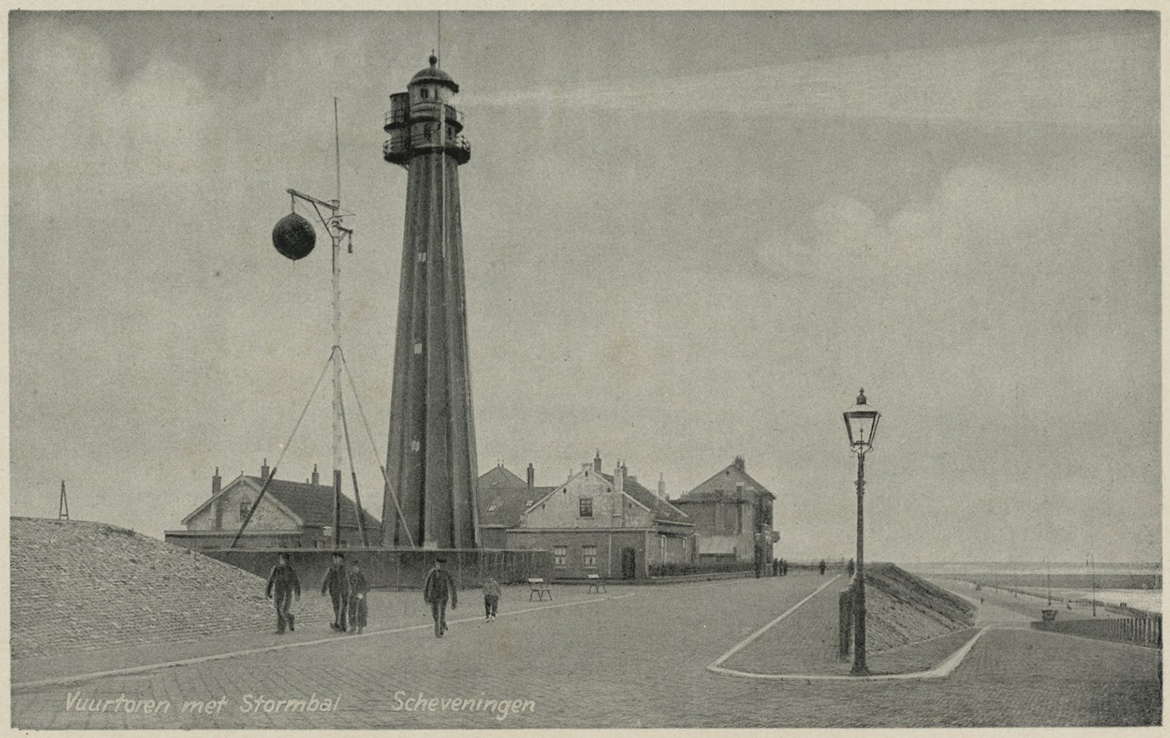
Storm signal pole next to the lighthouse of Scheveningen in the Netherlands. The black ball means “be on your guard: strong wind expected.” Undated postcard.
The storm warnings were distributed each morning from De Bilt, near Utrecht, where the KNMI was now located. They were based on observations that came in by telegraph from all over Europe, and if necessary, another message followed later in the day (except on Sundays). The warnings were given priority in the telegraph network. The messages were also distributed via the coastguard network, which kept functioning outside of the telegraph offices’ working hours. The actual storm signals were operated by lighthouse keepers, harbor masters, pilots, and others working at strategic locations. Transmitting the messages from De Bilt to the signal stations took about 1.5 hours, which was assessed to be “very satisfactory” (Schippers 1899, 12). The Dutch government distributed brochures and posters with information in the ports to explain and promote the system.
Assessing Reliability
The new system was easy to understand, modeled after foreign systems that had been operating for decades, and approved by both scientists and professionals. But within a year, the KNMI’s board of trustees felt compelled to have the system evaluated by rear admiral (schout-bij-nacht) H. A. Schippers. He presented an extensive report in November 1899 based on his own investigation, interviews with KNMI staff, and a brief survey of users (Schippers 1899). It provides an interesting counterpoint to the Galton Report of 1866. Both reports describe a clash between the practical and scientific sides of meteorology, but Schippers represented the practical perspective while Galton favored a scientific approach. At the heart of this debate were different views on the domestication of uncertainty aspect of the culture of prediction. The reports, and the discussions surrounding them, highlight a tension between different criteria of quality: quantitatively assessed scientific accuracy, which was valued by scientists, versus practical reliability, a qualitative criterium valued by sailors.
It is notable that in both the British and Dutch cases, the practical nature of meteorology was defended by navy officers (FitzRoy, Roosenburg, and Schippers). Navy officers played a crucial role in the rise of scientific meteorology in the nineteenth century, which in many cases led to clashes between officers and academic scientists, including FitzRoy v. Galton in Britain, M. F. Maury v. A. D. Bache and Joseph Henry in the United States, and M. H. Jansen v. Buys Ballot in the Netherlands (cf. Achbari 2017). To this list, we can add Schippers and Roosenburg v. Snellen.
According to Schippers, the storm warning system had been implemented according to plan, and the employees did their work well. Still, the system did not function properly. The signals often came too late or were not followed by strong winds, and unforeseen storms still occurred. Moreover, the signal was nearly always “storm signal zero”: a black ball that meant “be on your guard,” without providing information about the expected wind direction. Schippers dryly concluded: Even keeping in mind that the chance of disappointment is always rather large with weather predictions, and therefore expectations should not be too high, one can hardly be satisfied with the results obtained during the period under consideration. (Schippers 1899, 12)
Everybody agreed that users’ trust was crucial and that this trust depended upon warnings being correct: ideally, all warnings should be followed by a storm, and no storms should occur without warning; otherwise, the warnings would do more harm than good. Everybody also agreed that the warnings fell short of this ideal. They did not agree on how serious the problem was, however. KNMI director Snellen acknowledged the problems but felt that it was too early to pass judgment. Given how new the service was, he did not expect full accuracy. Errors, within limits, were unavoidable. Snellen held that uncertainty was not something to avoid altogether but something to deal with. Uncertainty could be domesticated. He also suggested that users probably had unreasonable expectations of the warnings; more explanation was needed (quoted in Schippers 1899, 20).
Snellen also stated that Schippers’s evaluation had not been collected in a properly scientific way. He wanted to statistically compare the storm warnings to actual wind speeds as measured by anemometers. This triggered discussion on the potentially faulty calibration of anemometers in Vlissingen and Amsterdam (KNMI archives inv. 240). Clearly, Snellen had a kind of mechanical objectivity in mind: accuracy should not be assessed by people but by “objective” measurements and statistics (cf. Daston and Galison 2007). Galton had similarly argued for scientific, quantitative assessment of accuracy instead of relying on “unreasonable” popular beliefs. He called for self-registering instruments to eliminate any possible personal interference (Galton 1866, 33-36).
For Schippers and Roosenburg, mechanical objectivity was beside the point, however for them, the only relevant metric was practical impact: whether users considered the signals reliable enough to factor into their decision to sail or remain in port. That assessment might be subjective, but it still counted. From a practical perspective, the warnings were either useful or not; a semi-reliable system was of no use to anyone (Schippers 1899, 22-23; cf. Roosenburg November 21, 1915, KNMI archive inv. 242). Moreover, the decision to sail or not had serious financial consequences. Not sailing cost income; sailing could cost a ship. Roosenburg and Schippers believed that this “practical element has been lacking in the management of the storm warning service” (Schippers 1899, 30).
In both the British and Dutch cases, the debate reflected changing elements in the culture of prediction. While the debate focused on the domestication of uncertainty, it was also related to changing views on the institutional and social settings of forecasting. In the British case, the Meteorological Department was about to be moved from the economically minded Board of Trade to the Royal Society, a scientific institution (Burton 1989; Walker 2012). The KNMI was an independent institution. It is often described as the first national science institute, and indeed Snellen described the KNMI’s mission as “purely scientific,” but it had been funded because of its practical use (Snellen, October 28, 1899, KNMI archive inv. 240). Snellen’s view matched a new way of legitimating academic research from the end of the nineteenth century, which emphasized pure science as the foundation of applied science, linking research to use in principle, but at the same time separating the two institutionally. Practical use was still the aim, but it was somebody else’s job (Theunissen 2000; cf. Kline 1995). The increasing separation between science and practice is reflected in the founding of the KNMI departments in Amsterdam and Rotterdam, which provided practical services, while the headquarters in De Bilt focused on meteorological research. The problem was to determine on which side of the boundary the storm warning service belonged.
Establishing a Culture of Prediction
In the end, the storm warning service was moved from the KNMI headquarters in De Bilt to the Amsterdam office, effectively shifting the service closer to sites of practice (Minister of Water, Trade and Industry, February 20, 1900, KNMI archives inv. 240). Many practical improvements were made: new posters and brochures were produced to explain the signals; updates were issued throughout the day in addition to the daily morning messages; more signal poles were erected, including some on stationary light ships at sea; and lights were added to make the poles more visible at night. By expanding the telegraph network and increasing telephone use, the warnings could also be distributed more quickly. Furthermore, in 1916, the Dutch coast was divided into separate districts to make more localized warnings possible (KNMI archive inv. 242, 247).
Arguably, the most significant improvement was that the service expanded the collection of observations from abroad. Most storms came from the west, so telegrams from Great Britain and Ireland were especially important. The KNMI constantly lobbied for earlier messages from overseas and quicker processing, so it could draw up its daily weather map earlier. From 1903, daily observations were also received from the Azores, and starting in 1907 from Iceland and the Faroe Islands, enabling earlier observations of storms developing over the North Atlantic. These had been old wishes of Buys Ballot (Cannegieter 1954, 67).
Gradually, a new culture of prediction was established. The transition is illustrated by an incident in September 1911, when the freight ship Solo left Rotterdam on its way to Batavia. It was almost immediately thrown off course by strong gales and the ship stranded on the coast of the nearby town of Monster. Luckily, the crew could be saved. During the ensuing investigation, the Board of Shipping (Raad voor de Scheepvaart) asked captain W. Gantvoort why he had sailed despite the storm warnings that had been issued by the KNMI. “The captain said he valued the warnings, but he could not see them from the Lloyd docks,” and in any case, as an experienced captain of a large, heavily loaded ship, he had not worried too much about the wind (Nieuwe Rotterdamse Courant, October 20, 1911). The inquiry demonstrated that the storm warnings had obtained official authority. Even experienced captains were supposed to obey them rather than make their own judgments, even if not all of them did. That was precisely the kind of authority that Buys Ballot had wanted to avoid. Clearly, expectations had changed and boundaries had shifted: users were expected to trust scientific experts, and the authorities did not trust users’ judgment anymore.
In 1915, Roosenburg (November 21, 1915, KNMI archives inv. 242) wrote that the storm warning service performed at the level that could be reasonably expected. He also noted that sailors now trusted and used it. Another sign of growing trust was the increasing number of requests for new signal posts, including from inland riverside towns (KNMI archive inv. 242).
With the advent of wireless telegraphy (marconigrams) and later radio, ships could also be warned off the coast. Initially, only large ships could receive wireless messages, but in the 1930s, smaller ships were increasingly also equipped with radio. In a survey among shipping companies in 1933, opinions on the usefulness of the traditional signal poles along the coast were divided, but they considered the storm warnings themselves indispensable (KNMI archive inv. 243).
Conclusion
In discussions surrounding the storm warning system, the authority of scientific experts was never challenged. What was contested were the expectations of expertise, especially what expertise users were expected to have. As we saw, this issue was closely related to the institutionalization and professionalization of meteorological expertise. The changing views on expertise are symbolized by the rise and fall of the aeroclinoscope, the material embodiment of Buys Ballot’s envisioned, but never fully realized, culture of prediction.
Another controversy concerned the domestication of uncertainty: should (un)certainty be assessed by measurable accuracy or practical reliability? Both scientists and users expected explicit and reliable (if not 100 percent accurate) forecasts, but their assessment of the actual performance of the new storm warning system differed. This discussion related to the different interests of the main stakeholders: was scientific credibility at stake or practical safety and income security? The debates revealed that stakeholders had different views on the nature of the storm warning system.
Out of all, these discussions emerged a new storm warning system and a new culture of prediction. In the Netherlands, as in other countries, the locus of legitimate interpretation moved to a centralized group of scientific experts within one institute, with no longer a role for nonscientific professionals. All aspects of the culture of prediction had changed in the process: the social role, the way uncertainty was “domesticated,” the institutional nature and the professionalization of expertise, the cultural impact, and the infrastructure. In the end, scientists and users co-constructed a new culture of prediction based on exclusive expert authority of the kind that would be vigorously contested later in the twentieth century.
Footnotes
Acknowledgments
I thank Marieke Gelderblom, Bert Theunissen, Robert-Jan Wille, Daan Wegener, and Frans van Lunteren for their help and support. I also thank the reviewers and especially the editor Courtney Addison of Science, Technology, & Human Values for their helpful comments and suggestions.
Declaration of Conflicting Interests
The author(s) declared no potential conflicts of interest with respect to the research, authorship, and/or publication of this article.
Funding
The author(s) received no financial support for the research, authorship, and/or publication of this article.
