




Abstract
Using survey data from 100 technology-intensive firms based in the United Kingdom, the paper analyses the effects of social capital on the process leading teams tasked with the development of new products (NDP teams) to acquire new knowledge from other teams. Drawing from the social capital theory as well as the relational view, the paper examines the impact of a number of dimensions of social capital on knowledge acquisition among NDP teams and it suggests that social capital facilitates external knowledge acquisition from key team(s) with which the NDP team develops a preferential relationship. We differentiate between types of knowledge that the NDP teams acquires from the other team. Product knowledge is related to the product specification and encompasses technology-related and market-related knowledge, while process knowledge is related to the procedures and techniques used to develop new products. Our results suggest that social interaction and network ties dimensions of social capital are associated with greater knowledge acquisition in the case of process knowledge, but in the case of product knowledge, trust is more important than the degree of social closeness. Further, our results provide evidence that when acquiring product knowledge, both absorptive capacity and cognitive ability play a positive mediating role; vice versa absorptive capacity does not facilitate the acquisition of process knowledge.
Introduction
How do teams acquire new knowledge? This is an important question when studying the behaviour of teams tasked with developing new products (NPD teams henceforth), as they thrive in environments where existing knowledge is replenished, and learning is facilitated at an organisational level (Alegre and Chiva, 2008; Schleimer and Faems, 2016). Therefore, they rely on firm-level mechanisms that can promote acquiring new knowledge (Nakata and Im, 2010). Yet, exposure to new knowledge does not guarantee it will be acquired. Indeed, knowledge acquisition can be a lengthy and time-consuming process for many reasons. To begin with, teams may lack the capacity to identify the new knowledge they need; they might not have mechanisms to acquire the knowledge once it is recognised. Furthermore, not every team learns from other teams (whether internal or external) in the same manner. Unsurprisingly, understanding what strategies acquire knowledge has been an important research topic in knowledge management studies (Backmann et al., 2015; Bjork and Magnusson, 2009; Dunlap et al., 2016; Jiang and Chen, 2018).
Some authors have pointed out that in the case of knowledge external to the team (but internal to the firm), teams tend to acquire it by developing ‘preferential’ connections with other teams (Tsai, 2001) that they recognise as potentially useful (Bjork and Magnusson, 2009; Cuevas-Rodríguez et al., 2014; Huber, 1991). Indeed, teams can facilitate knowledge acquisition by building preferential relationships with other teams and developing knowledge-sharing routines that create learning capabilities in the NPD teams (Ortiz et al., 2021). According to this literature, acquiring new knowledge is a social process, and therefore, social capital may be critical for successfully attaining knowledge (Cuevas-Rodríguez et al., 2014; Hansen, 1999; Maurer et al., 2011; Ortiz et al., 2021). Although several studies have examined how firms pursue learning opportunities in intra-organisational settings (e.g. Gupta and Govindarajan, 2000; Hansen, 1999; Hansen, 2002), extant research calls for further clarity on how social capital may support knowledge acquisition among NPD teams (Kanwal et al., 2022; Maurer et al., 2011). This paper aims to fill this gap in the literature and analyse how social capital influences the capability of NPD teams to acquire new knowledge (Rindfleisch and Moorman, 2001) from other teams within the same organisation (Cuevas-Rodríguez et al., 2014; Liu et al., 2017; Maurer et al., 2011). We focus on the relationship with its ‘key knowledge provider’, that is, the cross-functional relationship the NPD team refers to when accessing knowledge. We decided to look at internal knowledge acquisition among NPD teams as these teams are knowledge-intensive (Frank et al., 2015).
The concept of social capital was originally introduced in social and community studies (Jacobs, 1961). For the last few decades, it has been widely used in fields as diverse as sociology (e.g. Coleman, 1990; Granovetter, 1973), economics (e.g. Doh, 2014; Sabatini, 2008), and organisational studies (e.g. Burt, 1992; Hansen, 1999; Subramony et al., 2018). From a theoretical point of view, the importance of social capital in supporting intra-organisational communication has been long established. In their seminal paper, Tsai and Ghoshal (1998) first suggested that social capital facilitates the exchange of resources and information within the same organisation. Afterwards, several studies on intra-organisational communication have documented the importance of social capital in supporting knowledge acquisition and new product performance by fostering trust, knowledge sharing, collaboration, and innovation across teams in the same organisation (Adler and Kwon, 2002; Inkpen and Tsang, 2005; Ganguly et al., 2019; Hansen, 1999; Tsai, 2001; Tsai and Ghoshal, 1998). In particular, social ties have been identified as the key mechanisms to facilitate information exchange and allow team members to access knowledge from other teams. While social capital was originally conceptualised as the volume of resources available to a firm through personal ties within a network, it has increasingly come to be considered as significantly more than the structure of a company’s dyad connections (Adler and Kwon, 2002).
Nahapiet and Ghoshal (1998) introduce three distinct dimensions of social capital: structural, relational, and cognitive. The structural dimension refers to formally established relationships within a network. The relational dimension denotes the relationships’ quality and the extent of trust and close interaction between network members. The cognitive dimension refers to ‘resources providing shared representations, interpretations, and systems of meaning among parties’ (Nahapiet and Ghoshal, 1998: p. 244). Based on this conceptualisation of social capital, we develop a theoretical model to examine the impact of social capital dimensions on NPD knowledge acquisition. The article focuses on the role of social capital as a conduit of knowledge between an NPD team and another internal team with knowledge relevant to the work of the NPD team. We label the source of knowledge as the ‘key knowledge provider’. Our model suggests that structural ties with key knowledge providers can facilitate the NPD team’s knowledge acquisition; however, the model highlights that other social capital dimensions – relational and cognitive ties – can mediate this relationship.
The paper contributes to the literature on intra-organisational learning in four distinct ways. First, we emphasise social capital as a driver of intra-organisational knowledge acquisition (Adler and Kwon, 2002; Hansen, 1999). This area has been underexplored (Maurer et al., 2011), as most research on knowledge acquisition has focused on inter-organisational contexts (Ganesan et al., 2005; Rindfleisch and Moorman, 2001; Yli-Renko et al., 2001). We stress the importance of focusing on the intra-organisational knowledge transfer perspective for several reasons: first, theoretical literature has highlighted the role of social capital in facilitating resource-sharing among teams of the same organisation by supporting repeated interactions among teams that can help them to recognise and acquire resources they need for their activities (Hansen, 1999; Inkpen and Tsang, 2005). As the innovation production process requires the NPD team to obtain a specific type of resource, that is, knowledge, it is important to ascertain social capital’s role in supporting this type of resource-sharing (Maurer et al., 2011; Szulanski, 1996). Second, we investigate social capital’s relational and cognitive dimensions as mediating variables rather than treating all three dimensions as parallel (Maurer et al., 2011; Yli-Renko et al., 2001). While structural ties facilitate access to existing knowledge for NPD teams, relational and cognitive dimensions mediate knowledge acquisition (Castro and Roldán, 2013; Ortiz et al., 2021). The importance to conduct further studies on social capital dimensions and their inter-relational role was highlighted by Castro and Roldan (2013). They emphasised the mediating role of some of social capital dimensions and called for further studies to look for the internal functioning of social capital components. They emphasised the structural dimension as a prime generator of social capital, as in Tsai and Ghoshal (1998). Third, by pursuing a multidimensional measurement of social capital, the study can consider the direct facilitative roles of structural ties between NPD teams and their key knowledge providers while looking in conjunction at the mediating role of the relational relations with two other sub-dimensions: (a) social interaction (a close relationship with a key knowledge provider) and (b) trust (a benevolent type of trust); and for cognitive dimensions, we conceptualise these as (a) cognitive ability (sharing similar goals) and (b) absorptive capacity (sharing an overlap of knowledge background). This approach expands the concept of social capital by exploring the relational and cognitive dimensions in greater detail while investigating whether these sub-dimensions play distinct roles in intra-organisational NPD knowledge transfer and acquisition. Finally, this paper acknowledges the significance of different types of NPD knowledge, distinguishing between product knowledge and process knowledge based on previous scholarly work (Ganesan et al., 2005; Rindfleisch and Moorman, 2001).
We test the model using data from 100 R&D-intensive firms in the United Kingdom. We find that both product and process knowledge are acquired through connections with key knowledge providers. The findings suggest that trust (of the benevolent type) is more important when acquiring product knowledge. In contrast, close interactions through trust in competence play a more critical role in attaining process knowledge. Furthermore, we find that cognitive ability and absorptive capacity positively mediate in acquiring product knowledge, while absorptive capacity has no impact on process knowledge acquisition. This might be relevant to the debate on how the relational dimension affects absorptive capacity when dealing with complex and process-related knowledge (Gratton et al., 2007).
The structure of the paper is as follows. Section 2 discusses our theoretical framework and develops the research hypotheses. Section 3 describes the methodology, data, and empirical model, while Section 4 discusses the results. Finally, Section 5 discusses the findings and their implications for theory and practice, and Section 6 provides concluding remarks.
Theoretical background and hypotheses development
Our model builds upon the firm’s knowledge-based view. According to this view, companies accumulate knowledge, which they combine with other resources to innovate and create a competitive advantage (Kogut and Zander, 1992; Pereira and Bamel, 2021). Within an organisation, knowledge is spread across different teams. Importantly, each team has distinct resources that must be exchanged among teams to create value (and competitive advantage). For instance, NPD teams are the repositories of specific knowledge, which can contribute to successfully launched product innovations when combined with other teams. However, within organisations, teams have different tasks, and sharing knowledge with other teams may not be their main priority. As a result, the organisation may miss opportunities for value creation. Despite its importance, in the context of knowledge sharing, most studies have examined how firms pursue learning opportunities in inter-organisational settings – buyer–seller relationships (Von Hippel, 1998; Von Hippel et al., 2011) and supplier–customer relationships of entrepreneurial companies (Inkpen and Tsang, 2005; Larson, 1992) and small firms (Uzzi, 1997) – and given limited importance to the intra-organisational knowledge sharing (e.g. Gupta and Govindarajan, 2000; Hansen, 1999, 2002). In the case of NPD teams, similar research on knowledge acquisition among these teams focused on knowledge acquired externally (Ganesan et al., 2005; Rindfleisch and Moorman, 2001; Yli-Renko et al., 2001), although internal sources of knowledge can be equally important (Frank et al., 2015; Moran, 2005; Ortiz et al., 2021; Van Wijk et al., 2007). At the same time, several scholars have identified a lack of communication among teams as a key obstacle to organisational effectiveness. Tsai and Goshal (1998) pointed out that social capital may help solve the problem by encouraging informal interactions among teams and, in turn, helping align the teams’ goals with the organisation’s values; only a few have examined the role of social capital in facilitating learning in these relationships (Frank et al., 2015; Huang and Newell, 2003; Rosenthal, 1997).
Most research in social capital literature has focused on the effect of social capital as a macro-level concept in industrial networks (e.g. Ahuja, 2000; Burt, 1992) or as a micro-level notion from both an inter-organisational (e.g. Rindfleisch and Moorman, 2001; Yli-Renko et al., 2001) and an intra-organisational perspective (e.g. Levin and Cross, 2004; Nahapiet and Ghoshal, 1998; Tsai and Ghoshal, 1998). Studies have focused on one dimension of social capital and measured it indirectly regarding the number of relationships, its network position, or its tie strength (Burt, 1992; Coleman, 1990). However, in the context of new product development, it has been suggested that the extent to which an NPD team acquires external knowledge depends on the embeddedness and connectivity with the team from which they source knowledge (Yli-Renko et al., 2001). Within organisations, NPD teams need to acquire new knowledge by developing relationships with cross-organisational teams after identifying the nature of what will be beneficial to them (Frank et al., 2015; Huber, 1991; Tsai, 2001). However, while extant literature understands knowledge in an intra-organisational setting, this does not always transfer as easily as it sounds (Frank et al., 2015). This could be due to the nature of technical roles that make NPD team members more individualistic and less aligned with the company’s overarching goals (Van der Bij et al., 2003). Other times, it could be because of the lack of communication among teams as they are not geographically close (Song et al., 2006) or even are less trustworthy of one another (Ganesan et al., 2005). In this context, social capital may be helpful in facilitating informal relationships among teams, which may lead to a better alignment of the team to the values of firms.
Thus, they can leverage the knowledge they are exposed to to their benefit through their key relationships and degree of social capital (Ortiz et al., 2021).
In measuring the social capital dimensions, we follow Nahapiet and Ghoshal (1998) and other scholars who adopted the three dimensions for organisational learning (e.g. Yli-Renko et al., 2001). Nahapiet and Ghoshal’s (1998) seminal work categorises social capital into three distinctive dimensions: structural, relational, and cognitive. We use a similar conceptualisation and define network ties (a term used for the structural dimension) as the extent to which the key knowledge provider gives the NPD team access to a broader set of connections and knowledge sources (Nahapiet and Ghoshal, 1998; Tsai, 2001; Yli-Renko et al., 2001). The relational dimension refers to relationship quality, and we conceptualise that through the two sub-dimensions of close social interaction (Yli-Renko et al., 2001) and trust (Levin and Cross, 2004).
We expand the argument and suggest that the amount of external knowledge NPD teams acquire from their organisational sources depends on other dimensions of social capital. However, knowledge acquisition is aided by NPD teams’ exposure to knowledge sources. These intra-organisational social connections to NPD teams are their internal social ties (Ganesan et al., 2005; Rindfleisch and Moorman, 2001). Thus, we conceptualise this through two other dimensions of social capital offered by Nahapiet and Ghoshal (1998) as mediating ones for knowledge transfer. We argue that social ties facilitate knowledge transfer, and relational and cognitive dimensions can further mediate this NPD-related knowledge acquisition. Thus, the focus is on how these two dimensions can mediate the key relationship, and it looks deeper at this through sub-categories for relational and cognitive dimensions. We, therefore, conceptualise the mediating role of relational and cognitive components separately as they further facilitate the product and process of knowledge (Chang et al., 2024). We focus on two types of knowledge: NPD product and process knowledge. Product knowledge is related to product specification and encompasses technology- and market-oriented knowledge, while process knowledge is related to the procedures and techniques used to develop new products. Each of the social capital dimensions will now be discussed in turn.
Network ties (structural dimension)
Teams that provide knowledge are not only knowledge repositories; they can also link NPD teams to other sources of knowledge (Nahapiet and Ghoshal, 1998). Even one additional connection can facilitate exposure to new knowledge, allowing managers to acquire related knowledge at the individual level (Burt, 1992). Therefore, ties of the network the key knowledge provider belongs to act as links connecting the NPD team to other intra-organisational knowledge sources (Roper et al., 2017) and increase the NPD team’s chances of being exposed to new knowledge (Granovetter, 1973; Tsai, 2001). Access to a few knowledge sources enhances knowledge acquisition (Cohen and Levinthal, 1990; Lane and Lubatkin, 1998). Hansen (2002) concluded that diversity generated through broad inter-unit ties enhances the higher learning functions of NPD teams. Hill et al. (1992) addressed the same issue from the perspective of the business unit and again noted that network ties provide access to a more diverse and broader range of knowledge. In this context, types of knowledge will not make any difference as in both forms, connections to other teams through the key knowledge provider will allow the NPD teams to acquire more knowledge. They may facilitate the acquisition of complex knowledge (Rindfleisch and Moorman, 2001).
New knowledge that is different in content but similar in type to existing knowledge exposes the firm to greater knowledge acquisition opportunities and enhances the company’s ability to value such prospects (Rindfleisch and Moorman, 2001). Some knowledge diversity is required to transfer new knowledge (Adler and Kwon, 2002). Network ties aid in the development of new knowledge. Several links mean exposure to a broad set of opportunities for further learning (Tsai and Ghoshal, 1998). Ties enhance knowledge acquisition by providing a framework to evaluate new knowledge and deepen understanding. An increasing number of relationships among teams increase the knowledge NPD teams acquire by improving the ability to recognise relevant knowledge (Yli-Renko et al., 2001).
Social ties create channels for knowledge and resource flow (Burt, 1992). Through social interaction, an actor may access knowledge from other sources (Tsai and Ghoshal, 1998). Hansen (1999) contributed to the theme of social ties by arguing that teams should focus on tie strength rather than network density to gain superior opportunities. This aligns with Coleman’s argument, which emphasises the positive role of strong and closed ties in knowledge transfer (Coleman, 1988).
Another aspect of structural dyad ties is to study direct and indirect connections and to assess their relative strength. Hansen (1999) argues that direct ties are relatively expensive to maintain but can be a source of complex and coded knowledge. Thus, the role of a key knowledge provider is to give access to a broad network connectivity (McEvily and Zaheer, 1999) and, therefore, greater opportunity for focal teams to be exposed to non-redundant knowledge (Yli-Renko et al., 2001). Thus:
Network ties between a key knowledge provider and an NPD team will be positively related to
Network ties between a key knowledge provider and an NPD team will be positively related to
Relational dimension (social interaction and trust)
The relational dimension of social capital focuses on the relationship quality between the NPD team and its key knowledge provider (Ben Hador, 2016; Levin and Cross, 2004). Simple exposure to knowledge is insufficient to generate knowledge acquisition (Van Wijk et al., 2008). Granovetter (1985) suggests that people value a trusted source over a reliable one, and for this reason, scholars have recently begun to conceptualise multiple dimensions of relational embeddedness as close social interaction and trustworthiness (e.g. Moran, 2005). Since these elements could play different facilitating roles in knowledge acquisition, they deserve to be studied individually (Levin and Cross, 2004; Moran, 2005).
‘Social interaction’ refers to how teams feel familiar with their social connections (Maurer et al., 2011; Moran, 2005) and their resulting motivation to acquire knowledge. Close social interactions with other teams enhance knowledge comprehension and absorption (Szulanski, 1996) and develop norms of exchange and trust between teams based on the expectation of future interactions (Nugent and Abolafia, 2006; Whitener et al., 1998). Close social interaction between focal ties facilitates the acquisition of knowledge (Lane and Lubatkin, 1998). By allowing NPD teams to develop relationships with several teams, social interaction should also enhance the NPD team’s ability to recognise and acquire new knowledge (Cohen and Levinthal, 1990).
Larson (1992) notes that social interactions develop in dyadic relationships as exchange partners become comfortable with each other’s reliability. The more these social interactions evolve, the greater the intensity, frequency, and breadth of information exchanged. Lane and Lubatkin (1998) argued that while observable knowledge may be easily obtained through passive efforts such as reading trade journals, interactive learning allows a team to get close enough to acquire more complex aspects, such as the tacit (Nonaka and Takeuchi, 1995) component of knowledge.
In addition, social interaction facilitates knowledge acquisition and supports recognising and evaluating external knowledge. By intensifying the frequency of knowledge exchange, social interactions increase relation-specific common understanding, potentially providing the NPD team with insight into more specialised knowledge (Dyer and Singh, 1998; Moran, 2005). Thus, network ties may be especially valuable in acquiring complex knowledge (Van Wijk et al., 2008). Levin and Cross (2004) note that the acquisition of complex knowledge will be facilitated through closeness and intense social interaction.
The second element of the relational dimension is ‘trust’. A substantial body of research demonstrates that when relationships embody high levels of trust, parties are more willing to engage in knowledge exchange (Ben Hador, 2016; Ben Hador and Klein, 2020; Moran, 2005; Nahapiet and Ghoshal, 1998; Peters and Karren, 2009). Irrespective of the type and content of knowledge exchanged, a high level of trust puts the NPD team into a less critical frame of mind, thus enhancing knowledge acquisition (García et al., 2008). This aligns with Coleman’s (1990) view that trust plays a role in facilitating and mediating knowledge acquisition. Moreover, trust is a complement to formal governance mechanisms. When exchange partners have similar expectations and share similar governance mechanisms, trust will be the differentiating factor to facilitate further knowledge exchange. Trust-based relations do not need to be monitored, and there is an incentive to try new things, experiment, and take risks in sharing information. Dyer and Singh (1998) argue that because the costs of sharing know-how in inter-organisational relationships are high, effective mechanisms must be in place to avoid free riding. Their framework makes self-enforcing governance mechanisms effective because relational governance norms are not time-dependent. Ultimately, trust reduces the time spent monitoring knowledge exchange between the key knowledge provider and the NPD team (Dyer and Singh, 1998).
Knowledge acquisition may depend on complexity (Nonaka and Takeuchi, 1995; Van Wijk et al., 2008), which differs between product and process knowledge. Complex knowledge (i.e. involving many interacting elements) is more difficult to communicate and understand and, hence, to acquire (Kogut and Zander, 1992; Szulanski, 1996). This aligns with Nonaka and Takeuchi’s (1995) seminal work on categorising knowledge into tacit and explicit types. In the NPD context, product-related knowledge tends to be relatively simpler and easier to communicate than process knowledge (Ganesan et al., 2005). Moran (2005) argues that the degree of complex knowledge acquisition is positively associated with close social interaction. Similarly, Levin and Cross (2004) argue that trust plays a distinctive role in mediating knowledge acquisition when knowledge is complex (i.e. process knowledge). However, when it comes to knowledge acquisition, its ease could depend on knowledge form and content (Van Wijk et al., 2008). Thus, we argue that when NPD teams are exposed to complex knowledge, close social interaction will play a stronger mediating role than trust. When exposed to less complex knowledge, trust in the knowledge source is more important than close social interaction. Thus:
The acquisition of
The acquisition of
Cognitive dimension (cognitive ability and absorptive capacity)
Garcia-Vilaverde et al. (2018) highlight the under-studied and important notion of the cognitive dimension as the third dimension of social capital in organisational learning research. They acknowledge the importance of this dimension in knowledge acquisition and innovation (see also Molina-Morales et al., 2014). It is through this cognitive dimension that knowledge can be understood and exchanged (Lane and Lubatkin, 1998; Szulanski, 1996). ‘Cognitive ability’ embodies shared visions, languages, norms, and goals, facilitating common understanding among social partners (Nahapiet and Ghoshal, 1998). Shared goals and language indicate that both parties share a common understanding of end goals. Shared visions and goals are also important aspects of the cognitive dimension (Dyer and Singh, 1998). Unless exchange parties have shared visions and common goals and norms, knowledge exchange and organisational learning will not occur (Dyer and Singh, 1998; Lane and Lubatkin, 1998). Thus, both parties must develop reciprocal goals and norms (Lane and Lubatkin, 1998; Nahapiet and Ghoshal, 1998; Tsai, 2001). Through shared goals, they can easily understand one another, thus helping to facilitate knowledge exchange (Inkpen and Tsang, 2005). Also, in a business sense, shared culture and cultural norms are defined norms within two dyad parties that can direct the relationship (Gulati et al., 2000). Thus, sharing a similar culture within two business teams means sharing the same objectives, business language, interests, and routine (Rowley, 1997). Communicating shared goals, language, and cultural norms and being familiar with a common knowledge base enhances knowledge acquisition (Tsai, 2001).
Additionally, shared language affects the powerful influence of perception in knowledge acquisition (Pondy and Mitroff, 1979). By developing a reciprocal language, the two exchange parties are more likely to gain mutual benefits and reduce the likelihood of violation of trust (Nahapiet and Ghoshal, 1998; Szulanski, 1996). When two teams enjoy established reciprocal norms, the cost of monitoring knowledge exchange will be lower, enhancing knowledge acquisition. Thus, cognitive ability can strengthen knowledge acquisition, as established norms lead to less monitoring time and more knowledge exchange (Yli-Renk et al., 2001). This is likely the case irrespective of knowledge type and content, as mutual language promotes knowledge acquisition.
The notion of the cognitive dimension includes absorptive capacity (Cohen and Levinthal, 1990). Absorptive capacity relates to the ability of an NPD team to recognise and assimilate knowledge (Cohen and Levinthal, 1990). It acknowledges the importance of sharing prior knowledge and is associated with the cognitive dimension (Garcia-Vilaverde et al., 2018). Absorptive capacity can be independent of the relationship between the two teams, yet it can play a major mediating role in assimilating, recognising, and acquiring knowledge (Tsai, 2001; Enkel et al., 2017). This capacity builds cumulatively through an ongoing commitment to amass a diverse and comprehensive internal knowledge base (Cohen and Levinthal, 1998). NPD teams with a high absorptive capacity will likely recognise useful knowledge (Ferreras-Méndez et al., 2016). Indeed, Szulanski (1996) found that a lack of absorptive capacity was the major barrier to knowledge acquisition from internal teams. Mowery et al. (1996) argue that a team’s absorptive capacity depends on its endowment of relevant technology-based capabilities. Thus, although network ties can potentially give access to a breadth and depth of pertinent knowledge, the NPD team’s absorptive capacity will play a major role in its capability to understand and acquire that knowledge. This will be more relevant when knowledge is complex and technology-related. Knowledge is more difficult to communicate and understand when complex (Szulanski, 1996). On this occasion, the mediating role of absorptive capacity is critical, as without it, an NPD team cannot acquire knowledge (Hansen, 1999). The higher the absorptive capacity of an NPD team, the more likely the acquisition of external knowledge is. We argue that cognitive ability facilitates both NPD product and process knowledge acquisition. Because of the complexity usually associated with process knowledge acquisition, we propose that absorptive capacity plays a more positive mediating role (Tsai, 2001). Thus:
The acquisition of
The acquisition of
Figure 1 presents a conceptual model for the relationship between the three dimensions of social capital and knowledge acquisition, both product and process. It shows the hypothesised connection between the structural dimension and the hypothesised mediating relationship of the cognitive and relational dimensions. Knowledge acquisition through network ties.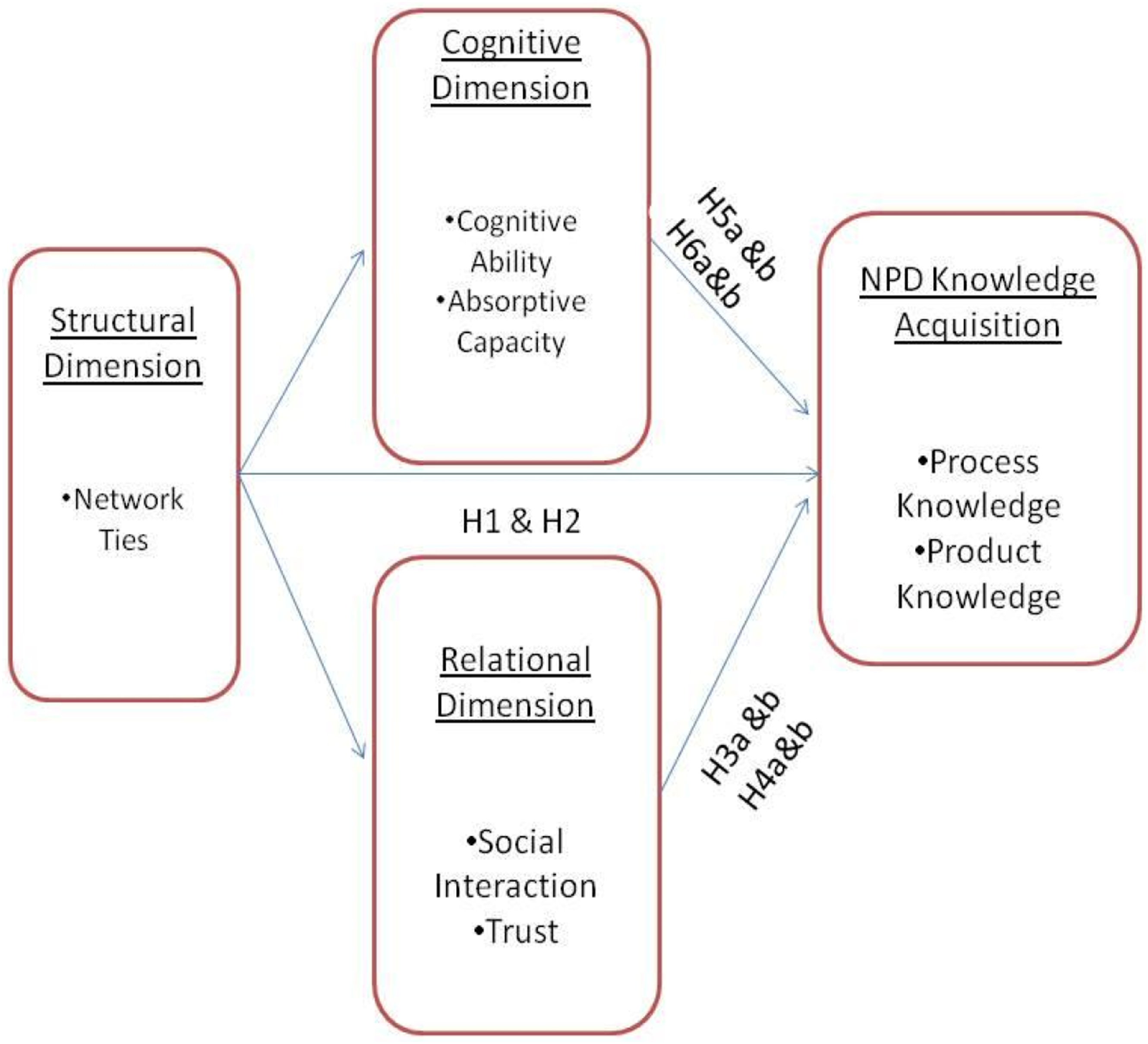
Methodology
Data collection
The collected data from a postal survey was based on a list of technology-intensive UK-based firms with an in-house R&D department separate from an NPD team. The unit of analysis for the study is the NPD team. We drew our sample from the Dun & Bradstreet company database, one of the most comprehensive company information in the United Kingdom (DnB.co.uk). Prior to conducting the survey, we contacted firms listed in the database in six areas of the technology-intensive industry sector (defined using the 1992 UK SIC Sector). The focus on technology-intensive industries was deemed appropriate because the rapidly changing markets and technological developments make knowledge acquisition important to these firms (Rindfleisch and Moorman, 2001).
The included industries were in manufacturing: chemical, rubber and plastic, medical equipment, environmental technology, transport equipment, and construction. To participate, firms were required to satisfy the following criteria: (a) to be involved in developing, commercialising, or manufacturing products in these areas; (b) to operate independently (even in the case that they were a subsidiary of a multinational, they were required to have full authority for developing their own products); (c) to have at least 15 years’ industry experience in their sector and the United Kingdom; and (d) to have launched a new product developed in the market in the last 9 months. To assess the right participants before sending the survey, we contacted all the companies that met the criteria and obtained the contact details of the head of NPD. We also enquired if their NPD team was separate from their R&D department. During data collection, we received the targeted sample’s updated postal and email addresses and the names of the heads of NPD teams.
Following Malhotra and Birks (2007), we reviewed and modified the survey before launch based on discussions with executives in two firms from different industries. The final survey included measures calibrated on a seven-point Likert scale. We sent the survey with a cover letter explaining the purpose of it. We targeted firms with formal NPD departments and formal processes for launching new products. The participating companies were well-established manufacturing firms based in the United Kingdom, and respondents were NPD managers who coordinated NPD activities and managed NPD ventures. Given that some of the large organisations in the sample had more than one NPD team, we asked the managers of each NPD team based in the United Kingdom to fill out the survey. This meant that each NPD team was considered a unit of analysis. Participants were guaranteed that their responses would be confidential and only aggregated data would be reported in the results.
After a series of follow-up calls and emails, we received 112 completed surveys. Twelve of these were excluded because of incomplete data. The final sample contained 100 completed surveys, with an accepted response rate of 18.5% (Chen, 1997; Sivadas and Dwyer, 2000). The sample included firms from the following industries: pharmaceutical and biotech, aerospace and defence, software and computer, and electronic and electrical equipment. Non-response bias was assessed through an extrapolation method that compares early with late respondents by t test (Armstrong and Terry, 1977). No significant differences in either mean scores or variance were found for any key constructs between early and later respondents. We applied Harman’s single-factor test to check for common method bias (Podsakoff et al., 2003). The test confirmed none of the factors were especially dominant.
The questionnaire required participants to respond to questions based on a new product venture (Rindfleisch and Moorman, 2001). Respondents were asked to identify the most important internal knowledge source (key knowledge provider) they had engaged throughout the NPD project. 78% of the respondents indicated the source of new knowledge as other internal teams involved in producing similar products, less than 10% identified internal departments producing different products as the key knowledge providers, and 12% indicated other teams (including sales and marketing) as their key knowledge providers.
Measures
Dependent variables
The dependent variable in our study is knowledge acquisition (product and process). Measurement was adopted by Rindfleisch and Moorman (2001).
Independent variable
The independent variable is the structural dimension measured as network ties. Measurement was adopted from Yli-Renko et al. (2001).
Mediating variables
Based on our conceptualisation, we have hypothesised the separate mediating roles of relational and cognitive dimensions. We adopted measurements for these constructs from prior research. Two sub-dimensions for the relational dimension are (a) social interaction (Rindfleisch and Moorman, 2001) and (b) trust (Nahapiet and Ghoshal, 1998). For the cognitive dimension, the two sub-dimensions are (a) cognitive ability adopted from (Tsai and Ghoshal, 1998) and (b) absorptive capacity, as adopted from Szulanski, (1996).
Control variables
Based on recommendations from prior research, our model controlled for firm age (number of years in operation), firm size (number of employees), number of other strategic partners, knowledge redundancy, and similarity of activity between dyad contacts (the degree to which the NPD team’s key knowledge provider was engaged in similar or different activity). This was in line with similar studies on social capital and knowledge acquisition (Maurer et al., 2011; Rindfleisch and Moorman, 2001).
Summary statistics and Pearson’s correlation coefficient.
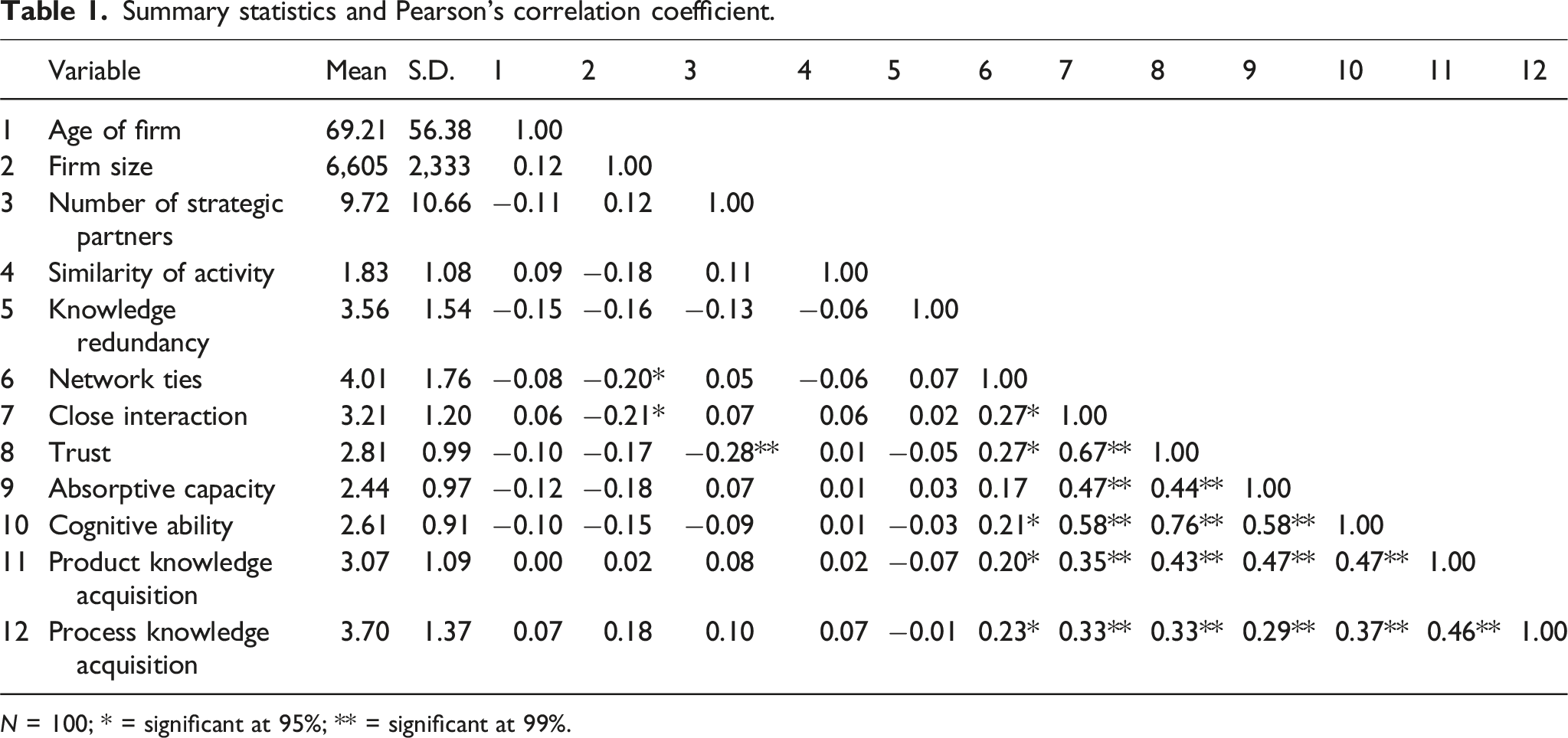
N = 100; * = significant at 95%; ** = significant at 99%.
Results
Regression analysis- Product knowledge acquisition.
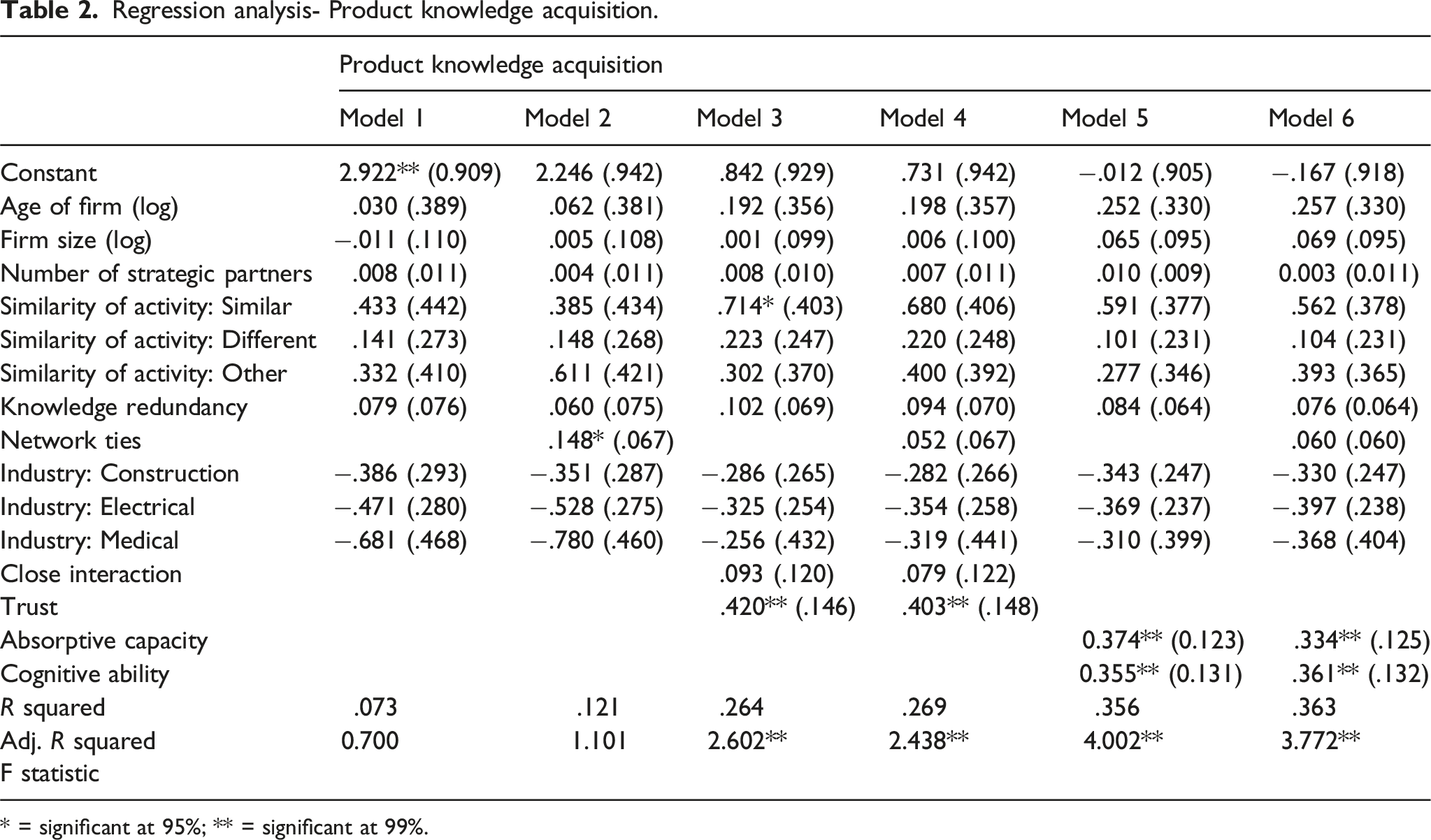
* = significant at 95%; ** = significant at 99%.
Regression analysis- Process knowledge acquisition.
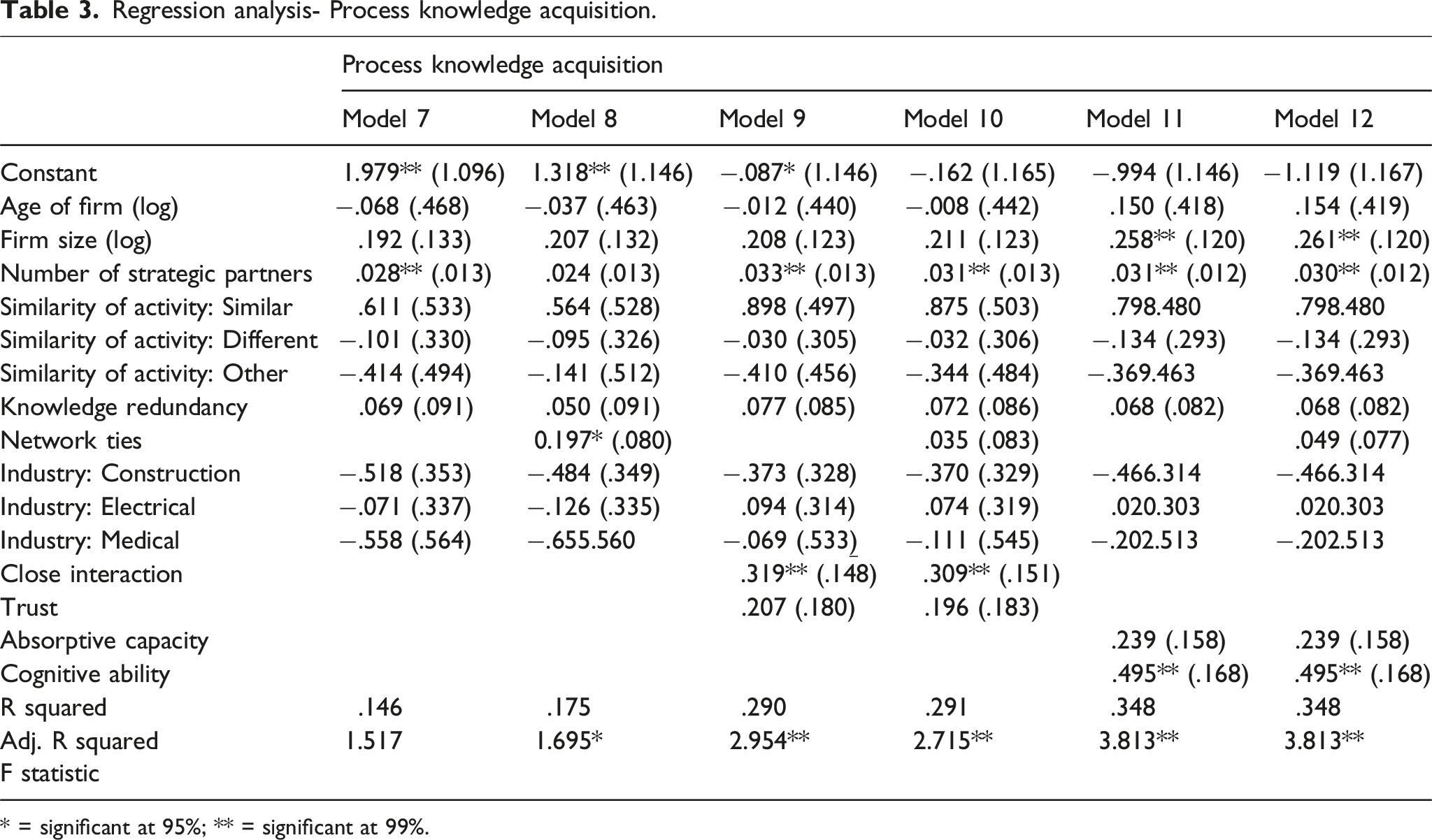
* = significant at 95%; ** = significant at 99%.
Mediation analysis.
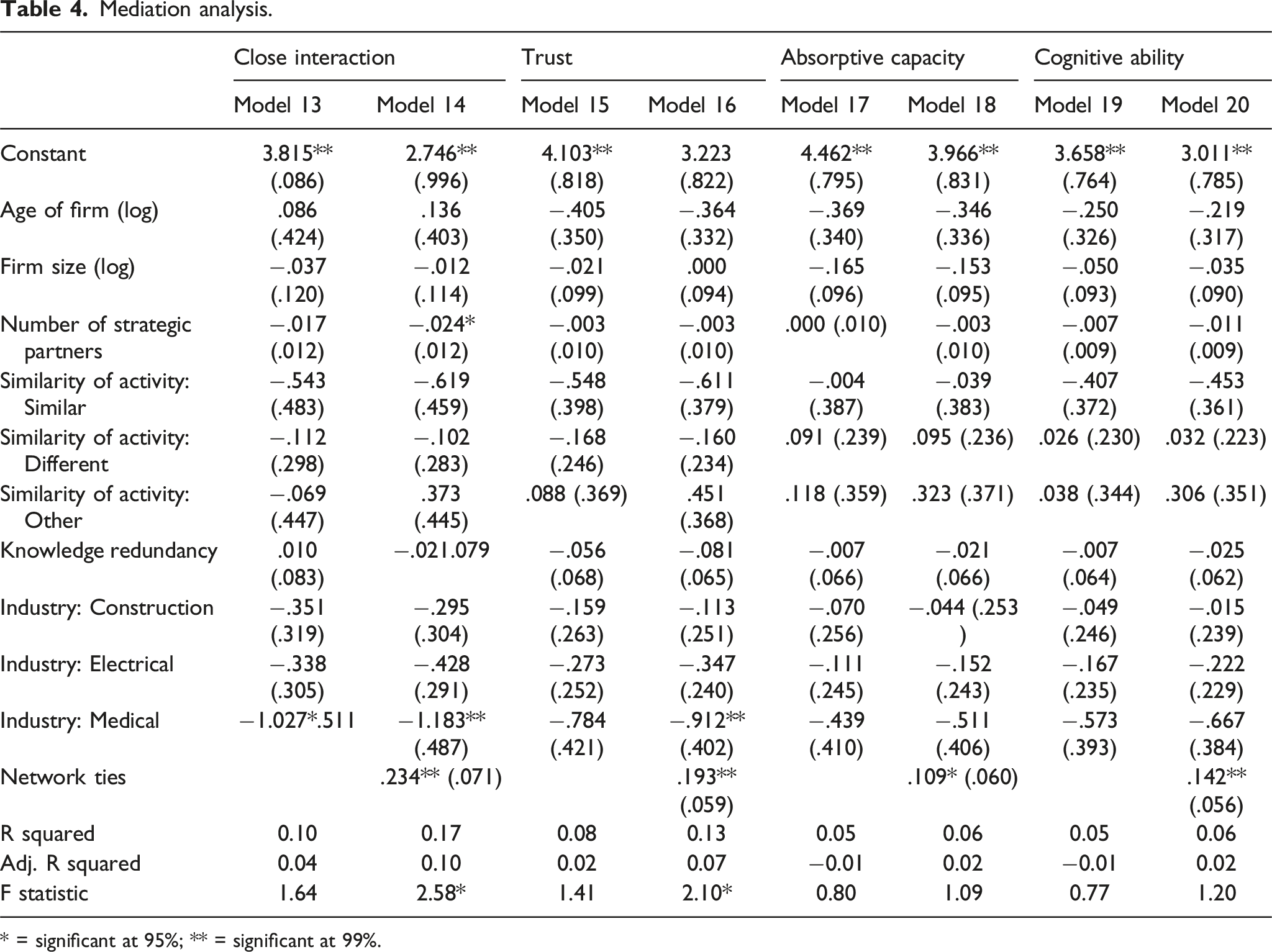
* = significant at 95%; ** = significant at 99%.
Model 2 confirms that NPD teams acquire product knowledge through the connections of key knowledge providers (Hypothesis 1 is supported).
Model 8 confirms that NPD teams acquire process knowledge through the connections of key knowledge providers (Hypothesis 2 is supported).
Discussion
This study examined the effects of three dimensions of social capital on NPD product and process knowledge acquisition. Results indicate that, although the structural dimension of network embeddedness is important, knowledge acquisition will be affected by the mediating role of NPD teams’ relational and cognitive capacity. The findings also suggest that the mediating roles of the relational and cognitive dimensions differ between product and process knowledge acquisition.
Our model tested whether NPD teams’ relational dimensions (social interaction and trust) were mediators. The results show that close social interactions matter in acquiring process knowledge, whereas trust seems to be the mediating factor in acquiring product knowledge. Frequent social interactions over time might be necessary for acquiring more complex types of knowledge, which we refer to as NPD-related process knowledge (Arnett and Wittmann, 2014). In the context of product knowledge, trust may lead to straightforward knowledge exchanges. This supports previous similar findings (e.g. Levin and Cross, 2004), which emphasise the role of trust when acquiring information-based knowledge.
As for the cognitive dimension, both absorptive capacity and cognitive ability were shown to have positive mediating roles when acquiring product knowledge. However, only cognitive ability appeared to have a mediation role in dealing with process knowledge acquisition. A surprising finding in our study was that absorptive capacity does not positively mediate process knowledge acquisition. Thus, this result challenges the existing literature on the positive role of absorptive capacity. Rindfleisch and Moorman (2001) argue that exposure to similar knowledge through key connections might enhance knowledge acquisition. Yet, absorptive capacity might not play a significant role due to its high similarity to a team’s knowledge base (Zahra and George, 2002). Our research extends this discussion by suggesting that the effect might differ depending on the type of knowledge involved (product vs process).
Theoretical contribution
Our findings contribute to social capital theory and knowledge management literature in three important ways. First, we argue for the need to distinguish the core role of the structural dimension in knowledge acquisition and draw out the important mediating role of relational and cognitive dimensions in NPD knowledge acquisition. We thereby address a gap in previous research, which, while acknowledging the multidimensionality of social capital, has tended to examine the role of different dimensions of relationship outcomes as equivalent (García-Villaverde et al., 2018). Thus, our study better explains how social capital dimensions contribute to knowledge acquisition in an intra-organisational context and seeks to enquire inter-relational aspect of social capital components through intra-organisational lens (Castro and Roldán, 2013).
Second, we argue that, in an NPD context, knowledge complexity and type of knowledge will affect the process of knowledge acquisition. Thus, we distinguish between product and process knowledge. Effective knowledge acquisition has been previously linked to both relational (Hansen, 1999; Nahapiet and Ghoshal, 1998; Levin and Cross, 2004; Tsai and Ghoshal, 1998) and cognition (Nahapiet and Ghoshal, 1998; Szulanski, 1996; Tsai, 2001; Tsai and Ghoshal, 1998) constructs. Yet the majority of research has viewed these dimensions independently. Our results show that relational and cognitive dimensions have different mediating roles depending on the type of knowledge (product or process) the NPD team acquires. These findings are also important because they provide empirical support for propositions in recent research that social capital dimensions may affect knowledge acquisition outcomes differently (García-Villaverde et al., 2018; Levin and Cross, 2004; Van Wijk et al., 2008). Finally, by distinguishing between types of knowledge, we contribute to the operationalisation of knowledge-based constructs. We further the development of NPD team learning by distinguishing between types of knowledge. In other words, while there may be value in examining knowledge acquisition by NPD teams, distinguishing types of knowledge generates interesting results (Rindfleisch and Moorman, 2001).
Managerial implications
This study suggests that NPD teams can enhance performance by leveraging internal connections to access valuable learning opportunities. By actively managing these key relationships, teams can improve knowledge acquisition. However, teams must avoid over-reliance on similar knowledge providers, which may impede explorative learning (Tsai, 2001). Intra-firm social capital is vital for enhancing knowledge acquisition and improving new product performance, as it fosters trust, knowledge sharing, collaboration, and innovation among NPD teams (Nahapiet and Ghoshal, 1998). By harnessing these internal relationships, firms can streamline their product development processes, accelerate time-to-market, and enhance overall product success.
Conversely, weak intra-firm social capital can lead to product failures from siloed operations, poor communication, and misaligned strategies. Notable examples of unsuccessful products, such as Microsoft Zune, BlackBerry, and HP TouchPad, demonstrate how insufficient collaboration among NPD teams can result in integration challenges and missed market opportunities. These instances highlight the critical need for fostering robust intra-firm partnerships to ensure successful product development and performance. This also suggests that while higher-level managers can facilitate knowledge acquisition, top-down approaches often lack the flexibility to navigate the complexities of NPD processes. NPD knowledge creation occurs through interactions between tacit and explicit knowledge, and this is more effectively facilitated in a bottom-up, network-based system where employees interact across teams. Tacit knowledge is better shared through informal ties and direct collaboration, which can be missed in a command-driven structure.
Conclusions and future research
Our paper provides empirical support for a model of knowledge acquisition with several key findings. First, we demonstrate that network ties of key knowledge providers enable NPD teams to acquire product and process knowledge. Second, by distinguishing between product and process knowledge, we can identify the different mediation roles played by relational and cognitive dimensions in acquiring new knowledge. Our results indicate that trust in a key knowledge provider is more important than the degree of closeness when acquiring product knowledge. However, social closeness plays a positive mediating role in acquiring process knowledge, while trust has no significant effect on process knowledge acquisition. Furthermore, our results indicate that when acquiring product knowledge, both absorptive capacity and cognitive ability play a positive mediating role, although this is not the case for process knowledge as absorptive capacity has not shown a significant mediating result.
Our research can be expanded in several directions. Our current study was conducted using data collected from UK-based firms. It is possible that UK companies have different cultural norms regarding new knowledge acquisition compared to other firms within a different cultural setting (Tyre and Von Hippel, 1997). Moreover, our sample was drawn from R&D-intensive firms; while this helped us to control for sectoral heterogeneity, the results might differ in service industries. Future studies conducted in other industries and/or countries may shed light on the generalisability of our results. Another limitation is the use of self-reported measures. Although these measures could be beneficial for concept-specific accuracy, they are still prone to bias. A third limitation relates to the single perspective of the NPD teams and their internal key contacts. Future research that focuses on knowledge acquisition might provide more insights by examining the entire network of NPD teams’ internal connections. Moreover, in line with Van Wijk et al. (2008), we acknowledge the importance of comparing knowledge acquisition from internal and external sources. The focus of this study was limited to knowledge acquisition. More research is required not only to focus on this but also on NPD teams’ performance in the form of product and process innovation and speed to market (Rindfleisch and Moorman, 2001). Finally, the process of NPD teams’ learning also needs closer qualitative and longitudinal examination.
Supplemental Material
Supplemental Material - Social capital and knowledge acquisition among new product development teams
Supplemental Material for Social capital and knowledge acquisition among new product development teams by Shahpar Abdollahi, Kholoud Mohsen, and Vania Sena in Journal of General Management.
Footnotes
Declaration of conflicting interests
The author(s) declared no potential conflicts of interest with respect to the research, authorship, and/or publication of this article.
Funding
The author(s) received no financial support for the research, authorship, and/or publication of this article.

Supplemental Material
Supplemental material for this article is available online.
References
Supplementary Material
Please find the following supplemental material available below.
For Open Access articles published under a Creative Commons License, all supplemental material carries the same license as the article it is associated with.
For non-Open Access articles published, all supplemental material carries a non-exclusive license, and permission requests for re-use of supplemental material or any part of supplemental material shall be sent directly to the copyright owner as specified in the copyright notice associated with the article.
