




Abstract
The implementation of smart technologies in the built environment presents unprecedented opportunities and challenges for the real estate sector. Among the challenges is building occupants’ behavioural control due to smart buildings’ technological apparatus underpinned by pervasive computing. Since the early days of cybernetics, control stemming from information technology has generated many arguments about freedom, privacy and surveillance. Arguments only focused on technology or ethics tend to foster a Manichean view which obscures our ability to rationally assess calm and transparent technology’s role in controlling space users’ behaviours in smart buildings. The paper applies two classic economic frameworks to decipher the economic nature of behavioural control in smart real estate. In the process, it sheds some light on the complex utilitarian relationship between behavioural control and smart space’s user centricity. It concludes by assessing whether regulators should step in, for instance, through de jure property rights allocation among all parties.
Keywords
Introduction
Digital technologies’ increasing embeddedness with the built environment is changing the essence of space in real estate, giving rise to smart space, a new type of hybrid space between physical space and digital space (Lecomte, 2019a). While the emergence of this new paradigm-shifting space brings unprecedented opportunities to radically rethink the role of real estate in human lives, challenges stemming from the massive implementation of non-conscious cognitive devices in buildings, a process akin to a ‘tectonic shift’ (Hayles, 2014), cannot be ignored lest they become roadblocks to innovation in the built environment. Among these challenges are the issue of behavioural control in space and, more generally, the agency relationships that digital technologies powering smart buildings enable among stakeholders, that is, building occupants and parties who can control smart space. To deal with this issue, Lecomte (2021a) proposes a property rights regime whereby parties controlling space users’ experiences in smart space are digital usage rights (DUR) holders.
Control has long been associated with the ‘Control Revolution’ (Beniger, 1986) fuelled by computing technology and microprocessing’s exponential capabilities to process information and manage reciprocal communication. Control is a crucial concept for economists for whom the most important end should be ‘the maximization of freedom’ (Lerner, 1960). In smart buildings, control takes a new relevance insofar as smart technologies implemented in the built environment with their sophisticated feedback mechanisms not only meet the conditions necessary for a real estate-based control economy to materialize, but also question the very notion of human freedom and free will in space (Lecomte, 2021b, 2022). Whoever control smart space either owing to de jure digital rights or de facto appropriation have the ability to monitor, control and shape building occupants’ digital surrounding worlds, or Umwelt 1 as defined in Lecomte (2019a, 2020, 2021a). Experiential customization underpinned by data collection, information processing and real-time feedbacks allows for enhanced user centricity (Lecomte, 2021a). But, in doing so, it opens the door to behavioural control in buildings dominated by the culture of computation (Lecomte, 2019b, 2021a, 2021b). As pointed out by Penny (2014), spaces powered by pervasive computing are never neutral since computation is not ‘value-free cognitive bedrock’. The relation between utility generated in smart space and building occupants’ freedom lays the foundations for a complex trade-off facing space users: user centric utility versus behavioural control in smart real estate.
In this context, it makes no doubt that space users’ ability to make informed choices with respect to the technological mediation of their experiences in smart buildings is crucial. But what governance system could empower them to do so? Examples of surveillance capitalism in digital space are hardly encouraging. Following Zuboff (2021) who identifies the ‘tragedy of the uncommons’ in digital space and calls for an outright ban of online data extraction, is it desirable to wipe out all control in smart space even though it might mean for space users to forgo the benefits attached to user centricity? Should public authorities step in to regulate, and possibly ban, space users’ behavioural control in smart real estate? Can a market arrangement or a decentralized governance system provide a workable alternative to regulation?
The paper addresses these questions by searching for an optimal balance between having no limitations on technologies’ implementation and imposing an all-out ban of user-data powered technologies in smart real estate. It acknowledges the quintessentially utilitarian dimension of the issue: space users benefit from technologies whose implementation materializes into behavioural control. Two perspectives are analysed hereafter: control as an externality stemming from the implementation of smart technologies in buildings (market arrangement) and control as a resource benefitting parties controlling smart space and users alike (decentralized governance). In the process, the paper describes components of digital rights and related actions along with their interplaying roles in enacting control in smart space.
The paper contains four sections. The first section explores the genealogy and application in smart space of the concept of behavioural control driven by information technology. The second section studies whether control in smart space considered as an externality can be addressed by a market arrangement through Coasean bargaining. The third section analyses control as a resource and explores whether a decentralized governance model after Ostrom’s common pool resources is workable in smart real estate. The fourth section concludes.
What is control in smart real estate?
Control as a research topic is still foreign to real estate studies. However, as digital technologies increasingly pervade physical space, control is instrumental in deciphering what is at stake in smart real estate. This section presents a brief review of seminal concepts and notions selected from the rich body of literature studying the close relationship between information technology and behavioural control in democratic societies. The aim is to shed some light on the genealogy and scope of the concept of behavioural control in smart space.
Control in the information age: Cybernetics and the control economy
In its search for homeostasis, cybernetics has a long history of association with control. Cybernetics’ etymology is derived from kybernetes, the ancient Greek word for steersman. Wiener (1948) assesses that cybernetics will open the door to an ‘age of communication and control’. Because of its fight against entropy, cybernetics might be used to control man by so-called ‘priests of power’ in search of power and money who “regard with impatience the limitations of mankind, that is man’s undependability and unpredictability” (Wiener, 1964). The ‘Principle of Minimum Infringement of Freedom’ and the ability “to realize one’s potential of engaging in a variety of chosen actions” are central in Weiner’s information ethics (Bynum, 2004). Similarly, for Heidegger (1966), cybernetics corresponds to “the determination of man as an acting social being” since the “apparent freedom of human plans and actions” is a source of irritation for cyberneticians (Heidegger, 1967).
Cybernetics, and more generally information technology, are part of a fundamental trend toward a ‘control revolution’ whereby information processing and reciprocal communication underpin a control economy. Beniger (1986) asserts that “control encompasses the entire range from absolute control to the weakest and most probabilistic form, that is, purposive influence on behaviour, however slight”. Microprocessing, digitalization and programming are such that control affects “all aspects of human society and social behaviour” so that “to decide is to control, and in short to control is to decide”.
Concerns about the social effects of computers and information systems surfaced in the public debate in the USA in the late 1960s when ‘tecnetronic determinism’ by government and corporations owing to ‘control technology’ was deemed as a challenge for democracies (Westin, 1971). The threat to personal liberty because of ‘excessive control’ (Brzezenski, 1967) and the “subordination of human experience to the economic process of the consumer society” could lead to the ‘great refusal’ of a tecnetronic society (Mendel, 1969). The unforeseen implications of information-communication technologies, aka technology’s ‘uninvited guests’, could affect “the mental and physical health of the individual and the welfare of the community” (Strausz-Hupe, 1968). Notable among these implications, according to Westin (1966), is humans’ loss of personal autonomy inasmuch as information technology makes it possible “to follow the movements and the private conduct of human beings” over time, a process enabled by computer-based data management (information gathering, record keeping, data sharing and centralization). Personal autonomy defined by Westin (1966) as “the desire to avoid being manipulated or dominated by others” is “vital in the development of individuality and consciousness of individual choice in life”. The advent of digital computer challenges personal autonomy by enabling physical, data and psychological augmented surveillance.
Digitalization and control as modulation and pattern recognition
With the rapid rise of digitalization since the early 1980s, control powered by digital technology has become central to the workings of contemporary society that Deleuze’s (1992) seminal paper characterizes as a ‘society of control’. The built environment is an important part of this society of control. Under discipline which prevailed in society prior to the dominance of control, the different spaces where individuals evolved were spaces of enclosures independent from one another and akin to moulds. Conversely, control creates a space for the individual “as if he or she has the freedom to tangle and to create, while their production as well as their ends follow the logic of intangible forces” (Hui, 2014). Controls are modulation “like a self-deforming cast that will continuously change from one moment to the other” (Deleuze, 1992). Nothing can escape the grasp of digital technologies which turn individuals into ‘dividuals’, that is, data points captured in the various databases of the networked economy (Deleuze, 1990). As modulation focused on pattern recognition aims to predict specific forms of behaviour, the environment adjusts to space users in advance (Savat, 2012). Thus, "in a context where one is always already programmed for in advance, ‘control’ comes to be so subtle that it may well present itself in the form of ‘choice'". In fact, control is "a process one may not even experience as ‘control’ […notwithstanding the fact that] depending on the code that is generated, a given pattern is allowed or enabled to continue or not" (Savat, 2012). Rouvroy and Berns (2013) talk about ‘algorithmic governmentality’ to describe this type of "normative rationality […] founded on the automated collection, aggregation, and analysis of big data so as to model, anticipate, and pre-emptively affect possible behaviours". Smart environments and ambient intelligence are "solutions to an espitemic governmental problem: the radical indeterminacy and incommensurability of contexts and behaviours" (Rouvroy, 2012). Paradoxically, smart space’s user centricity does not reflect any actual concern for space users’ individuality inasmuch as "in the context of modulatory power the concept of identity ceases to have much use. […] Identity is simply not what machine aims to produce. […] It recognizes and produces events, not essences" (Savat, 2012). Through coding of affects and desires, algorithms enable a "constant but continuous adjustment and manipulation" of the subject (Beckman, 2018), producing a "zone where (constructed) reality and the world in all its spontaneity and uncertainty become indistinct" (Rouvroy, 2012).
Ubiquitous computing and power imbalance in smart space
The digitalization of space in smart real estate relies on ubiquitous computing, a calm and pervasive technology that "vanishes into the background" (Weiser, 1991). As a result of Ubicomp, the nature of buildings changes. Smart buildings become part of ‘surveillant assemblages’ making it "increasingly difficult for individuals to maintain their anonymity, or to escape the monitoring of social institutions" (Haggerty and Ericson, 2000). Besides, smart buildings are constitutive of ‘cognitive assemblages’ where non-conscious cognitive devices and humans interact in smart space (Lecomte, 2020). In the process, smart real estate becomes the place of skewed power relationships between space users and those who control technology in smart buildings. As "the techniques for modelling human behaviour [become] more accurate and detailed" (Pentland, 2008), power shifts towards the latter while control of the former increases. There are at least three vectors for this power imbalance to materialize into control: (a) the intrinsic nature of Ubicomp as an invisible technology, (b) the structural asymmetries of knowledge among stakeholders in smart buildings and (c) fundamental differences in the microtemporal regimes of humans and technologies embedded in smart space. a- Ubicomp’s invisibility questions its trustworthiness. For Moor (1985), the ‘invisibility factor’ of computers is potentially a source of ‘invisible abuse’, for instance, the ‘insidious use’ of information technology for surveillance. Ubicomp also comes with ‘invisible programming values’ and ‘invisible complex calculations’ which are beyond space users’ comprehension, thereby triggering technical alienation (Hui, 2016). b- As highlighted by Zuboff (2015), digital space is characterized by "structural asymmetries of knowledge and rights [that have] made it impossible for people to learn about [surveillance capitalism’s] practices". Algorithmic profiling of users based on probabilistic statistical knowledge creates an insurmountable asymmetry between the very limited knowledge available to individuals and the knowledge abundantly produced through profiling by those who control the technological apparatus (Rouvroy and Berns, 2013). Thanks to tracking tools, sedentary and nomadic forms of control, those who control digital technologies show "a will to know to such degree of accumulation that it becomes a will to power" (Tiqqun, 2001). Because of the massive implementation of pervasive technology into the built environment, this situation has spread from digital space (Internet) to smart space (smart buildings). c- With digital technologies powering ever faster interactions in space, human-smart real estate agency relations become irremediably biased by technology. Hayles (2014) underscores the ‘missing half second’ identified by neuroscientist Benjamin Libet (2005) between the temporal regime of human consciousness (defined as the temporal gap between brain activation and awareness) and that of cognitive non-conscious devices operating at microtemporal regimes which are ‘inaccessible to humans’. Consequently, "we cannot but experience a certain cognitive opacity, as our consciousnesses perpetually – and vainly – struggle to ‘catch up’ to what is happening" (Hansen, 2015), which "may be exploited for capitalist purposes", for instance, through ‘affective programming’s mnemonic control’
2
(Hayles, 2014).
Behavioural control as externality in the production of smart space
Model of behavioural control as externality
The first framework considered as a potential remedy to behavioural control in smart space is based on Coase (1960)’s analysis of externality encapsulated in the so-called Coase theorem (Farrell, 1987). Lecomte (2021a) introduces a property rights regime for smart space in smart real estate (known as digital rights), which lays out the foundations for Coasean bargaining in smart real estate. Parties who are in control of smart space in smart buildings are Digital Access Rights (DAR) holders for the technological infrastructure and Digital Usage Rights (DUR) holders for the right to employ smart space to create value in space. DUR holders have full ownership and responsibilities over the use of smart space powered by the building’s technological apparatus. Lecomte (2021a) explains: "DURs enable [their] owners to tap into space users’ digital surrounding worlds and, in many ways, to shape them. DURs carry with them the right to monetize space users’ Umwelt”. The production of user centric smart space aims to generate profit for DUR holders as well as utility for space users who are subjected to behavioural control. In a Coasean framework, behavioural control can be treated as an externality attached to the production of user centric smart space, a production enabled by DUR as one of its factors of production. Behavioural control is an ‘uninvited guest’ of this productive process in smart buildings. It is not an environmental externality like smoke or noise in Coase’s (1960) classic examples, but an existential externality which represents a cost for the parties that bear it. Figure 1 summarizes the role of DUR and behavioural control in the production of user centric smart space. Control as externality in the production of space in smart real estate.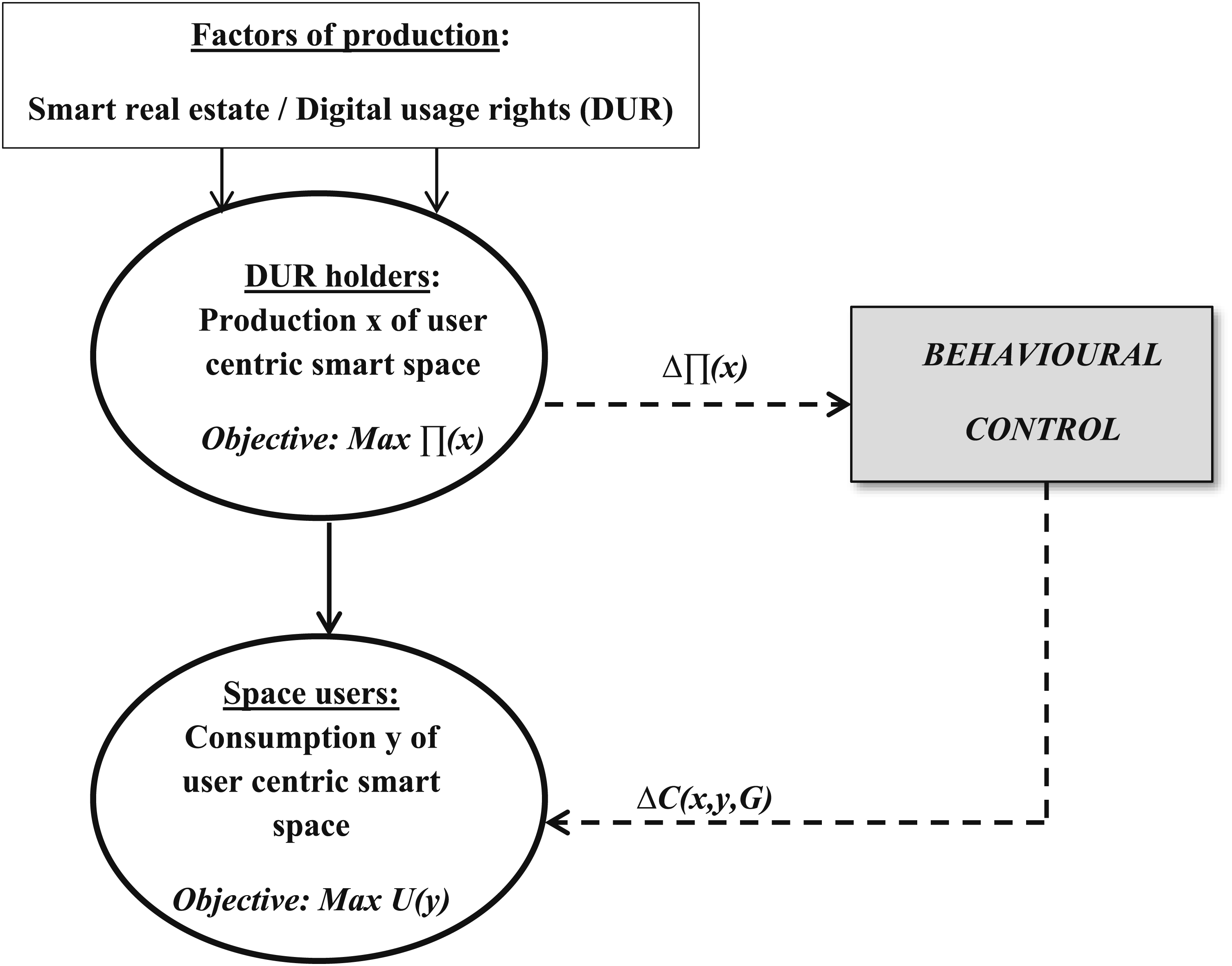
The application of this framework poses many practical questions: can a Coasean exchange allow space users to curtail control in smart real estate to levels deemed acceptable to them? What are the components and requirements of such exchanges? Can they represent a workable mitigation alternative to regulation aiming at an all-out ban, or at least mandatory restrictions, on DUR holders’ ability to control smart space?
In a simple externality model where utilities are measurable in monetary units, the situation translates as follows: - For DUR holders, their utility is given by Profit = ∏ (x) with x = quantity of user centric smart space produced. - For space users, their utility is given by V = U (y) with y = quantity of user centric smart space consumed.
3
Considering that this utility function takes shape over time, and delivers cumulatively growing user centricity as more data are collected each time there is an interaction in smart space (i.e. consumption of smart space), one can expect - The quantity of user centric smart space produced is always superior to or equal to the quantity of user centric smart space consumed: x ≥ y. Given smart buildings’ real-time feedback mechanisms and digital hyperthymesia, one can reasonably assume that the production of user centric smart space is a function of its expected consumption, or
Control arises if both user centric smart space production and user centric smart space consumption are simultaneously taking place in the building. Furthermore, control in smart space is not only a spatial phenomenon, but also a temporal one. As stated in Lecomte (2021a), "smart space is different from physical space, because it continuously grows over time, each time a space user steps into a smart building". Due to the perfect memory of digital technologies, control relies not only on current consumption of smart space (yt), but also on space users’ past consumptions of smart space during which data and relevant analytics were collected and stored to be refined, added-on and re-used.
4
The latter variable can be approximated as the cumulative past consumption of smart space G such as
If a Coasean exchange is possible, then the cost of the externality is borne by both parties at efficient levels of production and consumption xE and yE, respectively. At these levels, first order conditions are P x (x E ) – C x (x E , y E , G) = 0 for DUR holders and U y (y E ) − C y (x E , y E , G) = 0 for space users.
Components of a Coasean bargaining approach in smart space
One fundamental pre-requisite condition of a Coasean bargain set out in Coase’s (1960) seminal paper is a well-defined legal delimitation of the various parties’ rights, that is, rights should not be unlimited. A property right is fundamentally "the right to carry out a circumscribed list of actions". There are four types of action that DUR holders can carry out: - Data collection (C), - Data storage (S), - Spatial linkages (L) between smart spaces on which they own DURs with other spaces, be they digital or smart, - Use (U) of collected, stored or linked data and analytics to power user centric interactions so as to shape space users’ experiences in smart space, aka Umwelt.
Which one(s) of these actions should be part of a Coasean bargain? To address this question, Figure 2 proposes up to four levels of granularity: level 1 (aggregate DUR), level 2 (actions: C, S, L, U), levels 3 and 4 (actions’ components). Breaking down digital usage rights in terms of actions (panels A, B, C).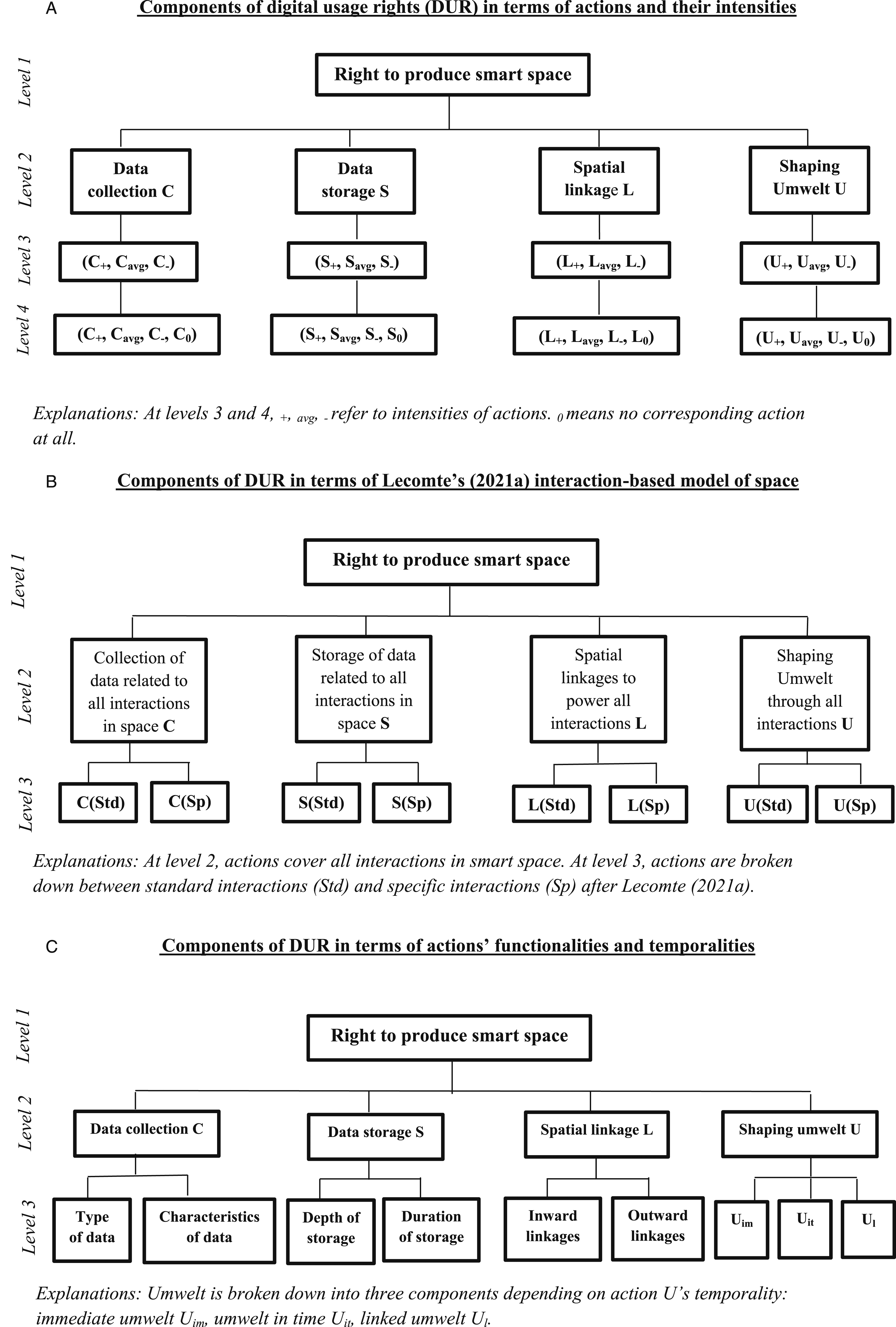
Panels A, B and C explore three approaches to circumscribe DUR holders’ actions in smart space. Panel A presents a normative approach whereby for each action, there are up to four possible options for space users to choose from: - At level 1: yes/no to DUR holders’ shaping their experiences in smart space; - At level 2: yes/no for each action; - At level 3: three intensity levels for each action: high (+), average (avg) or low (−); - At level 4: same choices as those at level 3 plus the option of forbidding each action (0), for example, for data collection: C+, Cavg, C−, C0.
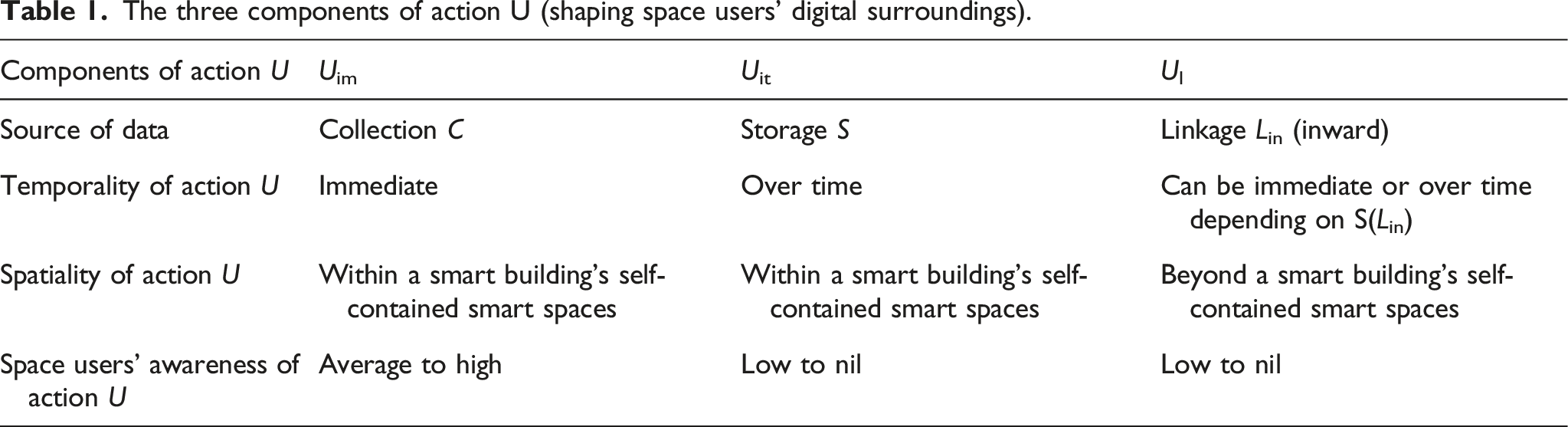
Noticeably, choices grow exponentially with combinations of four actions. At levels 3 and 4, there are respectively 81 and 256 possible combinations of actions, for example, (C+,S+, L+, U+). Thus, as soon as the analysis accounts for the possibility of fine-tuning each action as part of combinations of four actions (at level 2 and upwards), choices confronting space users become very complex. Panel B presents another approach whereby granularity is defined using the prism of Lecomte’s (2021a) interaction-based model of smart real estate. Actions are characterized in terms of standard (Std) and specific (Sp) interactions, which yields 256 possible combinations at level 3. Although this grid of analysis relates factually to experiences in smart space without the subjectivity of assessing an intensity level for each action, it unrealistically supposes that space users are conversant with the taxonomy of interactions (Lecomte, 2019a). Panel C proposes a third approach whereby DUR holders’ actions are characterized by their functional and temporal components: - Data collection depends on the type (e.g. behavioural, cognitive) and characteristics of data (e.g. anonymized). - Storage is defined by its depth (range of data stored) and duration. - Linkages can be inward (from outside digital/smart spaces to the building’s smart space: Lin) or outward (from the building’s smart space to outside digital/smart spaces: Lout). Gauging the diseconomy of L is extremely complex, if not impossible insofar as linkages’ impacts on user centricity and behavioural control are out of space users’ reach, and also beyond DUR holders’ unless they can carry out action U in other linked spaces. - Umwelt is broken down into three components: immediate Umwelt (Uim), Umwelt-in-time (Uit) and Umwelt from linkages (Ul). As summarized in Table 1, Uim is based on data immediately collected in the building’s smart space irrespective of storage; Uit is generated from data stored over time; Ul is powered owing to inward linkages whose effects on U can be immediate or over time (if L is combined with C and S). The sum of Uim and Uit represents Umwelt within self-contained smart space, whereas Ul is linked to other spaces which might be smart or digital (e.g. Google search history). The three components of Umwelt emphasize the temporal (immediate or over time) and spatial (self-contained or extramural) dimensions of action U. The three components of action U (shaping space users’ digital surroundings).
In sum, due to subjectivity and black box technicality, there are no easy ways to circumscribe actions undertaken by parties who control smart space in smart buildings.
Obstacles to the feasibility of a Coasean bargaining approach in smart space
Thus, is a Coasean approach workable in smart real estate? Indeed, there are specific challenges arising from the production of user centric smart space beyond transaction costs mentioned in Coase (1960).
* Interrelationships and mutual dependences of actions in smart space:
Actions attached to DUR are not stand-alone but part of combinations of actions dominated by interrelationships and mutual dependences. Any bargain must be assessed at the combination level, rather than the action level, making bargaining extremely challenging for non-informed parties.
First, data collection and storage are interrelated. For DUR holders, the more valuable C, the more valuable S becomes. Besides, S adds a temporal dimension to C: data can be collected and used to exercise U immediately (U im ) irrespective of S, or if S ≠ 0, U over time (Uit) as well as Lout. Thus, the value of C, V(C), is equal to V(C/Uim) + V(C/Uit) + V(C/Lout). If S = 0, then V(C) = V(C/Uim) since S is required to generate V(C/Uit) and V(C/Lout). Therefore, if the terms of the bargain focus on S, DUR holders have a strong incentive to generate Π(x) from Uim, possibly through ever more sophisticated behavioural control, and to favour inward linkages Lin. Furthermore, data collection and linkages are interrelated so that limiting data collection can have harmful effects due to linkages. If C→0, then S→0 and U depends entirely on Lin, that is, limiting data collection drives rational DUR holders toward inward linkages (Lin) in their search for Π(x) maximization. Thus, any bargain targeting C should also involve L, lest sources of externality shift from Uim and Uit (self-contained smart space) to Ul.
Finally, spatial linkages project action U over space and time, making it basically impossible to assess ex-ante where and when U triggers externalities. As a result, the delimitation of the legal right to carry out U is murky at best while Uit and Ul eschew space users’ immediate awareness (see Table 1). Thus, if we consider that space users’ ability to make informed choices is the guiding principle of any bargain, there should be a pecking order in actions to curtail. That is, unless all parties (including owners of linked digital spaces) opt for full disclosure of their utilities over space and time, a fair bargain should focus (i) firstly on L such that if Lin, Lout→0, lim U = Uim + Uit (situation of self-contained smart space), (ii) secondly, on S such that if S→0, lim U = Uim and (iii) finally, on C, for example, by interaction type. 5
Given the challenges identified above, should control be addressed by focussing on Uim only since this is the simplest action for space users to understand? The danger here is to overlook Uit and Ul, by fostering a nontemporal perspective on smart space akin to individuals’ myopic view about privacy which, according to Hoofnagle and Urban (2014), gives them "little reason to bargain in the marketplace". But, as DURs are at the heart of a spatial appropriation process which keeps on expanding at each interaction, any attempts that do not include combinations capturing the cumulative effects of all four actions in space and time will fail to achieve a fair bargain.
*Other structural obstacles
• Incomplete information:
As previously mentioned, smart space is plagued by a knowledge gap between producers and users. Given the opacity of models trained for implementing behavioural control, space users are ignorant of the underlying productive process at work, whereas DUR holders are proficient in not only their own utility function but also space users’. Past research shows that in cases of incomplete information affecting producers’ utility function, there is no efficient outcome to a Coasean bargain (e.g. Schweizer, 1988). Besides, space users’ deficit in understanding Π(x) is combined with major difficulties in gauging control C (x, y, G), an existential externality which is experienced, albeit oftentimes unconsciously, and not easily measurable. Thus, users cannot be expected to be conversant with the cost of control in smart space even though they might have (or wrongly perceive they have) a good understanding of their own utility function. The underestimation of C (x, y, G) results in values of (x, y) much larger than the optimal (x
E
, y
E
). In effect, in the absence of complete information about Π(x), U(y) and C (x, y, G), DUR holders’ utility maximization strategy as encapsulated in Lecomte’s (2021a) axioms of smart space rationally leads to situations where space users’ ability to perceive existential externalities (dependent on current consumption but also all past consumptions) is overshadowed by their focus on immediate user centric utility (with y > y
E
), a process potentially fuelling a headlong technological rush from utility-craving, and fundamentally unaware, users.
6
• Absence of a competitive market for control:
Based on Arrow’s (1969) universality of markets, externality could be treated as a commodity exchanged in a marketplace open to the ‘victims of control’ in smart real estate. DUR holders ‘supply’ control, whereas space users ‘demand’ it at a negative price since control is an external diseconomy. Schweizer (1988) shows that under these assumptions, an efficient Coasean bargain is possible, but hardly plausible. In the absence of a market for control, could a market for data collected in smart real estate provide an alternative? Markedly, the role of data in the production of user centric smart space is not straightforward. Data have a temporal impact on both utility and externality (with actions S and L as part of DUR and the presence of past consumptions G in the users’ externality function), which is out of even the most pragmatic users’ comprehension. Assumptions about space users’ self-knowledge in line with Alan Westin’s model of ‘privacy pragmatists’ 7 are unrealistic and mostly irrelevant in view of the complexity of smart space production. Therefore, short of establishing a competitive market for all collected data (past, present and possibly expected future) in all spaces (smart and digital including fully digital spaces like metaverses) open to both producers and users whose utility functions are made public, a market agreement through Coasean bargaining is not a workable option to deal with behavioural control in smart real estate.
Behavioural control as commons
The second framework presented hereafter is based on Ostrom’s Common Pool Resource (CPR): can a decentralized governance model address the issue of behavioural control in smart real estate?
Control as a common pool resource
A Coasean framework considers control as exterior to the customization of Umwelt. However, it is an integral part of it. Any attempt to shape space users’ surroundings through coded interactions implies some levels of control in line with Penny’s (2014) and Lessig’s (2006) views on code. Control derives from data which themselves stem from users’ interactions in smart space. Hence, coded interactions lead to control: shaping users’ Umwelt is to exercise control.
In a CPR framework, control, or rather man’s controlled behaviour, is a human-made resource that can be harvested for both producers and users of smart space. It is a resource for DUR holders because it enables them to increase their profits in smart real estate and, for space users insofar as it enables them to enjoy the enhanced utility of user centric interactions. This resource is co-produced between users whose interactions in smart space feed the building’s technological apparatus and smart space producers whose control over users’ Umwelt enables the latter to foster their utility (present and future).
As shown on Figure 3, control is the CPR, unlike data and Umwelt. Data are organized digital imprints of events triggered by human-building interactions. Likewise, Umwelt is a private good specific to each individual, whereas control is fundamentally a shared resource. Control exercised on one space user impacts other space users inasmuch as stored data and insights serve to carry out and/or fine-tune control not only on this particular user whose data are collected but also on other users (present and future) according to the technological apparatus’ hyper-segmentation. Control resides at three levels: (i) the self-contained physical building, (ii) linked smart spaces, (iii) linked digital spaces. Control in any of these three levels can have a permanent impact on control in the other two, for example, control exercised on a user in a smart office today might impact future exercises of control in the same building, other linked spaces of any usage (e.g. a shopping mall), and the user’s digital space (online events). Therefore, control is temporally and spatially cumulative. Ceteris paribus, control will organically grow over time and space to the point of full completeness (i.e. total appropriation of space users’ Umwelts in Lecomte, 2021a). Control in smart real estate as a co-produced common pool resource. Explanations: (*) In the absence of DUR unbundling, space users have no legal rights. Producers of smart space who unilaterally hold DURs decide on the level of control applied to space users. (**) Lecomte’s (2021a) 12th axiom of smart space states that smart space’s objective is first and foremost the maximization of profits for producers of smart space (production of smart space =x) subject to space users’ utility maximization (consumption of smart space= y).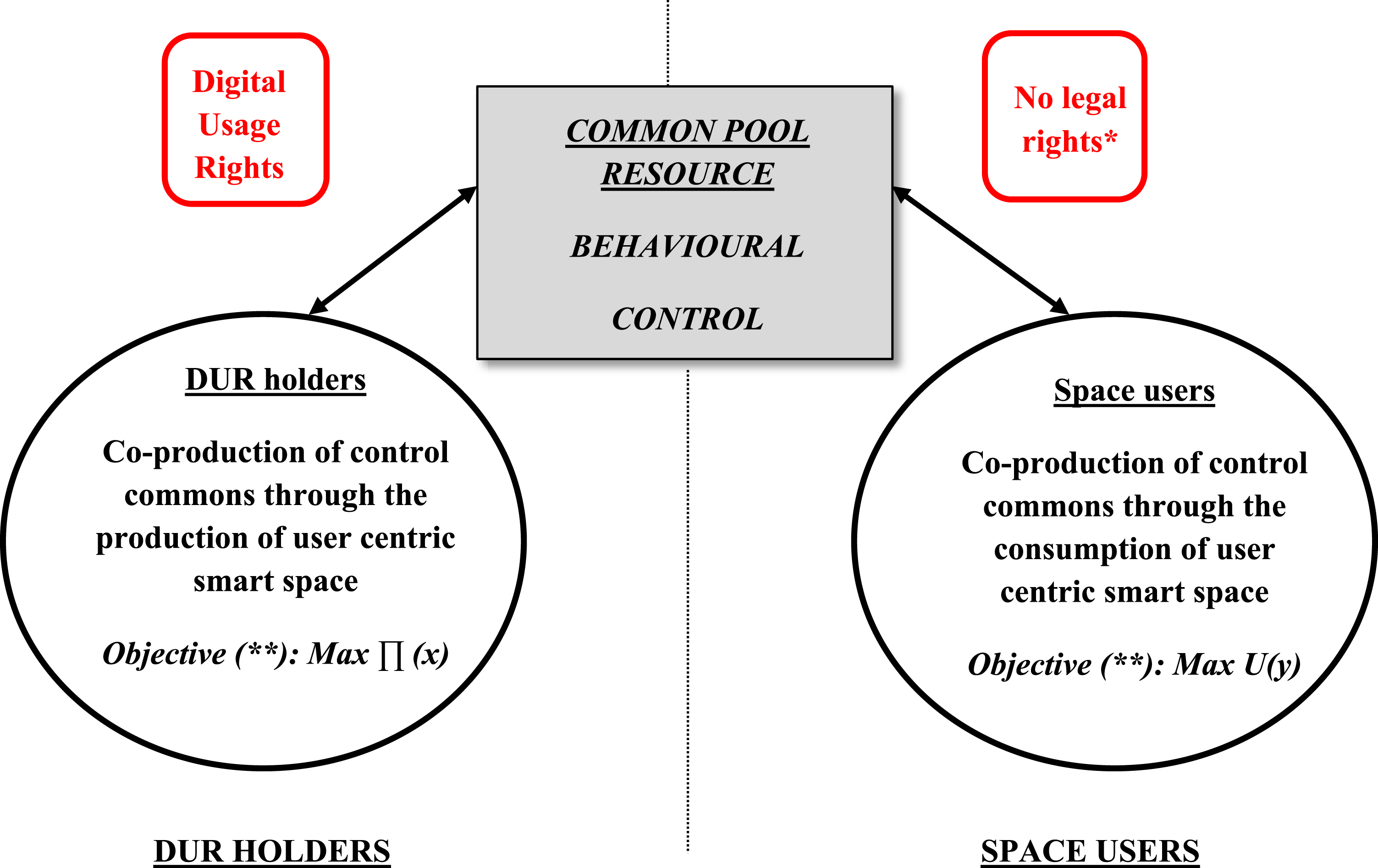
To be a CPR, a resource has to meet two criteria: exclusion and high subtractability (Ostrom and Ostrom, 1977). Control underpinned by technology allows for exclusion. 8 But, control, in its most abstract form, does not meet the high subtractability criterion. Indeed, the more space users consume smart space (i.e. the more control is enacted), the more plentiful (and possibly the more gross utility yielding) control becomes for all parties, producers and users alike. So, can control truly be a CPR? Hess and Ostrom (2006) analysis of knowledge commons addresses this point, by considering knowledge as a sort of commons which beyond exclusion and subtractability, "are jointly used [common resources], managed by groups of varying sizes and interests". Thus, akin to digital knowledge, control can be analysed as a CPR.
Unbundling the control commons
The CPR framework cannot be implemented without private property rights in smart space
9
: digital usage rights (DUR) introduced in Lecomte (2021a) can serve this purpose. Ostrom and Hess’ (2006) analysis of the digital knowledge commons based on Schlager and Ostrom’s (1992) classification of rights in common pool resources provides a useful model for unbundling the control commons as shown in Table 2. Bundles of rights encompass operational level property rights and collective choice property rights. ➢ • Right to access: This is space users’ only right among all the rights in the framework. • Right to contribution/right to extraction: DUR holders own these rights in full and impose their exercises on space users for whom they are obligations deriving from exercising the right to access. • Right to removal: DUR holders own this right in full. In practice, insights built from each individual user over space and time are embedded in algorithms’ ability to learn, train and tune models so as to enhance utility for all, making it challenging to calibrate this right’s true scope. Could this right be proxied by a right to privacy? In fact, privacy is not effective in implementing removal in smart space. As explained by Rouvroy (2012), algorithmic governmentality does not value identity, but focuses on profiling. Besides, if a right to privacy boils down to anonymity (aka pseudonymisation in the EU’s GDPR), it falls short on what an actual right to removal granted to space users should entail, that is, the right to remove all collected data, stored and linked data, specific insights derived from one’s interactions in smart space, for example, through ‘machine unlearning’ of trained models (Gupta et al., 2021). ➢ Bundles of rights of the control commons based on Schlager and Ostrom (1992), Ostrom and Hess (2006).
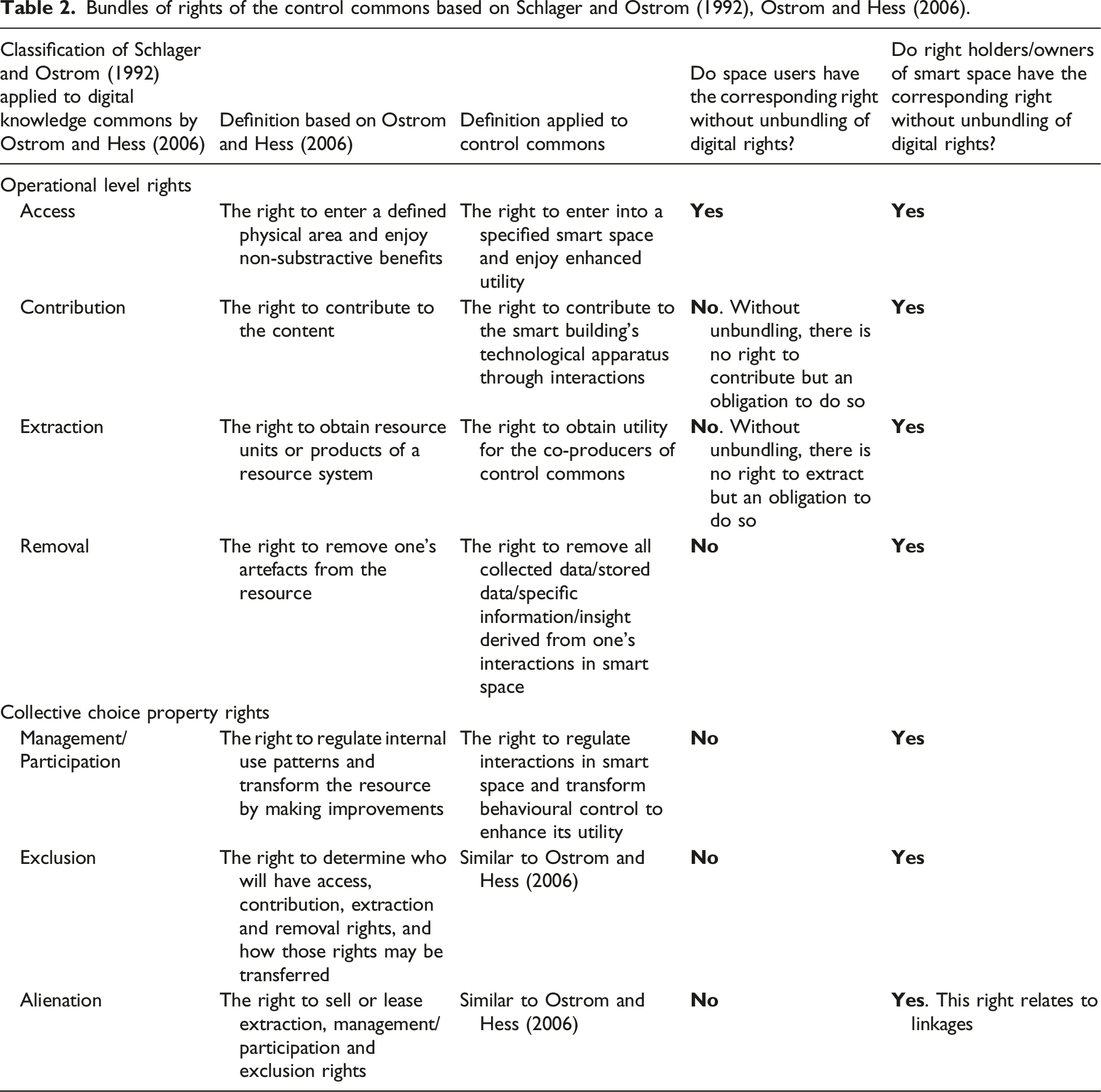
In sum, without proper unbundling, a control commons comes with a strikingly unbalanced allocation of rights. Whilst DUR holders enjoy the full set of operational level and collective choice rights, space users have no rights, except the right to access. In addition, contribution is imposed on them for a resource they are co-producing. Co-production of the control commons takes place within an exploitative master-slave relationship where the slave does not have any option not to produce. To address such lack of equity and in line with Schlager and Ostrom (1992), space users should at minima have the right of ‘access and withdrawal’, which encompasses all operational level rights (access, contribution, extraction and removal).
Design principles for control as common pool resource
To be robust, a CPR should meet well-researched design principles (Hess and Ostrom, 2006; Ostrom, 1990, 1994): - Clearly defined boundaries with regard to both appropriators who have the right to withdraw resource units, and the CPR itself; - Rules in use are well matched to local needs and conditions; - Collective choice arrangements whereby most individuals affected by the operational rules can participate in modifying them; - Self-monitoring by accountable monitors (e.g. appropriators themselves) who actively audit CPR conditions and appropriate behaviour; - Conflict-resolution mechanisms in low-cost local arenas for appropriators who violate operational rules.
How realistic are these conditions in smart real estate? First, due to public access to commercial buildings (as opposed to residential buildings), appropriators encompass all space users at any point in time, resulting in an unlimited number of potential appropriators in a single building. Besides, as control unfolds over space and time, CPR’s boundaries are mutable and difficult to comprehend ex-ante (for space users at least). Although rules can be adapted by property usage (e.g. different rules for office buildings and shopping malls), space users have no say on collective choice arrangements. By the same token, self-monitoring is problematic if only because of most users’ technical alienation. Hence, a control commons is unlikely to achieve institutional robustness. From the initial situation where space users only have the right to access to the institutional arrangement allowing for a functioning CPR in smart real estate, the path is overwhelmingly challenging. Two pre-requisite conditions have to be met: (i) DUR holders grant space users all operational level rights and the ability to modify operational rules; (ii) self-monitoring and low-cost conflict-resolution mechanisms are in place alongside a system of graduated sanctions (presumably targeting DUR holders). Of the two parallel systems in a CPR framework (Ostrom, 2012), that is, a resource system that sets the condition for an action situation and a governance system that sets the rules, the latter is irremediably iniquitous in a control commons. Therefore, a decentralized governance model is not a realistic proposition to deal with the issue of behavioural control in smart real estate. 10 Once again, we are faced with the failure of a classic economic framework to regulate control in smart buildings.
Conclusion
Space users’ freedom and right to action in smart real estate are challenged by the algorithmic governmentality imposed on their interactions in smart space. This paper tests two classic economic frameworks with the aim to strike a balance between a ban on pervasive technology in buildings and the absence of any regulations betting on "self-restraint of those who manage such systems" (Westin, 1967).
The first framework derived from Coase’s theorem considers control as externality in the production of user centric smart space and tests for a market arrangement of control. The second framework modelled after Ostrom’s common pool resources defines control as a co-produced resource between space users and those with property rights to produce user centric smart space (Digital Usage Rights after Lecomte, 2021a). It tests for a decentralized governance model underpinned by property rights unbundling. The analysis concludes that both frameworks fail to give space users the means for informed consent. The abyssal knowledge gap between parties coupled with data-behaviourism’s ‘maximization of jouissance’ (Rouvroy, 2012) are insurmountable hurdles for market arrangement and decentralized governance to rein in behavioural control ingrained in user centricity. We are therefore back to the core question asked in the introduction: should public authorities regulate, and possibly ban, behavioural control in smart real estate? The paper gives several insights on how regulators could step in. Firstly, from the Coasean framework, we infer that due to the existential nature of user centric utility, a cap on smart space production can curb users’ overconsumption while promoting socially acceptable qualitative and quantitative norms for control. Such caps might adopt a targeted approach by users, usages, contexts, spaces. Secondly, as identified in the CPR framework, a de jure property rights regime in smart space and subsequent unbundling of rights can prevent a new ‘tragedy of the commons’ materialized as boundless behavioural control in smart buildings. To make informed choices and tackle unrelenting spatial appropriation enabled by calm, ubiquitous and hypermnesic technologies, space users need to be awarded legally binding property rights, such as the rights to access and withdrawal.
It would be sophistry to claim that property rights in smart space and their subsequent unbundling limit users’ freedom. Property rights are dependent on the technology available for spatial appropriation (Godelier, 1978). Property rights in physical space rely on enclosure. In smart buildings, the technology at work to appropriate space is pervasive and calm. By searching for a total symbiosis with space users, Ubicomp’s ‘embodiment relation’ (after Ihde, 1990) aims for perpetual transparency (Lecomte, 2020), in sharp contrast to enclosure’s forceful and conspicuous mode of operation. Whereas the way to appropriate physical space is to restrict it, the way to appropriate smart space and maximize profits is to keep it as open as possible (e.g. by allowing for data storage and spatial linkages). The absence of property rights in smart space facilitates the unobstructed pervasiveness of technology, both spatially and temporally. It does not foster users’ freedom, but instead irremediably impinges it. The role that property rights play in smart real estate is therefore strikingly different from Marx’s characterization of property rights in physical space as a means towards expatriation of peoples’ land and lives (Bellamy Foster et al., 2021). There is no ‘tragedy of the uncommons’ in smart space, but in the absence of a clear definition of each party’s rights, a new ‘tragedy of the commons’ exemplified by the potentiality of space users being submitted to unchecked behavioural control. Setting up a regime of property rights specific to smart space and unbundling these rights among all parties can effectively restrict appropriators’ right to control while empowering structurally disadvantaged users to make their own informed choices.
With behavioural control, the real estate sector faces an issue beyond real estate studies’ classic scope. To be mapped, this terra incognita requires multidisciplinary research endeavours. Simondon (1958) posits that "each epoch must discover its humanism, by orienting itself toward the main danger of alienation [i.e. the danger of technics oppressing man and reducing him to slavery by denaturing him]". Enabling man to "overcome enslavement by consciously organizing finality [of technics]" is instrumental. The issue of behavioural control in smart real estate gives the real estate sector an opportunity to lay the foundations for a new relation of trust between smart buildings’ owners, tenants and occupants. If it succeeds, this relation will harmoniously combine every party’s legitimate quest for utility with fundamental human rights worthy of a free society.
Footnotes
Acknowledgements
This paper was presented at the European Real Estate Society’s 28th annual meeting (Bocconi, Milan-Italy) on 22–25 June 2022. The author is grateful to the conference participants for useful comments as well as anonymous reviewers.
Declaration of conflicting interests
The author(s) declared no potential conflicts of interest with respect to the research, authorship, and/or publication of this article.
Funding
The author(s) received no financial support for the research, authorship, and/or publication of this article.