




Abstract
The digital transition is an unstoppable process that affects consumers and companies. Consequently, new sales strategies oriented to the application of digital technologies are needed to increase the performance of sale teams. Based on a sample of 517 responses from salespeople of the retail real estate, the data were analysed using the Structural Equation Modelling and Generalized Logit Model. The results validate a conceptual model which shows that digital orientation has impact on the salespeople’s skills and on the implementation of the sales strategy. Furthermore, it is revealed that the salespeople’s skills influence the implementation of the sales strategy and that both constructs impact the sales performance. Finally, the study shows the positive role of the salesperson’s experience and the negative role of age on sales performance.
Introduction
The world is currently experiencing the transition to a digital era and companies are no exception to this inevitable process that will transform the activity of sales (Verhoef et al., 2019). Digital transformation consists of integrating digital technologies in all aspects of the company (Vial, 2019). For instance in the sales area, the resources of the sales ecosystem increasingly include technology and a knowledge repository (Ranjan and Friend, 2020).
Therefore, managers must adapt their business to the digital age, guiding their companies towards business competitiveness (Heim et al., 2019). To be successful in the digital age, companies need to implement new mentalities, digital skills and agile ways of working (Laar et al., 2020; Tronvoll et al., 2020). Particularly, the incorporation of digital skills in business activities becomes a necessity rather than an alternative (Donthu and Gustafsson, 2020). As mentioned by Reid et al. (2017: 981) ‘the changes that have occurred and the challenges sales managers are facing, sales force technology offers sales managers and their sales teams assistance in addressing several of these challenges/changes’. Sales is a customer-facing profession (Ranjan and Friend, 2020) and the sales team is the group of people whose main role is to interact with customers and prospects to build relationships and close sales (Kotler and Armstrong, 2017).
Salespeople are critical in building long-term customer relationships, but they crucially need communication competence to succeed in their work (Koponen et al., 2019; Brown et al., 2002). Further, in a world marked by greater connectivity and interactivity, digital interactions have emerged in the relationships between buyers and sellers (Steinhoff et al., 2019). For instance the web of influencers (Ouvrein et al., 2021) and live streaming (Wongkitrungrueng et al., 2020) are emerging as new ways of communication and business. From the consumer side, there is an increasingly access to multiple digital channels (e.g. social media) that allows an active communication with companies/brands and other consumers. From the company side, the marketing and sales departments have to be prepared to face the challenges of digital communication (Lemon and Verhoef, 2016), especially because the digital transformation is far from simple, certain or predictable (Krasonikolakis et al., 2020). Thus, not only salespeople need to consider their own commitment to digital, but also the stakeholders, such as customers or suppliers (Ardito et al., 2021).
In this evolving environment, companies need more guidance on their digital initiatives, particularly for the sales force (Bharadwaj and Shipley, 2020). For instance more empirical studies about the role of digital technologies in the development of the customer experience with the company are needed (Verhoef and Bijmolt, 2019; Quinton et al., 2018).
The present study aims to examine the effects of the salespeople`s digital orientation on the development of their own skills and on sales strategy implementation and the both of these constructs on salespeople`s performance. The importance of the study emerges as in a digital transition era, sales team need to use digital technologies to interact online with the customers and the sales team by remote work (Hartmann and Lussier, 2020). The research is applied in the retail real estate, where the digital transformation is being slow and more digital orientation is needed (Saull et al., 2020). The real estate market is strongly linked with the dynamics of the retail sector, where there is an urgent need to benefit from the offline and online channels (Nanda et al., 2021). According to some authors, real estate industry needs to improve the adoption of digital (Ullah et al., 2018) and have still a long way to go (Saull et al., 2020). In this context, this industry needs to know what changes and adjustments must be made to face the inevitable digitization (Lecomte, 2019; Piazolo and Dogan, 2020).
In the remainder of this article, after the introduction, section 2 reviews the literature, develops the hypotheses and presents the conceptual model. Section 3 explains the research methodology. Section 4 presents the results. Section 5 develops a discussion on the findings. Section 6 evaluates the theoretical and managerial implications. The paper ends with the conclusion.
Theoretical background, conceptual model and hypotheses formulation
The conceptual model depicted in Figure 1 specifies the links among the constructs of salespeople`s digital orientation, salespeople’s skills, sales strategy implementation and salespeople’s sales performance. The hypothesized linkages among these constructs and the control variables are discussed below. Conceptual model. Source: Own elaboration.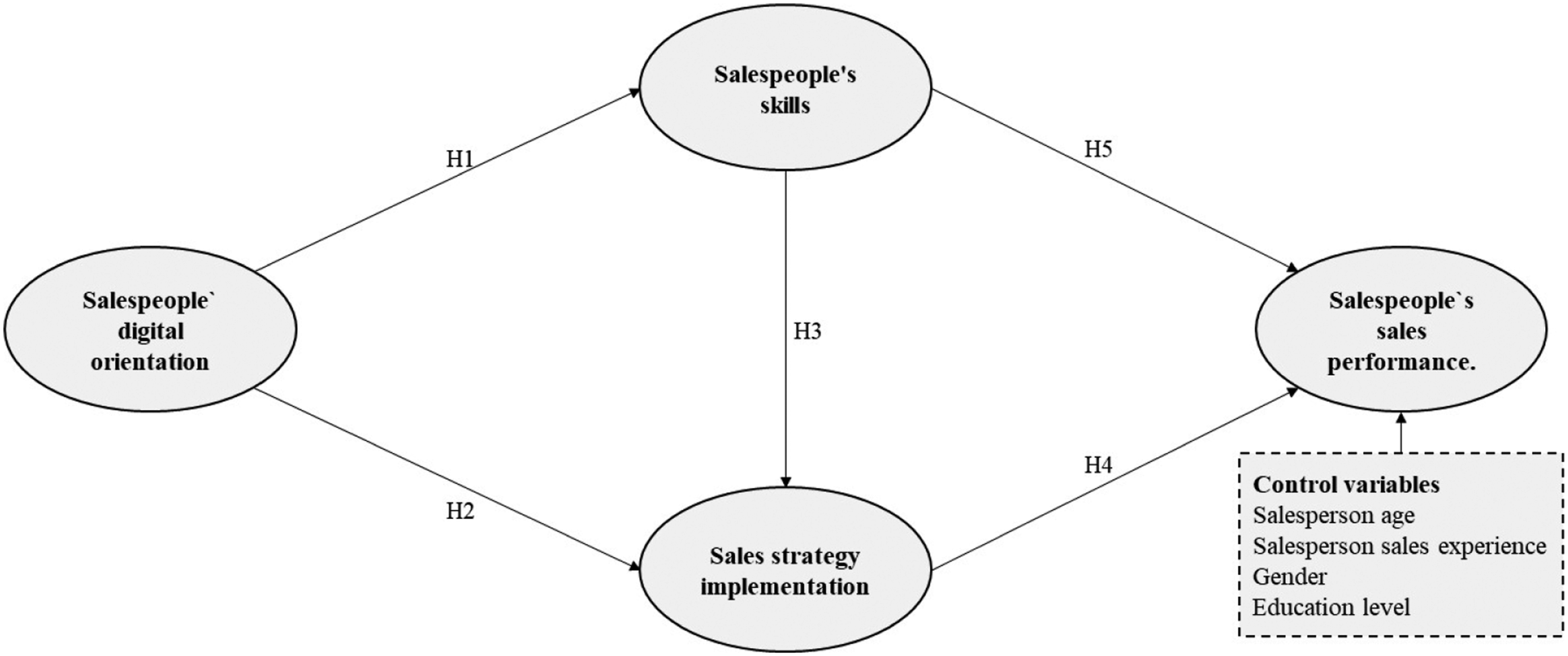
Salespeople`s digital orientation and sales skills
The markets are unpredictable, highly dynamic (Verhoef et al., 2019) and hypercompetitive (Chakravarty et al., 2013). In this context, the challenges presented by the market are multiple, such as (i) implementing organizational changes, (ii) responding to new customer needs and introduce new digital technologies and (iii) respond to intensified competition (Chakravarty et al., 2013; Verhoef et al., 2019). In order to be prepared to face these challenges, the companies must be digitally agile (Verhoef et al., 2019), which requires employees with digital skills (Laar et al., 2020; Tronvoll et al., 2020). The use of digital technologies in the sales processes and the orientation of salespeople to digital can help companies make new connections with stakeholders (Ardito et al., 2021), more specifically, to transform the customer experience (Westerman et al., 2012). Further, the development of digital technologies allow many customers to access a lot of information before interacting with the salespeople, which implies abilities to adapt to the customer’s needs (Ogilvie et al., 2018).
In this context, companies need to consider their own commitment to digital orientation (Ardito et al., 2021). Digital orientation is ‘a firm’s commitment toward application of digital technology to deliver innovative products, services, and solutions’ (Khin and Ho, 2019: 182). In practice, digital orientation is a deliberate strategic positioning (attitudes, behaviours, proactive innovation and openness to new ideas) that takes advantage of the opportunities presented by digital technologies (Quinton et al., 2018). For example digital interactions can help salespeople simulate online face-to-face interactions with customers, although they are not as rich in information as traditional face-to-face sales (Bharadwaj and Shipley, 2020). Still, digital communication is a powerful tool for transmitting information to customers (Samson et al., 2014). For instance social media has a major influence at all stages of the purchase process (before, during and after) (Alhakimi and Alwadhan, 2021).
The growing emphasis on the use of various digital technologies on sales affects the skills of salespeople as they are a facilitator and intensifier of sales activity (Singh et al., 2019). In this context, the orientation of salespeople’s to digital is an important attitude for enhancing their sales skills. This demands an adequate investment in the skills and training of salespeople (Hofacke and Corsaro, 2020; Hartmann and Lussier, 2020). Some of these skills are the ability to identify new customers and select prospect customers, the capacity to make sales presentations and to deal with customer objections (Rentz et al., 2002; Singh and Venugopal, 2015).Høgevold et al. (2021) add interpersonal ability, the capacity of adaptation, the knowledge of the selling activity and the competence to use technology. Therefore, sales skills are at the core of the salespeople activity as they help to support and communicate with customers and close sales. Currently, the capability to use digital tools is critical for salespeople in order to efficiently interact and engage with customers (Khin and Ho, 2019). Hence, H1. Salespeople’s digital orientation has positive effects on the salespeople’s skills.
Salepeople’s digital orientation and sales strategy implementation
Recent studies demonstrate a positive association between digital orientation and strategic dynamism of companies (Beutel and Brettel, 2019; Quinton et al., 2018). The adoption of a proactive digital orientation posture by the companies will allow the development of a more elaborate strategic position to provide value for the customers (Quinton et al., 2018). For example the salespeople can integrate customer relationship management (CRM) systems in managing customer networks (Ancillai et al., 2019). Further, the use of customer-related digital data can have a positive impact on customer responsiveness to digital marketing campaigns (Orlandi, 2016). Commitment toward application of digital technologies is important to deliver solution for costumers (Khin and Ho, 2019) and sales enablement strategy is strongly supported by technology (Rangarajan et al., 2020).
The use of digital tools allows salespeople to develop more effective and efficient sales strategies (Ogilvie et al., 2018; Rigby and Ledingham, 2004). For instance the use of CRM systems allow to track and organize data related to customers (contacts, sales opportunities, accounts, partners and competitors) and enhance the customer experience (Hofacke and Corsaro, 2020). Another example is the live streaming (using social media) which has recently become a popular direct sales channel. This digital channel is accessible to any seller and offers opportunities for interaction and engagement with the consumer (Wongkitrungrueng et al., 2020).
The sales strategy is a concept that encompasses the management of the sales force and the management of the entire sales function (Panagopoulos and Avlonitis, 2010; Zoltners et al., 2009). The implementation of the sales strategy refers to its execution and extension (Nowlin et al., 2018). In practice, a sales strategy is focused on maximizing the productivity of resources within the sales functions (Venkatraman, 1989), which includes prospecting customers, opening an account, qualifying the potential customer, presenting the sales message, closing the sale and servicing the account (Nowlin et al., 2018). Thus, a sales strategy is a detailed plan to position and communicate the value proposition to a prospect or a customer. In particular, salespeople can play an important role in the sales strategy implementation, especially in the approach to sales, choice of segments and customer prioritization (Inyang and Jaramillo, 2020).
On the basis of the above, the study hereby set out the following hypothesis: H2. Salespeople’s digital orientation has a positive effect on the sales strategy implementation.
Salepeople’s skills and sales strategy implementation
In the digital era, companies need to empower employees with digital skills (Donthu and Gustafsson, 2020; Laar et al., 2020; Tronvoll et al., 2020). In the specific context of sales, salespeople needs to acquire sales skills and update those skills through training in order to be competitive in their sales activities (Echchakoui and Ghilal, 2019; Shiue et al., 2021). For example the adoption of technological tools by salespeople helps them to improve their commercial activity, through tracking, simplification and streamlining of tasks, support in sales presentation, among others (Høgevold et al., 2021). In fact, salespeople frequently spend time and effort planning their activities and sales strategies before they start selling (Chen et al., 2015). So, new digital technologies can facilitate the planning process helping to programme the visits, allocate time to critical customers and control orders and deliveries. The training in dealing with digital technologies is critical to help the salespersons in the adaptation process to technological change and its impact on the company’s sales strategy (Sarin et al., 2010).
In the real estate industry the implementation of a sales strategy at the salesperson level is important as they tend to act most of the times with greater autonomy keeping an almost personal relationship with its customers (Cheng et al., 2021; Deng et al., 2022). Real estate sales are a dynamic and adaptive process, which requires constant updating of salespeople’s strategies and expectations (Cheng et al., 2021). Active listening, the ability to find solutions creatively (Hofacke and Corsaro, 2020), active and intensive prospecting, price update (Deng et al., 2022), adaptive selling (Cheng et al., 2021) and digital ability (Høgevold et al., 2021) are all examples of skills that can make a difference in the implementation of sales strategy. Furthermore, salesperson capacity to investigate the market and technical knowledge about sales are the base for implementing a competitive sales strategy (Inyang and Jaramillo, 2020). Thus, salesperson skills are generally connoted as indicators of sales performance (Høgevold et al., 2021). Therefore, it is hypothesized: H3. Salespeople’s skills have a positive effect on the sales strategy implementation.
Sales strategy implementation and salespeople`s performance
The essence of the strategy is to choose a unique and valuable position (Porter, 1996). The sales strategy is related to market performance and affects the sales performance of the salesperson (Terho et al., 2015). The salesperson’s performance is assessed by achieving sales goals and by performing sales tasks (Behrman and Perreault, 1982; Gao et al., 2020). Consequently, the sales strategy is consistently and positively associated with performance (Panagopoulos and Avlonitis, 2010; Chi et al., 2018). For instance the implementation of a price negotiation strategy (Alavi et al., 2018) or other sales strategies as customer-oriented sales, adaptive sales and relational strategy, could be effective in the sales success (Alavi et al., 2018; Moghareh and Haghighi, 2009). In fact, the increase in salesperson performance can happen through the implementation of the sales strategy (Nowlin et al., 2018). As pointed out by Porter (1996), strategy implementation is a key predictor for salespeople’s superior performance. When the salesperson helps to implement an effective sales strategy, the sales volume, profitability and customer retention tend to increase (Inyang and Jaramillo, 2020). Hence it is proposed, H4. Sales strategy implementation has a positive effect on the salespeople’s performance.
Salespeople’s skills and salespeople’s performance
Several factors affect sales performance, some of them are under control of the company (e.g. skill level) whilst others not (e.g. luck) (Johlke, 2006). However, sales skills explain a significant part of salespeople’s performance (Pettijohn et al., 2007; Singh and Venugopal, 2015).
The way the salesperson prospect customers, qualifies potential customers or the techniques he uses to make sales presentations and refute customer objections are important sales skills (Rentz et al., 2002), that help to perform their tasks and achieve salesperson’s goals (Behrman and Perreault, 1982; Gao et al., 2020). Salespeople’s skills also include appropriate closing techniques, flexibility to deal with different types of customers or situations, among other success factors (Johlke, 2006). Further, the dynamic and interpersonal nature of sales also requires affective and cognitive skills (Agnihotri et al., 2016), which positively affect sales performance.
The empirical study of Powers et al. (2014: 213) found three types of sales skills. The interpersonal skills encompasses ‘builds trust with the sales force, designs and builds effective teams, provides effective verbal feedback, role model for the sales force, creates a supportive team environment, manages team dynamics, understands salesperson evaluation metrics and sensitivity to cultural issues’. The technical skills include ‘understands the importance of new technology, implements sales force automation, implements CRM and understands global selling programmes’. The strategic skills comprise ‘understands general trends in the industry, understands the overall strategy of the organization and makes decisions consistent with company strategy’.
According to Singh and Venugopal (2015) the salespeople’s skills are a strong predictor of sales performance. Consequently, it is suggested that, H5. Salespeople’s skills have a positive effect on the salespeople`s performance.
Control variables
This study also incorporates control variables to offer some insight about the impact of the salespeople’s profile on sales performance. The following control variables are often introduced in sales surveys: education level (Gao et al., 2020; Nowlin et al., 2018); gender (Liu et al., 2020; Varela-Neira et al., 2018); salespeople age (Varela-Neira et al., 2018); and, years of experience (Sarin et al., 2010; Vasconcelos, 2018; Li, 2020; Liu et al., 2020).
The inclusion of control variables is extremely important in the statistical analysis of the data as it adds a broader perspective and specific knowledge to the study. Moreover, it can serve as inspiration for new studies (Nielsen and Raswant, 2018).
Methodology
To test the hypotheses and validate the conceptual model a field study was conducted based on a survey to collect the data.
Questionnaire
The questionnaire contained two parts. The first part relates to the characteristics of the respondents, such as gender, age, years of experience and education level. The second part grouped the issues related to the empirical study. To measure each construct, scales were created from previous studies. Salespeople`s Digital Orientation is based on Khin and Ho (2019), Salespeople Skills on Rentz et al. (2002), Sales Strategy Implementation on Nowlin et al. (2018) and Salespeople`s Sales Performance on Behrman and Perreault (1982). To measure the responses to constructs a Likert-type scale was used comprising five categories, ranging from ‘1 = strongly disagree’ to ‘5 = strongly agree’. The items can be found in Table A1 – appendix.
Prior to data collection, a draft questionnaire was prepared to pre-test among 30 salespeople from three real estate companies. This pre-test provided an exploratory analysis to assist in the operationalization of constructs and to assess the quality of the questionnaire. Based on the results of this pilot study, some small changes were made, namely the introduction of instructions to respondents, the possibility of anonymous responses to ensure greater participation and indication of the estimated response time to avoid missing responses.
Sample and data collection
The sampling frame encompasses a list of 4856 real estate salespersons. This list was acquired from the National Real Estate Directory in Portugal.
The questionnaires were sent electronically to the email of each salesperson on the list during the month of January 2021. All registered salespeople in the database had an equal opportunity to answer, so responses were randomly received. In the end, 517 complete and valid responses were collected, corresponding to a response rate of 10.65%.
The first 287 respondents (first 15 days) were compared with the last 230 respondents (last 15 days). The results showed no significant statistical differences between these two groups, suggesting no problem of response bias (Armstrong and Overton, 1977).
Of the salespeople studied, 53.8% are male and 46.2% female. 8.5% are among 18–30 years old, 21.9% between 31 and 40 years old, 35.2% among 41–50 years old, 26.9% between 51 and 60 years old and 7.5% over 60 years old. Regarding years of experience, 38.5% have among 1–5 years of sales experience, 17.4% between 6 and 10 years, 23.4% between 11 and 20 years, 13.5% among 20–30 years and 7.2% more than 30 years of experience. Finally, 47% of the surveyed salespersons have secondary education or less, and 53% have a university degree.
Data analysis
The present research uses two statistical methods. The first method is the Structural Equation Modelling (SEM) that was applied to analyse/test the hypothetical model presented in Figure 1. The SPSS (Statistical Package for the Social Sciences) and AMOS were used. AMOS software is adequate to examine the hypothetical relationship between multiples variables, especially when the sample is large (Byrne, 2016), as in this case (517 observations).
The second method (Generalized Logit Model – GLM) was applied to estimate the impact of control variables (Education level, Gender, Age, Years of experience) on the construct ‘Salespeople`s Sales Performance’. This method is appropriate to study the influence of control variables on an attitudinal variable (dependent variable) (Lu, 1999; Grilli and Rampichini, 2014; Williams, 2016). Logit Models are methods more robust than, for instance traditional linear regression model (Grilli and Rampichini, 2014). To perform this method, STATA software was used, since it is indicated for GLM (Liu and Koirala, 2012; Williams, 2016).
Results
Exploratory factor analysis was initially employed to purify the multi-item scales. Then, the set of items and their respective constructs were subjected to confirmatory factor analysis. Subsequently, SEM estimations and hypotheses testing were performed.
Measurements
Exploratory factor analysis.
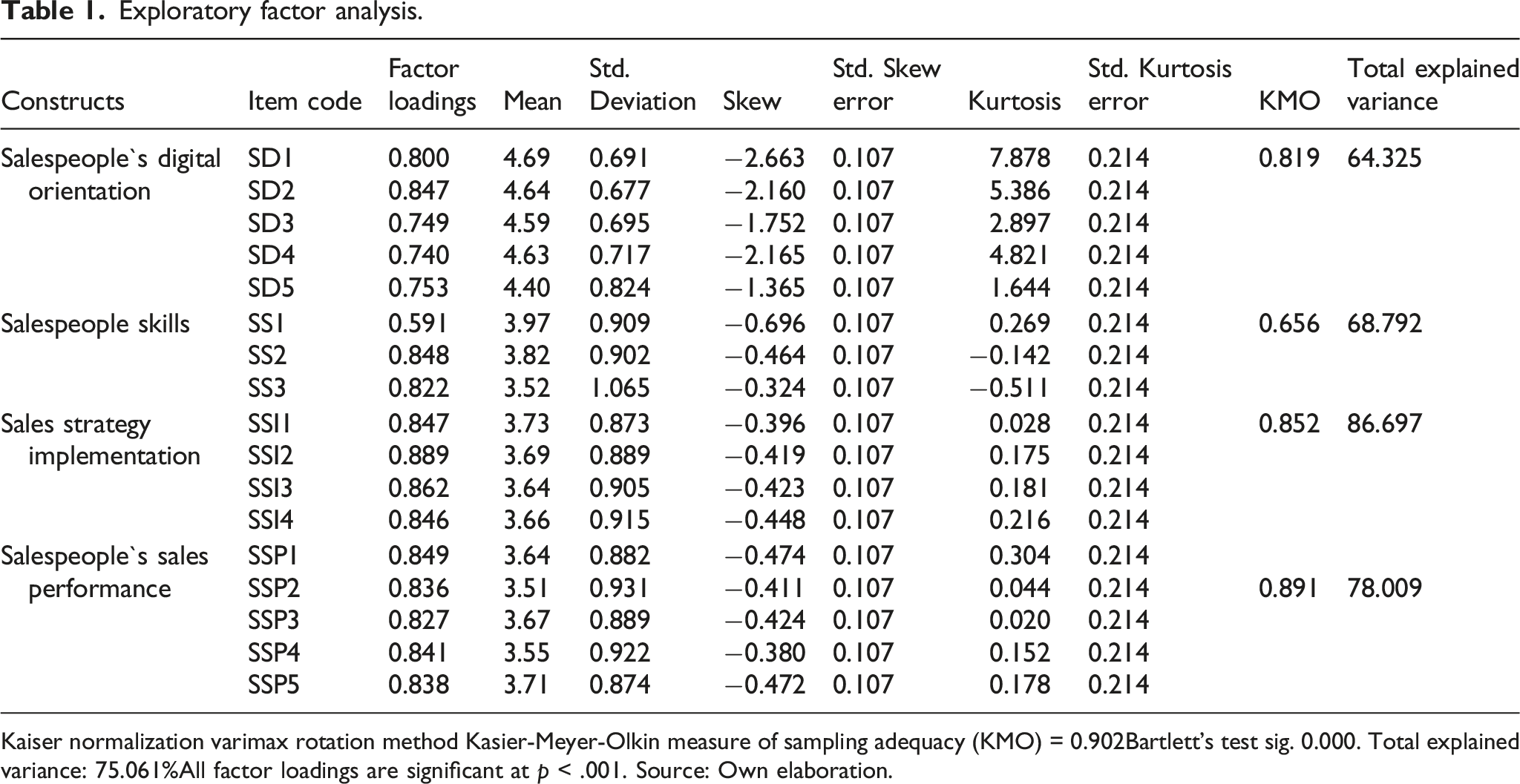
Kaiser normalization varimax rotation method Kasier-Meyer-Olkin measure of sampling adequacy (KMO) = 0.902Bartlett’s test sig. 0.000. Total explained variance: 75.061%All factor loadings are significant at p < .001. Source: Own elaboration.
Reliability and discriminant validity of the constructs.
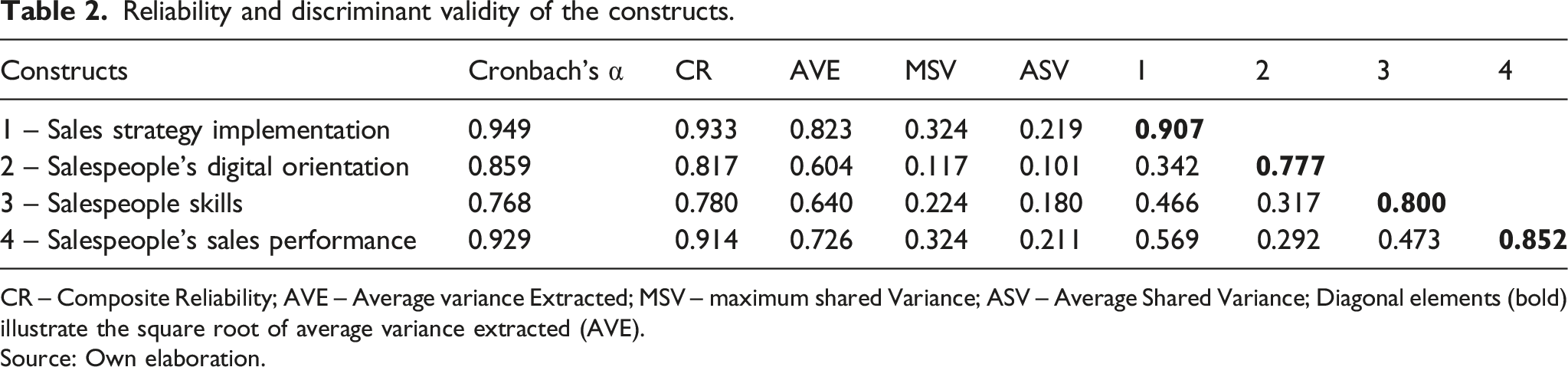
CR – Composite Reliability; AVE – Average variance Extracted; MSV – maximum shared Variance; ASV – Average Shared Variance; Diagonal elements (bold) illustrate the square root of average variance extracted (AVE).
Source: Own elaboration.
The maximum likelihood estimate was employed to test the reliability and validity of the measurements (Table 2). The indicators used were the Composite Reliability (CR), Average Variance Extracted (AVE), Maximum Shared Variance (MSV) and Average Shared Variance (ASV) (Hair et al., 2014). All the indicators (CR > 0.7, AVE > 0.5, MSV < AVE; ASV < AVE) present an acceptable level of one-dimensionality and convergent validity (Hair et al., 2014). Moreover, the square roots of the AVE measures are superior to all the correlations among all the constructs, which confirms discriminant validity (Fornell and Larcker, 1981; Roldán and Sánchez-Franco, 2012).
Structural model estimation and hypotheses testing
The indicators used to evaluate the model fit were the X2/DF (X2 – chi-square; DF – degrees of freedom), CFI (Comparative Fit Index), NFI (Normed-Fit Index), TLI (Tucker Lewis Index), IFI (Incremental Fit Index), GFI (Goodness of Fit Index), RFI (Relative fit index), RMR (Root Mean Square Residual) and RMSEA (Root Mean Square Error of Approximation). The obtained values are in line with the recommendations of Hair et al. (2014) and Kline (2016): (X2 = 97.319; DF = 49; X2/DF = 1.986; GFI = 0.970; CFI = 0.988; NFI = 0.976; TLI = 0.984; IFI = 0.988; RFI = 0.967; RMR = 0.025; RMSEA = 0.044) (Hair et al., 2014; Kline, 2016). Moreover, the degree of explanatory power of the respective predictors (R2), as shown in Figure 2, exceeds the minimum recommended value R2 > 0.1 (Falk and Miller, 1992). Results of structural equation modelling. Source: Own elaboration.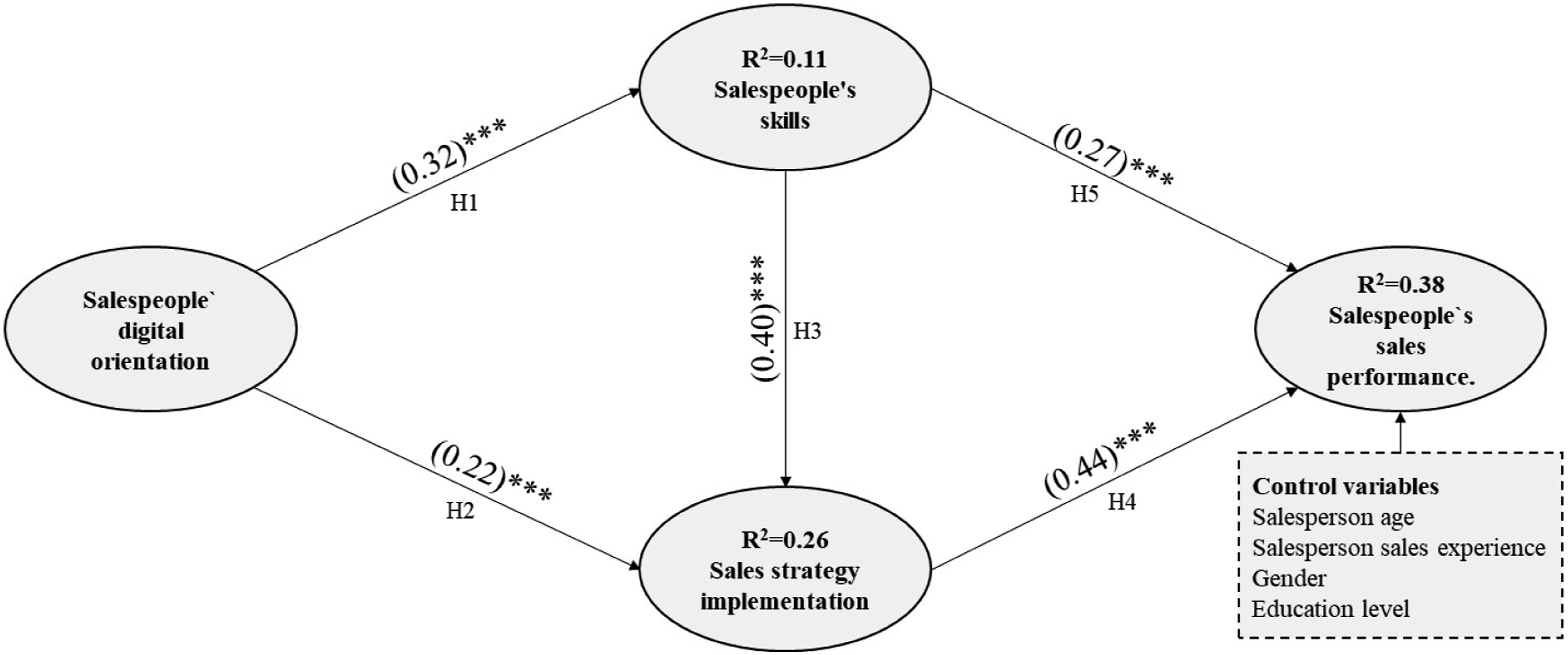
The hypotheses formulated in the model represent the structural or causal paths that can be empirically tested through the significance of the trajectories/paths represented in the structural model (Byrne, 2016). Therefore, the results show that (H1) digital orientation has a positive effect on the salespeople’s skills (β = 0.32; p < 0.001). The hypothesis (H2) confirms that digital orientation has a positive effect on the sales strategy implementation (β = 0.22; p < 0.001). The hypothesis (H3) corroborates that salespeople’s skills have a positive effect on the sales strategy implementation (β = 0.40; p < 0.001). Also, the hypothesis (H4) confirms that sales strategy implementation has a positive effect on the salespeople`s performance (β = 0.44; p < 0.001). Finally, the hypothesis (H5) is validated as salespeople’s skills have a positive effect on the salespeople`s sales performance (β = 0.27; p < 0.001). Therefore, the model and all the hypotheses were statistically supported.
Control variables
To evaluate the impact of control variables (Education level, Gender, Age, Years of experience) on salespeople’s sales performance (which includes 5 items) the GLM analysis was performed. This method was used due to (i) dependent criteria variables are attitudinal; (ii) robustness of analysis (Grilli and Rampichini, 2014; Williams, 2016).
Firstly, it should be noted that before employing the GLM, the Ordered Logit Model (OLM) was performed, but through the Brant test (Brant, 1990) was possible to examine that OLM was ineffective, because the common slope assumption
1
was violated (Lu, 1999), see Table A2 (Appendix). GLM is a more robust extension of OLM, which overcomes these OLM limitation (Liu and Koirala, 2012; Williams, 2016). So, the model is expressed as (Liu and Koirala, 2012)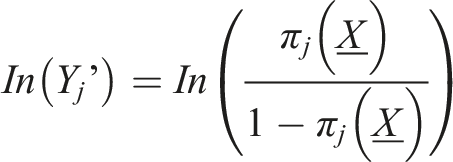


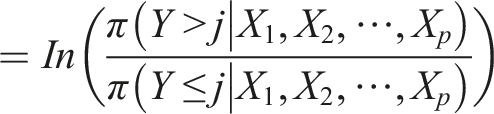

Williams (2006)’ gologit2 is a more evolved version of Fu (1999)’s gologit. The gologit2 offers an alternative when estimating partial proportional probability models. Moreover, it is more parsimonious and easier to interpret (Liu and Koirala, 2012). In practice, when the assumption of POM is violated (verified through the Brant test), the GLM proposed by Fu (1999) can be used for preliminary analysis. Then, the Williams (2006) GLM can be applied for a more precise analysis, since it is more robust (Liu and Koirala, 2012).
Results of the generalized ordinal logit model/partial proportional odds model using stata gologit and gologit2 (Y > cat. j vs. Y ≤ cat. j).
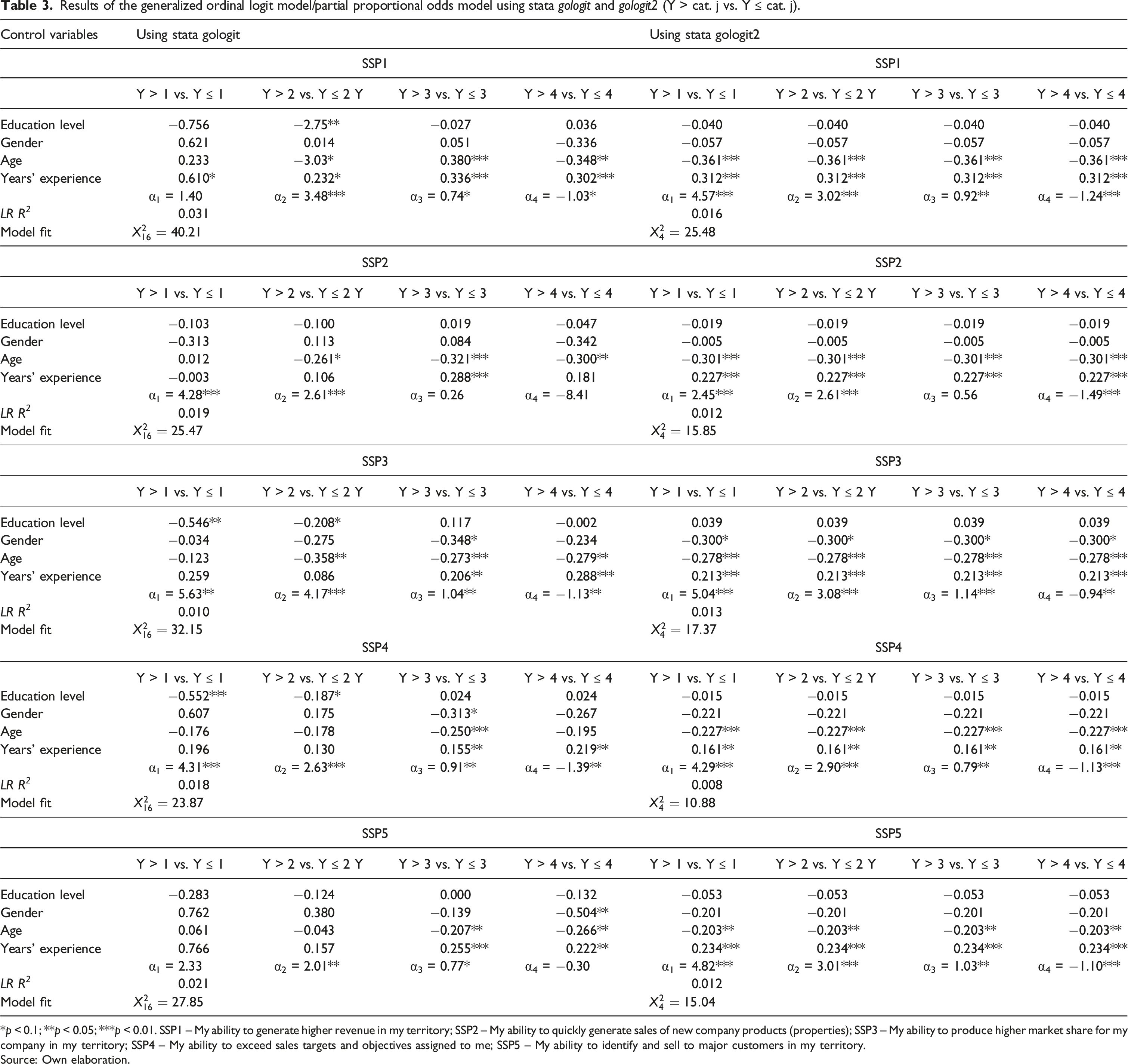
*p < 0.1; **p < 0.05; ***p < 0.01. SSP1 – My ability to generate higher revenue in my territory; SSP2 – My ability to quickly generate sales of new company products (properties); SSP3 – My ability to produce higher market share for my company in my territory; SSP4 – My ability to exceed sales targets and objectives assigned to me; SSP5 – My ability to identify and sell to major customers in my territory. Source: Own elaboration.
The results of Stata gologit2 (Table 3) show that the ‘age of salespeople’ and ‘salespeople years of experience’ have effects on all the variable criteria of ‘Salespeople`s Sales Performance’ at the level of 1%. Specifically, ‘age of salespeople’ has significant negative effects on the ability (i) to generate higher revenue in my territory (−0.361; p < 0.01), (ii) generate sales of new company products (−0.301; p < 0.01), (iii) produce higher market share for company (−0.278; p < 0.01), (iv) exceed sales targets and objectives (−0.227; p < 0.01) and (v) identify and sell to major customers (−0.203; p < 0.05). The ‘years of experience’ has significant positive effects on the ability to (i) generate higher revenue in my territory (0.312; p < 0.01), (ii) generate sales of new company products (0.227; p < 0.01), (iii) produce higher market share for company (0.213; p < 0.01), (iv) exceed sales targets and objectives (0.161; p < 0.05) and (v) identify and sell to major customers (0.234; p < 0.01). In contrast, ‘education level’ and ‘gender’ did not reveal significant effects on the variables mentioned above.
Discussion
The digital transition creates constant challenges for companies (Verhoef et al., 2019; Vial, 2019), particularly in the sales area (Ranjan and Friend, 2020).
The research setting of the study arises from the need for more empirical studies on the use of digital technologies within the customer-company relationship (Verhoef and Bijmolt, 2019), especially the use of digital technologies by sales force (Bharadwaj and Shipley, 2020). It will be critical for companies to accelerate internal digital transformation processes for their business competitiveness (Heim et al., 2019). Thus, this study extends research on Digital Orientation in the context of sales. The key feature of this empirical analysis is the development of a specific causal and dynamic model (Figure 2) which through SEM was tested empirically, showing that the observed data are consistent with our conceptual framework (Figure 1).
The results confirm that salespeople`s digital orientation affects their competencies and contributes to the implementation of the sales strategy (Ogilvie et al., 2018). Therefore, the study shows that salespeople with a greater digital orientation turn out to improve sales skills (Bharadwaj and Shipley 2020) and end up engaging in the implementation of the sales strategy (Nowlin et al., 2018; Ogilvie et al., 2018; Venkatraman, 1989).
In addition, the results also reveal that sales strategy implementation and salespeople skills affect salespeople`s sales performance (Nowlin et al., 2018; Singh and Venugopal, 2015). Thus, the enhancement of the skills of salespersons allow them to be more alert to understand the problems of customers or the context of the sale and to choose the best strategy to adopt, which might translate in the increasing of performance (Agnihotri et al., 2016; Johlke, 2006). Moreover, motivating salespeople to the implementation of the sales strategy is an important factor for the sales performance (Panagopoulos and Avlonitis, 2010) as they need to be engaged in fulfilling their role to achieve the desired results.
Finally, the results of the control variables show that the salespeople’ experience, has a positive and significant influence on their performance. This suggests that the most experienced salespeople are more effective in generating sales and revenue in their territory, contributing to increase the market share. Also, the experience factor shows that salespeople achieve more easily their goals and objectives including the most important customers. This result is different from the study by Liu et al. (2020) which revealed no statistical significance for the experienced salespeople.
In relation to the age of the salespeople, the results point in the inverse direction, showing that age has a negative and significant effect on their sales performance. In other words, older salespeople tend to lower performance, including sales and profitability in their territory. The results corroborate in part the study by Varela-Neira et al. (2018) that indicate a negative relationship between age and the salespeople’s proactiveness. Regarding gender and education level, this study revealed no significant relationship between these variables and the salespeople’s performance.
Theoretical and managerial implications
Theoretical implications
This study offers important theoretical contributions to sales literature and implications of the digital orientation to salespeople’s skills and sales strategy. Firstly, the research validates a coherent and integrated system of relationships between salespeople`s digital orientation, sales strategy implementation, salespeople’s skills and salespeople`s performance. This model suggests viable options for the definition of operational goals that companies can follow in their marketing and sales departments, more specifically the implementation of new sales mentalities, the enhancement of digital skills and more agile ways of working (Laar et al., 2020; Tronvoll et al., 2020).
Secondly, this study brings awareness to the retail real estate about the importance of using digital technologies in the sales activity (Piazolo and Dogan, 2020), which necessarily implies the adoption of a digital orientation of the sales teams, otherwise they risk be out of the market (Ogilvie et al., 2018). The digital transition has reached the point of no return, and the retail real estate needs more studies to be informed about the implications of digitization for sales (Piazolo and Dogan, 2020). Also, this could help salespersons move from the traditional way of doing sales to a ‘smarter’ one (Ullah et al., 2018).
Thirdly, this study arouses interest in two factors: experience and age of the salesperson. Presumably the most experienced salespeople can effectively assess each situation and profile customers and, consequently, gain market share from the competition as experienced salespeople are more alert to threatening or vulnerable situations (Li, 2020). Expectably, they are more resilient to the pressure of the moments and, for this reason, the high performance is a consequence of the development of its sales skills throughout his working career.
Moreover, this study reveals that age negatively affects the sales performance. In general, younger salespeople are frequently more proactive and agile regarding new challenges (Varela-Neira et al., 2018). The study did not aim to discuss this topic, but somewhat the matter is relevant, especially because the digital age can reinforce ageism (Soja and Soja, 2020). Nevertheless, having senior workers can be considered a valuable business asset as their knowledge and expertise constitute an authentic source of human capital for organizational wisdom (Vasconcelos, 2018).
Managerial implications
Regarding the managerial implications of the study, the following is outlined. Firstly, the findings of this study suggest that the role of digitally oriented salespeople has an impact on their skills, sales strategy implementation and performance. These results are particularly instructive for salespeople as they clarify the role of today’s salesperson. What the results of this study shows is that salespeople must incorporate adequate skills for attending customers in a face-to-face interview with the abilities to maintain useful and quick contacts with customers online. In fact, the digital transformation of the sales activity is essential and urgent to deliver more customize solutions, enhance customer experience, reinforce loyalty and increase sales. In the current context, with the right technology and digital tools, salespeople can be assertive and agile in their day-to-day sales (Bharadwaj and Shipley, 2020; Samson et al., 2014). These digital tools have affected the sales process at various digital and non-digital touch points. For instance Customer Relationship Management (CRM) has features that can help salespeople in their commercial strategy (Hofacke and Corsaro, 2020), through the customization of the customer experience, based on data about the consumer integrated into the CRM system regarding previous buying processes. Another example is the development of new digital technologies that has changed the ways in which customers and sellers communicate. They offer the possibility for the salesperson share information quickly and simply with customers via exchanging instant messages of text, voice, image and/or video (WhatsApp, email, social media, etc.). Therefore, digital technologies used properly could enhance the service to consumer as the salesperson will be more available to meet, answer questions or help its customers when they need. For instance the use of social media tools improves the satisfaction of and interaction and relationships with customers, as these tools facilitate communication between salespeople and customers.
Digital tools complement and perform extra services that empower the role of salespeople. The active use of digital tools in their sales activities (relationship with customers and transformation of prospects into customers) helps to implement the sales strategy (Nowlin et al., 2018). However, salespeople do not need to be experts in digital technologies, but they must be committed to apply it to sales developing an empirical understanding of the digital resources required for the sales activities (Khin and Ho, 2019).
Secondly, the findings of this study have implications for company managers. In particular, retail real estate companies must adapt to the new digital environment and update their selling methods. This new approach will improve customers relationships, enlarge market prospection and different ways of making sales (Donthu and Gustafsson, 2020; Laar et al., 2020; Samson et al., 2014; Tronvoll et al., 2020). In fact, the adoption of a digital orientation represents an opportunity for real estate companies to become more competitive and efficient in sales (Quinton et al., 2018). For instance the implementation of data analytical models, the use of CRM (Ancillai et al., 2019; Hofacke and Corsaro, 2020), the presentation of properties in live streaming (Wongkitrungrueng et al., 2020), the involvement of digital influencers (Ouvrein et al., 2021), are all tools that can enhance the engagement of customers with the salespeople (Ogilvie et al., 2018; Orlandi, 2016). It should also be noted that companies must consider salespeople as an integral part of their marketing strategy (Cheng et al., 2021; Deng et al., 2022; Inyang and Jaramillo, 2020; Høgevold et al., 2021). Indeed, they are the main players in the ‘theatre of operations’ and each phase of the sales strategy is a micro strategy in itself. Therefore, salespeople must be involved in the decision-making about the marketing strategy definition.
Thirdly, the analysis of the control variables, more specifically the age and the years of experience, has also impact at the company and salesperson levels. The study’s findings pointed out that salesperson experience has positive effects on sales performance. This result reveals the need for companies to develop more integrative policies, supporting and training inexperienced salespeople. For example build teams of salespersons combining experienced and inexperienced salespeople could be important. Also, the training activities should focus on behaviours, tools and techniques for junior salespeople in order to gain efficiency in establishing contacts with prospective customers. Similarly, inexperienced salespeople must invest in their training to absorb knowledge as quickly as possible and put it into practice. The road to success in the management of sales and customer relationship is a combination of work experience, clarity of the role and acceptance of goals (Li, 2020).
Finally, the study also highlights the need to value the work of senior salespeople. The results show that age has a negative effect on sales performance. Probably due to supervision roles in the sales management process, the managers’ motivation of senior salespeople should focus on field work conducting to sales by taking advantage of the maturity, stability and sales skills that senior salespeople have acquired over the years (Vasconcelos, 2018). Correspondingly, study warns about the need of senior salespeople to keep their sales skills up to date and elevate their digital literacy (Sarin et al., 2010).
Conclusion
The results of the study validate the model hypothesized. Thus, the research found positive linkages between salespeople`s digital orientation and salespeople’s skills and sales strategy implementation. The study also found that salespeople’s sales performance is positively influenced by salespeople’s skills and sales strategy implementation. Further, the study reveals that experience of the salesperson is related positively with performance whilst age impacts negatively.
The first limitation of the study is that includes essentially Portuguese salespeople in a very specific industry – retail real estate. So, future work should investigate other geographic contexts or industries. The study also analyses salesperson skills in general and does not focus on specific sales skills. Future studies can explore this topic. The introduction of control variables in the model is an important step forward to better understanding the role that age and experience plays in the digital orientation of salespeople and salespeople’s performance.
Footnotes
Acknowledgements
This work is financed by Portuguese national funds through FCT (Fundação para a Ciência e Tecnologia), under the project UIDB/05422/2020. The authors also wish to thank Centre for Social and Organizational Studies (CEOS) and NECE- Research Center in Business Sciences.
Declaration of conflicting interests
The author(s) declared no potential conflicts of interest with respect to the research, authorship, and/or publication of this article.
Funding
This work is financed by Portuguese national funds through FCT (Fundação para a Ciência e Tecnologia), under the project UIDB/05422/2020.

Note
Appendix
Questionnaire items. Source: Own elaboration.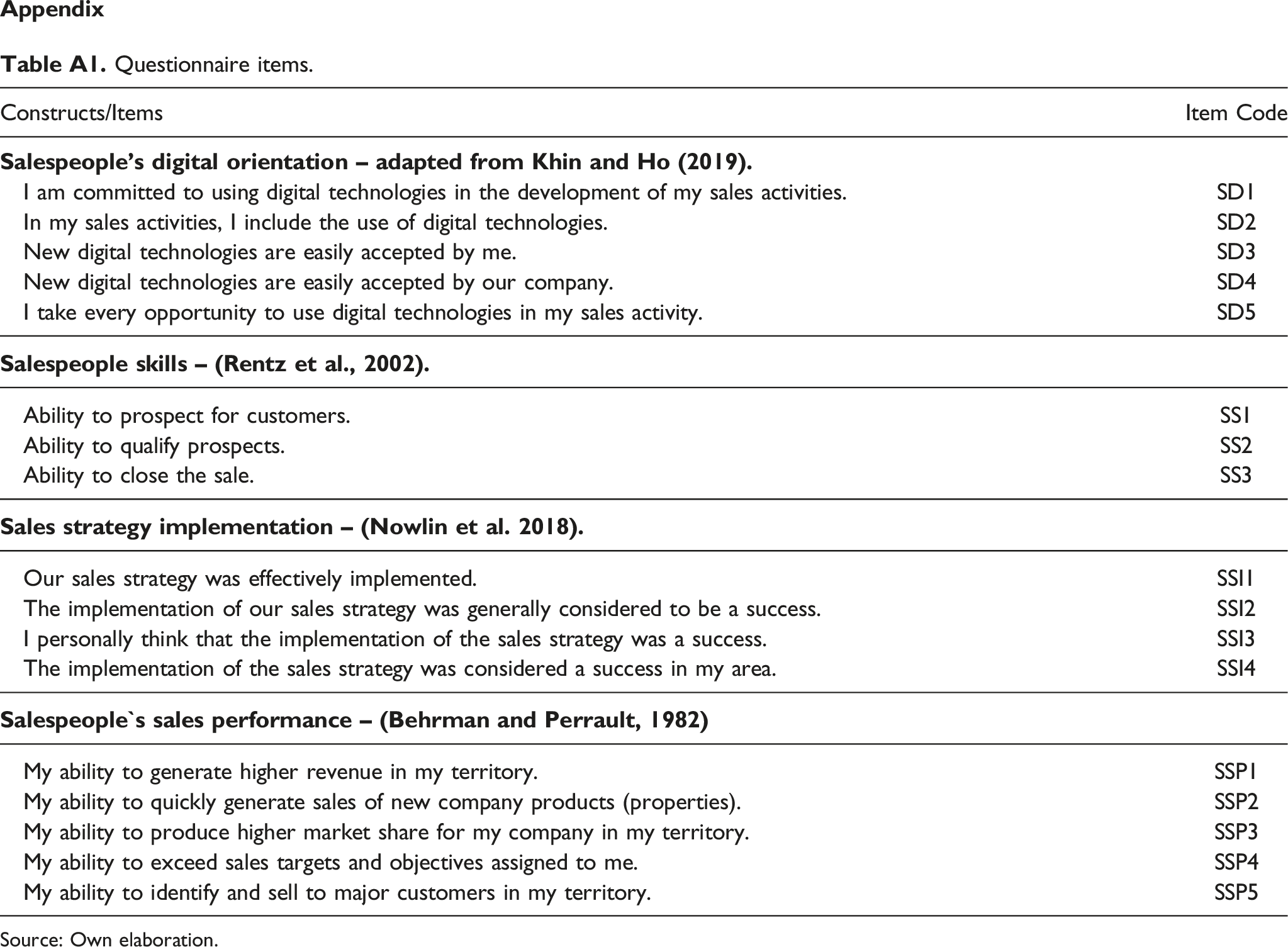
Constructs/Items
Item Code
I am committed to using digital technologies in the development of my sales activities.
SD1
In my sales activities, I include the use of digital technologies.
SD2
New digital technologies are easily accepted by me.
SD3
New digital technologies are easily accepted by our company.
SD4
I take every opportunity to use digital technologies in my sales activity.
SD5
Ability to prospect for customers.
SS1
Ability to qualify prospects.
SS2
Ability to close the sale.
SS3
Our sales strategy was effectively implemented.
SSI1
The implementation of our sales strategy was generally considered to be a success.
SSI2
I personally think that the implementation of the sales strategy was a success.
SSI3
The implementation of the sales strategy was considered a success in my area.
SSI4
My ability to generate higher revenue in my territory.
SSP1
My ability to quickly generate sales of new company products (properties).
SSP2
My ability to produce higher market share for my company in my territory.
SSP3
My ability to exceed sales targets and objectives assigned to me.
SSP4
My ability to identify and sell to major customers in my territory.
SSP5
Brant tests of the POM assumption for each predictor and the overall model. SSP1 – My ability to generate higher revenue in my territory; SSP2 – My ability to quickly generate sales of new company products (properties); SSP3 – My ability to produce higher market share for my company in my territory; SSP4 – My ability to exceed sales targets and objectives assigned to me; SSP5 – My ability to identify and sell to major customers in my territory. *p < 0.05. Source: Own elaboration.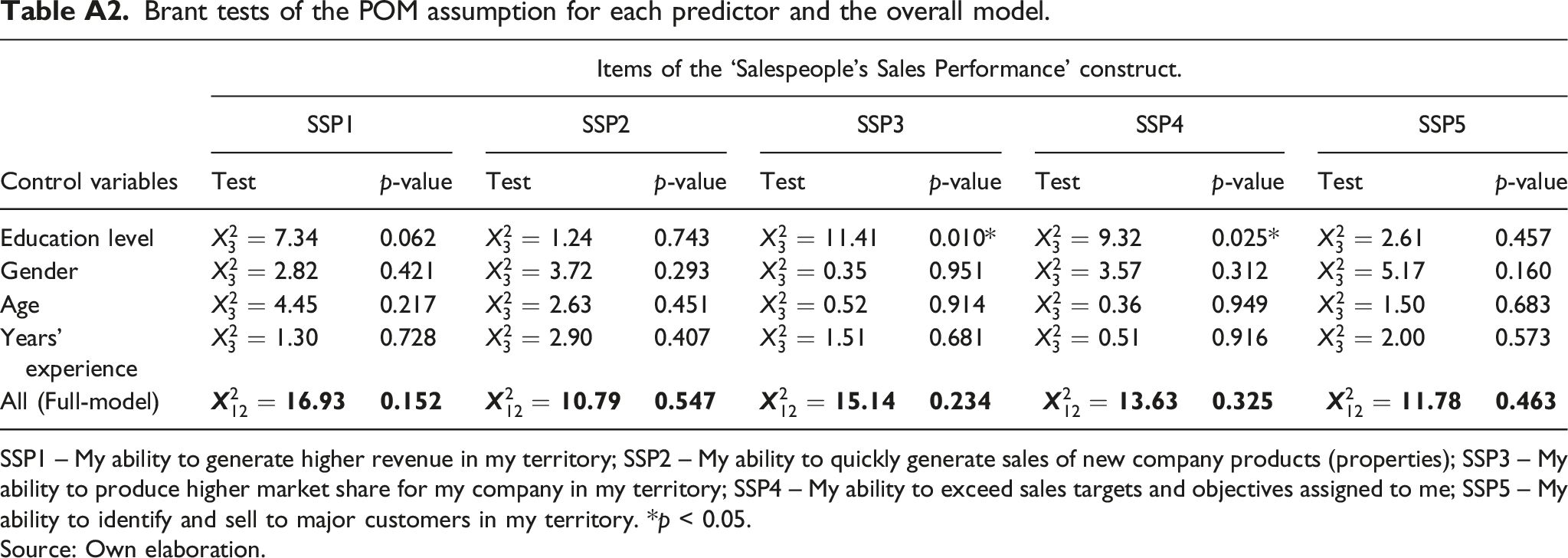
Control variables
Items of the ‘Salespeople’s Sales Performance’ construct.
SSP1
SSP2
SSP3
SSP4
SSP5
Test
p-value
Test
p-value
Test
p-value
Test
p-value
Test
p-value
Education level
7.34
0.062
1.24
0.743
11.41
0.010*
9.32
0.025*
2.61
0.457
Gender
2.82
0.421
3.72
0.293
0.35
0.951
3.57
0.312
5.17
0.160
Age
4.45
0.217
2.63
0.451
0.52
0.914
0.36
0.949
1.50
0.683
Years’ experience
1.30
0.728
2.90
0.407
1.51
0.681
0.51
0.916
2.00
0.573
All (Full-model)