




Abstract
This study develops and tests a theoretical model that investigates how career ambition can have an impact on different types of academics’ performance behaviour and how ideological development at work can affect this model in a special context of a communist country. In a study of 991 employees in a large university in Vietnam, the model is largely supported. The findings suggest that in-role behaviour has a significant mediating role in the effect of career ambition on extra-role behaviour and that this mediating effect is stronger among the group of employees who have participated in advanced ideological development in the context of Vietnamese higher education. This study advances the understanding of an underdeveloped relationship between career ambition and employee performance behaviour and expands the knowledge of the impact of ideological development at work.
Introduction
Employee performance behaviour can be broadly divided into in-role behaviour and extra-role behaviour (Podsakoff et al., 2018). In-role behaviour refers to the formal duties and responsibilities that an employee executes as an integral part of his or her job requirements, while extra-role behaviour refers to activities beyond formal job requirements that an employee chooses to do without expecting any direct reward (Vigoda, 2000). A body of systematic reviews of the organisational citizenship behaviour literature shows that in-role behaviour has been treated separately from extra-role behaviour construct (e.g. LePine et al., 2002). In general, extra-role behaviour is understood as behaviour that is ‘discretionary, not directly or explicitly recognised by the formal reward system, and in the aggregate promotes the effective functioning of the organisation’ (Organ, 1988: 4). It contributes to ‘the maintenance and enhancement of the social and psychological context that supports task performance’ (Organ, 1997: 91). Many researchers have frequently investigated these two different constructs together as dependent variables (e.g. van Loon et al., 2017), while others have demonstrated a blurred boundary between the two (e.g. Belogolovsky and Somech, 2010).
This study attempts to set a new path in the research of employee performance behaviour in higher education from several perspectives. Firstly, based on self-determination theory, this study investigates the relationship between career ambition and extra-role behaviour with the mediating role of in-role behaviour in higher education. In-role behaviour is imperative for formal job requirements. It, therefore, should be prioritised over extra-role behaviour. Career is a heated topic in higher education, particularly in the war for talent between higher education and the private sector, which are thirsty for knowledge workers (Finkelstein and Jones, 2019). Thirdly, this study investigates the above relationship in the specific context of the higher education sector of a communist single-party state that proclaims to adhere to a socialist ideology. Comparison of this relationship made between two large groups of employees, those who were subject to advanced ideological development programs at work and those who were not, is vital for understanding the impact of ideology in higher education in a diverse world.
Using a sample of 991 employees from a large university in Vietnam, this study is expected to make several critical contributions to both theory and practice. Firstly, it advances the self-determination theory by adding a new perspective of career ambition and its relationship to employee performance behaviour in higher education. Secondly, it provides a better understanding of the relationship between in-role behaviour and extra-role behaviour in a non-Western, Educated, Industrialized, Rich and Democratic context (Henrich et al., 2010). Last but not least, this study seems to be one of very few that demonstrate evidence of the impact of ideological development on employee performance behaviour in the public service delivery of a particular regime. Understanding the behaviour and psychology of employees in this corner of the world would benefit its Western partners in internationalisation and collaboration activities.
Theoretical background and hypotheses development
Self-determination theory and career ambition
Although career ambition intuitively relates to the will to succeed in one’s career, earlier work has offered a limited understanding of the associated construct. While focusing on the social conditions that enhance versus diminish a positive feature of human nature, that is, the natural activity and curiosity, known as intrinsic motivation, Ryan and Deci (2000) developed self-determination theory. Self-determination theory is based on two key assumptions: (a) the need for growth drives behaviour and (b) internal sources of motivation is important. Self-determination theory suggests that people can become self-determined when they feel competent, connected and autonomous. Ryan and Deci argued that contexts supportive of autonomy, competence and relatedness are of great significance for individuals who wish to motivate others in a way that engenders commitment, effort and high-quality performance. This argument seems to support an inherent, positive human tendency to move towards growth, which can include career ambition or, conversely, career indecision (Guay et al., 2003).
Few scholars pay sufficient attention to defining career ambition, even when career ambition is the main focus of the study (e.g., Ashby and Schoon, 2010), except Brewer (2018) as one of the very few examples. This is possibly due to a lack of clarity in the theoretical elaboration of the concept. Brewer (2018) defines career ambition as a universal motivation for achievement both in career and in personal success. This definition is broad and reflects the role of motivation in career ambition. Drawing from Derr’s (1986) five concepts related to career, namely getting ahead, getting secure, getting free, getting high and getting balanced and drawing influence from self-determination, this study moves a step forward to be more specific by defining career ambition as an individual’s desire and motivation to develop professional and personal capacities to get ahead, get secure, get free, get high and get balanced in one’s career.
The above definition distinguishes career ambition and careerist orientation. Careerist orientation is defined such that getting ahead in one’s career can best be accomplished by non-performance means (Aryee and Chen, 2004) and can have adverse effects on employee performance behaviour (Feldman and Weitz, 1991). To align with self-determination theory, which suggests a need for growth drives behaviour, this study argues that when people are ambitious in their career, they are likely to work harder. This argument lends support to the main investigation of this study on the relationship between career ambition and two different forms of employee performance behaviour, that is, in-role behaviour and extra-role behaviour. These are discussed below.
Career ambition and in-role behaviour
The concept of in-role behaviour was proposed by Katz and Kahn (1978) as a form of performance behaviour. In-role behaviour helps an employee to fulfil formal job requirements (e.g. task performance, technical competence) (Delcourt et al., 2017). An important characteristic of in-role behaviour is that it is essentially task-oriented (Goodman and Svyantek, 1999). In-role behaviour is required for formal job descriptions and role assignments (Ziegler and Schelett, 2016). Previous studies have shown that in-role behaviour interacts with extra-role behaviour, as a result, enhancing an employee’s overall job performance via technical effectiveness (Kiker and Motowidlo, 1999). Although in-role behaviour has been well-researched, hardly any study has investigated its relationship with career ambition even though both variables are important in organisational management.
Psychological scholars have shown that ambition is related to behaviour that supports occupational attainment (e.g. Judge and Kammeyer-Mueller, 2012). In a survey of 298 undergraduate students, Rhodes et al. (2005) show that higher ambition leads to higher achievement on given tasks. In this regard, it is argued that career ambition seems to be closely associated with employee’ in-role behaviour. However, there is hardly any evidence among employees of the higher education sector. Based on self-determination theory discussed above, it is argued that the more ambitious employees are about their career, the more they want to perform better in their role, particularly in higher education. Therefore, it is proposed:
In-role behaviour and extra-role behaviour
In-role behaviour and extra-role behaviour have been used as separate constructs in previous studies (e.g. Mehmood et al., 2016). It has been argued that the distinction between in-role behaviour and extra-role behaviour varies with regard to time, employee, organisation and situation (Ziegler and Schelett, 2016) and also across cultures (Paine and Organ, 2000) due to different rules of reciprocation and role obligation. Extra-role behaviour is distinct from a task or technical performance, has a more volitional and spontaneous character than core job contributions and has positive effects on the social, psychological, organisational and political contexts, rather than on the technical context (Farh et al., 2004). In general, it is agreed that the motivation for in-role behaviour is greater than the motivation for extra-role behaviour (Podsakoff et al., 2018).
According to Netemeyer and colleagues (1997), the conceptual domain of extra-role behaviour is represented in the following characteristics: (1) behaviour above and beyond the formally ascribed behaviour of a given job, (2) discretionary behaviour on the part of an employee, (3) behaviour that is not rewarded by a formal reward system and (4) behaviour considered important for the effective functioning of the organisation. However, employees differ in how they define the boundaries of their jobs and what constitutes an extra-role behaviour. It is widely recognised that extra-role behaviour improves organisational efficiency and effectiveness via resource transformation, adaptability and innovation (Podsakoff et al., 2018).
The relationship between in-role behaviour and extra-role behaviour is not simple. It depends on whether the organisation has behaviour-based or outcome-based control systems (Bergeron et al., 2013) because to some, in-role behaviour and extra-role behaviour stand separately (Hsu et al., 2017; van Loon et al., 2017). A few studies have investigated extra-role behaviour as an indirect consequence of in-role behaviour. For example, extra-role behaviour is an indirect consequence of in-role behaviour, mediated by commitment (O’Reilly and Chatman, 1986). Recently, Bergeron and colleagues have provided empirical evidence that extra-role behaviour can harm in-role behaviour in outcome-based control systems in the private sector (Bergeron et al., 2013).
This study challenges the existing literature by exploring the opposite perspective in higher education. According to Schnake (1991), when individuals lower their in-role behaviour, they are likely to reduce their discretionary output (extra-role behaviour) too. Evidence shows that public workers, including those in higher education, are more intrinsically motivated to perform better (Georgellis et al., 2011). Activities can be undertaken due to an inner incentive that requires no external pressure as it is intrinsically motivated, for example, a belief in public service and the public interest (Rayner et al., 2012). In addition, the boundary between intrinsic and extrinsic motivation is not defined and explained easily (Calder and Staw, 1975). Hence, teachers/academics tend to be more rounded, that is, those who perform better in their roles, tend to help and develop their peers and subordinates. As a result, it is proposed:
Career ambition and extra-role behaviour
On the one hand, researchers have looked at the instrumental value of extra-role behaviour to gain positive performance evaluations (see a meta-analysis by Podsakoff et al., 2009), rewards (Allen and Rush, 2001) or promotions (e.g., Hui et al., 2000). On the other hand, an extensive study of 3680 employees in a professional firm conducted by Bergeron et al. (2013) shows that extra-role behaviour might have a negative impact on career outcomes such as salary increase, advancement speed and promotion. These results indicate a need for further understanding of the effects of extra-role behaviour on career ambition.
The literature review has shown that job satisfaction, organisational commitment, fairness, leader or organisational support and personal conscientiousness are popular predictors of extra-role behaviour (see the meta-analysis by LePine et al., 2002). However, it seems that nobody has yet presented a model of extra-role behaviour with respect to career ambition and ideological development inside and outside higher education. Self-determination theory supports the need for growth, that is, career ambition in this study. At the same time, it indicates the need for connectedness, which can be translated into helping others at work to stay connected with others.
Drawing on the handicap principle in evolutionary biology, in their conceptual paper, Salamon and Deutsch (2006) argued that employees engage in extra-role behaviour because they want to prove their worth to their employer, and so to be retained by their organisation. By engaging in extra-role behaviour, employees send a signal to managers that they are not only capable of carrying out in-role behaviour but also have the potential to go beyond it, and thus stand out from the crowd (Bolino et al., 2013). In a review paper, Blino (1999) pointed out that career-oriented individuals tend to engage in extra-role behaviour to advance their career selectively.
Empirical studies also suggest that employees take on extra-role behaviour because it has a positive effect on their reputation (e.g., Bolino et al., 2013). The idea that employees perceive that extra-role behaviour can advance their career opportunities has been supported in a quasi-experiment involving 293 tellers of a multinational bank conducted by Hui et al. (2000). Henceforth, such self-enhancement motives can positively relate to extra-role behaviour (Yun et al., 2007). In their conceptual paper, Bolino et al. (2004) suggested that extra-role behaviour stems from self-serving motives and mundane motives (in-role behaviour).
Therefore, based on self-determination, it is argued that ambitious employees tend to have greater motivation to work harder and better than those who lack such career ambition. Career ambition motivates employees to go beyond the formal requirements of a job and engage in extra-role behaviour (Motowidlo and Van Scotter, 1994) for better career advancement opportunities. As a result, it is proposed:
The mediating role of in-role behaviour
On the one hand, in a critical work of reviewing more than 30 years of research in organisational citizenship behaviour, Bolino et al. (2013) have recently reported that employees who engage in extra-role behaviour could incur professional costs. That finding seems especially true in the higher education sector where employees are more intrinsically motivated to go extra miles for the development of new generations. On the other hand, in his study of more than 300 Taiwanese chefs, Ko (2012) showed that career development improves an individual’s professional knowledge, creativity and job performance. This current study investigates whether there is any link in higher education between an individual’s career ambition and their engagement in in-role behaviour with the further motivation to exhibit extra-role behaviour. To further support what has been developed in H1, H2 and H3, it is proposed:
Ideological development at work
Socialist ideology was once prevalent among socialist communities. It has been embedded into the education system of many countries, including China (Li, 2011), Cuba (Carnoy and Werthein, 1977) and East Germany (Baker et al., 2007). Initially, Marxist theory was adopted as its primary tenet, and many countries, including Vietnam, used the Soviet Union’s model of socialism as an example to be studied and followed (Li, 2011). After the collapse of the Soviet Union in the 1990s, only a few countries remained communist, including China, Cuba, North Korea and Vietnam. Nevertheless, each of those countries has now formed its own version of socialist ideology. For example, China developed its doctrine, while Vietnam still proclaims its adherence to socialist ideology by following Marxist theory but also incorporates more of Ho Chi Minh’s thoughts into its ideology (Thayer, 1994). In reality, Vietnam’s approach to reform characterised by the phrase ‘to develop a market economy under socialist guidance’ reflects a dual ideology. However, that dual ideology describes a battle between two conflicting forces: one pushes toward the market, while the other insists on retaining the traditional socialist system (Nguyen, 2005: 206).
The socialist ideology in such communist countries is widespread in tertiary education and integrated into professional development at work, particularly in the public sector. In Vietnam, it can exist under various names, such as ‘Marxism and Leninism’, ‘History of the Communist Party’, ‘Understanding of the Communist Party’ and ‘Political Development’ (which includes Ho Chi Minh’s thoughts). The first two of these are often compulsory in tertiary education, and the latter two are often used for personnel development in the public sector. Ideological programs in the workplace are often designed either to develop high-quality workers who are willing to join the Communist Party or to develop further those who have joined the Communist Party and prepare them for its future leadership. In many public-sector organisations or state-owned companies in Vietnam, including universities, the head(s) of organisations sometimes have less power than the leader of the Communist Party committees in those organisations. Thus, these two positions are often combined into a single role in many public-sector organisations in Vietnam, which is referred to as ‘mono-organisational socialism’ (Thayer, 2009).
Consideration of ideological development in the workplace appears fairly new in the extant management literature, although it is not a new concept in the reality of the communist systems. However, it is vital for anyone who would like to climb up to the career ladder if they work in the public sector. Thus, this study seems to be one of the very few studies to compare two groups of employees who received or did not receive advanced ideological development (as distinct from the ideological development in their tertiary education). It compares the relationship between career ambition and employee performance behaviour. It is argued that the group of employees who spend time participating in ideological development in their workplace are more likely to be ambitious about their career in the communist system’s universities than the others. Therefore, it is proposed:
Method
Participants and procedure
A survey was sent to 3500 employees in one of the largest universities in Vietnam, which consisted of eight faculties and five research institutes. The choice of this large university was enabled due to a research grant that two authors of this article received. Stratified sampling was adopted for the research to ensure the evenness and representativeness of the sample. The main advantage of stratified sampling is that it avoids overloading in certain subpopulations (Wiersma and Jurs, 2005). The entire process of data collection took 4 months with a total of 1026 participants returning their survey (indicating a response rate of 29%). Of these, 991 questionnaires were in a usable form and included the final analysis with an assumption that if the pattern of missing data is random and each variable has less than 10% of its data missing, then no corrective action is required; otherwise, it requires deletion (Hair et al., 2006). Among the respondents, 484 (49%) received advanced ideological development in their workplace, which is different from the compulsory development received in their tertiary education.
Measures
All the constructs were measured using a 7-point Likert-type scale. Three questionnaire translation techniques, including back-translation, a committee approach and pre-test procedure (Brislin, 1976), were implied to all measures (except the performance), to prevent any methodological problems associated with the translation from English to Vietnamese and vice versa (Sperber et al., 1994).
Career ambition is measured using a construct adopted from Bui et al. (2016), α = 0.82. In-role behaviour was measured using the inventory of Williams and Anderson (1991), α = 0.82. The measure for extra-role behaviour was also adopted from Williams and Anderson (1991), α = 0.71. Ideological development: It should be noted that the study does not develop a measure of ideological development at university, but uses it as a binary variable to indicate those who received advanced ideological development and those who did not. A value of 1 is assigned to those who had advanced ideological development in the workplace and 0 to those who did not. A set of demographic variables were also collected and used in the final analysis. These included gender and age.
Common method bias (CMB) concern
Since this study employed a single data collection method, the presence of common method variance was tested to exclude the chance of CMB. The issue of CMB was controlled in the study by using conventional scales (Podsakoff et al., 2003). The total explained variance of the three factors (using a minimum eigenvalue of one) was 56.47%. The first factor accounted for 38.27% of the variance, the second factor 9.67% and the third factor 8.54%. Because multiple factors were included, and the first factor did not dominate the variance, this was an indication that CMB was not an issue here (Teo and Noyes, 2008).
To further validate CMB, Harman’s single-factor test was also performed using SPSS statistical software. This test allows all variables to be loaded on a single factor. Usually, this test should indicate a poor fit of the data as compared to the actual model selected for the study. The model with a single factor explained only 38.27% of the variance, which was below the threshold level of 50%. To further validate the results of Harman’s single-factor test, a similar test was performed in the SPSS AMOS software package, using the common latent variable test. The results of this test were chi-square (χ2) = 1287.40, degree of freedom (df) = 148, p < 0.001, root mean square error of approximation (RMSEA) = 0.09, comparative fit index (CFI) = 0.87, normed fit index (NFI) = 0.86, as compared to the three-factor model with χ2 = 455.97, df = 131, p < 0.001, RMSEA = 0.05, CFI = 0.96, NFI = 0.95. This shows that a single-factor solution is not an appropriate model in comparison to the three-factor solution proposed by the study. Hence, the three-factor model is, empirically, an appropriate solution, and these tests were sufficient to confirm that CMB is not an issue in this study.
To further eliminate the doubt of CMB, the multicollinearity test was conducted between the predictor variables. The correlation coefficient value between the predictor variables was 0.49, which was much below the threshold level of 0.70. The tolerance test value was 0.75, which was greater than the threshold value of 0.01, and the VIF was 1.32, which was less than the threshold value of 10. All these tests confirm that CMB is not an issue in this study.
Measurement model
Construct validity and discriminant validity were checked for the given constructs. Construct validity refers to choosing the correct measures regarding the concepts that are being investigated. Factorial analysis was conducted for checking the construct validity of the latent constructs. Initially, principal factor analysis was conducted using oblique rotation to examine the inter-item relationships, and if necessary, to further delete some items. Items with a factor loading of 0.40 and above were retained to ensure convergent validity (Bennett and Robinson, 2000).
Discriminant validity assesses the extent to which constructs differ from each other. It involves comparing the square root of the average variance extracted for a given construct with the correlations between that construct and all other constructs. Confirmatory factor analysis (CFA) is a verification technique of the set of observed variables to assess their distinctiveness (Tabachnick and Fidell, 2007). All correlations were below 0.85, establishing discriminant validity of the measurement scales (Kline, 2005). Three of the variables in the model – career ambition, in-role behaviour and extra-role behaviour – indicated individual disposition and were self-reported by the employee, so CFA was conducted to ensure the three measures were distinct from one another. We compared the default model with a constrained model. The default model had a better fit (χ2 = 17.97, df = 2, p < 0.001, RMSEA = 0.90, CFI = 0.98, NFI = 0.98) than the constrained model with (χ2 = 57.74, df = 3, p < 0.001, RMSEA = 0.14, CFI = 0.94, NFI = 0.93). There was a significant improvement in model fit when the direct path in the constrained model was controlled.
Descriptive statistics
Table 1 presents means, standard deviations and inter-correlations among constructs. Almost all constructs seem to be related to one another. Still, none of them shows any correlation coefficient that seems alarming nor any that may raise problems of data multicollinearity by testing for variance inflation on regressions (Cohen et al., 2003).
Construct means, standard deviations and correlations.
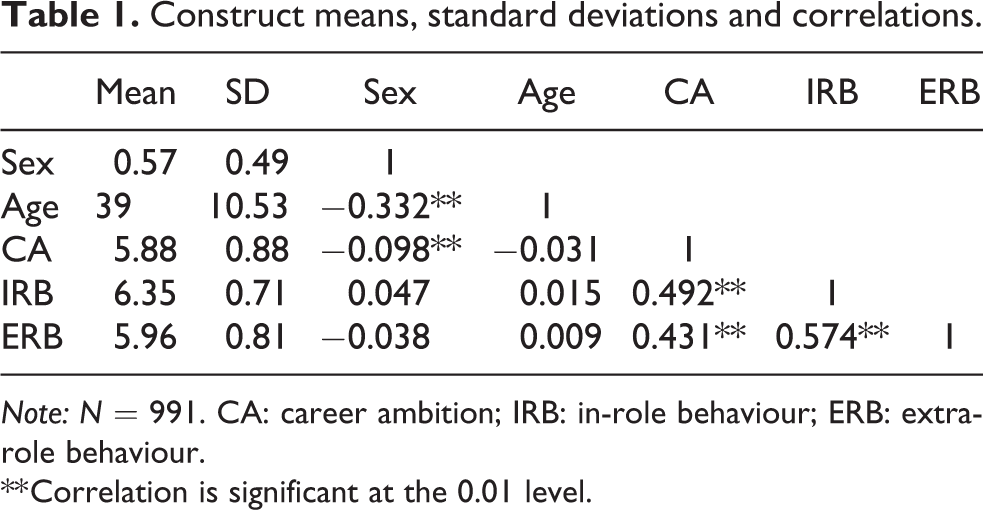
Note: N = 991. CA: career ambition; IRB: in-role behaviour; ERB: extra-role behaviour.
** Correlation is significant at the 0.01 level.
Structural model and alternative models
The mediation model developed for the study (career ambition → in-role behaviour → extra-role behaviour) is tested using SEM in AMOS 16. Mediation is confirmed by testing the indirect path in the given model using the bootstrapping technique, where the bootstrap sample is set to 1000. This means drawing 1000 random samples from the original sample and testing at two-tailed 95% bootstrap confidence interval estimates for the indirect effect. Bootstrapping is a preferred technique to the Sobel test because it does not impose any distributional assumptions (Preacher and Leonardelli, 2003).
The path analysis, as given in Figure 1(a) to (c), shows the unstandardised regression weights for different paths in their respective models. According to Preacher and Hayes (2004), mediation hypotheses are commonly tested in psychological research (for the given paths, career ambition → in-role behaviour = 0.49, in-role behaviour → extra-role behaviour = 0.48, career ambition → in-role behaviour → extra-role behaviour = 0.23, for model-without groups in Figure 1(a); again, career ambition → in-role behaviour = 0.54, in-role behaviour → extra-role behaviour = 0.51, career ambition → in-role behaviour → extra-role behaviour = 0.28, for model of ideological development group (received ideological development from the organisation) in Figure 1(b) and career ambition → in-role behaviour = 0.44, in-role behaviour → extra-role behaviour = 0.47, career ambition → in-role behaviour → extra-role behaviour = 0.21, for model of non-ideological development group (not received ideological development from the organisation) in Figure 1(c)). All these paths are different than zero and significant at a 95% confidence interval. Age and gender (sex) were used as control variables in the mediation model. Hence, it was found that age is insignificant, but the regression weight for gender (sex) is significant at −0.04 at a 95% confidence interval (in all the three models).
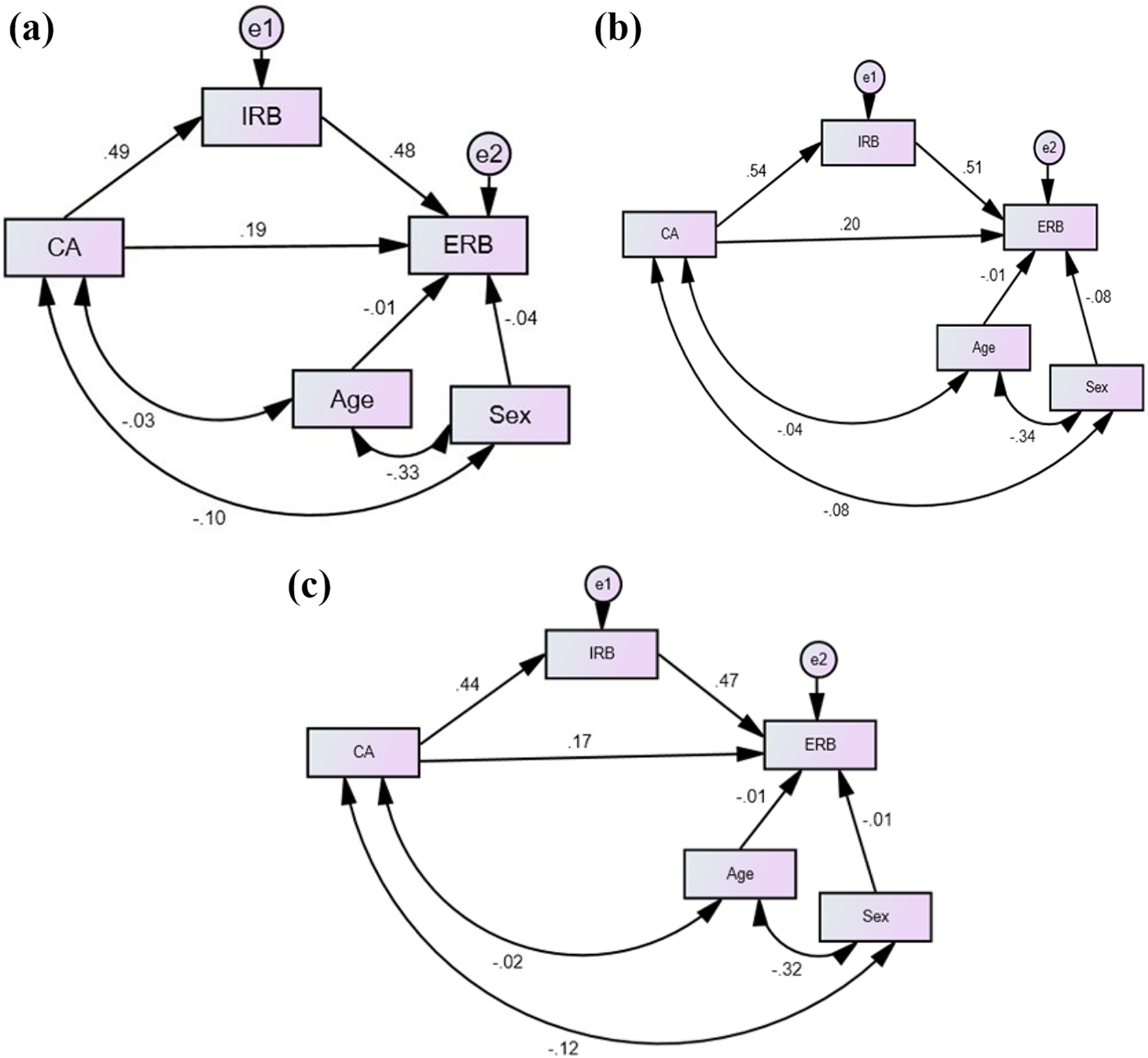
(a) Structural equation model (whole sample) path analysis. (b) Path analysis for group that received ideological development. (c) Path analysis for group that did not receive ideological development.
The structural equation modelling shows a good fit of the given data set to all the three models; however, looking at the fit indices of RMSEA, models 2b and 2c have a slightly better fit as compared to 2a. Moreover, models 2b and 2c are a mirror image of each other. The model fit indices are provided in Table 2 for model comparison.
Comparisons of alternative measurement models.
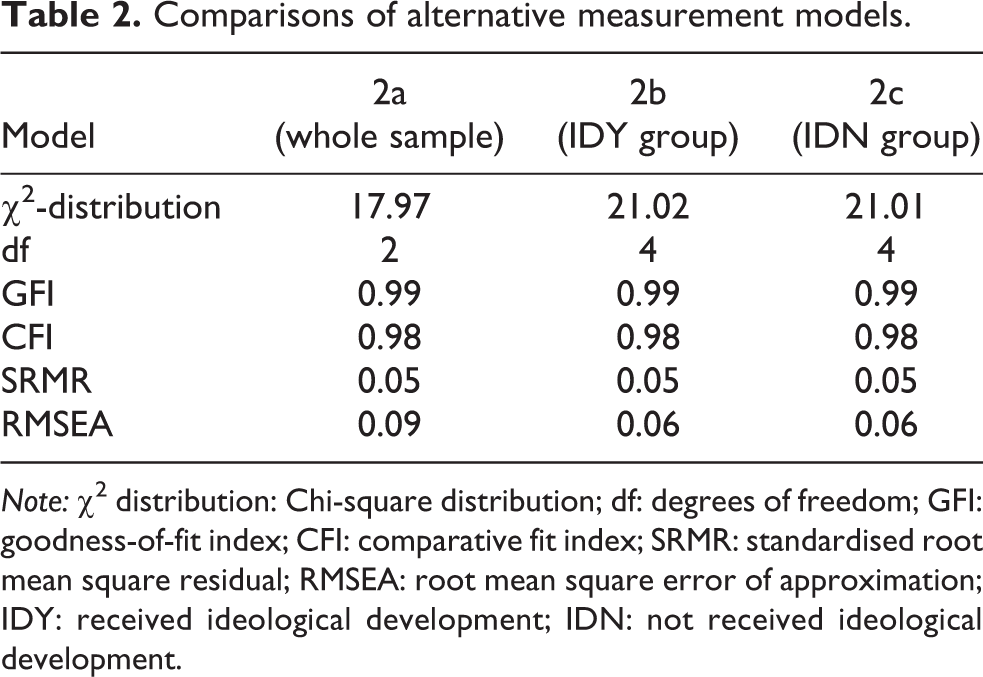
Note: χ2 distribution: Chi-square distribution; df: degrees of freedom; GFI: goodness-of-fit index; CFI: comparative fit index; SRMR: standardised root mean square residual; RMSEA: root mean square error of approximation; IDY: received ideological development; IDN: not received ideological development.
Hypothesis testing
H1a predicted a significant relationship between career ambition → in-role behaviour in Figure 1(a) with γ = 0.49, CR (critical ratio) = 17.78, p < .001, thus supporting H1a. H1b has also been supported as the relationship between career ambition and in-role behaviour is stronger for the group which has received ideological development. This can be confirmed from Figure 1(b) and (c) with γ = 0.54, CR = 14.34, p < 0.001 for ideological development group and with γ = 0.44, CR = 10.78, p < 0.001 for non-ideological development group. Thus, providing support for H1b.
The analysis finds support for the proposed relationship that in-role behaviour is positively associated with extra-role behaviour with γ = 0.48, CR = 14.61, p < 0.01. Thus, H2a has been supported. H2b has also been supported as in-role behaviour has a significant positive relationship with extra-role behaviour. This relationship is stronger for the group, which has received ideological development. This can be confirmed from Figure 1(b) and (c) with γ = 0.51, CR = 12.52, p < 0.001 for ideological development group and with γ = 0.47, CR = 11.38, p < 0.001 for non-ideological development group.
H3a predicted a significant relationship between career ambition and extra-role behaviour in Figure 1(a) with γ = 0.19, CR = 4.76, p < 0.001, thus supporting H3a. H3b has also been supported as the relationship between career ambition and extra-role behaviour is stronger for the group which has received ideological development. This can be confirmed from Figure 1(b) and (c) with γ = 0.20, CR = 3.54, p < 0.001 for ideological development group and with γ = 0.17, CR = 3.45, p < 0.001 for non-ideological development group. Thus, providing support for H3b.
H4a is only partially supported as in-role behaviour acts as a quasi-mediator between the effect of career ambition on extra-role behaviour with γ = 0.24, CR = 7.91, p < 0.01. The strength of the direct relationship between career ambition → extra-role behaviour changes from γ = 0.35 to γ = 0.19 with the inclusion of in-role behaviour as a mediator; however, the significance level remains the same; suggesting partial mediation. H4b is also supported with γ = 0.28, CR = 5.43, p < 0.001 for indirect effect in ideological development group, whereas the indirect effect in the non-ideological development group is γ = 0.21, CR = 4.83, p < 0.001. The difference between the indirect effects of the two groups shows that the group which has received ideological development has a higher mediational effect in comparison to the group which was deprived of ideological development.
Discussion and conclusion
This study has raised a discussion about ideology in relation to organisational studies in the flatter world (Friedman, 2011). By providing a different story, this study aims to establish a broader picture of how career ambition and individual in-role behaviour and extra-role behaviour might interact in unfamiliar contexts, and thus help to bring insight into other settings too. Primarily, the results show that in the case of a large organisation, ideological development in the workplace can potentially create more highly performing employees. The findings provide several important theoretical and practical implications, as discussed below.
Theoretical contributions
The main contribution of this study relates to the focus on ideological development and its ability to shape the influence of career ambition on employee performance behaviour. Ideological development is a structural feature, and it highlights the existing institutions and structures of opportunity that define how individuals train, engage and form their perceptions (Cohen and Duberley, 2015). From this perspective, this study adds to the growing body of literature emphasising the importance of context for the research of careers (Blustein, 2011). In particular, the context in the form of ideological development matters in understanding how career ambition relates to the outcome variables and how individuals reflect and engage in in-role behaviour and extra-role behaviour, which constitute their ambitions in organisations. This study builds on and expands the recently growing body of research that has started integrating career research with context. For example, the findings of Cohen and Duberley (2015) revealed the macro-level context, with a particular focus on government policies, ideologies, austerity and the impact on individuals’ career selves at work. Their study highlights the importance of exploring the time and space dimension of ideology in the UK. From this perspective, by employing a survey approach in Vietnam and integrating ideology development as a proxy for time and space, the findings of this study engage with that debate, showing the role of ideology in organisations.
Secondly, this study also expands recent research that focuses on the nature of careers (i.e. career ambition) and employee outcomes (i.e. in-role behaviour and extra-role behaviour). Career perceptions emanate from the self, but they are embedded in the wider societal context (Bayerl et al., 2018). Studies of careers tend to focus on individuals (e.g. Vogel and Feldman, 2009), overlooking the wider relational and group foci. The findings of this study demonstrate that employee perceptions of career ambition reflect the interactions of those individuals (i.e. career ambition), relational (in-role behaviour and extra-role behaviour) and collective (ideological development) foci and, even more importantly, require their combination to create an integral understanding of how career research may be shaped in the near future (Ashforth et al., 2011).
Thirdly, this study helps to extend and refine the associations among career ambition, in-role behaviour and extra-role behaviour in higher education, which has rarely been addressed. Moreover, the findings of this study challenge those of Bergeron et al. (2013) that extra-role behaviour can harm career outcomes. In-role behaviour as an indirect antecedent to extra-role behaviour has been confirmed by MacKenzie et al. (1998). This study has investigated in-role behaviour and extra-role behaviour in sequential order, where in-role behaviour acts as an antecedent to extra-role behaviour rather than placing them parallel to one another as some have done in previous studies (Mehmood et al. 2016; van Loon et al., 2017). It has addressed the lack of a comprehensive quantitative review that explores the nomological network of both extra-role behaviour and in-role behaviour as recognised by Hoffman et al. (2007). This finding is particularly important in higher education, in which the ranking and managerialism systems for performance measurement are believed to be dysfunctional (Adler and Harzing, 2009).
Practical implications
This study extends prior research by showing that in-role behaviour is a partial mediator in the relationship between career ambition and extra-role behaviour. This finding suggests that career ambitious employees are likely to exhibit better work performance, which leads to enhanced extra-role behaviour (i.e., above-and-beyond work performance). This finding is significant, especially in the higher education context and in a country where values of socialism and ideological development matter to a great extent. An important practical implication of this finding is that by recruiting ambitious employees who aspire to grow in their careers, employers may benefit in terms of enhanced in-role behaviour and extra-role behaviour.
This study may also better enable managers to inspire beneficial extra-role behaviour among employees in higher education in particular, in the public sector in general. Higher education should recruit people who have a stronger career ambition because such people are likely to display high levels of in-role behaviour and extra-role behaviour. Along the line with finding from the previous study showed that time spent on extra-role behaviour might harm career outcomes such as performance evaluation, salary increase, advancement speed and promotion in an organisation with outcome-based control systems (Bergeron et al., 2013). Therefore, managers should understand that the relationship between career (ambition and outcomes) and extra-role behaviour is much more complicated than it looks. Second, the sequential relationship between in-role behaviour and extra-role behaviour also has practical relevance for managers because the former will improve employees’ efforts concerning the latter. Together, both types of behaviour have a significant role in organisational efficiency (Organ, 1988).
Last but not least, higher education managers in single-party countries should be aware of the importance of ideological development among employees. Equipping employees with ideological development can motivate them to go the extra mile for the university and seems to have been regarded as ‘success’ in the case of Chinese higher education as well (Cai, 2010).
Limitations and future directions
Despite the various strengths of this study, the understudied context of higher education and a novel construct (i.e. ideology development), the findings of this study should be interpreted with caution because there are several noteworthy caveats/limitations. The first limitation is that the result of the positive association between in-role and extra-role performance may be relevant to workers in the public sector who have a high level of intrinsic motivation only. This is because research in the private sector has shown that individuals allocate to extra-role performance may be at the expense of in-role performance (Bergeron, 2007).
The second limitation is that the casualty claims cannot be established with certainty. Thus, it could be that high performers may exhibit better extra-role behaviours or those top performers may already possess strong career ambition in terms of what they would like to achieve at work. To address this concern, various alternative models were tested, and none of them was of significance. However, this possibility still exists in theoretical terms, and this study invites future researchers to address this issue by taking a longitudinal perspective.
The third limitation relates to the focus on ideology development as a context and boundary condition. While this offers novel insights, future research could explore other potential contextual conditions at the organisational level (e.g. culture or organisational climate) as well as other macro-level contextual conditions (e.g. governance, austerity, crises, financial measures). Concerning this, the implications of this study’s findings can be expanded by testing the propositions in other similar (e.g. China) and dissimilar (e.g. European) countries.
Footnotes
Author's note
Hong T.M. Bui is also affiliated with IPAG Business School, France.
Declaration of conflicting interests
The author(s) declared no potential conflicts of interest with respect to the research, authorship, and/or publication of this article.
Funding
The author(s) disclosed receipt of the following financial support for the research, authorship, and/or publication of this article: The research was funded by the VNU, Hanoi, Grant No. QGDA.11.05.
