




Abstract
Due to the strong focus on dyadic relationships in leader–member exchange (LMX) theory, it is vital to investigate the predictors of the types of relationships that leaders and subordinates develop. This study explores the supervisor-level antecedents of LMX. Drawing from conservation of resources theory, this study tests whether leaders’ psychological flexibility moderates the relationship between leaders’ perceptions of work overload and LMX. A field study was conducted among 186 subordinates and 93 leaders from a Norwegian public service organization. Multisource field data demonstrated general support for the hypothesized relationships. The results of multilevel analyses showed a negative relation between the perceptions of work overload of leaders with lower levels of psychological flexibility and their subordinates’ perceptions of LMX. Thus, psychological flexibility seemed to mitigate the negative implications of leaders’ work overload. This study extends previous studies on managers’ perceptions of work overload by introducing an important contingency of the relationship between managers’ perceptions of work overload and the quality of their relationship with subordinates. As such, this study contributes to a more complete understanding of the factors that relate to the development of high-quality LMX.
For more than four decades, an increasing body of academic literature has accumulated on the leader–member exchange (LMX) relationship. LMX theory, which started as an alternative to the average leadership style (Graen and Uhl-Bien, 1995), is based on the belief that leaders do not treat all subordinates alike but develop high-quality social exchange relationships with some subordinates and low-quality economic exchange relationships with others. Social exchange theory (Blau, 1964), which is increasingly applied as the theoretical foundation for the study of LMX, hypothesizes that subordinates who experience a social exchange relationship with their leaders feel an obligation to reciprocate by way of productive behaviors at work (Kuvaas et al., 2012). In accordance, several meta-analytical reviews have demonstrated relatively strong links between follower perceptions of LMX and important follower outcomes (Dulebohn et al., 2012; Gerstner and Day, 1997; Ilies et al., 2007; Rockstuhl et al., 2012).
There is also a burgeoning branch of research on the predictors of the different types of relationships that leaders and subordinates develop (cf. Dulebohn et al., 2012; Matta et al., 2015; McCarthy et al., 2019; Nahrgang and Seo, 2016). Job stressors are especially relevant in this regard as they are significant features of the work situation that, given their severe consequences (cf. Fried et al., 2008; Miraglia and Johns, 2016; Nohe et al., 2015), are likely to influence the type of relationship that leaders and subordinates develop. Being particularly exposed to job stressors such as work overload and excessive job demands (McCarthy et al., 2019), most leaders report that work is a primary source of stress in their lives (Campbell et al., 2007; Harms et al., 2017). In addition to experiencing higher demands, leaders have been found to experience higher levels of conflict and a lower degree of social support from their peers than their subordinates (cf. Bass and Bass, 2008; Skakon et al., 2011). Leaders’ experience of work overload should, therefore, have important detrimental effects on their subordinates, as it has previously been associated with destructive leadership behaviors (e.g. Collins and Jackson, 2015; Eissa and Lester, 2017; Lam et al., 2017) and with employee stress via emotional contagion (Johnson, 2008; Sy and Choi, 2013; Tee, 2015). Thus, the influence of leaders’ perceptions of work overload on LMX relationships is indeed an interesting avenue of research (Sonnentag and Pundt, 2016). However, there is a relative paucity in studies that have examined the influence of leader work overload on LMX quality. Some exceptions do exist, but these studies show somewhat contradictory results. For example, Kinicki and Vecchio (1994) found that leaders’ time-based stress positively influences LMX relationships, whereas Green et al. (1996) found that leaders’ workload negatively influences LMX relationships. In yet another study by Kuvaas and Buch (2016), leader role ambiguity was found to be negatively related to high-quality LMX relationships. Such contradictory results about the implication of leaders’ job stressors on LMX suggest the presence of unexamined moderating influences.
Accordingly, this study aims to contribute to the LMX theory by investigating whether leader perceptions of work overload are related to follower LMX and whether a psychological contingency applies to this relationship. According to the conservation of resources theory (COR), although resource depletion may cause leaders to invest less in their relationships with subordinates, individual differences may play an important role in shaping leaders’ responses to resource shortages (Halbesleben et al., 2014). In the present study, it is suggested that individual factors such as resource-building traits may be of particular relevance. Although resource-building traits have been widely studied as moderators in the broader stress literature, they are relatively unexplored in the leadership context (Harms et al., 2017). A psychological resource that should be especially important in this regard is leaders’ psychological flexibility. Psychological flexibility is people’s ability to focus on their current situation and to take action towards their goals and values, even if they simultaneously experience difficult or unwanted psychological events (Bond et al., 2008). As such, psychological flexibility is a resource-building trait that has been viewed as a vital aspect of psychological health (Kashdan and Rottenberg, 2010). Because psychological flexibility equips leaders with resources that enable them to master stressful events, it may buffer the negative influences of leader perceptions of work overload on the LMX relationship.
The theoretical point of view and empirical findings presented in this study are thus important for the LMX literature, as this study aims to further our knowledge on leaders’ experience of work overload and the resulting influence on LMX relationships. In doing so, this study responds to the calls to enrich our knowledge of the role of resource-building traits in preventing potential harmful effects of stress resulting from work overload in leadership contexts (Harms et al., 2017). Additionally, by applying multilevel techniques, this study responds to the calls to capture group effects and how they influence individual relationships (cf. Dulebohn et al., 2012).
Furthermore, investigating situational factors perceived by the leader and how these, in turn, influence the quality of LMX is important (Bauer and Erdogan, 2016) since previous research has shown that leader and employee ratings of LMX have little overlap (Liden et al., 2016). Thus, this study aims to contribute to the LMX literature by investigating how the interaction between leader perceptions of situational variables and an individual resource-building trait may influence the relationship with their subordinates.
Theory and hypotheses
Conceptual framework
In what follows, based on LMX theory and COR theory, it is argued that leader perceptions of work overload are associated with the quality of the social exchange relationship between the leader and the follower and that leader psychological flexibility acts as a personal resource buffering this association.
LMX theory relies heavily on social exchange theory (Blau, 1964) in explaining its mechanisms. The concept of social behavior as a form of exchange was first introduced by Homans (1958) and was subsequently enriched by Blau (1964). The basic assumption is that individuals establish social relationships because such relationships are expected to be rewarding and that individuals sustain those relationships because they experience them as being rewarding (Blau, 1994). Trusting, loyal, and mutually committed social exchange relationships should evolve over time, with exchange partners trusting each other to eventually reciprocate the benefits received (Coyle-Shapiro and Shore, 2007). For them to do so, however, the exchange partners must abide by the “rules of exchange” (Cropanzano and Mitchell, 2005). One such rule, or underlying exchange mechanism, is the norm of reciprocity (Gouldner, 1960), which has heavily influenced social exchange theory and, subsequently, LMX theory. In line with this norm, research into LMX has generally shown that subordinates respond to receiving favorable treatment from their leader by enhancing their attitudes and improving their behavior towards both their leader and their employing organization (cf. Dulebohn et al., 2012; Gerstner and Day, 1997; Ilies et al., 2007).
Leader work overload and LMX
Job demands are defined as characteristics of the work environment (e.g. workload demands, task requirements, and time pressure; Karasek and Theorell, 1990) and can generally be understood as the lack or potential loss of resources with which to successfully deal with the environment (Hobfoll, 2001; Luchman and González-Morales, 2013). Because leaders typically experience an excessive amount of job demands (Brett and Stroh, 2003), they are at risk when allocating the necessary resources to build high-quality relationships with their subordinates. In this respect, leaders’ perceptions of work overload are indicative of a high job demand-low control situation, because work overload is experienced when one has been assigned too many job demands and is not allotted enough time to meet them by the organization (Bliese and Castro, 2000; Coverman, 1989; Laurence et al., 2016).
High-quality LMX relationships require the leader to invest substantial resources in time, energy, and attention (Shore et al., 2018). Thus, being occupied with mastering their work overload may impair the leader’s potential for investing in these resources. This corresponds with the COR theory (Hobfoll, 1989), which suggests that people strive to obtain, retain, protect, and foster the things that they value. When faced with threats of resource loss, individuals typically protect themselves from further resource expenditure by defending their remaining resources (Hobfoll, 2001). Because resources are seen as vital elements in coping with stress, individuals who face threats of or the actual loss of resources also tend to experience resource loss cycles that increase in strength and speed (Hobfoll, 2002). Thus, the time and effort leaders use in dealing with work overload may drain them of their resources and, in turn, lead them to protecting themselves from further resource deprivation. Therefore, overworked leaders may be less likely to use their remaining resources to invest in creating and maintaining LMX relationships.
In support of these arguments, both Green et al. (1996) and Kuvaas and Buch (2016) obtained support for the linkage between leader perceptions of work overload and role ambiguity and impaired quality of LMX relationships. Similar results were also found by Salovey and Geen (1992), who linked leader stress with being more self-focused and neglectful of others. On the other hand, Kinicki and Vecchio (1994) found that time-based stress was positively associated with increased LMX quality and lower LMX differentiation. Nevertheless, in the current study, it is argued that work overload should drain resources from the leader because COR theory predicts that due to the threat of and actual resource loss, an overworked leader may not encompass the resources necessary to maintain and develop high-quality LMX relationships. Furthermore, resource depletion induced by work overload should reduce the ability of a leader to reciprocate by investing resources in positive relationships with their subordinates. Accordingly, the following is hypothesized:
The moderating role of leader psychological flexibility
Work overload is probably not equally detrimental to all leaders in terms of reducing their ability to develop and maintain social exchange relationships with their subordinates (Sonnentag and Pundt, 2016). In the current study, it is argued that the direct association between leaders’ work overload and subordinates’ perceptions of LMX will be moderated by leaders’ psychological flexibility. Psychological flexibility is an individual characteristic involving the ability to focus on the current situation and act according to personal goals and values, regardless of any joint experience of difficult or unwanted psychological events (Bond and Flaxman, 2006; Bond et al., 2008, 2013). The concept of psychological flexibility has its roots in the empirically based theory of psychopathology—acceptance and commitment therapy (ACT; Hayes, 1987; Hayes et al., 1999)—and involves two main processes that are deeply bound: acceptance and commitment. Acceptance involves individuals being open to the experience of thoughts and emotions, even negative ones, but not letting them determine one’s actions (Bond et al., 2003). Commitment involves adapting one’s behavior so that the likelihood of meeting goals is increased without the interference of negative thoughts and emotions (Hayes et al., 2006). Psychologically flexible people are thus able to focus on their current situation, make use of the opportunities offered by it, and then act according to their goals and values, regardless of difficult or unwanted psychological events (e.g. feelings of stress resulting from high job demands; Bond et al., 2008). As such, psychological flexibility is a resource-building trait that has been viewed as a vital aspect of psychological health (Kashdan and Rottenberg, 2010).
When people do not engage in ineffective efforts to control their internal experiences, they may be better at responding effectively to the situation because they are better able to focus on what is happening in the moment (Lloyd et al., 2013). This requires the individual to be willing to experience thoughts, feelings, and even physiological sensations without succumbing to the need to control them or let them determine one’s actions (Bond et al., 2003). Letting go of ineffective efforts to control one’s internal experiences involves taking a nonjudgmental perspective when observing one’s thoughts and feelings, a perspective that has commonly been described as being mindful (Bond et al., 2013; Brown and Ryan, 2003; Kabat-Zinn, 1990). When people are less focused on their internal experiences, they are better able to engage with their immediate environments, which will, in turn, improve both their health and goal-focused behavior (cf. Lloyd et al., 2013).
The importance of psychological flexibility has also been well-documented in work settings, as both longitudinal and correlational research has previously supported the relationships between psychological flexibility and important workplace behaviors, such as learning ability and job performance (cf. Bond and Flaxman, 2006; Bond et al., 2003, 2013; Donaldson-Feilder and Bond, 2004).
Many psychological events trigger our inclination to control our thoughts so that we alter, suppress, or even avoid difficult psychological events (Lloyd et al., 2013). For example, when leaders experience an excessive workload, it would not be unusual if they tried to engage thought patterns to evaluate, regulate, and avoid the negative emotions that are triggered by such a work overload (Hayes et al., 2006). However, such thought patterns will, over time, require substantial effort (Lloyd et al., 2013), which eventually should drain the leaders’ resources that could otherwise have been directed to other parts of their environments, such as being present in developing and maintaining high-quality LMX relationships. In turn, an overworked leader runs the risk of ignoring important situational cues and failing to respond effectively to the needs of their subordinates, which are vital parts of developing and maintaining high-quality relationships (cf. Dutton and Ragins, 2009; Cropanzano and Mitchell, 2005).
Furthermore, if a leader is primarily focused on dealing with stressful internal events, that leader may not even be able to acknowledge initiatives from their subordinates to develop high-quality LMX relationships (cf. Buch, 2015; Cropanzano and Mitchell, 2005). Additionally, when a person tries to avoid or control their internal experiences, these experiences tend to gain increased importance. This outcome will narrow the person’s possible actions because many forms of actions will trigger person’s internal experiences (Hayes et al., 2006). Thus, with lower levels of psychological flexibility, a leader may not be able to see potential opportunities for dealing with high job demands and may instead blame their subsequent actions on the negative emotions elicited from the experience of their work overload. For example, a leader may blame their amount of work and stress when declining to spend time with subordinates.
With higher levels of psychological flexibility, on the other hand, leaders are less distracted and less controlled by their internal experiences. Being mindfully attentive to the current situation allows the leader to invest the resources necessary to maintain and develop high-quality LMX relationships with their subordinates and to be attentive to cues from subordinates to invest in the relationship. For example, instead of using cognitive resources to control and regulate psychological events, these resources may be invested in discovering opportunities for acting in a current situation so that a high-quality relationship is likely to develop (cf. Bond et al., 2013). Furthermore, because psychologically flexible people have more energy with which to deal with work demands, they do not spend their resources on actively regulating their emotional reactions (Biron and van Veldhoven, 2012). Additionally, acceptance (as a vital part of psychological flexibility) may lead their subordinates to interpret work demands differently (a nonjudgmental and an open interpretation of work demands as a normal part of the workday). This should also be relevant for leaders who experience work overload. The interpretation of work demands as a normal part of the leadership role and an open and nonjudgmental acceptance of the stress that is elicited from work demands may help the leader fight the negative emotions and stress that are elicited from work overload and keep them from influencing the relationship with that leader’s subordinates.
In fact, when operating in high-demand environments, experiencing high levels of resources should lead to optimal functioning and the reinvestment of resources (e.g. energy and time) into work environment stress (Alarcon, 2011). In tentative support of these arguments, empirical research has established the importance of psychological flexibility as an individual resource in buffering the relationships between work overload and emotional exhaustion (Biron and van Veldhoven, 2012). Accordingly, psychological flexibility should moderate the proposed negative relationship between leaders’ work overload and their subordinates’ perceptions of LMX:
Methods
Participants and procedure
Our sample consisted of 240 leaders and 602 subordinates from several kindergartens in Norway during the spring of 2017. Leaders in Norwegian kindergartens operate in a context that is rapidly changing and are faced with a substantial increase in work demands (Børhaug and Lotsberg, 2010). Thus, leaders in Norwegian kindergartens should serve as an appropriate sample for the purpose of the study. The top management individuals for kindergartens in a large Norwegian municipality were contacted to gain access and approval to contact the leaders of kindergartens in this municipality. A total of 33 kindergartens wished to participate in the survey. One survey was distributed to the subordinates and one survey to the leaders. All surveys were administered with an online tool developed by the University of Oslo (Nettskjema).
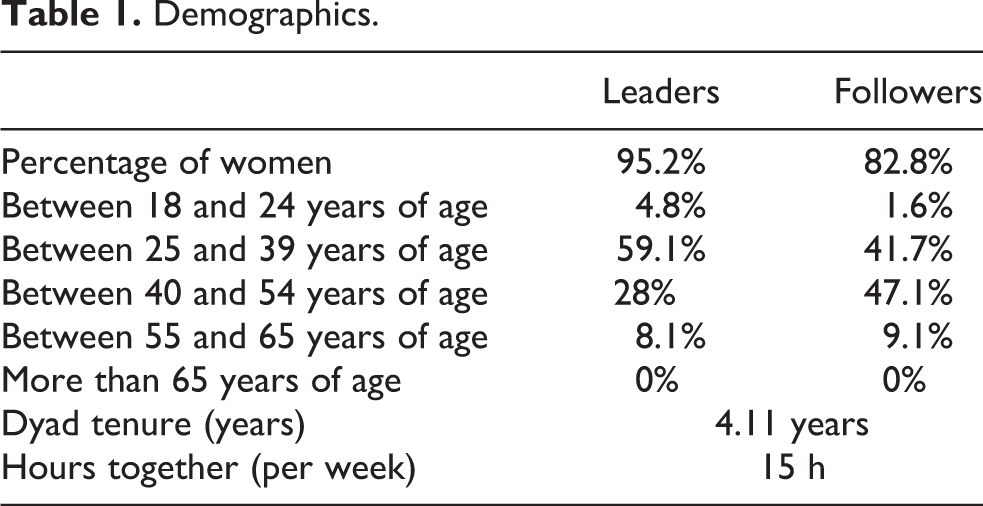
We received complete responses from 127 leaders (a 53% response rate) and 240 subordinates (a 40% response rate). The respondents filled out which kindergarten and which department in the kindergarten they were working in (all of the kindergartens consisted of different departments that were constituted depending on the children’s age). Each kindergarten and department were precoded with a unique number. As each department in the kindergartens had only one leader, this number was used to match the leader and follower responses. The samples were confined to leaders and subordinates who could be matched dyadically, arriving at a final sample of 93 leaders (39% of the initial sample) and their 186 subordinates (31% of the initial sample). The participants were informed that the survey had been approved by the Norwegian Centre for Research Data and assured them of strict confidentiality. The demographical distribution is presented in Table 1.
Demographics.
Measures
All the items were scored on 7-point Likert response scales, ranging from 1 (strongly disagree) to 7 (strongly agree) unless otherwise noted.
Work overload
To measure leaders’ perceptions of work overload, an instrument based on the role overload measure used by Shirom et al. (1997) was employed. This measure was further developed by Laurence et al. (2016) to explicitly capture work overload stemming from an organization. As noted by Laurence et al. (2016: 6), these items focus on the extent to which the leaders are “working too hard or too fast on completing too many duties and responsibilities in a work environment in which the availability of time is limited”. Sample items include “I am required by my organization/supervisor to take on too much at work” and “I have to work too fast to complete all the work that is required of me by my organization/supervisor.” The scale reliability for the present study was 0.94 (Cronbach’s alpha).
Leader psychological flexibility
For the measurement of leader psychological flexibility, the work-related acceptance and action questionnaire (Bond et al., 2013) was used, which consists of seven items. Sample items include “I am able to work effectively in spite of any personal worries that I have” and “My thoughts and feelings do not get in the way of my work.” The scale reliability for this study was 0.85.
Leader–member exchange
The most frequently utilized indicators of social exchange relationships between leaders and subordinates (e.g. LMX7) have been criticized for lacking content validity because they were created before the LMX literature became strongly associated with social exchange theory (Bernerth et al., 2007; Colquitt et al., 2014). Therefore, Colquitt et al. (2014) advocated the use of alternative scales more connected to the beliefs and sentiments that Blau (1964) used to describe social exchange relationships. In their comparison of the relative content validity of scale indicators of social exchange relationships, Colquitt et al. (2014) found a supervisor-targeted version of Shore et al.’s (2006) scale to exhibit a content-valid pattern. Accordingly, for the measurement of LMX, this 8-item supervisor-targeted version of Shore et al.’s (2006) social exchange instrument was employed. This scale has also been used to represent social LMX relationships by, for instance, Kuvaas et al. (2012). Sample items include “My relationship with my immediate supervisor is based on mutual trust” and “My immediate supervisor has made a significant investment in me.” The scale reliability for this measure was 0.83 for this study.
Control variables
Central to the pursuit of understanding the relationships among the variables in the present research is the ability to isolate the factors that explain LMX while controlling for relevant variables that may extraneously affect the hypothesized relationships. According to Bernerth and Aguinis (2016: 230), the “Identification and management of such extraneous (i.e. nonfocal) factors not only represent good science but also are essential for ensuring the generalizability that allows empirical research to benefit individuals, organizations, and society as a whole.” Accordingly, in the analyses, possible sociodemographic differences were controlled for, including age (measured on an ordinal scale ranging from 1 to 5, where 1 represented 18–24 years old, 2 represented 25–39 years old, 3 represented 40–54 years old, 4 represented 55–65 years old, and 5 represented above 65 years old) and gender (0 = women and 1 = men). Gender may, for instance, relate to different levels of work–family conflict (Greenhaus and Parasuraman, 1999; Powell and Greenhaus, 2010), which may differentially relate to the individual’s ability to develop high-quality LMX relationships at work. Furthermore, age may be associated with negative performance-related biases (Finkelstein and Farrell, 2007), which, in turn, may hinder the development of LMX, as leaders are likely to consider performance as a crucial part of LMX (Schyns and Wolfram, 2008). Finally, the length of time the leader and follower worked together (i.e. dyad tenure) as well as how much time they spent together (hours per week) were controlled for, because these variables could have implications for LMX development.
Analyses
The first step of the analyses was to conduct a confirmatory factor analysis (CFA) to examine whether the indicators sufficiently represented their hypothesized constructs. To accommodate the ordered categorical data, the weighted least squares estimator was applied (e.g. Flora and Curran, 2004) using Mplus software (Muthén and Muthén, 1998-2014). In addition, because of the hierarchical nature of the current data (i.e. subordinates were nested under leaders), CFA using cluster robust standard errors at the leader level was employed. The analyses then tested the hypotheses with the use of a two-level hierarchical linear model (with grand mean centering) via the MIXED procedure in SPSS (Statistical Package for the Social Sciences, Version 25, IBM, Corp., 2017). To further explore the nature of the estimated, multilevel, hypothesized two-way interaction, the procedure outlined by Preacher et al. (2006) was followed using the online hierarchical linear model of two-way interaction tool developed by the authors. Following Aiken and West (1991), simple slopes one standard deviation above and below the means of work overload and leader psychological flexibility were plotted.
Results
A three-factor CFA model representing work overload, leader psychological flexibility, and LMX achieved good model fit (χ2 [167] = 196.79, n.s.; root mean square error of approximation = 0.04; comparative fit index = 0.98; Tucker–Lewis index = 0.98). The factor loadings ranged from 0.86 to 0.96 for the work overload items, from 0.57 to 0.84 for the leader psychological flexibility items, and from 0.43 to 0.89 for the LMX items. Please see Table 2 for descriptive statistics and intercorrelations among the study variables and Table 3 for survey items and CFA results.
Descriptive statistics, correlations, and scale reliabilities.
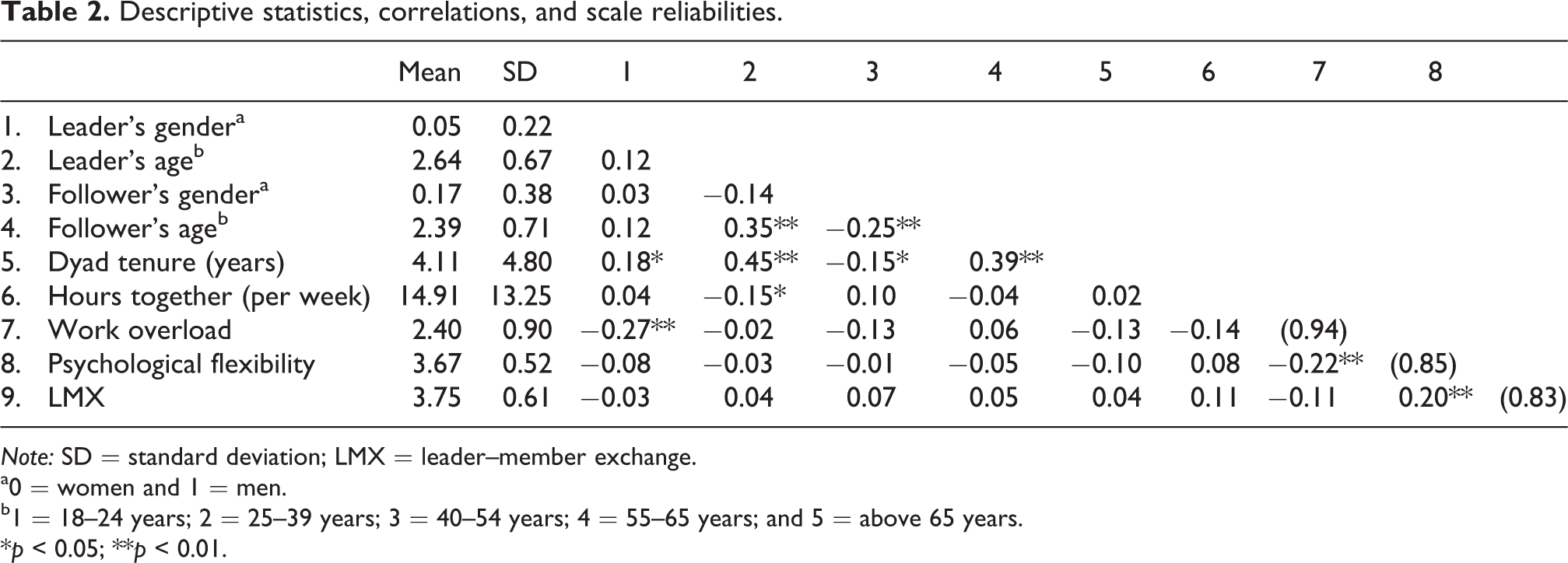
Note: SD = standard deviation; LMX = leader–member exchange.
a0 = women and 1 = men.
b1 = 18–24 years; 2 = 25–39 years; 3 = 40–54 years; 4 = 55–65 years; and 5 = above 65 years.
*p < 0.05; **p < 0.01.
Items and factor loadings for each of the latent factors in the estimated three-factor CFA.
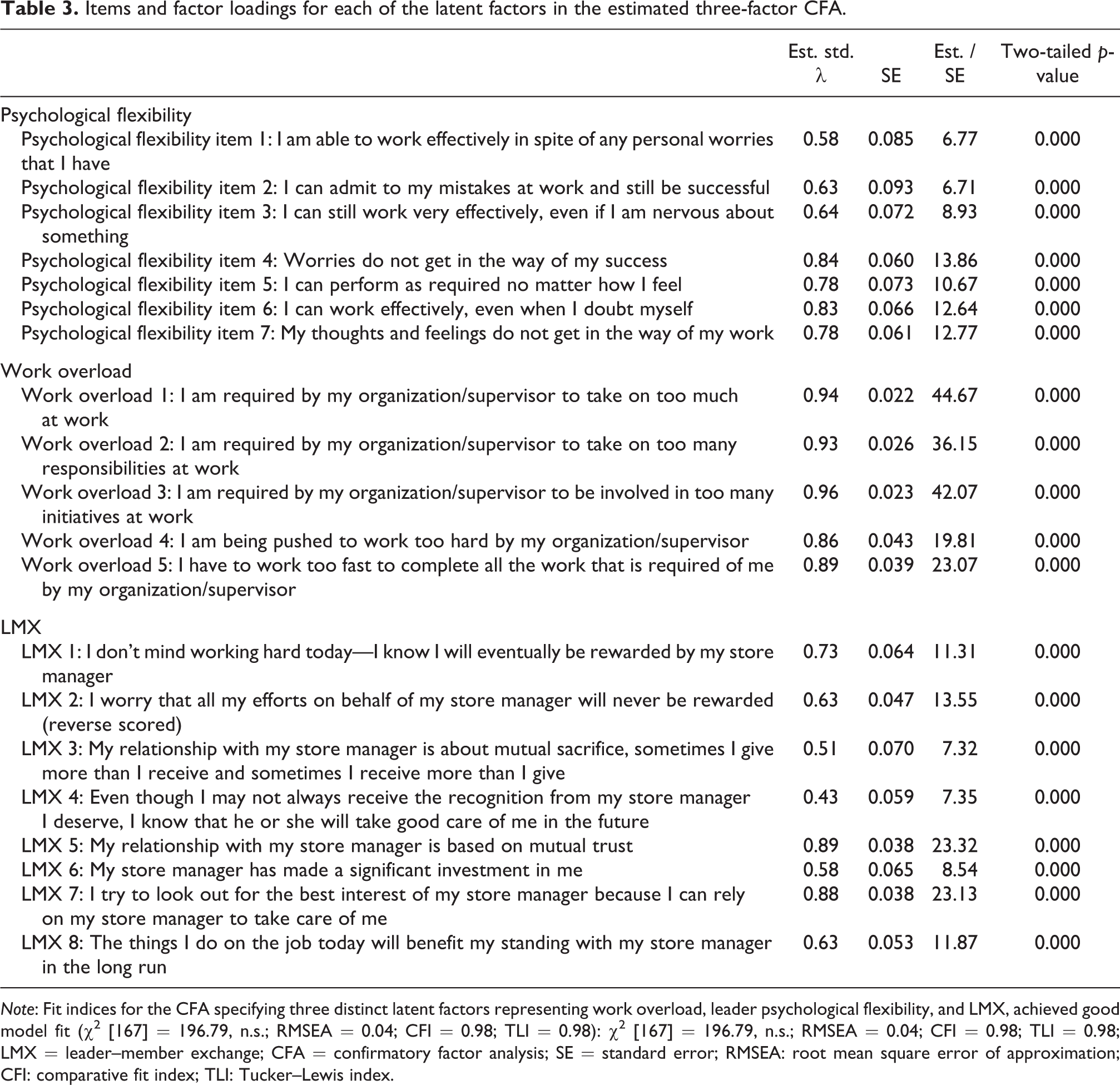
Note: Fit indices for the CFA specifying three distinct latent factors representing work overload, leader psychological flexibility, and LMX, achieved good model fit (χ2 [167] = 196.79, n.s.; RMSEA = 0.04; CFI = 0.98; TLI = 0.98): χ2 [167] = 196.79, n.s.; RMSEA = 0.04; CFI = 0.98; TLI = 0.98; LMX = leader–member exchange; CFA = confirmatory factor analysis; SE = standard error; RMSEA: root mean square error of approximation; CFI: comparative fit index; TLI: Tucker–Lewis index.
The results of the multilevel analyses are reported in Table 4. Contrary to the first hypothesis, a statistically significant negative relationship between leader perceptions of work overload and follower perceptions of LMX (γ = −0.06, n.s.) was not observed when controlling for gender, age, dyad tenure, and number of hours spent together (see Table 4, Step 1). Accordingly, Hypothesis 1 was not supported. The hypothesized direct relationship is, however, qualified by the statistically significant interaction term (γ = 0.30, p < 0.01), which suggests that the relationship between leader perceptions of work overload and follower perceptions of LMX is moderated by leader psychological flexibility.
Multilevel analyses using SPSS mixed.
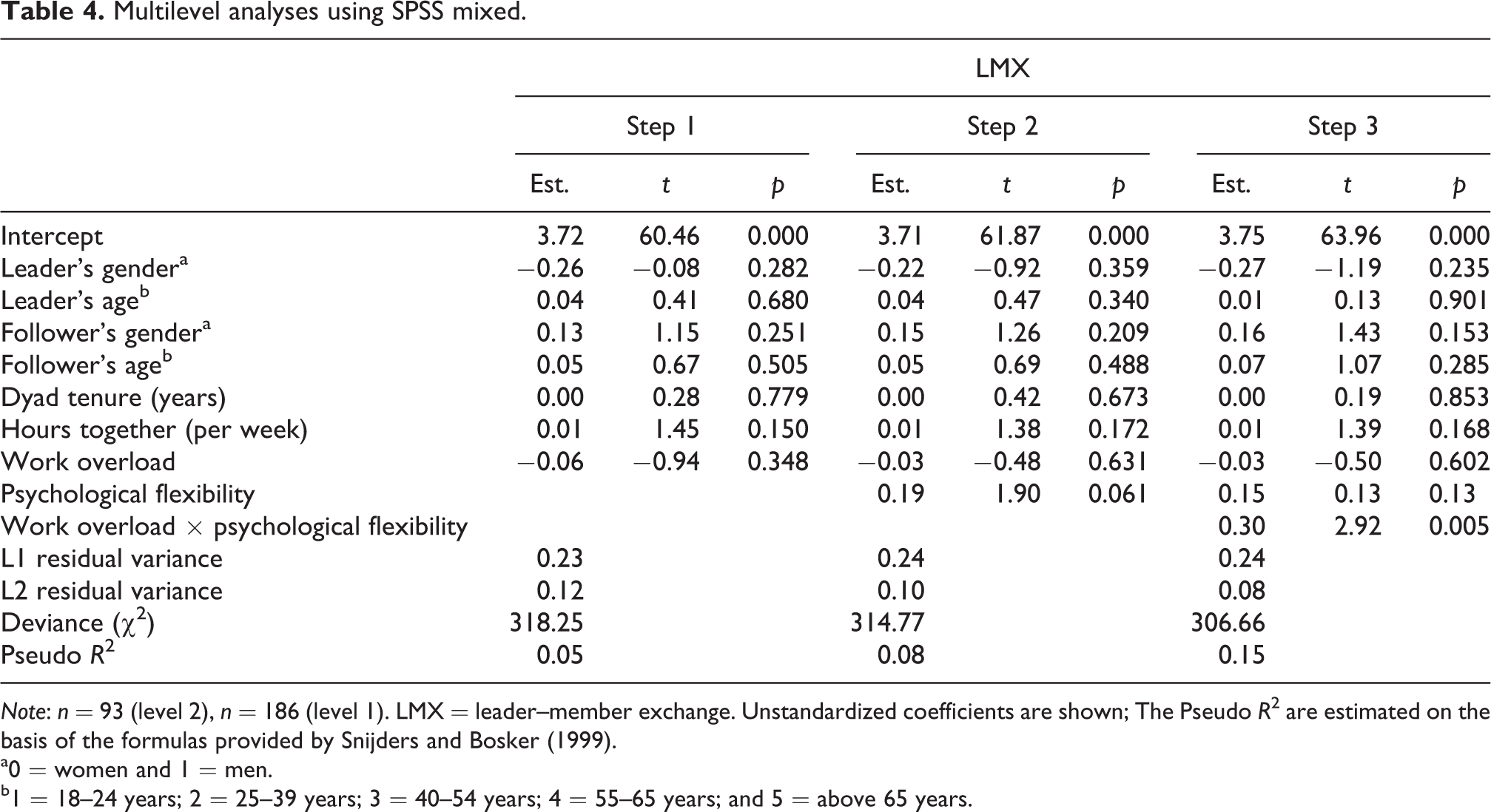
Note: n = 93 (level 2), n = 186 (level 1). LMX = leader–member exchange. Unstandardized coefficients are shown; The Pseudo R2 are estimated on the basis of the formulas provided by Snijders and Bosker (1999).
a0 = women and 1 = men.
b1 = 18–24 years; 2 = 25–39 years; 3 = 40–54 years; 4 = 55–65 years; and 5 = above 65 years.
Figure 1 demonstrates the nature of the moderated relationship. For leaders with low psychological flexibility, work overload was significantly and negatively related to follower perceptions of LMX (γlow = −0.19, p < 0.05). However, for leaders with high psychological flexibility, the relationship between work overload and LMX was not statistically significant (γhigh = 0.12, n.s.). Accordingly, the present study supported Hypothesis 2.
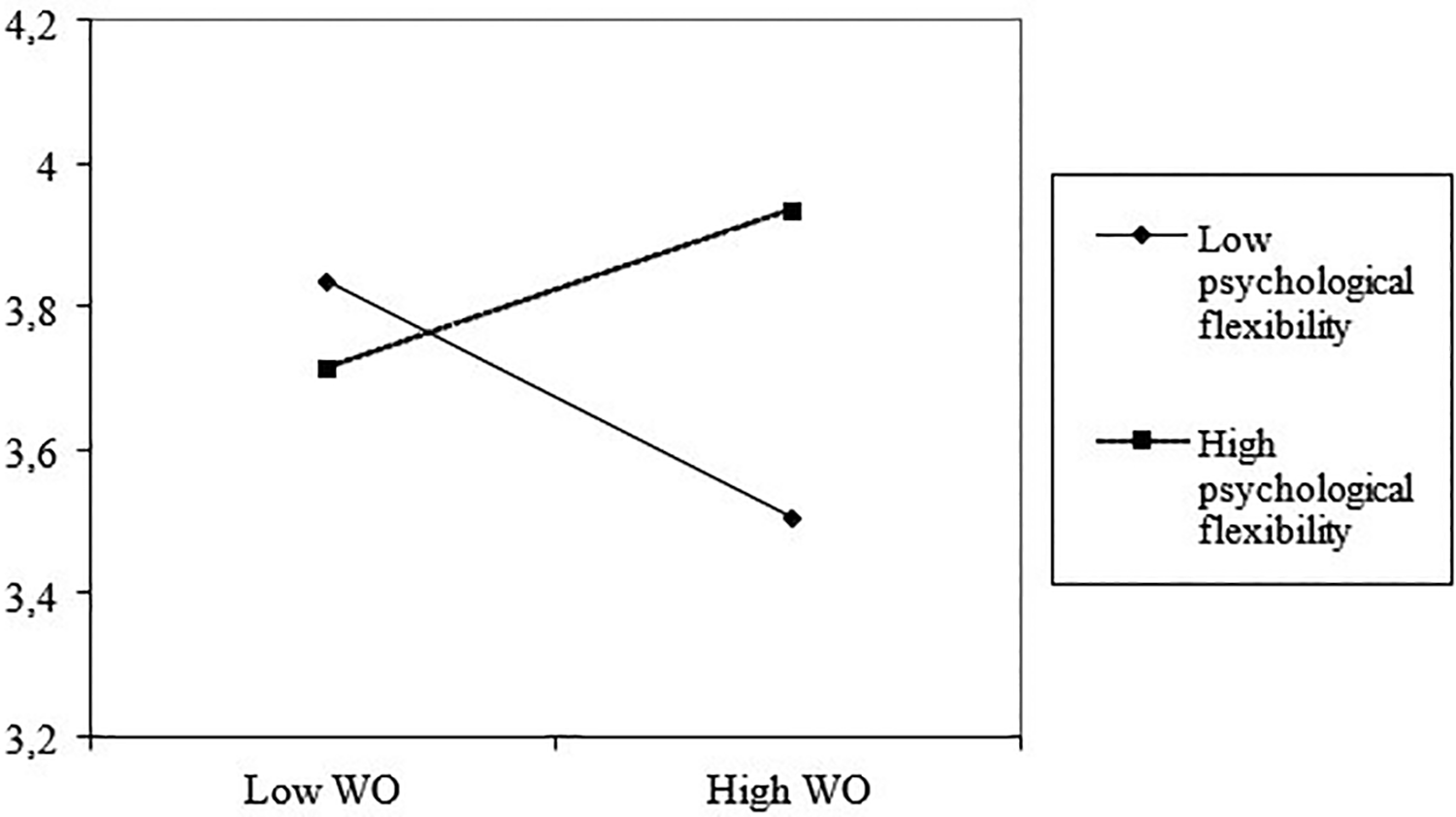
The moderating role of leader psychological flexibility on the relationship between work overload and leader-member exchange.
Discussion
The current study explored leaders’ perceptions of work overload as an antecedent of the quality of LMX relationships and whether leaders’ level of psychological flexibility buffers this association. Thus, the purpose of this study was to contribute to a more complete understanding of factors that relate to the development of high-quality LMX.
Although the results of the present study did not indicate a direct link between leader perceptions of work overload and follower LMX, the proposed direct relationship was qualified by an interaction. Specifically, the direct relationship between work overload and LMX was moderated by psychological flexibility, suggesting that, although work overload is detrimental to leaders’ abilities to develop and maintain high-quality social exchange relationships with their subordinates, it is less detrimental to those with higher levels of psychological flexibility. Rather, for leaders with higher levels of psychological flexibility, work overload was not linked to follower perceptions of LMX. These findings should have several important contributions to the extant literature, which are discussed in the following.
Implications for theory
The observed negative relationship between work overload and LMX only for leaders with lower psychological flexibility suggests that leaders who are more psychologically flexible are less prone to the negative effects of having too many work demands and too little time to meet them. These findings, therefore, imply that leaders with higher levels of psychological flexibility are better equipped to engage in long-term mutually committed social exchange relationships with their subordinates, independent of their level of perceived work overload. This result implies that psychological flexibility serves as a buffer or a boundary condition for the negative impact of work overload.
This is an important observation, as many dyads do not advance much beyond low-quality LMX (e.g. Buch et al., 2016). Hence, identifying factors that contribute to the development of high-quality LMX relationships in organizations is essential. As such, this finding should contribute to the LMX theory by unveiling how and when leader perceptions of situational determinants influence the quality of LMX relationships. This finding also helps clarify the confusion regarding whether work overload serves as a positive or negative antecedent of high-quality LMX relationships (cf. Green et al., 1996; Kinicki and Vecchio, 1994) by addressing a boundary condition for these associations.
The findings of this study align well with those from previous research, which have indicated that psychological flexibility is an individual resource in buffering the relationship between work overload and severe work-related outcomes (Biron and van Veldhoven, 2012). Psychologically flexible leaders probably have more energy with which to deal with work demands, as they do not spend their resources on regulating their emotional reactions. This is in line with the assumptions of both COR theory and social exchange theory. COR theory posits that experiencing high resource levels should lead to positive human functioning and the reinvestment of resources (e.g. energy and time) into the work environment stress (cf. Alarcon, 2011; Hobfoll, 2002). In fact, individual resources have typically been thought of as health-promoting resources in that they contribute to positive health, even in high-demand work situations (cf. Demerouti et al., 2001). Furthermore, in line with social exchange theory and related findings, resources can be received from one relationship and, in turn, be offered to other relationships (Erdogan et al., 2007; Molm et al., 2001). The findings of this study indicate that the stressors experienced in one relationship (i.e. work overload) can be transferred to other relationships by leaders who are less psychologically flexible. Thus, these findings may also imply that leaders with lower levels of psychological flexibility are deprived of resources from their work environment (i.e. experiencing work overload) and, in turn, have less resources to invest in their relationships with their subordinates. Leaders who have lower levels of psychological flexibility and who also experience work overload are less able to protect their subordinates from their experiences of stress derived from work overload. In this case, the leader lacks a vital internal resource that would aid them in acting according to goals or values, and as a result, it is more likely that the leader will not be able to protect their relationships with their subordinates from the strain related to the leader’s role.
The findings of this study are thus consistent with the premise of the ACT model of effectiveness (Hayes et al., 2006), in which psychological flexibility allows people to let go of ineffective ways of dealing with unwanted thoughts and feelings. For example, in this study, such thoughts and feelings center on the negative stress resulting from work overload. Psychologically flexible leaders who experience work overload are able to stay in contact with the present moment, regardless of other pressing demands. They are better able to accept negative internal experiences so that they can still act according to held values and goals (e.g. high-quality LMX relationships).
Psychological flexibility is also a characteristic that allows the leader to mobilize the resources necessary to ensure that the employee is not affected by the leader’s experience of work overload. This interpretation agrees with the assumptions that psychological flexibility facilitates actions that are consistent with the leader’s values and goals (Bond et al., 2013).
Implications for practice
Because LMX may be hard to develop due to the limited time and resources of both subordinates and leaders (see also Bauer and Erdogan, 2016) as well as personality differences, style differences, and so forth (Breland et al., 2007; Uhl-Bien, 2003), it may be argued that organizations can draw upon the findings of the present study and tailor their selection practices towards more psychologically flexible leaders. More specifically, the results of this study suggest that psychological flexibility can reduce some of the side effects of leaders’ perceived perceptions of work overload, that is, a seemingly lower ability to develop high-quality LMX. This, however, would represent the psychologization of a work-related social problem. That is, when placing the responsibility of mastering a highly problematic work situation (i.e. high degree of work overload) on the individual, the organization may fail to fulfill its obligations to ensure the health and well-being of their subordinates.
The findings of this study show that leaders’ perceptions of work overload may damage the quality of the social exchange relationship that leaders have with their subordinates and may thus represent a serious challenge for practicing positive leadership behaviors. Therefore, a primary concern for organizations would be to (re)consider the workload they place on their leaders, given the negative consequences of leaders not engaging in positive leadership behaviors (cf. Harms et al., 2017; Lam et al., 2017). This implies reducing the time pressure and number of tasks that organizations place on their leaders, including reducing the requirements for how hard and fast the leaders must work in a limited timeframe (e.g. Karasek, 1979; Shirom et al., 1997). Another practical implication of the findings of this study concerns the content of leadership development. As discussed by Harms et al. (2017), leadership development programs could benefit from a stronger focus on addressing the stress factor of leadership. This is especially important because stress-related variables influence leadership behavior perceptions in a negative way, which, in turn, has severe effects on subordinates. Of particular interest relevant to the present findings is that psychological flexibility can be trained through ACT and can thus improve mental health and stress management (c.f. Hayes et al., 2006). Thus, it could be helpful for organizations to increase their leaders’ flexibility through leadership development programs to ensure that the stress experienced in leadership roles does not negatively affect employee well-being. Such training programs would align well with previous research that has indicated that psychological flexibility mediates the relationship between ACT stress management intervention (e.g. Bond and Hayes, 2002) and health and innovation (Bond et al., 2000). Similar results were also found by Hayes et al. (2004).
Limitations and future research
Although this study involves potentially important theoretical and practical contributions, the present results need to be interpreted in light of its potential limitations. First, the present results cannot infer causal relationships between the variables or rule out reverse causality because of the cross-sectional nature of the data. For those purposes, future experimental studies are necessary (Shadish et al., 2001).
Second, this study assesses only the subordinates’ and not the leaders’ perceptions of LMX. Nevertheless, the recommendations for the one-time measurement of LMX and the measuring of LMX from the perspective of the subordinates due to the increased likelihood of leaders answering in a socially desirable way was followed (i.e. treating all subordinates the same way (Graen and Scandura, 1987; Howell and Hall-Merenda, 1999)). Additionally, measuring leader workload and follower LMX from different sources can be considered a strength of the present study since it reduces the potential common method bias (Podsakoff et al., 2003). Nevertheless, because leaders’ and subordinates’ perceptions of the relationship have frequently been found to differ (e.g. Sin et al., 2009), future research should measure both leaders’ and subordinates’ perceptions of LMX.
Similarly, strength of this investigation is the inclusion of measures from different sources. The inclusion of the predictor measure (i.e. leaders’ work overload) from one person and the criterion measure (i.e. subordinates’ perceptions of LMX) from another is a highly recommended way of controlling for method bias (Podsakoff et al., 2012). Nevertheless, future research should ideally measure leaders’ perceptions of work overload and follower LMX independently and include a temporal gap between their measurements.
Finally, due to the nature of the sample used in this study, the generalizability may be constrained, as the sample mainly consists of female workers employed in a public service sector in Norway. Accordingly, the generalizability of the present findings across countries, culture, sectors, and gender is not yet clear. Nevertheless, Dulebohn et al. (2012) did not find that either country or work setting produced any meaningful influences on the relationships in their recent meta-analysis on the antecedents and outcomes of LMX.
Beyond improving the research design and conducting similar studies across other cultures, countries, and occupations, it would be interesting for future research to investigate employee-based factors that may influence the relationships explored in the present study. For example, previous research has found that the individual characteristics of the employee influence the relationship between the leader and the employee (cf. Dulebohn et al., 2012). Thus, the psychological flexibility of the employee may play a role in the subordinates’ experience of LMX when the leader is experiencing work overload.
Conclusions
A significant amount of research exists that demonstrates the links between follower perceptions of LMX and important follower outcomes (Dulebohn et al., 2012; Gerstner and Day, 1997; Ilies et al., 2007; Rockstuhl et al., 2012). Although much can be learned from this literature, much less is known of the predictors of the different types of relationships that leaders and subordinates develop (Nahrgang and Seo, 2016).
The present research contributes in this regard by demonstrating that situational characteristics are of importance for leaders with lower psychological flexibility regarding the management and development of high-quality relationships with their subordinates. In short, developing high-quality social exchange relationships between leaders and subordinates is a highly complex matter that is influenced by factors that may be difficult to control. Therefore, the development of personal resources is of vital importance for leaders to buffer the potential negative impact of their heavy workload on their relationships with their subordinates (Snijders and Bosker, 1999).
Footnotes
Declaration of conflicting interests
The author(s) declared no potential conflicts of interest with respect to the research, authorship, and/or publication of this article.
Funding
The author(s) received no financial support for the research, authorship, and/or publication of this article.
