




Abstract
During the First World War, trench newspapers regularly printed parodies of natural history, depicting servicemen as half-human, half-animal creatures. These parodies present a new angle on the role that trench newspapers played in articulating servicemen's senses of identity, in relation both to the experience of joining the military and to human identity in a time of war. Servicemen present themselves simultaneously as estranged war-zone beings and as expert guides to an exotic realm, negotiating complex tensions between alienation and communication, and offering alternative pictures of the war zone to those that have become most familiar. The parodies indicate the representational value of humorous modes for depicting nuanced aspects of servicemen's experiences of the First World War. In using humorous tropes that first arose in response to nineteenth-century scientific advances, in addition, the parodies suggest a new strand to the cultural history of the trench press.
By 1917 the trope of nature offering redemption after battle was sufficiently clichéd that John Galsworthy could make a joke of it in his play The Foundations. When a sensationalist reporter comments after a riot that ‘far up in the clear summer air the larks were singing’, a shell-shocked ex-serviceman suffers an involuntary flashback to his wartime past: ‘[Blinking] Those infernal larks! Thought we were on the Somme again!’ 2 Similarly to Galsworthy's moment of satire, the literary responses to the conflict that are discussed in this article, in part because of their humour, sit outside the most familiar narratives of the natural world in the Great War. The parodies of natural history writing that servicemen published in trench newspapers present military personnel as a population of ‘war-zone creatures’, creatures that are not defined as human animals or non-human animals, but instead by the particular nature of the war-zone space they inhabit. 3 What emerges are pictures of the war zone that are more populous and more vibrant than are celebrated images of landscapes made barren and alien by the destructive forces of mechanised warfare, such as those found in the paintings of Paul Nash and Wyndham Lewis, and more comical and fantastical than are the famous ironising contrasts between devastation and pastoral idyll found perhaps most prominently in Edmund Blunden's poetry and in elements of Wilfred Owen's work, such as ‘Spring Offensive’.
The parodies present unique and frequently surprising perspectives on servicemen's experience. These texts reveal much about how servicemen viewed their environment, about what involvement in the conflict meant for servicemen's personal identity and sense of humanity, and about how servicemen envisaged their relationship with those outside the war zone. That such important records of military life rely on humour can, furthermore, trouble some assumptions about the depiction of the Great War that remain ingrained. The canon of First World War literature still tends to centre on gravity, but the parodies discussed here indicate that humour can be an evocative representational tool. The particular structure of the humour in the parodies aptly negotiates the war zone's effects on identity, conveying aspects of war experience that may escape solemn modes. It is because, not in spite, of humour that the parodies have a representational power, a historical insight, and a philosophical weight that should not be overlooked.
Previous studies of trench newspapers have established the role these publications played in helping servicemen to tolerate service; have used trench newspapers as evidence that institutions and attitudes from civilian life continued at the front; and have suggested that trench newspapers aided the process of building effective martial personnel. 4 This article adds granularity to understandings of trench newspapers’ literary and emotional roles, draws out the specific representational significance of their humour, and puts forward a new point of view on how writers during the war responded to the war zone as an environment.
The first section explains how soldiers use the parodies to describe themselves, in faux-academic style, as a series of strange species of creature. Servicemen explore and express how they might categorise themselves in response to the identities presented by military life, and how these identities separate them from other people. Other texts – for example works by Saki and Helen Hamilton – are also included as relevant examples of how relations between humans and non-humans featured in Great War literature more broadly.
The second section elucidates why the particular, Schopenhauerian, brand of humour in the parodies, in combination with their particular structure (lists of different creatures), works to trouble different hierarchies and taxonomies, including military hierarchies, but also the categories of human animal and non-human animal. The parodies are human-focussed; they are not ecocentric but instead see servicemen use animals as vehicles for exploring the war's effects on themselves. 5 Even so, to borrow from Derrida's perspective, explored in more detail below, the texts generate plurality or ‘thickness’ at the limit between humans and non-humans. These destabilised boundaries, brought about by the war, decentre the human and instead create an impression of a population of war-zone creatures – soldiers are portrayed as belonging to a hybrid human-animal world. This is not necessarily hostile to non-combatants, who do not belong to the war zone, but is rather a matter of servicemen presenting themselves as expert guides to an exotic environment; they are not entirely separate from those outside the war zone, but create an identity that is in part predicated on a communicative role. 6
The third section demonstrates how the parodies draw on and update well-established traditions of literary humour, identifying a new strand to the origins of the trench press. The nineteenth and early-twentieth centuries had seen similar parodies produced, for example, in response to Darwin's work. By making use of such precedents to express the strangeness of the war zone, servicemen produced a tension between familiarity and alienation.
Humorous Relations Between Humans and Non-Humans
Trench newspapers, despite what their name suggests, were produced by a range of units from a range of locations, both at the front and from training camps, and different titles vary wildly in their quality of production. The contents of the papers are however strikingly similar, with parody being an especially widespread feature. The entire genre is arguably a parody of the professional press. Contributors wrote spoofs of popular songs, of war reportage from the press in Britain, and of specific literary texts by well-known writers. Particularly popular were parodies of The Rubaiyat of Omar Khayyam, Samuel Pepys’ diary, Kipling's work (especially ‘If’), Shakespeare, Sherlock Holmes stories, and Henry Wadsworth Longfellow's The Song of Hiawatha. 7 Also common were mock answers to correspondents, adverts, and unit news. 8 So compelling was parody to those who produced the papers, in fact, that they chose to re-write pre-1914 music-hall songs for the wartime context rather than reprinting songs that were written specifically about the war. Twenty-five per cent of the 921 music-hall pieces from the 1915–18 period that are identified in John Mullen's work had the war as their main theme. These addressed ‘rationing, conscription or the new tanks’, just as ‘before the war they had sung about suffragettes, automobiles and the introduction of national insurance’. Despite this, there is a strong preference in trench newspapers for creating parodies of older songs. 9 The popularity of parody indicates a strong sense of connection to aspects of culture with which soldiers were well acquainted before the conflict, with a large part of the enjoyment of parody seemingly stemming from recognition of the familiar. At the same time, there is pleasure to be found in divergence from the well known, from the process of updating a famous work. It is such simultaneous rendering of the strange and the familiar that is central to the natural history parodies that appear in trench newspapers.
Natural history and anthropological study are repeatedly sources of parody across the trench-newspaper genre. Typically these parodies involve servicemen being described as if they are non-human animals or as if they are obscure ancestors of the human race. A particularly good example is a text entitled ‘Natural History Notes’ that was published by a writer pseudonymously known as ‘Compound’ in the Lead-Swinger, the newspaper of the Third West Riding Field Ambulance. Compound describes the ‘Sergentius Majoris’, the ‘Corporalis Cooke’, ‘Cow’, and the ‘Chat [louse]’. 10 These creatures are illustrated in the article by a serviceman called Alf Jackson (Figures 1–4), who wrote under the pseudonym of ‘Pipsqueak’, and who later worked for Punch. 11 At the end of the article Pipsqueak also provides an image of a serviceman catching a rat while fishing. The serviceman is not described in the text but has elongated limbs and, it appears, webbed feet, adding him to the ranks of the odd creatures he accompanies (Figure 5).
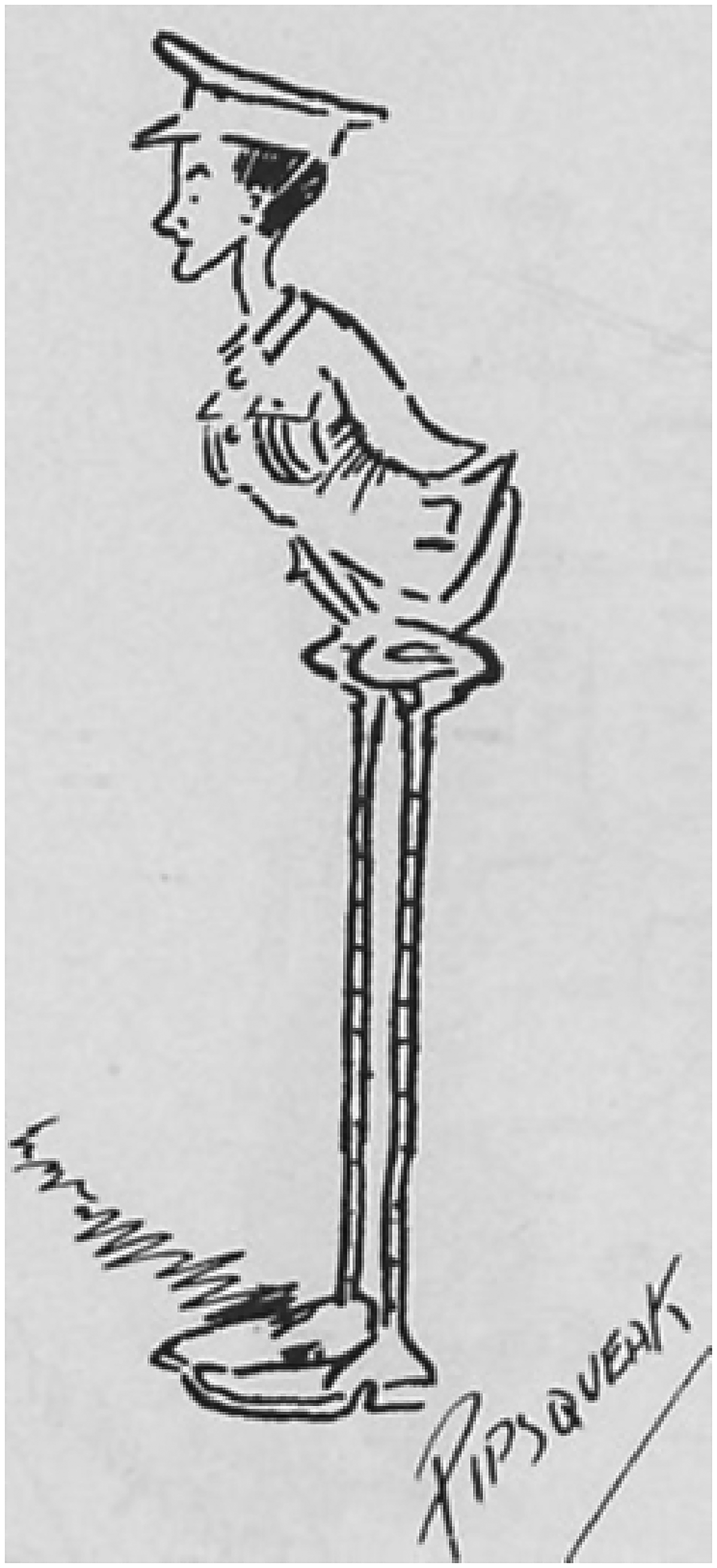
Sergentius marjoris. ‘Natural History Notes’, Lead-Swinger, 6 November 1915, pp. 16–18 (p. 16). Image published with permission of ProQuest. Further reproduction is prohibited without permission.
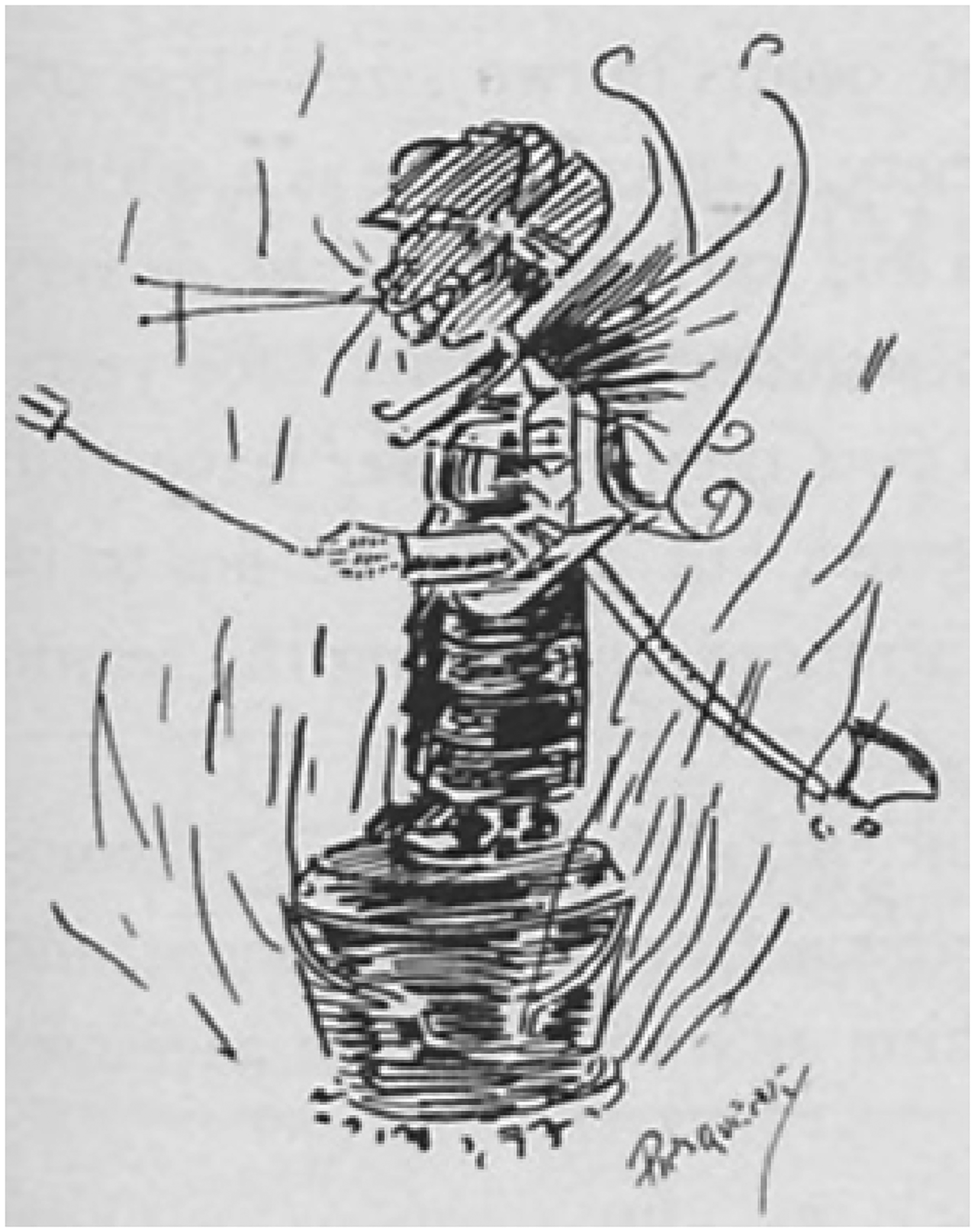
Corporalis cooke. ‘Natural History Notes’, Lead-Swinger, 6 November 1915, pp. 16–18 (p. 17). Image published with permission of ProQuest. Further reproduction is prohibited without permission.
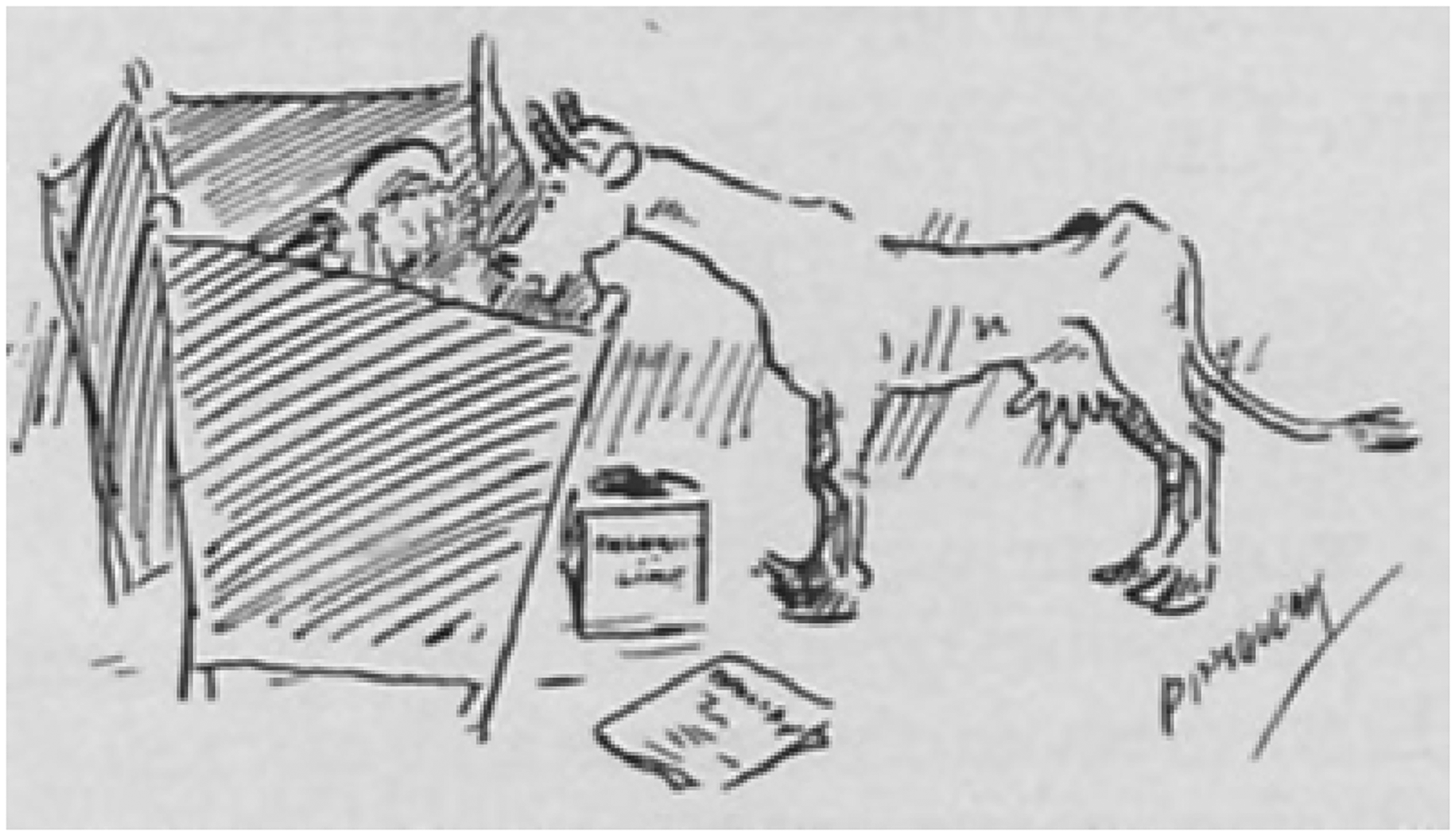
Flemish Cow. ‘Natural History Notes’, Lead-Swinger, 6 November 1915, pp. 16–18 (p. 17). Image published with permission of ProQuest. Further reproduction is prohibited without permission.
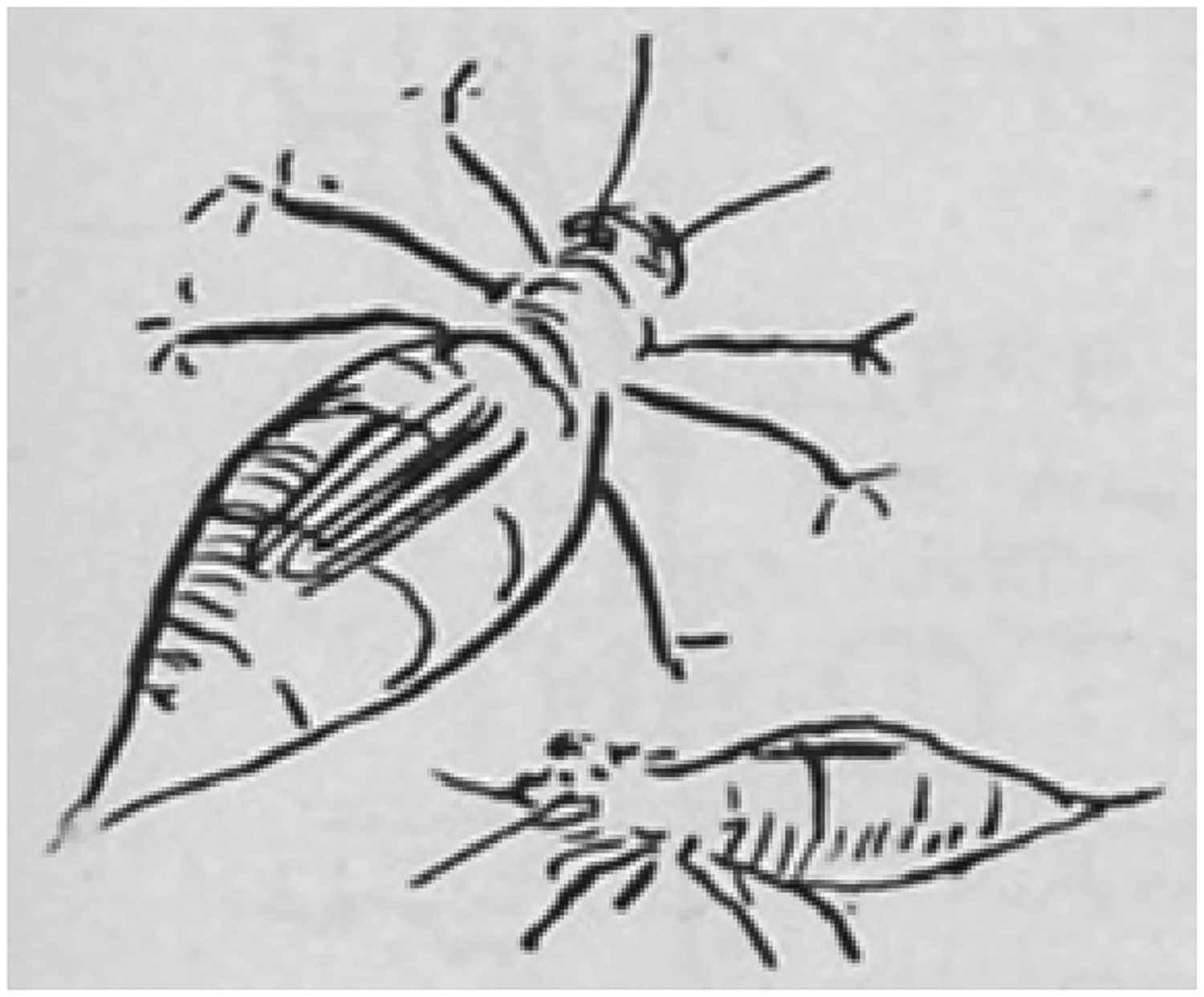
The chat. ‘Natural History Notes’, Lead-Swinger, 6 November 1915, pp. 16–18 (p. 17). Image published with permission of ProQuest. Further reproduction is prohibited without permission.
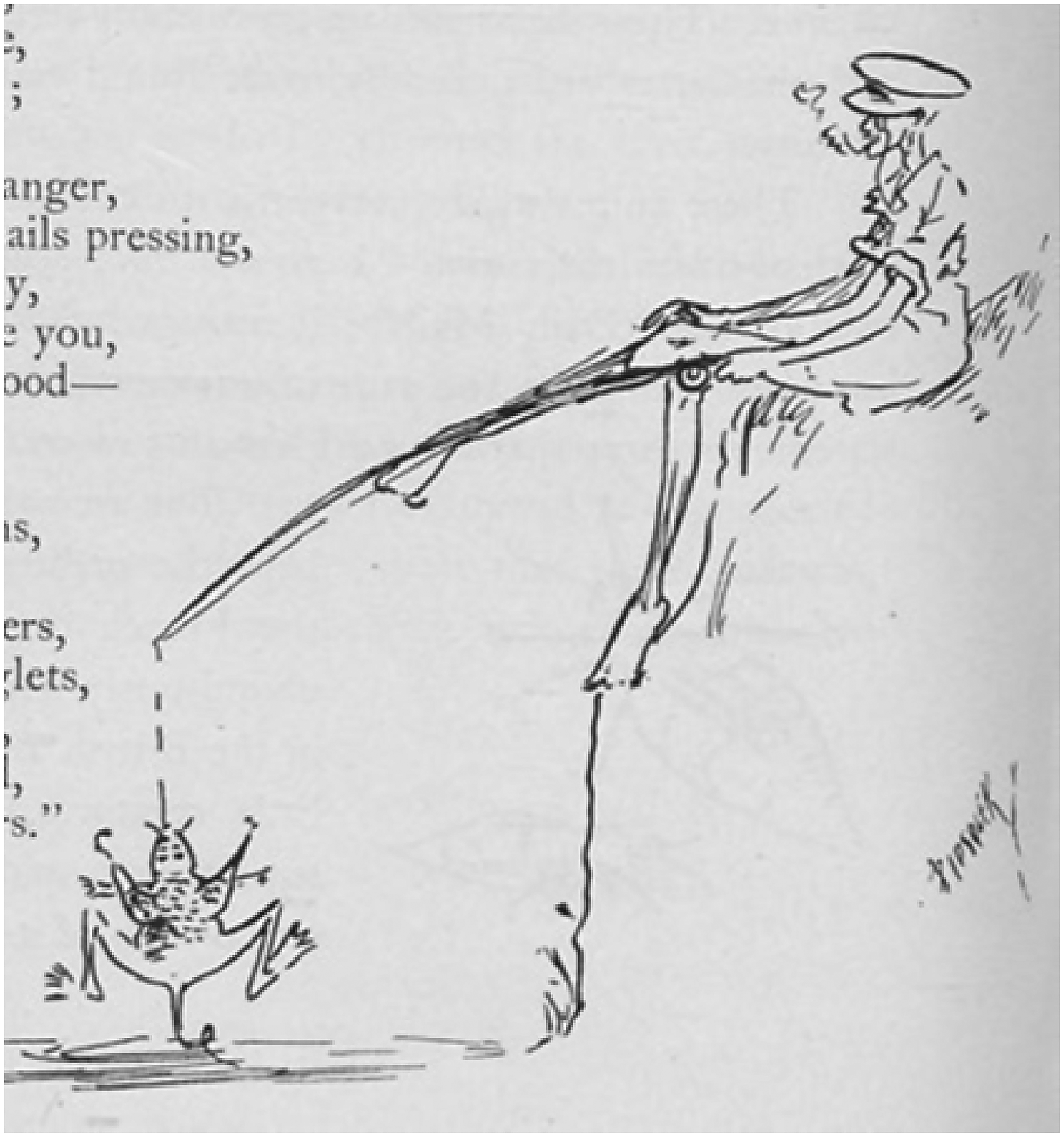
‘Natural History Notes’, Lead-Swinger, 6 November 1915, pp. 16–18 (p. 18). Image published with permission of ProQuest. Further reproduction is prohibited without permission.
The Sergentius Majoris is a ‘biped indigenous to the British Isles, having only in recent times migrated to the continent’. 12 The Corporalis Cooke is a ‘little animal’ that ‘well repays investigation, as it is full of quaint tricks and guilefulness’. 13 He ‘inhabits warm places, and when domesticated is often to be found in kitchens’. 14 The ‘Flemish cow’ lives ‘chiefly on paper and chloride of lime’, 15 and the Chat, ‘whose claim to popularity is perhaps the greatest’, is ‘a miniature quadruped found ubiquitously here’. 16 The Chat ‘occurs in two sizes – big and bigger – the latter being the more common variety’, and ‘he is very affectionate’. 17
The Gambardier, the newspaper of the Royal Garrison Artillery at Landguard Fort, devoted a column in 1915 to a similar joke. It describes the ‘Garrison Gunner (Ballisticus Ubique)’, a ‘biped of nocturnal habits although he displays certain activities during the daytime’. 18 He is ‘gregarious in his mode of life and herds together in groups which are known as Reliefs or Detachments according to their size’, the ‘chief of the Herd being usually selected for his superior cunning and ferocity’. 19 The Helm, produced by the crew of H.M.S. Britannia, gave similar treatment to the ‘Pilot’, the ‘Deluge’, and the ‘Squirt’. The latter, for example, is ‘An authority on pipes and tubes; can guage [sic] a glass with mathematical precision; knows capilliary [sic] attraction of most ordinary fluids and some extraordinary ones’, and ‘Knows one (?) good story – can sing (?)’ 20 The linesman appears in Fag Ends, the publication of a Royal Navy Signals Unit, as an ‘animal’ that is ‘somewhat amphibian’; he ‘occasionally’ does stunts on horseback and ‘at other times pad[s] the hoof like an ordinary human’. ‘[L]ines and all concerning them are the excuse for his existence’. 21 A poem entitled ‘The Sapper’, meanwhile, though not a parody of natural history writing specifically, adopted a similar theme. The Sapper is ‘a strange, but useful creature’: ‘Sometimes you’ll find him burrowing | Just like a little mole’; ‘He’ll dig or saw, and hammer nails’. 22 The poem appeared in the Dump, the newspaper of the 23rd Division of the British Army. The joke in each of the examples discussed thus far relies on a kind of humorous defamiliarisation – a making absurd of that which is well known. The texts described highlight recognisable features or stereotypes associated with those undertaking particular military roles, or in some cases, it would appear, they highlight features of an individual recognisable to those who know him. The familiar, though, is picked out in order to be made odd, creating a mixture of the in-joke and the absurd. There is a mirroring of the form of trench-newspaper parody – of the way in which parody sees a familiar text made strange via adaptation for a new context.
The parodies of anthropological and archaeological study that were also popular in trench newspapers include two mock reviews published in the Hangar Herald, the periodical produced by a logistics unit of the Army Service Corps. The first volume under review, entitled ‘The Hut Dwellers’, is by ‘Professor A. Fair Nayler’, dated ‘January 23rd 2915’. He describes an ‘interesting race of Riverside Dwellers’ who ‘flourished about 1914’. He ‘has been compelled to admit that he has no solution to offer as to their origin unless it be that they for some reason emigrated from the group of Northern Isles known as England or Jingoland’. The lives of these people ‘centre round a large building on which the letters Y.M.C.A. can still be traced’. The ‘assumption is […] that these people were heathen and the building in question was probably used for the celebration of their barbaric rites’. 23 The second review is of ‘Cage Denizens in Alcoholia’, a ‘very interesting and highly scientific work’. The ‘Author spent many months with the inhabitants of Alcoholia who live in a highly charged spiritual atmosphere’. He carried out blood tests on the inhabitants of the land and ‘has proved that the chemical composition and even appearance of the blood of this people is almost identical with what is known as “Jamaica Rum”’. 24 Similarly, the Gehenna Gazette, the newspaper of the Inns of Court Officer Training Corps, reported in 1917 on the ‘Icy Ohticee’, a ‘strange tribe of human beings’ discovered by ‘Dr. Ethnol O’Gist’. They ‘dwell in primitive houses made of cloth hung from a thick pole’. Their ‘habitat [emphasis in original] is called Bear Camp Stead. They wear a single-hued apparel of brown’. The ‘community, which consists only of men’, is ‘divided into novitiates and elders’ and ‘rises five minutes before the sun and spends the day at rites, genuflexions, and propitiations’, including worship of ‘the god of Alignment’: the ‘people put out in front of their dwellings every article they possess and arrange them in straight lines’. 25 The article emphasises that ‘Before the novitiates pass to the dignity of elders they must be able to worship the gods with a degree of proficiency that satisfies the Chief High Priest’. 26 It includes large, detailed illustrations showing the development of the devil-like beings described from ‘Raw Material’, to ‘Trussed and Plucked’, ‘Parboiled’, and ‘The Finished Article’ (Figures 6–9).
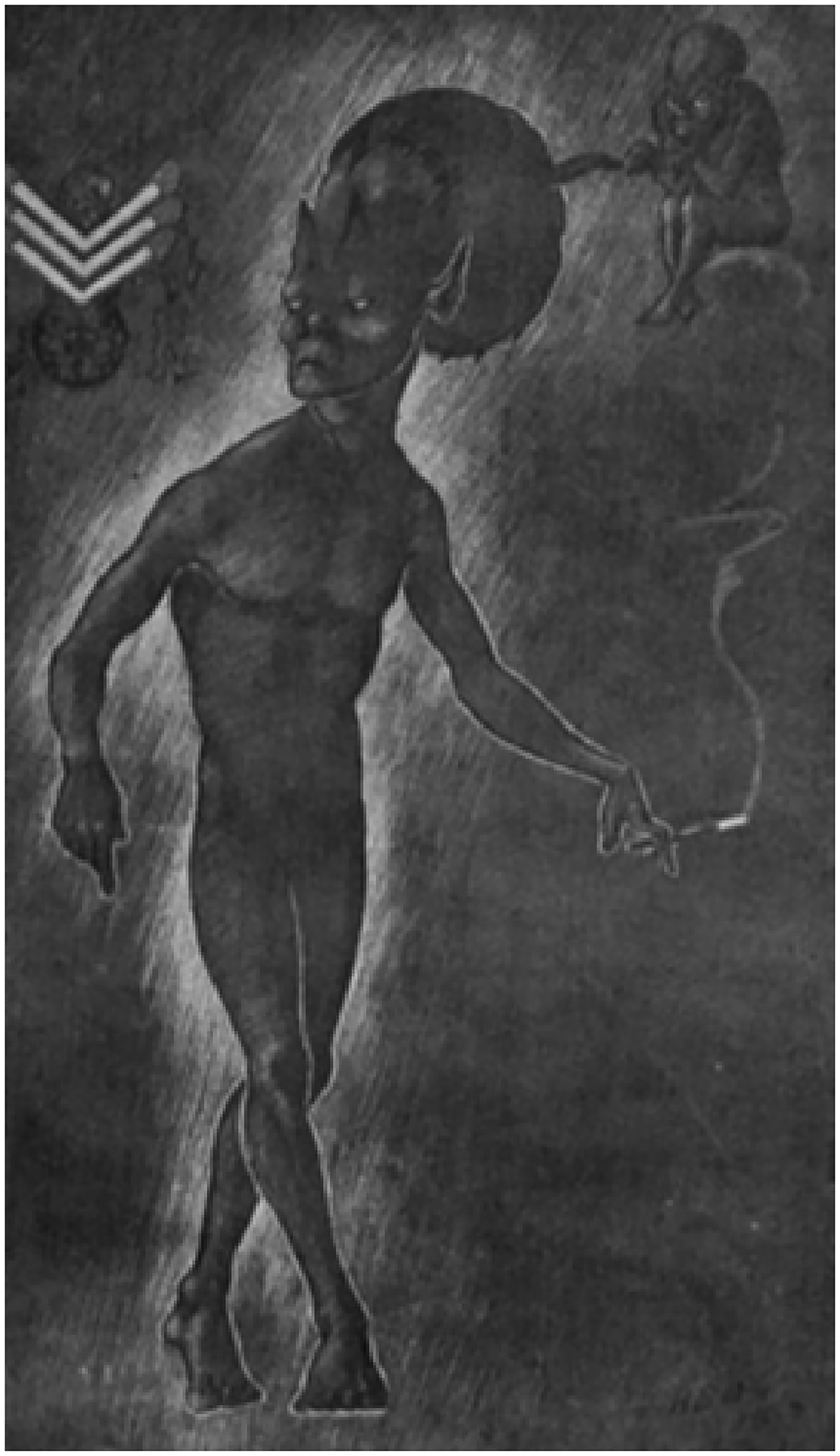
Raw material. ‘The “Icy Ohticee”’, Gehenna Gazette, August 1917, pp. 20–21 (p. 20). Image published with permission of ProQuest. Further reproduction is prohibited without permission.
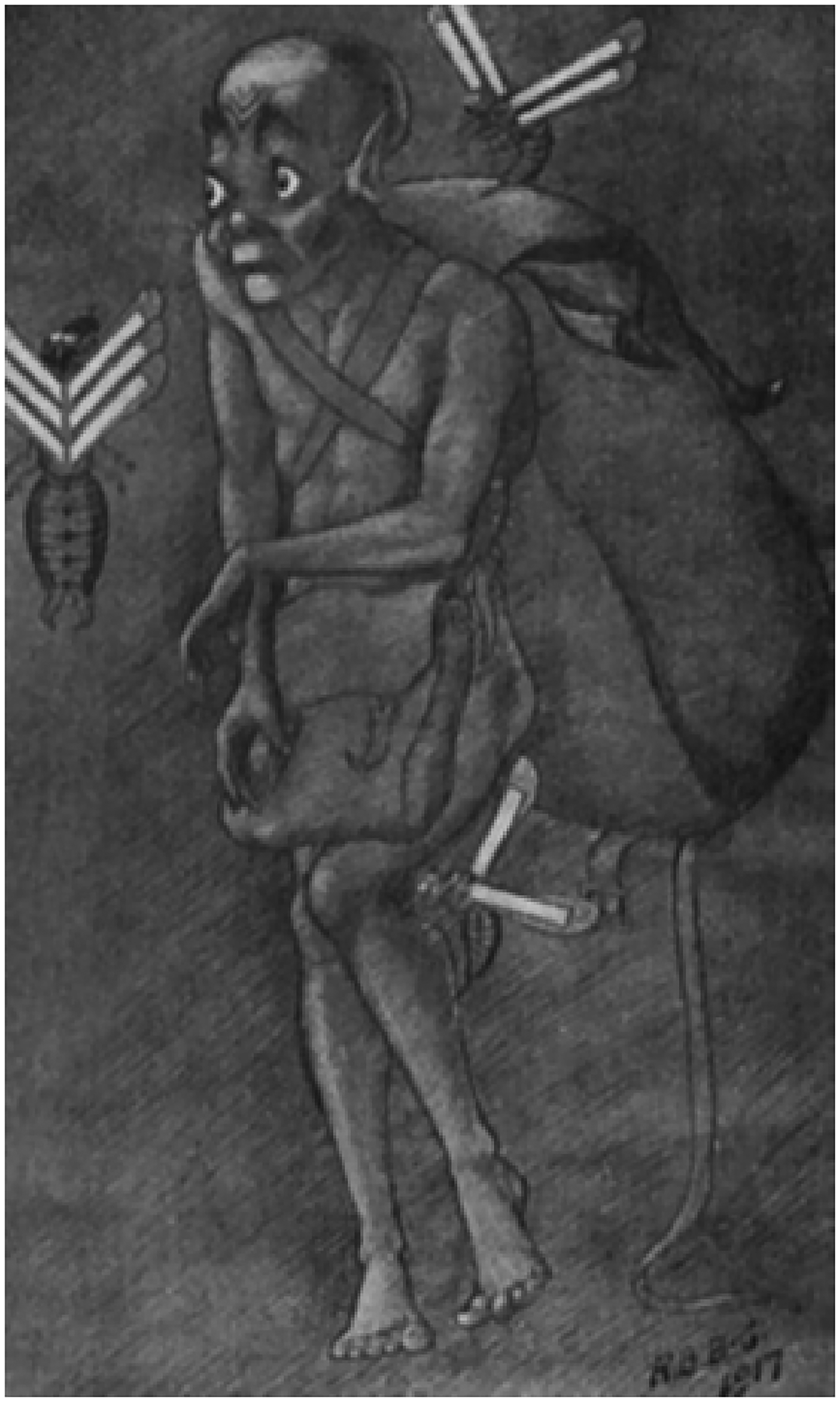
Trussed and plucked. ‘The “Icy Ohticee”’, Gehenna Gazette, August 1917, pp. 20–21 (p. 20). Image published with permission of ProQuest. Further reproduction is prohibited without permission.
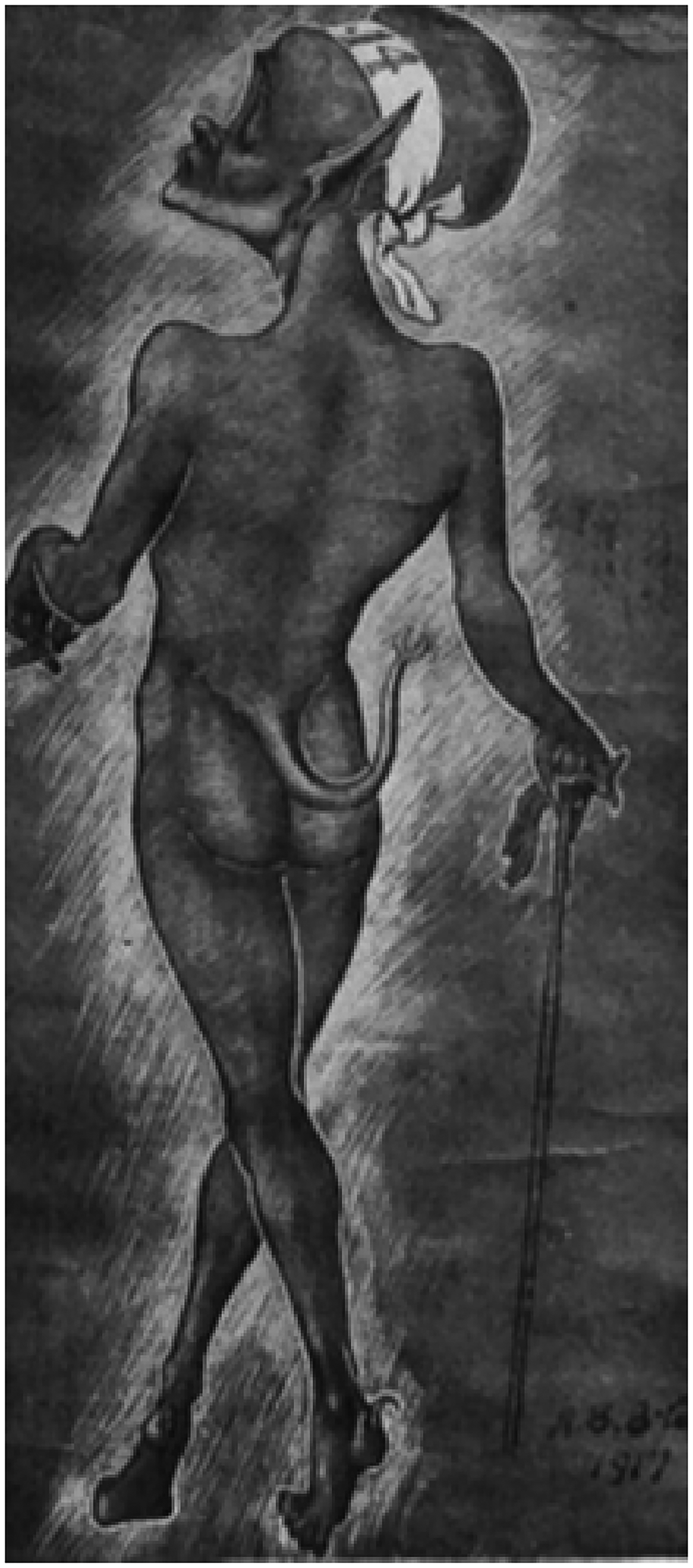
Parboiled. ‘The “Icy Ohticee”’, Gehenna Gazette, August 1917, pp. 20–21 (p. 21). Image published with permission of ProQuest. Further reproduction is prohibited without permission.
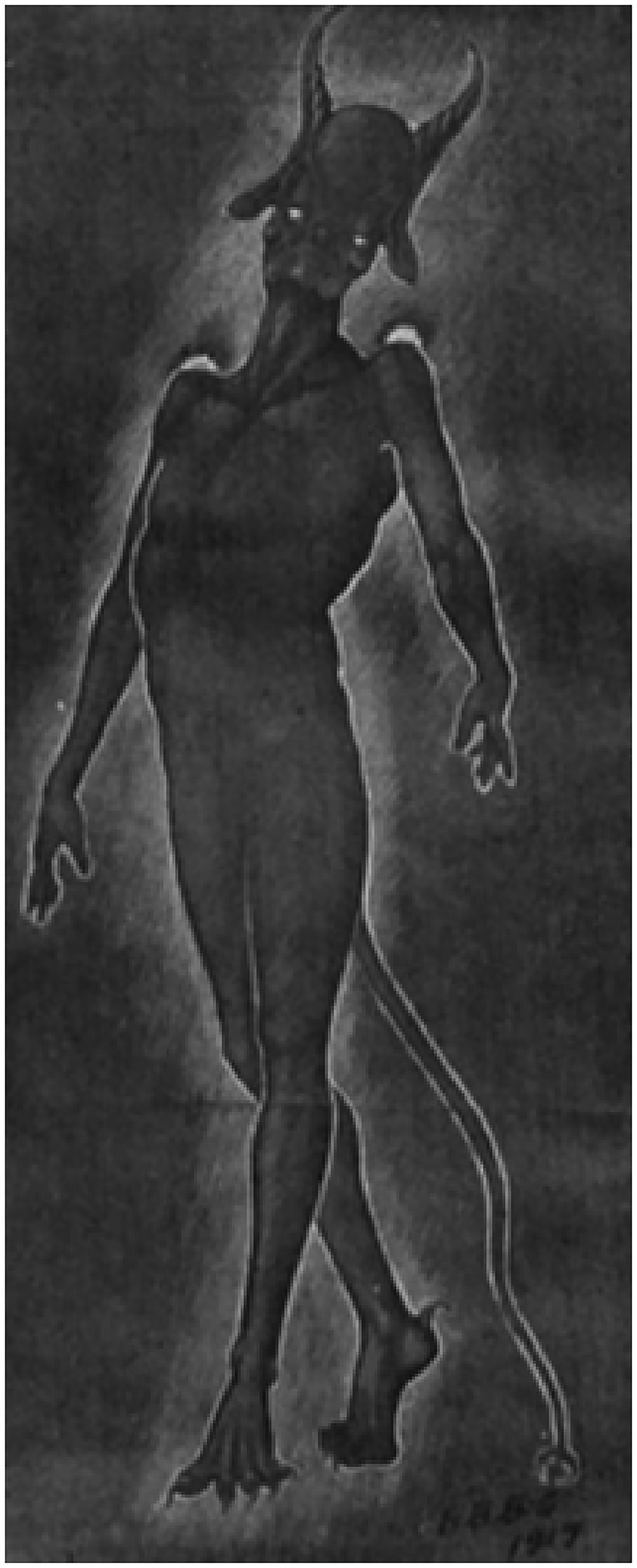
The finished article. ‘The “Icy Ohticee”’, Gehenna Gazette, August 1917, pp. 20–21 (p. 21). Image published with permission of ProQuest. Further reproduction is prohibited without permission.
Such development is also the theme of ‘Studies in Evolution’, again published in the Gehenna Gazette. Here the evolution is of half-human, half-insect creatures, starting from ‘Civis Simplicissimmus’ and ending with ‘Molestus Trivialis’ as wings develop (Figures 10–14). The article describes ‘the wonderful, nay, almost miraculous, transformation’ 27 that takes place, in large part due to superior creatures, or ‘serge ants’. 28 The Dump, meanwhile, printed in December 1915 ‘A few extracts from a very ancient manuscript recently discovered’. The speaker writes ‘I came to the land of the Tribe of Tommiz’, a ‘strange and wonderful people’, who ‘make unto themselves holes in the ground, even as the beasts of the field’, going on to describe their behaviour. 29 The sense of alienation in the two Gehenna Gazette pieces especially is disturbing as well as comical. This is true in particular of the illustrations, which do not entirely match the more humorous tone of the text in their depiction of the odd, partially-human creatures as they are transformed, in a series of steps that look less than comfortable, into military beings. The illustrations create a sense that changing from a recruit into a soldier can involve elements of painful alteration, even if the end results are preferable to the starting position.
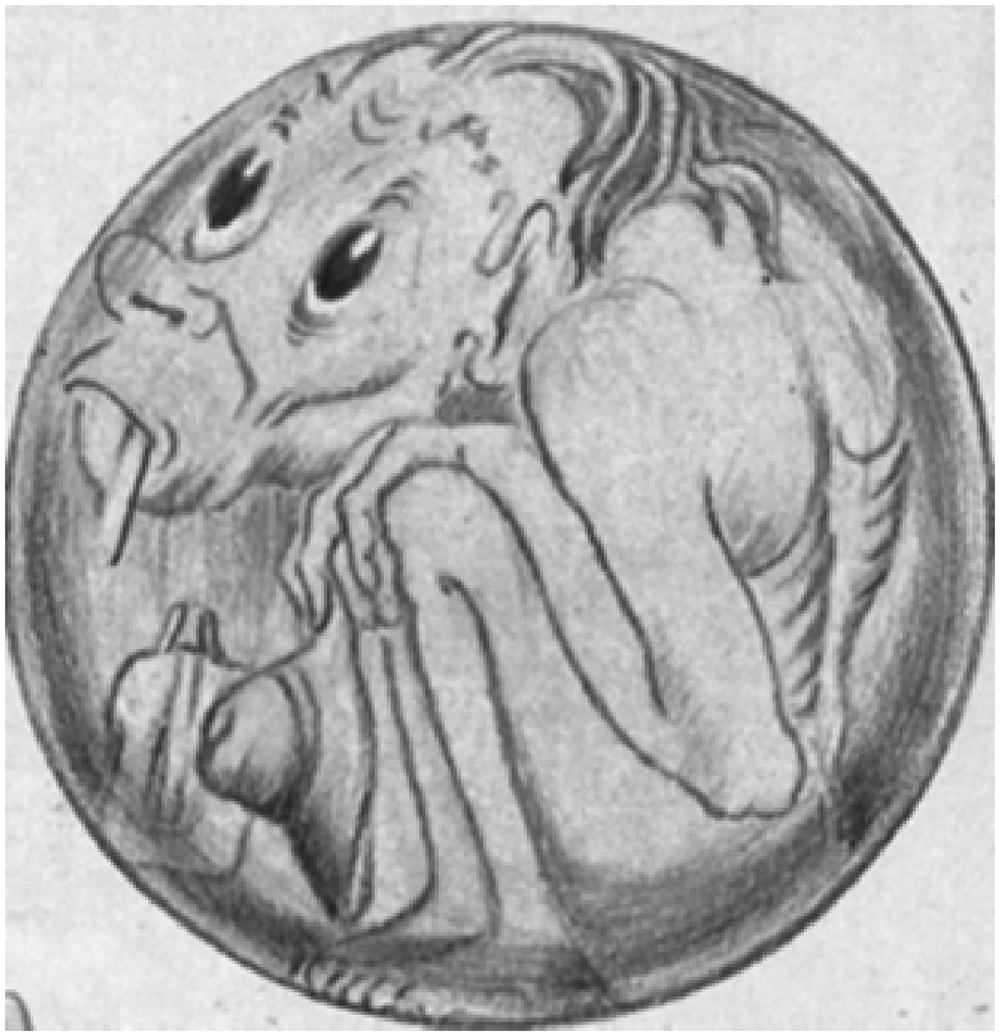
Civis simplicissimmus. ‘Studies in Evolution’, Gehenna Gazette, August 1917, 24–26 (p. 24). Image published with permission of ProQuest. Further reproduction is prohibited without permission.
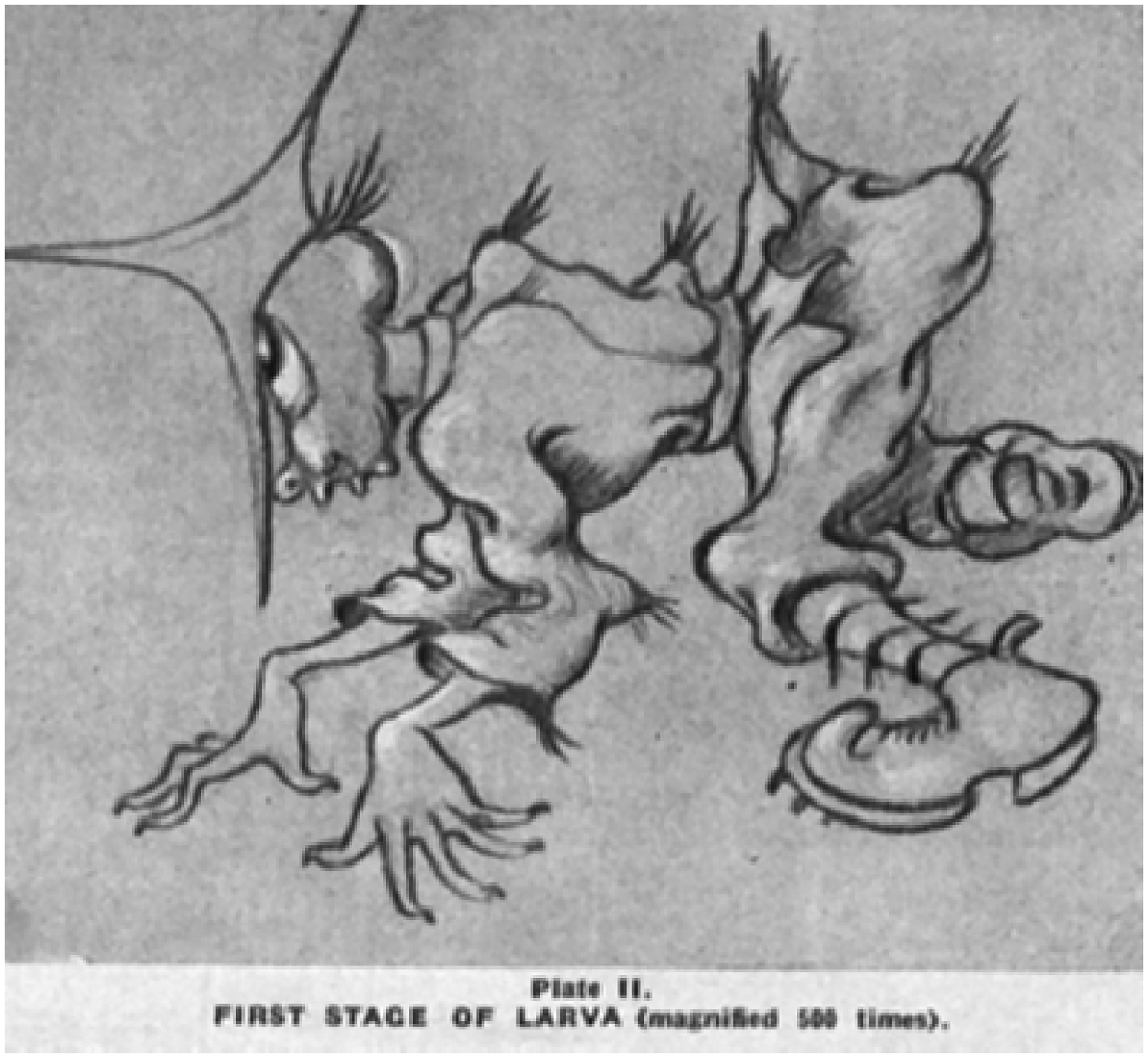
First stage of larva. ‘Studies in Evolution’, Gehenna Gazette, August 1917, 24–26 (p. 24). Image published with permission of ProQuest. Further reproduction is prohibited without permission.
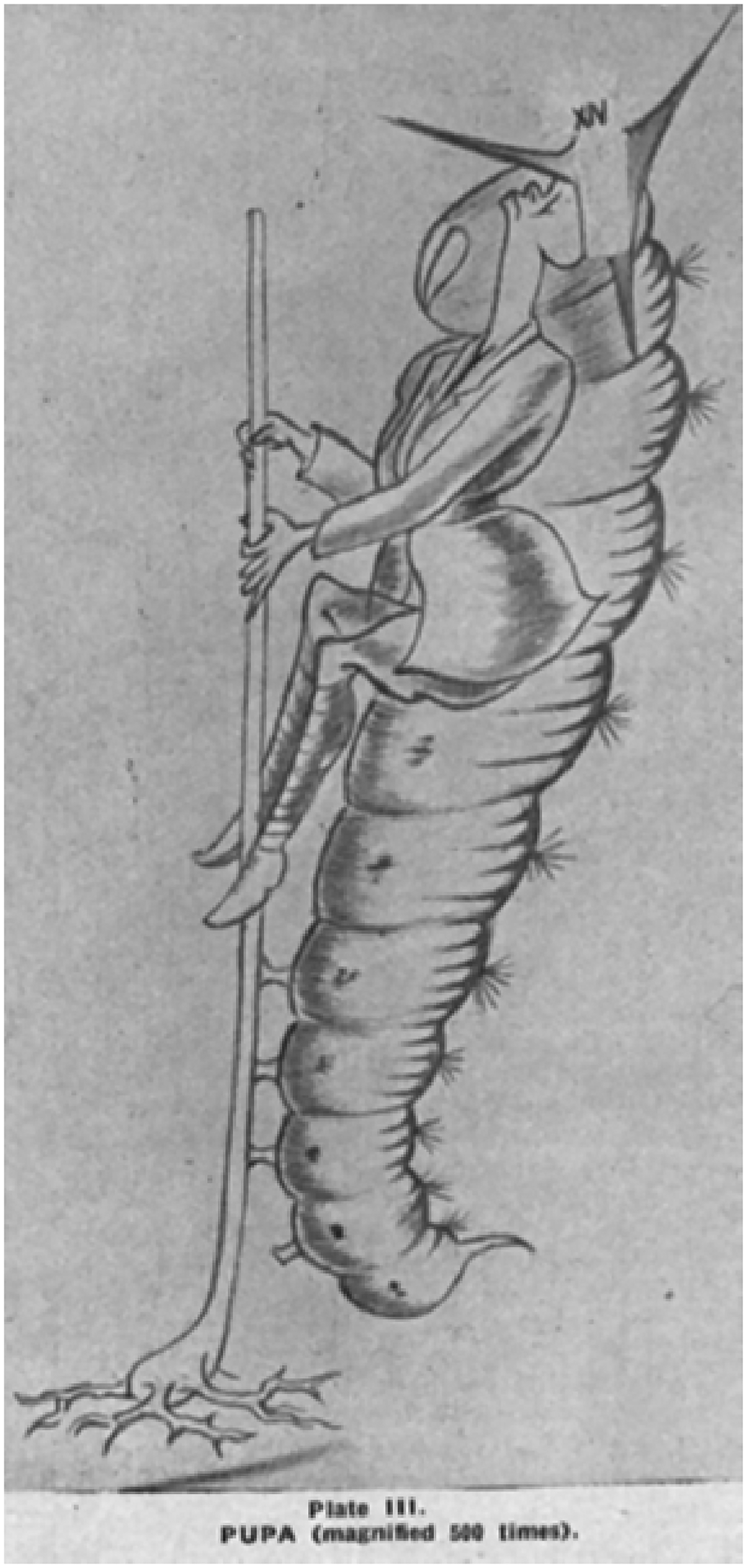
Pupa. ‘Studies in Evolution’, Gehenna Gazette, August 1917, 24–26 (p. 25). Image published with permission of ProQuest. Further reproduction is prohibited without permission.
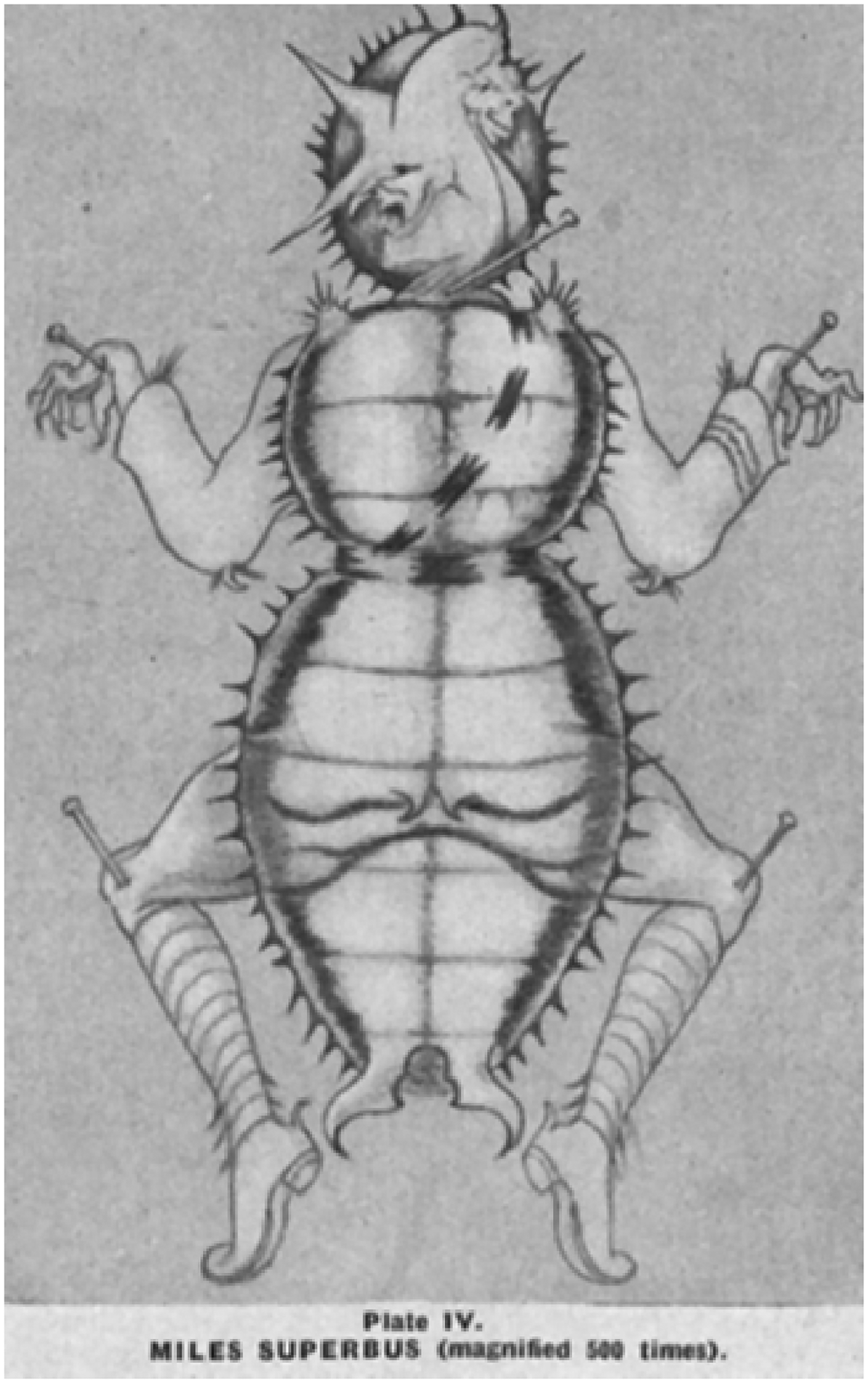
Miles Superbus. ‘Studies in Evolution’, Gehenna Gazette, August 1917, 24–26 (p. 25). Image published with permission of ProQuest. Further reproduction is prohibited without permission.
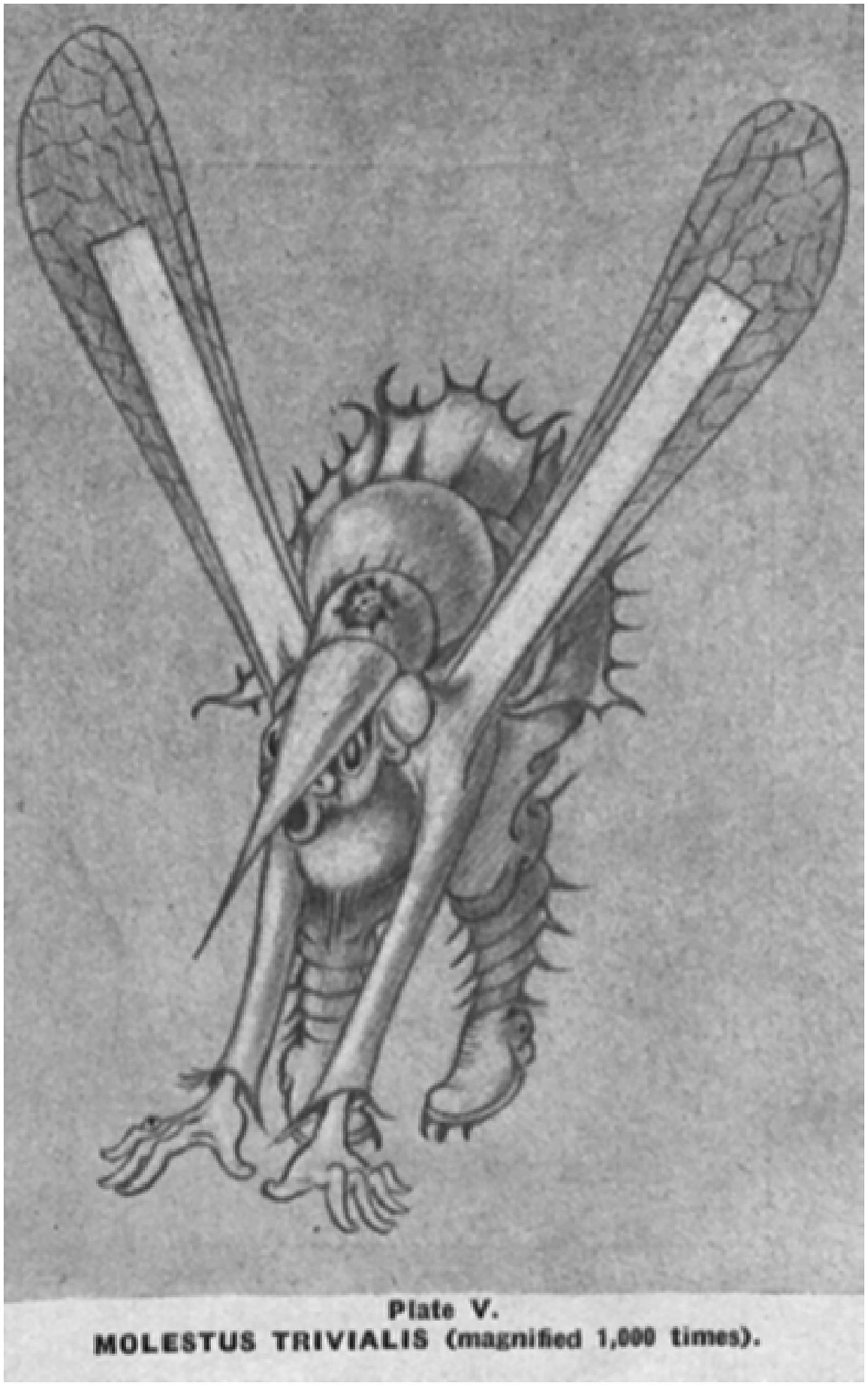
Molestus trivialis. ‘Studies in Evolution’, Gehenna Gazette, August 1917, 24–26 (p. 25). Image published with permission of ProQuest. Further reproduction is prohibited without permission.
It is in addition worth noting that zoomorphism and anthropomorphism were extremely common techniques in the trench press beyond parodies of natural history. Both techniques featured in the stand-alone cartoons and illustrations that were key features of many trench newspapers, and in It-narratives. Chronicles of war experience were published from the perspectives of, for example, a biscuit tin, a battalion dog, an identification disc, a police dog, a rifle, a rat, a mule, a ‘cuss-word’, a tin of bully beef, and a green window. 30 Short stories published in the trench press could also include animals as means to suggest the absurdities of war. This is true of Galsworthy's ‘A Corker’, which was written specially for the Christmas 1916 edition of the Dump and which does not appear to have been published elsewhere. Partially reflecting Galsworthy's broader interests in animal welfare, 31 the story centres on a man's grief over the death of a ‘wretched ill cur of a dog’, the ‘sort of dog […] no one would take’. 32 This sensitivity and affection is contrasted with humans ‘blowing each other to little bits all the time roasting fellow-creatures in the air, and cheering while they roast, working day and night to inflict every imaginable kind of horror on other men exactly like themselves’. 33
The trend for natural history in representations of the conflict, furthermore, spread beyond trench papers, though examples from outside the trench press are different in some respects. In ‘Birds on the Western Front’ (1915) Saki creates a speaker whose observations about the war zone are sardonically presented as a set of informative nature notes. The speaker comments that ‘Considering the enormous economic dislocation which the war operations have caused in the regions where the campaign is raging’, there ‘seems to be very little corresponding disturbance in the bird life of the same districts’, going on to detail, for example, a ‘mobilisation’ of rats, mice, and owls, and the sight of a ‘pair of crows’ engaging ‘in hot combat with a pair of sparrow hawks’ directly underneath two Allied planes fighting enemy aircraft. 34 The piece ends with the suggestion that ‘Gamekeepers who are serving with the colours might seize the opportunity to indulge in a little useful nature study’. 35 Saki's introduction to ‘The Square Egg (A Badger's-Eye View of the War Mud in the Trenches)’ (1915), meanwhile, states that ‘Assuredly a badger is the animal that one most resembles in this trench warfare, that drab-coated creature of the twilight and darkness, digging, burrowing, listening; keeping itself as clean as possible under unfavourable circumstances’, 36 and the speaker compares himself and other servicemen to a number of other animals during the course of the story. In this latter example the speaker expresses a clear, semi-humorous, affinity with the badger, though without quite the sense of absurdity found in the parodies discussed above. In ‘Birds on the Western Front’, meanwhile, which is more of a parody of the ‘nature notes’ genre, the joke is not so much a matter of making soldiers themselves into strange creatures, but more a comment on how war experience can make strange a familiar form of writing and a familiar occupation or hobby. Nevertheless, ‘Birds on the Western Front’ does reflect the sense in the trench-newspaper parodies above of a war zone that is populous, not barren, as well as, to a degree, reflecting the impression they give of a population of war-zone creatures that are in part defined by their environment. This comes through in particular in the comparison of the birds’ and humans’ parallel airborne conflicts. Similar observations apply to Hamilton's Napoo! A book of war bêtes-noires, etc. [In verse.] (1918). Hamilton's work follows the same format as the trench-newspaper parodies – she opens the volume by stating that she has ‘collected and classified’ a series of ‘beasts’ for a ‘War “Zoo”’. The volume consists of a series of poems that parody and criticise attitudes expressed by categories of civilians, including ‘Ghouls’, the ‘Patient Ass’, the ‘Persistent Pessimist’, and ‘Provoking Parrots’. The final poem is called ‘The Scold’, who is ‘none other than…| Myself!’ 37
Listing and the Humorous Disruption of Categories
The mock-scientific articles in the trench press are regularly concerned with exposing perceived absurdities of military hierarchies and with voicing complaints about the hardships suffered by those on the lower echelons. As has been seen, both the ‘Icy Ohticee’ and ‘Studies in Evolution’ in the Gehenna Gazette are structured around the progression of recruits through stages of training and the officers who enable or enforce such development. The former describes the ‘Chief High Priest’, the ‘right-hand man of the Ruler of the Icy Ohticee, whose name […] is See Oh’. Via a ‘system of benevolent despotism he, through his subordinates, spurs on the community to every kind of industry. Marks of distinction are awarded to the most diligent’. This practice includes ‘the savage custom of enduring excruciating pain and discomfort to secure superiority among their fellows’. 38 ‘Studies in Evolution’ similarly draws attention to absurdities surrounding the system of rank, including how relations between men of different ranks can alter. ‘[W]hen the imago stage has been reached’ such relations become ‘almost cordial’. The article ends with the observation that the ‘imago in these circumstances usually takes up an extremely magnanimous demeanour, and seems to bear no resentment at the treatment it formerly received’. In fact, ‘it sometimes manifests towards the serge ant something approaching gratitude’. 39 The piece on ‘Hut Dwellers’ in the Hangar Herald, meanwhile, describes the ‘social hierarchy of this people’: a ‘number of Chiefs were appointed, who lived in a state of comparative luxury’. They ‘kept the rest of the population in slavery, making them toil many hours a day for their enrichment’. 40 The ‘Tribe of Tommiz’ includes mention of ‘one with the face of a child, who commanded two score men of the tribe’ – possibly a reference to a particularly young (or young-looking) individual officer, but potentially also a more general reference to the youth of those given leadership roles. Importantly, such treatment of hierarchies does not appear to have been a serious threat to the status quo or to have been a form of serious resistance. This is typical of the trench-newspaper genre; some papers in fact had official support from commanding officers because of their contribution to esprit de corps. 41 The papers did, though, offer empowerment and relief because they were a space in which grievances could be voiced and the absurdities of military life, including the system of rank, highlighted.
The use of lists is central to the challenges the parodies make to a variety of human-made categories – to military taxonomies, to taxonomies of the human and the animal, and to taxonomies of the real and the fantastical. On first glance the lists of creatures that form servicemen's parodies seem to reflect straight natural history writing in presenting logical, neat relations between their items. Lists more broadly in fact give suggestions of hierarchy, with the most important or memorable items appearing first, or with items recorded according to alphabet or age. Yet, as Eric Griffiths comments ‘[a] list per se does not entail a hierarchy, it's much too simple to map priority of value directly on to the series of items’ and ‘because a list is not of itself a hierarchy, lists can be subtle devices for querying the priorities of those who have compiled them’. 42 It is ‘always a question about any list whether it is arranged in a sequence of ascending or descending priority or along more complicated loops’, and ‘why what comes first, comes first and why what comes second, comes second is something we need to understand to understand the whole communicative act’. 43 Servicemen's parodies of natural history are based on ‘complicated loops’ in that they include odd combinations of items, and items placed in surprising sequences. They overturn expectations that military hierarchies involve ordered progressions of value, power, and importance.
For example, the Lead-Swinger's ‘Natural History Notes’ seems at first to progress from the top to the bottom of an orderly hierarchy based on degrees of power and status: it begins with the ‘Sergentius Majoris’ and turns to the ‘Corporalis Cooke’, ‘Cow’, and ‘Chat’. However, the piece disrupts this sense of order in multiple ways, as the comical rapidity of the movement from sergeant major to louse indicates. The list brings together ‘creatures’ that would not usually be proximate and, by including them in the same ranking, the difference between the creatures’ relative statuses is eroded. The text includes an officer and a chat within four rankings of each other, turning against more conventional military hierarchies in which there are multiple gradations of human without animals entering the picture. 44 The chat gains status from this juxtaposition with the officer, while the officer loses status, levelling rank. As the article observes, ‘It is probable that every man in the British army has met one or more of these little creatures’. 45 The joke here in part relies on cheeky playfulness – even officers have lice to contend with – and is in part existential: the distinctions between officer and chat, human and non-human animal are eroded. Indeed, the article draws attention to how the chat reveals a connection between the human and the non-human, since hunting chats ‘is carried out in the same time-honoured fashion as when our own ancestors lived in the tree-tops and existed on nuts’. 46 The chat is also given the greatest space within the text – over a page of the three-page article – including a 28-line ‘Chatting Hunting song’ written in the trochaic tetrameter of Longfellow's Hiawatha. The prominence afforded to the chat again contributes to the suggestion of hierarchies at work outside the official military ranking system – perhaps chats and ‘“Chatting,” as the sport [of louse-hunting] is called’, take up more of servicemen's time, energy, and thoughts on a day to day basis than do the demands of the ‘Sergentius Majoris’. 47 The Lead-Swinger piece in addition brings together in the same list the real and the fantastical. The ‘Sergentius Majoris’ and ‘Corporalis Cooke’, strange mixtures of human and non-human, and the ‘Cow’ that is of a special war-zone variety (‘not the common, or garden, but the Flemish’, which ‘choke[s]’ on the war news from the Daily Mail), have fantastical, absurd elements that are reminiscent of Edward Lear's creations, a precedent explored in more detail below. 48
Taken in this light, the parodies of natural history writing diverge from other manifestations of lists that appear in trench newspapers, such as military alphabets and dictionaries. (For example, in the Hobocob of December 1917 ‘C’ is ‘our Captain, who can never believe | The reasons we give when applying for leave’, 49 and in the Mudhook of October 1918 a ‘Simplified French Dictionary’ explains ‘Pour le Général’ as a ‘phrase found useful by officers [sic] servant and others seeking some particularly choice merchandise’. It ‘Usually has the effect of putting up the price 50 per cent’.) 50 Graham Seal argues that the trench-paper alphabet became a ‘literary microcosm of the war, with the difference that the course of the poetic form was predictable and concludable’. 51 Their ‘emotional value’ was that they ‘imparted a vicarious sense of security’. 52 Seal grapples here with the thorny question of where to place the balance presented in the alphabets between, on the one hand, capturing war experience – which may not be neat, ‘predictable’ or ‘concludable’ – and, on the other, counterbalancing this with a sense of reassuring orderliness. In the case of the parodies of natural histories, there is perhaps a greater emphasis on a tension between the absurd and the well known. As with the trench-newspaper alphabets, they have a predictable structure and a familiar style but, to a greater degree than Seal suggests of trench-newspaper alphabets, the lists in the natural history parodies embrace and play with disruption and unpredictability. Griffiths’ discussion of a different playful list applies here: the parodies are ‘strange in the way jokes are often strange – they have logical inconsistencies or ethical “naughtiness” in them without making us feel our intellectual world has come to an end’; the humour in the parodies ‘protects us from the terror of classification run amok’ which they ‘delight to conjure up’. 53
The humour in the parodies is in fact foundational to their disruption of hierarchy, and hence to the unusual pictures they present of life in the war zone and of its creatures. The parodies demonstrate how humorous modes can be uniquely placed to ‘conjure’ certain complex experiences, including emotional experiences, in ways that may escape more solemn depictions. As explained above, the parodies invite amusement by bringing together entities that are often separated in the abstract (such as humans and non-humans) into close contact under the same category (creatures of the war zone). In this sense the texts are based on a Schopenhauerian type of humour, according to which amusement arises from recognising differences between our perceptions of how the world really is (what we observe the world to be) and our abstract conceptions of it (the way in which we think of the world). For Schopenhauer, laughter ‘always signifies’ a recognition of incongruity between a conception ‘and the real object thought through it, and hence between what is abstract and what is perceptive’. 54 The ‘perceived is always undoubtedly in the right, for it is in no way subject to error’; it comes into conflict with ‘what is thought’ because ‘abstract concepts, cannot come down to the infinite multifariousness and fine shades of what is perceived’. 55 In the parodies, indeed, ‘abstract concepts’ – in this case concepts of clear, orderly hierarchies – are overturned by the ‘multifariousness’ of what is perceived – that there are complex, surprising connections between different inhabitants of the war zone, that senior officers and lice can be proximate. There are in other words ‘fine[r] shades’ of relation between inhabitants of the war zone than might initially be imagined.
Derrida's discussion of animality elucidates how alienation is expressed through a sense of absurdity in the parodies. Derrida finds that the tradition of anthropomorphism in nonsense literature provides a means for exploring otherness. He quotes from Lewis Carroll's Alice's Adventures in Wonderland, with a particular interest in the scene in which Alice plays croquet: ‘Alice wanted to give the hedgehog a blow with the head of the flamingo she held under her arm, but “it would twist itself round and look up in her face”, until she burst out laughing’. 56 The moment corresponds with Derrida's key concerns with the ‘point of view of the absolute other’, the ‘alterity of the neighbour’ in ‘moments when I see myself seen naked under the gaze of a cat’. 57 Servicemen in their newspapers do not contemplate themselves under the gaze of an animal in the concrete, specific way in which Derrida does: he insists that the cat he is ‘talking about is a real cat, truly, […] a little cat. It isn't the figure of a cat’; it is not ‘an allegory for all the cats on the earth, the felines that traverse myths and religions, literature and fables’. 58 Servicemen's use of zoomorphism, though, is a form of defamiliarisation, facilitating the expression of their eccentric position outside ‘normal’ civilian society. Indeed, Carroll's Alice books were regularly parodied in trench newspapers in ways that cast the war zone as a space governed by the kind of logical absurdities found in wonderland.
Derrida's awareness of ridiculousness emerging from the animal's gaze informs his notion of ‘thicken[ing]’ or ‘multiplying’ the boundary between animals and humans, a notion that characterises well the impression of the war zone that the trench-newspaper texts convey: that of a space populated by war-zone creatures. Stating that he does not seek to question ‘the limit about which we have had a stomachful, the limit between Man with a capital M and Animal with a capital A’,
59
Derrida is interested instead in ‘what is cultivated on the edges of a limit’.
60
His goal is ‘not to efface the limit, but to multiply its figures, to complicate, thicken, delinearize, fold, and divide the line precisely by making it increase and multiply’.
61
He proposes that ‘The discussion becomes interesting’ once it is focussed on ‘the frontier’ not as ‘a single indivisible line but more than one internally divided line, once, as a result, it can no longer be traced, objectified, or counted as single and indivisible’.
62
Derrida argues that There is no animal in the general singular, separated from man by a single indivisible limit. We have to envisage the existence of “living creatures” whose plurality cannot be assembled within the single figure of an animality that is simply opposed to humanity. This does not of course mean ignoring or effacing everything that separates humankind from the other animals, creating a single large set.
63
The identity articulated in the natural histories is thus predicated not on membership of a specific unit or deployment in a specific location, but on inhabiting the war zone, broadly defined. This is different from the senses of identity expressed elsewhere in trench newspapers. Pegum for example finds that trench newspapers belonging to infantry express an exclusive identity: ‘[t]he infantryman is most clearly seen in relief when he describes all those who have chosen not to volunteer as he has’. This ‘arises […] principally from the exclusivity of their location: the trenches’. 64 Although, as several of the texts make clear, physical removal from Britain when serving overseas was important to servicemen's experience of otherness, the war zone is not solely defined by geography. This is a space that is ‘as much a product of experience as of geographical factors, transformative’. 65 Correspondingly, the creatures described in the humorous natural histories emerge from the trenches but also from ships, artillery, and training camps. The ‘Icy Ohticee’ even refers to servicemen in training as ‘a strange tribe of human beings’ living ‘in the heart of England’. 66 The war zone and the creatures it engenders can be close to home; what is important here is thus special, inside experience of the military rather than being overseas. The authors of the parodies do after all cast themselves in the position of investigative scientists and explorers, confident in, and enjoying, their knowledge of what odd creatures sergeant majors, sappers, and cooks really are.
There is an element of the in-joke to the parodies that functions analogously to the nonsense and comic verses published in Anglo-Indian newspapers, periodicals that enabled ‘a sense of local and colonial identity, related to but also set apart from the identity of the British at “home”’. 67 As Martin Dubois explains, Lear's poem ‘The Cummerbund’, for example, first published in the Times of India in 1874, ‘is virtuosic in its misuse of Anglo-Indian words, which are wrongly applied so as to lend a fabulous colouring to what are actually ordinary persons and things’. 68 What ‘purports to be the tale of a fantastic event occurring in a tropical setting actually involves a host of objects and persons ordinary to Anglo-Indian life’. 69 The layers of humour and fantasy here are complex, but part of the joke is on those readers in Britain who may not know the difference between real and invented terms. Similarly, the pleasure that the natural history parodies offered servicemen is partly the pleasure of having privileged knowledge of the exclusive military world.
This sense of separation from those who are not members of the military is not hostile, but may instead be an imagined means of communication: as with straight, scientific natural histories, the ‘scientists’ behind the parodies explain their ‘discoveries’ to less-informed readers who may view the findings as exotic. The explanatory function of the natural history form chimes with the role that trench newspapers as a whole could play for servicemen who shared the publications with those not in service. Though the primary readers of trench newspapers were servicemen in the same unit in which the papers were produced, editors were delighted when their publications were acknowledged in the professionally-produced press,
70
and the papers were also sent home to family members.
71
A handwritten note scribbled on one copy of the December 1917 edition of Hangar Happenings reads ‘Thinking of you all a Merry Xmas, a happy new year. I will explain the jokes when I get
The Nineteenth-Century Origins of Trench Newspaper Natural Histories
The Anglo-Indian newspapers described above offer one parallel between the trench-newspaper natural histories and earlier literary culture, but there are other precedents in nineteenth- and early twentieth-century publishing as well. Identifying these precedents adds a new element to the cultural history of the trench press, as well as contributing to evidence that First World War literature regularly remains rooted in, while adapting, pre-war literary culture. The trench-newspaper parodies see servicemen use familiar forms of humorous writing to ask new questions raised by their experiences of the conflict. 73
Amusing takes on natural history had emerged in response to the ‘crucial shift in understandings of the human–animal boundary’ that took place in the nineteenth century ‘[f]rom Jean-Baptiste Lamarck's ‘Zoological Philosophy (1809) to Robert Chambers’ Vestiges of the Natural History of Creation (1844) to Charles Darwin's revolutionary theory of species’ (1859). 74 In Eugene August's words, ‘Right from the start’, people sensed that ‘there was something funny about the Darwinian revolution’, with ‘the established, orderly view of creation’ being ‘turned topsy-turvy’. 75 Those who saw the humorous potential of Darwin's work did not create an entirely new form of amusement – anthropomorphism and zoomorphism have long been staples of humour. Schopenhauer in fact uses anthropomorphism as one illustration of his theory, referring to the amusement that may be prompted by a man placing his wig on his dog: animals sometimes appear ‘ludicrous’ because ‘something in them resembling man causes us to subsume them under the concept of the human form’. 76 The examination of relations between humans and non-human animals that famously arose in response to various nineteenth-century advances, however, appears to have produced a trend for creating humans who humorously resembled non-humans, and vice-versa. 77
Lear's oeuvre is one of the best examples of nineteenth-century entanglements between science and humour. His work in natural history – most famously his 1832 volume Illustrations of the Family of Psittacidae, or Parrots 78 – has humorous counterparts in his nonsense botany (1871–77), as well as in his drawings that mingle human and animal features. Lear ‘mock[ed] affectionately’ the ‘taxonomic pigeonholing’ found in natural history, with his ‘surreal Piggiwiggia Pyramidalis, and Phattfacia Stupenda, and Manypeeplia Upsidownia’. His ‘inventions […] reflected reports’ of real ‘travellers and plant hunters, of plants full of mimicry and odd relations with the animal and insect worlds’. 79 As Anna Henchman explains, Lear's use in his nonsense literature of unusual relations between ‘claw and hand, individual and species’ comes from ‘his work illustrating animals and plants for Charles Darwin and other naturalists’, from a ‘mid-nineteenth-century fascination with the fluidity of identity and the kinds of metamorphoses that happen in both biology and literature’. 80 The parodies of natural history published in the trench press have close parallels with Lear's invented species, his illustrations of them, and their mock-Latin names. That servicemen cast themselves in the role of explorers and scientists reporting back on the part-fantastical, part-real oddities of war in addition reflects the inspiration Lear took from the extraordinary characteristics of real flora and fauna.
Many spoof natural history articles were printed in Punch in the nineteenth and early twentieth centuries. These included, for example, two articles subtitled ‘Natural History’ that describe ‘The Barber’ and ‘The Opera-Dancer’. 81 Punch also published: ‘The Physiology of the London Idler’, specifically the ‘specimen […] Regent-Street Lounger’; 82 an illustration, entitled ‘A Study in Natural History’, of ‘The Boarding-School “Crocodile”’; 83 and a drawing called ‘In the Natural History Museum. A.D. 1910’, which showed a ‘Priceless restoration of British Pedestrian, now extinct’. 84 Similar items in Punch, as with the trench papers, made use of non-standard spelling to create humorously defamiliarised pictures of society. An article on ‘Natural History – The Horse’ in 1897 states that ‘these glorified beings’ have attendant ‘Jokkies’, ‘Grewms’ and ‘Stabel-bhoys’ to perform ‘sacred rites’. 85 Parodies of natural history were often pointedly satirical, such as the ‘Natural History of the City Pig’ (‘generic name […] Sus Aldermanicus’ – presumably a reference to the City Court of Aldermen) 86 and the ‘Natural History of the Oxford Spider’ (‘Class, Sanguisugae. […] Variety, Haberdasher, &c.’), which catches ‘the class Undergraduates’ in debts. 87 Some ‘Nature Notes’ of January 1908 moved from descriptions of the ‘now extinct’ creatures that Lear discovered to ‘even more marvellous beasticles’, including a ‘patriotic type of Cow in Ireland’. 88 An 1887 piece entitled ‘A Down-Y Philosopher; Or, Memoirs of a Missing Link’, foreshadowing something of the It-narratives that would later be published in trench newspapers, which often took the form of diaries, was accompanied by an illustration of a strange, seal-like creature seated at a writing desk. 89 Darwin himself was a common target for comic anthropomorphism; his ‘general hairiness could easily be turned into the animal fur of anthropoid apes’. 90 Some ‘Astronomical Information’ about the Earth from 1861, meanwhile, stated that Darwin ‘reports that the inhabitants are nothing at all, and never were anything, and will be the same for about two billions of years, when they will all turn into ducks with long green tails, having eyes at the end thereof’. 91
The parodies of natural history writing that were published in trench newspapers thus continued a longstanding tradition of such humour challenging those who held power or prestige and exploring and exposing oddities of human identity and behaviour. This continuity represents a nuanced new aspect of trench newspapers’ role in articulating and shaping servicemen's senses of identity. J. G. Fuller uses trench newspapers to argue that the continuance into military life of familiar forms of entertainment culture, such as music hall and sports fixtures, helped to maintain servicemen's senses of their civilian identities. 92 The parodies would for soldiers have had the same kind of familiarity, and the form also offered the opportunity to observe the military with an outsider's – or with a civilian's – eyes: the humour of the parodies relies on servicemen distancing themselves from and defamiliarising the military world. At the same time, as has been seen, the creatures described range from recruits, to cooks, to senior officers. All manner of servicemen are categorised as belonging to the strange war-zone environment, and this includes the parodists themselves. The parodies express alienation without this entailing a complete schism with civilian culture. Similarly to the way in which they thicken the line between the human and the non-human, these trench-newspaper texts oscillate between, and blur, military and civilian identities.
Seemingly slight articles in trench newspapers that are designed primarily to amuse thus take on and adapt some of the philosophical and emotional weight that had also formed part of the background to strands of pre-war comic publishing. Parodies of natural history writing that were published before the war were responding to large questions – including questions about the nature of humanity as raised by scientific advances – and wartime versions of these parodies address similar, but conflict-specific, concerns. Seeing humanity through the lens of war, they ask what war does to humanity, and what conflict experience does to one's sense of belonging to a community of humans. The basic structure and form of trench-newspaper natural histories do not greatly diverge from pre-war examples, but they were sufficiently adaptable that the authors of the trench press could update the genre for their own particular moment. The genre thus offered a usefully flexible literary framework: a framework that could be reproduced and adapted in ways that allowed servicemen to express the unfamiliarity of their war-zone experiences.
Humorous literature of the Great War is not regularly or automatically analysed for offering profound or valuable representations of the conflict: in the relatively rare instances where it has been studied, it tends to be investigated for its role in maintaining morale or offering relief. While this is an important part of its function, humorous literature of the conflict can also encompass exceptional ways of representing particular aspects of war experience. This is the case with the parodies of natural history writing published in trench newspapers. As with some of their antecedents, the trench-newspaper texts articulate complex concerns with identity, doing so both in a personal sense – the experience of being or becoming a serviceman in a time of war – and in a much broader sense – the experience of being human at a time of immense brutality. The trench-newspaper texts considered in addition offer an alternative point of view on the environment of the war zone. The picture the texts offer is not of a barren moonscape or of an ironised pastoral, but of a populous and vibrant space. The zoomorphism and anthropomorphism in trench newspapers create imaginative, fantastical worlds in which the war zone is productive of a different, partially estranged, partially familiar, set of beings.
Footnotes
Acknowledgements
Many thanks to Dr Anne Whitehead and Dr Martin Dubois for their support with this article, and to the reviewers for their enthusiastic and supportive comments.
Declaration of Conflicting Interests
The author(s) declared no potential conflicts of interest with respect to the research, authorship, and/or publication of this article.
Funding
The author(s) received no financial support for the research, authorship, and/or publication of this article.
