




Abstract
The past decade has seen the global growth of military-style reality television programming. These programmes, produced by militaries themselves or through collaboration with the entertainment sector, have proven to be an effective and increasingly powerful public relations conduit. Our article offers a theoretical treatment of reality television, both the aesthetic modes by which it invites the viewing subject as well as the political economy of its use in public relations. These dimensions are explored through two case studies. First, we focus on the genesis of military-style reality TV in the United States, where, after 9/11, the US military seized on the genre to pioneer and field-test various themes in response to public exigency as the occupations of Afghanistan and Iraq drew on. Second, we analyse the German military as both a latecomer and innovator to these new public relations endeavours. By reading the generic and aesthetic strategies in both cases, we argue that the genre’s public relations function goes beyond the immediate task of recruitment to cultivate civic participation in militaristic fantasies through a mediasphere rife with invitations to ‘go soldier’. Military reality TV, we argue, represents the militarization of civic identity and the gradual displacement of values from deliberative to authoritarian, cosmopolitan to nationalistic and diplomatic to combative.
Keywords
Introduction
As the largest military force on the planet, the United States has been an innovator in military public relations and messaging. This is no less true for the Defence Department’s adoption of reality TV as a PR platform. Such shows, produced by the military itself or through collaboration with the commercial entertainment sector, now have a long track record in proving themselves effective for accomplishing mundane tasks such as recruiting and burnishing the military’s public image. These efforts have gone beyond these rather mundane public relations goals, however. The general popularity of reality programming has made it a cultural and political liaison for the military, framing specific interventions and characterizing wider geopolitical affairs in accordance with official interests.
The US model has caught on. In the past decade, the success of such efforts has precipitated a second wave of military-themed reality TV, this time as a global phenomenon. While the US military still accounts for the majority of the 44 military-supported reality shows we have identified since 2001, other countries have mimicked this public relations tactic (see Graph and Appendix), extending far beyond military allies like the United Kingdom and Australia. Beginning around 2013, the phenomenon began its journey around the globe, from democratic to autocratic countries, developed to emerging media economies and conscription to post-conscription militaries. This includes countries as diverse as India, Nepal, South Korea, Russia and China. 1 The actual list, moreover, is likely much longer given the inherent limitations and conservative approach of this survey. 2
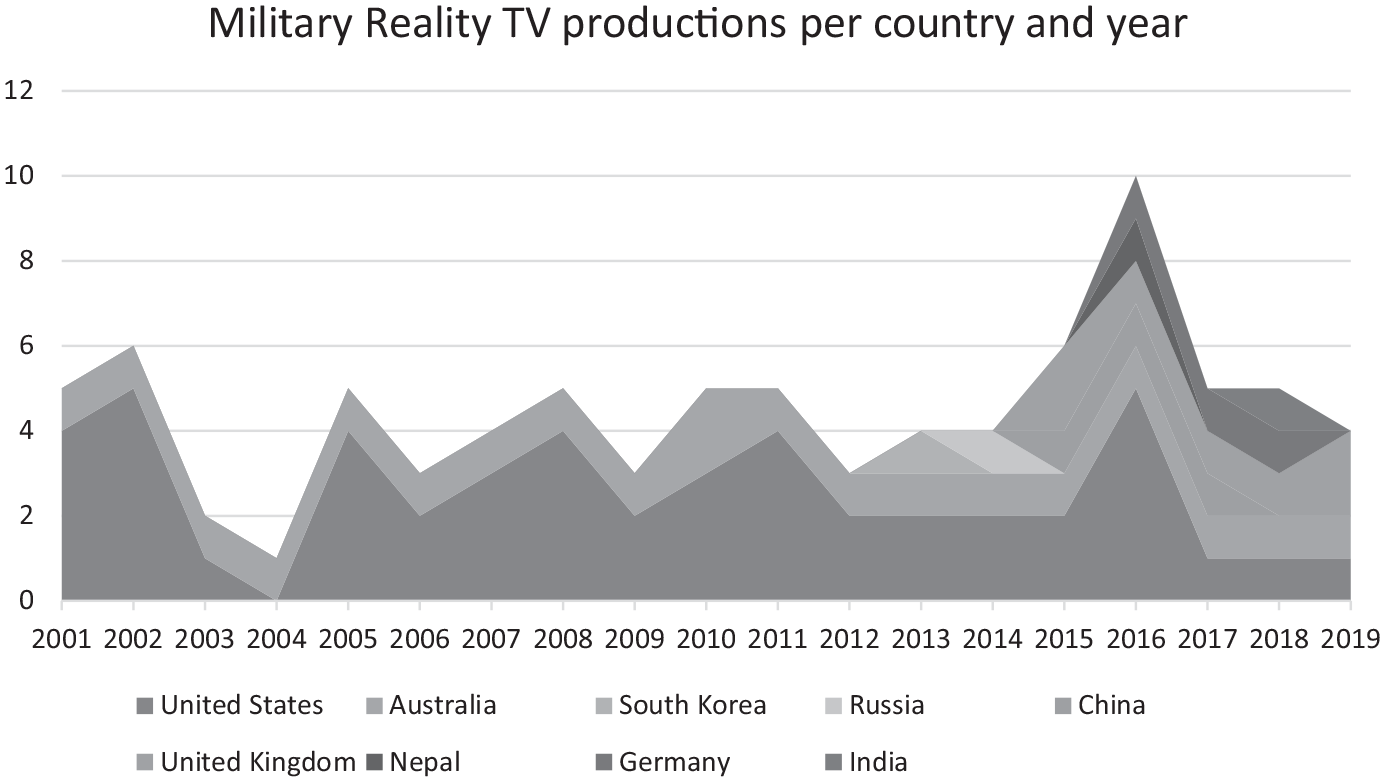
In this article, we take these preliminary data as a mere starting point, not to explain the reasons behind the global spread of this new genre, but instead to focus on its genesis and the motivations for militaries to become involved. For this purpose, we pose a set of questions. What makes this reality TV so attractive for militaries, and how does it align with their objectives? What are the styles of duplication in terms of content and aesthetics? How has military-themed reality television evolved over time and alongside technological changes? And what does it mean to cast military activity in the mould of this genre?
Our article begins with a theoretical treatment of reality television, both the aesthetic modes by which it invites – some may say conscripts – the viewing subject as well as the political economy of its use in public relations. These aesthetic features have only intensified as reality TV evolves into a version 2.0 fitted for the smartphone. The second section turns towards the genesis of military-style reality TV in the United States. In the wake of 9/11, the US military seized on the genre to conduct public relations. Multiple services pioneered and field-tested various genres and themes in response to public exigency as the occupations of Afghanistan and Iraq drew on. The final section takes Germany as a recent and dramatic case study of these developments, significant in part because the country has until recently been resistant to nationalistic and militaristic appeals. The content, production aesthetics and the cultural impact of these efforts by the German Bundeswehr provide insight into the trajectory of this kind of public relations. By reading the generic and aesthetic strategies in both cases, we argue that the genre’s public relations function goes beyond the immediate task of recruitment to cultivate civic participation in militaristic fantasies through a mediasphere rife with invitations to ‘go soldier’. Ultimately, the proliferation of this model – first in the United States, then worldwide – represents the militarization of civic identity and the gradual displacement of values from deliberative to authoritarian, cosmopolitan to nationalistic and diplomatic to combative.
Going Soldier: Aesthetics and Political Economy
In this section, we argue that the genesis of military reality TV as a genre can be understood through two key power dynamics that, when combined, yield a propaganda effect. The first relates to reality TV’s distinct aesthetic features which invite the viewing subject into a first-person relationship with the drama. The second relates to the political economy of reality TV, and in particular the ways in which it has aligned institutional interests, both commercial and military.
Although reality TV can resist definition, one of its major distinguishing characteristics involves a unique process of viewer subjectification. That is, the entrance of the genre has represented a shift in what it means to watch. This shift was predicated on increased audience involvement in terms of level of interactivity (voting, commenting), authorship (user-generated content) and a wider distribution of fame (lowering the threshold for celebrity). Early on, media scholar Su Holmes marked the sudden rise of ‘ordinary people’ on television. Alongside the consequent flattening of our notions of celebrity, the genre was fragmented. A reality TV ‘episode’ typically reached beyond the show itself with characters and conflicts cycling through the tabloids, talk-shows and other formats forming a cloud of activity that we now commonly refer to as ‘buzz’. Holmes noted that this intertextuality was the structural core of reality TV, intimately related to its diffuse structure of fame and symptomatic of the permeability between audience and stage. Later, Henry Jenkins connected the rise of reality TV to his concept of ‘convergence culture’, which added interactivity to the list of defining features. This mix of qualities constitutes the appeal of much of the genre, in which an ‘ordinary person’ on the screen acts as a vessel through which one can vicariously play out fantasies of fame and adventure.
The visual aesthetics of reality TV follow this basic enticement. The camera’s tendency to identify with a character’s first-person perspective not only gets ‘inside the head’ through confessions and backstory, but also inside the eyes. In this way, reality TV constitutes an evolution towards interactivity and authorship that, conditioned by the environment of social media, morphs into the figure of the ‘vlogger’ and its attendant aesthetics of the rolling confessional selfie. A portmanteau for video blogging, ‘vlogging’ constitutes an evolution of the reality genre to a more intimate, self-produced and ‘selfie’ style series of diary entries. This development was further accelerated by the evolution of recording equipment, ultimately converging on the smartphone, that freed the genre to go mobile. Alongside this mobility, online platforms facilitated vlogging as a new branch of reality TV. By 2019, 44% of all internet users globally watched at least one vlog each month, and 75% of all online video content was being consumed through mobile phones. 3 What we call ‘reality TV’ thus appears to have been a waypoint in a shift along the spectrum from the broadcast model (facilitated by television) to the social media model (facilitated by the mobile device), where the ideal viewer continually flirts with the idea of stepping through the screen and becoming a character in the story.
Insofar as it privileges first person over omniscient perspective, cinéma vérité over static camerawork, avatar over character and game over drama, reality TV is particularly adept at implicating viewer identities into the action. This in turn makes the genre attractive as a strategic instrument for shaping those identities. Naturally, militaries have come to make use of these aesthetic features for the purposes of actual recruitment, but they have also begun to leverage the immersive qualities of reality TV to discipline the citizen subjects on a broader, cultural level. Military reality TV asks them to leave behind a more deliberative persona to identify with ‘the troops’ instead, whose position displaces the will to ask critical questions with the will to carry out orders. This militarization of civic identity represents broader cultural shifts across entertainment media that are not confined to just military reality TV productions but extend to comic books, superhero movies, video games, TV programmes and Hollywood productions. 4 This phenomenon includes the rise of what James Der Derian calls the ‘military-industrial-media-entertainment network’ but also the cultivation of a particular inhabitant of this complex, what we have called the ‘virtual citizen-soldier’. 5 What has been lacking thus far, however, has been a focus on the specific artefact of military reality TV and its capacity to invite, address and hail the viewer as a participant in state violence, if only through a wall of participatory screens. Such a focus enables us to explore what military reality TV programmes (in the case of the United States and Germany) offer, not just in terms of ‘authenticity’ and ‘realism’, but also in terms of the political and institutional interests they serve.
As such, the aesthetics of military reality TV must also be considered in the context of the genre’s political economy. 6 A robust literature recognizes this history, 7 but little has been said of its function as a channel for official public relations. Here, classical notions of ‘propaganda’, perhaps best represented by figures like Jacques Ellul, are not entirely sufficient. 8 Indeed, the dynamics at play resemble the more diffuse variety that Chomsky and Herman call the ‘propaganda model’, which describes how a set of passive filters endemic to liberal capitalism produces a ‘propaganda effect’. 9 Chomsky and Herman name five filters that exert force on news coverage and work to harmonize it with corporate and state power: the concentration of media ownership, dependence on advertising, desire to maintain access to official sources, flak or blowback from powerful opinion-leaders and the hegemonic force of dominant narratives.
Although restricting their analysis to the sphere of journalism, Chomsky and Herman point out that all five filters are at work in the production of entertainment media as well. 10 If we narrow our scope to the current dynamic between the industry and military public affairs, we also find that the notion of a ‘propaganda effect’ (media depictions shaped by market forces) is a better descriptor of the dynamics at work than ‘propaganda’ (understood as state-produced media designed to influence public opinion). The filter perhaps most relevant to our analysis here is ‘sourcing’, which describes how official institutions exploit the media’s need for access. Chomsky and Herman suggest that in the case of news, maintaining access to official sources is vital to commercial success and the injunction against biting the hand that feeds produces a certain journalistic docility. In the case of entertainment media like film and reality TV, access generally takes a more tangible form: military hardware, personnel and installations to be used as set pieces. In the United States, there is a long tradition of the military offering these either free of charge or at cut-prices, in return for the military’s ability to control script content. 11
Military reality TV thereby reveals particular power dynamics that, in combination, help explain the genre’s global spread as a new avenue for military outreach. On the one hand, its aesthetic mode invites the viewing subject into a first-person relationship with the drama. On the other hand, the political economy dynamics of the genre have aligned the institutional interests, both commercial and military, to yield a ‘propaganda effect’. Framing our theoretical engagement around these two key elements of military reality TV enables us to investigate the genre’s various public relations functions, the images and narratives it seeks to generate, and the cultivation of civic participation through the militarization of civic identity. In what follows, we apply our theoretical frame to two case studies, the US military (which started this trend) and the German Bundeswehr (which only recently ventured into this genre). Both have been chosen not only due to the information available surrounding these productions, but also because both cases reveal a variety of ways in which the ‘propaganda effect’ works.
Prototype: The US Military Commandeers Reality
The formal collaboration between the US military and the entertainment industry for purposes of recruitment and propaganda dates back to the early days of film. Since then, it has kept pace with television and the development of the commercial gaming sector. The extent to which the Pentagon has viewed the conduct of war as an arena stretching well beyond the battlefields and into the mediascape has been extensively documented within the Communication and International Relations literature. 12 Underpinning much of this longstanding collaboration between American military and the entertainment industries is what Phil Strub, the former head of the Pentagon’s Media and Entertainment Office, euphemistically called a ‘relationship of mutual exploitation’. 13 For the military, the benefits of such an arrangement lie in recruitment, retention and influencing the positive portrayal of the armed forces. For Hollywood and TV studios, collaborating with the military gives them access to billions of dollars’ worth of military kit, personnel and installations. This allows producers to increase the production’s sense of authenticity and overall spectacle, which in turn enables them to reach bigger audiences and generate higher returns. To date, however, little attention has been placed upon the ways that militaries have exploited the reality television genre as a platform for conducting recruitment and public relations. 14 It is to this history that we now turn, one that begins as a distinctly American invention.
Given the growth rates in the reality TV genre, it is not surprising that the US military started taking an interest in collaborating in the production of such programmes. Until recently, we have only had a fragmented picture of these efforts, gleaned mainly from press reports. Beginning in 2018, however, we have been able to acquire a massive cache of internal Pentagon documents through Freedom of Information Act requests and the discovery of new archives. 15 This has allowed us not only to assemble a timeline of activity, but also to gain insight into the demands the Pentagon put on these reality TV productions in exchange for their support. These include such diverse civilian-oriented fare as talent shows, home renovations, cooking competitions, family reunifications and adventures in the jungle as well as more military-themed competition shows, survival training, weapons features and battlefield rescues. What can be observed, therefore, is the military colonization of a tested civilian genre produced in close collaboration with the military itself. Such Pentagon support of reality TV began in earnest just before 11 September 2001, grew dramatically into a wave of war-themed programming in the context of US invasions of Afghanistan and Iraq, and finally settled in as an established genre.
Before 9/11 sparked an enlistment boom, the Pentagon put a fair amount of effort into reaching the coveted 16–25 age demographic by sponsoring reality shows on MTV. The Navy’s ‘Accelerate Your Life’ campaign extended into a segment where the casts of The Real World and Road Rules competed against one another in emergency submarine drills. 16 The Air Force followed suit by challenging the cast of Road Rules to train for and execute a humanitarian relief scenario that included, for dramatic effect, the airborne refuelling of a B-2 bomber. 17 Spurred by these successes, the Air Force, Navy and Marines closed ranks to create a competition show on Ted Turner’s TBS Superstation called War Games where real soldiers competed in mock battle scenarios. 18 While the Army morphed its ‘Army of One’ recruitment campaign into a series of webisodes that looked like a boot-camp version of Survivor, the Marines struck up a deal with Fox to produce elimination-style shows – first Boot Camp and then Celebrity Boot Camp – that put regular civilians through gruelling training exercises. 19
Recruitment continued as a major concern for the military, of course, but after 9/11 the themes switched to maximizing support for new interventions in Afghanistan and Iraq. Survivor creator Mark Burnett brought soldiers from all four branches on board his existing brand on the USA Network, Eco Challenge, for a US Armed Forces Championship. He pushed further into military reality TV territory by developing Combat Missions for the network’s spring 2002 season, which enlisted Pentagon support and an array of ex-military officers for a series of pyrotechnic war games. 20 The Air Force went on to generously loan Tyndall Air Force Base for the production of American Fighter Pilot, a show where ‘everyday guys’ transform into ‘trained killers’ in the words of one of the producers. 21 The show brought in some big Hollywood guns to direct the action: Tony Scott, who had worked with the Navy on the cinematic recruitment poster, Top Gun (1986), and his brother Ridley Scott, who had worked with the Pentagon to direct Black Hawk Down (2001). Having a real war transpiring in Afghanistan, however, meant that war-themed reality television could begin to dispense with recreations and hypothetical scenarios and instead show what it is like ‘over there’. The music television network VH1 initiated the migration with Military Diaries in June of 2002 by cutting together soldier-produced material, all with Pentagon cooperation and censorship oversight. As its director noted at the time, ‘we are trying to uncover the soundtrack to the war on terrorism’. 22 Here reality television began to harmonize with the soft, uncritical, cheerleading news that had accompanied the US intervention in Afghanistan, what war reporter Martin Bell using the same metaphor calls ‘military mood music’. 23
The merger of reality TV and war coverage entered a critical new stage in late 2002 with the production of Profiles from the Front Line, a joint venture between the Pentagon and Jerry Bruckheimer. Bertram van Munster, creator of the long-running show COPS, stepped in as co-producer, transposing his style of depicting domestic police onto a global force. Van Munster was clear to his field producers that pleasing the Pentagon was a top priority. ‘Make sure that we handle our military liasons [sic] with great care and courtesy’, he commanded in directives uncovered in 2016. ‘They will report to their bosses, and they will yank us out of the field if we misbehave. They are our biggest ally and liason [sic] to the project, we need their total support, and we have no business being adversarial with them’. 24 Vice President Dick Cheney and Secretary of Defence Donald Rumsfeld signed off on the project, and the Pentagon media liaison director, Phil Strub, worked to coordinate production at the highest level. Profiles was the brainchild of Rumsfeld’s advisor, Victoria Clarke, a long-time Washington public relations agent whose lasting legacy from the Bush administration was conceptualizing the embedded reporting system that infused news coverage of the 2003 Iraq invasion. Profiles served as a prototype, one that became redundant as the invasion approached. In early 2003, the embedded reporting system displaced the show and amplified its basic premise. Not only did the camera continue to trot alongside storm troopers as they made their daily raids, now a civilian reporter was appearing on the screen to testify about what it was like to don boots and a flak jacket. Indeed, it would be accurate to call the embedding news system, dominated by personal stories of ordinary civilians playing soldier, a kind of reality show. During the next 2 years, a period when the war still occupied the news cycle and enjoyed public support, some embedding-style reality television persisted. To take one example, the Country Music Television channel, already appealing to audience positively disposed to the ongoing occupation, maintained an embedded reporter while also developing a reality show named American Soldier, which took its name from an earlier Toby Keith song whose music video the Army had assisted in filming. 25 In tune with the genre, the show followed individual deployments.
As the excitement over the initial military blitz of Iraq began to erode, so too did the frontline style of reality television, which gradually shifted to a more domestic emphasis. With official help, for example, BET’s College Hill held a cadet training competition, an Air Force cook appeared on Iron Chef, and the Air Force chose a pilot to appear on The Bachelor. The largest category of activity this time around, however, was the new theme of soldier returns. One of the main tasks of this rapidly expanding ‘homecoming’ theme was to manage the potentially bad PR associated with the physically or psychologically damaged veteran. Sometimes this meant displacing the image of victim with that of hero, such as when the Army collaborated with Country Music Television to host a competition for who could write the best song for returning heroic soldiers. More often, this meant flooding the screen with images of happy familial reunions. For instance, the Army worked with The Learning Channel to produce the series Operation Homecoming as well as with NBC and Christian singer Amy Grant on an episode of show Three Wishes, which granted moments of family reunion and honour for returning vets. Both Air Force and Army contributed to episodes of ABC’s Extreme Makeover: Home Edition, where well-adjusted, re-assimilated vets volunteered to build homes. And the Marines worked on an episode of Lifetime’s How to Look Good Naked that gave a makeover to a returning soldier’s wife to surprise him. 26
Between 2006 and 2013, the Pentagon matched the famous troop ‘surge’ in Iraq by surging once again into the genre of military competition shows. The Marines were particularly enthusiastic. The popular obstacle course show on the G4 network, American Ninja Challenge, held an episode at the Camp Pendleton training grounds. The NBC Sports mixed martial arts show, TapouT, staged a similar Camp Pendleton special that featured the show’s hosts riding in an amphibious vehicle and shooting a grenade launcher simulator. Two Marine CH-53 helicopters spirited in the first contestants on CBS’s The Amazing Race, a choice that recast the starting line as a kind of ‘drop zone’. NBC’s heavyweight, The Biggest Loser, also visited Camp Pendleton to put its contestants through training exercises against a backdrop of personnel transport vehicles and helicopters.
By this point, the Pentagon had fully integrated reality TV-style programming into its public relations repertoire. Indeed, by 2014 the specific job of attending to documentary and reality TV had been assigned to the second in command at the Media Entertainment Office, Deputy Director David Evans.
27
The fact that Evans eventually succeeded Phil Strub after a 30-year run as the Pentagon’s chief media liaison in 2018 indicates the centrality of reality television as a strategy of military public relations. By Evans’ own account, the tipping point occurred between 2013 and 2016 with the National Geographic Channel show, Inside Combat Rescue. ‘If I were to put my finger on one [series] that was a watershed moment for at least the level to which we committed resources to work with the filmmaker’, he noted in a personal interview, ‘[Inside Combat Rescue] was the one’.
28
Thematically, the series was a return to the embedding style of Profiles from the Front Line. The action takes place in Afghanistan where cameras follow various Air Force medical rescue groups as they tend to soldiers wounded in accidents and firefights. Indeed, Air Force documents refer to these camera crews as ‘embeds’, noting they were shuttled from Moody and Nellis Air Force Bases in the United States to Bagram in Afghanistan. The documents suggest, too, that Air Force officials screened all the rough cuts and were especially sensitive about the depiction of ‘wounded/KIA handling’.’
29
Evans was unusually candid about this high level of military oversight in our interview: [Producers] were only allowed to use what footage had been approved there at the source. And it turned out to be a very successful model both for the filmmakers and for the DOD, because we didn’t have any security concerns as far as what got up on the air and National Geographic was satisfied that they had gotten some of the best footage they could possible get and unknown access at that point to produce that kind of program. It was a huge success for everyone concerned.
30
The show featured themes traditionally summoned to prolong public support for a conflict that had otherwise lost legitimacy.
31
Evans noted that its commercial success, too, ensured more of the same. National Geographic saw their ratings go through the roof on it which at the time was almost unheard of, especially for a cable channel. So now we have got, two years later, three years down the line, other filmmakers coming to us wanting to something like a Nat Geo show, and they’ll say as much: ‘Yes, we wanna make another Inside Combat Rescue’ . . . and we now have other programmes in development that are similar as far as scope is concerned that are being worked on right now.
32
Inside Combat Rescue thus represented the maturation of the military reality television genre. Not only had it risen to compete with Hollywood cinema as a credible channel of public relations in the eyes of the Pentagon, the military had thoroughly field-tested the available genres, from embedded action to competition, homecomings, human interest and back. Thematically, too, the show demonstrated that reality TV too could be harnessed for a pivot in messaging. Just as they did late in the Vietnam War, the stated objections of the Iraq and Afghanistan occupations eventually lost credibility and had to turn to the rationale of ‘saving our own soldiers’ to justify continued activity. 33
The utility of such shows, moreover, went beyond story, which perhaps can be detected in the eagerness of the Entertainment Media Office to embrace the genre. Its interactive conventions, we argue, forge a more immediate sense of identification between the citizen viewer and the institution carrying out the mission, which makes the genre particularly useful for pushing both for hard-sell recruitment as well as for a softer variety that enlists the citizen on a cultural register. This powerful alchemy accounts for why military reality TV has begun to proliferate around the globe. By way of illustration, we turn to just one of its most recent adopters.
The German Mobilization
In contrast to the United States, the German military, called ‘The Bundeswehr’, has been both a latecomer and innovator in the practice of producing of reality TV. Even though both countries have been close political and strategic allies, the differences in broader military context could hardly be starker. Following two world wars for which its successive governments have taken responsibility, Germany post-1945 has been anything but a militarized society. Its rearmament in 1949 and its eventual integration into NATO in 1955 were actively sought neither by the German public nor German political leaders, both of which viewed the military and militarism as largely discredited. Rather, this military build-up resulted from US political pressures stemming from the Cold War. German suspicions were reflected in the post-WWII constitution, the ‘Grundgesetz’, which stated that German military forces served an exclusive defensive purpose, and which even prohibited the offensive use of its military beyond its sovereign borders. Accordingly, the German military did not participate in any military conflict throughout the duration of the Cold War, which helped generate the public image of the Bundeswehr being a ‘peaceful’ military. Following the end of the Cold War, successive German governments cashed in on the so-called ‘peace dividend’ by significantly cutting the size and funding for the Bundeswehr. Currently, severe doubt exists about Germany’s actual ability to function as a military actor. For instance, the military’s troop strength (half a million in 1990, making it one of Europe’s largest fighting forces) had fallen 60% by 2019, and its defence spending had fallen 34% by 2014. Over the past 30 years, the number of battle tanks fell from 6779 to just 806 and the number of combat aircraft and helicopters from 1337 to 345. On the eve of Russia’s invasion of Ukraine in 2022, less than half of the military’s heavy equipment was operational. 34 Given its historical legacy, the Bundeswehr’s slow but gradual involvement in humanitarian military interventions from the 1990s onwards (such as Somalia, Bosnia and Kosovo) has been both limited and beset by political controversy. Still, the image of the Bundeswehr, whose missions abroad were largely framed as ‘building schools, digging wells, and keeping the peace’, remained intact. Crucially, universal conscription has been viewed as an important public control mechanism of the military, whose ‘state within a state’ nature during the first half of the 20th century has been viewed as one of the core causes for Germany’s geopolitical military aggressiveness.
In 2011, as part of a major adjustment of the military to meet 21st-century security challenges, universal conscription was abolished and the decision was taken to build a larger, exclusively professional military. This landmark decision thereby generated two particular challenges for the Bundeswehr. No longer able to rely on the regular annual numbers of conscripted 18- or 19-year-olds, it now had to actively pursue recruitment of professional soldiers whilst also aiming to increase its ranks to 200,000 by 2024. These two pressures (post-conscription and growth rate targets) forced the Bundeswehr and the Ministry of Defence to think in new ways about recruitment, which eventually culminated in the production of three online flagship reality TV series called The Recruits (‘Die Rekruten’) in 2016, Mali in 2017 and KSK (Special Forces Command) in 2018. 35 By turning to the production of reality TV series, the German military became a late adopter of this practice. It was also an innovator, however, as all its reality TV shows were self-produced and disseminated through social media, thereby enabling the Bundeswehr to bypass the need to collaborate with traditional TV channels. As in the case of the US military, these productions display the ability to draw the viewer into a first-person relationship with the drama.
The Recruits, financed by the Ministry of Defence and produced with the advertisement agency Castenow, was scripted along the familiar tropes of the boot camp genre found in other American reality TV series. It follows 12 hand-picked young recruits (2 females, 10 males) from different parts of Germany and with diverse socio-economic backgrounds as they undergo basic military training. The stated purpose of the series, according to the Ministry of Defence, was to ‘enthuse young people for the army’, to generate interest in the military and to improve the public’s perception of the German armed forces. The innovation of The Recruits lay not in its reality TV-style production but in its exclusively online release through social media platforms such as YouTube, Instagram, Snapchat, Wikis and Facebook. In other words, it was not produced for television but deliberately aimed at a younger audience whose media consumer habits have decisively shifted to online and more interactive platforms. 36
New episodes (65 short videos in all, ranging from 4 to 13 minutes in length) were released twice a week (Tuesdays and Thursdays at 5 pm) and were accompanied with additional information, background stories and interactive features on Instagram, Snapchat and Facebook. Indicative of the target audience, the episodes were shot and edited in selfie-style from the perspectives of the 12 recruits, using their own mobile phones, GoPros and handheld cameras. The camera frame in each episode is shaky and the language is colloquial, generating the impression of a social media assemblage through slick, quick editing, replete with a catchy musical score. Told through the eyes (and devices) of the recruits themselves, the series replicates the aesthetics of personal ‘vlogging’ diaries based on human interest stories. Generated through this visual positioning, the focus of The Recruits is less on the military as an employer or institution but on the personal stories of the recruits themselves, their emotions, their comradery and the personal challenges they face while undergoing basic training. Alongside the biweekly release of new episodes, viewers could follow and directly engage with each of the recruits through social media chatrooms and interlinked platforms, which generated a richer and more live interactive experience than what any TV show could achieve.
The series generated significant public debate. Critics took issue with the ‘view through the soda straw’ the series generated. In particular, they pointed to the portrayal of soldiering as an adventure playground and thrill ride, a perspective from which both the dangers of being killed and the ethical questions over killing were omitted. 37 Despite these controversies, the series was a huge success for the Bundeswehr. The YouTube clips for The Recruits were clicked over 45 million times in the first few weeks alone, and millions actively engaged with (and subscribed to) the additional social media offerings that ran alongside the YouTube episodes. According to Colonel Holger Neumann, the Ministry of Defence’s Deputy Spokesperson, ‘while the series was airing, “The Recruits” generated 40% more visitors to the military’s career website, a quarter more calls on the career hotline, and 21% more applications [to join the armed forces]’. At the same time, he emphasized, ‘there were no other known influencing factors which is why we attribute this boost to “The Recruits.”’ 38 Beyond recruitment, the series has likely had more intangible effects: namely the ability to convey an exciting, more positive image of the military to a young audience. On the heels of its success, the Bundeswehr decided to produce a second series the following year entitled Mali that extended into interventionist territory.
Produced by the Ministry of Defence and the advertisement firm Spin TV, the 2017 reality series Mali followed the same production model of The Recruits. Between October and December 2017, 41 episodes (each 5–10 minutes long) were released biweekly on YouTube. The series follows eight protagonists from preparation and farewell in Germany, via their mission in Mali, all the way to returning back home. Here, the soldiers are not fresh recruits but more experienced professional soldiers who deploy as part of the German contingent within the UN Mission in Mali (MINUSMA). In the German military context, Mali was a significant milestone, constituting Germany’s biggest active military operation since the Second World War. Deployed under a Chapter VII mandate of the UN Security Council, MINUSMA also constituted the most dangerous mission the German military had undertaken. While the actual mission remained largely unreported in the mainstream press, it nevertheless generated a great deal of controversy in German politics.
Similar to The Recruits, Mali also featured a Facebook site, an Instagram profile, snapchat and a chatbot, and an automated dialogue system, which sent subscribers and fans daily news, additional videos and images. For instance, through Facebook messenger viewers could subscribe to a chatbot called ‘MaliBot’, which ‘pinged’ updates from the perspective of the soldiers onto the viewer’s devices several times a day. 39 The production style was also very similar, essentially replicating the handheld, selfie style aesthetic already found in The Recruits that generated the impression of a documentary unfolding live. The human-interest stories prevailed over the desire to generate wider understanding of the situation in Mali, and the overall role the military played on the ground. Visually embedded in this scenario, the viewer became more emotionally connected with the focus placed primarily on how the soldiers coped with heat and dust, the distance to their loved ones, and how much they despised their Meals Ready to Eat. ‘It’s like following a friend who is on a mission’, the Ministry said in a press statement. 40 For the military, the officially stated objective of this series was to attract specialists whom the military sought to recruit, and address the ignorance amongst the general public concerning the different specialized career pathways the military had on offer. At the same time, the show capitalized on the sparse reporting on the Mali mission in mainstream media. By focussing on logistic experts, on mechanics, alongside traditional soldiering, the Ministry hoped to boost recruitment efforts whilst defining the public narrative of its mission in Mali. Like its successful predecessor, Mali reached a massive audience. On the day of the release of the first episode, over half a million viewers tuned in. The 40 episodes were watched over 51 million times and visits to the military’s career website went up by over 10%.
Criticism of Mali was significantly stronger compared to The Recruits, however, which can be explained by the expeditionary nature of the military mission compared to the recruitment of soldiers through boot camps on German military bases. Critics pointed to the ‘Mission Impossible’ style of the series which emotionally emphasized adventure and fun while omitting the potential risks and dangers, the incoming attacks German forces experienced, the improvised explosive devices (IEDs), and the growing contempt of the Mali population towards the UN Mission. 41
Mali thus went beyond the Bundeswehr’s officially stated objective of recruiting. By selectively focussing in on only some of the soldiers’ tasks, the series highlighted the humanitarian aspect (digging wells, building schools) to the detriment of depicting the warfighting duties soldiers undertook in the country. Its message thereby replicated and cultivated the peaceful image of the military. This is significant because it invited viewers to an interactive engagement with the Bundeswehr at a time when the military found itself fighting a real, unsuccessful and rather controversial war in Afghanistan. In other words, Mali served both as a funnel that distracted the viewers from the nature of its warfighting in Afghanistan and as a filter that obscured the nature of the Bundeswehr’s engagement in Mali.
Conclusion: We’re All Enlistees Now
Militaries have a long track record of collaborating with a variety of entertainment productions such as cinema, television and videogames. Since 9/11, the new television sub-genre of military reality TV has emerged. Pioneered in the United States, it has spread to a range of other countries around the globe. The aim of our article has been to examine the reasons that have attracted militaries to become involved in the production of reality TV and how the genre has aligned with their objectives.
At surface level, one might think that militaries have simply undertaken these activities because of the genre’s global rise. Crucially though, our argument has been that unlike more traditional forms of military outreach, the aesthetics of reality TV enable a qualitatively new and unique opportunity for militaries to invite the audience into an interactive, first-person relationship with the drama. This means that, for militaries, these shows are more than simply efforts to win the battle over who gets to represent a particular, particular, real-world conflict. They are campaigns aimed at determining not just what one sees but also how one looks. From the soldier cams to the larger military makeover of reality TV, in other words, publics are increasingly invited into the boots of the soldier and enlisted into a story told not about the military institution but through it. The genre’s aesthetic features, which have aligned with embedded news reporting, competition shows and the practice of the travel vlog, can be used to generate a strong enticement to identify with a soldier screen avatar, a vessel for a first-person relationship. This relationship is bolstered with a strong attendant discourse of authenticity: the promise to deliver a transparent, unfiltered experience directed by the independent voice of the soldier.
And herein lies the genre’s real attraction for militaries, which we examined in the cases of pioneering US efforts and later German emulation. While a comparison between both cases reveals a number of differences (for instance, the Pentagon’s preference to collaborate with commercial TV channels vs. the Bundeswehr’s preference to produce its own shows and release them via social media exclusively), we also discovered a number of important similarities. While recruitment and retention have remained central concerns of military-themed reality TV, we have shown that this new genre also operates on a cultural level as a form of soft recruitment, which arrives in the guise of the human-interest story. These stories serve as filters for imagining the ‘reality’ of both soldiering and war. They also serve as funnels to distract from ongoing, yet publicly controversial and militarily unsuccessful campaigns. And finally, they generate, through the soldier as avatar, an enticement for audiences to identify with and thereby cheer on their forces. In other words, they serve as an invitation to participate in certain officially prescribed military fantasies that are ultimately aimed at sculpting and shaping the contemporary citizen subject, or ‘virtual citizen soldier’.
The repeated invitation to slip into the soldier’s boots comes at the expense, however, of providing any substantial insight into the wider political and military context in which the military operates. The genre functions to restrict the citizen’s focus, to narrow the set of available avenues for inquiry, and to frame war as a depoliticized set of tactical concerns. For authoritarian societies, this entails an intensification of nationalistic forces. For liberal democracies, these discourses also displace civic identity and its expectation to deliberate the use of military force. Instead it invites one to participate in a more militarized identity, whose focus has been rescripted to carry out predetermined orders.
Supplemental Material
sj-docx-1-mil-10.1177_03058298231175980 – Supplemental material for Elimination Games: The Global Rise of Military Reality TV and the Shaping of the Citizen Subject
Supplemental material, sj-docx-1-mil-10.1177_03058298231175980 for Elimination Games: The Global Rise of Military Reality TV and the Shaping of the Citizen Subject by Sebastian Kaempf and Roger Stahl in Millennium
Footnotes
Appendix
List of reality TV programmes produced with significant military support or produced by militaries themselves. Programmes with limited or sporadic military support, of which there are hundreds, are not listed here. Programmes suspected to be state-supported but not confirmed are marked with *.
Declaration of conflicting interests
The author(s) declared no potential conflicts of interest with respect to the research, authorship, and/or publication of this article.
Funding
The author(s) received no financial support for the research, authorship, and/or publication of this article.
1.
An important disclaimer is required: We do not have any specific evidence of why militaries (other than the United States’ and Germany’s) have started venturing into reality TV and whether earlier US shows served as either inspiration or models that were adapted. We merely observe that this is a new genre that has started to gain traction. Through what we have discovered in the US and German cases, however, we can probably assume others have started employing military reality TV for at least some of the same reasons.
2.
This search was limited to English, German and French languages. Moreover, the often politically delicate nature of this type of collaboration means that it is inherently difficult to document where such collaboration has taken place. In some instances, like in the United States and Germany, strong research and databases exist that allow for a clear verification, whereas in other countries, such information is more difficult if not impossible to find. This is further challenged by a lack of academic sources on this topic beyond a handful of well-documented cases. Therefore, what has been included here are reality TV shows which we could identify beyond significant doubt to have been produced in collaboration with or through direct sponsorship by militaries. Another limitation concerns the nature of the civilian (target) audience. Even in the cases where general information on military involvement in reality TV is available (the United States and Germany, our two case studies), specific details on the civilian audience are limited. This means that we are not able to dissect the audience in terms of race, gender, class or political affiliation and their respective engagement with, and uptake of, these shows. While these limitations mean that we cannot shed light onto viewer identities, they do not impact on our larger argument about why militaries have become involved in reality TV productions.
4.
A number of scholars have made important inroads in exploring the political functions that these pop-cultural artifacts fulfil in the production and reproduction of geopolitical representations, national security and imaginaries of conflicts. See, among others Nick Robinson, ‘Military Videogames: More Than a Game’, The RUSI Journal 164/4 (2019): 10–21; Louise Pears, ‘Military Masculinities on Television: Who Dares Wins’, NORMA 17, no. 1 (2022): 67–82; Julian Schmid, ‘(Captain) America in Crisis: Popular Digital Culture and the Negotiation of Americanness’, Cambridge Review of International Affairs 33, no. 5 (2020): 690–712; Georg Löfflmann, ‘Hollywood, the Pentagon, and the Cinematic Production of National Security’, Critical Studies on Security 1, no. 3 (2013): 280–94; Tricia Jenkins, The CIA and Hollywood: How the Agency Shapes Film and Television (Austin: University of Texas Press, 2016); James Der Derian, Virtuous War: Mapping the Military-Industrial-Media-Entertainment-Network (Boulder, CO: Routledge, 2009); Roger Stahl, Militainment, Inc. (New York: Routledge, 2009); Lawrence H. Suid, Guts & Glory: The Making of the American Military Image in Film (Lexington, KY: University Press of Kentucky, 2002); David L. Robb, Operation Hollywood: How the Pentagon Shapes and Censors the Movies (Amherst, NY: Prometheus Books, 2004); Susan L. Carruthers, The Media at War, 2nd ed. (New York: Palgrave Macmillan, 2011); Robin Andersen, A Century of Media, a Century of War (New York: Peter Lang, 2006); Sebastian Kaempf, ‘“A Relationship of Mutual Exploitation”: The Evolving Ties between the Pentagon, Hollywood, and the Commercial Gaming Sector’, Social Identities 25, no. 4 (4 July 2019): 542–58.
5.
Der Der Derian, Virtuous War; Stahl, Militainment, Inc.
6.
Reality TV in general offers profit margins that have exceeded any other TV format. While the genre had existed on the margins since the mass adoption of television in the 1950s, it was not until the early 2000s with the success of franchises such as Big Brother, Survivor and Idols, that it found a home as a recognizable, bread-and-butter genre. Globally, over the past two decades, no other TV genre has come even close to rivalling the growth rates of reality TV – both in terms of numbers of productions and viewers. Undoubtedly, the primary driver behind this trend has been economic. For TV channels, the genre offers profit margins significantly higher than any other form of TV production, a crucial factor at a time of declining production budgets. Data collected in the United States, for instance, shows the average cost of one reality TV episode to be 42% lower than those for the average drama episode with profit margins commonly reaching 40%. See Amanda Meade, “Reality Television to Dominate Australian Screens in 2015,” The Guardian, October 29, 2014, sec. Television & radio, http://www.theguardian.com/culture/australia-culture-blog/2014/oct/30/reality-television-to-dominate-screens-in-2015, accessed 4 June 2022; “Reality Television Review, Vol 1” (Australian Communications and Media Authority, March 30, 2007), https://www.abc.net.au/mediawatch/transcripts/0936_review.pdf. Accessed on 4 June 2022. Kate Allan, ‘Reality TV Changed the Economics of Television, and Now It’s Paying for It’, Business Insider. Available at:  . Last accessed March 11, 2021.
7.
Anna McCarthy, ‘Stanley Milgram, Allan Funt, and Me: Postwar Social Science and the “First Wave” of Reality TV”’, in Reality TV: Remaking Television Culture, ed. Susan Murray and Laurie Ouellette (New York: NYU Press, 2004), 19–39; Annette Hill, Reality TV: Audiences and Popular Factual Television (Routledge, 2005); Sam Brenton and Reuben Cohen, Shooting People: Adventures in Reality TV (New York: Verso, 2003). For example, on the German television market, the number of aired reality TV shows grew from 6 in 2001 to 92 in 2009. Joan Kristin Bleicher, ‘Reality TV in Deutschland: Dein Leben – Unser Fernsehen – Medien – Gesellschaft – Tagesspiegel’, Der Tagesspiegel, 7 January 2018. Available at: https://www.tagesspiegel.de/gesellschaft/medien/reality-tv-in-deutschland-dein-leben-unser-fernsehen/22755870.html; ‘Reality-TV – Formate in Deutschland’, Statista. Available at: https://de.statista.com/statistik/daten/studie/182123/umfrage/erstveroeffentlichte-reality-tv-formate-in-deutschland-seit-2000/. Last accessed March 29, 2021. By 2011, across all private TV channels in Germany, over 50% of all programmes aired at prime time (6–11 pm) were reality TV shows, a share that has grown to over 65% by 2017. ‘Programmbericht 2011: Fernsehen in Deutschland’ (Die Medienanstalten, 2011). Available at: https://www.die-medienanstalten.de/fileadmin/user_upload/die_medienanstalten/Publikationen/Content-Bericht/Programmbericht_Archiv/Programmbericht_2011.pdf. On the Australian free-to-air commercial market, reality television programming was the most popular type after sports between 2002 and 2006 and in the last decade enjoyed a growth rate of 25% per year, more than any other genre. Amanda Meade, ‘Reality Television to Dominate Australian Screens in 2015’, The Guardian, 29 October 2014, sec. Television & Radio. Available at: http://www.theguardian.com/culture/australia-culture-blog/2014/oct/30/reality-television-to-dominate-screens-in-2015; ‘Reality Television Review, Vol 1’ (Australian Communications and Media Authority, 30 March 2007), .
8.
Jacques Ellul, Propaganda: The Formation of Men’s Attitudes, trans. Konrad Kellen and Jean Lerner, 1st ed. (New York: Vintage, 1973).
9.
Edward S. Herman and Noam Chomsky, Manufacturing Consent: The Political Economy of the Mass Media (New York: Pantheon Books, 2002).
10.
Noam Chomsky, Understanding Power (New York: The New Press, 2002), 100.
11.
Kaempf, ‘A Relationship of Mutual Exploitation’: 542–58; Roger Stahl, Tom Secker, Matthew Alford and Sebastian Kaempf, ‘Theaters of War: How the Pentagon and CIA took Hollywood’, Feature-Length Film Documentary (87 minutes), Media Education Foundation (May 2022). Available at: . Last accessed 31 March 2023.
12.
Der Derian, Virtuous War; Stahl, Militainment, Inc.; Sebastian Kaempf, ‘The Mediatisation of War in a Transforming Global Media Landscape’, Australian Journal of International Affairs 67, no. 5 (2013): 586–604.
13.
Phil Strub, Interview with Phil Strub, Director of Entertainment and Media, Department of Defence, 11 October 2016.
14.
Stahl, Militainment, Inc., 73–90; John McMurria, ‘Global TV Realities: International Markets, Geopolitics, and the Transcultural Contexts of Reality TV’, in Reality TV: Remaking Television Culture (New York: New York University Press, 2009), 192.
15.
16.
Bob Houlihan, ‘MTV’s Extreme Challenge’, All Hands, March 2001.
17.
‘An MTV Road Rules 10 Producer Waves’, 23 March 2001, 6601995, National Archives.
18.
Steve Oxman, ‘War Games’, Daily Variety, 28 March 2001.
19.
Bill Carter, ‘Reality TV Goes Back To Basic’, The New York Times, 2 April 2001.
20.
Bill Keveney, ‘Military Is up to These Challenges’, USA Today, 5 December 2001.
21.
Robert Bianco, ‘Top Gun’ Meets MTV with “AFP”’, USA Today, 29 March 2002.
22.
Marc Silver and Betsey Streisand, ‘Hollywood at War’, U.S. News & World Report, 11 March 2002.
23.
Martin Bell, In Harm’s Way (Penguin, 1996) London 28.
24.
Bertram Van Munster, ‘Profiles from the Front Line – Instructions from Bert’ (document provided by Profiles field producer, Gavin Hill, in personal interview on 11 December 2014, 2002).
25.
William Hart, ‘The Country Connection’, in The Selling of 9/11: How a National Tragedy Became a Commodity, ed. D. Heller (New York: Palgrave Macmillan, 2005), 167. ‘Weekly Significant Activities Reports’ (Army Office of Communications and Public Affairs – Los Angeles, 17 October 2005); ‘Weekly Significant Activities Reports’ (Army Office of Communications and Public Affairs – Los Angeles, 11 October 2004).
26.
‘Air Force Entertainment Liaison Office Weekly Activities Reports’ (Air Force Office of Public Affairs, October 2005); ‘USMC Television and Motion Picture Liaison Office: Los Angeles Weekly Reports’, 2013. Available at: ; ‘Weekly Significant Activities Reports’, 17 October 2005; ‘Weekly Significant Activities Reports’, 11 October 2004.
27.
David Evans, Interview with David Evans in Washington, DC on 11 October 2016.
28.
Evans, interview.
29.
‘U.S. Air Force Entertainment Liaison Office PAYL Weekly Reports’ (U.S. Air Force, 2013).
30.
Evans, interview.
31.
Roger Stahl, ‘Why We “Support the Troops”: Rhetorical Evolutions’, Rhetoric & Public Affairs 12, no. 4 (2009): 533–70.
32.
Evans, interview.
33.
Stahl, ‘Why We “Support the Troops”’.
34.
Guy Chazen, ‘How War in Ukraine Convinced Germany to Rebuild Its Army’, Financial Times, 23 May 2022. Available at: https://www.ft.com/content/a9045654-f378-4f42-a012-e35f9e43b135; Hans Von Der Burchard, ‘Germany Signals More Ukraine Support, Wavers on Defense Spending’, POLITICO, 28 April 2022, . The general doubts about Germany’s military capacities have been dramatized in the context of Russia’s 2022 invasion of Ukraine. In response, the new German Chancellor, Olaf Scholz, referred to a turning point [‘Zeitenwende’], announcing a special fund of Euro 100 billion to upgrade the armed forces (the biggest increase in military spending since the end of the Cold War) and promising to adhere to NATO’s 2% of GDP defence spending goal (which Germany had not met since 1991).
35.
In what follows, we focus on the first two. ‘KSK’, its third production, essentially mirrored the purposes of ‘Recruits’ both in production style and ‘propaganda effect’. For more info, ‘Bundeswehr startet mit “KSK” erste WhatsApp-Serie Deutschlands – zeitgleich präsentiert sie den ersten Bundeswehr-Podcast sowie einen Alexa Fitness-Skill’, Presse Portal, 11 August 2018. Available at: .
36.
37.
38.
39.
40.
41.
Ibid.
Author biographies
Supplementary Material
Please find the following supplemental material available below.
For Open Access articles published under a Creative Commons License, all supplemental material carries the same license as the article it is associated with.
For non-Open Access articles published, all supplemental material carries a non-exclusive license, and permission requests for re-use of supplemental material or any part of supplemental material shall be sent directly to the copyright owner as specified in the copyright notice associated with the article.
