




Abstract
Technology is changing how we live our lives – of this there is no doubt. But how technology affects political deliberation, through which pathways, and how such processes compare to other forms of social mechanisms at play are less clear. Critical security studies have yet to reflect much on this. While the Copenhagen School outlined the workings of the securitisation mechanism and inspired further research into its dynamic together with analytical enquiries into other grammars, logics and security mechanisms operating in different sectors, the role of ‘the technical’ in the broader political processes remains under-researched. The article conceptualises the social mechanism of technification, outlines three possible forms to be found in practice and illustrates them using the example of the development of the nuclear energy program in Poland.
Introduction
If the Chernobyl disaster from 1986 raised the question of nuclear safety across Europe, the Russian military invasion of Ukraine in 2022 and the shelling of its nuclear facilities put the issue of nuclear energy once again on the European agenda. On the one hand, the conflict has explicitly illustrated the dangers of physically targeting critical energy infrastructure. On the other hand, faced with the Russian aggression and the subsequent energy crisis that requires an accelerated transition to a low-carbon economy, many EU states are turning to nuclear energy technology as a solution. While more spectacular incidents involving nuclear energy tend to steal current media attention, in this article we pursue a broader question of how technology affects political deliberation. We argue that technification is an overlooked social mechanism involving technology and investigate how it may play out and compare to other forms of social mechanisms at play. Critical security studies have yet to reflect much on this. While the Copenhagen School outlined the workings of the securitisation mechanism and inspired further research into its dynamic 1 together with analytical enquiries into other grammars, logics and security mechanisms operating in different sectors, 2 the role of ‘the technical’ in the broader political processes remains under-researched.
This article attempts to tackle this problem by identifying a distinct social mechanism in which technical knowledge and expertise drive a broadly conceived depoliticisation that pushes issues out of the sphere of open democratic deliberation. The analysis presents a model of the grammar and political implications of this mechanism and illustrates how technification can strain the political deliberation process and divert it along a distinct, technified, non-securitised, and at times even non-politicised logic.
Technified politics is argued not to be an instance of securitisation, but rather something distinct with its own advantages and dangers. As argued in Buzan et al., 3 threat-based security deals with direct causes of harm, whereas risk security, as Olaf Corry 4 formulates, is oriented towards conditions of possibility or constitutive causes of harm. We argue that technification concerns the construction of necessity – not in the context of the construction of an external threat or enemy, as is the case with securitisation, but as a consequence of the construction of the factual. Therefore, although technification ‘pulls issues out’ of normal political deliberation to the detriment of open democratic principles (similar to securitisation), it does so on the ground of ‘rendering technical’.
Through technification, a transformation is taking place at a slow and solidifying pace at the level of the unspectacular, the technical and the mundane. However, since in contrast to Corry 5 (but following Wæver’s clarifications 6 ), we adopt Hannah Arendt’s broad notion of the political, our understanding of technification transcends narrowly defined depoliticisation, which would limit the analytical focus on the role of institutions or technocratic experts per se. Instead, we scrutinise this mechanism along its wider discursive manifestations.
We illustrate this phenomenon using the example of critical energy infrastructure in a discussion of plans for Polish nuclear energy development. By examining the energy infrastructure example, we seek to add to both the energy security debate and the fruitful theory development within critical security studies concerning the dynamic of diverse social and security mechanisms. We argue that if we are to fully grasp the variety of processes governing our daily affairs across different sectors, we must zoom in on such a technification mechanism alongside mechanisms such as the Copenhagen School notion of securitisation and Corry’s notion of riskification.
Our argument unfolds as follows. First, the article outlines dilemmas of addressing ‘the technical’ in wider political processes in the literature on the subject. Second, the novel form of technification is defined and further conceptualised vis-à-vis some of the other (security) mechanisms presented in the literature on securitisation. Lastly, the technification of security politics is illustrated using the empirical example of the development of the first nuclear power plant (NPP) in Poland.
Technology in the Political Process
Obviously, technology is playing an increasingly important role in redefining our socio-economic and political systems. However, how technology and technical expertise affect wider social modes of governance remains less clear. Rendering things ‘technical’ frequently has profound implications for decision-making processes and the extent to which open political deliberation can take place. Yet, the mechanism through which such processes take place remains poorly understood.
The energy sector offers a good example of this dynamic. The observation that state authority is increasingly diffused and trivialised 7 strongly applies to energy politics. We find that technical expertise plays a key role here. However, even though the security studies debate has increasingly stressed how non-state actors encroach on the state monopoly on security decisions, 8 any focus on technical expertise as part of a distinct social mechanism at play has been lacking. Analytical attention has instead been paid to the politicised or securitised aspects of different energy infrastructure projects, such as the results of negotiated pipeline agreements (e.g. the Nord Stream project in the Baltic Sea). What has been less understood is the mechanism through which centralised state responsibility and authority in security politics are stripped in a gradual and unspectacular process with the use of technical language and expertise, putting other hybrid forms of technical governance in place.
In the energy sector, not only state actors but increasingly also energy companies and industry giants engage in the negotiation processes over energy infrastructure that often elude democratic scrutiny and shift decision-making competence to experts far removed from the offices of prime ministers and defence secretaries. Not in the sense that negotiations are taking place in a dark room behind closed doors; on the contrary, the changes are taking place in plain sight, but using technical language and a form of expertise that is either only accessible to a limited community of experts or utilised to shape the debate on technical grounds. This obfuscates the nature and reach of the decisions made to the detriment of democratic accountability. 9 Understanding such processes is crucial, as they have wide-reaching implications for governance forms, regional security dynamics and general political deliberation. Yet, the analytical tools for studying them remain limited.
The recent turn to materiality in critical security studies has produced numerous insightful analyses by showing, for instance, how politics is ‘hiding’ in seemingly technical or scientific procedures. Mike Bourne 10 has convincingly argued that technological ‘blackboxing’ has hindered possible political interventions (e.g. in classical security areas like arms control and disarmament). Marieke de Goede 11 has discussed how new forms of criticism are enabled by fine-grained analyses of technical practices. 12 With a few notable exceptions, including a Hansen and Nissenbaum 13 piece attempting to map out how expert knowledge is brought to the fore during ‘technification’ in the cybersecurity sector, the discipline has been lacking any profound engagement with the ‘technical’ as a form of governance.
Looking from a broader perspective, some studies explored how, for example, EU policy papers tend to be framed in a persuasive manner meant to convince the target audience of a pre-agreed policy course by presenting it as a neutral expert opinion rather than a normative preference, which limits open political debate and the consideration of other options. 14 Others showed how international organisations such as the World Bank present policy choices in the public debate as acceptable/unacceptable by depicting them as a neutral, technical exercise – essentially creating ‘choiceless democracies’. 15 The technical language and expertise were therefore identified as important factors, although the exact mechanism through which rendering things ‘technical’ would impact governance modes was left unexplored.
In other, broader work on depoliticisation, some arguments stand out; for example, Hay described a form of depoliticisation in which issues previously subject to formal political deliberation and accountability become simply displaced to less obviously politicised arenas, such as quasi-public or independent bodies. 16 More specifically, Kuzemko defined ‘technocratic depoliticisation’ as a process that emphasises ‘the central role of technocratic experts and communities as opposed to majoritarian institutions with governance processes’. 17 While we find these contributions insightful, we argue that further development into a general argument of the technification mechanism and its broader (also discursive) representations is needed.
Turning specifically to energy research, the ‘technical’ featured in various analyses for the most part by default while mainstream research mostly explored the link between economic and political aspects of energy supply paid little attention to the multiple mechanisms behind it. Although the energy supply issue was formerly seen largely through the prism of energy market mechanisms, 18 it has become increasingly securitised since the 1970s oil crisis. In the decades to follow, diversification attempts of the importing states embraced ‘a realist version of the demand side approach’, 19 where a thin understanding of the politics of energy security as something only traded in friend/foe terms flourished (with the nation-state as the referent object). 20 Despite the significant widening of the energy studies agenda since the 1990s, 21 this thin analytical understanding of the mechanisms guiding energy security politics prevails. Consequently, analyses of the potential social mechanisms in the energy sector have largely taken place in research on the securitisation of energy, 22 most of which has been confined to the securitisation mechanism and its political and security dimensions. While some studies explored other mechanisms and logics potentially at play in the energy sector, 23 they did not specifically link them to the issues of technical expertise or technical language. With certain exceptions, 24 the literature has devoted little space, if any, to the role of technical expertise in different modes of energy governance. While some voices in critical security studies have suggested that the energy sector could be said to work according to a logic of securing flows, where a technical and highly diffused form of authority steers towards the goal of uninterrupted and stable energy provision, 25 this argument has not been explored further.
We see this as a fundamental oversight, and this article argues that a distinct social mechanism of technification is at play in different sectors. This mechanism ‘pulls issues out’ of normal political deliberation to the detriment of open democratic principles on the ground of ‘rendering technical’. We conceptualise this mechanism vis-à-vis other social mechanisms and illustrate its different forms and dynamics in the energy sector.
Social Modes of Governance
Some have argued that the nature of the public political discourse might have taken a turn from the open ‘disagreement, dissent and polemic’ towards the suppression, exclusion and marginalisation of disagreement’. 26 This can happen via different means. The most obvious example would be when diverse competing policy options are not weighed against each other equally, but a preference is given to one of them and the forceful implementation of that policy follows. Another pathway could involve the securitisation of a policy issue when it rises to the security agenda in the face of a perceived existential threat and justifies the implementation of extraordinary measures, essentially preventing normal political deliberation. 27 However, what often escapes our analytical scrutiny is that such social modes of governance might also take a less spectacular form and hide behind seemingly neutral day-to-day practices and language. Here, technology frequently plays a role.
As we try to untangle the specific dynamic of that process, some inspiration could be obtained here from the notion of ‘technification’ as described in the cybersecurity sector by Hansen and Nissenbaum 28 : ‘Technifications are, as securitizations, speech acts that “do something” rather than merely describe, and they construct an issue as reliant on technical, expert knowledge. . .’. 29 Through technification, a ‘politically and normatively neutral agenda that technology serves’ is produced. And a technical domain requiring expertise, which is free of politics, arises. It is ‘speech acted into being’, so to speak. Far from claiming that expertise is essentially non-political, Hansen and Nissenbaum rightly argue that expertise is mobilised in a manner that may create a seemingly policy-free sphere. However, they emphasise that it is important to ‘distinguish a technification that depoliticises a securitised issue, thereby taking it out of the realm of the political, from a “proper” desecuritisation that allows for contestations and hence political debate’. 30 Therefore, even though technification pulls an issue into a technical realm, which does not command political and/or media attention, 31 we understand this closing off through technification as an essentially political move that limits or prevents democratic deliberation.
In the securitisation debate, a similar point has been explored by Berling 32 in her argument about the role of science in securitisation attempts. Berling noted how science can be mobilised in three distinct ways: To add to the standing of the speaker when claiming to have unique, scientific knowledge of the issue; as a way to bolster securitisation attempts by referring to ‘scientific facts’; and as a way of completely closing off deliberation through the objectivation process. As noted by Rychnowska et al. 33 and others, these distinct ways could also be traced in relation to technical fields of expertise, where political deliberation could be closed off on account of an issue being ‘too technical’.
Berling’s understanding of ‘objectivation’ as a mechanism whereby science suppresses political debate because of a strong scientific consensus on a specific issue 34 shares similarities with Hansen and Nissenbaum’s ‘technification’ speech act. We consider both definitions a useful starting point for conceptualising an ideal type of the social mechanism of technification. At the same time, the other two mechanisms developed by Berling (use of scientific facts to either bolster the standing of the speaker or securitisation attempts) might show some variations of that ideal type in practice. However, we argue for the importance of not understanding technification merely as a ‘speech act’, as Hansen and Nissenbaum suggest, but as a general social mechanism that cuts across sectors and plays out in the political sphere, broadly understood.
Technification as a Social Mechanism
How does the idea of a mechanism sit with a critical security studies engagement with intersubjectivity and contingency? Is a mechanism not an objectively and rationally defined causal relation? 35 Guzzini 36 has made a convincing case that securitisation itself can be considered a ‘sociologised’ causal mechanism. Starting from an analysis of what the Copenhagen School concept of securitisation achieves, Guzzini 37 argues concerning the regional security complex approach 38 that ‘the whole theory is set up in such a way that security is never “given” by geopolitical realities: it is the effect of (national) securitisation processes and their aggregation. . .[t]he constructivist horse has been put before the geopolitical cart: regions are what “they” [. . .] make of them’. In sum, this carries an implicit causality, which Guzzini deems to be equal to a social mechanism based on a social ontology. 39 In his words, ‘There is nothing in the analysis of mechanisms that per se asks for a materialist conception of (. . .) structures’. Guzzini refers to Colin Wight in saying that ‘. . .concepts possessed by agents “matter”, they make a difference. And in complex social settings they are part of the causal complex and, hence, may be a mechanism’. 40 Along this argumentation, he arrives at securitisation being such a mechanism in a complex social setting. This makes differentiating between the different mechanisms a key endeavour.
Similar to securitisation, we conceive of technification as another type of socially constituted causal mechanism. To understand the technification mechanism in greater detail, we propose looking for conceptualisations of securitisation and its possible ‘family members’, which share a focus on such general features of mechanisms at play. 41 Olaf Corry’s typology of security grammars stands out as a good place to proceed.
While similarly starting from the Copenhagen School framework, Corry has attempted to identify the distinct logic of speech acts that turns issues into questions of risk politics. 42 He suggested a pluralistic view of security logics and distinguished among three of them: securitisation, riskification and politicisation. 43 We argue that Corry’s security logics might correspond to what we term social mechanisms. Where securitisation would be marked by the construction of a scenario of direct harm (an existential threat) to a valued referent object, riskification would mean the construction of conditions of possibility of harm (risk) to a governance object and politicisation the construction of an object as governable. 44 The political imperative that would inform the respective ‘plan of action’ would then include defence against the threat in the case of securitisation, increased governance in the case of riskification and maximisation of utility in trade-offs with other goods in the case of politicisation. Consequently, the ‘performative effects’ that follow would imply the legitimation of exceptional measures aiming for survival, legitimation of precautionary measures and legitimation of trade-offs in relation to other goods, respectively. 45
Corry’s typology, which utilises three categories of ‘grammar’, ‘political imperative’ and ‘performative effects’, can aid our conceptualisation of the ideal type of technification mechanism that broadly draws on the work of Hansen and Nissenbaum 46 and Berling. 47 Thinking along Corry’s typology, the technification mechanism would have distinct characteristics vis-à-vis other mechanisms. First, as shown in the table, the grammar of technification would revolve around the construction of conditions of a necessity; not because of the construction of an external threat or enemy, as is the case in securitisation, but due to the construction of the factual. This could take the form of necessitating the development of a specific energy infrastructure project or a choice of a given type of energy technology. Second, the political imperative to follow would then involve a plan of action to implement this chosen technical solution. Third, the performative effects would be visible in the legitimation of that choice based on scientific or technical facts. Moreover, given the seemingly ‘objective’ character of the latter, they would most likely be used to shut down or limit potential public deliberation and effectively silence the alternatives. As such, the trade-offs would not be fully considered and a gradual erosion of security authority could take place, leaving central decisions to experts and, for example, big energy companies.
Therefore, if in securitisation naming something a ‘security issue’ would draw it away from the normal political domain and into the sphere of the exceptional, where political deliberation is absent, we argue that characterising an issue as a matter of necessity based on knowledge of, for example, material technicalities has the same effect of diminishing the circle of authoritative speakers and side-lining inclusive debate. In this ‘technified’ form, the authoritative speakers are of a different and particular kind: They know and speak the language of technical necessity (Figure 1).
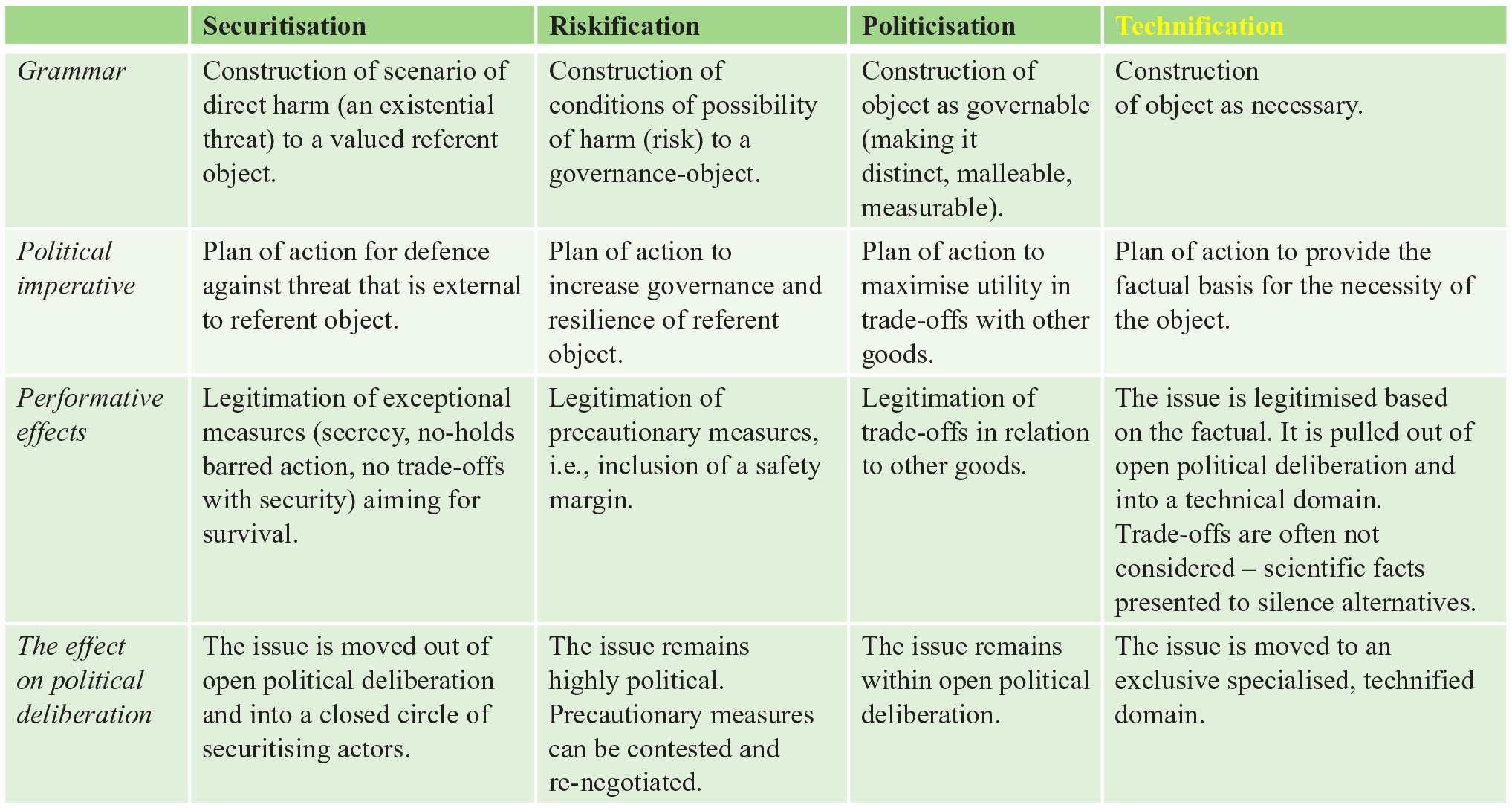
The securitisation, riskification, politicisation and technification mechanisms.
Technification does not equal politicisation, as the decisions are not weighed vis-à-vis other policy options but are necessitated by scientific or technical facts that grant the decision-making process priority and that create an impression of certainty. Other voices are excluded in the process, as the language of technification is, well, technical and specialised. In this regard, technification also contrasts strongly with the riskification mechanism, which revolves around feelings of uncertainty and management via precautionary measures.
Moreover, our take on technification goes beyond depoliticisation, commonly defined in narrow terms referring to the institutions and individuals associated with representative democracy (e.g. legislatures, elected politicians). 48 That is because we believe that our understanding of different social mechanisms being at play gains importance from a broader concept of the political. For Corry, normal politics or ‘politicisation’ merely requires the construction of something as governable in the first place. 49 As such, in the sphere of normal politics, different policy preferences (e.g. health care, education, roadbuilding) can be weighed against each other and traded to optimise the policy outcomes depending on the current preferences. This definition of politicisation is still a strong, intersubjectively held understanding of the concept, useful for the purpose of delineating other social mechanism ideal types. However, we would argue that it is conceptually of crucial importance to understand how ‘the political’ works in more abstract terms.
Following among others Rita Floyd, 50 we take inspiration from Hannah Arendt to understand the political as an open-ended and intersubjective practice of debate and deliberation. Arendt’s notion of ‘the political’ has been argued to lie in fact at the core of the securitisation theory itself, 51 where it is implicit that politics should be done consensually and through dialogue and deliberation as opposed to politics being a top-down process. Security policy is likewise viewed as an intersubjective process that is not decided by an individual actor or body. 52 As Ole Wæver himself has stated, his ‘general [concept of] politics is inspired by Hannah Arendt, because that which is narrowed down and constrained in the Schmittian security moment is necessarily a wider and different kind of politics’. 53 But what is this wider kind of politics? For Arendt, ideally, the political should exclude the rule of some over others, function on the principle of equality and give the right to speak for all. It would exclude violence, always function according to the principles of speech and persuasion and should deal with issues of common concern. 54
Framing the political in these terms, we can begin to see the contours of how different mechanisms (e.g. securitisation, riskification, technification) impinge on what is dealt with in the political realm. Following this argumentation, we have added a fourth category to Corry’s three in figure 1 above. The focus is on the extent to which the mechanism closes off the political as defined by Arendt.
Similar to Corry’s security grammars, our take on technification may present an ‘ideal type’ of social mechanism at play. In practice, the mechanisms can interweave and assume different forms, depending on the specifics of the sector in which it plays out. When approaching our example of the energy sector, we draw on the work of Berling 55 to illustrate how the technification mechanism may take different forms in practice.
Methodology
While defining the technification mechanism in this manner, we also need concrete ways of studying it empirically. Here, looking again to Berling, 56 we argue that technification can be traced in at least three forms in practice. As Berling argued in her research on the role of science in securitisation, the first of these forms would see science bolster or contradict securitisation attempts. This meant that science could be used instrumentally to further or hinder a securitisation attempt. The second form saw science used as an authoritative platform from which to speak in public independently of the securitising actor. Finally, the third form of objectivation saw science pulling decisions out of normal deliberation and into the closed circle of the expert few. 57 This would mirror the strongest form of the technification mechanism that comes closest to our ideal type and that potentially closes down the issue to the point where public debate is no longer considered relevant. Our empirical analysis takes these three practical forms and uses them as a net we throw out to trace technification in the case of Polish nuclear energy.
Our enquiry traces how scientific and technical expertise and argumentation serve to necessitate and legitimise energy development plans while potentially side-lining alternative voices and energy scenarios along these diverse forms of technification in practice. The analysis takes the development of nuclear energy in Poland as an illustrative example of these processes. One important caveat should be noted, however: While both the status and impact of ‘science’ took a blow from post-truth arguments, 58 we argue that technical knowledge was not affected to the same extent. So where scientific objectivation may be on the defensive, technification based on technical knowledge of infrastructure may still muster the effect of closing off deliberation. The analysis below takes note of this difference.
In carrying out the analysis, we have followed interpretivist research design and the logic of enquiry, where both ‘theory-based’ and ‘practice-based’ knowledge are given high importance as the analysis manoeuvres between them in a recursive and reiterative process. 59 Our logic of enquiry is therefore not simply inductive (reasoning that begins with observations of the particular phenomenon from which general laws are drawn) but rather an abductive one, where the researcher is ‘simultaneously puzzling over empirical materials and theoretical literatures’ and where ‘initial analytical hunches are continuously contrasted and reassessed vis-à-vis field reality’. 60
Our analysis has been initially informed by the theoretical debates on societal/security/political mechanisms discussed earlier, as well as secondary literature more specific to our case study. The latter included studies of issues such as the anti-nuclear social movements in Poland in a historical perspective, social management of technology in the nuclear energy development in Poland 61 or the securitisation of the Polish nuclear energy programme. 62 That helped us to grasp the general dynamic of the decades-long nuclear energy debate in Poland. In the next step, we researched in greater detail how scientific/technical expertise has more specifically functioned in the debate. Here, the analysis focused on the materials from a previous information campaign, reports and analyses made available by a number of government bodies to the public, as well as semi-structured interviews with pro-/anti-nuclear societal groups, NGOs, ministerial officials and energy experts conducted in 2020 in Warsaw and the communities of Krokowa, Choczewo and Gniewino in northern Poland, which have been considered as potential locations for the first NPP currently under consideration (with governmental sources pointing in 2022 to Choczewo, as the preferred localisation). 63 During the semi-structured interviews, the respondents were asked about the debate on nuclear energy in Poland and their understanding of the technical data and expertise in that debate. The timeframe of the analysis stretches from the first information campaign in 2012 up to 2021, when the renewed plans for the nuclear energy development programme were published. 64
It is important to stress that we, like securitisation theory in general, refrain from making claims about the motives behind instances of technification. While technification can clearly be used strategically to obtain certain goals, this is not the focus of this article. Here, for analytical purposes, we want to point out the existence of a social mechanism that has potential transformative power.
The next section analyses the technification mechanism in the development of the Polish nuclear energy programme: after a brief historical overview of the nuclear energy development plans in Poland, we turn to the analysis of their technification.
The History of Polish Nuclear Energy
While the nuclear energy law (Prawo atomowe) came into force in 1986, the decision to build an NPP in Poland dates back to 1971, and the project was reintroduced in 1982. 65 The project was shrouded in a veil of secrecy from the start, as the opaque decision-making typical of the communist regime was more obscure than ever during the period of Polish martial law in the early 1980s. The planned construction of the first NPP in Żarnowiec also suffered numerous setbacks. There were significant delays due to unwanted Soviet nuclear technology (A water-water energetic reactor), 66 as the Polish authorities sought to engage Western investors instead. 67 The nuclear power plans also mobilised strong social resistance rooted in the wider ecological movement in Poland in the 1980s, with environmental activists organising many anti-nuclear protests. The social opposition grew even stronger after the nuclear accident in Chernobyl in 1986, and a local referendum organised and conducted by societal actors in May 1990 in the Gdansk voivodship revealed strong local opposition to the project (86.2% against, only 13.8% in favour). 68 On this basis and in combination with concerns about nuclear waste and nuclear safety, 69 the initial plans for NPP construction were shelved. The official decision to halt the construction of the NPP in Żarnowiec was made in 1990, 70 but the Polish authorities kept the option open should the situation change.
The nuclear power plans resurfaced in 2005, 71 and the Polish Energy Group (PGE) was tasked with developing the first Polish NPP. 72 The development of the project in the years to follow was marked by centralised policymaking and a ‘top-down’ information campaign designed to convince society about the benefits of nuclear energy. The decision to develop nuclear energy was based on economic viability, nuclear safety and environmental concerns. 73 Technical expertise played an important role in legitimising the project. Some societal actors tried to ‘riskify’ the Polish nuclear energy programme, especially in the aftermath of the Fukushima NPP accident in 2011. The Polish media coverage of the event dominated the news cycle, highlighting the risks of nuclear technology and creating an atmosphere of unease, using phrases such as ‘nuclear catastrophe’, ‘radiation sickness’ and ‘radioactive cloud’. 74 Some commentators noted the extreme character of some media coverage at the time, with the ‘reports from Japan resembling reports from the ‘battlefield’, where the fate of humankind is being decided’. 75 However, the debate in the media was short-lived and largely inconsequential. First, a counter-narrative quickly emerged, with expert voices calling for a rational discussion; one not grounded in anti-nuclear phobias. 76 Second, although the Polish government started to portray itself as capable of preventing and managing the potential risks of nuclear energy, the policy course did not change. The ‘precautionary’ measures discussed did not go beyond general statements, 77 and safety guarantees were what would normally be expected from a new nuclear energy infrastructure project. 78 Third, pro-nuclear public opinion trends in Poland did not shift. The ‘riskifying moves’ therefore do not explain the overall decision-making dynamic and the implementation process of the Polish nuclear energy programme. Moreover, later attempts at ‘riskification’ of some societal organisations that oscillated around the issue of nuclear energy technology were not strong enough to challenge the increasing technification of nuclear energy plans that assumed different forms. Even with the Russian invasion of Ukraine and the shelling of the Zaporizhzhia NPP, the debate in Poland not only did not change its course, but the nuclear plans were more strongly necessitated by the rationale of energy sovereignty vis-à-vis Russia and future power generation in line with the EU’s low-carbon agenda. 79
The next section analyses this politics of technification in greater detail.
The Technification Mechanism in the Polish Nuclear Energy Programme
The 2005 decision to take the Polish nuclear energy programme back down from the shelf could be traced along the ideal-typical technification mechanism discussed above. First, it was based on conditions of necessity in the face of a number of pressing issues. Second, the political imperative took precedence over democratic deliberation and focused from the start on the plans of action to implement nuclear energy technology. The very decision to introduce the nuclear energy programme was adopted in the Polish energy policy until 2030 80 – and only then put on hold for 3 months to allow for public discussion. Although more inclusive, recent public consultations on the updated nuclear energy programme document conducted in 2020 81 do not allow space for challenging the very decision to develop nuclear energy. Both the past and future information activities have focused on framing nuclear as the optimal choice, with the future information campaign designed to maintain the existing public support for the programme; no public referendum on the issue was ever considered. 82 Third, the choice of nuclear technology was legitimised based on scientific facts and expert knowledge; alternatives have effectively been ruled out. If the overall technification mechanism could be traced along this entire process, the reading strategy proposed above shows that technification took different forms, sometimes against or in conjunction with other forms of politics.
Technification as Objectivation
We argued above that, in its strongest form, technification may resemble scientific objectivation as defined by Berling 83 when technical knowledge and expertise sought to pull decisions out of normal deliberation and confine them to a closed circle of experts. This would potentially depoliticise the issue to the point where the public debate would no longer be considered relevant. In practice, in the energy sector, objectivation could be achieved via a mix of, for example, expert impact studies on new energy infrastructure projects, technical assessments conducted by energy companies or parliamentary committees, or intra-expert debates. While carried out away from public scrutiny, these processes and their outputs would often remain publicly accessible but would largely fly under the radar due to a lack of public interest in the lengthy technical analyses and/or their non-contested character.
The development of the Polish nuclear energy infrastructure does not illustrate a strong objectivation mechanism. Nevertheless, some parts of the process clearly reveal attempts at stifling political deliberation on the issue, including the amassing of strong evidence of the necessity of nuclear energy development in Poland together with the provision of technical data in a format that might fail to address societal concerns.
To start with, convincingly outlining the necessity for the development of nuclear energy could successfully limit further political deliberation. In this case, given the CO2 emissions targets set by the EU and the heavy Polish reliance on coal, the development of nuclear energy has often been presented as the only option by a number of official sources ranging from the government portals, 84 through expert reports prepared by think tanks close to the ruling Law and Justice Party 85 and presentations made by scientists from the National Centre for Nuclear Research given during the meeting of the parliamentary committees on energy and mining, 86 to expert opinions from public research institutes working on nuclear energy. 87 The conditions of necessity were constructed by appealing to several pressing issues. The recently updated Polish nuclear energy development plan from October 2020 88 justified the project on the grounds of energy security, environmental and climate considerations, economic factors and technological developments. As an official from the Ministry of Climate stated, ‘The fact is that the government considers nuclear energy a necessity. (. . .) The decision to stop NPP development in 1990 has been widely regarded as the worst economic as well as environmental decision due to high CO2 emissions. Otherwise, our coal mines would most likely be phasing out earlier’. 89 Indeed, as the Minister of Climate stated in 2020, ‘It will be very difficult, if not impossible, to achieve ambitious goals without nuclear energy’. 90
Although this official rhetoric has also been echoed by some recently established pro-nuclear non-governmental organisations (e.g. a new grassroots social initiative ‘FOTA4Climate’ advocating the development of nuclear energy to decarbonise the Polish economy), 91 it has also been strongly contested by some domestic actors who either question the economic and technical viability of the current NPP construction plans or would rather opt for the low-carbon energy transition based on increased use of other energy sources (e.g. renewables) 92 and other pressing technical solutions (e.g. improvement of energy transmission lines). The official narrative of the necessity of nuclear energy thus clashes at times in the Polish context with alternative scenarios, and the high interest of diverse societal groups in the project has translated into ongoing scrutiny of the scarce technical expertise made available thus far. This dynamic effectively prevents the strongest form of technification to play out fully at the national level.
As regards the local level, despite high public support for the construction of the NPP in the designated locations,
93
the process is similarly far from objectified. On the one hand, the compact leaflets from the previous information campaign that presented nuclear energy as having more advantages than the alternatives
94
did not manage to sway the strongest local opponents of nuclear energy. On the other hand, some lengthy technical analysis that provided excessive data without addressing concrete concerns of the local opponents of nuclear energy did not achieve that, either. The member of an anti-nuclear group from the Lubiatowo area (one of the initial potential localisations of the NPP) described one such document provided during a local information event:
. . .the problem was, though, that it was like 500 pages or more [. . .] If you read it, there are a lot of numbers and analysis about radiation and other topics, even some financial plans are set out, but. . . Who wants to read it? Everyone needs a clear message. This way, they benefit from not sending a clear message, so if someone is not that interested in the topic, they can say, ‘Everything is ok’.
95
Therefore, given the high policy and security standing of energy sector developments in Poland, the objectivation attempts did not succeed, as the official narrative continuously met with contestation at both local and national levels. This did not mean that some form of technification did not play out; instead, the nuclear energy developments in Poland played out in line with the two other reading strategies proposed above. The subsequent sections investigate them.
Technification as Platform
Apart from the mode of objectivation described above, technification can also imply using scientific knowledge and expertise as an authoritative platform from which to speak to the population. As such, science and technology are not confined to a closed circle of experts but explicitly used in public in a strategic manner. Such a process can be steered by authorities or be initiated by the experts themselves. This form has been quite prevalent during the time since the announcement of the new plans to build an NPP in Poland but can be most easily identified in the 2012 information campaign run simultaneously by the energy company in charge of the project PGE EJ 1 (Polska Grupa Energetyczna EJ 1) titled ‘Świadomie o atomie’ (Conscious about the atom) and by the government: ‘Poznaj atom’ (‘Get to know the atom’).
The campaign ran at the national level but due to a limited budget it was not very visible in the public sphere. The public consultations conducted worked well at the institutional level (many institutions being close to the government and pro-nuclear) 96 but did not embrace the wider society. The campaign targeted the local communities where the NPP is to be located and took a structured, step-by-step approach to win local community support. It included programmes for schools and financial support for the districts. The debate has been criticised for its one-sided character and for focusing on the benefits of nuclear energy. 97 For our purposes, however, the programme contained several key elements of the technification mechanism in its practical use as a platform.
First, scientists and academics with degrees in natural sciences took part in the campaign, and their academic authority added legitimacy to the nuclear energy programme. The government side invited the experts to a number of public debates, and their voice was prominent in the campaign materials. Experts also frequently took part in the local events near the planned NPPs, such as harvest festivals and a regatta on Lake Żarnowieckie co-funded by PGE EJ 1. The local population was invited to approach a stand and ‘talk to an expert rather than a layman’. 98
Second, technical expertise was also widely used in many leaflets and publications aimed at educating society about nuclear energy technology and convincing them that it is the right choice. These were mostly distributed in the potential NPP locations. On the one hand, the technical aspects explaining the safety, necessity and workings of nuclear energy were conveyed in school materials targeting different age groups. On the other hand, the leaflets and short publications outlined the information about the ongoing project and technological/environmental assessment in the area in a technical yet simplified manner. 99 Crucially, expert knowledge was frequently used to present the safety of nuclear energy technology as a fact, 100 and the hard nuclear energy ‘facts’ were contrasted with societal ‘myths’ and irrational public fears of nuclear in the materials such as ‘Atom, radiation, energy: facts and myths’ (‘Atom, promieniowanie, energia: fakty i mity’), 101 ‘101 facts and myths about nuclear energy’ (‘101 faktów i mitów na temat energetyki jądrowej’) 102 or ‘Myths and facts about nuclear energy’ section in ‘Nuclear energy in a nutshell’ (‘Mity i fakty dotyczące energetyki jądrowej’ in ‘Energetyka jądrowa w pigułce’). 103 Moreover, the theme of the information campaign was displayed in the leaflets, online information websites, as well as local information points in the municipalities under the slogan, ‘Do you have knowledge or just an opinion?’ (‘Masz wiedzę czy tylko opinię?’), which further highlighted the dichotomy between authoritative and non-authoritative knowledge and constituted the technical and scientific as the relevant platform from which to speak on the issue.
Some opponents of nuclear energy in the local communities perceived this dynamic negatively. As one member of the local anti-nuclear group from the area where the NPP construction is planned stated:
They go like this: We’re doctors, scientists ‒ science is on our side, you don’t know the issue. We’ll show you. And OK, maybe I’m not a nuclear physicist, maybe I don’t know exactly how a nuclear reactor is built, but I know the consequences of the accident [in Chernobyl]. I know what the potential consequences are when there is an accident, and something explodes ‒ that the area will be largely contaminated (. . .).
104
In other words, technical knowledge was prioritised and constituted a platform from which to speak. Some domestic green NGOs questioned why the voices of scientists, economists and engineers are the key voices in the public debate on nuclear energy in Poland, while the authorities lack trust in the common and experience-based knowledge. 105 Regardless of the underlying causes, the ‘technification as platform’ mechanism inevitably determines that challenging the mainstream rhetoric could only be effectively attempted by similarly referring to scientific expertise.
As one anti-nuclear activist from the Żarnowiec region stated in an interview, it has never been possible to try to participate in the nuclear energy debate while using non-scientific arguments. 106 The anti-nuclear groups in the locations considered for the NPP construction, who oppose the project on numerous grounds (nuclear safety, local tourism, preservation of the coastline landscape and a natural ecosystem), have therefore attempted to challenge the mainstream in a number of ways. While trying to conquer the technology and science platform, a local group prepared their own leaflets and information materials to be distributed locally with the help of scientists and several NGOs, such as Greenpeace and the Green Institute. 107 Societal actors who held an anti-nuclear stance also occasionally outsourced various expert analyses to help their agenda. For instance, after the Fukushima accident, the local Greenpeace office commissioned a simulation of the consequences of a possible accident at an NPP in Poland to Austrian scientists from the Institute for Safety and Risk Studies at BOKU University in Vienna. 108 Based on meteorological simulations, the study analysed the possible impact of a nuclear accident in northern Poland while taking into account 2800 possible weather situations and scenarios for the spread of radioactive isotopes of iodine-131 and caesium-137. Here, the mobilisation of science and technology to be given a voice shines through clearly. 109
In other words, there was increasing understanding and even acceptance among the local environmental activists that only technical expertise could ensure success. As one anti-nuclear activist from the Żarnowiec region stated in an interview when asked how a debate on the future of Polish nuclear energy should look like: ‘I think that there should be experts from both sides, not everything one-sided’. 110 In fact, the societal actors themselves started to employ the rhetoric of ‘facts’ and ‘objectivity’. For instance, some leaflets distributed by Greenpeace aimed to challenge the official government campaign by deconstructing the government ‘myths’ with other ‘facts’. 111 Similarly, the interviewees emphasised that they wish to contribute ‘objective’ materials to the local debate on the pros and cons of nuclear energy and its alternatives. 112 As one interviewee stated, ‘We just wanted to show people the facts, to show them also another alternative in the form of renewables, and how they can be utilised’. 113 Another local activist stated that there need to be ‘Facts presented . . . There should be some equal debate, not that everything here gets saturated with this de facto dis-information, because it is such a mix of facts from physics with propaganda babble’. 114 Interestingly, this dynamic is not new and was present already in the 1980s, when, for example, the societal actors from the region chose a person with a PhD in chemistry as the head of a social referendum committee to be able to ‘stand up’ to other experts. 115
The counter-technification attempts described above illustrate how, within the ‘technification as platform’ mechanism, technical argumentation becomes accepted as the ‘rules of the game’. However, the existence of this mechanism does not necessarily imply that the authorities have established an actual, sufficient platform for dialogue with society. Some energy experts noted that building such a structure would take years and more in-depth commitment. 116 In addition, scientists from public institutes researching nuclear energy have also expressed some concerns that the scientific debate is insufficient, 117 that the potential of scientists is not sufficiently utilised by the government side to promote nuclear energy, 118 and that – similar to the recent COVID situation in Poland – experts are not in fact the ‘face’ of a current public discussion. 119 Hence, as opposed to the technocratic energy governance, where the decisions would be made by a confined circle of experts, the politics of technification rather implies that the legitimate debate is confined to the technical arguments, which set the tone of the debate and can be utilised as a strategic means towards certain political ends, illustrating ‘technification as platform’ practice.
Technology to Bolster or Contradict Securitisation Attempts
Technification could also imply that technology is used to either bolster or contradict securitisation attempts. In the Polish case, the development process surrounding the first nuclear reactors has largely been securitised, and the value-laden perception of technology has played an important part herein. The Polish nuclear energy programme has been considered raison d’état, since its renewal in 2005 and nuclear technology acquired a positive value somehow by default when linked to strategic Polish interests and suppliers. This has been apparent in the Polish nuclear energy debate, where nuclear plans were described in superlatives and justified on technical grounds, as discussed earlier. Consequently, the perceived foreign influence and agendas, as well as domestic expert voices that differed from the mainstream rationale, have been considered a threat. It is in this sense that the authorities have mobilised science and technology to bolster a certain security agenda.
To start with, some recent studies on energy governance in Poland noted how the development of the Polish nuclear energy programme was securitised via a number of exceptional measures. 120 These measures have included undermining the transparency and good practices of public administration in the energy sector, active measures to limit an open debate on nuclear energy, and increasing the competences of the Internal Security Agency (Agencja Bezpieczeństwa Wewnętrznego). 121 Limiting the public debate has been particularly noteworthy in the areas designated for the construction of the first NPP, where anti-nuclear activists complained about their exclusion from local meetings, the removal of most anti-nuclear posters and banners from the area and anti-nuclear leaflets from the local libraries, or a lack of interest to organise a more inclusive local debate that would present both the pros and cons of nuclear energy. 122 Although some extensive studies on the subject explored how concrete techniques were utilised in this process, 123 a 2009 communication strategy prepared by an external consultancy for the Ministry of Economy that categorised the societal actors into ‘friends’, ‘enemies’ and ‘neutral’ groups based on their attitudes to nuclear energy in Poland and that was targeted primarily at the population of the potential NPP localisations likely served as a basis for this approach. 124 Although another information campaign planned for the coming years is likely to be of a more inclusive character, as outlined in the recently updated nuclear energy development programme from October 2020, 125 the perception of the foreign influence prevails and permeates different decisions and considerations of the government side. For instance, although the government does not see a general need for a referendum due to stable public opinion polls (with public support for nuclear energy in Poland rising to an unprecedented 75% in favour in autumn 2022 amid the outbreak of war in Ukraine), 126 there are also concerns that external actors could manipulate a potential referendum. As Ministry of Climate officials noted, ‘despite high and stable public support for nuclear energy in Poland, this topic is surrounded by a lot of heavy stuff, also negative information of other countries and interest groups’. 127 While foreign influence has been painted as a threat to Polish nuclear energy, the legitimacy of societal actors who are perceived as somehow affiliated with the Western countries that are largely anti-nuclear and in favour of other types of energy technologies is also at times questioned. For instance, there is a local perception that many opponents of nuclear energy in the NPP-designated areas in northern Poland are in fact not from the region but live and work in Germany. 128 The Danish affiliation of the co-author of this paper has also been questioned during some expert interviews in the right-wing political spectrum: The latter implied that the information gathered can be used strategically to contribute to undermining the development of the Polish nuclear energy programme, possibly as part of a strategy to sell more Danish renewable technologies on the Polish market. This perception is not new and has been expressed previously by some Polish energy experts from right-wing political parties, 129 who saw EU climate policy as a structural way of Western states using ‘ecological tools’ to further their own economic and strategic interests in the Central and Eastern European region (CEE). 130 Hence, not only is the provision of nuclear energy technology not neutral, the same applies to energy technologies that are considered to be in direct competition to it; and, by default, to the Polish national interest and top security agenda. Polish nuclear energy is thus perceived as potentially under siege by foreign influence. Some local observers note that openly dividing the societal actors into those who ‘are with us’ versus those who are not and demonstrating a willingness to only communicate with those who support nuclear energy creates a hierarchy of relevance while installing a sense of waging a war. 131 Some local actors from the NGO sector point out that this dynamic is not confined to the Polish nuclear energy debate, as the mindset of authorities is marked by a general lack of trust in the outside world. And, as one analyst noted: ‘There’s a sense of threat. When you look at their narrative when it comes to media. (. . .) They constantly say they’re being surrounded. That media are against them. That it’s necessary to balance the forces. Etc. It’s a siege mentality. . .’
In relation to the nuclear energy debate, this securitised outlook led to additional extraordinary measures. Apart from the handling of the public debate during the first information campaign described above, the perceived threat from foreign countries as well as from within Polish society has been managed by the government decision to increase the state oversight of the nuclear energy development programme by involving the Internal Security Agency. 132 The latter started to tackle both the perceived internal and external threats; on the one hand, the agency was granted authority to identify societal ‘opponents’ of nuclear energy to protect the critical infrastructure, and it started providing regular reports to the government, with some domestic observers raising concerns about the potential infiltration and invigilation of the domestic environmental groups. 133 On the other hand, the agency issued a warning to the PGE EJ company in charge of the project regarding a contract for the local impact studies of the planned NPP that was to be signed with the Australian company Worley Parsons, as it was feared that their business links with Russia might mean that the company would not be interested in the success of the NPP project. 134 Due to alleged delays, Worley Parsons has since been fired and the PGE EJ started conducting its own technological assessment studies. The technological expertise that was not considered value-neutral therefore played a significant part in the securitisation attempt. Another example of the intertwinement of security and technical considerations is the choice of the nuclear technology provider. In autumn 2022, the Polish government announced that the US company Westinghouse will build the first NPP in Poland. 135 Apart from the Americans, bids for the construction of the NPP were also submitted by the French Électricité de France and Korean Hydro & Nuclear Power (KHNP). Although Korean KHNP was later announced in 2023 to join another NPP project in Pątnów in Poland jointly with the Polish ZE PAK and PGE, the French side has been left out. Although no official criteria were given for the choice of nuclear technology provider, local analysts pointed to the increasingly important geopolitical security considerations behind choosing the US partner. 136
Moreover, some domestic technical analyses have been handled via extraordinary measures; for instance, one of the portals ‘Wysokie Napięcie’ reported that several advisory teams primarily consisting of scientists and representatives of business organisations appointed by the Minister of Climate were to provide the theoretical foundation for The Polish Energy Policy 2040 document (PEP 40) 137 in 2020. 138 However, the secrecy enshrouding the project and measures to conceal the technical and scientific process of its development increased when a team working on the development of large-scale emission-free sources stated that NPP construction is unrealistic (without justifying why). The Ministry did not disclose the results, and the authors signed confidentiality clauses. 139 In this manner, science and technical expertise could also be suppressed by forcing confidentiality within the securitisation process.
The securitisation of nuclear energy in Poland has therefore taken distinct routes pointing to both external and internal enemies. Foreign technology and influence were seen as threats on an equal footing, whereas the ‘right’ kind of expertise was used to bolster the ‘necessity of nuclear energy’ claims. Our analysis illustrates the entanglement of securitisation and technification on this point.
Conclusion
This paper has sought to pinpoint the general technification mechanism using the example of the development of the Polish nuclear energy programme. Drawing inspiration from the securitisation literature and drawing on Arendt’s notion of the political, we argued that technification is a social mechanism, which can be distinguished from politicisation, riskification and securitisation as depicted in the literature. By conceptualising technification vis-à-vis the other mechanisms, we illustrated how technification has a certain grammar whereby technologies take on the character of necessity, and a plan for implementation must therefore be devised. The performative effect of technification is a closing off of political deliberation by establishing legitimacy based on technical/scientific facts. Similar to securitisation and riskification, technification thus constitutes a social mechanism that impinges on the intersubjective practice of open political deliberation among equals, as it marginalises certain voices and agendas by rendering issues technical.
In the example of the Polish nuclear energy development plans, we highlighted how technification can play out in practice along the spectrum of three different forms. First, technical knowledge could pull the decisions out of normal deliberation and into the closed circle of experts through a process similar to scientific objectivation. Second, technical expertise could be used as a platform of both technification and counter-technification moves. Third, technical arguments could bolster a securitising move by central actors.
The Polish example illustrated how examining energy infrastructure from the technification perspective reveals new aspects of energy governance where the technical, political and security considerations intertwine. Although nuclear energy could seem a ‘special’ form of energy technology due to its catastrophic potential and, hence, a highly contested character, previous research showed how, similar to other European countries, the nuclear politics in Poland can be driven by different social mechanisms – from politicisation to riskification – which are highly contextual. 140 We therefore argue that the technification mechanism is useful for studying the implementation of any kind of (energy) technology, nuclear or otherwise. A certain form of technology does not carry with it a built-in necessity in the choice of specific modes of governance. Moreover, our analysis sheds light on the possible interactions between different mechanisms. In the Polish case, the high contestation of the nuclear energy plans meant that they were not simply a policy option considered on par with alternatives within everyday politics; rather, some ‘riskifying’ moves sought to play on the feelings of uncertainty of nuclear energy technology but failed due to contextual factors and the successful technification of the issue by the Polish government. The latter necessitated and implemented the nuclear energy plans drawing on technical facts and expertise that effectively marginalised other voices. Given a high security standing of critical energy infrastructure projects in Poland, the technical expertise is also at times intertwined with the securitising moves around the nuclear energy programme. Therefore, the Polish example illustrated that the riskification mechanism (which focuses on managing uncertainties) and the technification mechanism (which builds certainty on the ‘technical’ and ‘factual’) often work as opposing forces. On the contrary, technification and securitisation frequently worked together.
The article contributes to critical security studies with a more fine-grained analysis of the technology negotiations as well as contributing to critical energy studies with the conceptualisation of the role of technology in relation to the ongoing debates on securitisation. The outlining of a new form of social mechanism adds to the debates at the intersection between science and technology studies and critical security studies by providing a new way of evaluating the role of science and technology. This new perspective on the technical domain will analytically and systematically bring to the fore how technology holds transformative power with possible security implications.
Footnotes
Declaration of Conflicting Interests
The author(s) declared no potential conflicts of interest with respect to the research, authorship and/or publication of this article.
Funding
The author(s) received no financial support for the research, authorship and/or publication of this article.
1.
Barry Buzan et al., Security: A New Framework for Analysis (Boulder, CO: Lynne Rienner, 1998); Ole Wæver, ‘Aberystwyth, Paris, Copenhagen. New ‘schools’ in Security Theory and Their Origins between Core and Periphery’ (Paper presented at the Annual Meeting of the International Studies Association, Montreal, QC, 17–20 March 2004); Ole Wæver, Concepts of Security (PhD Diss., Institute for Political Science, University of Copenhagen, 1997).
2.
Trine Villumsen Berling, ‘Science and Securitization. Objectivation, the Authority of the Speaker, and Mobilization of Scientific Facts’, Security Dialogue 42 (2011): 385–97; Olaf Corry, ‘Securitisation and “Riskification”: Second-Order Security and the Politics of Climate Change’, Millenium 40 (2012): 235–58; Izabela Surwillo, Energy Security Logics in Europe: Threat, Risk or Emancipation? (London: Routledge, 2019); Kacper Szulecki, Energy Security in Europe: Divergent Perceptions and Policy Challenges (eBook, Cham: Springer, 2017); Felix Ciută, ‘Conceptual Notes on Energy Security: Total or Banal Security?’, Security Dialogue 41, no. 2 (2010): 123–44.
3.
Buzan et al., Security: A New Framework for Analysis.
4.
Corry, ‘Securitisation and “Riskification”: Second-Order Security and the Politics of Climate Change’.
5.
Ibid.
6.
Ole Wæver, ‘Politics, Security, Theory’, Security Dialogue 42 (2011): 465–80.
7.
Didier Bigo, ‘Security and Immigration: Towards a Critique of the Governmentality of Unease’, Alternatives: Global, Local, Political 27 (2002): 63–92; Karen Lund Petersen, Corporate Risk and National Security Redefined (London and New York, NY: Routledge, 2011).
8.
Anna Leander, ‘The Power to Construct International Security: On the Significance of Private Military Companies’, Millenium 33 (2005): 803–26; Petersen, Corporate Risk and National Security Redefined.
9.
Compare with the classical book on nuclear energy and democracy by Robert Jungk, The Nuclear State (1st ed. London: John Calder Ltd., 1979): 35. ‘These deceptions are further camouflaged by the way in which they are presented to the public. The complex, far-reaching consequences of lethal radiation are improperly simplified by an appeal to statistics, curves and mathematical formulae. Only too often conjectures are presented as solidly and exact scientific findings’.
10.
Mike Bourne, ‘Guns Don’t Kill People, Cyborgs Do: A Latourian Provocation for Transformatory Arms Control and Disarmament’, Global Change, Peace & Security 24, no. 1 (2012): 141–63.
11.
Marieke de Goede, ‘Engagement All the Way Down’, Critical Studies on Security 8, no. 2 (2020): 101–15.
12.
Anthony Amicelle et al., ‘Questioning Security Devices: Performativity, Resistance, Politics’, Security Dialogue 46, no. 4 (2015): 293–306; Debbie Lisle and Mike Bourne, ‘The Many Lives of Border Automation: Turbulence, Coordination and Care’, Social Studies of Science 49, no. 5 (2019): 682–706; Claudia Aradau and Tobias Blanke, ‘Politics of Prediction: Security and the Time/Space of Governmentality in the Age of Big Data’, European Journal of Social Theory 20, no. 3 (2017): 373–91.
13.
Lene Hansen and Helen Nissenbaum, ‘Digital Disaster, Cyber Security, and the Copenhagen School’, International Studies Quarterly 53, no. 4 (2009): 1155–75.
14.
Ruth Wodak, ‘Recontextualization and the Transformation of Meanings’, in Discourse and Social Life, eds. Srikant Sarangi and Malcolm Coulthard (Harlow: Longman, 2000): 53–68; See also the compelling analysis of the performativity of modelling in EU energy policy by Sarah Royston et al., ‘Masters of the Machinery: The Politics of Economic Modelling within European Union Energy Policy’, Energy Policy 173 (2023): 1–10.
15.
A. Storey, ‘Depoliticising development: promoting choiceless democracies’, Paper from the ‘Whose Rules Rule? 2004; The IMF and World Bank at 60’ Dublin. See also Atle Midttun and Thomas Baumgartner, ‘Negotiating Energy Futures the Politics of Energy Forecasting’, Energy Policy 14, no. 3 (1986): 219–41 on how energy modelling exercises have diminished the realm of speakers to those ‘fluent in (. . .) technical discourse’ (p. 225).
16.
Colin Hay, Why We Hate Politics (Cambridge: Polity Press, 2007), 83.
17.
Caroline Kuzemko, ‘Energy Depoliticisation in the UK: Destroying Political Capacity’, The British Journal of Politics and International Relations 18, no. 1 (2016): 112.
18.
In Yergin’s (1988: 111) classical definition: ‘The objective of energy security is to assure adequate, reliable supplies of energy at reasonable prices and in ways that do not jeopardise major national values and objectives’.
19.
Hugh Dyer and Maria Julia Trombetta, International Handbook of Energy Security (Cheltenham: Edward Elgar Publishing, 2013), 4.
20.
Carlos Pascual and Evie Zambetakis, ‘The Geopolitics of Energy: From Security to Survival’, in The Geopolitics of Energy: From Security to Survival, eds. Carlos Pascual and Jonathan Elkind (Washington, DC: Brookings Institution Press, 2010).
21.
For example, Aleh Cherp and Jessica Jewell, ‘The Three Perspectives on Energy Security: Intellectual History, Disciplinary Roots and the Potential for Integration’, Current Opinion in Environmental Sustainability 3, no. 4 (2011): 202–12; Aleh Cherp and Jessica Jewell, ‘The Concept of Energy Security: Beyond the Four As’, Energy Policy 75 (2014): 415–21; Benjamin K. Sovacool and Marilyn A. Brown, ‘Competing Dimensions of Energy Security: An International Perspective’, Annual Review of Environment and Resources 35, no. 1 (2010): 77–108; Benjamin K. Sovacool and Ishani Mukherjee, ‘Conceptualizing and Measuring Energy Security: A Synthesized Approach’, Energy 36, no. 8 (2011): 5343–55.
22.
Szulecki, Energy Security in Europe; Kacper Szulecki, ‘Securitization and State Encroachment on the Energy Sector: Politics of Exception in Poland’s Energy Governance’, Energy Policy 136 (2020): 111066; Emil Kirchner and Can Berk, ‘European Energy Security Co-Operation: Between Amity and Enmity’, JCMS: Journal of Common Market Studies 48, no. 4 (2010): 859–80; Francis McGowan, ‘Putting Energy Insecurity into Historical Context: European Responses to the Energy Crises of the 1970s and 2000s’, Geopolitics 16, no. 3 (2011): 486–511; Andrew Phillips, ‘A Dangerous Synergy: Energy Securitization, Great Power Rivalry and Strategic Stability in the Asian’, The Pacific Review 26, no. 3 (2013): 17–38; Surwillo, Energy Security Logics in Europe; Odysseas Christou and Constantinos Adamides, ‘Energy Securitization and Desecuritization in the New Middle East’, Security Dialogue 44, no. 5–6 (2013): 507–22.
23.
Ciută, ‘Conceptual Notes on Energy Security’; Szulecki, Energy Security in Europe; Surwillo, Energy Security Logics in Europe.
24.
For example, Piotr Stankiewicz, Gra w atom. Społeczne zarządzanie technologią w rozwoju energetyki jądrowej w Polsce (Wydawnictwo Naukowe Uniwersytetu Mikołaja Kopernika, Toruń 2017).
25.
Claudia Aradau, ‘Security That Matters: Critical Infrastructure and Objects of Protection’, Security Dialogue 41, no. 5 (2010): 491–514.
26.
Norman Fairclough, ‘Dialogue in the Public Sphere’, in Discourse and Social Life, eds. Srikant Sarangi and Malcolm Coulthard (London: Routledge, 2000), 172.
27.
Buzan et al., Security: A New Framework for Analysis.
28.
Hansen and Nissenbaum, ‘Digital Disaster, Cyber Security, and the Copenhagen School’.
29.
Ibid., 1167.
30.
Ibid., 1168.
31.
Ibid., 1159.
32.
Berling, ‘Science and Securitization’.
33.
Dagmar Rychnovska et al., ‘Science and Security Expertise’, Authority, Knowledge, Subjectivity 84 (2017): 327–31.
34.
Trine Villumsen Berling, ‘Science and Securitization’, 390.
35.
See Guzzini’s (2011) discussion of Elster’s definition of a causal mechanism.
36.
Stefano Guzzini, ‘Securitization as a Causal Mechanism’, Security Dialogue 42, no. 4–5 (2011): 329–41.
37.
Ibid., 331.
38.
A variant of Copenhagen School analysis; see, for example, Buzan Barry and Ole Wæver, Regions and Powers: The Structure of International Security, Series 91: Cambridge Studies in International Relations (Cambridge: Cambridge University Press, 2003).
39.
Guzzini, ‘Securitization as a Causal Mechanism’, 333.
40.
Ibid., 334.
41.
We exclude desecuritisation from this in-depth discussion even though it can be studied as a mechanism as well. See Hansen (2006) for an overview of the desecuritisation literature. Cf. Lene Hansen, ‘Reconstructing Desecuritisation: The Normative-Political in the Copenhagen School and Directions for How to Apply It’, Review of International Studies 38, no. 3 (2012): 525–46; Ulrik Pram Gad and Karen Lund Petersen, ‘Concepts of Politics in Securitization Studies’, Security Dialogue 42, no. 4–5 (2011): 315–28. Hansen, Lene. 2006. Security as Practice. Discourse Analysis and the Bosnian War. London: Routledge.
42.
Jef Huysmans, The Politics of Insecurity: Fear, Migration and Asylum in the EU (London and New York,NY: Routledge, 2006), 8–9.
43.
Corry, ‘Securitisation and “Riskification”: Second-Order Security and the Politics of Climate Change’.
44.
Ibid.
45.
Ibid.
46.
Hansen and Nissenbaum, ‘Digital Disaster, Cyber Security, and the Copenhagen School’.
47.
Berling, ‘Science and Securitization’.
48.
Flinders, M., Buller, J. Depoliticisation: Principles, Tactics and Tools. Br Polit 1 (2006): 293–318.
49.
Corry, ‘Securitisation and “Riskification”: Second-Order Security and the Politics of Climate Change’, 249.
50.
Rita Floyd, Security and the Environment: Securitisation Theory and US Environmental Security Policy (Cambridge: Cambridge University Press, 2010).
51.
Barbara Motta Floyd and Cauê Pimentel, ‘Securitization and the Political: Contributions from Hannah Arendt’, Revista Brasileira de Estudos de Defesa 3, no. 1 (2016): 23–51.
52.
Floyd, Security and the Environment: Securitisation Theory and US Environmental Security Policy, 50.
53.
Wæver, ‘Politics, Security, Theory’.
54.
David Arndt, Arendt on the Political (Cambridge: Cambridge University Press, 2019), 68–71.
55.
Berling, ‘Science and Securitization’.
56.
Ibid.
57.
Ibid.
58.
Trine Villumsen Berling and Christian Bueger, ‘Expertise in the Age of Post-Factual Politics’, An Outline of Reflexive Strategies 84 (2017): 332–41.
59.
Dvora Yanow, ‘Interpretive Political Science: What Makes This Not a Subfield of Qualitative Methods’, APSA Newsletter, Fall 2003.
60.
Ibid., 99; Peregrine Schwartz-Shea and Dvora Yanow, Interpretive Research Design: Concepts and Processes (London: Routledge, 2013).
61.
Stankiewicz, Gra w atom.
62.
Szulecki, ‘Securitization and State Encroachment on the Energy Sector’.
63.
64.
Ministry of Climate and Environment, ‘Polityka Energetyczna Polski Do 2040 r. (PEP2040) [Poland’s Energy Policy until 2040]’ (Ministry of Climate and Environment, Warsaw, 2021).
65.
‘Ustawa z Dnia 10 Kwietnia 1986 r. Prawo Atomowe’ (Sejm Rzeczpospolitej Polskiej, Dz.U. z r. no. 14, poz. 70, 1986).
66.
The water‒water energetic reactor.
67.
Tomasz Borewicz et al., Bez atomu w naszym domu: protesty antyatomowe w Polsce po 1985 roku (Europejskie Centrum Solidarności: Gdańsk, 2019), 93. See also the recently published English version, Kacper Szulecki et al., The Chernobyl Effect: Antinuclear Protests and the Molding of Polish Democracy, 1986–1990 (New York, NY and Oxford: Berghahn Books, 2022).
68.
Ibid., 162. The referendum had no binding power.
69.
Borewicz et al., Bez atomu w naszym domu: protesty antyatomowe w Polsce po 1985 roku.
70.
‘Uchwała Nr 204 Rady Ministrów z Dnia 17 Grudnia 1990 r. w Sprawie Postawienia Inwestycji Elektrownia Jądrowa “Żarnowiec” w Budowie w Stan Likwidacji’ (Sejm, 17 December 1990).
71.
Ministry of Economy and Labor, ‘Polityka Energetyczna Polski Do 2025 r. [Polish Energy Policy Until 2025]’ (Ministry of Economy and Labor, Warsaw, 2005).
72.
73.
‘Polityka Energetyczna Polski Do 2040 r. (PEP2040) [Poland’s Energy Policy until 2040]’.
74.
75.
Ibid.
76.
77.
78.
Polska Agencja Prasowa. “Polska nie zrezygnuje z programu nuklearnego.” www.forbes.pl, April 12, 2011.  .
.
79.
‘Energia jądrowa w Polsce. Szef PGE: To jest największy projekt w historii’, polsatnews.pl, 7 March 2023. Available at: https://www.polsatnews.pl/wiadomosc/2023-03-07/energia-jadrowa-w-polsce-szef-pge-to-jest-najwiekszy-projekt-w-historii-polski/. Last accessed: March 31, 2023; ‘Współpraca Przy Budowie SMR – Małych Elektrowni Jądrowych’, portalkomunalny.pl, 13 March 2023. Available at: . Last accessed: March 31, 2023.
80.
Ministerstwo Gospodarki, ‘Polityka energetyczna Polski do 2030 roku’, Wersja no. 5, 2009: 1‒28.
81.
82.
‘Polityka Energetyczna Polski Do 2040 r. (PEP2040) [Poland’s Energy Policy until 2040]’.
83.
Berling, ‘Science and Securitization’.
84.
‘Polski Atom: Program Polskiej Energetyki Jądrowej [Polish Atom: Polish Nuclear Energy Progra]’.
85.
86.
87.
88.
89.
Author’s interview at the Ministry of Climate, Warsaw, 30 September 2020.
90.
91.
The initiative emerged in 2019 and, as of 2020, unites around 50 members and 400 active supporters across the country.
92.
For example, most notably promoted by the Polish Green Party as well as numerous other ‘green’ societal actors.
93.
94.
For example, information material, ‘Elektrownia Jądrowa w Polsce – Bezpieczeństwo, Rozwój, Ekologia. Dlaczego Polska Potrzebuje Elektrowni Jądrowej? [Nuclear Power Plant in Poland: Safety, Development, Ecology. Why Does Poland Need a Nuclear Power Plant?]’, n.d.
95.
Author’s group interview with a citizens’ group, ‘Nie dla atomu w Lubiatowie [No for atom in Lubiatowo]’, Słajszewo, 25 September 2020.
96.
Author’s interview no. 2 at the Institute of Nuclear Chemistry and Physics (Instytut Chemii i Fizyki Jądrowej) Warsaw, 29 September 2020.
97.
Katarzyna Iwińska and Katarzyna Witkowska, ‘Społeczeństwo Obywatelskie w Drodze Ku Podmiotowości. . . Przypadek Polskiej Energetyki Jądrowej1’, Energetyka – Społeczeństwo – Polityka, no. 2/2016 (4), n.d.: 83‒111.
98.
Author’s interview at Krokowa municipality, Krokowa, 15 September 2020.
99.
‘Badania Środowiskowe i Lokalizacyjne: Pytania i Odpowiedzi [Environmental and Siting Research: Questions and Answers Localization]’ (Polish Energy Group Nuclear Energy, n.d.); ‘Czy w Gminie Krokowa Może Powstać Elektrownia Jądrowa? Badania Terenowe [Can a Nuclear Power Plant Be Built in Krokowa Commune? Field Research]’ (Polish Energy Group Nuclear Energy, n.d.).
100.
‘Bezpieczna Elektrownia Jądrowa to Fakt [Safe Nuclear Energy Is a Fact]’ (Polish Energy Group Nuclear Energy, n.d.).
101.
‘Atom, Promieniowanie, Energia: Fakty i Mity [Atom, Radiation, Energy: Facts and Myths]’ (Ministry of Energy: Department of Nuclear Energy, n.d.).
102.
‘101 Faktów i Mitów Na Temat Energetyki Jądrowej [101 Facts and Myths about Nuclear Energy]’ (Polish Energy Group, n.d.).
103.
Ministry of Energy, ‘Energetyka Jądrowa w Pigułce [Nuclear Energy in a Nutshell]’ (Ministry of Energy, Warsaw, 2016).
104.
Author’s group interview with a citizens’ group ‘Nie dla atomu w Lubiatowie [No for atom in Lubiatowo]’, Słajszewo.
105.
Author’s interview at environmental NGO, Warsaw, 21 September 2020.
106.
Author’s interview with local environmental activist, Żarnowiec, 15 September 2020.
107.
Author’s group interview with a citizens’ group ‘Nie dla atomu w Lubiatowie [No for atom in Lubiatowo]’, Słajszewo.
108.
Stankiewicz, Gra w atom.
109.
In a less direct way, local anti-nuclear activists from the Choczewo district once hired two PhD researchers to conduct a local study on the potential development pathways of the surrounding rural areas, which included the tourist trends and profiles of the frequent visitors. Although not directly related to nuclear energy, the study aimed to illustrate scientifically how the construction of the NPP is not compatible with the development path formerly chosen by the local district (group interview Slajszewo).
110.
Author’s interview with local environmental activist, Żarnowiec.
111.
‘Nieświadomie o atomie: o czym nie mówi PGE. Mity w które nie warto wierzyć’ (Greenpeace, n.d.).
112.
Author’s group interview with a citizens’ group ‘Nie dla atomu w Lubiatowie [No for atom in Lubiatowo]’, Słajszewo.
113.
Ibid., emphasis added.
114.
Author’s group interview with a citizens’ group ‘Nie dla atomu w Lubiatowie [No for atom in Lubiatowo]’, Słajszewo.
115.
Borewicz et al., Bez atomu w naszym domu: protesty antyatomowe w Polsce po 1985 roku.
116.
Author’s interview at the Institute of Physics of the Polish Academy of Sciences (Instytut Fizyki PAN), Warsaw, 22 September 2020.
117.
Ibid.
118.
Author’s interview no. 2 at the Institute of Nuclear Chemistry and Physics (Instytut Chemii i Fizyki Jądrowej), Warsaw.
119.
Author’s interview at the Institute of Physics of the Polish Academy of Sciences (Instytut Fizyki PAN), Warsaw.
120.
Szulecki, ‘Securitization and State Encroachment on the Energy Sector’.
121.
Ibid.
122.
Author’s group interview with a citizens’ group ‘Nie dla atomu w Lubiatowie [No for atom in Lubiatowo]’, Słajszewo; Author’s interview with local environmental activist, Żarnowiec.
123.
Stankiewicz, Gra w atom.
124.
125.
‘Uchwała Nr 141 Rady Ministrów z Dnia 2 Października 2020 r. w Sprawie Aktualizacji Programu Wieloletniego Pod Nazwą “Program Polskiej Energetyki Jądrowej”’.
126.
‘Wzrost Poparcia Społecznego Dla Rozwoju Energetyki Jądrowej w Polsce’, CBOS Newsletter, 2022. Available at: https://www.cbos.pl/PL/publikacje/news/newsletter_ver3.php?news_r=2022&news_nr=38. Last accessed: 31 March, 2023.
127.
Author’s interview at the Ministry of Climate, Warsaw.
128.
Author’s group interview with a citizens’ group, ‘Nie dla atomu w Lubiatowie [No for atom in Lubiatowo]’, Słajszewo; Author’s group interview with a citizens’ group, ‘Tak dla atomu w Lubiatowie [Yes for atom in Lubiatowo]’, Krokowa, 26 September 2020.
129.
Think-tank affiliated with the Law and Justice Party.
130.
Surwillo, Energy Security Logics in Europe.
131.
Author’s interview at environmental NGO, Warsaw.
132.
‘Tusk: Grad Prezesem Spoółki? Ta Nominacja Ma Charakter Polityczny’, Wprost, 18 July 2012.
133.
‘Klucz Do Dobrobytu’, Przegląd, 27 May, 2012.
134.
135.
136.
‘Energia jądrowa w Polsce. Szef PGE: To jest największy projekt w historii Polski’; Information material, ‘Elektrownia Jądrowa w Polsce – Bezpieczeństwo, Rozwój, Ekologia. Dlaczego Polska Potrzebuje Elektrowni Jądrowej? [Nuclear Power Plant in Poland – Safety, Development, Ecology. Why Poland Needs Nuclear Power Plant?]’; ‘Polska rezygnuje z francuskiego atomu. “To kolejny prztyczek w nos”’,
www.money.pl
, 31 October 2022. Available at: . Last accessed: 31 March, 2023.
137.
‘Polityka Energetyczna Polski Do 2040 r. (PEP2040) [Poland’s Energy Policy Until 2040]’.
138.
139.
Ibid.
140.
Surwillo, Energy Security Logics in Europe.