



Abstract
The ‘securitisation’ of migration is argued to rest on a process of framing migrants as a threat to key values, principally identity. Yet, the socially constructed nature of ‘identity’ implies the potential for dual usage: support and contestation of the security frame. Using the UK as an illustrative case, this overlooked dynamic is explored through mixed-methods, incorporating elite political and religious discourse (2005–2015) and original public attitudinal survey evidence. The discourse analysis reveals that the preservation of an imperilled British identity (‘tolerance’) is a frame invoked, in different ways and by different actors, to either support or contest the securitisation of migration. Similarly, British citizens who deeply value the preservation of ‘Britishness’ have diverse, positive and negative views on migration, challenging the notion that identity as a referent object is deterministically linked to anti-immigration attitudes. The innovative concept of ‘counter-securitisation’ is utilised and developed, unpicking these nuances and their implications.
Introduction
From border walls and fences, to the growth of far-Right politics and populism across Europe and beyond, a consensus has emerged that host countries, predominantly, view migration through the lens of security and threat. 1 Yet, multiple studies have also shown that this so-called ‘securitisation’ of migration is not inevitable but is the outcome of a top-down process of social construction, whereby migrants are framed by elite actors as an existential threat to a key value, most notably identity. 2 Identity invocations, the story goes, automatically activate defensive reflexes in response to the presence of ‘others’, who threaten ‘our’ way of life by undeservingly accessing our finite resources and undermining the cohesion, prosperity and public order of the host society. 3 Whilst intuitive, this dominant perspective offers a limiting and, arguably, distorted understanding of the function of identity as a core value that needs to be protected, with implications for how we understand securitisation dynamics in the migration field.
There are two questionable assumptions underpinning the perspective that identity is inherently linked to negative immigration attitudes. Firstly, it sees it as defined by adversarial ‘us’ and ‘them’ characteristics, as established in social identity and self-categorisation theories, 4 which substantiates the realist view in security studies that threats to society and the state are external in origin. 5 Indeed, discourses of danger that emphasise the differences between members of the community and those on the outside do imply that the construction of the ‘Other’ is inseparable from how the ‘Self’ is understood. However, although this typically benefits the representation and sorting of migrants as inferior and/or dangerous, spearheading the securitisation process, 6 it does not necessarily have to be so. The existence of differences does not inevitably indicate vulnerability or produce inter-group conflict but, as Browning and Joenniemi highlight in the Nordic case, may equally be celebrated and, over-time, transmuted to fertilise a dynamic process that is ‘central in holding security communities together.’ 7
Secondly, uncritically associating identity with anti-immigration attitudes obscures the fundamental nature of the concept itself. Identity is neither monolithic nor fixed, and neither societies nor individuals have a single, unitary identity. 8 After all, Benedict Anderson notes that nations are ‘imagined communities’ with finite, sovereign but elastic boundaries, which are socially constructed through historical processes ‘as a deep, horizontal comradeship’ between people perceiving themselves to be part of that group. 9 Since identity is a fluid, multi-faceted and dynamic concept, it follows that the securitisation of migration is largely driven by how host societies articulate, negotiate and delimitate their self-identification and relationship with out-groups, within a specific temporal and spatial context. The process of constructing migration as a threat, therefore, begins with a top-down attempt to suppress multiple identities in favour of a hierarchically superior national identity, that is built on a set of behavioural customs, a language and a conception of ethnic purity, against external and perceived nefarious forces that seek to undermine them. 10 In other words, the ‘successful securitization of an identity involves precisely the capacity to decide on the limits of a given identity, to oppose it to what it is not, to cast this as a relationship of threat or even enmity, and to have this decision and declaration accepted by the relevant group.’ 11
Taken together, these insights indicate that to understand the process of (de)securitising migration, and the normative dilemmas it entails, a potent strategy would be to redirect attention from a focus on whether identity is, or is not, under threat by migrants, to the more nuanced, empirically driven and open-ended question as to whose version of societal identity comes to be established as the ‘legitimate’ one. In turn, this implies that invocations of particular aspects or notions of identity could potentially challenge the securitising frame, and, in doing so, actively promote the ‘desecuritisation’ of migration, in ways not previously considered. Such a process may be referred to as ‘counter-securitisation’, an innovative concept developed by Stritzel and Chang for application in the military sector, 12 which, however, may be appropriately adapted to capture identity dynamics in relation to the societal sector as well. 13 Counter-securitisation is operationalised here as the process whereby elite actors challenge a security frame by utilising their own, competitive securitisation, in which core elements of the original formulation are reversed, whilst maintaining the same referent object, which in the case of migration is identity. This allows us to dissect the more subtle framing contests surrounding the security-migration nexus around the questions of which identity is to be defended, who can legitimately speak for it, and what phenomena are deemed to be threatening it.
This article engages with these questions through an illustrative case-study of the United Kingdom (UK) in the period between 2005 and 2015. During this decade, anti-immigration attitudes increased and an exclusionary understanding of Britishness prevailed, culminating in the Referendum decision to leave the European Union (EU), partly because of concerns over immigration. 14 The article’s analytical focus is on political elites, the dominant actors in migration and security politics, 15 but also religious actors, who, recent research has established, 16 are also influential in shaping public immigration attitudes in the UK, by virtue of their authority, which allows them to claim the role of ‘holders of the collective identity.’ 17 More specifically, the aims of the article are twofold: first, to explore how political and religious elites may promote competitive identity frames to either support or oppose the securitisation of migration; and, secondly, to assess the extent to which these frames correspond to public immigration attitudes and understandings of what it means to be British.
To do so, the article adopts a mixed methods methodology. The first part engages with relevant theoretical insights on (de)securitisation, which set the parameters for how the securitisation of migration may be contested, resisted, or reversed. In the second part, discourse analysis – the ‘obvious method’ to study securitisation 18 – is employed, revealing three distinct securitising and counter-securitising frames, all of which share identity as the key referent object. The discourse is drawn from ‘important’ and salient interventions into the migration debate (e.g. key speeches), where ‘the major instances of securitization should appear.’ 19 For the corresponding attitudes of the general public, original survey evidence is presented in the third section, drawing on original representative survey data of 1534 British citizens. 20 This offers a snapshot of how the British public itself defines the important elements of British identity, and the varied implications of this for their attitudes towards migrants. In line with theoretical expectations, findings demonstrate that the elite antagonistic representations of British national identity – specifically, a broad notion of ‘tolerance’ – as being under threat, are used both to promote the securitisation of migration, but also, more subtly, as a means to oppose it, potentially paving the way for its ‘desecuritisation’. Indeed, British citizens who deeply value the preservation of ‘Britishness’ are shown to have diverse, positive and negative, views on migration, challenging the notion that identity, as a referent object, is deterministically linked to anti-immigration attitudes. The discussion of the UK case-study provides a rich empirical setting to reflect, in the final part of the article, on the dynamics of (de)securitisation and counter-securitisation, and their normative implications.
Theoretical framework: (De)securitisation and counter-securitisation
Securitisation theory, as developed by interdisciplinary Schools within security studies, 21 is the most influential attempt to redefine security beyond its narrow, realist-inspired, state-military conceptualisation. 22 Drawing on Austin’s speech act theory, 23 the Copenhagen School (CS) proposed a social constructivist approach, where ‘security’ does not refer to something objectively ‘real’ but is brought into being through discursive action. 24 The security agenda is, therefore, not predetermined and closed but dynamically constructed through ‘speech acts’, where ‘[b]y uttering “security,” a state-representative moves a particular development into a specific area, and thereby claims special right to use whatever means are necessary to block it.’ 25 Explicitly mentioning the term ‘security’ is not necessary. Instead, the CS states that ‘[w]hat is essential is the designation of an existential threat requiring emergency action or special measures and the acceptance of that designation by a significant audience.’ This implies that, technically, any issue can be deemed to be one of security, but ‘only if and when the audience accept it as such.’ 26
The myriad of studies applying and advancing the framework, in diverse contexts and across a range of issues, underlines its impact on the field. 27 Rather than celebrating securitisation, however, the CS warns that it is a normatively regressive process, due to the inherent ‘problematic. . . mind-set’ of security and the logic of ‘threat-defense’ it perpetuates. It is therefore argued that ‘in the abstract, desecuritization is the ideal,’ 28 yet, how exactly desecuritisation works and what it entails has ‘received comparably scant attention.’ 29 ‘Desecuritisation’ is loosely defined as securitisation in reverse, whereby an issue returns to normal politics constituted by democratic norms, or falls out of the public sphere. 30 To understand how identity, as a referent object, may serve to not only support but also challenge the security-migration nexus, this section discusses previous, albeit scarce attempts to identify pragmatic strategies towards desecuritisation.
One of the first attempts to theorise desecuritisation came from Huysmans, who identified three different pathways: objectivist, constructivist and deconstructivist. 31 For objectivists, security has an objective content, therefore desecuritisation should principally involve convincing an empowering audience that this threat is illusory. In the case of migration, this may, for instance, involve deploying statistics and sound arguments to educate the public that migrants are not a ‘real’ threat. A major limitation of this attempt, however, is that factual corrections frequently fail to reduce misperceptions and may even have a ‘backfire effect’ that increases them. 32 Furthermore, it is extremely difficult to ‘objectively’ prove that migration does not threaten identity – and this is a critical point for our discussion – since identity itself may mean different things to different people and groups.
The second strategy presented is constructivist. In this case, security is not understood as something ‘out there’. Security is viewed as socially constructed through practices in particular spatial and temporal contexts. The task then is not to study any objective notions of societal security, but rather the process of constructing societal (in)security. It is assumed that by understanding the mechanics of how an issue is presented as an existential threat, audiences are in better position to reject and contest securitisation attempts. However, this strategy may unintentionally reify migration as a threat by still operating within the adversarial Us/Them framework and the essence of the issue still resting on a discursive link between threat and migration. This Catch 22 or ‘constructivist dilemma,’ 33 which also applies to the objectivist approach, requires much greater theoretical refinement and empirical exploration.
The third strategy involves the deconstruction of the ‘migrant’ as a unified being, through identity fragmentation. Expanding identity past ‘migrant’ to subcategories such as ‘women, black, worker, mother, etc.’, 34 in comparable ways to how we think about ‘natives’, is postulated to breakdown the exclusory notions of ‘Us’ and ‘Them’. Unity and continuity are replaced by a focus on disunity and discontinuity. Although preferred by Huysmans, he acknowledges that by continually deconstructing ‘identities’, at its logical extreme, a deconstructivist strategy does not allow any identity. This position is untenable, since identity is an ‘inescapable’ part of the social world. 35 Thus, what is required, and has so-far been neglected in the securitisation of migration literature, 36 is to unpack the specific content of identities within host societies.
The work from Huysmans is now being built upon with increasing regularity and the concept of desecuritisation has undergone a series of further refinements. Hansen’s 37 work is particularly illuminating, as she provides four tactical approaches to desecuritisation: change through stabilisation, where an issue is framed in non-security terms, but where the original conflict remains in the background; replacement, where one securitised issue is replaced by another; rearticulation, where an issue moves from the security to the politicised realm, following a resolution of the threats/dangers at the root of the securitisation; and silencing, where desecuritisation equates to depoliticisation in that the issue moves out of public discourse. Some of these tactics correspond, implicitly or explicitly, to other approaches (e.g. stabilisation with the objectivist approach; rearticulation with the deconstuctivist one; replacement with counter-securitisation). Although more conceptual work is required to establish these connections in ways that fall outside the scope of the article, the implication is that they do not overcome the limitations identified in the broader literature on desecuritisation, at least in relation to the issue of migration.
An arguably more fruitful avenue to unpack pathways to challenge the securitisation of migration is to consider desecuritisation more holistically, as merely one mode of contesting security among many. The most thorough attempt to systematise these various ‘modalities’ of contestation is made in an edited volume by Balzacq, where four distinct approaches are identified: resistance, desecuritisation, emancipation and resilience, each opening up a plethora of strategies and tactics. 38 Of these, the concept of resistance is most poignant to our analysis here, offering a unique take on the continuous contests on what issues are brought in or out of the security agenda. “To resist is to deliver a counter-force”, meaning that whilst, at times, resistance may evoke desecuritisation – and this is the crucial point – this is not always so, as resistance to security politics/policies can also generate other security politics/policies. 39
One specific form of resistance is ‘counter-securitisation.’ Stritzel and Chang note that this term – counter-securitisation – has previously featured in several studies
40
but without clear theoretical delimitation. Stritzel and Chang theoretically sharpen the concept, defining it as a type of resistance to a securitisation that ‘also follow[s] the ideal-type grammar of securitising speech acts.’
41
What is at stake is a battle over legitimacy: [The] political struggle of legitimization/delegitimization in a process of securitization may therefore eventually take the particular form of a prolonged action-reaction game in which the securitizing actor continuously aims at legitimizing his own position and suggested policy whilst simultaneously continuously delegitimizing and securitizing the other.
42
From this perspective, the process of securitisation appears ‘less as a single act of transformation [and more of a] prolonged and fragile political game constituted by moves and counter-moves in a continuous struggle for authority and legitimacy.’ 43 In short, counter-securitisation is a strategy that can be used to challenge the original securitisation and securitisation moves, and can result in delay, prohibition or reversal of said original securitisation. To unpack this process, Strizel and Chang explore the battle for ‘legitimacy’ and ‘authority on the ground’ in Afghanistan between the USA/NATO and the Taliban, which corresponds to the military sector of security. They convincingly detail the way in which the Taliban, having been made the subject of securitisation by the USA/NATO, later engaged in counter-securitisation, reversing the message and presenting the USA/NATO as the ‘real’ threat and the appropriate subject of securitisation.
Applying this to the societal sector requires a further elaboration of how counter-securitisation works. Unlike the Afghanistan case in the military sector, migrants generally lack the agency, resources and authority to independently challenge being subjected to securitisation in their host society. 44 Counter-securitisation, in this instance, could then only be observed in framing contests within the host society, centred around how elites and citizens define themselves, in relation to non-citizens. The earlier discussion opens up this possibility of invoking identity frames in ways that move away from representing migrants as threat, promoting instead an inclusive, more tolerant notion of self-identification that contests the securitising frame.
This article puts this hypothesis to the test. The empirical focus covers the period 2005 to 2015, coinciding with a transformative decade for UK politics, which intensified debates about what it means to be British. The rise of support for far-right parties, UKIP in particular, coupled with the increase in anti-immigration attitudes and the gradual introduction of restrictive policies, did not only produce structural inequalities and a hostile environment for migrants in the UK 45 but also laid down the foundations for the Brexit vote. 46 With each of the three largest parties in the UK spending time in government during this decade and increasingly adopting hard-line positions on immigration in pursuit of electoral gains, 47 public anxieties about non-citizens sky-rocketed, consistently placing migration first or second in a list of ‘the most important issues facing Britain today.’ 48 Even in such unfavourable context, is there room for identity to be invoked in ways that challenges the dominant representation of migration as inherently threatening? The next section presents the analytical framework employed to engage with this question.
Analytical framework
Discourse analysis, the ‘obvious method’ to study security according to the CS and the conventions of securitisation research, is also applied in this article.
49
Rather than ‘sophisticated linguistic or quantitative techniques’, the CS suggests, ‘the technique is simple: Read, looking for arguments that take the rhetorical and logical form defined here as Security.’
50
In considering what sources to include in the analysis, a rather pragmatic take is offered: Since the security argument is a powerful instrument, it is against its nature to be hidden. Therefore, if one takes important debates, the major instances of securitization should appear on the scene to battle with each other for primacy; thus, one does not need to read everything, particularly not obscure texts.
51
Accordingly, our analysis focuses on elite interventions (speeches, writings etc.) that reached (deliberately or otherwise) a large audience and could thus be considered a core part of ‘important debates’ and ‘major instances’ of frame competition. Representing political elites, our focus is on the three largest UK-wide parties (Conservative; Labour; Liberal Democrat), as well as two parties at the two extremes promoting positive (the Green Party of England and Wales) or negative (UKIP) migration frames. 52 The coverage of religious elites includes the two largest denominations of the UK’s dominant faith, Christianity (the Church of England [CoE)] and the Catholic Church in England and Wales [CCEW]). 53
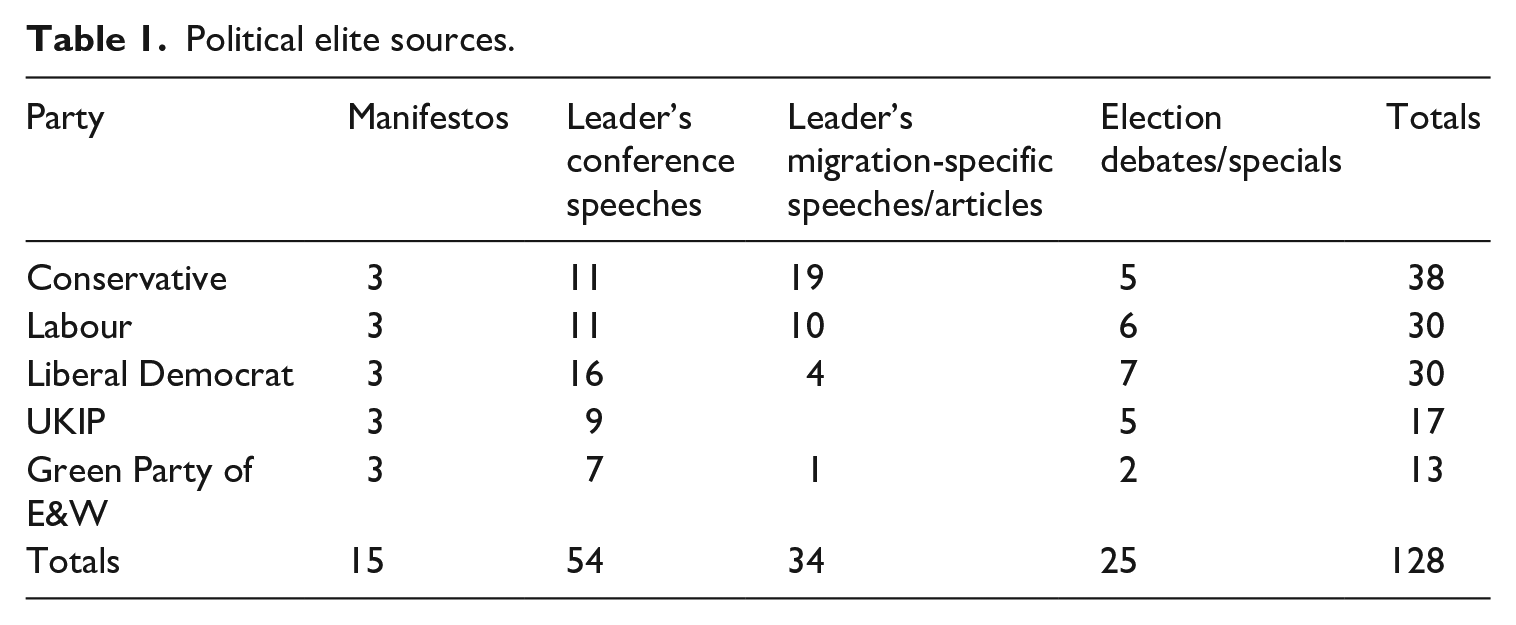
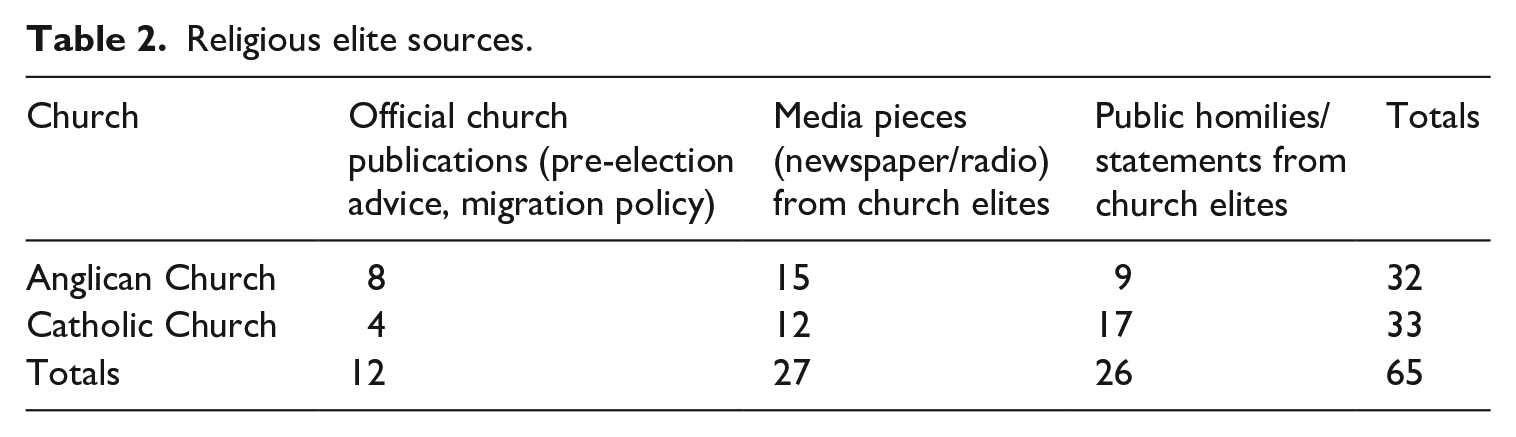
Sources were identified through searches of party/church website archives, news networks and internet search engines. The names of leading political and religious figures were entered alongside words such as ‘(im)migration’/‘asylum’/’refugees’ for each month between January 2005 and May 2015. For political elites, the analysis was restricted to interventions by party leaders (migration speeches/newspaper columns, annual agenda-setting conference speeches, and election debates) and election manifestos (see Table 1). For religious elites, the analysis covered official documents from the CoE and the CCEW that outlined their position on migration, as well as public speeches/homilies and media pieces from senior Church officials (current and former Church heads, Archbishops and senior Bishops) from each denomination (see Table 2). Media coverage of these ‘major instances’ was plentiful, ensuring that all relevant speeches/set-piece migration interventions were accrued through the archival search and included in the analysis. Whilst this may not necessarily be exhaustive, any speeches/statements that were not retrieved from this archival research would have to be considered ‘obscure texts’, with only peripheral, if any, effect on the framing contests surrounding migration, identity and tolerance in the UK during this decade. A notable advantage of our approach is that it generates fairness and analytical rigour, since ‘[i]t is better to have a limited set of texts and a complete representation of securitization instances than a large set from which the authors pick at liberty.’ 54 In total, 193 documents were subject to discourse analysis.
Political elite sources.
Religious elite sources.
In determining what thematic frames to focus on, we followed the general consensus in the literature that proposes a relationship between migration and security around four axes: Identitarian, Economic, Securitarian and Political. 55 Each axis percolates around a different referent object that is supposedly threatened by migration: societal/national identity (Identitarian); economic security, covering employment, wages and welfare (Economic); border security/sovereignty/crime (Securitarian) and political stability (Political). We therefore operationalised these insights in our discourse analysis by ‘looking for [security] arguments’ (and indeed counter-arguments using traditionally conceptualised desecuritising strategies, as outlined above) across the four axes. What this confirmed, and others have convincingly shown (e.g. Huysmans on ‘welfare chauvinism’ 56 ), is that identity is in effect the central monolith that underpins, transcends and drives each of the other three axes, with the whole debate fundamentally centred around a notion of an ‘Us’ that is argued to be threatened by ‘Them.’ 57 It is therefore imperative to analyse in greater depth how British identity is interpreted and invoked. The next section explores this process, zooming in on antagonistic and antithetical evocations of identity by different religious and political elites, focusing on the particular role that ‘tolerance’ plays in constructing competing frames about what it means to be British.
Framing identity and migration: Political and religious discourse
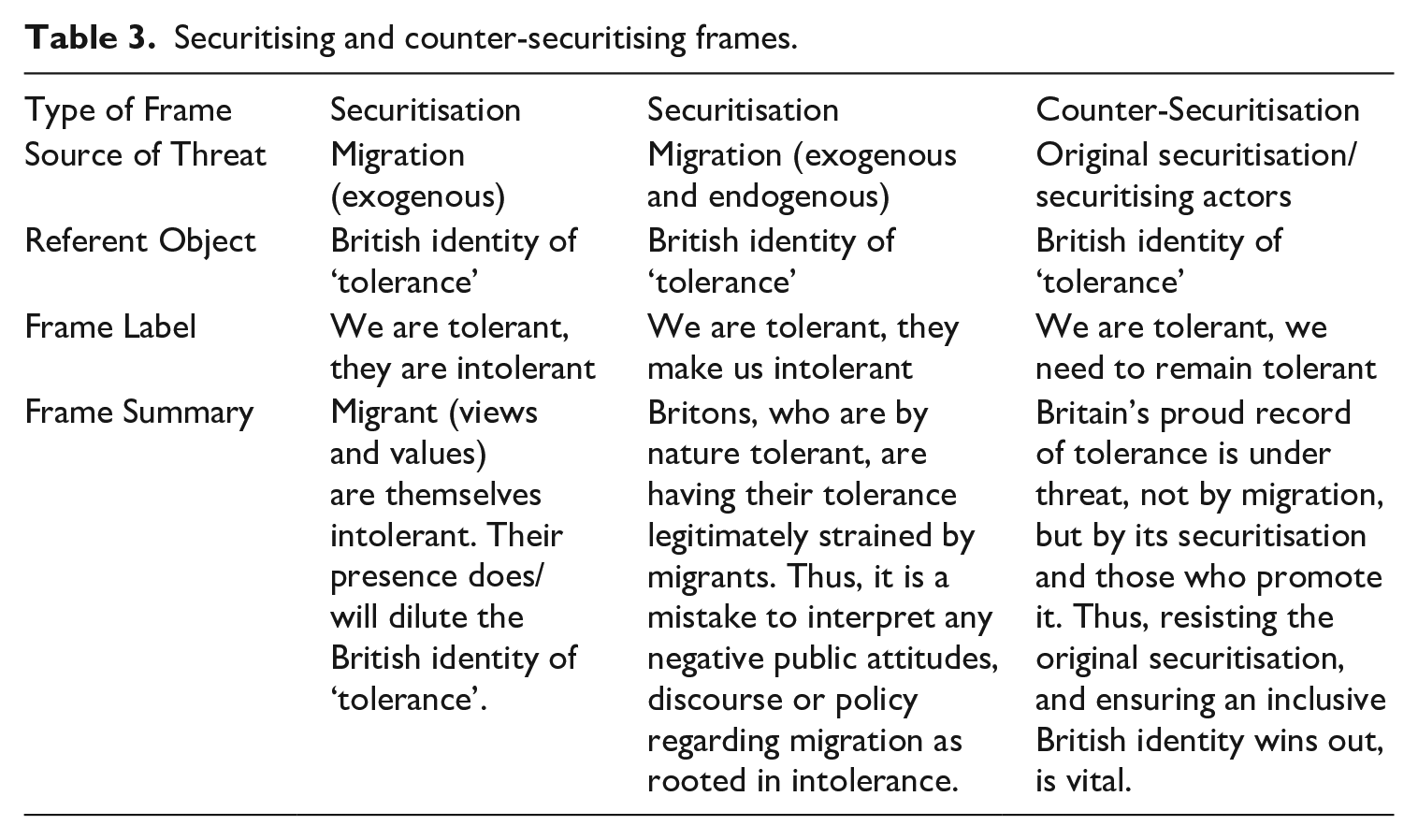
Being at the centre of the security-migration nexus, identity was ubiquitous in the documents analysed. One particularly important recurring discursive theme that emerged centred on the tradition of ‘British tolerance.’ To be explicit, the label of ‘tolerance’ is utilised for simplicity, but here tolerance captures a broader notion of positive identity, rooted in contemporary and historic kindness, compassion and hospitality, as well as a sense of democratic decency. Our analysis revealed two ‘tolerance’ frames (‘we are tolerant, they are intolerant’ and ‘we are tolerant, they make us intolerant’) that are securitising in nature. However, it also identified a third counter-securitising ‘tolerance’ frame (‘we are tolerant, we need to remain tolerant’), highlighting threats to identity in order to resist – rather than reinforce – the securitisation of migration. All three prominent frames share the same referent object (identity), but for differing purposes: British identity (‘tolerance’) is presented as being existentially threatened by migration or by our society’s intolerant response to migration. Each of these three frames, summarised in Table 3, are discussed in greater detail below.
Securitising and counter-securitising frames.
We are tolerant, they are intolerant
Presented as being rooted in democracy, decency and tolerance, Frame 1 argues that Britain’s identity is being undermined by migrants who hold undemocratic, indecent and intolerant views. Often, this message is aimed explicitly or implicitly towards Muslim migration, generating an Islamist-centred, threat-migration nexus, where Islamism (the illiberal theocratic ideology) is identified, haphazardly, with all (Muslim) immigration. The UKIP (2010) manifesto offers a typical example of this frame, with significance placed on ‘Culture and Restoring Britishness’. ‘Immigration and Asylum’ are discussed in the context of the perceived threats they pose to border control, economic prosperity and safety (via migrant criminality). As an example of this overtly securitising frame, the manifesto states that ‘[n]ew citizens should pass a citizenship test and sign a “Declaration of British Citizenship” promising to uphold Britain’s democratic and tolerant way of life.’ 58
Along the same lines, former Conservative leader, Michael Howard, promoted the idea that migrants threaten ‘our way of life’ and public order, placing terrorism and migration in the same security continuum.
We face a real terrorist threat in Britain today – a threat to our way of life, to our liberties. But we have absolutely no idea who is coming into our country. There are a quarter of a million failed asylum seekers living in our country today. No on one knows who they are or where they are. To defeat the terrorist threat we need action not talk – action to secure our borders.
59
Another telling example of a speech act promoting the first identity frame comes from the former Archbishop of Canterbury (Head of the CoE, 1991–2002). George Carey stated that migration pressures are ‘stretching almost to breaking point the enormous reserves of tolerance and generosity of the British people.’ He goes on: The sheer number of migrants from within Europe and elsewhere. . .threaten the very ethos or DNA of our nation. . . Democratic institutions such as the monarchy, Parliament, the judiciary, the Church of England, our free press and the BBC also support the liberal democratic values of the nation. Some groups of migrants however are ambivalent about or even hostile to such institutions.
60
The above messages portray migrants as threatening the core of British political culture: traditions of democracy and tolerance. Overall, this first frame is an archetypal securitising move with regards to migration, where what is claimed to be the ‘essential character’ 61 of the host society, is presented as existentially threatened by the incompatible identity of migrants.
We are tolerant, they make us intolerant
The second frame also maintains the portrayal of the British identity as ‘tolerant’. Yet, there is a subtle difference. Rather than framing this as being solely threatened by an external (or exogenous) threat – an influx of intolerant migrants – the message also seeks to protect the ‘tolerant’ identity from an internal (or endogenous) threat: the hardening of British immigration discourse, policy and public attitudes, which others may consider (incorrectly, it is argued) intolerant and/or prejudiced. In this way, the first part of the message acts as a prelude, or, more aptly, a disclaimer, to further messaging on migration. The general pattern is of a historical narrative detailing Britain’s qualities and tradition of ‘tolerance’, often linked to notions of Britain as a country having always been ‘open to the world’ and enjoying a dignified history of ‘welcoming people’ to its shores. The role of empire is conspicuously absent. Such narratives are then followed by a series of migrant-threat frames across the security-migration nexus (identity, economics and crime/terror). These disclaimers are situated in a context of a significant shift to the right, with regards to UK migration policy and discourse, especially from 2010 onwards. 62 Below are a few typical examples of this second identity frame.
Conservative Party leader, David Cameron, promoted this narrative, referencing Britain’s historic welcoming of Jewish communities prior to WWI, of Ugandan Asians in the 1970s and of West Indians who arrived on the Windrush.
63
Cameron posits that ‘[o]ur openness is part of who we are.’
64
The same preamble regarding the Windrush was utilised in another key immigration speech delivered in March 2013. Yet, on both occasions, Cameron followed this with a message designed to normalise the security-migration nexus and justify the need for illeberal migration policy, in defence of Britain’s essential tolerant character: I’ve always understood the concerns the genuine concerns of hard-working people, including many in our migrant communities, who worry about uncontrolled immigration. They worry about the pressure it puts on public services, the rapid pace of change in some of our communities and of course the concerns, deeply held, that some people might be able to come and take advantage of our generosity without making a proper contribution to our country. Now, these concerns, they’re not just legitimate; they are right.
65
The same rhetorical frame was promoted by Labour leader, Ed Miliband, in his major immigration-centric speeches: My parents came to Britain to flee the horrors of the Nazis. They found a country that welcomed them and offered them an opportunity to build a new life. . . I wouldn’t be standing here today asking you to elect me as Prime Minister, if it wasn’t for the generosity of this great country. A country that succeeds because of its tolerance, decency and its diversity. [. . .] When people worry about the real impact immigration has, this Labour Party will always respond to those concerns, not dismiss them. It isn’t prejudiced to worry about immigration it is understandable.
66
Liberal Democrat leader, Nick Clegg, also repeatedly employed similar narratives – for example in his 2014 immigration speech – regarding Britain’s historic tolerance, open-spiritedness and generosity, as well as drawing on his own multicultural background.
67
His message underlined the need to protect this notion of identity, in the context of legitimate concerns over migration: In order to remain an open and tolerant Britain we need an immigration system that is zero tolerant of abuse. Tolerant Britain, zero-tolerant of abuse. [. . .] People’s anxieties are not, generally-speaking, driven by prejudice or racism. We are, by nature, a tolerant people. But for too long, British people’s legitimate concerns have been downplayed.
68
Overall, alongside statements appreciating the historic and contemporary benefits Britain has enjoyed as a result of migration, this ‘tolerance disclaimer’ serves ubiquitously as an introduction to further messaging/policy on migration. The disclaimer aims to justify ‘tough’ public opinion, discourse and policy regarding migration, on the basis of the ‘real’ threats it poses, thus pre-emptively shielding against accusations of intolerance. Yet, the fact migration is presented as straining Britain’s tolerant reputation ensures migration is still portrayed as an external security threat.
We are tolerant, we need to remain tolerant
The first two frames invoke identity in a way that promotes the securitisation of migration. This is not the case with the third frame, which offers a counter-securitising alternative: it is not ‘Them’ – migrants – that pose a threat that needs to be curtailed, but, instead, our response to population movements, which compromises a key value and essential component of Britishness: its tolerant character. This frame was sparsely utilised by the three largest political parties (and not at all by UKIP) during this period. However, it was more common in the messaging of religious elites from both the CoE and the CCEW, and also featured in the discourse of the Greens.
In this counter-securitisation frame, alongside the declarations of Britain having a proud history of tolerance and a tradition of welcoming migrants and refugees, there is recognition that this is not a result of ‘nature’. Indeed, the crux of the message is that British tolerance is most threatened, not by migrants, but by the securitisation of migration itself and those who are responsible for it. This echoes Stritzel and Chang’s 69 counter-securitisation dynamics, whereby actors reject and attempt to ‘delegitimise’ the previous two identity frames (and, at times, those who promote them), in favour of their own counter-frame that shifts attention away from the migration-security nexus. Below are a few illustrative examples of relevant speech acts.
Rowan Williams, as Archbishop of Canterbury (2003–2012), explored the contributions of refugees to British life in a 2010 speech, highlighting that ‘welcoming the stranger’, in this case migrants, is an essential and desirable component for Christians to live out their lives and to help society develop and flourish. Yet, Williams is explicit that ‘there are no grounds for complacency about British society having an “essentially tolerant” character; we are no more exempt from the risks of political and ideological change than any other society.’ 70 During the 2009 European Parliament elections, where the BNP and UKIP received approximately 1 million and 2.5 million votes, respectively, Williams issued a joint statement with the Archbishop of York, John Sentamu (2005–2020), questioning the self-portrayal of such parties as ‘British’, rooted in Christian ideals. ‘This is not a moment for voting in favour of any political party whose core ideology is about sowing division in our communities and hostility on grounds of race, creed or colour.’ 71
Going a step further, the Greens did not only attack the far right for demonising migration, but also all other mainstream parties, who were accused of trying to ‘out UKIP’ UKIP. In this context, Green Leader, Natalie Bennett, noted: I am an immigrant. I came to this country from Australia, I became a British citizen, and I now consider it to be my home. I love this country, and I utterly reject those who attempt to divide us and condemn us simply for the countries in which we were born. It is time to consider the values for which we want our society to stand. To me, those are values of compassion, of tolerance.
72
The above statements are examples of strategic framing on how migration can impact upon the host societies’ perception of their own Self. Rather than the presence of migrants undermining Britain’s ‘essential character’, migrants are framed as being necessary to the fulfilment of ‘our’ traditional identity as ‘tolerant’. Indeed, the threat to ‘our essential (tolerant) character’ is shifted away from migrant intolerance (Frame 1), or the negative societal impact of migration (Frame 2), to the original securitisation of migration and those actors who foster it. Here, we see the discursive presentation of identity as existentially threatened as a means of counter-securitisation, whereby it is our extraordinary and illegitimate response to the perceived migration challenges that is alarming, not migration itself. In that sense, invocations of identity, in this third frame, can potentially serve to desecuritise migration, evidencing the importance of not approaching (de)securitisation as a single definite act, but appreciating the back and forth, relational nature of security contests.
The battle over British identity: Audience perspectives
The above discourse analysis of religious and political rhetoric revealed three key (albeit non-exhaustive) frames on migration that each invoke a particular vision of British identity, either to securitise (in the case of the first two) or desecuritise migration (in the case of the third). What remains unclear is whether or not the discursive battle at the elite level is reflected in public attitudes on migration as well. To tentatively explore this, this section draws on original survey evidence deriving from an online UK-wide representative survey administered by Survation in October 2017 (n = 1534).
All three frames identified in the discourse analysis centre upon a broad notion of British identity and ‘tolerance’ that encapsulates a tradition of compassion, generosity, decency, hospitality and democracy. As a proxy for valuing British identity, we utilise the following question in our survey, measured on a 5-point scale: “How important do you think each of the following is for being British? To share British customs and traditions.” After variables were recoded to remove ‘no responses’, 1321 respondents remained. Of these, 875 (66% of the sample) viewed British customs and traditions as ‘very’ or ‘extremely’ important to British identity, whilst 435 participants (33%) considered them ‘not at all’, ‘slightly’, or ‘moderately’ important.
A first way to gauge the extent to which people who value Britishness are more likely to consider immigration a threat, is to compare the levels of concern between these two groups. As Figure 1 clearly shows, British citizens that value identity are far more concerned about immigration, compared to those that do not (mean = 7.27 and 4.67 respectively). Among the former, 77.5% of respondents are concerned over immigration (6-10 on the scale) and only 14.5% are not concerned (0-4 on the scale). This would, at first sight, give credence to the dominant perspective that identity, as a referent object, produces hostility towards others, in line with the first two securitising frames identified in the discourse analysis above, but challenged by the third frame.
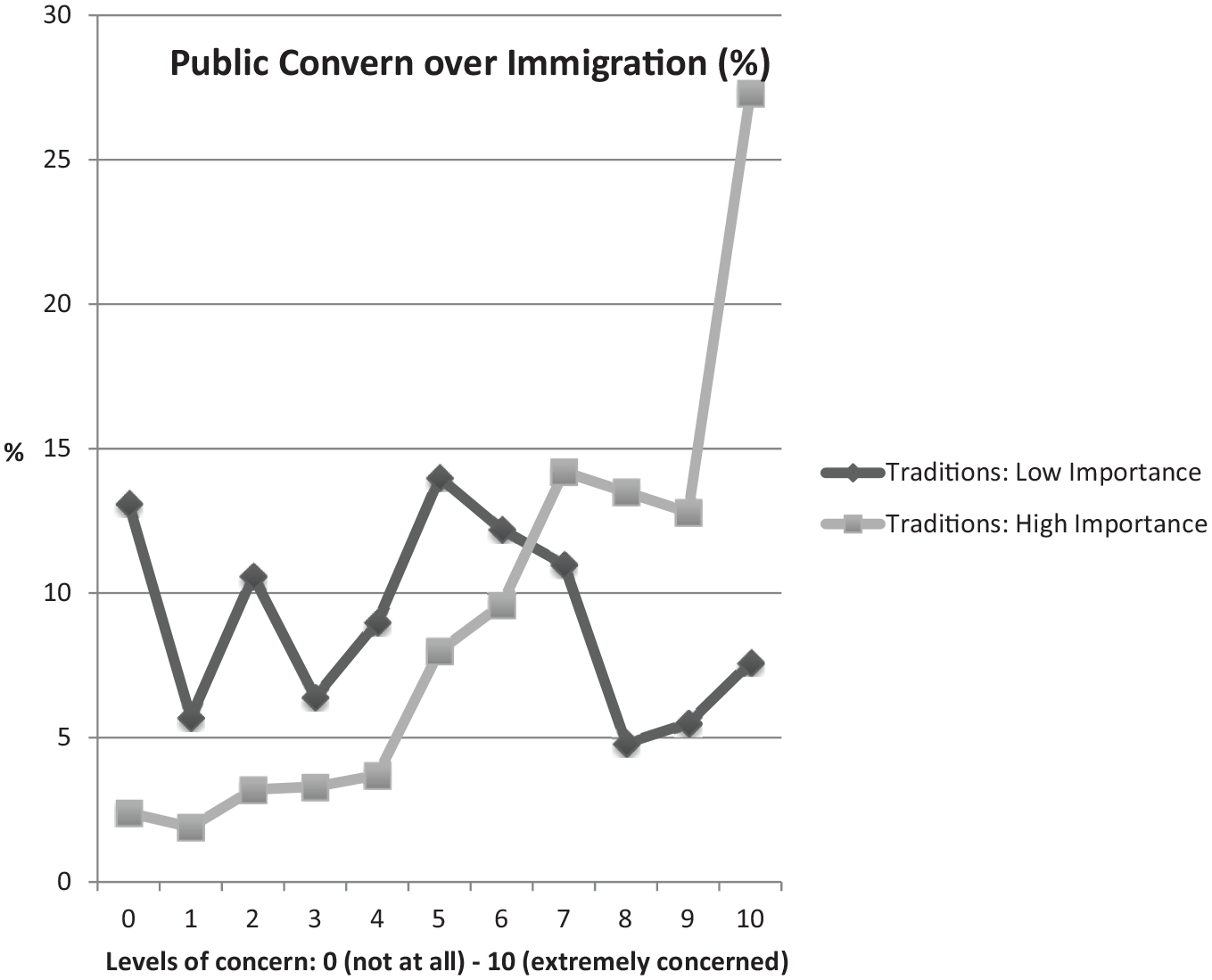
Percentage of people concerned over immigration: Comparing those who view ‘sharing British customs and traditions’ as very/extremely important (n = 875) to British identity compared those who view this as not at all/slightly/moderately important.
However, this interpretation is, arguably, misleading, for it provides very little information as to what specifically are people concerned about or how homogenous these views are. To tease this out, we need to have a closer look at the distribution of immigration attitudes, among those that value customs and traditions as central to Britishness, our proxy for identity. Figure 2 plots the results in relation to five questions that capture the main axes relevant to the security-migration nexus: cultural, economic, and public order considerations.
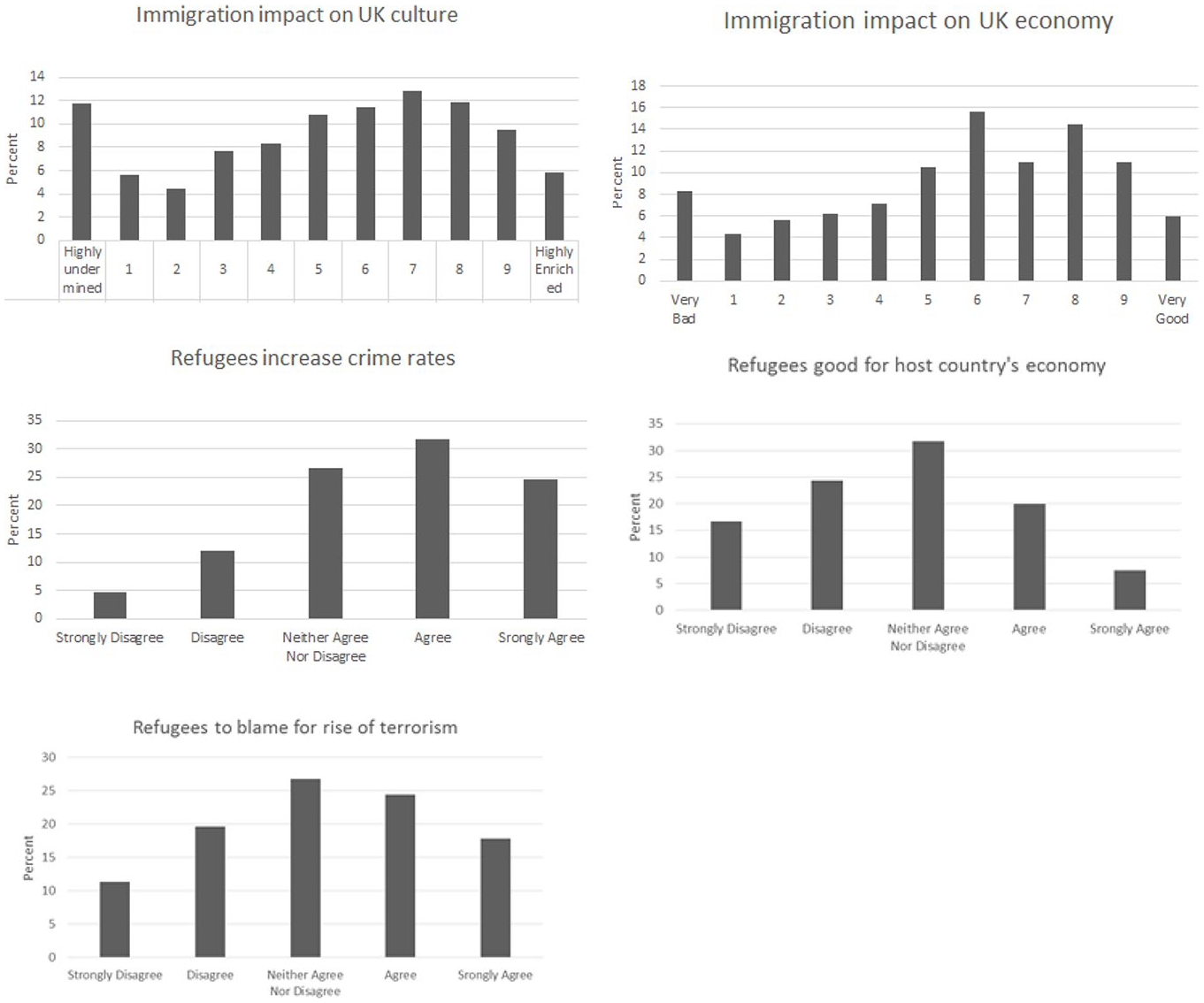
Immigration attitudes among people who view ‘sharing British customs and traditions’ as very/extremely important to British identity.
Results show that people that value British customs and traditions have a plurality of views on migration: they see it as either undermining or enriching culture, as being either good or bad for the economy, and as either linked or not to criminality and terrorism. This indicates that British identity, as the referent object, is not inherently or exclusively linked to ‘securitising’ frames but also, potentially, to ‘counter-securitising’ ones. 73 Although our analysis does not permit any causal inferences to be made, based on securitisation theory’s top-down understanding of security, it is reasonable to assume that the varied public understanding of identity and its relationship to migration is likely to reflect the dominant, competitive elite frames on this issue. This supports our hypothesis that identity is understood in different ways by different people, and particular invocations can also be used to promote positive immigration attitudes. In turn, this implies that a particularly potent strategy for desecuritising migration may be to deploy counter-securitisation frames, whereby our intolerant response to the presence of others is presented as a greater threat than migrants themselves. The final section explores the normative implications of deploying counter-securitisation as an instrument to desecuritise an issue.
Reflections on counter-securitisation dynamics
The illustrative case of migration politics in the UK indicates that there is great scope for paying more attention to counter-securitisation dynamics, beyond the military sector. Stritzel and Chang explore how the Taliban, who had been the subject of securitisation by allies, attempted to counter-securitise the USA/NATO intervention. By contrast, our empirical analysis demonstrates that counter-securitisation does not exclusively rely on the ability of securitised subjects to mirror threat projections but may also be promoted by other elite actors in the host society, who are able to construct legitimate security discourses. The key framing contest in the societal sector revolves around the question of which identity is legitimate and needs to be defended. As shown, the third identity frame that promotes an understanding of ‘national identity’ in non-exclusionary, non-xenophobic terms, may actually promote the desecuritisation of migration. This is, arguably, a step in the right direction, since securitisation of migration can and should be resisted. 74
However, whilst counter-securitisation may appear an attractive strategy in general, and for reducing public anti-immigration attitudes in particular, it is not, in itself, a panacea that is void of its own normative complications. 75 As a standard reading of securitisation theory suggests, presenting any identity as existentially threatened is likely to be problematic – after all, securitisation is deemed the ‘failure to deal with issues as normal politics’, according to the CS. 76 Since some identity is ‘inescapable’, and even the counter-securitisation frame heralds the urgency of protecting a particular notion of it, this strategy effectively moves the goalposts. The adversarial Us/Them dichotomy persists, albeit, it moves from ‘natives’ versus ‘migrants’ to ‘good natives’ versus ‘bad natives.’ In this context, as polarisation within societies increases, internal divisions emerge. For example, Hilary Clinton’s labelling of Trump supporters as ‘deplorables’, or elite frames in the UK that uncritically present all Leave voters as racist, produce new, hardened, and, often, toxic internal dichotomies that may be as counter-productive as the securitisation of migration itself.
Our dataset allows us to look at how this new dichotomy manifests in the context of the Brexit debate, which also centrally involves contested representations about what it means to be British, in opposition to blurred versions of who does not belong (e.g. EU citizens; third-country nationals). In doing so, both sides on this debate attempt to establish their invoked identity as not only superior to any alternative ones but, indeed, as the only correct and legitimate one. In turn, people’s broader views and attitudes in relation to other issues, including migration, are defined, in a myopic manner, by their projected, distinct, and exclusionary identity – as reduced by security dynamics that facilitate the stereotyping and sorting of citizens – as either ‘good’ or ‘bad’. This kind of reductive logic, when considered in relation to the securitisation of migration, fails to capture the diversity of views and values within sub-groups. For example, as Figure 3 illustrates, whilst Leave voters, as a group, consider migration a greater threat to culture compared to Remain voters (mean = 5.60 vs 7.68 respectively), many of them also hold positive attitudes to migration, which are obscured in representations of their camp as homogenously racist.
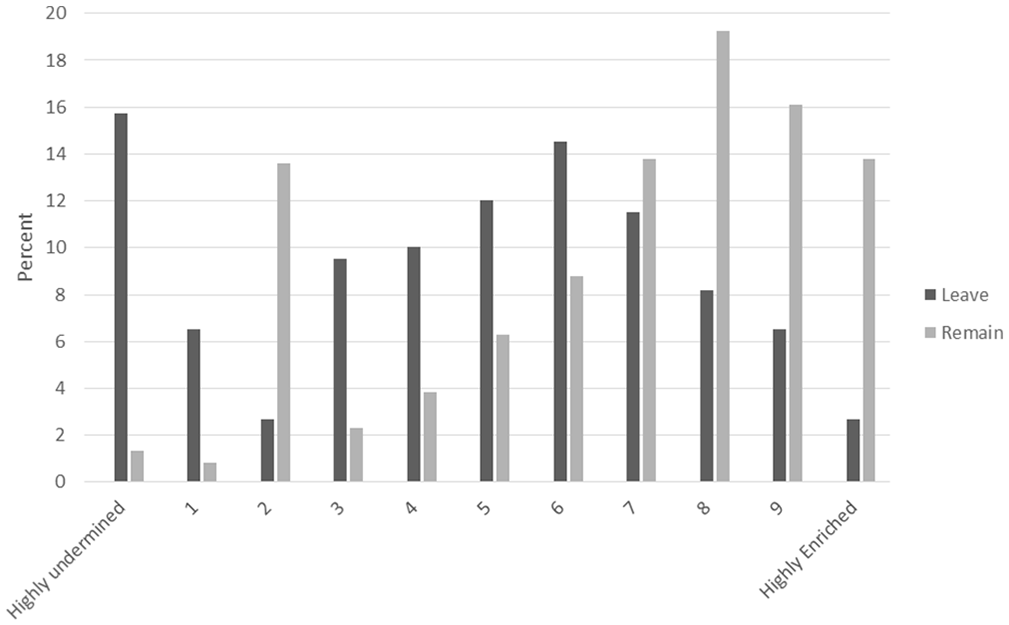
Perceived effect of migration on culture by vote on the 2016 EU referendum.
Whilst future work should fruitfully explore in far greater depth the normative and tactical dilemmas as to how counter-securitisation may be employed, potentially in combination with other desecuritising techniques, some broad considerations stand out from the discussion of migration politics in Britain. First, the counter-securitisation migration frame can help promote a notion of collective identity that is rooted in tolerance and openness to others, who are no longer presented as threatening and/or inferior. This does not necessarily require abandoning Us/Them dynamics, but, similar to Scandinavia, it does involve celebrating differences and appreciating that they are not inherently antagonistic. 77 Second, counter-securitisation attempts do not necessarily reduce insecurities but, rather, they shift the focus of contestation from an externally-induced threat (migrants) to an internal, self-referential battle to establish a legitimate identity. This can potentially cement divisions within a host society, particularly when competing notions of identity are firmly associated with different groups (e.g. on ideological, political, or socio-economic grounds), which suppresses individual variation in attitudes, values and interests and instead fuels inter-group competition. Overcoming this risk will, likely, require effective leadership by the holders of collective identity, who should resist promoting negative stereotypes and aphorisms directed against those that do not neatly fit within their projected identity frames. Whilst it remains doubtful whether and how this may work in practice, a first step may be to focus on challenging the message, rather than the messengers or their supporters, which perhaps is easier to negotiate within a society, since it has already established, as an imagined community, a minimum set of shared, albeit contested, values and traditions.
Conclusion
This article focussed on a critical, under-explored element of British migration politics: the underlying battle to narrowly define the legitimate British identity and determine what and who is threatening it. Our systematic analysis of elite discourse between 2005 and 2015 revealed three key frames, each portraying the ‘essential character’ of Britain as an identity centred on ‘tolerance’, which is existentially threatened in the context of migration. However, this portrayal was utilised in a non-homogenous way, with the first two (securitising) frames projecting migration as threatening, in contrast to a third (desecuritising) frame that depicted our ‘intolerant’ response to the presence of others, not migrants themselves, as the ‘real’ threat to core British values and traditions. Public opinion data was then introduced to explore audience perceptions of British identity. Our analysis indicates that competitive identity frames in elite discourse do, indeed, correspond to variable understandings of what it means to be British, with some people among those who value customs and traditions holding negative attitudes towards migrants, whilst others have positive views. These findings challenge two key notions. First, that societies have a single, fixed and definitive identity. And second, that if a ‘definitive’ identity is invoked, this is inherently associated with negative attitudes towards migrants. Instead, identity, as a referent object, can also serve to contest the original securitisation, potentially paving the way for desecuritisation.
Counter-securitisation provides a particularly useful conceptual vehicle to explore these dynamic processes of contestation, including in the societal sector, where elite actors (religious and political elites, in our case), rather than the ‘securitised subject’ (migrants), initiate and lead the process. What the discussion of British migration politics indicates is that elite framing contests about different projected notions of identity may have an under-explored impact, not only on the direction of policy outputs, but also on public understandings of ‘Self’ in relation to ‘Other’, which help legitimise a restrictive or liberal response. This has broader implications beyond the British case. For every securitisation move, it seems, there is the potential for counter-securitisation attempts by other actors that wish to resist and delegitimise it. The strategy centrally involves questioning what constitutes the greatest threat: Brexit or continuing membership in the European Union? Climate change or the economic effects of stricter green regulations? The spread of COVID-19 or the erosion of civil liberties? Whilst not devoid of its own and important normative dangers and complications, counter-securitisation opens up new pathways to study these salient debates. These should be fruitfully explored in future comparative and theoretical research, which, as in the British case, should appreciate the complex, dynamic and relational nature of securitisation processes.
Finally, our article illustrates the merits of adopting mixed-methods to study (de)securitisation processes. Most securitisation research focusses on elite constructions of the security frame alone, without consideration of the public’s evaluations of this message. 78 This negates the intersubjective nature of security, which requires securitising actors and empowering audiences to reach a shared understanding about the presence of threat. The inclusion of public opinion data, as attempted here, enables the analysis to modestly penetrate beyond the elite discursive environment. Although our data and design do not allow us to make claims about the direction of causality, they clearly show that diametrically opposed framings of identity from elite actors correspond, with far greater nuance that previously appreciated, to variable public immigration attitudes. Securitisation scholars should fruitfully explore further the relationship between elite frames and audience evaluations, which discourse analysis alone is not able to account for.
Footnotes
Funding
The authors disclosed receipt of the following financial support for the research, authorship, and/or publication of this article: The ESRC+3 Studentship entitled ‘Love Thy Neighbour? The Impact of Religion on Immigration attitudes in Europe.’ (Award reference number: ES/J500136/1); and the Global Challenges Research Fund (GCRF) project, entitled ‘Building Futures: Aspirations of Syrian Youth Refugees and Host Population Responses in Lebonon, Greece and the UK’, funded jointly through the Economic and Social Research Council (ESRC) and the Arts and Humanities Research Council (AHRC) (award reference: ES/P005179/1). Please see  .
.
Notes
Author biographies
).