




Abstract
The protection suit is the icon of infectious disease outbreaks. I argue that the protection suit has performative power not only by shaping the daily tasks of health workers and their interaction with patients, but also as a visual artefact and as a two-dimensional image determining how health crises and their security implications are understood and dealt with. The article proceeds in three steps: it firstly highlights the current absence of visuality in the academic literature on health security and makes the case for including it in the debate. Secondly, with recourse to Actor-Network Theory (ANT) it theoretically locates visual representations, as images and artefacts, as actors that act and enact each other in the health-security nexus. The third part of the article follows the protection suit during the Ebola epidemic in West Africa and maps the visual network it creates. In doing so this article demonstrates how the suit as artefact and image constitutes a network that visually and sensually links the bodies of patients, health workers and distant viewers in complex and at times competing makings of health security.
Introduction
The New York Times’ cover letter nominating photographer Daniel Berehulak for a Pulitzer Prize in 2015 begins with the protection suit: For four long months, Daniel Berehulak performed the same exacting ritual, cloaking himself from head to toe in a protective suit, face mask, three pairs of gloves — and chronicling the full, excruciating arc of Ebola as it tore across West Africa.
1
The necessity of putting on a suit and the exhaustion that comes with wearing it in the ‘stifling West African heat’ 2 serves as proof of the dedication of Berehulak and his willingness to take enormous risks and hardship to photograph the epidemic. The protection suit, hence, is not only a dominant motive in Berehulak’s Pulitzer Prize winning image series 3 , but it also shaped the process of taking these images in the first place. These are just two examples of the many roles protective clothing plays in pandemics and epidemics. It also determines the daily tasks of the health workers and especially their interaction with patients, it features in news media reports on health crises, it is used in information material of humanitarian organizations to promote their work and to attract donors, the protection suit even became a popular Halloween costume in 2014 in the US (see Figure 1). 4
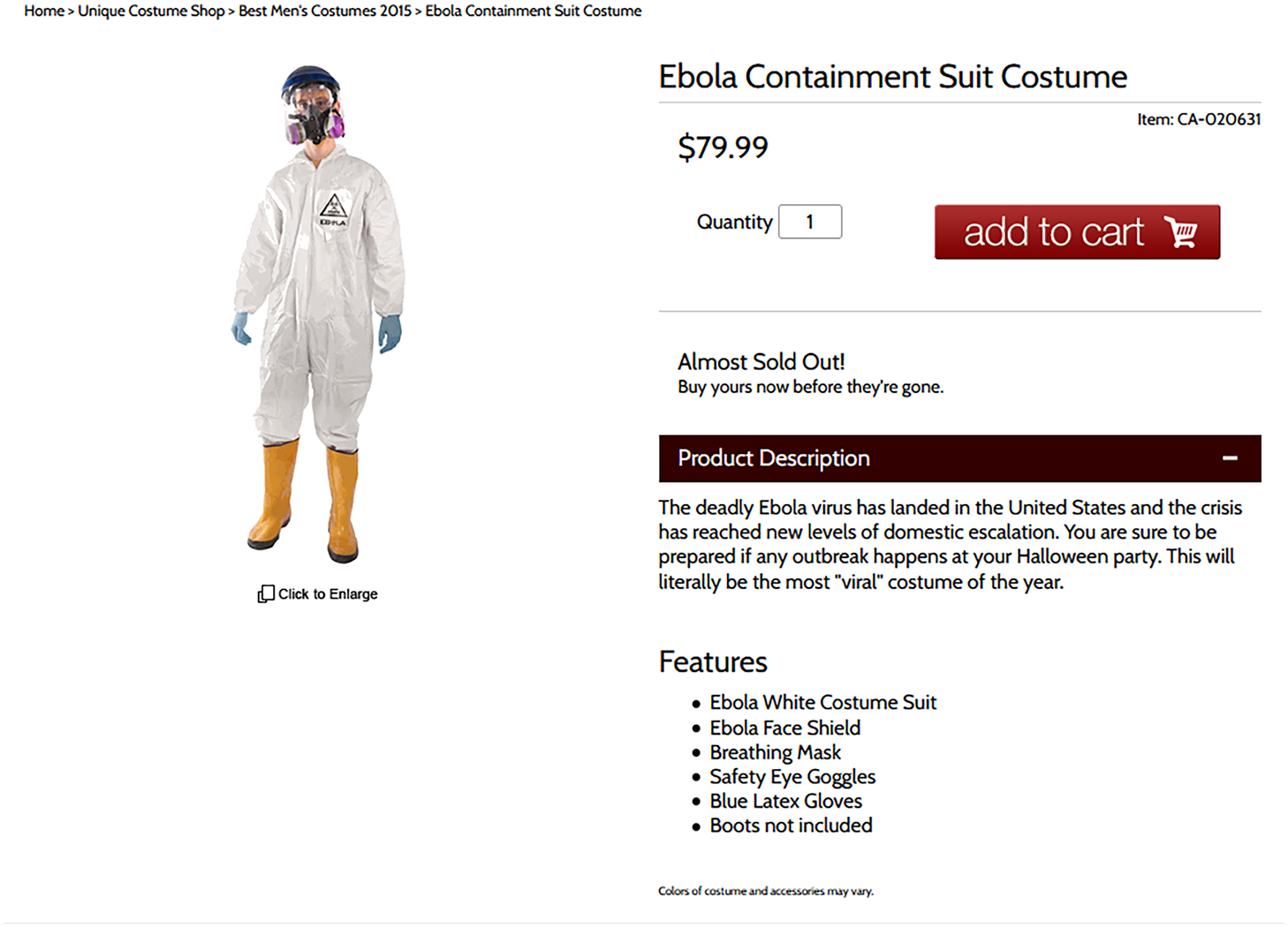
Screenshot of the website Brandsonsale advertising the Ebola Containment Suit Costume (published with permission). 16
The many roles and visual manifestations of masks in the current coronavirus (COVID-19) pandemic are the most recent example of the complex meanings and doings of protective clothing. 5 Not only seeing protective clothing in news media images or engaging with it via infographics and costumes, but actually making and wearing masks as a safety measure, offers new ways to (visually) engage with a health crisis and locates the body in the health-security nexus. Sewing masks can be seen as a way to connect with the pandemic as craft “fastens the concrete and the abstract into a material symbol”. 6 It requires thorough engagement with the virus. This starts with choosing the fabric: it is recommended to use a type of cotton that is machine washable up to 60 degrees centigrade. Furthermore, to ensure a maximum of protection, it should still be breathable, yet at the same time as impermeable as possible. One also needs to decide on how many layers to include and how to make sure the mask perfectly seals off mouth and nose to keep pathogens out as much as possible. Finally, one has to decide which color the fabric should have. Obviously, this has no impact on the effectiveness of the mask; however, it may reflect the attitude towards the pandemic. Explaining the element of solidarity in wearing masks, Lynteris explains that ‘[m]asks are also a marker of medical modernity, as well as a signal of mutual assurance that allows a society to keep functioning during an epidemic’ 7 . Masks, in this regard, certainly are textiles which are ‘bearers of knowledge’ 8 that offer insights into how people make sense of COVID-19 and how it shapes people’s everyday life and interaction with each other.
Inspired by these many roles, applications, and meanings of protective clothing, I argue that whilst protective clothing physically separates bodies from each other, it visually and sensually links them in the health-security nexus. Departing from the Ebola epidemic 2014-2016 and based on Latour’s claim that ‘objects too have agency’ 9 , this article sets out to explore what protective clothing does in the context of health crises. It considers the protection suit as having the performative power both as a visual, even multisensory, artefact and as a two-dimensional image to shape how health crises and their security implications are understood and dealt with. By following the protection suit and its visual manifestations, I seek to trace how these interlinkages open up the tension between the simultaneously threatened and threatening body and to discuss the ethical issues arising from this.
The article’s empirical starting point is the health-security nexus. 10 We cannot escape security in the context of health as ‘the securitization ship has already sailed’. 11 This, however, does not mean that the health-security nexus is a closed case. I claim the opposite to be true. If health issues are constantly securitised it is all the more important to fully understand this nexus and its implications. To get to this understanding, the article builds on the definition of Bengtsson et al. according to which the health security assemblage is ‘a web of human and non-human relations producing priorities about threats [. . .] and how they are handled’ 12 and seeks to understand how security and the protection suit are entangled. Recent works have engaged with the protection suit as a material object and its role in humanitarian action and health security through Barad’s 13 concept of entanglement 14 or with a focus on protective clothing as a mediating device in humanitarian action. 15 Departing from this literature, and coming back to it throughout the article, my focus is not so much on the suit as a device deployed on the ground by medical personnel, but focuses on its different visual materialisation beyond the immediate medical context of a health crisis.
The article proceeds in three steps: it firstly highlights the current absence of visuality in the academic literature on health security and makes the case for including it in the debate. Secondly, with recourse to Actor-Network Theory (ANT) it theoretically locates visual materialisations (as images and artefacts) as actors that act and enact each other in the health-security assemblage. The third part of the article follows visual materialisations of the protection suit as artefacts and images from the Ebola epidemic in West Africa linking it to the recent COVID-19 pandemic as well as historic plague outbreaks. I depart from three nodal points to explore the visual network: news media, humanitarian aid, and pop culture.
In doing so this article demonstrates how the suit as artefact and image both connects and separates different human bodies (i.e. the body of the health worker and of the distant viewer) and locates and dislocates them in the health-security nexus in complex ways that open up the tension between the simultaneously threatened and threatening body. In addition, and connected to this tension, the article also shows how different visual materialisations of the protection suit enable different interactions between protection suit, health worker and viewer that challenge the notion of the distant and passive spectator.
(Not) Seeing the Health-Security Nexus
Over a decade ago, Elbe 17 diagnosed a ‘tendency to articulate international health policy through the metaphors and vocabulary of security’, more recently Wenham 18 even finds an ‘oversecuritization’ of global health. Departing from the social constructiveness of security, 19 (critical) security studies scholarship in the realm of global health is not so much concerned with assessing the actual threat posed by, for instance, pathogens or bioweapons, but rather with the presentation of certain issues as threats. One key argument in this literature is that while the conceptualisation of health as a subject of security is held to mobilise attention and funding, questions as to who is threatened and by what and what measures are necessary to provide security tend to be answered with a strong western bias. Inherent to this bias is a prioritisation of the protection from and prevention of emerging infectious diseases that are regarded to have the potential of a global spread. 20 The consequences then are short term measures and technical quick-fix approaches that ignore structural factors and are devoid of long-term strategies. 21
The Ebola epidemic appears to be a bitter case in point in this regard. Lakoff, 22 for instance, diagnoses a shift from considering the outbreak a humanitarian issue to a concern for global health security once the outbreak spread beyond West Africa. In a critical assessment of the general linking of health and security, Nunes holds that ‘being ill is not the same as being insecure’ 23 and shows that the connection of a bodily condition (health) to security is a political assemblage containing practices fueled by assumptions and perceptions that reproduce each other. Furthermore, he criticises the self-evident status of health security and pleas for constantly questioning the nexus and its consequences as ‘we need to understand how health security “is made”’ 24 . I hold that a vital step to get to this understanding is taking the visual component of the health-security nexus seriously.
There is a substantial literature on the role of images and film in the context of health crises. Bleiker and Kay, 25 for instance, investigate the representation of HIV/AIDS and find that photography is one key medium in shaping the public and private perception of HIV/AIDS. Holding that ‘[t]he likelihood of a story making it to print, especially on the cover of a publication, increasingly depends on the quality of the pictures that accompany it’ 26 they discuss how different modes of photography entail different ways of understanding and dealing with the pandemic. With similar concerns like Bleiker and Kay, Campbell examines the visual economy of HIV/AIDS 27 and the iconography of famine 28 . Despite the significant changes in the understanding of the causes of famine, Campbell 29 finds that the photographic portrayal of famine has remained rather static as stereotypical portraits of famine are continued to be produced and, in the case of HIV/AIDS, shows how images of abject individuals support a reduction of the pandemic as a general construct to a specific embodiment. 30 Working on and especially with women with HIV/AIDS in Tanzania, Harman 31 explores film as a visual method to challenge these narratives.
While all these works conceptualise and highlight the vital role visuality plays in our understanding of health crises, the visual dimension of health security – especially in the context of epidemics and pandemics – remains largely untouched. So far, the visual studies literature pays attention to, for instance, the visibility of violence and death,
32
terrorist attacks like 9/11,
33
surveillance,
34
iconic images on the war in Afghanistan,
35
the torture scandal in Abu Ghraib,
36
and the European refugee crisis
37
but has little to say about the health-security nexus. This is a gap that needs to be addressed, because, as McInnes and Rushton argue, the positioning of particular health issues on the security agenda appears to be to a great extent unrelated to measures of morbidity and mortality. [. . .] Thus what constitutes a “health security” issue appears to be determined by something other [emphasis added] than a “clear and present danger” to life.
38
With a focus on visuality, this article sheds light on what this mysterious something other could be and how it shapes and impacts on the health-security nexus. This endeavour is based on the basic claim that representation is ‘a process through which we organise our understanding of reality’ 39 and that they influence the ‘distribution of the sensible’ 40 . Following Callahan’s argument that images and visual artefacts ‘complicate what can (and cannot) be seen, said, thought, and done’, 41 I argue that the way health security is visualised impacts on how health crises are imagined, understood, and ultimately dealt with.
Having established the need for thinking visually about the health-security nexus, the question that follows then is how to locate visuality into the nexus in theoretical terms. So far, the securitisation of health has largely been addressed with a focus on human actors. 42 However, recent works 43 inspired by the literature on new materialism, ANT, and assemblage thinking, make the case for investigating the role of non-human agency and relationality in the making of health security. Analysing the connection of human and non-human entities with a focus on pathogenic circulations, Voelkner, 44 for instance, points out their constitutive role for human security. Departing from these works and aiming for a more complex understanding of the interlinkages of health, security, and visuality, I rely on the concept of the health-security nexus as a health security assemblage consisting out of many human and non-human actors. 45
In line with recent works on securitisation processes 46 , I claim that security is not generated exclusively through discursive speech acts but actually made and performed by relational human and non-human actors building a network. ANT constitutes a useful lens through which one can make sense of this human – non-human interaction. With the famous statement ‘objects too have agency’ 47 Latour positions himself against the dominant view in sociology according to which agency is a priori limited to intentional and meaningful humans. This focus corresponds with the recent work of Elbe and Buckland-Merrett who hold that health security should be conceptualised as an ‘intensely relational phenomenon that does not exist prior to, nor independently of, its intra-action with other agencies’. 48 Using ANT as a ‘toolbox’ 49 for the purposes of this article means to investigate how the protection suit is entangled in the health security assemblage with other human and non-human entities that act and enact each other and what this does to our understanding of health security in the context of an epidemic or pandemic.
On the Entanglement of Images and Artefacts
Visuality matters to this relational understanding of health security in at least two ways: as visual artefacts and as two-dimensional images. This is in line with recent works in the field of visual studies that include three-dimensional artefacts and thus move beyond the more traditional focus on photographs, cartoons, and magazine covers. 50 This is not to say that the study of the two-dimensional image is outdated and can be neglected. To ‘open up for a broader range of visual practices to become part of the subject matter of visual security studies’ 51 is rather a way to understand how images and artefacts are entangled and together shape the making of (health) security. Images and artefacts should be considered ‘“not things we think about, but things we think with” and think through’ 52 .
Following Callahan, I understand visual artefacts as ‘sensory spaces in which international politics is represented, performed, and experienced through more embodied, affective, and everyday encounters’ 53 . This means that people cannot only observe artefacts, they may also experience them with their other senses like touch, smell, or hearing. Images and artefacts are analytically separable in a sense that visual artefacts are more than exclusively visual but rather enable multisensory experiences and demand the performative participance of people. For instance, you do not only look at a garden, but you may also walk in it and may be even further interacting with it by planting a tree or cutting the flowers growing in it. 54 Considering images and visual artefacts as non-human actors in the health security assemblage offers the ‘opportunity to appreciate international politics in a different register that values both thinking and feeling’ 55 and to trace and understand how artefacts and images connect bodies and things.
This also means to understand images beyond their content and thus as more than text and discourse. Building on Favero who finds that images’ ‘meaning is increasingly to be found beyond the realm of representation and indexicality, and in a terrain conscious about questions of multimodality, materiality and relationality’
56
, I suggest a material-semiotic approach to images that not only takes into consideration their content but also their materiality. Doing so I build on Aradau et al.’s understanding of discourse and materiality where: rather than trying to make general determinations as to the political significance of “things”, it is important to recognize that the relations between discourses and materialities are not universal but undergoing constant rearrangement according to the elements gathered together and the circumstances under which this occurs.
57
To think beyond images’ visual content and take seriously their materiality, scholars located in disciplines like art history, visual culture and photography studies 58 frequently emphasise that photography is more than a depicting device and that photographs do not only depict things, but also are things. 59 Ignoring this thing-ness or materiality of an image would result in a limited understanding of its performance. 60
Adding the material to the semiotic perspective offers the possibility to move away from a concept of images that takes them as passive objects without any power as it emphasises that
‘“[t]hings” are not empty receptacles of discourses’ 61 . Matter should not be thought of as the passive end-product of discourse but as an active element in material-discursive processes. 62 Including the materiality of images emphasises the ‘material character of every discursive structure’ 63 . This is also in line with Heck and Schlag holding that ‘[t]he picture is materially made by someone somehow and this materiality serves as the precondition for showing and seeing’ 64 . Hence, I claim that the materiality of images should be acknowledged because ‘in order to see what the photograph is “of” we must first suppress our consciousness of what the photograph “is” in material terms’. 65
Within an ANT framework images and artefacts do not enter into being with a predefined form of agency – rather, they become actors or actants through interactions in the network. An actor never acts alone but ‘is what is made to act by many others’ 66 . Take the protection suit as an example: as the next sections show in detail, the suit does not only matter on the ground as protective garment that is worn by medical personnel and thus shapes and limits the way they take care of patients. In addition, it visually circulates in the health security assemblage as award-winning images and magazine covers that are available to a global audience, and as infographics and Halloween costumes that enable the audience to actively and sensually engage with the epidemic. These examples cannot be understood in separation. For instance, the images of the protection suit acquire meaning through its application on the ground and through stories of the photographers’ experience with the protection suit (consider the quote at the beginning of the article). Images and artefacts, thus, are highly relational.
Methodological Considerations
I use ANT not only as a theory but also as a ‘methodological toolbox’.
67
Following de Vries, I take the network as: a tool for description, not something out-there to be described. An “actor-network” is not a network of actors, but an assembly of actants who (by way of the translations they are involved in) are “networked” and defined by other actants.
68
It is key to emphasise at this point that I am not trying to detect and identify some sort of cause-effect model between images and artefacts, and, for instance, threat perceptions or policy outcomes. ‘Causality is not the right concept to understand the impact of images’. 69 They work in much more subtle and indirect ways as their political power resides in framing what can be termed ‘conditions of possibility’. 70 Hence, instead of tracing causal processes, this article seeks to get to a more thorough understanding of how exactly visuality as images and multisensory artefacts contribute to the connection of health and security. To do so, I shift the focus away from the visual as a single and isolated entity to the complex entanglements images and artefacts are situated in as ‘[i]n ANT, relations then take priority over entities’. 71
Unsurprisingly, there is not one specific method to disentangle images. However, ANT’s famous call to ‘follow the actors’ 72 provides useful guidance. Latour encourages scholars to ‘[j]ust follow the flow. Yes, follow the actors themselves or rather that which makes them act, namely the circulating entities’. 73 Transferring this call to my work means to follow the images and artefacts to see how they act and are enacted in complex networks. Taking the ANT concept of ‘network’ seriously does justice to the fluid and interdependent nature of visuals and helps me to trace how images and artefacts connect and how both of them together act and are enacted in the health security assemblage.
In the following process, I acknowledge that any use of method shapes the production of knowledge and does not constitute a neutral procedure. 74 Furthermore, I am aware that there is not one universal answer to the question of what images and artefacts do. Taking an interpretivist stance, I consider research findings as results of intersubjective processes given that ‘[t]he way we see things is affected by what we know or what we believe’. 75 I hold that there is no such thing as one stable visual network but a myriad of networks unfolding differently depending on where and how one enters and becomes part of it. Thus, suggesting that there is one stable network ready to be analysed would not only oppose the ANT’s concept of a fluid network but would also neglect my own position in the research process. I must acknowledge that I am myself a part of the network I seek to understand and to analyse as ‘all observation is embedded and embodied’. 76 In the end, it is I who follows the actors. Acknowledging and working with this embeddedness is no disadvantage or limitation but precisely what constitutes the ‘“epistemological side” of objectivity’. 77
I focus on three nodal points that connect me with the epidemic and shape my seeing of the protection suit: news media, pop culture, and humanitarian aid. News media is the main medium through which I, as a Europe-based researcher, initially learned about the epidemic. I do not have first-hand experience on the ground. I do not know how wearing a protection suit whilst caring for patients feels. I know how it looks. Pop culture, secondly, is the second medium through which the protection suit became and becomes close to me and one important way through which my environment engages with epidemic. Pop culture is held to offer insights into fears and hopes of societies in ways news media analysis may not. 78 In addition to news media and pop culture, NGOs invested into tackling the epidemic are the third medium through which I saw and made sense of the epidemic. For instance, the urgent call of Médecins Sans Frontières (MSF) for military deployment as a last resort to stop the Ebola epidemic 79 exemplified and underscored its severity, especially for distant observers without first-hand knowledge about the course of the epidemic.
These points, of course, are not exhaustive but they aim to exploratively cover three important sites of the making of health security. The Ebola epidemic 2014-2016 is the central lens through which I approach these nodes. To at least provide a first idea of the vastness of the network, I also go back and forth in time beyond the Ebola epidemic, to explore how protective clothing connects historic health crises like plague outbreaks with most recent ones like the COVID-19 pandemic.
Following the Protection Suit
The Ebola virus is not a new phenomenon. Its history dates back to the year 1976, when the virus appeared simultaneously in former Zaire, today’s Democratic Republic of theCongo (DRC) and Sudan. However, the fast spread and high mortality rate turned the outbreak of the virus in late 2013 into an international security threat. 80 Margaret Chan, then World Health Organization (WHO) Director-General, stated that the epidemic was the ‘most severe acute public health emergency in modern times’ and a ‘crisis for international peace and security’. 81 Eventually, the WHO announced an international health emergency on 8 August 2014. 82 It was not before January 2015 that the WHO announced a turning point and reported falling numbers of new patients in Liberia, Sierra Leone and Guinea. After Guinea and Sierra Leone, Liberia was eventually declared ‘Ebola free’ in June 2016. By then the virus had killed more than 11,000 people. 83
The symptoms of an infection with the Ebola virus are non-specific and include fever, muscle pain, sore throat and headaches, followed by diarrhoea, vomiting, and possible liver or kidney failure. 84 External or internal bleeding are other indicators of infection. While fruit bats likely are the natural hosts of the virus, once they have infected a human being the transmission of the virus mainly happens from human to human via bodily fluids like blood, faeces, and urine. To prevent contact with these fluids, protective clothing played a major role in the response to the Ebola outbreaks. In its guidelines for the Ebola response in 2014, the WHO recommended ‘[f]ace cover, protective foot wear, gowns or coveralls, and head cover’ 85 as essential safety and protection equipment for anyone interacting with infected persons to protect the safety of healthcare workers and patients from Ebola virus disease transmission.
The Protection Suit as a Visual Artefact
The protection suit is without doubt regarded to be a, if not the, key device for facilitating medical responses to epidemic or pandemic disease outbreaks today. But what is it exactly that the suit does to people in epidemics or pandemics? Which things does it make possible and impossible, either (or both) individually and collectively? Using a protection suit during epidemics like Ebola is a complex endeavour that requires the adherence to strict safety protocols. 86 However, while the suit is a vital device to keep the health worker safe, it also constitutes a potential site of infection and visualises the presence of the invisible virus. This ambivalence emphasises the complex performative role of the protection suit in the health-security nexus.
In her work on protective equipment as a mediating device between individual patient care and biosecurity, Pallister-Wilkins describes the suit as a ‘bodily barrier’ 87 that prevents contact with bodily fluids like blood, urine, sweat, vomit, tears and diarrhoea, and also works to ‘mediate the relationship between the act of individual care giving by humanitarian workers and the management of the spread of the disease at local, national and global levels’. 88 In terms of interaction between patient and caretaker, the ‘hermetic isolation of the caregiving individual’ 89 limits the possibilities of the health workers to show affection and compassion. Due to the plastic layers, temperatures inside the suit can reach up to 46 degrees Celsius, not allowing health workers to work more than an hour in full gear. 90 A doctor in a MSF treatment centre in Liberia explains: ‘It’s frustrating and upsetting that I can’t spend unlimited time with my patients or connect with them as I usually would, with a smile or a comforting human touch’. 91 This points at the overarching tension between keeping health workers safe and caring for patients and at the physical hardship and limited interaction that comes with wearing the suit.
The suit, through the barrier it puts between health worker and patient and through the physical hardship that comes with wearing it, clearly has performative power in a sense that it shapes and limits the interaction between caretaker and patient. Existing works go even further by pointing out how the suit ‘performatively cements’ 92 not only what security problems are but how they can and should be approached and how ‘notions of security and safety are reinscribed into gloves, trash bags, and rubber boots to enable a form of care in the context of a broken health system’. 93 These arguments resonate with the assessment of the health-security nexus fostering a preference of rather short-term, technological measures over tackling more fundamental challenges like the stability of health infrastructures, or the access to protective clothing for family members who care for sick relatives or want to bury the deceased. 94 The focus on protective clothing as a key element in tackling the epidemic hence appears symptomatic for an understanding of security as ‘largely preoccupied with its application in Western settings and is less concerned with the translatability of the concept into non-Western settings’ 95 . This point is almost grotesquely illustrated by photographers from western news outlets arriving in Liberia ‘armed with 300 pairs of gloves, 35 Personal Protective Equipment suits, goggles, surgical face masks, hand sanitizers and countless rolls of tape’ 96 while the most basic equipment was lacking in the Ebola-affected regions and people took care of their relatives without any or highly improvised protective clothing. 97
Acknowledging the complex and controversial performative power of the protection suit is the first step of understanding its role in the health-security nexus. Building on that, this article holds that the protection suit did not only matter as an artefact on the ground but that its various visual materialisation affects an even broader audience. To trace and understand these effects, the next section discusses the protection suit as a multisensory artefact beyond its original medical application in the Ebola-affected region.
Learning about the Protection Suit with Infographics
The first example of the protection suit as a visual artefact is an infographic on the MSF website titled ‘Learn about our Ebola protective equipment’. 98 The graphic is based on a photograph of a health worker in protective clothing carrying a young child. The background of the image is blurred, and different elements of the protection suit (goggles, face mask, gloves, suit, plastic apron, rubber boots) are labelled with red letters on white background. When clicking on these labels detailed information on the usage of the respective items as well as the price fade into an extra info-box.
This graphic suitably demonstrates the at times fluid transition from image to multisensory artefact. The photograph in the graphic is based on an award-winning image taken by Getty Images photographer John Moore in a treatment centre in Paynesville, Liberia. 99 The fact that a photograph (and especially a rather famous one) is used for the graphic instead of, for instance, some animated image of a health worker, is significant. It gives the graphic a naturalist hinge of representing some sort of objective reality 100 and thus closely links the graphic to the real life of the health worker in West Africa. What sets the infographic apart from images, however, are its interactive features. These features are also the reason why I consider the graphic to be a multisensory artefact instead of simply an image. Instead of only looking at the graphic, the viewer can actively click on different elements of the protection suit and by this request additional information.
In terms of health security, the graphic does two things: Firstly, it emphasises the high contagiousness of the virus and the extraordinary measures it takes to protect the health worker. The protection suit here is a solution to this threat and thus a prerequisite for MSF’s engagement in the epidemic. The emphasis on the contagiousness of the virus via the extraordinary protective measures that are necessary – consider the ‘two pair of extra gloves’ and the ‘extra apron’ 101 -suggests the health worker facing an out of the ordinary threat. This notion resonates with and enforces the health-worker as hero narrative that is further discussed below. Secondly, the interactive setting connects the website’s visitor with the health worker. By actively clicking on chosen elements of the suit, the website’s visitor can learn more about the suit and the costs associated with it. The donation, which is likely the intended consequence of the graphic, gives the website’s visitor the opportunity to actively contribute to the safety of the health worker and to thus support the fight against the epidemic. The website’s visitor who engages with the graphic thus becomes a part of the health-security nexus and has the opportunity to support the work of the health personnel.
‘Playing’ with the Protection Suit as a Halloween Costume
In 2014, the contagiousness of the virus became so scary that the ‘Ebola Containment Suit’ was advertised as ‘the most “viral” costume of the year (see figure 1)’. 102 The protection suit costume offers entirely new ways of engagement with the epidemic as distant viewers may leave the auditorium. By putting on the costume they can (to a very limited extent, of course) experience how it might feel to be a health worker. The Halloween costume thus connects the body of the distant viewer with the body of the health worker. Through masquerade and role playing they can articulate fears in a much more direct way while simultaneously being protected by the notions of exaggeration and humour as essential parts of Halloween.
The protection suit of the Ebola epidemic is not the only example in this regard. The iconic plague doctor robe, invented by the French physician Charles de l’Orme in the 17th century, 103 experienced a revival in the context of the recent COVID-19 pandemic as a pop culture artefact and reference for looming death, featuring in Halloween costumes, memes, and TikTok videos. Here, the protection suit as visual artefact reflects, despite humour and irony involved, fears that exist in the respective society. 104
But what exactly are those fears? The threat of contagion has already been mapped out with reference to the suit as a medical device and to the MSF infographic. However, this meaning is modified through the translation into a costume. The Halloween protection suit was promoted with the phrase ‘[t]he deadly Ebola virus has landed in the United States and the crisis has reached new levels [. . .] are sure to be prepared if any outbreak happens at your Halloween party’ 105 . The costume gets a xenophobic connotation as it emphasises the virus as a foreign enemy threatening to invade the United States. In 2015 the perception of the health worker as a security threat to western states manifested itself in numerous troublesome ways: In the US, for instance, several states met this threat with a 21-day long mandatory quarantine for health workers returning from West Africa, regardless of whether they were showing symptoms of infection or not. 106 The transport of infected Western health workers from West Africa back to the US was met with enormous media coverage. The costume, hence, does not only embody fears for the physical wellbeing but also the fear of the foreign, the invader, so to speak. The invader in this case is not the virus itself but its personification by the health worker in protective clothing. This constitutes a significant difference to the infographic. Whereas in the latter case the health worker was in need of heavy protective clothing and the visitor of MSF website was encouraged to make this protection available by donating, the Halloween costume turns health workers into a security risk themselves.
This resonates with the iconic plague doctor robe which is visually distinctive through the animalistic beak mask and became a symbol of the plague as a ‘cultural marker for death and destruction’ 107 . The analogies that are (visually) drawn between the iconic figure of the plague-doctor and the health worker during the Ebola epidemic can be thus seen as a contribution to their stigmatisation and the presentation of the health workers as a security threat. 108 The next step of the article aims at further enhancing these insights and to understand the dynamics and making of the network by moving from artefacts to images.
Imaging the Protection Suit
Images and artefacts featuring the protection suit are deeply entangled and interdependent. For instance, Bleiker 109 points out that the lines between images and artefacts at some point become blurred given that artefacts oftentimes circulate via images and thus can overcome their spatial and temporal fixations. The entanglement of the protection suit as both visual artefact and two-dimensional image serves as a case in point in this regard. Images of health workers in protective clothing make the protection suit visible for a much broader audience. The performativity of the suit is hence extended beyond the persons wearing it as a medical device and those who are in direct interaction with them. Similarly, the above discussed infographic as a visual artefact is based on a photograph and the Halloween costume can be regarded as a reference to images taken in Liberia, Guinea, and Sierra Leone during the epidemic. Images and visual artefacts thus do not have any predefined form of agency but are highly relational and act and enact each other in the health-security assemblage. ANT with its focus on how human and non-human actors interact and are enacted is a useful theoretical tool to account for the relationality and interconnectedness of images and artefacts. 110
So, how exactly are images of the protection suit entangled in Ebola’s visual network and in the health-security nexus more broadly? What do they show, what or whom do they hide? To answer these questions, I follow the protection suit in award-winning images and on magazine covers.
The Protection Suit in Award-winning Images
In April 2015, the photographer Daniel Berehulak was awarded a Pulitzer Prize for his image series on the spread of the Ebola epidemic in Sierra Leone, Liberia, and Guinea. Nine out of the 19 images of the series feature health workers in protective clothing. 111 I find the fact that the prestigious photography award was given to a photo series about the Ebola epidemic telling in itself in terms of the (visual) attention the epidemic received. In the aftermath of the award, Berehulak’s images, which had been published already in a variety of international news media outlets, received international attention, and became known to a global audience.
In the following, I discuss one image of Berehulak’s winning series, which was added to the permanent Pulitzer Prize exhibition of the Newseum in Washington DC in 2016, where it was one of 40 large scale photographs that trace the history of the award. 112 Not only the publicity, but also the content and composition of the image is remarkable and makes the image a promising starting point for exploring the visuality of the protection suit. It is an image of two health workers in protective gear and a child in Monrovia. The background of the image, which is taken outside, is dominated by a bright blue wall out of corrugated iron. In the foreground, walking into the image from the right side, we see two health workers in bright yellow protective clothing including white respiratory masks and safety goggles. The health worker on the right carries a disinfector on his back which is as blue as the wall of the building in the background. Between them, the health workers carry a child wearing brown trousers and a shirt with orange and black stripes. The contrast between the yellow dressed and fully covered health workers and the barefoot and simply dressed child is striking. The impression of looming danger is enhanced by the yellow X sprayed on the wall of the building. We do not know if it is even related to the Ebola outbreak or if it is only a random graffiti. Nevertheless, given the visual context, it seems like a marker for death and/or danger of contagion. The contrast of the two complementary colours – blue and yellow – further highlights the protective clothing and creates an otherworldly atmosphere. It seems little surprising that protection suits are frequently linked to astronaut suits. 113
Two elements of the image are particularly important in the context of health security. Firstly, the heavy protective clothing emphasises the contagiousness of the virus. Together with the gloomy atmosphere created by the colour scheme, the protection suit suggests that utmost defensive action is necessary against a highly aggressive virus. The invisible virus is thus visualised by the highly visible protective measures that are necessary to protect health workers when caring for patients. As a result, the scientific knowledge on the transmission of the Ebola virus via bodily fluids may become in a sense sidelined as: in the public mind at least, Ebola moved into the broader category of infectious disease where transmission could also be indirect or at a distance, mediated by air, water, food, or vector.
114
One thing images of the protection suit are doing, hence, is to securitise the virus by turning it into an aggressive, fast spreading and hard to contain pathogen. Secondly, the health workers’ concealed faces render them seemingly emotionless, almost unhuman. This is further enhanced by how the health workers carry the child. Talking about the depicted situation, Berehulak himself says the health workers, to avoid as much physical contact as possible, picked the boy up ‘like he was a bag of garbage’. 115 The attempt to touch the child as little as possible, which is most likely a safety measure, gives the image an oppressive notion. Using the astronaut metaphor, the health workers in this image appear to be on a mission on a hostile planet. This notion of the epidemic taken place at a hostile planet implies the enhancement of the distance between the distant viewer of the image and the depicted situation. The epidemic and its security implications are firmly rooted within the depicted situation. Security, putting it differently, here has its reference point within the image.
The Protection Suit on Magazine Covers: Heroes and the War on Ebola
The prominence of health workers in protective clothing in images of the Ebola epidemic is not restricted to award-winning photo series: In October 2014, The Economist published an issue titled ‘The War on Ebola’ 116 and in the same year Time magazine named the ‘Ebola fighters’ the ‘Person of the Year 2014’ 117 . It is a common argument in arts and media studies that magazine covers constitute a genre of their own and have to be understood as iconic culture artefacts. 118 Magazine covers are held to make a lasting impression on viewers as they aim to attract passers-by with a crisp visual and textual summary of the magazine. 119 Furthermore, covers of globally sold magazines like The Economist or the Time magazine do not only attract the attention of interested readers but also are noticed by a multitude of random passers-by at the showcases of stores at high frequented places like train stations, airports, and supermarkets. They are part of the everyday life of people around the globe. This is especially the case if we consider the ‘iconic global status and recognition’ of Time magazine 120 and the international attention paid to the annual ‘Person of the Year’ nomination. Both covers feature health workers. Even though the motive is rather similar, they differ in the mode and message they communicate.
Time: Ebola Fighters as Person of the Year
The magazine cover shows a portrait shot of a male health worker in front of a white background. 121 He is wearing a white protection suit. The hood of the protection suit and the white respiratory mask cover large parts of his face. Only the eyes are visible behind transparent safety goggles. The image is surrounded by a red frame. On the top is the headline ‘Person of the Year’ written in black letters, followed by the lettering ‘TIME’ in light grey. In the lower left corner, it says ‘the Ebola fighters’ followed in smaller font by the text ‘Dr. Jeremy Brown, the Liberian surgeon, 48, turned the chapel of his hospital into an Ebola treatment center’. The white colour of the background and the protection suit build a strong contrast to the bright red frame that makes the image an eye catcher. This is not a cover one simply overlooks. The angle and composition of the image correspond with those of a classical portrait photograph and remind me of official images taken for passports or for applications. The protection suit and the covering of the face, however, do not fit this notion. This contradiction puts even more emphasis on the protective clothing, that appears to be grown together with the depicted person as a type of clothing that cannot easily be removed but instead constitute a vital part of his identity.
The fact that the protection suit is prominently featured on the cover of the magazine’s ‘Person of the Year’ series is in itself significant and sets the mood of the cover. It puts emphasis on the risk of contagion and thus the heroic action, courage and dedication of the health workers as they are ‘the man, woman, group or concept that had the most influence on the world during the previous 12 months’ 122 . The term ‘Ebola fighter’ furthermore adds the notion of war and soldier to the image due to which the protection suit appears to be not only work clothes but a sort of military uniform. A uniform which one does not remove when being photographed. Emphasising the risk of the health professionals’ work not only shines a light on the contagiousness but also on the deadliness of the virus that is portrayed as a cruel war enemy.
The Economist: The War on Ebola
The Economist picks up the war-narrative with its cover headlined ‘The War on Ebola’. The cover shows three health workers in protective clothing. One health worker is situated in the centre of the image, the other two are slightly blurred in the background and partly cut off. All three wear a white protection suit. The health worker in the front and the one in the left wear additional yellow plastic aprons. The heads and foreheads of all three are completely covered by white plastic hoods. Tinted safety goggles and respiratory masks cover eyes and mouth, we neither see a single piece of skin nor the eyes of the health workers. Due to the war-reference in the headline, the association of the protection suit with a military uniform from the Time cover is repeated and enhanced.
Even though the general motive is rather similar, I find the atmosphere of this image to be significantly different from the already discussed Time cover. The image in general is darker, the background is unsteady. Thus, the entire setting, compared to the white, illuminated Time cover, appears gloomy and oppressive. This sentiment is further enhanced by the way in which the health workers are depicted. Firstly, the number of persons in the cover makes a difference. For the Time cover it is only one person and we even learn his name, occupation and age. It is easier to emotionally connect with him than with the health workers in The Economist’s cover. Bleiker et al.’s 123 analysis of the visual dehumanisation of refugees explains this with reference to social-political studies according to which close-up portraits induce compassion whilst images of groups more likely evoke emotional distance between viewers and depicted persons. In the case of the two covers, this effect is further enhanced by the fact that in The Economist’s cover, we cannot see the face of the health workers, neither does the cover provide any additional written information on them. What we see is a faceless, nameless army (consider the headline!). The composition of the image, especially the cutting off of the health workers in the background, also invites speculation on whether there are more health workers outside the image, which makes the notion of an army even more threatening.
Why is this relevant for the health-security nexus? First of all, Pallister-Wilkins 124 points out that the protection suit, while designed to protect the health worker, also constitutes a possible side of transmission. With reference to Voelkner’s 125 notion of circulation of material objects as simultaneously necessary and risk laden for human security, she argues that the protection suit ‘is an important risk-mediator where its wearers are both at risk of catching the virus and simultaneously a risk as a possible transmission vector’ 126 . I find the cover to pick up this element of transmission but to transfer it to the health workers themselves, the emphasis being not so much on the transmission from suit to health worker but setting in one step later with the transmission from health worker to viewer.
Comparing the two covers and Berehulak’s image shows how protection suit and health worker are entangled and that the answer to what (or who!) is threatening is complex and variable. On the one hand, the protection suit visualises the need to protect the body from a brutal virus. The fact that it resembles a military uniform fits the ‘war on Ebola’ narrative and puts emphasis on the high risk of contagion and also the heroic dedication of the health workers. The visualisation of the health workers as a hero, as in the Time magazine cover, is problematic. On first sight, acknowledging and appreciating the dedication of the health worker and their central role in stopping a disease outbreak seems laudable. The hero narrative, however, comes with the risk of romanticising the precarious work conditions of health workers and glosses over, for instance, underfunded health systems and poor equipment. Health workers should be able to perform their duties without risking their lives. In broader terms, headlines like ‘war on Ebola’ also reflect the growing militarisation of global health governance.
On the other hand, the health workers may not only be perceived as in need of protection, they may also be regarded to pose a threat to others. The oftentimes emphasised contagiousness and deadliness of the virus easily backfires and comes with the risk of considering not the virus but the actual health workers as a security threat. Admiration, hence, may easily turn into fear and the clear (visual) division between the threatened health workers and the infectious patients is put into question. The dehumanising effect of the protection suit visually constitutes the health workers as a distinct and gloomy even threatening species. Acknowledging the potentially global viewership, it is important to ask ‘threatening for whom?’ Other than the previously discussed image by Berehulak, I find The Economist cover to connect and include the viewer, who (despite the tinted safety goggles), has eye contact with the health worker in the front. The ‘securitization move’, to use the vocabulary of the Copenhagen School, now exceeds the image and includes the viewer.
Conclusion: Locating and Connecting Bodies in the Health-Security Nexus
This article has followed the protection suit as image and artefact, traced its entanglements as protective clothing worn during the Ebola epidemic in West Africa and connected it with the role of the plague doctor robe and the masks worn in the recent COVID-19 pandemic. In theoretical terms, the article has made the case for including visuality into the health-security nexus. Building on Callahan’s work, following the protection suit demonstrates how images and artefacts intersect and together shape the health-security nexus.
Overall, this article demonstrates that whilst protective clothing physically separates bodies from each other, its materialisations as artefacts and images build and constitute a network that visually and sensually links the bodies of patients, health workers and distant viewers in different, at times competing makings of health security. It has furthermore been shown how different visual materialisations of the protection suit enable different interactions between suit, health worker and viewer that challenge the notion of the distant and passive spectator. On a normative level these findings emphasise the constant need to ask the question ‘Security for whom?’ 127 again and again to be sensible to whose body is percieved to be under threat, whose body is regarded to be safe, and whose body is ignored.
The examples of the MSF infographic and the Halloween costume suggest not only the tension between the health worker as threatened and threatening. They also show how the distant viewer is included in the making of health security, either through learning and donating or through role playing. The analysis and comparison of Berehulak’s award-winning image and of the two magazine covers further demonstrated how the tension between heroic and threatening health worker becomes dislocated from the West African context, including yet again the distant viewer as potentially threatened into the health-security nexus. This tension, to come back to the introduction of this article, comes full circle in case of the recent COVID-19 pandemic where the wearing of masks becomes disentangled from the health worker which means that the tension of the threatening and simultaneously threatened body not only encompasses health personnel but is applicable to the general public. Health security, to paraphrase Mol in this regard clearly ‘is done and enacted rather than observed’. 128
Footnotes
Acknowledgements
I would like to thank the editors and the two anonymous reviewers for their thorough and thoughtful engagement with the manuscript and for their valuable feedback. Many thanks also to my supervisors Thomas Diez and Roland Bleiker for their constant support and advice in the process of developing and formulating my ideas (not only) for this text. I also thank Ignasi Torrent for his generous feedback as discussant of this text at the Millennium conference 2020. The IR Colloquium at the University of Tübingen has read and discussed an early version of this text and I am very grateful for the comments and questions that helped me to think about the many meanings and doings of the protection suit. I am indebted to Miriam Keppner, Christine Andrä, Katharina Wezel, and Luis Aue who read the article at several stages and have offered invaluable feedback and encouragement.
Declaration of Conflicting Interests
The author declared no potential conflicts of interest with respect to the research, authorship, and/or publication of this article.
Funding
The author disclosed receipt of the following financial support for the research, authorship, and/or publication of this article: This work is based on my PhD-project which is funded with a PhD-scholarship from the Heinrich Böll-Foundation.
1
2
Ibid.
3
5
6
This point refers especially to the spring of 2020 when medical masks where scarce and people started sewing masks on their own; for a discussion of the performativity of mask making, see Katharina Krause, Making Masks, Reflections on Sewing in Times of COVID-19. 5 April 2020. Available at:  . Last accessed June 9, 2021; Jack Z. Bratich and Heidi M. Brush, ‘Fabricating Activism: Craft-Work, Popular Culture, Gender’, Utopian Studies 22, no. 2 (2011): 246.
7
8
Christine Andrä et al., ‘Knowing Through Needlework: Curating the Difficult Knowledge of Conflict Textiles’, Critical Military Studies 6, nos. 3–4 (2020): 341.
9
Bruno Latour, Reassembling the Social: An Introduction to Actor-Network-Theory (Oxford: Oxford University Press, 2005), 63.
10
See for instance, Stefan Elbe, ‘Should HIV/AIDS be Securitized? The Ethical Dilemmas of Linking HIV/AIDS and Security’, International Studies Quarterly 50, no. 1 (2006): 119–44; Stefan Elbe, Virus Alert: Security, Governmentality, and the AIDS Pandemic (New York: Columbia University Press, 2009); Stefan Elbe, Security and Global Health: Toward the Medicalization of Insecurity (Cambridge: Polity Press, 2010); Simon Rushton, ‘Global Health Security: Security for Whom? Security from What?’, Political Studies 59, no. 4 (2011): 779–96; Simon Rushton, Security and Public Health: Pandemics and Politics in the Contemporary World (Cambridge: Polity Press, 2019); Simon Rushton and Jeremy Youde, eds., Routledge Handbook of Global Health Security (London: Routledge, 2015).
11
Rushton, Security and Public Health, 2.
12
Louise Bengtsson, Stefan Borg, and Mark Rhinard, ‘Assembling European Health Security: Epidemic Intelligence and the Hunt for Cross-Border Health Threats’, Security Dialogue 50, no. 2 (2019): 116.
13
Karen Barad, Meeting the Universe Halfway: Quantum Physics and the Entanglement of Matter and Meaning (Durham: Duke University Press, 2007).
14
Katharina Wezel, ‘Ebola’s Entanglements: The West African Ebola Outbreak 2014-15 between Securitization, Protective Suits, Pharmaceuticals and the Management of Viral Circulation’ (Masters Thesis, Eberhard Karls Universität Tübingen, 2019).
15
Polly Pallister-Wilkins, ‘Personal Protective Equipment in the Humanitarian Governance of Ebola: Between Individual Patient Care and Global Biosecurity’, Third World Quarterly 37, no. 3 (2016): 507–23.
16
Due to ethical and practical reasons, I do not include any other of the analysed and discussed images in this article. I acknowledge that ‘[s]omething inevitably gets lost’ (Roland Bleiker, ‘Pluralist Methods for Visual Global Politics’, Millennium – Journal of International Studies 43, no.3 (2015): 872-90, 873) in the purely verbal assessment of visual material. By providing not only detailed descriptions but also the links to each image and artefact discussed, I hope to still make the visual material accessible for the readership.
17
Elbe, Security and Global Health, 2.
18
Clare Wenham, ‘The Oversecuritization of Global Health: Changing the Terms of Debate’, International Affairs 95, no. 5 (2019): 1093–110.
19
Barry Buzan, Ole Wæver, and Jaap de Wilde, Security: A New Framework for Analysis (Boulder: Lynn Rienner Publishers, 1998); Ole Wæver, ‘Securitization and Desecuritization’, in On Security, ed. Ronnie D. Lipschutz (New York: Columbia University Press, 1995), 46–86.
20
See for instance, William Aldis, ‘Health Security as a Public Health Concept: A Critical Analysis’, Health Policy and Planning 23, no. 6 (2008): 369–75; Andrew Lakoff, ‘Two Regimes of Global Health’, Humanity 1, no. 1 (2010): 59–79; Rushton, ‘Global Health Security’; Stefan Elbe, ‘The Art of Medicine: Should Health Professionals Play the Global Health Security Card?’, The Lancet 378, no. 9787 (2011): 220–21; Philippe Calain and Caroline Abu Sa’Da, ‘Coincident Polio and Ebola Crises Expose Similar Fault Lines in the Current Global Health Regime’, Conflict and Health 9, no. 29 (2015): 1–7.
21
João Nunes, ‘Ebola and the Production of Neglect in Global Health’, Third World Quarterly 37, no. 3 (2016): 542–56; Anne Roemer-Mahler and Stefan Elbe, ‘The Race for Ebola Drugs: Pharmaceuticals, Security and Global Health Governance’, Third World Quarterly 37, no. 3 (2016): 487–506.
22
Andrew Lakoff, ‘Two States of Emergency: Ebola 2014’, Limn, no. 5 (2015).
23
João Nunes, ‘The Politics of Health Security’, in Routledge Handbook of Global Health Security, eds. Simon Rushton and Jeremy Youde (London: Routledge, 2015), 61.
24
Ibid.
25
Roland Bleiker and Amy Kay, ‘Representing HIV/AIDS in Africa: Pluralist Photography and Local Empowerment’, International Studies Quarterly 51, no. 1 (2007): 139–63.
26
Ibid., 140.
27
28
David Campbell, ‘The Iconography of Famine’, in Picturing Atrocity: Photography in Crisis, eds. Geoffrey Batchen et al. (London: Reaktion Books, 2012), 79–92; David Campbell, ‘Salgado and the Sahel: Documentary Photography and the Imaging of Famine’, in Rituals of Mediation: International Politics and Social Meaning, eds. Cynthia Weber and François Debrix (Minneapolis: University of Minnesota Press, 2003), 69–96.
29
Campbell, ‘The Iconography of Famine’.
30
Campbell, The Visual Economy of HIV/AIDS, 100.
31
Sophie Harman, Seeing Politics: Film, Visual Method, and International Relations (Chicago: McGill-Queen’s University Press, 2019).
32
Simone Molin Friis, ‘“Beyond Anything We Have Ever Seen”: Beheading Videos and the Visibility of Violence in the War against ISIS’, International Affairs 91, no. 4 (2015): 725–46; David Campbell, ‘Horrific Blindness: Images of Death in Contemporary Media’, Journal for Cultural Research 8, no. 1 (2004): 55–74; Helen Berents, ‘Apprehending the ‘Telegenic Dead’: Considering Images of Dead Children in Global Politics’, International Political Sociology 13, no. 2 (2019): 145–60.
33
Frank Möller, ‘Photographic Interventions in Post-9/11 Security Policy’, Security Dialogue 38, no. 2 (2007): 179–96.
34
Rune Saugmann Andersen and Frank Möller, ‘Engaging the Limits of Visibility: Photography, Security and Surveillance’, Security Dialogue 44, no. 3 (2013): 203–21.
35
Axel Heck and Gabi Schlag, ‘Securitizing Images: The Female Body and the War in Afghanistan’, European Journal of International Relations 19, no. 4 (2012): 891–913.
36
Lene Hansen, ‘How Images Make World Politics: International Icons and the Case of Abu Ghraib’, Review of International Studies 41, no. 2 (2015): 263–88.
37
Lene Hansen, Rebecca Adler-Nissen, and Katrine Emilie Andersen, ‘The Visual International Politics of the European Refugee Crisis: Tragedy, Humanitarianism, Borders’, Cooperation and Conflict (2021): 1–27.
38
Colin McInnes and Simon Rushton, ‘HIV/AIDS and Securitization Theory’, European Journal of International Relations 19, no. 1 (2013): 116.
39
Roland Bleiker, ‘The Aesthetic Turn in International Political Theory’, Millennium: Journal of International Studies 30, no. 3 (2001): 512.
40
Jacques Rancière, The Politics of Aesthetics: The Distribution of the Sensible (London: Continuum, 2004); also see Roland Bleiker, ‘Mapping Visual Global Politics’, in Visual Global Politics, ed. Roland Bleiker (New York: Routledge, 2018), 20.
41
William A. Callahan, Sensible Politics: Visualizing International Relations (New York: Oxford University Press, 2020), 2.
42
See for instance, Elbe, Security and Global Health; Sara E. Davies, ‘Securitizing Infectious Disease’, International Affairs 84, no. 2 (2008): 295–313.
43
Bengtsson, Borg, and Rhinard, ‘Assembling European Health Security’; Stefan Elbe and Gemma Buckland-Merrett, ‘Entangled Security: Science, Co-production, and Intra-active Insecurity’, European Journal of International Security 4, no. 2 (2019): 123–41; Nadine Voelkner, ‘Managing Pathogenic Circulation: Human Security and the Migrant Health Assemblage in Thailand’, Security Dialogue 42, no. 3 (2011): 239–59.
44
Voelkner, ‘Managing Pathogenic Circulation’.
45
Bengtsson, Borg, and Rhinard, ‘Assembling European Health Security’.
46
See for instance, Jef Huysmans, ‘What’s in an Act? On Security Speech Acts and Little Security Nothings’, Security Dialogue 42, nos. 4-5 (2011): 371–83; Anthony Amicelle, Claudia Aradau, and Julien Jeandesboz, ‘Questioning Security Devices: Performativity, Resistance, Politics’, Security Dialogue 46, no. 4 (2015): 293–306.
47
Latour, Reassembling the Social, 63.
48
Elbe and Buckland-Merrett, ‘Entangled Security’, 124.
49
Peer Schouten, ‘Security as Controversy: Reassembling Security at Amsterdam Airport’, Security Dialogue 45, no. 1 (2014): 25.
50
Callahan, Sensible Politics; Juha Vuori and Rune Saugmann Andersen, eds., Visual Security Studies: Sights and Spectacles of Insecurity and War (Milton: Routledge, 2018).
51
Juha Vuori and Rune Saugmann Andersen, ‘Introduction: Visual Security Studies’, in Visual Security Studies: Sights and Spectacles of Insecurity and War, eds. Juha Vuori and Rune Saugmann Andersen (Milton: Routledge, 2018), 5.
52
Elspeth van Veeren, ‘Captured by the Camera’s Eye: Guantánamo and the Shifting Frame of the Global War on Terror’, Review of International Studies 37, no. 4 (2010): 1725, drawing on John Gillis.
53
Callahan, Sensible Politics, 3.
54
Ibid., 142.
55
Ibid., 1.
56
Paolo Favero, ‘“The Transparent Photograph”: Reflections on the Ontology of Photographs in a Changing Digital Landscape’, Anthropology and Photography, no. 7 (2017): 1.
57
Claudia Aradau et al., ‘Discourse/Materiality’, in Critical Security Methods: New Frameworks for Analysis, eds. Claudia Aradau et al. (London: Routledge, 2015), 63.
58
Julia Breitbach, ‘The Photo-as-Thing: Photography and Thing Theory’, European Journal of English Studies 15, no. 1 (2011): 31–43; Lorraine Daston, ed., Things that Talk: Object Lessons from Art and Science (Cambridge: MIT Press; Zone Books, 2004); Elizabeth Edwards and Janice Hart, eds., Photographs, Objects, Histories: On the Materiality of Images (London: Routledge, 2010).
59
Breitbach, ‘The Photo-as-Thing’, 31.
60
Elizabeth Edwards and Janice Hart, ‘Introduction: Photographs as Objects’, in Photographs, Objects, Histories: On the Materiality of Images, eds. Elizabeth Edwards and Janice Hart (London: Routledge, 2010), 1–15; Joanna Sassoon, ‘Photographic Meaning in the Age of Digital Reproduction’, Archives & Social Studies: A Journal of Interdisciplinary Research 1, no. 1 (2007): 299–319.
61
Claudia Aradau, ‘Security that Matters: Critical Infrastructure and Objects of Protection’, Security Dialogue 41, no. 5 (2010): 494.
62
Ibid., 497.
63
Ernesto Laclau and Chantal Mouffe, Hegemony and Socialist Strategy: Towards a Radical Democratic Politics (London: Verso, 2001), 108.
64
Heck and Schlag, ‘Securitizing Images’, 898.
65
Geoffrey Batchen, Photography’s Objects (Albuquerque: University of New Mexico Art Museum, 1997), 2.
66
Latour, Reassembling the Social, 46.
67
Schouten, ‘Security as Controversy’, 25.
68
Gerad de Vries, Bruno Latour (Cambridge and Malden: Polity, 2016), 92.
69
Bleiker, ‘Mapping Visual Global Politics’, 19.
70
Ibid., 20; William E. Connolly, Identity, Difference: Democratic Negotiations of Political Paradox (Minneapolis: University of Minnesota Press, 2002).
71
Bengtsson, Borg, and Rhinard, ‘Assembling European Health Security’, 119.
72
Latour, Reassembling the Social, 12.
73
Ibid., 237.
74
Claudia Aradau and Jef Huysmans, ‘Critical Methods in International Relations: The Politics of Techniques, Devices and Acts’, European Journal of International Relations 20, no. 3 (2014): 598.
75
John Berger, Ways of Seeing (London: Penguin Books, 1972), 8.
76
Anna Leander, ‘Ethnographic Contributions to Method Development: “Strong Objectivity” in Security Studies’, International Studies Perspectives 17, no. 4 (2015): 464.
77
Ibid.
78
Stefanie Fishel and Lauren Wilcox, ‘Politics of the Living Dead: Race and Exceptionalism in the Apocalypse’, Millennium: Journal of International Studies 45, no. 3 (2017): 335.
79
80
Annie Wilkinson and Melissa Leach, ‘Briefing: Ebola-Myths, Realities, and Structural Violence’, African Affairs 114, no. 454 (2015): 136–48.
81
82
83
85
86
Ibid.
87
Pallister-Wilkins, ‘Personal Protective Equipment in the Humanitarian Governance of Ebola’, 512.
88
Ibid., 508.
89
90
91
Ibid.
92
Wezel, ‘Ebola’s Entanglements’, 85.
93
Sung-Joon and Umlauf, Caring as Existential Insecurity.
94
Anne Roemer-Mahler and Simon Rushton, ‘Introduction: Ebola and International Relations’, Third World Quarterly 37, no. 3 (2016): 377.
95
Sung-Joon and Umlauf, Caring as Existential Insecurity.
96
97
Sung-Joon and Umlauf, Caring as Existential Insecurity.
98
99
100
Bleiker and Kay, ‘Representing HIV/AIDS in Africa’, 140.
101
Médecins Sans Frontières, Learn about our Ebola Protective Equipment.
102
Brandsonsale, Ebola Containment Suit Costume.
103
Lynteris, ‘Plague Masks’, 449; Christine M. Boeckl, Images of Plague and Pestilence: Iconography and Iconology (Kirksville: Truman State University Press, 2000), 15.
104
Stefanie Fishel and Lauren Wilcox, ‘Politics of the Living Dead: Race and Exceptionalism in the Apocalypse’, Millennium: Journal of International Studies 45, no. 3 (2017): 335.
105
Brandsonsale, Ebola Containment Suit Costume.
106
107
Rushton, Security and Public Health, 9.
108
For a discussion of the analogy, see Monica H. Green, ‘Preface: The Black Death and Ebola: On the Value of Comparison’, in Pandemic Disease in the Medieval World: Rethinking the Black Death, ed. Monica H. Green (Kalamazoo: Arc Medieval Press, 2015), ix–xx.
109
Roland Bleiker, ‘Visual Security: Patterns and Prospects’, in Visual Security Studies: Sights and Spectacles of Insecurity and War, eds. Juha Vuori and Rune Saugmann Andersen (Milton: Routledge, 2018), 191.
110
See for instance, Annemarie Mol, ‘Actor-Network Theory: Sensitive Terms and Enduring Tensions’, Kölner Zeitschrift für für Soziologie und Sozialpsychologie 50, Sonderheft (2010): 253.
111
112
The Newseum closed in December 2019 and is currently (as of June 2021) seeking a new location.
113
See for instance Susan D. Moeller, Compassion Fatigue: How the Media Sell Disease, Famine, War, and Death (New York: Routledge, 1999), 88; Alan Whiteside and Nicholas Zebryk, ‘Ebola and AIDS in Africa’, Canadian Journal of African Studies 49, no. 2 (2015): 414.
114
Michael Worboys, ‘Contagion’, in The Routledge History of Disease, ed. Mark Jackson (London and New York: Routledge, 2017), 71.
115
116
117
118
Ted Spiker, ‘Magazine Cover: The Craft of Identity and Impact’, in The Routledge Handbook of Magazine Research: The Future of the Magazine Form, eds. David Abrahamson, Marcia R. Prior-Miller, and Bill Emmott (New York: Routledge, 2017), 377–91.
119
Spiker, ‘Magazine Cover’, 377.
120
Mark S. Meisner and Bruno Takahashi, ‘The Nature of Time: How the Covers of the World’s Most Widely Read Weekly News Magazine Visualize Environmental Affairs’, Environmental Communication 7, no. 2 (2013): 256.
121
It is important to note that Time issued five cover versions for the ‘Person of the year 2014’ issue. Four of the covers show health workers without or with very light protective clothing. However, the cover with Jeremy Brown is arguably the most referenced one.
122
123
Roland Bleiker et al., ‘The Visual Dehumanisation of Refugees’, Australian Journal of Political Science 48, no. 4 (2013): 399.
124
Pallister-Wilkins, ‘Personal Protective Equipment in the Humanitarian Governance of Ebola’, 514.
125
Voelkner, ‘Managing Pathogenic Circulation’.
126
Pallister-Wilkins, ‘Personal Protective Equipment in the Humanitarian Governance of Ebola’, 519.
127
Rushton, ‘Global Health Security’.
128
Annemarie Mol, ‘Ontological Politics: A Word and Some Questions’, The Sociological Review 47, no. 1 (1999): 77.