




Abstract
Music can be used as a tool for exploring, learning, and coping with our environment. Moreover, research suggests that parent–child shared participation in music may promote enduring secure attachments. Consequently, we tested whether there is a relationship between secure adult attachment to fathers and perceptions of shared reasons for musical engagement (identity, coping, learning, relationships, time, and relaxation). University students completed a measure of adult attachment to fathers and a measure of reasons for musical engagement for both self and father. Multiple regression indicated that sharing reasons for engagement in music between participant and father was associated with a more secure attachment between those two people. There were no differences in this finding when comparing responses by participant gender identification. As engaging in music is related to attachment to fathers, clinical interventions to promote secure adult attachment to fathers could be grounded in father–child shared musical engagement experiences.
Attachment theory describes an innate psychobiological system where infants seek proximity to caregivers, who, in turn, become attachment figures who provide comfort and support in times of need (Baumeister & Leary, 1995; Bowlby, 1958; Simpson & Karantzas, 2019). These frequent interactions help build internal working models for other interpersonal relationships (Dykas & Cassidy, 2011). Depending on the quality of interactions between caregiver and child, infants may become securely or insecurely attached (Custodero et al., 2003; Liu & Wang, 2021; Sroufe, 2005). Though initially focused on infant–mother relationships, attachment theory has since highlighted the importance of fathers, too (Cabrera et al., 2014; Coe et al., 2019; Sarkadi et al., 2007; StGeorge et al., 2018), and that adult attachment, both secure and insecure, has long-term implications for future relationships and socioemotional outcomes (Bartholomew & Shaver, 1998; Bettmann, 2006; Caron et al., 2012; Fraley, 2002; Grube & Liming, 2018; Ravitz et al., 2010; Sroufe & Waters, 1977).
Listening to music, of course, brings great joy to many people (Derbaix & Derbaix, 2019; Miranda & Claes, 2009; Schafer et al., 2013). However, sharing our love of music with others cultivates more profound reciprocity within relationships (Bakagiannis & Tarrant, 2006; Kirschner & Tomasello, 2010; Rentfrow & Gosling, 2006). Moreover, research suggests that shared music experiences may promote secure attachment bonds (Blackburn, 2017; Creighton et al., 2013; Lamont & Crich, 2022; Steinberg, Liu, and Lense, 2021), benefit psychosocial development (Boer & Abubakar, 2014; Miranda, 2013; Williams et al., 2015) and foster positive parent–child relationships into adulthood (Pasiali, 2014; Wallace & Harwood, 2018). Consequently, our research tested the prediction that participants’ perceptions of shared reasons for musical engagement with their father can predict greater levels of secure attachment to that father.
Attachment theory
This prediction is in effect a consequence of attachment theory. When Bowlby (1958, 1969) developed attachment theory, he argued that the relationship between an infant and primary caregiver is the cornerstone of early development. Attachment can be defined as a deep, emotional bond that endures across time and space between two individuals, typically between an infant child and mother (Liu & Wang, 2021; Ruhl et al., 2014; Shaver & Mikulincer, 2002). Bowlby claimed that attachment was biologically and evolutionarily driven, whereby humans seek physical and emotional closeness to attachment figures, enhancing their survival probability (Simpson & Karantzas, 2019). Furthermore, attachment expectations, such as the provision of support and security, serve as internal working models for all subsequent close bonds (Carlson et al., 2004; Ruhl et al., 2014). While infants typically choose their mother over their father as an attachment figure during the first year, this difference declines once the infant reaches the second year (Ainsworth, 1989) and can fluctuate over the lifespan (Grossmann et al., 2005).
Ainsworth et al. (1979) further conceptualised attachment, through her observational ‘Strange Situation’ research, into three categories: secure, insecure-anxious, and insecure-avoidant. Children securely attached to caregivers tend to hold positive views of themselves, exhibit confidence in environmental exploration, and display emotional stability (Ainsworth et al., 1979; Kafetsios & Sideridis, 2006; Lai & Carr, 2018). Children with insecure-anxious attachment tend to exhibit heightened levels of anxiety when separated from caregivers, difficulty being soothed, and express anger and resistance to caregiver reunion (Ainsworth et al., 1979; Lai & Carr, 2018). Insecure-avoidant children tend to be indifferent to caregiver separation, often preferring to self-soothe rather than seek caregiver comfort and attempt limited environmental exploration (Ainsworth et al., 1979; Lai & Carr, 2018). Sroufe (2005) undertook a longitudinal study of at-risk mother–child dyads in which they implemented Ainsworth’s Strange Situation model, with results demonstrating that infants who were securely attached displayed more sensitivity, confidence, and cooperation than insecurely attached infants, directly in line with Ainsworth’s hypothesised categories. The children classified as insecurely attached (anxious and avoidant) were shown to have had ‘psychologically unavailable’ mothers during the attachment phase, leading to anxious and avoidant behaviours.
Infants who develop secure attachments tend to be more self-reliant and display socioemotional competence (Ainsworth, 1989; Ainsworth et al., 1979; Campa et al., 2008; Liu & Wang, 2021; Sroufe, 2005). Conversely, insecure attachment, characterised by anxiety and avoidance in relationships, has been linked to poorer socioemotional outcomes, including anxiety, depression, social isolation, identity disturbances, hindered development of a coherent and stable sense of self, and overall low levels of general well-being (Ford et al., 2008; Grube & Liming, 2018; Kafetsios & Sideridis, 2006; Keizer et al., 2019; Kim et al., 2021; Shenaar-Golan et al., 2021; Sroufe & Waters, 1977).
We acknowledge that the stability of and extent to which these defining traits are exhibited can be influenced by individual differences and environmental experiences, and may evolve over time (Collins & Feeney, 2000; Lai & Carr, 2018; Sroufe et al., 1999; Thompson, 2000). Even so, early child attachment relationships are important, given their correlation with later developmental outcomes and future relationships (Cabrera, 2020). Moreover, babies will approach both parents with equal enthusiasm if parents are equally responsive to their child’s needs in day-to-day interactions (Feldman, 2023). A more accurate forecast of a child’s psychological functioning can be obtained by considering the security of attachment to both parents (Grossmann et al., 2002). Our reading of this general overview of attachment suggests a two-tailed hypothesis regarding the relationship between attachment and sharing reasons for engaging with music with parents. On one hand, as secure attachment is associated with children developing greater self-reliance and socioemotional competence, this could mean that securely attached children develop to be independent from their parents and form their own relationship to the arts, and by implication develop their own reasons for engaging with music that are independent from those of parents. Conversely, secure attachment could instead lead to children learning from parents why they engage with music, identifying closely with these reasons, and going on to adopt them for themselves.
Attachment to fathers
Despite Bowlby’s (1958) initial focus on mothers, subsequent research on attachment theory identified the importance and uniqueness of father–child attachment relationships (Brown et al., 2012; Cabrera et al., 2018; Diniz et al., 2022; Giallo et al., 2013). While most of the research into attachment to fathers has focused on the quantity rather than the quality of father–child interactions, such as presence versus absence (Cabrera, 2020), Lucassen et al. (2011) conducted a meta-analysis of three decades of research (n = 546) on father–child attachment, focusing specifically on interaction quality. Although fathers who participate in research tend to be generally more engaged in family life than those who do not, the quality of interactions, particularly father sensitivity, was associated with more secure attachment between father–child dyads (Lucassen et al., 2011). Brown et al. (2012) further supported these research findings in their longitudinal study (n = 103 father–child dyads), where the quality of interactions correlated with secure attachment and was consistent throughout childhood. Other studies have highlighted the importance of father–child attachment to long-term developmental outcomes of the child, such as identity and trait formation, resilience, self-esteem, and emotional stability (Cabrera, 2020; Diniz et al., 2022; Feldman, 2023). Moreover, secure father–child attachment yields reciprocal advantages, fostering the child’s development and augmenting the father’s parenting abilities (StGeorge et al., 2018). Understanding the quality of a person’s attachment to their father during childhood can help predict behaviours within future relationship contexts (Bartholomew & Horowitz, 1991; Coe et al., 2019; Mikulincer & Shaver, 2007). Considering this, research on father attachment is important. In particular, if attachment is associated with music engagement, we should expect to find this in children’s relationships with their fathers specifically.
Adult attachment
While initial attachment research focused on infant/child development, further research suggests that adult attachment security also has important implications for social, emotional, and psychological outcomes (Fraley et al., 2011; Simpson & Karantzas, 2019). Attachment theory suggests that how we bond with others as adults mirrors our early attachment relationships (Mikulincer & Shaver, 2007). A 20-year longitudinal study (n = 50) found that not only were attachment patterns stable (72% of participants classified the same as during infancy), but change in attachment security, mostly from secure to insecure, was often mediated by serious adverse life events (Waters et al., 2000). Subsequent research has yielded similar results (Campa et al., 2008; Dykas & Cassidy, 2011; Fraley, 2002). These results support Bowlby’s theory that while attachment is relatively stable across the lifespan, it is also open to revision based on life experience and maturation (Kafetsios & Sideridis, 2006). More research is needed on what drives father–child attachment across the lifespan.
Over the last few decades, research suggests that mutually affective interactions are significant in developing secure, long-lasting attachments (Caron et al., 2012; Craig & Mullan, 2012; Laible & Thompson, 2000; Ruhl et al., 2014). Through interactive play and sharing personal interests, fathers instil confidence in children, helping foster resilience, identity formation, and determination to tackle challenges in adulthood (Feldman, 2023; Keizer et al., 2019). Research on the type of activities fathers share with their offspring suggests that engaging in activities in which the father has a personal interest develops more profound and meaningful relationships with their children (Cabrera, 2020). A systematic review of 16 studies across Western and non-Western populations by Diniz et al. (2022) found that fathers viewed sharing mutually enjoyable activities as a key factor in reinforcing father–child bonds across the lifespan. However, opportunities for reinforcing father–child attachment were often hindered by societal gender biases (Diniz et al., 2022). Grossmann et al. (2002) investigated mothers’ and fathers’ interactions with their children and their link to long-term attachment. Longitudinal findings highlight not only the unique ways fathers interact with their children, most commonly responsive, cooperative, challenging, exploratory, exciting, and play-based, but also how these types of interactions during early childhood were more robust indicators of enduring attachment bonds than early infant attachment (Grossmann et al., 2002). The opposite was found for mothers. Given this, how children perceive their relationship and interactions with their father could play a significant role in their continued attachment. Consequently, we might expect that attachment to fathers continues to relate to music engagement even when children reach early adulthood.
Perceptions of attachment
Perceiving a secure attachment to a parent may positively affect child–parent relationships more than objective relationship behaviours (Cassidy et al., 2013; Keizer et al., 2019). In studies by Raja et al. (1992) and Furman and Buhrmester (1992), including more than 1500 participants aged 9–20 years, perceived secure attachment to parents correlated with positive socioemotional development and psychological well-being. Both studies’ findings were consistent across age groups, social status, cultures, and genders. More recently, Keizer et al. (2019) found that changes in self-esteem were linked to perceptions of quality of attachment to mothers and also perceptions of quality of father–daughter attachment (although not father–son attachment). Hudson and Fraley’s (2017) study of 153,470 participants examined whether attachment styles predicted how much closeness and intimacy partners perceived in relationships. Results indicated that insecurely attached participants were more likely to perceive less intimacy and closeness in relationships than securely attached participants (Hudson & Fraley, 2017). These findings suggest that there may be a link between perceptions of relationship structures and attachment.
Reason for musical engagement
People use music for many reasons, which arguably fall into three broad categories: cognitive, emotional, and social (Hargreaves & North, 1999). Cognitively, people may engage with music to encourage brain stimulation, promote memory recall and enhance creative thinking (Menon & Levitin, 2005). Emotional regulation is another well-documented reason for musical engagement (Miranda & Claes, 2009; Schafer et al., 2013). Socially, musical engagement may foster social cohesion and the development of self-identity (Boer et al., 2011). Expanding on these further, in a study of participants from four varying cultures, Boer et al. (2011) identified seven main reasons for musical engagement: social bonding, reflection of self, self-regulation, emotion, diversion, memories, and background. Laukka (2007) researched the uses of music and well-being within a Swedish older adult population, with results showing the most common reasons for musical engagement were emotional regulation, issues of identity, belonging, and agency. Lonsdale and North’s (2011) factor analysis of participants’ responses to 30 reasons for musical engagement returned six factors: negative mood management, personal identity, surveillance, positive mood management, interpersonal relationships, and diversion. More recently, Kok et al. (2025) also conducted a factor analysis of 30 statements concerning reasons for musical engagement within a Japanese population, with results returning six factors, namely identity, coping, learning, relationships, time, and relaxing. Thus, these findings highlight that the reasons for engaging in music across various populations, age groups, and cultures may be similar.
Musical engagement and attachment
Intergenerational transmission is described as sharing knowledge, beliefs, and values from parent to child (Derbaix & Derbaix, 2019; ter Bogt et al., 2011). The origin of our musical preferences is often associated with family and peer group interactions (Lamont & Crich, 2022). Sharing music experiences with parents can also teach children reasons for musical engagement, such as communication, emotional regulation, identity formation, and expressing value systems (Dumont et al., 2017). Furthermore, shared musical experiences at home create familial bonds that tend to last into adulthood, influencing the child’s adult music use, although frequently, the musical genres in question differ between parent and child (Lamont & Crich, 2022). Research suggests it is not just the sharing of music that may facilitate attachment, but specifically, secure attachment is driven by the caregiver’s emotional response to music (Hallam, 2010). Blackburn (2017) found that in-home shared musical activities proved more advantageous for children’s (age = 0–60 months) social skill development and parental attachment than shared reading activities. Nicholson et al. (2008) found that in 358 socially disadvantaged families, shared musical activities fostered greater positive communication, behaviour, and social development in children and positive parent–child relationships. In their study of 760 young individuals (Mage = 19.99) from four culturally diverse countries, Boer and Abubakar (2014) discovered that communal music listening in the family home was closely associated with family and social unity, promoting psychological well-being in adulthood (and see similar findings by Dumont et al., 2017; Pasiali, 2014; Steinberg, Liu, and Lense, 2021). In addition, shared musical experiences in the family home tend to cultivate positive childhood memories, lessen parental conflict, and promote enduring parental bonds (Lamont & Crich, 2022; Steinberg, Shivers, et al., 2021), and Custodero and Johnson-Green (2003) found that parents were more likely to engage in music with their children in the same way their parents had engaged in music with them as infants.
While some research has suggested that shared musical engagement and family cohesion correlate, a more in-depth investigation into the possible relationship between father–child attachment and shared reasons for musical engagement seems warranted, as this area is yet to be explored. If a correlation between father–child attachment and shared music engagement exists, the implications for accessible father–child therapeutic practices could be far-reaching, especially as evidence suggests interventions aimed at increasing attachment security are more effective in father–child than mother–child relationships (Feldman, 2023).
However, it is less predictable whether sharing any one specific reason for music engagement is more important in predicting attachment than any other reason for music engagement. Consistent with attachment theory, attachment security predicts sharing numerous mutual values, attributes, and beliefs with parents (Groh et al., 2014; Laible & Thompson, 2000; Quintana et al., 2023). Furthermore, securely attached children were more likely to embrace their parents’ values and attributes willingly (Groh et al., 2014; Laible & Thompson, 2000; Quintana et al., 2023). If a participant had only one reason for musical engagement in common with their father, or one that was particularly important, a single attribute commonality might not be enough to predict secure attachment. Research suggests that securely attached individuals internalise various positive attributes and behaviours of their caregivers (Derbaix & Derbaix, 2019). Exhibiting these varied characteristics in adulthood reflects the secure attachment developed in childhood (Mikulincer & Shaver, 2007). More simply, it is possible that multiple trait commonalities, not singular, are better predictors of secure adult attachment, and by implication, multiple reasons for engaging in music are a better predictor of attachment than any single reason.
This study
Our study investigated the relationship between secure adult attachment to fathers and perceptions of shared reasons for musical engagement. We considered six reasons for musical engagement on the part of the participant and their father, as perceived by the participant, as well as the participants’ perception of their attachment to their fathers. The reasons for music engagement were taken from previous research on musical engagement and were coping, identity, learning, relaxing, relationships, and time (Kok et al., 2025; Laukka, 2007; Lonsdale & North, 2011). Our hypothesis was that a high level of secure adult attachment to fathers would be associated with a high level of overlap between father and child in perceptions of the reasons for musical engagement. Conversely, the null hypothesis proposes that there will be no association between the level of secure attachment to fathers and the degree of overlap in perceptions of the reasons for musical engagement between father and child. The analyses also presented an opportunity to test which, if any, specific reasons for music engagement are best shared with fathers to predict adult attachment to fathers.
Method
Participants
We recruited participants using face-to-face convenience sampling on campus at a university in Western Australia. A script was followed when approaching potential participants to minimise coercion and ensure standardisation. To meet inclusion criteria, participants had to be over 18 years and current students at the university. Ninety participants (n = 90, 42.2% male, 54.4% female, 3.3% other) completed the questionnaire, with ages ranging from 18 to 48 years (Mage = 22.7, SD = 5.83). This sample size is consistent with Kanal and Chandrasekaran’s (1971) Events Per Variable criterion (EVP). This pre-determined number (⩾10 per predictor variable) assumes medium-sized effects, which is appropriate here based on existing evidence, has been empirically tested, and is widely advocated for use in non-clinical studies (Pate et al., 2023; Riley et al., 2020; van Smeden et al., 2019; VanVoorhis & Morgan, 2007).
Research design and measures
A correlational methodology was used. The potential relationship between attachment and sharing reasons for music engagement was tested in terms of the overall relationship across all six reasons combined and for each of the six reasons separately. Gender differences were also tested.
Adult attachment
The Experience in Close Relationships–Relationship Structure Questionnaire (ECR-RS; Fraley et al., 2011) was used to measure adult attachment to fathers. The ECR-RS operationalises adult attachment to fathers as self-reported scores on the nine-item scale, where higher scores indicate greater attachment security. Academics such as Fraley et al. (2011) define ‘adult attachment’ as patterns of thought, feelings, and behaviour in close relationships, measured by indicators of attachment avoidance and attachment anxiety. The ECR-RS, a nine-item questionnaire adapted from the previously revised 12-item Experiences in Close Relationships measure (ECR-R; Sibley et al., 2005), is used where adult attachment within a specific relationship domain is being measured (Fraley et al., 2011). The adaptation was made using statements from the ECR-R that could be reworded to address specific relationships (Fraley et al., 2011). As Fraley et al. (2011) argued, a self-report measure of adult attachment that unambiguously specifies the relationship being investigated allows for more focused and accurate research. The scale asks participants how much they agree with statements concerning their relationship with their father using a 7-point Likert scale (1 = strongly disagree; 4 = neither agree nor disagree; 7 = strongly agree). Items include statements such as ‘I talk things over with my father’ and ‘I find it easy to depend on my father’. Items 1–6 assess attachment avoidance (AAV), while Items 7–9 assess attachment anxiety (AAX). As our study focused on secure/insecure attachment, scoring the ECR-RS took three calculations. First, items were reverse scored where required. Then, mean scores were calculated for the six AAV items and the three items assessing AAX. These mean scores (average AAV + average AAX) were summed to give a total attachment score (TAS). As such, for the purpose of this study, ‘attachment’ was operationally defined as this total TAS score. Possible TAS ranges from 2 to 14, where a lower TAS indicates a more secure attachment.
When first developed, the convergent and discriminant validity of the ECR-RS was assessed against the well-utilised ECR and ECR-R, with ECR-RS alpha reliability scores (α = .85–.92) comparable to the longer ECR and ECR-R scales (M α = .91; Fraley et al., 2011; Lafontaine et al., 2015; Wei et al., 2007). Subsequent validation studies across diverse populations and languages have further confirmed the strong psychometric properties of the ECR-RS, and reinforced its generalisability and utility across various relational domains, consistently reporting Cronbach’s alpha values above .80 (da Rocha et al., 2017; Guzmán-González et al., 2020; Zhang et al., 2021). The ECR-RS also exhibits robust construct validity, with high correlations to theoretically related constructs such as self-esteem and relationship satisfaction (Guzmán-González et al., 2020; Lafontaine et al., 2015). Thus, the ECR-RS delivers good psychometric properties while retaining the precision of the full-length 36-item ECR scale as well as the revised 12-item ECR-R, saving participant time and data collection costs (Fraley et al., 2011; Lafontaine et al., 2015; Wei et al., 2007). Cronbach’s alpha for the nine-item ECR-RS in the present sample was .90, indicating internal consistency and meeting psychometric standards for reliability (Taber, 2018).
Musical engagement
There is no accepted measurement of reasons for musical engagement. Therefore, we used a musical engagement scale designed by Kok et al. (2025), as this has been employed previously with the same population from which the present sample was drawn. Previous research has defined ‘reasons for musical engagement’ as the distinct motivations that influence an individual’s decision to participate in musical activities, including coping, identity, learning, relaxing, relationships, and to pass the time (Kok et al., 2025; Laukka, 2007; Lonsdale & North, 2011). The Music Engagement Questionnaire (MEQ; Kok et al., 2025) is a six-item scale that operationalises ‘reasons for musical engagement’ as participants’ ratings of the importance of six specific motivations for engaging with music, each represented by a single item. Kok et al.’s (2025) original research carried out a principal components analysis of 30 statements concerning reasons for music engagement using data collected across four countries (including the country involved in the present research). This produced six factors with loadings of the individual variables ranging between .717 and .913 – well above the values deemed acceptable in research (Taber, 2018) – namely coping, identity, learning, relaxing, relationships, and time. The scale used in the present research included only the highest loading item (i.e., the highest loading reason for music engagement) from each of the six-factor structures. Although a relatively new scale, the strong factor loadings observed and the replication of these structures across multiple countries presented by Kok et al.’s (2025) study provide evidence of the MEQ’s reliability, construct validity, and cross-cultural applicability. The six items, each representing a reason for musical engagement, are, respectively: ‘To relieve stress and anxiety/tension’ (COPING), ‘To create an image for myself’ (IDENTITY), ‘To obtain useful information for daily life’ (LEARNING), ‘To relax’ (RELAXING), ‘To spend time with family’ (RELATIONSHIPS), and ‘To pass the time’ (TIME). Participants were asked to respond to each statement twice using a 7-point Likert Scale (1 = not important at all, 4 = neutral, 7 = very important). Their first response to each statement concerned their own reasons for engaging with music, and their second response concerned their perceived reasons their father engages with music. We used scores from each participant separately to compute a correlational value for each participant, representing the overlap in all six musical engagement reasons between themselves and their father. More simply, each respective participant’s response for self was correlated with their responses concerning their father, leading to a correlation coefficient for each participant. Each participant’s scores were also treated in a second way to allow for consideration of the degree of overlap between rating of self and father for each reason separately. So, for each reason within each participant, we subtracted the rating of self from the rating of father, with the resulting number indicating how much overlap there was between themselves and their father for each of the six reasons. The internal reliability for the six-item MEQ in our sample was α = .82, indicating good internal consistency (Taber, 2018).
Procedure
The project was approved by the host university’s research ethics committee (HRE2024-0289). Participants were recruited via face-to-face convenience sampling outside the main entry to the university library. All participants were given an information sheet outlining the study’s purpose and inclusion criteria, a time estimate to complete the study (5 min), as well as information on support services should completing the questionnaires cause any distress. Participants were not offered any incentive to participate. Participants then completed the questionnaires as described above.
Results
First, we carried out assumption testing. Visual assessment of box plots for individual variables indicated mild departures from normality and eight univariate outliers for TAS (±3.29 SD from M). Such small numbers of deviations from normality are not considered problematic to the robustness of regression models (Allen et al., 2019). However, given that these outlier cases are of direct statistical relevance to the study, rather than remove them or leave them unchallenged, all outlier TAS scores were corrected to be one unit higher than the largest non-outlier, following Allen et al.’s (2019) suggestions. The highest non-outlier TAS score was 9.50. Therefore, the eight univariate outlier TAS scores were changed to 10.5, making them acceptable for inclusion (Allen et al., 2019). Second, we visually inspected the Q-Q plot of the normal distribution of standardised residuals and scatter plots of standardised residuals against predicted values to assess normality, linearity, and homoscedasticity which indicated that these assumptions were met. Third, Cook’s distance was used to identify any influential data points that may disproportionately affect the regression model. Values of >1 are problematic. With a maximum value of .235 in the present data, it was concluded that no individual cases significantly affected the overall model.
Participants who identified their gender as ‘Other’ were dummy-coded to ensure all were eligible for inclusion, helping ensure the study’s equitability. Analysis began by calculating Kendall’s Tau B (
Next, we computed the difference in item response values between ratings of self and father for each of the six MEQ reasons independently, into six new variables, respectively. This calculation was done by subtracting the participants’ ratings for themselves from their ratings of their father for each of the six separate MEQ reasons. These scores were considered in terms of their absolute value, representing the magnitude of the relationship, not the direction. This meant that the larger the resulting number, the greater the difference in rating between self and father on the reason in question. The score for each of the six resulting variables ranged from 0–6 and described how much the ‘scores differed’ between self and father. Scores closer to zero indicated more overlap between the ratings of self and father. The six new variables were titled IDENTITY_DIFF, COPING_DIFF, LEARNING_DIFF, RELATIONSHIPS_DIFF, TIME_DIFF, and RELAXING_DIFF, respectively. These newly computed variables were used to test the hypotheses.
Table 1 shows the intercorrelations between variables. High intercorrelations (r ≥ .7) between predictors can destabilise a multiple regression model, complicating the analysis of results, as can Tolerance and VIF statistics outside acceptable ranges (Allen et al., 2019). This can lead to difficulty in determining the individual effects of each variable in a regression model. Correlations between all study variables are presented in Table 1, as are descriptive statistics and multicollinearity results. These results show that intercorrelations and multicollinearity do not affect the interpretation of the hypothesis testing, as all correlation scores were under the suggested value (r = .7), as well as Tolerance > .1 and VIF < 10.
Summary of Intercorrelations Between Variables, Multicollinearity, and Descriptive Statistics.
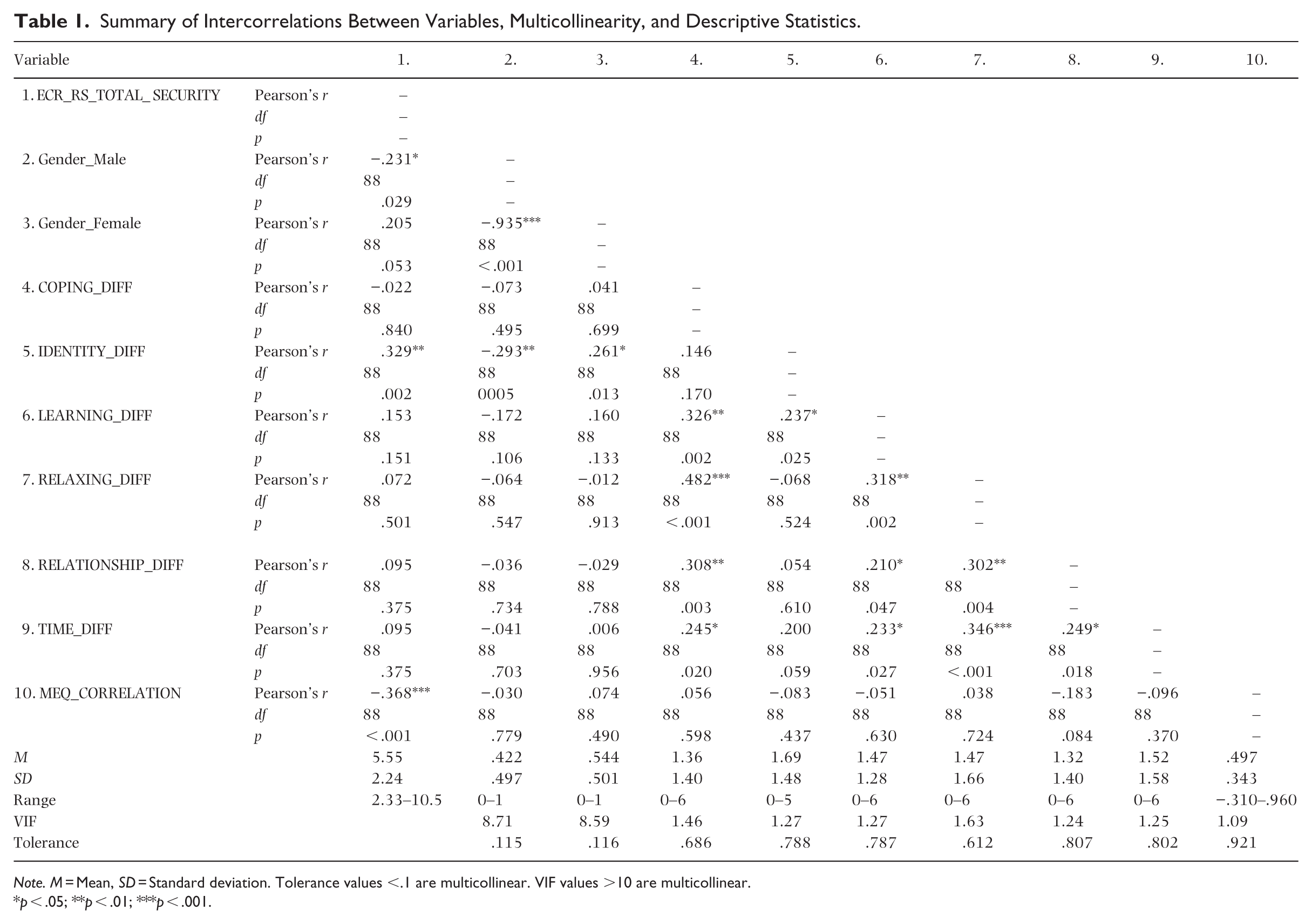
Note. M = Mean, SD = Standard deviation. Tolerance values <.1 are multicollinear. VIF values >10 are multicollinear.
p < .05; **p < .01; ***p < .001.
Next, we ran a multiple regression analysis to estimate the proportion of variance in the criterion variable, secure adult attachment to fathers, that could be accounted for by the predictor variables, namely the six musical engagement reasons (COPING_DIFF, IDENTITY_DIFF, LEARNING_DIFF, RELAXING_DIFF, RELATIONSHIPS_DIFF, and TIME_DIFF), MEQ_CORRELATION and gender. The results of this are shown in Table 2, which shows that attachment is related to shared reasons for engaging with music. Given that this leads to multiple comparisons, we applied a Bonferroni correction, leading to an adjusted criterion for significance at α = .006. The results showed that, in combination, the predictor variables accounted for a statistically significant 27.6% of the variability in secure adult attachment to fathers, R2 = .28, adjusted R2 = .20, F(9, 80) = 3.39, p < .001, which corresponds to a medium Cohen’s f effect size (f2 = .24; Allen et al., 2019). MEQ_CORRELATION predicted TAS significantly. However, neither gender nor the six individual MEQ reasons (COPING_DIFF, IDENTITY_DIFF, LEARNING_DIFF, RELAXING_DIFF, RELATIONSHIPS_DIFF, and TIME_DIFF) were statistically significant predictors. Unstandardised (B), standardised regression coefficients (β), and squared semi-partial correlations (sr2) for each predictor in the regression model are presented in Table 2.
Unstandardised, Standardised Regression Model Coefficients and Semi-Partial Correlations for Each Predictor in a Regression Model Predicting Secure Adult Attachment to Fathers.
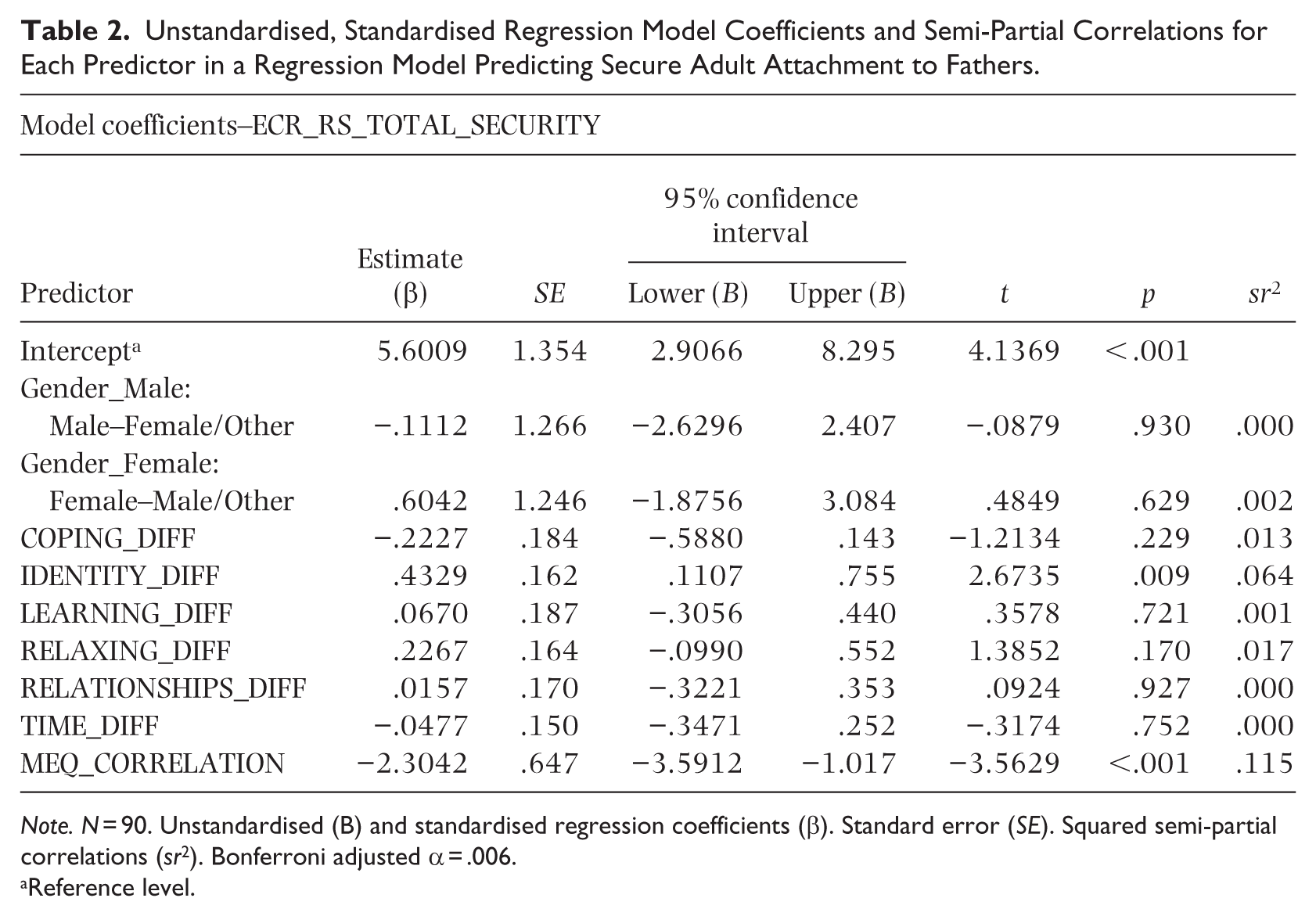
Note. N = 90. Unstandardised (B) and standardised regression coefficients (β). Standard error (SE). Squared semi-partial correlations (sr2). Bonferroni adjusted α = .006.
Reference level.
Discussion
Our study is the first to investigate the relationship between secure adult attachment to fathers and perceptions of shared reasons for musical engagement. Our results support Hypothesis 1, as participants with a higher level of secure attachment to their fathers also had a higher level of overlap between the reasons they engaged with music and the reasons they perceived their fathers engaged with music. None of the individual reasons for music engagement predicted adult attachment to fathers. The results concerning MEQ_CORRELATION, in particular, suggest that it is sharing a range of reasons for engaging in music, irrespective of what these may be, that predicts secure adult attachment to a father. Given the focus here on fathers, it is also worth noting explicitly that we did not find any gender differences between participants.
Implications
As with any correlation, our results do not imply a direction of causality. Sharing reasons for engaging with music may promote adult attachment with a father, of course. However, it is equally plausible that, because of their secure attachment, participants perceive their father to share musical engagement reasons with them. That is, adults who are more securely attached to their fathers tend to have more in common (Feldman, 2023; Grossmann et al., 2002; Mikulincer & Shaver, 2007) or perceive they have more in common (Hudson & Fraley, 2017; Levant et al., 2018), such as behaviours, values, and interests (Lamb & Lewis, 2010). Pasiali (2014) provided evidence of this in their study, emphasising a connection between secure attachment and high mutuality in interests, skills, and behaviours between child and attachment figure.
Alternatively, the overlap in perceptions of shared reasons for musical engagement may be explained by personal identity being shaped by the transference of generational traits or attributes. Participants could be more securely attached because they learned their musical engagement reasons from their father, and this shared musical connection has become a part of their identity, reinforcing their secure attachment. Musical family rituals and engagement are often observed in secure attachment relationships and are highly correlated with family cohesion and long-term bonds (Boer & Abubakar, 2014). Interestingly, none of the individual reasons for music listening gave rise to a better prediction of adult attachment than any of the others. As noted in the literature review, perhaps this can be explained by attachment security’s link to attribute commonality between child and caregiver (Mikulincer & Shaver, 2007), so that the attachment is associated with a range of commonalities rather than one or two particularly strong commonalities.
In theoretical terms, the present results clearly support attachment theory and its role in identity formation. They also provide a concrete way of promoting secure attachment to fathers, something often viewed as challenging due to the varying and diverse relationships fathers have with their children, as well as social expectations and definitions of the father role changing through generations (Brown et al., 2012). For fathers with a strong interest in music, musical engagement strategies can expedite secure attachment and even rebuild this (see Anderson et al., 2015; Henry et al., 2020; Pasiali, 2014). For educators, organising group music activities in classrooms provides an opportunity for children and caregivers to connect through enjoyment and shared experience, which fosters mutual understanding and deepens relational bonds (Boer & Abubakar, 2014; Pasiali, 2014). Therapists can employ music-based family interventions to facilitate more open communication and emotional sharing, particularly where verbal communication may be difficult (Henry et al., 2020). Caregivers may cultivate stronger attachments by intentionally participating in music-focused interactions, such as shared listening sessions, conversations about favourite songs or establishing family music routines (Anderson et al., 2015; Feldman, 2023). At a community level, these insights show that practising shared hobbies like music not only strengthens relationships but also helps shape personal identity and deepens a sense of interpersonal connection, offering clear benefits for well-being and social functioning (Levant et al., 2018; Mikulincer & Shaver, 2007).
Moreover, research already suggests that parenting interventions that involve musical engagement are better received by caregivers and children than other interventions, such as behavioural therapy (Newman et al., 2022). Therefore, the inability of the present research to infer the direction of the relationship between attachment and reasons for musical engagement may be of no consequence to designing useful interventions. However, future research should seek to implement longitudinal or experimental designs to help clarify any directional causality and expand the understanding of underlying mechanisms. In addition, future studies should validate the MEQ in broader populations and collect dyadic data from fathers’ self-reported reasons for musical engagement to strengthen the reliability and generalisability of our research findings.
Limitations
Although our research demonstrates a statistically significant relationship between secure adult attachment to fathers and perceptions of shared reasons for musical engagement, a few notable limitations should be flagged. First, there was no widely accepted measure of reasons for musical engagement that could be used. Although both the alpha scores for the study sample and the multicollinearity measures for the MEQ were well within acceptable ranges, it would clearly benefit from further studies to thoroughly test its reliability and validity. Second, there are various ethical and logistical implications of accessing fathers as research participants, but this study may nonetheless be limited due to the collection of perceptions of fathers’ reasons for musical engagement and perceptions of attachment to fathers, rather than data collected directly from fathers. A person’s perception of a relationship has been shown to hold significant bearing and can be just as important as the objective relationship behaviours exhibited (Cassidy et al., 2013; Keizer et al., 2019), but nonetheless, the father’s actual beliefs concerning their reasons for musical engagement may differ considerably from those perceived by the participants here. Third, the sample of university students used here (i.e., people who performed well at school and presumably had a relatively fortunate upbringing) may not necessarily map well onto the general population. Finally, it is worth emphasising that while the present results have identified a relationship between the variables, they tell us nothing about the underlying mechanisms and causal pathways between secure adult attachment to fathers and reasons for musical engagement.
Conclusion
In conclusion, this research is the first to investigate the relationship between secure adult attachment to fathers and perceptions of shared reasons for musical engagement. Our findings show that secure attachment to a father is related to sharing reasons with him for engaging in music. The findings also highlight the importance of personal perceptions of father–child relationships and the opportunity that musical engagement may offer in designing and implementing attachment interventions that would benefit fathers and their children. Music, with its almost unlimited accessibility, diversity, and usage, may be a valuable tool in developing relationship interventions and therapeutic techniques. Furthermore, with previous literature highlighting the importance of father–child attachments to lifelong outcomes for both, the present findings contribute to the theoretical knowledge of how to potentially facilitate secure adult attachment to fathers.
Footnotes
Consent to participate
Participants provided informed consent before commencing the research.
Consent for publication
The ethics approval for this research included consent for publication.
Data availability
All data are available by contacting the corresponding author.
Declaration of conflicting interests
The authors declared no potential conflicts of interest with respect to the research, authorship, and/or publication of this article.
Funding
The authors received no financial support for the research, authorship, and/or publication of this article.
Ethical considerations
This research was approved by the Curtin University Human Research Ethics Committee (HREC 2024-0289).
