




Abstract
Conservatoire music students experience a range of demands including performance, academic, and interpersonal demands. If not effectively managed, demands may lead to stress and negative well-being outcomes. This qualitative study explored conservatoire music students’ experiences of occupational stress and well-being, informed by a transactional stress theory. Six conservatoire music students were purposively selected to participate in semi-structured interviews. Participants discussed two stressful events: one perceived positively and a second perceived negatively. Interpretative Phenomenological Analysis was adopted and five themes developed: (a) Performance Demands; (b) Organisational Demands; (c) Relationship Demands; (d) Academic Demands; and (e) Multiple Demands. Participants commonly appraised demands as a threat. A smaller number of challenge or benefit appraisals were reported, with few harm or loss appraisals. Key underlying properties of stress appraisal were self and other comparison, preparation, and novelty. Participants highlighted the personal resources, psychological skills and problem-solving, and the organisational resource of social support to manage stressful experiences. Well-being outcomes related to stress appraisals. This study provides insight into the intra-individual processes related to occupational stress and well-being of conservatoire music students. Findings suggest interventions targeting the conservatoire culture and curriculum need exploring to create a positive learning culture and support students to cope with demands.
Keywords
Conservatoire music students operate within a highly demanding and unique environment. Much of the conservatoire experience is dedicated to improving students’ technical and musical proficiency through one-to-one lessons and performance opportunities (Perkins, 2013b), which leads to performance demands. Students also experience interpersonal demands as they encounter criticism from peers due to a competitive learning culture (Dobson, 2010b). Interpersonal issues may also arise in the relationship with the one-to-one teacher and some students have reported harassment and an abuse of power (Pecen et al., 2018). In addition, conservatoire music students experience academic demands and issues with assessment (Burland & Pitts, 2007; Burt & Mills, 2006). Outside the conservatoire, some students may take on employment, which can create conflict with their studies (Palmer & Baker, 2021). If not effectively managed, the demands experienced by performers may lead to occupational stress and negatively impact well-being (Willis et al., 2019).
Conservatoire music students have reported using a range of resources to cope with demands. Social support has been identified as an important resource with support sought from friends, teachers, and family (Dews & Williams, 1989). One-to-one teacher interactions are considered a particularly important source of social support with students seeking advice on physical issues, health, and well-being (Perkins et al., 2017; Williamon & Thompson, 2006). Previous research has indicated that music students use active coping skills such as proactive coping, reflection, planning, and seeking social support (Jääskeläinen et al., 2022). Considering maladaptive resources, music students have reported using substances and avoiding issues (Jääskeläinen et al., 2022; Orejudo Hernández et al., 2018). Orejudo Hernández et al. (2018) found that 33% of conservatoire music students used substances such as prescription drugs, alcohol, and herbal treatments to manage Music Performance Anxiety (MPA).
The well-being of music students is impacted by the experience of demands and coping resources. For instance, conservatoire music students have disclosed experiencing negative affective well-being outcomes due to competition and comparison with peers (Dobson, 2010a; Perkins et al., 2017). In addition, Antonini Philippe et al. (2019) suggested that social support contributed to higher well-being for conservatoire students. While studies suggest a link between demands, resources, and well-being, the intra-individual mechanism(s) linking these within conservatoire students have not been fully explained and require investigation to further understand the stress process. Willis et al. (2019) concluded that such investigation requires holistic approaches to assessing the occupational stress process. One approach is using Cognitive-Motivational-Relational Theory (CMRT; Lazarus, 1999).
Through CMRT, Lazarus (1999) attempted to explain how the appraisal of demands could influence affective and behavioural outcomes. When encountering a demand, a primary appraisal is made of threat, positive challenge, benefit, harm, or loss. Lazarus and Folkman (1984) proposed that a situation must include one of eight properties to be appraised as stressful: novelty, predictability, event uncertainty, imminence, duration, temporal uncertainty, ambiguity, and the timing of stressful events in relation to the life cycle. Thatcher and Day (2008) added two properties: inadequate preparation, and self and other comparison. To cope with demands, an individual may use personal or organisational resources (Bakker & Demerouti, 2014). Lazarus (1999) suggested that appraisal could lead to an immediate emotional outcome and/or long-term well-being outcomes. For example, threat appraisals may lead to negative affect, and challenge appraisals may lead to positive affect. Harm and/or loss appraisals may lead to long-term dissatisfaction. Eudaimonic well-being outcomes may also be influenced by appraisals. For example, an appraisal of benefit may be associated with increased environmental mastery. This suggests that CMRT incorporates both hedonic and eudaimonic well-being.
Hedonic well-being includes affective and cognitive dimensions (Diener et al., 1999). The affective dimension includes positive and negative affect (e.g., emotions, feelings), while the cognitive dimension includes satisfaction and is an evaluative judgement of well-being. Eudaimonic well-being is made up of six dimensions including autonomy, personal growth, environmental mastery, purpose in life, positive relations with others, and self-acceptance (Ryff, 2014). Although hedonic and eudaimonic well-being are highly correlated, they are distinct (Bartels et al., 2019) and researchers have highlighted the importance of considering both concepts (Keyes et al., 2002; VanderWeele et al., 2020).
Within classical music, few studies have taken a holistic theoretical approach to examining the stress process and well-being outcomes. Willis et al. (2024) examined the occupational experiences of professional classical musicians using CMRT. The exploration of appraisal allowed the researchers to further understand the intra-individual processes that link occupational demands and well-being. The researchers found that demands were most commonly appraised as a threat, which related to employment insecurity. Self and other comparison was a key underlying property of stress appraisal, which the authors linked to the competitive occupational environment. Given that conservatoire music students also experience a competitive performance environment and face similar demands, CMRT was considered an appropriate framework for the present study.
Aims and research questions
The aim of this study was to interpret the lived experiences of occupational stress and well-being of conservatoire music students through examining demands, appraisals, resources, and perceived well-being outcomes. The research questions were:
Methods
The authors adopted a critical realist position (Bhaskar, 2008), which aligned to the use of Interpretative Phenomenological Analysis (IPA; Smith et al., 2022). The study follows similar methods to Willis et al. (2024), where the occupational stress and well-being experiences of professional classical musicians were examined. IPA is a qualitative method of enquiry for exploring participants’ lived experiences including their actions, thoughts, and feelings (Smith et al., 2022). Within IPA, the interpretation of both the participant and the researcher is acknowledged, also known as a ‘double hermeneutic’ (Smith & Osborn, 2003). IPA is idiographic and focuses on depth of inquiry (Smith et al., 2022).
Participants and recruitment
Participants were recruited from a previous quantitative survey study assessing demands, stress, coping, and well-being of professional and student musicians. Eligibility criteria included (1) music student at a conservatoire or specialist music college; (2) engaged in undergraduate or postgraduate study; (3) any instrument or vocal pathway; (4) aged 18 or above; and (5) any nationality or country of residence. A small sample size was chosen to align with the idiographic approach of IPA (n = 6).
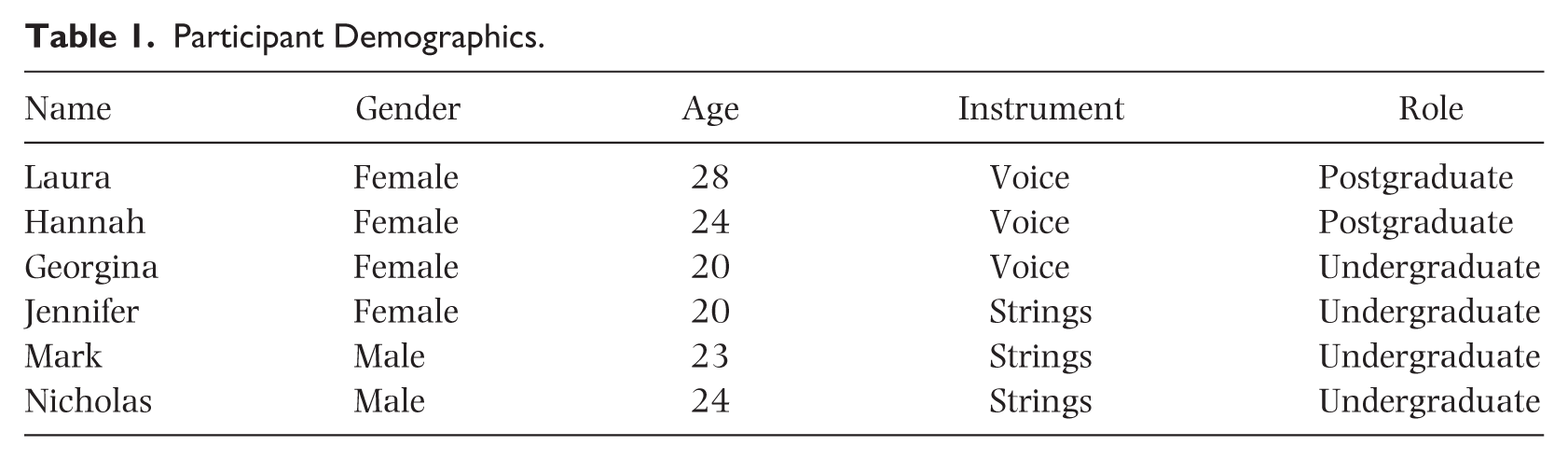
Survey participants who agreed to be contacted via email were invited to participate. Six students volunteered, of whom one withdrew due to other commitments. Therefore, an additional student was invited and agreed to participate. See Table 1 for participant demographics.
Participant Demographics.
Procedure
This study was approved by the Cardiff School of Sport and Health Sciences Ethics Committee at Cardiff Metropolitan University (PGR-2868) on August 6, 2020. Participants were given information sheets and required to provide written informed consent before being interviewed.
An interview guide was developed (see Supplemental Appendix A) and six semi-structured interviews were conducted. Participants were asked to consider two demanding situations and describe their thoughts, feelings, and actions in relation to the stress process. Interviews lasted 48–80 min (M = 66 min), were conducted on Zoom, and audio recorded. Interviews were transcribed and transcripts pseudonymised. Participants checked transcripts for accuracy.
Data analysis followed IPA guidelines (Smith et al., 2022). Transcripts were imported into NVivo 1.3 (QSR International, 2020) and were read and reread (S.W.). Exploratory notes and experiential statements were made (S.W.). Personal Experiential Themes were created for each transcript through clustering experiential statements (S.W., M.M.). These were clustered into Group Experiential Themes for cross-case analysis using mind maps and tabulation (see Supplemental Appendix B) (S.W., M.M., R.N.). Group Experiential Themes related to the types of demands participants discussed. To address the research questions, the table was expanded and demands were aligned with appraisals, underlying properties of stress appraisal, resources, and well-being. Each was categorised according to concepts aligned with CMRT (Lazarus, 1999; Thatcher & Day, 2008), and hedonic and eudaimonic well-being (Diener et al., 1999; Ryff, 2014) (S.W., R.N.). In this way, an inductive and deductive approach was used. Throughout data analysis, critical reflective meetings were held between co-authors to challenge the development of Group Experiential Themes (S.W., M.M., R.N., D.W.).
Results
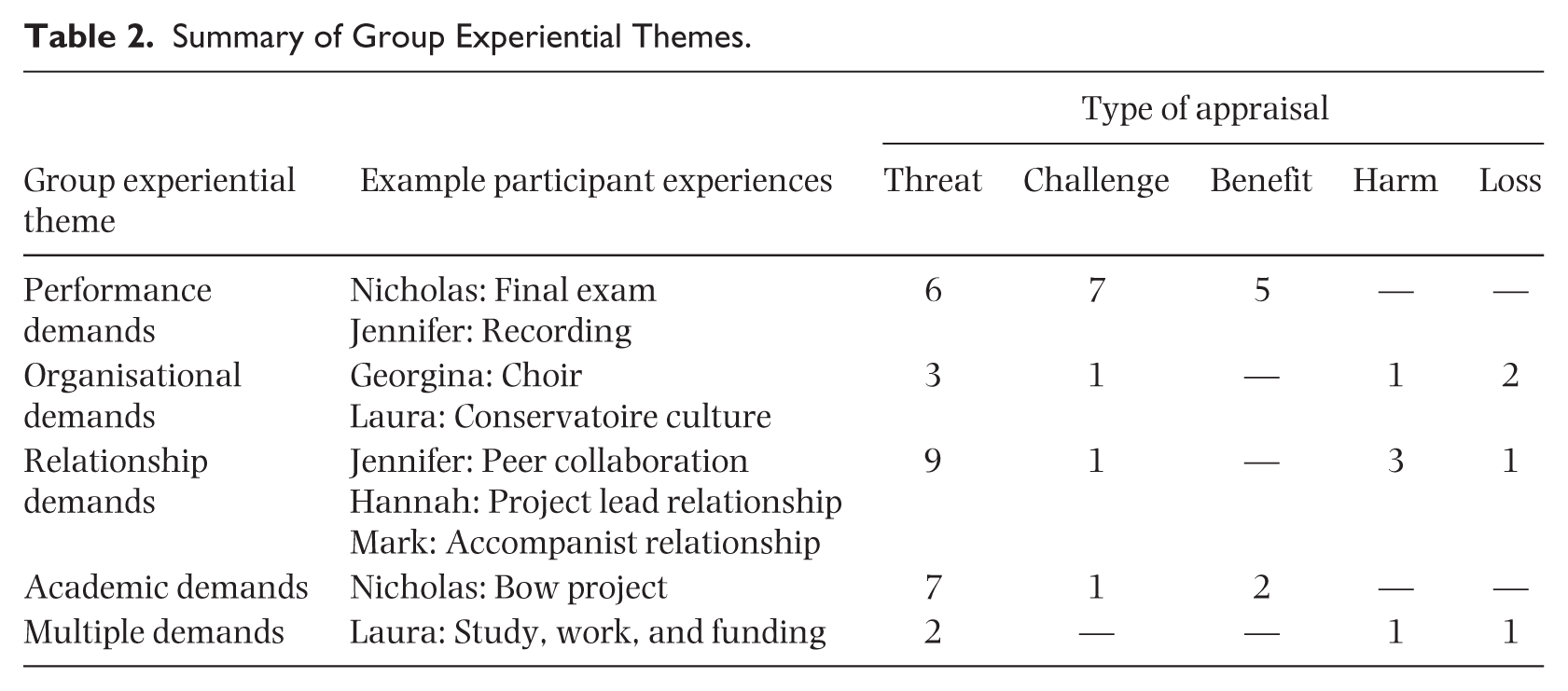
Five Group Experiential Themes were developed: (a) Performance Demands; (b) Organisational Demands; (c) Relationship Demands; (d) Academic Demands; and (e) Multiple Demands. Within each theme, examples of demands, appraisals, underlying properties of stress appraisal, resources, and well-being outcomes are presented alongside quotations. A summary of Group Experiential Themes and of types of appraisals described by participants is shown in Table 2. See Supplemental Appendix C for an overview of all participant experiences.
Summary of Group Experiential Themes.
Theme A: performance demands
Performance Demands related to participants’ experience of the musical demands they faced (e.g., competitions, opera performance). Five participants discussed performance demands: Georgina, Hannah, Jennifer, Laura, and Nicholas. Across participants, performance demands were appraised as a challenge (seven appraisals), followed by appraisals of threat (six appraisals), and benefit (five appraisals).
For Nicholas, a performance demand arose due to his final year exam. Nicholas experienced technical demands and made a challenge appraisal: ‘I’d been wanting to play [the piece] for years . . . I just wanted it to be a challenge’. Nicholas also appraised a threat that his performance might not reach the required standard: ‘quite a lot of pressure on me to try and push my level up to match [my peers]’. Nicholas discussed the underlying properties of threat appraisal of event uncertainty and self and other comparison. Nicholas compared his performance skills with his peers: ‘A colleague of mine . . . he did that [repertoire] in their first-year recital. And they played really well . . . how do I make it better than his?’ Self and other comparison had underlined much of Nicholas’s conservatoire experience and he felt on the ‘back foot’: ‘every assessment I felt behind’. Nicholas discussed using personal resources in the form of problem-solving, preparation, and psychological skills. The problem-solving skills Nicholas used involved self-regulated learning: ‘I don’t always have to go and ask. I can just sit there and work out what works best’. Regarding preparation, Nicholas simulated the performance environment: ‘practising in the room that I was going to do my recital’. Considering well-being outcomes, Nicholas experienced positive and negative affect linked to his appraisals of challenge and threat, respectively: ‘Sometimes it was full-on pride that I was doing something that I dreamed of doing’ and ‘other times it was just a disheartening’. Following the performance, Nicholas again felt proud, which suggests a benefit appraisal: ‘I’m still listening to it on a weekly basis . . . It was actually pretty good for once’. This quote also demonstrates that Nicholas experienced the eudaimonic well-being outcome environmental mastery as he was pleased with his performance.
Jennifer described the demand of recording performances and made multiple appraisals including challenge, benefit, and threat. Initially, Jennifer made a challenge appraisal: ‘Challenging when we first started . . . kind of scared’. Having practised recording, Jennifer made a benefit appraisal: ‘pushing yourself to do something that you’re not . . . comfortable with was very good’. Regarding a recent recording, Jennifer made an appraisal of threat and was concerned about becoming tired and not getting a good take. Considering her recent experience, Jennifer discussed the underlying properties of threat appraisal of self and other comparison and subjective event uncertainty: ‘[recording] it can either go very well or it can go really bad’. Jennifer discussed using psychological skills and problem-solving as personal resources. Concerning psychological skills, Jennifer normalised her experience: ‘shifted into thinking, well, it’s the same thing – performing in front of a camera and performing in front of an audience’. In terms of problem-solving, Jennifer created a strategy: ‘. . . try and get like a technically clean take for the first time . . . having a strategy’. Regarding well-being, Jennifer experienced negative affect, which was aligned to threat appraisal: ‘always feeling nervous’. Creating a strategy linked to Jennifer’s appraisal of challenge and led to positive affect: ‘having a strategy . . . It does give me a lot of security and almost joy while . . . performing’. Overall, recording performances led to personal growth, an aspect of eudaimonic well-being that was connected to a benefit appraisal, ‘teachers have said, “your sound has improved,” or . . . “you’re more sensitive, you have more emotion.”’
Theme B: organisational demands
Participants discussed Organisational Demands, which were controlled at the level of the organisation (e.g., by conservatoire staff). This included aspects such as scheduling, the conservatoire environment, and travel. Organisational demands were discussed by Georgina, Hannah, Laura, and Nicholas. Organisational demands were appraised as a threat (three appraisals), loss (two appraisals), harm (one appraisal), and challenge (one appraisal).
Georgina wanted to be considered for a place in a conservatoire choir, which created a demand. There was no formal structure for Georgina to audition or approach staff, with students selected by the choir lead: ‘She sees you, she likes you, she picks you’. Georgina appraised the demand as a loss (due to harm) as she was missing a development opportunity: ‘I really wanted to get in[to the choir] because that’s the only way you can improve your sight-reading’. Georgina described two underlying properties of loss appraisal: self and other comparison and ambiguity. Georgina compared her singing to her peers: ‘it becomes another factor in how good you are against everyone else’. Georgina attempted to improve her sight-reading skills to be selected for the choir using the personal resources information seeking and problem-solving. Georgina sought information from her sight-singing teacher and used problem-solving skills by speaking to the choir lead, ‘I’d be chasing after this teacher again and again and again . . . I was like, “ . . . Why can’t I just audition for you?”’ Georgina experienced frustration, a negative affective well-being outcome as her efforts to improve her sight-reading were unsuccessful: ‘Working at it was really driving me nuts because I wasn’t getting really simple things’. Associated with her appraisal of loss/harm, Georgina experienced a lack of autonomy, an aspect of eudaimonic well-being, as her attempts to get into the choir were unsuccessful: ‘it made me feel helpless because I couldn’t control anything’.
Laura described the demand of the organisational culture creating a ‘hothouse environment’. This created a competitive culture amongst students: ‘it’s more about like how you present as a performer . . . what gig have you got coming up next? . . . slightly competitive energy . . .’ Laura appraised the organisational culture as a threat: ‘the way people kind of peacock around one another about like how much they’re doing and how successful they are . . . I find that quite hard to, to cope with’. Laura discussed the underlying properties of threat appraisal novelty and self and other comparison. Laura was a Master’s student but had no previous experience of a conservatoire environment, which introduced novelty: ‘I did like a purely academic degree, so to come into this was quite a culture shock’. Laura compared her experiences to her peers: ‘I often found that I would kind of sit there being like, “oh, I don’t have that,” or like, “oh, I didn’t get that.”’ Laura discussed using organisational resources and due to a mental health diagnosis, she accessed weekly mentoring sessions. In these sessions, Laura received cognitive behavioural therapy and learnt to challenge irrational thoughts through ‘rational self-talk’. Related to her appraisal of threat, Laura perceived that the culture negatively impacted her well-being: ‘That slightly competitive energy . . . took a bit of a toll on my . . . mental well-being’. The competitive culture also had a negative impact on Laura’s relationships with her peers, an aspect of eudaimonic well-being: ‘. . . talking about, “Oh, have you done this audition?” . . . “Oh, you know, I’ve got a second round for this. You didn’t.” And you’re like, “Oh, great.”’
Theme C: relationship demands
The theme Relationship Demands included demands at the interpersonal level, which included relationships with tutors and peers. Relationship demands were discussed by four participants: Georgina, Hannah, Jennifer, and Mark. Relationship demands were largely appraised as a threat (nine appraisals), followed by harm (three appraisals), challenge (one appraisal), and loss (one appraisal).
Jennifer was involved in a string quartet and had difficulties collaborating with another ensemble member, which created a demand: ‘For me, the main demand . . . [is] to collaborate’. Jennifer made appraisals of threat and harm. Jennifer appraised a threat as she was performing for an exam: ‘it was quite difficult for me . . . it was for friend’s exam’. Considering the harm appraisal, Jennifer did not get on with another ensemble member and they criticised each other’s performance. Jennifer perceived the underlying properties of threat appraisal as self and other comparison and novelty. Regarding self and other comparison, Jennifer compared her acceptance of criticism to her peer she wasn’t getting on with: ‘Because I’ve seen him in a negative light, my mind just goes, yeah, but you’re not doing it as well’. The novelty experienced was because it was Jennifer’s ‘first ever string quartet’. Jennifer used personal resources to cope including cognitive restructuring and reflection: ‘realising that I can actually look quite negative in someone else’s eyes . . . not everyone’s perfect’. She also attempted to stay positive by focusing on the music: ‘I’ll just try my very best to focus on good music-making’. Considering well-being, Jennifer experienced negative affect and felt ‘very annoyed’, which linked to the appraisal of harm. The relationship dimension of eudaimonic well-being is demonstrated as Jennifer perceived that the experience affected the whole ensemble: ‘it didn’t help with the group energy’.
Alongside relationship demands with peers, participants discussed demands created due to interpersonal relationships with staff. Hannah discussed an ensemble project that had a project lead who ‘was a very difficult character to deal with’. Hannah described the project lead’s behaviour as ‘patronising, degrading . . . They would put you down’. Hannah initially made a challenge appraisal. Following the ensemble’s performance, Hannah made appraisals of harm and loss as she felt disrespected: ‘I have no respect for you and you clearly have no respect for us’. Hannah described the underlying properties of threat appraisal as novelty and predictability as she had not experienced such behaviour before. Hannah used psychological skills and problem-solving as personal resources. Considering psychological skills, Hannah used positive thinking during rehearsals: ‘I just tried to be this wall of positivity’. Following the performance, Hannah used problem-solving skills and contributed to a complaint submitted with her peers. Hannah also used organisational resources in the form of social support from her peers: ‘Before the concert, we actually all got together . . . we all just said . . . let’s just ignore that they’re there [the project lead]. Let’s do this performance, enjoy it’. Considering well-being outcomes, Hannah experienced negative affect in the form of frustration, anger, and sadness, which were associated with the appraisal of harm: ‘Anger. I was quite angry’, and ‘I felt sad. Saddened that like, it was our first project back [after COVID-19] and we were working with this knob [laughs]’. Hannah also discussed eudaimonic well-being outcomes in relation to positive relations with others, personal growth, and environmental mastery. Connected with the appraisal of loss, Hannah experienced a lack of environmental mastery and personal growth: ‘couldn’t progress at the rate I could’ve done had I not had my guard up’.
Mark also described a situation in which he experienced demands due to issues in his relationship with a staff member: ‘The relationship with the accompanist is difficult . . . I definitely fall into not liking her and I’m pretty certain she doesn’t like me’. The demand was ongoing and Mark also discussed an incident where he had not replied to an email promptly and the accompanist suggested he would lose rehearsal time. Mark appraised the demand as a threat on multiple levels. Mark was concerned about losing rehearsal time and the effect on his exam: ‘I can’t lose half an hour . . . if I want to do well in my final performance’. Mark also experienced the threat of a poor educational experience: ‘She has quite a lot of power within the department about decision-making’. Mark experienced ambiguity as the underlying property of threat appraisal and felt on uncertain ground when communicating with the accompanist: ‘interactions I’ve had with her have put me in mind of . . . gaslighting’. Mark discussed personal resources including avoidance and emotion regulation. He reported avoiding performing with the accompanist for an upcoming exam: ‘I’ve chosen to do about ten minutes of it unaccompanied’. In terms of emotion regulation, Mark discussed going into nature: ‘get away from things and try to get into natural environments . . . just getting away from work and, and people [laughs]’. Mark experienced negative affective well-being outcomes in the form of anger and anxiety. He was also frustrated about not being able to resolve the situation: ‘frustration with the, the system . . . I can’t deal with it in an effective way’.
Theme D: academic demands
Academic Demands related to specific modules that included written or non-performance tasks and independent study. Academic Demands were discussed by five participants: Georgina, Hannah, Jennifer, Mark, and Nicholas. Academic demands were appraised as a threat (seven appraisals), benefit (two appraisals), and challenge (one appraisal).
Nicholas discussed demands related to a module where he made a bow and submitted an accompanying report: ‘doing the write-up for that, was probably the worst part of the last five years’. Nicholas appraised the situation as both a threat and challenge. He appraised a threat as he needed to pass the module to progress onto a Master’s programme: ‘It was hard because it basically secures my place’. Nicholas also appraised making the bow as a challenge. Nicholas experienced imminence as the underlying property of threat appraisal. Due to the impact of COVID-19, Nicholas had a short timeframe of ‘about four weeks’ to make the bow. Nicholas also experienced novelty as the underlying property of challenge appraisal, as this was the first time he had made a bow. Nicholas used organisational resources in the form of social support from his teacher and perceived the experience as an opportunity for development. Nicholas received tangible support from his teacher, who gave his time for free: ‘He refused to take any money’. Nicholas used personal resources in the form of problem-solving and created a plan: ‘had to like plan everything down to the minute’. Considering well-being, Nicholas experienced positive affect in the form of pride and enjoyment, which related to the appraisal of challenge. Nicholas described the satisfaction of making his own bow, which suggests an appraisal of benefit following the experience: ‘I was close to tears’. Nicholas experienced the eudaimonic well-being outcomes of positive relations with others, purpose in life, and personal growth due to learning a new skill: ‘. . . disbelief, that someone who just plays the bass could actually do something neat and delicate’.
Theme E: multiple demands
Multiple Demands included participants’ experiences of concurrent demands, which in itself created a demand. Participants discussed competing demands between the conservatoire, professional work, and their health. Managing multiple demands was discussed by Georgina, Hannah, and Laura. The requirement to manage multiple demands simultaneously was appraised as a threat (two appraisals), loss (one appraisal), and harm (one appraisal).
Laura described the demand of managing multiple demands: I was struggling a bit with like managing my demands of like the course, the jobs that I was doing, the external singing work I was doing, and at the same time as that I was trying to find funding . . .
Laura appraised a threat, that she might not fulfil all her commitments and she would be perceived negatively: ‘I didn’t really want to upset college or, you know, get in anybody’s bad books’. Laura discussed the timing of managing multiple demands simultaneously as the underlying property of threat appraisal. Laura discussed time management and information seeking as personal resources. She sought information from her mentor: ‘I would bring to her like, very practical things, like I had a lot to do and I couldn’t quite understand how to get through it’. Laura also discussed organisational resources in the form of social support from her one-to-one teacher and the wider organisation. Laura’s teacher provided tangible support and helped her approach another member of staff about time off: I’d just been offered like a summer contract. And I wanted to ask her for like all this time off. So I was like preparing my email and I spoke to my teacher and she was like, ‘Don’t’. Like ‘Let’s wait for like maybe two, three weeks . . . try and get you guys to talk in person . . .’ we did do that and I did get the time.
Despite this, Laura perceived a lack of organisational support for the multiple demands she was facing: ‘I found that they [college staff] weren’t particularly understanding . . . if you had external engagements . . . it was kind of, “College comes first.”’
Discussion
The aim of this study was to interpret the lived experiences of occupational stress and well-being of conservatoire music students through examining demands, appraisals, resources, and perceived well-being outcomes. To address the research questions, each aspect of the stress process is addressed in turn followed by discussion of the connections between the stress process and well-being outcomes.
Demands
Performance Demands occurred across a range of contexts (e.g., exams, recording) and given the importance of developing conservatoire students’ musical skills, this is not surprising and has been previously discussed in the literature (e.g., Dobson, 2010b). The perception of the conservatoire culture as competitive created an Organisational Demand for some participants. Several studies have discussed the competitive aspect of learning at a conservatoire, which has been ascribed to a challenging labour market and concerns over the criticism of peers (e.g., Dobson, 2010a; Jääskeläinen et al., 2020; Perkins et al., 2017). Researchers have also suggested that conservatoires operate hierarchically and demonstrate perceived favouritism towards particular high-achieving students (Davies, 2004; Perkins, 2013a, 2013b).
Relationship Demands were experienced in interpersonal relationships with peers and staff. The competitive culture at the conservatoire contributed to poor interpersonal relationships between students, similarly shown by Perkins et al. (2017). Staff may facilitate students’ access to employment and Hannah was concerned that a poor relationship with a staff member could negatively impact her career. Master-apprentice relationships are often observed in music education (Burwell, 2005) and power imbalances can negatively impact relationships if not well managed. Conservatoire students have also described difficulties due to poor relationships with one-to-one teachers (Pecen et al., 2018; Perkins et al., 2017).
Multiple Demands encompassed the perspective that managing several demands at once was itself a demand. This included balancing demands such as study, employment, and sourcing funding. Laura was concerned about her ability to fund her studies and Davies (2004) suggested that students who are less financially stable may take on performance work, which can create conflicting demands. Similarly, Jääskeläinen et al. (2022) suggested that the need to work alongside studying could lead to stress overload for music students. Changes in the economy over the last 5 years potentially increase the juggling of multiple demands with an increased prioritising of the financial element.
Primary appraisal and underlying properties of appraisal
Participants most often appraised demands as a threat, which suggests the learning environment experienced by conservatoire music students is threatening. Challenge and benefit appraisals were made for a small number of demands, and harm and loss appraisals were made least often. Similarly, professional classical musicians and popular musicians have reported threat as the most common type of appraisal (Cohen, 1999; Willis et al., 2024). Threat appraisals related to performance or academic outcomes and the conservatoire culture. Considering the appraisal of threat due to the conservatoire culture, Long et al. (2014) suggested that this may be due to the competitive and specialised nature of study. Participants made challenge appraisals when encountering unusual or new situations as well as for performance projects. This was due to the perception of the potential to benefit by learning a new skill, which may be expected when enrolled at an educational institution.
Participants experienced nine of the underlying properties of stress appraisal (except for temporal uncertainty) previously proposed (Lazarus & Folkman, 1984; Thatcher & Day, 2008). Preparation, self and other comparison, and novelty were three key underlying properties discussed by participants. Given the centrality of performing, participants often discussed preparation in the form of practice. Conservatoire students practise for many hours and Kreutz et al. (2009) reported that students practice an average of 23 hr and 20 min each week. Willis et al. (2024) also found that preparation was an important underlying property of stress appraisal for professional musicians.
The most frequent underlying property of stress appraisal that participants discussed was self and other comparison. Participants compared themselves to their peers and those they considered successful, viewing themselves unfavourably. Self and other comparison is linked to conservatoire culture and activities such as displaying orchestral seating positions may lead students to feel competitive and compare their performance with peers (Perkins et al., 2017). Georgina compared the opportunities she was offered with those of her peers as a proxy for measuring success and Davies (2004) reported a similar finding.
Novelty was also an important underlying property of stress appraisal for participants, which aligns with the fact that students are in a period of transition and exposed to new experiences. Participants experienced novelty in relation to the conservatoire culture, relationships with staff, performance contexts, and assessments. Similarly, Miksza et al. (2021) suggested that novelty and uncertainty underpin some of the demands that music students experience such as responding to performance feedback and concern about future employment.
Resources
Participants used both personal and organisational resources to manage demands. Important personal resources included psychological skills and problem-solving, while social support was a key organisational resource. A systematic review suggested that psychological skills programmes are effective at reducing MPA and enhancing performance (Ford, Arvinen-Barrow, 2019). Participants also reported using problem-solving skills such as time management and self-regulated learning. Although some participants developed problem-solving skills due to their conservatoire experiences, many of the problem-solving skills were not formally taught and Pitts (2003) suggested that time-management skills were part of the hidden curriculum for university music students.
Considering organisational resources, participants discussed the importance of social support provided by peers, teachers, and staff. Within the literature, students have identified one-to-one teachers as a key source of support (Perkins et al., 2017; Williamon & Thompson, 2006) and given the educational context, it is unsurprising that participants sought informational support from staff. The emphasis on the one-to-one learning environment in a conservatoire may encourage students to rely on a specific teacher for a wide range of issues, increasing the responsibility of the teacher and the intensity of the one-to-one relationship (Gaunt, 2008).
Well-being experiences
Hedonic well-being outcomes included positive affect, negative affect, and satisfaction. Positive affective outcomes (e.g., enjoyment) related to musical experiences. Previous research with music students also found that music-making leads to strong positive emotional experiences (Lamont, 2012; Perkins et al., 2017). Negative affective outcomes included anxiety, frustration, and anger. Participants discussed acute anxiety due to performance scenarios and Barros et al. (2022) suggested 16–83.1% of music students experience MPA. Vervainioti and Alexopoulos (2015) reported that public exposure is one of the main demands faced by classical musicians, often resulting in MPA. Satisfaction was described by participants when they experienced positive academic or performance outcomes.
Participants discussed all six aspects of eudaimonic well-being with relationships with others, personal growth, and environmental mastery commonly described. Personal growth included developing specific skills (e.g., time management, instrumental skills), as a result of engaging with the curriculum and self-directed learning. While most participants described experiences that benefitted their personal growth, Hannah reported a lack of personal growth due to interpersonal demands. The importance of these dimensions of eudaimonic well-being may be due to the fulfilment or thwarting of basic psychological needs as explained in Self-Determination Theory (Deci & Ryan, 2000). In particular, environmental mastery and personal growth may relate to competence and relationships with others associated with the dimension relatedness.
Connections between stress and well-being
Considering the relationship between appraisals and well-being outcomes, the findings of this study supported CMRT. Appraisals of threat and challenge related to acute negative and positive hedonic well-being outcomes, respectively. That self and other comparison was the most frequent underlying property of stress appraisal may explain why the majority of demands were appraised as a threat, particularly as students viewed themselves unfavourably. To elaborate, if an individual’s musical abilities are judged as inadequate when compared to others this could mean the loss of performance opportunities. Appraisals of benefit and harm/loss related to satisfaction and eudaimonic well-being. For example, benefit appraisals often linked to personal growth, which was experienced when participants reported positive academic or performance outcomes. Appraisals of harm/loss were made when eudaimonic well-being was negatively affected (e.g., missed opportunities) and were associated with negative academic or performance outcomes. Participants also made harm/loss appraisals when they felt they had been treated poorly.
Implications
In developing the underlying properties of stress appraisal, Thatcher and Day (2008) included individuals feeling underprepared. However, this study supports the finding from Willis et al. (2024) that both adequate and inadequate preparation contribute to stress appraisals. The underlying property of stress appraisal ‘inadequate preparation’ should, therefore, be revised to ‘preparation’. An updated definition is provided by Willis et al. (2024).
Implications for conservatoires relate to culture and curriculum. Changing the culture and, therefore, reducing perceptions of threat could be achieved through greater transparency, widening the definition of success, and creating inclusive learning environments where all students are valued. Perkins (2013b) suggested that hierarchical practices within conservatoires are incompatible with a positive learning environment and highlighted that students should be able to develop without concern for their position within the hierarchy. To reduce favouritism, conservatoires could increase transparency when awarding performance opportunities, which Porton (2020) suggested could be achieved through more frequent auditions for prestigious performances and explanations on the selection process. In addition, Perkins (2013a) suggested that widening the definition of success could reduce the hierarchy of students by celebrating the achievements of alumni outside performance.
Considering the curriculum, conservatoire educators could ensure that psychological skills training (e.g., visualisation) is incorporated into modules or workshops, where students practise using techniques in a supportive environment. This would ensure students are equipped with these skills and can effectively use them during demanding situations. While Ford and Arvinen-Barrow (2019) suggested that such programmes are effective for developing performance skills, conservatoires should address the barriers some students face to engaging in psychological skills training such as lack of awareness and inadequate time to develop skills (Suzuki & Pitts, 2024). In addition, formally teaching time-management skills would benefit students’ ability to manage concurrent demands from both occupational and personal sources and support their progression into the profession.
Strengths, limitations, and future directions
This is the first qualitative study to explore conservatoire music students’ experience of the stress process and well-being outcomes informed by CMRT (Lazarus, 1999). Through examining appraisals and underlying properties of stress appraisal, we have offered insight into the potential mechanism linking demands and well-being outcomes. We do, however, acknowledge the limited scope of the study due to the small number of students. In future, replication studies should be conducted with larger samples and include educators and organisations. Educators could be presented with these findings to better understand current experiences of music students and facilitate discussions about the effect of demands and potential coping strategies.
Conclusion
The present study used qualitative inquiry to explore occupational stress and well-being experiences of conservatoire music students. Considering all demands, threat appraisals were most common, suggesting that the conservatoire culture is experienced as threatening. Participants perceived threats to performance or academic outcomes and the conservatoire culture. Three key underlying properties of stress appraisal were discussed: preparation, self and other comparison, and novelty. The frequency of self and other comparison may explain why demands were mainly appraised as a threat. Participants highlighted psychological skills and problem-solving as important personal resources and social support as a key organisational resource. Threat and challenge appraisals related to acute hedonic well-being outcomes. Appraisals of benefit and harm/loss related to long-term outcomes of satisfaction and eudaimonic well-being.
Supplemental Material
sj-docx-1-pom-10.1177_03057356261420181 – Supplemental material for ‘It made me feel helpless because I couldn’t control anything’: Occupational stress and well-being experiences of conservatoire music students
Supplemental material, sj-docx-1-pom-10.1177_03057356261420181 for ‘It made me feel helpless because I couldn’t control anything’: Occupational stress and well-being experiences of conservatoire music students by Simone Willis, Mikel Mellick, Rich Neil and David Wasley in Psychology of Music
Supplemental Material
sj-docx-2-pom-10.1177_03057356261420181 – Supplemental material for ‘It made me feel helpless because I couldn’t control anything’: Occupational stress and well-being experiences of conservatoire music students
Supplemental material, sj-docx-2-pom-10.1177_03057356261420181 for ‘It made me feel helpless because I couldn’t control anything’: Occupational stress and well-being experiences of conservatoire music students by Simone Willis, Mikel Mellick, Rich Neil and David Wasley in Psychology of Music
Supplemental Material
sj-docx-3-pom-10.1177_03057356261420181 – Supplemental material for ‘It made me feel helpless because I couldn’t control anything’: Occupational stress and well-being experiences of conservatoire music students
Supplemental material, sj-docx-3-pom-10.1177_03057356261420181 for ‘It made me feel helpless because I couldn’t control anything’: Occupational stress and well-being experiences of conservatoire music students by Simone Willis, Mikel Mellick, Rich Neil and David Wasley in Psychology of Music
Footnotes
Data availability
The datasets presented in this article are not readily available because they are restricted to the author team in accordance with Cardiff Metropolitan University Ethics Committee. Requests to access the datasets should be directed to the corresponding author.
Declaration of conflicting interests
The authors declared no potential conflicts of interest with respect to the research, authorship, and/or publication of this article.
Ethical considerations
This study was approved by the Cardiff School of Sport and Health Sciences Ethics Committee at Cardiff Metropolitan University (PGR-2868) on August 6, 2020. Participants were given information sheets and required to provide written informed consent before being interviewed. Written informed consent for publication was provided by participants.
Funding
The authors disclosed receipt of the following financial support for the research, authorship, and/or publication of this article: This work was supported by the Higher Education Funding Council for Wales (HEFCW) Higher Education Investment Recovery Fund.

Supplemental material
Supplemental material for this article is available online.
References
Supplementary Material
Please find the following supplemental material available below.
For Open Access articles published under a Creative Commons License, all supplemental material carries the same license as the article it is associated with.
For non-Open Access articles published, all supplemental material carries a non-exclusive license, and permission requests for re-use of supplemental material or any part of supplemental material shall be sent directly to the copyright owner as specified in the copyright notice associated with the article.
