




Abstract
Research about autistic people’s subjective experiences with music and its impact on their well-being is limited, despite its common presence in public spaces and support services. To provide an empirical framework and tools for future research, we examined the relevance of the participatory music engagement for mental well-being model for autistic adults. The model outlines four pathways through which music supports well-being: managing and expressing emotion, providing respite, facilitating self-development, and facilitating connections. Based on the model, we developed a new questionnaire, the Participatory Music Engagement for Mental Well-being (PaMEW), and collected responses from 63 autistic adults. We found that most respondents believed the items were relevant to their experiences of the relationship between music and well-being, that the factorial structure of their responses aligned with the model, and that their comments reflected the four pathways; however, they also highlighted nuances not addressed by the model. The study underscores the need for nuanced tools that reflect the unique ways autistic individuals use music to support their well-being, suggesting future revisions of PaMEW in collaboration with the autistic community to enhance its relevance and clarity.
There is wide-ranging evidence indicating the benefits of music engagement for health and well-being (Daykin et al., 2018; Fancourt & Finn, 2019; MacDonald, 2013; Viola et al., 2023). It shows cost-effective potential for supporting social determinants of health, child development, health prevention, caregiving, and positive effects on the management and/or treatment of mental illness, neurodevelopmental, neurological, and acute conditions, as well as end-of-life care. Despite the broad evidence that it can, we still lack a full understanding of how music supports well-being.
In a large meta-ethnographic study, Perkins and colleagues (2020) included 46 studies to explore the ways in which people engage with participatory music to support their well-being. Using a multinational sample of over 2000 participants from the general population, marginalised groups, and people experiencing physical and mental-health-related challenges, the authors found four overarching themes. Participants reported that music engagement supports their well-being by helping them (1) manage and express emotions, (2) facilitate self-development, (3) provide a form of respite, and (4) facilitate connections. This overview suggests that people use music, for example, to process, express, intensify, or change their emotions; develop their skills, identity, and self-confidence; feel a sense of purpose and achievement; create a sense of space and time just for themselves; or distract themselves from worries. They also use music to enhance their social life – for example, by playing or singing with others to feel connected to them, as well as their own heritage and past; to receive and give social support; and to feel a sense of belonging (Perkins et al., 2020). While Perkins et al. (2020) adopt a broad view of mental well-being, combining hedonic and eudaimonic approaches, they built the model of pathways on studies that allowed interviewees to use their own understandings of well-being (as did we in this study).
Given the uncommonly large and (in some ways) diverse sample, as well as an atheoretical approach to well-being, Perkins et al.’s (2020) study gives a broadly applicable basis upon which we can build even more detailed knowledge of how people use music to support their well-being. However, as the authors acknowledge, the study did not “explore how specific subgroups may use music to support their well-being” (Perkins et al., 2020. p. 1936). A key area for further research could involve examining how the four pathways are relevant to and replicated in smaller, more homogeneous samples, or determining whether they need to be adapted or nuanced for specific contexts and needs. In this article, we therefore explore whether and how the four pathways identified by Perkins et al. (2020) resonate with autistic people’s experiences of music in relation to their well-being.
Music and well-being among autistic people
Music is a common passion for many autistic people (Nowell et al., 2021), often sought after for its sensory appeal (MacLennan et al., 2021), and widely used in therapeutic contexts (Applewhite et al., 2022; Geretsegger et al., 2022; Marquez-Garcia et al., 2022). However, much of the research to date has focused on observable behaviours within music therapy, often guided by a medical model aimed at reducing autistic traits, such as repetitive movements or atypical social interaction, through music. These approaches have been critiqued for prioritising neurotypical norms over autistic individuals’ own goals, potentially reinforcing masking behaviours linked to long-term mental health challenges (Korošec, 2024; Korošec et al., 2022).
In response, autism research is increasingly shifting towards understanding lived experiences, aligning with the neurodiversity paradigm that views autism as a natural variation of human functioning (Pellicano et al., 2018). Within this framework, music is not merely a therapeutic tool but a meaningful part of many autistic individuals’ lives. This shift is especially timely given the elevated mental health risks faced by autistic individuals, including higher rates of anxiety, depression, and suicidality (Hollocks et al., 2019; Lai et al., 2019). Exploring how music supports well-being in everyday life is therefore essential to developing more inclusive and effective approaches.
Although only a handful of studies have investigated how autistic adults experience music and what it means to them, their findings seem well aligned with those of Perkins et al. (2020). Autistic adults (n = 12) in the study conducted by Allen et al. (2009) said they most often engage with music to manage their moods and emotions, as well as to experience aesthetic appreciation, relaxation, a sense of healing, belonging, and achievement. Autistic adults (n = 13) in the qualitative study conducted by Korošec et al. (2022) reported very similar roles of music. They engaged in music to support their well-being (e.g., by managing emotions, attention, or relaxing), to express their identity, facilitate self-development, and to feel connected. Similar themes have also been found in autistic adolescents and young adults (n = 11), who reported engaging with music to manage and express their emotions, develop friendships and social skills, develop and express their identity, and further their musical and non-musical skills (Kirby & Burland, 2022). Most recently, Venter et al. (2023) found that autistic adults (n = 3) use music to cope with auditory sensitivity, get lost in music and drown out the surroundings, have music as a companion, find connections to other people and for self-regulation. Korošec et al. (2025) proposed that these exploratory findings could be integrated under the framework of Self-determination Theory (SDT) (Ryan & Deci, 2000). SDT explores what people need from their psychosocial environments to thrive. It posits that people have three basic psychological needs: the need for autonomy (feeling that actions align with personal values and goals), relatedness (feeling a sense of belonging), and competence (feeling effective and skilled). Previous findings show clear parallels with these three needs, which are also reflected in the findings of Perkins et al. (2020).
What Perkins et al.’s (2020) model does not include are ways in which music can negatively affect well-being. So far, only Korošec et al. (2022, 2025) expicitly adressed negative experiences with music in autistic adults. They found that agency is crucial for them to experience music as something positive. When they lack agency, music can, for example, prevent them from focusing on a conversation or a task at hand and make them feel overstimulated. However, because research on this question is scarce, and because the model of pathways (Perkins et al., 2020) was specifically designed to represent how people engage with music to support their well-being (already implying they have agency over it), we do not incorporate the negative effects of music in this study.
In summary, when looking at how music positively affects well-being, results from all existing studies show parallels with the meta-ethnographic findings connected to emotion expression and management, self-development, respite, and social connectedness (Perkins et al., 2020).
Existing psychometric tools
There are several existing psychometric tools which assess music engagement, but few of them focus on mental well-being, and from those that do, none of them assesses all four areas found in the meta-ethnographic study (Perkins et al., 2020).
For example, the Music USE Questionnaire (MUSE) (Chin & Rickard, 2012), Goldsmiths Musical Sophistication Index (Gold-MSI) (Müllensiefen et al., 2014), and the Music Experience Questionnaire (MEQ) (Werner et al., 2006) assess how people engage with music. The Music in Mood Regulation questionnaire (MMR) (Saarikallio, 2008) measures how adolescents use music to regulate their emotions. The Barcelona Music Reward Questionnaire (BMRQ) (Mas-Herrero et al., 2013) evaluates the pleasure and reward derived from music-related activities but does not specifically address well-being. The Adaptive Functions of Music Listening scale (AFML) (Groarke & Hogan, 2018) focuses on well-being but only through music listening. Last, the Healthy Unhealthy Music Scale (HUMS) (Saarikallio et al., 2015) assesses musical engagement as a depression risk indicator in non-autistic youth, emphasising emotional and behavioural coping strategies. None of these questionnaires have been validated for autistic people.
Aim
This study investigates whether and how well the model of participatory music engagement for mental well-being (Perkins et al., 2020) resonates with autistic adults.
Present study
There are currently no psychometric tools on music and well-being that are validated or designed for autistic people. This gap makes it harder to understand how music affects well-being in the autistic community – and harder still to design effective and safe support services. To address this, we created a new questionnaire based on the model by Perkins et al. (2020).
We translated the model into a set of items and used them as a starting point to learn more about how autistic people engage in music. This, in turn, helps to enrich the model with insights from neurodivergent populations. We chose to build on Perkins’ model rather than start from scratch for several reasons. First, the themes they found overlap with findings from studies with autistic people (Allen et al., 2009; Kirby & Burland, 2022; Korošec et al., 2022; Venter et al., 2023). Second, starting with concrete examples (or themes) made the process more efficient, allowing us to share them with a larger number of people, who then let us know whether the examples were relevant and comprehensive. Third, starting with the model assures that we will generate insights about themes that are drawn from and relevant to a diverse, international population but might not come up in a sample of autistic adults. Knowing what does not support well-being is just as important as knowing what does. Finally, starting with the model makes it possible to create a common framework and a psychometric tool that, in the future, can be used with different populations (e.g., we can create add-on items that are relevant for autistic, attention-deficit/hyperactivity disorder [ADHD], or any other group of people). Perkins et al. (2020) developed the model of pathways based on “participatory” music engagement, which they defined as “music that is actively made by the participant, including singing.” On a closer look, the borders between participatory and non-participatory engagement can become blurry, for example, when someone hums or sings along with the music they are listening to. We have therefore decided to ask our respondents about all music engagement.
Specifically, we address two inter-connected research questions:
Method
Design
We created the Participatory Music Engagement for Mental-Wellbeing questionnaire (PaMEW) based on the themes and subthemes found in the meta-ethnographic study conducted by Perkins and colleagues (2020). The way we assessed whether the items reflect the experience of music engagement and well-being in autistic people, was by asking them for feedback. Two of the present authors are neurodivergent themselves.
We started by creating the items in English based on the descriptions of themes in the meta-ethnographic study. We then sent them to the first author of the meta-ethnographic study, R.P., and together with her, adapted them to optimally reflect their findings. After translating the revised items to Swedish (in collaboration between four bi-lingual authors), we started with recruitment.
The questionnaire was administered as part of a battery consisting of five additional questionnaires, 1 which are not included in the analyses and not discussed in this article. The battery was distributed in a pen-and-paper version as well as an online survey.
Respondents and recruitment
The study was approved by the Swedish Ethical Review Authority (application number 2021-01121).
We included respondents who were 18 years of age or older, and who either had a formal autism diagnosis or identified as autistic. 2 They were recruited via three different channels. The first was via an invitation posted on the webpage of a Swedish medical university and shared on social media; the second via posters hung in several health centres, a neuropsychiatric clinic, adult rehabilitation centres (Vuxenhabiliteringen in Swedish), and universities in the Stockholm region; and last, via personnel working at the Adult Rehabilitation Centre in Region Örebro County and a neuropsychiatric clinic in Region Stockholm handing out the paper-and-pen version of the questionnaire to their patients. The questionnaire existed in both physical and digital form (only four respondents sent us the physical form). Out of 90 people who opened the online survey, 59 completed it (an additional 4 sent us the paper version).
A total of 63 respondents were included in the analysis. Of these, 60% identified as women, 30% as men, and 10% as non-binary. The average age was 33.7 years (SD = 12.4), with ages ranging from 19 to 69. The majority of respondents reported having a formal autism diagnosis, while the remaining 14% self-identified as autistic. Nearly two-thirds of the sample engaged in music either professionally or as a hobby, and about half had received some form of formal music education. Most respondents rated music as very or extremely important in their lives. On average, they reported listening to music for 3.20 hours per day (SD = 2.56), with daily listening times ranging from 18 min to 12 hr (median = 2.86 hr). For additional details on respondents’ occupations, educational backgrounds, and other demographic characteristics, please refer to Supplemental Appendix 1.
Tools
PaMEW
The PaMEW is based on the four themes and 22 subthemes found by Perkins et al. (2020) and consists of 22 items and four subscales: managing and expressing emotion (Items 1–6), facilitating self-development (Items 7–12), providing respite (Items 13–16), and facilitating connections (Items 17–22) (see Supplemental Appendix 2).
For each statement, respondents were asked two questions: how often they do what the statement is describing (“frequency”) and how important that is to them (“importance”; example of a statement: “I engage with music to cope with emotions.”). They answered each question on a 5-point Likert-type scale. The answer alternatives for frequency were: 1 – Never or almost never, 2 – Once or a few times per year, 3 – Once or twice per month, 4 – Once or twice per week, 5 – Almost every day. The answer alternatives for importance were: 1 – Not at all important, 2 – Somewhat important, 3 – Important, 4 – Very important, 5 – Extremely important.
Open-ended questions
At the end of the questionnaire battery, we asked respondents three sets of open-ended questions: (1) Were the questions relevant to how you experience the connection between music and your well-being? (2) Were the questions clear? Do you think we should change any of the questions? If yes, which ones? (3) Would you like to add anything about music and your well-being? The length of respondents’ answers was not limited.
Analyses
We used Microsoft Excel for Macintosh, version 16.86 (Microsoft, 2024) and SPSS Statistics for Macintosh, Version 28.0 (IBM Corp., 2021) to perform statistical analyses. Following Shapiro–Wilk tests (α = .05) that revealed a non-normal distribution across several variables, we used Spearman’s test (α = .05) to analyse correlations between the variables (Peat & Barton, 2005). To assess the relationship between each item and its subscale, we used Cronbach’s alpha (using .70 as a lower threshold) (Nunnally & Bernstein, 1994) and corrected item–total correlation. We checked the dimensionality of PaMEW using principal axis factoring (rotation method was Promax with Kaiser Normalisation) and considered factor loadings above .30 as moderate (Tavakol & Wetzel, 2020).
From the PaMEW questionnaire only 2% of data were missing, seemingly at random. When performing analyses, we used listwise deletion and only used cases with complete data.
We analysed respondents’ open-ended answers using directed qualitative content analysis (DQCA) (Assarroudi et al., 2018). We started by creating a categorisation matrix, shown in Table 1, which was based on the four themes found in the meta-ethnographic study: emotions, self-development, respite, and connections. We used Perkins and colleagues’ (2020) descriptions of themes to code our meaning units. Our meaning units were the shortest excerpts of text describing a single way of using music to support one’s well-being (sometimes they spanned only a few words and sometimes a few sentences). We paid special attention to meaning units which could not be categorised under any of the existing themes or subthemes. The analysis was first conducted by one author and then reviewed by another author who is autistic.
Categorisation Matrix for DQCA.
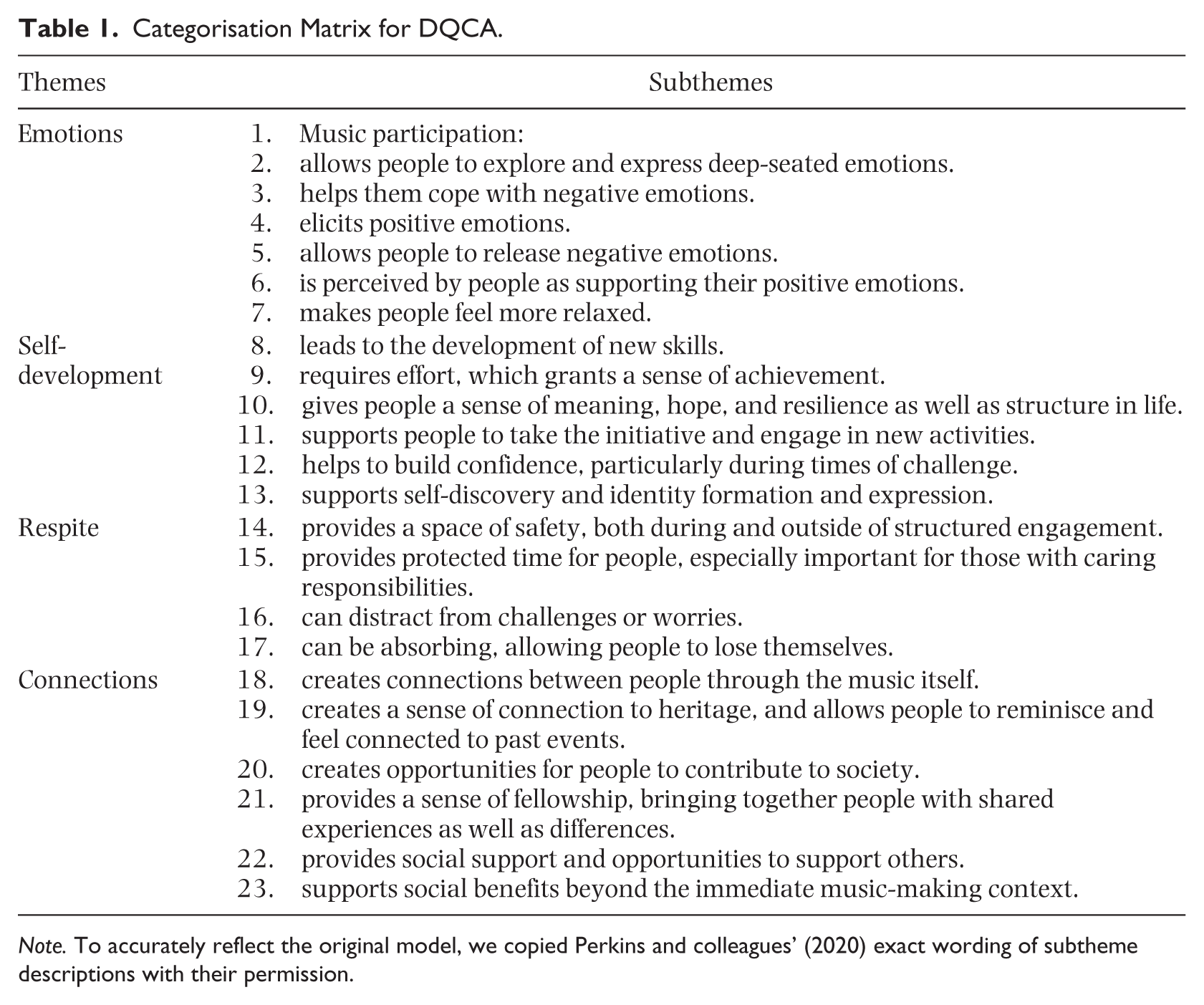
Note. To accurately reflect the original model, we copied Perkins and colleagues’ (2020) exact wording of subtheme descriptions with their permission.
Results
Descriptive statistics
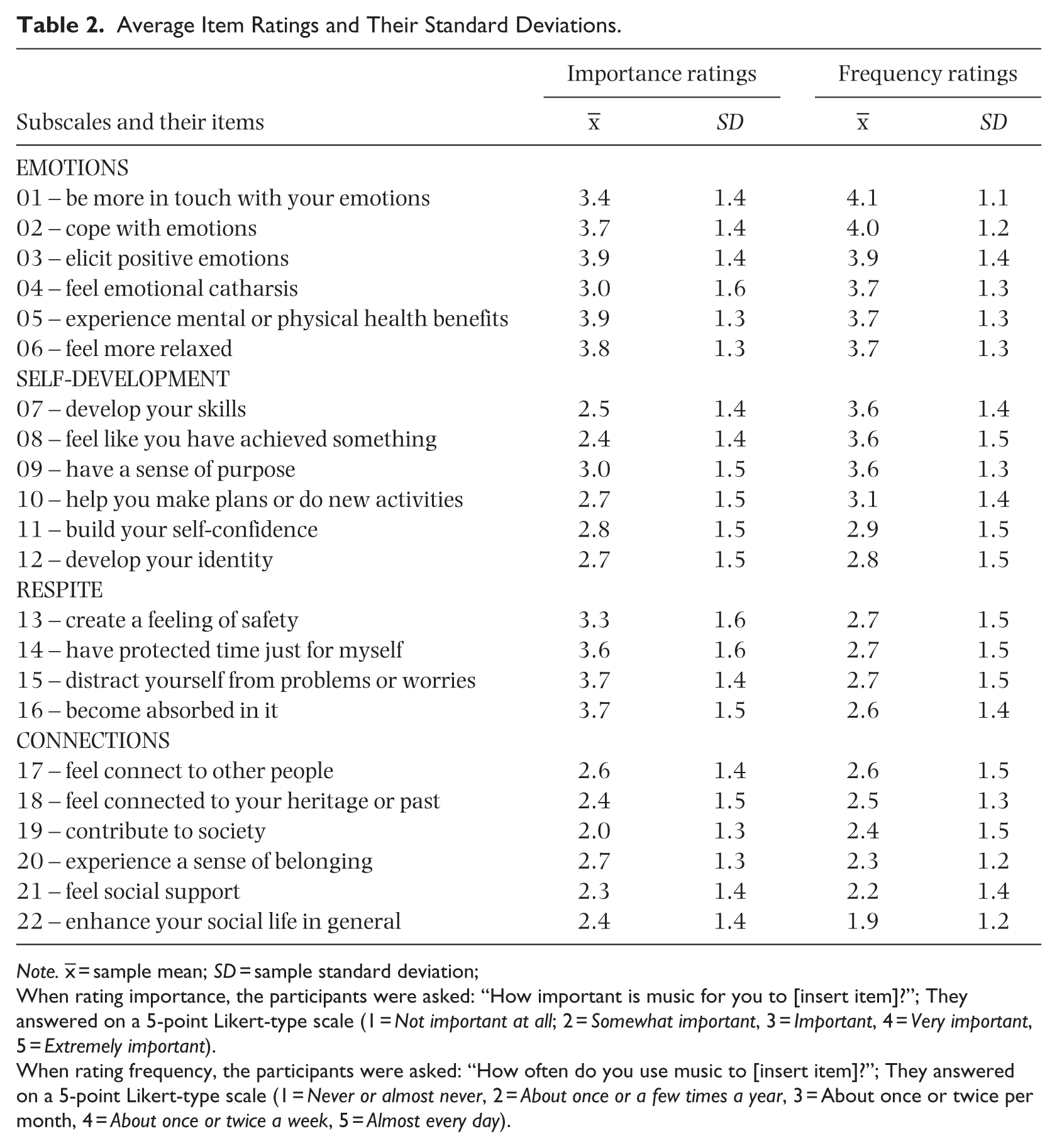
As shown in Table 2, respondents rated the subscales Emotion and Respite as the most important for their well-being, while they rated the subscale Connections as the least important. On a scale from one to five, the average importance rating in the subscale Emotions was 3.6 (SD = 1.1), in Respite 3.5 (SD = 1.2), in Self-development 2.6 (SD = 1.2), and in Connections 2.4 (SD = 1.1).
Average Item Ratings and Their Standard Deviations.
Note. x̅ = sample mean; SD = sample standard deviation;
When rating importance, the participants were asked: “How important is music for you to [insert item]?”; They answered on a 5-point Likert-type scale (1 = Not important at all; 2 = Somewhat important, 3 = Important, 4 = Very important, 5 = Extremely important).
When rating frequency, the participants were asked: “How often do you use music to [insert item]?”; They answered on a 5-point Likert-type scale (1 = Never or almost never, 2 = About once or a few times a year, 3 = About once or twice per month, 4 = About once or twice a week, 5 = Almost every day).
When asked how often they do what the items are describing (frequency), respondents again gave the highest ratings to the items on the subscales Respite and Emotion, and the lowest to Connections (see Table 2). On average, they reported using music to manage their emotions and rest about once or twice a week, to facilitate self-development about once or twice per month, and to facilitate connections with other people only a few times per year. On a scale from 1 to 5, the average frequency rating in the subscale Emotions was 3.6 (SD = 1.0), in Respite 3.7 (SD = 1.1), in Self-development 2.8 (SD = 1.1), and in Connections 2.3 (SD = 1.0). The ratings deviated from a normal distribution, exhibiting a platykurtic trend with negative skew in the subscales of Emotion and Respite, and positive skew in the subscales of Self-development and Connections.
Ratings of importance and frequency were moderately to strongly correlated, meaning that the more important an activity was to the respondents, the more often they engaged in it. Spearman’s correlation coefficients ranged between .53 and .83, with an average of .71 (SD = 0.08) (for all coefficients see Supplemental Appendix 3).
We then looked at how well our data reflected the four themes proposed by Perkins and colleagues (2020). Because the model depicts people’s attitudes (how they think music supports their well-being) and not their behaviour, we used importance ratings instead of frequency ratings to assess the dimensionality of the questionnaire.
Factor structure of PaMEW
The entire questionnaire had a Cronbach’s alpha of .94, and its subscale Emotions .87, Self-development .89, Respite .79, and Connections .89. There was only one item the deletion of which would improve Cronbach’s alpha of its subscale; this was item 10, and if we deleted it, Cronbach’s alpha would improve from .89 to .91.
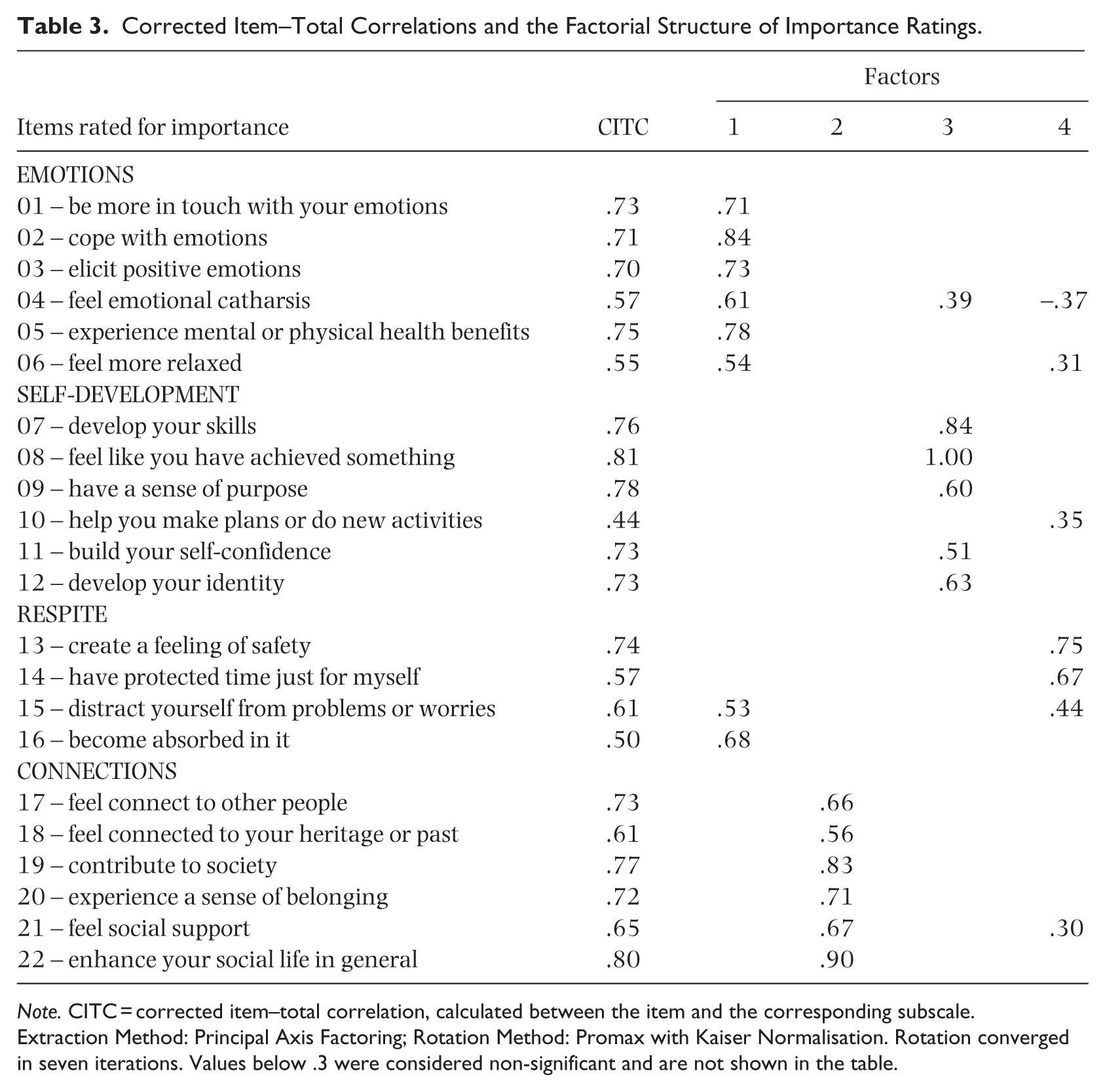
Table 3 shows that the corrected item–total correlations for items in the Emotions and Connections subscales were all .6 or higher, meaning that ratings on those items correlate moderately or strongly with the subscale total. However, in subscales Self-development and Respite, there were a couple of items that did not correlate as highly with the total of their respective subscales. Item 10 and 16 showed correlations of .44 and .50, respectively, which hints that they might be measuring something different from other items in the same subscale.
Corrected Item–Total Correlations and the Factorial Structure of Importance Ratings.
Note. CITC = corrected item–total correlation, calculated between the item and the corresponding subscale.
Extraction Method: Principal Axis Factoring; Rotation Method: Promax with Kaiser Normalisation. Rotation converged in seven iterations. Values below .3 were considered non-significant and are not shown in the table.
Exploratory factor analysis of importance ratings (see Table 3) shows a structure that is quite similar to the model proposed by Perkins and colleagues (2020). Items from the Emotions and Connections subscales form two clear, separate factors. Subscales Self-development and Respite, however, have a few items that do not load on to the factors one would expect. As seen in Table 3, Items 15 and 16 from the subscale Respite, load on the same factor as items belonging to Emotions, and Item 10 from Self-development loads on the same factor as items belonging to Respite.
Respondent feedback
Most respondents reported that the questions were relevant to how they see the connection between music and their well-being, with six reporting that this was not the case. Of the six who thought the questions were not relevant, three elaborated. The first reported that “besides listening to music at home, I dance to music together with others. Then it is very much the interaction with others that is important to create a dance experience based on the music.” As we interpreted it, this respondent missed more examples of interaction with others through music in combination with other arts domains. The second respondent wrote, “The questions assume that you use music to numb emotions, while listening to music is more about kneading your emotions.” This raises an interesting point about how music can be related to emotional expression and release and is worthy of further investigation. The third respondent wrote that they had trouble answering questions because their engagement with music changes in different periods (e.g., from listening 8 hr per day to not listening to music for a month). They also added that music “helps, gives structure, and makes it possible to do daily chores.” They felt that no statement captured this role of music well.
The second open-ended question was, “Were the questions clear? Do you think we should change any of the questions? If yes, which ones?” Six of the 63 respondents found some questions too broad and requested more specific examples. Three wanted an additional “I do not know” option, one desired more answer alternatives, and another wanted the option to comment on each answer. Three expressed difficulty answering emotion-related statements, and two noted that instructions were too far from the answer options, requiring them to scroll back on their phones. The vertical layout of answers made navigation difficult on mobile devices. Only one issue was specific to PaMEW: two respondents did not understand the term “social support.”
Finally, we asked respondents if there was anything they would like to add about music and their well-being, and we received answers from 26 out of 63. Their reflections largely reflected the four themes found by Perkins and colleagues (2020): expression and management of emotions (n = 13), self-development (n = 7), respite (n = 6), and connecting with others (n = 7). The questionnaire items failed to capture certain examples of how music supports well-being, but there were no examples that could not fit into any of the four categories. For example, in addition to using music to “process,” “regulate,” “manage,” “validate,” “express,” “elicit,” “stabilise,” “change,” and “intensify” their emotions, the respondents also used music to decode or define what it is that they are feeling. One of them wrote, “Music helps me identify what it is that I am feeling (physically or psychologically), [understand] why I am feeling that, process it, and then manage it” (id 2). Another said, “Music helps to sort out [my] emotions and define them for myself” (id 56).
Respondents also shared examples of how music supports their self-development, specifically in areas such as executive functions and sensory sensitivities, areas not addressed in PaMEW. One respondent used a vivid metaphor, likening their usual inner monologue to a chaotic pinball game, but when listening to music or singing, it becomes more like a game of bowling: “easier to follow, not quite so fast, still difficult to fully control, but it becomes possible for me to decide what I will focus on” (id 2). They also mentioned that music helps them avoid overstimulation. Other respondents echoed this, adding that music is necessary when thinking or working (id 60), offers a sense of predictability (id 84), and provides structure, aiding in daily chores (id 68).
Respondents shared numerous examples related to the theme of Respite, where music serves as a distraction from worries, allowing people to lose themselves and providing a safe space. One respondent noted, “Music is one of the few places where I get to be myself without having to mask or think about how others might react [. . .]. Music is my place to simply be” (id 51). Another mentioned, “I go to concerts and festivals at least 3–5 times per year, because there I feel most free and alive, and I get to express myself without feeling pressured about how I should or must behave around others” (id 59). These responses highlight music as a crucial space for safety and acceptance, where the respondents get to be their authentic selves.
Last, respondents provided examples of using music to support their social well-being, aligning with the proposed model. They highlighted the importance of “interplay with others” (id 18), experiencing “collective feelings” (id 1), and a sense of “belonging” (id 1, id 68). They also mentioned feeling supported or understood by others through music (id 1, id 45, id 50, id 56) and feeling less lonely (id 50, id 56).
In summary, most respondents found the questions relevant to their experience of the music-well-being connection, with their reflections aligning with Perkins et al.’s (2020) model of managing and expressing emotions, self-development, respite, and connecting with others. However, some had difficulty with questions about emotions and broad statements, requesting an “I do not know” option and clearer examples. They found the term “social support” unclear. In addition, some respondents highlighted aspects not covered in the items, such as music helping with attention, executive functioning, coping with sensory processing differences, and decoding emotions.
Discussion
We aimed to explore the resonance of Perkins and colleagues’ (2020) model with autistic adults and its potential application in developing a questionnaire on music engagement for well-being. We created a set of 22 items based on the 22 subthemes found in the meta-ethnographic study and collected answers from 63 respondents, alongside their feedback on the relevance and clarity of the items and their reflections on how music engagement supports their well-being.
To summarise the quantitative findings, respondents found music to be most important for managing their emotions and finding a place of respite, which they did on average once or twice a week. Social aspects, like contributing to one’s society, feeling social support, or feeling connected to others or one’s heritage, were rated as the least important and the least frequent reason to engage with music.
The items that did not behave as expected included Item 10, which did not exhibit a strong correlation with either its subscale or the entire scale, and Items 15 and 16, which loaded on a different subscale than anticipated. In the next version of PaMEW, we propose splitting Item 10 into two separate items, moving Items 15 and 16 from the Respite to Emotions subscale, and adding new items to Respite, which had fewer items than the other subscales and somewhat lower Cronbach’s alpha. Other subscales demonstrated adequate internal reliability and adhered to the original dimensionality.
Overall, the model resonated well with respondents, with most agreeing that the items reflected their experiences with the music–well-being connection. Their comments aligned with the four areas identified by Perkins et al. (2020): emotion expression and management, respite, self-development, and connections. However, while the broad uses of music for well-being are similar between autistic and non-autistic individuals, specific strategies might differ and warrant further study.
Emotions
Respondents rated the items in Emotions as the most important and frequent. They engaged in music to elicit positive emotions, experience health benefits, and relax, aligning with previous studies on autistic adults who use music to regulate moods and emotions (Allen et al., 2009; Kirby & Burland, 2022; Korošec et al., 2022; Venter et al., 2023). However, a few respondents found it difficult to answer questions about emotions due to struggles with recognising or describing them, a challenge noted by Allen et al. (2009) and possibly related to the higher prevalence of alexithymia in autistic people (Kinnaird et al., 2019). While most had no issues with the items, some reported using music to identify or decode their emotions, a strategy also reported by Venter et al. (2023) and Kirby & Burland (2022). Respondents also noted that music aids in expressing emotions non-verbally. Future versions of PaMEW should consider including strategies related to decoding emotions for autistic users.
Self-development
Previous studies support our findings that some autistic people engage in music to feel a sense of achievement, develop new or existing skills in different areas, develop or express their identity, or help in planning and doing chores (Allen et al., 2009; Kirby & Burland, 2022; Korošec et al., 2022; Venter et al., 2023). We have also found instances that the current PaMEW items do not address. The respondents mentioned that they use music to focus or switch focus to a different task. In previous studies, autistic people reported using music to “organise their thoughts” (Venter et al., 2023), to block external stimuli so that they can focus on a task, to keep track of time, and to structure their routines (Kirby & Burland, 2022; Korošec et al., 2022). In the next iteration of PaMEW, it would be pertinent to add items related to executive functioning and sensory processing when the respondents are autistic.
Respite
The respondents rated the importance and frequency of the Respite items similarly to the Emotions items. Previous studies also show that this seems to be an important function of music for many autistic adults. Music creates a space for them to get lost, distract themselves from worries, daydream, or reminisce (Allen et al., 2009; Kirby & Burland, 2022; Korošec et al., 2022; Venter et al., 2023). Perkins and colleagues’ (2020) description of this theme aligns well with our respondents’ reflections. However, in future PaMEW adaptations, it might be worth including an item about music providing a space where people can freely be their authentic selves. Our respondents pointed out that music does allow them not only to distract or lose themselves, but also to more freely and authentically be themselves. It creates a space where they feel like they do not have to mask anymore or worry how others might react, which was also found in previous studies (Korošec et al., 2022).
Connections
Social aspects were rated the least important and frequent in our study. However, previous studies show that autistic adults use music to form and develop relationships, experience belonging, and share meaningful experiences (Allen et al., 2009; Kirby & Burland, 2022; Korošec et al., 2022; Venter et al., 2023). Before concluding that autistic adults maybe use music for social reasons less frequently than for managing emotions or self-development, it is important to investigate whether our items perhaps did not illustrate well enough the way they use music to support their social well-being. Respondents rated vague items (like engaging with music to contribute to society) as the least important, while they rated more concrete items (like feeling connected to others) as more important. For future PaMEW development, we see a need to discuss and (if needed) revise these items with input from the autistic community.
Further development of the tool
The pathways model (Perkins et al., 2020) offers a strong foundation for understanding how autistic people use music, but our findings suggest it would benefit from further nuance. In particular, self-regulation and sensory adaptations emerged as important areas of music engagement not captured by the items. These uses of music – such as creating a calming sensory environment, managing energy levels, or reducing overwhelm – can for some autistic people be of central importance.
We found that these strategies align with existing pathways like emotion regulation, respite, and self-development, but they also stretch those categories in important ways. For example, using music to manage sensory input or support executive functioning adds depth to what “respite” or “self-development” can mean in an autistic context. While self-regulation and sensory adaptations can fit within the pathways model, they are currently not reflected in the items of the PaMEW questionnaire.
To reflect this, future versions of PaMEW should include clearer references to sensory and regulatory uses of music. This could mean revising existing items or adding new ones, ideally with input from autistic individuals to ensure the language and examples resonate. Including concrete, relatable examples – like using music to block out background noise or to transition between tasks – can make the tool more accurate and relevant.
Limitations
The sample had a skewed gender distribution: 60% women, 30% men, and 10% non-binary, which limits generalisability as there are more men diagnosed as autistic compared with other genders (Napolitano et al., 2022). However, the study aimed to assess the questionnaire’s feasibility and item relevance, not to generalise our respondents’ ratings to the autistic population. We need to conduct further studies with larger, more representative samples to evaluate the psychometric properties of the questionnaire and engage in discussions with the autistic community about the wording of PaMEW items. The current version of PaMEW did not include a “don’t know” answer option, and while there are arguments for and against it (Wetzelhütter, 2020), it would be worthwhile to test how this option might affect the results in future studies. Finally, the majority of respondents found music very important, suggesting future studies should include those who are indifferent or opposed to music to get a more representative picture of the autistic population.
While this study focused on autistic adults without additional learning difficulties, the tool has potential for broader use. For example, educators and researchers working with autistic individuals who also have intellectual or learning disabilities may need a version of PaMEW that uses simplified language, visual supports, or alternative response formats. Adapting the tool in collaboration with these subgroups – and those who support them – could ensure that their experiences with music are accurately captured. This would not only make the tool more inclusive but also expand its usefulness in educational and clinical settings where music is used to support well-being.
Conclusion
This study is the first to apply the pathways model (Perkins et al., 2020) to autistic adults and translate it into a structured questionnaire. The resulting tool, PaMEW, showed strong internal reliability and was well-received by respondents, who felt the items reflected their experiences with music and well-being.
While the model provides a solid foundation, our findings suggest it can be sharpened to better capture autistic experiences – particularly around self-regulation, sensory needs, and masking. These strategies fit within the existing pathways but are not yet represented in the questionnaire items.
Future versions of PaMEW can be improved by expanding the items in collaboration with the autistic community to include the mentioned areas and relevant clarifying examples. The study touches upon the similarities and differences in music engagement between autistic and non-autistic adults, emphasising the need for collaboration with the autistic community in creating valid psychometric tools. By continuing to refine both the model and the tool, we can move closer to a shared language for understanding the role of music in autistic lives.
Supplemental Material
sj-docx-1-pom-10.1177_03057356251406889 – Supplemental material for Development of the Participatory Music Engagement for Mental Well-being (PaMEW) questionnaire: A pilot study with autistic adults
Supplemental material, sj-docx-1-pom-10.1177_03057356251406889 for Development of the Participatory Music Engagement for Mental Well-being (PaMEW) questionnaire: A pilot study with autistic adults by Kaja Korošec, Lars-Olov Lundqvist, Rosie Perkins, Anna Détári, Walter Osika and Eva Bojner Horwitz in Psychology of Music
Supplemental Material
sj-docx-2-pom-10.1177_03057356251406889 – Supplemental material for Development of the Participatory Music Engagement for Mental Well-being (PaMEW) questionnaire: A pilot study with autistic adults
Supplemental material, sj-docx-2-pom-10.1177_03057356251406889 for Development of the Participatory Music Engagement for Mental Well-being (PaMEW) questionnaire: A pilot study with autistic adults by Kaja Korošec, Lars-Olov Lundqvist, Rosie Perkins, Anna Détári, Walter Osika and Eva Bojner Horwitz in Psychology of Music
Supplemental Material
sj-docx-3-pom-10.1177_03057356251406889 – Supplemental material for Development of the Participatory Music Engagement for Mental Well-being (PaMEW) questionnaire: A pilot study with autistic adults
Supplemental material, sj-docx-3-pom-10.1177_03057356251406889 for Development of the Participatory Music Engagement for Mental Well-being (PaMEW) questionnaire: A pilot study with autistic adults by Kaja Korošec, Lars-Olov Lundqvist, Rosie Perkins, Anna Détári, Walter Osika and Eva Bojner Horwitz in Psychology of Music
Footnotes
Ethical considerations
The study was approved by the Swedish Ethical Review Authority (application number 2021-01121) in November 2021.
Consent to participate
All participants provided written informed consent prior to participating.
Data availability
The data that support the findings of this study are not openly available due to reasons of participant confidentiality, and are available from the corresponding author upon reasonable request. Data are stored in secure data storage at the Royal College of Music in Stockholm, Sweden.
Declaration of conflicting interests
The authors declared no potential conflicts of interest with respect to the research, authorship, and/or publication of this article.
Funding
The authors received no financial support for the research, authorship, and/or publication of this article.

Supplemental material
Supplemental material for this article is available online.
Notes
References
Supplementary Material
Please find the following supplemental material available below.
For Open Access articles published under a Creative Commons License, all supplemental material carries the same license as the article it is associated with.
For non-Open Access articles published, all supplemental material carries a non-exclusive license, and permission requests for re-use of supplemental material or any part of supplemental material shall be sent directly to the copyright owner as specified in the copyright notice associated with the article.
