




Abstract
Does dissonance enhance the pleasantness of the following consonance due to the ensuing contrast? The contrast between the affective characteristics of successive stimuli is considered an important factor for the perceived pleasantness of the final stimulus, known as the contrast effect. We tested the contrast effect of dissonance and consonance by employing short chord sequences ending with a manipulated penultimate chord, resolving to the final tonic as stimuli. The dissonance level of the penultimate chord was manipulated by varying both its acoustic roughness and cultural familiarity, and 49 participants rated the pleasantness of the final chord. We hypothesized that the final chord would be more pleasant when the penultimate chord was more dissonant. However, the results showed the opposite: greater dissonance in the penultimate chord led to lower pleasantness ratings for the following final chord. It could be that greater dissonance in the penultimate chord makes it less tonally related to the final chord and that its dissonance may have violated listeners’ tonal expectations. Rather than demonstrating the contrast effect, this result demonstrates dissonance’s strong association with unpleasantness and its influence on the pleasantness of the following consonance.
In Western tonal music, consonance and dissonance (C/D)—the harmonious and inharmonious quality of the simultaneous sounding of a combination of tones—are contrasting perceptual phenomena (for an overview of C/D, see Di Stefano et al., 2022; Tenney, 1988). For Western listeners, consonance typically has aesthetic connotations such as beautiful, agreeable, and pleasant, whereas dissonance is associated with concepts like disagreeable, unpleasant, or tense (e.g., Lahdelma & Eerola, 2020; see also Armitage et al., 2023; Athanasopoulos et al., 2021; Lahdelma et al., 2021; McDermott et al., 2016 for differences across cultures). In a piece of Western tonal music, consonance and dissonance continuously change and dissonance needs to be followed by consonance in order to resolve, according to the principles of Western tonal music, thus creating a contrast both sonically and aesthetically. Some composers and music theorists suggest that this contrast created by the change from dissonance to consonance enhances the pleasantness of the subsequent consonance (Bartók, 2004; Huron, 2006; Meyer, 1956). This theory, however, has not yet been empirically investigated.
In empirical aesthetics, contrast is considered a key determinant of a stimulus’ pleasantness: it tends to increase when the stimulus follows a negatively perceived one and decrease when it follows a positively perceived one (e.g., Beebe-Center, 1932). This idea, contrast effect or hedonic contrast, has been widely confirmed across various art forms, such as paintings (e.g., Dolese et al., 2005; Zellner et al., 2010), human faces (e.g., Cogan et al., 2013), videos and films (e.g., Drouin et al., 2022), and music (e.g., Cantor & Zillmann, 1973; Parker et al., 2008; Schellenberg et al., 2012). For example, participants’ liking ratings for paintings that depict pleasant content increased after seeing paintings that depict negative and dark content, compared to when viewing the pleasant paintings alone (Dolese et al., 2005). In the case of music, Schellenberg et al. (2012) reported that greater appreciation and more intense emotional responses were recorded when a large amount of sad music preceded a small amount of happy music, and also when a large amount of happy music preceded a small amount of sad music, demonstrating the contrast effect.
In addition, some empirical evidence indicates that the changes in musical elements contribute to the listener’s affective and aesthetic responses to music. For example, a change in loudness significantly alters the level of the listener’s emotional engagement with a piece of music (Timmers et al., 2006), and changes that the listener perceives in music evoke feelings of curiosity (Omigie & Ricci, 2022). Furthermore, Smit et al. (2022) found that the pleasantness of a chord was influenced by the affective characteristics of the previous chords, pointing to the possibility that the contrast effect could also be observed with C/D in chord sequences.
It is worth mentioning that the contrast effect may be associated with the psychological mechanism of expectation, whereby expected musical events lead to positive affective responses in the listener, whereas unexpected events trigger negative affective responses such as tension (Huron, 2006; see also Meyer, 1956). However, when an unexpected event is followed by an expected outcome, this can lead to positive affective responses. Huron (2006) proposes that the larger the contrast between the preceding unexpected events and the following expected outcome, the greater the amount of pleasure will be induced from the following stimulus. Some also suggest that a great amount of pleasure will be induced when surprise or tension from an unexpected event in music is released by a succeeding expected outcome (e.g., Gebauer et al., 2012; Lehne & Koelsch, 2015).
In light of this, if the contrast between the two is a crucial factor in affecting the listener’s aesthetic response, it would be reasonable to assume that dissonance would enhance the pleasantness of the following consonance due to the contrast between them, and that this effect may be larger when the dissonance is greater. Also, this contrast effect may be more prominent for musically trained listeners than less trained listeners due to their greater sensitivity to C/D perception (e.g., Arthurs et al., 2018; Weiss et al., 2020). Musicians’ pleasantness ratings for the final chord after a dissonant penultimate chord may thus be higher than non-musicians’ ratings.
The present study
This study aims to examine whether and how the contrast between dissonance and the following consonance induces pleasantness. We employed chord progressions consisting of five chords that all ended on the tonic, and we manipulated the level of dissonance of the penultimate chord by using chords with a low or high level of roughness and cultural familiarity. A chord progression is a small but dynamic musical component where the contrast between dissonance and consonance may induce pleasantness. It is a suitable component to use for the purposes of this study because even a two-chord sequence induces an emotional response (Smit et al., 2020) and creates tension and release (Bigand & Parncutt, 1999; Krumhansl, 1996; Lehne et al., 2013).
We hypothesized that the contrast between the penultimate and final chords will contribute to pleasantness as follows: the pleasantness rating for the final chord will be higher when the cultural familiarity of the penultimate chord is low and its roughness is high. A chord with low cultural familiarity is perceived as being more dissonant (e.g., Lahdelma & Eerola, 2020), as is a chord with high roughness (e.g., Harrison & Pearce, 2020). The low cultural familiarity and high roughness of the penultimate chord will create a greater contrast between the dissonance of the penultimate chord and the consonance of the final chord which, on the basis of theorizing by Meyer (1956) and Huron (2006), will lead to a higher pleasantness rating. Also, this effect may be more pronounced for musically trained listeners than for less trained listeners.
Method
Participants
A total of 49 adults (Male = 19, Female = 28, Prefer not to say = 2, Mage = 40.69, SDage = 13.90) voluntarily took part in the online experiment conducted on Qualtrics (Qualtrics, Provo, UT) after being recruited online through Prolific. G*Power 3.1 (Faul et al., 2009) calculated that 48 participants was sufficient to detect the medium effect size of .25, with power .80, and an alpha of .05. Participants indicated a level of musical sophistication using the one item measures from The Ollen Musical Sophistication Index (Ollen, 2006; see Zhang & Schubert, 2019 for the benefits of this strategy), and these were: non-musicians (n = 11), music-loving non-musicians (n = 21), amateur musicians (n = 15), and serious amateur musicians (n = 2). All participants gave their informed consent prior to the experiment. Ethical approval for this study was obtained from the Research Ethics Committee at Waseda University (2022-161).
Stimuli
Sequences with five chords consisting of four notes were used as stimuli (Figure 1). All sequences consisted of the same chords apart from the penultimate chord (I–vi–IV–[manipulated chord]–I). To see the contrast effect of dissonance on the pleasantness of the following chord, the dissonance of the penultimate chord was manipulated. One of eight different chords with a low or high level of roughness and cultural familiarity was used each time for the penultimate chord: low roughness and low familiarity (LR–LF); low roughness and high familiarity (LR–HF); high roughness and low familiarity (HR–LH); high roughness and high familiarity (HR–HF). Familiarity was calculated based on the frequency with which each interval and chord appears in 739 popular songs collected in the Billboard corpus (Burgoyne, 2012), following Harrison and Pearce’s (2020) model. Roughness was calculated using a model by Hutchinson and Knopoff (1978). Cultural familiarity and roughness were used because cultural familiarity is a significant contributing factor to C/D perception (Eerola & Lahdelma, 2021), and roughness is influential in affective responses to chords (Armitage et al., 2021; Lahdelma et al., 2022). We did not include harmonicity for manipulation because harmonicity seems largely to overlap with cultural familiarity (Eerola & Lahdelma, 2021; Lahdelma et al., 2022).
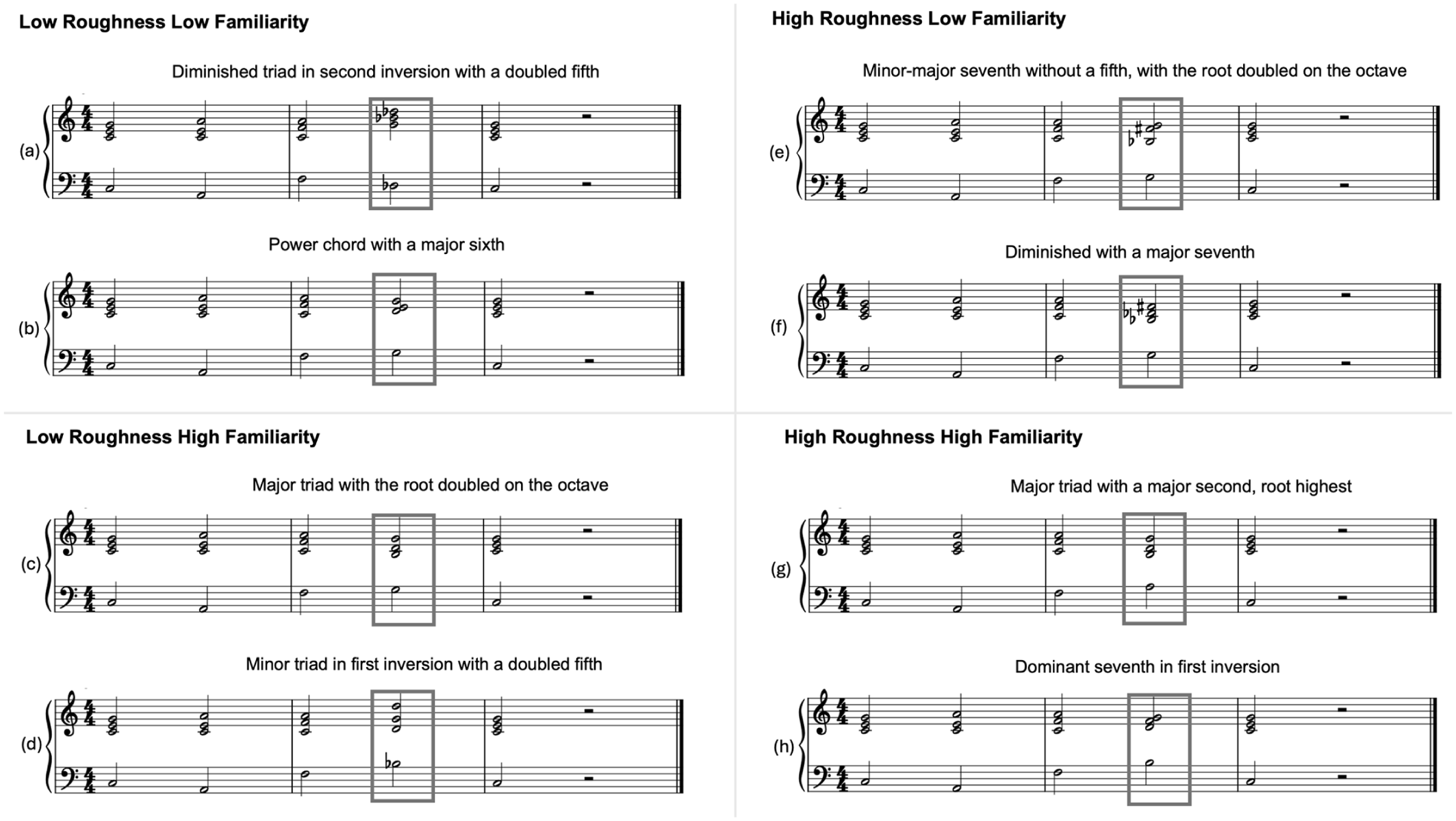
Eight Variations of the Chord Sequences in C Major Key.
The chord sequences were created using MuseScore 4 using the piano timbre, with a constant volume level and the tempo set at 80 bpm. The duration of each sequence was 8 s. The chord sequences with eight different manipulated chords were all played in seven keys whose tonic tones are within the range of three semitones below and above C (the keys of A major, B flat major, B major, C major, C sharp major, D major, and E flat major), yielding a total of 56 trials.
Procedure
At the start of the experiment, participants’ demographic information (age, gender, musical expertise) was collected. For the main task, participants were instructed to listen to chord sequences and to rate the pleasantness of the final chord, but not the pleasantness of the whole sequence (“How pleasant was the final chord?”), on a 7-point scale, ranging from 1 = very unpleasant to 7 = very pleasant. Participants proceeded to the main task after the practice session. The presentation order of the 56 stimuli was randomized. The duration of the whole experiment was approximately 20 min. Data and analysis are available at github.com/tuomaseerola/penultimate_chord.
Results
The inter-rater reliability for each type of stimulus was calculated using Cronbach’s alpha, and all types of stimuli had very high reliability: LR–LF (α = .915), LR–HF (α = .905), HR–LF (α = .947), and HR–HF (α = .937). A linear mixed model with two fixed factors (Roughness and Familiarity, both with two levels: low and high) and three random effects (Participant, Musicianship, and Transposition) was applied to the ratings, using lmer function from lme4 package (Bates et al., 2015) in R (R Core Team, 2022). The mean ratings of the final chords for each of the eight penultimate chords are shown in Figure 2. For fixed effects, the analysis showed significant effects of both Roughness, F(1,2578.9) = 9.15, p < .001, ε2p = .004, and Familiarity, F(1,2578.9) = 204.0, p < .001, ε2p = .07, indicating that the final chords were rated more pleasant when Roughness was lower, and when Familiarity was higher. There was also an interaction between them, F(1,2578.9) = 40.8, p < .001, ε2p = .02. For random effects, Transposition and Musicianship failed to show significant effects (p = .334 and p = 1.0, respectively), and the participant slopes indicated a strong effect (p < .001, all random effects tested with likelihood ratio tests).
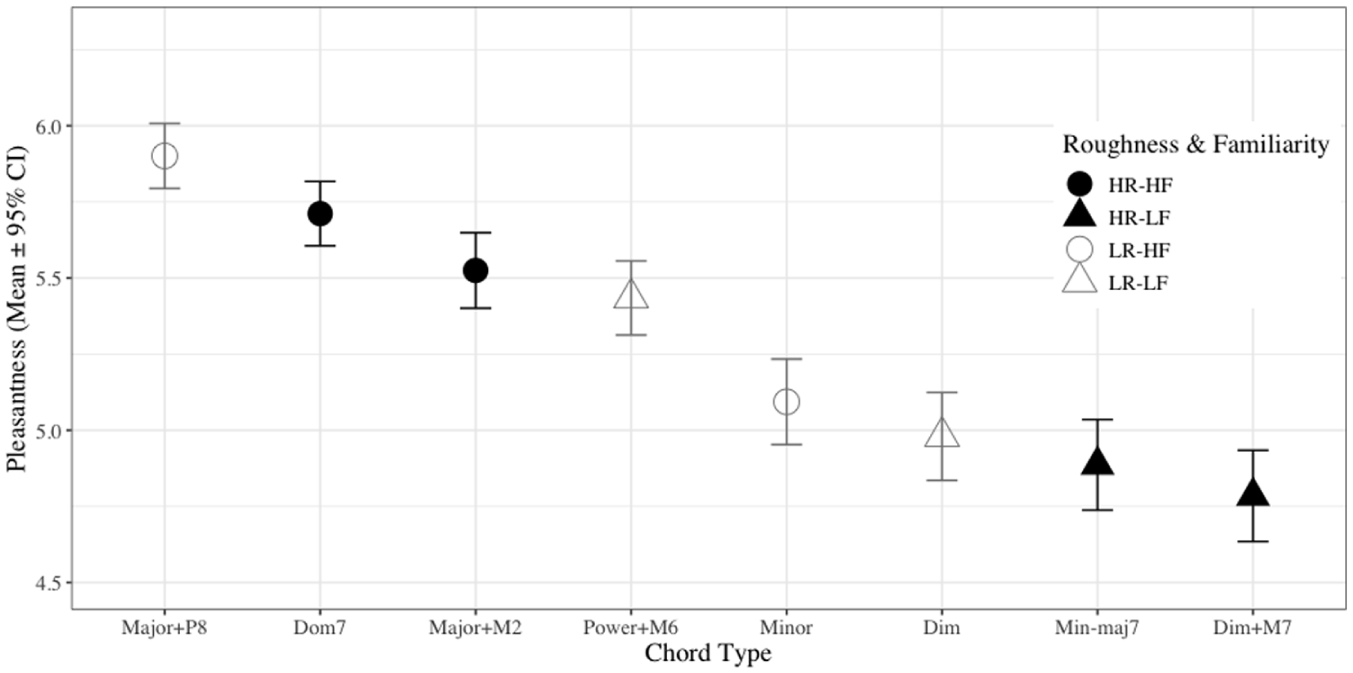
Mean Pleasantness Ratings of the Final Chords for Each Sequence With Different Penultimate Chord.
A post hoc pairwise comparison with Bonferroni correction was conducted to see whether each penultimate chord gave rise to different pleasantness ratings for the final chord. The majority (19 out of 28 pairs) were significantly different from each other (p < .001), while some adjacent pairs were not statistically different from each other. These are: Diminished triad and Diminished with a major seventh; Diminished triad and Minor-major seventh; Diminished triad and Minor triad; Diminished with a major seventh and Minor-major seventh; Dominant seventh and Major triad with a major second; Dominant seventh and Major triad with the root doubled on the octave; Dominant seventh and Power chord with a major sixth; Major triad with a major second and Power chord with a major sixth; and Minor triad with major seventh and Minor triad.
Discussion
Our experiment tested whether the dissonance of the penultimate chord increases the pleasantness of the following consonant chord, based on the idea of the contrast effect (e.g., Beebe-Center, 1932; Cantor & Zillmann, 1973; Parker et al., 2008; Schellenberg et al., 2012), which states that if there is a large contrast between dissonance and a following consonance then this will contribute to positive aesthetic responses (Bartók, 2004; Huron, 2006; Meyer, 1956). This is, to our knowledge, the first study to systematically examine the applicability of the contrast effect to C/D between chords. The results demonstrate that, although both the Roughness and Familiarity of the penultimate chord did indeed influence pleasantness ratings for the final consonant chord, they did so in the opposite way from how we had anticipated. High Roughness and low Familiarity of the penultimate chord led to lower, rather than higher, pleasantness ratings for the final chord. Our results did not reveal the contrast effect, unlike previous studies (Parker et al., 2008; Schellenberg et al., 2012; Smit et al., 2022), although in the case of these studies the contrast was between different affective characteristics of music and chords rather than the contrast between dissonance and consonance. The findings of this study instead demonstrate the influence of dissonance on the pleasantness of the following chord and reaffirm a well-documented association between dissonance and unpleasantness in line with previous research (e.g., Lahdelma & Eerola, 2020).
There are several possible explanations for this finding. One such explanation lies in the tonal relationship between the penultimate chord and the final tonic. According to Bharucha and Krumhansl (1983), when two chords are more closely related, the second chord is processed more quickly and as more consonant, and vice versa. Krumhansl (1979) states that non-diatonic tones are less closely related to the tones that make the triad, so non-diatonic tones in the dissonant penultimate chords we employed may have made these penultimate chords and the final, tonic chord less closely related. This may have resulted in the final chord being perceived as more dissonant and less pleasant. A second possible explanation is that the dissonance in the penultimate chord may have violated listeners’ tonal expectations, as listeners prefer the authentic cadence V-I (e.g., Tillmann & Marmel, 2013). The violation of expectation often results in negative responses (Huron, 2006), so in our case, the final chord is perceived as less pleasant.
Regarding the effect of Familiarity and Roughness, it is interesting that Familiarity seems to have a stronger effect on pleasantness ratings than Roughness. This can be seen from the larger effect size for Familiarity than Roughness (ε2p = .07 and ε2p = .004, respectively) and that HR–HF chords led to higher pleasantness ratings compared with HR–LF chords (see Figure 2). Familiarity’s stronger effect is in line with the findings of Eerola and Lahdelma (2021) that cultural familiarity is the dominant predictor of C/D perception.
We included participants’ level of musical sophistication in the analysis as a random effect. However, there was no significant difference between the ratings of listeners with different levels of musical training, even though previous studies report that musicians are more sensitive to the C/D of single chords (Arthurs et al., 2018; Weiss et al., 2020). This may be because the differences between the two levels (low and high) for both Roughness and Familiarity in the penultimate chords were very clear for any listener familiar with Western tonal music, regardless of their musical training, thus not finely graded enough to reveal individual differences. Also, regardless of their musical training, our participants may have had similar levels of cultural familiarity with the harmonic progression used, since it is very common in popular music (e.g., Temperley, 2018). This may explain the lack of significant difference between the pleasantness ratings of musicians and non-musicians.
Conclusion
In sum, this study found that the dissonance of the penultimate chord led to the following consonance being perceived as more unpleasant, demonstrating dissonance’s well-established association with unpleasantness (e.g., Lahdelma & Eerola, 2024) and in this case, its lasting effect on the following chord. Hence, we did not observe the contrast effect between dissonance and consonance on the pleasantness of consonant chords, contrary to theorizing by Bartók (2004), Meyer (1956), and Huron (2006). This is not to say, however, that there is no contrast effect inside a piece of music. We employed the five-chord sequences as stimuli in order to observe the effect of dissonance while strictly controlling other variables such as melody, voice leading, or rhythm. However, dissonance manipulation with such strict controls may have resulted in unnatural-sounding harmonic progressions. Strict controls also limited our ability to explore the potential effects of these other variables. Also, as in previous studies on the perception of chord progressions (e.g., Bigand et al., 1999; Jansen & Povel, 2004; Kuusi et al., 2021), the current experimental design did not allow for a clear distinction between the pleasantness of the final chord and that of the entire chord sequence, even though the participants were specifically instructed to rate the pleasantness of the final chord rather than the whole sequence. Future research could benefit from a more elaborate experimental design to control other variables by using longer chord progressions or real pieces of music for higher ecological validity, and by collecting continuous ratings in order to shed further light on the contrast effect that underlies our aesthetic response to music.
Footnotes
Declaration of conflicting interests
The authors declared no potential conflicts of interest with respect to the research, authorship, and/or publication of this article.
Funding
The authors disclosed receipt of the following financial support for the research, authorship, and/or publication of this article: This work was supported by Grant-in-Aid for JSPS Fellows awarded to Yuko Arthurs.
Ethical approval
Ethical approval for this study was obtained from the Research Ethics Committee at Waseda University (2022-161).
