




Abstract
This study investigates the complex dynamics underlying musical taste by examining five dimensions of musical taste through psychological, sociological, and music-analytical perspectives. By focusing on specific musical styles, the study aims to identify key factors that shape style-specific preferences. Data were collected from N = 844 participants through an online survey. Participants selected one of 17 musical styles they were most passionate about and completed five scales assessing factors influencing musical taste development, functions and situations of music listening, musical value judgments, and perceived musical dislikes. The data were analyzed using factor analyses to identify underlying dimensions, followed by a random forest classification to explore the importance of these factors for musical preferences across styles. The results highlight the role of social influences in shaping musical taste, particularly among punk, metal, and rock fans, while these factors were less relevant for classical and jazz enthusiasts. Identity expression and the relevance of lyrics were also pivotal for punk, metal, and rock fans, whereas pop and rap listeners frequently cited perceptions of mainstream appeal as a reason for rejection. This study underscores the multifaceted and style-specific nature of musical taste, advocating for an integrative approach by bridging psychological, sociological, and music-analytical perspectives.
Musical taste has been studied from three main perspectives: the psychological, focusing on individual experiences and emotional responses (e.g., mood regulation, identity), the sociological, emphasizing social context, group affiliation, including social-psychological mechanisms such as identity signaling and in-group/out-group differentiation, and processes of distinction (e.g., using taste to draw symbolic boundaries between social groups) (Bourdieu, 2018; Campbell et al., 2007; Chamorro-Premuzic & Furnham, 2007; Greb et al., 2017; Hargreaves & North, 1999; Hennion, 2001; Laiho, 2004; Lamont & Webb, 2010; Lonsdale & North, 2011; North et al., 2004; Schäfer et al., 2013; Schäfer & Sedlmeier, 2009; Tarrant et al., 2000), and the music-analytical, which considers the musical properties themselves—such as melody, rhythm, and structure—as the basis for evaluation (Boyle et al., 1981; Greasley et al., 2013; Parzer, 2011; von Appen, 2007). While conceptually distinct, these perspectives often overlap: a listener may enjoy music for how it feels (psychological), what it represents (sociological), or dislike a style due to both its musical features (analytical) and its associated audience (social). These overlapping perspectives guide the present study, which seeks to develop an integrated understanding of musical taste by examining it through five central dimensions: the development of musical taste with its influencing factors, functions of music listening, situations of music listening, musical value judgments, and musical dislikes. Among these, the development and functions have been most extensively studied, while research on musical dislikes remains relatively novel, and musical value judgments are the least explored. Also, existing studies primarily approach the topic of musical taste from sociological and psychological perspectives.
A study investigating the musical tastes of techno and schlager listeners demonstrated significant connections both within the five dimensions and across the three perspectives. For example, schlager and techno fans showed a strong preference for communal musical experiences (a sociological and psychological aspect tied to a sense of community), driven by specific musical parameters: singing along to lyrics in schlager and dancing to rhythms in techno (Gernandt & Merrill, 2024). Moreover, research at the level of specific styles remains sparse, constraining analyses of commonalities and divergences in musical preferences across styles. While sociological and psychological studies often focus on specific styles such as metal (Rowe & Guerin, 2018; Snell & Hodgetts, 2007), and musicology provides rich analytical distinctions, there is no comprehensive body of work integrating these perspectives.
To address this gap, the present study investigates each dimension—development, functions, situations, value judgments, and dislikes—through all three perspectives, that is, each dimension includes items assessing psychological, social, and musical aspects. By focusing on specific musical styles, the study aims to identify key factors that shape style-specific preferences.
Musical taste development and socioeconomic variables
Musical taste as a developmental process is shaped by a variety of environmental and upbringing-related influences (see Laplante, 2014). Central among these are agents of socialization, particularly the family, which plays a key role during early years. Other influential factors include educational background, environmental conditions, peer interactions, and identification with peer groups through music. Music often serves as a tool for both inclusion within a group and differentiation from others (Boer et al., 2012; Bourdieu, 2018; Jost, 1982; Kloppenburg, 1987; Kunz, 1998; North et al., 2000).
Musical taste is also shaped by rather static descriptors of socioeconomic correlates, such as age (Behne, 1986, 2010; Bonneville-Roussy et al., 2013; Jost, 1982), gender (Boer et al., 2012; Colley, 2008; Jost, 1982), education (Bryson, 1996, 1997; Jost, 1982; Kunz, 1998; Lizardo & Skiles, 2015), profession (Peterson, 1992; van Eijck, 2001), and milieu-related attitude (Siebrasse & Wald-Fuhrmann, 2023). Particularly, the latter seems promising in musical taste research. Using questionnaires, models of social groups can be created based on the participant’s lifestyle and attitudes (Barth et al., 2018; Otte, 2004, 2005) Results show, for example, that classical music fans often show a modernization-oriented attitude, while in contrast, EDM and metal listeners tend to adopt an attitude of reorientation (Siebrasse & Wald-Fuhrmann, 2023).
Hence, besides common factors of musical taste development, it seems promising to include lifestyle typologies. In the current study, a typology was used that categorizes the German population into nine types (Otte, 2004, 2005) It serves as an analytical link between a person’s social position (e.g., education, occupation, income, life stage, place of residence, migration background) and their domain-specific attitudes and behaviors (e.g., strong religious beliefs, participation in mainstream modern leisure culture, and strong family orientation). In essence, it describes fundamental orientations and coherent everyday practices that shape how individuals structure their lives. In relation to previous studies, different lifestyles should relate to different musical tastes (Siebrasse & Wald-Fuhrmann, 2023).
It is of note that traits such as personality (Devenport & North, 2019; North, 2010; Rentfrow & Gosling, 2003) and musical training (Campbell et al., 2007; Colley, 2008; Juslin & Isaksson, 2014) have also shown a connection to musical taste.
Functions and situations of music listening
Research on the general functions of music listening (not specific to particular styles) highlights the primary importance of mood regulation and arousal management (Campbell et al., 2007; Hennion, 2001; Lamont & Webb, 2010; Lonsdale & North, 2011; North et al., 2000; Tarrant et al., 2000). Intellectual stimulation represents another significant function (Hargreaves & North, 1999), while the social dimension of connecting with others through music also plays a key role (Campbell et al., 2007; Laiho, 2004). In addition, music is a powerful medium for expressing identity and values (Hargreaves & North, 1999, 2007; Schwartz, 2006), fostering creativity and inspiration, and managing emotions such as aggression (North et al., 2000; Schäfer et al., 2013; Schäfer & Sedlmeier, 2009; Tarrant et al., 2000). Studies suggest that much of the variation in musical preferences can be explained by the extent to which music fulfills specific goals or functions. Research has also revealed correlations between musical preferences and the functions of music listening. For example, frequent use of music for motor synchronization correlates with preferences for styles such as techno, EDM, rock, and metal (Greb et al., 2017; Parzer, 2011; Schäfer & Sedlmeier, 2009).
Situational factors, such as the listener’s company, location, and time, further shape the functions of music listening. Participants often prioritized creating a desirable atmosphere, with music choices influenced by these factors (Greb et al., 2017; Krause et al., 2016; North et al., 2004). Engagement in participatory activities, such as singing, dancing, or playing along, also represents a significant function of music (Lonsdale & North, 2011).
Recent models provide deeper insight into how people engage with music by emphasizing processes of meaning-making. The Model of Adaptive Functions (Groarke & Hogan, 2016) highlights how core uses such as emotion regulation support higher-level goals of identity and social connection. The CODA model (Lennie & Eerola, 2022) further stresses that music’s emotional meaning emerges through active interpretation, shaped by context, goals, and personal experience—shifting focus from what music expresses to why it matters to a listener in a specific moment. For example, music can take over sacred-like psychological functions not only through the music itself, but also through symbolic artifacts (e.g., in metal music; Messick et al., 2023).
Despite these insights, research rarely links these functions to listeners’ perceptions of musical features. Instead, studies often rely on style stereotypes (e.g., electronic music as inherently “danceable”), which may diverge from actual experiences—for example, when the same style is seen as both energetic and calming. Furthermore, functions are often linked to music listening situations and contexts, but rarely investigated separately (e.g., social listening can be with a partner or at a party). This study addresses this gap by examining how listeners’ functional and situational uses of music relate to their perceptions of specific styles. It combines psychological insights on listening motives with sociological perspectives on style-based identity and music-analytical attention to musical structure.
Musical value judgments
Studies examining expectations and ideals in popular music analyzed qualities such as compositional elements (e.g., song lyrics, melody, and rhythm), interpretative features (e.g., authenticity, vocal performance, and instrumentation), emotional qualities (e.g., energy and feeling), and other attributes such as originality and diversity (Boyle et al., 1981; Finnäs, 1989; Greasley et al., 2013; Parzer, 2011; von Appen, 2007). Among these, compositional quality emerged as an influential factor in shaping musical taste (von Appen, 2007), with lyrical content appearing one frequently examined aspect. However, existing studies tend to focus on specific themes within isolated styles (such as homophobia in rap or political expression in punk) rather than addressing the broader role and importance of lyrics across different musical styles (Adams & Fuller, 2006; Ambrosch, 2017; Brandes, 2016; Ciro, 2019; Lim & Park, 2023; Preniqi et al., 2022).
Research has largely neglected the variation in how listeners prioritize these qualities across different styles. For instance, aesthetic responses to contemporary classical music differ significantly from those to romantic classical music, highlighting the unique emotional, physical, and cognitive experiences evoked by distinct styles (Mencke et al., 2022; see also: Daynes, 2011; Juslin et al., 2016, 2023). This underscores the need for further investigation into the role of musical qualities in shaping taste across diverse styles.
Musical dislikes
Musical dislikes are not merely the absence of liking but involve active judgments and affective responses. Listeners reject music for a range of reasons: musical properties may not meet aesthetic expectations (e.g., too dissonant and not melodic enough), personal values may clash with lyrical or stylistic content, or the music may evoke a negative or no emotional response at all (Ackermann & Merrill, 2022; Merrill et al., 2023; Peltola & Vuoskoski, 2022). Social factors also play a role, for example, disliking music associated with out-groups or stigmatized audiences. While these studies have deepened our understanding of musical aversion, they have not yet addressed how listeners perceive or respond to the rejection of their own favorite music by others. Exploring this social awareness offers a new perspective on how musical taste is shaped not only by personal conviction and anticipated social reception (psychological and sociological perspectives), but also by judgments rooted in musical structure and aesthetic features (music-analytical perspective).
The present study
Building on existing research, this study adopts an integrated approach to understanding musical taste by considering psychological, sociological, and music-analytical perspectives in tandem. Rather than examining these aspects in isolation, we explore how they interact to shape musical preferences. Specifically, through an online survey, we investigate (1) the factors that influence musical taste development, (2) the functions of listening to preferred music, (3) the listening situations, (4) the criteria underlying musical value judgments, and (5) which aspects listeners draw on to understand why others might dislike their preferred style. Besides basic socioeconomic variables, we also collected data on musical training and active engagement (Gold-MSI; Müllensiefen et al., 2014), and a lifestyle typology (Otte, 2019). By analyzing these elements across different musical styles using random forest classification, the importance of these variables for musical preferences could be investigated, as well as differences in preferences between musical styles. Hence, our study aims to provide a more nuanced and comprehensive perspective on the complexity of musical taste.
Methods
Participants
Participants were primarily recruited via social networks, specifically Facebook and internet forums, focusing on the respective musical style groups represented in the current study, without incentive. The recruitment process targeted individuals who identified themselves as listeners of the respective styles (see Supplementary Material, Table S2) and demonstrated active engagement such as attending concerts or participating in specific groups. A total of N = 844 participants took part in the study, consisting of n = 395 females, n = 428 males, and n = 21 diverse (Germ. ‘divers’), with a mean age of 44.57 years (SD = 13.46), spanning an age range of 18 to 81 years (see Table S1 in Supplementary Material for further information). The study was advertised and conducted in German without further checks on residency.
In our convenience sample, participants from four of the nine lifestyle types (Otte, 2004, 2005) are represented: conservative affluent (n = 27), conventionalist (n = 92), liberal affluent (n = 300), and middle class (n = 425). Hence, participants are missing from down-to-earth traditionalists and entertainment seekers (see Supplementary Material for a full description of the lifestyle types). Participants showed an average level in musical training (M = 3.41, SD = 1.74) and were rather high in active engagement with music (M = 4.59, SD = 1.17).
Procedure
Data collection was conducted online using the LimeSurvey platform (https://www.limesurvey.com), with the survey presented in German. The study ran from January 20, 2023, to February 6, 2024. Prior to participation, respondents were informed about the scientific objectives of the study and the anonymized nature of data collection. The survey began by asking participants to select their preferred musical style from a list of 17 options (Siebrasse & Wald-Fuhrmann, 2023; see Supplementary Material for a detailed explanation of how the 17 styles were chosen), focusing on the style they were most passionate about or considered themselves fans of. Participants then rated on a 5-point Likert-type scale (1 = “not at all” to 5 = “very strongly”), how strongly they identified as a fan of their selected style. These ratings were used to ensure that only participants with a sufficient level of identification with their chosen style were included in the analysis; specifically, individuals who rated their fandom below 3 were excluded from further data analysis. To further specify their musical preferences, participants had the option to list up to three artists or substyles they particularly liked or disliked within their chosen style. Providing disliked artists or substyles was optional, allowing participants to skip this if no dislikes were present.
Following this, five scales were administered to assess different aspects of musical taste: one examining the factors influencing and shaping musical taste development (10 items), another focused on the functions and contexts of music listening (functions: 21 items, situations: 14 items), a third addressing musical value judgments (15 items), and a final one exploring possible reasons why others might reject the participant’s selected musical style (15 items from the musical value judgment section, plus five additional items). These scales were developed based on a review of relevant literature and the findings from a previous qualitative study (Gernandt & Merrill, 2024). Finally, participants’ active engagement with music and musical training was evaluated using the Gold-MSI (Müllensiefen et al., 2014; 9 items), alongside a lifestyle typology (Otte, 2019; 12 items), and demographic information of age, gender, education, and profession. All items, including original wording and sources, are listed in the Supplementary Materials (Table S3).
Analysis
Data 1 were analyzed using R v.4.2.2 (R Core Team, 2025). For each of the five scales, a separate factor analysis using the fa() function from the psych package (Revelle, 2007) was performed using maximum likelihood estimation with oblimin rotation to allow for possible correlations between factors. The number of factors was first determined using a parallel analysis (parallel() function), and then adjusted in three cases as follows: One additional factor was extracted for the development scale due to substantial cross-loadings between the second and third factors. Conversely, fewer factors were retained for the musical value judgment scale and the dislike scale, as the suggested solutions resulted in factors with too few items and problematic cross-loadings (e.g., between the first and fifth factors in both cases, and between the second and fourth in dislike). Factor scores were extracted for further analysis. Pearson correlations between factors (based on factor scores) were performed to check for similarities.
Nine styles were chosen for further analysis based on their number of occurrence: EDM (n = 47), jazz (n = 44), classical (n = 116), metal (n = 233), pop (n = 72), punk (n = 43), rap (n = 31), rock (n = 229), and folk (n = 29; Supplementary Material Table S2). To ensure stable and interpretable results, only style groups with more than 28 participants were included. This cutoff balances analytical robustness with diversity, excluding very small groups (e.g., funk/ska, n = 3) while retaining borderline cases (e.g., folk and rap/hip-hop). A minimum of ~30 participants per group is commonly recommended for reliable group-level estimates (Johanson & Brooks, 2010; Wilson Van Voorhis & Morgan, 2007). The number of participants choosing metal, classical, and rock was much larger than the others, and a latent profile analysis (using the estimate_profiles() function from the tidyLPA package (Rosenberg & Van Lissa, 2018)) was performed for each one to create smaller and more distinguished groups based on the factor scores from the scales. A three-class solution was chosen for metal and rock, and a two-class solution for classical (Figure S2a–c in Supplementary Material). As participants were asked to report on substyles and artists from their favorite style, an effort was made to name the profiles according to certain similarities between these descriptions. Unfortunately, no pattern emerged that would clearly separate the different profiles from each other (Figure S3a–c, Supplementary Material). Hence, the profiles were simply labeled a, b, and c. This resulted in 14 different style groups.
A random forest classification model was fitted using the randomForest package (Breiman et al., 2002), with a bootstrapping procedure from the boot package (Canty & Ripley, 1999; see “Methods” in Supplementary Material). The model predicted the 14 styles with predictors being the factors from the scales (factor scores), the sociodemographic variables of age and gender, the four lifestyles, and the two Gold-MSI factors of musical training and active engagement. A random forest classification model was chosen due to the categorical nature of the target variable. This approach is robust to multicollinearity and does not assume linearity or additivity, which is advantageous given the complex and potentially interacting psychological variables in the dataset. In addition, the variable importance and the out-of-bag (OOB) error rate were averaged across bootstrap iterations to ensure stability and mitigate bias from correlated predictors. This made the method well-suited for exploring patterns in the data without imposing restrictive modeling assumptions.
Results
Factor analysis and correlations
Five factor analyses revealed the latent variables of the five dimensions. The first dimension about musical taste development revealed four factors, comprising social media (explained variance = 0.34), social circle (0.34), identity (0.21), and experiential development (0.12) (Table 1 and Table S3 in Supplementary Material). The second dimension about musical functions revealed seven factors, comprising nostalgic (0.19), social (0.18), identity (0.15), regulative (0.13), stimulatory (0.13), exploratory (0.12), and artistic (0.10) functions. The third dimension about listening situations revealed five factors about social (0.25), domestic (0.25), activity-based (0.20), intimate (0.17), and focused (0.13) listening. The fourth dimension on musical value judgments revealed four factors about instrumental (0.37), melodic (0.23), lyrical (0.21), and experiential (0.19) value. The final dimension on perceived musical dislikes revealed five factors about mainstream (0.22), feature (0.22), creativity (0.19), musicianship (0.19), and social (0.18) dislike.
Overview of the Factors of the Respective Scales with a Short Description of the Items within a Factor.
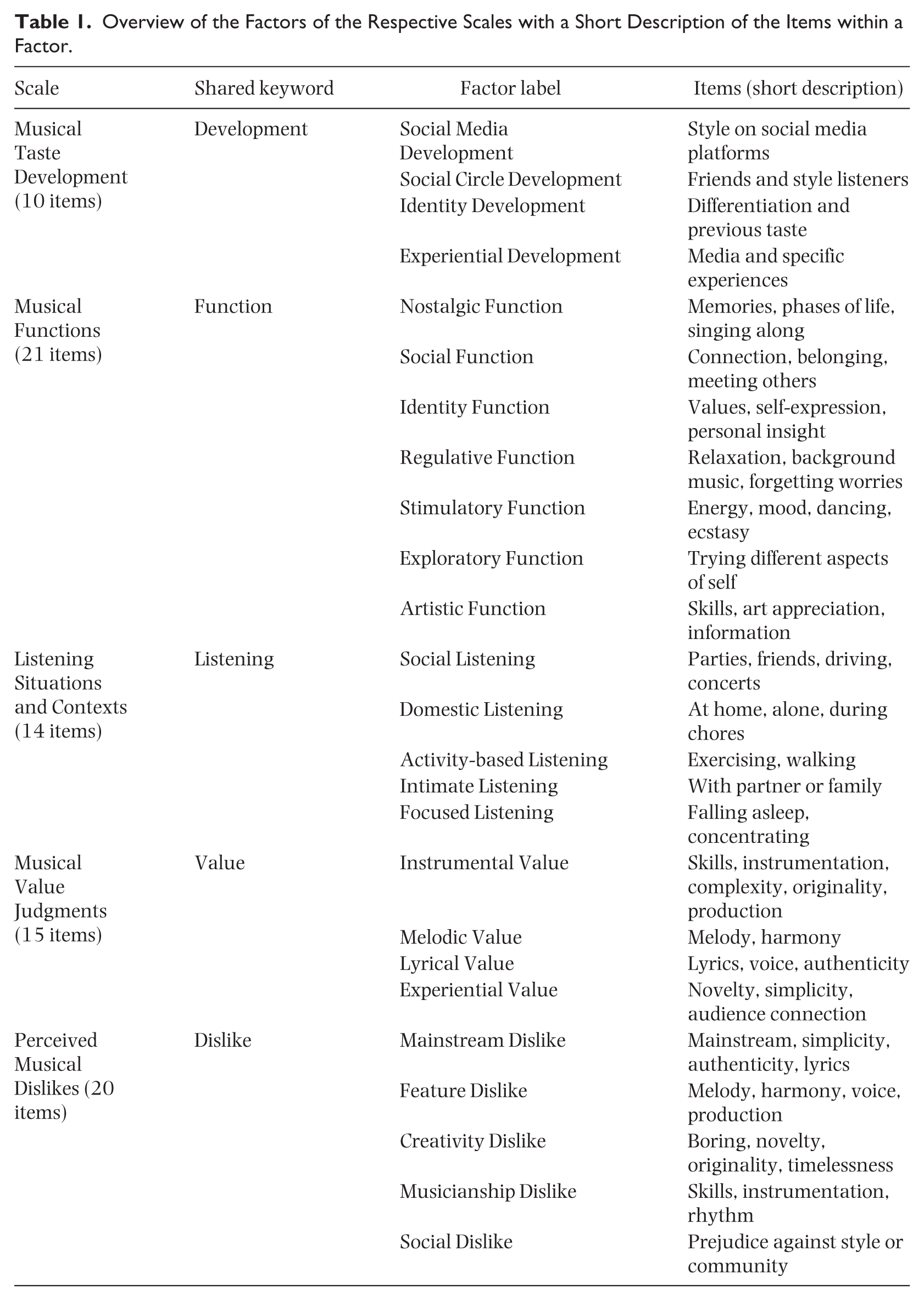
The majority of the correlation coefficients between the factors showed a small effect (147 correlations with r ⩾ .1, medium: 36 with r ⩾ .3, and large: 6 with r ⩾ .50; mean correlation: .157; range: −.206 to .657; full matrix in Supplementary Material). Notable correlations occurred between the various social factors, that is social listening and social function (r = .47), and between social circle development and social listening (0.46) and social function (0.36). Identity function correlated with social function (0.53) and lyrical value (0.42), demonstrating the overlap between the three perspectives in musical taste research. Instrumental value and lyrical value did not show a notable correlation (0.07), nor did mainstream dislike and social dislike (−0.01).
Random forest classification with all variables
The mean OOB error across all iterations was 14.6%, with a 95% confidence interval ranging from 12.5% to 16.7%, indicating good predictive accuracy in classifying participants’ preferred style category. The random forest analysis revealed key factors influencing musical preferences, providing insights into the relative importance of various variables across categories such as socioeconomic factors (i.e., age, gender, education, profession, lifestyle, and musical training and active engagement), factors of musical taste development, musical functions, listening situations and contexts, musical value judgments, and perceived musical dislikes (Figures 1 and 2). Note, importance values reflect the decrease in model accuracy when each predictor is randomly permuted, with larger values indicating greater importance. The scores are unitless and relative, meaning they should be interpreted in relation to each other rather than on an absolute scale.
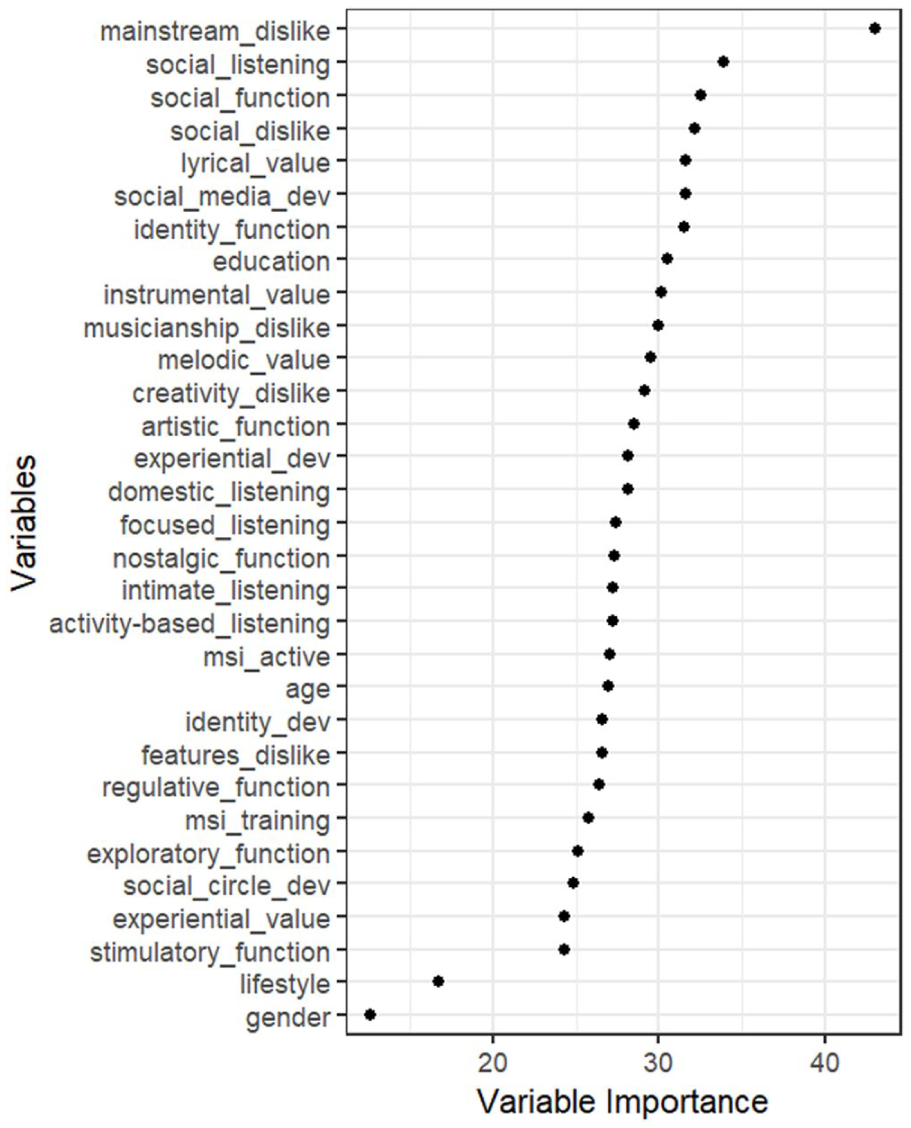
Importance Values from the Random Forest Classification Model for All Variables.
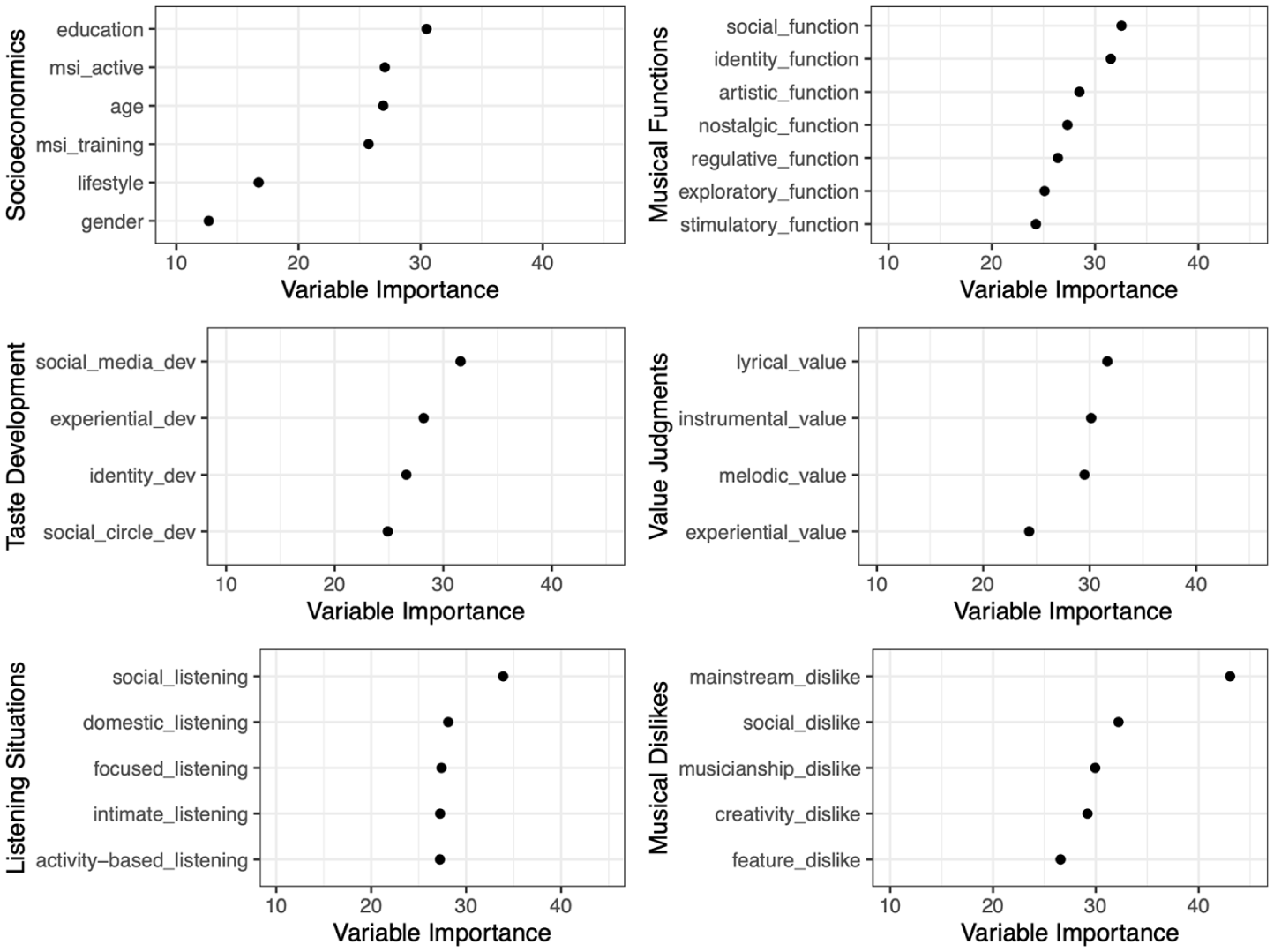
Importance Values from the Random Forest Classification Model for Variables Sorted by Scale.
In terms of socioeconomic factors, education emerged as the most important predictor of music preferences. This was closely followed by active engagement, age, and musical training. In contrast, lifestyle and gender had lower importance scores, indicating a comparatively lower impact on the model. Factors of taste development also played a critical role, with social media development emerging as the most influential variable, followed by experiential development, identity development, and social circle development. When examining factors of listening situations and contexts, the analysis identified social listening as the most important context for music consumption, with domestic listening, focused, intimate, and activity-based listening showing slightly lower importance values and hardly differing from each other. For the factors of musical functions, social function was the dominant factor, followed by identity function, artistic, nostalgic, regulatory, exploratory function, and stimulatory function. In terms of factors of musical value judgments, lyrical value was the most important, closely followed by instrumental value and melodic value, with experiential value being a lesser but still notable factor. For factors of perceived musical dislikes, mainstream dislike was the most critical factor, followed by social, musicianship, creativity, and feature dislikes.
Importance of key variables across musical styles
The influence of these variables varied across different musical styles (Figure 3). It is of note that an interpretation of the importance values includes the descriptive statistics of the factor scores: A factor can be of high importance because of its low factor scores. For example, if a reason is of high importance for a musical style, it might be because of its high relevance (i.e., high ratings) or its low relevance (i.e., low ratings) to its preference.
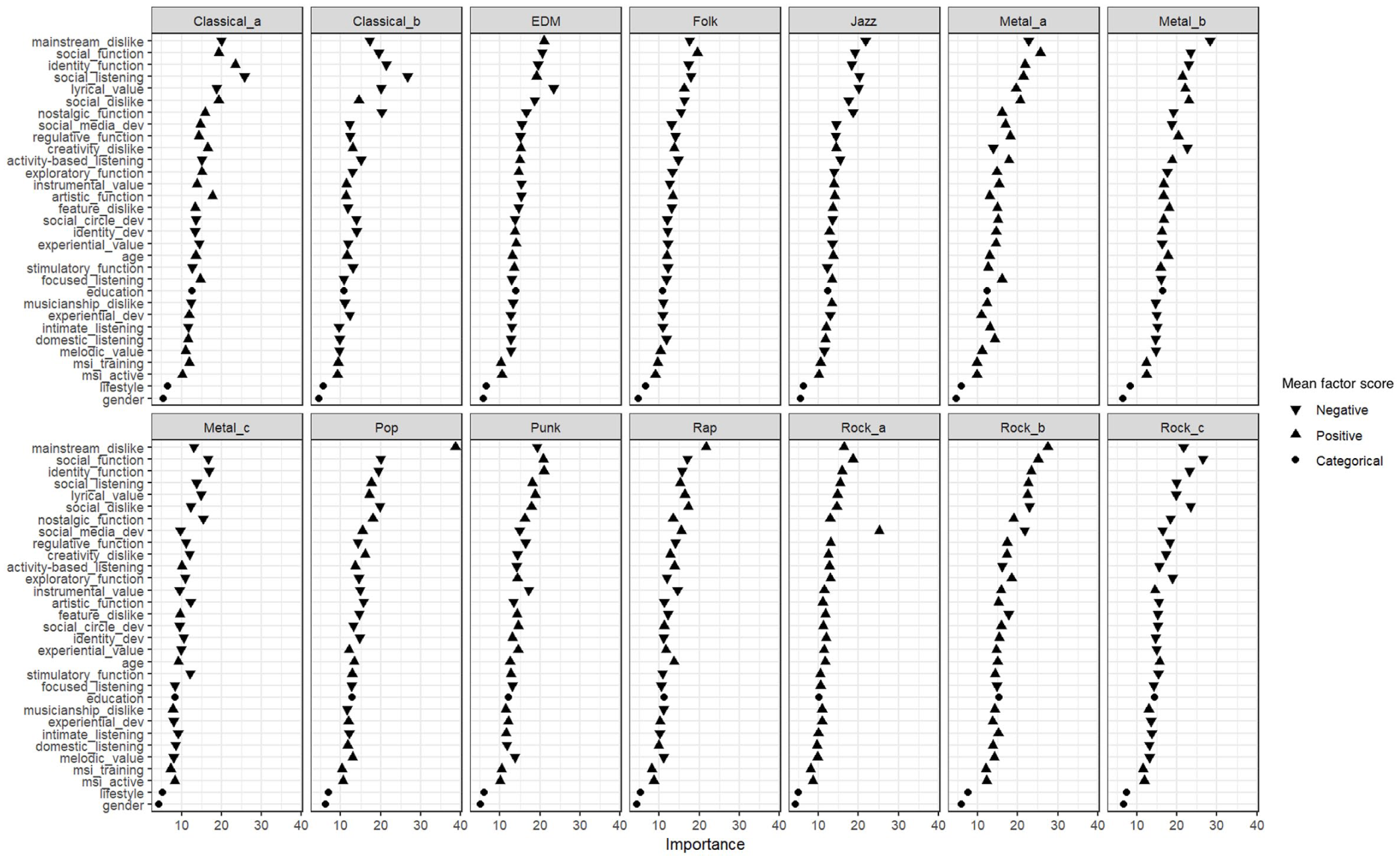
Importance Values from the Random Forest Classification Model, Sorted by Musical Style.
Mainstream dislike was consistently among the highest importance scores across many musical styles. This factor was especially relevant (i.e., high ratings) for styles such as pop, rock_b, and rap (note that the profiles from the LPA were labeled a, b, and c). In contrast, for styles such as classical_a, jazz, metal_a, metal_b, and punk, the irrelevance (i.e., low ratings) of this factor played a crucial role in differentiating these styles from others. Social function was consistently relevant for styles such as classical_a, folk, metal_a, punk, and rock_b. Conversely, for listeners of classical_b, EDM, jazz, metal_b, and rock_c, the irrelevance of social function was important in distinguishing their preferences. Social listening was relevant for styles such as EDM, metal_a, metal_b, and rock_b, while irrelevant for the preference of styles such as classical_a, classical_b, jazz, and rock_c. Social dislike was especially relevant for classical_a and metal_a music. On the contrary, for styles such as pop, rock_b, and rock_c the irrelevance of social dislike was crucial. Lyrical value was relevant for metal_a and rock_b. In contrast, for styles such as classical_b, EDM, rock_c and jazz, the irrelevance of lyrical value was a defining characteristic. Regarding the influence of social media development, this factor was particularly relevant for rock_a but irrelevant for styles such as metal_b and rock_b. Identity function was relevant for classical_a, metal_a, punk, and rock_b, while for classical_b, EDM, pop, metal_b, and rock_c however, identity function was irrelevant in shaping preferences. Education played a role in distinguishing music preferences of classical, jazz, and punk. Finally, instrumental value was relevant for styles such as classical, rock, and jazz.
Discussion
This study explored the multifaceted nature of musical taste and identified key factors that shape style-specific preferences. Our findings underscore the importance of social influences, the role of music in identity expression, and the differing importance of lyrical and instrumental value across various styles. In addition, the research sheds light on how listeners perceive the rejection of their preferred style. By examining these dimensions on a style-specific level, the study offers a deeper understanding of the complexity of musical taste.
Social influences
Social dimension plays a crucial role in musical taste, influencing its development, situational listening, and functional purposes. Accordingly, social dimensions were represented in three scales in the current study. Social circle development reflects the influence of a style’s community or friends, while social listening refers to social settings, such as parties and using music for distinction (Bourdieu, 2018; Neuhoff, 2001; Peterson, 1992; Peterson & Kern, 1996). Social function relates to using music to feel connected, signal group belonging, and meet new people (Campbell et al., 2007; Laiho, 2004). Findings from the random forest and correlations indicate that these factors are interrelated, suggesting that early social influences shape both musical preferences and subsequent listening habits.
Interestingly, classical, jazz, and folk listeners rated social circle development, social listening, and social function as irrelevant to their taste, that is, these factors were of high in importance because of their low ratings. This could stem from the fact that these styles are rarely played in highly social settings such as parties or clubs. However, classical concerts and jazz performances are inherently social (Chen & Cabrera, 2023; Dearn & Price, 2016; Pitts, 2021; Wald-Fuhrmann et al., 2021). It is possible that socializing in these styles differs, with more emphasis on connecting with musicians, or experiencing the performance rather than engaging with fellow listeners (Burland & Pitts, 2010, 2012; Pitts, 2021).
In contrast, punk, metal_a, rock_a, and rock_b listeners exhibit similar social listening behaviors. Social circle development, social function, and social listening significantly shape their musical tastes, and they continue to prioritize communal experiences. This is evident in the festival and concert culture surrounding these styles, where shared experiences are central (Brown, 2023; Rowe & Guerin, 2018; Snell & Hodgetts, 2007). Festivals such as Rock am Ring and Wacken, attracting tens of thousands of attendees (SWR Aktuell, 2024; Wacken Open Air, 2024).
Overall, musical taste development is influenced by social factors, with those shaped by social interactions continuing to engage with music in collective settings. Concerts and festivals further reinforce this communal aspect, particularly in rock and metal culture. Thus, those shaped by social influences in their musical taste development later engage with music primarily in social contexts.
Identity expression
A notable connection emerged between identity function, lyrical value of the music, and social function and listening, highlighting an interplay between psychological, music-analytical, and sociological perspectives.
The identity function distinguishes EDM and pop listeners, not due to its relevance, but because they rated it as largely irrelevant, resulting in a high importance value in the random forest analysis. This suggests that identity expression through music is not a key factor in their preference. It is of note that EDM listeners in the current study show low relevance for several factors but the stimulatory function and activity-based listening, suggesting that they primarily enjoy their music for physical arousal and motor synchronization (Greb et al., 2017; Solberg & Dibben, 2019; Solberg & Jensenius, 2017 see also Parzer, 2011; Schäfer & Sedlmeier, 2009). Listening in social situations or for social reasons seems to be less relevant for EDM listeners, likewise lyrical value, likely due to the often minimal presence of lyrics, and the focus in electronically produced sounds in this musical style (Dayal & Ferrigno, 2012; Solberg & Jensenius, 2017). Similarly, pop listeners do not prioritize identity expression through their style. Although pop music has some of the largest fan communities (International Federation of the Phonographic Industry, 2023), these groups center around specific artists rather than the style itself. Examples include Taylor Swift’s “Swifties,” Lady Gaga’s “Little Monsters,” and Beyoncé’s “Beyhive” (Lewis, 2024; Linden & Linden, 2017). This suggests that identity formation in pop fandom may be more artist-centric than style-driven. This raises the question of whether the expression of identity and values for pop fans is more anchored in the artists, and whether the results would change if the question was reformulated to ask if it is important that the artist, rather than the style, represents their values. This observation suggests a new way to conceptualize pop music fandom, drawing from Lewis’ (2024) work on sports fandom. Likewise, sports fans, pop fans follow a hierarchical structure of identification: (1) broad category: sports or music; (2) interest category: a specific sport (e.g., football) or style (e.g., pop); and (3) specific category: a team (e.g., Arsenal FC) or artist (e.g., Taylor Swift). Just as Arsenal supporters travel for games, wear jerseys, and call themselves “Gunners,” Taylor Swift’s “Swifties” attend concerts in themed outfits, and form a strong identity around their favorite artist. This highlights that pop music, as a category, may be too broad for studying musical taste, suggesting a need for differentiation—perhaps even at the artist level.
For the punk listeners in the current study, identity function, lyrical value, and social function and listening show high importance for their musical taste, while the three metal and rock groups show variations in relevance. Metal_a, rock_b, and rock_c listeners value identity function and social function and listening for distinction, indicating that those who express themselves through music do so via affiliation with their style community (North & Hargreaves, 1999). Especially for metal fans, music also plays a key role in strengthening social bonds (Olsen et al., 2023), reinforcing earlier findings that metal supports group identity and community (Slade et al., 2021). This aligns with the strong festival culture in rock and metal, where the focus is on shared experiences and identification with the scene (Brown, 2023; Snell & Hodgetts, 2007).
Lyrical value also plays a role, rated as important by punk, metal_a, and rock_b listeners, less so by metal_b, and as irrelevant by metal_c and rock_c listeners. This suggests that those who express their identity through music often do so via lyrics and artist authenticity (the authenticity item is included in the lyrical value factor; Meyers, 2009; Moore, 2002; von Appen, 2007; Weisethaunet & Lindberg, 2010). Punk, in particular, is well-known for its often political and socially critical lyrics, as exemplified by songs such as “Dosenbier” by the band ZK or “Staatsfeind” by Canal Terror. However, punk music also frequently incorporates poetic works into its songs, such as Heinrich Heine’s poem “Lorelei” in the song “Zu Kalt” by Slime, or Rainer Maria Rilke’s poem “The Panther” in a song by the band Schwarze Feuer (Ambrosch, 2017; Brandes, 2016).
In sum, the relation between identity expression, the importance of lyrics, and social connections underscores the overlap between the three perspectives.
Contrasting priorities: lyrical versus instrumental value
The relevance of instrumental value (i.e., instrumental skills, instrumentation, complexity, originality, production) and lyrical value (i.e., lyrics, voice, and authenticity) follows similar patterns across multiple styles, with key differences between electronically and analog-produced styles. Instrumental value is considered irrelevant for EDM, punk, rap, and folk. This is largely due to their production methods and use of instruments. In electronic music, few to no analog instruments are used. Tracks are predominantly produced electronically, with instruments only featured subtly or as special elements in live performances (Jerrentrup, 2008; Papenburg, 2001, 2016; Solberg & Jensenius, 2017; Wicke, 2015). In addition, electronic music listeners tend to prefer less complex songs, as highly complex tracks can be exhausting for club audiences over time (Gernandt & Merrill, 2024). For rap, instrumental value is also highly irrelevant. Similar to EDM, rap utilizes many electronic sounds and fewer analog instruments (Toop, 2012). Live performances often use instrumental playback to which the rapper performs. Moreover, rap places a strong emphasis on lyrics, often using them as a powerful storytelling tool, reflected in the high relevance of lyrical value for rap listeners. Instrumental elements primarily serve as a carrier for the lyrics and their message (Prinz, 2014; Toop, 2012).
A similar pattern is observed in punk, characterized by simple, raw sounds, often as a deliberate counterpoint to the mainstream American and British rock industry and its aesthetics (Prinz, 2014; Triggs, 2006; Wolf, 2024), and emphasizes socially critical and political lyrics (Ambrosch, 2017; Brandes, 2016). Folk music follows a similar trend, with a strong focus on lyrical storytelling, as exemplified by Bob Dylan’s Nobel Prize-winning songwriting, which addresses themes of social struggle and political protest (Habib, 2014; The Nobel Prize, 2024).
In contrast, instrumental value is highly relevant for jazz and the two classical style groups, while lyrical value is irrelevant to both. In many classical genres, such as sonatas or symphonies, textual elements are not a part of the composition. These are distinguished by their extensive instrumental arrangements and complex compositions. The absence of text directs attention to the instrumental performance. Even in vocal-based classical genres such as opera or Lieder, the instrumental elements play a crucial role in supporting lyrical content (Winter et al., 2001, see, for example, the Schubert Lieder Erlkönig (D328) or Auf dem Wasser zu singen (D774)). Jazz, though sometimes incorporating lyrics, is predominantly characterized by and valued for its complex harmonies, melodies, and improvisational instrumental play (Alperson, 2010; Benson, 2006; Nettl et al., 2001).
The findings suggest that listeners often perceive lyrics and instrumental performance as opposing elements in musical preference—when lyrics hold high significance, instrumentation takes a secondary role, and vice versa. It can be assumed that high complexity in both aspects would be overwhelming for the listener, leading to overstimulation and, consequently, rejection (Behne, 1987, 1993; Berlyne, 1970; Chmiel & Schubert, 2017; De la Motte-Haber, 1996).
Perceived musical dislikes: mainstream and social prejudice
As musical taste is linked to social distinction, participants were asked why others might dislike their preferred style. The goal was to identify further mechanisms of musical preference by taking on an external perspective. Two key factors emerged: mainstream dislike—perceiving a style as too mainstream, issues with authenticity, simplicity, and lyrical content—and social dislike—perceived prejudices against the music or its community.
The rejection of a style as “mainstream” aligns with previous empirical research (Ackermann & Merrill, 2022; Merrill et al., 2023). In the current study, mainstream dislike is the one with the highest importance value overall and found to be particularly important for distinguishing pop and rap styles from other styles because of its high relevance. The assumed reason for the rejection is in line with the literature, where pop music is discussed to be produced for mass appeal, features simple melodies, familiar harmonic patterns (I–V–vi–IV), and universally relatable lyrics (von Appen, 2007). This aligns with the high relevance ratings for lyrical value and melodic value, while the artistic function is irrelevant for pop listeners. For rap listeners, mainstream dislike is also relevant, even though rap is often rejected for its provocative lyrics, its increasing commercial success contributes to mainstream perceptions. High-profile events such as the Super Bowl Halftime Shows featuring Kendrick Lamar and others (Caulfield, 2025; Kreps, 2024; NFL.com, 2024), and the dominance of German rap in streaming charts (“Top 50—Germany” Spotify, 2024 as of November 11, 2024) highlight rap’s integration into the mainstream.
In contrast, the current study reveals also higher importance values for jazz, classical_b, and metal, where mainstream dislike is not perceived to be a relevant reason for rejection. Jazz music is characterized by complex harmonies, melodies, and rhythms, with a high degree of improvisation, and rarely serves commercial purposes (Alperson, 2010; Benson, 2006; Nettl et al., 2001; Tucker & Jackson, 2020). Jazz listeners appreciate the style as an art form (high relevance of artistic function), which, interestingly, seems to contradict the perception of jazz as mainstream. The classical_b group shows similar patterns, reinforcing links between jazz and classical music in social listening and instrumental value. For metal_b listeners, mainstream dislike is also highly irrelevant. Metal is also not perceived as mainstream due to its perceived musical complexity, extreme sound (described metal as “loud” and “powerful”; Gernandt et al., 2025; Lehmann, 2018), and strong subcultural identity, marked by distinct symbols such as band shirts and vests (Snell & Hodgetts, 2007).
The second important reason for the assumed rejection of a musical style pertains to prejudices against the music and the style community. Social dislike is highly relevant for metal_a, classical, and rap listeners. Classical music is associated with wealth, education, and prestige, often seen as exclusive to the educated elite (Peterson, 2005; Roy & Dowd, 2010). Metal faces strong societal rejection due to extreme performances (e.g., Ozzy Osbourne), associations with satanic imagery (Firdaus, 2021; Moberg, 2009). Rap is often criticized for lyrics perceived as misogynistic, sexist, or homophobic (Adams & Fuller, 2006; Ciro, 2019). Studies show that music fans want to express their values through music (Hargreaves & North, 1999, 1999, 2007) leading to the assumption that rap fans endorse the often offensive and discriminatory lyrics. However, while fans may view rappers as artistic personas (e.g., Eminem’s Slim Shady), the media focus on rivalries, such as Drake vs. Kendrick Lamar (Lamarre, 2024; Savage, 2024), or the Tupac-Notorious B.I.G. feud (Faina, 2024), reinforces associations with crime and gang culture (Coscarelli & Cowan, 2023).
In contrast, social dislike is irrelevant for pop, rock_b, and rock_c listeners. Pop music, designed for mass appeal, lacks strong symbolic or cultural associations. Rock, spanning commercial rock-pop to hard rock (e.g., AC/DC, Van Halen, Black Sabbath), fosters a sense of belonging through fashion but to a lesser extent than metal.
Overall, participants mainly assumed a social dislike to their preferred style. These factors of perceived musical dislike are essential in differentiating styles and shaping future research on musical preferences.
Limitations
Certain limitations should be considered when interpreting the present findings. First, the range of lifestyle types represented in the sample was incomplete. This limited representation may help explain the relatively low importance attributed to lifestyle-related factors in musical taste. A broader and more diverse sample in future studies could provide a more accurate picture of the role lifestyle plays in musical preferences.
Second, the latent profile analysis for specific style groups (metal, rock, and classical) did not yield clearly distinguishable listener profiles and may have led to a bias in the outputs of the regression model. This may be due to the considerable diversity within these broad style labels. Previous research (Lange et al., 2025) has shown that, while style-based assessments of musical taste are sufficient for many applications, some styles—such as classical, rock, and metal—encompass substyles that differ substantially in aesthetic and cultural dimensions. For example, distinguishing between classical music and classical modern and avant-garde, or between metal and nu-metal and industrial, may reveal more fine-grained listener patterns. Future work should consider using such distinctions where style heterogeneity is known to be high.
Conclusion and outlook
This study demonstrates the complexity of musical taste, spanning sociological, psychological, and music-analytical perspectives. It emphasizes the need to study musical taste at a style-specific level, as different styles, such as punk and classical, reflect contrasting social and individual values. The findings suggest that while some patterns are universal, each style has unique characteristics worth exploring.
The study highlights the importance of a comprehensive framework that includes identity, social connections, and developmental influences in understanding musical preferences. It also finds that music is most appreciated when it balances lyrical and instrumental complexity, with listeners often prioritizing one over the other.
Pop fans, in particular, tend to connect more with individual artists than the style itself, which suggests a need to rethink pop fandom. In addition, musical taste is influenced by both current trends and historical events, such as the shifting perception of rap, influenced by cultural milestones.
Finally, the study stresses the value of combining music-analytical with sociological and psychological perspectives to better understand how musical taste evolves in response to cultural changes. In conclusion, musical taste is dynamic and context-dependent, offering a rich area for future research.
Supplemental Material
sj-docx-1-pom-10.1177_03057356251405832 – Supplemental material for Dimensions of musical taste: A style-specific approach
Supplemental material, sj-docx-1-pom-10.1177_03057356251405832 for Dimensions of musical taste: A style-specific approach by Emily Gernandt and Julia Merrill in Psychology of Music
Footnotes
Author contributions
Both authors designed the research and E.G. collected the data. Both authors analyzed the data. E.G. interpreted the results and wrote the first draft of the manuscript. J.M. revised the initial draft. Both authors revised, read, and approved the final manuscript.
Declaration of conflicting interests
The authors declared no potential conflicts of interest with respect to the research, authorship, and/or publication of this article.
Ethics approval statement
All experimental procedures were approved by the Ethics Council of the Max Planck Society (No 2702-12) and were undertaken with the written informed consent of each participant.
Funding
The authors received no financial support for the research, authorship, and/or publication of this article.

Data availability statement
All data supporting the findings of this study are available within the article, its Supplementary Information file, and the accompanying dataset (“data.xlsx”), which contains the raw data, factor scores, and importance values from the random forest analysis with bootstrapping.
Supplemental material
Supplemental material for this article is available online.
Notes
References
Supplementary Material
Please find the following supplemental material available below.
For Open Access articles published under a Creative Commons License, all supplemental material carries the same license as the article it is associated with.
For non-Open Access articles published, all supplemental material carries a non-exclusive license, and permission requests for re-use of supplemental material or any part of supplemental material shall be sent directly to the copyright owner as specified in the copyright notice associated with the article.
