




Abstract
This interpretative phenomenological analysis (IPA) study explores how five professional violinists, who teach and perform in South Africa, make sense of their lived flow experiences during solo and chamber music performances, and to what extent flow theory explains the inhibiting and promoting conditions of flow for the participants. Data were collected by conducting in-depth, semi-structured online video interviews. Rigorous data analysis followed a structured seven-step process. Eight group experiential themes emerged from the data. These themes are (1) the importance of preparation; (2) awareness and managing thoughts and attention; (3) emotion, intention, and the message of the music; (4) interactive musical relationships; (5) the audience’s role in the performer’s flow experience; (6) the influence of past experiences; (7) unique interpretations of flow; and (8) the outcomes of having experienced or not experienced flow. This study is the first of its kind, as it highlights professional performing violinists’ unique flow experiences during solo and chamber music performances. The study contributes to the improvement of practice by creating increased awareness of the conditions that promote and inhibit flow experiences for professional, amateur, and student performers as well as music teachers.
Keywords
As I walked on stage of the old theatre in Sant’Agata Feltria, the floor creaked. The old wooden planks were hollowed out in some places from the decades of footsteps on them. I heard the introduction and soared into the opening of the second movement of Sibelius’s violin concerto. As my bow descended onto the strings, I felt as if I was lifted up into the air. From the moment I started playing, I escaped to a place where it was possible and safe to wear my heart on my sleeve. I was absolutely consumed with emotion. During the performance, I poured all my heart, fears, uncertainty, anger, and love into that moment – not my playing. It was as if it were a whole experience, not a performance. It was raw, honest, and unpretentious. It was an exhilarating moment when I felt entirely present. I did not try to do or say anything. The moment just consumed me completely – as if it had accepted me.
My experience described in the vignette above inspired this qualitative study, as it was the most vivid flow experience I have experienced as a violinist. ‘Flow’ is a term established by the Hungarian psychologist Mihaly Csikszentmihalyi (1990) and can be described as an optimal experience in which the psychological state of being fully engaged in the pursuit of an activity is experienced so intensely that nothing else matters. Flow is also described as ‘the holistic sensation that people feel when they act in total involvement’ (Csikszentmihalyi, 2000, p. 36), being ‘in the zone’, and is similar to ‘peak experience’ and ‘optimal experience’ (Tan & Sin, 2020, p. 36).
Csikszentmihalyi (2014) developed nine conditions for flow. Flow has these dimensions: (1) a challenge-skill balance, where one’s skill must be sufficient to support the challenges presented by the activity; (2) action-awareness merging, meaning one must be certain what one’s actions lead to; (3) having clear goals and knowing instantaneously how well one is doing by immediately being able to objectively judge one’s own playing; (4) unambiguous feedback; (5) concentration on the task at hand, where one’s mind must be completely focussed on the activity to such an extent that one cannot be distracted; (6) sense of control to such an extent that failure is not a concern; (7) loss of self-consciousness and how other people perceive you; (8) transformation of time; and (9) autotelic experience, where one performs the activity simply for the experience itself.
My flow experience in Italy was an ultimate peak performance and was filled with intense happiness and pleasure (Marin & Bhattacharya, 2013). The memory of this experience will forever serve as an inspiration for me to experience flow again. That specific experience has become so idealised in my memory that I find it difficult to experience such an intense level of flow again in my performances. Therefore, the problem addressed by this study has two main aspects, namely (1) the challenge for violinists to generate regular flow experiences and (2) the lack of violin-specific literature about the flow experiences of violinists.
Although there are not violin-specific studies indicating how to deal with the problem of not being able to experience your highest level of flow again after you have experienced it once, research does indicate that music performance anxiety (MPA) decreases the possibility of creating general flow. Flow and anxiety have a conflicting relationship (Csikszentmihalyi, 1990). Studies have shown that performing in the presence of someone who is evaluating the performance causes significant anxiety in musicians (Abril, 2007). Furthermore, if the challenge-skill dimension is not balanced, this could add to the MPA (Loepthien & Leipold, 2021). It has also been reported that anxiety arises when performers feel that they are not in control of a situation (Abril, 2007) or when performers feel that if they fail on their instrument, they also fail as people (Kenny, 2010). Developing techniques for facilitating flow, such as a flexible self-concept (Loepthien & Leipold, 2021) or developing mindfulness (Bloom & Skutnick-Henley, 2005), might help reduce MPA (Cohen & Bodner, 2021).
The second aspect of the problem is the rarity of literature about flow experiences for violinists. Although studies have been conducted on the flow experiences of performers (Akutsu, 2018; Bloom & Skutnick-Henley, 2005; Cohen & Bodner, 2021; Ford et al., 2020; Fritz & Avsec, 2007; Iusca, 2015; Loepthien & Leipold, 2021; Panebianco-Warrens, 2014; Pang, 2022; Sinnamon et al., 2012; Sinnett et al., 2020), none of them focus on the violin or clarify whether there is any association between flow and playing the violin.
Although one study has been conducted on flow in violin playing (Akutsu, 2018), the participant was a 2-year-old child and not a professional performer. Another similar study has been done on flow for a double bass student (Brown, 2020); however, the study is neither based on a professional performer nor violin-specific. Orlandi (2020) explored the lived experiences of five professional pianists and found that pianists experienced flow more often when performing familiar or preferred styles. The pianists also expressed a strong correlation between musical preference, the perceived emotional content of the repertoire and flow. This study, however, focused on pianists rather than violinists, and on the concept of spirituality, and not exclusively on flow.
In a study conducted by Granville (2024), findings showed that it is very important to create optimal conditions for flow to occur rather than making achieving flow the main goal and forcing it to happen. By focusing on the musical goals and dedicating your thoughts and actions to the music itself, one creates the natural conditions for flow to occur. Although Granville’s (2024) study is helpful in identifying factors promoting flow, it is based on a horn player’s experience and is not violin-specific.
Therefore, the purpose of this interpretative phenomenological analysis (IPA) study is to explore how five professional violinists, who teach and perform in South Africa, make sense of their lived flow experiences during solo and chamber music performances. The central research question that guided this inquiry is: How do five professional violinists, who teach and perform in South Africa, make sense of their lived flow experiences during solo and chamber music performances? The secondary theory-driven research question is: To what extent does Csikszentmihalyi’s (2014) flow theory explain the inhibiting and promoting conditions of flow experiences for the five professional violinists?
Procedures
IPA
In this qualitative study, we made use of IPA as a strategy of inquiry that examines how people make sense of their experiences (Smith et al., 2009). The IPA approach is based upon three theoretical foundations, namely ‘phenomenology, hermeneutics and idiography’ (Smith et al., 2009, p. 11).
Phenomenology is a philosophical approach to studying everyday, specific, lived human experiences by examining the participants’ perceptions of the phenomenon (Smith et al., 2009; Van Manen, 2016). The meaning that participants ascribed to the experience is analysed through processes of interpretation, making the IPA study hermeneutic (Smith et al., 2009). Hermeneutics refers to the general theory of interpretation, and the process is described as both empathetic and critical (Shinebourne, 2011). Idiography focuses on the specific individual, resulting in precise personal details (Shinebourne, 2011; Smith et al., 2009). Smith and Nizza (2022) state that this is best achieved by focusing on single cases and analysing them individually before making possible comparisons between cases.
Participants
To comply with IPA principles, we followed an idiographic approach by ensuring the participants for our study were limited to a small group of individuals (Smith et al., 2009; Smith & Osborn, 2008). For this study, we identified five participants who were willing to be part of this study and to share their personal experiences of flow during performances with me. The participants are male and female, aged between 26 and 64, speak English and Afrikaans, and fall within a middle socio-economic class. No vulnerable population groups were involved. The participants are homogeneous because they are professional South African violinists who actively perform and teach.
Data collection
The primary and most effective method of data collection in IPA studies is in-depth, semi-structured interviews (Eatough & Smith, 2008; Smith et al., 2009). The first author adopted this method by conducting online video interviews with each of the participants, which encouraged and facilitated reflection (Eatough & Smith, 2008). These online interviews allowed the participants to discuss their experiences and meaning-making in depth in a safe environment.
As the first author is also a participant in this study, she completed her own ‘interview’ by recording her reflections before conducting the interviews with the other participants to avoid her sense-making being influenced by their sense-making. Being a professional violinist and experienced chamber musician, the first author brings an insider’s perspective to this study, allowing her to interpret participants’ reflections with sensitivity to the nuanced demands of both solo and ensemble playing.
Data analysis
Smith et al. (2022) suggest seven steps to analyse and interpret data rigorously. This process was applied to every case individually to support the idiographic nature of an IPA. The first step was to read and re-read the transcribed interviews to fully understand and organise the data. During the second step, exploratory notes were made in ATLAS.ti 23 (a computer-assisted qualitative data analysis software programme) to identify information that could be useful to the study (Friese, 2019). Experiential statements on these data were constructed separately for each participant in the third step. The fourth step was to search for connections across experiential statements within each case and to group similar statements in clusters. In the fifth step, the personal experiential themes (PETs) were generated and, in some cases, sub-themes were created to show the specific set of experiential statements that were brought together in developing the PET(Smith et al., 2022). The themes for each participant were then consolidated and organised (see Supplementary Material). In the sixth step, the previous five steps were applied to the other cases until all the analyses had been completed. Finally, in the seventh step, the PETs and sub-themes were organised to develop group experiential themes across cases (Smith et al., 2022).
Ethics
This study was approved by the Basic and Social Sciences Research Ethics Committee (BaSSREC) of the North-West University, South Africa (ethics number NWU-00989-22A7). The violinists participated voluntarily and were informed of the purpose of the study. They were told that they had the right to withdraw at any time without consequences. I asked the participants for their informed consent to conduct the online face-to-face interviews, possible follow-up interviews, and to use the results of the analysis and interpretation of the data for the purpose of this study. They were also given the option of anonymity and the opportunity to correct and confirm their interview transcriptions (Smith et al., 2009). Three participants chose to use their real names, and two participants chose pseudonyms.
Findings from the cross-case analysis
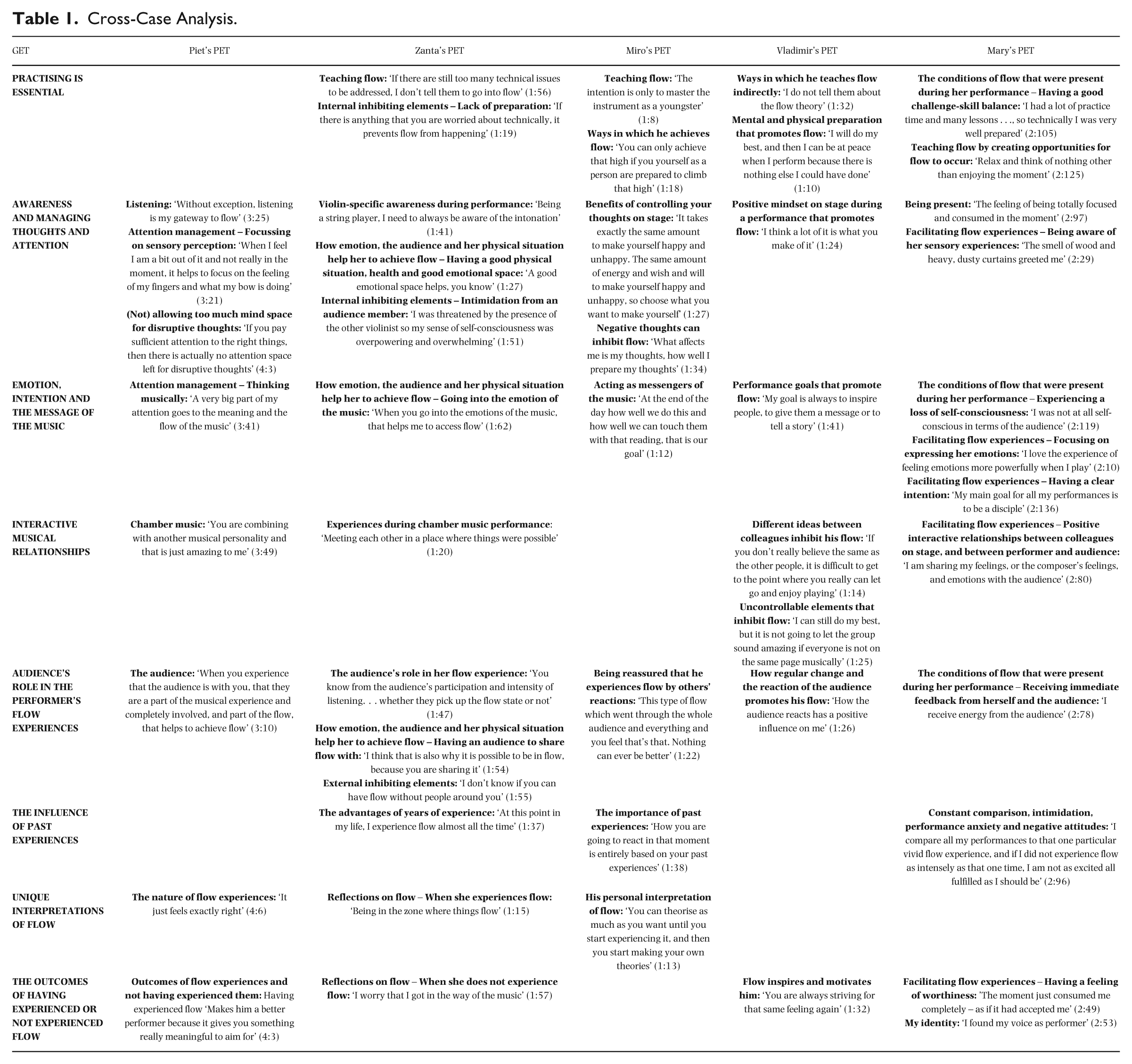
During the cross-case analysis, the following eight group experiential themes emerged from the five participants’ data (see Table 1):
Practising is essential.
Awareness and managing thoughts and attention.
Emotion, intention and the message of the music.
Interactive musical relationships.
The audience’s role in the performer’s flow experience.
The influence of past experiences during the performance.
Unique interpretations of flow.
The outcomes of having experienced flow or not.
Cross-Case Analysis.
The cross-case analysis has been categorised into three main parts, namely before, during and after a concert (see Figure 1). The findings have shown that prior to the concert, preparation and practising play an extremely important role for all participants to create the opportunity for flow to occur. On stage, participants attach great value to being aware and managing their thoughts and attention. This, together with focusing on their emotion, intention and the message of the music, promotes their flow experiences. Regarding other people, the participants may be influenced both positively and negatively by interactive musical relationships and by the audience. The participants have admitted that past experiences influence their performance, as they have gained confidence and coping mechanisms from past experiences that can help them in their current performance. After experiencing flow, the participants can create their unique interpretations of flow. Finally, the participants reflect on and talk about the outcomes of having experienced flow or not. This then serves as motivation to practise and prepare again, resulting in the experience moving full circle.
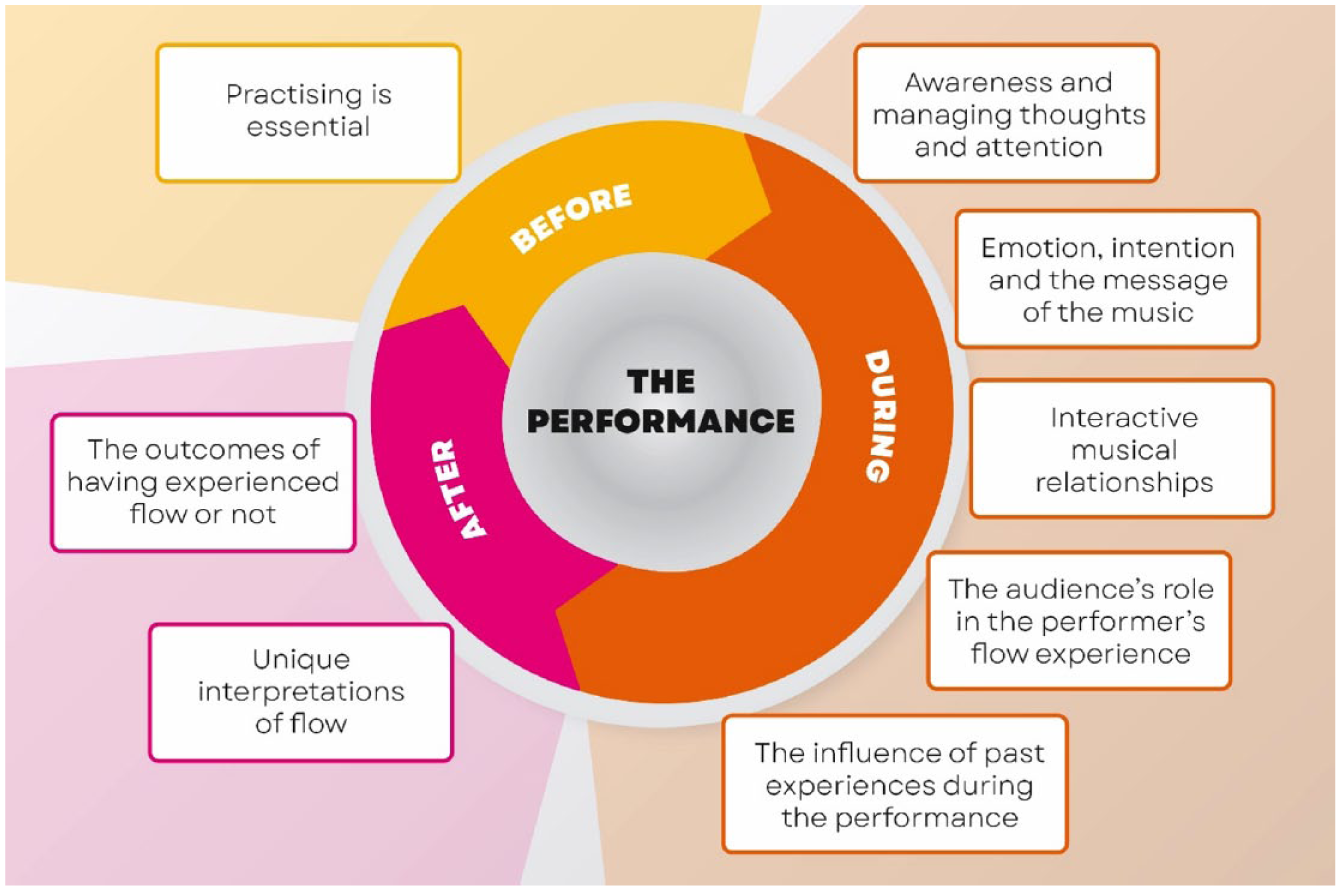
The Eight Group Experiential Themes That Emerged From the Cross-Case Analysis.
Group experiential theme 1: practising is essential
All of the participants state that preparation prior to the concert plays a very big role in their flow experiences. Piet states that if he does not feel prepared, then ‘a flow experience is basically impossible’ (Piet 3:14). Zanta also agrees with Piet by saying that it is impossible to experience flow ‘if there is anything that you are worried about technically’ and that ‘the only way to become free enough to enter a flow state’ is when you have done ‘excessive work in preparation’ (Zanta 1:19). Mary also agrees and confirms that she had a good challenge-skill balance during her flow experience, and this enabled her to feel free and effortless. Vladimir adds that his preparations are of both a physical and a mental nature. In addition to intense physical practice, he also tries to have as many preparation concerts as possible before the actual concert and does visualisation exercises.
Group experiential theme 2: awareness and managing thoughts and attention
The participants have shown active and receptive ways of being aware of and managing thoughts and attention. During flow, Mary feels particularly present and ‘totally focused and consumed in the moment’ (Mary 2:97). She acknowledges that extreme concentration is necessary for her to be present and that experiencing a certain amount of stress on stage helps her to reach ‘a state of full concentration’ (Mary 2:77).
For Vladimir to achieve flow, he tries to ‘let go’ (Vladimir 1:40) by ‘being in the music’ rather than thinking too much about technical requirements. Imagining playing for someone who is not judgemental helps him be in the music.
Piet feels that to be in the zone, or to be able to experience flow, he must feel physically in control of his body. When on stage, Piet concentrates on getting the physical things in place by ‘being in the moment, by perceiving the sense of touch adequately, and to adequately observe the actions of the bow’ (Piet 3:22). Piet deliberately makes small adjustments to his left hand, like pressing harder or lighter to feel exactly where his fingertips touch the string. Similar to Piet, when on stage, Zanta is actively aware of three violin-specific points of focus, namely intonation, ensuring that the left hand is relaxed, and being very aware of the bow’s contact on the string, ensuring that she gets the sound she desires. When Miro is in flow, he feels relaxed and has good coordination between his body and fingers.
Piet explains that ‘if you pay sufficient attention to the right things, then there is actually no attention space left for disrupting thoughts’ (Piet 4:2). Similarly, Zanta feels that ‘if you are worried about something, then it is difficult to separate your thoughts from that’ (Zanta 1:27). Vladimir also agrees by saying when you have ‘voices in your head, and thinking about other things’, it is impossible to experience flow. Miro states that one has to be psychologically very strong to be able to overcome these negative thoughts. Zanta also says that when intimidated by someone in the audience, she feels an overpowering sense of self-consciousness to such an extent that she cannot listen objectively, be aware of her body or manage her attention or thoughts. Miro, Mary, Zanta, and Piet also think that a flow experience can eliminate and overcome the performance anxiety that causes disruptive thoughts: ‘If you’re taken up by the beauty and the meaning of the music, in other words, if you are having a total aesthetic experience, anxiety does not make sense’ (Piet 4:6).
Piet states that when he focuses intensely and very exclusively on what he hears for a few minutes, then listening is ‘without exception’ his ‘gateway to flow’ (Piet 3:25), as this exclusive listening aids in the integration of all the sensory information, which results in the musical and physical challenges simply falling in place (Piet 3:24).
One of the more receptive activities that occurs on stage is awareness. Although Piet is very aware of the physical requirements and his actions to get the desired results, he ‘does not feel removed’ from the situation. When his action-awareness and musical awareness are balanced, he explains that it becomes a ‘very holistic experience’ (Piet 2:22).
Because of the concentration level during a flow state, all participants remarked that they lost all perception of time. Piet summarises it by saying that ‘time stands still, or to put it differently, musical time becomes overriding’ (Piet 3:44).
Group experiential theme 3: emotion, intention and the message of the music
When telling the story about her vivid flow experience, Mary admits that she was aware of her feelings and emotions and desired for her performance to be ‘meaningful’ (Mary 2:119). She sees the stage as a place where ‘raw emotion is celebrated’ (2:84) and finds expressing her emotions very satisfying.
All of the participants stated that it is important to convey the composer’s intention of the music to the audience. Miro sees a musician as a messenger of the music: ‘We study all our lives to be messengers between what is on the paper of the music which is given, and to pass it to the audience’ (Miro 1:9).
Piet states that a big part of his attention goes to conveying the meaning of the music. ‘If I feel like I’m producing sound successfully and it is congruent with the musical meaning I want to convey, then I am very happy!’ (Piet 3:42). It is also when he starts ‘thinking musically’ (Piet 3:22) that he experiences flow. Before walking on stage, Zanta has a very unique ritual where she imagines her head opening up for inspiration from above to flow through her. This helps her to focus on the ‘depth and the beauty’ (Zanta 1:62) of the music, which is also one of her main gateways to flow.
Group experiential theme 4: interactive musical relationships
Piet regards chamber music as ‘combining with another musical personality’ (Piet 3:49). He also says that ‘when one really has a good rapport with the people you play with, and if you kind of play through them, then it is much easier to forget yourself than when you actually feel like a soloist on stage’ (Piet 2:39). Mary agrees with Piet and states that she found that a special connection or like-mindedness with her colleagues on stage contributes to her flow experience.
Vladimir has a very rich chamber music history, and from his years of experience in this capacity, he admits that when colleagues in a smaller ensemble have different beliefs and disagree on many topics, it is almost impossible to experience flow together. He thinks that to achieve group flow, you must ‘work well with the people you play with’ (Vladimir 1:21), and they must respect and listen to you. Zanta experienced flow in a group setting, even though there had not been enough practice time for the group to rehearse together. She attributes the group’s ability to experience flow, despite limited rehearsal time, to the strong friendships within the group, individual preparedness, and the mutual trust that allowed them to rely on one another unconditionally.
Group experiential theme 5: the audience’s role in the performer’s flow experience
All of the participants acknowledge that the audience plays a significant role in their flow experiences on stage. Mary mentions that an exchange of emotions between her and the audience offers her a great deal of energy (Mary 2:78). The audience’s reaction is thus a form of immediate feedback. Vladimir feels that the reaction of the audience intensifies his flow experience. Miro also values the audience’s reaction and finds it rewarding when he notices that the audience is in flow with him. Piet also agrees by saying that the audience plays a role in encouraging his flow experiences on stage. He believes that if he feels musically convinced, this conviction is transferred to the audience and results in them also feeling musically convinced. Zanta agrees with Mary and Piet that she finds reassurance from the audience’s reaction: ‘You know from the audience’s participation and intensity of listening whether they pick up the flow state or not’ (Zanta 1:47).
Zanta, Vladimir and Miro feel that flow is not only for their enjoyment but also meant to be shared. Zanta thus believes that one needs an audience to achieve flow. Vladimir also needs an audience, as his goal is to ‘inspire people, to give them a message, or to tell a story’ (Vladimir 1:41). For Miro, the audience plays an irreplaceable role in his performance, as he sees himself as the messenger of the musical meaning, and without the audience, there is no receiver of his message.
Group experiential theme 6: the influence of past experiences during the performance
Zanta experiences flow ‘almost all the time’ (Zanta 1:37), thanks to her knowing herself so well on stage after being in the profession for over 40 years. She explains that she experiences a ‘certain feeling of self-confidence’ that she has built up ‘because of experience’ (Zanta 1:25). Miro credits a big part of a performer’s success on stage to his past experiences: ‘How you are going to react in that moment is entirely based on your past experiences’ (Miro 1:38).
Surprisingly, Mary shared that sometimes her vivid flow experience was a discouragement to pursue future flow experiences, as she constantly compares her current performances with that vivid flow experience: It makes me compare all my performances to that one particular vivid flow experience, and if I did not experience flow as intensely as that one time, I would not be as excited or fulfilled as I should have been (Mary 2:96).
Group experiential theme 7: unique interpretations of flow
All of the participants have formed their own, personal way of describing and interpreting flow. Mary describes her flow experience as a moment that ‘just consumed me completely – as if it had accepted me’ (Mary 2:49) and a safe space where it is possible to wear her heart on her sleeve.
Piet describes flow as ‘literally feeling one with what you do, and with the circumstances in which you do it’ (Piet 2:35). Zanta describes flow as ‘being in the zone where things flow’ (Zanta 1:15). She does not feel, however, that she is losing her mind’s active role during the flow experience. For her, flow is thus a fine balance between rational presence and the absence of this balance. Zanta explains her sense of control as a perfect balance of technical effortlessness and intensity when in flow. ‘I am aware of a certain feeling of effortlessness, even though there is a lot of intensity, so it is a strange combination of those two opposing forces actually which are both present’ (Zanta 1:50).
When in flow, Zanta does not have a strong sense of self but rather feels ‘part of a bigger whole, a whole where things are flowing’ (Zanta 1:52). Miro describes flow as when ‘you are reaching your highest possible vibration of yourself and of what you are as a person’ (Miro 1:15).
Group experiential theme 8: the outcomes of having experienced flow or not
Having experienced flow or the absence of flow during a performance has various effects on the participants. Piet states that as a result of experiencing flow before, he now has an enhanced feeling of ‘unity with the music, your instrument, the sound you produce and also the audience’ (Piet 2:34). He also believes that having experienced flow ‘makes one a better performer as it gives you something really meaningful to aim for’ (Piet 4:3). Mary agrees with Piet by saying that ‘once you have tasted it, you will always want more, which results in working harder to be well prepared so that you can just let go and let flow take over’ (Mary 2:133). Vladimir also agrees by saying, ‘You are always striving for that same feeling again’ (Vladimir 1:32). Flow inspires Vladimir. When he feels that a performance is going well and he is experiencing flow, he wants to play even better and experience flow even more intensely.
Regarding bad performance experiences, Vladimir believes that they serve as motivation to ‘try harder the next day or the next time’ (Vladimir 1:54). Similar to Vladimir, Miro explains that in such cases where he is unsatisfied with his performance, he thinks back to previous good experiences, and this motivates him and makes it worth trying again. When Zanta does not experience flow during a performance, she worries that she got in the way of the music. ‘I am a vehicle through which the music has to come. If I stop that flow that feels like a sin against music’ (Zanta 1:57).
The outcome of Mary’s vivid flow experience played a big role in forming her identity, especially as a performer. Her vivid flow experience enabled her to realise that she was able to say what she wanted to say and gave her the validation that she had indeed ‘found her voice as a performer’ (Mary 2:53).
Discussion
In this section, the extent to which Csikszentmihalyi’s (2014) nine conditions of flow explain the inhibiting and promoting conditions of flow experiences for the five participants of this study will be discussed.
Having a challenge-skill balance requires that the musician has the necessary abilities and skills to carry out the requirements of the piece being played, as well as the music offering a challenge that is in line with the player’s abilities (Moral-Bofill et al., 2023). In the current study, the performers indicated the importance of their preparation to develop the necessary skills to meet the challenges posed by their pieces. Zanta states that if you are worried about anything technically, then flow is impossible.
The merging of action and awareness can also be seen as the merging of body and mind (Habe & Biasutti, 2023). Miro explains that when he is in flow, he notices that he is relaxed and that there is good coordination in his body. Zanta also states that she has a good balance between rational presence and the absence of this balance. Piet explains that he feels one with what he is doing when he is in flow, indicating that his actions and awareness have merged. Being in touch with what one is feeling physically is necessary to produce a positive performance that allows flow to occur (Antonini Philippe et al., 2022).
Csikszentmihalyi (2014) indicates that all goals must be clear and achievable. The goals of the participants in this study include making their performance meaningful and conveying a message to the audience. The findings in a study conducted by Ginsborg and Gayford (2003) showed that an optimal performance was one characterised by the performer having a clear intention or emotional message to communicate. The professional violinists in this study did not set achieving their own technical demands as the goal but rather considered other people and set the meaning and sharing of the composer’s message as the goal for their performances.
Unambiguous feedback helps to improve a musician’s performance and confidence (McPherson et al., 2022). Through the years of performing and evaluating their own playing, both Miro and Zanta have developed a certain degree of confidence, which allows them to react instinctively on stage, as well as to have a sense of trust in the future. The participants thus create unambiguous feedback for themselves through years of experience and self-evaluation after performances. The audience also plays an important role in providing immediate feedback. The presence of an audience leads to heightened arousal and evaluation apprehension but also increases the value of the performance (Tozman & Peifer, 2016).
Concentration on the task at hand is needed for performers to avoid distraction. Mary stated that during her flow experiences, she was completely absorbed in the moment and experienced a high level of concentration. The participants in this current study state that being in a state of full concentration leaves no space in the mind for negative thoughts to occur. Li (2020) agrees by saying that when musicians experience intense flow, MPA is less likely to occur.
A sense of control emerges when performers are deeply involved in their activity (Habe & Biasutti, 2023). To increase their sense of control during a performance, Piet and Zanta focus on violin-specific techniques which require a lot of control, such as making small changes to the sounding point of the bow or actively relaxing the left hand. This focuses their attention and reassures them that they are in control.
A loss of self-awareness is described as the state when musicians are deeply involved in expressing themselves when playing and when they can tune into and empathise with the music (Habe & Biasutti, 2023). Piet has had strong experiences with flow during chamber music performances and describes his feelings on stage as being able to play through someone. In this way, he overcomes the feeling of playing solo.
A transformation of time occurs when musicians are completely and deeply involved in their playing, often leading to a loss of self-awareness. Both of these conditions can result from having good concentration on the task at hand (Sinnett et al., 2020). The participants of this current study all stated that they experienced transcending time during their flow experience. Piet explained this transformation beautifully by saying that musical time, rather than clock time, dominates in a flow experience.
An autotelic experience leads to intrinsic motivation, meaning one does an activity simply for the joy thereof. Li (2020) states that flow can offer long-term motivation and potential achievement for performers. The participants declared that they found their flow experiences to be very enjoyable and, in some cases, even life- and career-changing. They thus also see the flow experience as an autotelic experience. This offers great motivation for them to work hard and practise hard to experience flow again.
Conclusion
The participants make sense of their flow experiences by noting that preparation is of the utmost importance. On-stage awareness, managing their thoughts, and focusing on the emotion, intention and meaning of the music are all beneficial. Interactive musical relationships and the presence of an audience play a big role in their flow experiences as well as the influence of past experiences. The findings suggested that all of Csikszentmihalyi’s (2014) nine conditions of flow were involved in the participants’ flow experiences.
In addition to the nine conditions of flow, the findings suggest that positive relationships and mutual respect among colleagues are necessary to experience flow, and that seeing yourself as part of the bigger picture is also beneficial in the promotion of flow. Knowing what inhibits and promotes flow experiences for violinists can create more meaningful experiences for violinists.
Recommendations for future research include further exploration of the lesser-studied conditions within Csikszentmihalyi’s nine dimensions of flow. Although the challenge–skill balance has been extensively investigated in music performance research, other conditions – such as clear goals, immediate feedback, and a sense of control – remain relatively underexplored. Research into these dimensions could deepen theoretical insight and inform practical strategies in both performance and pedagogy. In addition, investigating how flow can be cultivated through specific teaching practices is essential, as the yearning to experience flow may serve as a motivational factor for musicians. Future studies could also examine how performers re-engage with flow following interruptions, particularly those prompted by comparisons with previous peak experiences. Beyond Csikszentmihalyi’s nine conditions for flow, psychological constructs such as self-esteem, social support, and notably, self-efficacy have been linked to flow. For example, Spahn et al. (2021) found that higher self-efficacy was closely associated with stronger flow experiences in orchestral musicians. Exploring how such variables interact with flow in various performance contexts would further enrich this field of study.
This study is limited by its small, purposively selected sample of five professional violinists, which, although appropriate for IPA, may restrict the transferability of the findings to broader populations. Similar studies with larger sample sizes might contribute to the theoretical understanding of the flow experiences of professional violinists. This study is also limited to the South African context. Studies in other countries and cultures are recommended.
Implications for practice consist of encouraging performers to engage in thorough preparation, develop on-stage awareness, and connect emotionally with the music’s intention and meaning, all of which were found to support flow experiences. Educators should guide students in managing performance-related thoughts and foster reflective habits that enhance mental and emotional readiness. Creating positive ensemble environments grounded in mutual respect and collaboration can further support the emergence of flow, particularly in chamber music settings. In addition, helping musicians recognise their place within a broader artistic community may strengthen their sense of purpose and connection. These findings highlight the importance of pedagogical approaches that address not only technical proficiency but also psychological and interpersonal dimensions of performance.
Supplemental Material
sj-docx-1-pom-10.1177_03057356251386030 – Supplemental material for Exploring five professional violinists’ flow experiences during solo and chamber music performances: An interpretative phenomenological analysis
Supplemental material, sj-docx-1-pom-10.1177_03057356251386030 for Exploring five professional violinists’ flow experiences during solo and chamber music performances: An interpretative phenomenological analysis by Carli D’Alebout and Liesl van der Merwe in Psychology of Music
Footnotes

References
Supplementary Material
Please find the following supplemental material available below.
For Open Access articles published under a Creative Commons License, all supplemental material carries the same license as the article it is associated with.
For non-Open Access articles published, all supplemental material carries a non-exclusive license, and permission requests for re-use of supplemental material or any part of supplemental material shall be sent directly to the copyright owner as specified in the copyright notice associated with the article.
